CHAPTER 1: LIQUID DENSITY MEASUREMENT
Objective
Calculate density and specific gravity of fluids using hydrometers, and investigate the dependence of these variables with temperature.
Introduction
Liquid density is an important characteristic used to provide information concerning composition, concentration, mass flow in fuels, and caloric content. Density is expressed as mass per unit volume but is often expressed in terms of specific gravity (SGliq), which is the ratio of the liquid density to the density of water both taken at the same temperature and pressure.
T , P w liq liq SG ...(1-1)
Petroleum industry frequently uses the specific gravity 60/60, which means that the densities of both, liquid and water were measured at 60oF ( 0.999041g/cm
60 F w o
) and atmospheric
pressure. The petroleum industry uses another measure, degree API gravity, based on oil specific gravity at 60/60: 5 . 131 5 . 141 60 / 60 SG API o ...(1-2)
Note that the lighter the fluid the higher the API gravity. API gravity is one factor that determines the price of oil per barrel.
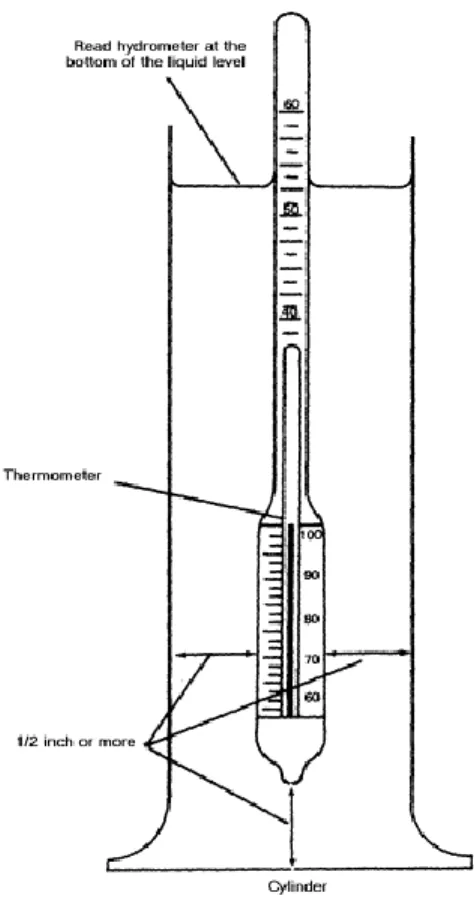
API gravity is measured using a hydrometer, which consists of a weighted float with a small diameter indicator stem at the top as shown in Figure 1-1. The stem is graduated in any density units (API used in petroleum industry). According to Archimedes’ principle, when a body is immersed in a fluid it loses weight equal to the liquid weight displaced. The hydrometer element is a constant weight body (constant buoyant force), which will displace different volumes of fluid for different fluid densities. Therefore the amount of stem submersion is an indication of fluid density.
Figure 1-1. Hydrometer
Hydrometers are basic to density measurement. They are accurate, frictionless, direct indicating without need for mechanical linkages or external energy sources, and are compatible with most corrosive fluids. Their limitations are in the fluid properties they can handle and in their pressure and temperature ratings. Because fluid density should be the only factor affecting the float position, friction, turbulence, and viscosity effects must be minimized. Additionally, because the
tolerated. For these reasons, hydrometers are “ideal” for clean, non-viscous fluids. However, they can be used for crude oils with good accuracy.
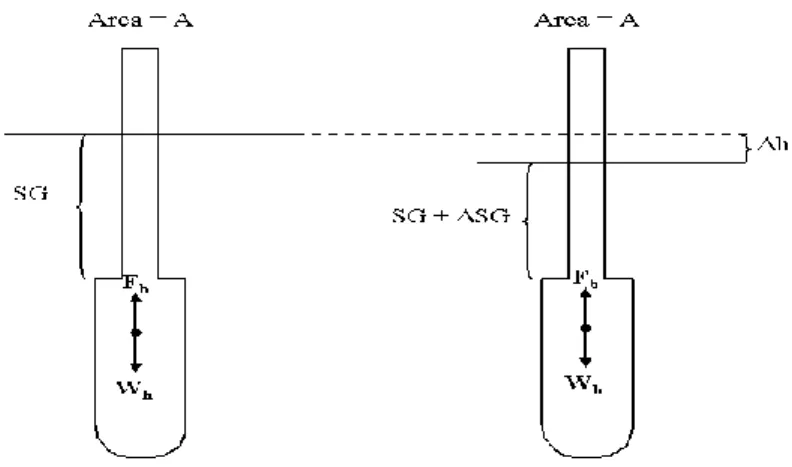
Hydrometer scale is non-linear as shown next; the buoyant force balances the hydrometer weight (See Figure 1-2): liq SG liq SG h b W V g V F * * ...(1-3)
Where Fb is the buoyant force, Wh is the weight of the hydrometer, VSG is the displaced volume of liquid with specific weight liq, and g is the gravitational constant.
Figure 1-2. Hydrometer Force Balance
If the specific gravity of two different fluids is measured, the buoyant force of both fluids must equal the weight of the hydrometer because the measurement is taken when the system (hydrometer-fluid) is in equilibrium (i.e. F0):
w SG h V SG W * *
w SG SG h V SG SG W * *Where SG is the specific gravity of the first liquid and SGSG is the specific gravity of the second fluid. SG is the variable marked in the hydrometer stem (Figure 1-2). By inspection,
A h V *
. Solving for the respective submerged volumes, then taking the difference of volumes:
w
h
w
h SG W SG SG W A h V * / * / * Solving for h (the increment in the mark):
SG SG
SG SG A W h w h * * ...(1-4)Equation 1-4 shows that the increment in the mark is a non-linear function of the specific gravity of the fluids.
Density Measurement Using a API Gravity Hydrometer
Place the fluid sample in a cylinder and submerge it into a controlled temperature bath. Submerge a clean hydrometer in the fluid contained in the cylinder. Release the hydrometer into the fluid slowly. If the hydrometer is not within the API gravity range of the fluid it will touch the bottom of the cylinder and crack. There should be a clearance of 1 inch between the bottom of the hydrometer and the bottom of the cylinder containing the fluid sample. Avoid wetting the entire stem of the hydrometer, since the weight of the liquid on the stem will affect the reading. Depress the hydrometer to about 2 scale divisions into the liquid, apply a spin (this will help the hydrometer to remain in the center of the cylinder) and release it. When it comes to rest, the scale in the hydrometer stem should be read at the principle surface of the liquid (the bottom of the meniscus in most cases). The reading will give the API gravity at the selected temperature and atmospheric pressure. This value is corrected using Table 5A of Reference 3. The following example illustrates the procedure for temperature correction.
Example: “If the API gravity reading observed on a hydrometer in an oil at 77o
F is 63.5. What is the API gravity at 60oF?” (Taken from Reference 3).
Solution: Enter the table in the column “API gravity at observed temperature”, head to 63oAPI and record the API gravity at 60oF and do the same for 64oAPI:
API @ 76oF API @ 60oF
63 61.0
63.5 X
64 61.9
Using linear interpolation:
63.5 63
61.45 61.5 API@60 F * 63 64 61 9 . 61 o o XOnce the API gravity at 60oF has been determined, the specific gravity of the fluid at the temperature of measurement is calculated using the following correlation (from Bear-72):
1 60
60 / 60 T a SG SGT ...(1-5a)
0.0106* 8.05
exp 60 F o o API a ...(1-5b)The density of the fluid is then calculated by multiplying the specific gravity at measurement temperature by the density of water at the same temperature. The following correlation can be used to compute the density of distilled water at any temperature (Taken from Reference 5):
00039 . 1 * 10 * 00025 . 6 * 10 * 44149 . 5 * 10 * 30753 . 1 8 3 6 2 6 T T T w ...(1-6)
Where w is the density of water in g/cc at desire temperature ToC.
Part1: Hydrometer.
Place fluid sample in a cylinder.
Measure the API gravity at room temperature using the appropriate hydrometer. Make sure to follow the instructions of a hydrometer given in this chapter.
Use controlled temperature baths to raise the temperature of the fluid sample and take four or five measurements at different temperatures.
Part 2: Pycnometer measurement
Measure fluid density at room temperature.
Measure fluid density at same temperatures used in the hydrometer measurements.
References
1. Petroleum and Chemical Engineering Department, PETR 345 Lab Manual. Fall 1999.
2. Giles, Ronald V., Fluid Mechanics & Hydraulics, Schaum’s Outline Series, Mc Graw-Hill,
(1962).
3. Table 5A-Generalized Crude Oils D1298-85, Correction of Observed API Gravity to API Gravity at 60oF: Manual of petroleum Measurement Standards: Chapter 11.1, Volume 1, (ANSI/ASTM 1250-80)(API Std 2540), American Petroleum Institute, Washington D.C. (1987).
4. Bear Jacob, Dynamics of Fluids in Porous Media, Dover Publications, INC. New York 1972. 5. http://baervan.nmt.edu/Petrophysics/group/density-procedure.pdf (water density correlation).