econ
stor
www.econstor.eu
Der Open-Access-Publikationsserver der ZBW – Leibniz-Informationszentrum Wirtschaft
The Open Access Publication Server of the ZBW – Leibniz Information Centre for Economics
Nutzungsbedingungen:
Die ZBW räumt Ihnen als Nutzerin/Nutzer das unentgeltliche, räumlich unbeschränkte und zeitlich auf die Dauer des Schutzrechts beschränkte einfache Recht ein, das ausgewählte Werk im Rahmen der unter
→ http://www.econstor.eu/dspace/Nutzungsbedingungen nachzulesenden vollständigen Nutzungsbedingungen zu vervielfältigen, mit denen die Nutzerin/der Nutzer sich durch die erste Nutzung einverstanden erklärt.
Terms of use:
The ZBW grants you, the user, the non-exclusive right to use the selected work free of charge, territorially unrestricted and within the time limit of the term of the property rights according to the terms specified at
→ http://www.econstor.eu/dspace/Nutzungsbedingungen By the first use of the selected work the user agrees and declares to comply with these terms of use.
zbw
Leibniz-Informationszentrum Wirtschaft Leibniz Information Centre for EconomicsKlinke, Sigbert
Working Paper
Developing web-based tools for the teaching of
statistics: Our wikis and the German Wikipedia
SFB 649 discussion paper, No. 2011-030 Provided in Cooperation with:
Collaborative Research Center 649: Economic Risk, Humboldt University Berlin
Suggested Citation: Klinke, Sigbert (2011) : Developing web-based tools for the teaching of statistics: Our wikis and the German Wikipedia, SFB 649 discussion paper, No. 2011-030
This Version is available at: http://hdl.handle.net/10419/56652
SFB 649 Discussion Paper 2011-030
Developing web-based tools
for the teaching of statistics:
Our Wikis and the German
Wikipedia
Sigbert Klinke*
* Humboldt-Universität zu Berlin, Germany
This research was supported by the Deutsche
Forschungsgemeinschaft through the SFB 649 "Economic Risk". http://sfb649.wiwi.hu-berlin.de
ISSN 1860-5664
SFB 649, Humboldt-Universität zu Berlin Spandauer Straße 1, D-10178 Berlin
S
FB
6
4
9
E
C
O
N
O
M
I
C
R
I
S
K
B
E
R
L
I
N
Developing web-based tools for the teaching of statistics:
Our Wikis and the German Wikipedia
Klinke, Sigbert
Humboldt-Universit¨at zu Berlin, Ladislaus von Bortkiewicz Chair of Statistics Unter den Linden 6
10099 Berlin, Germany
E-mail: [email protected]
When we started the development of our CD to support the teaching of our basic statistic
courses our work was twofold: we had to develop the content and the necessary software ourselves.
Maintaining our software development in a university environment turned out to be especially difficult since it is time-consuming. At the same time the available open source software has become much more powerful such that our own development has become superfluous. The use of “standard software” (wikis) allows us to concentrate more on content rather than on software development.
In several projects we have used wikis to support the teaching of our students and to publish their projects and homework. However the introduction of the bachelor/master system has reduced the willingness of students to make contributions to our wikis. As a consequence we have now started to involve ourselves and our students in more direct contributions to the German Wikipedia.
Keywords: Wiki, Teaching, Wikipedia, MM Stat JEL Classification: A22, A23
1999: MM-Stat I
In 1998 we started to create teaching material for the undergraduate courses “Statistics I” and
“Statistics II”. A CD was produced on the basis of HTML and JavaScript (R¨onz, M¨uller, Ziegenhagen,
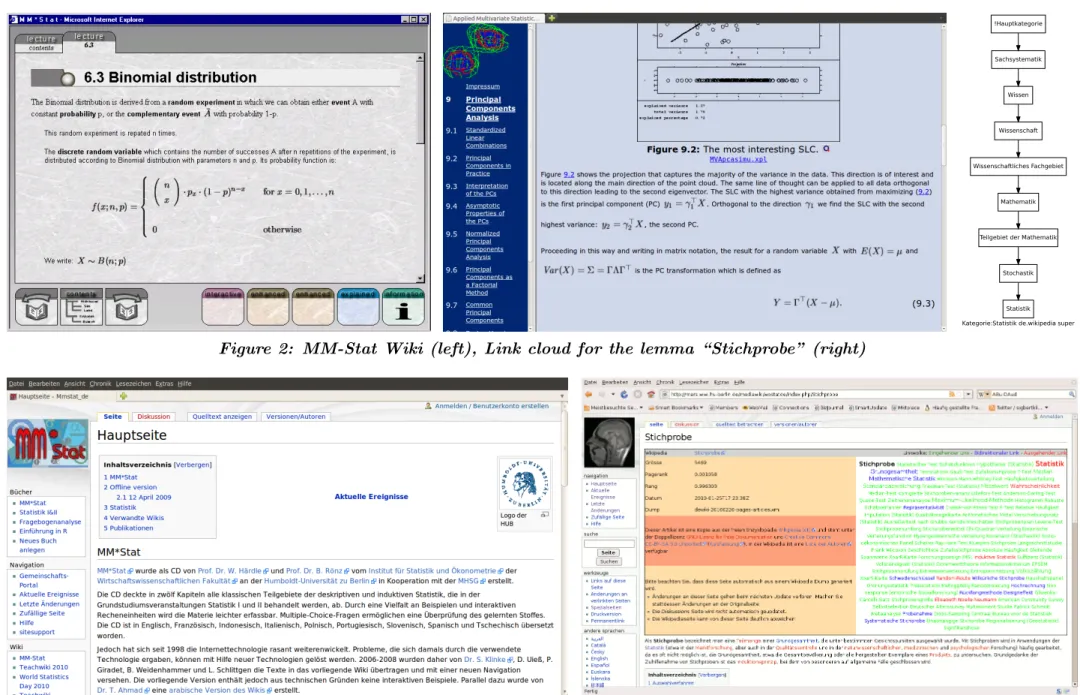
2000). It was structured like a book with chapters and sections using the hypertext capabilities of HTML. Each section consists of one web page with several subpages complementing it with different types of examples (see Figure 1 left) consisting of one web page, too:
•Interactive examples allow the students to work interactively with real or simulated datasets.
• Explained examples require the understanding of the current section to understand the example, whereas
•Enhanced examples also make use of knowledge from previous sections.
•Informationadds additional information, for example historical information.
Each chapter is finalized with Multiple-Choice-Exercises and the whole CD with a glossary of statistical terms. A lot of JavaScript programming was necessary to run the CD smoothly. With some adaptations the CD will run on modern versions of Internet Explorer. However, maintaining the necessary JavaScript code turned out to be time-consuming, and we finally decided to transfer the content to a wiki.
The author acknowledges generous support from the Collaborative Research Center 649 of the German Science Foundation.
2001: Electronic books
Since most of our research reports and books are produced in LATEX we decided to create
electronic versions from the LATEX sources. The idea was to generate new electronic versions whenever
the book contents would change. We developed a script software, MD*Book, based on latex2html
to generate HTML (Witzel, Klinke 2002). Figure 1 (middle) shows a section from the book “Applied Multivariate Statistical Analysis” with graphics, formulas and links to interactive programs. Again
each section of a LATEX document is translated into one web page and an additional navigation bar is
created on the left. Several books have been produced with it and are freely available on the web. Late versions of the translations of MM-Stat were also produced with the MD*Book script. The
advantage of usinglatex2htmlas a basis was the automatic translation of mathematical formulas into
embedded graphics. The MD*Book development was discontinued because adaptation of the script to
new versions of latex2html became time-consuming, too. Moreover, the developers of latex2html
extended their own functionality to features we covered with MD*Book. 2006: Statwiki
With the Bologna process in Europe the higher education system consists of three cycles which are finalized by awarding Bachelor, Master and PhD degree. The transition from bachelor to master leads to increased mobility of students. Therefore in the second cycle (masters degree) we have a discrepancy in knowledge since students come from different universities. As a consequence we set up a wiki as a dictionary for students and teachers as a joint project by two other chairs and the Ladislaus
von Bortkiewicz Chair of Statistics at Humboldt-Universit¨at zu Berlin. In contrast to the Wikipedia,
the entries aim more at a reactivation of already learned knowledge.
Different to the MM-Stat CD and the electronic books each statistical term is now on one web page, as in the Wikipedia. As a basis we first used the LatexWiki extension with the Zope Content
Management system used at Humboldt-Universit¨at zu Berlin. Since the future development of the
LatexWiki was unclear we decided to switch from the LatexWiki to the Mediawiki software which is the basis of the Wikipedia.
With use of the LatexWiki and the math extension of Mediawiki, mathematical formulas were
easily generated and embedded. For the integration of Figures and Tables into the Latexwiki and the Mediawiki we developed the R extension. It allows us to embbed R programs which generate graphics and tables through R programs (Klinke, Zlatkin-Troitschanskaia 2007).
2006: Teachwiki
In the same year we set up another wiki for student projects and homework. Usually the papers handed in vanish in a cupboard after grading, and after the compulsory period of record-keeping they are disposed of. However, we think that new students should have the possibility to learn from previous work. We therefore offer students the possibility to create a wiki page with their work, besides the traditional way of delivering their work in paper or electronically as PDF file.
We started with the seminar “Numerical Introductory Course”: covering, for example, topics like optimization, random number generation and numerical computation quality in statistical software. The contributions from the students of this course later became part of the wikibook in Statistics (chapter 12: Numerical methods). However, the rules of the wikibook community make it clear that the transfer of complete course work is not desired, we therefore now keep them in our wiki. Later contributions by some students have become the highest ranked German sources in Google for specific queries.
Figure 1: MM*Stat CD example page (left), Electronic book page (middle), Category tree for “Statistik” (right)
Kategorie:Statistik de.wikipedia super Statistik Stochastik Teilgebiet der Mathematik
Mathematik Wissenschaftliches Fachgebiet Wissenschaft Wissen Sachsystematik !Hauptkategorie
The introduction of the bachelor and master system has drastically reduced the willingness of students to make contributions to the Teachwiki instead of paper-based or PDF-based work. Although a new set up of the Teachwiki offers the possibility to integrate graphics from Wikimedia Commons and the German Wikipedia to facilitate student work, in the last semester no student took the opportunity of putting their work in the wiki. This development encourages us to invest more time in direct contribution/improvement to the German Wikipedia in the area of statistics.
2008: MM-Stat II
In 2008 we started to save the contents of the earlier MM-Stat CD into a new wiki available
under www.mm-stat.org (see Figure 2 left). As with the earlier CD, the wiki is used heavily by
students on the basic statistic courses for preparation of exams.
A web page from the MM-Stat CD including all complementing examples has been integrated into one web page in the wiki. Mediawiki extensions ensure a similar navigation as on the CD and the integration of multiple-choice exercises. Only the interactive examples could not be transferred,
since they are written in the XploRe language (see H¨ardle, Klinke, M¨uller 2000). However, the R
extension of the Mediawiki offers some limited interaction possibilities which would be sufficient for the interactive examples. Only the interfaces and the programs need to be translated from XploRe to Mediawiki and R.
The wiki has been expanded by two more books: a book for the lecture “Applied Quantitative Methods” about analysis of questionnaire data which also includes several videos explaining statistical methods. The second book was produced in the framework of an introductory course for R held at the
department of educational science at Humboldt-Universit¨at zu Berlin. For more details see Klinke,
Kuhlee, Theel, Wagner and Westermeier (2009).
Two further books are in progress: a book for the course “Computer aided statistics” and an exercise collection used in basic statistics courses.
2009: German Wikipedia
The problems with the Statwiki and the Teachwikis leads us to consider whether to immediately contribute to the German Wikipedia in the field of statistics. The German Wikipedia was considered because of two reasons: Firstly, our lectures for bachelor studies are usually in German, which is our main concern, and also because the master programs run partly in German and in English. Secondly, a lot of people contribute to the English Wikipedia such that the area of statistics in the English Wikipedia is already much better developed. We have several aims: to improve the quality of
existing articles, to create new articles and to improve access to thesurroundingsof an article. When
we announced our project in the German Wikipedia it was mentioned in the Wikipedia news (see Wikipedia Kurier, 2009).
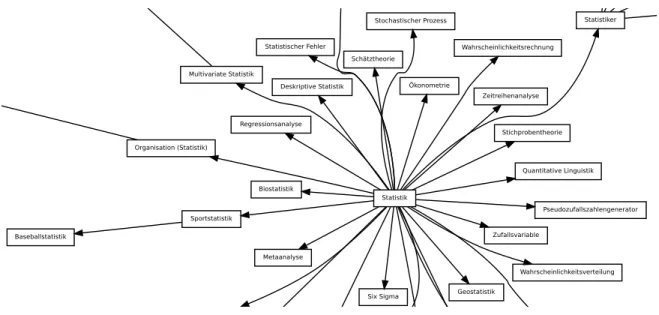
Category system. Besides the web pages for each term, called “lemma”, a hierarchical category system exists in all Wikipedias; see, for example, Figure 1 (right) the hierarchical category tree for “Statistik”. Each lemma can be part of one or more categories. All lemmas in one category should belong to one topic. In the category “Statistik” we had more than 500 lemmas and only very few subcategories. As the category tree in Figure 1 (right) shows statistics is part of mathematics. A lot of lemmas are written by mathematicians aiming more at random variables rather than the empirical counterparts and there are also criticisms that they are too mathematical. We have reorganized and extended the category system under “Statistik”; for an excerpt of the current state see Figure 3. The reorganization of the categories suffers from the fact that no common subject classification system for statistics, like the 2010 Mathematics Subject Classification (MCS) system from the American Mathematical Society, is available. The categorization of “62-XX Statistics” in the MCS would often contradict the rule in Wikipedia that a category should have at least 10 lemmas inside to be useful.
Figure 3: Excerpt of current subcategories of the category “Statistik”
Statistik Zeitreihenanalyse Wahrscheinlichkeitsverteilung Geostatistik Six Sigma Quantitative Linguistik Statistischer Fehler Deskriptive Statistik Wahrscheinlichkeitsrechnung Regressionsanalyse Schätztheorie Stichprobentheorie Biostatistik Zufallsvariable Ökonometrie Sportstatistik Organisation (Statistik) Pseudozufallszahlengenerator Metaanalyse Stochastischer Prozess Multivariate Statistik Statistiker Baseballstatistik
Improving quality. From the more than 1000 lemmas in the category “Statistik” and its subcat-egories we have touched on around 100, mainly related to topics for basic statistics. We have used five categories for the problems we found and corrected. The numbers in brackets give roughly the percentage of lemmas which contained this type of problem.
•Contents (55%): Modification of mistakes and extension of contents and creation of new lemmas, for example “rank”.
•Cosmetics (45%): Typos and grammar correction etc.
• Structure (35%): Reordering the lemma contents to increase understanding and going from the general to more specific aspects of the lemma. The introductory part of a lemma should be under-stood by a non-statistician (the grandmother principle: your grandmother should understand what the lemma is about).
•Reliability(35%): Adding references, correction of inexact formulations and so on. For example, in the “coefficient of determination” lemma, it was never mentioned in the introduction that the variance of the dependent variable is considered; only the word “explained variance” was used.
•Access(35%): New links between lemmas, new redirects to existing lemmas, since the same statis-tical term is named differently in different application areas.
Improving access. Based on the links between lemmas we have used standard statistical techniques, e.g. multidimensional scaling (distance between two linked lemmas is always one), to visualize the “surroundings” of a lemma. We have generated with R, uni- and bivariate link clouds to statistical lemmas; Figure 2 (right) shows the lemma “Stichprobe” (sample). Different colours of the lemma names give information about the link type: black - the current lemma, blue - the lemmas link mutual (bidirectional link), red - current lemma links to lemma, however the lemma does not link back (outbound link) and green - the lemma links to the current lemma, but the current lemma does not link back (inbound link). Since these kind of link overviews are not permitted by the German Wikipedia we have created a subset of lemmas with our link clouds integrated.
Conclusion
Giving up our own software tools and using the wiki software as a basis gave us the chance to concentrate more on content rather than software development. Terminating the work on our own wikis allows us to involve ourselves in the German Wikipedia. However, the quality of the Wikipedia lemmas in statistics is very mixed and partly requires considerably polishing. However, we believe it is not a hopeless task, especially considering that publishers are starting to setup their own online dictionaries in statistics.
Acknowledgements
We would like to acknowledge the support by Humboldt-Universit¨at zu Berlin for our work,
namely by the Multimedia-F¨orderprogramm of the university, without their initial support the
MM-Stat CD would have not been possible and the subsequent support in the years 2003-2009 made further work possible. We would like to especially thank our (former) student assistants Sarah Asmah, Paul Giradet, Patrick Lehmann, Vinh Hanh Lieu, Leonie Schlittgen, Christian Theel, Dennis Uieß, Beate Weidenhammer, Christian Westermeier and Yilan Zhou for their direct contributions to the wikis, the creation of videos and exercises. And finally a thanks to all the students who have contributed with their works to the Teachwikis. Thanks also to Leslie Udvarhelyi for linguistic help.
REFERENCES (R ´EFERENCES)
H¨ardle, W., Klinke, S., M¨uller, M. (2000)XploRe Learning Guide, Springer Verlag, Heidelberg, Germany.
H¨ardle, W., Klinke, S., Ziegenhagen, U. (2007) On the Utility of E-Learning in Statistics, International Statistical Review, 75, p. 355-364.
Klinke, S., Kuhlee, D., Theel, C., Wagner, C., Westermeier, C. (2009),MM-Stat MultiMedia-Statistik: Statistische Datenanalyse webbasiert, interaktiv und multimedial, SFB 649 Discussion paper SFB649DP2009-047, Humboldt-Universit¨at zu Berlin, Berlin, Germany.
Klinke, S., Zlatkin-Troitschanskaia, O. (2007)Embedding R in the Mediawiki, SFB 649 Discussion Papers SFB649DP2007-061, Humboldt-Universit¨at zu Berlin, Berlin, Germany.
R¨onz, B., M¨uller, M., Ziegenhagen, U. (2000)The Multimedia Project MM*STAT for Teaching Statistics, COMPSTAT 2000 - Proceedings in Computational Statistics. Bethlehem and van der Heijden (eds.), Springer Verlag, Heidelberg, p. 409-414
Witzel, R., Klinke, S. (2002), MD*Book online & e-stat: Generating e-stat Modules from Latex, In: COMPSTAT 2002 - Proceedings in Computational Statistics - 15th Symposium held in Berlin (Germany) by W. H¨ardle and B. R¨onz (eds.), Physika Verlag, Heidelberg, p. 449-454.
Weblinks
Electronic books http://fedc.wiwi.hu-berlin.de/xplore/ebooks/html/
Project home in German Wikipedia http://mars.wiwi.hu-berlin.de/mediawiki/sk/index.php/
Statistik in der Wikipedia - Verbesserung von Qualit¨at und Zugang
LATEX2html http://www.latex2html.org
LatexWiki http://zwiki.org/LatexWiki
Link cloud http://mars.wiwi.hu-berlin.de/mediawiki/wpstatde
Mediawiki http://www.mediawiki.org
MM-Stat I http://www.mhsg.de/index.php?id=110
MM-Stat II http://www.mm-stat.org
Statwiki http://statwiki.wiwi.hu-berlin.de
Teachwiki http://teachwiki.wiwi.hu-berlin.de and
http://mars.wiwi.hu-berlin.de/mediawiki/teachwiki2010
Wikibook Statistics http://en.wikibooks.org/wiki/Statistics
SFB 649 Discussion Paper Series 2011
For a complete list of Discussion Papers published by the SFB 649,
please visit http://sfb649.wiwi.hu-berlin.de.
001 "Localising temperature risk" by Wolfgang Karl Härdle, Brenda López Cabrera, Ostap Okhrin and Weining Wang, January 2011.
002 "A Confidence Corridor for Sparse Longitudinal Data Curves" by Shuzhuan Zheng, Lijian Yang and Wolfgang Karl Härdle, January 2011. 003 "Mean Volatility Regressions" by Lu Lin, Feng Li, Lixing Zhu and
Wolfgang Karl Härdle, January 2011.
004 "A Confidence Corridor for Expectile Functions" by Esra Akdeniz Duran, Mengmeng Guo and Wolfgang Karl Härdle, January 2011.
005 "Local Quantile Regression" by Wolfgang Karl Härdle, Vladimir Spokoiny and Weining Wang, January 2011.
006 "Sticky Information and Determinacy" by Alexander Meyer-Gohde, January 2011.
007 "Mean-Variance Cointegration and the Expectations Hypothesis" by Till Strohsal and Enzo Weber, February 2011.
008 "Monetary Policy, Trend Inflation and Inflation Persistence" by Fang Yao, February 2011.
009 "Exclusion in the All-Pay Auction: An Experimental Investigation" by Dietmar Fehr and Julia Schmid, February 2011.
010 "Unwillingness to Pay for Privacy: A Field Experiment" by Alastair R. Beresford, Dorothea Kübler and Sören Preibusch, February 2011.
011 "Human Capital Formation on Skill-Specific Labor Markets" by Runli Xie, February 2011.
012 "A strategic mediator who is biased into the same direction as the expert can improve information transmission" by Lydia Mechtenberg and Johannes Münster, March 2011.
013 "Spatial Risk Premium on Weather Derivatives and Hedging Weather Exposure in Electricity" by Wolfgang Karl Härdle and Maria Osipenko, March 2011.
014 "Difference based Ridge and Liu type Estimators in Semiparametric Regression Models" by Esra Akdeniz Duran, Wolfgang Karl Härdle and Maria Osipenko, March 2011.
015 "Short-Term Herding of Institutional Traders: New Evidence from the German Stock Market" by Stephanie Kremer and Dieter Nautz, March 2011.
016 "Oracally Efficient Two-Step Estimation of Generalized Additive Model" by Rong Liu, Lijian Yang and Wolfgang Karl Härdle, March 2011.
017 "The Law of Attraction: Bilateral Search and Horizontal Heterogeneity" by Dirk Hofmann and Salmai Qari, March 2011.
018 "Can crop yield risk be globally diversified?" by Xiaoliang Liu, Wei Xu and Martin Odening, March 2011.
019 "What Drives the Relationship Between Inflation and Price Dispersion? Market Power vs. Price Rigidity" by Sascha Becker, March 2011.
020 "How Computational Statistics Became the Backbone of Modern Data Science" by James E. Gentle, Wolfgang Härdle and Yuichi Mori, May 2011.
021 "Customer Reactions in Out-of-Stock Situations – Do promotion-induced phantom positions alleviate the similarity substitution hypothesis?" by Jana Luisa Diels and Nicole Wiebach, May 2011.
SFB 649, Ziegelstraße 13a, D-10117 Berlin http://sfb649.wiwi.hu-berlin.de
This research was supported by the Deutsche
SFB 649 Discussion Paper Series 2011
For a complete list of Discussion Papers published by the SFB 649,
please visit http://sfb649.wiwi.hu-berlin.de.
022 "Extreme value models in a conditional duration intensity framework" by Rodrigo Herrera and Bernhard Schipp, May 2011.
023 "Forecasting Corporate Distress in the Asian and Pacific Region" by Russ Moro, Wolfgang Härdle, Saeideh Aliakbari and Linda Hoffmann, May 2011.
024 "Identifying the Effect of Temporal Work Flexibility on Parental Time with Children" by Juliane Scheffel, May 2011.
025 "How do Unusual Working Schedules Affect Social Life?" by Juliane Scheffel, May 2011.
026 "Compensation of Unusual Working Schedules" by Juliane Scheffel, May 2011.
027 "Estimation of the characteristics of a Lévy process observed at arbitrary frequency" by Johanna Kappus and Markus Reiß, May 2011.
028 "Asymptotic equivalence and sufficiency for volatility estimation under microstructure noise" by Markus Reiß, May 2011.
029 "Pointwise adaptive estimation for quantile regression" by Markus Reiß, Yves Rozenholc and Charles A. Cuenod, May 2011.
030 "Developing web-based tools for the teaching of statistics: Our Wikis and the German Wikipedia" by Sigbert Klinke, May 2011.
SFB 649, Ziegelstraße 13a, D-10117 Berlin http://sfb649.wiwi.hu-berlin.de
This research was supported by the Deutsche