Copyright, 2013 – MIP Corporation Page 1
How Thought Process Optimization
®(TPO) and Expert Reasoning
Make Big Data and Analytics More Valuable
According to Accenture: Recent research, based on a survey of more than 600 C-level and other senior executives of large companies in the U.S. and U.K., only one in 12 of the respondents had achieved their anticipated return on investments (ROI) for these technology solutions. (1) Big data and analytics are failing to deliver the expected high performance and ROI because:
1. Big data is useless without the reasoning skills to analyze it -- the ability to know what information is relevant, what it means or how to use it to make good decisions
2. Big data and analytics are often not a part of decision-making processes -- typical decision-makers make their decisions and then seek facts to support the decisions
3. Inconsistent terminology causes confusion and use of the wrong data
4. Analytics and big data are not improving employee performance and decision quality as expected Today over 40% of an organization’s employees are decision-makers whose jobs require a high level of decision-making and judgments. Those jobs are growing 2.5 times faster than jobs requiring repetitive procedures and three times faster than overall employment. Empowering these decision-makers to quickly make the right decisions creates immense benefits -- from lower costs and profitable business growth to superior innovation and sustainable competitive advantage.
What Are Big Data & Analytics?
Big data: Big data is the organization’s digital universe of organized structured and unstructured information. “IDC estimates that the world created 487 billion gigabytes of information in 2008, up 73 percent from 2007, and that this digital universe is doubling every 18 months.” (2) “We are all wading through a proliferation not just of data volume but also of type, including video, audio, and web data that wasn’t readily extracted even five years ago.” (1)
Analytics: The simple definition is that analytics are information derived from big data and provide facts about what is occurring in the business and/or its environment. Accenture defines analytics as an integrated framework that employs quantitative methods to derive actionable insights from data, then uses those insights to shape business decisions and, ultimately, to improve outcomes. (1) Wikipedia states that analytics is the discovery and communication of meaningful patterns in big data. According to MIT Sloan Management Review, analytics is the new path for finding value in big data. (3)
What is Expert Reasoning?
According to Herbert Simon and Daniel Kahneman, Nobel Prize winners in economics, when experts encounter new situations, the reasoning in their decision-making processes enable them to accurately recognize patterns in information and correctly use those patterns to make the right decisions. (4) Non-experts do not have this capability.
Most organizations do not realize that experts think differently from experienced non-experts and that their reasoning skills are far superior to those used by experienced non-experts whose reasoning is not well developed. (See video at: http://youtu.be/dxhQ4eBOWFs). While the video is a medical example, the same conditions and results occur in all industries.
Experts produce superior results because they use superior reasoning skills -- the ability to accurately identify and correctly use relevant knowledge, information, data as well as cues from tacit human interactions -- to immediately make the right decisions.
Copyright, 2013 – MIP Corporation Page 2 The superior reasoning of experts is automatic thinking that becomes a part of their unconscious minds through years of experience. That means they are unaware of it and cannot explain it to others. Since an expert’s reasoning -- often called intuition by psychologists -- is unknown and unavailable, it cannot be taught, transferred or shared with others.
What Is Thought Process Optimization® (TPO)?
TPO is a proprietary methodology for capturing, documenting and sharing the automatic unconscious reasoning that comprises an expert’s decision-making process. Once captured, expert reasoning is easily transferred and quickly put into practice by other employees to make high performance decisions. TPO establishes and enforces a strict one-to-one relationship between terms used in decision-making processes and their meaning through a process known as One-Term One-Meaning. TPO includes a dynamic continuous improvement process, supported by software that enables reasoning processes to evolve and adapt to changing environments.
With TPO, analytics and employee performance are tracked and correlated with reasoning processes so that employees can assess and improve the reasoning in their decision-making processes. Reasoning that creates superior performance is identified and shared with others enterprise-wide.
1.
Data Is Useless Without the Reasoning Skills to Analyze It
Accenture’s Jeanne Harris stated in a Harvard Business Review article: Data Is Useless Without the Skills to Analyze It, and “to thrive in this world, many will require additional skills…In a new Avanade survey, more than 60 percent of respondents said their employees need to develop new skills to translate big data into insights and business value.” (5)
According to McKinsey Global Institute, “Analysis shows that companies and policy makers must tackle significant hurdles to fully capture big data’s potential. The United States alone faces a shortage of 140,000 to 190,000 people with analytical and managerial expertise and 1.5 million managers and analysts with the skills to understand and make decisions based on the study of big data.” (6) “Anders Reinhardt, head of Global Business Intelligence for the VELUX Group is convinced that “the standard way of training, where we simply explain to business users how to access data and reports, is not enough anymore.” (5)
Before TPO, moving beyond the “standard way of training” was a major challenge because expert decision-making processes are automatic thinking that has become a part of the unconscious mind. Experts are unaware of their reasoning and cannot explain it to others. Therefore, expert reasoning is unknown and unavailable to be taught, transferred or shared with others. That means that with “the standard way of training,” organizations must rely on employees to develop expert reasoning skills on their own over many years of trial and error experience. As a result, most employees never become experts or use expert reasoning.
How TPO Closes the Reasoning Skills Gap
With the “standard way of training” it takes years to understand and use big data to make smarter decisions because employees are not given actual expert reasoning. They must develop it on their own through years of experience just as the experts have in the past.
With TPO, employees can achieve the smarter decisions and high performance level of an expert in days or weeks rather than years. They are able to use the expert’s actual reasoning to identify the right data and cues, understand them and correctly use them to make the right decisions.
Copyright, 2013 – MIP Corporation Page 3 Thereafter, employees continuously make better, smarter and faster decisions as they improve their reasoning by using performance data and analytics to assess and adjust their reasoning to make certain it is based on reality and by sharing reasoning among colleagues.
Example: TPO was used to retain the reasoning of a bank’s retiring expert strategist. To retain his abilities, the bank built a marketing strategy department staffed with very bright novices and made it the expert’s job to teach them banking. TPO was used to capture his reasoning.
Once the expert’s reasoning was captured, it was transferred to everyone in the department by having them use the expert’s reasoning to do their jobs. Within weeks, the department was developing strategies and identifying and solving problems as if they had many years of experience.
After the transfer, members of the department were empowered to personalize and improve their copy of the expert’s reasoning. They used data and analytics to adjust their reasoning to make certain it was based on reality, to identify the need for and determine corrective action for the bank and to analyze assets and liabilities that impacted the bank’s liquidity and processes. As members of the department shared their reasoning, they incorporated each other’s improvements into their own reasoning. Analyzing data and sharing reasoning enabled them to harness the collective reasoning skills of the marketing strategy department and quickly create innovative solutions for changing and reallocating financial resources – loans, investments, deposits and purchased funds. This solution solved the bank’s serious liquidity problem and reversed the negative profit trend, which led to a doubling of bottom-line profits within months.
2.
Big Data and Analytics Are Not a Part of Most Decision-Making Processes
Each decision-maker has their own decision-making process but they are usually totally unaware that they are using reasoning to make a series of judgment calls in order to finalize their decisions. Once implemented that final decision creates a result. Today, over half of these final decisions are wrong. (7) The cause of wrong decisions is almost always one or more erroneous judgment calls.
Many decision-makers, while reluctant to say so, rely primarily on intuition and experience rather than fact-based analysis. A recent Accenture survey found that 40 percent of business decisions are still made based on judgment alone, partly because of the absence of good data. (1) Even if good data were available non-experts do not know what data is relevant and how to use it, a problem that is
exacerbated by the increased volume and diversity of available data.
Often non-experts or typical decision-makers make their decisions and then seek facts from big data and analytics to support those decisions. When a typical decision-maker asks a business analyst to find data that supports a decision that has already been made, he/she will only receive the information that supports that decision not information that would support a different decision. On the other hand, when the expert asks for information, it is more specific and is used to select or refute alternative decisions. (8)
Unlike typical decision-makers, experts incorporate the use of data and analytics in their decision-making process. This enables them to formulate several hypothetical alternatives and then correctly identify and use relevant data to eliminate poor alternatives, thereby, making the best decisions. (8)
Experts are also extremely creative at finding data that others do not even know exist. For example, each month a bank’s marketing expert reported how many people moved in and out of areas where the bank
Copyright, 2013 – MIP Corporation Page 4 wanted to open a branch. When asked how he knew this he said, “Simple, each month I call Jack at Public Services and he tells me how many families turned off their electricity and how many had it turned on.” When employees are unaware of their reasoning, performance data is primarily used for management control. Even experts have difficulty using data to assess and refine reasoning in their decision-making processes. That is one reason why it takes so many years to become an expert.
How TPO Makes Big Data and Analytics Part of Decision-Making Processes
With TPO, once an expert’s reasoning has been captured, documented and transferred to others in a similar field, those employees’ use of data and analytics changes as data becomes part of each employee’s decision-making process. Typical decision-makers will now use the same approach as experts when they make decisions. They will be aware of their imtermedicate judgment calls and formulate smarter hypothetical alternatives before they seek more focused information that will enable them to select or refute alternative decisions. In other words, they will use data to eliminate poor decision and make the right decision.When reasoning is well documented, performance data becomes a critical component of the decision-making process by facilitating self assessment and continuous improvement of reasoning and performance.
3.
Inconsistent Terminology Causes Confusion and Use of the Wrong Data
Today people use different meanings for the same term and different terms for the same meaning. This causes continuous misunderstanding, confusion, tunnel vision and costly sub-optimization. (9) When decision-makers communicate with business analysts, inconsistent terminology often causes
misunderstanding and many decision-makers do not receive the right data or the data they want. Perhaps more importantly, inconsistent terminology makes it impossible to the accurately link
reasoning, big data and analytics. This causes decision-makers to use different data for the same term, which is often the wrong.
TPO Establishes and Enforces Consistent Terminology that
Ensures the Right Decision-Makers Receive the Right Data at the Right Time
Part of the process of capturing and documenting an expert’s reasoning is the establishment of Term Meaning. In TPO, a term is a phrase that contains a key word within its context. TPO’s One-Term One-Meaning process enforces a one-to-one relationship between terms and their meaning across every decision-making process. Consistent terms and meanings link all decision-making processes that contain the same terms. It also facilitates the linking of each decision-maker’s reasoning to big data and analytics so that everyone using the same term makes decisions based upon the same data This goes a long way toward overcoming silo thinking and sub-optimization that cause the tunnel vision, which by definition reduce efficiency and contribute to the failing of corporate cultures.Once terms and their meanings are documented, each decision-maker can understand the meaning of the terms in another’s reasoning and any data associated with those terms. They can communicate with business analysts without causing misunderstandings. The code needed to create analytics, derive or access data can be stored with the term and its meaning in one place that can be used by appropriate people. This means the code only has to be created once and the data can be created or accessed once and at the right time made available to every decision-maker who uses it in their decision-making process.
Copyright, 2013 – MIP Corporation Page 5
4.
Big Data and Analytics Are Not Meeting Expectations for High Performance Employee and
Decision Quality
Experts are known for their exceptional high performance, which is better than 95% of all employees in their field. Research has shown that no amount of knowledge, information and data will create experts or employees with the expert’s exceptional high performance. Until TPO, expert performance has always been “a result of intense practice extended for a minimum of 10 years.” (10)
TPO Creates High Performance Employees and Smarter Decisions
Once TPO is used to capture and document an expert’s decision-making process, organizations can create high performance employees who deliver smarter decisions. This can be accomplished in days or weeks instead of years.
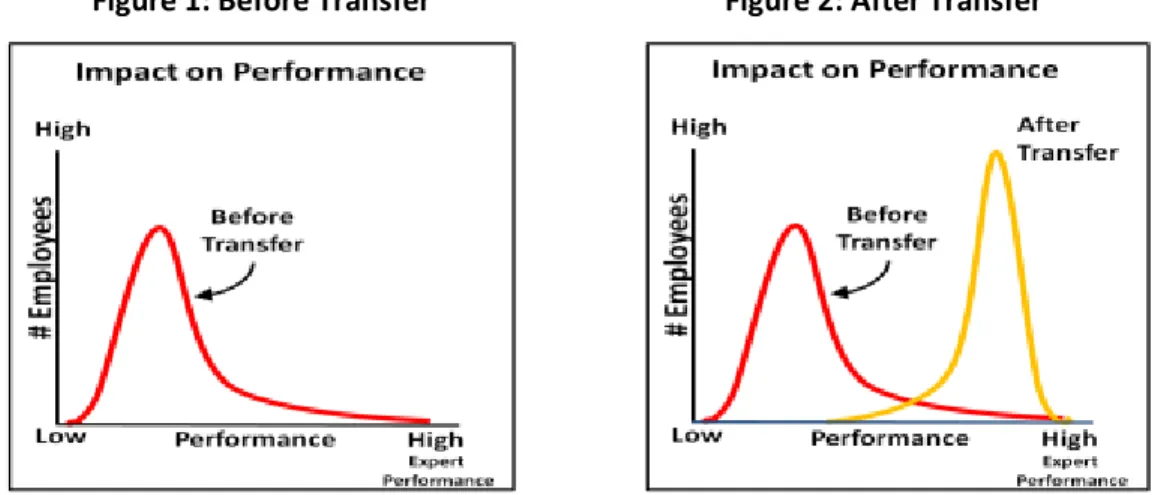
Figure 1, below, represents the distribution of performance before the expert’s reasoning is transferred. The performance of the majority of the employees is significantly lower than that of the experts who are on the far right of the chart.
Figure 1: Before Transfer Figure 2: After Transfer
Figure 2 shows how the performance changes after the initial transfer of expert reasoning. The performance of the majority of employees improves significantly because all the employees can take advantage of the expert's reasoning and the majority of employees improve to where they are performing almost like the expert. There is still a distribution in performance due to experience, unwillingness to use the expert’s reasoning, etc. but the average performance is much higher. Over time as employees improve and share their reasoning and use big data and analytics in their decision-making processes, performance moves even higher than that of the original expert. Smarter decisions and expected ROI are realized as performance improves.
TPO Provides the Reasoning Skills Needed to Thrive in Today’s World of Big Data
Ms. Harris stated in the Harvard Business Review -- data is useless without the reasoning skills to correctly analyze it and use it to make the right decisions. If organizations and individuals are going to thrive in this world of big data and analytics, they need better reasoning skills. (5)
Only a few experts have the reasoning skills needed to make big data usable and valuable and those skills are locked in the brains of the experts and not available to be shared – without TPO. TPO makes expert decision-making processes available to employees across departments, functions and
geographical areas. This enables organizations to move beyond the “standard way of training” and quickly create the decision-makers and analyst who use the necessary reasoning skills.
Copyright, 2013 – MIP Corporation Page 6 Closing the reasoning skills gap
Making big data and analytics part of decision-making processes
Establishing and enforcing consistent terminology that ensures the right decision-makers receive the right data at the right time
Creating high performance employee and smarter quality
Delivering on the ROI potential of big data and analytics
With well documented expert reasoning, decision-makers make smarter, better and faster decisions. Business analysts and IT have the requirements they need to deliver better data with less effort regardless of the technology used. And when reasoning is used for routine decisions that sense online data or conditions and do not require human judgment, IT has the logic they need to automate those routine decisions by developing decision applications such as triggers that notify people of production delays, labor scheduling in retail stores or monitoring oil wells for preventive maintenance. (1)
Once implemented, TPO can provide the high performance employees and ROI that big data and analytics are not delivering today.
References
1. Dave Rich, Brian McCarthy and Jeanne Harris.Getting Serious About Analytics: Better Insights, Better Outcomes.
s.l. : Accenture, 2010.
2. ICD.The Diverse and Exploding Digital Universe. May 2009.
3. Steve LaValle, Eric Lesser, Rebecca Shockley, Michael S. Hopkins and Nina Kruschwitz.Big Data, Analytics and the Path From Insights to Value. s.l. : MIT Sloan Management Review, 2010.
4. Kahneman, Daniel.Thinking, Fast and Slow. New York : Farrar, Straus, Giroux , 2011.
5. Harris, Jeanne.Data Is Useless Without the Skills to Analyze It. s.l. : Harvard Business Review, 2012.
6. McKinsey Global Institute.The challenge - and opportunity - of ‘big data’. s.l. : McKinsey & Company, 2011. 7. Nutt, Paul C. Surprising but true: Half the decisions in organizations fail. 4, s.l. : Academy of Management Executives, 1999 , Vol. 13.
8. Tice, S., McNutt, R., Tice, P., Elstein, A., Schwartz, A., Bordage, G., Abrams, R., and Stuckey, R.Reducing Cognitive Errors By Capturing And Disseminating Expert Reasoning. Chicago, IL : Diagnostic Error in Medicine Conference, 10/2011.
9. Tice, S.K. and Shidle, J. The Quest for Consistency. Darwin Magazine. 2003.
10. K. Anders Ericsson, Ralf Th. Krampe, and Clemens Tesch-R.The Role of Deliberate Practice in the Acquisition of Expert Performance. s.l. : Psychological Review, 1993.
About the Authors:
Sandra Kay Tice, cognitive scientist, is the CEO of MIP Corporation. Ms. Tice is an expert in the new paradigm methodology called Thought Process Optimization® (TPO). She has implemented TPO and pioneered the process of capturing the expert reasoning of: marketers and sales representatives as well as CEOs, CFOs, physicians, strategist, economists, managers, engineers, teachers and underwriters in a number of industries.
Richard J. Stuckey, MBA, is a Partner with MIP Corporation. Mr. Stuckey has been working with Thought Process Optimization® for three years. He has captured physician reasoning and worked with leaders in medical education. Rick is a retired Accenture partner.