of Financial Institutions
Finance Master's thesis Jani Nurmi 2015 Department of Finance Aalto University School of Business Powered by TCPDF (www.tcpdf.org)Abstract of master’s thesis
Author Jani Nurmi
Title of thesis The Effect of Functional Diversification on the Credit Risk of Financial Institutions Degree Master’s degree
Degree programme Finance Thesis advisor(s) Matti Suominen
Year of approval 2015 Number of pages 72 Language English
Abstract
PURPOSE AND MOTIVATION:
The purpose of this study is to examine the effect functional diversification on the credit risk of financial institutions. The focus is on whether financial institutions should be allowed to combine commercial banking and investment banking functions under one financial conglomerate. Under current regulators financial institutions are allowed to combine the functions, however regulators are considering driving regulation towards separating commercial and investment banking. This study sheds light on whether the contemplated separation of investment and commercial banking increases or decreases the credit risk of financial institutions.
DATA AND METHODS:
The data sample of his study consists of 51 financial institutions from Europe and the US, with a time span ranging from 2007 to 2014. Functional diversification is measured using income and asset based measures, collected from the annual financial statements of the financial institutions. Credit risk is measured with the financial institution level credit default swap (CDS) spreads and the CDS spread difference with banking sector CDS index spreads. The impact of functional diversification on credit risk is examined with multiple panel data regressions, where the credit risk of financial institutions is explained with the functional diversification measures and a set of control variables. Furthermore, multiple robustness checks are developed.
FINDINGS:
Based on the results, functional diversification decreases the credit risk of financial institutions at the financial institution credit risk level and compared with the average credit risk in the banking sector. The results are confirmed with multiple robustness checks. Based on the results the contemplated separation of commercial and investment banking with new regulation can have grave consequences. Separating the two functions would decrease functional diversification increasing the credit risk of financial institutions and the probability of financial institution failures.
Keywords Financial institutions, functional diversification, credit risk, credit default swaps,
www.aalto.fi
Maisterintutkinnon tutkielman tiivistelmä
Tekijä Jani Nurmi
Työn nimi The Effect of Functional Diversification on the Credit Risk of Financial Institutions Tutkinto Kauppatieteiden maisteri
Koulutusohjelma Finance Työn ohjaaja(t) Matti Suominen
Hyväksymisvuosi 2015 Sivumäärä 72 Kieli Englanti
Tiivistelmä
TUTKIMUKSEN TARKOITUS:
Tämän tutkimuksen tarkoitus on tarkastella rahoituslaitosten funktionaalisen hajauttamisen vaikutusta laitosten luottoriskiin. Fokuksena on tutkia, pitäisikö rahoituslaitoksille antaa mahdollisuus yhdistää investointipankki- ja liikepankkifunktiot yhden rahoituslaitoksen yhteyteen. Nykyisen regulaation mukaan rahoituslaitokset saavat yhdistää funktiot. Tästä huolimatta rahoituslaitosten valvojat tällä hetkellä harkitsevat regulaation muuttamista suuntaan, jossa investointipankki- ja liikepankkifunktiot erotetaan toisistaan. Tämä tutkimus analysoi, kasvattaako vai laskeeko mahdollinen uusi regulaatio rahoituslaitosten luottoriskiä.
AINEISTO JA MENETELMÄT:
Tutkimuksessa käytetty dataotos koostuu 51 rahoituslaitoksesta Euroopasta ja Yhdysvalloista. Otoksen aikajakso alkaa vuodesta 2007 ja loppuu vuoteen 2014. Funktionaalista hajautusta mitataan käyttämällä liikevaihto- ja taseperusteisia mittareita, jotka on kerätty rahoituslaitosten vuosittaisista tilinpäätöksistä. Luottoriskiä mitataan käyttämällä rahoituslaitosten luottotappioriskin vaihtosopimusten (credit default swap, CDS) spredejä ja spredien eroa pankkisektorin CDS-indekseihin. Funktionaalisen hajautuksen vaikutusta luottoriskiin tutkitaan useilla paneelidataregressioilla, joissa rahoituslaitosten luottoriskiä selitetään funktionaalisen hajautuksen mittareilla ja monilla kontrollimuuttujilla. Lisäksi useita lisätestejä käytetään tulosten vahvistamiseksi.
TULOKSET:
Tulosten perusteella funktionaalinen hajautus vähentää rahoituslaitosten luottoriskiä rahoituslaitostasolla sekä verrattuna keskimääräiseen pankkisektorin luottoriskitasoon. Tulokset vahvistetaan useissa lisätesteissä. Tulosten mukaan suunnitteilla olevalla investointipankki- ja liikepankkifunktioiden erottavalla uudella regulaatiolla voi olla merkittävä vaikutus rahoituslaitosten luottoriskiin. Uusi regulaatio laskisi funktionaalisen hajautuksen tasoa, joka puolestaan nostaisi rahoituslaitosten luottoriskiä ja niiden konkurssin todennäköisyyttä.
Avainsanat Rahoituslaitokset, funktionaalinen hajautus, luottoriski, luottotappioriskin
vaihtosopimukset, laajuuden ekonomia, agenttikustannukset, intressiristiriidat, rahoituslaitosten regulaatio
Table of Contents
1. Introduction & Motivation ... 1
2. Literary Review ... 5
2.1. The Overall Impact of Functional Diversification on the Riskiness and Value of Financial Institutions ... 5
2.2. Economies of Scope and Conflicts of Interest ... 9
2.3. Credit Default Swaps ... 13
3. Data and Methodology ... 14
3.1. Selected Financial Institutions ... 14
3.2. Credit Default Swap Spreads ... 14
3.3. Functional Focus and Diversification Measures ... 17
3.4. Control Variables ... 28 3.5. Summary Statistics ... 33 4. Hypothesis ... 33 4.1. Research Question 1 ... 34 4.2. Research Question 2 ... 35 5. Results ... 37
5.1. Is Investment Banking More Risky Than Commercial Banking? ... 37
5.2. Are More Diversified Financial Institutions Less Risky? ... 46
6. Robustness ... 53
6.1. Fixed Effects Panel Data Regressions ... 53
6.2. Heteroscedasticity ... 58
6.3. Results Using the Herfindahl-Hirschman Diversification Measures ... 60
6.4. Effect of the Financial Crisis ... 66
7. Limitations of the Study ... 69
8. Conclusion ... 71
9. References ... 73
List of Tables
Table I – Summary Statistics 2007-2014 ... 33
Table II – Net Interest Income Share and Loan Share, Random Effects Regressions ... 38
Table III – Net Interest Income Share and Loan Share with Quadric Terms, Random Effects Regressions ... 41
Table IV – Banking Sector CDS Index Spread Differences, Random Effects Regressions... 44
Table V – Income and Asset Diversification Measures, Random Effects Regressions ... 47
Table VI – Income and Asset Diversification, Random Effects Regressions Using Quadric Terms ... 49
Table VII – Income and Asset Diversification, Random Effects Regressions using banking Sector CDS Index Spread Differences ... 51
Table VIII – Net Interest Income Share and Loan Share, Financial Institution and Time Fixed Effects Regressions ... 54
Table IX – Income and Asset Diversification, Financial Institution and Time Fixed Effects Regressions ... 57
Table X – GLS Heteroscedastic Robust Standard Error Regressions ... 59
Table XI – HH Income and Asset Diversification Measures, Random Effects Panel Data Regressions ... 61
Table XII – HH Income and Asset Diversification Measures, Random Effects Panel Data Regressions Using Quadric Terms ... 63
Table XIII – HH Income and Asset Diversification Measures, Random Effects Panel Data Regressions Using Banking Sector CDS Index Spread Differences... 65
Table XIV – OLS Random Effects Regressions without 2008 Data ... 67
Table XV – Net Interest Income Share and Loan Share, Financial Institution Fixed Effects Regressions ... 76
Table XVI – Income and Asset Diversification, Financial Institution Fixed Effects Regressions ... 77
Table XVII – OLS Financial Institution and Year Fixed Effects Regressions Without 2008 Data ... 78
List of Figures
Figure 1 – CDS Spreads ... 16Figure 2 – CDS Difference ... 17
Figure 3 – Net Interest Income Share... 20
Figure 4 – Income Diversification ... 22
Figure 5 – HH Income Diversification ... 23
Figure 6 – Loan Share ... 25
Figure 7 – Asset Diversification ... 26
Figure 8 – HH Asset Diversification ... 27
Figure 9 – Tier 1 ... 29
Figure 10 – Leverage Ratio ... 30
Figure 11 – Cost to Income Ratio ... 31
Figure 12 – Non-linear Relationship between CDS Spread and Net Interest Income Share Using 5-Year maturity ... 42
Figure 13 – Non-linear Relationship between CDS Spread and Net Interest Income Share Using 1-Year maturity ... 43
1. Introduction & Motivation
The impact of functional diversification (i.e. combining commercial banking, investment banking and other financial services under the same financial conglomerate) on the riskiness and value of financial institutions has been subject to much debate among academics and regulators. Current literature offers conflicting results on the impact of financial institution functional diversification, some suggest higher diversification decreases the riskiness of financial institutions and some the opposite. According to the standard portfolio theory (Markowitz 1952) diversification reduces the volatility and riskiness of a portfolio of assets. According to Demsetz & Trahan (1997) and Baele, De Jonghe & Vander Vennet (2007) when applying the portfolio theory to banking and financial services, functional diversification should decrease the probability of default and riskiness of the financial institution. However, some suggest that the increasing amount of different financial services offered by the financial institution increases agency costs and conflicts of interest inside the financial institution, and thus its riskiness.
Regulation currently allows financial institutions to combine traditional commercial banking with investment banking under one financial conglomerate. However, historically commercial banking and investment banking has not been allowed to operate under the same legal entity. In the US, the Glass Stegall act was introduced in 1933 as a response to the great depression, prohibiting financial institutions to combine investments banking services with commercial banking and limited the ability of commercial banks to offer securities activities, such as securities underwriting. In 1999, the Gramm–Leach–Bliley Act was introduced, allowing financial institutions to functionally diversify and combine commercial and investment banking under Financial Holding Companies. In the European Union, the Second Banking Directive of 1989 allowed European financial institutions to functionally diversify across different financial services, allowing financial institutions to offer commercial banking, investment banking, insurance and other financial services through the same legal entity. New regulation in Europe and the US has allowed financial institutions to pursue a wide range of diversification strategies, some financial institutions have remained focused on the traditional commercial banking market or on investment banking, and others have pursued to offer a wide range of financial services becoming large financial conglomerates.
After the financial crisis, regulators and politicians in the US and EU have once again suggested to separate commercial banking from investment banking. In the EU, the Liikanen report calls for the separation between high risk trading from commercial banking services. The report does not suggest the total legal separation of high risk trading and commercial banking under one financial conglomerate. However, activities would have to be conducted under different entities owned by the conglomerate to avoid agency costs and conflicts of interest. The FED is contemplating making it so costly and difficult for functionally diversified financial institution to operate that they eventually divide themselves up, effectively re-enforcing Glass Stegall1. Similarly, the bank of England and BaFin (the German financial institution regulatory body) hint that they are examining the possibility to introduce new regulation, separating commercial and investment banking2. Furthermore, major global financial institutions are considering whether to split up commercial and investment banking, Deutsche Bank is considering spinning off its consumer banking division and analysts are pressuring JPMorgan to split its commercial and investment banking divisions1.
Since the aim of the potential new regulation is to decrease the functional diversification of financial institutions, the motivation of this study is to find out how functional diversification impacts the credit risk (i.e. probability of default) of financial institutions. Previous studies have mainly focused on measuring the impact of functional diversification on the equity market risk of financial institutions. The equity risk measures, such as beta, market value, share price volatility, z-scores and Tobin’s q have been used to determine the relationship between risk and functional diversification. However, the equity risk measures capture a large number of risk factors that impact the results. For regulatory purposes and to determine whether commercial and investment banking should be allowed to operate under one financial institution, the most appropriate risk measure is the credit risk of the financial institution. The purpose of financial institution regulation is to mostly protect depositors and the overall economy from the adverse effects of defaulting and distressed financial institutions. Financial institutions offer multiple financial services that are crucial to a well-functioning economy, acting as intermediaries between depositors and corporates in need of financing and providing payment services which are crucial in a modern economy. Defaults of financial institutions can have very adverse effect on the economy as deposits can be at risk (even though deposits are mostly guaranteed by
1 Sources: Financial Times, ” Regulators right to cut biggest banks down to size”, 7.1.2015 & ”Regulators test the universal banking model”, 15.1.2015
2 Source: The Economist, ”Together, forever? The enduring marriage of investment and commercial banking”, 18.8.2012
governments) and money transfers can slow down in the case of disturbance in the banking sector. Financial institution regulation is mostly in place to avoid financial institution defaults and the adverse effect resulting from the defaults, making credit risk a major point of interest from the regulative perspective3. Thus in this study, instead of measuring financial institution level risk using risk measures from the equity market, credit default swap (CDS) spreads of the financial institutions are used. CDS yields directly measure the credit risk (i.e. probability of default) of financial institutions. The results should provide insights from a regulatory perspective on whether functional diversification increases or decreases the credit risk of financial institutions and what is the impact of separating investment banking from commercial banking on the credit risk of financial institutions.
The data sample used in this study consists of 51 financial institutions from the US and Europe. The sample is Europe focused with 9 financial institutions from the US, since only 9 financial institutions from the US have liquid CDSs traded. The time span of the sample starts from 2007 and ends at the end of 2014. The financial crisis started during the time span of the sample and had a major effect on the 2008 observations. However, multiple robustness cheeks have been performed in order to mitigate the effect of the financial crisis.
In this study functional diversification is measured with the income and asset diversification of financial institutions. Income diversification measures the extent to which the income mix between net interest income (generated by traditional commercial banking activities) and non-interest income (mostly fee and trading related income generated from investment banking) of the financial institution is diversified. Even though non-interest income can include income from insurance and other financial services, the majority of non-interest income is investment banking related. Thus financial institutions generating more non-interest income (interest income) are referred as investment banks (commercial banks). Asset diversification refers to the extent to which the mix between the loans (commercial banking assets) and other earning assets (investment banking assets) in the balance sheet of the financial institution is diversified.
The main focus of this study is to examine how functional diversification impacts the credit risk of financial institutions. However, at first it is examined whether financial institutions
3 Information about the purpose of financial institution regulation has been obtained from Division of Supervision and Risk Management of Federal Reserve Bank of Kansas City, ”Banking Regulation”, 2000
that focus more on investment banking4 have higher credit risk than those focusing more on commercial banking. The impact of functional focus needs to be determined first since diversification benefits could arise from less exposure to a riskier function and not functional diversification itself. When actually examining the impact of functional diversification the functional focus is controlled for. Based on the results, the functional focus of financial institutions does not seem to impact their credit risk. Financial institutions focusing more on investment banking do not differ in terms of credit risk from financial institutions focusing more on commercial banking.
When examining functional diversification, it is found that financial institutions with higher income diversification have lower CDS spreads at the financial institution level and compared with the banking sector CDS index. The results suggest that benefits from functional diversification decrease the credit risk of financial institutions and should make them less probable to default. I find no evidence that asset based diversification impacts the credit risk of financial institutions. However, income based measures are more appropriate, they better describe the functional focus of the financial institution since asset diversification measures do not fully capture the extent of investment banking services. Based on the results, the current regulatory agenda to decrease the level of functional diversification of financial institutions, seems counterintuitive. If new regulation is introduced, separating commercial and investment banking would increase credit risk, making financial institutions more likely to default. The motivation for the new regulation seems to stem from the desire to make monitoring of large and complex functionally diversified financial institutions easier. However, the benefits from easier regulation and monitoring should not overweigh the grave consequences of increased probability for financial institution failures.
The rest of this study is constructed as follows. Chapter 2 describes previous literature focusing on the functional diversification of financial institutions. Chapter 3 describes the data and methods used in this study. Chapter 4 outlines the hypothesis. Chapter 5 describes the results in detail. In Chapter 6 the robustness of the results is tested, chapter 7 discusses the limitations of the study and chapter 8 concludes.
4 For the entirety of this study financial institution focus areas are divided into commercial banking and investment banking. Even though when measuring the focus non-interest income can contain income from non-investment banking functions (e.g. insurance or other financial services). However, since investment banking dominates the non-interest income, only investment banking/commercial banking division is used.
2. Literary Review
More recent literature examining the functional diversification of financial institutions does not focus on studying the economies of scope or conflicts of interest related to functional diversification directly, but the overall impact of functional diversification on the riskiness and value of financial institutions. A similar approach is used in this study and the aim of this study is to contribute to the literature examining the overall impact of functional diversification. The academic results vary between different academics, some papers finds that functional diversification increases (decreases) risk (value) and others the opposite. Broadly research on European financial institutions differs to the results found in the US and other developed markets. Older research has tried to directly examine the impact of conflicts of interest or economies of scope resulting from functional diversification, without achieving consensus. The newer studies focusing on measuring the overall impact of functional diversification, directly contribute to the older research. If financial institutions with high diversification are found to have higher (lower) risk (value), the existence of conflicts of interest and agency costs could explain the discount. Vice versa lower (higher) risk (value) could suggest the existence of diversification benefits or economies of scope.
At first in the literature review, the more recent research focusing on the overall impact of functional diversification is discussed. Secondly older research on conflicts of interest and economies of scope is discussed. Finally research on why CDSs should be used to measure credit risk is discussed.
2.1.The Overall Impact of Functional Diversification on the Riskiness and Value of Financial Institutions
This section is divided into two sub-sections, first one describing studies that find functional diversification increasing the riskiness of financial institutions and the second detailing papers discovering the opposite.
2.1.1.Research Suggesting Functional Diversification Increases the Riskiness of Financial Institutions
Based on US financial institutions Stiroh (2006) suggests that increased share of non-interest income, income mostly from investment banking, raises the volatility of profits without raising the average profit of the financial institutions. Moreover, Stiroh (2006) finds a positive relationship between non-interest income and the volatility of total and idiosyncratic risk components. He also finds a positive relationship between the market betas and a higher share of non-interest income of financial institutions. Finally Stiroh (2006) suggests, that some US financial institutions with high non-interest income shares have over diversified their activities, since their riskiness have increased without increase in average profitability.
Using cross-sectional analysis Stiroh and Rumble (2006) find that more functionally diversified financial institutions in the US have higher risk-adjusted profits, however the effect of higher profits is offset by costs associated to higher exposure to more volatile non-interest activates. They conclude that diversification benefits can be gained, but high volatility activities like trading, diminish the diversification benefits on the risk adjusted basis. Furthermore, using a panel data sample they confirm that higher share of non-interest activities is negatively associated with risk-adjusted profits and find no evidence that diversification affects the performance or profitability of US financial holding companies. They conclude that financial holding companies have overestimated the benefits of functional diversification and argue that even though functional diversification may generate new income opportunities for financial institutions, the different income stream are subject to the same industry shocks and risks reducing diversification benefits.
Using a sample of financial institutions from 43 developed countries Laeven and Levine (2007) examine whether the Tobin’s q of financial institutions is higher than if the financial institution were to be separated to single corporations, where each entity would specialize in offering a specific financial service. According to them, the existence economies of scope would result in higher valuations of diversified financial institutions compared with if the financial institutions were broken into separated specialized entities. Vice versa the existence of agency costs would result in a valuation discount on the diversified financial institutions. They find that market values of diversified financial institutions are significantly lower than if the financial institutions were to be broken into specialized independent entities. They argue
that diversification of financial institutions increases agency costs and has a higher impact than any potential economies of scope. Thus, if financial conglomerates have lower valuations than if the same conglomerate was operating as specialized individual entities, functional diversification should increase the riskiness of financial institutions. Using a sample of US financial institutions Schmid and Walter (2009) find similar results, diversified financial conglomerates have lower market valuations. The lower market value is evident when financial institutions diversify with commercial banking, insurance and securities services, no impact in value is seen in financial institutions operating mainly in investment banking activities (Schmid, Walter 2009). They speculate that the reduction in value of diversified financial institutions is caused by the overestimations of the potential economies of scope related to diversification. 2.1.2.Research Suggesting Functional Diversification Decreases the Riskiness of
Financial Institutions
Examining listed financial institutions from 17 European countries with a panel data sample covering 1989-2004, Baele, De Jonghe and Vander Vennet (2007) find a positive relationship with functional diversification and the franchise value of financial institutions, suggesting that the equity markets value functionally diversified financial institutions higher that less diversified counterparts. They find that the more functionally diversified financial institutions have higher market risk and lower idiosyncratic risk. Thus more functionally diversified financial institutions have higher market betas and higher systematic risk and lower financial institution specific risk. Financial institutions that diversify become more similar to the average financial institution in the market, explaining the higher market betas. Lower idiosyncratic risk suggests that functional diversification decreases the financial institution specific risk, reducing their probability of default and thus credit risk.
Using a sample of financial institutions from 9 developed countries, including the US, Elsas, Hackethal and Holzhäuser (2010) find that financial institutions diversification increases profitability through higher margins from non-interest services and lower cost to income ratios. According to them, higher profitability increases the market valuations of diversified financial institutions. When, they control for profitability they find no impact of diversification on valuations, implying limited evidence for the existence of conflicts of interest and that economies of scope are evident in diversification. The authors suggest that previous results finding a negative diversification impact on valuations are driven by the use of insufficient
measures for diversification and market valuations, and not using control variables for profitability.
Demirgüç-Kunt and Huizinga (2010) examine the effect of diversification and short-term funding strategies of financial institutions from 101 countries on their risk and return, mainly the rate of return on assets and distance to default. They discover that expansion into interest income generating services can offer some diversification benefits at low levels of non-interest income. They conclude that financial institutions relying mostly on non-non-interest income and on non-deposit funding (mostly specialized investments banks) are very risky. In their opinion the downfall of the US investment banking sector during the financial crisis can be explained on their over-reliance on risky non-interest income and non-deposit short term funding. They conclude that evidence on diversification benefits is weak, there can be some benefits on combining risky investment banking with traditional commercial banking. However, financial institutions should not overly depend on non-interest income generating activities.
De Jonghe (2010) examines the relationship between financial institution diversification and the ability of the financial institution to survive a banking sector crash. He finds that non-interest income focus increases the tail-beta of financial institutions, reducing banking system stability. He finds that smaller better capitalized banks focusing mainly on commercial banking, are more likely to sustain difficult market conditions and improving the overall banking sector stability. Wagner (2010) shows, using models, that diversification reduces the probability of default of individual financial institutions. However, he finds that diversification reduces the stability of the overall banking sector increasing the likelihood of systemic crises, since diversification makes financial institutions more similar and more correlated.
The literature on the impact of functional diversification on the riskiness and value of financial institutions is mixed. Broadly, European evidence suggests that diversification decreases risk and evidence from US the opposite. However, even geographical consensus cannot be established. This study aims to build on previous research, by introducing an alternative perspective using credit risk as the explanatory variable. Credit risk is better suited to determine whether functional diversification should be allowed from the regulatory point of view. Previous studies have mainly examined the impact of functional diversification from the shareholder perspective, using equity based measures for risk and value. Based on the perspective different conclusions can be drawn. It can be possible to transfer value and risk between the share- and debtholders. According to Green and Talmor (1986) and Jensen and
Meckling (1976) the asset substitution problem can cause value transfers between the share- and debtholders of a corporation. According to them if a company is financed with high amounts of debt, shareholders might increase the riskiness of the company’s projects in the expense of the debtholders, transferring risk to and value from the debtholders. Thus results on the impact of functional diversification on risk, can be different in the debt and equity markets. Making regulatory decisions based on studies using the shareholder perspective can lead to wrong conclusions, as the credit risk perspective is better suited for regulatory conclusions. Since mixed results has been obtained using equity data, the credit risk perspective should shed more light on whether functional diversification should be allowed and commercial banking combined with investment banking. However, it can’t be said that result obtained from the CDS market can be generalized to the equity market. Potential risk transfer in financial institution diversification is not the focus of this study but should provide an interesting topic for further research, as the results from the equity market seem inconclusive.
2.2.Economies of Scope and Conflicts of Interest
The older literature studying the impact of functional diversification aims to directly identify and discover the potential economies of scope and conflicts of interest associated with functional diversification. Unlike the more recent literature, the older studies do not directly measure how functional diversification impacts the riskiness of the whole financial institution. The older literature does not directly compare with this study, but provides the theoretical and empirical backbone, on how functional diversification can create the economies of scope and conflicts of interest and through them impact the riskiness of the financial institution.
According to Baele, De Jonghe and Vander Vennet (2007) the potential advantages of functionally diversified financial institutions result from the potential enhanced revenue generation ability of the financial conglomerate or potential synergies. They argue that the potential synergies might result from the increased economies of scope through the sharing of employees, information and technology between different services offered by the financial conglomerate.
The potential economies of scope are argued to result from the sharing of information within the financial conglomerate. Financial institutions benefit from the information acquired from the customers they lend to in traditional commercial banking, they receive private information from the lending relationship unavailable to the public. The information can be
utilized when offering other financial services, such as investment banking or insurance services to the same customers, improving the provision of financial services (Diamond 1991, Rajan 1992, Stein 2002). Vice versa, other financial services such as securities underwriting, insurance, mutual fund and brokerage services generate information that can be used in the loan origination in commercial banking and improve the way financial institutions originate loans (Diamond 1991, Rajan 1992, Stein 2002). Since financial conglomerates can utilize the information acquired from a single financial service in other services, financial conglomerates should benefit from the economies of scope which should improve performance and reduce credit risk.
According to Vander Vennet (2002) functionally diversified financial institutions are not more cost efficient, compared with specialized financial institutions, in producing traditional commercial banking services. However, Vander Vennet (2002) finds that diversified financial institutions are more cost efficient when other investment banking services are taken into account. They also discover that diversified financial institutions are more efficient in terms of operational efficiency and profit efficiency.
Using a framework which takes into account the potential revenue and cost synergies, DeYoung and Roland (2001) find when financial institutions move their service mix from traditional commercial banking towards fee based investment banking, the revenue volatility and leverage of the financial institution increases, suggesting an increase in overall earnings volatility. Furthermore, they find that the overall earnings level also increases when the service mix is moved towards investment banking, suggesting a risk premium on investment banking. Stiroh (2004) finds similar evidence suggesting small or no diversification benefits from shifting the service mix towards fee income generating services. Stiroh (2004) finds a negative relationship between the non-interest income share and profit per unit of risk, especially trading activities appear to decrease profit per unit of risk. Stiroh and Rumble (2006) conclude that some diversification benefits exist for US financial holding companies, however these benefits are offset by increases in more volatile investment banking which is not more profitable that traditional interest generating commercial banking services.
Mercieca, Schaeck and Wolfe (2007) find that small European financial institutions do not benefit from diversification. They find non-interest income services negatively related to profitability and risk-adjusted performance. They conclude that small European financial institutions do not show the existence of economies of scope through diversification.
Measuring the economies of scope related to the functional diversification of financial institutions has proven difficult. According to Berger and Humphrey (1997) the identification of cost functions in diversified financial conglomerates offering a wide range of financial services, suffer from econometric challenges. Berger and Humphrey (1997) suggest that the econometric difficulties explain to some extent why the existence of economies of scope has not been confirmed or rejected in offering diversified financial services.
Overall, according to previous research it seems that offering investment banking together with commercial banking does not seem to increase the profitability of financial institutions on risk adjusted basis. Offering limited evidence on the existence of economies of scope in financial services.
Functional diversification may create or intensify agency costs and conflicts of interest inside the financial institution, between the insiders and outsiders and between customers and the financial institution. The existence of conflicts of interest when a financial institution originates loans in commercial banking and offers investment banking services, mostly securities underwriting and distributing, to the same corporate customer has been extensively examined. The literature examines whether financial institutions, which lend to a corporate client and underwrite its securities, try to generate private benefits by selling the securities of the client corporation to the public as higher quality assets than they actually are.
According to Kroszner and Rajan (1994) financial institutions lending to a corporate client receive information about the client before the public, this may incline the financial institution to underwrite the securities of the client to the unaware public at inflated prices. The purpose is to subsidize the lending through underwriting inflated securities. They argue that since financial institutions have access to a large number of unsophisticated depositors, the financial institutions have the opportunity to distribute the inflated lower quality securities without the public’s full understanding of the true quality of the securities. However, by examining US financial institutions before the introduction of the commercial and investment banking separating Glass-Stegall Act of 1933, Kroszner and Rajan (1994) find that investors and rating agencies took into account the possibility of conflicts of interest when the same financial institution both underwrote the securities and had a lending relationship with company in question. They found that financial institutions with underwriting and lending relationships were forced to mainly underwrite better quality securities, since the public took into account the possible conflicts of interest in lower quality and more information sensitive securities.
Moreover, Puri (1996) finds that investors are willing to pay a higher price for securities underwritten by financial institutions with lending relationships, since the financial institution possesses private information. Gande et al. (1997) finds similar evidence; investors pay higher prices (lower yields), for low grade debt securities underwritten by financial conglomerates that have a lending relationship with the company in question. Gande et al. (1997) find no evidence of conflicts of interest even when a debt issue (underwritten by a financial institution with debt to the issuing company) is used to refinance the debt owed to the underwriting financial institution, a situation where the potential for conflicts of interest is high.
More recent research find no evidence supporting that debt underwritten by a financial institution with a lending relationship with the debt issuing corporation has lower yields (Sufi 2004), suggesting that financial institutions with lending relationships do not have an information advantage over non lending relationship financial institutions. Furthermore, Sufi (2004) finds that debt underwritten by lending relationship financial institutions has lower underwriting fees and confirms that the lower fees are not offered to capture business in the future. The lower underwriting fees are confirmed by Drucker and Puri (2005) and they find lower yield spreads for corporations whose debt is underwritten by a financial institution with a lending relationship to the same corporation, suggesting the existence of economies of scope and that the customers of the financial institution also benefit from them.
Schenone (2004) examines whether a lending relationship with a financial institution affects the underprizing of corporate IPO’s, when the same financial institution underwrites the corporations securities. She finds that a pre-IPO lending relationship reduces underprizing. When underwriting securities financial institutions can reduce the asymmetric information gap between the public and the issuer, by utilizing the private information gained by the pre-IPO lending relationship. However, Ber, Yafeh and Yosha (2001) find conflicting evidence from the Israeli IPO market, they find that companies with IPO’s underwritten by a financial institution with a large credit stake in the company, experience lower than average post-IPO share price development. They discover that when investment funds affiliated to the underwriting financial institution purchase the underwritten shares extensively, share price development is even more negative, suggesting the existence of conflicts of interest.
Is seems that research focusing on directly finding economies of scope or conflicts of interest is also mixed. However, based on the literature it can be concluded that evidence on the existence of either one is limited.
2.3.Credit Default Swaps
Credit default swaps (CDSs) provide insurance against the default risk of the referred financial institution. The buyer of the CDS insurance pays the seller periodic payments until a credit risk event occurs or until the maturity of the CDS contract. The annual payment, referred as the CDS spread, is expressed as basis points of the value of the CDS contract. If a credit even occurs (i.e. the default of the underlying financial institution) the byer of the CDS is compensated for the losses, equalling the difference between the par value of the underlying bond and its market value after the credit event. The CDS spread provides a robust measure of the default probability (credit risk) of the referred financial institution.
According to Jorion and Zhang (2007) using CDS spreads instead of the spread between the corporate and Treasury bond yields is preferable to measure credit risk. They argue that bond measures are sensitive to the choice of the risk-free rate and other risk factors not related to credit risk. Chen, Lesmond and Wei (2007) find that bond yield spreads are strongly related to liquidity measures, like bond bid-ask spreads. Longstaff, Mithal and Neis (2005) find that corporate yield spreads have a credit risk and liquidity component. Moreover, Blanco, Brennan and Marsh (2005) find that CDSs have a clear lead over bond yield spread in the price discovery process. They also suggest that CDSs are cleaner indicators over bonds yield spreads on credit risk, concluding that CDSs are more useful in analysing credit risk.
Equity based risk measures contain some credit risk information (Vassalou, Xing 2004). However, when measuring credit risk CDSs are preferable over equity market measures, since credit events can imply different results in CDS and equity markets (Jorion, Zhang 2007). As an example, increases in leverage implies increases in credit risk and higher CDS spreads, however increases in leverage can transform value from bond holders to equity holders implying increases in equity value (Jorion, Zhang 2007). Furthermore, equity risk measures capture multiple risk factors instead of only credit risk (Fama, French 1993). Thus using CDS spread over equity measures is preferable to measure credit risk.
3. Data and Methodology
3.1.Selected Financial Institutions
In this study, the data sample consists of 51 financial institutions from Europe and the US, 42 from Europe and 9 from the US. The European financial institutions are selected from all of the listed financial institutions from the EU 15 countries, Norway and Switzerland. From the listed institutions, only the financial institutions with traded credit default swaps are included in the sample. From the US only financial institutions with liquid credit default swaps are included in the sample5. The time span of the data sample ranges from 2007 to 2014, because most of the currently traded CDSs started trading during 2007 when new CDS restructuring clauses were implemented. The data is in panel data form with 51 financial institutions during 2007-2014. However, the data is not fully balanced as 14 financial institution year observations are excluded due to missing data points, reducing the financial institution year observations from 408 to 394.
3.2.Credit Default Swap Spreads
3.2.1.Financial Institution level Credit Default Swap Spreads
The credit default swap spreads used in this study have been collected from Datastream Advanced database. For each financial institution daily CDS spreads, expressed in basis points, are collected from 2007 to 2014. To measure the yearly credit risk of the financial institutions as the dependable variable, the average of the daily senior debt CDS spreads within each year are used. CDS spread can be obtained in different maturities, in this study the most liquid6 5
year maturity is used. However, for the sake of robustness also 1 and 10 year maturities are used. CDS spreads can also be obtained for the junior debt of the financial institutions. Junior debt is considered as mezzanine capital and can have equity risk characteristics in addition to credit risk. Because of this, only senior CDS spreads are used.
5 The liquid US financial institutions have been selected based on reports from the Kamakura Corporation and iBanknet.
6 According to the Bank of Finland “The determinants of global bank credit-default-swap spreads“ the 5 year CDS maturity is the most liquid maturity.
Different contractual restructuring clauses have been introduced to CDSs, which define the credit events that trigger the CDS settlement. Overall, there are multiple credit events that trigger payments from the seller of the CDS contract to the buyer; bankruptcy, failure to pay, repudiation/moratorium, obligation acceleration, obligation default and restructuring. The restructuring credit event is the most difficult credit event to contract. Major differences between different CDS contract clauses arise from the contractual handling of the restructuring credit event. The full-restructuring (CR) clause used to be the standard clause, under which any debt restructuring event is considered as a credit event. Under the CR clause, debt restructurings that did not cause losses to the bond holders could constitute as credit events and trigger payments to the CDS protection byers. As a response to the issue, the modified restructuring clause (MR) was introduced in 2001, to limit credit events that did not cause losses. Under the MR clause restructuring agreements still constitute as credit events (excluding the restructuring of bilateral loans), however the MR clause limited the obligations deliverable in restructuring agreement credit events to maturity under 30 months. In 2003 the modified-modified (MM) restructuring clause was introduced, which increased the maturity limit of the deliverable obligations to 60 months. In this study the MM restructuring clause is primarily used, which is common in Europe and was found for most of the financial institutions used in this study.7 However, for 3 European financial institutions the CR clause is used and for 2 US financial institutions the MR restructuring clause is used8. It is not believed that the use of non-MM clauses for 5 financial institutions impacts the results. The spread difference between clauses is not economically different, on average CR clause is priced 3.4 basis points higher than MR and MM clause trades between CR and MR.9
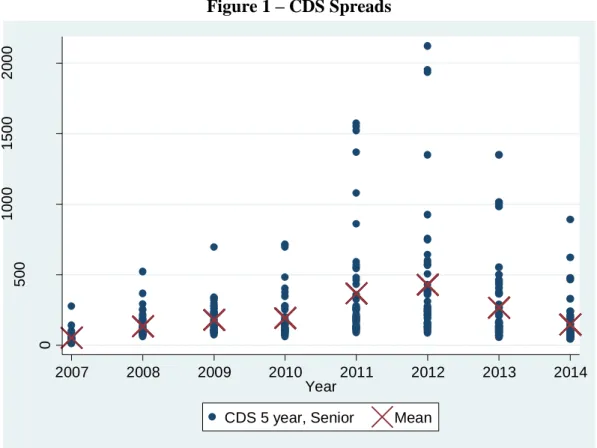
Figure 1 describes the yearly CDS spread observation for the 5-year maturity senior debt CDS spreads used in the sample. Each yearly data point represents the yearly average of the daily CDS spreads of a single financial institution within a specific year.
7 Information on credit default swap contractual terms and clauses has been obtained from the Bank of International Settlements, Thompson Reuters and Markit.
8 The 5 financial institutions do not have MM clause CDSs
Figure 1 – CDS Spreads
Figure 1 shows that the mean of the yearly CDS spreads has increased from 2007 to 2012 and that the standard deviation has also increased during the sample period. It seems that some financial institutions have experienced large increases in credit risk, increasing the cross sectional variation at the financial institution level. After 2012, the mean CDS spread and the cross sectional variation have decreased. The observations are consistent with the evolution of the financial crisis which started in 2008 and forced financial institutions to write-off assets. Furthermore, the Eurozone debt crisis started in 2009 and reached its peak during the 2011-2012, threatening the stability of the European financial sector. As most of the financial institutions in the sample are EU based, a clear spike in the CDS spreads can be seen in 2011-2012.
3.2.2.Credit Default Swap Banking Sector Index Spreads
Daily banking sectors CDS index spreads are collected from Datastream Advanced database between 2007 and 2014. For each year the yearly averages of the daily CDS index spreads are calculated, to represent the average credit risk in the banking sector during the year. The index acts as a benchmark to which the financial institution level CDS spreads are
0 5 0 0 1 0 0 0 1 5 0 0 2 0 0 0 C D S sp re a d , b a si s p o in ts 2007 2008 2009 2010 2011 2012 2013 2014 Year
compared. The motivation is to also use the difference between the financial institution level CDS spread and the banking index CDS spread in the regressions as the dependable variable. For European financial institutions the ds europe banks 5y cds index is used and for US financial institutions the ds na banks 5y cds index is used as the benchmark. As both CDS indexes have 5-year maturities also the financial institution level 5-year CDS spreads are used in the difference. In order to calculate the difference the following method is used.
𝐶𝐷𝑆 𝐷𝐼𝐹𝐹.𝑛𝑡 = 𝐶𝐷𝑆𝑛𝑡− 𝐶𝐷𝑆 𝑖𝑛𝑑𝑒𝑥𝑡
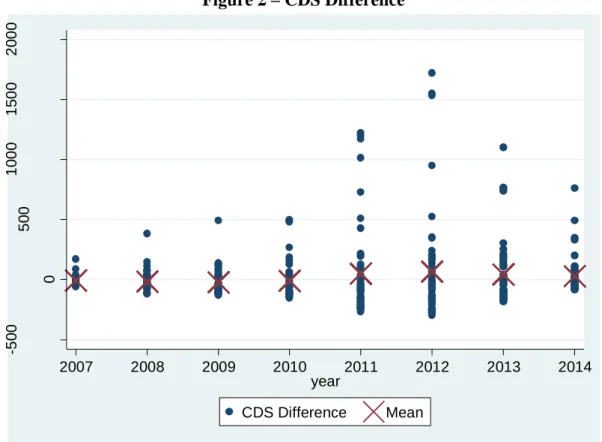
If the CDS spread of the financial institution is lower (higher) than the banking sector CDS index spread, the difference is negative (positive). Meaning that negative (positive) CDS difference values for a financial institution result in lower (higher) than the industry’s average credit risk. Figure 2 demonstrates the annual financial institution level CDS spread differences.
Figure 2 – CDS Difference
3.3.Functional Focus and Diversification Measures
The explanatory and control variables used in this study are derived from the income statement and balance sheet data of the financial institutions in the sample, the data has been
-5 0 0 0 5 0 0 1 0 0 0 1 5 0 0 2 0 0 0 C D S sp re a d , b a si s p o in ts 2007 2008 2009 2010 2011 2012 2013 2014 year CDS Difference Mean
collected from the annual financial reports of the 51 financial institutions in the sample10. The data ranges from 2007 to 2014 and includes only annual data.
The functional focus and diversification measurements used in this study follow methods used in previous literature. Income and asset based methods are used to measure both functional focus and diversification. Income based method of measuring functional focus measures which income stream of the financial institution is larger, commercial banking or investment banking income stream. Income based functional diversification measures how much the income streams from commercial banking and investment banking are diversified. The asset based functional focus method measures which commercial banking or investment banking assets are larger and diversification how well the two asset categories are diversified in the balance sheet. 3.3.1.Income Based Measures for Functional Focus and Diversification
Measurements of income diversification and focus compare the proportion of net interest income with the non-interest income of the financial institution. Net interest income is mostly generated from the traditional commercial banking activities of the financial institution. Net interest income is calculated by deducting interest expense (mostly the interest financial institutions pay on the financing of their lending activities) from the interest income (interest financial institutions receive from their lending activities), thus net interest income mostly captures the extent of the financial institutions commercial banking activities. Non-interest income captures income generated by investment banking11 activities of the financial institution, which includes net fee income, net commission income, net trading income, net insurance income and other income. Non-interest income is mostly generated from investment banking, insurance, underwriting and distributing securities, securitizing assets, mutual fund services and other financial services.
3.3.1.1.Net Interest Income Share
10 The annual statements have been obtained from the websites of the financial institutions and the data has been collected by hand from the statements.
11 Even though referred to as investment banking, non-interest income can include income from other financial services (e.g. insurance). The focus of the financial institutions is divided between commercial banking and investment banking for the sake of clarity and since non-interest income mostly contains income from investment banking.
Net interest income share, used by (Baele, De Jonghe & Vander Vennet 2007), simply measures the share of net interest income to total operating income. Higher the ratio more the financial institution generates its income from commercial banking. With a lower ratio, more income is generated from investment banking activities. Thus the net interest income share measures the functional focus of the financial institution.
𝑁𝑒𝑡 𝑖𝑛𝑡𝑒𝑟𝑒𝑠𝑡 𝐼𝑛𝑐𝑜𝑚𝑒 𝑆ℎ𝑎𝑟𝑒 =
𝐼𝑁𝑇
𝑇𝑂𝑅
Where:
INT = net interest income
TOR = total operating income = net interest income + non-interest income
The net interest income share does not properly capture functional diversification. The method describes to which activity the financial institution is focusing on, not diversification. The high (low) values of the measurement imply that the financial institution is focused on commercial banking (investment banking). Only medium values imply that the financial institution would be diversified. However, since commercial banking and investment banking activities can have different risk profiles, the method is used to determine if there is a difference in credit riskiness between commercial banking and investment banking. Furthermore, when the functional diversification is examined, the net interest income share is used as a control variable.
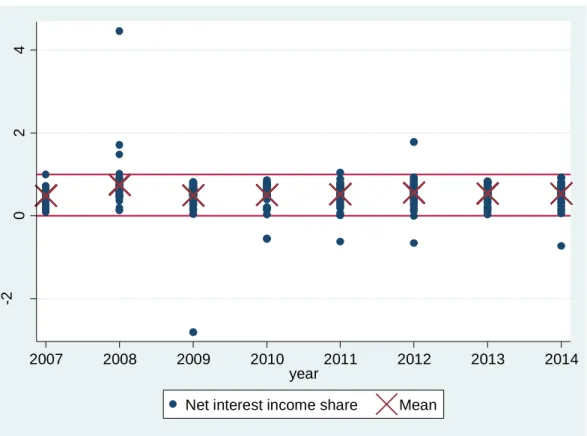
Figure 3 – Net Interest Income Share
Judging by the means of the net interest income share ratio, the share of net interest income has slightly increased from 0.48 in 2007 to 0.53 in 2014. Moreover, the mean of the year 2008 (0.74) is clearly higher than the means of other years, this can be explained by the outbreak of the financial crisis. Based on the 2008 financial statements of the financial institutions in the sample, many financial institutions wrote off large amounts of trading assets and their net trading income was negative. This leads to small or even negative non-interest income, increasing the net interest income share ratio. As evident from Figure 3 not all observations lie between 0 and 1 as intended. The larger than 1 values result from the negative non-interest income, making net interest income larger than total operating income. The negative values result from negative total operating income. The larger than 1 and negative values are not removed from the sample in order to avoid bias.
3.3.1.2.Income Diversification
The income diversification measure used by (Laeven, Levine 2007) captures income diversification more effectively than the net interest income share. Income diversification is
-2 0 2 4 2007 2008 2009 2010 2011 2012 2013 2014 year
calculated by taking the absolute value from, the difference between net interest income and non-interest income divided by total operating income.
𝐼𝑁𝐶. 𝐷𝐼𝑉 = 1 − |
𝐼𝑁𝑇 − 𝑁𝑂𝑁. 𝐼𝑁𝑇
𝑇𝑂𝑅
|
Where:
INC.DIV = income diversification INT = net interest income NON.INT = non-interest income TOR = total operating income
The income diversification measurement takes values between 1 and 0, where 0 implies no diversification since income is generated exclusively from net interest income or non-interest income, 1 implies high diversification since income is generated evenly from both net interest income and non-interest income. The measure captures income diversification effectively for regression purposes, since the relationship between high and low diversification is linear. The measure returns the same values regardless which income stream is larger, thus only focusing on diversification. Income diversification is the main explanatory variable used in this study to measure the functional diversification.
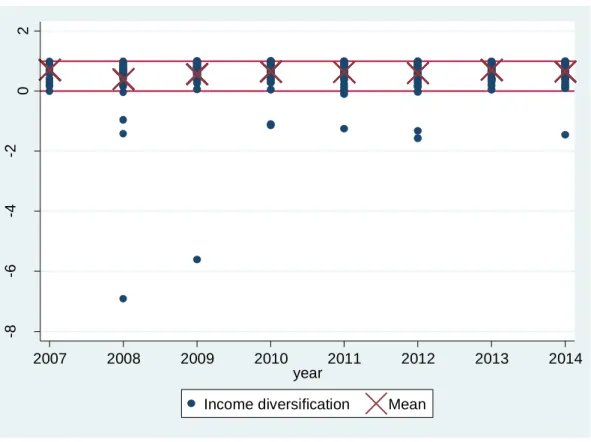
Figure 4 – Income Diversification
The mean of the income diversification measure is the highest during 2007 at 0.71. During 2008, the mean income diversification decreased to 0.40, due to the decreases in non-interest income. The mean of income diversification varies between 0.57 and 0.71 during 2009-2014. Observations indicate a relatively high level of average diversification among the financial institutions in the sample. Figure 4 shows that the financial institutions in the sample have wide cross sectional variation in functional diversification, as the income diversification measures are quite evenly distributed between 0 and 1. Again negative observations result from negative non-interest income or total operating income.
3.3.1.3.Herfindahl-Hirschman Income Diversification
Second method used to measure functional diversification is the application of modified Herfindahl-Hirschman index to income diversification, also used by (Elsas, Hackethal & Holzhäuser 2010, Stiroh, Rumble 2006a). The HH income diversification is used in the robustness section of this study.
-8 -6 -4 -2 0 2 2007 2008 2009 2010 2011 2012 2013 2014 year
𝐻𝐻 𝐼𝑁𝐶. 𝐷𝐼𝑉 = 1 − ((
𝐼𝑁𝑇
𝑇𝑂𝑅
)
2+ (
𝑁𝑂𝑁. 𝐼𝑁𝑇
𝑇𝑂𝑅
)
2)
Where:HH INC.DIV = Herfindahl-Hirschman income diversification INT = net interest income
NON.INT = non-interest income TOR = total operating income
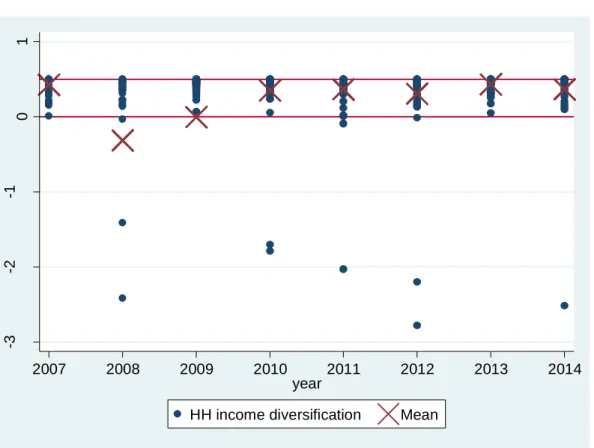
The HH income diversification measure can take values between 0 and 0.5, 0 implying the financial institution is fully specializing in commercial banking or investment banking and 0.5 implying high diversification where income streams are evenly divided between the 2 income streams. The measure returns the same values regardless which income stream is larger, only focusing on diversification.
Figure 5 – HH Income Diversification
-3 -2 -1 0 1 2007 2008 2009 2010 2011 2012 2013 2014 year
The HH income diversification measure tells the same story as the income diversification measure, diversification among the financial institutions in the sample seems quite high based on the means. The negative means of the 2008 and 2009 result from two highly negative observations for one financial institution -30.80 in 2008 and -21.35 in 2009. The extreme values have not been plotted in Figure 5, in order to increase readability. Negative non-interest income and total operating income result in negative HH income diversification measures.
3.3.2.Asset Based Measures for Functional Diversification
Similar methods are used to measure the functional focus and functional diversification based on the balance sheets of the financial institutions. The purpose of the asset measurements is to measure the share and mix of commercial banking assets and investment banking assets in the balance sheet of the financial institution. Since traditional commercial banking is mostly lending based, loans in the balance sheet are categorised as commercial banking assets. Other earning assets mostly include trading assets, derivatives, insurance assets, different investments and other financial assets and are categorized as investment banking assets. Non-earning assets such as cash, non-investment real-estate, equipment, intangible assets and tax assets are not included in neither category nor total earning assets.
3.3.2.1.Loan Share
Loan share measures the share of loans to total earning assets and is used to measure the functional focus of the financial institutions based on its balance sheet.
𝐿𝑜𝑎𝑛 𝑆ℎ𝑎𝑟𝑒 =
𝐿𝑂𝐴𝑁
𝑇𝐸𝐴
Where:
LOAN = net loans to customers
TEA = total earning assets (loans to customers + other earning assets)
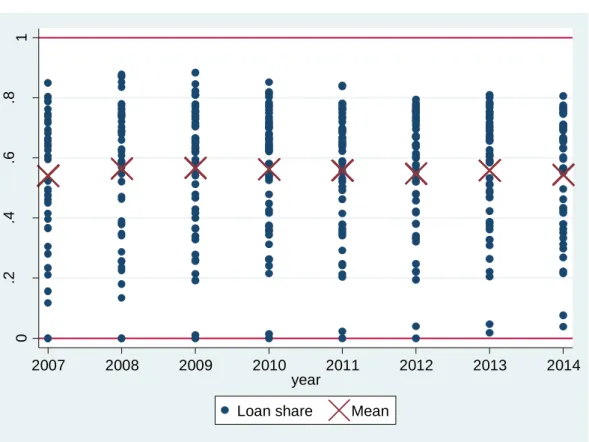
Similarly to the net interest income share, high (low) values imply high focus on commercial banking (investment banking) and mid values high diversification. The loan share is used to determine if the credit risk between commercial banking and investment banking is different and as a control variable.
Figure 6 – Loan Share
The loan share measure seems to be evenly distributed between 0.8 and 0.2, with mean values ranging between 0.54 and 0.57. Meaning that on average the earning asset base of financial institutions contains more loans than other earning assets. The mean loan share was 0.54 in 2007, in 2008 the value increased to 0.56 probably since financial institutions had to write off other earning assets, like trading assets, due to the financial crisis. Eventually in 2014 the mean share of loans to total earning assets decreased back to 0.54. Not a single financial institution’s asset base consists solely of loans. Two financial institutions sole assets base contained only other earning assets during 2007 and 2009, with a slight increase of loans during 2009 and 2014. The financial institutions in question are US based investment banks Goldman Sachs and Morgan Stanley.
3.3.2.2.Asset Diversification
The asset diversification follows the same methodology as the income diversification measure and is used to measure functional diversification.
0 .2 .4 .6 .8 1 2007 2008 2009 2010 2011 2012 2013 2014 year
𝐴𝑆. 𝐷𝐼𝑉 = 1 − |
𝐿𝑂𝐴𝑁 − 𝑂𝐸𝐴
𝑇𝐸𝐴
|
Where:
AS.DIV = asset diversification LOAN = net loans to customers OEA = other earning assets
TEA = total earning assets (loans to customers + other earning assets)
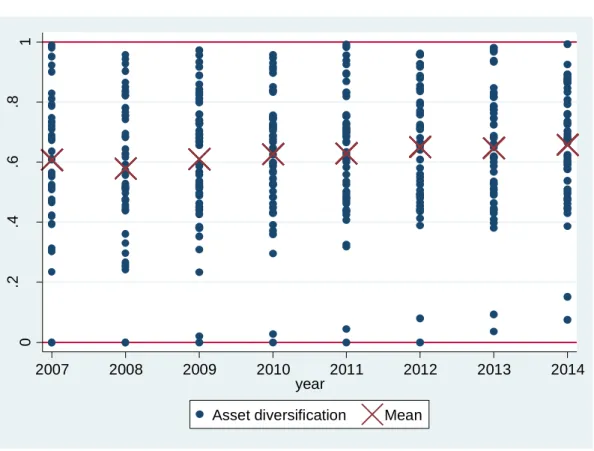
The asset diversification measurement takes value between 1 and 0, where high (low) values imply high (low) functional diversification.
Figure 7 – Asset Diversification
The means of the asset diversification measure show a slight upward trend, the asset diversification has increased from 0.61 in 2007 to 0.66 in 2014. However, in 2008 asset diversification decreased, since the share of loans to total assets increased, decreasing diversification. Again the sample shows a wide array of different diversification observations.
0 .2 .4 .6 .8 1 2007 2008 2009 2010 2011 2012 2013 2014 year
3.3.2.3. Herfindahl-Hirschman Asset Diversification
The HH asset diversification measure uses the modified Herfindahl-Hirschman index method. The HH asset diversification is used in the robustness section of this study to measure functional diversification.
𝐻𝐻 𝐴𝑆. 𝐷𝐼𝑉 = 1 − ((
𝐿𝑂𝐴𝑁
𝑇𝐸𝐴
)
2+ (
𝑂𝐸𝐴
𝑇𝐸𝐴
)
2)
Where:HH AS.DIV = Herfindahl-Hirschman asset diversification LOAN = net loans to customers
OEA = other earning assets
TEA = total earning assets (loans to customers + other earning assets)
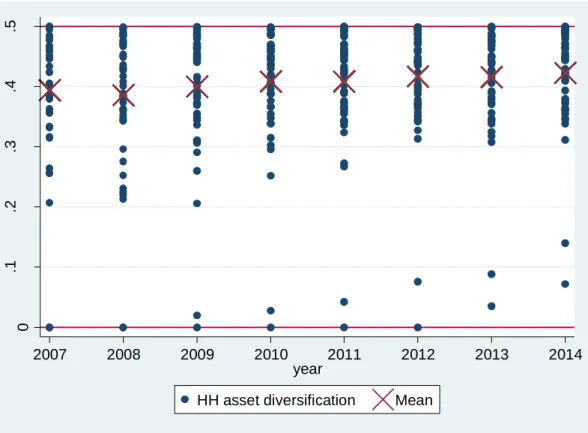
The HH asset diversification measure can take values between 0 and 0.5, high (low) values implying high (low) diversification.
Figure 8 – HH Asset Diversification
0 .1 .2 .3 .4 .5 2007 2008 2009 2010 2011 2012 2013 2014 year
3.4.Control Variables
In order to control for other potential explanatory factors for the credit risk of financial institutions, I employ several control variables in the panel data regressions. The used control variables follow previous literature12. The control variables have been obtained from the annual
financial statements of the financial institutions in the sample. 3.4.1.Tier 1 Capital Ratio
First major control variable is the tier 1 capital ratio of the financial institutions. The tier 1 capital ratio describes the financial strength and riskiness of the financial institution and is similar with the traditional leverage ratio. Tier 1 is used for regulatory purposes. The tier 1 capital ratio is calculated by dividing the core equity capital (or tier 1 capital) with the risk weighted assets of the financial institution. The risk weighted assets include all risky assets of the financial institution with different credit risk weights for each asset class. Central banks or national institutions in charge for regulating financial institutions develop the weights for different asset classes, which often follow the international Basel regulatory guidelines. Financial institutions with a tier 1 capital ratio under 6%13 are seen as undercapitalized and are forbidden to pay out any dividend or management fees. High tier 1 ratio implies lower riskiness and stronger capital structure of the financial institution. Thus the tier 1 ratio is expected to be negatively related to CDS spreads and credit risk.
12 Some control variables follow methodology used in a study published by the Bank of Finland “The determinants of global bank credit-default-swap spreads”
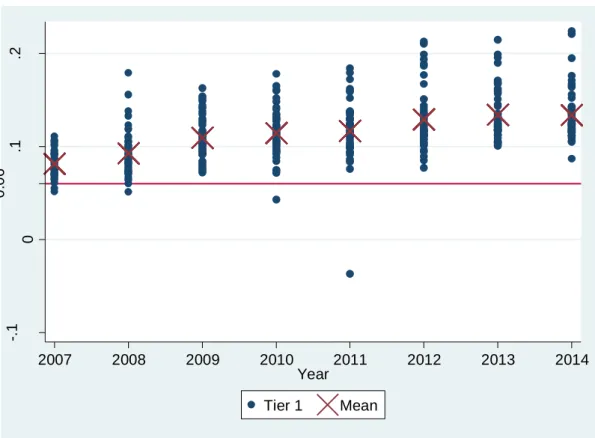
Figure 9 – Tier 1
For the financial institutions in the sample, the mean tier 1 has steadily increased from 0.081 in 2007 to 0.134 in 2014. The increases in tier 1 capital ratio can be explained by the efforts of central banks to increase capital requirements, especially the Basel committee has been introducing stricter capital requirements for the largest global financial institutions. Only a small number of financial institutions in the sample have had a tier 1 ratio under 0.06 and only one negative ratio can be observed.
3.4.2.Leverage Ratio
In addition to the tier 1 ratio, the traditional leverage ratio is employed as a control variable. Leverage should capture the effect of the actual financial structure on the credit risk of financial institutions. The leverage ratio has been calculated by dividing total equity with the total assets of the financial institutions. In this case, a high leverage ratio implies that lower amount of debt is used in the financing of the financial institution. Thus a high leverage ratio results in stronger capital structure and lower risk for the financial institution. The relationship between the leverage ratio and credit risk is expected to be negative.
-. 1 0 .1 .2 0 .0 6 2007 2008 2009 2010 2011 2012 2013 2014 Year Tier 1 Mean
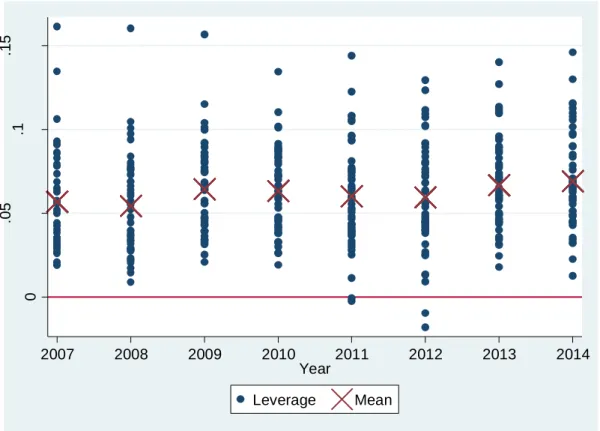
Figure 10 – Leverage Ratio
The mean leverage ratio has also increased from 0,057 in 2007 to 0,069 in 2014. Negative values in 2011 and 2012 are observed as the National Bank of Greece, Dexia and Eurobank Ergasias had negative equity values during those years. The means of the leverage observations increased by 21% between 2007 and 2014, as the tier 1 observations increased by 65%. Since the increase in the leverage ratio is much smaller, it can be interpreted as an indication that financial institutions have increased their tier 1 capital ratios by both increasing the relative amount of equity and by shifting their asset base towards less risky assets (decreasing risk weighted assets).
3.4.3.Cost to Income Ratio
The cost to income ratio is widely used to measure the profitability of financial institutions. The ratio is calculated by dividing the operational costs (salaries, SQ&A, the depreciation of non-financial assets and other costs) with the total net operating income (net interest income and non-interest income). Provisions for credit losses (losses and expected losses on loans) are not included in the ratio. Lower (higher) the ratio more (less) profitable the
0 .0 5 .1 .1 5 2007 2008 2009 2010 2011 2012 2013 2014 Year Leverage Mean