reprinting/republishing this material for advertising or promotional purposes, creating new collective works, for resale or redistribution to servers or lists, or reuse of any copyrighted component of this work in other works.”
imagery (MI), in which motor actions are mentally rehearsed with-8
out engaging in actual physical execution, has been widely used as 9
a major BCI approach. One robust algorithm that can successfully 10
cope with the individual differences in MI-related rhythmic pat-11
terns is to create diverse ensemble classifiers using the subband 12
common spatial pattern (SBCSP) method. To aggregate outputs 13
of ensemble members, this study uses fuzzy integral with parti-14
cle swarm optimization (PSO), which can regulate subject-specific 15
parameters for the assignment of optimal confidence levels for clas-16
sifiers. The proposed system combining SBCSP, fuzzy integral, and 17
PSO exhibits robust performance for offline single-trial classifica-18
tion of MI and real-time control of a robotic arm using MI. The 19
main contribution of this paper is that it represents the first attempt 20
to utilize fuzzy fusion technique to attack the individual differ-21
ences problem of MI applications in real-world noisy environment. 22
The results of this study demonstrate the practical feasibility of 23
implementing the proposed method for real-world applications. 24
Index Terms—Brain–computer interface (BCI), electroen-25
cephalography (EEG), fuzzy integral, motor imagery (MI), particle 26
swarm optimization (PSO). 27
I. INTRODUCTION 28
B
RAIN–COMPUTER interfaces (BCIs) [1] based on the29
user’s voluntary modulations of electroencephalography
30
(EEG) [2] signals provide an alternative method of
communica-31
tion between humans and machines. Despite the many pivotal
32
Manuscript received November 13, 2015; revised March 9, 2016; accepted May 2, 2016. Date of publication August 11, 2016; date of current version. This work was supported in part by the Aiming for the Top University Plan of National Chiao Tung University, sponsored by the Ministry of Education, Taiwan, under Grant 105W963; in part by the Cognition and Neuroergonomics Collaborative Technology Alliance Annual Program Plan, sponsored by the Army Research Laboratory under Cooperative Agreement W911NF-10-2-0022; in part by the VGHUST Joint Research Program, Tsou’s Foundation, Taiwan, under Contract VGHUST105-G7-10-3; and in part by MOST104-2221-E-009-191.
S.-L. Wu and T.-Y. Hsieh are with the Institute of Electrical Control Engineer-ing, National Chiao Tung University, Hsinchu 30010, Taiwan, R.O.C (e-mail: [email protected]; [email protected]).
Y.-Y. Lin is with the Electronic Systems Research Division, National Chung-Shan Institute of Science and Technology, Taoyuan 32546, Taiwan, R.O.C (e-mail: [email protected]).
C.-Y. Chen is with the Brain Research Center, National Chiao Tung Univer-sity, Hsinchu 30010, Taiwan, R.O.C (e-mail: [email protected]).
Y.-T. Liu, C.-H. Chuang, and C.-T. Lin are with the Brain Research Center, National Chiao Tung University, Hsinchu 30010, Taiwan, R.O.C, and also with the Faculty of Engineering and Information Technology, University of Technol-ogy Sydney, Sydney, NSW 2007, Australia (e-mail: [email protected]; [email protected]; [email protected]).
Color versions of one or more of the figures in this paper are available online at http://ieeexplore.ieee.org.
Digital Object Identifier 10.1109/TFUZZ.2016.2598362
because of inter- and intrasubject variability. This variability in- 36
troduces a large number of uncertainties that severely degrade 37
the performance of BCIs. 38
Among existing BCIs [3], efforts to develop EEG-based BCI 39
systems relying on motor imagery (MI) [4] have attracted in- 40
creasing attention in recent years. The brain dynamics of MI 41
are predominantly observed in the primary sensorimotor area 42
and resemble those observed during the actual execution of 43
movement. A variety of feature extraction methods have been 44
proposed to differentiate between the brain dynamics of left- and 45
right-hand MI. In addition to event-related potentials [5], many 46
methods [6], [7] focus on observing the difference in spectral 47
power between the cerebral hemispheres during MI. Among the 48
existing feature extraction methods [8]–[11], the common spa- 49
tial pattern (CSP) method is one of the most effective approaches 50
for constructing optimal spatial filters that are sensitive to dif- 51
ferences between left and right imagery [12], [13]. However, the 52
performance of these spatial filters depends on the operational 53
frequency band. Searching for the optimal frequency range for 54
each subject can be very time-consuming. To address this issue, 55
the subband CSP (SBCSP) method [14] employs a filter bank 56
to decompose EEG signals into different subbands as inputs 57
to the CSP analysis. The SBCSP approach is used to extract 58
useful features of brain activity during MI tasks; subsequently, 59
multiple linear discriminant analysis (MLDA) [15] is applied to 60
recognize the EEG signals in each subband spectrum. After the 61
subband decisions are obtained from each LDA, a classifier en- 62
semble is constructed for each subband, and a fusion algorithm 63
is then employed to obtain a final decision. Because the deci- 64
sion is derived from different subband classifiers, a combination 65
of classifiers promises to offer better uncertainty identification 66
performance than a single classifier. 67
Recently, the fuzzy fusion approach [16], [17] has been shown 68
to improve the BCI performance in terms of classification accu- 69
racy and system stationarity. One commonly used fuzzy fusion 70
approach is fuzzy integral [18], [19], which allows the uncertain, 71
imprecise, and incomplete information available from EEG sig- 72
nals to be represented and processed using the concept of fuzzy 73
measures introduced by Sugeno [20]. This study attacks the 74
misclassification problem that many current BCI systems ex- 75
perience because of variations among individuals. A judicious 76
use of multiple sources effectively reduces individual uncer- 77
tainty, and serves to enhance the reliability of the system’s 78
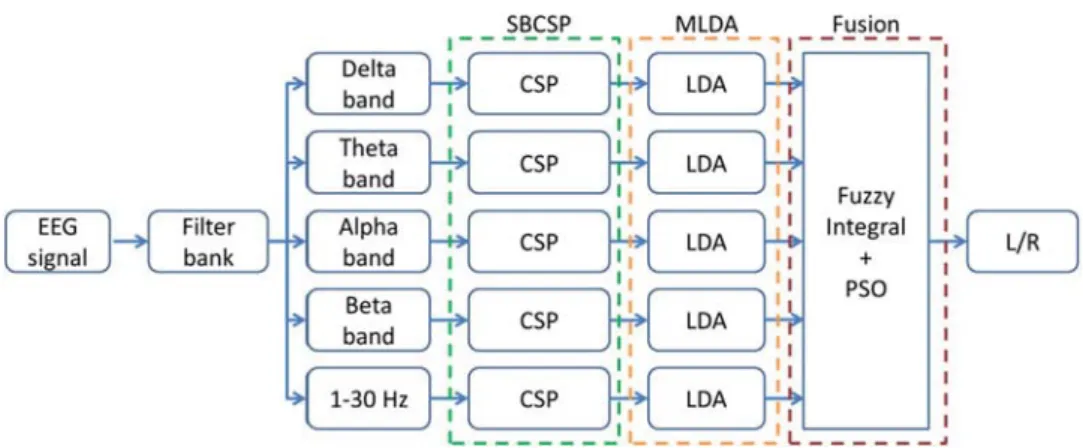
Fig. 1. System architecture of the proposed MI-based BCI fuzzy fusion.
decisions from different sources, using a combination of
clas-80
sifiers holds the promise of achieving better performance in
81
uncertainty identification than the recognition technique based
82
on the single feature. The fuzzy integral [26] is regarded as a
83
numeric-based connective aggregation approach for obtaining
84
collaborative decisions by integrating information from multiple
85
classifiers.
86
In MI tasks, there are two main difficulties in real-world MI
87
applications: individual difference and noisy environment. The
88
individual differences include not only inter- but also
intrain-89
dividual differences, which arise from the fact that individuals
90
continually change over time due to factors such as fatigue,
91
attention, and stress. Likewise, physiological signals are
non-92
stationary and can change over time due to movement artifacts,
93
sensor configuration, and intrinsic noise in the environment.
94
Accordingly, features obtained from different subjects under
95
different tempo-spatial environments might vary widely. That
96
is, some effective features can be found in recordings from one
97
subject but not from another. Hence, each possesses its own set
98
of reliabilities and potential uncertainties. As a result, the
per-99
formance of traditional MI systems using a single classifier to
100
recognize all the feature usually degraded obviously under the
101
situations of individual differences and noisy environments. To
102
solve this problem, the proposed MI-based BCI system in this
103
paper employs the fuzzy integral with particle swarm
optimiza-104
tion (PSO) to classify EEG feature vectors. The fuzzy integral is
105
a fusion technique that exploits multiple decisions from different
106
sources to reap collaborative inferences to achieve the objectives
107
under investigation, a result that is infeasible to achieve from
108
each individual source separately.
109
In this paper, diverse LDA classifiers following the SBCSP
110
approach are established as an ensemble of classifiers to
collab-111
oratively recognize the user’s mental representation of
move-112
ments from EEG patterns recorded during an MI task. Two
113
fuzzy integral methods, i.e., the Sugeno integral [27], [28] and
114
the Choquet integral [29], are applied to integrate the
informa-115
tion from this ensemble of classifiers and then make a joint
116
decision. To effectively assign confidence levels to
particu-117
lar classifiers, PSO [30] is employed to determine the
con-118
fidence of the employed classifiers. The proposed method is
119
demonstrated in the real-time MI control of a robotic arm.
120
The remainder of the paper is organized as follows. In 121
Section II, the proposed BCI for deciphering the mental re- 122
hearsal of motor actions is introduced. In Section III, an MI 123
experiment is presented. The classification results obtained us- 124
ing the proposed approach are compared with those obtained 125
using conventional ones. Finally, a brief conclusion is presented 126
and future studies are suggested in Section IV. 127
II. MATERIALS ANDMETHOD 128
The proposed MI-based BCI system is schematically illus- 129
trated in Fig. 1. During the MI task, the EEG signals are mea- 130
sured by a wireless acquisition device with dry electrodes. A 131
filter bank is then used to extract frequency components (rang- 132
ing from 1 to 30Hz) from the EEG recordings. The CSP method 133
leads to optimal variances for the discrimination of two popula- 134
tions of EEG related to left- and right-hand MI. Multiple LDA 135
classifiers are established that employ CSP features to integral 136
multiclassifiers. Finally, a fuzzy integral with PSO is then ap- 137
plied to fuse the decisions of classifiers and decipher the mental 138
rehearsal of motor actions. 139
A. EEG Acquisition Device 140
The EEG acquisition device [31] was designed to measure 141
scalp EEG signals using dry electrodes [32] [see Fig. 2(a)– 142
(c)]from the sensorimotor area[see Fig. 2(d)]. The acquisition 143
device consists of a preamplifier unit, a microcontroller unit, 144
and a Bluetooth transmission unit. The wireless integrated- 145
circuit-based acquisition module has dimensions of approxi- 146
mately 55.08 ×38.8×5 mm3. The gain of the preamplifier 147
unit is set to 1361 V/V, and the cut-off frequency is regulated 148
to0.2 Hzby a high-pass filter. The microcontroller unit is used 149
to regulate the signal sampling rate and for noise reduction. 150
The microcontroller unit digitizes the analog EEG signal at a 151
sampling rate of 512 Hz. A sinc filter is used to remove frequen- 152
cies above 128 Hz. Moreover, the ac power line noise (60 Hz) 153
in the amplified EEG signal is reduced by the microcontroller 154
unit using a moving average. Then, the processed EEG signal is 155
transmitted to the computer using Bluetooth (v2.1+enhanced 156
data rate). The power is supplied by a commercial 700 mAh 157
Fig. 2. Wireless and portable EEG device. (a) Dry electrodes. (b) Wireless EEG acquisition system, which consisting a preamplifier, a filter, a microcon-troller, and a wireless module. Each circuit board has a width of 55.08 mm. (c) EEG headset. (d) Placement of the four recording electrodes.
B. CSP and Linear Discriminant Analysis
159
Applying the proper spatial filter can improve the
discrimi-160
nation of data from different classes, thereby facilitating
classi-161
fication. The CSP approach [33] is a popular method that yields
162
the optimal variances for the discrimination of two EEG
popu-163
lations related to left- and right-hand MI. In this study, the CSP
164
method is applied to each set of filtered dataE to find a
spa-165
tial filter matrixW that maximizes the variance of the spatially
166
filtered data of one classΣ1, and simultaneously minimizes the
167
variance of the spatially filtered data of the other class, Σ2.
168
Mathematically, the CSP criterion is written as
169 maximize trWTΣ1W subject toWT(Σ1+ Σ2)W =I (1) where 170 Σ1 = exp En∈{class 1} EnEnT tr (EnEnT) and Σ2 = exp En∈{class 2} EnEnT tr (EnEnT) . (2)
This problem can be solved as a generalized eigenvalue
prob-171
lem. With the spatial filter transformationW thus obtained, the
172
spatially filtered dataZ=WTE are then used as the feature
173
vector for LDA classifiers.
174
LDA [34] is a well-known binary classification method based
175
on the estimation of the mean vectors and covariance matrices
176
of individual classes to find the linear combination of features
177
that maximizes the separability between distinct classes. LDA
178
can be formulated in terms of a Bayes rule that aims to assign
179
each sample to the class with the maximal posterior probability.
180
In this study, multiple LDA classifiers are trained from each
181
subband to serve as base classifiers constituting an ensemble
182
system. The decisions derived from each LDA classifier, i.e.,
183
the combination of classifiers based on fuzzy measures and inte- 194
grals can enhance the robustness and reliability of BCI systems. 195
In this paper, the combination of classifiers is performed by 196
means of the Sugeno integral [27], [28] and the Choquet in- 197
tegral [29], which have been successfully implemented in the 198
pattern recognition community. 199
The Sugeno integral is a type of integral with respect to a fuzzy 200
measure that is defined for functions whose range is 0–1. Given 201
the outputs ofkclassifiersxk ∈[0,1], the Sugeno integral over 202 the setA={x1, . . . , xi, . . . , xk}of a membership functionh 203
with respect to the confidencegis defined as 204
Sg(h) = A h(xi)◦g= sup α∈[0,1] [min (α, g(A∩Fα))] (3) whereFα ={x|h(x)≥α}. 205
The Choquet integral is another type of integral with respect 206
to a fuzzy measure. The choice of this integral is inspired by 207
both a theoretical property and a practical one. Specifically, it is 208
a proper generalization of the normal integral operator. In addi- 209
tion, the learning task can be regarded as a convex quadratic 210
program and can therefore be solved using well-known 211
algorithms. The Choquet integral is defined as 212 Cg(h) = k i=1 [h(xi)−h(xi−1)]g(Ai) (4) whereh(x0) = 0. 213
Note that the confidencegof each classifier is heuristically 214
assigned. In this study,gis proposed to be determined via PSO 215
(see Section II-D). 216
The joint confidence of the entire set of sourcesg(Ai)can be 217
obtained as 218
g(Ai) = g({h1, .., hi−1}) +g({hi})
+λ×g({h1, .., hi−1})×g({hi}) (5) where λ∈(−1,∞) and λ can be obtained by solving the 219
following equation: 220 λ+ 1 = k i=1 (λgi+ 1). (6) Then, the final decision is determined by the class with the 221
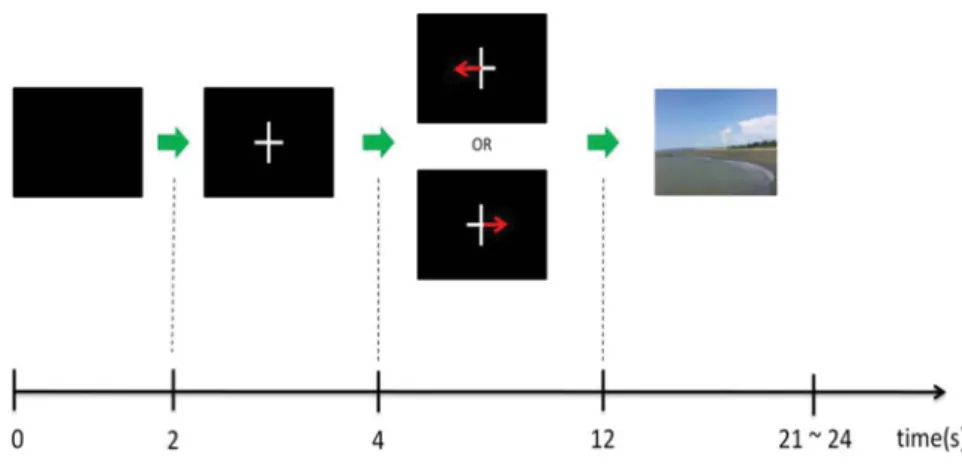
Fig. 3. Experimental paradigm.
D. Particle Swarm Optimization
223
To effectively assign confidence levels to the classifiers used
224
in the fuzzy integral, PSO [21] is employed to update the
con-225
fidence of the classifiers. The PSO algorithm is a well-known
226
swarm intelligence technique that was developed to imitate the
227
behavior of a flock of birds or a school of fish. The objective of
228
PSO is to optimize a model by iteratively attempting to improve
229
upon a candidate solution with regard to a given measure of
230
quality. The PSO algorithm involves two critical steps, which
231
are as follows:
232
1) Initialize a population of particles with a random
233
distribution within the desired range of the search space.
234
2) Update the particle positions and velocities as follows:
235
vi,d ←ωvi,d +φprp(pi,d−gi,d)
+φfrf(fd−gi,d), gi←gi+vi (7) wherefis the best known position of the entire swarm andpi,d
236
is the best known position of particlei. Whenωis less than 1,
237
the particle velocities may tend toward 0, causing the particles
238
to fall into a local minimum and delaying convergence.
239
The confidential weights g of the Sugeno integral and the
240
Choquet integral are determined by PSO in this study. The initial
241
vector that contains the fuzzy integral parameters is randomly
242
chosen; ω is the inertial weight, φp and φf are acceleration
243
constants, andrp andrf are random numbers drawn from the
244
uniform distributionU(0,1). The confidential weights updated
245
via PSO are calculated according to (7). When a particle finds
246
a better position than its previous best position, the previous
247
position is dropped and the new one is stored in the population.
248
This value is called the personal best position of that particle,
249
i.e., pbest. The mechanism retains a satisfactory confidential
250
weight until the predefined number of iterations is reached.
251
Meanwhile, the global best position, i.e.,fbest, of the particle
252
swam as a whole is updated by the particle swarm optimizer
253
based on the particles that exist in the population. The distances
254
between the positions of the particles and the values offbest 255
andpbest decrease during optimization. This procedure allows
256
us to search for the optimal weights for each information source
257
to obtain an optimized output during the training phase.
258
III. RESULTS ANDDISCUSSION 259
Ten male subjects, aged 22–26 years old, were recruited to 260
participate in the MI experiment. All participants were neuro- 261
logically healthy. Before the experiment, the participants were 262
required to complete an informed consent form. Each partic- 263
ipant was seated comfortably in front of a monitor, and the 264
MI task was explained via written instructions on the screen. 265
Five dry electrodes were used (four channels to record the 266
EEG signals and one for reference) to measure EEG signals 267
from the sensorimotor area. The MI experiment consisted of 268
three phases. The first phase was a baseline-constructing task 269
to establish an individual MI model of the proposed system, 270
with the aim of constructing the features for the imagery of 271
left- and right-hand movements. Twenty trials were performed 272
in this baseline-constructing phase for the imagery of both 273
left- and right-hand movements. The second phase was designed 274
to train the participants in imaging left- and right-hand move- 275
ments for EEG measurements. Each of the two directions was 276
tested 40 times. In each training trial, an arrow pointing either 277
to the left or to the right would randomly appear on the screen. 278
After each imagery trial, a picture was displayed on the screen 279
for a randomly determined period of time to help the subjects 280
relax between trials. The training phase was used to calibrate 281
the parameters of the proposed measurement system for each 282
user, with the aim of identifying each user’s EEG features. The 283
last phase was the actual experiment, also with 40 MI trials per 284
direction. Upon seeing an arrow indicating a direction, the users 285
were instructed to perform imagery of the corresponding left- 286
or right-hand movement. The wireless EEG acquisition device 287
was used during the MI experiment. 288
A. Experimental Procedure 289
The experimental paradigm is illustrated in Fig. 3. A subject 290
was seated in a comfortable chair, with his hands placed on 291
a table. A blank screen was displayed for 2 s, followed by a 292
cross displayed at the center of the screen for 2 s. Then, the 293
subject was instructed to perform left/right MI as indicated by a 294
left/right-pointing arrow, which was presented for 8 s. Finally, a 295
picture was shown on the screen for 9–12 s to allow the subject 296
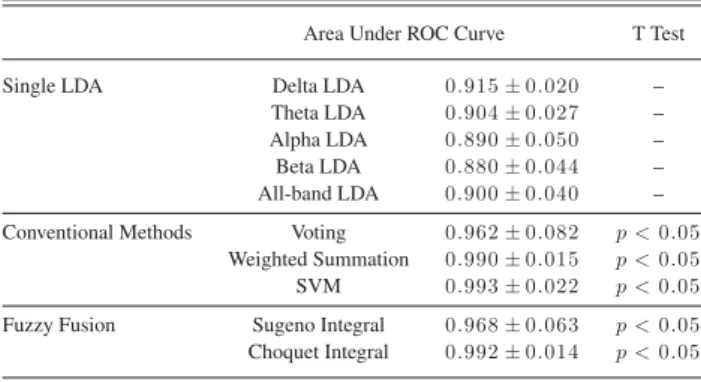
Fuzzy Fusion Sugeno Integral 0.968±0.063 p <0.05
Choquet Integral 0.992±0.014 p <0.05
TABLE II
CLASSIFICATIONRESULTS FOR THESUGENOINTEGRAL AND THECHOQUET
INTEGRALAFTERPSO TRAININGWITHFOURFOLDCROSS-VALIDATION
APPLIEDTENTIMES
Fuzzy Fusion w/o PSO w/ PSO Fuzzy Fusion Sugeno 0.968±0.063 0.998±0.040
Choquet 0.992±0.014 0.998±0.003
B. Fuzzy Fusion Performance
298
In MLDA, classifiers are constructed using a combination of
299
features from multiple frequency bands, including four separate
300
frequency bands (i.e., the delta, theta, alpha, and beta bands) and
301
the full-band signal ranging from 1 to 30 Hz. In each frequency
302
band, an LDA classifier is constructed using features extracted
303
via CSP projection. Consequently, the MLDA is established
us-304
ing the spatial pattern features from these five frequency bands.
305
The separate frequency bands provide the features of each band
306
in greater detail and allow more features to be obtained.
Ac-307
cordingly, the Sugeno integral or the Choquet integral is used
308
for fuzzy fusion to integrate the MLDA decisions constructed
309
using the five base classifiers, namely, the delta, theta, alpha,
310
beta, and all-band LDA classifiers, in the proposed system.
Af-311
ter the aggregation of the results from different bands, the fuzzy
312
fusion mechanism is applied to make the final decision.
Ini-313
tially, the weights of each classifier in the Sugeno integral and
314
the Choquet integral are all set to 0.2. The PSO algorithm is
315
later applied to update these weights.
316
The performances of the two fuzzy integrals and of several
317
conventional fusion methods were evaluated in terms of the area
318
under the ROC curve (AUC). As shown in Table I, each fusion
319
technique outperformed each single classifier, with the proposed
320
fusion architecture yielding not only higher AUC values but also
321
smaller standard deviations. In comparison with existing fusion
322
techniques, the weighted summation approach, the support
vec-323
tor machine (SVM) approach [35], and the Choquet integral
324
outperformed the voting approach [36] and the Sugeno integral.
325
As shown in Table II, after the application of PSO to update
326
the weights of the classifiers, the results of both the Sugeno and
327
Choquet integrals exhibited improvements, from0.968±0.063 328
experiment, each subject wore an EEG acquisition system on 339
the top of his head along the central sulcus, and the reference 340
was recorded at the earlobes on both sides. Each subject was 341
required to perform a full experiment consisting of four sessions 342
(160 trials), and the model previously derived for that subject 343
was applied in the online system. 344
In each trial, the user interface of the online system presented 345
a randomly generated cue, namely, an arrow pointing to the left 346
or to the right at the center of the screen. Each classification re- 347
sult was recorded as a score of+1or−1; the total accumulated 348
score was calculated after every trial. If the final score was above 349 +25 or below−25, the system made a final decision of either 350
a left command or a right command, respectively. Because the 351
computing speed of the online system was 25 Hz, if the subject 352
wished to issue a left or right command, he was required to con- 353
tinuously think about the same direction for 1 s. After each trial, 354
the classification result accumulated over 1 s was plotted as a 355
bar. The accuracy rate was recorded at the top of the window. 356
The processing time (from the input of the raw data to the output 357
of the result) was 40.1715 ms, as shown in Fig. 5. In other words, 358
this system is capable of computing at a rate of approximately 359
25 Hz when performing online computations. This computation 360
rate was the basis for the selection of a value of 25 points as the 361
threshold for the online interface. The accuracy rate achieved in 362
the online test was approximately 86%. Depending on the clas- 363
sification result, a robotic arm would immediately grasp a glass 364
to either the left or the right. The robotic arm used in this ex- 365
periment is commercially available on the rehabilitation market 366
(Kinova, Canada). It consists of a six-axis robotic manipulator 367
arm with a three-fingered hand. This robotic arm can perform a 368
wide variety of functions with graceful movements. 369
D. Reliability Test 370
A further test was performed to confirm the model reliability. 371
In this test, the performance of the algorithm was evaluated us- 372
ing data acquired from the same subject but on a different day. 373
The training set included data recorded continuously from four 374
experimental sessions (160 trials) in a single day for one sub- 375
ject. The test set included data from two experimental sessions 376
(80 trials) recorded on a different day for the same subject. Af- 377
ter a model was generated from the training set, that model was 378
applied to the test data to evaluate its performance. The accu- 379
racy rate of prediction was found to be 91.25%, indicating good 380
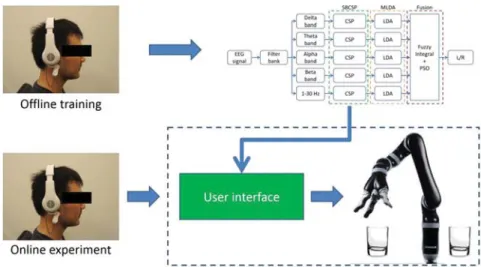
Fig. 4. Flow chart of the proposed MI-based BCI system application.
Fig. 5. Signal processing time within the proposed online system.
IV. CONCLUSION 382
In this study, we propose an innovative ensemble method with
383
swarm-optimized fuzzy integral for an MI recognition task. The
384
fuzzy integral provides an effective mechanism for
represent-385
ing and processing the uncertainty of the outputs of individual
386
ensemble members using the concept of fuzzy measures.
Fur-387
thermore, PSO is used to update the confidence of the employed
388
classifiers. The experimental results derived from a typical MI
389
task show that the best classification accuracy is achieved when
390
applying the Choquet integral with PSO training in the fusion
391
phase. Additionally, the results demonstrate the feasibility of
392
implementing the proposed system in real-time robotic arm
393
control. In the future, developing a more advanced BCI
sys-394
tem with fuzzy theory will be necessary to enable the execution
395
of multidirectional movements.
396
ACKNOWLEDGMENT 397
The authors would like to thank Prof. J.-Y. Chang and all the
398
members of the Brain Research Center, National Chiao Tung
399
University, Taiwan.
400
REFERENCES 401
[1] G. E. Fabiani, D. J. McFarland, J. R. Wolpaw, and G. Pfurtscheller, “Con-402
version of EEG activity into cursor movement by a bracomputer in-403
terface (BCI),”IEEE Trans. Neural. Syst. Rehabil. Eng., vol. 12, no. 3, 404
pp. 331–338, Sep. 2004. 405
[2] S. Ferdowsi, S. Sanei, V. Abolghasemi, J. Nottage, and O. O’Daly, “Re-406
moving ballistocardiogram artifact from EEG using short- and long-term 407
linear predictor,”IEEE Trans. Biomed. Eng., vol. 60, no. 7, pp. 1900–1911, 408
Jul. 2013. 409
[3] M. Bamdad, H. Zarshenas, and M. A. Auais, “Application of BCI systems 410
in neurorehabilitation: A scoping review,”Disability Rehabil. Assistive 411
Technol., vol. 10, pp. 355–364, 2015. 412
[4] T. Mulder, “Motor imagery and action observation: Cognitive tools 413 for rehabilitation,” J. Neural Transmiss., vol. 114, pp. 1265–1278, 414
2007. 415
[5] S. S. Chung, L. K. McEvoy, M. E. Smith, A. Gevins, K. Meador, and 416 K. D. Laxer, “Task-related EEG and ERP changes without performance 417 impairment following a single dose of phenytoin,”Clin. Neurophysiol., 418
vol. 113, pp. 806–814, 2002. 419
[6] J. M. Cano-Izquierdo, J. Ibarrola, and M. Almonacid, “Improving mo- 420 tor imagery classification with a new BCI design using neuro-fuzzy S- 421 dFasArt,”IEEE Trans. Neural. Syst. Rehabil. Eng., vol. 20, no. 1, pp. 2–7, 422
Jan. 2012. 423
[7] Y. H. Liu, C. T. Wu, Y. H. Kao, and Y. T. Chen, “Single-trial EEG-based 424 emotion recognition using kernel Eigen-emotion pattern and adaptive sup- 425 port vector machine,” inProc. 35th Annu. Int. Conf. IEEE Eng. Med. Biol. 426 Soc., Osaka, Japan, 2013, pp. 4306–4309. 427 [8] V. Bostanov, “BCI competition 2003—Data sets Ib and IIb: Feature ex- 428 traction from event-related brain potentials with the continuous wavelet 429 transform and the t-value scalogram,”IEEE Trans. Biomed. Eng., vol. 51, 430 no. 6, pp. 1057–1061, Jun. 2004. 431 [9] W. Y. Hsu and Y. N. Sun, “EEG-based motor imagery analysis using 432 weighted wavelet transform features,”J. Neurosci. Methods, vol. 176, 433
no. 2, pp. 310–318, 2009. 434
[10] B. Obermaier, C. Neuper, C. Guger, and G. Pfurtscheller, “Information 435 transfer rate in a five-classes brain-computer interface,”IEEE Trans. Neu- 436 ral Syst. Rehabil. Eng., vol. 9, no. 3, pp. 283–288, Sep. 2001. 437 [11] D. P. Burke, S. P. Kelly, P. de Chazal, R. B. Reilly, and C. Finucane, 438 “A parametric feature extraction and classification strategy for brain- 439 computer interfacing,”IEEE Trans. Neural. Syst. Rehabil. Eng., vol. 13, 440
no. 1, pp. 12–17, Mar. 2005. 441
[12] R. Zhanget al., “Control of a wheelchair in an indoor environment based 442 on a brain-computer interface and automated navigation,”IEEE Trans. 443 Neural Syst. Rehabil. Eng., vol. 24, no. 1, pp. 128–139, Jan. 2016. 444 [13] P. Wei, W. He, Y. Zhou, and L. Wang, “Performance of motor imagery 445 brain-computer interface based on anodal transcranial direct current stim- 446 ulation modulation,”IEEE Trans. Neural Syst. Rehabil. Eng., vol. 21, 447
no. 3, pp. 404–415, May 2013. 448
[14] Q. Novi, G. Cuntai, T. H. Dat, and X. Ping, “Sub-band common spatial pat- 449 tern (SBCSP) for brain-computer interface,” inProc. 3rd Int. IEEE/EMBS 450
Conf . Neural Eng., 2007, pp. 204–207. 451
[15] R. Zhang, P. Xu, L. Guo, Y. Zhang, P. Li, and D. Yao, “Z-score linear 452 discriminant analysis for EEG based brain-computer interfaces,”PLoS 453
One, vol. 8, pp. 1–7, 2013. 454
[16] G. Salimi-Khorshidi, A. M. Nasrabadi, and M. H. Golpayegani, “Fusion 455 of classic P300 detection methods’ inferences in a framework of fuzzy 456 labels,”Artif Intell. Med., vol. 44, pp. 247–259, 2008. 457 [17] X. Luqiang and X. Guangcan, “Study on power spectrum signal 458 fuzzy fusion for motor imagery,”Comput. Eng., vol. 41, pp. 306–309, 459
2015. 460
[18] B. S. Yoo and J. H. Kim, “Fuzzy integral-based gaze control of a robotic 461 head for human robot interaction,”IEEE Trans. Cybern., vol. 45, no. 9, 462
[24] M. K. Wali, M. Murugappan, and B. Ahmad, “Subtractive fuzzy classifier 480
based driver distraction levels classification using EEG,”J. Phys. Therapy 481
Sci., vol. 25, pp. 1055–1058, Sep. 2013. 482
[25] J. W. Bang, J. S. Choi, H. Heo, and K. R. Park, “A fuzzy-based fu-483
sion method of multimodal sensor-based measurements for the quantita-484
tive evaluation of eye fatigue on 3D displays,”Sensors (Basel), vol. 15, 485
pp. 10825–10851, 2015. 486
[26] Q. Gao, L. Liu, G. Feng, and Y. Wang, “Universal fuzzy integral sliding-487
mode controllers for stochastic nonlinear systems,”IEEE Trans. Cybern., 488
vol. 44, no. 12, pp. 2658–2669, Dec. 2014. 489
[27] M. F. Anderson, D. T. Anderson, and D. J. Wescott, “Estimation of adult 490
skeletal age-at-death using the Sugeno fuzzy integral,”Amer. J. Phys. 491
Anthropol., vol. 142, pp. 30–41, 2010. 492
[28] H. Agahi, R. Mesiar, and Y. Ouyang, “On some advanced type inequalities 493
for Sugeno integral and T-(S-)evaluators,”Info. Sci., vol. 190, pp. 64–75, 494
2012. 495
[29] M. Singh, V. K. Madasu, S. Srivastava, and M. Hanmandlu, “Choquet 496
fuzzy integral based verification of handwritten signatures,”J. Intell. Fuzzy 497
Syst., vol. 24, pp. 145–161, 2013. 498
[30] C. Liu, W.-B. Du, and W.-X. Wang, “Particle swarm optimization with 499
scale-free interactions,”PLoS ONE, vol. 9, pp. 1–8, 2014. 500
[31] L. D. Liaoet al., “A novel 16-channel wireless system for electroen-501
cephalography measurements with dry spring-loaded sensors,” IEEE 502
Trans. Instrum. Meas., vol. 63, no. 6, pp. 1545–1555, Jun. 2014. 503
[32] C. T. Lin, L. D. Liao, Y. H. Liu, I. J. Wang, B. S. Lin, and J. Y. Chang, 504
“Novel dry polymer foam electrodes for long-term EEG measurement,” 505
IEEE Trans. Biomed. Eng., vol. 58, no. 5, pp. 1200–1207, May 2011. 506
[33] K. Yu, K. Shen, S. Shao, W. C. Ng, and X. Li, “Bilinear common spatial 507
pattern for single-trial ERP-based rapid serial visual presentation triage,” 508
J. Neural Eng., vol. 9, pp. 1–8, 2012. 509
[34] H. P. Hsu and J. S. Shih, “Multi-channel surface acoustic wave sen-510
sors based on principal component analysis (PCA) and linear discrimi-511
nate analysis (LDA) for organic vapors,”J. Chin. Chem. Soc., vol. 53, 512
pp. 815–824, 2006. 513
[35] P. J. Facchini and B. St-Pierre, “Synthesis and trafficking of alkaloid 514
biosynthetic enzymes,” Curr. Opin. Plant Biol., vol. 8, pp. 657–666, 515
Dec. 2005. 516
[36] M. Almonacid, J. Ibarrola, and J. M. Cano-Izquierdo, “Voting strategy 517
to enhance multimodel EEG-based classifier systems for motor imagery 518
BCI,”IEEE Syst. J., vol. 10, pp. 1082–1088, 2016. 519
Shang-Lin Wu(M’15) was born in Kaohsiung, Tai-520
wan, in 1987. He received the B.S. and M.S. degrees 521
from the Department of Computer Science and In-522
formation Engineering, National Chiayi University, 523
Chiayi, Taiwan, in 2009 and 2011, respectively. He 524
is currently working toward the Ph.D. degree in the 525
Institute of Electrical Control Engineering, National 526
Chiao Tung University, Hsinchu, Taiwan. 527
His research interests include fuzzy theory, trans-528
fer learning, biomedical signal processing, biofeed-529
back control, and embedded system. 530
531
Tsung-Yu Hsiehreceived the B.S. degree in elec- 542 trical engineering and computer science, in 2013, 543 and the M.S. degree from the Department of Elec- 544 trical and Control Engineering, National Chiao-Tung 545 University, Hsinchu, Taiwan, in 2015. He is currently 546 working toward the Ph.D. degree at the Department 547 of Computer Science and Engineering, Pennsylvania 548
State University. 549
His current research interests include fuzzy logic 550 theory, machine learning, computer vision, and EEG 551 analysis and application. 552 553
Yang-Yin Lin (M’13) received the M.S. degree 554 from the Institute of Electrical Engineering, National 555 Chung Hsing University, Taichung, Taiwan, in 2008, 556 and the Ph.D. degree from the Department of Elec- 557 trical Engineering, National Chiao Tung University, 558 Hsinchu, Taiwan, in 2013. 559 He is currently working as a Researcher Engi- 560 neer at the Electronic Systems Research Division, 561 National Chung-Shan Institute of Science and Tech- 562 nology, Taoyuan, Taiwan. His current research inter- 563 ests include evolutionary computation, type-2 neural 564 fuzzy systems, deep learning, transfer fuzzy learning, and field-programmable 565 gate array chip design based on neural network architecture. 566 567
Chih-Yu Chen was born in Kaohsiung, Taiwan, 568 R.O.C., on March 20, 1988. He received the M.S. 569 degree from the Insitute of Biomedical Engineering, 570 National Chiao Tung University, Hsinchu, Taiwan, 571
in 2013. 572
He is currently with the Quanta Computer 573 Incorporation, Taoyuan, Taiwan. 574 575
Chun-Hsiang Chuang(M’16) received the B.S. de-576
gree in mathematics education from Taipei Munic-577
ipal Teachers College, Taipei, Taiwan, in 2004, the 578
M.S. degree in educational measurement and statis-579
tics from National Taichung University, Taichung, 580
Taiwan, in 2009, and the Ph.D. degree in electri-581
cal engineering from National Chiao Tung University 582
(NCTU), Hsinchu, Taiwan, in 2014. 583
He was a Visiting Scholar at Swartz Center for 584
Computational Neuroscience, University of Califor-585
nia, from 2012 to 2013. He is currently a Postdoctoral 586
Researcher of Brain Research Center at NCTU. His research interests include 587
machine learning, computational neuroscience, biomedical signal processing, 588
and brain–computer interface. 589
590
Chin-Teng Lin(F’05) received the B.S. degree from 591 National Chiao-Tung University (NCTU), Hsinchu, 592 Taiwan, in 1986, and the Master’s and Ph.D. de- 593 grees in electrical engineering from Purdue Univer- 594 sity, West Lafayette, IN, USA in 1989 and 1992, 595
respectively. 596
He is currently the Chair Professor of Faculty of 597 Engineering and Information Technology, University 598 of Technology Sydney, Sydney, NSW, Australia, the 599 Chair Professor of Electrical and Computer Engineer- 600 ing, NCTU, International Faculty of the University of 601 California at San-Diego, and Honorary Professorship of the University of Not- 602 tingham, Nottingham, U.K. He has published more than 200 journal papers 603 (Total Citation: 20 155, H-index: 53, i10-index: 373) in the areas of neural 604 networks, fuzzy systems, multimedia hardware/software, and cognitive neuro- 605 engineering, including approximately 101 IEEE journal papers. 606 Dr. Lin was promoted as an International Fuzzy Systems Association Fellow 607 in 2012. Since 2011, he has been elected as the Editor-in-Chief of the IEEE 608 TRANSACTIONS ONFUZZYSYSTEMS. He also served on the Board of Gover- 609 nors at the IEEE Circuits and Systems (CAS) Society in 2005–2008, the IEEE 610 Systems, Man, Cybernetics Society in 2003–2005, the IEEE Computational In- 611 telligence Society (CIS) in 2008–2010, and the Chair of the IEEE Taipei Section 612 in 2009–2010. He is the Distinguished Lecturer of the IEEE CAS Society from 613 2003 to 2005, and the CIS Society from 2015–2017. He served as the Deputy 614 Editor-in-Chief of the IEEE TRANSACTIONS ONCIRCUITS ANDSYSTEMS-II in 615 2006–2008. He was the Program Chair of the IEEE International Conference 616 on Systems, Man, and Cybernetics in 2005 and the General Chair of the 2011 617 IEEE International Conference on Fuzzy Systems. He is the co-author ofNeural 618 Fuzzy Systems(Prentice-Hall), and the author ofNeural Fuzzy Control Systems 619
with Structure and Parameter Learning(World Scientific). 620