
Data Redundancy Reduction in Wireless Sensor
Network
Mohammad Ibrahim Adawy, Shahrudin Awang Nor and Massudi Mahmuddin
InterNetWorks Research Laboratory, School of Computing, UUM.Abstract—In Wireless Sensor Network, sensor nodes are
randomly deployed where the sensor nodes are not situated faraway from each other. Thus, an overlapping area is generated due to intersection of their sensing ranges. If an event occurs within the overlapping area, all the sharing nodes sense the same event and produce redundant and correlated data. Data redundancy exhaust network resources and increase network overhead. Data aggregation and numerous data redundancy reduction algorithms are employed to solve this problem. This paper reviews modern data redundancy reduction used sleep schedule model to solve the redundancy. All proposed algorithms are classified on the basis of network coverage and similarity among sensory data which can be used in reducing redundancy in WSN effectively.
Index Terms—Coverage Control Protocol; Efficient Data
Redundancy; Intelligent Algorithms; Locality Sensitive Hashing; Sleep Schedule.
I. INTRODUCTION
WSN can be held to denote finite set of sensor devices geographically distributed in each indoor or outdoor environment [1], [2]. In some applications like commercial applications, monitoring system, food safety, military surveillance [3], [4], and the prediction of natural disasters [5], there is presence of WSN. To ensure reliability, WSN deployment is densely and randomly based on the kind of application being used [6], [7], [8], and it is of benefit to inaccessible area [9]. WSN has limited resources of the sensor nodes [10], [11], since the main key of resource in WSN are energy and communication [12]. Approximately, 80% of energy consumed in individually sensor node is used for data transmission [13]. Rechargeability or replacement of the battery, source of energy, is impossible [14]. Hence, energy efficiency is a main design issue that needs to be considered for enhancing WSN lifetime [15]. The above WSN features facilitate the ability of sensor nodes to detect same event concurrently and produce redundant and correlated data [16], due to overlap their sensing ranges within monitoring area [17].
Moreover, to improve data accuracy, system lifetime, sensing reliability and security issues, redundancy must be exploited [18]. This will be of benefit to the redundancy in WSN. However, generating redundant and correlated data, which can give rise to network overhead and drain resources [19] which is considered a disadvantage for the redundancy in WSN. WSN suffers from redundancy, especially when it comes to data transmission, because sensor nodes consume huge energy while transmitting redundant data [20]. Thus, data aggregation remains essential in WSN, because it removes redundant data which in turn conserve energy by reducing energy consumed by sensor nodes [21], [22].
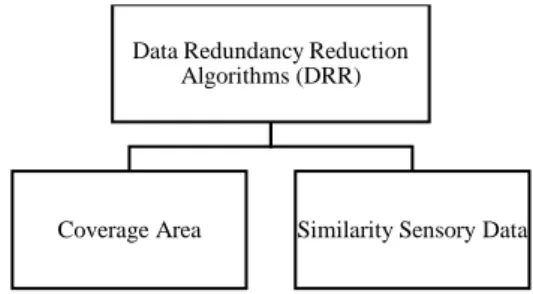
Consequently, data aggregation would lengthen the network lifespan [23], but the redundancy sustains reliability. Therefore, there is a need to maintain redundancy adequately [22]. Researchers have come up with many data redundancy reduction algorithms. Nevertheless, these algorithms are considered obsolete. Thus, this paper aims to propose a review for modern algorithms for data redundancy reduction which will be more effective in reducing redundancy in WSN. All proposed algorithms used sleep schedule model to solve redundancy, while they are categorized based on network coverage and data similarity among sensory data.
Figure 1: Data Redundancy Reduction Algorithms
II. DATA REDUNDANCY REDUCTION BASED ON NETWORK
COVERAGE
When a sensor node sensing range is covered by its neighbours sensing ranges, it becomes redundant [24]. To solve this problem, is used node sleep scheduling methods. They employed coverage sensing ranges for the sensor nodes within monitoring area to identify which the sensor node is active and which of them is sleep, as this will reduce number of source nodes within monitoring area in which maintained the coverage area that implies connectivity among of them.
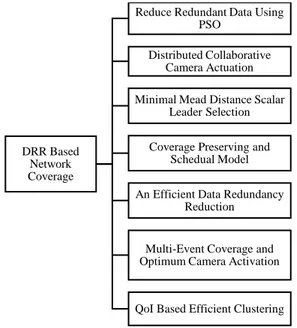
A. Reduce Redundant Data Using Partical Swarm Optimization
This approach is proposed by Mishra and Singh [25], and it refers to a technique which condense the redundant data in the WSN via optimally selection of active sensor nodes. Clustering WSN are proposed for increase the network scalability and ease of data processing [26], [27]. The process involves base station (BS) picking the cluster head (CH) through specific parameters and simulated annealing optimization method. CH arranges the communication within cluster by Time division Multiple Access (TDMA) and schedule that which is achieved by Particle Swarm Optimization (PSO). The chosen nodes are arranged to send data to the CH and rest of the time they are in sleep mode. This process would go on until next CH is not chosen for the cluster. Nevertheless, the algorithm improves the lifespan of
Data Redundancy Reduction Algorithms (DRR)
the WSN proficiently when life of the network is estimated with half of the sensor nodes which are alive.
Figure 2: Data Redundancy Reduction Based on Network Coverage.
B. Distributed Collaborative Camera Actuation
In a study conducted by Salim and Ramdan [28], proposed distributed collaborative camera actuation scheme. The scheme operates by turning the camera sensors to off mode and activating optimum number of camera sensors to eliminate the level of redundancy of data that occurs due to the overlapping of their field of views (FOVs). In this process, a necessary event coverage preservation is need when an event occurred in collaboration with active camera sensors having heard from scalar sensors about occurrence event. Through examination of different cases such as varying number of scalars, number of cameras, and event radius and examination of their impact on number of cameras activated, it is discerned that the number of cameras activated in the proposed method, in most of the cases, are not up to the number of cameras activated in the other work while persevering the certain coverage.
C. Minimal Mean Distant Scalar Leader Selection for Event Driven
The algorithm is proposed by Priyadarshini and Panigrahi [29], and it is meant for activating least number of cameras but maximizing the event area coverage and decreasing the resulting traffic overhead. This would be accomplished via real choice of scalar leaders in each sub-region of the monitored area and the chosen scalar leaders work as informers for event information communication to their matching camera sensors. The less camera actuation with enhanced coverage, abated redundancy ratio and reduced optimize the coverage performance of the sensor network energy consumption obtained from the experimentation reveal the effectiveness of the proposed algorithm as compared to three other recent approaches.
D. Using Event-Driven-Mechanism
This is an Event-driven-mechanism Coverage Control Protocol (ECCP) proposed by Sun, Tao, Li and Xing [30]. This scheme employs the connection between the nodes and dynamic grouping to regulate the coverage region. Within the coverage region, it utilized the greedy algorithm to augment
the coverage region. So, the target node is consistently covered by other sensor nodes and the network resource is enhanced. Only wake partial nodes to work in a cycle to enable them work in turn.
E. An Efficient Data Redundancy Reduction
In a study conducted by Sampoornam and Rameshwaran [31] proposed an Efficient Data Redundancy Reduction (EDRR) scheme by employing Conjugative Sleep Scheduling scheme with data redundancy reduction scheme. Rake receiver model data aggregation method is implemented for aggregation the data from various sensor nodes. In EDRR scheme, whenever a sensor node flops or a new node is added to the network, the conjugative scheduling scheme assesses the route maintenance algorithm. Remaining power levels of nodes would be assessed to upsurge the network lifespan. The simulation results reveal that the EDRR efficiently extend network lifespan and balance node power consumption with a lesser message overhead when compared to the extant popular energy efficient methods.
F. Multi-Event Coverage and Optimum Camera Activation
In Priyadarshini and Panigrahi [32], an algorithm was proposed based on centralised cum sub-centralised scheme that works efficiently to handle multiple events occurring simultaneously, while reducing the number of cameras published unnecessarily to cover the event area that occurs effectively. When any event occurs, event sensing occurs somewhat beyond the specified event limits. Thus, cameras outside the event boundary are unnecessarily activated. As the methodology avoids the undesired activation of cameras, the additional power and energy costs of these cameras, as well as the transmission of redundant data are eliminated. The results obtained from the experimental evaluation reveal that the proposed methodology significantly reduces the number of unnecessary cameras while providing adequate coverage of the event area for a multi-event. Moreover, the reduced activation of the camera with increased coverage ratio, reduced redundancy ratio, improved area of view usage, and lower energy as well as the energy expenditure needed to activate the camera obtained from the investigation justifies the effectiveness of the proposed algorithm compared with two other approaches recently proposed.
G. Quality of Information Based Energy Efficient Clustering
Quality of Information Based Energy Efficient Clustering algorithm was proposed by Prasead and Dharani [33] to reduce data redundancy within clustering wireless sensor network. All sensor nodes in the cluster have an equal sensing range in order to avoid data redundancy. At the centre of the network, the BS is normally situated. In the first instance, an individual node in each round will determine if it is in the sensing range for another node that is active already. If this is true, the node will be in the sleep mode, hence, there will be no time slot that is allocated to that node. With this, the current time slot is capable of being allocated to other nodes in the same cluster. The same condition will be checked by the member of its CH since the CH is similarly a node with the same sensing range. Hence, the message will be received by the nodes from its CH to go to the idle mode instead of receiving the duplicate data from its members. In this regard, a decision is made on whether to become idle or active by the
DRR Based Network Coverage
Reduce Redundant Data Using PSO
Distributed Collaborative Camera Actuation Minimal Mead Distance Scalar
Leader Selection Coverage Preserving and
Schedual Model An Efficient Data Redundancy
Reduction Multi-Event Coverage and Optimum Camera Activation QoI Based Efficient Clustering
threshold range. Idleness occurs in a node when it is in sensing range of another node, otherwise, the node is active. This process will continue till the network becomes sparse. After that, all nodes will be active in the cluster. The computation of sparse network is based on the number of dead nodes during the operation.
III. REDUNDANCY REDUCTION BASED ON SIMILARITY
SENSORY DATA
The modification of sensory data collected from neighbouring nodes are expected to be similar [34]. To satisfy the coverage area, deployment of spatial dense sensor nodes is necessary in some types of WSN applications. The spatially event observations are taken by the multiple sensor nodes. These observations are highly connected with the degree of correlation that upsurge when reducing the overlap area among the sensor nodes [35].
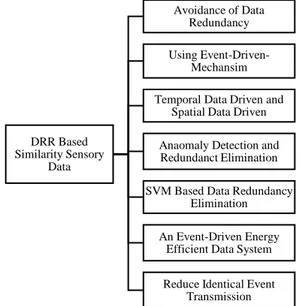
A. Avoidance of Data Redundancy
The algorithm proposed by Amala, Jeyapriya and Shenbagavalli [36], which has three characteristics, can be applied on the clustering tree wireless sensor network. Considering the three characteristics of the algorithm, the sink node symbolizes the tree root, CH signifies the parent node while the member nodes are the tree leaves. The member nodes get data event and send to the matching CH node while, in turn, the data packets received by the CH node are stored in the memory and apply replication avoidance algorithm to evade the same data reception through member nodes.
Figure 3: Data Redundancy Reduction Based on Similarity Sensory Data.
In a single cluster, it indicates acceptance of data from only one node and rejection of the rest of the nodes, if the node receives same data from more than one node. Conversely, there is acceptance of all data, if diverse data are obtained from the member nodes. However, if different data are taken from the member nodes, the implication is acceptance of all data reception.
B. Coverage-Preserving and Sleep Scheduling Model Coverage-Preserving Control Scheduling Scheme (CPCSS) based on a cloud model and redundancy degree in
sensor networks is proposed by Shi, Wei, Wang and Shu [37]. In this scheme, the normal cloud model is utilized for estimating the similarity level between the sensor nodes in terms of their historical data. Then, all nodes in each grid of the target region can be divided into some categories. Following this, the redundancy level of a node will be estimated based on its sensing region covered by the neighbouring sensors. Then, the process is ended through a centralized approximation algorithm based on the partition of the target area, which will be designed to get the approximate minimum set of nodes that can retain adequate coverage of the target region and guarantee the connectivity of the network simultaneously.
C. Temporal Data-Driven and Spatial Data-Driven This algorithm, which is proposed by Li, He, Huang and Tang [38], involves combination of temporal data-driven sleep scheduling (TDSS) and spatial data-driven anomaly detection, in which TDSS diminishes data redundancy. In this algorithm, transmission control protocol (TCP) congestion control stimulates TDSS model. Based long and linear cluster structure in the tunnel monitoring system, cooperative TDSS and spatial data-driven anomaly detection are then proposed. Furthermore, TDSS is applied in a cooperative way in the cluster in order to accomplish synchronous acquisition in the same ring for analysing the situation of every ring. Also, spatial data driven anomaly detection based on the spatial correlation and Kriging technique is accomplished to generate an anomaly indicator, as this will keep the accuracy of sensor data.
D. Anomaly Detection and Redundancy Elimination In a study conducted by Xie and Chen [39] proposed anomaly detection and redundancy elimination scheme, and it represents a sensor data pre-processing framework comprising two parts, (i.e., sensor data anomaly detection and sensor data redundancy elimination). For sensor data anomaly detection, which is the first part, methods based on principal statistical analysis and Bayesian network are proposed, but approaches based on static Bayesian network (SBN) and dynamic Bayesian networks (DBNs) are proposed for sensor data redundancy elimination, the second part. Static sensor data redundancy detection algorithm (SSDRDA) for eliminating redundant data in static datasets and real-time sensor data redundancy detection algorithm (RSDRDA) for eliminating redundant sensor data in real-time are proposed.
E. SVM Based Data Redundancy Elimination
Solution to the problem of much data redundancy found in WSN could be accomplished through Support Vector Machine (SVM) based data redundancy algorithm is proposed by Patil and Kulkarni [40]. The reason is that the algorithm can build aggregation tree for given size of the sensor network. Then, SVM method is applied on tree to eliminate the redundant data. The Locality Sensitive Hashing (LSH) is adopted to minimize the data redundancy and to eliminate the false data based on the similarity. The LSH codes are sent to the aggregation supervisor node. The aggregation supervisor node finds sensor nodes that have the same data and chooses only one sensor among them to send the real data. This approach is of benefit as it minimalizes the redundancy and eliminate the false data to enhance performance of WSN. DRR Based Similarity Sensory Data Avoidance of Data Redundancy Using Event-Driven-Mechansim Temporal Data Driven and
Spatial Data Driven Anaomaly Detection and Redundanct Elimination SVM Based Data Redundancy
Elimination An Event-Driven Energy
Efficient Data System Reduce Identical Event
F. An Event-Driven Energy Efficient Data System An event driven redundant data elimination scheme was proposed by Liu, Wu, and Pei [41]. This scheme uses in- network data processing before transmitting data to CH or base BS. The sensor nodes within cluster have irregular distance from the CH. When the event take place within cluster, many of sensor nodes can detect it. However, transmitting the sensory data by all the detector nodes may lead to network congestion and waste of nodes energy because of redundant data. Therefore, all the detector nodes start the in-network data processing to select the node which will transmit the data to BS node based on the residual energy and distance to the BS. Thus, the node which is having maximum residual energy and at the shortest path to CH, is chosen to send data event to CH which will avoid data redundancy and energy depletion. The simulation results show that the proposed data reporting system along with routing scheme diminishes the transmission loss and upsurge the network life time.
G. Reduce Identical Event Transmission
In a study conducted by Shih, Chu, Roddick, Ho, Liao and Pa [42] proposed Reduce Identical Event Transmission (RIET) algorithm. This algorithm is used in the WSN, and it can reduce the probability of transmitting the same event. It can also save the power of the nodes. In addition, it improves the life span of the sensor nodes by the sensor nodes’ communication. The RIET algorithm applies the finite state machine (FSM) which has” Sensing State”, “Delay State”, “Query State”, and “Receive Query State” to avoid data transmission for the same event by the sensor nodes concurrently in the algorithm. Figure 7.1 illustrates RIET algorithm finite state machine [42].
Figure 4: RIET algorithm’s finite state machine [42].
IV. PERFORMANCE METRICS
Choosing the performance metrics that indicate the objective of the data redundancy reduction algorithm or scheme is the main focus. It is demonstrated that not all algorithms have all significant performance metrics. Thus, this section elaborates which are the vital performance metrics are existing in the data redundancy reduction algorithms:
a. Number of active sensor nodes: identify number of active nodes that sense and transmit data packets. It assumes that, N is number of sensor nodes are deployed in the interest area. P is number of active nodes while V is number of sleep nodes. where P, V ϵ N.
P = N – V (1)
b. Energy efficiency:the average of energy spending by sensor node components that is divided into four main components, namely: sensing sub system ,processing sub system, radio sub system, and power supply unit [43].
Figure 5: Major components and associated energy cost of sensor node [44]
As shown in Figure 5, each component consumes amount of node energy to achieve its tasks, and the transmitter absorb most of energy node. It assumes that use the same radio model discussed in [45], and the radio channel is symmetric as in [46]. The transmit, receive and data aggregation energy costs for k-bit data packet between two nodes separated by distance of d meters is given by Equations 2, 3 and 4, respectively:
ETX (k, d) = (Eelec * k) + (Eemp *k*dα) (2) ERX (k) = (Eelec * k) (3) EDA (k)= (EDAG * k) (4) EAVg = 1 P∑ ((ETX(k, d) + (ERX(k) + (EDA(k)) P i=1 (5)
c. The coverage ratio: means that the ratio of entire area to covered area by sensor nodes [47]. For example, it assumes that the interest area is divided into 50 x 50 squar grids [17]:
Ratio=∑ grids that are covered by at least the sensor node
the total number of grids (6)
d. Network lifetime: This metric measures the time when the first node fails due to a battery power discharge [48].
Networklifetime= Time when first node dead – Start Time (7) e. Data accuracy: many of the ideas are exist about how to define the accuracy. For instance, accuracy is defined by amount of received data [49], while it is defined by number of collected data at BS to the number of sensed data [50].
Accuracy = Number of collected data at BS
Number of sensed data (8)
Table 1 shows the significant performance metrics that are existing in the data redundancy reduction based on network coverage and temporal-spatial data correlated. The sensor node may be mote node, scalar sensor, and camera sensor.
Table 1
Performance Metrics in Data Redundancy Reduction algorithms Based on Network Coverage and Similarity Sensory Data Data Redundancy Reuction Number of active
sensor nodes Coverage Ratio Energy Efficiency Network Lifetime Data Accuracy Reduced Redundant Data Using PSO [25] X X X Distributed Collaborative Camera Actuation [28] X X Minimal Mean Distant Scalar Leader Selection for Event Driven [29] X X Coverage-Preserving and Sleep Scheduling Model [30] X X An Efficient Data Redundancy Reduction [31] X X X Multi-Event Coverage and Optimum Camera Activation [32] X X Quality of Information Based Energy Efficient Clustering [33] X X X Avoidance of Data Redundancy [36] X X X Using Event-driven-mechanism [37] X X X Temporal Data-Driven Sleep Scheduling and Spatial Data-Driven [38] X X Anomaly Detection and Redundancy Elimination [39] X X SVM Based Data Redundancy Elimination [39] X X
An Event-Driven Energy Efficient Data System[41] X X X Reduce Identical Event Transmission [42] X X X
V. CONCLUSION
All sensor nodes that have the event in their sensing range will detect the same event. If all detector nodes transmit event data to the base station, then this will result in data redundancy causing congestion and energy depletion. Thus, an aggregation process is essential in WSN to eliminate the redundancy, but redundancy sustains reliability. Many of redundancy reduction schemes are employed to saving energy and prolong network lifetime by reduction redundant data. This paper reviews modern data redundancy reduction algorithms used sleep schedule model. All proposed algorithm is classified based on network coverage and similarity among sensory data which can be used in reducing redundancy in WSN efficiently. The significant performance metrics for the data redundancy reduction based network coverage are denoted that, all schemes show that increasing in network density leads to increase in the number of active sensor nodes, while reducing in number of active sensor nodes leads to increase in energy efficiency. While in data redundancy based on similarity sensory data schemes, some schemes have just increased network lifetime and energy efficiency while other schemes have been interested to raise network lifetime, energy efficiency and improve accuracy of sensor data by detection anomalous data.
REFERENCES
[1] M. Carlos-Mancilla, E. López-Mellado and M. Siller, "Wireless Sensor Networks Formation: Approaches and Techniques", Journal of Sensors, vol. 2016, pp. 1-18, 2016.
[2] Y. Wang, X. Wang, B. Xie, D. Wang and P. D & Agrawal, “Intrusion detection in homogeneous and heterogeneous wireless sensor networks”, IEEE transactions on mobile computing, vol. 7, no. 6, pp. 698-711, 2008.
[3] N. Rani and M. Gupta, "Review on Key Pre-Distribution Schemes in Wireless Sensor Networks", International Journal of Advanced Smart Sensor Network Systems, vol. 6, no. 1, pp. 01-15, 2016.
[4] K. Sohraby, D. Minoli, and T. Znati, Wireless Sensor Networks: Technology, Protocols, and Applications. Hoboken, New Jersey: John Wiley and Sons, 2006.
[5] A. Chatterjee and D. Mukherjee, “Variety event detection in Wireless Sensor Networks through single hop cluster topology,” IFIP Int. Conf. Wirel. Opt. Commun. Networks, WOCN, pp. 1–5, 2013.
[6] Y. Zhuang, J. Pan and L. Cai, “Minimizing energy consumption with probabilistic distance models in wireless sensor networks”, In INFOCOM, 2010 Proceedings IEEE , pp. 1-9, 2010.
[7] A. Pal, “Localization algorithms in wireless sensor networks: Current approaches and future challenges”, Network Protocols and Algorithms, vol. 2, no. 1, pp. 45-73, 2010.
[8] T. S, M. R. Tiwari and S. Shringi, "Event Driven Routing Protocols for Wireless Sensor Network- A Survey", International Journal on Computational Science & Applications, vol. 3, no. 2, pp. 1-16, 2013. [9] M. M. Bhuiyan, L. Gondal and J. Kamruzzaman, “CODAR:
Congestion and delay aware routing to detect time critical events in WSNs”, In Information Networking (ICOIN), 2011 International Conference on IEEE, pp. 357-362, , 2011.
[10] M. Ndiaye, G. Hancke and A. Abu-Mahfouz, "Software Defined Networking for Improved Wireless Sensor Network Management: A Survey", Sensors, vol. 17, no. 5, p. 1031, 2017.
[11] D. Sharma, S. Verma and K. Sharma, “Network topologies in wireless sensor networks: a review 1”, International Journal of Electronics & Communication Technology, vol. 4, no. 3, pp. 93-97, 2013.
[12] N. Zaman, L. Tang Jung and M. M. Yasin, “ Enhancing Energy Efficiency of Wireless Sensor Network through the Design of Energy Efficient Routing Protocol”. Journal of Sensors, vol. 2016, pp. 1-16, 2016.
[13] N. Kimura and S. Latifi, “A survey on data compression in wireless sensor networks,” Inf. Technol. Coding Comput. 2005. ITCC 2005. Int. Conf., vol. 2, pp. 8–13, 2005.
[14] H. Chen, H. Mineno, and T. Mizuno, “A Meta-Data-Based Data Aggregation Scheme in Clustering Wireless Sensor Networks,” 7th Int. Conf. Mob. Data Manag., vol. 2006, pp. 1–7, 2006.
[15] I. Sharma, R. Singh and M. Khurana, “Comparative study of LEACH, LEACH-C and PEGASIS routing protocols for wireless sensor network”, In Computer Engineering and Applications (ICACEA), 2015 International Conference on Advances in IEEE, pp. 842-846, 2015. [16] R. Rajagopalan and P. K. Varshney, “Data-aggregation techniques in
sensor networks: A survey,” IEEE Commun. Surv. Tutorials, vol. 8, no. 4, pp. 48–63, 2006.
[17] H. Zhang and J. C. Hou, “Maintaining Sensing Coverage and Connectivity in Large Sensor Networks,” Ad Hoc Sens. Wirel. Networks, vol. 1, pp. 89–124, 2005.
[18] D. Curiac, C. Volosencu, D. Pescaru, L. Jurca And A. Doboli, “Redundancy and Its Applications in Wireless Sensor Networks: A Survey”, Wesas Journal, WSEAS Transactions on Computers, vol. 4, no.8, pp. 705-714, 2009.
[19] D. E., Boubiche, S., Bilami, A., and H. Toral-Cruz, “Toward Adaptive Data Aggregation Protocols in Wireless Sensor Networks”, In Proceedings of the International Conference on Internet of things and Cloud Computing (p. 73). ACM, 2016.
[20] W.S. Jung, K.W. Lim, Y.B. Ko, and S.J. Park, “A Hybrid Approach for Clustering-Based Data Aggregation in Wireless Sensor Networks,” 2009 Third Int. Conf. Digit. Soc., pp. 112–117, 2009.
[21] J. Kiepert and S. M. Loo, “A wireless sensor data fusion framework for contaminant detection,” in 2009 IEEE Conference on Technologies for Homeland Security, HST 2009, 2009, pp. 214–220.
[22] R. Daman, S.Dhiman and K. Rakesh, “A Review on Various Approaches of Data Aggregation in WSN,” Int. J. Adv. Res. Comput. Sci. Softw. Eng., vol. 6, no. 6, pp. 861–864, 2016.
[23] S. Sirsikar and S. Anavatti, “Issues of data aggregation methods in Wireless Sensor Network: A survey,” Procedia Comput. Sci., vol. 49, no. 1, pp. 194–201, 2015.
[24] P. Brass and H.S. Na, “Sensor redundancy check without geometric information”, In Proceedings of the 2011 ACM Symposium on Research in Applied Computation, pp. 183-186. ACM, 2011. [25] A.K. Mishra, D. Singh and M.K. Jain, “Reduced Redundant Data in
2nd International Conference on Emerging Trends in Engineering, Technology, Science and Management. pp. 679-688, 2017.
[26] Y. Zhou, M. Hart, S. Vadgama, and A. Rouz, “A Hierarchical Clustering Method in Wireless Ad Hoc Sensor Networks,” Proc. IEEE Int’l Conf. Comm. (ICC ’07), pp. 3503-3509, 2007.
[27] C. Liu, K. Wu, and J. Pei, “An Energy-Efficient Data Collection Framework for Wireless Sensor Networks by Exploiting Spatio- temporal Correlation,” IEEE Trans. Parallel and Distributed Systems, vol. 18, no. 7, pp. 1010-1023, 2007.
[28] A., Salim and H. Ramdan, “An Efficient Distributed Collaborative Camera Actuation Algorithm for Redundant Data Elimination for Event Detection and Monitoring in Wireless Multimedia Sensor Networks”, International Journal of Computer Applications (IJCA), vol.155, no.6, pp. 1-10, 2016.
[29] S.B.B. Priyadarshini and S. Panigrahi, “Redundant Data Minimization Using Minimal Mean Distant Scalar Leader Selection for Event Driven Camera Actuation”, In Information Technology (ICIT), 2016 International Conference on, pp. 142-147, IEEE, 2016.
[30] Z. Sun, R. Tao, L. Li and X. Xing, “A New Energy-efficient Multi-Target Coverage Control Protocol Using Event-driven-mechanism in Wireless Sensor Networks”, International Journal of Online Engineering, vol. 13, no.2, pp. 53-67, 2017.
[31] K. P. Sampoornam, K. P. and K. Rameshwaran, “An Efficient Data Redundancy Reduction Technique with Conjugative Sleep Scheduling for Sensed Data Aggregators in Sensor Networks”, WSEAS Transactions on Communications, vol. 12, no.9, pp. 499-508, 2013. [32] S. B. B. Priyadarshini and S. Panigrahi. “Centralised cum
sub-centralised scheme for multi-event coverage and optimum camera activation in wireless multimedia sensor networks”. IET Networks, vol. 4, no. 6, pp. 314-328, 2015.
[33] M. Prasead and A.Dharani, “ A Qoi Based Energy Efficient Clustering for Dense Wireless Sensor Network,” Int. J. Adv. Smart Sens. Netw. Syst., vol. 3, no. 2, pp. 1–9, 2013.
[34] L.A. Villas, A. Boukerche, D.L. Guidoni, H.A. De Oliveira, R.B. De Araujo and A.A. Loureiro, “An energy-aware spatio-temporal correlation mechanism to perform efficient data collection in wireless sensor networks”, Computer Communications, vol. 36, no. 9, p. 1054-1066, 2013.
[35] I. F. Akyildiz, C. Mehmet, C.M. Vuran and B.O. Akan, “On Exploiting Spatial and Temporal Correlation in Wireless Sensor Networks”, Proceedings of WiOpt, vol. 4, pp.71–80, 2004.
[36] S. Amala, G. Jeyapriya and S. Shenbagavalli, “Avoidance of Data Redundancy in Wireless Sensor Networks”, International Journals of Innovative Research in Science and Engineering, vol. 3, no. 2, pp. 106-114, 2017.
[37] B. Shi, W. Wei, Y. Wang and W. Shu, "A Novel Energy Efficient Topology Control Scheme Based on a Coverage-Preserving and Sleep
Scheduling Model for Sensor Networks", Sensors, vol. 16, no. 10, p. 1702, 2016.
[38] G. Li, B. He, H. Huang and L. Tang, "Temporal Data-Driven Sleep Scheduling and Spatial Data-Driven Anomaly Detection for Clustered Wireless Sensor Networks", Sensors, vol. 16, no. 10, p. 1601, 2016. [39] S. Xie and Z. Chen, “Anomaly Detection and Redundancy Elimination
of Big Sensor Data in Internet of Things”, arXiv preprint arXiv:1703.03225, 2017.
[40] P. Patil and U. Kulkarni, “SVM based data redundancy elimination for data aggregation in wireless sensor networks”, In Advances in Computing, Communications and Informatics (ICACCI), International Conference on, pp. 1309-1316, IEEE, 2013.
[41] C. Liu, K. Wu, and J. Pei, “An Energy-Efficient Data Collection Framework for Wireless Sensor Networks by Exploiting Spatio- temporal Correlation,” IEEE Trans. Parallel and Distributed Systems, vol. 18, no. 7, pp. 1010-1023, 2007.
[42] J. Shih, H., Chu, Sh., Roddick, J., Ho, J., Liao, B. and Pa, A Reduce Identical Event Transmission Algorithm for Wireless Sensor Network, vol. 179, no. 1. Verlag Berlin: Springer-Verlag Berlin Heidelberg 2013, 2011.
[43] O. Ogundile and A. Alfa, "A Survey on an Energy-Efficient and Energy-Balanced Routing Protocol for Wireless Sensor Networks", Sensors, vol. 17, no. 5, p. 1084, 2017.
[44] O. Moussaoui, “A Distributed Energy Aware Routing Protocol for Wireless Sensor Networks,” ACM, pp. 34–40, 2005.
[45] W. B. Heinzelman, A. P. Chandrakasan, and H. Balakrishnan, “An Application-Specific Protocol Architecture for Wireless Microsensor Networks,” IEEE Trans. Wireless commun., vol. 1, no. 4, Oct. 2002, pp. 660 – 670.
[46] S. Lindsey and C. Raghavendra, “PEGASIS: Power efficient Gathering in sensor information systems,” Proceeding IEEE Aerosp. Conf., vol. 3, pp. 1125–1130, 200
[47] S.M. Kwon, and J.S. Kim, “Coverage ratio in the wireless sensor networks using Monte Carlo simulation”, In Networked Computing and Advanced Information Management, 2008. NCM'08. Fourth International Conference on, vol. 1, pp. 235-238, IEEE., 2008. [48] C. Vimalarani, R. Subramanian and S. Sivanandam, "An Enhanced
PSO-Based Clustering Energy Optimization Algorithm for Wireless Sensor Network", The Scientific World Journal, vol. 2016, pp. 1-11, 2016.
[49] M. S. Sobana, M. Kasthur and M. S. K. Prabha, “Dynamic Data Gathering Protocol in Wireless Sensor Networks”, International Journal of Computer Science and Mobile Computing (IJCSMC), vol. 2, no. 4, pp. 186 – 192, 2013.
[50] W. Li, M. Bandai, and T. Watanabe, “Tradeoffs among delay, energy and accuracy of partial data aggregation in wireless sensor networks,” Proc. – Int. Conf. Adv. Inf. Netw. Appl. AINA, pp. 917–924, 2010.
![Figure 5: Major components and associated energy cost of sensor node [44]](https://thumb-us.123doks.com/thumbv2/123dok_us/9954264.2488021/4.893.93.390.662.849/figure-major-components-associated-energy-cost-sensor-node.webp)
