Technological University Dublin Technological University Dublin
ARROW@TU Dublin
ARROW@TU Dublin
Doctoral Science
2011-10
Active Learning for Text Classification
Active Learning for Text Classification
Rong HuTechnological University Dublin
Follow this and additional works at: https://arrow.tudublin.ie/sciendoc Part of the Data Storage Systems Commons
Recommended Citation Recommended Citation
Hu, R. (2011). Active Learning for Text Classification. Doctoral Thesis. Technological University Dublin. doi:10.21427/D70K5Z
This Theses, Ph.D is brought to you for free and open access by the Science at ARROW@TU Dublin. It has been accepted for inclusion in Doctoral by an authorized administrator of ARROW@TU Dublin. For more information, please contact
Active Learning
for Text Classification
by
Rong Hu
Supervisors: Dr. Brian Mac Namee
Dr. Sarah Jane Delany
Prof. P´adraig Cunningham
School of Computing
Dublin Institute of Technology
A thesis submitted for the degree of
Doctor of Philosophy
Declaration
I certify that this thesis which I now submit for examination for the award of Doctor of Philosophy, is entirely my own work and has not been taken from the work of others, save and to the extent that such work has been cited and acknowledged within the text of my work. This thesis was prepared according to the regulations for postgraduate study by research of the Dublin Institute of Technology and has not been submitted in whole or in part for an award in any other Institute or University.
The work reported on in this thesis conforms to the principles and re-quirements of the institute’s guidelines for ethics in research.
The Institute has permission to keep, to lend or to copy this thesis in whole or in part, on condition that any such use of the material of the thesis be duly acknowledged.
Acknowledgements
This thesis would not exist without the help, friendship and support of many people. I am happy to take this opportunity to thank those who have influenced and guided me during my graduate career.
First and foremost I would like to acknowledge my supervisors – Dr. Brian Mac Namee, Dr. Sarah Jane Delany and Prof. P´adraig Cunning-ham who have had the greatest impact on my academic development during my time at Dublin Institute of Technology (DIT). I want to ex-press my gratitude to Prof. P´adraig Cunningham for the invaluable advice and insight he provided throughout the research. I am extraor-dinarily grateful to my primary supervisors: Dr. Brian Mac Namee and Dr. Sarah Jane Delany. I thank they for believing in me and giving me the great chance to pursue my Ph.D. in DIT. They are open-minded, supportive, resourceful, and caring. They had been tremendous supervi-sors and collaborators, providing me with invaluable guidance and advice about research, teaching and academic skills in general. I appreciated their constant support, their brilliant ideas, their deep knowledge and un-derstanding of machine learning and text classification. They are tireless and enthusiastic in their position as supervisors and have always been available. They always replied very quickly and very efficiently to the
numerous emails I sent to them during the last four years. They always read my paper drafts thoroughly, giving constantly invaluable advice and comments in content, structure, and style. They gave me the confidence and knowledge I needed to turn my dreams into reality. I feel unbe-lievably lucky to have been their student and I owe them a great many heartfelt thanks.
The Applied Intelligence Research Centre (AIRC, originally the DIT AI Group) is a wonderful place to work and my colleagues gave me all the support I needed. I would like to thank the past and present members of AIRC that I have had the great fortune of knowing: Mark Dunne, Kenneth (Ken) Kennedy, Yan Li, Patrick (Paddy) Lindstrom, Robert Ross, Niels Sch¨utte, Gurpreet Singh, Colm Sloan and Alexey Tarasov. They have been great to knock around ideas with, to learn from, as well as being good friends. And it has been a pleasure to have them around with their contagious positive attitude. My special thanks to Paddy. I am deeply indebted to him for his support over the years and last for the thesis. We have discussed many interesting topics, and explored conferences together. I am particularly grateful to Ken for the indispensable advice he provided, and for his diligence in proof-reading several drafts of my papers. Ken has been showing me his generosity, humor and skills. We had many interesting conversations over the years. I would also like to thank pc-turing and pc-cavan for their hard work and 24/7 dedication, to run experiments.
I am also very grateful to people who have indirectly influenced my research. I would like to thank all the staffs in School of Computing for their help and support and Denise Murray deserves special thanks for making everything easier. I would like to thank Dr. John Kelleher for all that I learned in his artificial intelligence class. I thank Aoife D’Arcy and Joe Condon for generously sharing their expertise and their lucid view of the areas of probability and statistics. I am very grateful to Dr. Mary McNamara, the Head of Graduate Research for organizing all the wonderful research events. I thank Graduate Research School Office especially Denise Farrell-Smith and Raffaella Salvante for being always ready to help and knowing how to.
Outside of DIT, my experience of the 13th Machine Learning Summer School (MLSS) at Churchill College in the University of Cambridge was both enlightening and rewarding. It made such a big difference to me to actually meet so many of the big names in the field – it not only allowed me to get to know them personally, but also urged me to do better in my research career. I would like to particularly thank Tom Minka who not only gave us great talks on approximate inference but also encouraged me on the study of active learning.
During my 23 years in school, I was fortunate to encounter teachers that motivated me, shaped my thinking, and greatly influenced my future: Xiuzhen Li, Linghui Wang, Ronghuang Huang, Muzhi Li, Jianxin He, Jie Yu, Changjie Tang and Mr. Yun. Each of them deserves more thanks
that I can ever express. I am very grateful to Xiuzhen Li who advised me to go to graduate school even when I was a little girl in the primary school. I give special thanks to Changjie Tang, my supervisor at Sichuan University in my graduate study for the master degree, who initiated me into research, encouraged me to pursue a doctoral degree, and helped me in many ways to accomplish my goals. I am extraordinarily grateful to Mr. Yun for showing me a bright way to pursue.
I am also pleased to have spent a portion of my time in ISPCC and AgeAction. I would like to deeply thank Lisa Collins, Amy Callahan and Margaret Fitzpatrick for their support and for showing me their confidence on my work.
Let me just say that I send my heartfelt gratitude to all my dear friends, as well as a sincere apology that I am not listing you all by name. I will just mention a few people who have been extremely supportive during my study in Ireland: Alan Flynn Aldo, Marzena Cybulska, Qiaohuang Cheng, Fuhu Deng, Jianhua Deng, Yi (�) Ding, Yi(�) Ding, Ketao Gong, Xiaohua Guo, Xiang Han, Jingjing Huang, NengLian Jin, Bo Liu, Hongliang Liu, Xiang Liu, Xin Liu, Yupeng Liu, Xiao Meng, Jin Su, Chenqi Wang, Qi Wang, Huali Wu, Jianfeng Wu, Jianhua Xu, Wei Yan, Tiedong Yang, Lingjian Zeng, Erqiang Zhou and Qianling Zhou. I would like to thank Alan Flynn Aldo for helping my transition into a different culture and for all his kind caring. Fuhu Deng, Jianhua Deng, Yi (�) Ding, Yi(�) Ding, Jianfeng Wu, Tiedong Yang and Erqiang Zhou,
deserve my infinite gratitude for never, ever doubting me, for invaluable support, encouragement, and cheering-me-up whenever necessary. Every step of the way, they have made me laugh, and made me food. They made the house in Ireland a comfortable home away from home. The sweet memory of our improvised meals, and our laughs will never desert me.
Many friends-for-life, although dispersed all over the world, lightened my days with their lovely emails, phone calls, and online chats. I also owe a great deal of thanks to friends who have been a steady source of inspira-tion and support for me: Qi Chen, Sheng Chen, Lili Cui, Jiaxiang Du, Xin Gu, Wenjing Luo, Qianghai Ren, Huimin Xu, Mingyu Xu, Huabin Yan, Li Zhang, Hui Zeng and too many others – you know who you are! I owe a special debt of gratitude to my parents for their enduring love and support. Completing a Ph.D. is like running a marathon. Without their sacrifices and inspiration, it would never have been possible for me to reach this point. They always support me in whatever decisions I made, even when the decisions took me in a different direction than they had originally intended. By the same token, I am greatly indebted to my parents-in-law for their love and support throughout my career as a Ph.D. research student. I also owe a great deal of thanks to my brothers and sisters-in-law: Hua Hu, Baohua Zhou, Da Hu and Ronghua Zhang. I would not have had the strength to complete this work without the love and support of my family. I am forever grateful of their belief in
me.
My deepest gratitude and appreciation is reserved for my husband Youli Song and my son Zeshui Song, for the infinite reserves of love, support, and encouragement. Without their love, support, and sacrifice, this work would have never come to fruition. I would like to thank Youli for sharing all these years and for brightening my life. I am eternally grateful to Zeshui for being a good boy far away parents and always cheering me with sweet smiles and voices. I am deeply affected by their trust and love. I dedicate this thesis to them.
Finally, I would like to thank the funding agency that made this research possible: Science Foundation Ireland under Grant No.
Abstract
Text classification approaches are used extensively to solve real-world challenges. The success or failure of text classification systems hangs on the datasets used to train them, without a good dataset it is impossible to build a quality system. This thesis examines the applicability of active learning in text classification for the rapid and economical creation of labelled training data. Four main contributions are made in this thesis. First, we present two novel selection strategies to choose the most infor-mative examples for manually labelling. One is an approach using an advanced aggregated confidence measurement instead of the direct out-put of classifiers to measure the confidence of the prediction and choose the examples with least confidence for querying. The other is a simple but effective exploration guided active learning selection strategy which uses only the notions of density and diversity, based on similarity, in its selection strategy.
Second, we propose new methods of using deterministic clustering al-gorithms to help bootstrap the active learning process. We first il-lustrate the problems of using non-deterministic clustering for selecting initial training sets, showing how non-deterministic clustering methods
can result in inconsistent behaviour in the active learning process. We then compare various deterministic clustering techniques and commonly used non-deterministic ones, and show that deterministic clustering al-gorithms are as good as non-deterministic clustering alal-gorithms at se-lecting initial training examples for the active learning process. More importantly, we show that the use of deterministic approaches stabilises the active learning process.
Our third direction is in the area of visualising the active learning pro-cess. We demonstrate the use of an existing visualisation technique in understanding active learning selection strategies to show that a better understanding of selection strategies can be achieved with the help of visualisation techniques.
Finally, to evaluate the practicality and usefulness of active learning as a general dataset labelling methodology, it is desirable that actively la-belled dataset can be reused more widely instead of being only limited to some particular classifier. We compare the reusability of popular active learning methods for text classification and identify the best classifiers to use in active learning for text classification.
This thesis is concerned using active learning methods to label large unla-belled textual datasets. Our domain of interest is text classification, but most of the methods proposed are quite general and so are applicable to other domains having large collections of data with high dimensionality.
Contents
1 Introduction 1
1.1 Reducing Labelling Costs in Text Classification . . . 3
1.2 Contributions of the Thesis . . . 5
1.3 Outline of the Thesis . . . 8
1.4 Publications . . . 9
2 Supervised Learning and Text Classification 12 2.1 Basic Concepts . . . 13
2.2 Text Classification . . . 14
2.2.1 Text Representation . . . 16
2.3 Approaches to Text Classification . . . 18
2.3.1 k-Nearest Neighbour Classifiers . . . 19
2.3.2 Support Vector Machines. . . 21
2.3.3 Na¨ıve Bayes Classifiers . . . 24
2.4 Performance Measures . . . 25
2.5 Conclusions . . . 29
3 Active Learning 31 3.1 Basic Concepts and Problem Settings in Active Learning . . . 32
3.1.1 Pool-Based Active Learning Process. . . 36
3.2 Initial Training Set Construction . . . 38
3.3 Selection Strategies . . . 39
3.3.1 Exploitation Based Selection Strategies . . . 40
3.3.1.1 Classifiers in Active Learning . . . 43
3.3.1.2 Confidence-based Active Learning . . . 46
3.3.2 Exploration Based Selection Strategies . . . 49
3.3.3 Balancing Exploration and Exploitation . . . 50
3.3.3.1 Using Clustering in Active Learning . . . 51
3.3.3.2 Using Density in Active Learning . . . 53
3.3.3.3 Using Diversity in Active Learning . . . 54
3.3.3.4 Using Density & Diversity in Active Learning . . . . 56
3.4 Stopping Criterion . . . 57
3.5 Evaluation Measures . . . 58
3.6 Visualisation and Active Learning . . . 60
3.6.1 Visualisation in Machine Learning . . . 60
3.6.2 Using Visualisation in Active Learning . . . 61
3.7 Reusability Problems in Active Learning . . . 64
3.7.1 Reusability Measures . . . 68
3.8 Other Interesting Fields . . . 69
3.8.1 Semi-supervised Methods. . . 69
3.8.2 Using Ensembles in Active Learning. . . 71
3.8.4 Using Active Learning for Multi-class and Multi-label
Classi-fication. . . 73
3.9 Key Findings . . . 74
3.10 Conclusions . . . 75
4 System Design 78 4.1 Framework Design of ALL . . . 78
4.2 Experimental Methodology . . . 81
4.2.1 Datasets Used in Experiments . . . 82
4.2.2 Configuration of the Active Learning Process. . . 83
4.2.3 Evaluation Measures . . . 84
4.3 Conclusions . . . 85
5 Confidence-based Active Learning Using Aggregated Confidence Measure 88 5.1 Introduction . . . 89
5.2 Approach . . . 90
5.2.1 Confidence Measures . . . 90
5.2.2 Single Confidence Measure Algorithm . . . 92
5.2.3 Aggregated Confidence Measures Selection Strategy . . . 95
5.3 Evaluation . . . 96
5.4 Conclusions . . . 102
6 EGAL: Exploration Guided Active Learning Selection Strategy 104 6.1 Introduction . . . 104
6.2 The Exploration Guided Active Learning Algorithm . . . 106
6.2.1 Measuring Density . . . 106
6.2.2 Measuring Diversity . . . 107
6.2.3 Combining Density and Diversity . . . 108
6.3 EGAL Evaluation . . . 114
6.3.1 Role of the Balancing Parameter w . . . 114
6.3.2 EGAL Evaluation Results . . . 115
6.4 Examples of Visualised Active Learning . . . 121
6.5 Conclusions . . . 124
7 Initial Training Set Construction Using Deterministic Clustering 133 7.1 Introduction . . . 134
7.2 Evaluation . . . 135
7.2.1 Comparison of Initial Training Sets Building Methods Using Clustering and Random Sampling . . . 136
7.2.2 Illustrating the Impact of Non-Determinism . . . 139
7.2.3 Comparison of Different Clustering Techniques . . . 143
7.3 Conclusions . . . 146
8 Reusability in Active Learning 147 8.1 Evaluation Methodology . . . 149
8.1.1 Evaluation Objectives . . . 149
8.1.2 Evaluation Set-up . . . 150
8.3 Identifying the Best consumer . . . 164
8.4 Efficiency of Selectors . . . 167
8.5 Conclusions . . . 169
9 Case Studies 174 9.1 Case Study 1: The Computer Cooking Contest. . . 175
9.1.1 Problem Setting and System Configuration . . . 175
9.1.2 Evaluation . . . 178
9.2 Case Study 2: The 2010 Active Learning Challenge . . . 180
9.3 Conclusion . . . 184
10 Conclusions 185 10.1 Summary of Contributions and Achievements . . . 186
10.2 Open Problems and Future Work . . . 189
A Notation 192 B Abbreviations 194 C Additional Material for Chapter 7 197 C.1 Clustering . . . 197
C.1.1 k-Means Clustering . . . 198
C.1.2 KMeans+ME approach . . . 200
C.1.3 k-Medoids Clustering . . . 201
C.1.4 Furthest-First-Traversal . . . 202
C.1.6 Affinity Propagation Clustering . . . 204
References 250
List of Tables
1.1 Contributions, corresponding chapters and publications. . . 112.1 Contingency table for binary classification scenario. . . 26
3.1 Some successful applications of active learning. . . 33
4.1 Benchmark datasets. . . 83
4.2 AULC scores of active learning and random sampling. . . 85
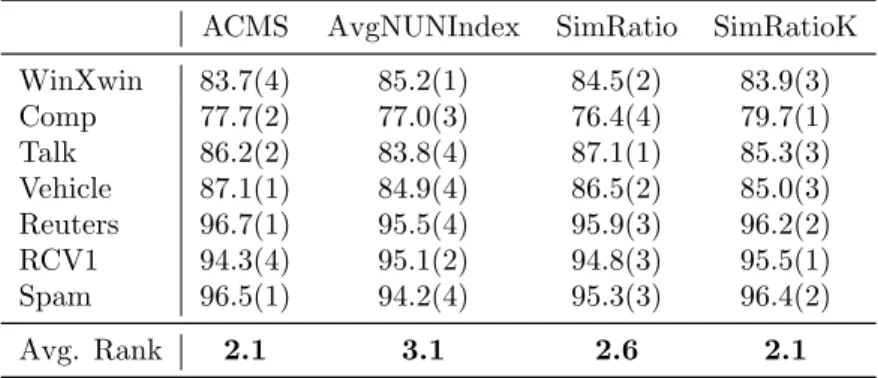
5.1 AULC scores of the AvgNUNIndex, SimRatio, SimRatioK and ACMS algorithms. . . 98
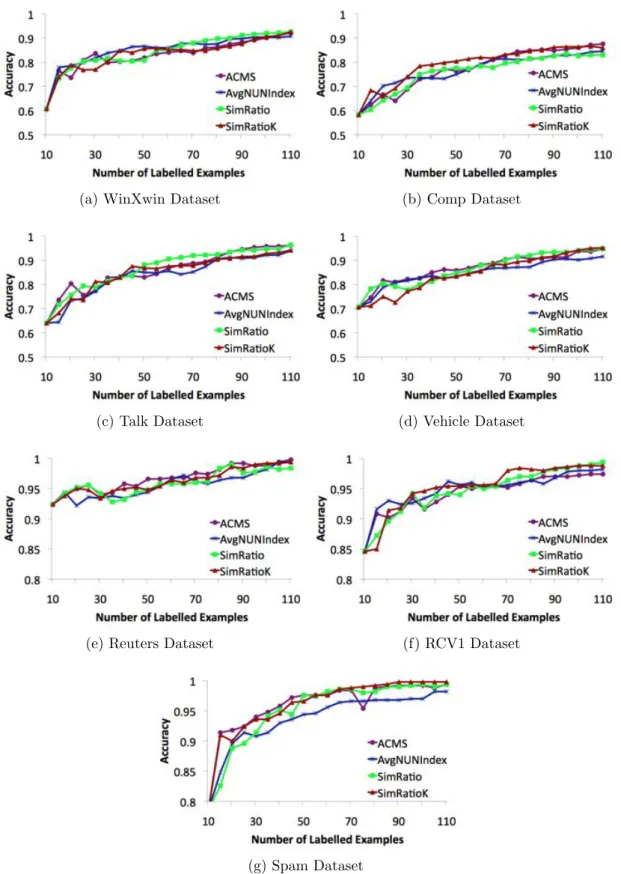
5.2 Effectiveness of the AvgNUNIndex, SimRatio and SimRatioK confi-dence measures in the ACMS algorithm. . . 100
5.3 AULC scores of the ACMS, US and RS selection strategies. . . 102
6.1 AULC scores and ranks of density sampling, diversity sampling, ran-dom sampling and the EGAL algorithm. . . 117
6.2 Illustrative AULC values for learning curves up to the specified num-ber of labels.. . . 119
6.3 Snapshots of Density Sampling, Diversity Sampling, EGAL and
Un-certainty Sampling on the Seven Datasets. . . 122
7.1 AULC scores of active learning using different non-deterministic clus-tering algorithms in initial training set selection. . . 139
7.2 AULC scores of active learning using different deterministic clustering algorithms in initial training set selection. . . 145
8.1 Details of datasets used in the reusability evaluation experiments. . . 151
8.2 Results for identifying the best selector. . . 162
8.3 Percentage overlap of the labelled sets between different selectors. . . 164
8.4 Results for identifying the best consumer. . . 166
8.5 Best selector and consumer pairs. . . 168
8.6 Time performance on the seven datasets (seconds). . . 169
9.1 Recipe structures. . . 177
9.2 Datasets from the 2010 Active Learning Challenge. . . 182
9.3 GlobalScores on the six datasets. . . 183
C.1 Preference values. . . 208
List of Figures
1.1 Active learning framework. . . 42.1 Cosine similarity. . . 20
2.2 SVM for a simple classification scenario. . . 22
3.1 Pool-based active learning framework. . . 37
3.2 A learning curve. . . 59
3.3 Extended pool-based active learning framework. . . 68
4.1 The flow diagram of the ALL system. . . 80
4.2 Illustrative learning curves and AULC scores calculations. . . 86
5.1 Comparison of individual confidence measures and ACMS as the se-lection strategy. . . 99
5.2 Comparison of the ACMS, US and RS selection strategies. . . 101
6.1 Illustrating how density-based sampling can perform badly. . . 108
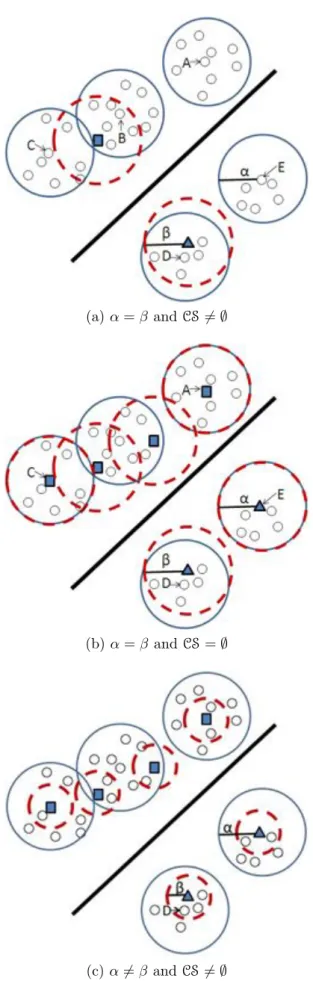
6.2 The relationship between parameters α and β and the candidate set CS. . . 111
6.3 The effect of the balancing parameter w on the EGAL algorithm. . . 115
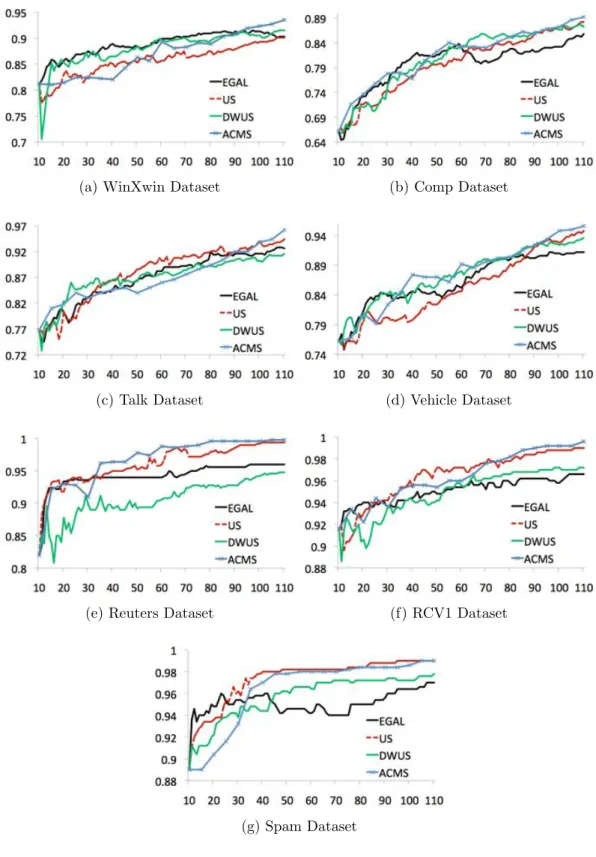
6.4 Comparison of Density, Diversity, EGAL and RS selection strategies. 116 6.5 Comparison of EGAL, US, DWUS and ACMS selection strategies. . . 120
6.6 A visualisation of the active learning process running on the WinXwin dataset using a density only selection strategy. . . 125
6.7 A visualisation of the active learning process running on the WinXwin dataset using a diversity only selection strategy. . . 126
6.8 A visualisation of the active learning process running on the WinXwin dataset using the EGAL selection strategy. . . 127
6.9 A visualisation of the active learning process running on the WinXwin dataset using an uncertainty sampling selection strategy. . . 128
6.10 A visualisation of the active learning process running on the Reuters dataset using a density only selection strategy. . . 129
6.11 A visualisation of the active learning process running on the Reuters dataset using a diversity only selection strategy. . . 130
6.12 A visualisation of the active learning process running on the Reuters dataset using the EGAL selection strategy. . . 131
6.13 A visualisation of the active learning process running on the Reuters dataset using an uncertainty sampling selection strategy. . . 132
7.1 The learning curves produced by the active learning process when the initial training set is chosen using random selection (RS), k-Means, KMeans+ME, and k-Medoids. . . 138
7.2 The learning curves produced by three runs of the active learning process when the initial training set is populated using k-Medoids clustering. . . 140
7.3 The learning curves produced by three runs of the active learning process when the initial training set is populated using KMeans+ME clustering. . . 141
7.4 Comparison of the ACMS and US selection strategies on the Comp dataset using k-Medoids clustering created initial training sets. . . 142
7.5 Comparison of the ACMS and US selection strategies on the WinXwin dataset using KMeans+ME created initial training sets. . . 143
7.6 The learning curves produced by the active learning process when the initial training set is chosen using furthest-first-traversal (FFT), ag-glomerative hierarchical clustering (AHC), affinity propagation clus-tering (APC), random selection (RS), and KMeans+ME. . . 144
8.1 Learning curves of three consumers with different selectors (as shown in legend) on the 20NG-WinXwin dataset. . . 154
8.2 Learning curves of three consumers with different selectors (as shown in legend) on the 20NG-Comp dataset. . . 155
8.3 Learning curves of three consumers with different selectors (as shown in legend) on the 20NG-Talk dataset. . . 156
8.4 Learning curves of three consumers with different selectors (as shown in legend) on the 20NG-Vehicle dataset. . . 157
8.5 Learning curves of three consumers with different selectors (as shown in legend) on the Reuters-1804 dataset. . . 158
8.6 Learning curves of three consumers with different selectors (as shown in legend) on the RCV1-2000 dataset. . . 159
8.7 Learning curves of three consumers with different selectors (as shown in legend) on the Spam-1000 dataset. . . 160
8.8 CPU time of three selectors on seven datasets. . . 170
9.1 F1 score comparison of active learning and random sampling.. . . 177
9.2 Accuracy comparison of active learning and random sampling. . . 178
Chapter
1
Introduction
Machine learning is an offshoot ofArtificial Intelligence (AI)(McCarthyet al.,1955). The primary goal of machine learning is to develop general purpose algorithms of practical value from a limited amount of data. The distinguishing factor in machine learning approaches to general AI is the use of data and the discovery of patterns in data. There are many examples of machine learning applications, such as medical diagnosis, fraud detection and weather prediction. Supervised learning and unsupervised learning are the two main areas of machine learning. Supervised learning is the machine learning task of generating a mapping from supervised or labelled training data to an output of classes or predictions. One core area of supervised learning is the classification task. The goal in classification is to create a function from input objects to output values, referred to as labels orclasses. The mapping or the function is referred to as a classifier or a model. The input objects
are things that are to be classified, also known as instances, tuples or examples. The machine learning approach to classification is to gather a set of examples with their classes known by manually labelling some number of examples. The set of labelled examples is known as a training set. Next a classifier is used together with the training set to generate a mapping from examples to labels. Then the trained classifier can be used to classify orlabel new, unseen examples.
Increasingly examples are available in free text form, the classification problem of determining the predefined categories of natural language documents, namely
text classification, becomes more and more important. A classic example of text classification is categorizing news articles into topics such as politics and sports. However, the competence of a classification system relies significantly on the quality of the training data used. Building a training set requires a large number of historical labelled examples. Gathering such labelled collections can be time consuming and expensive. In many cases limited resources are available for collecting such data which makes it difficult to create classifiers for known problems. Instead of randomly picking examples to be manually labelled for building the training set, we have the option of carefully choosing examples from the pool that are to be labelled using active learning. In this work, we explore active learning methods to label textual datasets.
1.1
Reducing Labelling Costs in Text
Classifica-tion
There are many situations where unlabelled examples are plentiful and cheap, but it is expensive and time-consuming to label these examples. For instance, it is easy to grab billions of webpages at essentially no cost, but much more costly to pay human annotators to label those documents with their topic categories. Likewise, it is simple to collect video clips data, but much harder to obtain good semantic content labels. It is also easier to obtain a large collection of compounds that may be good to cure some disease, but much more costly to run expensive biochemical tests to know which one really works. Fortunately, creating labelled datasets can be addressed using active learning. Active learning is a machine learning technique that can be used to build accurate classifiers or to label unlabelled datasets by selecting the most informative examples and querying their labels from human experts (the oracle). The application task we focus on is text classification.
A typical framework of active learning is shown in Figure1.1. In this framework, the active learner starts from a small labelled dataset and with access to a large pool of unlabelled data and selects the most informative unlabelled data from the pool. Then the active learner can query the true label of the selected most informative examples from the oracle, remove those selected examples from the pool and add them into the labelled dataset. This process is repeated until some stopping criterion has been met. This is in contrast with the traditional method of labelling randomly selected material, namely random sampling, which are often referred to as passive
Figure 1.1: Active learning framework.
learning.
The benefits of active learning for labelling can include a reduction in the amount of data needed to achieve learning, improved predictive accuracy, and reduced execu-tion time. These factors are of particular importance in the area of real-life machine learning applications. This thesis focuses on active learning labelling – a process that can benefit learning algorithms to create high-quality labelled datasets with minimum manual labelling efforts. Active learning for real-world dataset labelling should meet the following requirements (Tomanek, 2010):
• Accuracy: it should output a labelled dataset with high accuracy;
• Efficiency: it should have a reasonable interactive process with the oracle, which means fast selection cycles are preferred;
• Reusability: it should supply a labelled dataset which can be reasonably used by different applications.
for human labelling than traditional methods which randomly select examples for labelling, thus alleviating the large amounts of labelling workload for human experts and reduce the scale of the datasets, and consequently reduce the computational cost of classifiers.
1.2
Contributions of the Thesis
In this work, we place a particular emphasis on understanding the implementa-tion of active learning methods in text classificaimplementa-tion. The aim of this thesis is to explore various key aspects of active learning for the tasks of labelling large unla-belled textual datasets. The chapters that follow (i) formalise active learning and its applications to text classification, (ii) present the active learning scenarios and algorithms we have developed for labelling textual datasets, (iii) demonstrate the use of visualisation techniques in understanding active learning methods, (iv) inves-tigate the reusability problem in active learning. This thesis claims that labelled dataset creation for supervised machine learning tasks can be accomplished using active learning. We explored three main hypotheses in this thesis:
• Active learning strategies that consider confidence measures can perform bet-ter than strategies that rely on the direct output of the classifier.
• Active learning strategies that focus on exploration can perform better than those that focus on exploitation in the early learning stage.
• The active learning process can be bootstrapped using deterministic clustering techniques.
We proposed different ways to explore these issues, developing new selection strategies and new methods to seed active learning process. Our main contributions on these initial hypotheses can be summarised in the following way:
• Active learning literature review (Chapter 3): We presented a compre-hensive review of active learning and how it is used in text classification.
• Confidence-based selection strategy (Chapter 5): We developed a new selection strategy based on confidence measures (Huet al., 2009).
• Exploration guided selection strategy (Chapter6): We proposed a new selection strategy based on exploration that performs well in the early active learning stage where exploration is especially helpful (Hu et al., 2010a).
• Hybrid selection strategy (Section 9.2): We proposed a hybrid selec-tion strategy combining an exploitaselec-tion based selecselec-tion strategy and an ex-ploration based selection strategy which showed promising performance (Hu
et al., 2010b).
• Use of visulisation techniques in active learning (Section 6.4): We demonstrated the usefulness of visulisation in understanding active learning selection strategies (Mac Nameeet al., 2010).
• New method to seed active learning (Chapter 7): We proposed new
methods of using deterministic clustering algorithms to help bootstrap the active learning process (Hu et al., 2010c).
(Chap-ter 8): We conducted a comprehensive analysis of the reusability performance of classifiers used in text classification when applied to active learning. Results showed that a labelled dataset from an active learning process can generally be used to build different types of classifiers than the specific classifier em-ployed in the active learning selection strategy. It is best to use the same type classifier in the active learning selection as the one will be used in the sample reuse scenario.
• Best classifiers in active learning (Chapter 8): We identified the best classifiers to use in active learning for text classification.
Finally, during this research, we have published our results at different confer-ences. The complete list is given in Section 1.4.
Although we place a particular emphasis on text classification applications, the techniques described throughout this thesis are quite general in nature. Many ma-chine learning problems in natural language processing, bioinformatics and computer vision can be benefited from methods proposed in this work.
1.3
Outline of the Thesis
This thesis is structured as following:
• Chapter 2provides a high level overview of concepts from supervised learning and text classification.
• Chapter 3concisely surveys past research in the active learning domain. After a brief discussion of the general active learning process, an overview of common fields of active learning application is provided.
• Chapter 4 first describes the system framework design of ALL, our active-learning-based labelling system. Then it gives an initial evaluation of the pro-posed framework on a recipe dataset which shows that active learning methods can help in the creation of labelled datasets. Thirdly, a description of the ex-perimental methods and datasets used in the empirical evaluations throughout this thesis is provided.
• Chapter 5 presents the design, implementation and evaluation of ACMS – a novel ensemble based active learning selection strategy usingk-Nearest Neigh-bour classifier confidence measures and shows that ACMS compares favorably against current state-of-the-art methods.
• Chapter 6 first introduces EGAL, an exploration guided active learning se-lection strategy. Then it demonstrates the use of visualisation techniques in understanding active learning selection strategies.
• Chapter7addresses the question of how to select initial training sets for active learning. The two main objectives of Chapter 7 are to show that commonly used techniques are problematic and to show the superiority of deterministic clustering algorithms in creating initial training sets.
• Chapter 8 explores and discusses the reusability problem in active learning with the aim of identifying the best classifier in active learning in the context of text classification.
• Chapter 10 summarises key contributions of this work and highlights oppor-tunities for additional research.
1.4
Publications
The thesis is supported by the following publications:
[Hu et al. (2009)] Hu, R., Delany, S.J., Mac Namee, B.: Sampling with confi-dence: Using k-NN confidence measures in active learning. In: Proceedings of the UKDS Workshop at the 8th International Conference on Case-based Reasoning (ICCBR 09). (2009) 181-192
[Hu et al. (2010a)] Hu, R., Delany, S.J., Mac Namee, B.: EGAL: exploration guided active learning for TCBR. In: Case-Based Reasoning Research and Development, Volume 6176 of Lecture Notes in Computer Science. Springer Berlin / Heidelberg. (2010) 156-170
Explor-ing the frontier of uncertainty space. At the AISTATS 2010 Workshop on Active Learning and Experimental Design (May 16, 2010; Sardinia, Italy).
[Hu et al. (2010c)] Hu, R., Mac Namee, B., Delany, S.J.: Off to a good start: Using clustering to select the initial training set in active learning. In: Pro-ceedings of the Twenty-Third International Florida Artificial Intelligence Re-search Society Conference (FLAIRS 2010), AAAI. (2010) 26-31 (Best Student Paper Award)
Additional work related to the contribution is as following:
[Zhang et al. (2008)] Zhang, Q., Hu, R., Mac Namee, B., Delany, S.J.: Back to the future: Knowledge light case base cookery. In Schaaf, M., ed.: Proceed-ings of Workshop on Computer Cooking Contest, ECCBR’08. (2008) 239-248 (Champion of the 1st Computer Cooking Contest)
[Hu et al. (2008)] Hu, R., Mac Namee, B., Delany, S.J.: Sweetening the dataset: Using active learning to label unlabelled datasets. In Proceedings of the 19th Irish Conference on Artificial Intelligence and Cognitive Science. (2008) 53-62
[Lindstrom et al. (2010)] Lindstrom, P., Hu, R., Delany, S.J., Mac Namee, B.: SVM based active learning with exploration. At the AISTATS 2010 Workshop on Active Learning and Experimental Design (May 16, 2010; Sardinia, Italy).
[Mac Namee et al. (2010)] Mac Namee, B., Hu, R., Delany, S.J.: Inside the se-lection box: Visualising active learning sese-lection strategies. At the NIPS 2010 Workshop on Challenges of Data Visualization (December 11, 2010; Whistler, BC).
As a summary, the contributions of this work, the corresponding chapters of this thesis and the publications are shown in Table 1.1.
Table 1.1: Contributions, corresponding chapters and publications.
Contribution Chapter Publication
Active learning literature review Chapter3
Confidence-based selection strategy Chapter5 Huet al.(2009) Exploration guided selection strategy Chapter6 Huet al.(2010a)
Hybrid selection strategy Section9.2 Huet al.(2010b) Use of visulisation in active learning Section6.4 Mac Nameeet al.(2010)
New method to seed active learning Chapter7 Huet al.(2010c) Understanding of the reusability problem Chapter8
Chapter
2
Supervised Learning and Text
Classification
Machine learning is inherently a multidisciplinary field which draws on concepts and results from many fields, including probability and statistics, artificial intelligence, philosophy, psychology, information theory, cognitive science and other fields. This chapter introduces notations and provides a brief introduction to the formalisms most pertinent to the work presented in this thesis. More specifically, Sections 2.1
sketches basic principles and concepts of supervised learning with a focus on classifi-cation learning. Section 2.2describes text classification. Section2.3provides a brief overview of common approaches to text classification. Finally, methods to evaluate the performance of the text classification systems are presented.
2.1
Basic Concepts
In this section, a formal definition of the elements involved in supervised machine learning is given. We have revised some of the definitions and adapted them to the purpose of this thesis, with the aim of clarifying the classification task and setting a base terminology for further discussion. Therefore, the notation and definitions ex-posed in this section are the result of some consolidation of the most used formalisms we can find in supervised learning literature.
The goal of supervised learning is to find a functiong :X → Y which maps an example x∈X to its output value y∈Y, as shown in Definition 1.
Definition 1. (Example, Output) An example x ∈X represent an input object
in the data. X is the set of all possible examples in the input space where X =
{x1, . . . , xi, . . . , xN}. The output y ∈ Y represents an output value of an output
space and Y is the set of all possible values. ♣
Two types of learning problems are often defined depending on the output values Y: regression learning where Y = R, classification learning where Y = C (C is a set of classes andC ={c1, . . . , cj, . . . , cM}). Classification is the process to output a
value that matches an example to a class. The focus of this thesis is on classification learning. The output values y ∈ Y in classification learning are called classes or
labels. When applied to text classification tasks, an example is a text document, such as a recipe document. The classes could be the types of recipes, for example Y ={starter, maincourse, dessert}.
a machine learning approach for a specific problem, it is a key step to select an appropriate function (Mitchell,1997). The function is called a model or a classifier
in classification learning as defined in Definition 2. A binary classifier assigns a positive (+1) or negative class (−1) to each example; a multi-class classifier assigns a class from a set of classes C (|C| >2) to an example; and a multi-label classifier assigns a subset of the set of classes to an example, that is, it assigns more than just one class to an example.
Definition 2. (Classifier) A classifier is a function Ψ :X →C that maps exam-ples to assignment classes. For example, for the binary classifier C ={−1,+1}, so
Ψ :X → {−1,+1}. ♣
Usually, an example is characterised by a vector of features which is a vector of real values with a dimension for every feature in the feature space: �x ∈ Rk and
�x= (f1(x), . . . , fk(x)). A feature is any item that can be considered a characteristic
of an example by a classifier. It is important to identify which items will be features for the example. More details about feature representations of text documents can be found in Section 2.2.1.
2.2
Text Classification
Text classification (a.k.a. text categorization – TC) (Yang, 1999) is the task of assigning predefined categories to texts based on the contents of the documents. Text classification has an important role to play in the field of natural language processing or other text-based knowledge applications, especially with the recent explosion of readily available text data – such as electronic news articles, digital libraries, and
blogs. One example is spam filtering (Drucker et al., 1999) which attempts to sift through a user’s incoming emails and identify those that are unsolicited, unwanted or inappropriate – those that are considered ‘spam’ to the user. Another example is sentiment analysis (Panget al.,2002) which aims to determine the overall sentiment (positive or negative) expressed in a document, for example, the classification of online product reviews into those that are positive or negative about a product.
Text classification problems can be solved by applying supervised learning al-gorithms to train classification models with a collection of previous examples of the problem in question, for which the correct classifications (or labels) are known. These models can then be used to predict the labels of unlabelled documents ( Du-mais et al., 1998; Joachims, 1999; Nigam et al., 1999; Soucy & Mineau, 2001; Vid-hya.K.A & G.Aghila, 2010; Yang & Liu,1999).
A text classification system may be built up from the following components:
• Text representation: to convert documents into a set of features that can be handled by classification algorithms;
• Feature reduction: to reduce the number of features to make classification algorithms efficient which can be implemented by methods including dimension reduction (Davy & Luz, 2007b) and feature selection (Abe & Kudo, 2006;
Wiratunga et al.,2006; Yang & Pedersen,1997);
• Classifier training: to build up an autonomous classifier by using supervised learning algorithms;
the trained classifier.
Comparisons among different text classification techniques can be found inYang & Liu (1999) and Dem˘sar (2006).
2.2.1
Text Representation
In the representing step, documents are often tokenised first and then presented as feature vectors (a.k.aVector Space Model (VSM) orBag-Of-Words (BOW)) ( Ragha-van & Wong,1986; Saltonet al.,1975;van Rijsbergen,1979) where a subset of dis-tinct words occurring in the given documents are used as features. Words that are too common in the language are thought to be meaningless terms which are known as stop words include determiners, prepositions, auxiliaries, and so on. Stop words are usually removed. Words that occur in very few documents may also be removed. Stemming analysers such as Porter stemming algorithm (Porter,1980) can be used to remove the commoner morphological and inflexional endings from words.
The vector space model assumes that each word (orterm) is a dimension in the feature space. The dimension of the term space is the number of terms t in corpus. Each term ti in a text or document dj has an associated weight wij. One document
dj can be represented as: d�j =< w1j, w2j, . . . , wtj >. A collection of n documents
can be expressed by a Term×Document Matrix (TDM) where wij is the weight or
and documents, respectively. TDM= t1 t2 . . . tt d1 w11 w21 . . . wt1 d2 w12 w22 . . . wt2 : : : : : : : : dn w1n w2n . . . wtn
Different weighting schemes have been used (Salton & Buckley, 1988; Soucy & Mineau, 2005) to calculate the weight wij including a binary weight schema and
more complex term-weighting scheme. With the binary weight schema, if a term ti occurs in a document dj then the weight wij is 1, otherwise wij = 0. Term
Frequency (TF) gives each feature a weight proportional to the number of times it occurs within a given document. In most situations of term frequency schemes, tf is normalised with some normalisation techniques to prevent a bias towards longer documents. For example:
fij =f requency of term i in document j
tfij =fij/max i {fij}
Document Frequency (DF) is also employed in order to construct more sophis-ticated weighting mechanisms for texts. Document frequency of term i (dfi) means
(IDF) is used. The rationale behind IDF is that features that rarely occur over collections of documents are valuable, and that therefore, the IDF of a feature is inversely proportional to the number of documents that it appears in. One example is shown as following:
idfi = log2(N/dfi)
TF·IDF (Baeza-Yates & Ribeiro-Neto, 1999; Salton & Buckley, 1988) is one of the most common weighting scheme used where the term frequency is weighted by the inverse document frequency, that gives a higher weight to infrequent terms in the dataset:
wij =tfij ×idfi =tfij ×log2(N/dfi)
2.3
Approaches to Text Classification
Various models have been described in the literature on machine learning, such as those listed below:
• Probabilistic classifiers, such as Na¨ıve Bayes classifier (McCallum & Nigam,
1998a; Vidhya.K.A & G.Aghila, 2010);
• Decision trees (Mitchell,1997; Quinlan,1992);
• Margin classifiers, such as Support Vector Machines (Cortes & Vapnik, 1995;
Joachims, 1997; Vapnik, 1995);
• k-Nearest Neighbour classifiers (Cover & Hart,1967;Duda et al., 2000);
• Boosting and ensembles (Schapire & Singer, 2000);
• Other algorithms such as maximum entropy modeling (Greiff & Ponte, 2000) and logistic regression (Gey, 1994).
Among them, three most common approaches used for text classification tasks including thek-Nearest Neighbour classifier, Support Vector Machines and the Na¨ıve Bayes classifiers are described in more detail in the following sections.
2.3.1
k-Nearest Neighbour Classifiers
Nearest Neighbour (NN) algorithms are well-known and intensively used methods. The nearest neighbour classification is straightforward and intuitive: given a set of labelled training examples, a new unlabelled target example is assigned to the same label as its nearest neighbour which is identified using a similarity measure. It is often more accurate to take more than one neighbour into account, leading to the more common nearest neighbour classifier namely k-Nearest Neighbour (k-NN) where k nearest neighbours are used to determine the class of the given target example (Cover & Hart, 1967; Dudaet al., 2000).
The determination of the similarity between the given target and its neighbours is mostly based on distance measures. Two typical distance functions are the absolute distance (shown in Equation 2.1 where r = 1) and the Euclidean distance (shown in Equation 2.1 where r= 2). d(A, B) = ( n � i=1 |ai−bi|r) 1/r (2.1)
Figure 2.1: Cosine similarity. Adapted from Raymond J. Mooney’s talk about “Text Categorization”.
Cosine similarity (Baeza-Yates & Ribeiro-Neto, 1999) is commonly used in text classification to measure the similarity of two document vectors based on the cosine of the angle between two vectors as shown in Figure 2.1. The similarity between document d1 and the target document q is measured by the cosine of the angle
θ1. The same with the angle θ2 between d2 and q. The cosine similarity between
documents dj and dk is defined in Equation2.2.
CosSim(dj, dk) = � dj ·d�k |d�j| · |d�k| = �t i=1(wij ·wik) ��t i=1wij2 · �t i=1w2ik (2.2) Once the k-NN classifier determines the k neighbours (training examples) that are closest to the target example, a voting scheme is used to decide the class pre-diction of the target example. Majority voting is the most commonly used scheme. However in simple majority voting, the k neighbours contribute equally to the
de-cision of the prediction of the given target. This can be problematic. For example, in a sparse space, some of the neighbours of an target example may be far away and have little or no effect on the target example. In order to overcome this limita-tion, Weighted k-Nearest Neighbour (WKNN) technique (Hechenbichler & Schliep,
2004; Kibler & Aha, 1987), is proposed which is based on the idea that the close neighbours should get a higher weight in the decision than far ones.
An overview ofk-NN classifiers can be found in Cunningham & Delany(2007). The main computation in the k-NN algorithm is the sorting of training examples in order to find the k nearest neighbours for the target example. Several algorithms (Aryaet al.,1998; Connor & Kumar,2010;Garcia et al., 2008) have been proposed in order to reduce the computational burden of k-NN classifiers. The advantage of the k-NN algorithm includes its simplicity, flexibility to incorporate different data types and adaptability to irregular feature spaces. Even with its simplicity, the results obtained by applying k-NN algorithm are competitive, as shown by Yang & Liu (1999).
2.3.2
Support Vector Machines
The Support Vector Machine (SVM) (Vapnik, 1995) is probably the most promi-nent approach to maximum margin classification which is essentially specified by a separating hyperplane in the multi-dimensional input space Rk given by the
fea-ture representation �x of the example x. The best separating hyperplane is the one that represents the largest separation – called margin. The distance from it to the nearest training example on each side is maximised. The hyperplane is defined as
Figure 2.2: SVM for a simple classification scenario: The solid line represents the separating hyperplane. Points on the dashed lines are the support vectors. The figure is adapted from (Tomanek,2010).
in Equation 2.3 where w� is a weight vector in Rk defining the orientation of the hyperplane and b is an offset (b ∈R).
< �w, �x > +b = 0. (2.3) The basic idea behind SVM is to find those examples (support vectors) that delimit the widest frontier between positive and negative examples in the feature space as shown in Figure2.2(seeBurges(1998) for a detailed introduction to SVM). Support vectors are examples which are closest to the hyperplane. The width of the classification border is known as the hyperplane margin. The SVM classifier is given by Equation2.4. The examples for which< �w, �x > +b >0 are classified as positive
examples, or negative otherwise.
fw,b� (x) =sgn(< �w, �x > +b) (2.4)
SVM classifiers can deal with non-linearly separable data by mapping the feature representation�x of examplex with a non-linear mapping function Φ :Rk →Hinto
a higher-dimensional feature space Hwhere the separability between examples may be easier. This is done using a kernel function K(�x, �y) =< φ(�x), φ(�y)> leading to a reformulation of the SVM classifier into Equation 2.5 where s is the number of support vectors which have non-zero αi values. Well-known kernel functions include
the linear kernel, the polynomial kernel, Radial Basis Functions (RBF) , and sigmoid kernels. ˆ Φ(x) = s � i=1 αiyiK(x, wi) +b. (2.5)
While SVM classifies are formulated for binary classification problems, there are ensemble approaches to multi-class classification with SVMs, such as the one-against-rest (also namely one-against-all) (Bottou et al., 1994), one-against-one
and Error Correcting Output Codes (ECOC) (Morelos-Zaragoza, 2006) . A unified approach of reducing multi-class to binary for margin classifiers has been proposed in Allwein et al. (2000). A comparison of methods for multi-class SVM classifiers can be found in Hsu & Lin (2002).
Support Vector Machines have been applied successfully in many text classifica-tion tasks since most text classificaclassifica-tion problems are linearly separable and SVMs are robust in high dimensional space and robust with sparse data (Joachims,1997).
2.3.3
Na¨ıve Bayes Classifiers
The Na¨ıve Bayes classifier is a popular supervised learning technique for text clas-sification and has been found to perform surprisingly well despite its simplicity (Domingos & Pazzani, 1997; Friedman et al., 1997; Langley et al., 1992; Lewis,
1998; Lewis & Ringuette, 1994; McCallum & Nigam, 1998a). For a good survey of using Na¨ıve Bayes classifiers in text classification see Vidhya.K.A & G.Aghila
(2010).
The underlying theorem for Na¨ıve Bayes classifiers is Bayes’ Law as in Equa-tion 2.6 which is based on the assumption that all features are conditional indepen-dent. A probabilistic model that embodies the assumption is posited and training examples are used to estimate the parameters of the proposed model. The classifi-cation on a new examples is performed by selecting the class that is most likely to have generated the example.
P(y|x) = P(y)P(x|y)
P(x) (2.6) In a dataset, every document has the same probability, so P(x) is a constant which can be eliminated from Equation 2.6. Based on the Na¨ıve Bayes assump-tion that all features are conditional independent, the Na¨ıve Bayes (NB) model is formulated as in Equation 2.7. This is used in text classification to determine the probability that a document x is of class y just by looking at the frequencies of words in the document.
P(y|�x)∝P(y, �x) = P(y)
k
�
j=1
P(xj|y). (2.7)
The Na¨ıve Bayes classifier exists in different versions, depending on how exam-ples are represented. One version is called multi-variate Bernoulli model (Koller & Sahami,1997;Larkey & Croft,1996) in which an example is represented as a binary vector of term occurrences. Another is the multinomial model in which an example is represented as a vector of term counts (Mitchell,1997). Descriptions of the differ-ences of these two models can be found in McCallum & Nigam (1998a), Schneider
(2004), and Schneider(2003). Several work shows that the multinomial model usu-ally performs better than the multi-variate Bernoulli model (Eyheramendy et al.,
2003; McCallum & Nigam, 1998a).
There was work that focused on the analysis of the limitations of the Na¨ıve Bayes models (McCallum & Nigam,1998a;Rennieet al.,2003). Airoldiet al.(2004) proposed an extension to the widely-used multinomial model for texts which allows better modelling of frequent words.
2.4
Performance Measures
This section describes measures and methods to evaluate the performance of classi-fiers. Lewis (1991) supplied a review on how evaluation is carried out in text clas-sification systems. The evaluation of a text clasclas-sification system is usually based on test examples that have been already labelled by human experts (Sch¨utzeet al.,
Table 2.1: Contingency table for binary classification scenario. true class p n total predicted class p’ TP FP P’ n’ FN TN N’ total P N 2006).
Table 2.1 shows a contingency table (or confusion matrix) illustrating the out-comes for a binary classification problem where one class is known as positive and the other as negative. If the outcome from a prediction is positive and the actual label is also positive, then it is called atrue positive (TP); however if the actual label is negative then it is said to be a false positive (FP). Conversely, a true negative
(TN) has occurred when negative examples are correctly labelled as negative, and
false negative (FN) is when positive examples are incorrectly labelled as negative. Given the numbers from the contingency table, several performance measures can be calculated, such as accuracy (Equation 2.8), error rate (Equation 2.9),true negative rate(TNRate, orspecificity, Equation2.10) andfalse positive rate (FPRate, Equation 2.11). The true negative rate measures the proportion of negative exam-ples that are correctly labelled. The false positive rate measures the proportion of negative examples that are misclassified as positive. Besides these measures, pre-cision and recall from information retrieval are adopted and commonly used for evaluating a text classification system. Precision is the ratio of correct labelling of positive examples (or target examples) divided by the total number of the predic-tions that are positive, shown in Equation 2.12. Recall is defined to be the ratio of correct labelling positive examples (or target examples) divided by the total number
of examples whose actual labels are positive in the dataset, shown in Equation2.13. The true positive rate (TPRate, or sensitivity) which measures the proportion of positive examples that are correctly labelled is calculated in the same way as recall as in Equation 2.13.
Accuracy= T P +T N
T P +F P +T N +F N (2.8) Err = 1−ACC (2.9) T N Rate=Specif icity = T N
N =
T N
F P +T N (2.10) F P Rate= 1−Specif icity = F P
N =
F P
F P +T N (2.11) P recision= T P
T P +F P (2.12) Recall =T P Rate=Sensitivity = T P
T P +F N (2.13) In a non-binary classification problem, micro-averaging and macro-averaging (Lewis, 1992) are introduced to calculate precision and recall. Micro-averaged val-ues are calculated by constructing a global contingency table, and then calculating precision (Equation 2.14) and recall (Equation 2.15) using these sums. In contrast, macro-averaged scores are calculated by first calculating precision and recall for each class and then taking the average of these, as shown in Equation 2.16and 2.17
respectively. Pmicro = �|C| i=1T Pi �|C| i=1(T Pi+F Pi) (2.14) Rmicro = �|C| i=1T Pi �|C| i=1(T Pi+F Ni) (2.15) Pmacro = 1 |C| |C| � i=1 T Pi T Pi+F Pi (2.16) Rmacro = 1 |C| |C| � i=1 T Pi T Pi+F Ni (2.17) It is usually beneficial to have a single measure assessing the system performance. One of the most used measures for the overall performance is F1 measure which is defined as the harmonic mean of precision and recall, shown in Equation 2.18. An-other overall measurement, Precision-Recall BreakEven Point (PRBEP) is defined as the precision and recall value at which the two are equal.
F1 = 2×P recision×Recall P recision+Recall =
2T P
2T P +F P +F N (2.18)
Provost et al. (1998) suggested that using measures such as accuracy can be misleading and proposed to use Receiver Operator Characteristic (ROC) curves to present results for binary classification problems. A receiver operating characteristic curve is a plot of the true positive rate on the y-axis against the false positive rate on the x-axis which shows how the number of correctly classified positive exam-ples varies with the number of incorrectly classified negative examexam-ples. In order to compare ROC curves of different classifiers, one often calculates theArea Under the receiver operating characteristic Curve (AUC) (Hanley & McNeil,1982) .
When comparing multiple classifiers, usually multiple runs of the experiments are launched with a different partition of the training set and the test set to reduce the possible bias introduced by the splitting of training set and test set. n-fold cross-validation strategy (Chang et al., 1992; Devijver & Kittler, 1982; Kohavi, 1995;
Manning & Schutze,1999) is used most frequently which randomly divides the data collection into n sets of equal size. At each turn, one set is used for testing and the rest for training the system. The final result is an averaged measurement of the experiment over every partition made.
Statistical tests are used to decide whether the performance difference between multiple classification algorithms are significant or not. For example, Yang & Liu
(1999) compared five text classification methods by using a set of designed signif-icance tests. Dietterich (1998) gave a review of five approximate statistical tests for determining whether one classification algorithm is better than another one on a particular classification problem and suggested that cross validation t-test is very powerful. Dem˘sar (2006) recommended a set of simple non-parametric tests for sta-tistical comparisons of classifiers with results that are not normally distributed: the Wilcoxon signed-rank test (Wilcoxon, 1945) for comparison of two classifiers and the Friedman test (Friedman, 1940) for comparison of more classifiers over multiple datasets.
2.5
Conclusions
In this chapter, we have outlined basic concepts and approaches to classification problems. Classification is one core area of supervised learning research. The goal
of classification learning is to put examples into classes based on a given collection of labelled examples – a training set. There has been significant research into text classification where examples to be classified are presented in textual forms. Typical text classification applications include spam filtering, topic classification and sen-timent classification. There are a number of approaches to deal with classification problems. Among them, k-Nearest Neighbour classifiers, support vector machines and Na¨ıve Bayes classifiers are very popular. Measures including accuracy, precision, recall, and AUC are usually used to measure the performance of text classification systems.
In order to build a text classification system, a labelled training dataset would be required. It is easy to get the articles themselves but hard to label them because of the huge amount of documents involved and the time requirement. Usually human experts need time to read those articles and label them. On the other hand, not only reading but also judgement about the articles are needed to label them. This would make the labelling process time consuming and expensive. Active learning is a machine learning technique which can be used to build labelled datasets with minimum human labelling effort. Our objective is to apply active learning to the problem of generating labelled textual datasets. The next chapter gives a literature review on active learning with emphasis on the selection strategies design.
Chapter
3
Active Learning
As discussed in Chapter 2, when using supervised learning methods to solve learn-ing problems, a set of examples labelled with their actual classes is required to train a model. The success or failure of such learning systems is largely determined by the datasets used to train them. Without a good dataset it is difficult to build a quality classifier. Unfortunately, manually generating collections of labelled exam-ples is typically time-consuming and expensive since it usually involves expensive experts such as doctors or engineers. This can be a real barrier to the creation of classification systems, as often the time or money is not available to build a labelled training set. Fortunately, this is not an insurmountable problem. Active learning is a machine learning technique that can be used to select only the most informative examples for labelling and help to reduce the labelling effort.
3.1
Basic Concepts and Problem Settings in
Ac-tive Learning
As was mentioned previously in Section 2.1, in traditional supervised learning, the learner is given some training examples and builds a classification model. The training examples are usually selected by random sampling. This way is referred to aspassive learning (Tong,2001). However, in many text classification tasks, labelled training documents are often expensive to obtain, while unlabelled documents are readily available in large quantities. For example in document relevancy filtering (Xu
et al., 2007) although there are a large number of potential unlabelled documents available, labelled documents are expensive to obtain because human evaluation is required in order to ascertain relevance.
Active Learning (AL) (see Settles, 2009, for a review) is an iterative learning process that can be used to build high performance classifiers or labelled datasets by selecting only the most informative examples from a larger unlabelled dataset for labelling by an oracle (normally a human expert). Active learning first garnered serious research attention in the 1980s (Angluin, 1988) and since has remained a vibrant research area. Active learning is widely used in situations where there are vast amounts of unlabelled data available (e.g. astrophysical data (Schneider,2009), image retrieval (Dagliet al., 2005;Gosselin & Cord,2005;Hoiet al.,2009b;Tong & Chang, 2001), natural language processing (Tomanek & Hahn, 2009; Zhu & Hovy,
2007) and text classification (McCallum & Nigam, 1998b; Novak et al., 2006)) or where labelled training examples are expensive or time consuming to obtain (e.g.
bioinformatics (Cebron & Berthold,2006) or medical applications (Warmuth et al.,
2003)). Several recent applications of active learning are summarised in Table 3.1. Table 3.1: Some successful applications of active learning.
Domain Description
bioinformatics drug discovery (Warmuth et al., 2003), medical image classification (Hoi et al., 2006b), cancer classification (Liu, 2004), mining of cell assay images (Cebron & Berthold,2005), plankton recognition (Luoet al.,2005), medical subject headings assignment (Sohnet al.,2008), time-series gene expression analysis (Singhet al.,2005) natural language processing named entity recognition (Laws & Sch¨utze, 2008; Shen
et al.,2004), word sense disambiguation (Imamuraet al., 2009; Zhu & Hovy, 2007), parse selection (Baldridge & Osborne,2003), spoken language understanding (Tur et al.,2005), frame assignment (Ghayoomi,2010) detection outlier detection (Abe et al., 2006), network intrusion
detection (Li & Guo, 2007), malicious code detection (Moskovitch et al., 2007), rare category detection (He & Carbonell, 2007), mine detection (Juszczak & Duin, 2003)
robotics robot manipulation (Moraleset al.,2004)
astrophysics anomaly and rare-category detection (Pelleg & Moore, 2004)
texts classification (McCallum & Nigam,1998b;Nigam & Mc-Callum, 1998), texture segmentation (Juszczak & Duin, 2003), spam filtering (Sculley, 2007; Segal et al.,2006), labelling textured data (Turtinen & Pietik¨ainen,2005)
information extraction extracting attribute-value pairs from product descrip-tions (Probst & Ghani, 2007); extracting noun phrases that belong to a predefined set of semantic classes (Jones et al.,2003)
information retrieval relevance feedback (Dagli et al., 2006; Xuet al., 2007), music retrieval (Mandelet al.,2006), active information retrieval framework (Loureiro & Siegelmann,2005) software engineering automatic classification of software behavior (Bowring
et al.,2004)
speech recognition select a good training-data subset for transcription (Lin & Bilmes,2009;Yuet al.,2009), classify voicemail mes-sages (Kapooret al., 2007b)
recommender systems minimize the number of requests for user evaluations (Teixeiraet al., 2002)
computer vision image classification (Li et al., 2004b), video annotation (QI et al., 2006; Yan et al., 2003), visual object detec-tion (Abramson & Freund, 2005), image segmentation (Maet al.,2006), human motion capture (Cooperet al., 2007), object category recognition (Kapooret al.,2007a), object detection (Nguyen et al., 2009), image retrieval (Cord et al., 2007; Dagliet al., 2005), optical character recognition (Monteleoni & Kaariainen, 2007)
There are three main forms that have been considered in the active learning literature: (i) active learning with membership queries, (ii) stream based active learning, and (iii) pool-based active learning.
In active learning with membership queries (Angluin, 1988), on each trial the learner constructs an example in the input space and requests its label from the oracle. This approach was originally used in concept induction (Angluin, 1988) and involved learning to identify an unknown concept drawn from a finite hypoth-esis space using queries to gather information about the unknown concept. It has been used to predict the target position of a robot hand given a set of joint angles (Cohn, 1996) and to classify handwritten characters (Baum & Lang, 1992). The main advantage of active learning with membership queries is that it can work in situations when unlabelled data is unavailable. However, Baum & Lang found that examples generated by the algorithm are not meaningful and recognizable by the human experts. This approach is almost impossible for text classification because the documents constructed by the algorithm are implausible examples which have no meaningful contents.
Instream based active learning (Freundet al.,1997), queries are based on filtering a stream of unlabelled examples rather than on creating artificial examples. The learner is presented with a stream of unlabelled examples and chooses whether or not to query the oracle for the label for each example in the stream. Stream based active learning is predominately used in time series data such as video sensor data (Saunieret al.,2004). The advantages of stream based active learning is that it can deal with complex and noisy data (in the case of temporal evolving data) and it can be used in dynamic and online learning scenarios. Sculley (2007) investigated the use of stream based active learning method for spam filtering where the filter was exposed to a stream of messages. Stream based approaches have the disadvantage