Parallelizing Support Vector Machines for
Scalable Image Annotation
A Thesis submitted for the Degree of
Doctor of Philosophy
By
Nasullah Khalid Alham
Department of Electronic and Computer Engineering
School of Engineering and Design
Brunel University
Parallelizing Support Vector Machines for Scalable Image Annotation ii
Abstract
Machine learning techniques have facilitated image retrieval by automatically classifying and annotating images with keywords. Among them Support Vector Machines (SVMs) are used extensively due to their generalization properties. However, SVM training is notably a computationally intensive process especially when the training dataset is large.
In this thesis distributed computing paradigms have been investigated to speed up SVM training, by partitioning a large training dataset into small data chunks and process each chunk in parallel utilizing the resources of a cluster of computers. A resource aware parallel SVM algorithm is introduced for large scale image annotation in parallel using a cluster of computers. A genetic algorithm based load balancing scheme is designed to optimize the performance of the algorithm in heterogeneous computing environments.
SVM was initially designed for binary classifications. However, most classification problems arising in domains such as image annotation usually involve more than two classes. A resource aware parallel multiclass SVM algorithm for large scale image annotation in parallel using a cluster of computers is introduced.
The combination of classifiers leads to substantial reduction of classification error in a wide range of applications. Among them SVM ensembles with bagging is shown to outperform a single SVM in terms of classification accuracy. However, SVM ensembles training are notably a computationally intensive process especially when the number replicated samples based on bootstrapping is large. A distributed SVM ensemble algorithm for image annotation is introduced which re-samples the training data based on bootstrapping and training SVM on each sample in parallel using a cluster of computers.
The above algorithms are evaluated in both experimental and simulation environments showing that the distributed SVM algorithm, distributed multiclass SVM algorithm, and distributed SVM ensemble algorithm, reduces the training time significantly while maintaining a high level of accuracy in classifications.
Parallelizing Support Vector Machines for Scalable Image Annotation iii
Table of Contents
Chapter 1 Introduction...1 1.1 Background...1 1.2 Motivation of Work...4 1.3 Major Contributions...51.4 Structure of the Thesis...8
Chapter 2 Literature Review Related to the Thesis...10
2.1 Image Annotation Techniques...10
2.3 Support Vector Machines (SVM)...11
2.3 Distributed SVM...12
2.4 Distributed multiclass SVM...12
2.5 SVM Ensemble...13
2.6 Related Work...13
2.6.1 Image Annotation Techniques...13
2.6.2 Distributed SVM...17
2.6.3 Distributed multiclass SVM...19
2.6.4 SVM Ensemble...21
2.7 Summary...23
Chapter 3 Evaluation of Machine Learning Classifiers for Image Annotation...25
3.1 SVM...25
3.2 Bayesian network...25
3.3 k-Nearest Neighbour...26
Parallelizing Support Vector Machines for Scalable Image Annotation iv
3.5 Composite Classifiers...27
3.5.1 Bagging...27
3.5.2 Boosting...27
3.6. Performance Evaluation...27
3.6.1 Preparing Training Images...29
3.6.2 Experiment Results...30
3.7 Summary...32
Chapter 4 Resource Aware Parallel SVM for Scalable Image Annotation...33
4.1 The Design of MRSMO...34
4.1.1 SMO Algorithm...34
4.1.2 Cascade SVM...35
4.2 The RASMO Algorithm...36
4.2.1 MapReduce model...36 4.2.2 RASMO Design...37 4.3 Load Balancing...39 4.4 Experimental Results...43 4.4.1 Image Corpora...44 4.4.2 Performance Evaluation...44 4.5 Simulation Results...47 4.5.1 Simulator Design...48
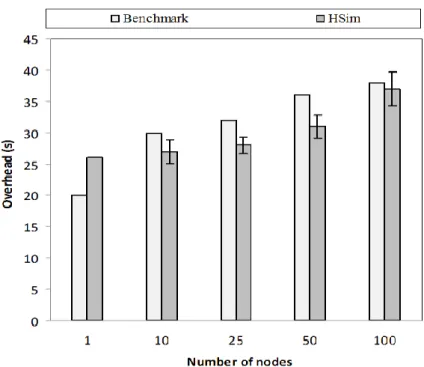
4.5.2 Validation of HSim with Benchmarks...49
4.5.3 Comparing of HSim with MRPerf...52
4.5.4 Simulation Results...53
4.5.5 Load Balancing...54
4.5.5.1 Overhead of the Load Balancing Scheme...56
4.6 Summary...58
Chapter 5 Parallelizing Multiclass SVM for Scalable Image Annotation...59
5.1 The Design of RAMSMO...59
5.1.1 One Against One method...59
Parallelizing Support Vector Machines for Scalable Image Annotation v
5.2 RAMSMO...61
5.2.1 The Algorithm Design...61
5.3 Load Balancing...63 5.4 Experimental Results...63 5.4.1 Image Corpora...64 5.4.2 Performance Evaluation...64 5.5 Simulation Results...67 5.5.1 Scalability...67 5.5.2 Load Balancing...69
5.5.3 Overhead of the Load Balancing Scheme...72
5.6 Summary...73
Chapter 6 Distributed SVM Ensembles for Scalable Image Annotation...74
6.1 SVM Ensemble...74
6.1.1 Aggregation Methods...75
6.1.2 Balanced Bootstrapping...76
6.2 Bias Variance Decomposition...77
6.3 The MRESVM Algorithm...78
6.4 Experimental Results...81
6.4.1 Image Corpora...81
6.4.2 Performance Evaluation...81
6.4.3 Measuring bias and variance...83
6.5 Simulation Results...85 6.5.1 Scalability...86 6.6 Summary...88 Chapter 7 Conclusions...89 7.1 Conclusions...89 7.2 Future Work...91 References...92
Parallelizing Support Vector Machines for Scalable Image Annotation vi
List of Figures
Figure 1.1: CBIR main processes...1
Figure 3.1: Image annotation system architecture...28
Figure 3.2: A snapshot of the system...29
Figure 3.3: Sample images...30
Figure 3.4: Accuracy in image annotations... 31
Figure 3.5: Overheads in training models...32
Figure 4.1: A cascade SVM example...36
Figure 4.2: The MapReduce model...37
Figure 4.3: The architecture of RASMO………...38
Figure 4.4: A snapshot of the image annotation system...44
Figure 4.5: The efficiency of RASMO using 12 mappers...45
Figure 4.6: The efficiency of fully converge RASMO using 12 mappers...46
Figure 4.7: The overhead of RASMO...47
Figure 4.8: HSim Architecture...48
Figure 4.9: Grep Task evaluation (533MB/node)...50
Figure 4.10: Grep Task evaluation (1TB/cluster)...50
Figure 4.11: Selection Task evaluation...51
Figure 4.12: UDF Aggregation Task evaluation...52
Figure 4.13: A comparison of HSim with MRPerf...52
Figure 4.14: The scalability of RASMO in simulation environments...54
Figure 4.15: The performance of RASMO with load balancing...55
Figure 4.16: The performance of RASMO with varied sizes of data...56
Figure 4.17: The convergence of the RASMO...57
Figure 4.18: Overheads of the load balancing algorithm...58
Figure 5.1: The architecture of RAMSMO………....61
Figure 5.2: A snapshot of the image annotation system...64
Figure 5.3: The efficiency of RAMSMO in SVM training using 12 mappers...65
Figure 5.4: A comparison of RAMSMO and MRSMO...66
Figure 5.5: The overhead of RAMSMO using equal and unequal binary chunks...66
Parallelizing Support Vector Machines for Scalable Image Annotation vii
Figure 5.7: The performance of RAMSMO with load balancing...70
Figure 5.8: The performance of RAMSMO with different datasets...71
Figure 5.9: A comparison RAMSMO with MinMin and MaxMin...71
Figure 5.10: The convergence of the RAMSMO...72
Figure 5.11: Overheads of the load balancing scheme...73
Figure 6.1: Architecture of SVM ensemble...75
Figure 6.2: MRESVM architecture double hierarchical combination...79
Figure 6.3: MRESVM architecture with majority voting combination...79
Figure 6.4: A snapshot of the image annotation system...81
Figure 6.5: The efficiency of MRESVM using 12 mappers...82
Figure 6.6: The overhead of MRESVM...83
Figure 6.7: Bias–variance decomposition...84
Figure 6.8: Classification error of MRESVM with random and balanced sampling...85
Figure 6.9: The scalability of MRESVM in simulation environments...87
Figure 6.10: Comparison of simulation results between chunk sizes 11.4 MB and 100MB...87
Parallelizing Support Vector Machines for Scalable Image Annotation viii
List of Tables
Table 4.1: HADOOP Configuration for RASMO...45
Table 4.2: Summarized performance results of RASMO...47
Table 4.3: Configurations for scalability evaluation...53
Table 4.4: Configurations for load balance evaluation...54
Table 5.1: HADOOP Configuration for RAMSMO...65
Table 5.2: Summarized performance results of RAMSMO...67
Table 5.3: Configurations for scalability evaluation of RAMSMO...68
Table 5.4: Configurations for load balance evaluation of RAMSMO...69
Table 6.1: HADOOP Configuration for MRESVM...72
Table 6.2: Summarized performance results of MRESVM...85
Parallelizing Support Vector Machines for Scalable Image Annotation ix
List of Algorithms
Algorithm 4.1: Sequential Minimal Optimization Algorithm...35
Algorithm 4.2: RASMO Algorithm...39
Algorithm 5.1: RAMSMO Algorithm...62
Parallelizing Support Vector Machines for Scalable Image Annotation x
Acknowledgments
I would like to thank all those who have given me academic and moral support for my research work over the last three years. I would like to thank the department of Electronic and Computing Engineering, in particular to my supervisor, Dr. Maozhen Li for his guidance and valuable advice.
I would like to thank all my family members, My mother, My wife, My brothers and sisters for their support and to whom I dedicate this work.
I would like to thank my friends and fellow PhD students Yang Liu and Suhel Hammoud for their help and advice over the last three years.
Parallelizing Support Vector Machines for Scalable Image Annotation xi
Author’s Declaration
The work described in this thesis has not been previously submitted for a degree in this or any other university and unless otherwise referenced it is the author’s own work.
Parallelizing Support Vector Machines for Scalable Image Annotation xii
Statement of Copyright
The copyright of this thesis rests with the author. No quotation from it should be published without his prior written consent and information derived from it should be acknowledged.
Parallelizing Support Vector Machines for Scalable Image Annotation xiii
Publications
The following papers have been accepted for publication or under review as a direct or indirect result of the research discussed in this thesis.
Journal Papers
N. K. Alham, M. Li, Y. Liu and S. Hammoud, A MapReduce-based Distributed SVM Algorithm for Automatic Image Annotation, Computers & Mathematics with Applications, Elsevier (accepted for publication)
Y. Liu, M. Li, N. K. Alham, S. Hammoud, HSim: A MapReduce Simulator in Enabling Cloud Computing, Future Generation Computer Systems (FGCS), the International Journal of Grid Computing and e-Science, Elsevier Science (accepted for publication)
N. K. Alham, M. Li, Y. Liu and S. Hammoud, Parallelizing Multiclass Support Vector Machines for Scalable Image Annotation, Neurocomputing, Elsevier Science (under review)
N. K. Alham, M. Li, Y. Liu and S. Hammoud, A Resource Aware Parallel SVM for Scalable Image Annotation, Parallel Computing, Elsevier Science (under review)
G. Caruana, M. Li, N.K. Alham, and Y. Liu, A Parallel Support Vector Machine for Large Scale Spam Filtering, information Sciences, Elsevier Science (under review)
Y. Liu, M. Li, N. K. Alham, S. Hammoud, A Resource Aware Distributed LSI for Scalable Information Retrieval, Information Processing and Management, Elsevier Science (under review)
Conference Papers
N. K. Alham, M. Li, S. Hammoud, Y. Liu, M. Ponraj, MapReduce-based Distributed SMO for Support Vector Machines, Proc. of IEEE FSKD’10, pp. 2983-2987.
Parallelizing Support Vector Machines for Scalable Image Annotation xiv
N. K. Alham, M. Li, S. Hammoud and H. Qi, Evaluating Machine Learning Techniques for Automatic Image Annotations, Proc. of IEEE ICNC09-FSKD09, pp.245-249, 2009 (invited paper).
N. K. Alham and M. Li, Content Based Image Retrieval: A Review, Proc. of ICAC’08, Sept. 2008, Brunel University, UK.
Y. Liu, M. Li, S. Hammoud, N.K. Alham, M. Ponraj, Distributed LSI for Information Retrieval, Proc. of IEEE FSKD’10, pp. 2978-2982.
S. Hammoud, M. Li, Y. Liu, N. K. Alham, Z. Liu, MRSim: A Discrete Event based MapReduce Simulator, Proc. of IEEE FSKD’10, pp. 2993-2997.
Parallelizing Support Vector Machines for Scalable Image Annotation 1
Chapter 1
Introduction
This chapter briefly describes the background to the problems investigated in this thesis, motivation of work, major contributions and the structure of the thesis.
1.1 Background
The increasing volume of images being generated by digitized devices has brought up a number of challenges in image retrieval. Content Based Image Retrieval (CBIR) was proposed to allow users retrieve relevant images based on their low-level features such as colour, texture and shape. The past decade has seen a rapid development in CBIR. In CBIR systems images are first segmented into regions or fixed size blocks, and then image features can be extracted. For example, by extracting colour histograms, the colour content of an image can be represented [21]. In a retrieval process, users feed the retrieval system with query images. The CBIR system then computes these images into its internal representation of feature vectors. The similarities or distances between the feature vectors of a query image and those of the images in the image database can be calculated and retrieval is performed with the aid of an indexing scheme such as HG-tree [23]. HG-tree is a multi dimensional Point Access Method (PAM) which is used to index multi-dimensional data to support queries such as ―Find all images that are similar to a query image‖. Figure 1.1 shows the processes of CBIR.
Figure 1.1: CBIR main processes Query Image Feature extraction Similarity Matching Image Database Image Features Feature extraction Feature database Retrieved Image
Parallelizing Support Vector Machines for Scalable Image Annotation 2
One of the primary components in CBIR is colour analysis [95]. Each image is analyzed to compute a colour histogram which shows the proportion of pixels of each colour within the image. The colour histogram for each image is then stored in the database. Colour moments are also measures that can be used to compute the similarity of images based on their colour features. Colour moments are based on the theory that the distribution of colour in an image can be interpreted as a probability distribution. Probability distributions are characterized by a number of unique moments; the moments of the distribution can be used as features to identify that image based on colour. Stricker and Orengo [125] use three moments of an image's colour distributions which are Mean, Standard deviation and Skewness. These values of similarities can then be compared with the values of images indexed in a database for tasks like image retrieval [95].
Another key component in CBIR is the analysis of the texture of an image which is the perception of smoothness or coarseness of an object. Similar to the colour histogram mentioned above, many of the current techniques for image texture analysis while quantified, lack the spatial information that allows one to compare the location of a coarse object with a smooth object within an image [100]. There is a notable use of Local Binary Pattern (LBP) in CBIR. Block based methods which divides a query image and database images (or database images only) into blocks and compare their LBP histograms are found to perform significantly better than the methods based on global LBP histograms [71]. Other texture features such as Gabor Filters are applied to images convert image texture components into graphs. A comparison of these images is performed based on the mathematical representation of these graphs. This makes it possible to compare the textures of two different images [136]. The ability to retrieve images based on shapes is perhaps the most obvious requirement at the primitive level [28]. Unlike texture, shape is a fairly well-defined concept and there is considerable evidence that natural objects are primarily recognized by their shapes. In contrast to colour and texture features, shape features are described after an image is segmented into objects. Since accurate image segmentation is difficult to achieve automatically. Using shapes in CBIR is limited to specific application where objects are readily available [93].
The accuracy of CBIR is not adequate due to the existence of a Semantic Gap,a gap between
Parallelizing Support Vector Machines for Scalable Image Annotation 3
normally used by the user in the search process [122]. Annotating images with labels is one of the solutions to narrow the semantics gap [132]. Automatic image annotation is a method of automatically generating one or more labels to describe the content of an image, a process which is commonly considered as a multi-class classification. Typically, images are annotated with labels based on the extracted low level features. Machine learning techniques have facilitated image annotation by learning the correlations between image features and annotated labels.
Support Vector Machine (SVM) techniques have been used extensively in automatic image annotation [12] [26] [34] [48] [49] [85] [147]. The qualities of SVM based classification have
been proven remarkable [30] [40] [119] [143]. In its basic form SVM creates a hyperplane as
the decision plane, which separates the positive and negative classes with the largest margin [119]. SVMs have shown a high level of accuracy in classifications due to their generalized
properties. SVMs can correctly classify data which is not involved in the training process.
This can be evidenced from our previous work in evaluating the performance of representative classifiers in image annotation [77]. The evaluation results showed that SVM performs better than other classifiers in term of accuracy, however the training time of the SVM classifier is notably longer than that of other classifiers.
SVM was initially designed for binary classifications. However classification problems in domains such as image annotation usually involve more than two classes. Extending binary SVM solutions effectively to solve multi-class classification is an ongoing research issue [59]. Due to various complexities, a direct solution to multiclass problems using a single step SVM training is usually avoided [44]. A superior approach is to combine a number of binary SVM classifiers to solve a multiclass problem. Various approaches have been proposed such as One Against Rest [45] (OAR), One Against One (OAO) [79] and decision trees based multiclass SVM techniques [114].
Due to various complexities in classification problems, it is difficult to systematically create classifiers with enhanced performance. The combination of classifiers leads to considerable reduction of misclassification error in a wide range of applications. Among them SVM ensembles is shown to outperform a single SVM in terms of classification accuracy [18]. Bagging [15] is the most commonly used combination method which combines multiple classifiers by introducing randomness in the training data. The bagging method is useful in
Parallelizing Support Vector Machines for Scalable Image Annotation 4
reducing the variance component of the expected misclassification error of a classifier. Bagging is effective particularly for classifiers with high variance and low bias, which is described in [15] as unstable classifiers. Unstable classifiers experience significant changes with small change of the training data or other parameters [54].
1.2 Motivation of Work
A number of machine learning techniques are available for image annotation. These techniques are usually evaluated under different environments using different low level features of images. To facilitate the selection of best machine learning techniques to be used in image annotation, there is a need for evaluating some representative techniques under the same environment using the same set of low level features.
It has been widely recognized that SVMs are computationally intensive when the size of a training dataset is large. A SVM kernel usually involves an algorithmic complexity of
O(m2n), where n is the dimension of the input and m represents the training instances. The
computation time in SVM training is quadratic in the number of training instances.
To speed up SVM training, distributed computing paradigms have been investigated to partition a large training dataset into small data chunks and process each chunk in parallel utilizing the resources of a cluster of computers [24] [41] [61] [153]. The approaches include those that are based on the Message Passing Interface (MPI) [8] [10] [20] [21] [148] [153]. A comparative study of the most popular multiclass SVM approaches indicates that OAO approaches usually perform better than others in terms of training efficiency and classification accuracy [27]. However OAO does not perform well when the datasets of the classes to be processed are different in size.
To speed up multiclass SVM training, distributed computing paradigms have been investigated to partition a large training dataset into small data chunks and process each chunk in parallel utilizing the resources of a cluster of computers [20] [21] [41] [63] [105]. The approaches include those that are based on the Message Passing Interface (MPI) [155]. However, MPI is primarily targeted at homogeneous computing environments and has limited support for fault tolerance. Although some progress has been made by these approaches, exiting distributed multiclass SVM algorithms employ naive and ineffective schedulers to address the problem of unbalanced multiclass datasets in homogeneous
Parallelizing Support Vector Machines for Scalable Image Annotation 5
computing environments in which the computers have similar computing capabilities. Currently heterogeneous computing environments are increasingly being used as platforms for resource intensive distributed applications. One major challenge is to balance the computation loads across a cluster of participating computer nodes.
SVM ensembles based on bagging show improvement in classification performance compare to a single SVM. Although some progress has been made by these approaches in
classification accuracy, current method of builds replicates training data sampleby randomly
re-sampling with replacement, from the given training data set repeatedly. The number of samples required to create an effective ensemble SVM is debatable. Improving classification performances for fixed number replicates training data has not been studied. Ensemble learning is extremely computational intensive which limits their applications in real environments. Moreover SVM classifiers applied in ensemble learning require large computing resources due to the fact that computation time in SVM training is quadratic in terms of the number of training instances.
1.3 Major Contributions
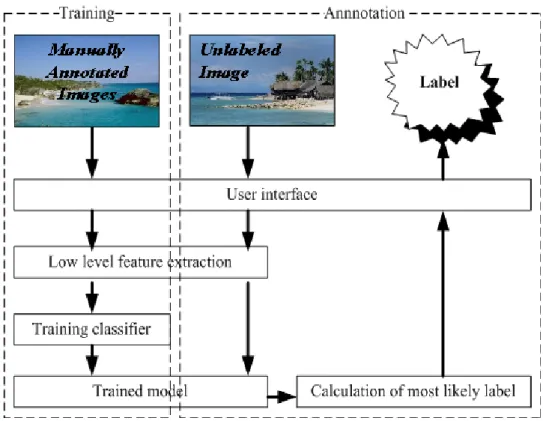
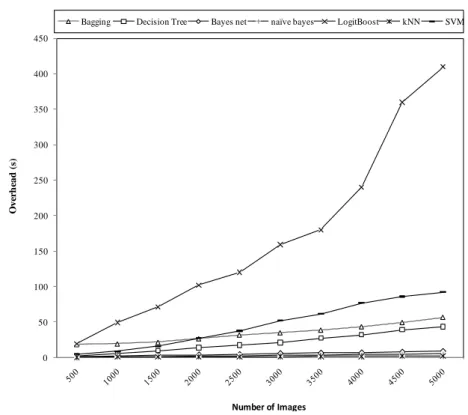
Evaluation of seven representative machine learning classifiers for image annotation namely SVM, Bayesian Network, Naive Bayes, Boosting, Bagging, kNN and Decision tree from the aspect of accuracy and efficiency is presented. To facilitate performance evaluation, an image annotation prototype has been implemented which builds training models on low level features extracted from sample images. The evaluation results showed that SVM performs better than other classifiers in term of accuracy, however the training time of the SVM classifier is notably longer than that of other classifiers.
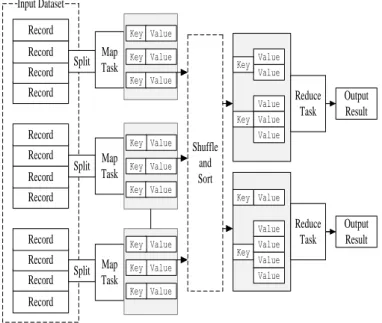
Resource Aware Sequential Minimal Optimization (RASMO), a distributed SVM algorithm for automatic image annotation has been implemented. RASMO builds on the Sequent Minimal Optimization (SMO) algorithm [113] for high efficiency in training and employs MapReduce [37] for parallel computation across a cluster of computers. MapReduce has become a major enabling technology in support of data intensive applications. RASMO is implemented using the Hadoop implementation [3] of MapReduce. The MapReduce framework facilitates a number of important functions such as partitioning the input data, scheduling MapReduce jobs across a cluster of participating nodes, handling node failures,
Parallelizing Support Vector Machines for Scalable Image Annotation 6
and managing the required network communications. A notable feature of the Hadoop implementation of MapReduce framework is the ability to support heterogeneous environments but without an effective load balancing scheme for utilizing resources with
varied computing capabilities. For this purpose, a genetic algorithm based load balancing
scheme is designed to optimize the performance of RASMO in heterogeneous computing environments.
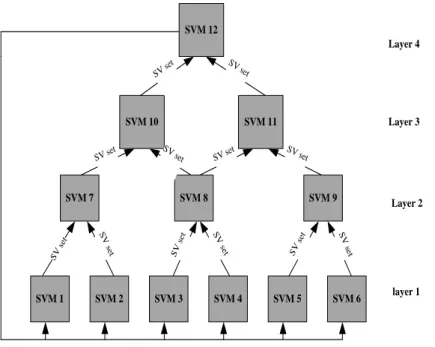
The RASMO algorithm is designed based on a multi-layered cascade architecture which removes non-support vectors early in the training process and guarantees a convergence to the global optimum [58] [151]. The genetic algorithm based load balancing scheme is applied in the first layer computation in RASMO as this layer is the most intensive part in computation in optimizing the whole training dataset. The resulting support vectors from the first layer computation are used to create the input data for next layers which is usually much smaller in size in comparison with the original training data [104]. The size of each data chunk at the first layer is computed by the load balancing scheme based on the resources available in a cluster of computers such as the computing powers of processors, the storage capacities of hard drives and the network speeds of the participating nodes.
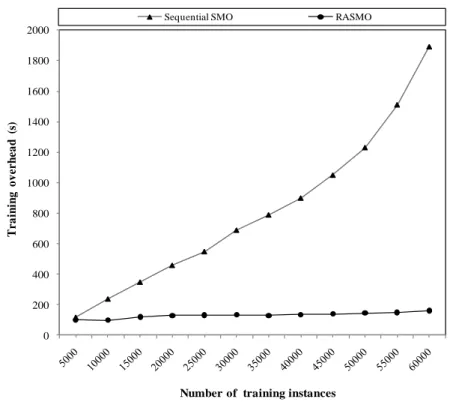
The performance of RASMO is first evaluated in a small scale experimental MapReduce environment. Subsequently, a MapReduce simulator is implemented to evaluate the effectiveness of the resource aware RASMO algorithm in large scale heterogeneous MapReduce environments. Both experimental and simulation results show that RASMO reduces the training time significantly while maintaining a high level of accuracy in classification. In addition, data chunks with varied sizes are crucial in speeding up SVM computation in the training process. It is worth pointing out that using different sizes for data chunks has no impact on accuracy in SVM classification due to the structure of the RASMO algorithm in which the training work in the first few layers is merely a filtering process of removing non-support vectors and the resulting support vectors of the last layer are evaluated for a global convergence by feeding the output of the last layer into the first layer.
Resource Aware Multiclass Sequential Minimal Optimization (RAMSMO), a resource aware distributed multiclass SVM algorithm for scalable image annotation has been designed and implemented. RAMSMO is built on MapReduce framework for parallel computation across a cluster of computers. A genetic algorithm based load balancing scheme is used to optimize
Parallelizing Support Vector Machines for Scalable Image Annotation 7
the performance of RAMSMO when processing binary data chunks with different sizes in heterogeneous environments in which the participating computers have varied resources in terms of the computing powers of processors, the storage capacities of hard drive and the network speeds of the participating nodes.
The performance of RAMSMO is evaluated in both small scale experimental and large scale MapReduce environments including the effectiveness of the load balancing scheme in large scale heterogeneous MapReduce environments. Both experimental and simulation results show that RAMSMO reduces the training time significantly while maintaining a high level of accuracy in classification.
MapReduce Ensemble Sequential Minimal Optimization (MRESVM), a distributed SVM ensemble algorithm for automatic image annotation has been implemented. MRESVM builds on the SMO algorithm for high efficiency in training and employs MapReducefor parallel computation across a cluster of computers.
The MRESVM algorithm is based on the bagging architecture which train multiple SVMs on bootstrap samples and combines the output in appropriate manners. Two types of combination methods are considered, firstly majority voting which is the commonly used combination method for bagging. Secondly combination of SVMs based double layer hierarchical combining that use second layer SVM to combine the first layer SVMs. Balanced sampling strategy for bootstrapping is introduced to increase classification accuracy for fixed number samples. The performance of the MRESVM algorithm is evaluated in both small scale experimental and large scale MapReduce environments. Both experimental and simulation results show that MRESVM reduces the training time significantly while increase the classification accuracy compare to a single SVM.
1.4 Structure of the Thesis
The rest of this thesis is organised as follows. Section 2.1 introduces image annotation techniques. Section 2.2 describes the basic concepts of SVM while Section 2.3 introduces distributed SVM. Section 2.4 introduces distributed Multiclass SVM Section 2.5 describes distributed SVM ensemble. Section 2.6 reviews and discuss the related work. Section 2.7 concludes the chapter.
Parallelizing Support Vector Machines for Scalable Image Annotation 8
Chapter 3 describes the implementation of an image annotation system which is essential for evaluating most commonly used machine learning classifiers in automatic image annotation. The evaluation results are presented in this chapter.
Chapter 4 is dedicated to the implementation of the RASMO and evaluation of the algorithm in experimental and simulation environment. A Genetic algorithm is introduced to enhance the performances in heterogonous computing environment.
Chapter 5 presents the implementation of the RAMSMO for training multiclass SVM and evaluation of the algorithm in experimental and simulation environment. A Genetic algorithm is introduced to enhance the performances in heterogonous computing environment.
Chapter 6 presents the implementation of the MRESVM for training SVM ensemble and evaluation of the algorithm in experimental and simulation environment.
Finally, chapter 7 summarises the contributions of the thesis and proposes directions for future work.
Parallelizing Support Vector Machines for Scalable Image Annotation 9
Chapter 2
Literature Review
This thesis is conducted from four different aspects, namely evaluated automatic image annotation techniques, distributed binary SVM, distributed multiclass SVM and distributed SVM ensemble. This chapter briefly describes the above techniques, reviewing the related literatures and summarising the weakness of the existing techniques.
2.1 Image Annotation Techniques
In recent years image annotation has become a major approach to bridging the semantic gap. This section describes some the main techniques used in image annotation.
Currently a great number of images are widely available on the World Wide Web. In order to organize and efficiently retrieve this vast number of images, contextual information of the images such as surrounding text and links is used for image annotation.
Semantic Web technologies such as ontologies have been used to annotate images with semantic descriptions. Ontology [123] is a specification of an abstract which defines a set of representational terms called concepts. Ontology based semantic image annotation focuses on describing the contents of an image, and tries to describe image contents as fully as possible.
Automatic image annotation is a method of automatically generating one or more labels to describe the content of an image. Typically, images are annotated with labels based on the extracted low level features. Machine learning techniques such SVM, Bayesian Networks,
Artificial Neural Networks, Decision Tree and Composite Classifiers such bagging and
boosting have facilitated image annotation by learning the correlations between image
Parallelizing Support Vector Machines for Scalable Image Annotation 10 2.2 Distributed SVM
It has been widely recognized that training SVMs is computationally intensive when the size of a training dataset is large. A SVM kernel usually involves an algorithmic complexity of
O(m2n), where n is the dimension of the input and m represents the training instances. The
computation time in SVM training is quadratic in terms of the number of training instances. To speed up SVM training, distributed computing paradigms have been investigated to partition a large training dataset into small data chunks and process each chunk in parallel utilizing the resources of a cluster of computers.
2.3 Distributed Multiclass SVM
Due to various complexities, a direct solution to multiclass problems using a single step SVM training is usually avoided [44]. A superior approach is to combine a number of binary SVM classifiers to solve a multiclass problem. Various approaches have been proposed such as One Against Rest [45] (OAR), One Against One (OAO) [79] and decision trees based multiclass SVM techniques [114]. To speed up SVM training, distributed computing paradigms have been investigated to partition a large training dataset into small data chunks and process each chunk in parallel utilizing the resources of a cluster of computers.
2.4 SVM Ensemble
The combination of classifiers leads to significant reduction of classification error in a wide range of applications. Among them SVM ensembles is shown to outperform a single SVM in terms of classification accuracy. However, SVM ensembles training are notably a computationally intensive process especially when the number replicated samples based on bootstrapping is large. Ensemble learning is extremely computational intensive which limits their applications in real environments.
2.5 Related Work to this Thesis
This section reviews the related literatures in automatic image annotation techniques, distributed binary SVM, distributed multiclass SVM and SVM ensemble.
Parallelizing Support Vector Machines for Scalable Image Annotation 11
2.5.1 Image Annotation Techniques
In order to organize and efficiently retrieve vast number of images on the Web, contextual information of the images such as surrounding text and links are used for image annotation.
Hua et al. [66]introduce a system which automatically acquires semantic knowledge for Web
images. A page layout analysis method is used to assign context to Web images. Joshi et al. [72] propose a scheme for automated story picturing using stop word elimination and
identification of a set of proper nouns. The textof a story is processed based on the Wordnet
[102] which forms a list of keywords.
Although image retrieval techniques based on textual information can retrieve many relevant images, the accuracy level of image retrieval is low [92]. The main reasons for low level of accuracy are; firstly the Web images are used freely in the Web pages and there is no standard exists for the relationships between the texts and embedded images in the same Web pages, secondly Web images are fairly comprehensive in meaning, and are created by different people for different purposes, thirdly the qualities of the Web images vary greatly [57]. The users need to go through the entire list of retrieved images to find the desired ones. To improve Web image retrieval performance, there is an on-going research to combine the textual information and visual image contents [92].
Marques and Barman [100] propose three layer architecture for image annotation. The bottom layer extracts low level features of images, which are mapped to semantically meaningful keywords in the middle layer, which are then connected to schemas and ontologies on the top layer. Petridis et al. [112] present a software environment called M-Onto Mat-Annotizer to bridge the gap between the low level visual descriptors and high level semantic concepts. M-Onto Mat-Annotizer allows linking low level MPEG-7 visual descriptions to the Visual Descriptor Ontology (VDO). Hollink et al. [65] argue that ontologies serve two purposes in image annotation. Firstly, user is immediately provided with the right context to find an adequate index term. This ensures quicker and more precise indexing. Secondly, the hierarchical presentation of concepts helps to disambiguate terms. They propose a scheme for semantic image annotation and retrieval in a collection of art images using multiple ontologies to support this process. Srikanth et al. [123] use a hierarchy of annotation words derived from text ontology for automatic image annotation.
Parallelizing Support Vector Machines for Scalable Image Annotation 12
Wang et al. [141] compare ontology-based image annotation with keyword-based image annotation. It has been found that keyword based approach is user friendly and easy to apply with acceptable retrieval accuracy, while semantically rich ontology addresses the need for complete descriptions of image retrieval and improves the accuracy of retrieval. Ontology works better with the combination of low level image features. However there is a trade-off between the complexity and performance. Ontology based annotation work better by combining low level features with high level textual information due to usefulness of visual information to filter a majority of inaccurate results. For instance, from an indoor background
it can be inferred that a wild fox is not likely to exist in an image.
SVM is considered as a good candidate for image annotations due to its high generalisation
performance without the need to add prior knowledge [25]. Zhang et al. [154] used a SVM
classifier to separate two classes of relevant images and irrelevant images. A classifier is trained with training data of relevance images and irrelevance images marked by users. The trained model is used to find more relevance images in an image database. Tsai et al. [131] propose a system which is composed of three modules of SVMs for colour, texture, and high-level concept classification. Cusano et al. [34] present an image annotation tool for classifying image regions in one of seven classes- sky, skin, vegetation, snow, water, ground, and buildings using multi-class SVM. Wang et al [40] used SVM and point out the main drawback of the SVM models are too large to be used in a practical system with limited
memory space. As a result, the speed of the classification is also slow when using SVM
models with many support vectors.
Barrat and Tabbone [5] use a Bayesian network to classify images based on visual and textual features and to automatically annotate new images. Kane and Savakis [73] employ low-level
classification based oncolour and texture, semantic features such as sky and grassdetections,
along with indoor and outdoor ground truth information, to create a set of features for
Bayesian network structure learning. It is reported that a Bayesian network provides
classification rates which are 97% correct. Benitez and Chang [7] use a Bayesian network in combination of meta-classifiers. For a new image, the presence of concepts is first detected using the meta-classifiers and then is refined using Bayesian inferences. Niedermayer [35] claims weakness of Bayesian network lays on the quality and extent of the prior beliefs used
Parallelizing Support Vector Machines for Scalable Image Annotation 13
in Bayesian inference process. A Bayesian network is only is useful when this prior knowledge is reliable.
One of the widely used techniques is to predict the class of a new instance based on the most
common class amongst the k Nearest Neighbours [9]. k Nearest Neighbours classifiers are
known as non-parametric classifiers. Non-parametric classifiers can naturally handle a huge number of classes, and avoid over fitting of parameters which is a central issue in learning based approaches. In addition, non-parametric classifiers do not require learning/training phases. Makadia et al. [99] introduce a technique for image annotation that treats image annotation as a retrieval problem, using low-level image features and a simple combination of basic distances to find the nearest neighbours of a given image. The keywords are then assigned using a greedy label transfer mechanism. Pakkanen et al. [108] use MPEG-7 feature vectors to perform a kNN classification of the images. They report that the results are generally satisfactory especially the Colour Structure and Homogeneous Texture descriptors seem to perform well. Lepisto et al. [67] present a method for combining different visual descriptors in rock image classification. In their approach, the k-NN classification is first carried out for each descriptor separately. After that, a final decision is made by combining the nearest neighbours in each base classification. The total numbers of the neighbours representing each class are used as votes in the final classification.
In image annotation, low-level feature vectors are fed into the input layer of a multilayer perceptron (MLP) where each of the input neurons corresponds to each of the feature vectors and the output neurons of the MLP represent the class labels of images to be classified. Zhao et al [156] propose an annotation system based on a neural network for characterising the hidden association between the visual and the textual modalities. Latent semantic analysis (LSA) is employed to discover the latent contextual correlation among the keywords. Shah and Lim et al [89] use a three-layer feed-forward neural network with dynamic node creation capabilities to learn 26 visual keywords from 375 labelled image patches collected from home photos. Colour and texture features are computed for each training region as an input vector for the neural network. Breen et al. [14] propose an annotation system which uses ontologies and neural networks as object identifiers to provide a high level of accuracy in automatic classification of images.
Parallelizing Support Vector Machines for Scalable Image Annotation 14
ID3 and C4.5 are well known algorithms to construct a decision tree classifier; however ID3 has some disadvantages such as preference bias and the inability to deal with unknown attribute values [149]. Tseng and Su [133] use the decision tree algorithm to build a classifier with low-level features extracted from images. The classifier is then used for classifying images with one representative object. Huang et al [68] use decision tree to categorize new images. It has been suggested that this scheme performs better than standard k-nearest neighbour techniques, and also has both storage and computational advantages [68].
Feng and Chua [50] propose bootstrapping approach to deal with the problem of providing large labelled training data which is needed in the training stage of a classifier to annotate a large collection of images. The idea is to start from a small set of labelled training images, and consecutively annotate a larger set of unlabeled images by using the co-training approach, in which two statistically independent classifiers are used to train and co-annotate the unlabeled images. This process offers the advantage of requiring only a small initial set of training images. Huan [95] claim boosting method such as adaboost, boosts a weak learning algorithm by updating the sample weights iteratively. They propose to integrate feature reweighting into boosting scheme, which not only weights the samples but also weights the feature elements iteratively. Fan et al [48] propose a hierarchical boosting algorithm by integrating concept ontology and multi-task learning to achieve hierarchical image classifier training with automatic error recovery.
2.5.2 Distributed SVM
SVM training is a computationally intensive process especially when the size of the training dataset is large. Numerous avenues have been explored with an effort to increase efficiency and scalability, to reduce complexity as well as ensure that the required level of classification accuracy can be maintained. SVM decomposition is a widespread technique for performance improvement [4] [107] [127].
Decomposition approaches work on the basis of identifying a small number of optimization variables and tackling a set of problems with a fixed size. One approach is to split the training data set into a number of smaller data chunks and employs a number of SVMs to process the individual data chunks.
Parallelizing Support Vector Machines for Scalable Image Annotation 15
Various forms of summarizations and aggregations are then performed to identify the final set of global support vectors. Hazen et al. [61] introduced a parallel decomposition algorithm for training SVM where each computing node is responsible for a pre-determined subset of the training data. The results of the subset solutions are combined and sent back to the computing nodes iteratively. The algorithm is based on the principles of convex conjugate duality. The key feature of the algorithm is that each processing node uses independent memory and CPU resources with limited communication overhead. Zanghirati et al. [153] presented a parallel SVM algorithm using MPI which splits the problem into smaller quadratic programming problems. The output results of the sub-problems are combined. The performance of the parallel implementation is heavily depended on the caching strategy that is used to avoid re-computation of the previously used elements in kernel evaluation which is considered as computationally intensive. Similarly, MPI based approaches have been proposed for speeding up SVM in training [8] [10] [20] [21] [148]. Whilst good performance improvements can be achieved by MPI based parallelization, these approaches tend to suffer from poor scalability, high overhead in inter-node communication, and limited support for heterogeneous computing environments.
Collobert et al. [31] proposed a parallel SVM algorithm which trains multiple SVMs with a number of subsets of the data, and then combines the classifiers into a final single classifier. The training data is reallocated to the classifiers based on the classification accuracy and the process is iterated until a convergence is reached. However the frequent reallocation of training data during the optimization process may cause a reduction in the training speed. Huang et al. [67] proposed a modular network architecture which consists of several SVMs of which each is trained using a portion of the whole training dataset. It is worth noting that speeding up the training process can significantly reduce the generalization performance due to the increase in the number of partitions. Lu et al. [97] proposed a distributed SVM algorithm based on the idea of partitioning training data and exchanging support vectors over a strongly connected network. The algorithm converges to a global optimal classifier in finite steps. The performance of this solution is depended on the size and topology of network. The larger a network is, the higher communication overhead will incur. Kun et al. [83] implemented a parallel SMO using Cilk [130] and Java threads. The idea is to partition the training data into smaller parts, train these parts in parallel, and combines the resulting
Parallelizing Support Vector Machines for Scalable Image Annotation 16
support vectors. However Cilk's main disadvantage is that it requires a shared-memory computer [81].
An interesting alternative is considered and discussed in [21]. The work on updating optimality condition vectors is performed in a parallel way leading to a speedup in SVM training. However this approach can incur considerable network communication overhead due to the large number of iterations involved. Another approach utilizes Graphics Processing Units (GPU) for SVM speedup [27]. MapReduce was adopted in this work exploiting the multi-threading capabilities of graphics processors. The results show a considerable decrease in processing time. A key challenge with such an approach lies in the specialized environments and configuration requirements. The dependency of specific development tools and techniques as well as platforms introduces additional, non-trivial complexities.
SVM algorithms rely on the number of support vectors for classification. Removing non-support vectors in an early stage in the training process has proven to be useful in reducing the training time. Dong et al. [43] proposed a parallel algorithm in which multiple SVMs are solved with partitioned data sets. The support vectors generated by one SVM are collected to train another SVM. The main advantage of this parallel optimization step is to remove non-support vectors which can help reduce the training time. Graf et al. [58] proposed a similar parallel SVM algorithm using a homogenous Linux cluster. The training data is partitioned and an SVM is solved for each partition. The support vectors from each pair of classifiers are then combined into a new training dataset for which an SVM is solved. The process carries on until a final single classifier is left. Although the convergence to the global optimum can be guaranteed, partitioning a large dataset into smaller data chunks with the same size can only be effective in a homogeneous computing environment in which computers have similar computing capabilities. Another similar work is presented in [146].
Given the focus that most of the current approaches are primarily on the SVM solver, parallelization using a number of computers may introduce significant communication and synchronization overheads. Frameworks such as MapReduce are believed to provide an effective application scope in this context [56]. Chu et al. [29] capitalized natively on the multi-core capabilities of modern day processors and proposed a distributed linear SVM using the MapReduce framework; batch gradient descent is performed to optimize the
Parallelizing Support Vector Machines for Scalable Image Annotation 17
objective function. The mappers calculate the partial gradient and the reducer sums up the partial results to update weights vector. However the batch gradient descent algorithm is
extremely slow to converge with some type of training data [119].
2.5.3 Distributed Multiclass SVM
Existing research efforts in multiclass SVM classifications generally fall into two approaches. One approach is to consider all the classes in a single optimization step and the other approach is a combination of several binary classifiers.
A multiclass SVM classification method based on a single optimization process was introduced in [33]. A major advantage of this method is that the training of all the classes occurs in a single optimization step. Keerthi et al. [75] presented a dual method based on direct multiclass formulations of linear SVM. The main idea is to sequentially pass through the training dataset and optimize the dual variables associated with one example at a time. However a single step multiclass optimization is not practical to many classification applications due to the creation of a large optimization problem [44]. While directly extending a binary SVM into a multiclass SVM is not practical, a commonly used approach is to create a multiclass classifier based on the combination of binary classifiers. The One Against Rest (OAR) method is one of the popular methods to solve multiclass problems in which a binary classifier is trained for each class, which separates a single class from the rest of the classes and then combines the classifiers for multiclass inference. OVR can achieve high accuracy in classification [75] but the training process is not efficient due the involvement of all training data for creating binary classifiers for each class.
OAO method trains a binary classifier for each pair of classes. To classify an unlabelled instance, all binary classifiers are used. One advantage of the OAO method lies in its efficiency in training process. However, OAO does not perform well when the binary classifiers have different dataset in size.
An interesting solution is the use of error correcting output codes (ECOC) together with binary classifiers for solving multiclass classification problems [39]. Li et al. [88] combined different feature selection methods using ECOC strategies for multiclass cancer
Parallelizing Support Vector Machines for Scalable Image Annotation 18
classifications. One of the main limitations of the ECOC framework is the requirement of considering all classes for each binary classifier, hence is slow in training process. Platt et al. [114] introduced Directed Acyclic Graph SVM (DAGSVM) in which each node represents a classifier trained with the dataset of a pair of classes. DAGSVM depends on a rooted binary directed acyclic graph to make a decision on classifying unlabelled instances. However DAGSVM does not work well on an unequally distributed training data where the number of samples of each class is not equal.
To speed up multiclass SVM training, distributed computing paradigms have been investigated to partition a large training dataset into small data chunks and process each chunk in parallel utilizing the resources of a cluster of computers. Zhang et al. [155] presented a parallel multiclass SVM based on OAO using Message Passing Interface. Although the heterogeneity of multiclass training datasets is considered in their implementation, the scheduling of the computation tasks among multiple processors is based on a naive cyclically approach which does not consider the processing power of participating computing nodes. Additionally MPI is primarily targeted at homogeneous computing environments and has limited support for fault tolerance. Herrero-Lopez et al. [63] utilized GPU which is a specialized processing hardware. Here the authors considered a parallel multiclass SVM approach based on OAR exploiting the multi-threading capabilities of graphics processors. The results show a considerable decrease in processing time. Although the accuracy level of the GPU based SVM is comparable to the original OAO method, the training process is considerably less efficient.
Munoz- Mari et al. [105] presented a parallel SVM algorithm for multiclass problems based on OAO method using Medusa cluster [103] in a homogenous environment. Although the different sizes of classes in multiclass training datasets is considered in their implementation, however the scheduling of the computation tasks among multiple processors is simply to keep all the processor busy without considering the resources available on the underlying computing nodes. Lu et al. [94] presented a part-versus-part method to decompose a large multiclass classification problem into a number of two class sub-problems. A significant difference of the part-versus-part method with existing popular OAO multiclass classification approaches is that a large-scale two-class sub-problem can be further divided into a number of relatively smaller and balanced two-class sub-problems to increase training efficiency.
Parallelizing Support Vector Machines for Scalable Image Annotation 19
However the classification of par-versus-part method is slow in computation compared with the OAO classification approach due to the large number of support vectors to be processed.
2.5.4 SVM Ensemble
Ensemble methods represent one of the main current research issues in machine learning for improving classification accuracy [115]. Mason et al [101] show that ensembles enlarge the margins, consequently improve the generalization performances of learning algorithms while Schapire et al [117] present analysis of ensemble learning methods based on bias variance decomposition of classification error which shows that ensemble classifiers reduce variance and bias, therefore reducing the overall classification error rate.
Bagging is the most commonly used method for constructing ensemble classifiers. Bagging introduces randomness in the training data. Recently a number of SVM ensemble based on bagging have been proposed. Kim et al. [78] proposed SVM ensembles based bagging to improve the classification accuracy. The experimental results show improvement of classification accuracy of SVM ensemble. However, the experiments were performed with small datasets. This approach of ensemble learning is extremely computational intensive for large data set and large number of samples which limits their applications in real environments. Yan et al. [150] presented a SVMs ensemble method based on bagging. The results show the ensemble method performs better than a single SVM. The ensemble method involves tuning each of the base SVMs. However, the algorithm is evaluated using a small number of bootstrap samples, evaluating the algorithm with large number bootstrap samples is extremely computational intensive. Tao et al. [129] presented a SVMs ensemble method based on bagging and random subspace to improve the user relevance feedback performance in content-based image retrieval. The results show improvement in classification accuracy. However the ensemble method cannot guarantee diversity within SVMs base classifiers due to use only negative user feedback in the training process of SVMs.
Theoretical analysis of the performance of bagging in classification show that expected misclassification probability of bagging has the same bias component as a single bootstrap sample while the variance component is reduced significantly [54]. Valentini et al. [134] present a low bias SVMs ensemble based on bagging. The aim is to reduce bias of base SVMs before applying bagging. They consider the bias variance tradeoffs to improve the
Parallelizing Support Vector Machines for Scalable Image Annotation 20
classification accuracy of SVM ensemble. The experiments show improvement in classification accuracy. However, the idea was only tested on small datasets and no efficiency analysis was given. This approach of ensemble learning is also extremely computational intensive for large data set and large number of samples. Silva et al. [121] proposed a distributed SVM based ensemble system. Processing times is reported to have shown notable improvements over sequential approaches. Furthermore, the deployment of ensemble techniques improves classification performance in terms of accuracy. The system is evaluated using evaluate Condor and Alchemi middleware platforms.
Re et al. [115] evaluate the performance of several SVM ensemble, in which each base classifier is trained on different data types, the output are aggregated based on different combination methods. Their results show that heterogeneous data integration through ensemble methods is highly accurate for gene function prediction. Derbeko et al. [38] propose a new technique for aggregating SVM classifiers based on bootstrapping. In this method a linear combination of the base classifiers using weights are optimized to reduce variance. However efficiency of the ensemble is not analysed.
Lei et al. [86] propose the ensemble of support vector machines based on the bagging and boosting for text-independent speaker recognition, the experimental results show improvement of classification accuracy of SVM ensemble compare to single SVM. However, this approach of ensemble learning is extremely computational intensive for large data set and large number of samples which limits their applications in real environments. Tang et al. [128] applies bootstrapping to create samples from the original training dataset. An SVM is trained on each sample. The SVMs output are aggregated by Bayesian Sum Rule for a final decision. The algorithm is efficient and scalable. However there is slight reduction in the accuracy level compare to standard SVM.
2.7 Summary
Research on distributed SVM algorithms has been carried out from various dimensions, but mainly focuses on specialized SVM formulations, solvers and architectures [22] [58] [61] [67]. Although some progress has been made in speeding up SVM computation in training, existing approaches on high performance SVMs are mainly targeted at homogenous
Parallelizing Support Vector Machines for Scalable Image Annotation 21
computing environments using an MPI based solution. Scalability still remains a challenging issue for parallel SVM algorithms. These challenges motivated the design of RASMO which targets at a scalable SVM in heterogeneous computing environments empowered with a load balancing scheme.
Although some progress has been made in speeding up multiclass SVM computation in training, existing approaches on multiclass SVMs are mainly targeted at the classifications in which the classifiers have equal sizes of datasets deployed in homogenous computing environments without effective load balancing scheme. Scalability still remains a challenging issue for multiclass SVM classifications. These challenges motivate the design of RAMSMO which targets at a scalable multiclass SVM in heterogeneous computing environments empowered with a load balancing scheme.
Research on SVM ensemble algorithms has been carried out from various dimensions, but mainly focuses on improving classification accuracy, however solving the training inefficiency of SVM ensemble remains a huge challenge. This challenge motivates the design of MRESVM which is an efficient distributed SVM ensemble algorithm building on a highly scalable MapReduce implementation for image annotation with higher level classification accuracy compare to a single SVM.
This chapter started with briefly description of automatic image annotation techniques, distributed binary SVM, distributed multiclass SVM, distributed SVM ensemble and reviewing the related literatures. The chapter concluded and summarising the weakness of the existing techniques.
Parallelizing Support Vector Machines for Scalable Image Annotation 22
Chapter 3
Evaluation of Machine Learning Classifiers for
Image Annotation
This chapter review seven representative machine learning classifiers for automatically image annotation. To facilitate performance evaluation, an image annotation prototype has been implemented which builds training models on low level features extracted from sample images. This chapter concludes on presenting the evaluation results.
3.1 Support Vector Machine (SVM)
SVM is based on creating a hyperplane as the decision plane, which separates the positive
(+1) and negative (-1) classes with the largest margin. An optimal hyperplane is the one with
the maximum margin of separation between the two classes, where the margin is the sum of
the distances from the hyperplane to the closest data points of each of the two classes. These
closest data points are called Support Vectors (SVs) [119]. Given a set of training data D, a
set of points of the type
D
x
i,
c
i
│ ,
1,1
i1n i
p
i c
x , where
c
i is either 1 or -1indicative of the class to which the point xi belongs, the aim is to give a maximum margin
hyperplane which divide points having ci 1from those having ci 1. Any hyperplane can
be constructed as a set of point x satisfyingw.xb0. The vector w is a normal vector. We
want to choosew and b to maximize the margin. These hyperplanes can be described by the
following equations: w.xb1 (3.1) w.xb1 (3.2) The margin 1/ . 2 w m
Parallelizing Support Vector Machines for Scalable Image Annotation 23
Maximize (in αi )
(3.3) Subject to and
yi indicates the class of an instance, there is a one-to-one association between each Lagrange
multiplier αi and each training example xi. Once the Lagrange multipliers are determined, the
normal vector wand the threshold
b
can be derived from the Lagrange multipliers as follow:(3.4)
bw xkyk
. (3.5)
for some
a
k
0
. Not all data sets are linearly separable. There may be no hyperplane existthat separate separates the positive (+1) and negative (-1) classes. SVMs can be further generalized to non-linear classifiers. The output of a non-linear SVM is computed from the Lagrange multipliers as follow:
b X X K a y u i i n i i
) , ( 1 (3.6)where K is a kernel function that measures the similarity or distance between the input vector
Xi and the stored training vector X.
3.2 Bayesian Networks
Formally, a Bayesian network is directed acyclic graphs in which the nodes represent variables and the edges encode conditional dependencies between the variables [7]. Let
1..
, 1 x x n
U n be a set of variables. A Bayesian network B over a set of variables U is a
network structureBS. The classification job is to classify a variableyx0called the class
variable given a set of variables
x
x
1....
x
ncalled attribute variables. A classifier h:xyisj i j i j j i i n i i yy xx
![Figure 3.2: A snapshot of the system [32].](https://thumb-us.123doks.com/thumbv2/123dok_us/9911474.2484334/41.892.154.740.290.731/figure-snapshot.webp)
![Figure 3.3: Sample images [32].](https://thumb-us.123doks.com/thumbv2/123dok_us/9911474.2484334/42.892.114.826.296.721/figure-sample-images.webp)
![Figure 4.4: A snapshot of the image annotation system [32].](https://thumb-us.123doks.com/thumbv2/123dok_us/9911474.2484334/56.892.219.677.358.739/figure-snapshot-image-annotation.webp)