European Online Journal of Natural and Social Sciences; vol.2, No. 3(s), pp. 130-136 Copyright © Danial Rahimi Esfesalari, Alireza Zarei, 2013
Corresponding author: Danial Rahimi Esfesalari, Department of Accounting, Mobarakeh Branch, Islamic Azad University, Mobarakeh, Iran. Email: [email protected]
Studying the effect of voluntary disclosure changes on firm value
Danial Rahimi Esfesalari, Alireza Zarei
Department of Accounting, Mobarakeh Branch, Islamic Azad University, Mobarakeh, Iran
Abstract
The main purpose of the present research is studying the effect of voluntary disclosure changes on firm value in accepted firms at Tehran stock ex-change. Using Feltham and Ohlson’s model (1995), the present research has discussed the effect of in-vestors’ reaction to net operating assets and abnor-mal operating earnings for firms changing their vol-untary disclosure. Data analysis was carried out in two steps in this research; at first based on changing in the amount of voluntary disclosure member firms of statistical sample were divided to firms with re-duction in disclosure and firms with increase in dis-closure then research hypotheses were tested. Re-sults from 420 firm-year during 2006-2011 showed that managers of firms whose firm values are under-valued by investors increase voluntary disclosure of information.
Keywords: Voluntary disclosure, value-relevance, abnormal operating earning, net operating assets
Introduction
Disclosure is one of accounting principles that can influence on all aspects of financial reporting. Disclosure principle requires that all important reali-ties relating to financial events and activireali-ties of trade unit be reported completely and properly. According to this principle, financial statements should contain comprehensible and perfect information and the in-formation should be properly put at the disposal of different groups. Important realities of economic unit, therefore, should be disclosed properly and completely. In terms of quality and quantity on the other hand, presented information should not con-fuse users of financial statements in order that they can make conscious decisions (Alivar, 1986).
Regarding that managers always seek to show that their performance is good and so to receive more compensation, then one of criteria that they rely on to evaluate their performance is the market value of the firm. So, when market investors devalue the firm managers seek to find a way to resolve it. In this research, one of factors affecting on expecta-tions of investors about firm value that is voluntary disclosure and confirming its value-relevance with conservatism has been discussed. So, results of this research can have applied aspects for managing firm value by managers.
Literature Review
There are different definitions for disclosure in financial literature that the most of them are: Hen-driksen and Vanbreda (1992) that defined exposure as: disclosure generally means the reflect of informa-tion. Accountants however take a narrower meaning of it and consider it as reflecting of financial infor-mation of trade unit in the form of financial state-ment which is prepared annually. Balkouee (2002) considers disclosure as the information which is useful for normal investor and does not mislead the reader. He states complete disclosure requires that financial statements prepared and planned so that they present an accurate image of economic events that are affected on the economic unit for one pe-riod. Maheshwari (2000) considers that disclosure is one of accounting principles based on which fi-nancial reports should be prepared completely and fairly in terms of presenting the information.
Generally, disclosure can be divided to two parts: forced disclosure and voluntary disclosure: forced disclosure includes all cases and items that should be put in charge of competent authorities ac-cording to legal obligations and regulations ruling on financial reporting. In order to increase the
va-lidity of financial reporting managers disclose infor-mation voluntarily. Although accounting standards have at least determined the necessary amount of disclosure, they have limited voluntary disclosure of external information. Among them are useful non-financial indexes which are effective for judgment about effectiveness and success of the institution in accomplishing organizational goals or indexes that disclose the relationship between status quo and fu-ture interests.
If managers can provide guidance relating to the accomplishment of organizational short-term and long-term goals and optimal use of their resources that they have and report the perspective of their decisions clearly they would respond to investors’ critics about current performance and make them hopeful about the future of institute. So voluntary disclosure for investors help they become aware of managers’ current policies(Izadiniya, 1998).
Question that is posed here is what motivates managers to change the amount of voluntary disclo-sure of firm and whether these changes have effects on value relevance of voluntary disclosure?
Research History
Etemadi et al. (2012) carried out a research titled “Disclosure and Value of Firm: some evidence about Iranian capital market”. This research aims at deter-mine how does disclosure has effect on value of the firm. To do so, financial data of accepted firms in Teh-ran stock exchange are examined during 2003-2008. by using multiple regression and analyzing combined inputs and controlling such factors as properties mea-surement, profitability, leverage and growth results in-dicate that there is positive and significant relationship between disclosure and value of firm.
Khoddamipour and Mahroomi (2012) carried out a research titled “Effect of Voluntary Disclosure on Related Profit of each Share”. Based on this hy-pothesis that more focus on informational needs of investors would lead to increase in the quality of ac-counting information, it is predicted that increased voluntary disclosure leads to increase in related profit of each share as one of the most important accounting information. Results indicated that vol-untary disclosure does not have significant effect on related profit of each share.
In a research titled “Does Conservatism Have Effect on Relevance-Value Voluntary Disclosure of Accounting?” Park et al.(2011) discussed the effect of conservatism on voluntary disclosure. Results
from hypotheses test indicate that market reaction to firms whose investors are considered as conserva-tive is more than to aggressive firms and managers of those firms that are devaluated by investors tend to increase voluntary disclosure.
Esmaeelzade and Sharbafi (2010) carried out a research titled “Voluntary Disclosure of Information and its Relation with Stock Return Rate in Investing Firms”. Statistic population of this research included all investing firms accepted in Tehran stock exchange whose name has been published in the list of firms in Tehran stock exchange till 2004 and have presented needed primary information and data to Tehran stock exchange for five consecutive years(2004-2008). Re-sults indicate that research hypothesis that states there is significant relationship between disclosure quality and stock return is not accepted in none of years.
In another study titled “Do Managers Avoid Dis-closing Bad News?”Kothari et al. (2009) discussed factors affecting on disclosing bad news and accelerat-ing in disclosaccelerat-ing good news in U.S.A. results showed that for different reasons including issues relating to compensation and tenure, managers delay disclosing of bad news and accelerate to disclose good news. Re-sults also showed that negative reaction of stock price to disclosure of bad news is more than positive reaction of stock price to disclosure of good news.
Lou et al. (2006) in a research titled “Effect of Voluntary Disclosure, Ownership Structure and Capital Cost on Return Relationship-Future Prof-its” tested the effect of voluntary disclosure on the relationship between annual current return, annual profits and future profits and the effect of ownership structure and capital cost on this relationship. Re-search results showed that there is positive relation-ship between voluntary disclosure and level of news relating to future profits.
Research Objective
The objective of this research is to determine the relationship between abnormal operating earnings and net operating assets and voluntary disclosure changes.
Research Hypothesis
In the FO model, accounting earnings and op-erating assets are components which determine the firm value. If current operating assets are understated through conservatism, future expected earnings will be higher to reflect the reversal of the understatement, and the normal earnings will be lower (see Feltham
and Ohlson [1995). Therefore, managers are expected to reveal information concerning operating assets if they believe that market investors have undervalued the value-relevance of operating assets. Therefore, it is hypothesized that the managers of firms which are un-dervalued by market investors tend to expand volun-tary disclosures. It is also hypothesized that the man-agers of firms which are overvalued by market investors would have a tendency to reduce voluntary disclosures in order to not reveal the market’s miss-pricing.
H1: Managers will expand voluntary disclosures if the value-relevance of abnormal earnings or oper-ating assets is undervalued by market investors.
H2: Managers will reduce voluntary disclosures If the value-relevance of abnormal earnings or oper-ating assets is overvalued by market investors.
Methodology
In terms of foundational object present research is experimental and it is correlated research in terms of nature and method and in terms of fulfillment dura-tion it is ex-post facto type. In experimental research-es, primary data and information are gathered by the use of experiment methods, observation, interview and so on and are analyzed by statistical methods and tech-niques. Researcher’s though is of course very impor-tant in applying methods and result analysis. Correla-tion researches are carried out for becoming aware of the relationship between variables. In these researches the researcher wants to know whether there is any re-lationship and correlation between two things or two groups if so of what type it is and how much is it.
Data Collection and Instrument
In research theoretical principle segment, data col-lection was performed by review literature and reading books, journals and referring to specific webs neces-sary theoretic principle was collected in order to col-lect needed data for testing the hypotheses document exploring method was used. To do so, software relating to data of stock exchange organization such as Raha-vardNevin, Tadbirpardaz, Tehran stock exchange web, Codal web and so on were used. Following data collect-ing in this research needed information were gathered in Excel software and prepared for final analysis, and then final analysis was performed by Eviews software.
Research Population and Sample
Research population for this study was the firms accepted in Tehran stock exchange. Research time scope is years 2006-2011. The following criteria are
used for selecting proper sample by systematic elim-ination method.
1) They were accepted in stock exchange before 2006 and to continue the activity in Tehran stock exchange till 2011.
2) They have not changed their activity during 2006-2011.
3) Not being investing firms or financial agent or bank or leasing.
4) In order to create comparability financial year should finish in March 20
5) Financial information of firms being avail-able during studied period.
6) Firms’ shares have interacted constantly in Tehran stock exchange and do not have interaction interruption more than 4 months.
After the enforcement of above criteria, 70 firms were selected as the sample.
Dependent Variable
In this research, there is one dependent vari-ables that is unrecorded goodwill of each share of firm i in current year.
Independent Variables
In this research there are two independent vari-ables that are:
1) Abnormal operating earnings of each share of firm i in current year.
2) Operating assets of each share of firm i in current year
Variables are defined as:
• Unrecorded good will (g): share price without its book value(Park et al 2011).
• Net operating assets (oa) from balance sheet view it is the deference between operating assets and operating liabilities (Hirshleifer et al, 2004).
• Operating assets: it equals total assets after de-ducting financial assets
• Operating liabilities: it equals total assets after de-ducting financial liabilities and rights of shareholders.
• Operating earnings: it equals the difference be-tween incomes and operating costs (Noravesh et al, 2008, p.25). In present research operating earnings is the reported number in audited financial statements of firms presented in the sample which are reported according to accounting standards of Iran.
• Abnormal operating earnings (oxa): it is
de-fined as the difference between operating earnings and normal earnings and it obtains from the follow-ing relation oxa
it=oxit-(r*oait-1) where oxitis
return rate expected by shareholders of firm i in year t and it is computed by the use of pricing model for capital assets(park et al, 2011).
Research model
Through classifying the sample in terms of vol-untary disclosure into firms with expanded disclo-sure, unchanged disclosure and reduced disclosure this research discussed economic outcomes of firms which reduce voluntary disclosure or they expand it. In order to measure the level of disclosure of firms Riahi and Arab(2011) index was used which is mea-sured by using financial statements, the board of di-rectors and other published reports of firms.
For testing the hypotheses in this research multi-variable linear regression was used. Used model was Feltham and Ohlson’s linear model as follow:
Evaluation Linear Model: git=α0+α1oxa
it+α2oait+εit
git is unrecorded goodwill of each share of firm i in year t .
0xa
it: abnormal operating earnings of each share
of firm i in year t .
Oait: net operating assets of each share of firm i in year t .
α1: is persistence coefficient of abnormal operat-ing earnoperat-ings in each share.
α2: is accounting conservatism in operating as-sets in each share.
εit: is the random error term
By using combined data for firms with expand-ed disclosure, unchangexpand-ed disclosure and rexpand-educexpand-ed disclosure in each year from study period and also during after and before of disclosure change this re-search estimated model.
Hypothesis testing
First hypothesis states that coefficients of ab-normal earnings and net operating assets are higher for firms with expanded disclosure.
α1ea>α1eb ,α2ea>α2eb
e: firms with expanded disclosure a: after change in disclosure. b: before change in disclosure.
Since investors may consider the reduced dis-closure as the effort of managers for hiding bad news so second hypothesis predicted that coefficient of abnormal earnings and net operating assets are low-er for firms with reduced disclosure.
α1ra<α1ra< ,α2ra<α2rb
r: firms with reduced disclosure. a: after change in disclosure. b: before change in disclosure.
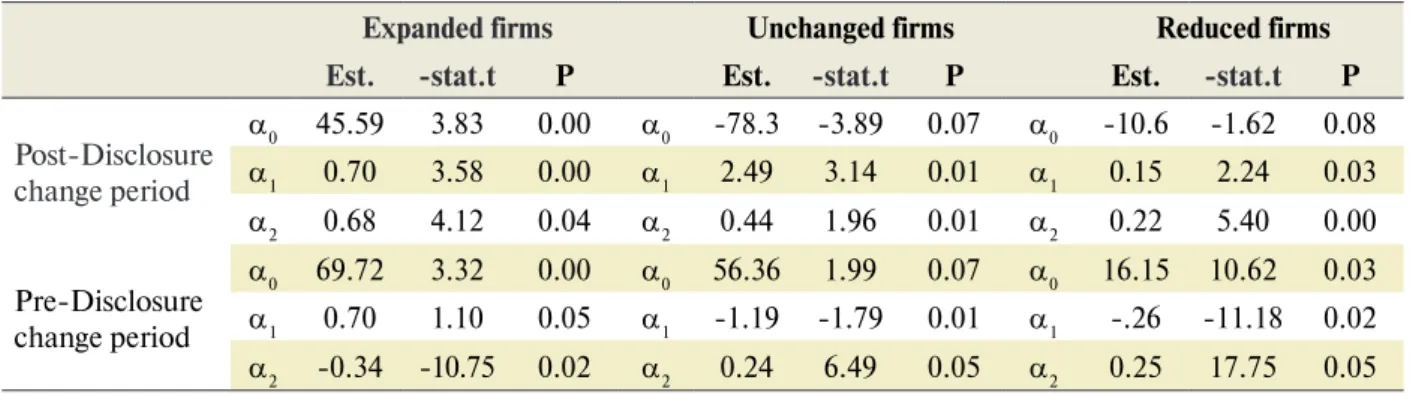
In order to test first hypothesis, model was es-timated for firms with expanded, unchanged and reduced disclosure before and after change in dis-closure and then coefficients were studied. Results are shown in table 1.
Table 1. Results of regression model
Expanded firms Unchanged firms Reduced firms
Est. -stat.t P Est. -stat.t P Est. -stat.t P
Post-Disclosure change period α0 45.59 3.83 0.00 α0 -78.3 -3.89 0.07 α0 -10.6 -1.62 0.08 α1 0.70 3.58 0.00 α1 2.49 3.14 0.01 α1 0.15 2.24 0.03 α2 0.68 4.12 0.04 α2 0.44 1.96 0.01 α2 0.22 5.40 0.00 Pre-Disclosure change period α0 69.72 3.32 0.00 α0 56.36 1.99 0.07 α0 16.15 10.62 0.03 α1 0.70 1.10 0.05 α1 -1.19 -1.79 0.01 α1 -.26 -11.18 0.02 α2 -0.34 -10.75 0.02 α2 0.24 6.49 0.05 α2 0.25 17.75 0.05
First part of hypothesis states that a1 and a2 must expand in compare with before changing in disclo-sure for expanded firms. So, the first hypothesis is confirmed as it clear here:
α1ea>α1eb 0.70 > 0.07 and α2ea>α2eb 0.68 > -0.34 Second hypothesis states that a2 and a1 must re-duce in compare with before changing in disclosure
for reduced firms. That is
α1ra<α1rb0.15 < -0.26 and α2ra<α2rb 0.22 < 0.25 As it is observed, the hypothesis is not true for α1 coefficient. So the second hypothesis is rejected.
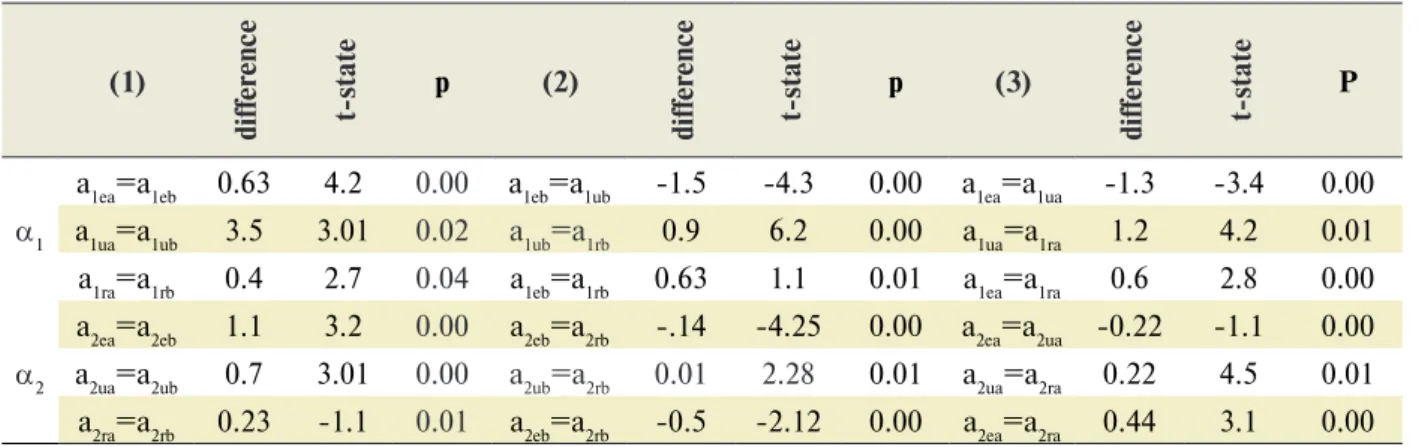
For ensuring the correctness of results, coeffi-cients differential test was carried out in three levels as follow.
(1) Tests for the difference in coefficients for each disclosure stratum between pre- and post-dis-closure periods.
(2) Tests for the difference in coefficients for pre-disclosure period between disclosure strata.
(3) Tests for the difference in coefficients for post-disclosure period between disclosure strata.
Results are summarized in table 2 and it indi-cates that coefficients differential is significant in all three levels.
Conclusions
In this research, the results from first hypoth-esis testing indicate that an increase in voluntary disclosure leads to increase in coefficients of abnormal operating earnings and net operating assets(in this research they indicate the value of the firm) and decrease in disclosure does not nec-essarily lead to decrease in coefficients of abnor-mal operating earnings and net operating assets, so it is possible that managers reduce level of dis-closure In order to hide overvaluing of the firm by the investors. Results of this hypothesis are con-sistent with Watts and Zimmerman(1985)’s view. They believe that managers who have positive and good performance try to aware their addressees by presenting more information. Of course maybe this criticism exists that disclosing more infor-mation in the form of voluntary disclosure is not suitable in competitive market. To such criticisms
Table 2. Coefficients differential test results
(1) differ ence t-state p (2) differ ence t-state p (3) differ ence t-state P α1
a1ea=a1eb 0.63 4.2 0.00 a1eb=a1ub -1.5 -4.3 0.00 a1ea=a1ua -1.3 -3.4 0.00 a1ua=a1ub 3.5 3.01 0.02 a1ub=a1rb 0.9 6.2 0.00 a1ua=a1ra 1.2 4.2 0.01 a1ra=a1rb 0.4 2.7 0.04 a1eb=a1rb 0.63 1.1 0.01 a1ea=a1ra 0.6 2.8 0.00 α2
a2ea=a2eb 1.1 3.2 0.00 a2eb=a2rb -.14 -4.25 0.00 a2ea=a2ua -0.22 -1.1 0.00 a2ua=a2ub 0.7 3.01 0.00 a2ub=a2rb 0.01 2.28 0.01 a2ua=a2ra 0.22 4.5 0.01 a2ra=a2rb 0.23 -1.1 0.01 a2eb=a2rb -0.5 -2.12 0.00 a2ea=a2ra 0.44 3.1 0.00
Table 3: Results from hypothesis testing
Hypothesis No Hypothesis Subject Results of Hypothesis Testing
H1 Coefficients of abnormal operating earnings and net operating
assets for firms with expanded disclosure are higher than before Confirmed H2 Coefficients of abnormal operating earnings and net operating
assets for firms with reduced disclosure is less than before Rejected
Hendriksen(1992) responds that competitors can obtain their needed information from other infor-mation. So more expanded disclosure of informa-tion can reinforce capital market and help inves-tors to make right decisions.
Recommendation of the study
Regarding the results of this study, the following recommendations can be suggested:
• Given to the importance of disclosure issue it is recommended that while obliging the firms to observing forced disclosure of information stock exchange organization encourages the firms to dis-close the information voluntarily.
• Results obtained from research hypotheses show that coefficients of abnormal operating earnings and net operating assets are more than before for firms with expanded disclosure. So it is recommended that if investors undervalued the firm managers expand voluntary disclosure
of information. Results also indicate that de-crease in disclosure does not lead to dede-crease in abnormal operating earnings and net operating assets necessarily so it is possible that in order to hide overvaluing of the firm by investors man-agers should reduce disclosure and it is recom-mended to investors that when confronting with firms with reduced disclosure to act more care-fully and cautiously.
Suggestions for Future Research
• Given to the importance of disclosure it is suggested that more attention is needed to payto the amount of voluntary disclosure of information of accepted firms in Tehran stock exchange with other accounting variables.
• Given that laws and regulations of Tehran stock exchange have changed during recent years it is suggested that the effect of disclosure of informa-tion on the value of the firm and the effect of new laws are studied.
• In future researches the effect of conservatism on value relevance of disclosure id specific indus-tries can be studied and indusindus-tries can be discussed in terms of the amount of disclosure of information.
References
Alivar, A. (2006). Disclosure in Financial Reporting. Journal No 68 of auditing organization, First ed. Tehran, p1.
Ahmed, A.S., & S.Duelman (2012). Managerial
overconfidence and accounting conservatism.
http://www.ssrn.com/abstract= 2097895. Basu, S. (1997). The Conservatism Principle and
the Asymmetric Timeliness of Earnings, Journal
of Accounting and Economies, 24, 3-37.
Bliss, J. H. (1924). Management through Accounts.
New York: The Ronald press co.
Etemadi, H., Hesarzade, R., Mohammadabadi, M., Bazrafshan, A. (2012). Disclosure and Value of Firm: Evidences from new Capital Market of Iran.
Quarterly Management Accounting, 5(13),67-77.
Esmaeelzade Maghari, A., & M.Sharbafi (2010). Voluntary Disclosure of information and its relationship with stock return rate in investing firms. Quantitative Studies in management Quar-terly periodical, 1(3), 82-69.
Feltham, G.A., & J.A. Ohlson (1995). Valuation and Clean Surplus Accounting for Operating
and Financial Activities, Contemporary Account-ing Research, 11, 689-731.
Hendrikson, E.S., Michael, F. Van Breda (1992).
Accounting Theory, 5th edition. United States of America: Irwin Inc, p854.
Hirshleifer, D., Hou, K., Teoh, S., & Y. Zhang (2004). Do Investors Overvalue Firms whit Bloated Balancesheets? Journal of Accounting
and Economics, 38, 297-331.
Hafeznia, M.R. (2006). An Introduction on Re-search Method in Humanity. Tehran: Institute for Studying and Compiling Humanity Books of Universites (SAMT) 51-67.
Izadinia, N. (2008). The Effect of Policy of Finan-cial Disclosure on Stock Price. Accounting and Auditing Studies, 6(23), 121-138.
Jokar Marchoobe, M., & M.Dastgir (2011). The Effect of Conservative Financial Reporting on Relevance-Value of Accounting Relevance-Value. M.A Thesis in Account-ing, Islamic Azad University, Mobarake Branch. Karami, G., & H. Omrani (2010). The Effect of Firm
Lifecycle and Conservatism on Firm’s Value. Ac-counting and Auditing Studies, 59, 79-96.
Khodammipour, A., & R. Mahroomi (2012). The Ef-fect of Voluntary Disclosure on Related Earnings of Each Share. Management Accounting, 5(14), 1-12. Kothari, S.P., S. Shu, & P.D. Wysocki (2009). Do
Managers Withhold Bad News?, Journal of
Ac-counting Research, 47, 241-276.
Lafond, R., & R.L. Watts (2006). The Informa-tion Role of Conservative Financial Statements,
http://www.ssrn.com.
Luo, S., Courtenay, S.M., & M. Hossain (2006). The effect of Voluntery Disclosure, Ownership Structure and Proprietary Cost on the return-future earnings relation, Pacific-Basin Finance Journal, 14(5), 501-521.
Maheshwari, S.N., & S.K. Maheshwari (2000).
Fundamentals of Accounting (for A Foundation Course), p. 121.
NoRavesh, I., Mehrani, S., Karami, G.R., & M.Moradi (2008). A Comprehensive Review of
Financial Accounting. First Vol. Tehran:
Negah-e- Danesh Publication Firm
Park, Y., Wilcox, W., & K.T. Berry (2011). Does Conservatism Affect The Value Relevance of Discreationary Accounting disclosures,
Pro-ceedings of ASBBS, 18(1), 298-311.
Price, R.A. (2005). Accounting Conservatism an the Asymmetry in the Earnings Response to Current
Riahi, A., Ahmed, B. (2002). Accounting Principles.
(A.Parsaian, Trans). Tehran: Office for Cultural Researches.
Riahi, Y., & M. BEN ARAB (2011). Disclosure fre-quency and earnings management: An analysis in the Tunisian context, Journal of Accounting and Taxation, 3(3), 47-59.
Roychowdhury, S., & R.L. Watts (2007).Asymmet-ric timeliness of earnings, market to book and conservatism in financial reporting. Journal of Accounting and Economics, 44: 2-31.
Technical committee of auditing organization. (2008). Accounting Standards. Center for spe-cific researches of accounting and auditing, Au-diting Organization Journal, 160.
Watts, R.L. (2003). Conservatism in Accounting part1, Explanation and Accounting Horizons, 17(3), 207-221.
Watts, R.L., & J.L. Zimmerman (1978). To-ward a positive theory determination of ac-counting standards. Accounting Review, 53, 112-134.