1
Public Workplace Commitment
(PWPC): an exploratory analysis of
commitment foci, and discussion of
potential implications for public
managers.
EGPA Study Group III: Public Personnel Policies
Armand Brice Kouadio, PhD candidate
Prof. Y. Emery
Institut de hautes études en administration
publique (IDHEAP),
(Graduate School of Public Administration),University of Lausanne, Switzerland
Quartier UNIL MoulineCH - 1015 Lausanne T +41 21 692 68 73
2
Abstract
In a context where many post bureaucratic theoretical models and empirical evidences call for taking into account the current hybridization of public work environments, the employment relation between public servants and their organizations demands further investigations. To enable the discovery of new forms and dimensions of commitment, an approach using the foci of commitment is adopted in the present paper. Based on more than 20 explanatory interviews with public employees holding different positions in different contexts, it presents a new typology of commitment foci of public employees and a first discussion of their potential implications for public managers. Commitment in the public sector is characterized by individual, organizational and supra-organizational foci. Following typologies founded, so far, on the bases of commitment, our foci-oriented specification of public commitment contributes with novel insights for public HR specialists and managers, thus enabling a better understanding of workplace attitudes and behaviours; and subsequent adjustment of the policies and practices intended to personnel management.
Keywords: Public workplace commitment, commitment foci, career
3
Usefulness
The value added of this research is twofold: At the theoretical level, we intend to contribute to the state of the art with a new conceptualisation of Public Workplace Commitment (PWPC) and their corresponding foci in hybrid public organizational environments. The importance of commitment foci lies in the fact that the nature of the focus on commitment importantly contributes to the variance of individual attitudes and behaviour involved in the commitment process. Furthermore, an approach by the foci permits person-centred analyses, and hence the identification of interesting commitment profiles. At the practical level, Human resource management (HRM) would gain insights from the study of commitment foci within public work settings to fuel their implementation of high commitment HRM practices. Renewed dynamism in the relationships between public staff and their employers, would contribute to the improvement of trust, loyalty and performance. This has many implications in terms of person-job and environment Fit, internal and external organizational branding, but also individual career choices and decision making.
Introduction
The theoretical framework mobilized for this research dwells on the ongoing literature on organizational behaviour and commitment in private and public organizations (Simon, Sekiguchi, and Vaurès Santamaria 2014, Goulet and Frank 2002, Zeffane 1994), as well as emerging work on post-bureaucracy as a source of a hybridization in the public sector (Joldersma and Winter 2002, Anheier and Krlev 2015, Wittmer 1991). Research on the effect of hybridization at the employee level in only nascent, especially concerning employee commitment foci deemed to be related to work condition and realities not exclusively organizational in nature (Allen and Meyer 1990, Meyer et al. 2002, Vandenberghe 2005) and which
4
may eventually be hybrid (Emery and Giauque 2014, Emery and Giauque 2016).
For many reasons, employee-employer relations are currently evolving. These relations are traditionally captured through the concepts of motivation, satisfaction and commitment at work (Giauque et al. 2009, Moon 2000b, Markovits, Davis, and Van Dick 2007), as a consequence of a P-O fit and expectations linked to a psychological contract. For what concerns the commitment literature, the domination of the tri-dimensional (TCM) model of organisational commitment by Allen and Meyer (1990, 1996) is quite evident. The latter, drawing on previous work by Mowday and al. (1979), conceptualises organisational commitment as being composed of three specific mind-sets: Affective Commitment, Normative Commitment, and Continuance Commitment, each resting on a different set of bases. Noteworthy is the fact that the main focus of commitment is the organization as such, whereby is it not always clear at what level the organization should be defined: whole organization (for example regional or local employer), subunits like departments, or even teams within subunits (Reichers 1985, Becker et al. 1996, Paillé 2009, Riketta 2002). Moreover, the main foci of commitment may be not related to the organization, but focused on other dimensions of the employer-employee link. In an era of heavy professional nomadism and ongoing transformations of the relationship to work and to work organizations (Biétry and Laroche 2011), the commitment of public employees1 can hardly be captured within the limits of public organizations only.
While they are seldom convergent in their findings, many scholars of organization behaviour in the public sector often depict public employees as less committed at work, and particularly to their
1In this paper, we use the term „employee“ as generic word for people working in the public sector (civil servants or public employees)
5
organisations, than their private counterparts (Buchanan 1974, Choudhry 1989, Hoy and Sousa 1984). In the same time, others advocate for more caution concerning such comparisons in commitment level, with the argument that the organization is perhaps not the most important aspect of employee commitment in the public sector given its missions and societal goals, as well as its multiple constituencies - workgroups, professionals, leaders, networks (Balfour and Wechsler 1996, Balfour and Wechsler 1991, 1990).
The scarcity of works pertaining to the commitments of public employees, especially in post-bureaucratic work contexts, and the importance of job and sectorial variables for commitment (Meyer et al. 2002), prompt the necessity of the current article.
The proposed research questions
We propose to examine the very nature of commitment at work for public employees from the angle of their foci, as suggested by an emerging scholarship (Clugston, Howell, and Dorfman 2000, Becker 1992). Research has already been exploring abundantly five universal foci of work commitment: organisation, job/occupation, career, team, and supervisor (Riketta, Van Dick, and Rousseau 2006, Meyer, Allen, and Smith 1993, Morrow 1983, Morrow and Wirth 1989). However these so-called universal foci are not specifically linked to the public sector, and even less linked to new realities encountered in hybrid post-bureaucratic environments. Our research will thus propose a new and enlarged concept of public sector work commitment, that we call Public Workplace Commitment (PWPC). Inspired by work carried on in the field of Public Service Motivation (PSM) by Vandenabeele (2008) and Valeau's researches on commitment (2002, 2004, and 2007), we suggest the concept of PWPC defined as:
6
The way public employees identify, get attached, and express their loyalties, beyond self-interests, to goals, values, and attitudes embodied in more or less salient commitment foci, and act accordingly within their work environments.
Thus, departing from the assumption that the commitments of public employees might have profoundly been affected in the same way their identification mechanism, belongings and loyalties have been impacted by post-bureaucratic hybridization (Simonet, 2014; Horton, 2008; Emery, 2005) our main research questions are as follows:
1. What are the different foci of public workplace commitment in hybrid and public (i.e. classical) work environments (based on the above mentioned definition of PWPC)? 2. Are they some differences between foci identified in
classical contexts and in hybrid contexts?
3. What are the potential implications of the identified commitment foci on the roles of public managers?
Post-bureaucratic work settings and the (evolving)
relation to work (Work relationship)
An important stream of research now concurs to say that the era after NPM type reforms has hybrid features characterized by the mix between managerial logics and bureaucratic remnants (Emery and Giauque 2014, Stoker 2006, Osborne 2006, Simonet 2010). Hybridization appears in public management scholarship, as an attempt to push the theory of dimensional publicness forward (Bozeman and Bretschneider 1994, Emmert and Crow 1988, Pesch 2008, Anderson 2012). Dimensional publicness coins the idea that many organizations in the public realm can hardly be characterized as being public or private because of the mix of public and private ownership, practices and values. Thus they may be positioned on a
7
continuum with public and private characteristics on each side. The concept of hybridity is based on this contention, but intends to push the argument much further, by stating that hybridity is borne out the idea that the two entities in relation, do not only co-exist; rather they mingle to give birth to a new entity. A common image use to portray hybridity is that of the Centaurs in Greek mythology2. The process of hybridization (and ultimately the hybridity of post-bureaucratic settings) in the public sector can well be perceived at the organizational (structural, strategic and managerial – especially for what concerns HRM) and individual (identification, motivation and attachment) levels. First at the organizational level, some paradoxical elements, related to the mix of bureaucratic and private logics, are revealed by reviewers of the consequences and effects of NPM reforms (Emery and Giauque 2005). Managerial autonomy and strategic empowerment for instance have to be conceived of in relation with the politics of the involved stakeholders. For what concerns performance tracking, the resort to more private-like performance management systems is limited by public action and rationales, more qualitative and symbolic in nature; which perspires in the dilemmas faced by Street level bureaucrats as to whether to serve the Client or the User (Lipsky 2010, Giauque, Ritz, Varone, and Anderfuhren-Biget 2012, Buffat 2014). This brings us to the individual level, characterized by the puzzle of public staff in their identification, motivations and attachment to their organizations and workplaces.
The Employee-employer relationship (EER) has been influenced by three important factors in the post-bureaucratic era: the first and most important of them pertains to the conflicting logics of belongings experienced by public servants, who had hitherto identified themselves with public service ethos. Public ethos
2 The Centaurs are believed to be a tribe of half-man, half-horse savages who inhabited the mountains and forests of Magnesia
8
embodies values and identification mechanism that are ultimately specific to the people that work in public organizations (Fortier and Emery 2012). In fact, post-bureaucratic public employees might hardly position themselves as agents of the public sector (according to what that means in terms of values goals, missions, or vision), or as mere employees of public organizations (Buffat 2014), despite the fact that some of them, of course, continue to define and perceive themselves as typical public sector employees (Rondeaux, 2011). For instance, Emery and Martin (2009), studying identities in the public sector, show how public employees are torn between their organizational missions and goals, oriented towards the public interest, and the efficacy and efficacy requirements of NPM reforms. For the authors, we should go beyond a mere dichotomy of public and private identities, and consider a more complex typology of individual and professional identities for public servants, even though Buffat considers that private or public belongings are strategically activated by public employees and organizations, depending on the circumstances (Buffat 2014). Competing values frameworks influenced by civic as well as professional and managerial values, have been analysed by a growing body of literature at international level (Bozeman 2007, Emery and Giauque 2012, Louart and Beaucourt 2003, Pollitt and Bouckaert 2011). In this regard, the clash between classical-Weberian values and managerial values has been a typical discussion within the NPM literature, whereas the tensions and power issues between managers and professionals is broadly analysed in all organizational settings where professionals are dominantly represented (Andersen 2009, Bolgiani 2002).
The second influence of post-NPM on the individual relation to work in the public sector is related to their motivations. As public work settings evolve, individual enter a process of reassessment of the reasons why they chose to work in the public realms in the first place. During the last two decades, motivation in the public sector
9
has essentially been captured through the well-known concept of Public service motivation PSM (Van Loon et al. 2016, Perry and Vandenabeele 2015, Giauque, Anderfuhren-Biget, and Varone 2013). But as managerial and operational logics in the public organizations are profoundly revised, PSM is at risk of becoming a burden for public servants if current public work settings impede rather than facilitate the production of public value (Giauque, Ritz, Varone, and Anderfuhren‐Biget 2012). At the same time, recent theoretical developments tend to ponder the sacrosanct specificity of PSM as the dominant type of motivation for public servants. These studies are progressively accepting the contention that extrinsic motivators may counterbalance intrinsic motivators in the public sector (Bénabou and Tirole 2006, Acatrinei 2015). Consequently, the structure of employee motivation in the public may rather certainly resemble a subtle mix of intrinsic and extrinsic incentives, yet to be determined with accuracy. Besides, even scholars of PSM warns us about the tendency to characterize PSM as an attitude specific to public organizations and their employees (Horton 2008, Perry and Hondeghem 2008, Anderfuhren-Biget et al. 2010). Recent work even recommend to better balance intrinsic and extrinsic motivators instead of overlooking the extrinsic factors in the motivation construct of public servants (Acatrinei 2015). Failing to do so may blur the vision of public servants' motivation in its particular complexity. This evolving motivational background of public employees should also influence their commitment at work.
The third factor that questions contemporary work relations in the public sector relates to organizational attachment. The private-like transformations and values that are introduced within public organizations in many countries also come with a renewed conception of work and career. The times when people got into their employing organizations for a lifelong career thus seems to be over (Biétry et al. 2014), partly because individuals, especially the so-called Gen-Y generation, become self-focused and in quest of
10
more personal enrichments, besides professional development (Pennaforte 2012). Here, individual attachment to public organizations and work needs to be reconceptualized as not exclusively bound to the employing organization3. Changing organizations may alter work experiences along with the willingness to maintain exclusive work arrangement. The evolving nature of public careers prompts to a rescaling of the very idea of attachment in public sector organizations. If a life-time career in the public sector was the norm in the past, recent legal revisions of public statuses4, and the evolution of work life expectations may have made of professional nomadism something ordinary in the public sector5. This suggests that the attachment and loyalties expressed in the public sector may not solely be devoted to public work organizations, and that co-existing (public-private) foci of attachment ought to be considered when dealing with public servants' attachment to their workplaces (Buffat 2014, Biétry 2012, Arthur, Khapova, and Wilderom 2005).
It should be mentioned that multiple other concepts have been used to characterized work relationships, the most prominent of which are identification, motivation, attachment or loyalty. Measures of commitment have mainly been made by instruments encompassing (at least partially) a measure of the above-mentioned related concepts (Meyer et al. 2002). Albeit closely related, these almost overlapping concepts remain distinct from Workplace commitment. For instance, whereas commitment implies an exchange
3 Especially in so-called “position system” (as opposite to “career system”), as is it the case in Switzerland)
4 Employment relations have been profoundly revisited in Switzerland by 2002, rendering public statuses more akin to private sector contracts, thus creating the counter-intuitive notion of public contract (Bellanger and Roy 2013). Similarly NGP reforms in France (LOLF 2004) and Canada (Giauque and Caron 2004), based on staff reduction, have contributed to deconstruct the idea of public jobs as protected.
11
relationship, and presupposes a separation between the committed entity and the object of its commitment, identification suggests an incorporation in one's self concept, of what the individual identify with (Meyer, Becker, and Dick 2006). If motivation describes the mechanism by means of which individual actions come to be initiated, and hence contribute to explaining why people act, it fails to enlighten the inner coherence of a course of action, which is one of the original ambition of commitment (Becker, 1960). As for attachment (or loyalty), it may be the most referred to attitudinal and behavioral proxy of individual commitment. However, to base one's evaluation of individual workplace commitment on attachment and loyalty tells only one part of the truth. In fact, commitment attitudes and behaviors are pretty much different from passive attachment (Riketta, Van Dick, and Rousseau 2006).
To paraphrase Klein and al. (2012), identification, attachment, loyalty, motivation and commitment are different possible bonds that an individual can develop within his workplace. The difference with commitment is that it can be considered as “a volitional psychological bond reflecting dedication to and responsibility for a particular target” (Klein and al, 2012: p. 16).
To put it in a nutshell, post-bureaucratic work relations bear features which reveal important issues concerning public servants' ethos and organizational identification, the distinctiveness of their motivations for choosing and maintaining a public job, and their attachment and loyalty to their employing organizations. In this paper, our analysis is focused on new forms (foci) of commitment at work. The Swiss public administration appears to us as an ideal-type of the hybridization process which is particularly interesting as a framework to study post-bureaucratic work settings in the public sector. In Switzerland, the autonomy of Cantons (i.e. regional level) and Communes (i.e. local level) give them the leeway in operational and managerial decisions, particularly for what concerns HRM (Bellanger, 2013). Moreover, in a country, described as a rather a good implementer of NPM reforms,
12
agencification and management through mandates (GMEB6), with their underlying logics of performance, are increasingly being used, leading to a forced coexistence of private managerial and public political management tools.
Besides, Switzerland's open system (as opposed to career system) of public service, founded on the principle of competence, would accept any individual meeting the legal and skill requirements for a job, with no prior public sector specific mode of socialization. The propensity, then, to encounter employees with prior experience in the private sector, and related values, is high in the Swiss public sector. The Swiss way of public administration, hence, shows many signs of hybridization at the institutional, managerial levels and offers an interesting observation field for the present research. Consequently, the lessons drawn here could also contribute to enlighten similar cases where fundamental public features resist complete private-driven transformations in the public sector.
In short the recent evolution of Employee-employer relationships (EER), coupled with more institutional, structural and managerial evolutions stress the need to reconsider employee commitment in contemporary public work environments.
Commitment in the public sector: what do we
know?
Commitment, alongside identification and attachment, has been used since the 1960's (Becker 1960) to characterize work relations in a variety of settings. Up to now, researchers have mostly concentrated their effort on discovering why people come to identify themselves and be attached to particular organisations.
13
Underlying was the idea that individual performances (and related outcomes such as satisfaction and willingness to stay in the organization, etc.) and organizational performance could be secured as long as talented people remained in the organization. But in reality, another reason for the outburst during the 1970s of the academic interest on the concept of commitment was that Taylorist conceptualizations of industrial relations has begun to falter and be progressively replaced by the theories that place human relations at the heart of work organizations (McGregor 1960, Likert 1967, Mayo 2001). As NPM-type public reforms were popularized by the 1980s, research on organizational commitment was developed alongside, with the idea that one best way to commit employees was possible both for the private and public sector (O'Reilly and Chatman 1986, Mathieu and Zajac 1990, Allen and Meyer 1990). Consequently, the importance to have committed employees, alongside with competent employees, became even more evident as the strategic HRM literature boomed, with prominent scholars such as D. Ulrich BE Becker and M. Huselid among others (Becker, Huselid, and Ulrich 2001, Huselid 1995). The success of organizational commitment (OC) is explained by the strong belief of its role in individual performance and the superiority of its predictive power thereof, as compared to other concepts of organizational behaviours such as motivation, satisfaction, identification or attachment (Meyer et al. 2002). And in spite of important debates as for the uni-/multidimensionality of the concept, its attitudinal or behavioural nature (O'Reilly and Chatman 1986, Allen and Meyer 1996, Van Dick et al. 2004), scholars now mostly agree upon the three-component model by Allen and Meyer (1996), whereby OC is made of an Affective (AOC, a Normative (NOC), and a Continuance (COC) component. So OC describes a mind-set more or less encompassing the three dimensions. Meyer and al. (2002), in their most recent review of OC proposed a general model of commitment, define commitment
14
as "a force that binds an individual to a course of action of relevance to one or more targets. As such, commitment is distinguishable from exchange-based forms of motivation and from target-relevant attitudes, and can influence behavior even in the absence of extrinsic motivation or positive attitudes." (Meyer et al. 2002). However, so far, the bulk of the research on OC has mainly focus on its antecedents. In spite of the laundry list that can be made of the important antecedents to OC, it is now possible to group them into individual characteristics (values and personality); organizational characteristics (culture, climate, HR practices, but also the public versus private nature); and Work design (nature of the task, interaction dynamics at work) (Klein, Molloy, and Brinsfield 2012, Morrow 1983).
As the majority of studies pertaining to commitment overlooked the type of organization as an explaining or moderating variable, researchers started to replicate OC scales in a number of publications of interest for public sector work settings and state organizations. In the wake of the first wave of NPM reforms in the public sector, some wanted to run counter to the generic view prevalent in rationales behind reform, assuming that work within the public and private organizations were mainly interchangeable (Cho and Lee 2001, Goulet and Frank 2002, Coyle-Shapiro and Kessler 2003). Following the classics of researches around OC, studies of commitment in the public sector first went in the direction of comparing its antecedents and levels between public organizations and private enterprises. For what concerns the antecedents of organizational commitment in the public sector, the perceived organizational social climate, and of organizational support were found to be influential for the OC health professionals for example (Balfour and Wechsler 1991, Liou 1995). When reward mechanisms were identified as antecedents of OC, Young, Worchel, and al. (1998) called for distinguishing between extrinsic rewards, which were conducive of commitment in the private sector, from intrinsic rewards deemed to dwell at the basis of public
15
commitment (Young, Worchel, and Woehr 1998). Hence the impact of perceived intrinsic motivation factors can be used to characterize public servants in comparison to private employees (Moon 2000a, 184). The reward system, as an antecedent of OC in the public sector is furthermore supplemented by organizational climate and political behavior, which may result in trust or distrust, as a possible responses to organizational support (Vandenberghe 2005, Rhoades and Eisenberger 2002). The problem with these many bases of public commitment have been presented in a too dichotomous way, and have proven no specificity to public realms and work setting.
Nevertheless, some antecedents of commitment have been found to be more specific to the public sector and their employees: one of them is PSM (Moon 2000a); the other is related to informal expectations fulfilment associated with the psychological contract (Coyle-Shapiro and Neuman 2004, Vandenberghe 2005). As an antecedent of Organizational commitment, the Psychological Contract encompasses some of the most important concepts of Employee-Employer exchange relations (Blau 1964), such as inter-personal trust, organizational justice, organizational support and Leader-membership exchange (Charles-Pauvers et al. 2006, Eisenberger, Fasolo, and Davislamastro 1990). Also in further support to commitment in the public sector is the idea, purported by Moon (2002), that there is a significant relationship between PSM and the workplace commitment of public servants, since the latter place greater value on expectancy-intrinsic rewards. The authors add Psychological Empowerment which pictures the relative control enjoyed by the individual over his professional life and fate. This means doing a meaningful job (in line to one's own values) self-determination and a feeling that one's competences and performances have valuable incidences (Thomas and Velthouse 1990, Vandenberghe 2005).
16
analyses on public private comparisons in terms of commitment levels. This mainly comes with the multiple questions derived from the first critiques of the consequences of public sector reforms at the employee level in the late 1900s, and partially coincided with the common negative stereotypes towards the attitudes and behaviours of public servants. Thus, some authors come to the conclusion that public managers are less committed to their organizations (Rainey 1989, Odom, Boxx, and Dunn 1990, Savery 1991, Zeffane 1994, Boyne 2002). While Bourantas and al. (1990) blame it on the discrepancy between actual and expected culture in the public sector, Goulet and Frank (1995) find that public employees are less committed because they are less extrinsically motivated. Given the relative interest of public employees in extrinsic incentives Coyle-Shapiro and Kessler (2003) warn about relying exclusively on the intrinsic rewards as criterion in the exchange relation between employees and their employing organizations. Others, on the contrary get no answers from their research, supporting the view that either commitment is superior to the other (Clugston, Howell and al., 2000): for instance, Boyne's meta-analysis of 44 studies concludes on the inconclusive nature of research on commitment on the public sector, particularly for what concerns the difference in the level of commitment between public and private employees (Boyne, 2002). Overall public-private comparisons have become less pertinent in a highly hybridized work context where each sector tend to borrow values and logics of action from the other. Certainly that's the reason why research on OC has failed to yield satisfactory answers about a difference in kind or in level by comparing commitment in public and private organizations (Clugston, Howell and al., 2000). It follows that the public-private difference in terms of OC, albeit intuitively presumed, is not yet empirically supported.
The implications, then, of hybridization for the commitments of public employees need to be studied, especially for what concerns commitment foci in the public sector, an insufficiently studied matter in organizational behaviour theory (Paillé, 2009).
17
The utility of an approach by the foci of
commitment
Long before scholar started to pay attention to a broadened concept of workplace commitment, the primary and foremost focus of commitment was the organization. Guided by the fact the individual performance was only sizeable in their relation towards the employing organization, the literature has mostly scrutinized individual attitudes and behaviors as far as they were related to satisfaction (SAT), motivation (MOT), commitment (WPC) and citizenship behavior directed towards the organization. Relying on Social exchange theory (Blau, 1964; Etzioni, 1961; Gould, 1979; Levinson, 1965), effort and loyalty on the part of the employee, had to be rewarded by pay, support and recognition by the organization (considered as the employer responsible for such policies). Such a view not only takes the organization as a whole, making no distinction of its constitutive parts or sub-systems, but also ignores others exogenous factors which prove more influential than the organization as such in personnel performance, identification, and involvement at work. In fact, leaders would like to affectively tie their employees to the organization, whereas employees themselves value and are involved in several aspects of their work (Charles-Pauvers et al. 2006), thus justifying the weak correlations between AOC and individual performance (Mathieu and Zajac 1990, Somers and Birnbaum 2000, Cooper-Hakim and Viswesvaran 2005)
Following ongoing interest in commitment foci (Reichers, 1985; Becker, 1992, 1993), Hunt and Morgan tried to resolve this particularly debated issue, relative to the importance of the Organizational as a focus of commitment (OC). The two rivalry conceptualizations of Organizational commitment, One of many vs key mediator variable, were thus examined to see which best suited their empirical data. Organization as a key mediating construct of
18
WPC means that OC is the sum of commitments to its multiple constituencies, based on the reasoning that those different components share the organizational values (Hunt and Morgan, 1994: p.1569). The One of many view adopts the contrary stance, considering OC to be one commitments among many possible others within the workplace. In the present article, we espouse this latter stance, even if we accept that mediating or synergistic relations might exist between different foci of commitment (Morin and al., 2011; Johnson and al., 2009).
Even if both models were deemed valid in Hunt and Morgan's study, the authors set the path for subsequent trivialization of OC in the development of the commitment scholarship. Workplace commitment is now conceptualized as embodying multiple targets of commitment in work organizations and environments. Since the organization as such seems to be only important in providing a fertile ground for the enactment of professional roles, more is to be gained from paying attention to particular foci of commitment (Charles-Pauvers et al. 2006).
Trying to synthetize the important concept redundancy characterizing research on workplace commitment, Morrow (1983) introduced the idea of five universal foci of commitment: Protestant Work ethic (the value one places on hard work, as opposed to leisure and excess money (Blood, 1969; Mirels and Garrett, 1971; Morrow, 1993), AOC, COC, Career, and Job involvement (JI) (Morrow, 1993). This model places the different commitment constructs on a continuum ranging from stable an enduring commitments (PWE and Career) to flexible and changing commitment constructs (organization, job, etc.). The commitment constructs identified by Morrow are supposed to apply to the largest amount of situations possible (Carmeli and al., 2007; Morrow, 1993). A first remark to be made is that Morrow's distinction between AOC and COC in her universal forms of commitment (Morrow, 1993) is useless when approaching WPC by
19
its foci. For us, then, AOC and COC are to be gathered into commitment directed towards the organization.
Secondly Morrow did not mention the supervisor as a focus of commitment (Morrow, 1983, 1993). The reason is that the supervisor is considered as a representative of the organization. In this logic, commitment to the supervisor is interchangeable to commitment to the employing organization. While this reasoning can be supported, a bunch of studies in Workplace commitment (WPC) scholarship have found that both the Supervisor and the Organization – were distinct types of commitments (Vandenberghe and al, 2004; Morin and al., 2011; Becker, 1992; Balfour and al., 1996). The supervisor is perhaps the most proximal embodiment of the organization and, in many instances, explains variance in job performance beyond that of the organization (Jin and al., 2016; Balfour and al., 1996). This view (commitment to the supervisor) is further supported by Vandenberghe (2004), for whom supervisors and workgroups are distinct foci of commitment; commitment to the supervisor having a more direct effect on job performance (Vandenberghe, 2004). Ongoing research calls for adding the Supervisor (Bentein, Vandenberghe, and Dulac 2004), and the Customers or intended beneficiaries (Siders and al., 2001) to the universal (we'll use generic instead which has a more neutral tone) forms of commitment. Even if Morrow's universal foci of commitment needs to be a bit refined, and supplemented by commitment to the supervisor (Becker, 1992), and commitment to customers (and intended beneficiaries as is the case for the public sector), she must be given credit for having been one of the first to coin the idea of generic or universal foci of commitment in all types of organizations.
It follows that generic (universal according to Morrow) foci of commitment are the Organization (Meyer and Herscovitch 2001), the Supervisor, the Job/Occupation (Meyer, Allen, and Smith 1993), the Workgroup (or team) (Bishop and Dow Scott 2000), the
20
individual's Career (Gao‐Urhahn, Biemann, and Jaros 2016), and the Customers (or Intended beneficiaries (Siders and al., 2001). Kim and Rowley (2005) even go as far as stating that an individual can be equally, or more or less, committed to his Organization and Union; Union Commitment (UC) is, however, akin to OC, since Unions are organizations rely on their members' loyalty to achieve their goals (Cohen, 2003, 2007). This focus of commitment will therefore not be considered in the present study.
According to Fornes and Rocco (2013), these independent targets of commitment can be reorganized as organizational commitment (comprised of the organization and the supervisor) and individual commitment (made up of the job, the career, and the team) (Fornes and Rocco, 2013). In the present article, we will consider those categories as different levels of commitment and verify what foci of commitment falls in either of the levels or not.
The study of these universal commitment foci so far has yielded interesting results, prompting us henceforth towards the discovery of new ones, especially in the public realms. Morrow's and subsequent authors' findings support Reichers' (1985) previous contention that a multiple commitment approach is more meaningful. Organizations are made up of many constituencies and these constituencies (exemplified by supervisors, coworkers, organizational unit) can be as many foci of commitments (Riketta, 2002; Becker, 1992; Reichers, 1985). In addition, the 1990s started with important work contributing to the relativization of the prominence of the organization in the commitment construct. According to Paillé, "(…) affective commitment towards the organization and supervisor better predict citizenship behaviour oriented towards the organization (civic virtue and sportsmanship). On the other hand, (…) Affective commitment to colleagues better predicts citizenship behaviour oriented towards individuals (altruism and helping). In short, the findings (…) demonstrate better prediction of different forms of citizenship when employees’
21
commitment to multiple targets is examined." p.186.
Research has identified a number of important features to commitment foci (also known as targets) Klein et al.'s (2012) (Meyer and Allen, 1997, Meyer et al., 2006, Meyer et al., 2004 and Meyer and Herscovitch, 2001). These foci may be locally situated, relatively to the employee (coworkers and supervisors), or globally situated (the organization taken as a whole or some other extra-organizational entities). Other authors use the term proximal or distal to characterize the particular positioning of commitment foci, in relation to the employee. Thye and al. (2011) support the argument that WPC will be stronger for proximal foci, using the theory of nested group commitment (Lawler, 1992; Lawler et al., 2009; Mueller and Lawler, 1999). The reason for that is because those proximal foci are deemed responsible for individuals' positive work experiences. Furthermore, proximal foci can be located within the organization (co-workers, supervisors, team etc.) or outside of it (professions, citizens/customers etc.). However, that proximity to the target of his commitment is not only physical. It can also be psychological in nature if not cognitive (remember commitment is portrayed as a psychological bond by Klein (2012): in the latter case, WPC also concerns abstract ideas, besides values (Meyer and al., 2001) in the likeness of the notion of publicness or Protestant Work ethics (PWE) (Morrow 1993b, Morrow 1983). Other scholars like Siders and al. (2001), in their survey of 527 sales executives, use the term internal and external commitment, and make a difference in terms of performance as per when the foci of commitment are rewarded by the organization or not. Internal commitment relate, in Siders and al.'s study, to the organization and the supervisor, while external commitment relates to customers (or intended beneficiaries in the public sector).
The scarcity of research trying to ground public commitment's distinctiveness, especially within post-bureaucratic workplace
22
settings, and their apparent incapability to embrace that issue in its entire complexity, calls for a renewed conceptualization of work commitment. The possible multiplicity of those workplace commitment foci, well beyond the organizational level, especially for what concerns their particular meaning in public workplace settings, forms the principal rationale behind the present study.
Methodology
The design of our proposal is first qualitative-exploratory at this stage. Qualitative approaches are seldom used in the study of workplace commitment (Ben Hassine 2007, Gharbi and Ben 2009); mainly relying on well-known scales emerged in the 1980s and 1990s (Mowday, Steers, and Porter 1979, Meyer, Allen, and Allen 1997, O'Reilly and Chatman 1986, Blau 1989, Becker et al. 1996). At the core of the present study lies the constructivist, interpretative and interactionist belief that people while transforming their immediate socio-professional frames, are also transformed through their interacting within different social groups (Glaser 2002, Creswell 2008, Dupuis 1990). These transformations can be captured at the individual and aggregated level, by the employees qualitative and perceptual reports, thus providing useful empirical insights for the study of their attitudes and behaviours at work (Miles, Huberman, and Saldana 2013). Relying on public employees' accounts of the way they identify, are attached and express their loyalties in their workplaces (supra), we intend to unveil the inherent peculiarities and specific focis of Public Workplace Commitment (PWPC).
Sample and Interviews
Twenty-two non managerial public employees were interviewed, sampled from classical public organisations as well as more hybrid work environments, with an underlying logic of saturation. We rely on the scholarly work on organizational publicness (Perry and
23
Rainey 1988, Rainey and Bozeman 2000a) and influential work by Perry and Rainey (1988) on public-private distinction to categorize some organization as potentially hybrid or classical-public. Perry and Rainey use a classification based on public and private ownership, funding, and Mode of social control (polyarchy defined by the exercise of power by many and market). Other subcategories exist to characterize the distinction between private and public organizations, such as organization goals and managerial roles ambiguity, employee attitudes and behaviours, employee reward incentives, organizational values – to quote the main ones (Rainey and Bozeman, 2000). Including the latter would have implied a thorough study of organizational activities and routines, which was not the aim in the present study. In this article, the concern for a parsimonious conceptual construction motivated the use of Perry and Rainey's broad model (Perry and Rainey 1988). Following the authors' view, we characterized as public organization with public ownership, public funding and polyarchy as a mode of social regulation involving multiple stakeholders. On the other end of the spectrum, a private organization would have been characterized by private ownership, private funding, and market (since we do not have private organizations in our sample). The organizations falling in between would display more or less hybridity, depending on their particular configuration in ownership, funding, and mode of social control (Perry and Rainey 1988). For the sake of parsimony, we chose to call them simply Hybrids.
The number of interviews is determined by the time when we reach a level of saturation: that is when further investigations would yield no supplementary or complementary richness for identifying relevant aspects of the research object (Wolfswinkel, Furtmueller, and Wilderom 2013, Corbin and Strauss 1990, Strauss and Corbin 1990), i.e. no new commitment foci.
The respondents were chosen for the nature of their current occupation, occupations which were either generic, in so far as they could also be found within the private sector (like positions in
24
support activities such as HR, IT, administration), or specifically identified as public, based on their particular function within the organization. Public or private positions were classified according to their level of the statuses enjoyed, the influence thereon of polity, politics, or market, or the nature of decision mechanisms affecting the activities as such.
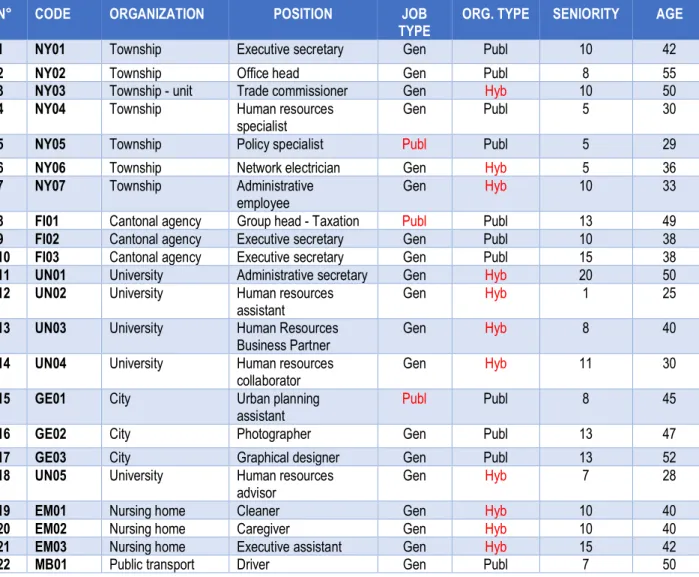
In an attempt to nullify the over determination of their hierarchical level (Meyer et al. 2002), non-managerial positions were targeted. It should be added that it is not the organization as such that is important in our model but the peculiar working environment in which individual evolve and accomplish their everyday work. Such a conceptualization enables us to observe interesting variations in the kind of job performed (generic or public sector specific), and the kind of work setting (operational logics, values and goals etc.) from which it can be deduced that the agent holds a classical public position or a generic one within a post-bureaucratic environment (Emery 2012, Heckscher and Donnellon 1994, Kernaghan 2000). Table 1 below gives detail about our 22 respondents. They are aged between 24 and 40 years old, with 5 to 15 years of seniority in the same organization or in the public sector. This was an important condition, for we wanted the individuals to be reflective about their relation to work in the public sector.
25
Tableau 1: Descriptive information on the interviewed agents
N° CODE ORGANIZATION POSITION JOB
TYPE ORG. TYPE SENIORITY AGE 1 NY01 Township Executive secretary Gen Publ 10 42
2 NY02 Township Office head Gen Publ 8 55
3 NY03 Township - unit Trade commissioner Gen Hyb 10 50 4 NY04 Township Human resources
specialist Gen Publ 5 30
5 NY05 Township Policy specialist Publ Publ 5 29
6 NY06 Township Network electrician Gen Hyb 5 36
7 NY07 Township Administrative
employee Gen Hyb 10 33
8 FI01 Cantonal agency Group head - Taxation Publ Publ 13 49 9 FI02 Cantonal agency Executive secretary Gen Publ 10 38 10 FI03 Cantonal agency Executive secretary Gen Publ 15 38 11 UN01 University Administrative secretary Gen Hyb 20 50 12 UN02 University Human resources
assistant Gen Hyb 1 25
13 UN03 University Human Resources
Business Partner Gen Hyb 8 40
14 UN04 University Human resources
collaborator Gen Hyb 11 30
15 GE01 City Urban planning assistant
Publ Publ 8 45
16 GE02 City Photographer Gen Publ 13 47
17 GE03 City Graphical designer Gen Publ 13 52
18 UN05 University Human resources
advisor Gen Hyb 7 28
19 EM01 Nursing home Cleaner Gen Hyb 10 40
20 EM02 Nursing home Caregiver Gen Hyb 10 40
21 EM03 Nursing home Executive assistant Gen Hyb 15 42
26
Using a guide (built up following a review of the most frequently used scales of commitment) 7 for the most important themes to be discussed, the open discussions revolved around the way the interviewed public employees identified, were attached, and expressed their loyalties to specific foci at work. Given the conceptual links between Motivation (especially PSM) and Commitment, attention was paid not to capture the respondents' motivations to work in the public realm. This is why the discussions sought coherence around public employees' identification with, attachment and loyalty to the factors, first identified by them as the targets of their willingness to hold and keep holding public jobs. Hence typical themes addressed during the interviews were related to the meaning of their work or organization to them, what they deemed important at work, their views about the changing nature of public organizations and their own job, how they envision their future etc. Our interview guide is attached to the present article.
Technical Analyses
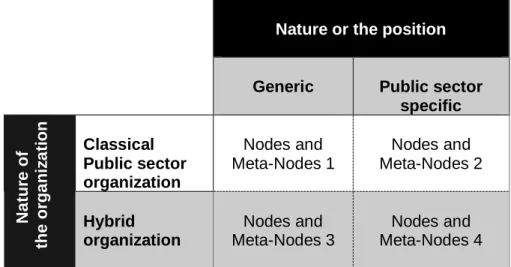
The open, on average one-hour interviews (from 50 minutes to 80 minutes), have been coded by means of NVIVO, using the respondents' own words to describe their commitment foci, classified as nodes. These codes then underwent a process of continuous refinement in axial nodes, so as to generate a new classification of commitment foci, in theoretical clusters to be discussed (Meyer and Herscovitch 2001, Mowday, Steers, and Porter 1979). A total of 250 data strips have been coded as foci of commitment (Corbin and Strauss 1990). Those strips were then clustered in different themes, by grouping individual foci into conceptually coherent commitment foci; the latter constitute meta-nodes and, according to the Model of analysis represented in Table
7 For further details see Fields, D. L. (2002). Taking the measure of work: A guide to validated scales for organizational research and diagnosis. Sage.
27
2 below, serve as commitment foci in the present research. The process was further refined in order to achieve qualitative and conceptual distinctiveness between the different clusters of foci. This was made possible, besides the manual grouping, thanks to the theoretical training of the authors, and their knowledge of the investigated field.
Table 2: Model of analysis of commitment foci8
8 The dashed lines express the possibility that some of the nodes and meta-nodes may possibly overlap between the four categories, even if we made an effort of theoretical and conceptual distinction.
Nature or the position
Generic Public sector specific N a tur e of t he orga niz a ti on Classical Public sector organization Nodes and Meta-Nodes 1 Nodes and Meta-Nodes 2 Hybrid organization Nodes and Meta-Nodes 3 Nodes and Meta-Nodes 4
28
Overall results: individual, organizational and
extra-organizational foci in general
All in all, this study unveils 17 foci of commitment, described in detail in annex 2. In the following lines, we review 13 of them, which do not fall into the above-mentioned generic foci of commitment (ORG, LEAD, JOB, TEAM, si nce these are what adds value to the present study. Public missions and Goals (PPUBL) refers to preference for strategic public policies implemented by the organization. Public goals are appreciated in relation to their social ends. In this regard, they are closely related to Public services (SPUBL), the pride that employees take in the sense and meaningfulness of the employment through its service aspects and the solutions found for beneficiaries. The latter are another focus of commitment, known as Customers in the private sector and termed User-Clients (USCL) in this study; in fact, the raison d'être of most public activities. Embedded in public activities are public Values (VALUES) which may be congruent to individuals' own values, thus forming a fertile ground for commitment in the public sector. The Dynamic and interpersonal social interactions (DISOC) are characterized by the building of social ties and the quality of interpersonal relations among colleagues and beneficiaries. Public employees also strongly identify with their professions, roles and career. This focus has been termed Professional, role, and career identity (IDC) and equates to how public employees perceive their functions within the organization and the public system in general. Another focus of commitment is Innovation (INNOV), especially when public workplaces sit at the forefront of innovative ideas and technologies and empower their employees to develop "small things" or share their experiences. Also important is the Social and societal impacts (ISSOC) of one's activities, mostly because their "direct output" is sometimes visible, for instance in the field of
29
urban planning. To make this possible, particular facilitating mechanisms need to be mobilized: Workdesign (WDGN) corresponds to HRM logics that place a strong emphasis on flexibility, autonomy and participation. Flexibility in Workdesign is furthermore manifest in the relation to time. We have called this focus of commitment Public Time (TPSPUBL). Thanks to the amount of time allocated to them, public employees get more satisfaction in the conduct of their work. Public Time in fact enables quality work by granting employees enough time to perform. This is all the more appreciable that in private companies, employees are often bound to do more with less time. Public Time is hence a fertile ground for Professional dedication (CPRO) - work well done with professionalism, respect, positivity and empathy, while Public employees also seek Professional and personal development (DEV) for their personal fulfilment at work. The difference with dedication to one's career is that DEV is related to everything that enables good performance, whereas commitment to the career equates to adopting a long term and strategic stance. Behind DEV is the need to be efficient; which is why some employees would place great value on training.
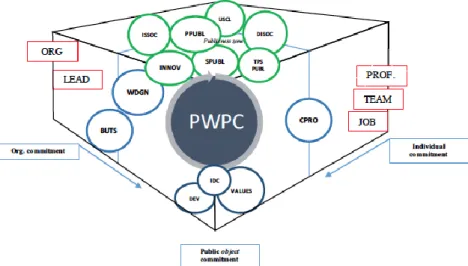
Together with the generic foci of commitment, our analysis yields three axes, two of which are part of Fornes and Rocco's categorization of commitment foci (individual and organizational), and one derived from the present study: (extra organizational). The commitment foci around these three axes reveal five categories. Apart from the categories clearly revolving around the three main axes, three other overlapping categories include:
• The core of workplace commitment (VALUES, IDC, and DEV)
• Foci overlapping the Organizational and Extra-organizational axis (WDGN and BPUBL)
• One focus overlapping the Individual and Extra-organizational axis (CPRO).
30
Thus the first axis is made up of two foci: The Job (JOB), and the Team (TEAM). The organization (ORG) and the Leader or Supervisor (LEAD) form the second axis. On the third position are seven remaining commitment foci labelled as the Dynamics of social interactions (DISOC), Social and societal impacts (ISSOC), Innovation (INNOV), Public policies and missions (PPUBL), User-clients (USCL), Public services (SPUBL), Public time (TPSPUBL). This third axis of foci can eventually be supplemented by the ones which overlap between two or more of the different levels of commitment revealed by our analysis. Professional consciousness (CPRO) for instance intersects the individual and extra-organizational level. Workdesign (WDGN) and Public goals (PPUBL) intersect the organizational and extra-organizational levels. Finally, Values (VAL), Role and career identification (IDC), and Personal and professional development (DEV) are at the heart of the commitment construct of our respondents, since they intersect all of the three axes of commitment (individual, organizational, and extra-organizational).
Drawing from the criteria used in Fornes and Rocco's study (2013), individual foci of commitment means the "employee’s identification with the values of other individuals and peers within the organization" through his teammates, work and career. Organizational commitment characterizes public employees' identification to the employing organization. The latter is exemplified by the Supervisor and the Organization. Extra-organization commitment foci are commitment to foci other than the individual and organizational types. They may be of many sorts, but the ones of interest to us here concern foci that are relevant to public employees and public workplaces.
In sum, if an extra-organizational level clearly appears, besides the individual and organizational forms of commitment identified in the literature, a number of commitment foci still overlap some of the levels or all of them together.
31
A color code is used in Table 2 (in the appendixes) to sketch this first classification of the commitment foci. We have chosen to place the generic foci, also described in the literature in red boxes. These foci gather a first cluster of individual level foci of commitment and a second cluster of organizational cluster of commitment foci. Supplementary Individual foci are Personal and professional development in yellow (DEV) and Professional dedication in blue (CPRO). The remaining foci have been placed in green boxes and are hereby considered as Extra-organizational given that they conceptually go beyond organizational boundaries. Values for example can appear at the individual, organizational or societal level. As for Public goals and missions, they may be pertinent at the organizational level since, after all, public organizations are mainly in charge of implementing policies in line with public interests. Yet, public interest as such is defined outside of the organization in a polyarchic mode, on account of the multiple stakeholders involved in public action. Table 2, in the appendixes defines all the foci further, especially concerning their peculiar meanings for our respondents.
Discussion
Commitment foci in the public sector: a complex
arrangement
The commitment foci unveiled in the current study more or less coincide with the universal foci of commitment theorized by Morrow (1993), which are globally also those specified by Fornes and Rocco (2013) as being organizational (Supervisor and Organization) and individual (Profession, Team/Workgroup, and Job). This is the case apart from Professional dedication (CPRO), a typical cultural trait of Swiss employees in general and of the
32
interviewed public employees in particular: their push for excellence by the quality of work (Turansky and Rousson 2001). Compared to the literature on Workplace commitment, new foci of commitment emerge from the current study. These foci, which are not considered among the generic forms of commitment, already known in the literature (Morrow, 1989; Riketta, 2002), will be the one discussed hereafter.
Public values, often identified as an object of motivation in the literature, especially in PSM (Baarspul, 2011; Perry, 1990), are also cited here as foci of their commitment. Besides, the social and societal orientations of public action particularly reveal their importance in Public policies (PPUBL): Public services (SPUBL), all framed by Public values (VALUES), in addition to its societal Impacts (ISSOC).
Particularly interesting for HRM management in the public sector is Workdesign (WDGN). In relation to the operational organization of work, Employees' commitment is enhanced via the autonomy, participation and flexibility they enjoy within their workplaces. In public realms, Time (a focus coded as TPSPUBL in this study) is considered as particularly important in that it enables performance and the delivery of quality work: Having more time at their disposal, public employees are empowered to innovate in their everyday work (INNOV), even if public organizations are generally not portrayed as innovative (Rainey and al, 1999). Furthermore, Public jobs are peculiar in their inherent complexity and their involving of multi-stakeholders. This implies dynamic interactions that contribute to enrich employees personally and professionally (DISOC). These dynamics may also involve individuals outside public organizations: their beneficiaries, as well as other types of stakeholders.
33
The inherent complexity in public work settings is exemplified by the many commitment foci revealed by the present study, besides the generic ones hitherto analyzed. It follows that the typology proposed by Fornes and Rocco (2013), which splits the commitment construct in only two levels (individual and organizational), can further be enriched, as discussed in the following sub-chapter.
An emerging typology of foci in the public sector
Figure 2: Public Workplace Commitment, a three pillars model
A first expanded typology of commitment therefore emerges from the workplaces studied, encompassing individual, organizational and extra-organizational foci of commitment. The latter are specific in that they are not equated to public employee's identification to their peers, not to the organization as such (Fornes and Rocco, 2013) in their psychological bond to their workplaces (Klein, Molloy, and Brinsfield 2012).
34
Even if this construction with three axes is of particular interest, close attention should be paid to the group of foci cutting across the three levels of commitment: Values (VALUES), Identification to one's role and career (IDC), and Professional and personal development (DEV). These commitment foci, at the core of our model, are particularly important to the interviewees. Possibly, they could be considered as the primary criterion and drivers of Workplace commitment. Our findings thus imply a broader conceptualization of work design. One that promotes employee personal (empowerment and legitimization) and professional (skills and competences) development while acknowledging the human dimension within the bureaucratic machinery (Markovits et al. 2010, Emery and Giauque 2016).
Resting PWPC on this three pillar model is elsewhere interesting in its capacity to give clues for a specification of commitment in the public sector. Here, we name Extra-organizational, the foci emerging besides the generic ones, when they are not intertwined with one or another level of commitment, because no control group permits their qualification as specifically public. The overlapping categories cut through the organizational and Extra-organizational on one hand, and individual and Extra-organizational axes on the other. This relative predominance of the Extra-organizational axis here invites to the enlargement of the concept of workplace commitment beyond the organizational and individual levels. It appears that public servants are in quest, above all, of social ties within the organization (Hackman and Oldham 1980, Wright 2004). This is mainly what perspires from the fact that their commitments are mostly oriented towards the services facets of their jobs: public services and policies (SPUBL and PPUBL), the impact of the implemented policies on society (ISSOC) with a special interest for the receivers of public services (USCL). Besides, the social ties built with colleagues within the workplace or outside of it (DISSOC) are also important for they facilitative
35
function in the conduct of work. A corollary to social ties is the social function of one's job, what it represents and the social status granted to the public employee through that specific job; perhaps why role, professional and career identity (IDC) is so much emphasized in this study. Consequently, a work organization or design (WDGN) that promotes social ties is a particularly appreciated commitment focus. Another thing is that the conception of Time (TPSPUBL) - on a practical plan, the way goals are set and work time organized in general - takes a special taste here. This tends to counter a view derived from today's technology-bound organization of society, characterized by an over-acceleration of professional interactions and streamlined processes.
The other important axis of public workplace commitment is related to the meaning of work in so far as it promotes a number of values and affects the lives of many (ISSOC). This focus of commitment has implications on the type of policies in which the employing organization is engaged (PPUBL), and its outcomes in terms of public services dedicated to the citizens (USCL). Effectively, Dedication to the citizens is often what attracts many to the public realms, be it for a generic job, or something in the organization's core business (Perry 1996, Vandenabeele 2005, Leisink and Steijn 2009, Andersen 2009). But this motivation to work in the public sector can only end up in a good fit with the work environment, if the personal and professional selves are developed at the same time.
In short, the multi-foci approach of commitment reveals a number of interesting foci, aside the ones deemed as universal (and hence valid in all kinds of work organizations). In the discussion below, the potential differences in foci between public of hybrid contexts (in terms of organizational and job characteristics) is examined.
36
Commitment foci in public and hybrid
organizations: exploratory differences
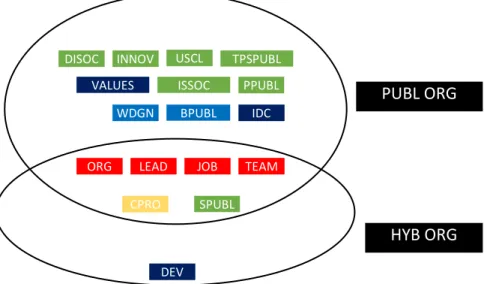
Figure 3: Distribution Commitment foci by organization type9
It can be noticed from Figure 3 above that the public-classical nature of the organization concentrates commitment foci. The generic foci of commitment (Morrow 1993a, Cohen 2007) are rather well represented in this distribution, since they all appear in the context of public organization. Innovation (INNOV) and commitment to the intended beneficiaries (USCL) are prominent in public organizations too. Innovation (INNOV) and Public time (TPSPUBL) are rather unusual foci of commitment in the public
9 In red the generic foci of commitment; in dark blue those at the core of the model; in blue the foci overlaping the organisational and Extra-organizational axes; in yellow the only focus overlaping the Individual and the Extra-organizational axis. PUBL ORG HYB ORG DISOC TPSPUBL PPUBL SPUBL USCL CPRO BPUBL WDGN IDC VALUES DEV INNOV ISSOC JOB