econ
stor
www.econstor.eu
Der Open-Access-Publikationsserver der ZBW – Leibniz-Informationszentrum WirtschaftThe Open Access Publication Server of the ZBW – Leibniz Information Centre for Economics
Nutzungsbedingungen:
Die ZBW räumt Ihnen als Nutzerin/Nutzer das unentgeltliche, räumlich unbeschränkte und zeitlich auf die Dauer des Schutzrechts beschränkte einfache Recht ein, das ausgewählte Werk im Rahmen der unter
→ http://www.econstor.eu/dspace/Nutzungsbedingungen nachzulesenden vollständigen Nutzungsbedingungen zu vervielfältigen, mit denen die Nutzerin/der Nutzer sich durch die erste Nutzung einverstanden erklärt.
Terms of use:
The ZBW grants you, the user, the non-exclusive right to use the selected work free of charge, territorially unrestricted and within the time limit of the term of the property rights according to the terms specified at
→ http://www.econstor.eu/dspace/Nutzungsbedingungen By the first use of the selected work the user agrees and declares to comply with these terms of use.
zbw
Leibniz-Informationszentrum WirtschaftBroll, Udo; Gilroy, B. Michael; Lukas, Elmar
Working Paper
Export production under exchange rate
uncertainty
Dresden discussion paper series in economics, No. 08/08
Provided in cooperation with:
Technische Universität Dresden
Suggested citation: Broll, Udo; Gilroy, B. Michael; Lukas, Elmar (2008) : Export production under exchange rate uncertainty, Dresden discussion paper series in economics, No. 08/08, http://hdl.handle.net/10419/36491
Dresden University of Technology
Faculty of Business Management and Economics
Dresden Discussion Paper Series
in Economics
Export Production under Exchange Rate
Uncertainty
U
DO
B
ROLL
B.
M
ICHAEL
G
ILROY
E
LMAR
L
UKAS
Dresden Discussion Paper in Economics No. 08/08
Address of the author(s):
Udo Broll
Dresden University of Technology Faculty of Business and Economics Helmholtzstraße 10 01069 Dresden Germany e-mail : [email protected] B. Michael Gilroy University of Paderborn Department of Economics Wartburger Str. 100 33098 Paderborn Germany e-mail : [email protected] Elmar Lukas University of Paderborn Department of Economics Wartburger Str. 100 33098 Paderborn Germany e-mail : [email protected] Editors:
Faculty of Business Management and Economics, Department of Economics
Internet:
An electronic version of the paper may be downloaded from the homepage: http://rcswww.urz.tu-dresden.de/wpeconomics/index.htm
English papers are also available from the SSRN website: http://www.ssrn.com
Dresden Discussion Paper in Economics No. 08/08
Export Production under Exchange Rate Uncertainty
Udo Broll B. Michael Gilroy
Dresden University of Technology University of Paderborn Faculty of Business and Economics Department of Economics
01069 Dresden 33098 Paderborn [email protected] [email protected] Elmar Lukas University of Paderborn Department of Economics 33098 Paderborn [email protected] Abstract:
Given that a multinational enterprise can react flexibly upon exchange rate movements, international trade flows may be interpreted as an option. An enterprise will opt to export if the profits obtained from exporting under given exchange rate developments are greater than if foreign subsidiary sales were opted. Naturally, given negative exchange rate scenario situations, an enterprise will choose not to export. By virtue of a favorable exchange rate situation it may be more advantageous to implement the flexibility given by the inherent option exercise privilege. Interestingly, even taking account of entrepreneurial risk aversion aspects of enterprises, it is demonstrated that situations characterized by enhanced exchange rate volatility may still lead to greater export trade volumes.
JEL-Classification: F31, J20
1. Introduction
Export consignments and exchange rate uncertainty play a vital role in the ongoing debates of globalization and the welfare of nations (see e.g. McKenzie 1999; Bacchetta and van Wincoop 2000). Apparent contradictory theoretical foundations in the midst of empirically observed inconsistent evidence and reactions of international trade flows under various exchange rate risk situa-tions are the motivation for the following analysis. If an enterprise possesses the eventuality of deciding whether to sell its products or services domesti-cally or internationally after gaining certain knowledge of revenue and cost relevant exchange rates, then a real option situation emerges. Since the value of an option increases under upward volatility, a situation may arise in which the volume of exports and expected profit utility increases (see e.g. Franke 1991; Dellas and Zilberfarb 1993; Gagnon 1993). However, at the same time enhanced exchange rate volatility commonly implies an increase in earnings risk. Under such circumstances, aspects of entrepreneurial risk aversion have a vital economic role to play when analyzing the interaction of export flex-ibility, exchange rate volatility and international trade flows (see e.g. Broll et al. 2006).
Applying common valuation methods of mathematical finance it is possible to ascertain the pecuniary economic value of such flexibility. Flexibility is interpreted here in the following sense: as well known from the real options literature an option gives the holder the right to do something in the future. It should be emphasized that the holder does not have to exercise this right, although there is a cost of obtaining the option. Thus, an investor has a degree of flexibility or choice in exercising or not exercising a given option at hand. Meanwhile it is currently common to implement such valuation methods in economic modeling of real production units (see e.g. Kulati-laka and Marks 1988; Gilroy and Lukas 2006). The following now considers the economic consequences that emerge from a real option perspective for international trade flows in view of circumstances in which multinational en-terprises can flexibly react to changes in exchange rates. An enterprise has to decide ex-ante about production, however, with regard to the selling market an enterprise is capable of selecting ex-post between the domestic and foreign market.
As is well know from corporate finance, the value of an option rises as the volatility of the company’s rate of return is on the rise. The analogue condi-tion for a real export opcondi-tion posicondi-tion is now evident: given rising exchange rate volatilities, the assessment of an export option becomes more valuable. It is now conceivable that the volume of exports observed will increase
paral-lel to the volatility of the spot quotations of market exchange rates provided that the entrepreneurial risk aversion preferences do not overshadow the ben-efits of the option. We demonstrate this effect in the following.
2. Exchange Rate Risk and Export Flexibility
An enterprise, it is assumed, is capable of supplying domestic and foreign markets. The enterprise has free flexible choice of which market it desires to serve and how. Contingent upon the relevant benefits of domestic and foreign market sales, managers have to decide which market to serve. The exchange rate ˜e is a log-normal distributed random variable and fluctuates with an error term z around the price relationship ¯e =P/P∗, i.e. ˜e = ¯ee−12σ2t+σ
√
tz, whereby z is standard normal distributed with zero mean and var(z) = 1.1 An increase in σ implies an increase in the exchange rate risk given constant expected value ¯e.
The objective of a risk averse enterprise is to maximize future random ex-pected profits Π. The general structure of the maximization problem is outlined as follows. During the current periodt= 0 (ex ante), the enterprise chooses a specific production level Y and at the time pointt= 1 (ex post) an enterprise must decide on the allocation of the produced output to the home or foreign goods market. Thus the allocation decision can be made condi-tional on the realization of the exchange rate. This captures the notion of flexibility and the enterprise’s specific advantage. Multinational enterprises can be treated as export flexible firms. An enterprise will only opt to export given that an advantage in exercising the option is evident, i.e. when the realized exchange rateeat time point t= 1 is greater in magnitude than the expected exchange rate ¯e. If the realized exchange rate is, on the other hand, smaller in magnitude than the expected exchange rate ¯e, the enterprise will allocate its production to the more advantageous domestic market sales. Consequently, export flexibility possesses a significant inherent economic value: enterprises that are internationally active are in an advantageous po-sition with regard to favorable and profitable exchange rate developments, without being exposed to the disadvantages of unfavorable exchange rate changes. Given a non-favorable exchange rate situation, an enterprise will prefer to sell their entire production batch Y domestically at price P. If the
1Here we follow the literature that models exchange rates dynamics by means of a
geo-metric Brownian motion. See e.g. Briys and Solnik (1992). For a more general approach with respect to price process dynamics see e.g. Lioui and Poncet (2002).
exchange rate situation evolves favorably from the firm’s perspective, then it will try to sell its’ entire production consignment Y =X at price ˜eP∗ in foreign markets (with P∗ representing the constant world price expressed in foreign currency units).
3. Risk Aversion and Production
Since the enterprise optimal sales consignment decision is made after the exchange rate has been observed, the allocation decision will be made on the basis of a comparison of the sales prices on the home and foreign goods markets. Accordingly, the production decision condition of optimality out-come reflects a functional relationship between the optimal production lot size and exchange rate volatility. A comparative-static analysis illustrates that exchange rate volatility affects the entire enterprise production benefi-cially and on average simultaneously enhances exports (dY /dσ > 0), given that the enterprise or managerial relative risk aversion R=−u(Π)Π/u(Π) is not too vast. Hereby, Π designates enterprise profits. If the degree of rel-ative risk aversion is smaller than one, then on average exports will increase given an increase in exchange rate volatility observed. Specifically, we can restate this result more succinctly as follows:
Proposition: (Export Flexibility, Production and Risk Aversion) Given a risk averse domestic enterprise that exhibits aspects of export flex-ibility, exchange rate volatility will have a positive effect upon the firm’s entire production such that on average exports will be affected positively if the entrepreneurial relative risk aversion is not too large. If the degree of relative risk aversion is smaller (larger) than one, then on average exports will increase (decrease) when exchange rate risk (volatility) increases. PROOF. The decision-rule respective of exercising or not exercising an export option is revealed as: X = 0, for z ≤ 0.5σ and X = Y for z > 0.5σ. The objective of management is to maximize expected utility profits:
max Y ∞ z>0.5σ u (e−12σ2+σz)P Y −C(Y) df(z) +u(P Y −C(Y))f(z ≤0.5σ). The necessary condition for an optimal production consignment is derived as: ∞ z>0.5σ u(ΠF) (e−12σ2+σz)P −C(Y) df(z)+u(ΠH)(P−C(Y))N 1 2σ = 0.
where N(. . .) denotes the cumulative normal density function, ΠH and ΠF denote the profits from serving either the local and foreign market. The final result now depends on an examination of the sign of the derivative dY /dσ = −A/B. Since −B is positive due to the second-order conditions, the result is contingent on the sign of the value ofA which is determined by:
A= ∞ z>0.5σ u(ΠF)P e−12σ2+σz(z−σ) u(ΠF) u(ΠF)Y(P +σP ∗z−C(Y)) + 1 df(z). Applying some simple rearranging and substitutionR=−uΠ/u one finally obtains A= ∞ z>0.5σ u(ΠF)P e−12σ2+σz(z−σ) u(ΠF) u(ΠF)(C(Y)−Y C (Y)) + 1−Rdf(z) > ∞ z>σ u(ΠF)P e−21σ2+σz(1−R)df(z).
hence proving the claim.
What is the economic interpretation behind these relationships among ex-change rate risk, production, international trade and risk aversion? The next section illustrates this by means of a stylized example.
4. International Exchange Rates and their
impact on Trade
In the following we want to discuss the results in more detail. For the sake of simplicity we will assume that the individual’s utility from production can be expressed by a constant relative risk aversion (CRRA) utility function, i.e. u= 1/(1−γ)Π(1i −γ) wherei indicates whether the profits are generated from local production (H) or exporting (F) and γ = 1. This utility function implies that R ≡ γ. Further, production costs are assumed to be quadratic inY, which yields C(Y) = 1/2Y2 and the length of the time interval is set to
T =t1 −t0 = 1. Consequently, profits derived from serving solely the home country or from exporting to the foreign country result to:
ΠH = P Y −1 2Y 2, ΠF = ˜eP∗Y − 1 2Y 2 = e−1 2σ2+σz P Y − 1 2Y 2.
Substituting these in the objective function of the management yields:
= max Y ⎡ ⎣ ∞ z>0.5σ u(ΠF)df(z) +u(ΠH)f(z ≤0.5σ) ⎤ ⎦, = max Y ⎡ ⎣ ∞ z>0.5σ 1 (1−γ)√2π e −1 2σ2+σz P Y −1 2Y 2 (1−γ) e−12z2dz + 1 (1−γ) P Y − 1 2Y 2 (1−γ) N 1 2σ .
This equation cannot be solved analytically and we have to rely on nu-merical methods to estimate a solution for Y∗. Let’s normalize the price of the production good in the home country to 1. Then the following Figures (1) and (2) depict the solution of an optimal output Y∗ as a function of exchange rate volatility and degree of risk aversion.
As Figure (1) highlights, an increase in the exchange rate volatility leads to a decrease in the optimal amount of output if the manager is very risk averse, i.e. γ > 1. Moreover, the higher the degree of risk aversion the lower the absolute amount of optimal production output. The intuition be-hind this result is as follows. Under consideration of relative risk aspects, greater exchange rate volatility is judged negatively. The resulting pattern is a standard result in economic theory. On the other hand, however, if the manager is less risk averse, i. e. γ <1 an increase in exchange rate volatility corresponds with an increase in production output (Figure 2). In addition, an increase in risk aversion leads to a decrease of the total amount of goods produced under the expected utility maximization principle. Put differently, under consideration of option aspects the situation is assessed positively due to the what one might call theinsurance effect, i. e. the ability to profit from positive exchange rate developments while being secured against losses if the economic situations turns out to be unprofitable.
In conclusion, the final outcome effect upon the total production and ex-port magnitudes is ultimately dependent upon the degree of entrepreneurial
0.2 0.4 0.6 0.8 1.000 1.005 1.010 1.015 1.020 Volatility Y*
Figure 1: Optimal production Y∗ and uncertainty σ relationship for firms with γ = 4 (solid) and γ= 4.5 (dashed).
0.2 0.4 0.6 0.8 1.00 1.05 1.10 1.15 1.20 1.25 Volatility Y*
Figure 2: Optimal production Y∗ and uncertainty σ relationship for firms with γ = 0.2 (solid) andγ = 0.4 (dashed).
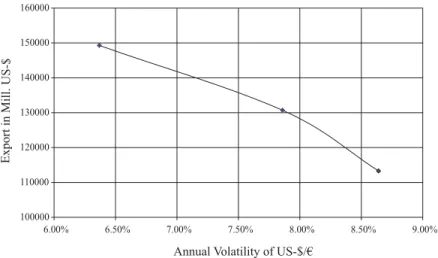
risk aversion. Pragmatically, at a more stylized level, the following Figures 3 and 4 put forward a brief illustration of our lines of thought.
The seizing up of the inter-bank money markets around the world recently shows how risk aversion, starting from the weakness of the US housing market
Annual Volatility of US-$/€ Export in M ill. US-$ 100000 110000 120000 130000 140000 150000 160000 6.00% 6.50% 7.00% 7.50% 8.00% 8.50% 9.00%
Figure 3: Export (in mill. US-$) and Annual Historical Exchange Rate Volatility Relationship for the U.S. for the years 2005 to 2007.
and the sourcing of subprime mortgages, has become acute enough to cause enterprises to fear future global developments. Financial markets being in turmoil has enhanced volatility, leading to higher levels of uncertainties as well as exchange rate fluctuations as the Euro is traded heavily against the dollar while risk aversion stays high. During the current bout of market turmoil, it is sometimes argued in passing in the United States that in 2007, risk aversion in international financial markets has reached the same levels as seen after the September 11 attacks in 2001. As a result investors are on rebound from their current depressed levels against the Euro.
Although geographically a small open economy, Switzerland, however, constitutes the foundation of an extraordinarily innovative national econ-omy. Indeed, as evinced by the WEF (2006), in which Switzerland comes in first place as the most competitive country in the world, the steady po-litical and economic environment has highly positive effects on an already good record of companies’ activities. It seems almost natural given such a specific contextual environment that the relative risk assessment of interna-tional private sector actors and their activities, such as exporting, continues to develop comprehensively as illustrated above in Figure 4.
Both the stylized illustrations of Figures 3 and 4, along with the demon-strated analysis presented, further highlight the need to adapt relevant risk assessment methodologies and frameworks associated with the interactions of potential differences reflected by entrepreneurial risk aversion and export consignments given situations of exchange rate uncertainty.
48000 53000 58000 63000 68000 73000 78000 2.50% 2.70% 2.90% 3.10% 3.30% 3.50% 3.70% 3.90% 4.10% Annual Volatility of CHF/€ Export in M ill. CHF
Figure 4: Export (in mill. CHF) and Annual Historical Exchange Rate Volatility Relationship for Switzerland for the years 2005 to 2007.
5. Conclusion
Historically, multinational enterprises have often been exposed to high for-eign exchange risk since major currencies have shown a substantial volatility. Empirical evidence, however, regarding the effect of exchange rate risk on ex-port volumes, trade and investment flows has at best been inconclusive. The analysis offered here discusses analytically and graphically one possible an-swer to the observed inconclusiveness of enterprise behavior based upon the firm’s potential advantages to allocate production and exports to the world market or to the domestic market. Enterprises are in the favorable position of deciding ex-ante about production, but with respect to the selling market the enterprise is able to choose ex-post between the domestic and the world market. The advantage of this decisional flexibility suggests that the interna-tional allocation of production consignments can be made condiinterna-tional on the realization of the exchange rate. Commonly, in situations in which exchange rates surge to high levels, one observes enhanced volumes of exports. On the other hand, in situations in which exchange rates drop below a certain level, exports fall to zero. Specifically, taking into account relevant aspects of risk aversion perceptions of firms, enterprise exports are an example of a real option which is exercised if profitable. Multinational enterprises can be regarded as flexiblefirms because of their use of worldwide distribution facil-ities. An enterprises’ flexibility can be viewed as a real hedging instrument offering an intrinsic advantageous risk management policy founded upon the realization of foreign spot exchange rates and the respective degree of
preneurial risk aversion. Given that the relevant elasticity of risk aversion is smaller than one, exchange rate volatility goes hand-in-hand with frequently observed increases in chosen export strategies of multinational enterprises.
References
Bacchetta, P., E. van Wincoop, Does Exchange Rate Stability Increase Trade and Welfare?, in: American Economic Review, Vol. 90 (2000), pp. 1093-1209.
Broll, U., J.E. Wahl, K.-W. Wong, Elasticity of Risk Aversion and International Trade, in: Economics Letters, Vol. 92 (2006) pp. 126-130.
Briys, E., B. Solnik, Optimal Currency Hedge Rations and Inter-est Rate Risk, in: Journal of International Money and Finance, Vol. 11 (1992), pp. 431-445.
Dellas, H., B.-Z. Zilberfarb, Real Exchange Rate Volatility and In-ternational Trade: A Reexamination of the Theory, in: Southern Economic Journal, Vol. 59 (1993), pp. 641-649.
Franke, G., Exchange Rate Volatility and International Trading Strategy, in: Journal of International Money and Finance, Vol. 10 (1991), pp. 292-307.
Gagnon, J.E., Exchange Rate Variability and the Level of Interna-tional Trade, in: Journal of InternaInterna-tional Economics, Vol. 34 (1993), pp. 269-287.
Gilroy, B.M., E. Lukas, The Choice between Greenfield Investment and Cross-Border Acquisition: A Real Option Approach, in: Quarterly Review of Economics and Finance, Vol. 46 (2006), pp. 447-465.
Kulatilaka, N., S.G. Marks, The Strategic Value of Flexibility: Reducing the Ability to Compromise, in: American Economic Review June, Vol. 78 (1988), pp. 574-580.
of International Money and Finance, Vol. 21 (2002), pp. 241-264.
McKenzie, M., The Impact of Exchange Rate Volatility on International Trade Flows, in: Journal of Economic Surveys, Vol. 13 (1999), pp. 71-106.
WEF-World Economic Forum, The Global Competitiveness Report 2006–2007, World Economic Forum, Geneva, 2006.
Dresden Discussion Paper Series in Economics
14/06 Kemnitz, Alexander / Eckhard Janeba / Ehrhart, Nick: Studiengebühren in Deutschland: Drei Thesen und ihr empirischer Gehalt
01/07 Kemnitz, Alexander: University Funding Reform, Competition and Teaching Quality 02/07 Sülzle, Kai: Innovation and Adoption of Electronic Business Technologies
03/07 Lehmann-Waffenschmidt, Marco / Sandri, Serena: Recursivity and Self-Referentiality of Economic Theories and Their Implications for Bounded Rational Actors
04/07 Lehmann-Waffenschmidt, Marco / Hain, Cornelia: Neuroökonomie und Neuromarketing: Neurale Korrelate strategischer Entscheidungen
05/07 Günther, Edeltraud / Lehmann-Waffenschmidt, Marco: Deceleration - Revealed Preference in Society and Win-Win-Strategy for Sustainable Management
06/07 Wahl, Jack E. / Broll, Udo: Differential Taxation and Corporate Futures-Hedging
07/07 Bieta, Volker / Broll, Udo / Milde, Hellmuth / Siebe, Wilfried: The New Basel Accord and the Nature of Risk: A Game Theoretic Perspective
08/07 Kemnitz, Alexander: Educational Federalism and the Quality Effects of Tuition Fees
09/07 Mukherjee, Arijit / Broll, Udo / Mukherjee, Soma: Licensing by a Monopolist and Unionized Labour Market
10/07 Lochner, Stefan / Broll, Udo: German Foreign Direct Investment and Wages
11/07 Lehmann-Waffenschmidt, Marco: Komparative Evolutorische Analyse – Konzeption und Anwendungen
12/07 Broll, Udo / Eckwert, Bernhard: The Competitive Firm under Price Uncertainty: The Role of Information and Hedging
13/07 Dittrich, Marcus: Minimum Wages and Union Bargaining in a Dual Labour Market
14/07 Broll, Udo / Roldán-Ponce, Antonio / Wahl, Jack E.:: Barriers to Diversification and Regional Allocation of Capital
15/07 Morone, Andrea / Fiore, Annamaria / Sandri, Serena: On the Absorbability of Herd Behaviour and Informational Cascades: An Experimental Analysis
16/07 Kemnitz, Alexander: Native Welfare Losses from High Skilled Immigration
17/07 Hofmann, Alexander / Seitz, Helmut: Demographiesensitivität und Nachhaltigkeit der Länder- und Kommunalfinanzen: Ein Ost-West-Vergleich
01/08 Hirte, Georg / Brunow, Stephan: The Age Pattern of Human Capital and Regional Productivity 02/08 Fuchs, Michaela / Weyh, Antje: The Determinants of Job Creation and Destruction: Plant-level
Evidence for Eastern and Western Germany
03/08 Heinzel, Christoph: Implications of Diverging Social and Private Discount Rates for Investments in the German Power Industry. A New Case for Nuclear Energy?
04/08 Bieta, Volker / Broll, Udo / Siebe, Wilfried: The Banking Firm: The Role of Signaling with Collaterals
05/08 Felder, Stefan / Werblow, Andreas: Do the Age Profiles of Health Care Expendidure Really Steepen over Time? New Evidence from Swiss Cantons
06/08 Broll, Udo / Wahl, Jack E. / Wessel, Christoph: Export Production, Hedging Exchange Rate Risk: The Duopoly Case
07/08 Choi, Jay-Pil / Thum, Marcel: The Economics of Political-Connected Firms
08/08 Broll, Udo / Gilroy, B. Michael / Lukas, Elmar: Export Production under Exchange Rate Uncertainty