An Agent-Based Simulation
Model of Structural
Change in Agriculture
A Thesis
Submitted to the College of Graduate Studies and Research
in Partial Fulfillment of the Requirements
for the Degree of
Master of Science
In the Department of
Bioresource Policy, Business, and Economics
University of Saskatchewan
by
Peter C. Stolniuk
Permission to Use
In presenting this thesis in partial fulfillment of the requirements for a postgraduate degree from
the University of Saskatchewan, I agree that the Libraries of this University may make it freely
available for inspection. I further agree that permission for copying of this thesis in any manner,
in whole or in part, for scholarly purposes may be granted by the professors who supervised my
thesis work, or in their absence, by the Head of the Department or the Dean of the College in
which my thesis work was done. It is understood that any copying or publication or use of this
thesis or parts thereof for financial gain shall not be allowed without my written permission. It is
also understood that due recognition will be given to me and the University of Saskatchewan in
any scholarly use that may be made of any material in this thesis.
Requests for permission to copy or to make other use of the material in this thesis in whole or
part should be addressed to:
Head of the Department of Agricultural Economics
University of Saskatchewan
51
Campus
Drive
Abstract
Stolniuk, Peter, M.Sc. University of Saskatchewan, Saskatoon, March 2008.
An Agent-based Simulation Approach to Forecast Long-Run Structural Change in the
Saskatchewan Grain and Livestock
Sectors.
Supervisor: R.A. Schoney
Like many North American agricultural regions, Saskatchewan has experienced significant
fundamental structural changes in farming. Structural change encompasses evolution in
distribution of farm sizes, land tenure and financial characteristics, as well as variations in
demographic and production characteristics. These issues are often a source of discontent among
farm populations as it implies these populations are forced to adapt in a number of potentially
unpleasant ways. These changes have profound and sometimes poorly understood effects on the
rural economy – for example, structural change affects rural population and therefore demand for
rural infrastructure.
Traditional agricultural farm level analysis is often conducted using a representative farm or
group, but this framework cannot capture the growing heterogeneity of modern farm operators or
the current operating environment in agricultural regions. Farm profiles vary by demographic
characteristics, such as age and education, and resource endowments. Agent-based simulation
captures this heterogeneity through a farm by farm analysis, where after initialization, the
regional economy evolves over time.
A synthetic population is created based on survey data and the land characteristics based on the
actual land data in CAR 7B of Saskatchewan. A number of different price and yield time paths
were created using a bootstrap procedure on historical data and the model evolved to potential
agriculture structures that may occur in the model region, 30 years in the future.
Structural change occurs endogenously as farms interact in land markets, and make decisions on
land use. Agents compete for available land in a purchase and lease market with land selling to
the highest bidder. The dynamic nature of agent-based models allows individual farms to adjust
land use in response to changing economic conditions and individual preferences. How
The results indicate that many of the trends are the same under the different price and yield time
paths, however the rate of change is significantly impacted by the price and yield time path that
occurs. The model predicted the trend to fewer and larger farms will continue into the future.
The forecasted distribution of smaller farms will decline and proportion of large farms will
increase, while mid sized farms will remain relatively unchanged. The proportion of mixed
farms, land use, and total livestock numbers depend significantly on the price and yield time path.
The actual structure that will occur will be the result of the actual individual price and yield time
path that occurs.
Acknowledgements
As I look back many people have contributed to the success of this thesis. I would first like to
thank my supervisor Dr. Richard Schoney for his time, patience, knowledge, and encouragement.
I am extremely grateful that his door was always open and that he was willing to discuss any
issues that I encountered. Next, I would like to thank committee member Dr. James Nolan, for
the advice, comments, and enthusiasm in this area of research, as well as the very much
appreciated words of encouragement along the way. I would also like to thank committee
member Dr. Craig Wilson and external examiner Dr. James Unterschultz for helpful comments
that significantly benefited this research. I would like to thank my classmates who offered a
much needed break from research. I owe a great deal of gratitude to my parents who instilled the
value of education in me and for their support throughout not only this process, but in all other
aspects of my life. Lastly, my wife Karyn for her support throughout my years as a graduate
student, without you this would have never been possible.
Table of Contents
Permission to Use ... i
Abstract... ii
Acknowledgements ... iv
Table of Contents ...v
List of Figures... viii
List of Tables ...x
Chapter 1 ...1
1.0 Introduction
...1
1.2 Objectives and Expected Results
...2
1.3 Thesis Organization
...3
Chapter Two...4
2.0 Introduction
...4
2.1 What is Agent-based Modeling?
...4
2.1.1 Advantages of Agent-based Models
...5
2.1.1.1 Complexity
...5
2.1.1.2 Flexibility
...6
2.1.1.3 Emergence
...6
2.1.1.4 Spatial Representation, Soil Quality and Land Use
...6
2.2 Causes of Structural Change
...7
2.2.1 Technology and Economies of Size
...7
2.2.2 Off Farm Employment and Demographic Characteristics
...8
2.3 Land Use
...9
2.3.1 Land Use Methodologies
...10
2.3.1.1 Equation Models
...10
2.3.1.2 Agent-based Models of Land Use
...11
2.3.2 Land Use Decisions
...11
2.4 Agent-based Models of Structural Change
...12
2.5 Farmland Markets
...12
2.5.1 Farmland Bid Value
...13
2.5.1.1 Market Based Annual Rent
...13
2.5.1.2 Government Payments
...14
2.5.1.3 Capital Gains
...14
2.5.1.4 The Role of Capital and Liquidity Constraints
...14
2.5.2 The Role of Speculation
...15
2.5.3 Farmland Leasing
...15
2.5.4 Farmland as an Investment
...16
2.6 Forage Markets
...16
2.7 Summary
...17
Chapter 3 ...18
3.0 Introduction
...18
3.1 NetLogo
©Platform
...19
3.2 Heterogeneity
...19
3.2.1 Agent Heterogeneity
...20
3.2.2 Land Heterogeneity
...20
3.3 Dynamics
...21
3.3.1.1 Cost of Production
...22
3.3.1.2 Land Use
...23
3.3.1.3 Incomplete Information
...23
3.5 Summary
...24
Chapter 4 ...25
4.0 Introduction
...25
4.1 Model Assumptions
...26
4.2 Farm Production Activities
...27
4.2.1 Crop Income
...27
4.2.2 Forage and Livestock Production
...28
4.2.2.1 Livestock Income
...28
4.2.2.2 Hay and Pasture Production
...29
4.2.2.3 Hay and Pasture Usage
...30
4.2.2.4 Hay Reserves, Sales, and Purchases
...31
4.2.3 Variable Costs and Forage Establishment and Breaking
...32
4.2.4 Transportation Expense
...32
4.2.5 Annual Machinery Repairs
...33
4.2.6 Cash Commitments
...34
4.3 Off Farm Employment and Family Living Withdrawal
...34
4.4 Farm Accounting
...35
4.4.1 Cash Flows
...35
4.4.2 Balance Sheet
...35
4.5 Farm Agent Expectations
...36
4.6 Farm Agent Crop Mix
...37
4.7 Farm Exits and Transfers
...37
4.8 Land Use
...38
4.9 Machinery and Livestock Investment
...41
4.10 Farmland Markets
...42
4.10.1 Bidding Eligibility Criteria
...43
4.10.2 Farmland Purchase Market
...44
4.10.2.1 Maximum Bid Based on Income Earning Ability
...44
4.10.2.3 Investor’s Bid Value and Minimum Acceptable Price
...48
4.10.3 Auction Process
...50
4.10.4 Farmland Lease Market
...50
4.10.4 Lease Renegotiation
...51
4.11 Summary
...51
Chapter 5 ...52
5.0 Introduction
...52
5.1 Synthetic Farm Population
...53
5.1.1 Farm Size, Operator Age, and Off Farm Income
...53
5.1.2 Land Tenure, Land Use, and Livestock Numbers
...54
5.1.3 Assets and Debt
...55
5.2 Stochastic Prices and Yields
...56
5.3 Crop Production Data
...58
5.3.1 Crop Variable Cost
...58
5.3.2 Crop Machinery Options
...59
5.4 Livestock and Forage Production Data
...61
5.4.1 Cow and Forage Variable Costs
...61
5.4.2 Livestock Energy Requirements and Energy from Various Feed Sources
...62
5.4.3 Forage Establishment and Breaking Costs
...63
5.4.4 Forage Reserves and Transaction Fee
...64
5.5 Transportation Costs
...64
5.6 Hired Labour Costs
...64
5.7 Retirements and Farm Transfers
...65
5.8 Family Living Withdrawal
...66
5.9 Model Validation
...67
5.10 Summary
...68
Chapter 6 ...69
6.0 Introduction
...69
6.1 Simulation Results: Base Scenario
...69
6.1.1 Farm Numbers, Type, and Average Size
...69
6.1.2 Distribution of Farm Sizes
...73
6.1.3 Land Use, Total Livestock Numbers, and Average Herd Size
...75
6.1.4 Financial Characteristics
...78
6.1.4.1 Farm Financial Characteristics
...78
6.1.4.2 Financial Characteristics by Farm Type
...81
6.1.5 Land Markets
...82
6.1.5.1 Farm Exits
...82
6.1.5.2 Land Price and Lease Rate
...82
6.1.5.3 Land Tenure
...83
6.1.5.4 Unfarmed Land
...84
6.2 Simulation Results: Alternative Scenarios
...85
6.2.1 Farm Numbers, Type, and Average Size
...85
6.2.2 Distribution of Farm Sizes
...88
6.2.3 Land Use, Livestock Numbers, and Herd Size
...90
6.2.4 Financial Characteristics
...92
6.2.4.1 All Farms Financial Characteristics
...92
6.2.5 Land Markets
...95
6.2.5.1 Farm Exits
...96
6.2.5.2 Land Price and Lease Rate
...96
6.2.5.3 Land Tenure
...97
6.3 Summary
...97
Chapter 7 ...99
7.1 Summary
...99
7.2 Conclusions
...100
7.3 Limitations
...101
7.4 Suggestions for Further Study
...102
References...103
Appendix A...110
Appendix B ...112
Appendix C...114
Appendix D...115
Appendix E ...117
List of Figures
Figure 3.1:
Conceptual Model of an agricultural system...19
Figure 3.2:
Farmland Markets...21
Figure 3.3:
Average Cost of Production with Lumpy Investments ...22
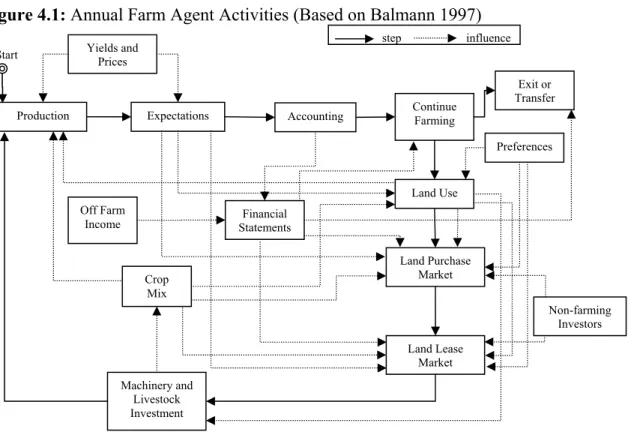
Figure 4.1:
Annual Farm Agent Activities...25
Figure 5.1:
Census Agriculture Regions of Saskatchewan ...52
Figure 5.2:
Historic Land Prices and Simulated Land Prices ...68
Figure 6.1:
Simulated Farm Numbers (Base Scenario) ...70
Figure 6.2:
Simulated Distribution of Final Farm Numbers (Base Scenario)...70
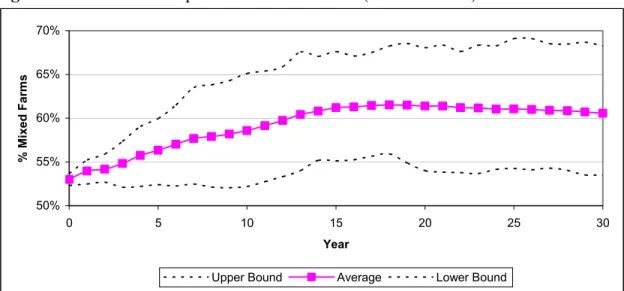
Figure 6.3:
Simulated Proportion of Mixed Farms (Base Scenario)...71
Figure 6.4:
Simulated Mean Farm Size (Base Scenario) ...71
Figure 6.5:
Simulated Distribution of Final Mean Farm Size (Base Scenario) ...72
Figure 6.6:
Simulated Mean Farm Size by Farm Type (Base Scenario) ...73
Figure 6.7:
Simulated Distribution of All Farm Sizes (Base Scenario)...73
Figure 6.8:
Simulated Distribution of Grain Farm Sizes (Base Scenario)...74
Figure 6.9:
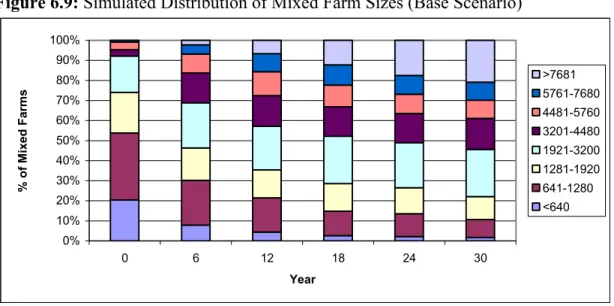
Simulated Distribution of Mixed Farm Sizes (Base Scenario)...75
Figure 6.10:
Simulated Proportion of Land Used in Crop Production (Base Scenario) ...75
Figure 6.11:
5 Simulated Time Paths of Proportion of Land Used in Crop Production (Base
Scenario)...76
Figure 6.12:
Simulated Mean Mixed Farm Herd Size (Base Scenario)...77
Figure 6.13:
Simulated Total Cow Herd Size (Base Scenario)...77
Figure 6.14:
Simulated Distribution of Mixed Farm Herd Sizes (Base Scenario)...78
Figure 6.15:
Simulated Mean Net Worth (Base Scenario) ...79
Figure 6.16:
Simulated Distribution of Final Mean Net Worth (Base Scenario)...79
Figure 6.17:
Simulated Mean Debt to Assets (Base Scenario) ...80
Figure 6.18:
Simulated Distribution of Final Mean Debt to Assets (Base Scenario) ...80
Figure 6.19:
Simulated Mean Net Worth by Farm Type (Base Scenario)...81
Figure 6.20:
Simulated Mean Debt to Assets by Farm Type (Base Scenario) ...81
Figure 6.21:
Simulated Land Price (Base Scenario) ...83
Figure 6.22:
Simulated Land Lease Rate (Base Scenario)...83
Figure 6.23:
Simulated Proportion of Leased Land (Base Scenario)...84
Figure 6.24:
Simulated Farm Numbers (All Scenarios)...85
Figure 6.25:
Simulated Proportion of Mixed Farms (All Scenarios)...86
Figure 6.26:
Simulated Mean Farm Size (All Scenarios) ...86
Figure 6.27:
Simulated Mean Grain Farm Size (All Scenarios) ...87
Figure 6.28:
Simulated Mean Mixed Farm Size (All Scenarios)...88
Figure 6.29:
Simulated Distribution of All Farm Sizes (Scenario 1)...89
Figure 6.30:
Simulated Distribution of All Farm Sizes (Scenario 2)...89
Figure 6.31:
Simulated Proportion of Land Used in Crop Production (All Scenarios) ...90
Figure 6.32:
Simulated Mean Total Cow Herd Size (All Scenarios)...91
Figure 6.33:
Simulated Mean Mixed Farm Herd Size (All Scenarios)...91
Figure 6.34:
Simulated Mean Net Worth (All Scenarios)...92
Figure 6.35:
Simulated Average Debt to Assets (All Scenarios)...93
Figure 6.36:
Simulated Mean Grain Farm Net Worth (All Scenarios) ...93
Figure 6.37:
Simulated Mean Mixed Farm Net Worth (All Scenarios)...94
Figure 6.38:
Simulated Mean Grain Farm Debt to Assets (All Scenarios)...95
Figure 6.40:
Simulated Land Price (All Scenarios) ...96
Figure 6.41:
Simulated Land Lease Rate (All Scenarios)...97
List of Tables
Table 5.1:
Initial Distribution of Farms by Age and Farm Size (Synthetic Population)...54
Table 5.2:
Distribution of Off Farm Income by Farm Size (Synthetic Population)...54
Table
5.3:
Initial Land Tenure, Land Use, and Cow Numbers ...55
Table 5.4:
Distribution of Farm Debt by Age (Synthetic Population) ...56
Table 5.5:
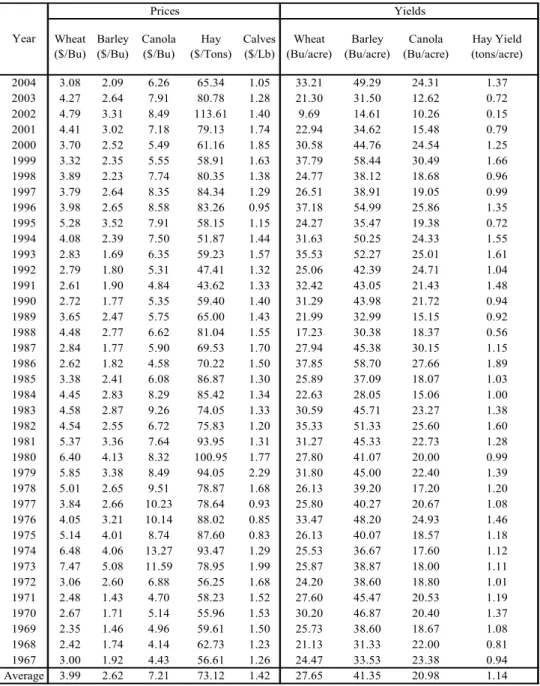
Historic Yields and Detrended Prices ...58
Table 5.6
: Variable Cost per Acre of Various Cropping Alternatives ...59
Table 5.7:
Crop Machinery Options...60
Table 5.8:
Farmers Crop Mix ...60
Table 5.9:
Cow Production Variable Costs Excluding Labour and Feed ...61
Table 5.10:
1,300 lb beef cow Energy requirements as predicted by CowBytes
©...62
Table 5.11:
Forage Seeding and Breaking Cost for the Dark Brown Soil Zone...63
Table 5.12:
Crop Enterprise Hired Labour...65
Table 5.13:
Probability of Farm Exits by Farm Operator Age...66
Table 5.14:
Probability of Off Farm Employment by Farm Size...66
Table 6.1:
Farm Exits by Exit Type (Base Scenario)...82
Chapter 1
Introduction
1.0 Introduction
Modern economies continually experience structural change as new technologies, policies, and
markets emerge or change. For some people it results in discontent as they are forced to change,
relocate, or adjust to lower earnings. This is evidenced by the debate about what the future holds
for the “family farm” and the role of agricultural policy in determining that future. For others
structural change can be viewed as a challenge that creates new market opportunities.
The changing structure of agriculture is often characterized by the decline in farm numbers
accompanied by the increase in farm size. Goddard et al. (1993) identifies structural change as
changes in essential characteristics of production activities. Therefore, structure of an industry
can also include: 1) farm size and distribution 2) technology and production characteristics 3)
demographic characteristics, and 4) resource ownership and financing. Changes in farm size and
distribution are based on the number of farms in each size category. The production mix and
how these products are produced are influenced by technology and production characteristics.
Demographic characteristics include the age, education, and financial characteristics of farm
operators. Land tenure, whether land is leased or owned, and how land and other assets are paid
for is included in resource ownership and financing.
The farming sector is characterized by many different individuals with different financial and
demographic characteristics. Traditional economic models, such as general or partial equilibrium
models, are unable to capture the diversity and interactions apparent in agriculture system and
cannot accurately forecast behaviour far beyond the years which the model parameters where
derived (Freeman 2005). This has led researchers to utilize alternatives to traditional economics
such as, agent-based modeling, when analyzing structure of the agricultural industry.
Public programs can have a significant impact on the agricultural structure. Agricultural policies
can impede or encourage structural change by increasing the profitability of one production
activity relative to others, resulting in an inefficient allocation of resources (Happe 2004).
Agricultural support programs also create an incentive for inefficient producers to remain in
operation by subsidising their income to an acceptable level (Happe 2004), slowing agricultural
adjustment. As a result the direct costs and benefits of public programs interfere with the process
of structural change in an economy (Goddard et al. 1993). It is critical that policy makers have
the ability to accurately evaluate the impacts of agricultural policy both in the short run and many
years into the future.
The structure of agriculture is an important issue because it has a large impact on rural
communities. Fewer and larger farms lead to rural depopulation, which has an impact on the
demand for infrastructure. With fewer people in rural areas there is less demand for schools,
hospitals, recreational facilities, roads, and businesses and services in these areas. Closing of
these businesses and services leads to concern of the remaining population of the rural areas and
may feedback and influence their decision to remain in the rural area. The structure of
agriculture also impacts the type and location of processing facilities, which can impact the
marketing and production plans of producers.
1.2 Objectives and Expected Results
The primary purpose of this research is to project what the future agricultural structure in
Saskatchewan will be in 30 years under alternative price scenarios. More specifically the farm
numbers, farm size and distribution of size, production characteristics, demographic
characteristics, and resource ownership and financing of the agricultural industry will be
projected. This is achieved through expanding the agent-based model of Freeman (2005) to
represent typical Census Agriculture Region in Saskatchewan, where structural change takes
place endogenously within the model. Freeman’s model was expanded to include: 1) mixed
farms that are willing to use land in the highest and best use to produce forage and livestock or
annual crops in addition to grain farms unwilling to produce livestock and 2) economies of size
and lumpy machinery investments for the annual crop production enterprise. The inclusion of
livestock allows farmers to make annual land use decisions and expected land use when creating
bid values in the farmland markets based on profitability, with mixed farms having a bidding
advantage on land suited for livestock production. The model is initialized with an exogenous
price scenario and is allowed to evolve over time revealing the future agricultural structure.
It is expected that the price and yield scenarios will have an important role on the structural
change that occurs. If the prices and yields are high it is likely that the farm numbers will not
decline as quickly as a scenario with lower prices and yields. However, it is possible that the
increase in income could be captured by the individuals selling and leasing land in the land
markets and not have a significant impact on farm numbers. It is also expected that if the relative
price of livestock increases to annual crops, the mixed farms will have a bidding advantage in the
land markets and will likely increase farm size while grain farms may eventually be forced to exit
the industry.
1.3 Thesis Organization
This thesis is composed of seven chapters. Chapter two is a brief discussion of the literature on
agent-based models and their suitability to modeling a complex agricultural system, causes of
structural change, farmland markets and bid values, land use, and forage markets. The following
chapter develops a conceptual model of an agricultural system. The fourth chapter defines in
detail the individual agents’ behaviour. The fifth chapter outlines the model initialization and
data, followed by a chapter describing the results. The last chapter contains summary and
concluding remarks.
Chapter Two
Literature Review
2.0 Introduction
This chapter will review the literature that applies to modeling agricultural structural change.
The first section deals with agent-based models and their advantages, including the ability to
handle complex systems, build models at the individual level, produce emergent or unexpected
results, and capture heterogeneity and spatial characteristics. This is followed by a discussion on
how technology and economies of size, off farm employment, and demographic characteristics
affect structural change. A discussion of the characteristics of equation models and agent-based
models of land use and the factors that influence the land use decision follows. Next, a section
focusing on other agent-based studies of structural change and their suitability to a Saskatchewan
agricultural system. Following this, a discussion on how farmer’s determine farmland bid values,
from annual income, government payments, capital gains, and capital and liquidity constraints.
Also included in this section is a discussion on the role of speculation in the farmland markets,
description of farmland leasing, and farmland as an investment for non-farming individuals.
There is then a brief discussion on forage markets, followed by a summery of the chapter.
2.1 What is Agent-based Modeling?
Agent-based modeling (AbM) is a relatively new methodology to economics (Rosser 1999), but
it is an established methodology in other social science (Parker et al. 2003). AbM consists of
autonomous, interacting agents who make decisions linking their behaviour to the environment
(Parker et al. 2003). These models are computer simulations of individual agents used to study
how their aggregation leads to complex macro behavior (Berger 2001). Increases in computing
power have allowed increasingly complex problems to be analyzed using AbM.
Agent-based modelers initialize an economy with a population of agents distributed across a
geographical landscape (Tesfatsion 2002). Common behavioral and decision rules are assigned
to all agents, but each individual agent can vary according to demographic, financial, and other
personal characteristics. Once the decision rules and initial attributes of the agents are set and
exogenous data included, there is no further intervention by the modeler and the economy
evolves over time (Tesfatsion 2002).
2.1.1 Advantages of Agent-based Models
AbM offers a number of advantages over traditional economic models. Freeman (2005) identifies
some of these as: 1) the ability to obtain numerical solutions in complex systems that maybe
unsolvable analytically, 2) flexibility, 3) emergent characteristics, and 4) spatial representation.
AbM’s ability to capture these characteristics gives it potential to overcome the limitations of
previous farm level models (Freeman 2005) and include aspects such as heterogeneity and
feedback that exist in an agricultural system.
2.1.1.1 Complexity
Agricultural economists have viewed agricultural structures as complex dynamic systems since
the 1960s (Happe 2004). Complex systems are characterized by heterogeneity,
interdependencies, and nested hierarchies among agents and their environment (Parker et al.
2003). Heterogeneity includes both differences in agents and land characteristics. Agents vary
according to demographic characteristics, financial characteristics, and available resources. Land
is heterogeneous in terms of soil quality, which can influence land use, farmable area and
location. Interdependencies arise because agents rely on information from their past decisions and
other agents’ decisions to update their decision making strategy (Parker et al. 2003). An example
of interdependencies in an agricultural region is the land market, where a farm is unable to
expand unless another agent decides to sell (Happe 2004). Hierarchal structures occur as
individuals interact to form households, which interact with other households to form villages,
with multiple scales influencing individual agents (Parker et al. 2003). Rosser (1999) adds that in
economics, an added layer of complexity results from interacting human calculations in decision
making, which may not exist in other disciplines.
2.1.1.2 Flexibility
The flexibility of AbM allows for a “bottom up” approach to modeling that does not rely on
exogenous assumptions that are required by “top down” approaches (Freeman 2005). Traditional
equilibrium models require fixed decision rules, common knowledge assumptions, representative
agents, and imposed market equilibrium constraints (Tesfatsion 2002). These assumptions are
required to ensure consistency between the macro and micro level (Happe 2004). Once the
mechanics of an AbM are understood and programmed, the researcher has greater flexibility to
design and execute experiments to explore alternative causal mechanisms that are more complex
and possibly easier to solve than equilibrium based solutions (Parker et al. 2003). In AbM’s there
are no market equilibrium constraints allowing the market to be out of equilibrium.
2.1.1.3 Emergence
The interactions of a complex system may give rise to emergent phenomenon. There are
numerous definitions of emergence in the literature, but there are some commonalities. Gilbert
and Troitzsch (2002) state a phenomenon is emergent if it requires new categories to describe it,
which are not required to describe the behavior of the underlying components. Many of the
definitions concern macro scale phenomena that arise as a result of complex, micro-scale
interactions (Parker et al. 2003). Other definitions associate emergence with surprise or
unanticipated results (Batty and Torrens 2001). An early example of emergence is in Schelling’s
(1978) model of how nieghbourhoods become segregated by race. Schelling found that a
moderate urge to avoid being the minority in a particular neighbourhood results in highly
segregated nieghbourhoods to develop.
2.1.1.4 Spatial Representation, Soil Quality and Land Use
Spatial representation is an important aspect of agriculture because it can have a significant
impact on farm level decisions. An example is the transportation costs associated with
machinery operations and its affect on farming geographically dispersed land (Freeman 2005).
Transportation costs from farmstead to field increase with distance causing competition for land
to be mainly between neighbours (Berger 2001).
Soil quality is often associated with certain geographical features such as glacial moraines, river
deltas, ancient lake bottoms, or natural prairie/forest ecosystems. Production and land use
decisions are based on soil quality and consequently, the difference in soil quality determines the
spatial land use landscape (Berger 2001). AbM’s have the ability to capture spatial
characteristics, which are important to the agricultural structure.
2.2 Causes of Structural Change
Structural change is well documented in the literature. Although there is consensus that
structural change has occurred in the form of decreasing farm numbers and increasing farm size,
there often is no common agreement on the implications of these changes for the viability of the
sector, rural community, environment, and society (Goddard et al. 1993). In order to understand
the implications of structural change it is important to understand its underlying causes. The
following section reviews possible causes of structural change such as technology and economies
of size, off farm employment and demographic characteristics, and sectoral heterogeneity.
2.2.1 Technology and Economies of Size
A well known theory on possible cause of structural change is based upon Cochrane’s
technological treadmill. Cochrane (1958) maintained that new technology decreases the unit cost
of production and early adopters of this technology realize increased net incomes. As the number
of adopters increases, total output increases, resulting in lower prices, forcing other farmers to
adopt the technology to remain competitive. Those who do not adopt the technology are forced
out of the industry and their assets will be acquired by the producers that remain (Harrington and
Reinsel 1995). The result is that each individual has incentive to adopt the new technology, even
though their collective decision will not make them better off and could make them worse off
(Harington and Reinsel 1995).
Another cause of structural change is the presence of economies of size. Economies of size
imply that an increase in size will result in a decrease in the average total costs and therefore,
large farms are more efficient then small farms. Optimal farm size is the minimum of the
long-run cost curve (Goddard et al. 1993) and if an individual is not at this point there is incentive to
adjust farm size or resource use to reach this point. Technological change shifts this curve to the
right, increasing the number of farms with increasing returns to size and therefore increasing the
number of farms with incentive for farm growth (Goddard et al. 1993).
The shape of the long-run cost curve has important implications on the desire for farm growth.
Schoney (1997) identifies that the majority of studies find an “L shaped” curve where after a
threshold point most economies of size are exhausted. This threshold for grains and oilseeds was
estimated by Fleming and Uhm (1982) to be approximately 350 tonnes of production in the black
soil zone of Saskatchewan. Schoney (1997) estimated this threshold to be 1,500 to 2,000 acres in
the black soil zone and 2,500 to 3,000 acres in the brown soil zone of Saskatchewan. There is
little evidence of diseconomies of size in the literature (Schoney 1997), which creates incentive to
increase in size to obtain higher total returns even though cost will not decrease (Goddard et al.
1993).
2.2.2 Off Farm Employment and Demographic Characteristics
Structural change in agriculture can occur as a result of the ability for farm operators to use their
labour to earn off farm income. Farmers optimize their economic well being through allocating
their land, labour, and capital to farm and non farm uses (Harrington and Reinsel 1995). Kesliv
and Peterson (1982) believed a rise in urban incomes creates incentive to leave agriculture,
leaving the remaining land to fewer, but larger farms. With more resources, the remaining farms
increase their incomes, closing the urban-rural income gap (Kesliv and Peterson 1982).
Others have argued that off farm employment helps ensure the survival of smaller farms. Off
farm employment reduces the amount of farm income that is needed to meet a required standard
of living (Goddard et al. 1993). Increases in productivity and a fixed land base along with the
seasonal nature of agriculture causes farm families to have their available labour underemployed
(Olfert 1992). This allows for the reallocation of excess labour to off farm activities, raising their
household income. While once considered a transition phase for new entrants or a short-term
crisis response, off farm employment is now recognized as a stable long term condition (Olfert
1992). The increase in off farm employment has increased the number of small part time farmers
(Goddard et al. 1993).
Changing patterns of entry, growth, and exit can result in structural change (Harrington and
Reinsel 1995). This theory is known as the life cycle hypothesis. The life cycle hypotheses is
based on an agricultural ladder where operators enter through the renting of farm assets, add
more rented land for part of their lives, progressively acquire ownership of land, and finally
progressively relinquish control of rented and owned land during the exit stage (Harrington and
Reinsel 1995). Different age cohorts experience similar patterns that are marginally affected by
economic conditions, government policy, or external shocks (Harrington and Reinsel 1995).
Traditionally, farming entrants are young males that were raised on farms. However, this group
is shrinking in size as a result of fewer farms and declining birth rates (Gale 1993). Fewer
entrants implies continued aging of the current farm operators and fewer, larger farms (Gale
1993). Gale (1993) suggests that due to the fewer potential entrants, the number and size
distribution of farms may not reach equilibrium even if returns from non farm employment were
equivalent to farming.
There are a number of arguments on the causes of structural change in agriculture with little
consensus on the issue. The next section will review various land use methodologies and the
land use decision, which can influence structure.
2.3 Land Use
Land use denotes the human employment of the land (Meyer and Turner 1992). The land use
decision of an individual farmer will impact the level of income they are able to generate from
their available resources. Each individual’s land use decision is important in determining farm
profitability and survival. The income generated from land can also have an impact on the desire
for farm growth and the ability to bid for additional farmland.
Land use decisions not only impact the income of farmers, but also the location of infrastructure.
Processing facilities and services will locate in regions that have a large production of a specific
product. For example, in order to minimize travel and transportation costs, a veterinarian will
locate in a region that has large number of livestock and not in an area that is strictly grain and
oilseed farms. Infrastructure location can also feed back and impact land use decisions. If there
is a veterinarian in the area, a farmer will be more willing to switch land from grain and oilseed
to livestock production. The land use of each individual will therefore have a significant impact
on the structure of agriculture.
2.3.1 Land Use Methodologies
There are a number of methodologies used to analyze land use. Parker et al. (2003) identifies the
following models: 1) system models, 2) statistical techniques, 3) expert models, 4) evolutionary
models, 5) cellular models, and 6) agent-based models. This section will focus on equation
modeling and agent-based models of land use.
2.3.1.1 Equation Models
Most models are mathematical in some way, but some are especially so, that models rely on
equations that seek a static or equilibrium solution (Parker et al. 2003). One of these models is
the computable general equilibrium model (CGE). The CGE model has been used for land use
studies by Darwin et al. (1996), Ianchovichina, Darwin, and Shoemaker (2001), and Wong and
Alavalapati (2003).
CGE models are based on general equilibrium theory and assumptions. These assumptions
include perfect competition, full employment of resources, perfectly mobile factors of
production, complete information, and market clearing conditions (Scriecu 2005). CGE models
usually cover economy wide impacts on resource allocation and income, but at a very aggregate
level (Scriecu 2005). As a result, CGE models are weak at assessing and predicting the effects
across various households (Scriecu 2005).
To achieve analytical or computational tractability, equation models require simplifying
assumptions (Parker et al. 2003). Due to the highly aggregated results and the restrictive
assumptions of these types of models, the implications of a shock at the farm level may not be
accurately represented.
2.3.1.2 Agent-based Models of Land Use
A number of researchers have utilized AbM for analyzing land use (See Evans and Kelly 2004;
Kelly and Evans 2005; Balmann 2000; Huigen 2004; Robinson 2003). Land use AbM consist of
two components: 1) a cellular component that represents biophysical and ecological aspects of
the model and 2) an agent component that represents human decision making (Parker et al. 2003).
Traditionally land use models have incorporated biophysical attributes, such as soil quality as
primary land use determinants and have emphasized human decision making as having a smaller
role (Veldkamp and Lambin 2001). However, it is likely that human decision making plays a
role and is evidenced by the fact that land with similar attributes is often used differently (Kelly
and Evans 2005). Land use decisions are made by the individual household or owner of the land
and to understand land use requires learning about how private owners make decisions (Koontz
2001, Messina and Walsh 2001). Individuals make land use decisions based on constraints that
they face (Messina and Walsh 2001).
2.3.2 Land Use Decisions
The most common theory of land use decisions is based on the individual who is primarily
motivated by economic and financial returns (Koontz 2001). Any parcel of land is assumed to be
put its highest and best economic use, given its attributes and location (Lambin, Geist, and Lepers
2003).
Farming, haying, and grazing are primarily motivated by economic return, however many other
land use activities are motivated by other factors (Koontz 2001). Hosier (1988) maintains that
land use decisions are based on economic, environmental, aesthetic, and personal reasons. In
addition to economic reasons, Koontz (2001) identifies that non-monetary benefits may play a
large role in land use decisions. Based on interviews with land owners, Koontz (2001) found that
80% of individuals largely base their land use decisions on non-monetary benefits including
aesthetics, hobbies, and recreation. Non-monetary benefits vary across activity type, parcel size,
and land owner characteristics (Koontz 2001). Varying land use may be caused by
heterogeneous preferences. In the model developed by Kelly and Evans (2005), agents maximize
their expected utility from various activities by choosing how to allocate their labour and land. In
their model, utility is the weighted sum of expected pecuniary and non pecuniary aspects of each
activity. Each activity is assigned a preference weighting that can be different for different
agents. Kelly and Evans (2005) results indicate that land owners’ preferences are equally or
more important than land suitability for determining land use.
2.4 Agent-based Models of Structural Change
Agent-based models of structural change view agriculture as a complex system. One of the first
models was developed by Balmann (1997) for a hypothetical region in Germany, where structural
change occurred endogenously in the model. Largely based on the original model of Balmann
(1997), the AgriPoliS model subsequently developed by Balmann, Happe, and Kellermann was
used to analyze a number of agricultural policies and their impact on structural change (See
Happe 2004; Happe and Balmann 2003; Happe, Kellermann, and Balmann 2006; Sahrbacher et al
2005). However, the AgriPoliS model does not include some aspects which are important to
Saskatchewan agriculture. Farm growth in the AgriPoliS model is limited to producers renting
land as opposed to purchasing (Happe, Balmann, and Kellerman 2004). Another shortcoming of
this model is that it does not include a forage market, limiting livestock herd size.
Building upon the AgriPoliS model, Freeman (2005) developed a model to analyze differing
management styles and their impact on farm structure in Saskatchewan. Freeman’s model
enhanced the AgriPoliS model to include a land purchase market in addition to a lease market.
The land market included both a purchase market and a leasing market. This model imposes the
assumption that all farmers prefer to purchase land first and will lease land only if unsuccessful in
the purchase market. Freeman’s model had simulated results for the period of 1960 to 2000,
which replicated the actual structural change that occurred over the same period, validating AbM
as a methodology for predicting structural change. However, Freeman’s model does not include
economies of size, the ability to change land use, or livestock, which are important aspects of
Saskatchewan agriculture.
2.5 Farmland Markets
In Saskatchewan, farmers are able to gain control of additional farmland through a primary land
purchase market and a secondary leasing market. Farmland markets are characterized by: 1) few
buyers and sellers, 2) farmland rarely being sold, often averaging only once a generation, 3) a
relatively localized market, where competition is traditionally between neighbours, and 4)
imperfect information. To reach economies of size or increase profitability, farmers must
compete in farmland markets to gain control of additional farmland. Once a farmer gains control
of a parcel of land they can then make decisions on the best use of the land.
The following section will deal with some of the issues related to farmland markets. There will
be a brief discussion on the influences of farmland bids. This will be followed by the possibility
of speculation in the farmland markets. The remainder of this section will be a discussion on
farmland leasing and non farm operators investing in farmland.
2.5.1 Farmland Bid Value
The current value of farmland is the present value of the expected future economic return to land
(Pederson 1982). There have been a number of past studies that have attempted to identify major
sources of farmland value. Important sources of farmland value are: 1) market based annual rent,
2) government payments, and 3) capital gains. There has also been discussion on the possibility
of speculation in the farmland market, where individuals believe that the value of farmland will
likely increase in the future. This would cause the bid values of these individuals to increase as a
result of the expected capital gain.
2.5.1.1 Market Based Annual Rent
The underlying source of farmland value is the annual income it can generate (Burt 1986).
Rensiel and Rensiel (1979) thought that the changes in land values are a result of the changing
expectations that individuals have about the annual income. Alston (1986) found that most of the
real growth in land price can be accounted for by growth in real income. Although changes in
annual income are an important component in farmland valuation, they are not the only cause of
the changes in farmland price. Land prices tend to rise faster than income when both are rising
and fall faster when both are falling (Melichar 1979; Clark, Fulton, and Scott 1993). This has
lead to other theories of the causes of change in farmland values.
2.5.1.2 Government Payments
In Saskatchewan, a portion of annual farm income is made up of government support, paid to
farm operators. The size of these payments impacts the maximum bid of each individual farmer.
The level at which the government payments are capitalized into the bid value depends upon the
level of certainty that the support will continue in the future (Goodwin and Otalo-Magne 1992).
The level of support capitalized into land values has not been agreed upon in the literature. Moss,
Shonkwiler, and Reynolds (1989) believed that in the short run, an increase in government
support may signal future problems in agriculture and result in a decline in real asset values.
Both Turvey et al. (1995) and Goodwin and Ortalo-Magne (1992) found that a portion of
government payment are capitalized into land value. Shaik, Helmers, and Atwood (2005)
estimated that since 1980 government payments represented between 15% and 20% of land value
in the U.S. Government payments are an important consideration in determining a bid value, but
it is unclear the level of impact they have.
2.5.1.3 Capital Gains
An important major source of farmland value is expected capital gains. Melichar (1979) found
that a large portion of the growth in the land value was the result of capital gains and not current
income. Similarly, Castle and Hoch (1982) found that increases in land values in the late 1970’s
cannot be explained on the basis of earnings in production alone and that capital gains have a
significant impact on the value of farmland. It is important to note that capital gains also have
differential taxation and rollover provisions.
2.5.1.4 The Role of Capital and Liquidity Constraints
The previous discussion on farmland value was based on profitability. However, in purchasing
farmland, a bid may not be based on profitability, but may be constrained by the individual
farmer’s ability to make cash flows. Oltmans (1995) identifies three primary reasons for cash
flow problems that can occur when purchasing farmland. The first occurs when the capital
repayment period is less than the economic life of the asset. This is likely the case with an asset
such as farmland as the economic life is, for all practical purposes, infinite. Secondly, an asset
that is expected to have capital gains will have cash returns below the cost of capital. Thirdly,
higher returns only benefit current asset owners’ cash flow and profitability and not new owners
seeking to buy the asset. Increases in annual income will be capitalized into the value of
farmland increasing the price, benefiting current land owners. This will also increase the value
that prospective buyers will have to pay and will result in further cash flow difficulties.
2.5.2 The Role of Speculation
Because bid values are based on expectations as to future profitability, there is always the
possibility of speculation in the farmland market. In the case of investors, taking a “long”
position occurs when an asset is purchased with the belief that it will increase in value. During
the late 1970’s and early 1980’s there was a rapid increase in the price of farmland, which caused
many farmland market observers to believe that farmland prices reflected speculative mania
rather than market fundamentals (Tegene and Kuchler 1993). Featherstone and Baker (1987)
suggest that historic annual rents cannot explain a large portion of the movement in farmland
prices and speculative forces maybe driving price determination.
Farmland price movements are composed of two sources: 1) a fundamental component and 2) a
non-fundamental or fad component (Falk and Lee 1998). Falk and Lee (1998) found that in the
short run, the fad component accounted for approximately 50% of farmland price movements.
However, in the long run, they found that most price movements were caused by fundamental
shocks. Tegene and Kuchler (1993) found evidence against the presence of speculation and
concluded the rapid increase in land values was caused by a change in investors expectations.
2.5.3 Farmland Leasing
The farmland lease market allows a producer to gain control of farmland without the large capital
requirements associated with purchasing. Leasing agricultural land has advantages over land
purchased on credit. Leasing allows farmers to operate with less debt, without the large capital
requirements of farmland purchases, reducing the likelihood of bankruptcy and also gives
flexibility to increase or decrease acreage farmed easily (Bierlen, Parsch, and Dixon 1999).
There are two types of common leases, a share lease and a cash lease. A share lease means
income or production is divided proportionally to the inputs that each individual contributes. A
cash lease means a fixed payment is made to the landowner.
Lease choice depends on risk preferences, management skills, financial position, and farm size.
In a cash lease, all risk is assumed by the farm operator. Landowners with high risk aversion and
farm operators with low risk aversion, prefer cash leases over share leases (Paterson, Hanson, and
Robison 2000). Management ability can affect the level of production and profits and as a result
it has been argued that tenants with better management skills will prefer a cash lease where they
have greater managerial discretion over a share lease (Bierlen, Parsch, and Dixon 1999). Large
scale producers usually have contracts with many landlords and cash leasing provides greater
flexibility than share leases (Sotomayor, Ellinger, and Barry 2000). Bierlen, Parsch, and Dixon
(1999) test what affects the type of preferred lease agreement and their results indicate that
tenant’s financial position and the size of the operation are important variables, while rejecting
the risk aversion and managerial ability hypotheses.
2.5.4 Farmland as an Investment
Investors may consider farmland as a possible candidate to maximize the return of the portfolio
for a given risk level. Investors only need to be compensated for systematic risk, which is the
risk the asset will contribute to a well diversified portfolio and not the risk that can be diversified
away (Barry 1980). Using a capital asset pricing model (CAPM) both Barry (1980) and Arthur,
Carter, and Abizadeh (1988) found investment in farmland contributed little systematic risk to a
well diversified portfolio. Barry (1980) also found that farmland offered returns above those for
systematic risk. The inability of the CAPM to account for the illiquidity, indivisibility, and thin
markets of farmland could bias the returns to farmland upwards (Barry 1980). Lins, Sherrick,
and Venigalla (1992) also found that investment in farmland is a good way to diversify a
portfolio because the returns to farmland were negatively correlated with stocks and bonds.
2.6 Forage Markets
Forage markets are of interest because they offer an additional cropping alternative to grain
farmers and also allow mixed farms to have a herd size that is larger than their land base can
support. However, forage markets are very different than grain and oilseed markets. Forage
markets are typically thin, local markets, where quality is not easily determined.
The bulky nature of forage makes it expensive to transport to other regions; volume is the
limiting factor. Therefore, forage markets tend to be local (Rudstrom 2004; Tronstad and
Aradhyula 2004). For example, corn is about four times more valuable than alfalfa based on a
volume basis, but sells for a similar price based on weight (Tronstad and Aradhyula 2004). Thus,
in a localized market high forage yields will result in lower prices for that region (Tronstad and
Aradhyula 2004). Forage markets also tend to be thin, with approximately 70% of the hay
production consumed on the farm where it was produced (Tronstad and Aradhyula 2004) leaving
the rest to be sold and consumed on other farms.
Hay quality is an important factor in determining price (Grisley, Stefanou, and Dickerson 1985).
In Canada, grains and oilseeds quality assessment is based on a grading system; however, such a
system does not exist for hay. Hay quality is often based on protein content and digestibility
(Rudstrom 2004). Although, these quality measures can be tested for, they are not easily
determined visually.
2.7 Summary
This chapter identified a number of advantages of agent-based models including the ability to
handle complexity, flexibility, emergence, and spatial representation. The advantages of AbM,
along with their success in the past, indicates they are a suitable methodology to analyze
structural change and land use. This chapter also reviewed a number of theories about the
sources of structural change in Saskatchewan agriculture. These include technology, economies
of size, off farm employment, demographic characteristics, and sectoral heterogeneity.
Farmers interact in two markets, the farmland markets and the forage markets. Bids for land in
farmland markets are based on the income generating ability of land or the capital and liquidity
constraints of the individual farmer. Finally, forage markets were classified as local markets due
to the bulky nature of forage.
Chapter 3
Conceptual Model
3.0 Introduction
This thesis is concerned with understanding long run structural change in rural areas and
individual farming operations. Structural change is affected by heterogeneity in individuals’
resources and preferences, demographic changes, and technology. Farm operators rely on crop
and livestock income, each of which cannot occur independently, from a scarce, immobile, land
resource. A changing economic environment, along with advances in technology, has
encouraged farms to expand and to transfer resources to different enterprises in order to remain
profitable. To expand, farms must gain control of additional farmland through land markets.
Farmland markets are imperfect, being the result of small groups of people bidding under
incomplete information on heterogeneous land, which rarely becomes available for purchase. As
a result, regional agricultural structure is a complex evolving system, caused by the interaction of
three major components: farms, markets, and land (Happe, Balmann, and Kellermann 2004) (see
figure 3.1). The use of AbM is appealing because each individual farm can be endowed with
specific characteristics and resource endowments. In addition, heterogeneous and spatial
characteristics of land can be included, meaning markets can be modeled using agents that
coordinate market activity (Happe, Balmann, and Kellermann 2004).
Figure 3.1:
Conceptual Model of an agricultural system (Adapted from Happe, Balmann, and
Kellermann 2004)
3.1 NetLogo
©Platform
NetLogo
©is a freeware platform suitable for modeling complex systems that develop over time
(Wilensky 1999). It is quite likely the most widely used platform for AbM research (Railsback,
Lytinen, and Jackson 2006). NetLogo
©is continuously upgraded by the Center for Connected
Learning and Computer Based Modeling at Northwestern University, Evanston Illinois.
Within the NetLogo
©platform, users provide rules to thousands of independent agents operating
concurrently, making it easier to analyze how micro level behaviour leads to macro level patterns
(Wilensky 1999). NetLogo
©is fully programmable with the user creating the spatial
environment and the agents’ behavioral rules (Railsback, Lytinen, and Jackson 2006). NetLogo
©has three classes of agents: turtles, patches, and observer (Wilensky 1999). Turtles are mobile
agents, which can move around the artificial world. Patches are fixed and represent the spatial or
geographic environment grid. The observer agent has no location, but has some control over
other agent classes. In this model, turtles represent the individual farming household located on
various patches of land. The observer represents the market auctioneer and coordinates land
markets.
3.2 Heterogeneity
In traditional economic models, homogeneity among agents is often assumed for simplicity and
mathematical tractability. A major strength of AbM’s are their ability to incorporate
Markets
-LandFarm
farm 1 farm 3 farm 4farm 2
Land/
Space
depends on influences
Enter Exit
heterogeneity in a relatively transparent manner. The agricultural region under study is
characterized by two main sources of heterogeneity: 1) individual agents and 2) land.
3.2.1 Agent Heterogeneity
There are three main agent types in this model: 1) farmers, 2) non-farming land owners, and 3)
the auctioneer, with the farmer being the most numerous. Farmers purchase and rent land used
for production activities while non-farming land owners hold land as an investment, and the
auctioneer coordinates the land markets.
Farming agents are endowed with different resources, abilities, and demographic characteristics.
Resources include capital, land, and labour. These are used for crop or livestock production by
farm agents in an attempt to generate income and wealth. Demographic characteristics include
age, education, and preferences. Although each agent has a common goal of maximizing wealth,
resource organization varies based on the individual’s preferences and resource endowment.
Agents also vary based on the risk aversion and preference for livestock production. In order to
increase wealth, the farm must expand by acquiring more land to increase production.
3.2.2 Land Heterogeneity
Land is arranged in plots of 640 acres and each plot consists of five categories of land: 1) tillable,
2) hay, 3) improved pasture, 4) natural pasture, and 5) waste. Tilled land can be used as pasture,
hay, or crop production. Hay land, consisting of natural hay, is unsuitable to be tilled and can be
used as either hay or pasture. Both improved pasture and natural pasture are used only as pasture
land and waste land is unsuitable for any use.
1The area and quality of each category of land for each plot included in the simulation are based
on Saskatchewan Assessment and Management (SAMA) agency Data. Forage yields and land
value are based on SAMA quality, while annual crop yield indexes are also included for each plot
of land from Saskatchewan Crop Insurance Data.
21
Although it may be possible to improve land quality, it is likely very expensive. An example is the ability to haul
in top good top soil, or remove water from a slough.
The spatial heterogeneity of land is captured through transportation costs for both hay and crop
production to the farmstead. Farm agent bid values for land will be directly affected by the
relative location of the plot in the land market.
3.3 Dynamics
Farm structure is largely influenced by a farmer’s ability to compete in farmland markets.
Farmland markets are the source of growth and represent change in land use when a new
individual gains control of additional farmland. The desire for farm growth causes farm agents to
compete in the farmland markets for the scarce immobile land resource. Farm operators in this
region are able to gain control of additional farmland through a primary farmland purchase
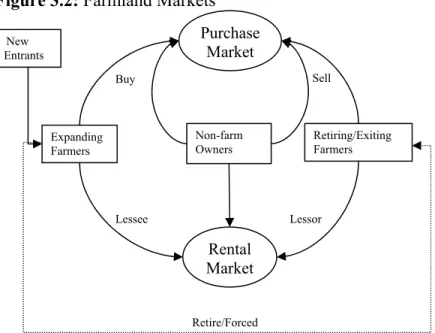
market and a secondary lease market (figure 3.2). Demand in the farmland purchase market is
created by farming operators hoping to expand and non-farming investors. Farmland is supplied
by exiting farmers and non-farming investors. The latter sell farmland when its return falls below
other investment opportunities. In the land lease market, demand is generated from farm
operators seeking to expand, but are unsuccessful, unable, or chose not to compete in the
farmland purchase market. Leased land is supplied by 1) retired farmers, who want to keep
control of their land, and 2) non-farming investors.
Figure 3.2:
Farmland Markets
Rental
Market
Purchase
Market
Expanding Farmers Non-farm Owners Retiring/Exiting Farmers New Entrants Sell Buy Retire/Forced Lessee Lessor3.3.1 Farmer Bid Values in Land Markets and Land Use
Change over time largely stems from changes in control of land through the land market.
Changes in farm size along with farm numbers and a large portion of the transition of land use
occurs through a new individual gaining control of additional land and making the land use
decision. Farmers with sufficient capital and labour required to expand from one efficient point
to another, create bids based on their expected income from controlling the plot. Bid values are
therefore dependent on production costs, land use, and expectations, which determine how
competitive a farmer is in the farmland markets.
3.3.1.1 Cost of Production
In an environment where technology is constantly changing, machinery sizing is a major concern.
Varying cost structures are caused by the indivisible and lumpy nature of machinery and land.
Figure 3.3 demonstrates that as size increases the fixed costs of the investment are spread over
more units and decrease until an efficient point is reached. After the efficient size, diseconomies
are present due to farm operator’s inability to do work in a timely manner (or at all) with their
existing machinery. Past the efficient point, diseconomies set in and the per unit cost increases
until investment in more machinery allows the shift to AC 2.
Figure 3.3:
Average Cost of Production with Lumpy Investments
Accordingly, farms will jump from efficient point to efficient point as they expand their farm
operations. The fixed plot size of farmland does not allow farm operators to expand from an
efficient point without investing in more machinery and shifting to a new cost curve. The result
$/Acre
Acres
AC 1 AC 2