CBMM Memo No. 80
10/2017
Multi-stage Multi-recursive-input Fully
Convolutional Networks for Neuronal Boundary
Detection
Wei Shen
1,2, Bin Wang
1, Yuan Jiang
1, Yan Wang
2, Alan Yuille
21: Key Laboratory of Specialty Fiber Optics and Optical Access Networks, Shanghai University 2: Department of Computer Science, Johns Hopkins University
Abstract
In the field of connectomics, neuroscientists seek to identify cortical connectivity comprehensive-ly. Neuronal boundary detection from the Electron Microscopy (EM) images is often done to assist the automatic reconstruction of neuronal circuit. But the segmentation of EM images is a challenging problem, as it requires the detector to be able to detect both filament-like thin and blob-like thick mem-brane, while suppressing the ambiguous intracellular structure. In this paper, we propose multi-stage multi-recursive-input fully convolutional networks to address this problem. The multiple recursive inputs for one stage, i.e., the multiple side outputs with different receptive field sizes learned from the lower stage, provide multi-scale contextual boundary information for the consecutive learning. This design is biologically-plausible, as it likes a human visual system to compare different possible segmentation solutions to address the ambiguous boundary issue. Our multi-stage networks are trained end-to-end. It achieves promising results on two public available EM segmentation datasets, the mouse piriform cortex dataset and the ISBI 2012 EM dataset.
This material is based upon work supported by the Center for Brains,
Minds and Machines (CBMM), funded by NSF STC award CCF-1231216.
Multi-stage Multi-recursive-input Fully Convolutional Networks for Neuronal
Boundary Detection
Wei Shen
1,2, Bin Wang
1, Yuan Jiang
1∗, Yan Wang
2, Alan Yuille
21
Key Laboratory of Specialty Fiber Optics and Optical Access Networks, Shanghai University
2Department of Computer Science, Johns Hopkins University
[email protected],{wangbin418,jy9387}@outlook.com,{wyanny.9,alan.l.yuille}@gmail.com
Abstract
In the field of connectomics, neuroscientists seek to i-dentify cortical connectivity comprehensively. Neuronal boundary detection from the Electron Microscopy (EM) im-ages is often done to assist the automatic reconstruction of neuronal circuit. But the segmentation of EM images is a challenging problem, as it requires the detector to be able to detect both filament-like thin and blob-like thick mem-brane, while suppressing the ambiguous intracellular struc-ture. In this paper, we propose multi-stage multi-recursive-input fully convolutional networks to address this problem. The multiple recursive inputs for one stage, i.e., the multi-ple side outputs with different receptive field sizes learned from the lower stage, provide multi-scale contextual bound-ary information for the consecutive learning. This design is biologically-plausible, as it likes a human visual system to compare different possible segmentation solutions to ad-dress the ambiguous boundary issue. Our multi-stage net-works are trained end-to-end. It achieves promising re-sults on two public available EM segmentation datasets, the mouse piriform cortex dataset and the ISBI 2012 EM dataset.
1. Introduction
A central theme of neuroscience is to understand how a brain’s functions are related to its neuronal structure [23]. This is difficult because of the small size of neurons and the extremely high packing density of the neuropil, e.g., neurons densely packed axons and dendrites [13]. Recen-t advances in high-Recen-throughpuRecen-t serial secRecen-tion elecRecen-tron mi-croscopy (EM) have made possible the imaging of large volumes of neuronal tissue at high resolution, allowing neu-roscience experts to reconstruct neuronal circuits and study the interconnections of neurons [38]. However, analysis of a large number of EM images by expert annotators is
labo-∗equal contribution with the second author
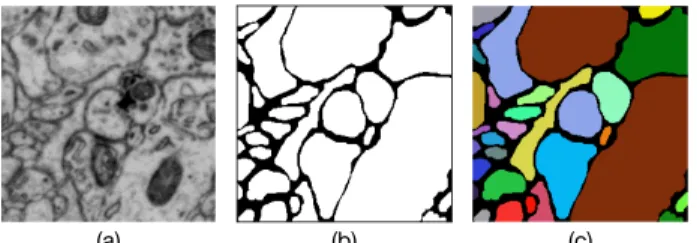
(a) (b) (c)
Figure 1. Neuronal structure segmentation: an EM image (a) and the ground truths for its neuronal boundary detection result (b) and segmentation result (c), respectively.
rious and even impractical [13], which drives the demand for efficient automated neuronal circuit reconstruction ap-proaches.
Serial section EM produces a stack of 2D images by cut-ting sections of brain tissue. Due to the anisotropic resolu-tions of in-plane and out-of-plane, most neuronal circuit re-construction approaches follow the following pipeline: (1) neuronal boundary detection on each 2D image, (2) neu-ronal structure segmentation based on the 2D boundary map, and (3) linking the neuronal segments across 2D im-ages into a 3D reconstruction result.
This paper focuses on neuronal boundary detection on 2D images from serial section EM, also called membrane detection, which is the essential first step of the reconstruc-tion pipeline. The challenges of this problem, as can be seen from Fig. 1, mainly lie in the following aspects: (1) The variation of the membranal thickness is large, as thin as a filament to as thick as a blob. (2) The noise of EM acquisi-tion makes the membrane contrast to be low, inducing some membranal boundaries are even invisible. (3) The presence of confounding structures, such as mitochondria and vesi-cles, also increases the difficulty in membrane detection.
Driven by the rapid process of deep neural network-s, more and more deep learning based methods have been proposed for neuronal boundary detection on EM images, achieving considerable progress [8, 5, 11, 28, 21].
Howev-er, most of them only focus on how to improve detection performance by using the deep learning strategies shown to be effective on general computer vision problems, like im-age classification [17, 37, 12], semantic segmentation [25] and boundary/symmetry detection [35, 42, 36]. For exam-ple, using fully convolutional networks enables holistic im-age training instead of patch-by-patch training [5]; deeply supervised learning hierarchical representations [5]; using residual structures rather than plain structures [11, 28]. Al-though these strategies indeed improve membrane detection results, they lack an interpretation for this problem, i.e., how can membranes be detected and intracellular structures be suppressed meanwhile, even the contrasts of intracellular structures to context are much higher than those of mem-branes?
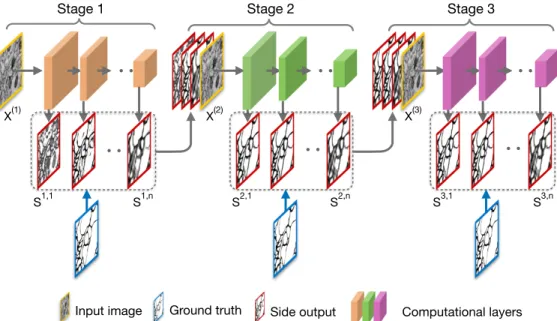
In this paper, we propose multi-stage multi-recursive-input fully convolutional networks (M2FCN) for neuronal boundary detection. The architecture of M2FCN is shown in Fig. 2. The whole net consists of multiple stages, where each stage generates multiple side outputs by imposing su-pervision at different levels [20, 42] of the sub-net in this stage, and all these side outputs are concatenated with the original image to serve as the inputs for the next stage.
From a neurobiological prospective, this network archi-tecture is biologically-plausible. First, as explained in [21], this recursive framework is in accord with the interplay pro-cess, named “countercurrent disambiguating process” [7], between the primary and higher visual cortical areas (V1 and V4, respectively) in monkeys’ brains, found by examin-ing monkeys’ performances on contour detection tasks. The latter stages of our networks act as V4 to detect the overall “contour” of neuronal boundaries and feed top-down influ-ence to the early stages, which acts as V1, to enhance the activation on neuronal boundaries while suppressing those on intracellular structures. Second, as pointed out in [13], the ambiguous neuronal boundaries make segmentation d-ifficult, and this issue can only be resolved when explicit-ly comparing the different possible segmentation solutions, which is what the human visual system may compute when inspecting this situation. We can roughly think that of the multiple recursive inputs, computed at the different levels in the previous stage, provide different possible segmentation solutions for training of the next stage. We show that using multiple recursive inputs is very important in our experi-ments, as it leads to much better results than using a single recursive input.
From the deep learning view, our networks take several advantages of the latest deep learning strategies to facili-tate the learning of a neuronal boundary detection model, including (1) holistic image training and prediction benefit-ed from using the architecture of fully convolutional neu-ral networks, (2) supervised multi-scale feature learning at each level of each stage and (3) learning multi-stages in an
end-to-end fashion, different from previous recursive ap-proaches [39, 21, 14, 9] which learn a series of classifiers stepwise. Using multiple recursive inputs rather than one is a major difference between our networks and [21]. Note that, the multiple recursive inputs for one stage are the mul-tiple side outputs computed at the levels having different scales (receptive field sizes). In general, a side output with a small scale has better ability than one with larger scale for detecting a thin neuronal boundary between cluttered neu-rons. Conversely, a side output computed at a large scale can suppresses the false predictions on intracellular struc-tures by using more image context. Therefore, these multi-ple recursive inputs provide richer information than one for the learning of next stage. We show that introducing these strategies in our networks can improve the performance of neuronal boundary detection.
We verify our networks on two public available EM seg-mentation datasets. One is the mouse piroform cortex EM dataset [21], a sizable and important EM dataset, contains 4 stacks of EM images of mouse piriform cortex, covering 460 images for training and 168 images for testing. We an-alyze alternative designs in our network architecture on this dataset and show it outperforms the state-of-the-arts [21]. The other is the dataset used for ISBI 2012 EM segmenta-tion challenge [29], covering 30 images for training and 30 images for testing. Our networks can achieve a comparable result to the state-of-the art [28, 10] on this dataset.
In summary, our main contributions includes (1) end-to-end multi-stage networks architecture, in which each stage generates multiple side outputs by imposing supervision on different levels and feeds them into the next stage as the multiple recursive inputs. (2) using multiple recursive in-puts rather than single recursive inin-puts can not only boost the performance of neuronal boundary detection, but also be biologically-plausible. (3) our networks achieve promising results on two public available EM segmentation datasets.
2. Related Work
Segmenting EM images of neural tissue is an important step to understand the circuit structure and the function of the brain [21, 28]. Early work of this topic needs to im-pose experts’ knowledge. For example, users need to label intracellular regions to allow graph cut segmentation, and also correct segmentation errors afterwards [41]. To reduce the amount of human labor required [13], automatic neuron segmentation became an active research direction, which follows the pipeline that detects neuronal boundaries by ma-chine learning algorithms [19, 15, 18, 31] and then applies post-processing algorithms, such as watershed [26, 40, 43], hierarchical clustering [27, 24] and graph cut [16] algo-rithms, to boundary maps to obtain neuron segments. But early methods, which are based on hand-crafted features, tend to fail when the membrane is ambiguous.
Stage 1 Stage 2 Stage 3
Input image Ground truth Side output Computational layers X(1)
S1,1 S1,n S2,1 S2,n S3,1 S3,n
X(2) X(3)
Figure 2. The architecture of the proposed M2FCN. The multiple side outputs of one stage are concatenated with the original image along the image channel dimension, and are fed into the next stage. It makes the side outputs learned at the next stage approach ground truth.
With the rapid development of deep networks, segmenta-tion and classificasegmenta-tion on medical images have undergone a vast revolution, from analyzing specific features of neuronal boundaries to designing fully automatic algorithm without experts’ knowledge. Recent deep learning based neuron segmentation methods are well suited to deal with ambigu-ous neuronal boundaries in EM images. One of the earliest works made by Ciresanet al.[8] used a succession of max-pooling convolutional networks as a pixel classifier, which estimated the probability of a pixel being a membrane. This method won the ISBI 2012 EM segmentation challenge [1]. Ronneberger et al. [29] presented a U-net structure with contracting paths, which captures multi-contextual informa-tion. Compared with the work in [8], the U-net replaces pooling operations by upsampling operators, which prop-agates context information from multiple feature channels to higher resolution layers. Fully convolutional networks (FCNs) [25] led to a breakthrough on semantic segmenta-tion. With deep supervision and side outputs on FCN, a holistically-nested edge detector (HED) [42] was then pro-posed to solve the ambiguity in edge and object bound-ary detection. Due to the great success of these methods, Chen et al. [5] presented a deeply supervised contextu-al network to fuse the multi-level side-outputs to segment the membrane. Deep residual network (ResNet) [12] ad-dresses the degradation (of training accuracy) problem by optimizing the residual mapping, which ranked the 1st on ILSVRC 2015 image classification challenge [30]. This inspired fully residual convolutional neural networks with nested short and long skip connections for membrane seg-mentation, proposed by Quan et al. [28] and Fakhry et al. [11]. Most of the recent deep learning based methods
were motivated by the novel network architectures proposed in the computer vision community. Although these meth-ods achieve improvements on membrane detection, they lack interpretation and comprehensive analysis. Our pro-posed multi-stage multi-recursive-input fully convolution-al networks (M2FCN) not only considers the advantages of the latest deep network architectures but also is biologically plausible.
The recursive training framework has been applied to many computer vision tasks, such as image labeling [39], instance segmentation [22], human pose estimation [34], and face alignment [9, 3]. However, they trained the recur-sive framework stepwise and only used one single recurrecur-sive input. There are two image segmentation methods [32, 33] also fed multi-recursive inputs into next stage in the recur-sive training framework. But, their strategies to generate the multi-recursive inputs are different from ours. In the first one [32], the multi-recursive inputs for one stage were ob-tained by applying a series of Gaussian filters to the single output of the previous stage, but ours are the multiple out-puts supervised at different levels in a deep network. The second one [33] downsampled an original input image in-to multiple input images with different resolutions and ob-tained the multi-recursive inputs from these multiple input images, but ours are computed from the same input image by using the hierarchy of a deep net. In addition, the multi-ple stages in their methods were trained in a stepwise man-ner. On the contrary, we embed the recursive learning in a deep network and first learn it in an end-to-end fashion.
Our work is related to the recursively trained network proposed in [21], which trains a Very Deep 2D (VD2D) network first, then a Very Deep 2D-3D (VD2D3D) network
initialized with learned 2D representations from VD2D net-work is trained to generate the boundary map. There are two important differences between the networks in [21] and our method. (1). We use multiple recursive inputs with differ-ent receptive field sizes to incorporate multi-level contex-tual boundary information learned from the previous stage, while VD2D3D only uses the single output of VD2D as its recursive input. (2). We train our network in an end-to-end fashion to co-enhance the learning ability (e.g., detec-t membranes while suppress indetec-tracellular sdetec-trucdetec-ture) of all stages, while [21] sequentially learns deep networks. Bene-fited from end-to-end training and multiple recursive inputs, our networks can achieve better performance than VD2D3D while only using 2D EM images.
3. Multi-stage Multi-recursive-input Fully
Convolutional Networks
3.1. Overview
Fig. 2 illustrates the proposed network architecture. Our networks consist of multiple sequential stages, where each stage is a sub-net built based on fully convolutional net-works with multiple side outputs [42]. Each sub-net con-sists of multiple levels, each of which is composed of sev-eral combinations of one convolutional layers followed by one ReLU layer and a final pooling layer. Each side out-put layer is connected to the last convolutional layer of each level, which is composed of a1×1convolutional layer and a deconvolutional layer to ensure the resolution of each side output is the same as the input original image. A sigmoid layer is applied to each side output layer to generate a neu-ronal boundary map having values belonging to[0,1].
Note that, the multiple side outputs of one stage are con-catenated with the original image along the image channel dimension and fed into the next stage. By feeding multiple side outputs to the next stage, the side outputs of next stage can obtain the information from all scales, so that even low level side outputs in the next stage can capture large object-s. While in a single stage network, each side output only corresponds to a certain scale, e.g., low level side outputs cannot suppress large intracellular structures, and high level side outputs cannot locate thin membranes accurately. This is like how a human visual system may compare differen-t possible segmendifferen-tadifferen-tion soludifferen-tions and selecdifferen-t differen-the righdifferen-t scale from them [13]. The multiple stages in our networks can be trained in an end-to-end fashion, which enable the side outputs in a previous stage to receive feedback from those of the next stage, like V4 in the human visual system gives the top-down influence to V1.
3.1.1 Sub-net Architecture
We adopt the well-known HED network [42] as our default sub-net, which is converted from VGG-16 net [37], having
5 levels, with strides 1, 2, 4, 8 and 16, respectively, and receptive field sizes 5, 14, 40, 92, 196, respectively. Each side output layer is connected to the last convolutional lay-er of each level, i.e., conv1 2, conv2 2, conv3 3, conv4 3, conv5 3, respectively.
3.2.
M2FCN for Neuronal Boundary Detection
Now we formulate our approach for neuronal bound-ary detection as a per-pixel classification problem. Giv-en a raw input EM image X = (xj, j = 1, . . . ,|X|),
where indexj is over the image spatial dimensions of im-age X, the goal is to predict the neuronal boundary map
ˆ
Y = (ˆyj, j = 1, . . . ,|X|), whereyˆj ∈ {0,1}denotes the
predicted label for each pixelxj, i.e., ifxj is predicted as
a boundary pixel, yˆj = 0; otherwise, yˆj = 1. We learn
an M2FCN, which consists ofM stages and each stage has
N levels, to address this problem. Next, we introduce the training and testing phases of our approach respectively.
3.2.1 Training Phase
Since our networks use holistic image training, we consid-er each training image independently. Suppose that we are given a training batch with one 2D EM image X and it-s correit-sponding ground truth neuronal boundary map Y, our goal is to supervise the multiple side outputs at d-ifferent level to approach the ground truth map Y. Let
Sm,n = (sm,n
j , j = 1, . . . ,|X|)be the side output at the
n-th level of them-th stage. Since the side outputs of one stage will be fed to the next stage as the inputs, we express the input to them-stage by
X(m)=X⊕Sm−1,1⊕. . .⊕Sm−1,n (1)
where⊕is the the concatenation operation along the image channel dimension and we defineX(1) =X. LetWmbe the network parameters for the sub-net in them-th stage and
wm,nbe the parameters for then-th side output in them-th stage, we define a cross-entropy loss function for this side output by `m,n(Wm,wm,n;X(m), Y) = −βP j∈|B|log(1−σ(s m,n j )) −(1−β)P j∈|B¯|log(σ(s m,n j )). (2)
This loss function (Eqn.2) is computed over all pixels in the training imageX, where|B|and|B¯|denote the bound-ary and non-boundbound-ary ground truth label sets respectively,
σ(·) is the sigmoid function and β = |B¯|/|B| is a pos-itive/negative class-balancing weight [42] to eliminate the bias between boundary and non-boundary ground truths in training (in a typical 2D EM image, most of the ground truth is non-boundary). To supervise all the side outputs in our network, we define a loss function by
Ls(W,w;X, Y) = M X m=1 N X n=1 αm,n`m,n(Wm,wm,n;X(m), Y), (3)
whereW = (Wm, m = 1, . . . , M), w = (wm,n, m = 1, . . . , M, n= 1. . . , N)andαm,nis a loss weight for each
side output.
To obtain a fused output Sf,m form-stage , we use a 1×1convolutional layer to fuse its side outputs:
Sf,m= N X n=1 hm,nSm,n, (4) whereh = (hm,n, m = 1, . . . , M, n = 1. . . , N) is the
fusion weight. Similar to Eqn. 2, a class-balanced cross-entropy loss function is defined for the fused output ofm -stage: `f,m(Wm,wm;X(m), Y) = −β X j∈|B| log(1−σ(sf,mj ))−(1−β) X j∈|B¯| log(σ(sf,mj )). (5)
wherewm= (wm,n, n= 1. . . , N). The loss function for
all the fused outputs is
Lf(W,w,h;X, Y) =
M
X
m=1
αf,m`f,m(Wm,wm;X(m), Y), (6)
whereαf,mis a loss weight for each stage.
All these parameters,W,w,h, are optimized simultane-ously by standard back-propagation:
(W,w,h)∗= arg min(Ls(W,w;X, Y)
+Lf(W,w,h;X, Y)). (7)
3.2.2 Testing Phase
In the testing stage, given an imageX, by considering the
m-th sub-net as a functionFm, we sequentially obtain the
side outputs of them-th sub-net by
(Sm,n, n= 1. . . , N) =Fm(X(m),
(W1)∗, . . . ,(Wm)∗,(wm,1)∗, . . . ,(wm,N)∗). (8)
The fusion output ofm-stage is obtained by
Sf,m=
N
X
n=1
h∗m,nSm,n. (9)
We use the fused output of the last stageSf,M as the final output of our network, then the unified boundary probability map is given byYˆ =σ(Sf,M).
3.2.3 Initialization for Multi-stage Training
The proposed network is very deep (our 3-stage network with 5 levels has totally 48 layers). It is known that, train-ing such a deep network from scratch is not easy. Here, we adopt a simple strategy to initialize the multi-stage network. First, we train a single stage network. Then, this network is
used to initialize the first stage of our network, while the rest of the network is randomly initialized. The initialization for the first stage provides high-confidence recursive inputs to the consecutive stage, which facilitates the training proce-dure.
4. Experimental Results
In this section, we discuss our designs for network ar-chitectures and training strategies, and compare our perfor-mance with other competitors.
4.1. Experiment Setting
The hyper parameters of our networks include: the mini-batch size (1), the loss weight for each side-output (1), the momentum (0.9), and the weight decay (2×10⁻⁴). We set
the base learning rate to 1e-8 and pre-train a single stage network by 20,000 iterations. Then we use this pre-trained single stage network to initialize the first stage of our multi-stage network, and reduce the base learning rate to 1e-9 and train it by 10,000 iterations.
4.2. Mouse Piriform Cortex Dataset
The images of mouse piriform cortex dataset [21] were collected from the piriform cortex of an adult mouse, which contains 4 stacks of EM images. We use the same training-testing split in [21], i.e., stack2, stack3 and stack4 are for training and stack1 is for testing.
4.2.1 Evaluation Metric
To evaluate membrane segmentation performances, we fol-low the protocol used in [21], where the segmented mem-brane is measured by the Rand F-score:
VF scoreRand =
2VmergeRandV Rand split
VRand
merge+VsplitRand
, (10)
whereVmergeRand andVsplitRandare Rand merge score and Rand
split score respectively, and defined by:
VmergeRand = P ijn 2 ij P i( P jnij)2 , VsplitRand= P ijn 2 ij P j( P inij)2 , (11)
where nij denote the number of voxels in the i-th
seg-ment of the proposal segseg-mentation andj-th segment of the ground truth segmentation. VmergeRand andVsplitRand are close
to1 when there are fewer merge and split errors, respec-tively. To calculate the Rand score, we obtain the neuronal segmentation based on the boundary map by applying the same modified graph-based watershed algorithm [43] as in [21]. We use the default setting in [21] and report our best Rand F-scoreVRand
4.2.2 Data Augmentation
Data augmentation is a standard way to generate sufficient training data for learning a “good” deep network. We rotate the images to 4 different angles (0◦,90◦,180◦,270◦) and
flip them with different axis (up-down, left-right, no flip), then resize images to 3 different scales (0.8,1.0,1.2), totally leading to an augmentation factor of 36.
4.2.3 Alternative Design Discussion
We use the pre-trained single stage network as the baseline and discuss some possible alternative designs for network architectures and training strategies. The results of these alternative designs are summarized in Table. 1. To simplify description, we denote each alternative design by “AD” plus an index.
The role of multiple stages. Since our networks consist
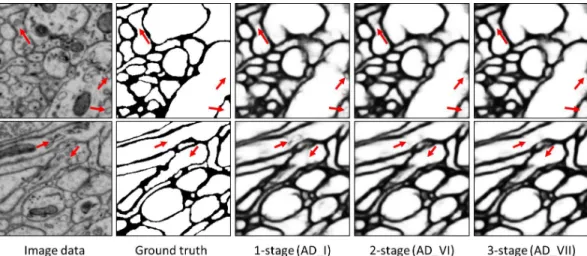
of multiple stages, it’s necessary to see whether the perfor-mance can be improved by adding stage by stage. Due to the limitation of GPU memory, the deepest network we can train is a 3-stage network with sub-nets of 5 levels (Sec. 3.1.1). We compare the performance between a 1-stage work (AD I), a 2-stage network (AD VI) and a 3-stage net-work (AD VII). Note that, the AD I has the same archi-tecture as the pre-trained single stage network. As shown in Table. 1, the performance of AD I is almost the same as that of the pre-trained single stage network, which in-dicates that training a single stage network by more iter-ations cannot improve the performance considerably. The AD VI and the AD VII achieve1.39%and1.86% perfor-mance improvements compared with the baseline, respec-tively, which shows that our multi-stage training is effec-tive for neuronal boundary detection. A qualitaeffec-tive compar-ison between these three networks, i.e, 1-stage (AD I), 2-stage (AD VI) and 3-2-stage (AD VII) networks, is given in Fig. 3. Observed that, the false detections on intracellular structures such as mitochondria and vesicles can be reduced (indicated by red arrows) by training a network with more stages.
The role of multiple recursive inputs. As we stated in
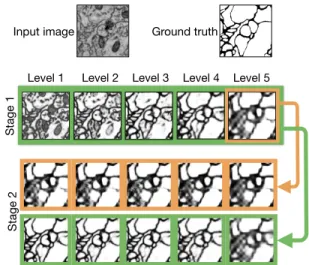
the Sec. 1, using multiple recursive inputs for the multiple stage training is crucial for our framework. To evaluate this, we test two alternative network architectures, which only uses the side output of the 5-th level (AD III) and the 4-th level (AD IV) in each stage as the recursive input for the next stage respectively. As shown in Table. 1, only using single recursive input results in a significant performance drop, 4.56% decrease for AD III and 2.1% decrease for AD IV. We illustrate the side outputs of the second stages of AD III and AD VI in Fig. 4, where we see that the side out-puts of the former one only response to large scale objects,
while even the side outputs of the latter one can capture objects of different scales, thanks to the multiple recursive inputs.
Stage 1
Stage 2
Level 1 Level 2 Level 3 Level 4 Level 5 Input image Ground truth
Figure 4. The side outputs of the second stages learned by single recursive input (AD III) and multiple recursive inputs (AD VI).
Stepwise or end-to-end training. One difference
be-tween our multi-stage training framework to others [39, 21, 14, 9] is we train these multiple stages in an end-to-end fashion, not stepwise. To verify which way is better, we also train a 2-stage network stepwise, by simply fix-ing the parameters of the first stage in this 2-stage network (AD V). As can be seen from Table. 1, training the 2-stage network stepwise leads to a considerable performance de-crease (0.9819 → 0.9762). During end-to-end training, previous stages are influenced by next stages. We visual-ize the fused outputs (after watershed) of the first stages of (AD V) and (AD VI), respectively, in Fig. 5, where we see the latter one leads to better segmentation results (indicated by red arrows). Therefore, we conclude that training in an end-to-end way is better.
The range of the receptive field sizes in each sub-net.
The receptive field sizes of the 5 levels in each sub-net range from 5 to 196. Such a wide range of receptive field sizes ensure the side outputs to be able to capture small neuronal boundaries while suppress relative big intracellular struc-tures. To show this wide range of receptive field sizes is important for neuronal boundary detection, we use an alter-native network architecture for each sub-net, which is ob-tained by removing the last level from the default sub-net, i.e., a 2-stage network with 4-level sub-net (AD II). As we expected, as shown in Table. 1, removing the last level in each sub-net leads to performance decrease.
Figure 3. Qualitative comparison between 1-stage (AD I), 2-stage (AD VI) and 3-stage (AD VII) networks. Red arrows indicate sup-pressed false detections by training more stages.
Figure 5. The comparison between the fused outputs (after water-shed [43]) of the first stages of a 2-stage network trained stepwise (AD V) and end-to-end (AD VI). The latter one leads to better segmenting results (indicated by red arrows).
4.2.4 Performance Comparison
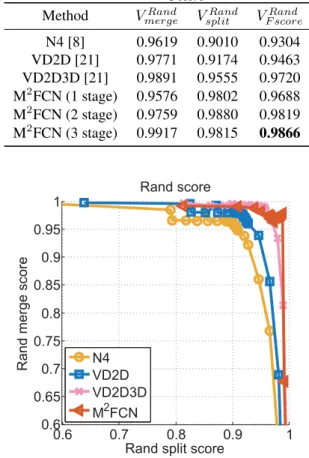
Now we compare our networks (3-stage with 5 levels) with other competitors on the mouse piriform cortex dataset. The quantitative results are summarized in Table 2 and the pre-cision (rand merge)-recall (rand split) curves are illustrat-ed in Fig. 6. As can be seen, our method can maintain a high precision even when it achieves a high recall, thanks to the multi-stage training which suppresses false detections of boundaries on intracellular structures while enhancing neu-ronal boundaries. The current state-of-the-art method on the mouse piriform cortex dataset is VD2D3D [21], which is also a recursive training framework. But it trains two stages stepwise, i.e., train the first one, a 2D convolutional network, then uses its output as the recursive input for the
Table 1. Performance of alternative designs for network architec-tures and training strategies.
Alternative Design VF scoreRand
pre-trained single stage, 5-level (baseline) 0.9680 AD I: 1-stage, 5-level 0.9688 AD II: 2-stage, 4-level, end-to-end,
0.9739 multi-recursive-input
AD III: 2-stage, 5-level, end-to-end,
0.9410 single-recursive-input (level 5)
AD IV: 2-stage, 5-level, end-to-end,
0.9656 single-recursive-input (level 4)
AD V: 2-stage, 5-level, stepwise,
0.9762 multi-recursive-input
AD VI: 2-stage, 5-level, end-to-end,
0.9819 multi-recursive-input
AD VII: 3-stage, 5-level, end-to-end,
0.9866
multi-recursive-input
second one, a 3D convolutional networks. The experimen-tal results show that with the end-to-end multi-stage train-ing and multi-recursive-inputs, our 2D 2-stage network can achieve better performance than a 2D-3D network. Note that, as VD2D3D already obtained a high Rand F-score, our method achieves around1.5%improvement on it, which is meaningful. Such a low error obtained on a large EM im-age dataset is important for neuron reconstruction. Some neuron segmentation results obtained by applying the wa-tershed algorithm [43] to our boundary maps are shown in Fig. 7.
4.3. ISBI 2012 EM segmentation dataset
Most of current neuronal boundary detection methods are evaluated on the public dataset of ISBI 2012 EM seg-mentation challenge [29]. The training data of this dataset is a set of 30 consecutive images (512×512 pixels) from a
Table 2. Neuronal boundary detection performance comparison between different methods. The values ofVRand
mergeandVsplitRand
cor-respond to the best Rand F-scoreVRand F score.
Method VmergeRand VsplitRand V Rand F score N4 [8] 0.9619 0.9010 0.9304 VD2D [21] 0.9771 0.9174 0.9463 VD2D3D [21] 0.9891 0.9555 0.9720 M2FCN (1 stage) 0.9576 0.9802 0.9688 M2FCN (2 stage) 0.9759 0.9880 0.9819 M2FCN (3 stage) 0.9917 0.9815 0.9866 0.6 0.7 0.8 0.9 1 0.6 0.65 0.7 0.75 0.8 0.85 0.9 0.95 1 Rand score
Rand split score Rand merge score N4
VD2D VD2D3D
M2FCN
Figure 6. Evaluation of neuronal boundary detection methods by precision (rand merge)-recall (rand split) curves.
Figure 7. Neuron segmentation examples. From left to right: the original image, the ground truth segmentation, our boundary map and the segmentations obtain by applying the watershed algorith-m [43] to our boundary algorith-maps.
serial section Transmission Electron Microscopy (ssTEM) dataset of the Drosophila first instar larva ventral nerve cord [4]. The testing data of this dataset also contains 30 consecutive EM images of the same resolution. The ground truth boundary maps of the training images are made pub-licly available to enable participants to develop their algo-rithm, while the ground truth boundary maps of the test
images are kept by the organizers. Although this chal-lenge is over, it is still open for submissions. The perfor-mance of the new submissions will be reported on the lead-er board of this challenge. Thlead-ere are ovlead-er 70 results list-ed on the leader board, but not all of them have publishlist-ed papers. We summarized some leading quantitative results reported in published papers in Table 3. Note that, many state-of-the-art methods apply post-processing or average multiple trained models to boost the performance, such as PolyMtl [10], FusionNet [28] and CUMedVision [5]. Our method, a two-stage network using a single trained model without post-processing, can achieve 0.9780 Rand F-score, which is comparable with the state-of-the-art methods and better than CUMedVision [5], a one-stage HED. But, C-UMedVision used post-processing and averaged 6 trained models to improve the result. This comparison shows the effectiveness of our multi-stage learning. IAL IC [2] is a post-processing method, which can be applied to our result to improve our performance. Besides, as both FusionNet and PolyMtl are built on ResNet [12], we can also replace the sub-net in our model by such a powerful network to gain improvement.
Table 3. Comparison to published entries on the ISBI 2012 EM dataset [29]. For full ranking of all submitted methods, please re-fer to the challenge website:http://brainiac2.mit.edu/
isbi_challenge/leaders-board-new. Method VRand F score PolyMtl [10] 0.9806 M2FCN (ours) 0.9780 FusionNet [28] 0.9780 IAL IC [2] 0.9773 CUMedVision [5] 0.9768 FCN+LSTM [6] 0.9754 Unet [29] 0.9727
5. Conclusion
We present multi-stage multi-recursive-input fully con-volutional networks for neuronal boundary detection. In the proposed architecture, the multiple side outputs learned at different scales in one stage, are fed into the next stage. This provides the ability to detect neuronal boundaries while suppressing false predictions on intracellular structures. Ex-tensive analysis on two public EM segmentation datasets, the mouse piriform cortex dataset and the ISBI 2012 EM dataset, verifies the advantages of our network architecture.
Acknowledgement. This work was supported in part
by the National Natural Science Foundation of China No. 61672336 and No. 61303095, in part by “Chen Guang” project supported by Shanghai Municipal Education Com-mission and Shanghai Education Development Foundation No. 15CG43, and in part by NSF CCF-1231216.
References
[1] I. Arganda-Carreras, S. C. Turaga, D. R. Berger, D. Cires¸an, A. Giusti, L. M. Gambardella, J. Schmidhuber, D. Laptev, S. Dwivedi, J. M. Buhmann, T. Liu, M. Seyedhosseini, T. Tasdizen, L. Kamentsky, R. Burget, V. Uher, X. Tan, C. Sun, T. D. Pham, E. Bas, M. G. Uzunbas, A. Cardona, J. Schindelin, and H. S. Seung. Crowdsourcing the creation of image segmentation algorithms for connectomics. Fron-tiers in Neuroanatomy, 9:142, 2015.
[2] T. Beier, B. Andres, U. K¨othe, and F. A. Hamprecht. An efficient fusion move algorithm for the minimum cost lifted multicut problem. InECCV, pages 715–730, 2016. [3] X. Cao, Y. Wei, F. Wen, and J. Sun. Face alignment by
ex-plicit shape regression. InProc. CVPR, pages 2887–2894, 2012.
[4] A. Cardona, S. Saalfeld, S. Preibisch, B. Schmid, A. Cheng, J. Pulokas, P. Tomancak, and V. Hartenstein. An integrat-ed micro- and macroarchitectural analysis of the drosophi-la brain by computer-assisted serial section electron mi-croscopy.PLoS Biol, 8(10):e1000502, 2010.
[5] H. Chen, X. Qi, J. Cheng, and P. Heng. Deep contextual net-works for neuronal structure segmentation. InProc. AAAI, pages 1167–1173, 2016.
[6] J. Chen, L. Yang, Y. Zhang, M. S. Alber, and D. Z. Chen. Combining fully convolutional and recurrent neural network-s for 3d biomedical image network-segmentation. In NIPS, pages 3036–3044, 2016.
[7] M. Chen, Y. Yan, X. Gong, C. D. Gilbert, H. Liang, and W. Li. Incremental integration of global contours through interplay between visual cortical areas. Neuron, 82(3):682– 694, 2014.
[8] D. C. Ciresan, A. Giusti, L. M. Gambardella, and J. Schmid-huber. Deep neural networks segment neuronal membranes in electron microscopy images. InProc. NIPS, pages 2852– 2860, 2012.
[9] P. Doll´ar, P. Welinder, and P. Perona. Cascaded pose regres-sion. InProc. CVPR, pages 1078–1085, 2010.
[10] M. Drozdzal, G. Chartrand, E. Vorontsov, L. Di-Jorio, A. Tang, A. Romero, Y. Bengio, C. Pal, and S. Kadoury. Learning normalized inputs for iterative estimation in medi-cal image segmentation.CoRR, abs/1702.05174, 2017. [11] A. Fakhry, T. Zeng, and S. Ji. Residual deconvolutional
networks for brain electron microscopy image segmentation. IEEE Trans. Med. Imaging, 36(2):447–456, 2017.
[12] K. He, X. Zhang, S. Ren, and J. Sun. Deep residual learning for image recognition. InProc. CVPR, pages 770–778, 2016. [13] M. Helmstaedter. Cellular-resolution connectomics: chal-lenges of dense neural circuit reconstruction. Nature meth-ods, 10(6):501–507, 2013.
[14] E. Jurrus, A. R. C. Paiva, S. Watanabe, J. R. Anderson, B. W. Jones, R. T. Whitaker, E. M. Jorgensen, R. Marc, and T. Tasdizen. Detection of neuron membranes in electron mi-croscopy images using a serial neural network architecture. Medical Image Analysis, 14(6):770–783, 2010.
[15] V. Kaynig, T. J. Fuchs, and J. M. Buhmann. Geometrical consistent 3d tracing of neuronal processes in sstem data. In Proc. MICCAI, pages 209–216, 2010.
[16] N. Krasowski, T. Beier, G. W. Knott, U. Koethe, F. A. Ham-precht, and A. Kreshuk. Improving 3d EM data segmentation by joint optimization over boundary evidence and biological priors. InISBI, pages 536–539, 2015.
[17] A. Krizhevsky, I. Sutskever, and G. E. Hinton. Imagenet classification with deep convolutional neural networks. In Proc. NIPS, pages 1106–1114, 2012.
[18] R. Kumar, A. V. Reina, and H. Pfister. Radon-like features and their application to connectomics. InCVPR Workshops, pages 186–193, 2010.
[19] D. Laptev, A. Vezhnevets, S. Dwivedi, and J. M. Buhman-n. Anisotropic sstem image segmentation using dense cor-respondence across sections. InProc. MICCAI, pages 323– 330, 2012.
[20] C. Lee, S. Xie, P. W. Gallagher, Z. Zhang, and Z. Tu. Deeply-supervised nets. InProc. AISTATS, 2015.
[21] K. Lee, A. Zlateski, A. Vishwanathan, and H. S. Seung. Re-cursive training of 2d-3d convolutional networks for neu-ronal boundary prediction. InProc. NIPS, pages 3573–3581, 2015.
[22] K. Li, B. Hariharan, and J. Malik. Iterative instance segmen-tation. InProc. CVPR, pages 3659–3667, 2016.
[23] J. W. Lichtman and W. Denk. The big and the smal-l: Challenges of imaging the brains circuits. Science, 334(6056):618–623, 2011.
[24] T. Liu, C. Jones, M. Seyedhosseini, and T. Tasdizen. A mod-ular hierarchical approach to 3d electron microscopy image segmentation. Journal of Neuroscience Methods, 226:88– 102, 2014.
[25] J. Long, E. Shelhamer, and T. Darrell. Fully convolutional networks for semantic segmentation. InProc. CVPR, pages 3431–3440, 2015.
[26] L. Najman and M. Schmitt. Geodesic saliency of watershed contours and hierarchical segmentation.IEEE Trans. Pattern Anal. Mach. Intell., 18(12):1163–1173, 1996.
[27] J. Nunez-Iglesias, R. Kennedy, T. Parag, J. Shi, and D. B. Chklovskii. Machine learning of hierarchical clustering to segment 2d and 3d images.PLoS ONE, 8(8), 2013. [28] T. M. Quan, D. G. C. Hildebrand, and W. Jeong. Fusionnet:
A deep fully residual convolutional neural network for im-age segmentation in connectomics. CoRR, abs/1612.05360, 2016.
[29] O. Ronneberger, P. Fischer, and T. Brox. U-net: Convolu-tional networks for biomedical image segmentation. InProc. MICCAI, pages 234–241, 2015.
[30] O. Russakovsky, J. Deng, H. Su, J. Krause, S. Satheesh, S. Ma, Z. Huang, A. Karpathy, A. Khosla, M. Bernstein, A. C. Berg, and L. Fei-Fei. ImageNet Large Scale Visual Recognition Challenge. International Journal of Computer Vision (IJCV), 2015.
[31] M. Seyedhosseini, R. Kumar, E. Jurrus, R. Giuly, M. Ellis-man, H. Pfister, and T. Tasdizen. Detection of neuron mem-branes in electron microscopy images using multi-scale con-text and radon-like features. InProc. MICCAI, pages 670– 677, 2011.
[32] M. Seyedhosseini, M. Sajjadi, and T. Tasdizen. Image seg-mentation with cascaded hierarchical models and logistic
disjunctive normal networks. InProc. ICCV, pages 2168– 2175, 2013.
[33] M. Seyedhosseini, M. Sajjadi, and T. Tasdizen. Image seg-mentation with cascaded hierarchical models and logistic disjunctive normal networks. InProc. ICCV, pages 2168– 2175, 2013.
[34] W. Shen, K. Deng, X. Bai, T. Leyvand, B. Guo, and Z. Tu. Exemplar-based human action pose correction and tagging. InProc. CVPR, pages 1784–1791, 2012.
[35] W. Shen, X. Wang, Y. Wang, X. Bai, and Z. Zhang. Deep-contour: A deep convolutional feature learned by positive-sharing loss for contour detection. In Proc. CVPR, pages 3982–3991, 2015.
[36] W. Shen, K. Zhao, Y. Jiang, Y. Wang, Z. Zhang, and X. Bai. Object skeleton extraction in natural images by fusing scale-associated deep side outputs. InProc. CVPR, pages 222–230, 2016.
[37] K. Simonyan and A. Zisserman. Very deep convolution-al networks for large-scconvolution-ale image recognition. CoRR, ab-s/1409.1556, 2014.
[38] O. Sporns, G. Tononi, and R. K¨otter. The human connec-tome: A structural description of the human brain. PLOS Computational Biology, 1(4):245–251, 2005.
[39] Z. Tu. Auto-context and its application to high-level vision tasks. InProc. CVPR, 2008.
[40] M. G. Uzunbas, C. Chen, and D. N. Metaxas. Optree: A learning-based adaptive watershed algorithm for neuron seg-mentation. InProc. MICCAI, pages 97–105, 2014.
[41] N. Vu and B. S. Manjunath. Graph cut segmentation of neu-ronal structures from transmission electron micrographs. In Proc. ICIP, pages 725–728, 2008.
[42] S. Xie and Z. Tu. Holistically-nested edge detection. InProc. ICCV, pages 1395–1403, 2015.
[43] A. Zlateski and H. S. Seung. Image segmentation by size-dependent single linkage clustering of a watershed basin graph.CoRR, abs/1505.00249, 2015.