1
School of Civil Engineering
Graduate Program Handbook
2
TABLE OF CONTENTS
INTRODUCTION ... 4 Degree Titles. ... 4 SPECIALITY GROUPS ... 4 COUNSELING ... 5GENERAL ACADEMIC REQUIREMENTS FOR GRADUATE STUDENTS ... 5
Prerequisites ... 5
English Proficiency Requirements ... 5
Continuation of Studies towards the Ph.D. Degree. ... 6
Time Constraints for the Ph.D. Program. ... 6
Plan of Study ... 6
Registration Study Requirements ... 7
Master’s Degree ... 7
Ph.D. Degree ... 8
Dual-Degree Programs ... 8
Transferring courses to a Purdue Graduate Plan of Study... 8
Transferring credits from an MS degree to a PhD Plan of Study ... 8
Registration of Graduate Students ... 9
General Credit Requirements ... 9
Ph.D. Registration Credit. ... 10
Research in Absentia. ... 10
CLASSIFICATION OF GRADUATE STUDENTS ... 10
ADMINISTERING GRADUATE DEGREE PROGRAMS ... 10
Steps for a Non Thesis Master’s Degree ... 10
Steps for a Thesis Master’s Degree ... 11
Steps for the Ph.D. Degree ... 11
GRADUATE ADVISORY COMMITTEE ... 12
Master’s Advisory Committee ... 13
Ph.D. Advisory Committee ... 13
MASTER’S FINAL EXAMINATION ... 13
Non-thesis Master’s Final Exam. ... 13
Thesis Master’s Final Exam. ... 14
PHD EXAMINATION ... 15
Ph.D. Preliminary Examination ... 15
Ph.D. Final Examination ... 15
GRADUATE STUDENT APPOINTMENTS ... 16
Policy for Contact Teaching Assistants ... 16
Teaching Assistantship (TA) Training Program ... 17
Fringe Benefits and Privileges ... 17
School of Civil Engineering Office Space Policy for Short-Term Appointments ... 17
Registration of Graduate Assistants ... 18
GRADUATE STUDENT RESPONSIBILITIES AND RIGHTS ... 18
Academic Grades ... 18
3 Integrity ... 19 Copyright Permission ... 19 Harassment ... 20 APPENDICES ... 21 APPENDIX A – ARCHITECTURAL ... 22 APPENDIX B - CONSTRUCTION ... 24 APPENDIX C - ENVIRONMENTAL ... 25 APPENDIX D - GEOMATICS ... 27
APPENDIX E - HYDRAULICS AND HYDROLOGY ... 30
APPENDIX F - MATERIALS ... 33
APPENDIX G - STRUCTURES ... 34
4
INTRODUCTION
Welcome to graduate study in the School of Civil Engineering at Purdue University! The purpose of this handbook is to acquaint new and continuing graduate students in the program with the opportunities and requirements for graduate study and graduate degrees. Useful information for our graduate students, including this document can be found at: https://engineering.purdue.edu/CE/Academics/Graduate/Current. For additional information or explanation of matters that may remain unclear, please contact the Civil Engineering Graduate Programs Office by calling (765) 494-2166 or emailing [email protected].
Degree Titles.
Graduate degrees awarded by the School of Civil Engineering include:
MSCE: Students who are admitted and who have a Bachelor of Science degree with major group of study in Civil Engineering receive a Master of Science in Civil Engineering degree.
MSE: Students with a Bachelor of Science major in some other engineering discipline receive a Master of Science in Engineering degree.
MS: Students with a Bachelors of Science in a related non-engineering area receive a Master of Science degree.
PhD: Doctor of Philosophy
Please note that the program requirements are the same for all master’s degree titles.
SPECIALITY GROUPS
To facilitate the management of our nearly 400 graduate students, the Civil Engineering Graduate Program is subdivided into the following 9 areas.
Architectural Engineering Construction Engineering Environmental Engineering Geomatics Engineering Geotechnical Engineering
Hydraulic and Hydrologic Engineering Materials Engineering
Structural Engineering
Transportation and Infrastructure Systems Engineering
Opportunities for interdisciplinary study in a number of related areas are also available.
Should a student wish to change specialty group, s/he should identify a faculty member in the new area willing to act as primary advisor. The student should then obtain a “Change of Area” form from the CE Graduate Office and obtain the required signatures.
5
COUNSELING
Each student is assigned an initial advisor, who will counsel the student on his/her program of study, special classes, and offer academic guidance. Students may decide to change their initial advisor after meeting the faculty. If the student is funded on a research assistantship or fellowship, they must discuss their contractual obligations with the advisor providing financial support before initiating the process to change advisors. All change of advisors must be coordinated through the Civil Engineering Graduate Programs Office and changed on the Plan of Study filed through myPurdue (mypurdue.purdue.edu). Until the time a Plan of Study is filed, an email with updates to the CE Grad Office and advisor will suffice.
GENERAL ACADEMIC REQUIREMENTS FOR GRADUATE STUDENTS
A description of the academic and registration requirements for graduate students is available in the Graduate Policies and Procedures Manual, Sections V and VI. That document is available online at:
http://www.gradschool.purdue.edu/downloads/Graduate_School_Policies_and_Procedures_Manual.pdf
Requirements specific to the School of Civil Engineering follow:
Prerequisites
The general requirement for admission to graduate study in the School of Civil Engineering is satisfactory completion of a baccalaureate degree at a college or university of recognized standing. Because of the diversity of programs available within the School, no one kind of undergraduate preparation is stipulated. However, if deficiencies in math, physics or specific civil engineering studies are identified by the admissions committee or advisor, they are often required to be included in the first one or two semesters of a student’s courses.
English Proficiency Requirements
At the time of enrollment, the records of all incoming on-campus graduate students are reviewed to determine whether or not they have met the minimum written English proficiency requirements as established by the School of Civil Engineering. The minimum requirements are as follows:
Domestic Students – A GRE verbal score of at least 151 (or 470 on the old scale) and a grade of “B” or better in all undergraduate composition courses. Students testing out of undergraduate courses have not met the requirement.
International Students – A GRE verbal score of at least 151 and a minimum score of 575 on the Test of English as a Foreign Language (TOEFL-paper), 233 on TOEFL (computer based), or 22 on the Writing and Speaking Section of the internet based TOEFL (iBT).
Students, who have not met the written English proficiency requirements, must meet with their major professor at the beginning of the semester and review their writing and speaking background to determine if any course of remediation is necessary. It is the responsibility of the major professor to ensure that the student is
sufficiently proficient in English to fulfill his/her obligations, and prescribe remedial actions if warranted. Neither the remediation action nor the results need to be reported to the CE Graduate Office or to the Graduate School.
6 Possible options for gaining English Proficiency are:
• Passing the Oral English Proficiency Test (OEPT) – this is required of any international student who will be employed as a teaching assistant, but can also be used to show general proficiency.
• Enrolling in ENGL 62000 or ENGL 62100.
ENGL 62000 is a 5 credit hour course: Classroom Communication in ESL for Teaching Assistants. Student must be enrolled in the Graduate School and be a non-native speaker of English.
Permission of department required.
ENGL 62100 is a 3 credit hour course: Written Communication for International Graduate Students. A course in English composition for non-native English speaking graduate students.
Continuation of Studies towards the Ph.D. Degree.
Upon successful completion of the MS degree, a student may wish to continue towards a Ph.D. degree within Civil Engineering at Purdue. A formal request must be filed in the Civil Engineering Graduate Programs Office 45 days before the end of the MS candidate semester.
Time Constraints for the Ph.D. Program.
Pursuit of a Ph.D. results in highly individualized programs in which progress toward completion will take varying amounts of time. However, the School of Civil Engineering expects that satisfactory progress toward the degree shall result in the completion of all requirements within six calendar years from the time a student is first admitted in a Ph.D. program. In the event that the six years need to be exceeded, the student and their advisor should contact the CE Graduate Office to discuss plans for completion.
Research in absentia shall not result in an increase in this time, and permission for research in absentia shall be granted with this clearly understood by the student and the advisor.
Plan of Study
The Graduate School regards the Plan of Study (POS) as an individualized curriculum designed by the advisory committee to assist a student in achieving his/her educational objectives. In order to comply with Graduate School requirements, Civil Engineering students shall compose their POS in the following manner:
An official transcript showing the completion of an undergraduate degree must be on file with the Purdue University Graduate School. This typically takes place in the first semester of Graduate Study. The POS should be submitted by the end of the second semester of graduate study for MS students
and by the end of the third semester for PhD students. MS students wishing to complete their degree in two semesters should plan to submit their POS by the end of their first semester.
Students will be asked to designate all courses as primary or related based on their area of interest. The student must take the courses on the POS for a letter grade, not with Pass/Fail or
Satisfactory/Unsatisfactory options.
The POS shall include the specific courses the student is expected to complete and any other requirements of the particular degree he/she is seeking.
o Minimum requirements for the specific number of course credit hours are: MS non-thesis: 30 hours of course work
MS thesis: 21 hours of course work and 9 hours of appropriate CE 69800 research hours with their advisor.
Ph.D.: 48 hours of course work and 42 hours of appropriate CE 69900 research hours with their advisor.
7 Research credit hours are not listed on the Plan of Study. They are recorded on transcripts.
Changes in the POS are permitted. A justification for each revision must be provided when approval for a change is requested. This action may be accomplished by completing a Change to the Plan of Study through the on line system in myPurdue.
The POS will generally be composed of 50000 or 60000 level courses or their equivalent from other universities.
o In general, most Civil Engineering courses below the 50000 level are considered prerequisites for the graduate degree and should not be included on the Plan of Study unless the student is from a discipline other than Civil Engineering. Permission to use a 30000-40000 level course may be granted on a case by case basis.
o No more than 3 hours of 30000 or 40000 level coursework will be permitted on a student's POS.
o A 30000 or 40000 level course requires a grade of B or better, to appear on a plan of study. Further, it must not have been used for a prior BS degree.
The graduate school has implemented fees for late candidate deadlines:
A $200 late fee will be charged to a student who submits their POS after the deadline in the semester they wish to be a graduation candidate. A formal request must still be made of the graduate school to accept the POS after the deadline. If the request is not approved, no fee will be charged.
Poor performance in a course, such as a "D" grade, is not an appropriate reason for modifying a Plan of Study. In such cases, the course must be taken over with a grade of C or better before granting of the degree. For a course on the Plan of Study in which the student gets a "D" or "F", the grade from the course taken the second time will be counted toward the acceptable graduation index. Such courses cannot be
eliminated from the student's Plan of Study. The Graduate School’s policy on satisfactory performance is reproduced below:
A graduate student is expected to maintain a graduation index representing a B average (3.0/4.0 GPA) or better. Indices below this level are marked "under 3.0 GPA" on the grade reports. The student also is expected to earn S grades for research registration. Two consecutive sessions of U grades for research registration mandate that the department take formal action and inform the student, in writing, and the Graduate School with regard to discontinuation or conditions for continuation of the student's graduate study. In any event, the student's progress should be reviewed each session by the student's department. The student's progress also may be reviewed by the Graduate School. Should the student fail to perform in either coursework or research on a level acceptable to the advisory committee, the departmental graduate committee, or the dean of the Graduate School, he or she may be asked to discontinue graduate study at Purdue.
Registration Study Requirements Master’s Degree
At least one-half of the total credit hours used to satisfy degree requirements, including CE 69800 Research Master’s Thesis, must be earned in registration on the Purdue campus where the degree is to be granted.
o Course credits obtained via televised instruction or computer course initiated at a Purdue campus shall be considered to have been obtained in residence on that campus.
The student must be registered for at least one credit hour in the semester prior to graduating. During the semester of expected graduation, the student must register for an appropriate candidate
8
Ph.D. Degree
At least one-third of the total credit hours used to satisfy degree requirements, including CE 69900 Research Ph.D. Thesis, must be earned (while registered for Ph. D. study) on the Purdue campus where the degree is to be granted.
A Master’s degree from any accredited university may contribute up to 30 credit hours toward satisfying the 90 credit hour requirement. These courses should be approved by the students committee using the ‘MS credit transfer to PhD POS’ form.
Coursework from one and only one Master’s degree may be used toward the Plan of Study for a PhD. An official transcript showing the completion of the master’s degree must be on file with the Purdue
University Graduate School if courses are to be transferred to the PhD POS.
The student must be registered for at least one credit hour in the semester prior to graduating. During the semester of expected graduation the student must register for an appropriate candidate
course.
Special note on candidate registration:
• A $200 late fee will be charged to a student who has been on the graduation candidate roster for the same degree for more than two consecutive semesters.
Dual-Degree Programs
A dual-degree program is one in which an existing Purdue University master’s degree program is combined with an existing graduate degree program in another School/Program. Dual-degree programs formally approved by the participating academic units and the Graduate School may use a maximum of nine credit hours of 50000- and 60000-level coursework taken to satisfy the graduate degree on the master’s degree plan of study.
Transferring courses to a Purdue Graduate Plan of Study
• The Graduate School allows up to 30 credits from one MS degree to be transferred to a PhD plan of study. These can be coursework or research credits.
• A student can transfer up to 12 credits of non-degree coursework to their Purdue Graduate POS. • A student can transfer as many credits as needed from a degree seeking program – as long as they
did not receive a degree from that program.
• MS students must earn at least 16 of the required 30 credits from the Purdue WL campus. • PhD students must earn at least 30 of the required 90 credits from the Purdue WL campus. • The “transfer” process happens when the student submits their POS – there is no mechanism to
approve transfer courses prior to the generation of the POS.
• All courses/research hours that are being transferred must be verifiable with transcripts and must have credit hours associated with them. An official transcript showing the completion the courses must be on file with the Purdue University Graduate School.
• Only courses with a grade of “B” or better can be transferred.
Transferring credits from an MS degree to a PhD Plan of Study
(i) The student meets with their committee and provides a copy of his/her MS transcripts for review. (ii) The committee determines the courses and credits that can be applied towards the student’s PhD
POS. These can include both coursework credits and research credits (maximum of 30 credits). These courses are then listed on the ‘MS credit transfer to PhD POS’ form.
9 (iii) The advisor signs the form and submits it to the CE Graduate Office.
(iv) The student can then move forward with generating his/her electronic plan of study. The MS transfer courses should NOT be listed on the PhD plan of study with the PhD courses, however the student should list the approved MS transfer courses as a Supplemental Note or in the
Comments section. Be sure to list the course number, course title, credits and date taken. The CE Grad Office will note the overall number of MS credit being transferred in the appropriate field in the POS during the approval process and it will be approved by the committee chair.
(v) The MS transfer form will remain in the student’s file as a record of the approval of the transfer courses and associated credits.
Registration of Graduate Students
Registration is the process of selecting courses, reserving space in those courses, receiving a schedule, and paying fees. A student is not officially enrolled until fees are paid.
Registration begins with a meeting between the student and the academic advisor (major professor). During this meeting, the student should complete a Schedule Revision Request Form (Form 23), and obtain the advisor’s signature on this form and a PIN number. The student can then access myPurdue and register for most courses using the PIN number. The signed copy of Form 23 must be submitted to the CE Graduate Office. If a student needs to register for research credits (CE 69800 or CE 69900) or a course that requires special permissions, Form 23 must contain this information and the CE Graduate Office will enter the appropriate overrides.
Continuing graduate students are required to register during the appropriate time ticket via myPurdue for the next semester. Note: Summer and Fall registrations may be submitted concurrently. A Form 23 is required each semester. If a student adds/drops courses later in the semester, he/she must inform the CE Graduate Office of these changes via email to [email protected]. All students must register for the Graduate Student Orientation course (CE 69100) during their first semester. A student must be registered during the semester an exam is held (preliminary exam, MS or PhD defense exam). Students are required to register for research hours (CE 69800 or CE 69900) if they are conducting research or working on their thesis/dissertation in any way. Students should register for research hours in proportion to their research and writing efforts.
General Credit Requirements
There are different rules governing semester credit requirements.
• In general, a load of eight credit hours is considered full time for a graduate student for Spring and Fall; six credit hours is considered full time for Summer.
• If a student is applying for federal financial aid, registration for at least four credit hours is required during any semester.
• Those students who are funded (at least .50 FTE) must be registered for at least three credit hours. • Students on a visa are required to maintain eight credit hours each for Spring and Fall. However, if they
have received an assistantship, they may be considered full time if registered for six credit hours in Spring or Fall.
• Students on a visa are not required to be registered during the Summer unless they are graduating in the Summer.
10 • Students on a visa who are eligible for exam/degree only registration in their last semester of study and
are not registering for a full course load, must submit a “reduction in course load” request to the Office for International Students and Scholars (ISS) at the time of registration. This includes the Summer semester. • Non-thesis master’s students must be registered for at least one credit in their final semester in order to
maintain their visa. This means that non-thesis MS international students cannot register as exam only and stay in the US. They must register for 1 credit in order to stay in the US and keep their visa valid. If they register for exam only they will need to leave the country. They can return as a visitor to walk in graduation.
• Guidelines set by ISS should be considered primary for students on a visa.
• Each situation is unique. A student should be sure to seek the advice of their advisor and/or the CE Graduate Office before registering as less than full-time.
Ph.D. Registration Credit.
A Ph.D. student is expected to satisfy the requirement of 90 credit hours. Since a Master’s' degree can provide up to 30 hours of this requirement, the combination of courses not used to meet the Master's degree plus the hours of CE 69900 (Ph.D. research) must be at least 60 hours. As a general practice, students should register as a full time student each semester. Once course work is complete, students shall register for a minimum of eight credits of CE 69900 to maintain full time status. At least 30 credit hours of any combination of research and coursework must be completed by registering at the West Lafayette campus.
Research in Absentia.
The policy on research in absentia is given in the Graduate Policies and Procedures Manual (August 2009), Section V, Page 6.
http://www.gradschool.purdue.edu/downloads/Graduate_School_Policies_and_Procedures_Manual.pdf
CLASSIFICATION OF GRADUATE STUDENTS
A. Degree-seeking Graduate Students. A degree-seeking graduate student may be admitted to a program that awards a Master’s or a doctoral degree.
B. Non-degree-seeking Graduate Students. Purdue provides a variety of educational opportunities for students who wish to acquire knowledge and training beyond the baccalaureate degree, but do not wish to enter an advanced degree program. Non-degree-seeking students who have been admitted to graduate study must have the prerequisites or background and experience needed for any course in which they seek to enroll. They may be required to secure consent from each of the departments in which they would like to register for courses. Consultation and/or registration approval by the course instructor may be required.
ADMINISTERING GRADUATE DEGREE PROGRAMS
Steps for a Non Thesis Master’s Degree
1. Meet all admissions conditions that apply.
2. Meet with advisor each semester to determine appropriate course enrollment. 3. Request the appointment of an advisory committee.
11 4. Submit a Plan of Study by the end of second semester of study. If a student intends to graduate in two
semesters, POS should be submitted by the end of the first semester.
5. Register for an appropriate candidate course, alert the CE Graduate Office of candidacy and attend the Candidate Workshop in the semester of planned graduation.
6. Request the final examining committee and exam date by submitting a Form 8 online via the myPurdue Academic Tab at least three weeks before exam date.
7. Take and pass the Final Exam. Student should check that their advisor has submitted the approved Exam Form online.
8. Arrange for Civil Engineering Exit Interview.
9. Respond to inquiries by Commencement Activities (Office of the Registrar) to arrange for participation in graduation.
10. Additional requirements may be placed by the individual groups of specialization.
Steps for a Thesis Master’s Degree
1. Meet all admissions conditions that apply.
2. Meet with advisor each semester to determine appropriate course enrollment. 3. Request the appointment of an advisory committee.
4. Submit a Plan of Study by the end of second semester of study. 5. Thesis preparation.
6. Register for an appropriate candidate course, alert the CE Graduate Office of candidacy, and attend Candidate Workshop/Thesis Preparation Seminar in the semester of planned graduation.
7. Request the final examining committee and exam date by submitting a Form 8 online via the myPurdue Academic Tab at least three weeks before exam date. Submit a pdf copy of abstract to
8. Respond to inquiries by Commencement Activities (Office of the Registrar) to arrange for participation in graduation.
9. Take and pass the Final Exam. Prepare Graduate School Thesis Acceptance (Form 9) – ensure that the form is signed by all committee members. Students should check that their advisor has submitted the approved Exam Form online and submitted rubrics to the CE Graduate Office.
10. Arrange for Civil Engineering Exit Interview. Obtain the signature of the Chair of the Graduate Program on Form 9 during this meeting. At least one day before the exit interview, submit a copy of thesis to
[email protected] or drop off a hard-copy to the Civil Main Office (CIVL 1141).
11. Arrange for a Thesis Deposit meeting with the Graduate School Thesis Deposit Office at least one day after the Civil Engineering Exit Interview.
12. Additional requirements may be placed by the individual groups of specialization.
Steps for the Ph.D. Degree
1. Meet all admissions conditions that apply.
2. Meet with advisor each semester to determine appropriate course enrollment. 3. Request the appointment of an advisory committee.
4. Submit a Plan of Study by the end of third semester of study.
5. Hold annual meetings with advisory committee and submit progress reports to CE Graduate Office. 6. Request the preliminary examining committee and exam date by submitting a Form 8 online via the
12 7. Successful completion of a preliminary examination. Students should check that their advisor has
submitted the approved Prelim Form online and submitted completed rubrics to the CE Graduate Office.
8. Thesis preparation.
9. Register for an appropriate candidate course, alert the CE Graduate Office of candidacy and attend Candidate Workshop/Thesis Preparation Seminar in the semester of planned graduation.
10. Request the final examining committee and exam date by submitting a Form 8 online via the myPurdue Academic Tab at least three weeks before exam date. Submit a pdf copy of abstract to
11. Respond to inquiries by Commencement Activities (Office of the Registrar) to arrange for participation in graduation.
12. Take and pass the Final Exam. Prepare Graduate School Thesis Acceptance (Form 9) – ensure that the form is signed by all committee members. Students should check that their advisor has submitted the approved Exam Form online and submitted completed rubrics to the CE Graduate Office.
13. Arrange for Civil Engineering Exit Interview. Obtain the signature of the Chair of the Graduate Program on Form 9 during this meeting. At least one day before the exit interview, submit a copy of thesis to
[email protected] or drop off a hard-copy to the Civil Main Office (CIVL 1141).
14. Arrange for a Thesis Deposit meeting with the Graduate School Thesis Deposit Office at least one day after the Civil Engineering Exit Interview.
15. Additional requirements may be placed by the individual groups of specialization.
The Graduate School, Registrar and Bursar (with Board of Trustees approval) have implemented fee polices for candidate deadlines.
• A $200 late fee will be charged to a student who submits their POS after the deadline in the semester they wish to be a graduation candidate. A formal request must still be made of the graduate school to accept the POS after the deadline. If the request is not approved, no fee will be charged.
• A $200 late fee will be charged to a student who requests candidacy after the appropriate deadline for the semester. A formal request must still be made of the graduate school to add the student to the graduation candidate roster. If the request is not approved, no fee will be charged.
• A $200 late fee will be charged to a student who has been on the graduation candidate roster for the same degree for more than two consecutive semesters.
• The student has the right to appeal any of these fees.
GRADUATE ADVISORY COMMITTEE
Members of the Graduate Faculty are tenure-track faculty members at Purdue University who have been nominated by the head of a specific graduate program and an academic dean for appointment to the Graduate Faculty. The dean of the Graduate School, acting on behalf of the Graduate Council, grants graduate faculty status to Purdue faculty members. Research Faculty can be granted Graduate Faculty status.
A special appointment may be requested by the head of a graduate program for an individual who does not meet the conditions required for regular appointment, yet who can contribute special expertise to the work of graduate students. The proposed member must hold a degree which is of at least the same level as the degree the student is earning. Such a person may serve as a member or as a co-chair, but not as chair, on
13 graduate student committees and teach graduate courses. If a student would like to request a special
appointment for a potential committee member, the advisor should send a request by email to the Chair of the CE Graduate Committee. This request should briefly describe how inclusion of the proposed member will benefit the student, and must be accompanied by a complete CV (as an attachment) of the proposed member. This process can be time consuming (on the order of few months) and early planning is required.
Master’s Advisory Committee
For each prospective MS candidate, the advisory committee consists of a minimum of three members. All committee members must be approved by the Graduate School. It is recommended that one member be from outside the student's group of specialization. The duties of this committee are to assist the student in the preparation of a Plan of Study and to advise him/her during the period of graduate work. For students with a thesis option, the committee also advises the student regarding research. The major professor will act as the chair of the student's advisory committee and be in charge of his/her research. The major professor and the student shall agree upon the additional committee members. Other members may also be added to the committee with proper approval. Once agreed upon by the major professor and the student, and with the approval of the Chair of CE Graduate Programs, the advisory committee shall be presented to the Graduate School for approval and formal appointment. Faculty members with joint appointments in the School of Civil Engineering and another School/College at Purdue are considered as an internal committee member.
Ph.D. Advisory Committee
Each prospective candidate for the doctoral degree shall work with a major professor who will act as the chair of the advisory committee and who will direct the research. An advisory committee of not fewer than four members, including the major professor, must be formed by the student and the advisor. All committee members must be approved by the Graduate School with at least 50% of them being Regular Purdue Graduate Faculty. The composition of this committee must be mutually acceptable to the student and the committee and should be representative of the general field of study in which the student expects to conduct research. The committee should be composed of at least two members from the student's major group of study, one member from another group in Civil Engineering and one from outside the School of Civil
Engineering. Other committee profiles may be appropriate. Committees can include appropriately credentialed persons from outside Purdue. The critical aspect is to have a committee that will help the major professor oversee the technical work and assist the student in his/her research. The names of the advisory committee members will be approved and filed through the Plan of Study Generator in myPurdue and through the Civil Engineering Graduate Programs Office and the Graduate School. Faculty members with joint appointments in the School of Civil Engineering and another School/College at Purdue are considered as an internal committee member.
MASTER’S FINAL EXAMINATION
Non-thesis Master’s Final Exam.
The Master’s Advisory Committee certifies to the Graduate School that the student has passed the required examinations of the School of Civil Engineering. The committee has discretion on the exam formats that range from a committee conference to a comprehensive written and oral examination. The request for the final examination (Form 8), including the time and place, must be made online via the myPurdue Academic Tab at
14 least three weeks before the requested exam date. Exam materials will then be prepared by the CE Graduate Office and given to the advisor before the exam date.
Thesis Master’s Final Exam.
Students selecting the thesis option must prepare an acceptable thesis in residence. Research in absentia is not permitted for the Master's degree. In general, the thesis is based on work done in the primary area of study. The work consists of assigned research, which shall be recorded with no grades given except "satisfactory" or "unsatisfactory".
1. At least nine hours of CE 69800 must be satisfactorily completed before an examination is held. 2. The thesis must be prepared according to the ‘Civil Engineering Thesis Guidebook’ and the ‘Manual
for the Preparation of Graduate Thesis’ in combination with other resources available through the Graduate School Thesis Office.
3. Each member of the examining committee must receive a copy of the thesis at least two weeks before the date of the final oral examination.
4. The final examining committee for the MS candidate shall consist of a minimum of three members. The request for the final examination (Form 8) including the time and place must be made online via the myPurdue Academic Tab at least three weeks before the requested exam date. Exam materials will then be prepared by the CE Graduate Office and given to the advisor before the exam date. Submit a pdf copy of abstract to [email protected].
5. The student should prepare a Form 9 in preparation for the exam. The form will be signed by the examining committee upon their approval.
6. The final examination must be taken and passed and the report submitted online before the end of the session in which the degree is expected. If the corrections cannot be completed before the end of the session, the degree will be awarded the following semester and the student can register for "degree only."
7. The School of Civil Engineering requires that MS defense exam rubrics be completed by each committee member and submitted to the CE Graduate Office with the exam form. Exam
paperwork will not be approved by the CE Graduate Chair unless all rubrics have been received. 8. All students are required to schedule an exit interview with the CE Graduate Committee Chair. 9. All students are required to submit a copy of their thesis and their Form 9 with all other signatures to
the CE Graduate Programs Office 24 hours before their exit interview meeting with Chair of the Graduate Committee. The Chair of the Graduate Committee will sign the Form 9 during the exit interview.
10. The student must submit an electronic copy of his/her thesis and the original Form 9 to the Graduate School. The completed and signed copy of the Form 9 and Form 32 must be deposited in the Thesis Format Office in the Graduate School, YONG 170, before the end of the session in which the degree is expected.
11. In instances where confidentiality of the thesis material is requested, Graduate School Form 15 must be filed with the Graduate School.
15
PHD EXAMINATION
Ph.D. Preliminary Examination
After the student has completed his/her formal study to the satisfaction of the advisory committee and has an approved Plan of Study, he/she becomes eligible to take the preliminary examination. The examining committee will report the results of these examinations, written and oral, to the CE Graduate Office with an appropriate recommendation for the student's admission to PhD candidacy, continued preparatory study, or discontinuation. The formal request of the appointment of the preliminary examining committee and the scheduling of the examination must be made with a Form 8 online via the myPurdue Academic Tab at least three weeks before the requested exam date. Note that the Prelim Thesis Title does not need to be final. No examining committee shall have fewer than four members. The School of Civil Engineering also requires that PhD preliminary exam rubrics be completed by each committee member and submitted to the CE Graduate Office with the exam form. Exam paperwork will not be approved by the CE Graduate Chair unless all rubrics have been received.
If the student does not pass the preliminary examination, at least one semester must elapse before re-examination is permitted. Should the student fail the preliminary re-examination a second time, the student may not be given a third examination, except upon the recommendation of the examining committee and with special approval of the Graduate School. After admission to candidacy, the candidate must devote at least two semesters to research before taking the final examination.
Ph.D. Final Examination
The special research carried on as part of the doctoral work is expected to make a clearly articulated contribution to the candidate's chosen field of knowledge - a contribution of sufficient importance to merit publication. The candidate must, therefore, prepare a thesis showing the results of his/her research. The schedule that should be adhered to with regard to the submission of the thesis and final examination follows:
1. In consultation with the advisor, a student should develop a plan to prepare a thesis 6-12 months in advance of the actual graduation date.
2. The thesis must be prepared according to the ‘Civil Engineering Thesis Guidebook’ and the ‘Manual for the Preparation of Graduate Thesis’ in combination with other resources available through the Graduate School Thesis Office.
3. Each member of the examining committee must receive a copy of the thesis at least two weeks before the date of the final oral examination.
4. The final examining committee for the Ph.D. candidate shall consist of a minimum of four members. The formal request for the appointment of the examining committee must be made online via the myPurdue Academic Tab at least three weeks preceding the final examination date. This formal request must specify the time and place of the examination. The final examination or thesis defense must take place in a room that will seat a minimum of 20 visitors and will be
announced by the CE Graduate Programs Office when the Graduate School Form 8 is submitted. 5. Upon submitting the Graduate School Form 8, the candidate shall provide the CE Graduate
Programs Office an electronic copy of his/her thesis abstract. The electronic copy may be e-mailed to [email protected].
16 6. The student should prepare a Form 9 in preparation for the exam. The form will be signed by the
examining committee upon their approval.
7. The final examination must be taken and passed and the report filed in the CE Graduate Office before the end of the session in which the degree is expected. If the corrections cannot be completed before the end of the session, the degree will be awarded the following semester and the student can register for "degree only."
8. The School of Civil Engineering also requires that PhD defense exam rubrics be completed by each committee member and submitted to the CE Graduate Office with the exam form. Exam paperwork will not be approved by the CE Graduate Chair unless all rubrics have been received.
9. All students are required to schedule an exit interview with the Chair of the Graduate Committee of Civil Engineering.
10. All students are required to submit a copy of their thesis and their Form 9 with all other signatures to the CE Graduate Programs Office 24 hours before their exit interview meeting with Chair of the Graduate Committee. The Chair of the Graduate Committee will sign the Form 9 during the exit interview.
11. The completed and signed copy of the Form 9 and Form 32 must be deposited in the Thesis Format Office in the Graduate School, YONG 170, before the end of the session in which the degree is expected.
12. In instances where confidentiality of the thesis material is requested, Graduate School Form 15 must be filed with the Graduate School.
GRADUATE STUDENT APPOINTMENTS
The school of Civil Engineering employs a large number of graduate students to assist with teaching and research. These are typically 0.5 FTE appointments and provide both tuition reimbursement and a stipend. In all instances, the duties of the assistant must be fairly and equitably assigned, and the demands placed upon the assistant must not be unreasonable. The generally accepted measure for setting graduate assistant assigned workloads is time. As in other major research universities, Purdue assumes that a half-time
appointment entails 20 hours of service per week.
Typical Teaching Assistant duties include class or lab preparation time, laboratory contact (lectures and non-lecture), office hours for student contact, grading homework assignments, grading lab reports, and consultation with supervising staff member. However, duties do vary with every course and faculty member. Duties and expectations of a Research Assistant are specified by the respective advisor.
Policy for Contact Teaching Assistants
All graduate students for whom English is a second language must take and successfully complete the screening procedure as provided by the Department of English, Oral English Proficiency Program (OEPP). Certification by the OEPP is necessary before a contact teaching assignment may be made. It is also required that all contact teaching assistants participate in a Graduate Teaching Assistant Workshop.
17 Students who fail to gain certification through the OEPP screening must satisfy the recommendation of the OEPP examiner. Normally the recommendation is that the student takes English 62000, a special English course designed for non-native speakers of English.
Students required to take the OEPP screening should contact the CE Graduate Programs Office, to request screening information.
There are no exceptions to the policy stated above. All questions pertaining to the policy should be addressed to the Civil Engineering Graduate Programs Office.
Teaching Assistantship (TA) Training Program
A graduate student orientation and teaching assistant (TA) training program is held in the Fall semester of each academic year. Entering graduate students expecting a TA are required to attend these sessions at least once. Graduate students entering in the Spring or Summer semesters may be required to attend the following Fall semester training program based on the recommendation of their advisor.
All entering and continuing graduate students with assistantships, as a condition of employment, should arrive on campus one week before classes begin.
Fringe Benefits and Privileges
Graduate staff employee benefits are categorized and described in the following five major sections: Tuition and Fee Remissions, Leaves of Absence, Medical Insurance, Risk Management Programs, and
Miscellaneous. You can find more information at:
http://www.gradschool.purdue.edu/downloads/Graduate_Student_Employment_Manual.pdfand
http://www.purdue.edu/push/insurance/brochures.shtml.
School of Civil Engineering Office Space Policy for Short-Term Appointments
1. All office space for graduate students, post-doctoral associates, and visiting faculty in the School of Civil Engineering will be managed centrally by a staff member. New graduate students, post-docs, and visiting faculty will request the space directly from this staff member. The staff member will consult with the area coordinators before office assignments are finalized.
2. Assignment of office space in the area where the graduate student, post-doc, and visiting faculty will be working is of the highest priority. However, if office space in the requested area is not available, vacant office space elsewhere in the building will be assigned.
3. Since office space in the School of Civil Engineering is limited, there will be a prioritization of available office space as shown below.
Priority 1: Visiting faculty
Priority 2: Post-doctoral associates (funded by Purdue) Priority 3: Graduate students (funded by Purdue) Priority 4: Graduate students (unfunded)
4. Each office space will contain a defined amount of furniture per person (one desk, a shared bookcase, a shared file cabinet). Additional furniture, boxes, and microwaves will not be permitted. Coffee pots and refrigerators are discouraged. Office spaces cannot be used as storage areas for faculty
18 5. When the office occupant vacates his/her space, the office will be inspected to insure that he/she has
removed all personal items. All personal items remaining after the occupant has left Purdue will be discarded.
6. If available, the School will attempt to assign shared office space for emeritus faculty who continue to be involved in School research and/or educational programs. This space assignment will be reviewed annually.
Registration of Graduate Assistants
In order to be eligible to hold a graduate staff appointment during any session, an individual must be enrolled as a graduate student in a degree or teacher license program and be registered for at least three credit hours of graduate-level course and/or research work during the entire appointment period. (Graduate staff holding an appointment during the summer are obligated to register for a minimum of three graduate hours during at least one of the summer modules.) A graduate student will normally register for no more than 18 credit hours per fall or spring semester.
A student is eligible for the graduate staff fee remission if the appointment is in effect during the first six weeks of a semester or July 1 of the summer session. If a graduate staff appointment terminates within the first six weeks after the start of a semester or prior to July 1 during the summer session and coursework is continued, all fees will be assessed for the semester or summer session.
Students enrolled in the summer session are eligible for summer fee remission if they held a teaching
assistantship in the prior spring semester and will also be appointed to a teaching assistantship in the following fall semester. Graduate programs should notify (in writing) the Bursar’s Office of graduate students who comply with the Graduate School memorandum from T. P. Adler on “Summer Tuition and Fee Waivers for Teaching Assistants.”
A student who held a teaching assistantship in the spring semester, but will not hold one in the fall semester because he or she will complete degree requirements during the summer may be granted a Graduate Tuition Scholarship for the summer session. The graduate program must submit a Graduate Fellowship Assignment (G.S. Form 90). Refer to Graduate School memorandum from T. P. Adler on “Summer Tuition and Fee Waivers for Teaching Assistants.”
GRADUATE STUDENT RESPONSIBILITIES AND RIGHTS
Academic Grades
Success in graduate studies requires performance at a high level. Only grades of A, B, or C are acceptable in fulfilling Graduate School requirements in any Plan of Study. An advisory committee may require higher performance than C in certain courses. Pass/not-pass grades are not acceptable. The student's progress will be reviewed each semester by both the Graduate School and the School of Civil Engineering. Should the student fail to perform at a satisfactory level, he or she may be asked to discontinue graduate study at Purdue. The same scholastic requirements in effect during the regular University year apply to graduate study during the summer session and in work taken at the University's regional campuses. The same grade standards apply to prerequisite courses.
19
Selecting an Advisor
All students, particularly those pursuing a thesis option, must identify an advisor (major professor) to direct the student’s work. If no faculty advisor is identified to serve as a major professor, the student will be asked to leave the program. In conjunction with the Plan of Study expectations, master’s students should have their advisor identified by the end of their second semester of study; PhD students should have their advisor identified by the end of their third semester of study.
Integrity
Integrity in scholarship and research is an essential part of Purdue University's intellectual and social
structure, and adherence to its spirit and principles must be maintained. These principles include commitment to truth, objectivity, fairness, honesty and free inquiry. Advances in scientific knowledge depends on
trustworthy data and honestly reported legitimate information in a manner that other scholars, operating in good faith, can judge and replicate. The integrity of the process of research and scholarship must depend largely on self-regulation; it is the responsibility of all who engage in the search for knowledge.
An MS or a Ph.D. thesis is a document authored by an individual, describing results of original research undertaken by that individual, and asserting a position which that individual is willing to defend. This position should not be construed to prohibit joint or collaborative research endeavors. It is expected, however, that in such situations unique aspects of the broad problem will be explored by each individual and that the thesis written and presented to the final examining committee will be a personal document describing the student's independent effort and contribution.
Each graduate student is required to complete the Collaborative Institutional Training Initiative (CITI) course on Responsible Conduct in Research (RCR). The Graduate School in cooperation with the Office of the Vice President for Research has developed the Purdue University Responsible Conduct of Research (RCR) program. The purpose of this program is to inculcate, promote and sustain an environment of research integrity in all graduate students, staff and faculty at Purdue University.
Purdue University Graduate School recommends a multi-pronged approach to promote Responsible Conduct of Research:
a. Attending workshops,
b. Online training/tutorial modules, and
c. Meeting Departmental or College expectations in Responsible Conduct of Research
Within the School of Civil Engineering, part (a) is met by attending the RCR seminar during the Graduate Student Orientation Seminar (CE 69100) in the first semester; part (b) is met by completing the online RCR module during the first semester as a requirement for successful completion of the Graduate Student Orientation Seminar.
More information can be found at: http://www.gradschool.purdue.edu/RCR/.
Copyright Permission
The use of photographs, figures, tables, or other information that is scanned from other individual documents must receive written authorization for use in a thesis or dissertation.
20
Harassment
It is the policy of Purdue University to maintain the campus as a place of work and study for faculty, staff, and students, free of sexual harassment or harassment on the basis of race, color, religion, national origin, or other protected status. In providing an educational and work climate which is positive and discrimination free, faculty, staff, and students should be aware that harassment in the workplace or the educational environment is unacceptable conduct and will not be condoned. If a graduate student believes he/she has been the victim of harassment, there are a number of ways to seek assistance. For further details please contact the School of Civil Engineering Graduate Programs Office or the Dean of Students Office.
21
APPENDICES
22
APPENDIX A – ARCHITECTURAL
Graduate study in Architectural Engineering is available through the School of Civil Engineering to qualified post-baccalaureate students who have attained engineering or science degrees. A diversity of course offerings and faculty research interests provides wide flexibility in formulating a program of study that is consistent with a student’s professional goals. The master’s degree may be a Master of Science in Civil Engineering (M.S.C.E.), a Master of Science in Engineering (M.S.E.), or Master of Science (M.S.), depending on whether the student’s undergraduate degree is in Civil Engineering, some other engineering discipline, or some discipline other than engineering, respectively. General pre-requisites for the graduate program (both Master’s and Ph.D.) include: (1) CE 31100 – Architectural Engineering, (2) CE 41300 – Building Envelope Design and Thermal Loads, and (3) CE 41400 – Building Mechanical and Electrical System Design or equivalent classes from a student’s undergraduate institution. Strong applicants who meet most but not all of these requisites may be admitted conditionally with the specification that all these pre-requisites are met prior to graduation.
Master’s Options
At the master’s level both a non-thesis and a thesis option are available. Within the first semester of the student’s Master’s program, each student selects three faculty members who will serve on the student’s examination committee. At least one member of this committee must be a faculty member outside of the Architectural Engineering emphasis area. This committee will be asked to review and approve the student’s Plan of Study (i.e., list of courses), and conducts the “final exam”. In the case of a non-thesis master’s student, the final exam generally consists of a conference of the committee to review the students’ record in the absence of the student. In the case of a thesis student, the final exam generally consists of a presentation by the student on their thesis work, discussion of the thesis, and a question and answer session. In either case, the exact format of the final exam remains the discretion of the examining committee. A student must satisfactorily complete 30-credits to earn a Master’s degree. For the non-thesis option a student must complete 30 course credits using the following guidelines to meet the requirements: 1) A minimum of 5 core courses must be taken from the list below entitled “Architectural Engineering Courses” (Note that students who join the graduate program in Civil Engineering at Purdue with the equivalent of one or more of the five required courses can substitute those with courses from the “Related Courses” list; 2) A minimum of 2 courses must be taken from the list entitled “Related Courses”. Non-thesis option students may earn a maximum of 6 credits through an independent study research project overseen by a faculty member, and agreed upon by the student’s examination committee. These projects may involve laboratory, computational, and/or scientific literature review work. Thesis option students must earn 21 credits through course work, and the remaining 9 credits from their thesis research. Only one 300 or 400 level course can be included on an M.S. plan of study. The M.S. thesis option is available to those students who gain approval from an advising faculty member. Student thesis research may involve experimental work in the laboratory or field, or may focus on theoretical or computational studies.
Ph.D. Requirements
The doctoral degree requires 48 course credit hours beyond the bachelor’s degree in addition to an acceptable dissertation. Up to 30 credits from a student’s Master’s degree program may be applied towards the Ph.D. degree. Within the first two semesters of the student’s Doctoral program, each student selects four faculty members who will serve on the student’s examination committee. At least one member of this committee must be a faculty member outside of the School of Civil Engineering. Due to the diversity in student’s professional goals within the program, there is no requirement to take a qualifying exam. The preliminary exam and final exam are administered according to the rules stated in the School of Civil Engineering Graduate Program Handbook. Prior to the preliminary exam, the plan of study must be submitted and the student prepares and submits a research proposal to the examining committee, the content of which is generally the main discussion point of the preliminary exam. It is at the discretion of the examining committee on how to conduct the preliminary exam. Because publication of any Ph.D. thesis research in peer-reviewed science and engineering journals is highly encouraged and valued, the main chapters of the Ph.D. thesis may be composed of text and figures consistent with journal article content, and may include submitted manuscripts.
23 Architectural Engineering and Related Course Offerings
In addition to the catalog courses listed below, new courses with “59700” designators are routinely offered within the architectural engineering program. Students are encouraged to evaluate whether these additional courses would help address their specific education and research needs.
Architectural Engineering Courses
CE 41300 or CE 41400
CE 51300 – Lighting in Buildings (Spring) CE 51401 – Building Controls (Spring) CE 51501 – Building Energy Audits (Fall)
CE 59700 – Sustainable Building Design, Construction, and Operation (Fall) ME 51800 – Analysis of Thermal Systems (Fall)
Related Courses(partial list)
CE 47900 – Design of Building Components and Systems (Fall or Spring) CE 49700 – Building Information Modeling (Fall or Spring)
CE 69700 – Building Thermal Analysis (Spring)
CE 69700 – Airflow Modelling in the Built Environment (Fall) CS 50100 – Computing For Science and Engineering (Fall) CS 51400 – Numerical Analysis (Fall)
EAS 59100 – Solar and Terrestrial Radiation (Fall)
ECE 46200 – Object Oriented Programming Using C++ And Java (Fall) ECE58000 – Optimization Methods for Systems and Control (Spring)
EEE 55500 – Life Cycle Assessment: Principles and Applications (Fall or Spring) MA 52100 – Introduction to Optimization Problems (Fall)
MA 52700 – Advanced Mathematics for Engineers and Physicists I (Fall) MA 52800 – Advanced Mathematics for Engineers and Physicists II (Spring) ME 41300 – Noise and Acoustics (Spring)
ME 41800 – Engineering of Environmental Systems and Equipment (Spring) ME 50500 – Intermediate Heat transfer (Fall)
ME 51300 – Engineering Acoustics (Fall) ME 58100 – Numerical Methods (Fall)
ME 59700 – Sustainable Energy Options & Analysis (Fall) ME 59700 – Solar Energy Engineering (Fall or Spring) ME 60600 – Radiation Heat Transfer (Fall)
ME 60800 – Numerical Methods in Heat, Mass, and Momentum Transfer (Spring) ME 61000 – Boundary Layer Theory (Spring)
ME 50900 – Intermediate Fluid Dynamics (Fall) ME 60500 – Convection of Heat and Mass (Spring) ME 61400 – Computational Fluid Dynamics (Spring) STAT 51100 – Statistical Methods (Fall or Spring)
24
APPENDIX B - CONSTRUCTION
MS/MSE/MSCE students in the Construction Engineering Specialization Non-Thesis/Non-Independent Research Study Option
Guidelines for Course Selection
Every MS/MSE/MSCE student will take a minimum of 30 credits of coursework towards their degree (courses to be included in the Plan of Study) using the courses listed in the following groups.
Group 1. Required: Four foundational courses - CE 520, CE 521, CE 523, CE 527
Note: Students who join the graduate program in Civil Engineering at Purdue with the equivalent of one of the four required courses can substitute one of the required courses with any course in Group 2 or Group 3. CE520- Construction Project Controls
CE521- Construction Business Management
CE523- Selection and Utilization of Construction Equipment
CE527- Analytical Methods for the Design of Construction Operations
Group 2. A minimum number of three courses from the following prescribed list: CE 524 - Legal Aspects in Engineering
CE 522 - Computer Applications in Construction CE 597 - Infrastructure Planning
CE 597 - Decision Making under Uncertainty
CE 597 - Geospatial Technologies in Infrastructure Planning and Construction CE 597 - Sustainable Building Design, Construction and Operation
CE 597 - Advanced Modeling and Visualization of Construction Operations CE 597 - Virtual Reality Technologies for Construction
CE 597 - Trenchless Technologies for Infrastructure Renewal CE 597 - Advanced Project Management
CE 497 - Building Information Modeling
Group 3. Remainder of the courses from Graduate Offerings in CE, STAT, MATH, IE, NUCL, ME, MGMT, EE, ABE, ENE, CHME, ECON, CS
Final examination
During the final semester of the student’s enrollment in the master’s program, the student will complete a final examination. The examination could have written and/or oral components, and its structure and content will be developed by the members of the student’s plan of study committee.
25
APPENDIX C - ENVIRONMENTAL
Within the School of Civil Engineering, graduate study in Environmental Engineering is available to qualified post-baccalaureate students with engineering or science degrees. A diversity of course offerings and faculty research interests provides wide flexibility in formulating a program of study attuned to a student’s professional goals. The master’s degree may be a Master of Science in Civil Engineering (M.S.C.E.), a Master of Science in Engineering (M.S.E.), or Master of Science (M.S.), depending on whether the student’s undergraduate degree is in civil engineering, some other engineering discipline, or some discipline other than engineering, respectively. General pre-requisites for the Masters program include: (1) math through differential equations, (2) one year college chemistry, (3) one year college physics, (4) CE 340 (Introduction to hydraulic engineering) and CE 350 (Introduction to environmental engineering) or equivalent. Strong applicants who meet most but not all of these pre-requisites may be admitted conditionally with the specification that all these pre-requisites are met prior to graduation.
Masters Options
At the master’s level, both a non-thesis and a thesis option are available. The 30-credit requirement for a masters degree is satisfied by completing 30 course credits (non-thesis option) or 21 course credits plus a thesis (9 credits) for the for thesis-option. Many non-thesis students gain 3 course credits through an independent study project overseen by a faculty member. These projects may involve laboratory,
computational, and/or scientific literature review work. The M.S. thesis option is available to those students who gain approval from an advising faculty member. Choice between these options is strongly dependent upon the student’s own professional and personal interests, the ability of the student and faculty member to reach mutual agreement on a thesis topic, and availability of resources for conducting thesis research. Student research may involve experimental work in the laboratory or field, or may focus on theoretical or computational studies. Each master’s student selects three faculty members who will serve on the student’s examination committee. This committee will be asked to review and approve the student’s Plan of Study (i.e., list of courses), and conducts the “final exam”. In the case of a non-thesis master’s student, the exam
generally consists of a conference of the committee to review the students’ record in the absence of the student. In the case of a thesis student, the final exam generally consists of a presentation by the student on their thesis work, discussion of the thesis, and a question and answer session. In either case, the exact format of the exam remains the discretion of the examining committee.
Ph.D. Requirements
The doctoral degree requires 48 course credit hours beyond the bachelor’s degree in addition to an acceptable dissertation. Up to 30 credits of a masters degree program may be applied towards the Ph.D. degree. Due to the diversity in student’s professional goals within the program, there is no requirement to take a qualifying exam. The preliminary exam and final exam are administered according to the rules stated in the School of Civil Engineering Graduate Program Handbook. Prior to the oral preliminary exam, the plan of study must be submitted and the student prepares and submits a research proposal to the examining committee, the content of which is generally the main discussion point of the oral exam. It is at the discretion of the examining committee whether the student will be asked written questions. Responses to any written questions may be discussed during the oral exam. Because publication of any Ph.D. thesis research in peer-reviewed science and engineering journals is highly encouraged and valued, the main chapters of the Ph.D. thesis may be composed of text and figures consistent with journal article content, and may include submitted manuscripts.
26 Environmental Engineering and Related Course Offerings
In addition to the catalog courses listed below, new courses with “59700” designators are routinely offered within the environmental engineering program. Students are encouraged to evaluate whether these additional courses would help address their specific education and research needs.
CE Environmental Engineering Courses CE 45600 Wastewater Treatment
CE 55000 Physico-Chemical Processes of Environmental Engineering CE 55400 Aquatic Chemistry
CE 55500 Microbial Degradation of Organic Pollutants CE 55700 Air Quality Management
CE 55800 Sampling and Analysis of Air Pollutants CE 55900 Water Quality Modeling
Related Courses in CE (partial list) CE 440 Urban Hydraulics
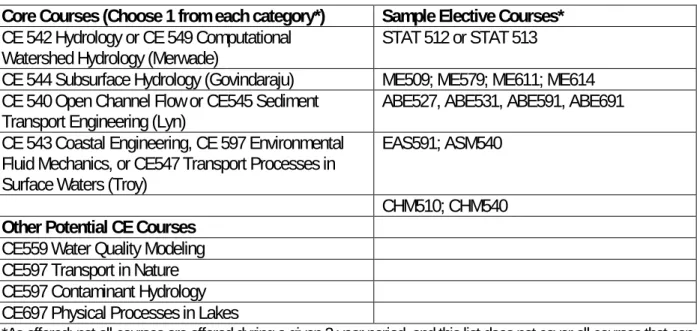
CE 540 Open Channel Hydraulics CE 542 Hydrology
CE 544 Subsurface Hydrology CE 545 Sediment Transport
CE 546 Computational River Hydraulics CE 547 Transport Processes in Surface Waters CE 549 Computational Watershed Hydrology CE 641 Statistical Hydrology
CE 642 Advanced Hydrology
CE 593 Environmental Geotechnology Related Courses on Campus (partial list) ABE 52600 Watershed Systems Design ABE 56500 Agricultural Systems Engineering ABE 59100 GIS Applications Using ArcView ABE 60100 Applied Finite Element Analysis AGRY 54000 Soil Chemistry
AGRY 54400 Environmental Organic Chemistry AGRY 56000 Physical Properties of Soils AGRY 58200 Environmental Fate of Pesticides ATMS 55100 Atmospheric Chemistry
BCHM 56100 General Biochemistry I BCHM 56200 General Biochemistry II CHM 56300 Organic Chemistry CHM 57700 Physical Chemistry CHM 57800 Physical Chemistry
CHM 51000 Chemical Engineering Thermodynamics FOR 50100 Limnology
FOR 50200 Watershed Hydrology, Ecology & Mgmt FOR 54000 Wetlands Ecology
STAT 51100 Statistical Methods
27
APPENDIX D - GEOMATICS
B.1 MS/MSE/MSCE degree students
The first decision an incoming Geomatics Master’s student has to make is whether he/she is going to choose between the Thesis or Non-Thesis option. The thesis option consists of 7 courses and 3 research courses, totaling 30 credit hours. The non-thesis student takes 10 courses (also 30 credit hours).
The student will follow, as an example, any of the four tracks shown below in the table. The tracks have an enormous amount of overlap though. Non-thesis (and often thesis) students have to take six core courses sometime during their studies at Purdue. Typically a MS student follows the core-courses CE502, 503, (506), 510, and 545 in the fall, and CE(506), 508 and 511 in the spring. The core course CE506 is offered either in the fall or in the spring semester. All students are advised to defer the desired electives MATH511 and STAT511 to the summer semester. The reason is that it is very rare that Geomatics courses are offered during the summer.
Depending on whether the student is employed as a TA (or RA), the most often occurring course loads over the Fall/Spring/Summer/Fall semesters are either 4/4/2/0 or 3/3/2/2.
The advisor initially assigned to all new incoming graduate students is the representative of the Geomatics area in the Civil Engineering Graduate Committee. After a month or so, the student will finalize his/her selection of the academic advisor.
The Masters study will be concluded with a 2 hour oral exam. The student selects with his/her advisor a Master’s Advisory Committee that preferably consists of three Geomatics faculty members, and an external faculty member. The latter member is most often the instructor of one of the elective courses, i.e. “external to Geomatics” classes. The exam for the thesis-option student can be characterized by a “student driven” exam: the student presents during 45-60 minutes his/her findings of the research, followed by questions of the committee members. The exam for the non-thesis student can be characterized as “faculty driven”.
With exceptions the student may be given a waiver for the core courses. In this instance, the student should be prepared to detail the arguments to his/her advisor and instructor of the course for which the waiver is sought, by supplying textbooks, lectures notes, etc. The instructor may choose the student to submit to an exam in the course for which the waiver is requested.
B.2 Ph.D. degree students
Some of the core courses may not be required for Ph.D. students who have already a master’s degree from another school or department with a very similar program as the Geomatics Master’s degree program at Purdue. Common practice is that the far majority of the Ph.D. students go through the Geomatics Master’s program at Purdue first. The 30 credit hours course work for the Master’s non-thesis student, or the 21 credit hours course work for the thesis option student count towards the minimum 48 credit hours course work for the PhD degree. Popularly speaking, the Ph.D. student may “cash-in” his/her first 30 of the 48 required credit hours for a (non-thesis) Master’s degree.
In most instances, the Master’s exam in Geomatics is considered as the Ph.D. qualifying exam.
This exam is different from the Ph.D. Preliminary Examination. During the latter exam the Geomatics Ph.D. student is subjected to various written exams by the embers of the Ph.D. Advisory Committee. The oral part of this exam consists mainly of the presentation of the research proposal of the candidate. Only after the student has passed the written and oral exams of the Preliminary Examination the student is admitted to Purdue as a Ph.D. candidate.