Mobility Services:
Setting the policy framework
First Year Project Report
A Review of Experience
Ian Skinner
Dawn Haines
Luisa Senft
Catherine Bowyer
Malcolm Fergusson
Institute for European Environmental
Policy
28 Queen Anne’s Gate
London SW1H 9AB
Correspondence:
[email protected]
March 2004
The project is funded by a Small Project Grant from the Volvo Research
Foundations.
The authors would like to thank the following for their contributions: Peter Hjerp (IEEP);
Astrid Ladefoged (IEEP); and
MOBILITY SERVICES: SETTING THE POLICY
FRAMEWORK
...1
REPORT OF YEAR 1 OF THE PROJECT
...1
A REVIEW OF EXPERIENCE
...1
1 Introduction... 1
1.1 Background to the Project... 1
1.2 Aim and Objectives of the Project... 2
1.3 Scope and Methodology of the Project... 2
1.4 Content and Structure of this Report... 3
2 Mobility Services: A Solution to the Urban Transport Problem?... 5
2.1 The Urban Transport Problem... 5
2.2 Towards a Sustainable Urban Transport System... 6
2.3 In Search of ‘Mobility Services’... 7
3 The Potential Contribution of Services to Sustainability: Theory and Practice... 11
3.1 Services for Sustainability: An Overview of the Theory... 11
3.2 Services for Sustainability in Practice... 16
3.3 Services in the Context of Mobility... 22
3.4 Refining the Scope of the Analysis... 26
4 Review of International Experience with Mobility Services... 27
4.1 Car Sharing... 27
4.2 Car Pooling... 33
4.3 Bicycle Pooling... 37
4.4 Innovative Public Transport... 39
4.5 Integration of Public Transport and ‘Private’ Transport Modes... 41
4.6 Summary and Conclusions... 44
5 The Role of Stakeholders... 47
5.1 The Role of Local, Regional and National Government... 47
5.2 Manufacturers’ Perspectives on Mobility Services... 50
5.3 The Role of the Consumer... 54
5.4 Summary and Conclusions... 58
6 Summary of the Main Findings and Next Steps... 59
6.1 Summary of the Main Findings of the Report... 59
6.2 Next Steps... 60
M
OBILITY
S
ERVICES
: S
ETTING THE
P
OLICY
F
RAMEWORK
R
EPORT OF
Y
EAR
1
OF THE PROJECT
A Review of Experience
1 Introduction
1.1 Background to the Project
In industrialised countries, car ownership and use continue to grow, and with these, individual expectations of a high degree of personal mobility. However, road space and parking space in traditional urban centres in particular are extremely limited, resulting in traffic intrusion and congestion as widespread problems. At the same time, it is acknowledged that there are people who live in urban areas, particularly in poorer areas, who have problems of accessing jobs and facilities, and therefore whose access needs to be improved. Hence there often appears to be a contradiction in resolving the problems of urban transport between the need to reduce congestion and improving access to services. One element of the solution to these problems could be a new and broader approach to mobility management which seeks on the one hand to improve the space- and time-efficiency of personal trips, and on the other, in some cases even to seek alternative forms of access which avoid the need for some trips altogether.
For these reasons there is a developing debate about the potential of ‘mobility services’. At the same time, a range of developments in ‘smart’ vehicle technology and ICT capabilities are greatly improving the possibilities for a range of such services to deliver individual access, even within the constraints of a range of sustainable transport objectives (OECD, 2000). Reflecting this, existing transport and environment research programmes are paying increasing attention to mobility services (eg the CarLink II Research Team based at the University of California, Davis; a national research programme in Switzerland) and programmes in the EU have undertaken a significant amount of work that includes aspects of mobility services (eg MOSES, which
aims to develop innovative mobility services
based on car sharing
). There are also a number of pilot and existing schemes for mobility services, especially car sharing (eg Mobility in Switzerland).However, most of this work focuses on the implications of specific types of mobility services on society and the transport system and the elements of success for these services. Few studies have been undertaken of the broader potential of fully integrated services, or of the roles of policy instruments and the various elements of the transport and related industries in this. Where the former have been undertaken, policy instruments were assessed primarily at the local scale. As an example, the UK’s Commission for Integrated Transport report on car sharing looked at the role of the government in providing the appropriate policy framework.
1.2 Aim and Objectives of the Project
While car sharing is the most widely-quoted example of a mobility service, it is only one of a number of mobility service models that is discussed in the literature. Hence, there is a need to look at the potential role of mobility services in a broader sense in resolving the urban transport problem. One possible vision of an urban future could be where the development of integrated mobility services has improved accessibility, but reduced the amount of travel, for example, through the use of sophisticated internet and associated technologies.
The primary aim of this project, therefore, is to consider how mobility services in their broadest sense could deliver this vision of improved access and reduced travel by examining existing trends and future possibilities, along with the policy instruments, social and other changes that could help to achieve this goal.
The research objectives of this project are to:
• Identify the potential for the full range of services currently encompassed by the term ‘mobility services’;
• Identify their potential role and contribution to a future urban sustainable transport system; and
• Identify the potential role of the policy community and various elements of the transport-related industries in the development of more comprehensive and sustainable mobility services.
1.3 Scope and Methodology of the Project
Initially, the scope of the project was set so that it was relatively broad to ensure that nothing that could provide an important insight for the project was excluded. Hence, the starting point was to take the term ‘mobility services’ in its broadest possible sense, ie services that enable mobility. However, this definition was refined as the project developed (as discussed further in Section 3.3).
It was also recognised that the increasing prominence given to the development of services within the transport/mobility sector is mirrored in other sectors and that the project could not ignore such developments. These were potentially important from two perspectives. First, insights from the development of services in other sectors could be beneficial with respect to the development of mobility services. Second, theoretical models and typologies developed for other sectors might be more developed than any applied in the transport sector to date, and therefore could offer insights into the development of the typology of mobility services. Hence, the project was broadened to include other sectors, at least in the first stage (as reviewed in Section 3.1 and 3.2).
The role of various stakeholders in the delivery of ‘mobility services’ was also examined. A range of transport-related industries have developed some aspects of mobility services in certain areas, but this process has not yet reached anything like its full potential or extent.
To give one example, car manufacturers have in recent years been increasing their interest in mobility services, although this has, to date, manifested itself only in the form of taking more control of aftersales services, where there are more profits and less risk for the industry. Manufacturers and other companies in the automotive sector evidently have a potentially important role to play in the development of mobility services, and benefits to gain from becoming mobility service providers rather than simply makers of cars. Car sharing schemes, for instance, are a potential means of introducing new technology as they provide a sustainable, low-risk market that can be controlled by the service providers. There has also been an increasing debate in policy circles about the potential for mobility services. UNESCO has identified mobility services as a potential element of sustainable consumption behaviour, while the OECD and the EU institutions have held workshops or supported research on the subject (OECD, 1999; MOSES, 2002). In some European countries such as Germany, the development of mobility services has been supported by the government through direct funding or relevant policy approaches, such as promoting the idea of car-free cities. As a result, mobility service schemes, such as car clubs, have been reasonably well developed in some countries, where a national framework has facilitated the development of networks of schemes – which is obviously beneficial for some transport services. In contrast, similar schemes have failed to take off elsewhere, for example in the UK, where the government has not been involved in the development of such schemes. In this context, policy-makers can be argued to have an important role to play as well as the transport-related industries which seek to provide services, and identification of this role is critical for the future of mobility services.
With this discussion in mind, the main stages of the project are: • Review of experience and literature, to include:
° International experience with mobility services;
° Approaches being taken by transport-related industries and policy-makers towards mobility services;
° Theories of services and sustainability; and
° Review of the development of services in other sectors.
• Identification of the potential role and contribution of these services to a future urban sustainable transport system.
Broadly, the former is the objective of the first year’s work, and the latter the objective of the second year’s work. The identification of the role and contribution of mobility services to a future urban sustainable transport system will be undertaken through a number of more focused projects, which were identified in the course of this work.
1.4 Content and Structure of this Report
This report focuses on the first year of the two-year project, which broadly equates to the first stage of the project as listed in the previous section, ie the review of experience and literature. The literature review has had two foci: a review of experience and literature to do with mobility services; and a review of the theory and practice of services in other sectors. First, in relation to mobility, it sought to identify the range of services currently
encompassed by the term mobility services through a review of international experience. This examined both practical experience as well as academic literature on mobility services and material posted on the internet. Second, the literature review examined experience of service development in other sectors, through looking at concepts such as eco-services and product service systems (PSS). This aspect of the work has also covered practical experience with the development of services.
The report is structured as follows:
• Chapter 2 outlines the problem of urban transport in some more detail and reviews the literature in order to identify whether there are any definitions of mobility services and/or what types of service are generally encompassed by the term.
• Chapter 3 looks more broadly at the potential role of services in a more sustainable society and looks at any commonalities or implications for the development of mobility services. It does this by reviewing the theories behind services and sustainability, models of services and practical examples of the development of services for sustainability in other sectors.
• Chapter 4 reviews international experience with mobility services.
• Chapter 5 reviews the role and motivation of the principal stakeholders in the provision of mobility services.
• Chapter 6 summarises the main findings of the report and briefly outlines the focus of the work for the second year of the project.
2
Mobility Services: A Solution to the Urban Transport Problem?
2.1 The Urban Transport Problem
In the urban context, the principal adverse environmental impacts of transport are the emission of pollutants, noise and the use of land. The emission from motorised transport of pollutants such as volatile organic compounds, the oxides of nitrogen and particulate matter, contribute to poor air quality, which is recognised as having adverse impacts on human health and the wider urban environment (EEA, 2003). Also, although carbon dioxide is not a local pollutant, it is relevant that the slow or stop-start driving that is typical of urban centres gives rise to particularly high levels of CO2 emissions.
Noise from motorised transport disturbs everyday human activity particularly in urban areas, and has consequent social and economic impacts, for example through sleep loss and loss of productivity. Owing to its location and ubiquitous nature, road transport in particular is generally the major source of noise nuisance, and ongoing EU requirement for the compilation of noise maps is serving to highlight this point. The European Environment Agency estimates that 30 per cent of the EU population are exposed to noise from road, and 10 per cent to noise from rail, at levels that interfere with the quality of their lives and potentially damages health (EEA, 2003).
Whereas in rural areas, land take is an issue in relation to the damage of habitats and eco-systems, in urban areas, it is more a question of making the most effective and efficient use of valuable and scarce land in the face of competition from other potential uses. Consequently, in urban areas, the amount of land space used for car parking, both on-street and private, is as much of an issue as the land used by other transport infrastructure, such as roads and rail. For example, figures for 1990 in the UK suggest that roads cover 3.3 per cent of the country’s land areas, while railways occupy about 0.2 percent (RCEP, 1994). Comparable figures for the EU put road as occupying 1.3 per cent of land and rail as occupying 0.03 per cent (CEC, 1992)1.
In the social context, transport enables mobility allowing access to jobs, goods and services, but this benefit is not experienced to the same extent by all members of society (Social Exclusion Unit, 2003). Transport routes can also lead to barriers to movement developing. For example, the heavy use of urban roads can result in severance, ie the roads act as barriers to certain pre-existing patterns of mobility, thus changing mobility patterns and potentially restricting access for some of those affected. From an economic context, access to jobs, goods and services results in economic activity, which benefits the local economy. However, increasingly congested travelling conditions on the roads of many cities result in economic costs in terms of lost time and the inefficient use of resources. Time wasted in congested conditions restricts the amount of time that can be dedicated to other, more economically-beneficial activities. For individuals, these costs do not appear on any balance sheet, but for businesses, they do, as time wasted in congestion leads to real economic losses and congestion can also result in the need to use more resources, eg in terms of
1 The figures for the percentage land take by a certain land use are not widely-reported, as these are difficult to calculate and vary depending on what has been taken into account. For example, the RCEP (1994) reports that figures for roads vary depending on whether the roadside verges are included or not.
delivery vehicles. Congestion on roads also results in direct economic losses in terms of wasted fuel and economic losses for society in terms of an inefficient use of roadspace. It is apparent that the current pattern of urban transport is unsustainable in terms of environmental, social and economic factors. Much of the problem relates to the heavy use of, or some would argue an excessive reliance on, private road transport, and particularly the private car, even when public transport is readily available. However, an acceptance for change is being recognised and is mirrored by the increasing number of papers from policymakers on this subject, eg white and green papers and moves to legislate on transport issues (for example, UK (DETR, 1998) and EU White Papers (CEC, 2001)). Accordingly, the need for sustainable transport solutions is advocated by many as a means to move away from the problems associated with the current transport system.
2.2 Towards a Sustainable Urban Transport System
The context of this work is the identification of the potential contribution of mobility services to a future urban sustainable transport system to address the issues set out in the previous section. The need for a USTS is reflected in the current undesirable and unsustainable path that the current transport system is following (see, for example, EEA, 2003). However, a universal or agreed definition of a sustainable transport system does not yet exist2, and in view of the many definitions and theories afforded to issues concerning
sustainability, nor is one likely to in the near future. What is fundamental to the achievement of a more future urban sustainable transport system is for both future and current policies to take into account the three pillars of sustainability; that is the recognition of environmental, social and economic factors. The various environmental, social and economic considerations that need to be taken into account in the development of a sustainable transport system have been well documented (eg Skinner and Fergusson, 1999; OECD, 2000).
Moreover, the need for a more integrated approach is also essential. One of the main failings of the current transport system is that too often a reductionist approach is adopted (as set out in, for example, DETR, 1998). For instance many actors have responsibilities relating to areas that impact on transport either directly or indirectly. The lack of integration between such actors can often result in detrimental affects. For instance strategies carried out to improve traffic flow can often result in the degradation of cycling facilities. More generally, it is clear that an urban sustainable transport system might, as discussed above encompass inter alia land use management, improved communications, reducing the need to travel and mobility services. Some advocates see technological innovations as the way forward. For instance the emissions of pollutants that contribute to air pollution and noise from vehicles are being reduced by technical developments3. However, problems would
remain in relation to reducing congestion where there are competing demands on a limited
2 There are definitions by the OECD’s Working Group on Transport (OECD, 2002) and the
Commission’s Expert Working Group On Transport And The Environment (CEGTE WG1, 2000). Interestingly, both papers referred to environmental sustainability in their titles, however this should not lead to conclusions that the environmental aspects of sustainability feature more prominently in the guidelines than the other two pillars of sustainability; economic and social.
3 It is worth noting that while this is true, poor air quality resulting principally from transport emissions, particularly the oxides of nitrogen and particulate matter, is, and will continue to be for at least the next decade or so, a problem in many cities (eg CEC, 2000).
supply of land, while at the same time enabling access to jobs, goods and services that have social and economic benefits. Conversely, others see the need to actually reduce travel as an important component of a USTS. Consequently, in the congested cities and towns of western Europe, policies to reduce the need to travel are being developed (see review in Banister and Marshall, 2000). Elsewhere the advent of Integrated Communications Technologies (ICT) that enable teleworking and teleshopping is being seen as a means of reducing travel, while innovative marketing techniques are resulting in less travel in cities such as Perth in Australia (RAC, 2002; Brog and John, 2001).
However, to date, there are few policies that actively address ever-increasing car ownership, which is, if not the root of the problem, then one of its principal drivers (eg Keles, 2002). However, these do exist. Car sharing, for example, addresses car ownership through enabling access to the benefits of car ownership (ie flexible availability of a car), without requiring direct personal car ownership. Such schemes may help to bridge a ‘gap’ between conventional car ownership patterns on one side, and taxis and public transport on the other. These are increasingly put forward as an answer to the problems of urban transport (eg OECD, 1999; AIGT, 2002) and are often included under the umbrella heading of ‘mobility services’.
2.3 In Search of ‘Mobility Services’
In the literature, few authors attempt to put forward a definition of mobility services, whereas several authors put forward examples of mobility services without explicitly defining the term. One of the few examples is from the UK’s Automotive Innovation and Growth Team4, which defined mobility services, in rather broad terms as:
‘comprising a variety of transport arrangements which allow people to enjoy the benefits of car-based mobility while doing away with the need to own a vehicle’
(AIGT, 2002, p 17).
It is noticeable that the AIGT’s definition focuses on providing car-based mobility without the need for car ownership, hence they suggest further investigation of the potential of car sharing, although they also considered more innovative leasing schemes and car pooling. AIGT’s definition is narrower that that given by Klewe (1999), who makes a distinction between the term Mobilitätsservice and Mobilitätsdiensleistung, both of which can be translated into English as ‘mobility services’. Klewe argues that Mobilitätsdiensleistung is a generic term for:
• The pure transport provided by a transport company (eg a bus service), as well as the temporary option to use a car (eg one that belongs to a car sharing company); and
4 The AIGT was set up by the UK’s Department of Trade and Industry. It consists of stakeholders
and aims to identify the key issues that will shape the future of the industry and to identify how the UK should respond to the competitive challenges that it faces.
• The service enabling the use of these transport options (eg public transport information system, combined ticket for public transport and car sharing).
In contrast, Mobilitätsservice are the non-physical services and management of transport. Other authors do not attempt to provide a definition of mobility services; rather they give either implicit or explicit examples of the services that might be encompassed by the term. In 1999 the OECD hosted a series of workshops entitled ‘Innovation for Environmentally Sustainable Transport: Mobility Services and Logistics for Passenger and Freight Transport’. The workshops aimed inter alia to explore practical ways in which mobility services can support more environmentally sustainable travel, review the technological options available for mobility services and explore best practice. Whilst participants looked at mobility service providers, ‘door-to-door’ mobility packages and mobility centres, an actual definition of what constituted mobility services was not discussed. Similarly, Hörmandinger discusses mobility services in depth, however does not offer a definition at any point. Rather, he discusses the conditions under which they developed and how various schemes work. He also looks in detail at the impact of mobility services on the motor industry and the future role and possibilities for the motor industry becoming involved in such schemes (see section 5.2).
The European Platform for Mobility Management (EPOMM), which is an international partnership that aims to promote and further develop mobility management in Europe, discusses mobility services in the broader context of mobility management. It describes the core of mobility management as using ‘soft’ measures to enhance the ‘hardness’ of measures, such as changes to infrastructure and sees mobility services as one of the major components of the soft approach. EPOMM believes that mobility services are a tool to convince people to make sustainable travel choices and that to do this effectively, the services need to be adapted to the particular needs and demands of the clients. EPOMM distinguishes six broad types of services, these are:
• information and advice; • consultation;
• organisation and co-ordination; • products and services;
• sales and reservation; and • awareness and education.
The EU project ‘Mobility Services for Urban Sustainability’ (MOSES), in spite of its name, does not give an actual definition as to what mobility services are. MOSES’ objective is to facilitate developing the concept of car sharing across Europe, which seems to prescribe car sharing as a mobility service without questioning what such a service is or should entail. As seen from the other studies above it would seem that this is commonplace with only a handful of studies attempting to offer a definition.
In order to attempt to gain a clearer understanding of what the term ‘mobility services’ might actually cover and how these might contribute to a future urban sustainable transport system, it is also worth reviewing the broader services for sustainability literature and to
review experience in other sectors. In the sustainability literature, particularly that relating to sustainable consumption, much attention has been given to the potential role of services in the ‘dematerialisation’ of the economy (eg Weizsäcker et al, 1998). There are also a number of programmes exploring the potential role of services in a future sustainable economy, eg the EU Thematic Network SusProNet (eg Tischner, 2003) and, in the UK, the Green Alliance’s Service Innovation for Sustainability project (eg Willis and Oldham, 2003). These, and others, will be reviewed in Chapter 3.
3
The Potential Contribution of Services to Sustainability: Theory
and Practice
In order to identify the potential role of mobility services in a future transport system, it is important to undertake a review of the theory and practice in other sectors to identify any useful insights that these provide for transport. This is the aim of this chapter. It begins with an overview of the theory underlying the potential role of services in a future sustainable economy (Section 3.1), followed by a review of some practical examples of services and their contribution to sustainability (Section 3.2). Section 3.3 concludes the chapter with a discussion of how the theory and practice in other sectors might be relevant for transport.
3.1 Services for Sustainability: An Overview of the Theory
The interest in the role of services in a future sustainable economy derives from the fact that, on average, services are less resource-intensive than manufacturing. Less use of resources in turn implies less need for primary extraction industries, less waste disposed, and in general fewer environmental impacts as a result. Thus a shift towards a more service-orientated economy is considered by some to be a crucial component of a move towards a more sustainable economy. In this context, the economic and social benefits of services are enhanced by a reduction in their environmental impact. In industrialised countries, the contribution of services to the economy has been increasing at the expense of manufacturing, and estimates suggest that services contribute 75 per cent of total GDP in the US and around 50 per cent in Europe (Tischner, 2003). However, this increase has happened for commercial and broader economic reasons, rather than widespread recognition of the potential contribution of services to a future sustainable economy.
The development of services as a contribution to a future sustainable economy is part of a broader debate on the ‘dematerialisation’ of the economy, which effectively means a reduction in the materials intensity of economic activity (Heiskanen and Jalas, 2000). The scale of the dematerialisation necessary to achieve a sustainable economy is the subject of much discussion. Weizsäcker et al (1998) take as a starting point for their book the need for an improvement of a factor of four, to be achieved by doubling wealth while halving resource use. Schmidt-Bleek (1994) and others talk of the need for an improvement of a factor of 10, based on the argument that global consumption needs to halve and that consumption in OECD countries is already five times the global average. Others (eg Vergragt and Jansen 1993, Weterings and Opschoor 1992) argue for an improvement by a factor of 20, based on the assumption that by 2050 the global population will double, average wealth will increase fivefold and that there is a need to halve the environmental burden caused as a result. In all cases, however, a very substantial improvement in the efficiency of the use of materials is envisaged.
While increasing the role of services in an economy can contribute to such a scale of dematerialisation, this is not a sufficient condition for such an economy to be sustainable. Many authors point out that it is not correct to see a service economy as essentially an environmentally-clean economy (eg see discussion in Heiskanen and Jalas, 2000; Young & Charter, 2001; Tomiyama, 2001). White et al (1999) argue that a service economy should be seen as ‘a value-added layer resting upon a material-intensive, industrial economy’ (p 1). They argue that services will only contribute to a greener economy if they change the way
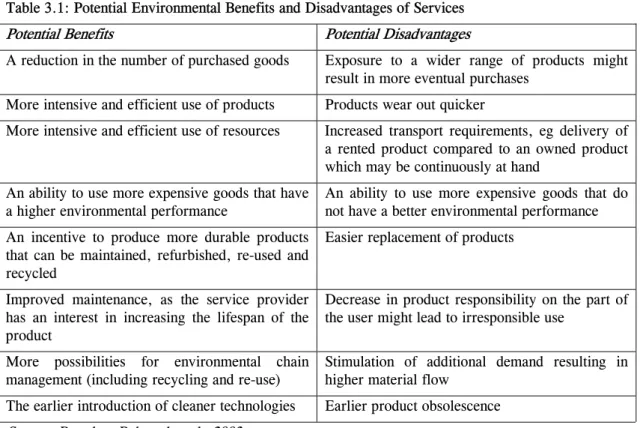
in which products are manufactured, used or disposed of, or if, in some cases, they actually replace a product. Behrendt et al (2003) demonstrate this point by discussing possible environmental advantages and disadvantages of services (see summary in Table 3.1).
Table 3.1: Potential Environmental Benefits and Disadvantages of Services
Potential Benefits Potential Disadvantages
A reduction in the number of purchased goods Exposure to a wider range of products might
result in more eventual purchases
More intensive and efficient use of products Products wear out quicker
More intensive and efficient use of resources Increased transport requirements, eg delivery of
a rented product compared to an owned product which may be continuously at hand
An ability to use more expensive goods that have
a higher environmental performance An ability to use more expensive goods that do not have a better environmental performance An incentive to produce more durable products
that can be maintained, refurbished, re-used and recycled
Easier replacement of products
Improved maintenance, as the service provider has an interest in increasing the lifespan of the product
Decrease in product responsibility on the part of the user might lead to irresponsible use
More possibilities for environmental chain
management (including recycling and re-use) Stimulation of additional demand resulting in higher material flow
The earlier introduction of cleaner technologies Earlier product obsolescence
Source: Based on Behrendt et al, 2003
The recognition that services are not necessarily beneficial to the environment has resulted in a number of attempts to conceptualise the relationship and potential contribution of services to sustainability (see Table 3.2). The definition of an service (or an eco-efficient service) as being a service that is beneficial to the environment is a logical development from this recognition, but the definitions quoted in Table 3.2 generally go further than this. For example, in attempting to define eco-services, Behrendt et al (2003) emphasise the substitution of tangible components by intangible components, in addition to the services having a positive impact on the environment. White et al (1999) suggest that we are seeing a blurring of the distinction between the activities of the manufacturing and traditional service sectors, and implicitly, between products and services. Other authors, eg Meijkamp (2001), Tischner (2003) and UNEP (nd), shift the focus to providing for the needs of the consumer rather than on the selling of the actual products or services, themselves5.
In order to understand better the potential implications of these ideas, it is necessary to discuss further the definition of a service and its relationship to a product. The basic distinction between a product and service is that the former is tangible and the latter is intangible, although possibly connected to a tangible product. Behrendt et al (2003), in
5 The exception in Table 3.2 is the WBCSD’s definition of eco-efficiency, which does not necessarily entail the development of services, rather it focuses on reducing the unit environmental impact of products. However, the WBCSD does note that increasing service intensity, through sharing and selling results, is one aspect of eco-efficiency (see WBCSD, 2000; DeSimone and Popoff, 2000).
common with other authors (eg White et al, 1999), define services according to the framework given in Figure 3.1. They identified use- and result-orientated services (the shaded areas in the diagram) as the two categories of service on which to focus in their discussion of eco-services, as they considered that these were encompassed within their definition of eco-service (see Table 3.2).
Table 3.2: Services and Sustainability: Relevant Concepts
Concept Definition (source)
Eco-services ‘those intangible service components that partially or completely substitute for
tangible components, resulting in a positive effect on the environment’ (Behrendt et al, 2003)
‘being achieved by the delivery of competitively priced goods and services that satisfy human needs and bring quality of life, while progressively reducing ecological impacts and resource intensity throughout the life cycle, to a level at least in line with the Earth’s estimated carrying capacity’ (WBCSD, 2000)
Eco-efficient services (based on the concept of
eco-efficiency) ‘all kinds of commercial market offers aimed at fulfilling customer needs by
selling the utilisation of a product (system) instead of providing just the hardware for these needs. Eco-efficient Services are services, related to any kind of hardware, of which some of the properties rights are kept by the supplier’ (Meijkamp, 2001)
‘a competitive system of products, services, supporting networks and frastructure. The system includes product maintenance, parts recycling and
ntual product replacement, which satisfy customer needs competitively and with lower environmental impact over the life cycle.’ Key idea behind PSS is that ‘consumers do not specifically demand products, per se, but rather are seeking the utility these products and services provide’ (UNEP, nd)
in eve Product Service Systems (PS systems or PSS)
‘consists of tangible products and intangible services designed and combined so that they jointly are capable of fulfilling specific customers needs’ (Tischer, 2003)
Servicizing ‘The emergence of product-based services which blur the distinction between
manufacturing and traditional service sector activities’ (White et al, 1999)
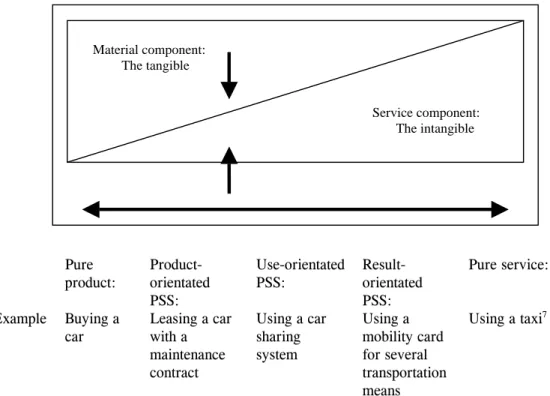
The various categories of services shown in Figure 3.1, and their relative relationship to products, is sometimes also represented as a continuum (see Figure 3.2). This representation highlights the increasingly blurred distinction between products and services, as highlighted by White et al (1999; see Table 3.2). It also demonstrates the fact that services and products can be combined to different degrees, and better conveys the potential for shifting from one type of product-service combination to another, which fits in with the concept of product-service systems (or PSS; see Table 3.2). Effectively, therefore, the concept of eco-services and PSS are comparable, as demonstrated by the fact that both Figures 3.1 and 3.2 contain use-and result-orientated services, and the ‘services additional to products’ of the former could be seen to be equivalent to the product-orientated PSS of the latter. Other authors, such as Hockarts (1999), Meijkamp (2001) and Young and Charter (2001), give similar categories of services that are consistent with these. The concept of PSS, as presented in Figure 3.2, has the advantage over the idea of eco-services, as presented in Figure 3.1, as it conveys better the dynamic nature of the product-service relationship. Hence, for the remainder of this chapter, we will refer to the categories of PSS set out in Figure 3.26.
6 It is worth noting that PSS is also the concept used in the EU Thematic Network SusProNet, hence the concept has broad support among a range of practitioners.
Figure 3.1: Framework of Services Eco-services Services Primary pure service Service additional to product Joint use: sharing, pooling Individual use: renting, leasing Use-oriented Contracting Result-oriented Service substituting product Secondary service with product component
Source: Behrendt et al, 2003 (amended); eco-services are shaded
Figure 3.2: The Tangible and Intangible Components of a Product-Service System
Material component: The tangible
Service component: The intangible
Pure product: Product-orientated
PSS: Use-orientated PSS: Result-orientated PSS: Pure service: Example Buying a
car Leasing a car with a
maintenance contract Using a car sharing system Using a mobility card for several transportation means Using a taxi7
Source: Diagram from Behrendt et al (2003); categorisation and examples from Tischner (2003)
7 Tischner’s examples are included to give an idea of the type of service represented by each category of PSS. However, it is worth noting that the classification of taxi services as pure services is not consistent with the views of other authors (see discussion of Behrendt et al’s work in the next section). This will be explored in more detail in Section 3.3.
Tischner (2003) further elaborates on the three categories of PSS, as follows:
• Product-oriented PSS – the product is owned by the user/consumer and includes, for example:
° A new service is added to an existing product (often initiated through the availability of new technology, eg a modem for a computer);
° Product extension service (eg the value of an existing product is increased through an additional service, eg upgrading, repair, or guarantees); or ° Vertical integration (eg a modified delivery strategy to supply products to
customers where the retailer and/or customer gets directly involved in the process of production, eg production on demand).
• Use-oriented PSS – where the product is owned by the service provider, who sells its function instead of the product, eg through sharing, pooling and leasing systems.
• Result-oriented PSS – where the product is owned by the service provider, who sells the result rather than the product or its function, for example:
° Product Substituting Service (products are substituted by new services, often driven by new technologies, eg virtual answering machine instead of product, pest control service instead of pesticides); or
° Demand Side Management/Facility Management (supplier gives incentives for the customer to consume more efficiently, eg by using modified payment systems, eg contracting).
It is worth noting that a common characteristic of use- and result-orientated services is that the service provider, rather than the product-user, is the product-owner. Clearly this requires either the creation of a service provider or potentially a broadening of the role of the manufacturer to becoming a service provider either instead of, or in addition to, its manufacturing activities. By extension, this change also relies on the product-user, or consumer, accepting that they will not be the product-owner, which in turn requires a shift in attitude on the behalf of the consumer from focusing on the advantages of owning a product to the benefits of non-ownership. While consumers are already, to some extent, prepared to rent selected products, eg videos, or share the use of others, eg washing machines in launderettes, these examples are outweighed by the range of products that consumers choose to buy outright. In addition, it could be argued that the use of some of these services, such as launderettes, are associated with low levels of disposable income, and therefore are not necessarily indicative of a willingness to share products. However, if the development of more services is to contribute to a future sustainable economy, then rental or shared use of more products is likely to be necessary, as well as the development of more innovative PSS than are currently available. However, this clearly requires a cultural shift from the prevailing paradigm on the part of both the service provider (or manufacturer) and the product user.
However, it not only the role of the provider and consumer that must change in order for such a transformation to occur. In a broader discussion on policies for achieving sustainable patterns of consumption, Jackson and Michaelis (2003) argue that active government intervention is also required to put in place an appropriate policy framework to enable more sustainable consumption. They argue that current thinking that governments cannot change consumer behaviour is not supported by research evidence, as governments play a fundamental role in shaping the cultural context within which individual choices are made.
Hence, Jackson and Michaelis assert that one of the roles of government in relation to attaining a more sustainable economy would be to contribute to changing consumer behaviour. Similarly, they argue that the presumption underlying much government policy that the market provides for consumers’ needs is also not supported by research. They suggest that consumers often find themselves locked in to unsustainable consumption patterns, which require government intervention to change. While the sustainable consumption debate is clearly broader than the development of services for sustainability, the emphasis that Jackson and Michaelis put on the need for government intervention is worth noting due to the fact that the development of more services also requires changes to consumer behaviour.
This section has provided an overview of the current theory relating to the potential role of services in a future sustainable economy. It underlined that services, while being of economic and social benefit, are not necessarily of environmental benefit. Various attempts at conceptualising the potential role of services to a future sustainable economy were presented and it was concluded that these approaches were broadly compatible. However, the concept of PSS was identified as particularly useful in the context of this study, as it demonstrates the potentially dynamic nature of the relationship between products and services. The section also underlined the need for a change in the role of the various actors, if the role of services in a future sustainable economy is to attain its full potential. The ownership of the product itself is fundamental to this, as this need not necessarily be transferred to the user, rather it could remain with a service provider. For such an approach to gain wide acceptance, a change in the culture surrounding the relationship between those involved is necessary, ie a manufacturer/consumer relationship needs to develop into a service provider/user relationship. It was also suggested that the role of government in relation to facilitating such a shift needs to become more active, as policies do affect the way we consume. While this section has looked at the theory, the next section will look at the practice with respect to the development of PSS in other sectors in order to investigate whether these reflect the theory.
3.2 Services for Sustainability in Practice
The aim of this section is to review the discussion in the consumption literature to highlight the range of services that are being discussed in the context of developing services to contribute to the attainment of a future sustainable economy. It does not attempt to give a comprehensive overview of all types of services, although it does, to some extent, cover ‘traditional’ services, as these can be environmentally-beneficial, even though they have often been developed for economic or social reasons. Section 3.2.1 presents an overview of the practical examples of possible services that are given in the literature, while Section 3.2.2 is a discussion of the issues raised.
3.2.1 Overview
In the course of reviewing the state of play of, and the potential for, the development of eco-services, Behrendt et al (2003) review experience with services in four countries: Netherlands, Germany, Austria and Spain. This covers experience with traditional leasing, renting, pooling and sharing, as well as that which could be considered to be undertaken for environmental reasons. They conclude that cars are already by far the most common rented goods, even though the use of rental cars is a very small proportion of total annual car
mileage. The rental of other vehicles – vans, bicycles, special vehicles, etc – is also common. The purchase of cars through leasing arrangements is increasingly popular; for example, in Germany one in four cars is purchased in this way and leasing has become the most important means of financing purchases. However, eco-renting or eco-leasing is not as yet that well developed, although they do not elaborate on what the latter might entail. They note that there appears to be little recognition that renting can be environmentally-beneficial in that it requires fewer products to be produced compared to if the products were owned rather than rented. Other examples of rental or leasing services that are also common, but which have generally developed for economic and social reasons rather than environmental ones, include the rental of domestic and commercial property, video rental and libraries (eg see Vercalsteren and Geerken, 2003). However, there are some examples of leasing schemes that are being considered specifically for their environmental benefits, eg a company in the Netherlands was considering the possibilities of sofa leasing, which offers environmental benefits, as these are refurbished after a number of years (Goedkoop, 1999). Behrendt et al (2003) conclude that there is a large potential for the further development of services in relation to the rental or hiring of DIY and gardening equipment. They conclude that the reasons for this not happening at the moment are financial and pragmatic, as well as a lack of knowledge, rather than any strong preference against hiring. Their analysis suggests that the development of such services would be environmentally-beneficial for infrequently used items, but that this benefit disappears the more an item is used as a result of the additional transport involved. They also examined the case of sports equipment and concluded that hiring is common, but that this is undertaken for financial rather than environmental reasons, even though the environmental benefits are clearer than those in the other sectors they examined.
Elsewhere, there are examples of rental services for computers and photocopiers to business. White et al (1999) discuss IBM’s move from being a supplier of hardware to a deliverer of IT business solutions, which involves inter alia the rental of PCs. While the change was driven by commercial and not environmental concerns, the leasing of PCs has necessitated an IBM product take-back programme, which is supported by IBM Materials Recovery/Recycling Centres. Similarly, Xerox’s approach to the rental of its photocopiers, which entails the take-back, recycling and remanufacture of cartridges and photocopiers, is effectively the provision of a service rather than a product. This approach had environmental benefits initially, as photocopiers were reengineered rather than being disposed of, but as environmental issues have risen up the company’s agenda, new approaches to product design aimed at extending its life have also been developed (DeSimone and Popoff, 1997).
In relation to pooling and sharing, the most obvious examples Behrendt et al (2003) identified are in relation to mobility, eg car sharing and pooling. Apart from these, other sharing and pooling schemes that they identify include launderettes, videos, gardening tools, nappies and even ducks8. Pooling and sharing are well developed in Germany and the
Netherlands and the environmental benefits of car pooling and nappy cleaning initiatives are recognised as part of their attraction. They also examined in more detail the potential for the development of eco-services with respect to washing. They concluded that communal laundry and washing facilities could have some environmental benefit, as long as these were
8 A company in northern Austria has a poll of ducks available to householders to enable them to control populations of garden snails.
located in the neighbourhood or building, thus not necessitating a car journey. They proposed that the development of professional laundry services in communal areas serving single person households is the way forward. They acknowledge that the financial benefits of communal laundries are low, given the trend towards cheaper washing machines, but conclude that more professionally-run services might be attractive. Another example of a washing service developed for environmental reasons is a nappy provision and washing service in the Netherlands, which was developed to counter the waste problem of disposing of three million nappies, annually (Goedkoop, 1999).
Charter and Clark (2003) identify examples of IT-based result-orientated PSSs, such as virtual answering machines, email and web-based directories, which replace answering machines, fax machines and telephone directories, respectively. Behrendt et al (2003) look at the latter case in more detail and concluded that, even though there is an environmental benefit of an online book, the internet’s limitations, including speed, the cost of telephone calls, etc, limits the current potential. However, in the long-term, they conclude that there is potential for the development of these and other online services that could be environmentally-beneficial. They also note that environmental benefits are already realised as a result of the internet, as sending an email is a more environmentally-friendly way of communicating than sending a letter or a post-card.
Joore et al (2003) review experience in the food and retail sector and identify a whole range of PSS, some of which had environmental benefits and added value for the customer, and some of which did not. The clearest examples of services that added value for the customer and had an environmental benefit were those, including some provided by cooperatives, that provided organic products to customers. There was a whole range of other services in the sector where the environmental benefit was not clear. This included internet food shopping, meal delivery services and ready-to-eat meals, the environmental benefits of which depended on whether the transport or cooking undertaken by the supplier is more efficient than that which would have been undertaken privately.
To date, however, the most sophisticated result-orientated PSS are present in the business to business market, rather than between business and the public. Frazão et al (2003) list some examples, including chemical management services, renewing and recycling of solvents, integrated pest management, renovation of office buildings, paint on demand systems and supply chain management. Chemical management services (or CMS) were pioneered by General Motors and their suppliers in the US in the late 1980s. Many chemical suppliers in the US are now offering CMS and some companies, of which the largest is Haas TCM, now only offer CMS rather than chemicals. A study by NGO Chemical Strategies Partnership (CSP) has estimated that the potential market for CMS in the US is between $10.5 and $13 billion, or one tenth of the total US chemicals market (Westervelt, 2003).
The CSP acts as an intermediary between chemical companies and potential clients, particularly those in the aerospace, automotive and microelectronic industries, to help set up partnerships to develop services. For example, these partnerships could arrange for cleaning, painting and lubricating services to replace the selling of solvents, paints and oils (Willis and Oldham, 2003). Various case studies suggest that the benefits of such services include a reduction in the amount of chemicals used, improved data and inventory management, reduced chemical costs and reduced hazardous waste (eg Oldham et al, 2003). The Austrian government commissioned two studies to assess the development of and
potential for CMS in the country. This concluded that 4000 companies in the country could introduce some form of chemical leasing model, which could reduce waste from these companies by one-third and increase their net income by an average of 10 to 15 per cent (Federal Ministry for Agriculture, Forestry, Environment and Water Management, nd). While CMS are now being promoted for their potential environmental benefits, case studies suggest that in the past they were a response to customers’ demands (eg see the case study on Castrol in White et al, 1999).
For some companies, however, the move towards the provision of services instead of products is part of a strategic move to make the company and its operations more environmentally sustainable. In 1994, Interface, the world’s largest manufacturer of commercial carpet tiles, made the strategic decision to become the ‘prototypical company of the 21st century’ by reducing its emissions and waste, sourcing non-renewable resources
from recycled material and increasing the use of renewable resources, including energy. This approach included moving to provide services instead of products, as this was the best way to reduce the environmental impact of the company’s products. As a result, Interface changed their business to leasing floor tiles, managing their use at their clients’ offices and taking them back at the end of their lease period or useful life. However, this vision had to be bought into by the whole company, especially the sales people, who had to sell the idea to their customers. In addition, the company has had to convince its customers that the new approach to their business will also be financially beneficial to them (Wales, 2002; Willis and Oldham, 2003).
One example of a PSS involving chemicals and relating to the domestic sector is the home delivery of detergents used in house-keeping (Manzini and Vezzoli, 2001). The system, called Casa Quick started in 1998 to deliver detergents in a mobile van direct to homes. Users fill up containers, which are provided by the service provider, with the amount of product they want to buy. Environmental benefits are gained by the optimisation of packaging and delivery.
Behrendt et al (2003) classify heating and lighting services, along with public transport, including taxis9, as result-orientated PSS. They identify the means of providing such
services as some form of contracting. As an example, in relation to energy services, they identify three forms of contracting: plant contracting, ie providing energy through an energy plant; performance contracting, ie developing an energy saving plan; and delivery of energy uses, eg the consumer receives an end-use energy service, such as heat or light. In relation to households, Vercalsteren and Geerken (2003) suggest that a range of PSSs already exist, including the provision of drinking water, electricity and gas, telephone and cable television services. Mont (2001) argues that market liberalisation, fierce competition and low profit margins have encouraged utility companies to find new business models to make more profits and attract more customers and that these models seek to exploit the functionality of their utilities. The application of such a functional approach depends on the characteristics of the utility, eg waste water needs to be treated, whereas for other utilities there is currently no such end-of-life requirement. For example, an electricity company could sell a function, eg keeping the house at 20°C, rather than selling units of electricity. Macklon (2000) suggests that a typical energy services package might consist of: ‘duel fuel energy supply; free home energy efficiency audit; provision and project managed installation of
energy efficiency measures; finance for these measures; and ongoing advice and promotion of energy efficient appliances and practices’ (p6).
3.2.2 Discussion
The previous section gave an overview of the type of service that could be developed to contribute to a future sustainable economy. From the services mentioned, it is clear that by no means all services have been developed on the basis of their potential environmental benefit. In fact, many of the services identified by the work undertaken within the context of the SusProNet Thematic Network (eg Joore et al, 2003), one of the aims of which is to identify examples of good practice, were not even necessarily environmentally-beneficial. In evaluating the ‘dematerialisation through services’ debate, Heiskanen and Jalas (2000) review the work of a number of authors that criticise the simplicity of the debate. For example, one study quoted by Nørgård (1995) suggests that while it is true that the direct energy intensity of the service sector is lower than that of the manufacturing sector, the total energy consumption (including indirect use) of private services (eg hotels, transport) is comparable to that of manufacturing. The study argues that only public services, such as health and education, have a lower total energy intensity. However, as these could not significantly increase their contribution to the economy, it argues that the widespread introduction of services could not significantly reduce energy use. Others suggest that while services might be less environmentally-damaging, as they have a lower demand for materials, their materials intensity is growing, as a result of more self-service and more capital-intensive forms of service provision (eg Welford at al, 1998). Other concerns relate to the fear that the service sector generally pays little attention to its environmental impacts (eg White et al, 1999) and the lack of applicability of life-cycle assessment techniques to the service sector to enable its true environmental impact to be identified (eg Charter, 1999). However, there is a relative consensus that services can play a role in the attainment of a more sustainable economy.
In addition, when a service is implemented and has environmental benefits, these may be undermined by so-called ‘rebound effects’. These are unwanted side effects, where an environmental saving for a particular act of consumption does not necessarily lead to a net environmental gain. Heiskanen et al (2001) identify two potential types of rebound effect. In the first instance, if, for example, a consumer saves money on energy as a result of energy services, the net environmental impact will depend on how they spend the money saved. The second perspective relates to the way in which any time saved is used. For example, restaurant services, which are more eco-efficient in terms of economic value than cooking and eating at home, free up time for additional consumption activities.
The potential environmental benefit of services may also be undermined by increased use of transport in their provision. For example, the rental and hiring of products requires their initial collection (or delivery) and return, which incurs additional energy use if motorised transport is used (UNEP, 2002). The frequency of use will determine whether the net effect of the rental service is beneficial (see, for example, the examples noted in the previous section). The shifting of ownership from the product-user to service provider may also result in more irresponsible use of the product and advanced telecommunications could increase mobility and thus resource use (eg Manzini and Vezzoli, 2003).
UNEP (2002) suggests that the main barrier to the development of PSS is arguably the cultural shift required to move away from ‘owning a product’ to ‘having a need or a want met in a sustainable way’ (p15). In addition, business faces a number of barriers, including how best to design, develop and deliver PSS, as well as implementing the changes required in corporate culture to support a more innovative, service-orientated business.
Wales (2002) outlined a number of problems that commercial carpet tile manufacturer Interface had to address in the course of transforming itself into a provider of services rather than of products. Many of the company’s customers were not aware of the wider resource efficiency debate, so the company had to communicate this to its customers in order that they understand the company’s rationale for its shift to providing services rather than products, which has not been easy. The company also found that there was a need for a buy-in from the salespeople, in particular, as selling leasing arrangements as opposed to only a product requires a greater understanding of the advantages of the new arrangements and the needs of the customer. Hence, the salespeople have to understand the rationale behind the provision of the service, and be prepared and able to explain this to the customers. The salespeople also had to overcome the internal budgetary divisions of their customers, as they found that often the cost of purchasing, maintaining and disposing of carpets was covered under different budget lines. In order to convince customers of the economic benefits of leasing over buying floor covering, it was necessary to bring these costs together, as otherwise leasing would come across as more expensive than it actually is. In addition, as leasing is more complicated than selling, it also requires the salespeople to understand more about the contractual and legal side of things, which can vary from country to country. In this context, the leasing culture, (eg its strength and the type of products that are leased) of the country in question is also important. Finally, he noted that the economic viability of certain recycling material is also an issue.
Macklon (2000) identifies a number of obstacles on both the demand and supply side to the development and take-up of energy services for the domestic sector in the UK. A number of these relate to the lack of an obvious business case for energy providers to sell energy services, while others relate to the regulatory framework or the attitudes of consumers. He suggests that many energy providers believe that there are easier ways of gaining market share than trying to sell energy services. Tied to this is the fundamental tension between energy efficiency and the basic business equation that selling more units means more revenue. The lack of clear benefits leads to an ambiguous message, which makes marketing difficult, hence few resources are being put into creating a demand for energy services to date. In addition, the liberalisation of energy markets is driving prices down, which makes it more difficult to sell the importance of energy efficiency to customers. Even without declining prices, many customers were choosing to avoid the short-term, expensive disruption of installing energy efficiency measures in their home, which would only bring economic gain in the longer-term.
Oldham et al (2003) looked at examples of innovative services that contributed to improving resource productivity in a number of sectors, notably chemicals, energy and agriculture, and identified a number of barriers, which are a useful summary of the issues raised, above. These include:
• Cultural barriers – For example, the need for a change in approach on the part of the supplier and customer, the need for different business models, and nervousness surrounding the new, closer relationships required.
• Budgetary and management structures – These can effectively hide the full costs of product use, or at least make these difficult to identify.
• Implications for existing certainties – For example, concerns about the impact of the service approach on quality assurance and liability.
• Attachment to ownership – Domestic consumers, in particular, want more from a product than the service it offers, as, for example, they gain status through ownership and enjoying the experience of buying and owning products.
• Investment – Analysts and investors prefer product-based investment, as they lack understanding and awareness of service approaches.
• Cost – The low cost of energy, resources and waste management reduces the incentives to adopt a more service-orientated approach.
Heiskanen et al (2001) conclude that while the development of services does not necessarily lead to the dematerialisation of the economy, they, along with the development of Information and Communication Technologies, are a necessary, but not sufficient condition to decouple natural resource use from economic growth. The examples of this section highlight a number of barriers to the development of services for sustainability, and note, in particular, the need for a change in the approach on the part of both consumer and the service provider. The next section discusses mobility in the context of the broader services for sustainability debate.
3.3 Services in the Context of Mobility
This chapter, so far, has discussed the theory behind the development of services in the context of a future sustainable economy and reviewed a number of examples of the type of service being introduced in this context, along with the problems that they face. It was impossible to undertake such a review without an occasional reference to mobility, but care was taken not to discuss these in detail until now, rather to focus on services in other sectors. The aim of this section is to discuss mobility in the context of Sections 3.1 and 3.2 in order to attempt to highlight the parallels and to illustrate the potential problems for the development of mobility services.
Section 3.1 highlighted the potential contribution of services to the dematerialisation of the economy. Broadly, transport uses materials, or resources, in the construction and maintenance of infrastructure and the manufacture, maintenance and operation of vehicles. Hence, the dematerialisation of transport, or mobility, would only happen by dematerialising some or all of these activities. In relation to the discussion of the previous section, car rental, sharing and pooling clearly all have the potential to contribute to the efficiency of use of a vehicle, as such vehicles are likely to be used more intensively and for longer periods than privately owned vehicles. If this results in less demand for vehicles, then fewer vehicles might be required to be manufactured, which would also be positive in the context of the dematerialisation of transport.
Table 3.3: Potential Environmental Benefits and Disadvantages of Services in Transport Environmental Impact* Example in Relation to Transport
Potential Benefits
A reduction in the number of purchased products If car sharing were to result in less demand for vehicle ownership
More intensive and efficient use of products If a car in a car sharing scheme is used more
frequently than a comparable private car. Also car users can select a vehicle appropriate for each particular period of use, rather than having to own a vehicle large enough to accommodate all the range of uses to which it might be put. An ability to use more expensive goods that have
a higher environmental performance The use of alternatively-fuelled vehicles, eg hybrids, through car sharing schemes
More intensive and efficient use of resources If the average occupancy of a pooled car is
greater than a comparable private car then fuel would be used more efficiently
Improved maintenance, as the service provider has an interest in increasing the lifespan of the product
This is potentially relevant in the case of a car share provider, although whether there would be more incentive compared to a private owner is not clear
The earlier introduction of cleaner technologies If car share schemes bulk buy cleaner vehicles
with new technologies An incentive to produce more durable products
that can be maintained, refurbished, re-used and recycled
If manufacturers had the potential to make a financial gain from mobility services
More possibilities for environmental chain
management (including recycling and re-use) If manufacturers were actively involved in more stages of a car’s lifecycle, which could happen if they became, or were actively involved with, a car sharing provider
Potential Disadvantages
Exposure to a wider range of products might
result in more eventual purchases If access to a range of cars in a car sharing scheme encourages a purchase of a car
Products wear out quicker If a shared car is indeed used more frequently
than a comparable private car An ability to use more expensive goods that do
not have a better environmental performance The use of luxury or high performance vehicles through a car sharing scheme Decrease in product responsibility on the part of
the user might lead to irresponsible use When a driver is using a rental or shared car compared to a private vehicle
Easier product replacement If a driver is a member of car club, it is easier to
change model (ie the next booking), which could result in more environmentally-damaging use; a privately-owned car is only changed when it is sold
* Based on Behrendt et al, 2003, and applied to transpor by the authors t
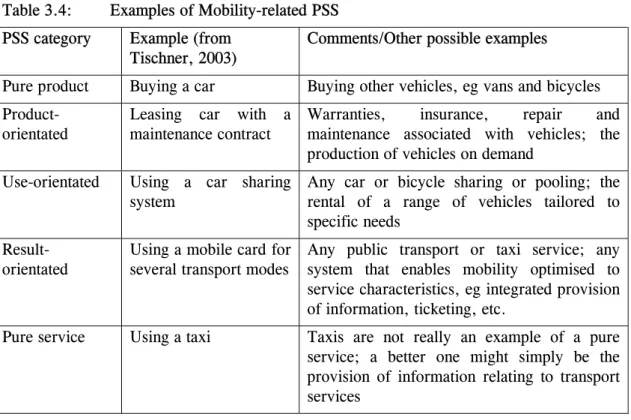
Section 3.1 also noted the importance of services for dematerialisation and Section 3.2.1 identified mobility services as the most common examples of various categories of services, including rental and car sharing services, public transport and taxi services. However, it is