176
Performance of Mojosari Alabio Males Ducks
Fed Complete Ration Silage
Muhammad Ridla1)*, Allaily2), Fitri Kurnia Nikmah1) and Nahrowi Ramli1)
1)
Department Feed Technology and Nutrition, Animal Science Faculty, Bogor Agricultural Institute, Jl. Agatis Kampus IPB Darmaga, Bogor 16680
2)
Agricultural Faculty, Syiah Kuala University, Darussalam, Banda Aceh, Indonesia *Corresponding author email: [email protected]
Abstract. The experiment was conducted to determine the effect of complete diet silage on feed consumption, body weight gain, feed conversion, water consumption and mortality. The materials used were 75 Mojosari Alabio male ducks, commercial diet plus rice bran (16.50% CP, 2900 kkal GE/kg), silage with 30-60% water content. Data were subject to Completely Randomized Design with five treatments and three replications. The treatments were S0 (commercial feed), S1 (silage with 30% water content), S2 (silage with 40% water content), S3 (silage with 50% water content) and S4 (silage with 60% water content). Data were subject to analysis of variance followed by orthogonal contrast test. The result showed that silage with 50% water content has significantly increased body weight gain and decreased water consumption, but there were no effect in feed conversion. Complete diet silage was safe for Mojosari Alabio male duck.
Key words : complete ration silage , duck, performance
Abstrak. Penelitian ini untuk mengetahui pengaruh pemberian silase ransum komplit terhadap konsumsi pakan, pertambahan bobot badan, konversi pakan, konsumsi air dan persentase kematian. Bahan yang digunakan adalah 75 ekor itik Mojosari Alabio jantan, ransum komersial ditambah dedak padi (16,50% CP, 2900 kkal GE/kg), silase dengan kadar air 30-60%. Percobaan ini menggunakan Rancangan Acak Lengkap dengan lima perlakuan dan tiga ulangan. Perlakuan S0 (pakan komersial), S1 (silase dengan kadar air 30%), S2 (silase dengan kadar air 40%), S3 (silase dengan kadar air 50%) dan S4 (silase dengan kadar air 60%). Data dianalisis menggunakan analisis ragam dan dilanjutkan dengan uji kontras orthogonal. Hasilnya menunjukkan bahwa silase dengan kadar air 50% memiliki peningkatan berat badan dan penurunan konsumsi air yang signifikan, tetapi tidak mempengaruhi konversi pakan. Silase ransum komplit pakan aman untuk itik Mojosari Alabio jantan.
Kata kunci : silase ransum komplit, itik, performans
Introduction
The main issue in feed processing is the high moisture content of feed ingredients, making it difficult for the storage and direct utilization. Drying technology is a commonly used method, which has not completely solved the problem due to the limited time, space and materials for a single drying execution, there by impractical for large amount of drying, also dependent on the weather condition. Raw material feed in wet conditions is more suitable for fermented preservation. Fermentation technology is known as a way of preserving a material (maintaining the quality) rather than improving the quality. As technology develops, such an
assumption is no longer appropriate,
considering many fermentation products have better quality than the original material.
Silage is a fermented product containing water (Sapienza and Bolsen, 1993). Some of the advantages of fermentation technology are time and cost saving as well as the feed durability against stunted growth of spoilage bacteria so that lactic acid-producing bacteria will thrive. Lactic acid bacteria in silage canal so are used as probiotics to improve the balance of microflora in the digestive tract (Gauthier, 2002). High moisture content can decrease the quality of silage, like in orchard grass silage in the high level moisture have the bad dry matter
177
(Yahaya et al., 2002).
Ducks are one of the poultry that potential produce high enough source of animal protein. Mojosari Alabio ducks originate from cross
breeding of male Mojosari (Anas javanica) and
female Alabio (Anas platyrhynchos Borneo).
Reciprocal Crosses between Mojosari and Alabio ducks will provide benefits when taken as a whole and not to specific traits (Yudityo, 2003). Excellence of Mojosari Alabio ducks by Balai Penelitian Ternak Ciawi (2006) is the early age at first laying, higher egg productivity, better consistency of production, faster growth, male child duck can be used as a broiler duck when compared to Mojosari and Alabio offspring. Mojosari Alabio is local duck with high egg production and male Mojosari Alabio can serve as a broiler duck egg producer at the age of 8 month gaining 80% 69.7 g weight and average eggs production per year is 253 rounds (BPTP 2010). Drake usually has low price and has not been widely used, while the demand for meat continues to increase; therefore, more intensive maintenance will provide additional income for farmers.
Allaily (2006) reported that feeding ducks in
the form of paste decreased water
consumption because ducks get enough water from the paste. Less energy for drinking resulted in positive body weight and performance. Treatment silage moisture with 50% water content influences the weight gain.
Allaily et al. (2011) also stated that water
content of silage can support ensilage process
for better feed. Kokoszynsky et al. (2014)
claimed that supplementing corn silage reduced weight gains at the end of the rearing period, but for young fattening geese with whole-crop corn silage had a positive effect on production economy and carcass composition.
Materials and Method
Livestock experiment.
Seventy five cross Mojosari Alabio male ducks aging three dayswere reared until ten weeks old. Ducks were placed in 15 wire cages measuring 1x1 m, each containing 5 ducks. The ducklings from the age of three days to five weeks were given a commercial diet plus bran, then weighed again to randomize in cages. Silage was given at the age of five and ten weeks. Feed and water
provided adlibitum in which rations and
remaining feed were weighed and count every day. Data were collected in between seven and ten weeks old. Feed and water were closely placed to avoid the possibility of being spilled in the cage.
Silage. Silage is made as much as 600 kg containing 16% crude protein content and 2,900 kcal/kg metabolite energy. Materials such as cassava, cassava leaves and soybean were washed and boiled until tender, making it easier to grind. The materials passed through a heating process to eliminate anti- nutrients. The minor materials (CaCO3 , L-lysine , DL-methionin and DCP ) were mixed first, while the dry materials (rice bran, yellow corn, fish meal and palm kernel cake) were also homogenously mixed. The fresh ingredients (cassava , cassava leaves and soybean ) were mixed in the final stage with a little dry materials, then added with a large amount of coconut oil thoroughly and homogenously. Ration was made of four
kinds of the different water content
treatments, namely 30, 40, 50 and 60%. Silage
was firstly made by adding 105CFU/g of
Lactobacillus plantarum starter silage in distilled water and then mixed with the ration to homogeneous. Treatment S1 was prepared to obtain silage yield of 30% water by adding
distilled water mixed with Lactobacillus
plantarum and well-stirred. Likewise, distilled water was added to S2, S3 and S4 treatments to obtain 40, 50 60% water level, respectively Table 1). The addition of water was carried out by the following formula:
178 ght ration wei total (%) silase content er matter wat Dry (%) ration matter Dry (kg) water of yield Silage x
Added water (L): Silage yield of water (kg) - the amount of feed (kg) The materials were mixed with water, then put
in an air-tight plastic container, condensed, rubber-tied to store in silos, then sealed to obtain an anaerobic atmosphere for 4 weeks. Table 1. Water added to silage for 600 kg
Treatment Water (litre)
S1 10,37
S2 37,10
S3 74,52
S4 130,68
S1 (silage with 30% water content), S2(silase with 40% water content), S3 (silase with 50% water content), S4 (silase with 60% water content).
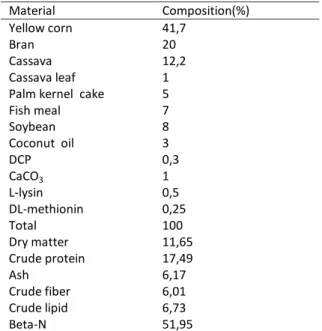
Rations. Feed ration was composed of yellow corn, rice bran, cassava, cassava leaf, palm kernel cake, fish meal, soya bean, coconut oil, DCP, CaCO3, L-lysine and DL-methionin. Ration formulation was prepared with 16% crude protein and 2,900 kcal/kg metabolism energy based on as-fed. Silage rations were then made and stored for 4 weeks. The composition and nutrient of ration is presented in Table 2.
Variables. Variables included the dry matter intake, body weight gain, feed conversion, water consumption and mortality. Dry matter intake was calculated from the amount of feed intake (the difference with the remaining ration every day) multiplied by percentage of dry matter of silage from each treatment contained. Research utilized four levels namely S1 treatment (silage with30% water content), S2 (silage with 40% water content), S3 (silage with 50% water content), S4 (silage with 60% water content). The experimental design used was a completely randomized design (4 treatments, 3 replications each with 5 ducks).
Data were subject to analysis of variance followed by orthogonal contrast test (Steel and Torrie, 1995).
Table 2. Composition and nutrient of the
complete ration silage (As-fed)
Material Composition(%) Yellow corn 41,7
Bran 20
Cassava 12,2 Cassava leaf 1 Palm kernel cake 5 Fish meal 7 Soybean 8 Coconut oil 3 DCP 0,3 CaCO3 1 L-lysin 0,5 DL-methionin 0,25 Total 100 Dry matter 11,65 Crude protein 17,49 Ash 6,17 Crude fiber 6,01 Crude lipid 6,73 Beta-N 51,95
Analysis result from Feed and Technology Animal Faculty, IPB (2006)
Table3. Crude protein and pH complete ration silage (As-fed) Treatment CP (%) pH S0 16.50 Neutral S1 16.88 4.46 S2 16.83 4.33 S3 16.63 4.22 S4 17.14 4.14
S0: calculation result, S1-S4: Analysis result from Feed and Technology Animal Faculty, IPB (2006).
Result and Discussion
Analysis of variance result showed that a complete ration silage on duck Mojosari Alabio
male significantly (P<0.05) increased
179
60% water was significantly (P<0.05) higher than that in 30, 40, 50% and commercial ration plus bran. Dry matter consumption increase was influenced by the level of the ration palatability.
Palatability level was determined by smell, taste, color and shape of the ration. Ration physical form in this research was paste which was favorable to duck due to its high water content. This was in line with Titus and Fritz (1971) that paste was suitable for duck’s beak shape living in wet water fowl habitat, making it easier to swallow the feed. Silage has a slightly acidic smell and taste which was still tolerable because the silage was initially aired to reduce odor and acid. Silage should be removed from heavy metal contamination so the sour smell was minimized and affected feed consumption ducks (Nahrowi , 2005).
The average body weight gain of 7-10 week old male Mojosari Alabio ducks ranged from 77.00 to 104.78 g/head/week. Analysis of variance result showed that the administration of a complete ration silage gave a very
gain of the 7-10 week old male Mojosari Alabio duck. Body weight gain of ducks fed with 50% water content silage was significantly (P<0.01) higher than that in 30%, 40% and commercial ration plus bran, because silage with 50%
moisture content had higher total
consumption, resulting in a higher body weight gain as well. Moreover, silage can produce organic acids, which according to Gauthier (2002) has strong antibacterial that can reduce pathogenic bacteria in the digestive tract. Lactic acid bacteria in silage also serve as a probiotic that contributes in maintaining the intestinal microbial balance, because it can inhibit the growth of pathogenic bacteria. Mohamed et al. (2014) claimed dietary inclusion of organic acids increased growth performance and improved intestinal health and morphology of broiler chicks. Body weight gain of ducks fed with a commercial ration plus bran was highly significantly (P< 0.01) lower than ducks fed with silage. This suggested that homemade ration has better quality and is able to compete with commercial ration, although the homemade Table 4. Average dry matter consumption, body weight gain, conversion ratio, water consumption, and mortality of 7-10 week old male Mojosari Alabio
Variable Treatment
S0 S1 S2 S3 S4
Dry matter Feed consumption (g/head/mg) 469.86a ±109.74 428.29a ±34.90 348.29a ±71.94 484.84b ±22.07 510.04b ±26.39 Weight gain (g/head/mg) 77.78A ±10.06 77.00A ±2.42 79.69A ±17.00 104.78B ±10.09 90.16B ±8.67 Feed convertion 6.22 ±2.08 5.56 ±0.28 4.66 ±1.87 4.65 ±0.30 5.69 ±0.65 Water consumption (ml/head/mg) 640.79A ±62.38 419.97B ±57.92 357.93B ±64.49 443.87B ±65.22 373.49B ±22.82 Mortality (head) 0 0 0 0 0
S1 (silage with 30% water content), S2(silase with 40% water content), S3 (silase with 50% water content), S4 (silase with 60% water content).
Values bearing different superscript within rows are significant (P<0.05) and the capitalized superscriptwithin rows are very significant (P<0.01)
180
ration is not supplied with growth booster ingredients. Higher feed intake that allowed more nutrients in body of cattle was used to meet basic living and for growing ducks, characterized by high body weight gain. It indicated that the amount of feed consumption would determine the growth rate of ducks (Anggorodi, 1985), so the high consumption resulted in a high body weight gain as well.
Barroga et al. (2004) proved that paddy herded
ducks can adapt well to fish silage mixed diets without adverse effects on their growth performance and carcass quality.
Analysis of variance result showed that a complete ration silage on Mojosari Alabio male duck did not significantly affect feed conversion. The use of silage with a water content of 30-60 % resulted in lower feed conversion compared to commercial ration plus bran. The low value of feed conversion showed that the use of silage with a water content of 30-60% increases feed efficiency. This is presumably because the silage with moisture content of 30-60 % in paste form which eased the duck to swallow the ration, so the power digest was better compared with commercial ration plus bran. Lowest feed conversion was in the silage treated with a water content of 50%. It was suspected that the increase in feed intake in silage with a water content of 50% was followed by an increase in body weight gain of ducks, so the conversion outcome was lower than silage yield of 30, 40 and 60 % water and commercial ration plus bran. The lower feed conversion value, the higher the efficiency ration. Agustina et al. (2013) proved that duck fed with probiotic showed not negative effect on duck performance.
Low conversion value indicated the number of rations required to raise the lower body weight to gain high efficiency. In Vietnam, Bau Ducks (Lien et al., 2005) silage is given in the form of waste silage commercial shrimp feed which replaced up to 35%, indicating that the
influence did not negatively affect the performance of ducks, giving silage to 55% decreased
body weight gain but feed conversion was improved to 1.7. Ketaren et al. (1999) mentioned that poor duck feed conversion was due to the duck feeding behavior, including the habits to urgently look for water after a meal. Generally, feed was wasted when ducks moving from one place to another was dissolved in the drinking water container. The high feed conversion might be due to the inability of ducks in controlling the amount of feed consumption is regulated by the amount of energy consumption.
Results of analysis of variance showed that complete ration silage highly significantly (P<0.01) reduced water consumption compared with the ration commercial plus bran. Drinking water consumption was highest in ducks fed with commercial ration plus bran silage when compared with the water content of 30-60 %. This may be due to that the higher water content in the feed, the less water was consumed because high water content sufficed the duck’s digestion process. Water in the body is used to transport livestock nutrients, metabolism of and into all cells of the body to regulate temperature and body temperature ducks (Scott et al., 1982). Decreased in water consumption was due to the shape of ducks pasta ration, temperature and ambient temperature (Parakkasi, 1995). According to Esmail (1996) the consumption of drinking water for the ducks was generally two times the feed consumption. In this study, the ratio of water consumption and feed consumption was 1:1.1, indicating that every one kilogram feed intake resulted in increased consumption of 1.1 liters drinking water. Less consumption of drinking water was because of shaped pasta that contained water in the silage ration. Evaluating the success of the farm business was through mortality. During the study there was
181
suggesting that the provision of complete ration silage with 30-60% water content treatment in Mojosari Alabio male ducks was favorable to ducks. In addition, ducks’ immune system was improved so no mortality occurred because the silage used in the digestive process did not contradict with the duck's body, so the silage was well-absorbed lactic acid bacteria in silage served as a probiotic that contributed in maintaining the intestinal microbial balance, because it inhibits the growth of pathogenic
bacteria. Probiotics also improves the
production of the enzyme (lactase, amylase, and protease), binds mycotoxins and is able to reduce the levels of ammonia in the feces (Lebeer et al., 2008). Probiotics will give good impact to its host by means of communicating with the bacterial cell surface macro molecules by pattern recognition receptors (PRRS) cells in
the intestinal mucosal surface. The
communication signaling resulted in mutual cooperation to reduce the impact of pathogenic bacteria (Leeber et et al., 2010). Sankhanath and Gautam (2012) find that Escherechia coli,
Clostridium perfringens, Aspergillusflavus, Aspergillusfumigatus and aflatoxins B1 levels were significantly reduced in the organic acid supplemented feeds. Complete ration silage produced organic acid from lactic acid bacteria that decreased pH in ensilage process. Adil et
al. (2010) indicated that the organic acid
supplementation had a beneficial effect on the performance of broiler chicken, because it absorbs nutrition in gastro intestinal tract and serves as growth promoters.
Conclusions
The use of complete ration silage with 50% water content in Mojosari Alabio male ducks could increased weight gain and decreased water consumption when compared with a water content of 30, 40, 60% and commercial ration plus bran. Provision of a complete ration
not result in mortality Mojosari Alabio male ducks at the age of 7-10 weeks.
References
Adil S, T Banday, GA Bhat, M Saleem Mir and M Rehman. 2010. Effect of dietary supplementation of organic acids on performance, intestinal hCistomorphology, and serumbiochemistry of broiler chicken. Vet. Med. Int. Article ID 479485, 7. http://dx.doi.org/10.4061/2010/479485. (Accessed: April 2014).
Agustina D, N Iriyanti and S Mugiyono. 2013. Pertumbuhan dan konsumsi pakan pada berbagai jenis itik lokal betina yang pakannya di suplementasi probiotik. J. Ilmiah Peternakan. 1(2):691–698.
Allaily. 2006. Kajian silase ransum komplit berbahan baku pakan lokal pada itik Mojosari Alabio jantan. Thesis. Graduate School. Pascasarjana IPB. Bogor. Indonesia. (In Indonesian with abstract in English)
Allaily, N Ramli and R Ridwan. 2011. The quality of complete ration silage use traditional local feed materials. Jurnal Agripet Vol 11(2). www.jurnal.unsyiah.ac.id/agripet
Anggorodi. 1985. Kemajuan Mutakhir dalam Ilmu Ternak unggas. Penerbit Universitas Indonesia Press. Jakarta.
Balai Penelitian Ternak. 2006. Pendatang Baru Penghasil Telur Itik Mojosari Alabio. Teknologi Balitnak. Unit Komersialisasi Teknologi Balai Penelitian Ternak. Ciawi, Bogor.
Balai Pengkajian Teknologi Pertanian (BPTP). 2010. Petujuk Teknis : Budidaya Ternak Itik. Balai Besar Pengkajian dan Pengembangan Teknologi Pertanian Badan Penelitian dan Pengembangan Pertanian Departemen Pertanian. Jawa Barat. Indonesia. http://jabar.litbang.deptan.go.id/ (Accessed: April 2014).
Barroga AJ, RM Pradhan and Tobio. 2004. Research Note: Growth Performance and Meat Production of Fattened Paddy Herded Ducks Fed Fish-Silage Mixed Diets. Philippine Agricultural Scientist. Vol.
87 No. 2.
ftp://193.43.36.92/upload/Agrippa/614_en.pdf. (Accessed: March 2014).
Esmail SHM. 1996. The Vital Nutrient. Poultry International. Watt Publishing Co. Illinois. In Wartazoa. Buletin Ilmu Peternakan Indonesia. Gauthier R. 2002. Intestinal Health, The key to
Productivity (The Case of Organic Acid). XXVII Convencion ANECA-WPDC. Puerto Vallarta. Mexico.
182 Ketaren PP and l H Prasetyo. 1999. Pengaruh
pemberian pakan terbatas terhadap penampilan itik silang Mojosari X Alabio (MA) umur 8 minggu. Lokakarya Nasional Unggas Air. Balai Penelitian Ternak, Ciawi, Bogor.
Kokoszynski, Z Bernacki, M Grabowicz and K Stanczak. 2014. Effect of corn silage and quantitative feed restriction on growth performance, body measurements, and carcass tissue composition in White Kołuda W31 geese. Poultry Science Vol 93 Issue 8 Pp. 1993-1999. http://ps.oxfordjournals.org/content/93/8/1993. (Accessed: February 2014)
Lebeer SVJ and SCJD Keersmaecker. 2008. Genes and Molecules of Lactobacilli Supporting Probiotic Action. www.ncbi.nlm.nih.gov. (Accessed: November 2013)
Lebeer SVJ and SCJD Keersmaecker. 2010. Host interactions of probiotic bacterial surface molecules: comparison with commensals and pathogens. Nature Reviews Microbiology 8:171-184.
Lien LV, PT Thoa, NV Thai and NH Tao. 2005. Use of Lactobacillus plantarum inoculate to improve the fermentation process of shrimp by-products silage and evaluation of the silage as a protein source for ducks. In : Workshop seminar: Making Better Use of Local Feed Resource. Mekarn-CTU, 23-25 May 2005. Hanoy-Vietnam: www. mekarn.org (Accessed: 6 June 2006).
Mohamed MA, EF El-Daly, NAA El-Azeem, AW Youssef and HMA Hassan. 2014. Growth performance and histological changes in ileum and immune related organs of broilers fed
organic acids or antibiotic growth promoter. Int. J. Poult. Sci. 13(10):602-610.
Nahrowi. 2005. Teknologi Pakan dan Teknologi Reproduksi Ternak. Puslit Bioteknologi Lembaga Ilmu Pengetahuan Indonesia. Cibinong.
Parakkasi A. 1995. Ilmu Nutrisi dan Makanan Ternak. Universitas Indonesia Press, Jakarta.
Sankhanath K and S Gautam. 2012. Effect of organic acid supplementation on feed quality, performance, gastrointestinal milieu and blood minerals of khaki campbell ducks. Animal Nutrition and Feed Technology. 12(2):187-197. Sapienza A and Bolsen. 1993. Teknologi Silase.
Translated by Rini and BS Martoyoedo. Kansan State University.
Scott ML and RJ Young. 1982. Nutrition of the Chicken. 3th. M.L. Scott and Associates. Ithaca. Newyork.
Steel RGD and GH Torrie. 1995. Prinsip dan Prosedur Statistika. Translated by: B. Sumantri. PT Gramedia Utama. Jakarta.
Titus HW and JC Fritz. 1971. The Scientific Feeding of Chickens. 5th. The Interstate Publisher Inc., Danville, IIlinois.
Yahaya MS, M Kawai, J Takahashi and S Matsuoka. 2002. The effects of different moisture content and ensiling time on silo degradation of structural carbohydrate of orchardgrass. Asian-Australia J. Anim. Sci. 15(2):213-217.
Yudityo MP. 2003. Persentase Heterosis Fertilitas Daya Tetas, Kematian Embrio Serta Bobot Telur Tetas Hasil Persilangan Timbale Balik Antara Itik Alabio dan Mojosari. Skripsi. Fakultas Peternakan. IPB.