TEACHING COMPUTER SCIENCE: EXPERIENCES FROM FOUR CONTINENTS
Mats Daniels Judith Gal-Ezer Ian Sanders G. Joy Teague
Dept. of Computer Systems The Open University of Israel Computer Science Dept. Deakin University
Uppsala University 16, Klausner St. University of the Geelong Campus
Uppsala Tel-Aviv Witwatersrand Victoria
Sweden Israel 61392 Johannesburg Australi& 3217
[email protected] [email protected] South Africa [email protected]
ABSTRACT
In this paper we compare and contrast computer science curricula in four universities in four different countries (and continents): Australia; Israel; South Africa and Sweden. Uppsala University in Sweden is a European university founded in 1477 with a long history of tradition. The Uni-versity of Witwatersrand in South Africa and Deakin Uni-versity in Australia evolved from ‘Schools of Mines’ (technical schools) in 1922 and 1977 respectively and have their roots in the British academic system. The Open Uni-versit y of Israel, established in 1974 by the Ministry of Education. began teaching in 1976. As new universities, Deakin University and the Open University of Ismel sought to fill needs not met by existing universities, so both have concentrated on distance learning (off-campus) programs. For similar reasons, Deakin University and the Open Uni-versity of Israel also provide special non-degree short courses and programs. We refer to undergraduate and grad-uate studies and consider degree requirements, methods of delivery, assessment, and costs. We also briefly mention such issues as programming languages and the develop-ment and evolution of programs of study and of in~lvidual courses in the four universities.
INTRODUCTION
While one might believe that the methods of teaching, ways of designing courses, systems of assessment, indeed the whole modus operandi, are the same among universities worldwide, we can report that this is not the case. In com-paring the computer science (CS) departments at our home Permission to copy without fee all or part of this material is granted provided that the copies ate not made or ditibuted for direct commemial advantage, the ACM copyright notice and the Utfe of the publication and its date appear, and notice is given that copying is by permission of the Association for Computing Machinery. To copy othetwise or to republish, requires a fee and/or specific permission. SIGCSE ’96 2/S6 Philadelphia, PA USA
QI 996 ACM 0.S9791 -757-NS6K)002 . ...SO.SO
universities, we did find similarities, but also noted many differences.
It quickly became apparent that different terminology is used, and that in different places the same word can have quite different meanings. For the purposes of this paper we standardized on the following terms:
●
✎
●
‘program’ for a program of study leading to a degree such as a Bachelor of Science (BSC);
‘discipline’ for all material relating to the same scientific area e. g. CS, information systems (IS);
‘course’ for a sequence of lectures, for example, CS 1, the successful completion of which receives credit towards a degree; and
‘topic’ for specific parts in a course, e. g. the section on algorithms in CS
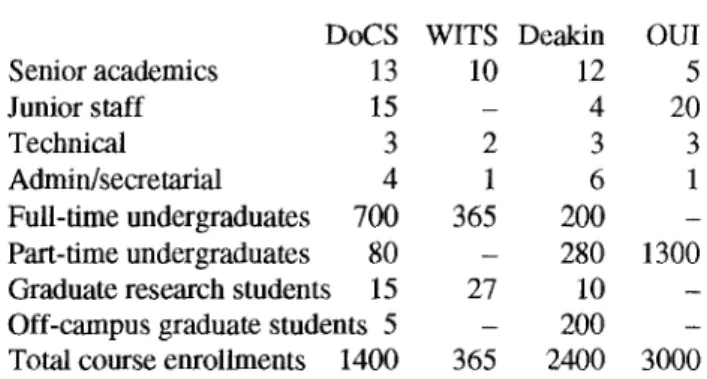
1.-The four departments described in this paper are described below and compared in Table 1.
Department of Computer Systems (DoCS), Uppsala Uni-versity, Sweden. Uppsala University is the oldest and sec-ond largest (approximately 30,000 students) in Sweden. There are several different programs where CS is either a major or minor (but substantial) part of the requirements for achieving a degree. Students residing in Uppsala com-prise the majority of the student body, but distance educa-tion is also offered. DoCS has a large share of the distance students, with roughly 20~0 of the department’s under-graduates learning at a dkwance.
Department of Computer Science, University of the Witwa-tersrand (Wits), Johannesburg, South Africa. The univer-sity originally served mainly local students and had very few students in residence. This is gradually changing, although residential students are still a relatively small per-centage of the total student numbers. The university has approximately 25,000 enrolled students, most of them full-time students. The CS Department, originally a division of the Applied Mathematics Department, became a depart-102
ment in its own right in 1981. The University also has an IS Department.
School of Computing and Mathematics, Deakin University, Australia. Established as the first country university in the State of Victoria, Deakin commenced operations with the programs and students of two antecedent institutions. Recently there have been mergers with other institutions and the University is now located on six campuses across a distance of some 180 miles. Rather than competing directly with the established universities, Deakin has concentrated on distance education, loosely modeled on the UK Open University. With approximately 51,500 enrolled students in
1995, it has the highest enrollment numbers of any
Australian University, although about half of these are non-degree students. In 1995 Deakin University was named Australian University of the Year by The Australian Good Universities Guide for its innovative use of information technologies in undergraduate studies.
The Open University of Israel (OUI). The OUI is a distance learning university designed to offer academic studies to students resident throughout the country. It has an enroll-ment of more than 20,000 students. The OUI maintains a policy of open admission and itx home study method allows students to pursue a higher education wherever they are located, without interfering with their personal and voca-tional obligations, Authorized by the Israeli Council for Higher Education to confer a Bachelors degree (only), the OW offers more than 400 courses in Life Sciences, Natural Sciences, Mathematics, CS, Social Sciences, Managemen~ Jewish Studies, Education, Humanities, Music and Art. With only 32 senior academic (faculty) members, the OUI has no faculties or departments. However, for atl intents and purposes, the CS team functions as a regular depart-ment.
UNDERGRADUATE EDUCATION
Degree requirements
The composition of an undergraduate degree differs
between countries. Uppsala University offers three, four, and four-and-a-half year undergraduate programs culminat-ing in the awardculminat-ing of either a Bachelor of Science (B SC) or
a Master of Science (MSC) degree. The CS program
emphasizes CS skills useful for the labor market. It includes Discrete Mathematics but very little Physics or Calculus. There are also two engineering programs (four and five years duration), containing less Discrete Mathematics and more Calculus and Physics.
In Australian and South African universities, completion of
a three year undergraduate program earns a B Sc, with an optional fourth year leading to a BSC with Honors, intended primarily for students wishing to pursue graduate studies. Unlike most South African CS departments, Wits offers a
Table 1: Department sizes
DoCS WITS Deakin OU1
Senior academics 13 10 12 5 Junior staff 15 - 4 20 Technieal 32 33 Admin/secretarial 4 1 6 1 Full-time undergraduates 700 365 200 -Part-time undergraduates 80 – 280 1300
Graduate research students 15 27 10
-Off-campus graduate students 5 – 200
-Total course enrollments 1400 365 2400 3000
BSC that is strictly CS — no IS component. The Wits undergraduate program teaches CS as a mathematical science and concentrates on theory somewhat more than on practice or applications. Deakin’s program contains both IS and CS majors with common core courses, either or both of which may be taken. Originally Deakin’s strong IS stream was unusual in an Australian university CS program. Now, however, many Australian CS departments offer IS. An Honors degree at both Deakin and Wits can be followed by a (minimum one year) MSC, either by coursework and research report or by thesis (research only). Deakin and Wits both offer Diploma courses for graduates from otlher disciplines. The Wits Higher Diploma in CS attracts mainly science and engineering graduates. Deakin’s off-campus Graduate Diploma of Computing has been popular with stu-dents from many backgrounds, but particularly teaching, wanting to learn about computers and/or to obtain a formal computing qualification.
The OUI offers its students a full-fledged CS undergraduate program and, recently, a CS and Management program. Although students learn at a distance and are part-time, the CS program, consisting of mandatory courses and electives, is compatible with programs offered by other academic institutions in Israel. It is equivalent to a three year full-time degree. The OUI is not yet authorized to offer graduate studies.
Structure versus flexibility
The greatest contrasts among the four programs were in lhe requirements for undergraduate degrees. At one extreme, undergraduate programs at Uppsala University and Wits i~e highly structured in the first two (Uppsala) or three (Wits) years, with effectively no electives, The factors in favor of this approach are: when new subject material is presented,
it is known what previous courses have been taken;
scheduling of lectures is more efficient; scheduling of stu-dent assessment dates for different courses is straight-forward; and with few options, fewer courses are taught and fewer faculty members are required, although Uppsala
negates this benefit to some extent by repeating courses for
other programs. A structured approach allows more
material to be covered than in a more flexible program. At the other extreme is the Deakin program. Under the Deakin University BSC regulations, there are no compul-sory courses. Students must comply with prerequisites and must complete a major study. They can, however, take any courses offered by the University, with a maximum of one-third of their total courses permitted from other (non-Science) disciplines. This flexibility: allows students more time to decide on their major study area(s); permits them to avoid some courses in which they have little interest or ability; and allows students from other institutions (particularly Asian) to enter the program at higher levels with full credit for courses taken elsewhere.
The program offered by the OUI is balanced between
structure and flexibility, On the one hand, it is structured; there are some mandatory courses and students are not permitted to take courses from other disciplines. On the other hand, it is the policy of the OUI learning system to allow students: to carry on with their studies for as long as they wish; to enroll in a course without completing recom-mended prior studies (atthough most students undertake courses in the recommended sequence); and to decide on their major after finishing about 60% (or even more) of their studies. This method allows students to pursue courses towards a Bachelors degree, or just to study course(s) in order to broaden their education.
Methods of delivery
In each of the four counties a full-time student is expected to spend approximately 200 - 300 hours in class each semester and at least the equivalent outside class. Students learning at a distance are expected to spend as much time in total studying a course as on-campus students.
Uppsala and Wits teach courses across a half semester (quarter). Advantages of quarter courses are that academics have quarters free for research; students can concentrate on one or two courses at a time; and there is less conflict scheduling assessment tasks. At Uppsala, each week has its own schedule. making it possible to concentrate the teach-ing of basic theory early in a course and atlowteach-ing plenty of time for completion of assignments.
At Wits the first year intake includes students from mixed backgrounds: good educational backgrounds with good familiarity with computer technology and programming; good educational backgrounds but with little familiarity with computer technology; and educationally disadvan-taged students with little exposure to computing. In order to make the CS courses accessible to atl students, Wits has
adapted its curriculum to present theoretical material earlier in the year (Mueller, Rock and Sanders, 1993). All students must have a minimum level of mathematics to enter the course and this common foundation can be built on, while introducing the less technologically familiar students to the technology before it forms part of their work requirements. Wits has also expended a lot of effort reviewing and revis-ing approaches to teaching and learning (Sanders and Mueller, 1994). Wits offers a number of additional tutorials, at lunch times and on Saturday mornings, to give extra assistance to the educationally disadvantaged students who currently comprise about 30% of the student body. At the fiist year level the aim is to give a broad introduction to CS. At Wits and Deakin, all on-campus students enrolled in the same course attend the same lectures. These large groups (several hundred in some classes) are divided into smaller groups of approximately 20 students for laboratories or tutorial classes which provide the only opportunity for group interaction. This approach has the advantage that academics spend fewer hours per week in the classroom. Off-campus studies allow students, who are placed in a variety of situations that make on-campus attendance diffi-cult, to complete degrees in their own time. Such situations include: working full-time, stationed overseas, living in re-mote regions, house-bound, or in prison. Off-campus courses are designed to meet the needs of individuals studying away from the university. At the OUI and Deakin,
students are provided with: texts published by the
university; assignments; tutorial guidance; study group sessions; tutoring by telephone; and a final exam. At Deakin, CS students are required to have access to a
per-sonal computer and a modem and to complete the same
course requirements (with the exception of laborato~ attendance and group work) as on-campus students. Stu-dents typically communicate with the course coordinator by phone or email.
The OUI is a multi-campus university with study centers throughout Israel. The textbooks are supplemented by tuto-rial assistance and study group sessions that take place in 90 study centers. More than 650 tutors throughout the coun-try offer guidance and a personat link between students and the university. Tutoriat sessions range in frequency from weekly to once in three weeks and are usually optional. The OUI has been integrating educational aids and technology since its inception. Some of its courses are accompanied by television broadcasts, slides, laboratory kits, etc. Over the last three years, much progress has been made in devel-oping interactive studies via satellite, multimedia course-ware, computer-mediated studies, and tele-courses. Beginners may enroll in only one course, but many later increase to this two or three courses per semester.
Recognizing the need to be more flexible and more en- an average of 50% to pass each year of study in CS. At all frepreneurial, the OUI, Uppsala and Deakin universities are universities with on-campus students, laboratory work: is all introducing summer courses. As stated earlier, Deakin mostly supervised by honors and graduate students who
and the OUI also offer non-degree courses. generally are responsible for grading assignments.
Introductory programming language Costs of completing a degree
In one area there is worldwide similarity: the inevitable de- No student fees are allowed in Sweden —- not even for bate that occurs whenever the subject of choice of the intro- items such as a plastic card to provide entry to labs. The ductory programming language is raised. At Uppsala, Stan- costs of literature and other study materials are, however, dard-ML (a change from Scheme this year) or C++ is the responsibility of the students. Special loans are avail-taught as the first programming language (depending on a able to students who have passed at least 75~0 of a normal student’s education program). Wits and the OUI use Pascal study load during the previous semester.
as their introductory programming language — it is a good
teaching language and less obscure for educationally disad- In South Africa, education is government subsidized and vantaged students or for students working mainly alone. At also partially funded by local municipality grants. Thus, the Wits, the major programming course (C++ from 1995) is in cost of a degree varies across institutions. Wits, as a result the second year Data Abstraction and Algorithms topic. At of its past opposition to the apartheid system, receives Deakin, after much discussion, C was introduced some four somewhat less overall funding and studying at Wits costs
years ago. about US$2200 per year of study. University scholarships
and/or loans are available to most of the students on the
Student assessment basis of financial need. In addition private companies offer
In all four departments there is a heavy emphasis placed on bursaries (scholarships) — normally based on academic a written final examination, At Uppsala University the final merit although there is an increasing number of affirmative six hour examination provides the main, and sometimes the action bursaries — and banks offer special student loans,, sole, contribution to the grade awarded for the course, Most
assignments and laboratories are compulsory and often The cost for Australian resident undergraduates is approxi-contribute to the final grade. Wits examinations are typi- mately US$ 1500 per full-time year, with a discount for up-cally two hours per topic and taken at the end of the front payment. A minimum taxable income applies before semester in which the topic is taught. The exam to course- any payment is required. An allowance of up to US$200 work weighting is normally 60:40, although practical topics per week and a loans scheme are available to those in do sometimes increase the weighting of assignments and financial need.
laboratories. Deakin University, in line with most
Aus-tralian universities, typically holds three-hour final exam- At the OUI, tuition fees per course are approximately inations. Deakin CS assessment is typically 30% progres- US$375, but this can change in accordance with a natic,nal sive and 70~0 for the final examination. At the OUI each policy covering all Israeli universities. Tuition fees cover student must complete a battery of assignments. These are the OUI textbooks, as well as the assignments, participation graded by the student’s tutor. Some courses have additional in tutorial sessions, and the final exam. University scholar-requirements such as workshops, laboratory work, a pro- ships based on financial need or on academic merit are gramming project or seminar papers. Assessment is typi- available.
tally 30% for assignments, and 70% for the final (three
hour) examination, or 30% for regular assignments, 30% Development of courses and the evolution of programs
for the project, and 40% for the final exam. At Uppsala, Wits and Deakin, programs are revised every
four to five years with minor revisions by course coordina-Uppsala University students are given two opportunities tors, as required, between times. The OUI does a major re-each year to retake examinations that they fail. At the OUI, vision every seven years. At all four universities, revisions in line with other Israeli institutions, students are given one take into account the requirements of local accreditation opportunity to retake exams. To pass a course they must bodies, comparisons with other university programs in the achieve a minimum grade of 60% in the examination, and country, and worldwide trends in CS programs, such as the
submit a minimum number of assignments. Deakin Univer- recommendations of the ACM and IEEE (Denning, Comer,
sity students are given a supplementary examination only if Gries, Mulder, Tucker, Turner, et al., 1988; Tucker, 1991). they have obtained at least 40% at their first attempt and
good results in other courses. Wits students have no oppor- At Uppsala, student course evaluations are used as indi-tunity to retake exams they have failed. They are required caters of a need for review by the teachers, the departments, to achieve a subminimum mark of 40% for each topic and and the program board (each program has a coordinator
who chairs a program board). The reasons for poor evalua-tions are discussed at both the departmental and the pro-gram board levels. The departments, are the main force be-hind course changes. However, major changes are dis-cussed by the program board, where issues such as whether the changed course fits the program or affects later courses in the program have to be settled. Each education program board makes yearly revisions to all course descriptions and decides which courses to offer in the following year. At Wits, courses are normally discussed by the whole de-partment to establish the broad general principles. The aca-demic(s) most likely to teach the course then draw up an outline which is again debated by the whole department before being accepted or revised.
The primary element of the OUI’S study method is the printed text, meticulously formulated by Israel’s foremost scholars and attractively illustrated to highlight and en-hance learning. The text is designed to be the best pssible ‘written lecture’ in the field, and as such, the OUI enlists the cooperation of distinguished faculty from other Israeli universities. The course preparation team includes senior academic advisors, writers, external evaluators, assistants, and editors. After approval by faculty members and the academic committee, every course undergoes a compre-hensive process of refereeing, re-drafting and evaluation. The development of a course takes at least four years and costs as much as US$250,000.
Deakin University follows the same method of develop-ment of materials as the OUI, but, with a much smaller bud-get. The course is written by the people who will be most likely to administer it when it is up and running, then it is professionally edited. With standardization of courses on-and off-campus and across campuses, the ‘course-team’ approach is now also being applied to on-campus course development and teaching.
GRADUATE EDUCATION
Uppsala University offers licentiate and doctoral degrees in CS. A licentiate degree nominally takes two years of course
work and research (ratio 50:50) after an MSC, and a
doctoral degree nominally takes four years of course work and research (ratio 40:60).
The undergraduate honors degrees offered by Wits and Deakin prepare students for higher degree research. The honors year consists of coursework at an advanced level, a literature review and a research report. An honors degree can be followed by an MSC — either by coursework and research report or by thesis (research only).
The Wits MSC degree is offered for both full- and part-time study. The MSC conrsework generally relates to the
lectur-ers’ research interests. Students taking the coursework and research option are required to take three or four fairly intensive topics each over a six week period. The topics are seldom lectured, most comprise reading and discussion. Deakin University offers an MSC, a minimum of one year
post honors, and a minimum three year PhD both by
research only. A coursework off-campus Graduate Diploma of Computing, for students who already have a degree in another discipline, has been available for many years. In recent years a Graduate Certificate (equivalent to half a year of full-time study) and a Master of Computing Studies (equivalent to two years of full-time study and including a major project) have been introduced.
The OUI’S first graduate program, an MSC program in CS is awaiting the approval of the Council for Higher Education. SUMMARY
This paper has explored Computer Science programs in four different countries. As can be seen, there are common-alities as well as differences. Different methods suit differ-ent places, but increasing knowledge of possible choices is an important aspect of enhancing education anywhere. We hope that this paper will generate international interest in some of the approaches we have described and motivate further international exploration of educational issues such as: half semester courses; off-campus methods of study; development of superior undergraduate courses; computer-mediated courses; interactive TV methods of studies, sup-port for students with disabilities, etc. Collaborations of this type may also increase exchange visits of both students and academics between countries.
REFERENCES
Denning, P. J., Comer, D. E., Gries, D., Mulder, M. C., Tucker, A., Turner, A. J., & Young, P. R. (1988), Report of the ACM task force on the core of Computer Science.
New York: ACM Press.
Mueller C. S. M., Rock S. T. and Sanders I. D. (1993). Au Improved First Year Course Taking Into Account Third World Students, Proceedings the 24th SIGCSE Technical Symposium, ACM SIGCSE Bulletin, 25(1), pp. 213-217.
Sanders I. D. and Mueller C. S. M. (1994). Making
Computer Science more accessible to educationally disadvantaged students, GATES, 1(2), pp. 32-41. Tucker, A. B. (Ed.). (1991). Computing Curricula 1991:
Repofl of the ACM/IEEE-CS Joint Curriculum Task Force. ACM Press.
ACKNOWLEDGMENTS
The authors thank Vicki Ahnstmm for her criticat reading and criticisms from an American perspective and Barrie Hesketh for his review of the paper prior to submission,