4. Implementing a System of Research-Based
Interventions
Contents of this Chapter
Chapter Overview 1
Regulations and Rules 2
Establishing Systems of Scientific Research-Based Interventions 3 Guidelines for Selecting Interventions and Instructional Strategies 7 Analyzing Data to Determine Level of Intervention 9
Problem-Solving Protocol 15
Writing an Intervention Plan 33
Next Steps 35
Resources 37
Appendix 38
Chapter Overview
The first part of this chapter provides guidance to teams on designing Systems of Research-Based Interventions (SRBI) in order to use the resulting data to determine eligibility. An illustrative example and two well-accepted conceptual models of RTI provide further guidance. A decision tree assists teams in selecting evidence-based interventions when SRBI are unavailable. A second tree aids in determining an appropriate intervention level based on screening results.
The second part of the chapter helps teams match interventions with specific instructional needs for small student groups and provides suggestions about what data to include and gather from parents and problem analysis. Example intervention plans also help teams complete this step.
Minnesota Department of Education Draft 4-2
Regulations and Rules
Note: Regulations, statutes, and rules form the basis for legal compliance, and are provided below to help teams understand what the law requires.
Minnesota Rule 3525.1341 Subpart 4 requires consistency between the team's plan for identifying a child with a specific learning disability and its Total Special Education System (TSES) plan. The team must implement its interventions consistent with that plan. Minnesota Rule also dictates that teams include the following in their TSES plan:
Specific systems of SRBI approach. Timelines for progression through the
intervention model.
SRBI for each content area and grade.
Proposed teacher training for systems of SRBI implementation.
Strategies for increasing student achievement. Minnesota Statute section 125A.56 requires that teams provide two interventions prior to referral for evaluation. View complete legal language on the Minnesota state Website.
Subdivision 1. Requirement. (a) Before a pupil is referred for a special education evaluation, the team must conduct and document at least two
instructional strategies, alternatives, or interventions using a system of scientific, research-based
instruction and intervention in academics or
behavior, based on the pupil's needs, while the pupil is in the regular classroom. The pupil's teacher must
document the results. A special education evaluation team may waive this requirement when it determines the pupil's need for the evaluation is urgent. This section may not be used to deny a pupil's right to a special education evaluation.
Adequate progress after an appropriate period is not defined within the federal regulations for the following reason:
“The Federal Department of
Education felt the meaning will vary depending on the specific
circumstances in each case. There may be legitimate reasons for varying timeframes to seek parental consent for evaluation; however, they also believe that teams will know if an intervention is not working in less than 90 days. In general, it is not acceptable for an LEA to wait several months to conduct an evaluation or seek parental consent for an initial evaluation. If, through monitoring efforts, the state determines there is a pattern or practices of delaying evaluations, it could raise questions as to whether the LEA is within compliance.” --OSEP guidance Jan 1, 2007
Statute also requires that interventions meet the criteria of “scientifically research-based” unless specific research-based interventions are not available for a given content area. For more information, see Determine if an Intervention is Research-based in the Appendix. View complete legal language on the Minnesota state Website.
Minnesota Statute section 120B.12 Subd. 3. Intervention. For each student identified under subdivision 2, the team shall provide a reading intervention method or program to assist the student in reaching the goal of learning to read no later than the end of second grade.
Minnesota Department of Education Draft 4-3
Establishing Systems of Scientific Research-Based Interventions
(SRBI)
Underlying effective implementation of systems of SRBI are key beliefs about how core curriculum and interventions should operate. Teams typically build their vision of effective systems on the following foundations:
Staff, community members and parents believe that all students can learn. They engage in designing instruction to meet the needs of all students.
Capacity exists to systematically maximize the effect of instruction for all students. Evidence-based instructional practices and materials are used at each support level
and meet the needs of targeted learners including culturally diverse and special education populations.
Instructional practices are differentiated to ensure that all students have access to the “critical” content or skills and experience instruction that is motivating and
challenging.
The focus of instruction is on alterable variables (instruction, curriculum, and environmental supports) that change trajectory of performance and achievement. Instructional supports are designed to accelerate learning and performance
(remediation is insufficient).
Mechanisms, processes, and procedures are in place to facilitate continuous improvement.
Typically, systems of research-based interventions include tiers of support as described in Orientation to Specific Learning Disabilities Definition and Laws. Even though the
Minnesota Department of Education uses three tiers of support to describe a framework, schools have the flexibility to determine their own conceptual model and structure of support systems.
Important: This chapter refers to support tiers as primary, secondary and tertiary prevention levels in order to stress that systems are not obliged by rules to require tiers. However, schools must determine the levels of support or tiers of intervention they will provide within their team system of SRBI and outline them in the TSES plan. For complete listing of requirements, see Minnesota Rule 3525.1341 Subpart 4. The linkage to primary, secondary, and tertiary levels of prevention comes from the extensive history of these terms in public health and community psychology.
Minnesota Department of Education Draft 4-4
Building a System of Scientific Research-Based Interventions
Prior to building a system of interventions, school and teams should thoroughly evaluate their core curriculum and instructional practices at the primary level of prevention to ensure they are scientifically research-based, feasible, and that the critical areas of instruction are in place.
Pilot site staff implementing a system of SRBI report that analysis of core practices is essential and highly discourage skipping analysis of core instructional practices in order to focus on selecting interventions. Teams that select
interventions without thoroughly understanding the
strengths and weaknesses of the core curriculum run a risk that selected interventions will not meet their long-term needs. Some districts have identified obvious gaps and selected secondary and tertiary supports to address those
issues with an understanding that it is as an interim step. Simultaneously the team is working on training staff to systematically analyze alignment and implementation of core instruction.
Minnesota Rule requires that teams specify the details of their systems used to generate data for eligibility determinations. For each content area, include related estimated timelines, and decision rules for how students will move through interventions (Minnesota Rule
3525.1341)
Illustrative Example
Happy Valley school team began to use the Consumer’s Guide to Evaluating a Core Reading Program Grades K-3 (Simmons and Kame’enui) to help them analyze their reading practices prior to selecting interventions. This practice has since become an established precedent for other teams.
To analyze core practices for adolescent literacy, see Model Secondary Plan, developed by the Minnesota Department of Education to assist secondary schools in revising their reading instructional practices.
Additionally, school staff have found benefit in analyzing implementation of their core practices to understand if curriculum maps are current and are followed as designed. Once satisfied that core curriculum and instructional practices have been implemented correctly, school-wide data is used to identify performance gaps and lead to selection of appropriate interventions.
After achievement data and core practices have been thoroughly reviewed, teams will have valuable data to assist in selecting appropriate research-based interventions. The SRBI research community developed two conceptual models of RTI: a standard treatment protocols for interventions, and a problem-solving approach. The table below includes definitions of both and the parameters in which they are effective.
Minnesota Department of Education Draft 4-5 Table 4-1
Intervention Protocols and Corresponding Problem-Solving Approaches Standard Treatment Protocol Problem-Solving Approach Includes interventions that researchers
have validated as effective through experimental studies. A specific
intervention protocol, that has evidence to support its effectiveness in improving student achievement, is provided to any student whose needs match what the intervention addresses.
Involves planning interventions for an individual student. The plan is created by an instructional team and implemented in the general education classroom (Mellard, 2008). This approach often combines interventions and accommodations to address multiple issues.
Standard treatment protocols are effective if they specify conditions, such as:
What yields evidence of success. Number of minutes per day and days
per week for interventions. Who should provide instruction,
assumed knowledge and training? Specific skills to be taught.
Materials to be used. How to monitor progress.
Evidence of faithful implementation.
Problem-solving models are effective if they include:
A rigorous problem analysis that leads to understanding the gap between current and expected levels of learning and performance.
A scientific approach to solving the problem with a focus on altering instruction, curriculum and classroom environment to improve performance. Scientifically tested interventions that have
been proven effective by the field. A procedure for continuously monitoring
student performance.
Procedures for using information from a variety of sources that informs the decision to continue or modify the intervention in order to increase student performance.
Quality practice and the need for efficiency suggests that the most effective and efficient means of matching interventions to student needs is an integration of problem-solving to identify which standard treatment protocols would be most appropriate. An alternative discussed in research indicates that selection of a standard treatment protocol in secondary prevention level supports (Tier 2 intervention) that addresses multiple critical areas of weakness, with a problem-solving approach applied to selection from a more targeted menu of tertiary prevention level supports (Tier 3 intervention), increases efficiency. (For more information on levels of support and standardized protocols see Mellard and Johnson, 2008; the National Center on Response to Intervention).
Districts must devise systems with interventions and supports that provide the greatest likelihood of accelerating academic and behavioral learning and performance of those students identified as needing additional instruction. To assist districts in uniformly
Minnesota Department of Education Draft 4-6 most appropriate intervention. Districts guidelines should be inclusive of circumstances under which a student should:
Move into secondary supports.
Skip to tertiary supports or evaluation for special education.
Stay within a level of support (e.g., move from secondary decoding to secondary language comprehension intervention).
Exit out of interventions.
There is no assumption or statement in the Minnesota Rule specifying that students must move sequentially through the system. Instructional teams may decide to provide a student with the most intensive intervention available based on the significance and the need. The selected supplemental instruction should have the greatest likelihood of reducing the gaps in skills.
Illustrative Example
To prevent a mismatch between students' needs and available intervention supports, Lake Woebegone elementary has established guidelines for their continuum of supports.
Secondary Supports: Early Intervention Reading, Read Well and Language! —small group instruction in letter recognition and language skills appropriate for students performing between the 26th to 40th percentile in letter recognition and language skills.
Tertiary Supports: Reading Recovery—intensive one-to-one instruction in letter recognition and language skills appropriate for students performing between the 11th to
25th percentile in letter recognition and language skills.
First-graders performing between the 11th and 25th percentile in letter recognition and
language skills receive Reading Recovery for 12 weeks. First-graders performing between the 26thand 40th percentiles receive Early Intervention Reading and Language! intervention
in 6-week cycles.
Although Reading Recovery would typically be considered a tertiary intervention, the team has determined through research and pilot data that the intervention is most successful for students performing in the 11th-26th percentile range. Additional analysis of team data has led to the guideline for moving students back to secondary supports if students do not respond or need continued intervention beyond Reading Recovery.
For districts building their systems of SRBI or those selecting pre-referral
interventions, the variables that are important to consider when differentiating between levels of intervention support include (Mellard, McKnight & Jordan, in press):
Size of the instructional group.
Minnesota Department of Education Draft 4-7 Mastery requirements of content.
Number of response opportunities within instructional session. Number of transitions among contents or classes.
Specificity and focus of instructional goals covered each session. Frequency with which the intervention is delivered in a week. Duration or number of weeks in an intervention cycle.
Minutes of intervention per session.
The Changing Roles and Responsibilities of Screening and Intervention Staff The TSES plan requires an explanation of professional development plans. Quality practices suggest that training should include administration and interpretation of assessment results (screening and progress monitoring) as well as the intended
research-based interventions. To ensure clarity for parents and staff providing service, it is also recommended that the description of each professional’s role in the intervention process be clearly articulated.
If a related services specialist or special education teacher delivers an intervention, those responsible for selecting the intervention the student will participate in should explain to parents how the role of the selected interventionist differs from the role of a special education teacher delivering special education services. In some cases, licensure statutes or union contracts influence who can provide intervention services. In 2006, the International Reading Association convened a workgroup to explore how various professionals could contribute to the intervention process. View New Roles in Response to Intervention: Creating Success for Schools and Children on the American Speech-Language-Hearing Association Website to learn more about the role of staff in improving the achievement of struggling students.
Guidelines for Selecting Interventions and Instructional Strategies
The body of scientific research-based interventions and instructional strategies continues to develop. In the event that scientific research-based interventions or instructional practices are lacking, or peer-reviewed research is not available, the following decision tree may be helpful in determining appropriate interventions:Minnesota Department of Education Draft 4-8 Figure 4-1. Decision Tree for Determining Interventions.
For more information, read consumer guides in the What Works Clearinghouse and the Florida Center for Reading Research to evaluate if interventions are research-based.
Minnesota Department of Education Draft 4-9
Effective interventions follow these quality practices:
Taught as supplemental to core instruction; not a replacement of core instruction or a subtraction from core instructional time.
Guided by and responsive to data on student progress. Motivate and engage the student.
Address areas the student needs to learn, not just followed because it is the next lesson or task in the book.
Intervention staff provide students with:
o Interventions as soon as the student shows a lag in developmental skills or
knowledge critical to reading growth.
o Interventions that increase in intensity and focus as the gap between the
desired level of performance and student level of performance widens.
o Opportunities for explicit and systematic instruction and practice with
cumulative review to ensure mastery.
o Skillful instruction including good error correction procedures with many
opportunities for immediate positive feedback and reward.
Important: This is the end of guidance for building a system of scientific research-based interventions. The next section covers how to take the information gained during systems of SRBI to determine the level of intervention for the student.
Analyzing Data to Determine Level of Intervention
Teams should establish a framework to assist in developing decision rules about what intervention is required given the results of screening. The decision tree in the figure below uses the 80-15-5 resource allocation model discussed in the research literature as a guide for determining the necessary level of intervention. Systemic interventions should proceed when 20 percent or more of students require supplemental instruction.
This rule should be applied to subgroups not just the total population to ensure that the core instruction is effective for culturally and linguistically diverse students. The decision tree shown below allows teams to skip to an individual level of problem-solving when problems are infrequent or rare. Read the figure from the upper left corner and follow the arrows that match the “yes” or “no” answers.
Minnesota Department of Education Draft 4-10 Figure 4-2. Level of Problem Analysis.
Adapted from Christ, T. (2008), Best Practices in Problem Analysis. Best Practices in School Psychology. NASP.
Primary Supports (Tier I) to Help Determine When to Intervene in
Core Instruction
In some instances, screening data may indicate that a significant number of students require additional instructional supports. Since resources may not be available to provide 20 percent of a class or grade with additional instructional supports, a class-wide or grade-level intervention may be warranted. After reviewing the screening data, devise appropriate standard protocol interventions to meet students’ needs. For class-wide intervention or a small-group intervention, use multiple sources of data to select the appropriate
intervention.
Note: Teams making eligibility determinations may want to incorporate data used to analyze and adjust core instruction to address exclusionary factors. These data may be available from Professional Learning Community or grade-level team meetings or school improvement plans.
Minnesota Department of Education Draft 4-11
Illustrative Example for Decision to Provide A Class-wide Intervention Through screening, the teacher finds that 7 of 28 students are low in decoding skills and records show deficiency in both sight word vocabulary and intermediate decoding skills. Given the number of students needing additional support in sight word vocabulary, the teacher assumes that the students did not have access to adequate instruction in this area. The teacher and the grade-level team develop a class-wide intervention within core
instruction to build sight word vocabulary and multi-syllabic decoding strategies. The teacher conducts progress monitoring for the seven students to ensure they are responding to the class-wide intervention.
Resource Tool: Possible Reasons Core Instruction Does Not Meet Student
Needs
The resource tools below provide guidance on options to improve core instruction. This also provides reasons for adjusting and documenting changes to core instruction in order to improve outcomes for subgroups of learners.
Table 4-2
Troubleshooting to Improve Core Instruction
Instruction Curriculum Environment
Instructional approach or method(s) align with curriculum standards. Missing skills or gaps in
knowledge are specifically taught and linked to existing knowledge.
Percent of instructional time that is academic engaged time is maximized and transitions are minimized. Structure of lessons includes
clear expectations, predictable organization, and appropriate pace. Opportunities for practice
are maximized.
Feedback is specific and frequent.
Content is appropriate given students cultural and linguistic
background.
Content of materials aligns with standards and is appropriately timed.
Meets principles of Universal Design. Content is relevant and
allows flexibility to develop gaps in prior knowledge.
Arrangement of the room facilitates learning. Expectations explicitly
posted, modeled and taught.
Management plans in place and executed with skill.
Task pressure is developmentally appropriate.
Social/behavioral skills. Adaptive behavior skills. Motivation.
Minnesota Department of Education Draft 4-12
Resource Tool: Research-Based Suggestions for Strengthening Core
Instruction
The following table describes research-based adjustments to strengthen core curriculum according to four domains. Documentation of these and other research-based
improvements to core instruction will be valuable in matching interventions, comprehensive evaluation, and eligibility determination.
Table 4-3
Suggestions for Strengthening Core Instruction Domain Teaching Suggestion
Instruction Increase opportunities to respond.
Increase feedback both in frequency and specificity.
Check level of classroom instruction against student’s instructional level. Pre-teach terms or concepts.
Increase direct and explicit instruction as well as opportunities for explicit practice.
Curriculum Check alignment of curriculum with state standards and assessment measures.
Check for gaps in curriculum and/or execution of curriculum. Prioritize and pre-teach concepts and terms.
Use extensions of core program, supplement or replace core curriculum, provide additional staff development.
Adjust instruction to provide appropriate practice for stage of learning (acquisition, proficiency, maintenance, generalization, adaptation). Observe or coach staff in implementing core or supplemental features of
core curriculum.
Environment Create flexible groups that work on targeted skills size.
Increase teacher led instruction; alter/eliminate distracters in the environment.
Establish clear expectations and class routines. Teach organization and study skills.
Teach social emotional skills such as problem-solving, cooperating, and peer coaching, reciprocal teaching.
Minnesota Department of Education Draft 4-13
Domain Teaching Suggestion
Differentiating for Individual Learners
Analyze health history and make accommodations for sensory issues. Adjust instruction based on information from an error analysis.
Identify and teach to learning strengths, provide immediate feedback. Reinforce effective effort.
Provide homework or extra practice within instructional level (90% correct without help).
For additional research-based suggestions, visit Center for Applied Special Technology (CAST). See Universal Design for Learning (UDL) Curriculum Self-Check.
Secondary Support (Tier II) Decision-Making: Small
Groups/Individuals
When less than 15 percent of a class or grade level does not develop skills as expected, or at a rate not commensurate with state standards, staff need to use procedures to
determine the precise skills to address. Rather than using trial and error, teams should provide a protocol or established guidelines for making data-driven instructional decisions. Solving the problem at the group or individual level should require the staff responsible for selecting interventions to follow team guidelines (also see recommendations made in Building a System of Scientific Research-Based Interventions). An illustrative example of how a district established a protocol for grade level teams is shown below.
Illustrative Example
Lake Wobegone held meetings to identify and problem-solve the need for large scale intervention within core curriculum and to match specific students with interventions. Grade-level teams now meet the third week of the school year to review screening data and their own data on student performance. This review session is used to verify students’ level of risk, and determine the most powerful intervention that can be provided.
Teachers come to the data meeting having identified students that appear to need
secondary or tertiary supports based on cut scores and their own data. Each teacher takes turns presenting the list of students and the data that indicates the needs. The teachers discuss the patterns of needs and the available menu of interventions. They begin to form groups for interventions and identify staff that will provide the interventions. Students that have language needs are placed into a group that receives the standard protocol language intervention. Students who require additional support in vocabulary and decoding receive a broad intervention that develops multiple skills. Grouping of students continues until all at-risk students are placed in interventions that address their needs. Some students are placed in tertiary supports and/or receive additional behavioral supports.
Minnesota Department of Education Draft 4-14 Figure 4-3. Intervention Selection Process.
Note on Semantics: For all intents and purposes, identifying the appropriate standard protocol or intervention support requires professional judgment through the use of data to make informed decisions. Some individuals prefer the term “professional judgment” while others prefer “data-driven decisions” or “problem-solving.” The SLD Manual uses the term “problem-solving” to describe a protocol that outlines how teams and schools make
professional judgments or data-driven instructional decisions.
Whatever specifications teams choose to include in a problem-solving protocol, the team’s procedures should require that instructional staff systematically identify and examine variables that can be altered to improve the performance of students. The most controllable variables are instruction, curriculum, and environment (ICE). These variables should be given priority over assumptions about learner characteristics with the exception of sensory issues such as vision, hearing, physical health, etc. Systematic analysis of instruction, curriculum, and environmental variables provides multiple benefits:
A better match between student needs and intervention supports.
Increase in implementation of system of SRBI or pre-referral interventions. Ability to determine whether or not a student has received appropriate instruction. A larger impact than on just one student; the whole class may benefit.
Minnesota Department of Education Draft 4-15 The following framework for problem-solving provides one means of systematically analyzing student needs. Teams are encouraged to specify and train staff in their own protocol and tools. The sample protocol below provides a basis for informed decision making.
1. Define the Problem. Define the problem and why it is happening (see pages 15-20).
2. Analyze the Problem: Validate the problem, identify the variables that contribute to the problem and develop a plan (see pages 20-33).
3. Implement the Plan: Carry out the intervention as intended (for more information see (pages 33-35). 4. Evaluate the Plan: Does the data indicate the plan is
working (see chapter 5 for further discussion of monitoring progress).
Problem-Solving Protocol
This section contains steps for problem-solving, suggested tools to assist with the step, and guidance on special cases to help teams predict reading problems for students with language deficits.
Problem-Solving Protocol Step 1: Define the Problem
What is the problem? Analyze the data and define the problem by determining the difference between what is expected and what is occurring. Use the results of screening, curriculum-based evaluation, record reviews or teacher collected data to analyze the specific skills that require additional instruction. Based on the results, look for students with similar needs and group them for targeted intervention. This process can be quite quick if instructional staff have training in miscue analysis or curriculum-based evaluation. The most challenging part of matching interventions to students’ needs is identifying the specific learning problem to be solved. This requires weighing multiple pieces of data while maintaining focus on the alterable variables that have the greatest likelihood of making a difference in student performance. To determine if a skill limits student growth,
instructional staff should know if said skills are developmentally appropriate. When
choosing interventions, teachers should be aware of skill development progress as defined by research.
Illustrative Example
Three students who do not respond to a class-wide intervention may have poor rates of attendance and homework completion. When planning a second small group
intervention as an addition to the class-wide instruction, the teacher focuses on the most relevant alterable variable for why a student isn’t developing appropriate reading skills. Instead of assuming lack of progress is due to attendance or homework, she dedicates attention on determining whether lack of progress is more attributable to language
Minnesota Department of Education Draft 4-16 acquisition or decoding/encoding subskills. Based on a review of data, she and the other grade-level teachers quickly analyze the list of students at risk and make assignments to standard protocol language and decoding interventions.
Resource Tool: Skills Hierarchies for Targeting Skill Deficits
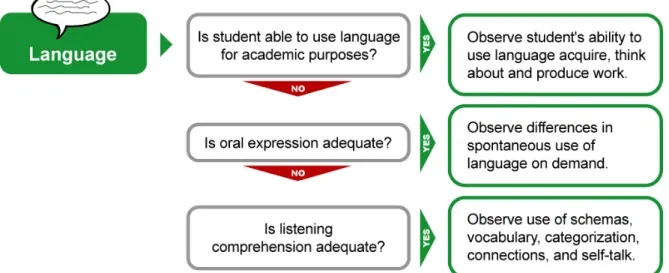
Language Skills Hierarchy
If screening indicates that a student is significantly behind in reading skills, and it is more likely due to inadequate language skills than phonics skills, additional screening on the developmental stages of language is indicated. The decision tree below shows one possible diagnostic sequence. The rule of thumb is, “test backwards and teach forwards.” Testing backwards means backtracking through the diagnostic sequence to determine the student’s instructional level and identify the appropriate intervention starting point.
Figure 4-4. Diagnostic Sequence For Determining Point of Intervention – Language For students lacking in sufficient independent reading skills, teachers may begin their evaluations with determining the adequacy of listening comprehension and oral expression skills.
Guidance on Linking Language and the Development of Basic Reading and
Comprehension Skills
Although sufficient evidence indicates that students with previously identified language delays may experience persistent difficulty in acquiring literacy skills, not all language disorders impact the development of literacy skills. The following guidance may help teams sort through which language issues may lead to difficulty in acquiring basic reading or reading comprehension skills:
Some students with articulation issues may be falsely identified as at-risk in
benchmarks requiring oral production. Consider the influence of articulation errors in acquisition or early literacy skills. Consult with speech clinician to determine if pattern of errors on literacy screening are due to articulation. Consider whether the
Minnesota Department of Education Draft 4-17 student can hear the difference when the teacher makes the errors (minimal pairs— hat vs. cat–consult with SLP).
Fluency and voice should not influence acquisition of literacy skills; therefore special education services in the areas of reading, writing or math are not justifiable unless additional intervention or assessment data indicates a co-existing problem.
Linguistic differences should not influence the acquisition of literacy skills when quality reading instruction is in place. Do not track students for dialect or cultural language differences (plural endings when not in native language, non-standard English, verb tenses, etc.). See Reducing Bias and ELL Manual to understand language differences that are relatively normal and not indicative of language impairment.
Illustrative Examples
Example 1 - Student does not use verbalizations to monitor attention, thinking, and self-regulation. Teacher observes a delay in verbalizations becoming internalized. Students not using verbalizations, sub-vocalizations, or internal voice to monitor behavior and attention may have difficulty acquiring reading comprehension and self-monitoring skills. Example 2 - Students eligible for Early Childhood Special Education services under the category of Developmental Delay or Speech/Language services with language
impairment are high risk for difficulty in acquiring literacy skills including those with: Difficulty with symbol associations as well as basic concepts (more/less,
larger/smaller).
Difficulty sequencing (first/last) spoken sentences and writing. Limited vocabulary (fewer words and alternative words). Generic stories that lack detail.
Display significant grammatical and syntax errors in oral language.
Difficulty acquiring social skills, such as turn-taking and reading facial expressions. Difficulty discerning humor.
Continue providing services in language and consider targeted interventions in reading and math. For students entering into kindergarten, consider most intensive interventions for developing phonemic awareness and vocabulary. Monitor progress and modify instruction to accelerate skill acquisition.
Example 3 - Student is not eligible for Speech/Language services, but screening data indicate issues with expressive/receptive and pragmatics of language or student had issues listed above but didn’t qualify for service. Determine if student is appropriate for targeted intervention, quality of data and severity of concern in addition to prior
experience factor into the intensity of intervention (secondary or tertiary).
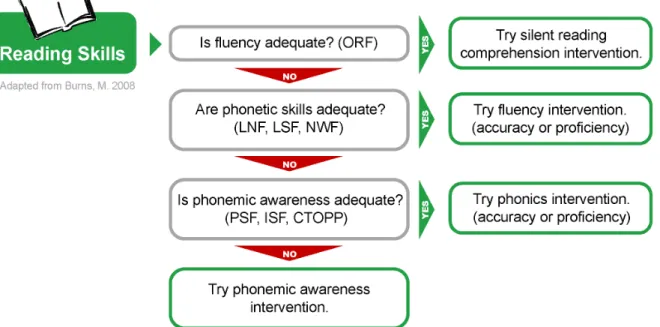
Reading Instructional Hierarchy
Students whose screening data indicate inadequate oral reading fluency should undergo additional problem-solving to determine if the problem lies in accurately reading words or
Minnesota Department of Education Draft 4-18 reading connected text. Accurate word reading fluency with poor fluency in reading
connected text may indicate lack of automaticity in decoding skills. If students lack automatic decoding or phonetic skills, general outcome measures or other informal
measures may be used to assess adequacy of phonemic awareness skills and so on. The instructional team should use the lowest scores between language and reading
assessments to prioritize allocation of instructional time during intervention.
The hierarchy below shows one possible diagnostic sequence. Again, the rule of thumb is, “test backwards and teach forwards.” Backtrack through the diagnostic sequence outlined below to determine the student's instructional level and identify the appropriate intervention starting point. Then teach the skills building on each other, keeping in mind that vocabulary and prior knowledge must be layered into every lesson to continue to build the student’s knowledge.
Figure 4-5. Diagnostic Sequence For Determining Point of Intervention – Reading Skills. ORF - oral reading fluency, LNF - letter naming fluency, LSF - letter sound fluency, NWF - nonsense word fluency, PSF - phoneme segmentation fluency, ISF - onset fluency, CTOPP - Comprehensive Test of Phonological Processing.
Minnesota Department of Education Draft 4-19
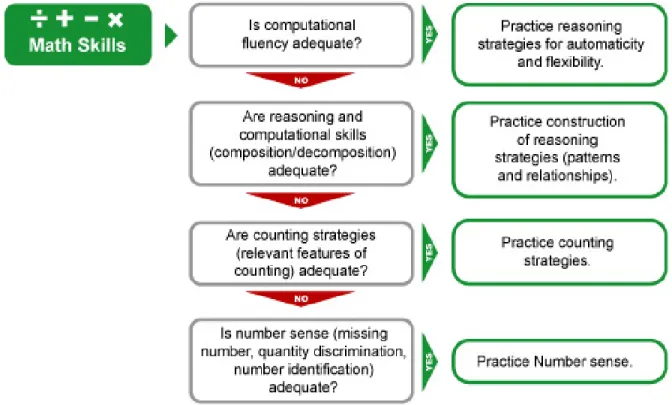
Mathematics Instructional Hierarchy
The hierarchy below shows one possible diagnostic sequence. Just a reminder, use the rule of thumb, “test backwards and teach forwards.”
Figure 4-6. Diagnostic Sequence For Determining Point of Intervention – Math Skills. For more information see Geary, D. (1999) or Methes, S. or www.enumeracy.com.
Minnesota Department of Education Draft 4-20
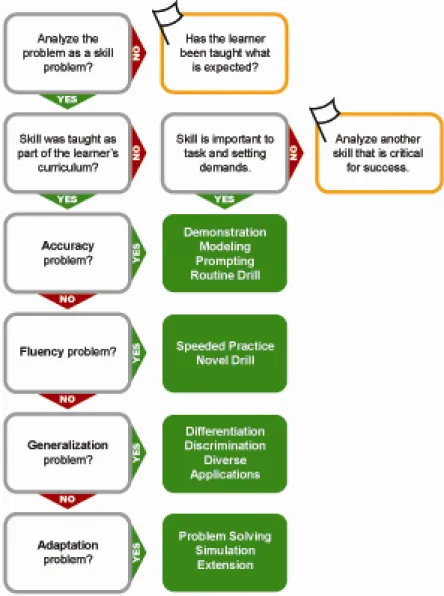
Generic Instructional Hierarchy for Skills Problems
The following generic instructional hierarchy will help teams create their own means of targeting appropriate sub skills.
Figure 4-7. Targeting Appropriate Sub Skills
Adapted from Christ, T.J. (2008) Best practices in problem analysis. In A. Thomas, & J. Grimes (Eds.), Best practices in school psychology. Pp. 159-176. Bethesda, MD: National Association of School Psychologists.
Minnesota Department of Education Draft 4-21
Problem-solving Protocol Step 2: Analyze the Problem
Validate the problem, identify the variables that contribute to the problem and develop a plan. This section reviews tools for validating the plan, gathering information from parents as well as sample forms for documenting the intervention plan. Additional questions that can guide in the selection of the most appropriate intervention follow Resource Tool 4.
Even if a system of SRBI uses standard protocols, those
responsible for assigning students to specific interventions should
understand the reason for the problem. Analysis of group data may help instructional staff better maximize the impact of interventions as well as help to review data for students suspected of having a disability. Teams should use existing data, (academic, behavioral, health, teacher judgment, developmental history, etc.) or, if necessary, gather additional data to determine if the student requires differentiated instruction or intervention supports.
Resource Tool for Analyzing the Problem:
Validating the Problem and Contributing FactorsThe following tables may help teams target student performance according to the variables that are within a teacher’s ability to address. See broad questions to analyze the context behind screening and informal assessment results and to root out the cause. The table below applies to the variable or domain of instruction:
Tables 4-4
Guidelines for Analyzing the Problem
Problem Analysis Questions to Consider Why the Problem Exists
Does evidence
suggest the problem is a lack of experience with the content or a mismatch between instruction and expectations? Do there patterns in the data suggest areas of language acquisition, prior knowledge, or conceptual understandings that need additional development? Nature of Instruction
Has the student consistently received the full amount of research-based instruction?
o What is the time spent on instruction vs. management of behavior and
transition?
How is content delivery structured?
o Is the structure of lessons coherent and consistently implemented? o Does the structure of the lesson include activating prior knowledge,
pre-teaching and connecting prior knowledge with new learning?
o Does instruction account for necessary prerequisite skills and adjust for
difficult content?
What does the data suggest is the phase in learning: acquisition, proficiency, maintenance, generalization, or adaptation?
Are errors consistent or patterns of performance suggestive of specific skill deficits of gaps in knowledge?
Language Acquisition
Minnesota Department of Education Draft 4-22
Problem Analysis Questions to Consider Why the Problem Exists
instruction provided in English?
Are differences in the student’s level of listening comprehension and oral language in native language and English evident?
The following table applies to the variable or domain of Curriculum: Questions for
Problem Analysis
Questions to Consider Why the Problem Exists
Do gaps exist in curriculum or execution of curriculum?
Does the curriculum provide adequate pacing and practice for the student to move through the four stages of learning (acquisition, accuracy, fluency, generalization/ application)?
Alignment of Curriculum
Has instruction been aligned with state standards and assessment measures?
Are areas of the curriculum in which students/ subgroups of students typically experience challenge evident? How effective are the adjustments?
Are or have the students been held accountable for material that has not been taught?
The following table applies to the variable or domain of the Environment:
Are the behavioral expectations
specifically taught? Is the student being held accountable for expectations or
behaviors that have not been taught?
Clear Expectations
Are expectations developmentally appropriate, posted, modeled and taught?
Do expectations include criteria for acceptable performance? Is feedback on performance timely and specific?
Positive Supports
Are positive and pro-social behaviors recognized in a ratio of 5:1? Does the student’s motivation reflect the teacher’s attention to
student’s approach, persistence, and interest level to subjects? To what extent is student actively engaged and participating with
content?
Are study skills that facilitate learning of new material explicitly taught?
Are interpersonal skills, including behaviors necessary to interact with others, explicitly taught?
Minnesota Department of Education Draft 4-23 What is the student’s
performance in relationship to setting demands (e.g., teacher expectations, focus on achievement vs. focus on task completion)?
Is the physical arrangement of the classroom (noise, position relative to focus of instruction, etc.) conducive to learning? Are management plans consistently executed?
Are relational influences (peer-to-peer, student-to-instructor, student-to-family) adversely influencing learning and performance? What is the ratio of time spent on instruction vs. management of
behavior?
The following table applies to the variable or domain of what is internal to the learner: Questions for
Problem Analysis
Questions to Consider Why the Problem Exists
Are physical or sensory abilities limited for the learner? Vision o Acuity o Efficiency Near focus Near-point convergence Tracking saccades Hearing o Acuity o Resistance to distraction Motor Coordination
Medical diagnoses inconsistently treated
Note: Simultaneous intervention may be in the student’s best interest; however, implementation of multiple interventions does not automatically move a student to comprehensive evaluation unless the team determines that the need is urgent.
Involving Parents in the Selection of Interventions
As discussed in chapter 2, Minnesota Rules have specific requirements for informing and providing data to parents. Although instructional teams may be initially selecting students for standard protocol interventions, parents can still be involved in the process. For teams that continue to use pre-referral intervention procedures, inclusion of parents continues to be a quality practice. At the point where instructional staff have gathered and interpreted the data, a conversation with the parent about the need for supplemental instruction is recommended. This point is also an opportune time to gather information from the parent that may further validate the implementation of an intervention or provide additional knowledge that further informs problem-solving. The following resource tool provides optional questions for gathering data and establishing a collaborative relationship.
Minnesota Department of Education Draft 4-24
Resource Tool: Structuring a Dynamic Interview
First inform parents: Explain that any information gained may be used as part of the system of SRBI process. Explain the system of SRBI process, if necessary. State all information is private and only specific information will be shared with staff if necessary. Convey any previously acquired data that the school has already collected including any graphs or samples of work from previous interventions. Accompany the process of
gathering information from parents with face-to-face or phone interviews. Mailing interview questions to parents without in-person interaction is strongly discouraged since parents may not understand questions or know what information is relevant to the professional. Directions for the interviewer:
Explain the purpose of the interview:
A concern about (name area) has been expressed about how (name student) has been performing in school and we would like to gather information that will help the team determine how to intervene.
1. This information may be used as part of a scientific research-based
interventions (SRBI) process. All the information is private and will be shared only with the staff that needs to know it.
2. If an interpreter is being used for this process, a licensed school staff person must accompany the interpreter and conduct the actual interview.
3. Interviews should be conducted in person, not over the phone, whenever possible.
4. Ask the questions in the order they are listed.
You may not be able to ask all the questions; however, in order to develop a rich developmental history of the student all questions should be asked.
a. The primary reason for not asking a question is that the information is already on file.
b. Another reason for not asking the question would be the age of the student. Older students or students who are already in the program would be a possible reason for some questions being no longer relevant.
5. Be sure to check for understanding when asking the questions. Passive nodding may not indicate that the person being interviewed really understands the question being asked. You may need to give specific examples or rephrase questions to clarify.
6. You may need to clarify for the parent that the individual student’s lack of progress is not related to the school’s ability to meet adequate yearly progress (AYP).
Minnesota Department of Education Draft 4-25
Illustrative Example Interview Script between Team Member and
Parent/Guardian
To the parent/guardian: Explain to the parents that the purpose of the interview is to build a partnership/collaborative effort to help their child be more successful in school.
(Child’s name) is having difficulty making progress in (name area). We have tried (name and describe interventions attempted) at school already. We are going to try additional interventions and instruction to help (child’s name) to be more successful in this area. As the parent, you are an important part of the team and we need your help so we can better understand (child’s name) needs. This information will guide our development of an
effective intervention, so we would like to hear your thoughts about your child at home and school. We know that when parents and schools are partners, children are more
successful at school.
Second Ask Questions: Ask increasingly targeted questions based on the parent’s response. The recommendation is to either follow up with written questions so that the parent may add additional thoughts after the meeting or send the broad questions in advance to help the parent organize his/her thoughts.
Note: The bank of questions that follows has been put in a suggested order; however, staff are encouraged to select the most appropriate questions for the context. Start with broad questions. The broad questions are numbered and the more targeted questions are preceded with a lower case letter. Always use the child’s name when asking questions.
Tell us what (child’s name) likes to do at home? What are your child’s favorite activities and interests?
o Please give me an example of what (child’s name) likes to do for fun.
1. Tell us about what s/he does well. (This can be academic, social, sport or any area).
2. Tell me about his/her friends?
a. Does he/she have a lot, few, trusted?
b. How does your child get along with his friends? (Leader? Follower?) 3. Is (child’s name) involved in activities after school? (This can be school or
non-school related. The purpose of this question is to determine how busy the child is, what are the stressors in the child’s life, whether any activities are interfering and also to see if the parents have noticed and done something to address the area of concern).
Minnesota Department of Education Draft 4-26 4. Gather background information that is not currently available in the student file
and/or to check accuracy of existing information.
a. Does (child’s name) have a nickname s/he prefers to be called? What is the name your child prefers to be called at home?
b. What language does (child’s name) speak at home? What language is the primary language of the primary caregiver? Parent(s)?
i. About how many hours a day is s/he hearing and using both the native language and English?
ii. Did (child’s name) participate in pre-school or day care? Which language was the primary language used?
c. Who is at home that might be able to help (child’s name) with learning things in (name the area of concern)?
d. What previous school experience has the student had? If not specifically stated, ask: Preschool? Previous schools attended?
e. Are you aware of any problems with (child’s name) vision and hearing? Have any outside evaluations been done in these areas of which the school may not be aware?
f. Has (child’s name) been diagnosed with any illness or condition we should know about? If so, what can you share with us that is relevant to education? g. Does (child’s name) take any medications? If so, what are they?
h. Has (child’s name) received any support services such as Title I or Special Education in the past? If so, what services and with what effect?
5. How do you teach (child’s name) new tasks and skills? (This question is attempting to see what learning strategies the parents have tried and used successfully. This information may help guide the instructional interventions).
6. What does (child’s name) tell you about school? (This question is attempting to see if the parent and student are aware of any difficulties or successes at school. This question may also open up communication between the parent and child about the area of concern).
7. What do you know about how well (child’s name) is doing in school?
8. Interviewer should explain areas of concern at this point if they have not already been explained to the parent. Then ask the parent: Have you seen any of these issues at home? If the parent has already expressed these concerns in response to question #3, do not ask this question.
9. Do you have any concerns about (name the specific skill or behavior)? 10. What do you think the school could do to help (child’s name)?
11. Realizing the constraints of time and work, what activities are you or someone in the home doing to help your child with (name concern)?
Minnesota Department of Education Draft 4-27 12. How much time does your child spend doing homework at home? (The purpose of
this question is to determine the parents awareness of the child’s educational load). a. What is the amount of homework (child’s name) brings home? Describe the
homework they bring home on a daily basis. Does your child bring home the materials needed to complete the homework?
b. How much time does (child’s name) spend on homework each night? Do you feel this is an appropriate amount of time?
c. How much assistance does (child’s name) require to complete the homework? Who is available to help? Is someone proficient in English available to help the child with homework? (Refer back to question regarding who is available to help child with learning.)
d. What is his/her behavior when doing homework? Is s/he able to complete the homework? Alone? With assistance? Do you know if the homework is turned in?
e. Where does (child’s name) complete homework? Do they have a set spot or are they more likely to pick a variety of spots?
f. Would you like to know about other sources to assist your child with
homework? Are there any questions you have about things at school? (Ask this only if there are sources for assistance).
13. Next are questions about your family and culture. As you think about your family's cultural background and heritage (language, traditions), what would you like the school staff to know about (child’s name) which might make a difference in the assessment of their learning and/or behavior.
14. Do you feel comfortable in communicating with the school? What is the best way (phone, written, face to face) for you to communicate with the school and the school to communicate with you? Do you feel the staff listen to your concerns?
Important: Ask all families the following questions, not just those from observably different cultures.
a. What do you feel your role is in helping (child’s name) learn or helping with schoolwork?
b. Often struggles at school are temporary and can be due to changes occurring in the child’s life at school or at home. The school team will look into any changes that have occurred during the school day. (State any findings from the school portion.) Are there any changes that are occurring in the home/family at this time? (The school also needs to look at the possibility of changes in the school that may contribute to the child’s struggles.)
c. What else would you like us to know about your child that may help us help him/her in school?
Minnesota Department of Education Draft 4-28 d. What do you want the school to know about your family’s culture and
customs?
Resource Tool: Sample Forms for Documenting Problem Identification
Important: Below are example forms for documenting reading and writing intervention information with parents, or for creating the written intervention plan.
Sample1: Student Reading Intervention Record
Student Name Teacher and Grade Date
Background Information
Home and Community
School Background Information (attendance, health screenings, etc.)
Reading History and Assessment Data (please attach assessment details) Phonics Survey
Test of Phonemic Awareness Sound Identification
Oral Reading Assessment Listening Assessment Word Recognition/Analysis Silent Reading Assessment
Spelling Assessment Informal Reading Inventory Vocabulary Inventory Writing Sample Running Record Observational Notes
Notes:
Independent Reading Level Instructional Reading Level
State Assessment Information Normed Assessment Information
Areas of Strength Areas of Interest
Emotional response to instruction/sense of self-efficacy with task
Minnesota Department of Education Draft 4-29 Intervention Plans (Tiers of implementations, programs, strategies, etc.)
Progress Monitoring Plans (insert or attach graph of student data, observations, timelines, expectations)
Match or Mismatch with Present Instructional Context Matching Areas:
Areas of Mismatch:
Address the following: “What might achieve a closer instructional match?” How will intervention address motivational self-efficacy?
Staffing Summary
Parent Summary (including communication, dates for meetings, record of dates connected, etc.)
Minnesota Department of Education Draft 4-30
Sample 2: Student Reading Intervention Record Form from St. Croix River Education Team
CUMULATIVE FOLDER REVIEW
PREVIOUS SCHOOLS/SERVICES
Pre-Referral Interventions – Dates: __________
Title 1 – Dates: __________
SPED Eval / Services – Dates: __________
Out of Team – Dates: __________
Retained – Dates: __________
Home Schooled – Dates: __________
Other Grades HEALTH INFORMATION Vision Concern Hearing Concern ADHD Asthma Other Diagnosis: ________________ ATTENDANCE
# Days Absent Last Year: ________ # Days Absent Current Year: ________ Other Concerns: ELEMENTARY: Math Readin g Writing Above Meets Below Other Concerns: SECONDARY: GPA: ________ Credits Earned: ________ INTERVIEW SUMMARY
PARENT STUDENT TEACHER
DATE:
TYPE OF INTERVIEW:
ATTACH COMPLETED INTERVIEW NOTES
CLASSROOM OBSERVATION DATE: BY: TYPE: Interval Frequency Latency Duration Other: ___________
ATTACH COMPLETED OBSERVATION FORM(S)
TESTING RECORDS
ATTACH COMPLETED WEB PORTAL STUDENT TEST DATA SUMMARY
Minnesota Department of Education Draft 4-31
PROBLEM IDENTIFICATION SUMMARY – C1
Team met to review these data on: Prioritized area of concern: Discrepancy statement:
List at least two sources of convergent data that support this discrepancy: Baseline data are plotted on the attached graph
Disposition: Level 1 Grade Level Team Level 2: Consultation from Support Staff
Level 3: Problem-solving Team Level 4: Special Education Consult
Team member responsible for follow-up:
Problem-Solving Protocol Step 3: Implement a Plan
Once the problem has been adequately identified and parents are informed there should be ample evidence to provide a good match between intervention and student need. The following resource tool should help guide the selection of the intervention that is most appropriate for the student.
Resource Tool: Guiding Questions for Selecting the Most Appropriate Intervention
1. What is the data suggesting?
Will the student’s needs be adequately addressed within the core-curriculum with further differentiation?
What variables (instruction, curriculum, or environment) or accommodations can be made within the core-curriculum to allow the student continued benefit from core instruction?
The process may be derailed if:
Non-instructional accommodations are used, such as preferential seating, extended time, etc.
Accommodations do not systematically improve acquisition of skills and are not interventions. The primary instructor is not committed to the belief
that intervention will be effective in addressing the student’s needs.
Teacher efficacy and lack of commitment to intervention is a field-wide concern.
The student is not motivated to perform within the intervention or core curriculum.
Minnesota Department of Education Draft 4-32 2. If targeted intervention supports are needed, which level of support is warranted?
Given the size of the gap between the student’s performance and the
desired skill level, what will it take to accelerate student learning to reach the performance goal?
What is the magnitude of problem that needs to be solved? Staff should refer to team guidelines for selecting the intensity of intervention.
What intervention is most appropriate to meet needs indicated by the data? Will the intervention provide support that is proportional to the extent the
student is behind?
Is the intervention rigorous enough to resolve the learning issue? The process may be undermined if interventions are not delivered within the designed time or when they are not powerful enough to address the problem.
As previously discussed in the section Building Systems of SRBI, the dimensions that teams may use to differentiate levels of support include:
Duration of intervention (weeks).
Frequency of intervention (daily or weekly).
Amount of minutes provided per session, research recommends 15 minutes per every 13 percentile points below the 50th percentile on standardized measures
of achievement (Fielding, L. Kerr, N. Rosier, P., 2007). Size of instructional group (1:1, 2:3, 3:5, etc.).
Specificity and focus of instructional goals (one skill or comprehensive instruction in key areas).
Proportion of intervention where students receive direct instruction from the teacher:
o Number of opportunities to respond. o Immediacy of corrective feedback.
Note: Team decision rules may provide flexibility in allowing for immediate placement of a student in tertiary intervention supports. However, an exceedingly large gap does not necessarily suggest the need to evaluate for special education is urgent. Additional factors as to why the learning problem exists will need to be considered to make a determination of urgency.
Minnesota Department of Education Draft 4-33
Writing an Intervention Plan
Documentation is critical if special education evaluation teams are to be able to use data from SRBI in the eligibility determination process. Collect both qualitative and quantitative evidence that proves the student’s lack of performance is not attributable to inadequate instruction. Collect this data throughout an intervention regardless of whether a school uses a system of SRBI or implements interventions prior to a referral. Regular evaluation of evidence is necessary with any new information integrated into what is known about the student’s learning progress.
Include the information below in a written
intervention plan: Adequate progress after an
appropriate period is not defined within the federal regulations for the following reason:
“The Federal Department of Education felt the meaning will vary depending on the specific circumstances in each case. There may be legitimate reasons for varying timeframes to seek parental consent for evaluation; however, they also believe that teams will know if an intervention is not working in less than 90 days. In general, it is not acceptable for an LEA to wait several months to conduct an evaluation or seek parental consent for an initial evaluation. If, through monitoring efforts, the state determines there is a pattern or practices of delaying evaluations, it could raise
questions as to whether the LEA is within compliance.”
--OSEP guidance January 1, 2007
Hypothesis of area and/or underlying cause of poor achievement/performance.
Description of intervention or instructional strategy and identification of provider. Description of when, where, and frequency
intervention is to take place.
Description of progress monitoring data to be collected and means of collection/ tools to be used.
Identification of individual collecting data. Performance goals or targets and decision
rules regarding growth across intervention. Start date and date of data review.
Teams should also discuss conditions for continuing the intervention when it is working and when it is not working.
Minnesota Department of Education Draft 4-34
Sample Written Intervention Form from St. Croix River Education Team Note: Intended as guidance only.
Student: ______________________ Plan Development Date: ____________ Intervention #: 1 2 3 _______
Area of Concern: Reading Math Writing Behavior
Goal: _______________________________________________________________ INTERVENTION Brief Description: Description of Needed Materials: Intervention Implementer: When: Where: How Often: Training to take place: MEASUREMENT SYSTEM Data Collection System: Data Collector: What Will Be Recorded? Frequency of Data Collection:
When will Data be Collected?
DECISION MAKING RULE
Slope / Trend Analysis Consecutive Data Point Rule Level of Performance Other:
Intervention Start Date:
____________________________________________________________ Review Date: ______________ Time: __________ Place: _________
Minnesota Department of Education Draft 4-35
Next Steps
This chapter discussed how to match interventions to address student needs. Processes for determining the appropriate level to address the learning problem as well as several resource tools were included. A discussion of quality practices revealed how teams should consider multiple variables when developing intervention plans.
The next chapter will discuss what happens when interventions are in place, step three and four of a problem-solving protocol. Once interventions are in place, teams must monitor progress to ensure that they are being implemented with fidelity and that the student is responding to the added instruction.
The following assessment process flow-chart indicates the next steps for using the data. Teams should document each step as students move through the pre-referral or system of SRBI process to maximize efficiency.
Figure 4-8. Assessment Flow
To assist teams using data from interventions or SRBI, the table below includes a set of guiding questions aligned with legal requirements for determining eligibility. These
questions will build from one chapter to show how existing data can be used to inform the next step in intervention as well as to individualize the design of a comprehensive
evaluation should one be warranted. If not already in process, the data from each step in the assessment process should be integrated into the guiding questions template. Data may include screening, record reviews, curriculum reviews, error analysis, teacher interviews and documentation, observation and parent interviews.
Minnesota Department of Education Draft 4-36 Table 4-5
Template for Integrating Data into SRBI Selection
Guiding Question Existing Data Information needed How has the team determined
the student has had sufficient access to high-quality instruction and the opportunity to perform within grade-level standards? What supplemental efforts, aligned with grade-level
standards, were implemented to accelerate the student’s rate of learning and level of
Minnesota Department of Education Draft 4-37
Resources
Fielding, L. Kerr, N. Rosier, P.,(2007). Annual Growth For All Students, Catch-up Growth for Those Who Are Behind. Kennewick, WA: New Foundation Press.
Fuchs, D. Mock, D. Morgan, P, & Young, C. (2003). Responsiveness to intervention: definitions, evidence, and implications for the learning disabilities construct. Learning Disabilities Research to Practice, 18(3), 157-171.
Geary, C. (1999). Mathematical Disabilities: What We Know and Don't Know. Retrieved from: www.ldonline.org/article/5881
Haring, N. G., & Eaton, M. D. (1978). Systematic instructional procedures: An instructional hierarchy. In N. G. Haring, T. C. Lovitt, M. D. Eaton, & C. L. Hansen (Eds.) The fourth R: Research in the classroom (pp. 23-40). Columbus, OH: Charles E. Merrill. Jimerson, S. Burns, M. & VanDerHeyden, A. (2007). Handbook of Response to
Intervention: The science and practice of assessment and intervention. New York: Springer Science & Business Media LLC.
Mellard, D.F. & Johnson, E.S. (2008) RTI: A Practitioner’s Guide to Implementing Response to Intervention. Thousand Oaks, CA: Corwin Press.