Outsourcing in public hospitals:
a Greek perspective
Socrates J. Moschuris
Department of Industrial Management and Technology,
University of Piraeus, Piraeus, Greece, and
Michael N. Kondylis
Public Power Corporation S.A., Athens, Greece
Abstract
Purpose– The purpose of this research is to investigate the extent of outsourcing, the decision-making process, the impact of outsourcing, and the future trend of outsourcing in public hospitals in Greece.
Design/methodology/approach– A survey instrument was designed and mailed to a random sample of 100 public hospitals in Greece and 43 usable questionnaires were received, representing a response rate of 43 percent. The survey instrument focused on the extent to which public hospitals outsource services, the decision-making process for choosing an external service provider, the impact of outsourcing, and the future trend of outsourcing in public healthcare organisations.
Findings– Public hospitals in Greece outsource a variety of activities. Cost savings and customer satisfaction are the main factors affecting the outsourcing decision. The cooperation with a contract service provider has led to significant improvement in service quality levels. Most users are satisfied with the performance of these companies and believe that there will be an increase in the usage of these services in the future.
Practical implications– It provides a decision-making framework regarding outsourcing in public healthcare organisations.
Originality/value– This research fills the gap in the area of outsourcing in public hospitals in Greece.
KeywordsOutsourcing, Health services, Hospitals, Greece
Paper typeResearch paper
Introduction
Outsourcing is the process of contracting an outside company to provide a service previously performed by staff. In many cases, outsourcing involves a transfer of management responsibility for delivery of service and internal staffing patterns to an outside organisation. Subcontracting, contracting out, staff augmentation, flexible staffing, employee leasing, professional services, contract programming, consulting, and contract services are all terms which refer to outsourcing (Sarpin and Weideman, 1999).
For decades, healthcare organisations have outsourced services such as food service and housekeeping. Today, as managed care programs attempt to reduce healthcare costs, providers are turning to outsourcing in new ways in an effort to maintain high standards of care while addressing current economic realities (Sarpin and Weideman, 1999).
Outsourcing is growing in response to trends in the industry that are changing the way administrators view their organisations. Healthcare facilities are considering
The current issue and full text archive of this journal is available at
www.emeraldinsight.com/1477-7266.htm
JHOM
20,1
4
Journal of Health Organization and Management
Vol. 20 No. 1, 2006 pp. 4-14
qEmerald Group Publishing Limited 1477-7266
outsourcing as a possible response to demands created by such factors as market pressures, requirements of managed care organisations, mergers and acquisitions, and competition within the industry. Moreover, outsourcing seems to facilitate flexibility at a time when change seems to be the only constant. The structure of healthcare organisations is evolving as they shed the role of providing all services to providing only carefully selected clinical services. The emerging structure consists of a network of services that are performed by entities that operate as autonomous units with greater maneuverability and adaptability than those held by a more bureaucratic, monolithic entity. This structure greatly increases an organisation’s ability to respond to continual change (Sarpin and Weideman, 1999).
Given the growing importance of outsourcing in healthcare, the extent of its usage has been widely examined in the USA (Gardner, 1991; Solovy, 1996; Hensley, 1997; Triulzi, 1997; Hensley, 1998; Ngeo, 1998; Smyth, 1998; Sunseri, 1998; Blouin and Brent, 1999; Katzman, 1999; Morrissey, 1999; Wholeyet al., 2001; Lorence and Spink, 2004; Nicholsonet al., 2004). There are also studies, which investigate the usage of contract service providers in healthcare in UK (Mark, 1994; Smyth, 1998; Heavisides and Price, 2001; Riley, 2001), in New Zealand (Cameron, 1998; Renner and Palmer, 1999), and in Canada (Chow and Heaver, 1994; Rivard-Royer et al., 2002). The main conclusions derived from these studies are, first, that healthcare organisations outsource a variety of activities and, second, that the major benefits from using outside services are improved performance, cost savings, and increased management time in core business. In Greece, there has been a lack of empirical and published research directed toward outsourcing in healthcare. To the best of our knowledge, we have not found any comprehensive studies reported in the literature focusing on outsourcing decisions in non-profit and public hospitals. This is surprising, since in 2003 more than 150 non-profit and public hospitals with more than 37,000 beds were operating in Greece. Moreover, the total budget of these hospitals was overe2 billion (Statistical Abstract, 2003). A large amount of this budget is allocated to the procurement of goods and services. We believe that an extensive investigation of outsourcing will provide the hospitals in Greece with a framework, which will be useful for more efficient procurement procedures. The purpose of this research is to fill the gap in the area of outsourcing in healthcare in Greece and to illustrate this framework.
In the next section, a brief description of the Greek public healthcare environment is provided. The following two parts describe the research methodology as well as the results obtained from the survey. Finally, conclusions, implications of the findings, weaknesses in the study, and future directions are presented.
The Greek public healthcare environment
In Greece, public healthcare institutions have not attempted to evaluate the value of reducing the operational cost because they were previously reimbursed a sum based on their actual cost or annual budget projections. Initially, these funding sources did not question the operational costs of healthcare providers because the institutions were operated in a “not for profit” status. During the past three decades, as the “for profit” healthcare corporations entered the market, funding institutions began to view the healthcare market and its operational costs differently.
Since the late of 1950s, the cost of public hospitals has steadily risen, usually faster than the consumer price index, absorbing a larger proportion of the Gross National
Outsourcing in
public hospitals
Product (GNP). Technology was introduced at an accelerating rate, and each new item was more expensive to purchase and operate. The new buildings to accommodate the patients were more expensive to build and operate.
In recent decades, the public healthcare industry has been under political and public pressure to control the rapidly increasing cost for treatment. Public opinion has been that the appropriate regulatory price controls have not been instituted in the industry. While the public has demanded price control measures be implemented, there has not been any research to determine, first, why the cost of delivery has continued to climb or, second, why has the industry been reluctant to implement the same competitive operational processes found in the manufacturing and distribution industries. The manufacturing industry shares many similar business processes with the healthcare industry, especially in the areas of supply distribution, inventory control, and product production. The weakness in the public healthcare supply chain is the difference between traditional buyer-seller relationships. These relationships are generally transactional, and built up in a partnering arrangement, where each party shares benefits and burdens over a long period of time so that they all gain competitive advantage. Successful partnerships must result in a win-win relationship and should be thrived on seven ingredients: Compatibility, Deep understanding of each other’s business needs, Open communications, Commitment, Fairness, Flexibility, and Trust.
Research methodology
To investigate the outsourcing in public hospitals in Greece, a survey was conducted during June-July 2003. The survey instrument focused on the following four areas: the extent to which public hospitals outsource services, the decision-making process for choosing an external service provider, the impact of outsourcing, and the future trend of outsourcing in public healthcare organisation
The target population included all public healthcare organisations operating in Greece. 100 public hospitals were randomly selected from the list of all registered public hospitals in Greece. A questionnaire, together with a cover letter and a reply envelope were mailed to the general manager of each hospital. Two weeks after the questionnaires were sent out, reminder telephone calls were made to approximately 30 randomly selected hospitals that had not responded. A total of 43 usable questionnaires were received, representing a response rate of 43 percent. This rate compares favourably to response rates for other studies regarding outsourcing in healthcare organisations (Gardner, 1991; Solovy, 1996; Hensley, 1997; Ngeo, 1998; Sunseri, 1998; Katzman, 1999; Heavisides and Price, 2001; Lorence and Spink, 2004). Analysis of the responses is presented in the next section.
One potential problem with a survey methodology is the existence of nonresponse bias (Lambert and Harrington, 1990). To evaluate the possibility of nonresponse bias, a formal procedure was used to compare early respondents with late respondents, as recommended by Armstrong and Overton (1977). The premise underlying this approach is that late respondents are more likely to answer the questionnaire like nonrespondents than are early respondents. Conducting at-test under the assumption of both equal and unequal group variances, no significant between-group mean differences were found to exist with respect to any of the variables considered in the study. Besides, a second comparison was applied between participant group and a group of 30 randomly selected nonrespondent public hospitals in terms of number of
JHOM
20,1
beds. Likewise, no significant differences were found to exist between these two groups. Hence, nonresponse bias was deemed to be of no significance in this research. Results
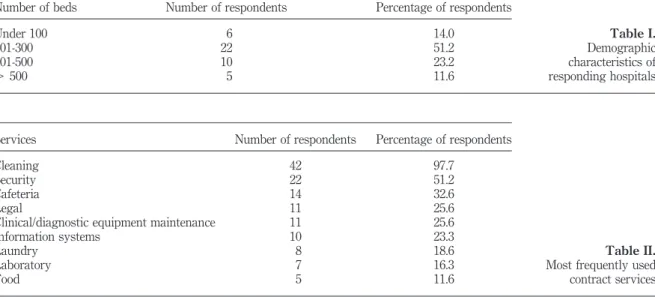
Out of a total of 43 usable responses, 41 respondents (95.3 percent) indicated that their healthcare organisations currently outsource one or more activities, whereas only two respondents (4.7 percent) are going to outsource some activities in the near future. Demographic characteristics of the responding hospitals are shown in Table I.
Extent of outsourcing
In addressing this topic, respondents were asked to specify the services most frequently outsourced, the percentage of budget allocated to contract service providers, and the average duration of the contracts signed with these providers. The responses to these issues are presented in this section.
The services most frequently outsourced by public hospitals in Greece are shown in Table II. Cleaning is outsourced by almost all the responding hospitals, whereas more than half of the respondents outsource security services. Cafeteria, legal, and equipment maintenance services are outsourced by more than one-fourth of the public hospitals. Finally, the services that are least outsourced include laundry, laboratory, and food.
The degree of commitment to using the services of external providers varies amongst the responding public hospitals. Just over two-fifth (42.3 percent) of the respondents indicated that their commitment to the services of contract providers was “moderate” or “extensive”, while the remaining users indicated that the commitment of their healthcare organisations was “limited” or “very limited”.
The degree of commitment is also reflected in the percentage of the budget allocated to contract service providers. Table III shows that more than three-quarters of the Number of beds Number of respondents Percentage of respondents
Under 100 6 14.0 101-300 22 51.2 301-500 10 23.2 .500 5 11.6 Table I. Demographic characteristics of responding hospitals
Services Number of respondents Percentage of respondents
Cleaning 42 97.7
Security 22 51.2
Cafeteria 14 32.6
Legal 11 25.6
Clinical/diagnostic equipment maintenance 11 25.6
Information systems 10 23.3
Laundry 8 18.6
Laboratory 7 16.3
Food 5 11.6
Table II.
Most frequently used contract services
Outsourcing in
public hospitals
respondents allocate 5 percent or less of their total budget to these providers, whereas only one public hospital allocates 15 percent or more of its total budget to such providers.
In terms of formal contracts, all responding hospitals have signed contracts with their external service providers. 93 percent of these contracts had been signed for a period of one two years, whereas the remaining 7 percent of the hospitals had signed contracts for periods less than one year.
The decision-making process
To illustrate the decision-making process employed by public hospitals in Greece with regard to outsourcing, respondents were asked to assess the involvement of a number of functional areas in this process, the sources of information regarding contract providers, the importance of a number of factors affecting the outsourcing decision, and the importance of a number of criteria on which contract providers were evaluated. The responses to these topics are discussed in this section.
A number of functional areas are involved in the outsourcing decision-making process. Approximately two-thirds (65.1 percent) of the respondents indicated that personnel from the finance department are actively involved in the decision-making process, followed by personnel from the purchasing function (51.2 percent). A number of public hospitals indicated that personnel from the administrative and the legal functions are actively involved in this process. Finally, personnel from the technical and the nursing functions are involved in the outsourcing decision-making process in a limited number of responding healthcare organisations.
Respondents were also asked to indicate how they became aware of the contract service providers. All responding public hospitals indicated that they obtain information regarding the existence of potential contract service providers during the competitive bidding process, whereas 16.3 percent of the users indicated that representatives of the providers directly contacted them. Finally, advertising in professional publications and discussions with experts were mentioned only by two responding public hospitals.
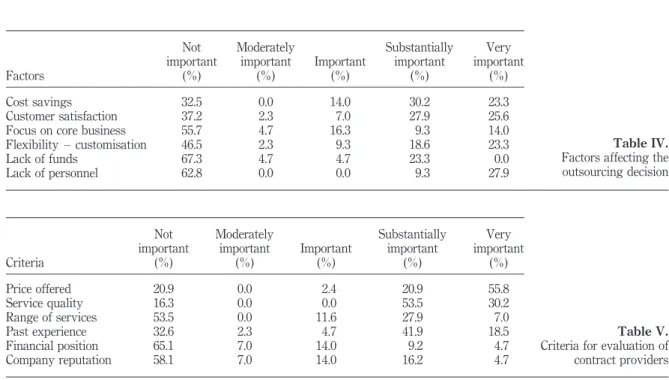
To determine why public healthcare organisations decide to outsource activities, respondents were asked to evaluate the importance of a number of factors affecting the decision to outsource. The responses to this question are presented in Table IV.
More than one-half (53.5 percent) of the respondents indicated that cost savings and customer satisfaction were substantially important or very important in their decision to outsource, whereas more than two-fifth (41.9 percent) of the users mentioned flexibility as a substantially important or very important factor in the outsourcing decision. Finally, lack of personnel was mentioned as a substantially important or very
Percentage of budget Number of respondents Percentage of respondents
0-5 33 76.7 6-10 6 14.0 11-15 3 7.0 .15 1 2.3 Table III. Percentage of budget allocated to contract service providers
JHOM
20,1
important factor by more than one-third (37.2 percent) of the users, whereas maintaining focus on the core business and lack of funds were mentioned by 23.3 percent of the users as being substantially important or very important in their decision-making.
Public healthcare organisations usually have several contract service providers from which they should select the most suitable one. For this purpose, a number of evaluation criteria are used. Respondents were asked to assess the importance of a number of criteria in making the final selection among competing providers. The responses to this topic are presented in Table V.
The quality of the service provided and the price offered are considered as the most important criteria with 83.7 percent and 76.7 percent of the users respectively indicating them as substantially important or very important. Past experience was ranked as a substantially important or very important criterion by more than three-fifths (60.4 percent) of the users, whereas more than one-third (34.9 percent) of the public hospitals assessed the range of services provided as a substantially or very important criterion. Finally, company reputation and financial position of the provider are ranked high as important criteria in the selection of the contract service provider by a small number of users.
Impact of outsourcing on public healthcare organisations
The impact of outsourcing on public hospitals was investigated in terms of organisational impact, benefits, difficulties, and reduction of full-time positions. The responses relating to these issues are discussed in this section.
Not important Moderately important Important Substantially important Very important Factors (%) (%) (%) (%) (%) Cost savings 32.5 0.0 14.0 30.2 23.3 Customer satisfaction 37.2 2.3 7.0 27.9 25.6
Focus on core business 55.7 4.7 16.3 9.3 14.0
Flexibility – customisation 46.5 2.3 9.3 18.6 23.3
Lack of funds 67.3 4.7 4.7 23.3 0.0
Lack of personnel 62.8 0.0 0.0 9.3 27.9
Table IV.
Factors affecting the outsourcing decision Not important Moderately important Important Substantially important Very important Criteria (%) (%) (%) (%) (%) Price offered 20.9 0.0 2.4 20.9 55.8 Service quality 16.3 0.0 0.0 53.5 30.2 Range of services 53.5 0.0 11.6 27.9 7.0 Past experience 32.6 2.3 4.7 41.9 18.5 Financial position 65.1 7.0 14.0 9.2 4.7 Company reputation 58.1 7.0 14.0 16.2 4.7 Table V.
Criteria for evaluation of contract providers
Outsourcing in
public hospitals
Regarding organisational impact, respondents were asked to assess the impact of outsourcing on cost reduction, on improvement in customer satisfaction and on improvement of the services provided by the hospitals. The responses are presented in Table VI.
The impact of outsourcing on cost reduction was assessed as high or very high by around one-third (32.5 percent) of the respondents. On the other hand, more than one-half (51.2 percent) of the respondents indicated that the impact on cost reduction was very low or low. As far as customer satisfaction is concerned, more than one-half (55.8 percent) of the respondents indicated a positive of very positive impact. Finally, about two-thirds (65.0 percent) of the respondents argued that outsourcing has led to a significant improvement of the services provided by public hospitals.
According to the survey respondents, public hospitals in Greece typically experience multiple benefits from outsourcing. Improvement in service quality levels was mentioned by approximately two-thirds (65.1 percent) of the respondents. Enhanced flexibility, economies of scale, the opportunity for the user firm to focus on its core business, and the use of the external provider’s infrastructure were mentioned as important benefits by around one-third of the users.
In terms of implementing the decision to outsource in public hospitals, 27 users indicated that they experienced significant difficulties in bringing contract service providers on-line. The most often mentioned difficulties included the lack of coordination and integration between the healthcare organisation and the external provider as well as the insufficient understanding of the provider regarding the hospital’s operations. Price negotiation problems, employees’ resistance to changes and quality problems were also mentioned by a number of respondents.
Theoretically, the decision to outsource may lead to an elimination of a number of full-time related positions in the public healthcare organisation. In our survey, the responses to this topic are shown in Table VII.
Over two-thirds (69.8 percent) of the responding public hospitals indicated that their decision to outsource did not lead to an elimination of full-time related positions, whereas 16.3 percent of the users indicated that they had eliminated between 11 percent and 20 percent of their full-time staff. No public healthcare organisations
Percentage of positions eliminated Number of respondents Percentage of respondents
0 30 69.8
1-10 6 13.9
11-20 7 16.3
Table VII.
Percentage of full-time positions eliminated due to outsourcing
Very low Low Moderate High Very high
Nature of impact (%) (%) (%) (%) (%)
Cost reduction 37.2 14.0 16.3 23.2 9.3
Improvement in customer satisfaction 25.6 0.0 18.6 34.9 20.9
Improvement of services 23.3 4.7 7.0 37.1 27.9 Table VI. Organisational impact of outsourcing
JHOM
20,1
10
reported eliminating more than 21 percent of full-time positions due to outsourcing. Elimination of full-time positions suggests that the decision to outsource would generate an amount of work for the human resources function. It is of concern that managers from the human resources function are not involved in the outsourcing decision-making process, as indicated by the results presented earlier.
Future trend of outsourcing
The focus here is on the future plans and concerns of public healthcare organisations in Greece regarding outsourcing, and whether they consider changes in the level and nature of their involvement with contract service providers.
The satisfaction of users from their cooperation with external providers influences the future trend of outsourcing. Of the respondents, 21 percent indicated that they were “very satisfied” with the performance of their contract service providers and 37.2 percent indicated they were “satisfied”. Another 34.8 percent of the public hospitals indicated that they were “moderately satisfied”. Only three users stated that they were “very dissatisfied” or “dissatisfied” with the performance of the external providers. Hence, approximately 60 percent of the respondents indicated that their cooperation with contract service providers had been a positive development for their organisation. Users were also asked to predict the trend of outsourcing in their organisations during the next three years. 35 out of 43 users (81.4 percent) predict a moderate or substantial increase of outsourcing in the near future. Conversely, less than 20 percent indicated that they predict stability or a decrease in the use of contract service providers during the same time.
Conclusions and implications
The main objective of this research was to identify the use of contract service providers by public healthcare organisations in Greece. For this purpose, this study identifies four topics that impact on outsourcing in public hospitals in Greece. These parameters are the extent of the use of contract service providers, the outsourcing decision-making process, the effects of the cooperation with service providers on the users, and the future trend of outsourcing in public hospitals in Greece.
In Greece, the majority of the public healthcare organisations are satisfied from their cooperation with external service providers, and they believe that this has led to positive developments within their organisations. With a high current level of satisfaction, more than four-fifths of these public hospitals predict a moderate or substantial increase of outsourcing in the near future. The reason for this can be found in the input measures, which are important determinants of the decision to outsource activities in public healthcare organisations.
In assessing the extent of outsourcing in Greek public hospitals, we found that the vast majority of respondents have been utilising external service providers for several years. With a relatively limited to moderate level of commitment to the usage of contract service providers, and signing of contracts with a duration longer than one year, these users would be likely to continue or even increase their usage.
Regarding the outsourcing decision-making process, personnel from the finance department are actively involved in the majority of these decisions. However, managers from other functional areas are usually involved in the decision to outsource. The most popular way for becoming aware of contract service providers is the
Outsourcing in
public hospitals
competitive bidding process and, more specifically, during the submission of proposals by potential external service providers. In deciding whether to continue the cooperation with an external service provider, the motivation to outsource must be adequately satisfied by the contract service provider. The main driving forces are cost savings and customer satisfaction, which could also explain why service quality, the price offered by the external providers, and past experience are the main criteria used by public healthcare organisations for the selection of the most suitable service provider.
In the majority of the cases, the respondents view the use of external service providers as having had a significant impact on customer satisfaction and on the quality of the services provided by public healthcare organisations in Greece. It is interesting to note that only approximately one-third of the respondents stated that outsourcing has a significant impact on cost reduction. This may be explained by the fact that public hospitals in Greece are non-for profit and product-independent organisations, which means that a regulatory authority determines an important part of their income. In this situation, the output-income relationship is less clear than in the situation of product-dependent organisations. Under these circumstances, public hospitals in Greece do not operate with pure private and economic criteria and their priority is focused on the provision of high quality services to the society.
The benefits realised after the implementation of the outsourcing decision have further explained the relatively high satisfaction level of the users and, hence, the positive development of the public healthcare organisations. Improved service quality levels and enhanced flexibility were the main benefits realised by the users after outsourcing, which greatly satisfy their driving forces initially.
To those public healthcare organisations considering outsourcing of their activities, this positive feedback should be reassuring. The number of experienced organisations provides an important source of information about how to proceed and what to expect. Consideration of the use of contract service providers will bring in contact managers from a number of functions in public hospitals in Greece. This should improve the scope of the analysis, as well as subsequently facilitating the implementation of the outsourcing decision.
The experience of the responding public healthcare organisations in this study also provides insights as to how to plan for implementation. For example, users should inform in detail and educate the contract service provider about their requirements. Moreover, plans and programs to place redundant employees must also be developed. The survey also contains useful information for the external providers of services. The results of our study show that in only one-sixth of the public hospitals in Greece there was a direct contact with sales representatives of the providers. This means that contract service providers do not consider public healthcare organisations as an important group of potential clients. This is an erroneous view and contract providers should invest time, effort, and money in order to educate their representatives to be more persuasive and effective in their contacts with public hospitals.
The empirical setting of this study concentrated on a specific country. This suggests that the findings may suffer from limited external validity. Caution should therefore be exercised in attempting to draw generalisations from this inquiry. Replication efforts should be undertaken in other countries, mainly to those located in the Balkans, to test the extent to which these findings can be generalised. Furthermore,
JHOM
20,1
it would be of interest to investigate the outsourcing in the private healthcare organisations in Greece.
The above analysis of the experience of Greek public hospitals in their usage of contract service providers indicates that the outsourcing in public healthcare organisations in Greece has a reasonable potential for further development. This study provides contract service providers a framework, which, we hope, will help them in increasing their business in this dynamic and rapidly growing market.
References
Armstrong, J.S. and Overton, T.S. (1977), “Estimating nonresponse bias in mail surveys”,Journal of Marketing Research, Vol. 14 No. 3, pp. 369-402.
Blouin, A.S. and Brent, N.J. (1999), “Outsourcing legal services in healthcare”,Journal of Nursing Administration, Vol. 29 No. 11, pp. 18-20.
Cameron, R. (1998), “Healthcare cleaning in New Zealand . . . a contractor’s perspective”, INCLEAN Magazine: Australasia’s Cleaning Industry and Environmental Technology Magazine, Vol. 1 No. 4, available at: www.fmlink.com/Prof/Resources/Magazines/article. cgi?InClean:inc05971.htm
Chow, G. and Heaver, T. (1994), “Logistics in the Canadian health care industry”,Canadian Logistics Journal, Vol. 1 No. 1, pp. 29-73.
Gardner, E. (1991), “Going on line with outsiders”,Modern Healthcare, July 15, pp. 35-47. Heavisides, B. and Price, I. (2001), “Input versus output-based performance measurement in the
NHS – the current situation”,Facilities, Vol. 19 No. 10, pp. 344-56.
Hensley, S. (1997), “Outsourcing boom: survey shows more hospitals turning to outside firms for a broad range of services”,Modern Healthcare, September 1, pp. 51-6.
Hensley, S. (1998), “Making outsourcing marriages work”, Modern Healthcare, March 30, pp. 47-56.
Katzman, C.N. (1999), “Outsourcing keeps growing: contract management survey finds times are good for firms serving healthcare industry”,Modern Healthcare, August 30, pp. 42-8. Lambert, D.M. and Harrington, T.C. (1990), “Measuring nonresponse bias in customer service
mail surveys”,Journal of Business Logistics, Vol. 11 No. 2, pp. 5-25.
Lorence, D.P. and Spink, A. (2004), “Healthcare information systems outsourcing”,International Journal of Information Management, Vol. 24 No. 2, pp. 131-45.
Mark, A. (1994), “Outsourcing therapy services: a strategy for professional autonomy”,Health Manpower Management, Vol. 20 No. 2, pp. 37-40.
Morrissey, J. (1999), “Outsourcing as partnership”,Modern Healthcare, October 25, pp. 32-3. National Statistical Service of Greece (2003),Statistical Abstract, National Statistical Service of
Greece, Pireus.
Ngeo, C. (1998), “A different view of outsourcing: survey shows providers want quality and consolidation, not cost-cutting”,Modern Healthcare, August 31, pp. 43-50.
Nicholson, L., Vakharia, A.J. and Erenguc, S.S. (2004), “Outsourcing inventory management decisions in healthcare: models and application”, European Journal of Operational Research, Vol. 154 No. 1, pp. 271-90.
Renner, C. and Palmer, E. (1999), “Outsourcing to increase service capacity in a New Zealand hospital”,Journal of Management in Medicine, Vol. 13 No. 5, pp. 325-38.
Riley, H. (2001), “Life support”,Supply Management, Vol. 6 No. 14, pp. 28-30.
Outsourcing in
public hospitals
Rivard-Royer, H., Landry, S. and Beaulieu, M. (2002), “Hybrid stockless: a case study”, International Journal of Operations & Production Management, Vol. 22 No. 4, pp. 412-24. Sarpin, J. and Weideman, G. (1999),Outsourcing in Health Care: The Administrator’s Guide,
AHA Press, Chicago, IL.
Smyth, J.D. (1998), “Competition as a means of procuring public services”, Journal of Management in Medicine, Vol. 12 Nos 4/5, pp. 215-40.
Solovy, A. (1996), “No, you do it!”,Hospitals and Health Networks, October 20, pp. 40-6. Sunseri, R. (1998), “Outsourcing loses its ‘mo’”,Hospitals and Health Networks, November 20,
pp. 36-40.
Triulzi, D.J. (1997), “Advantages of outsourcing the transfusion service”,Transfusion Science, Vol. 18 No. 4, pp. 559-63.
Wholey, D.R., Padman, R., Hamer, R. and Schwartz, S. (2001), “Determinants of information technology outsourcing among health maintenance organizations”, Health Care Management Science, Vol. 4 No. 3, pp. 229-39.
Corresponding author
Socrates J. Moschuris can be contacted at: [email protected]
JHOM
20,1
14
To purchase reprints of this article please e-mail:[email protected] Or visit our web site for further details:www.emeraldinsight.com/reprints