Implementing ITIL Change Management
Filipe Crespo Martins
Disserta¸c˜
ao para obten¸c˜
ao do Grau de Mestre em
Engenharia Inform´
atica e de Computadores
J´
uri
Presidente:
Professor Doutor Ant´
onio Manuel Ferreira Rito da Silva
Orientador:
Professor Doutor Miguel Leit˜
ao Bignolas Mira da Silva
Vogal:
Professora Maria do Ros´
ario Bernardo
Acknowledgements
First and foremost, I would like to thank to my supervisor, Prof. Miguel Mira da Silva for all his guidance, support and availability during the last year.
Then, I would like to thank to all my colleagues for their support especially Diogo Nesbitt for all his good advices, help and support in understanding the application he developed and that I used in my work.
I would also like to thank to the two organizations that made possible for me to develop my work in their facilities and specially to Hugo Sousa, Nuno Henriques and Paulo Oliveira for all the infor-mation they provided me to develop my work.
To all my friends a great thank you for all your support and helping me in the worst moments.
Finally, I would like to thank to my family, especially my mother for her continuous support not only during this year but also during all the course.
Lisboa, November 5, 2010 Filipe Martins
Resumo
Hoje em dia, a tecnologia tem um forte impacto na nossa sociedade. As pr´aticas actuais nas empresas seriam imposs´ıveis nos dias de hoje sem IT. O ITIL ´e uma framework que foi criada com o objectivo de reduzir os custos e de melhor gerir o IT. Contudo, implementar ITIL n˜ao se tem verificado uma tarefa f´acil sendo comum grande parte das implementac˜oes n˜ao terem sucesso. Para al´em disso, toda a documenta¸c˜ao sobre ITIL explica em detalhe todos os processos mas n˜ao explica como ´e que os mesmos devem ser implementados. Neste documento propusemos implementar o processo ITIL Change Management assim como construir uma CMDB e um prot´otipo para suportar esse mesmo processo, usando as melhores pr´aticas de implementa¸c˜ao de sistemas de informa¸c˜ao tentando evitar os erros mais comuns nesta ´area. Usando o m´etodo Action Research, esta proposta foi avaliada numa organiza¸c˜ao p´ublica que j´a seguia outros processos ITIL impementados tais como Gest˜ao de Incidentes e Gest˜ao de Configura¸c˜oes. Conclu´ımos que se tornou muito dif´ıcil obter todas as informa¸c˜oes necess´arias para construir a CMDB. J´a a implementa¸c˜ao do processo Change Management foi um sucesso, com o aux´ılio de um prot´otipo desenvolvido e posteriormente colocado em produ¸c˜ao.
Abstract
Today’s technology has had a huge impact on business and society. Current business practices would be impossible without IT. ITIL is a framework that was created with the goal of reducing costs and to better manage IT service delivery. However, implementing ITIL is not easy and it is common that ITIL implementations end in failure. Further more, ITIL documentation explains all the processes but it doesn’t tell us how that implementation should be made. In this document we proposed to build a Configuration Management Database and how to implement an ITIL Change Management process, including the development of a prototype to support the process, using the best practices of implementing information systems, avoiding the most common mistakes in this area. Using the Action Research method, this proposal was evaluated in a public organization which already followed other processes, namely ITIL Incident Management and ITIL Configuration Management. We concluded that it became very difficult to obtain all the information necessary to build the Configuration Management database. However, we could accomplish this step and implement a Change Management process including a prototype which was then put in production and used.
Palavras Chave
Keywords
Palavras Chave
ITIL
Implementa¸c˜
ao ITIL
CMDB
Gest˜
ao de Altera¸c˜
oes
Keywords
ITIL
ITIL Implementation
Configuration Management Database
Change Management
Table of Contents
1 Introduction 1 1.1 ITIL . . . 1 1.2 Change Management . . . 3 1.3 Problem . . . 5 1.4 Research Method . . . 7 2 Related Work 10 2.1 The Configuration Management Database . . . 102.2 The Change Management Process . . . 11
2.3 Information Systems Implementation . . . 17
3 Proposal 21 4 First Research Cycle 23 4.1 Diagnosing . . . 23
4.2 Action Planning . . . 24
4.3 Action Taking . . . 26
4.4 Evaluating . . . 28
4.5 Learning . . . 29
5 Second Research Cycle 30 5.1 Diagnosing . . . 30
5.2 Action Planning . . . 31
5.2.2 Defining the Change Management Process . . . 33
5.3 Action Taking . . . 35
5.3.1 Getting the Data . . . 35
5.3.2 Importing the Data to the CMDB . . . 36
5.3.3 The Change Management Prototype . . . 36
5.4 Evaluating . . . 46
5.4.1 Building the CMDB . . . 47
5.4.2 Developing and Deploying the Change Management Prototype . . . 47
5.5 Learning . . . 48
6 Conclusion 49 6.1 Future Work . . . 50
References 51
A Work System Method Example 53
B Proposed Change Management Process 54
C Listings for the CMDB 55
List of Figures
1.1 The Configuration Management Database . . . 4
1.2 Percentage of succeeded, challenged and failed IT projects according to The CHAOS Reports . . . 5
1.3 The Action Research Cycle . . . 8
2.1 Change Management and other ITIL Processes (van Bon, 2007) . . . 12
2.2 High level overview of the change management process (Addy, 2007) . . . 13
2.3 Change Management activities (Arjen de Jong, 2008) . . . 13
2.4 Lifecycle of hardware CI proposal (Mattila, 2008) . . . 15
2.5 Proposed states of change (Wardet al., 2007) . . . 16
2.6 The Work System FrameworkTM (Alter, 2006) . . . . 18
3.1 IT Department Organizational Chart . . . 22
4.1 CMDB Data Model in the first organization . . . 25
4.2 Incident States and Transitions . . . 25
4.3 Definition of resolution times according to urgency and impact of the incident . . . . 26
5.1 Initial structure of the CMDB . . . 32
5.2 The new defined structure of the CMDB . . . 32
5.3 Proposed Change Management Process . . . 33
5.4 Change States Diagram . . . 34
5.5 The Outsystems Platform . . . 36
5.6 References from the Configuration Management Application . . . 37
5.8 Create new RFC screen . . . 39
5.9 Set changes in CI screen . . . 40
5.10 Home screen . . . 41
5.11 Review RFC screen . . . 42
5.12 Build Change screen . . . 43
5.13 Definition of Priorities screen . . . 44
5.14 Definition of Categories screen . . . 44
5.15 CI log screen (CMDB application) . . . 45
List of Tables
1.1 Components of ITIL v3 and its main processes . . . 2
2.1 KPIs for ITIL processes Change Management and Release Management (Spremic
et al., 2008) . . . 16
4.1 List of types and subtypes of CMDB’s items . . . 24
List of Abbreviations
AR Action Research
CAB Change Advisory Board
Ci Configuration Item
CM Change Management
CMDB Configuration Management Database
CMS Configuration Management System
ECAB Emergency Change Advisory Board
IT Information Technology
ITIL Information Technology Infrastructure Library
ITSM Information Technology Service Management
KPI Key Performance Indicator
Chapter 1
Introduction
Today’s technology has had a huge impact on business and society. Current business practices would be impossible without IT. A seemingly endless stream of innovations brings images of boundless opportunity and change (Alter, 2006).
1.1
ITIL
In response to the serious economic downturn in the late 1980s, the Central Computer and Telecom-munications Agency (CCTA) in the United Kingdom developed the IT Infrastructure Library (ITIL) framework to reduce costs and to better manage IT service delivery. The ITIL framework is now administrated by the Office of Government Commerce1 (OGC) and its best-practice processes are supported by the British Standards Institutes BS 15000 Standard for IT Service Management (Cater-Steelet al., 2006).
Since 1989 the ITIL concepts, policies and guidelines progressed through its stages of maturity. In May 2007, the version 3 of ITIL, known as ITIL v3, was published. It comprised 26 processes and functions, assimilated under 5 volumes, arranged around the concept of service lifecycle structure. Apart from limiting itself into improved concepts of the framework and standards and emphasizing the service delivery model, the ITIL v3 also popularized the concepts of IT Service Lifecycle with a strong focus on the IT strategy and its business outcomes. In other words, ITIL v3 further elevated the status of IT department from a service provider to that of a strategic partner.
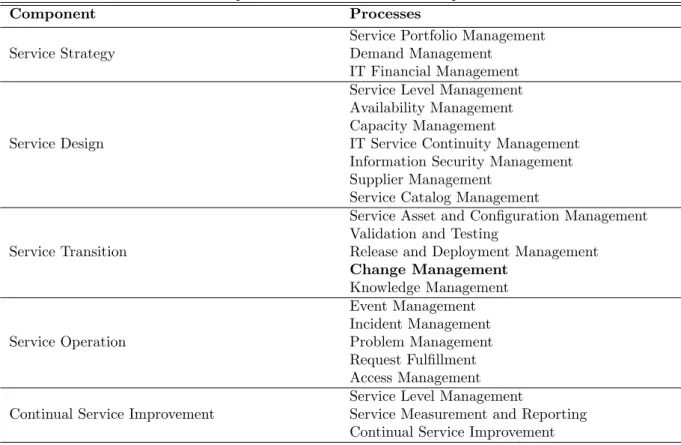
ITIL v3 Core is a set of five books, consisting of: Service Strategy, Service Design, Service Tran-sition, Service Operation and Continual Service Improvement. Each one provides guidance for an integrated approach. Furthermore, ITIL complementary guidance is a set of publications which are related to a specific industry, type of organization, technology architectures and operating models (Sharon Taylor, 2006). A more detailed description of each book is found in Table 1.1.
IT Service Management is a subset of the Services Science discipline that focuses on IT operations 1
Table 1.1: Components of ITIL v3 and its main processes
Component Processes
Service Strategy
Service Portfolio Management Demand Management
IT Financial Management
Service Design
Service Level Management Availability Management Capacity Management
IT Service Continuity Management Information Security Management Supplier Management
Service Catalog Management
Service Transition
Service Asset and Configuration Management Validation and Testing
Release and Deployment Management
Change Management Knowledge Management Service Operation Event Management Incident Management Problem Management Request Fulfillment Access Management
Continual Service Improvement
Service Level Management
Service Measurement and Reporting Continual Service Improvement
delivery and support (Galup et al., 2007) and, in spite of being often associated with ITIL (OGC, 2000) it also has an international standard, ISO 2000.
In this trend towards embracing principles of organizational IT Service Management, the IT Infras-tructure Library has, of all approaches, gained the biggest popularity and can, at least in Europe, now indeed be called ade-factostandard (Brenner, 2006).
Why is ITIL important to the organization? ITIL itself tells us a number of benefits, or added value for business, of having this process implemented. Such benefits can be (OGC, 2007):
• Implementing changes that can meet the customers’ agreed service requirements while opti-mizing costs
• Reducing failed changes and therefore service disruption, defects and re-work
• Tracking changes through the service lifecycle and to the assets of its customers
• Liaising with the business change process to identify opportunities for business improvement
Further more, in 2005 a study revealed that both customer satisfaction and operational performance improve as the activities in the ITIL framework increases (J.H. Botha, 2005). Increased use of the ITIL framework is therefore likely to result in improvements to customer satisfaction and operational performance.
1.2
Change Management
Change Management is not responsible for identifying components affected by Change or updating Change records (the domain of Configuration Management), nor is it responsible for the release of new changed components (the domain of Release Management) (OGC, 2001).
The change management process must:
• use standardized methods and procedures
• record all changes in the CMDB
• take account of risks for the business
ITIL Change Management recommendations emphasize on the activity of assessing and evaluating the change requests or change orders. During change assessment, some generic questions, popularly known as 7 Rs of change management, play critical role in judging its potential impact on service assets and configurations (OGC, 2007). These Rs are described below:
1. Raised - who raised the changes?
2. Reason - what is the reason for the change?
3. Return - what is the return required from the change?
4. Risk - what are the change’s risks?
5. Resources - what resources does it require?
6. Responsible - who are responsible for build, testing and implementation?
7. Relationship - which relationships exist between this and other changes?
Change Management is one of the ITIL processes and in the current version of this framework, it is integrated in the Service Transition volume (see Table 1.1). According to this framework, “Change is the process of moving from one defined state to another”.
The ITIL Change Management, in simple words, covers the management methods of IT change control encompassing the change orders or change requests for the Configuration Items2 (CIs).
CIs are the items that are present in the Configuration Management Database, commonly known as CMDB. CIs typically include IT Services, hardware, software, buildings, people and formal documentation such as Process documentation and Service Level Agreements (OGC, 2007).
Change Management is responsible for managing Change processes involving (OGC, 2001):
• Hardware 2
http://itilchangemanagement.blogspot.com/2009/10/itil-change-management.html, last accessed on Dec 2009
• Communications equipment and software
• System Software
• ’Live’ applications software
• All documentation and procedures associated with the running, support and maintenance of live systems.
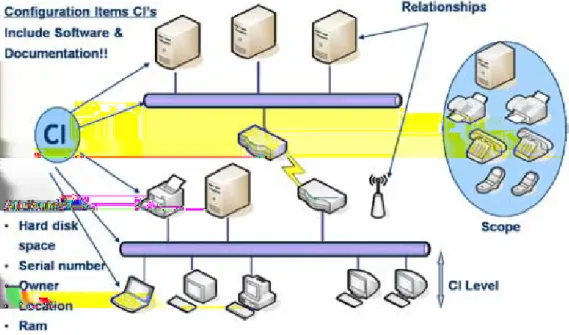
CMDB is something that underlies all the processes, it is where the usual asset management data resides, but the CMDB also holds the sources on information on the resources used by each service and their dependencies. A common example of a CMDB is shown in Figure 1.1. When a Change needs to be executed, the CMDB will show which components are attached to the altered compo-nent or service so that any consequences and problems associated to the change are always known (Greiner, 2007). Further more, this repository is widely used in many organizations (Steinberg, 2005)(Atherton, 2007).
Figure 1.1: The Configuration Management Database
The primary objective of Change Management is to enable beneficial changes to be made with minimal disruption to IT services. Change Management ensures that changes are deployed in a controlled way, i.e. they are evaluated, prioritized, planned, tested, implemented and documented (Arjen de Jong, 2008).
Changes arise as a result of problems, but many Changes can come from proactively seeking business benefits such as reducing costs or improving services.
Changes are also made for proactive or reactive reasons. Examples of proactive reasons are cost reduction and service improvement. Examples of reactive reasons for change are solving service disruptions and adapting the service to a changing environment.
The goal of the Change Management process is to ensure that standardised methods and procedures are used for efficient and prompt handling of all Changes, in order to minimise the impact of Change-related Incidents upon service quality, and consequently to improve the day-to-day operations of the organization (OGC, 2001).
1.3
Problem
One of the main challenges posed by information systems is ensuring they can deliver genuine business benefits. There is a very high failure rate among information systems projects because organizations have incorrectly assessed their business value or because firms have failed to manage the organizational change surrounding the introduction of new technology (Laudon, 2007).
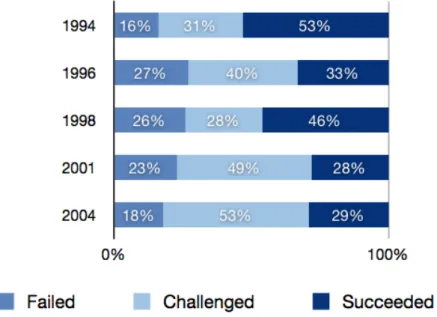
The CHAOS Report (The Standish Group, 1995) also refers that only 16% of IT projects are successful (finished on-time and on-budget). However, since 1994 this value has not suffered almost any variation, as it is illustrated in Figure 1.2.
Figure 1.2: Percentage of succeeded, challenged and failed IT projects according to The CHAOS Reports
ITIL is a methodology to improve delivery service efficiently and effectively, with high quality, based on the best practices of service. Every year more organizations desire implementing ITIL. However a considerable percentage of them fail and some organizations collapse trying it. Some of the most common mistakes made by organizations when implementing ITIL are (The Standish Group, 1995)(Sharifiet al., 2008):
• Lack of management commitment
• Spend too much time on complicated process diagrams
• Not assigning process owners
• Concentrating too much on performance
• Being too ambitious
• Failing to maintain momentum
• Allowing departmental demarcation
• Ignoring constant reviewing of the ITIL
• Memorizing self ITIL books
Besides these factors, another ones can also be referred like the organizational resistance to change or even the fact that ITIL books only explain what to do to implement its processes but it does not explain how that same implementation should be done.
Another research (Pereira, 2010) where a maturity model for ITIL implementations was developed and was tested in seven different portuguese organizations, proved that those same organizations had a maturity level of one. The fact that these organizations were only at the first level of maturity is also a good reason to believe that ITIL implementations are not easy.
There are studies that conclude that a majority of organizations give priority to implement some ITIL processes (Cater-Steel & Toleman, 2007a) but there is even less research about the implementation of these processes. Despite this sweeping adoption by industry, most academic institutions appear to be reluctant to include ITIL in their IT curriculum (Cater-Steel & Toleman, 2007b), what helps to explain a little why there is not much published in implementing ITIL.
Many organizations are already implementing ITIL. Most part of them resume ITIL to just Incident Management and Configuration Management. These points represent a huge problem regarding first, the CMDB and then the business itself. Many organizations that use a CMDB today don’t have Change Management implemented. The most direct consequence is that the CMDB used in Configuration and Incident Management, can become out of date very quickly, caused by any change in any Configuration Item (Ci). Some common examples are the installation of new software or even software updates in the workstations. Further more, these changes can occur several times a week or even several times a day. It becomes obvious that a CMDB that is not up to date, does not have any interest to the organization. Worse than that, working with a CMDB which is not up to date, thus inconsistent, can lead to wrong and bad decisions. As ITIL says, the Change Management process depends on the accuracy of the configuration data to ensure the full impact of making Changes is known (OGC, 2000).
So, the fact that many organizations don’t know how to implement Information Systems projects, namely ITIL, is a problem that this thesis proposes to solve.
1.4
Research Method
In order to evaluate the work and goals proposed on section 1.3, it was chosen a methodology called Action Research.
Action Research is about investigating change. Cunningham (1993) suggests that action research is “a continuous process of research and learning in the researcher’s long-term relationship with a problem”. He further suggests that the action researcher must be prepared to experience the research problems its context evolves within the problem. The intention of action research is to institute a process of change and then to draw conclusions from this process. More specifically, action research involves the collection of data about an organization in order to identify problems and their identifying causes (Michael E. Withman, 2004).
The ideal domain of the action research method is characterized by a social setting where (Baskerville, 1999):
1. The researcher is actively involved, with expected benefit for both researcher and organization.
2. The knowledge obtained can be immediately applied, there is not the sense of the detached observer, but that of an active participant wishing To utilize any new knowledge based on an explicit, clear conceptual framework.
3. The research is a (typically cyclical) process linking theory and practice.
In Action Research, the researcher wants to try out a theory with practitioners in real situations, gain feedback from this experience, modify the theory as a result of this feedback, and try it again. Each iteration of the action research process adds to the theory in this case a framework for information systems development so it is more likely to be appropriate for a variety of situations (Avisonet al., 1999).
The Action Research cycle is composed of five steps (Baskerville, 1999) which are (also illustrated on Figure 1.3):
Diagnosing
Diagnosing corresponds to the identification of the primary problems that are the underlying causes of the organizations desire for change. Normally, diagnosing is made through self-interpretation of the organizational problem. This diagnosis will develop certain theoretical assumptions (i.e., a working hypothesis) about the nature of the organization and its problem domain.
Action Planning
In this phase, researchers and practitioners collaborate in planning the actions to solve the problem identified earlier. This planning is guided by the theoretical framework, which indicates both some
Figure 1.3: The Action Research Cycle
desired future state for the organization, and the changes that would achieve such a state. The plan also establishes the target for change and the approach to change.
Action Taking
In this third phase, the actions decided in the last one (Action Planning), are implemented. Similarly to Action Planning, both researchers and practitioners work together in this implementation. For example, the intervention might be directive, in which the research “directs” the change, or non-directive, in which the change is sought indirectly. Intervention tactics can also be adopted, such as recruiting intelligent laypersons as change catalysts and pacemakers. The process can draw its steps from social psychology, e.g., engagement, unfreezing, learning and re-framing (Baskerville, 1999).
Evaluating
Following Action Taking, comes evaluation. This is the phase where is decided if the problem was successfully solved within the actions taken before. If those actions were unsuccessful, a change to the working framework or even to the hypothesis formulated at the begin of the cycle may be required or necessary.
Specifying Learning
This is the last step of the Action Research Cycle. In spite of being the last one, the learning should be done during all the other four steps. Taking the fact that this methodology has a strong
practical component, this learning comes natural and is made during all the process. This last phase has many advantages as not only because it is possible to learn about a problem a try to solve it better in a future cycle but also because the organization itself learns more about its nature and environment.
Chapter 2
Related Work
In this section, we present various concepts related to ITIL implementation, including CMDB and Change Management implementation, as well as some work that has already been done in this area. Unfortunately, there is still a lot to investigate as currently the information available is not as much as we would like (see page 17).
2.1
The Configuration Management Database
A Configuration Management Database (CMDB) is a repository of information related to all the components managed by IT. Although repositories similar to CMDBs have been used by IT depart-ments for many years, the term CMDB stems from ITIL. In the ITIL context, a CMDB represents the authorized configuration of the significant components of the IT environment. A CMDB helps an organization understand the relationships between these components and track their configura-tions. The CMDB is a fundamental component of the ITIL framework’s Configuration Management process. As it has been previously referred, a common example of a CMDB can be viewd in Figure 1.1.
The CMDB records are called Configuration Items (CI). A Configuration Item is any component of an information technology infrastructure that is under the control of configuration management. Configuration Items can be individually managed and versioned, and they are usually treated as self contained units for the purposes of identification and change control. The CMDB should also include all relationships between its Configuration Items.
All Configuration Items are uniquely identified by names, version numbers, and other attributes. The lowest level CI is usually the smallest unit that will be changed independently of other components. CIs vary in complexity, size, and type. They can range from an entire service which may consist of hardware, software, and documentation to a single program module or a minor hardware component.
The benefits of having a good Configuration Management CMDB are many. As ITIL says, some of these benefits are (OGC, 2000):
• CIs affected by a scheduled (authorised) Change
• All Requests for Change (RFCs) relating to one particular CI
• CIs purchased from a particular supplier within a specific period
• CI history
• Equipment and software at a given location, for example to assist in an audit
• CIs that are scheduled to be upgraded, replaced or decommissioned
• Changes and Problem records associated with a CI
2.2
The Change Management Process
Changes should be managed to optimize risk exposure, minimize the severity of any impact and disruption or to be successful at the first attempt (of any change). Such an approach will deliver direct benefit to the bottom line for the business by delivering early realization of benefits (or removal risk), with a saving of money and time (OGC, 2007).
While the benefits of applying IT Service Management practices vary depending on the organiza-tion’s needs, some typical benefits include (OGC, 2009):
• Improved quality service provision
• Cost justifiable service quality
• Services that meet business, customer and user demands
• Integrated centralized processes
• Everyone knows their role and knows their responsibilities in service provision
• Learning from previous experience
• Demonstrable performance indicators.
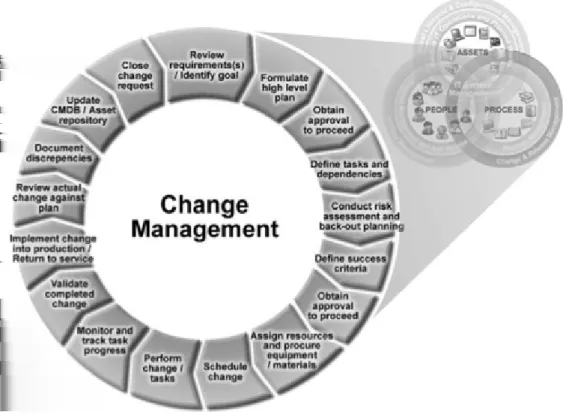
The activities involved in ITIL Change Management process are shown in Figure 2.3.
It is also important to consider the range of stakeholders who can benefit from improved ITSM practices. These stakeholders can come from (OGC, 2009):
• Senior management
• Business unit managers
• Customers
• IT staff
• Suppliers.
A study (Thomas Mendel, 2004) states that, on average, the information network causes 15% of all problems resulting in downtime at $1 billion-plus companies. However, only 2% are caused by actual networking hardware failures: The other 13% are due to different issues like human errors, unmanaged changes, misconfigurations, routing failures, and problems with networking software.
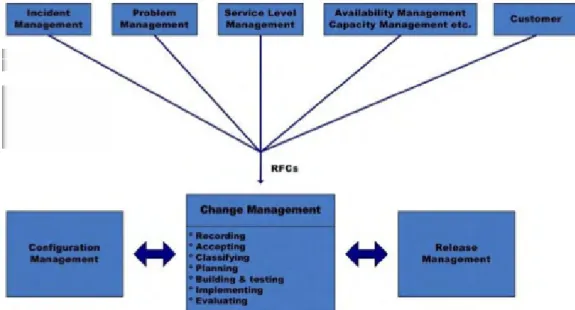
ITIL Service Support volume states that Change Management ensures that standardized methods and procedures are used for efficient and prompt handling of all changes, in order to minimize the impact of change-related incidents upon service quality, and consequently to improve the day-to-day operations of the organization (OGC, 2000). This way, Figure 2.1 shows the interfaces of Change Management process with other ITIL processes.
Figure 2.1: Change Management and other ITIL Processes (van Bon, 2007)
Furthermore, changes to any components that are under the control of projects are subject to project Change Management Procedures, not under general Change Management procedures. The Change Management team will, however, be expected to liaise closely with project managers to ensure smooth implementation and consistency within the changing management environments. It is the Change Management process that produces approval for any proposed Change. While Change Man-agement makes the process happen, the decision authority is the Change Advisory Board (CAB), which is made up for the most part of people from other functions within the organization (OGC, 2000).
Change Management Activities
Figure 2.2: High level overview of the change management process (Addy, 2007)
There is a research that proposes an interesting approach to the Change Management activities. The author states that it is based on ITIL with some specific modifications according to the business needs of the respective organization in the case study (Mattila, 2008). A summary of this process follows:
1. Request for Change (RFC) - change originator requests for a change by using a web form in the intranet or by sending e-mail to the Service Desk. Change initiator can be anyone. RFC ticket is created.
2. Change Coordinator reviews the RFC
3. Change Coordinator evaluates the RFC, classifies it, and categorizes it based on the impact and urgency. Change Coordinator does the initial planning of the change implementation by describing the change and by assessing the change necessity and feasibility.
4. The change request is approved for implementation either by the Change coordinator or the Change Advisory Board (CAB). Need for CAB approval depends on the change impact for the business, the scope of the investment, the amount of resources needed for implementation, and the amount of risk related to the change implementation.
5. Change Coordinator plans the change implementation by defining the tasks needed to com-plete the implementation, the work effort, resources, schedule budget and acceptance criteria. Change implementer plans the change implantation from technical viewpoint by defining tech-nical solution, test and back out plans.
6. The change is implemented according to the implementation plan and Build and Test and Release to production Methods
7. Build and Test is the change preparation process where impact of the change is verified and also what will be done and how. It also includes testing if feasible. Release to Production is the process of taking changes to production. It also involves defining if the change can be considered successful or not and deciding if implementation of back-out plan is needed.
8. The change implementation success and impact are reviewed in cooperation with the Change Originator. The RFC ticket and related information is updated, and the change ticket closed.
Change Advisory Board
According to ITIL, the Change Advisory Board (CAB) is a group that provides expert advice to the Change Manager. It involves representatives from various IT and business areas as well as other involved stakeholders including external suppliers. It is chaired by the Change Manager. There is also a subgroup of CAB called Emergency CAB which task is to provide expert advice for emergency change decisions (OGC, 2009).
A research asserts that too few people in the CAB make it easier to meet, but may exclude some of the essential stakeholders of a particular change1(Dorst, n.d.). In order to avoid this problem, the
author proposes the creation of several area CABs. This has the benefit that it becomes easier to accommodate existing decisions and communication forums. The logical separation between areas made it easier to appoint the correct people in these roles, both from a management (authority) and an acceptance perspective. In order to overcome the silo-structure that was created (albeit business rather than technology focussed), they defined a new role, the Change Controller which is someone who specifically (horizontally, across all CABs) would review, authorize, coordinate and control the changes from a technical or technological perspective.
Configuration Item Lifecyle
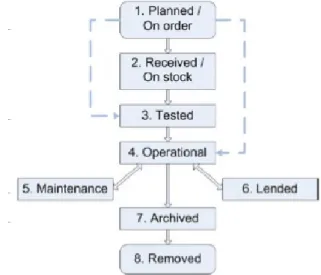
ITIL suggests only some examples of the status of an RFC as logged, assessed, rejected, accepted and sleeping. Mattila also proposes a Lifecycle in his thesis (Mattila, 2008) which is illustrated in Figure 2.4.
Figure 2.4: Lifecycle of hardware CI proposal (Mattila, 2008)
Other author still suggests other stages, as is shown in Figure 2.5 (Ward et al., 2007). He also introduces the concept of protected stages. In these stages, any change made do the Configuration Item required that an RFC has to be associated with them. This validation capability recognizes explicitly that there are life-cycle states in which a greater degree of control is required over the way in which they can be modified.
Change States
In spite of the fact that ITIL already defines different change states as standard, minor, major and significant, other authors propose slightly modifications to this idea.
For example, (Mattila, 2008) proposes three states instead of the four referred in the last paragraph: Normal, Major and Emergency Change.
Figure 2.5: Proposed states of change (Wardet al., 2007)
Metrics to be used
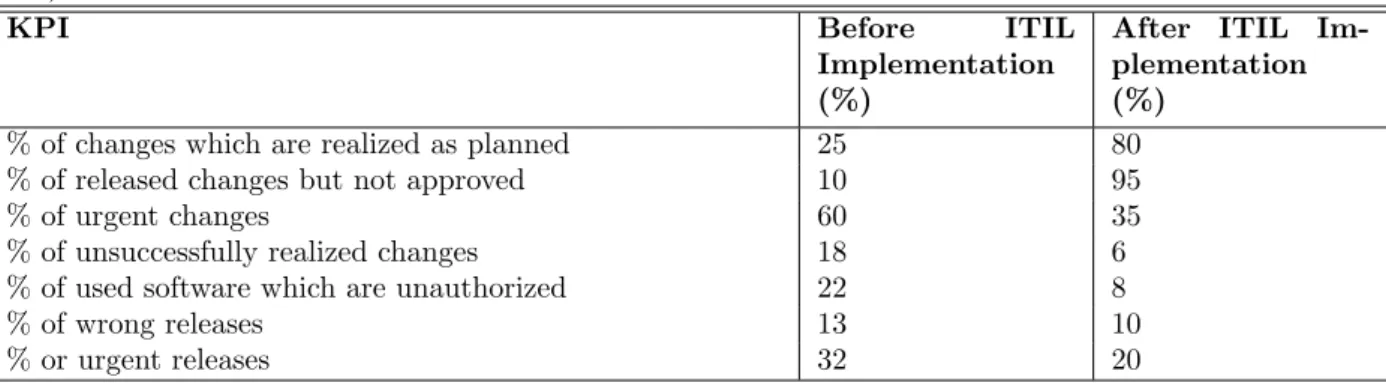
In a case study in which ITIL methodology was successfully implemented in a financial industry (Spremicet al., 2008), results based on a set of KPIs showed the exact and measurable improvements the Company achieved. Among many ITIL processes, in Table 2.1 are illustrated the KPI’s used in both Configuration and Release Management processes.
Table 2.1: KPIs for ITIL processes Change Management and Release Management (Spremicet al., 2008)
KPI Before ITIL
Implementation (%)
After ITIL Im-plementation (%)
% of changes which are realized as planned 25 80 % of released changes but not approved 10 95
% of urgent changes 60 35
% of unsuccessfully realized changes 18 6 % of used software which are unauthorized 22 8
% of wrong releases 13 10
% or urgent releases 32 20
However, some other metrics are proposed by Rob Addy. According to him, the following metrics should also be kept in mind (Addy, 2007):
• Number of changes within a specified period broken down by type.
• Percentage of changes completed on schedule.
• Percentage of changes completed within budget.
• Number of aborted changes within a specified period.
• Average duration broken down by type.
• Number of incidents attributed to changes completed within a specified period.
• Number of changes completed per time per unit
• Number of rejected changes
• Number of incidents resulting from changes
• Number of back out related to changes
• Cost of the implemented changes
Unfortunately, a large array of authors state that there is little or no published research that concerns ITSM. There is a world of knowledge, secretly contained in Consulting Firms and Organizations, but that knowledge is contained there, in exclusivity, and is not based on worldwide scientific construction. There is some research related to areas like automatic scheduling of IT Changes, but none concerning the actual way to implement and do IT Change Management. There are studies that conclude that a majority of organizations give priority to implement Change Management (Cater-Steel & Toleman, 2007a) but there is even less research about the implementation of this process.
Despite this sweeping adoption by industry, most academic institutions appear to be reluctant to include ITIL in their IT curriculum (Cater-Steel & Toleman, 2007b), what helps to explain a little why there is not much published in implementing ITIL, or specifically implementing Change Management.
So, actually it is not known how to implement ITIL Change Management in any context of an organization.
2.3
Information Systems Implementation
In order to better understand information systems implementation, a framework called The Work System Method (WSM) (Alter, 2006) was analysed.
Work System Method
This framework (see Figure 2.6) was designed to help business professionals understand systems in their organizations. It is especially valuable early in a system-related project when people identify the problem, think about alternative courses of action, and decide how to proceed. Unlike some other methods that require specific steps performed in a specific order, the work system method is designed to be quite flexible. It provides usable guidelines and analysis concepts while at the same time permitting the analysis to occur in whatever order and at whatever level of detail is appropriate for the task at hand.
So, the WSM is organized around a typical problem solving processes of defining a problem, gathering and analysing relevant data, identifying alternatives, and selecting a preferred alternative (Alter, 2006).
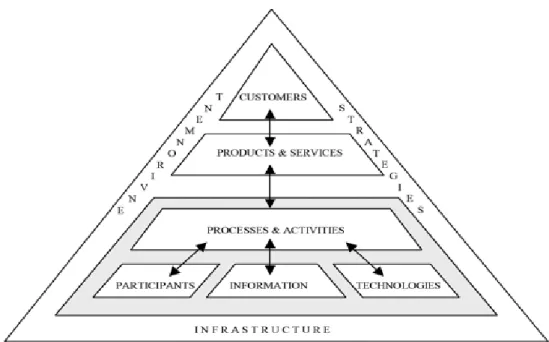
Figure 2.6: The Work System FrameworkTM (Alter, 2006)
WSM is divided into three major steps that apply general problem solving to typical systems in organizations:
1. SP- Identify the System and the Problem: Identify the work system that has the problems or opportunities that launched the analysis. The size and scope of the work system depends on the purpose of the analysis.
2. AP- Analyse the system and identify Possibilities: Understand current issues and find pos-sibilities for improving the work system.
3. RJ- Recommend and Justify changes: Specify proposed changes and sanity-check the recom-mendation.
To use this framework, the first and surely the most important phase is the first one, in which the work system itself is defined. It is a very important phase as if a system is defined too wide and contains many activities or processes, it becomes easy to loose the focus on the small problems that shouldn’t be ignored as unnecessary topics will expand time and effort required for the analysis. On the other hand, if a system is defined too strict or limited, we may not be able to detect external problems that are avoiding the well functioning of the activity in analysis in spite of being possible to view an entire organization as a single work system. Due to the points referred before in this paragraph, is is better to see that same organization as a combination of many smaller work systems.
Having said this, how is a Work System and its scope defined? Since this work’s scope is englobed on a Information Systems thesis, it is important to have in mind that the definition of a system work scope cannot be only thought in terms of technology. Using other words, the work defines the system, not the technology that is used to do the work. An example of a definition of a work system, is illustrated on Table A.1.
As shown on Table A.1, six main topics were defined: Customers, Products & Services, Work Practices, Participants, Information and Technologies. To understand a little bit more about what is each topic, a small description is made below:
• Customers- people who receive direct benefit from products and services the work system produces. They can be external customers who receive the organization’s products and/or services or internal customers who are employees or contractors working inside the organiza-tion.
• Products & Services- they are the combination of physical things, information, and services that the Work System produces. This may include physical products, information products, services, intangibles such as enjoyment and peace of mind, and social products such as ar-rangements, agreements, and organizations.
• Work Practices- these include everything that happens within the Work System. The term processes and activities is used instead of the term business process because many work systems do not contain highly structured business processes defined. However, business process is but one of a number of different perspectives for analyzing the activities within a work system. Other perspectives with their own valuable concepts and terminology include decision-making, communication, coordination, control, and information processing.
• Participants- these are the people who perform the work. Some may use computers and IT extensively, whereas others may use little or no technology. When analyzing a work system the deeper role of work system participant is more important than the more limited role of technology user.
• Information- includes codified and non-codified information used and created as participants perform their work which may or may not be computerized. Data not related to the work system is not directly relevant, making the distinction between data and information secondary when describing or analyzing a work system. Knowledge can be viewed as a special case of information.
• Technologiesinclude tools (such as cell phones, projectors, spreadsheet software, and auto-mobiles) and techniques (such as management by objectives, optimization, and remote track-ing) that Work System participants use while doing their work.
After defining the work system, the next phase is to analyse it. This way, we can evaluate it and decide wether and how to improve it.
IT Processes Performance
Nowadays, IT Departments can no longer be an isolated silo in the organization. They must be completely aligned with business in order not only to support it, but also to improve it. Still, business is not static, and it needs to be adapted as a response to market needs or to exploit a business opportunity that has arised. As business is not static, IT Services can’t be static either. This is another important motivation for IT Departments to continuously improve their processes
(Peynot, 2006). But once again, it is hard to define a roadmap for improvement as ITIL does not provide a set of tools to do so and as very often CIOs arent able to see the true links between IT and Business (Gaughan, 2008).
Even when CIOs know how to effectively analyze their IT processes performance and know which changes need to be introduced, in many situations, it is not easy to implement them. In fact, the amount of changes can be extremely high and according to Laudon’s framework (Laudon, 2007) they can be organized as following:
Organizational changes
• New organizational structure for the department • New skills demanded for the employees
• New activities and processes
• Different way to perform old activities
• New perspectives of how IT supports and enables Business
Managing changes
• New metrics and indicators to analyze • New SLAs
• Higher expectations for this department and his services
Technological changes
• New software • New hardware
Chapter 3
Proposal
Building a new Information System is one kind of planned organizational change. The inroduction of a new information systems involves much more than new hardware and software. it also includes changes in jobs, skills, management and organization. When we design a new Information System, we are redesigning the organization. Systems builders must understand how a systems will affect specific business processes and the organization as a whole.
An Information System implementation can be composed of three main components (Laudon, 2007). These components are People, Organization and Technology.
Being ITIL an Information System implementation, it can also be composed by these three compo-nents. As it has been already said in section X, there are few Information Systems projects that are finished on-time and on-budget.
Having said this, we propose an implementation of a new Information System taking in mind that it is crucial to avoid the problems that usually make this projects to fail, such as:
• Lack of management commitment
• Spend too much time on complicated process diagrams
• Not creating work instructions
• Not assigning process owners
• Concentrating too much on performance
• Being too ambitious
• Failing to maintain momentum
• Allowing departmental demarcation
• Ignoring constant reviewing of the ITIL
In the specific context of this thesis, we implemented the ITIL Change Management process in a public organization. This implementation consisted in two phases. The first phase of this work consisted in constructing a new and up to date CMDB so that it could bring added value to the organization. Only with this phase completed, the Change Management process implementation could advance.
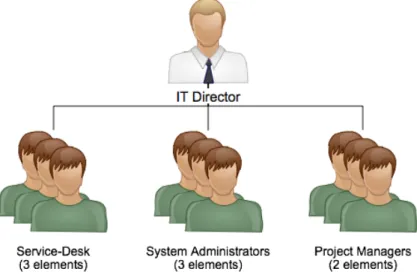
This implementation was integrated in a wider ITIL implementation project where other processes such as Configuration Management or Incident Management were underway or almost completely implemented. However, no Change Management process was defined. Besides this, the CMDB that existed was not up to date which made it unuseful. All its contents were more than one year old and since that time that nobody maintained it. The only information that was kept to date, was the inventory of the workstations of everybody and even this list, in which were made changes every day in order to keep it actual, had many inconsistencies. This list was only maintained by the service-desk responsible (see figure 3.1)
Figure 3.1: IT Department Organizational Chart
To implement the Change Management process in the organization, an application was developed using the agile programming framework Scrum in the Outsystems platform. With this solution, the time spent is minimal, the development sprints are very short and there is constant feedback between the users and the development team.
Chapter 4
First Research Cycle
The first of a set of two Action Research cycles concluded in this work, consisted in Importing a Configuration Management Database in a private organization which main business is to provide IT Outsourcing services.
In this project, the goal was to implement ITIL processes Incident Management and Configuration Management in the Organization mentioned before. At the moment, there were no processes defined and the idea was to create a centralized support center where they could manage all IT infrastructure of their clients, which had IT technicians in outsourcing contacts. The implementation of the Change Management process was also planned, but it was cancelled later. The causes for this cancelation are unknown.
In the future it was pretended to put all the technicians, that were in each client, in the newly created support center and do the work from there. Of course they would need to go to their clients if the situation required that.
The idea was to have these processes working for six different organizations (six clients of the organization).
4.1
Diagnosing
Before starting the project, a kick-off meeting was arranged. In that meeting, the problem (all the service-desk activities did not follow a defined process) and all its consequences were discussed. It was also decided mainly the specific organizations we would do the project. Some points were discussed in detail, such as deciding what would be the CIs and their types or subtypes, which turned to be the items illustrated on Table 4.1. A detailed diagram of these items and their relations can be viewed on Figure 4.1.
Table 4.1: List of types and subtypes of CMDB’s items CMDB items Type Subtype Workstation Desktop Laptop Server Physical Virtual Database SQL Oracle Application Client Web Router Router Switch External Device Local Printer Network Printer Scanner
4.2
Action Planning
By taking advantage of some other projects (MSc and Phd thesis) in implementing this ITIL process and using it to our benefit, it was decided to use an application already developed using the Outsys-tems technology. This application is already being successfully used in another public organization for almost two years in order to manage incidents according to the ITIL framework.
It was also discussed in a following-up meeting the states of any incident, during its lifecycle. It was decided that any incident should have one of possible nine states. These states and the transitions between them, are illustrated in Figure 4.2. A small description of each states is also made below:
• Not Assigned- The Incident has not been assigned to anyone • Assigned- The Incident is assigned to a technician.
• Validation of Information- It is verified if all the information needed to solve the incident is available.
• Pending from Client- Waiting for the client to give more detailed information about the incident.
• Scheduled- The incident is scheduled to be solved.
• External Entity- The incident resolution was assigned to an external entity. • In Resolution- Incident is being solved.
• Solved- Incident is solved.
• Closed- After the client confirmation that the incident is solved, it is closed. • Cancelled- Incident is cancelled.
Another topic that was decided was the impact, urgency and time of resolution of a problem. That decision is illustrated on Figure 4.3 where:
Figure 4.1: CMDB Data Model in the first organization
• Criticalmeans 2 hours • Highmeans 4 hours • Mediummeans 8 hours • Lowmeans 24 hours
• Planning- very low priority thus no time is assigned
Figure 4.3: Definition of resolution times according to urgency and impact of the incident
4.3
Action Taking
Putting this to work was not a big problem at all. All the points previously defined (the ones described in the last section) had to be configured in the Incident Management application which, once more, was already developed.
All this parameters were easy to set as the application has many configuration areas which allow to easily add or remove certain configuration data. Further more, it was used some former knowledge as we had information of these configuration data in a public organization where this process was already implemented.
Technicians
First of all the names and logins of the technicians, as well as other relevant data as their e-mails and phone contacts, had to be introduced in the system.
Two new teams were newly built. The service-desk team and the system administrator team. The service-desk team was the first line of support. It was their role to solve all the problems. If the service-desk could not solve the problem or incident, it was passed to a second line of support, the system administrator team.
The role of this second line of support was to solve any problems that the first line couldn’t solve, either by not having permissions or because they simply didn’t have the required knowledge. This team usually would resolve more technical and specific problems as for example upgrading a server or backing up some databases.
A third line of support was not defined as it was considered that this type of support would be given by external entities, usually the manufacturers which had already maintenance contracts with the organizations involved.
States and Transitions
The states previously defined, as illustrated in figure 4.2 had also to be introduced in the application. Then each transition between the states was also configured. This allowed the application to follow the states of the incidents exactly as it was defined earlier.
Impacts, Urgencies and Priorities
As previously defined in a meeting, the impacts, urgencies and its respective priorities, which were used to prioritize each incident, had also to be introduced in the application.
Four different Impacts and Urgencies were loaded. Then, the priorities were already defined for each combination of those same Impacts and Urgencies, as it is illustrated in Figure 4.3. The maximum times of resolution of the incidents according to its priorities were already set.
Incident Categories
The categories of the incidents also had to be defined. When creating an incident, the application forces the user to categorize it. The categorization is made after the technician has chosen what was the CI related with the new incident.
There were three top pre-defined categories by the application: Failure, Service Request and As-sistance Inquiry. My role here was to configure all the categories under each of these top three categories. They also had to be defined by CI Types and Subtypes (see those types in Table 4.1).
Using the knowledge from an older ITIL implementation process, these categories were defined:
• Failure
– Permission issues
– Outlook
– Office
– Operating System
– Workstation doesn’t boot
– Hardware
– Drivers
– Disks
– Communication Devices – Total Failure – Application – Other failures • Service Request – Keyboard – Mouse
– New software installation
– General Service Request • Assistance Inquiry
– General Inquiry
Building the CMDB
Having completed the first step, the loading of the CIs to the CMDB began.
Lists of all items were requested to each organization. The idea was to load all the CIs as soon as the lists were received. However, such requests turned out to be very difficult and long, as it is going to be described in the next section.
Using the Application
The technicians and the system administrators, which would be the new users of this application, had already worked with it in other organization. Thus, no training was required as they already had the necessary knowledge do work with it.
This way, the beginning of the use of the application was natural and had no difficulties at all.
4.4
Evaluating
Considering all the six organizations together, the following items were imported to the newly created CMDB:
• 292 Workstations
• 224 Staff
• 88 Printers or Scanners
• 22 Applications
• 11 Routers
• 116 Databases
4.5
Learning
After finishing this cycle, some conclusions can be taken.
First of all, some lists took a long time to receive. Then, we realised that all the lists came incomplete or with serious errors. The errors were very different, but mostly because the lists were incomplete or had many contradictions. The most common of these errors were (among others):
• Incomplete list of the existing workstations and servers
• List of users was incomplete and/or out of date
• It was not known what workstations were being used by what users
• It isn’t known which users use some applications
• It isn’t known what items are connected to the routers
• It isn’t known what computers use certain network printers
• It isn’t known what databases belong to what servers
In order to be possible to do the loading, we had to detect the errors and ask for a new list. This happened with all of the six organizations involved. While in the smaller ones (I am considering smaller the ones with less IT assets) it was more easy to correct what was wrong, in the bigger ones it revealed to be a bit more complex and long task. In spite of having more errors to correct, I also realized that in these ones, the quality of the lists was worse than in the smaller ones. Due to this fact we can say that the information about what the organizations have, become more accurate as less assets they have.
After asking for some more corrections of the lists until have accurate ones, we began the loading of the items to the CMDB. Fortunately this step was quick and we can affirm that six organizations had their CMDB loaded and used in the Incident Management process.
Throughout the entire process we can conclude that, as predicted, organizations don’t know what their assets are. Specifically in IT, which is the context of this project, no one knows how many workstations exist or who uses them, how many servers exist or the list of web applications, for example. These were real problems that had to be faced and solved in order to accomplish our initial goal, to successfully create an accurate Configuration Management Database.
The following step would be to start building an application to support a new Change Management process but, due to unexplained reasons, the project was cancelled by the organization which made impossible to accomplish all the initial goals.
Chapter 5
Second Research Cycle
The second Action Research Cycle took part in a second public organization.
This public organization has suffered some strong organizational changes in the last two years as it became responsible for managing not only its own headquarters but also all casinos and hotel schools from Portugal. The same happens to IT.
The goal in this second organization, which already followed some ITIL processes namely ITIL Incident Management and ITIL Configuration Management, was to implement ITIL Change Man-agement.
5.1
Diagnosing
Regarding its ITIL usage, they have been using an ITIL Incident Management application for almost two years. A Configuration Management application was already implemented and available but it was ignored by all as its rarely modified information data (the CI data and its relations) was out of date.
Especially this last point made the implementation of ITIL Change Management the next logical step. This way, the data of all IT assets would be kept up to date and this would bring many advantages to the Organization. These advantages were already described in the first chapters of this document.
At the beginning, there was no process defined for managing changes. Besides this, even the lists of assets were highly incoherent. All the data they used, was based on many Excel files. Almost everyone had its own Excel file and made changes on it not sharing them with anyone. No one could be sure on who had the right list of anything. The closest I verified for a process of managing changes, was the service-desk manager to update daily a list of the headquarters’ workstations and the users of each of these workstations.
5.2
Action Planning
Before implementing Change Management itself, a Configuration Management Database with all its up to date information had to be imported as Change Management logically makes no sense without a CMDB.
Like it was said before, an application was already functioning but all the data was out of date. So, the first step was to clean it before getting and introducing the new information. To clean it was relatively simple as it only required minor changes in the application itself once the items could not be deleted forever because there were many incidents that were related to one or more CIs. This way, the items were only deactivated maintaining all the data from the incident reports that existed at the time.
5.2.1
Defining the New Structure of the Data
The base structure, already defined in the existing Configuration Management application, allowed the division of each Configuration Item by one of the following CI Types (this is the name the application uses to name these types): Staff; Software; Hardware; Server; Workstation; Router; External Device; Racks; Communication Device; Database; Application.
TheseCI Types are static and pre-defined by the application. However, for each of theseCI Types, it is possible to define subtypes, designated by the application asMeta CIs.
Having said this, the structure of the data that was in place at the beggining had a quite complex model, as it is shown in Figure 5.1. TheMeta CIs are represented in Figure 5.1 inside the bubbles while the correspondent CI Types are represented outside those same bubbles.
As it was learned in the first organization, the more complex the structure we define, the longer it takes to obtain the information we want in a consistent mode. So, a new and more simple structure based on the former one was defined. The criteria used to choose which items would be imported was simply to choose the items that were more used by the service-desk technicians and system administrators in their daily tasks.
The structure of the new CMDB was defined as it is illustrated in Figure 5.2. In this figure, CI Types and its relatedMeta CIs are represented in the same way as in the previous figure.
In Figure 5.2 there are some sections marked in blue, namely Databases and Applications. The fact that these points are marked in a different way, was used to distinguish these ones from the other ones. The difference was that there was no available information about these ones. While some listings of the other assets were already available there was zero information about these ones. However, the fact that some of the listings were already available, did not help too much as they were all inconsistent and out of date. Once more, regarding to servers and databases, no list had ever been done.
Figure 5.1: Initial structure of the CMDB
5.2.2
Defining the Change Management Process
The design of the proposed Change Management Process, had some points taken in mind. First of all, it is based in the process defined by ITIL (see Figure 2.3). Then, the goal was to define a simple process based on the one described in ITIL, not forgetting its main phases like requesting, authorization, scheduling, implementation and roll-back if anything goes wrong.
In Figure 5.3 it is illustrated the proposed process in this thesis that was later implemented in the application. The same figure in a higher resolution is available in appendix B.
Figure 5.3: Proposed Change Management Process
As it can be seen, these process always begins creating a new RFC. In this step, it is chosen the CI in which the change is pretended to be made and all the related information such as the change requester, the category of the Request For Change and any additional details that describe the change and that will be useful for the Change Coordinator or CAB decide if the change will be accepted.
Depending on the category of the change, it can be standard or not. If it is, the change is automati-cally approved and the change can immediately be built. Otherwise, the request goes to the change coordinator awaiting feedback (Evaluate action in Figure 5.3). Here, if the Change Coordinator has all the privileges to approve or reject the change, he approves or rejects it. Otherwise, he passes the RFC to the CAB, a higher change authority which is capable of deciding if some changes can be built. Normally, these are changes which may represent higher risk to the business as they can cause
unwanted damage to it. For example, a change that requires some downtime from a crucial server to the business can be considered a type of change that requires the feedback from a CAB. However, the definition of the changes that required CAB review must be defined in each organization by that same organization. This way, it is guaranteed that all these classifications are aligned to the business itself.
After the approval phase, the RFC can be approved or rejected.
If it is rejected there are two options. The first one is that the RFC is simply closed. The second one allows the creation of a new RFC based on the first one. This normally happens when the first one did not have the required information for the Change Coordinator or the CAB to take a decision. In this case, the change agent receives the feedback from the Change Coordinator or the CAB and can provide the missing information in the new RFC. This corresponds to the decisionPropose New RFC in Figure 5.3.
If the RFC is approved, the Change Agent can Build the Change (Build Change). The RFC then passes to a testing phase where it will be tested if the Change was successful and did not cause any unexpected behaviour, either on the related CI or on any other one. For example, if a change is made in an application, is it necessary to check if the application continues to function without any problem and that all the workstations that use that application also do not experience any unexpected behaviour.
As ITIL defines, the Change Requester can be anyone. Then there are the roles of Change Agent that is responsible to build, test and close changes. Change Coordinator and CAB (Change Ad-visory Board) roles are assigned to the ones that inside the organization have the privileges or responsibilities to take decisions on Changes that may represent high risk or impact to the business.
Following this definition, different states for a RFC were also defined. These states and transitions are illustrated in Figure 5.4.
Figure 5.4: Change States Diagram
Below, a description of each state represented in Figure 5.4 is made:
• Pending Approval- After creating the RFC, the RFC passes to this state where it is pending an approval, either from a Change Coordinator or from a CAB. If the change is considered a standard change, the RFC automatically passes from this state toApproved or toRejected.
• Rejected- This is the state of the RFC when it was previously rejected either by a Change Coordinator or a CAB.
• Approved- In this state, the RFC was previously approved either by a Change Coordinator or a CAB.
• Testing- After building the change, the RFC remains in Testing. As explained earlier, this is the phase where it is checked that the change was successful.
• Closed - This is the last state of a RFC. A RFC can reach this state after being rejected or after having passed the testing phase. In this phase it is considered that the process was concluded and that the change was sucessful (if it was previously built).
5.3
Action Taking
In this section it will be described all the phases that followed the planning one, described in the previous section.
5.3.1
Getting the Data
Having defined the new structure, the next step consisted in requiring the data to the ones responsible for it. While the list of workstations, staff and phones was requested to the service-desk people, other items such as servers, databases and their relations were asked to the system administrators team.
A structured spreadsheet was provided to them where they could fill in the data and all the infor-mation that was needed. They were asked to provide:
• List of Workstations, their serial numbers, models and location
• Relationship between Staff and Workstations
• List of Servers and Clusters
• List of Databases
• Relationship between Databases, Servers and Clusters
• List of phones and its relationships with Staff
• List of Routers
A list of the the Staff was not needed as the application automatically obtains it once a day with a direct integration to the organization’s Active Directory.
In spite of having simplified the initial structure of the CMDB in order to be easier to understand and obtain the information, this phase revealed to be the most difficult, long (it took more than 3 months) and complicated phase.
5.3.2
Importing the Data to the CMDB
Once the data was obtained in a consistent mode, the importation began. Using the potentials of Outsystems technology, which makes it very simple to read data from Excel (.xls) files, this phase did not take long and in two days, all the information was loaded to the new CMDB.
5.3.3
The Change Management Prototype
Having concluded the previous phase, the building of the prototype to support the Change Man-agement Process began.
Technology
The technology chosen to build the prototype was the Outsystems Platform which is a technology that provides rapid and agile development of web based business applications.
Figure 5.5: The Outsystems Platform
It’s made of four major components, as illustrated in Figure 5.5:
• The Platform Server - a collection of services that complement standard .Net or Java application server installations and it is where the web application is stored and run. This component is composed by the four components Application Management, Environment Op-eration, Application Server and 1-Click Publishing illustrated in Figure 5.5.
• Service Studio - a visual modelling tool used by development and maintenance teams to assemble and change web business applications.
• Integration Studio- a windows tool that works in tandem with Microsoft Studio or Eclipse. It is used by developers to extend the built-in Platform Services with extra functionality.
• Service Center- a browser-based administration console that controls and manages the agile platform.
The reasons that led to the choice of this solution were first of all, the ease and the rapid development of applications that it provides. Then, the implementation of both Incident and Configuration Management processes had already been done using this technology, which would facilitate the integration of the existing ones to the new Change Management process.
Integration
One of the advantages of using the Outsystems platform and having already the Configuration Management application developed with this technology is the integration between applications.
Once the Change Management process is highly dependent on a Configuration Management Database, it became necessary to integrate the new Change Management prototype with the existing Config-uration Management one, using this way the items of the CMDB.
The Outsystems platform allows integration with other Outsystems applications by sharing some of its components that can be used by other applications. Those shared components are webblocks, actions and entities. In Figure 5.6 are illustrated some of the references from the Configuration Management Application that are used in the new Change Management prototype.
Figure 5.6: References from the Configuration Management Application
The webblocks used such as CIEdit, CIShow, ShowRelation or ListCIs allow to view the CMDB items using the same screens. The actions refer to the usually called functions that can be also used in the new application. Lastly, CMDB’s entities are also used. The most important one is the CI
Data Model
In Figure 5.7 it is shown the defined datamodel of the new prototype.
Figure 5.7: The Prototype’s Datamodel
Below, a small description of each one of the entities shown in figure 5.7 is made:
• RFC - This is the central entity. As it can be seen, all data from a created Request For Change like the Change Requester, the CI where the change is intended to be made or all the RFC history is stored here.
• RFCState- The states of a Request For Change are defined in this entity. The states defined, are the ones previously described in section 5.2.2.
• RFC Logs- In this entity, each log is considered to be a change to a attribute of a CI. The list of all changes related to an RFC are a set of many RFC Logs records (one for each attribute changed) related to one only RFC.
• ChangeLogRelations- Similar to the last one, but instead of registering the changes of the attributes, it registers the changes in relations between CIs.
• Categories- Here, the different categories of a Request For Change are defined and also if a Category represents a standard change or not.
• Priority- Here, it is defined the priorities for a RFC. These priorities are defined, according to ITIL, as a result of a matching between an Impact and an Urgency.
• ChangeLog- A set of logs of all changes to a CI. This entity is used to show the history of changes to the attributes of a CI in the CMDB application.