Council of the European Union Brussels, 17 December 2014 (OR. en) 17036/14 CSDP/PSDC 745 COVER NOTE
From: European External Action Service To: European Union Military Committee Subject: EU Military Rapid Response Concept
Delegations will find attached EEAS document 02168/3/14 REV 3.
Encl.: EEAS document 02168/3/14 REV 3
17036/14 LPS/ils
EUROPEAN EXTERNAL ACTION SERVICE
EUROPEAN UNION MILITARY STAFF Brussels, 17 December 2014 EEAS 02168/3/14 REV 3 CSDP/PSDC NOTEFrom: European Union Military Committee
To: European Union Military Committee
No. Prev. doc.: 11406/14, dated 27 June 2014
Subject: EU Military Rapid Response Concept
Delegations will find attached the EU Military Rapid Response Concept, as agreed by the EUMC on 17 December 2014.
________________________
EEAS 02168/3/14 REV3 JD/is 1/68
EUROPEAN UNION
MILITARY RAPID RESPONSE
CONCEPT
EEAS 02168/3/14 REV3 JD/is 2/68
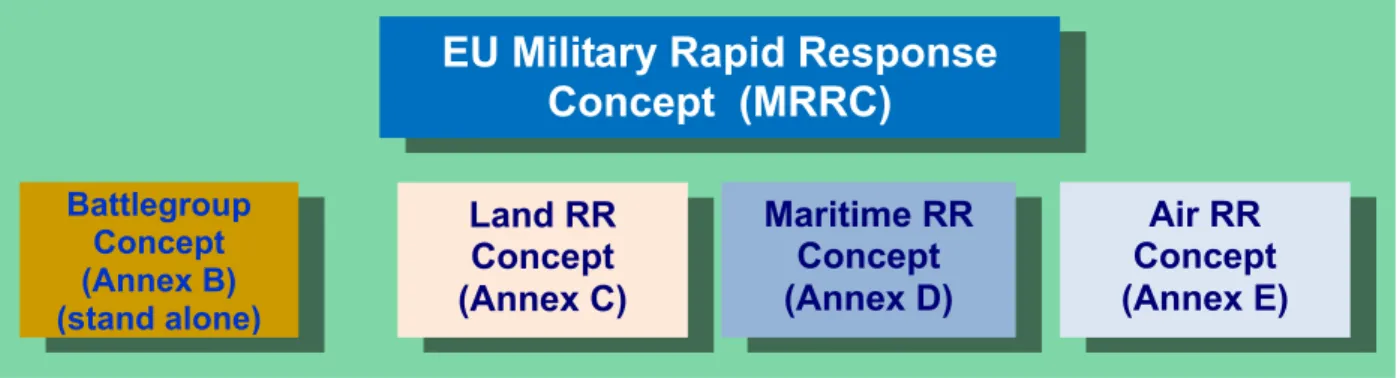
TABLE OF CONTENTS REFERENCES... 5 A. INTRODUCTION ... 8 B. AIM ... 11 C. SCOPE ... 11 D. DEFINITIONS ... 12
E. MILITARY RAPID RESPONSE CONCEPTS HIERARCHY ... 12
F. MILITARY RAPID RESPONSE PRINCIPLES AND CONSIDERATIONS ... 13
G. CHARACTERISTICS AND RISKS ... 15
H. MILITARY RAPID RESPONSE TASKS ... 16
I. MILITARY RAPID RESPONSE TIMELINES ... 22
J. READINESS ... 25
K. MODULARITY ... 26
L. MILITARY RAPID RESPONSE MECHANISMS ... 30
M. MILITARY RAPID RESPONSE INITIATION PROCEDURES ... 34
N. FACILITATING OFFERS AND COMMITMENTS TO THE EU BG CONCEPT ... 38
O. MILITARY RAPID RESPONSE PLANNING ... 39
P. COMMAND AND CONTROL ... 41
Q. STANDARDS, TRAINING AND CERTIFICATION ... 42
R. MILITARY RAPID RESPONSE FINANCE ... 44
ANNEX A – MILITARY RAPID RESPONSE "GENERIC TASKS" ... 45
ANNEX B – EU BATTLEGROUP CONCEPT... 48
ANNEX C – EU LAND RAPID RESPONSE CONCEPT ... 49
A. INTRODUCTION ... 50
B. PURPOSE ... 51
C. SCOPE ... 51
D. LAND CHARACTERISTICS IN RAPID RESPONSE ... 51
E. PROCESSES AND MECHANISMS ... 52
F. KEY CONSIDERATIONS IN IMPLEMENTATION ... 53
ANNEX D – EU MARITIME RAPID RESPONSE CONCEPT ... 56
A. INTRODUCTION ... 57
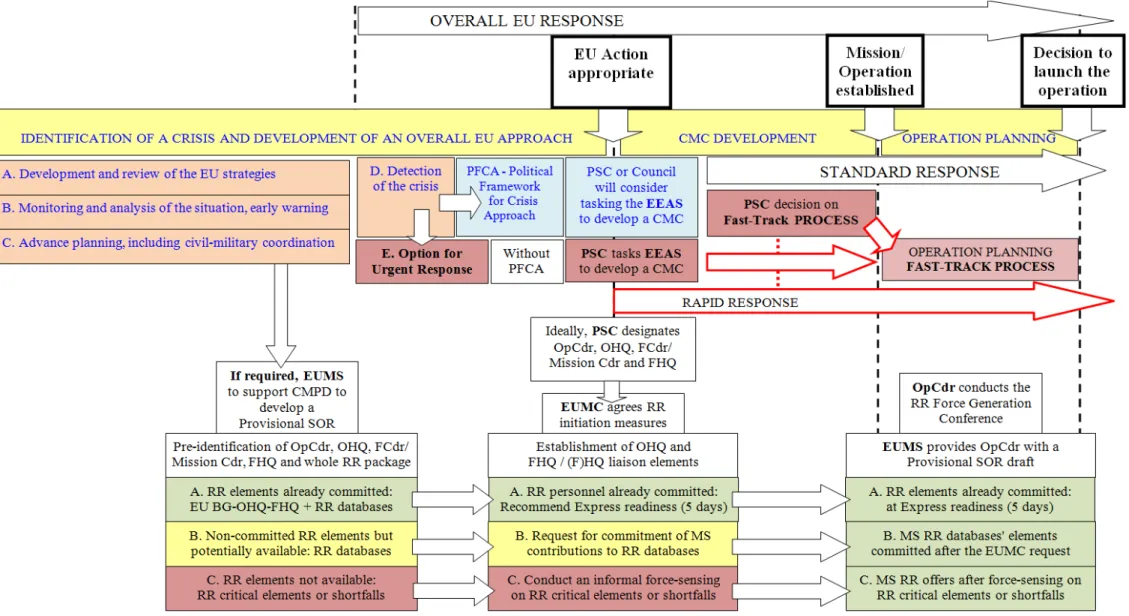
B. PURPOSE ... 58
C. SCOPE ... 58
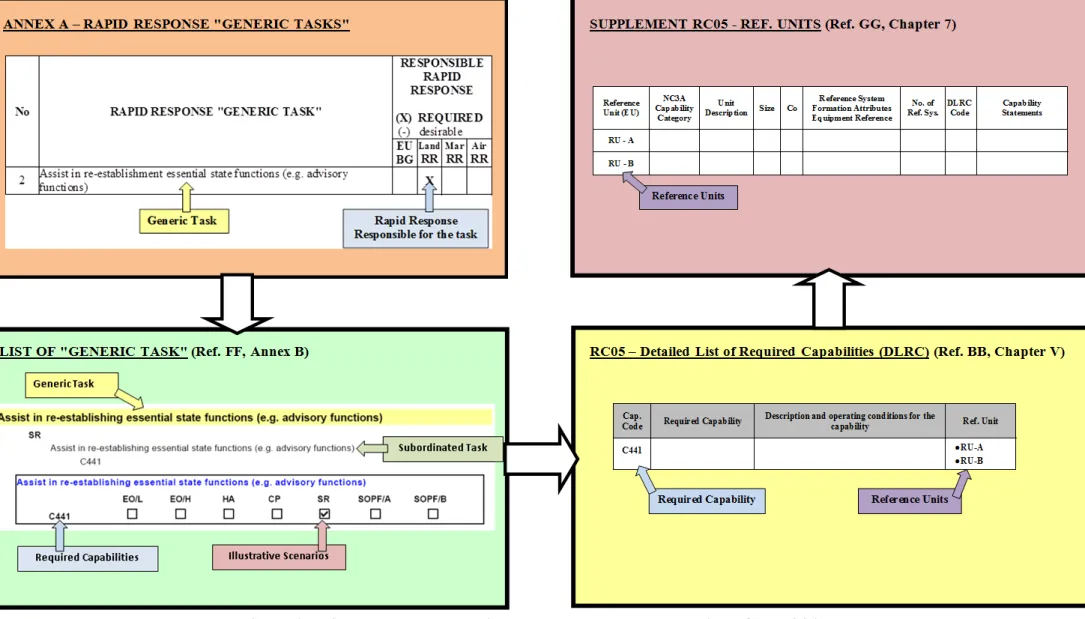
EEAS 02168/3/14 REV3 JD/is 3/68
D. MARITIME CHARACTERISTICS IN RAPID RESPONSE ... 58
E. PROCESSES AND MECHANISMS ... 59
F. KEY CONSIDERATIONS IN IMPLEMENTATION ... 60
ANNEX E – EU AIR RAPID RESPONSE CONCEPT ... 63
A. INTRODUCTION ... 64
B. PURPOSE ... 65
C. SCOPE ... 65
D. AIR POWER CHARACTERISTICS IN RAPID RESPONSE ... 65
E. PROCESSES AND MECHANISMS ... 66
F. KEY CONSIDERATIONS IN IMPLEMENTATION ... 66
EEAS 02168/3/14 REV3 JD/is 4/68
A. REFERENCES
A. Presidency reports to the Helsinki European Council - on strengthening the common
European policy on security and defence – non-military crisis management of the European Union (doc. 13619/1/99 REV 1, dated 8 December 1999).
B. EU Framework Nation Concept (doc. 16276/10, dated 22 November 2010).
C. EU Military Rapid Response Concept (doc. 5454/1/09 REV 1, dated 27 April 2009). D. Headline Goal 2010 (doc. 6309/6/04 REV 6, dated 4 May 2004).
E. The Treaty on European Union.
F. EU Battlegroups Concept (doc. 13618/06, dated 5 October 2006).
G. EU Maritime Rapid Response Concept (15294/07, dated 15 November 2007). H. EU Air Rapid Response Concept (16838/07, dated 21 December 2007).
I. EU Civilian and Military Capability Development beyond 2010 (Doc. 17127/10, dated 7 December 2010).
J. European Council 19/20 December 2013 – Conclusions (doc. EUCO 217/13, dated 20 December 2013).
K. Council Conclusions on Common Security and Defence Policy (CSDP) (doc. 15992/13, dated 25 November 2013).
L. Revised EEAS note on EU Rapid Response Capabilities and EU Battlegroups (doc. 16289/13, dated 15 November 2013).
M. PMG recommendations on EU Rapid Response Capabilities and EU Battlegroups (doc. 14968/13, dated 6 November 2013).
N. Military Advice on EEAS note EU Rapid Response Capabilities and EU Battlegroups including Supporting Documents (doc. EEAS 02182/13 FINAL COR 1 dated 14 November 2013).
O. Suggestions for crisis management procedures for CSDP crisis management operations (doc. 7660/2/13 REV 2, dated 18 June 2013).
P. EU Concept for Military Planning at the Political and Strategic level (doc. 10687/08, dated 16 June 2008).
EEAS 02168/3/14 REV3 JD/is 5/68
Q. EU Concept for Military Command and Control (doc. 10688/5/08, dated 24 September 2012). R. EU Concept for Force Generation (doc. 10690/08, dated 16 June 2008).
S. EU Concept for Military Intelligence Structures in EU Crisis Management and EU-led Military Operations/Missions (doc. 16361/13, dated 18 November 2013).
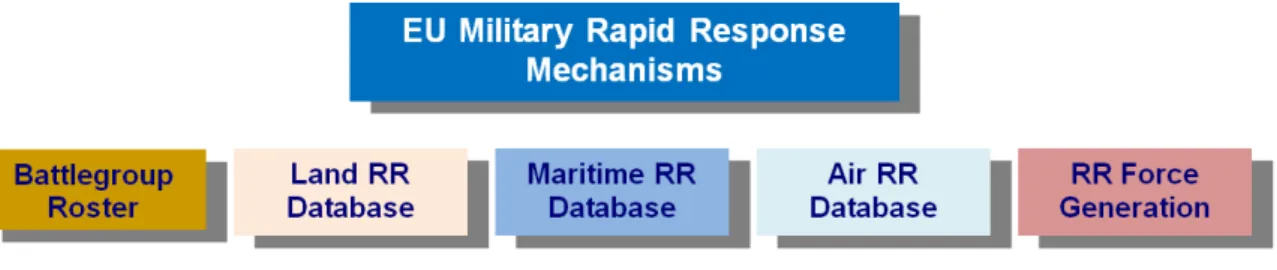
T. EU Concept for Logistic Support for EU-led Military Operations (doc. 8641/11, dated 4 April 2011).
U. Host Nation Support (HNS) Concept for EU-led Military Operations (doc.7374/12, dated 6 March 2012).
V. EU Concept for Strategic Movement and Transportation for EU-led Military Operations (doc. 9798/12, dated 11 May 2012).
W. EU Concept for Reception, Staging, Onward Movement and Integration (RSOI) for EU led Military Operations (doc. 9844/12, dated 11 May 2012).
X. Military Engineering Concept for EU-led Military Operations (doc. 11242/12, dated 12 June 2012).
Y. EU Concept for Contractor Support to EU-led military operations (Doc. 8628/14, dated 07 April 2014)
Z. Comprehensive Health and Medical Concept for EU-led Crisis Management Missions and Operations (doc. 10530/14, dated 3 June 2014).
AA. EU Concept for CIS for EU-led Military Operations (9971/12, dated 14 May 2012). BB. Requirements Catalogue (RC 05) (doc. 13732/05, dated 7 November 2005).
CC. European Security Strategy (doc. 15895/03, dated 5 December 2003).
DD. Report on the Implementation of the European Security Strategy - Providing Security in Changing World (16823/1/08 REV 1, dated 5 December 2008).
EE. PMG recommendations on EU Battle Groups (doc. 17150/11, dated 17 November 2011). FF. Evaluation Handbook (doc. 8923/07, dated 25 April 2007).
GG. Supplement to the RC05 (doc. 13076/05, dated 7 November 2005).
HH. Translation from EU Capability Codes and Statements to Reference Units (doc. EEAS 00681/1/12 REV 1, dated 25 April 2013).
II. GAERC conclusions (doc. 90004/05, dated 23 May 2005).
EEAS 02168/3/14 REV3 JD/is 6/68
JJ. Council Conclusions on Military Capability Development (doc. 15281/12, dated 19 November 2012).
KK. EU Principles for EU Headquarters (doc. 9983/14, dated 16 May 2014).
LL. Council Decision 2011/871/CFSP of 19 December 2011 establishing a mechanism to administer the financing of the common costs of European Union operations having military or defence implications (Athena).
MM. EU Capability Codes and Statements (EU CCS) (doc. EEAS 01021/1/12 REV 1, dated 11 July 2012).
NN. EU Maritime Dimension Study (doc. 6794/07, dated 2 March 2007).
OO. EU Maritime Security Operations (MSO) Concept (doc. 8592/12, 17 April 2012). PP. European Union Maritime Security Strategy (doc. 11205/14, 24 June 2014). QQ. EU Maritime Security Strategy Action Plan (doc. 15658/14, 24 November 2014). RR. European Union Concept for EU-led Military Operations and Missions (doc. EEAS
00990/4/14, 30 October 2014).
SS. Mandate and Methodology for a study of the Rapid Response Air Initiative in ESDP (doc. 11774/06, dated 18 July 2006).
TT. Rapid Response Air Initiative Paper (doc. PLP 4198/07 dated 20 September 2007).
UU. Concept for the Implementation of a European Union Air Deployable Operating Base (doc. 6908/1/10 REV 1, dated 19 March 2010).
VV. Concept for Air Operations in support of the Common Security and Defence Policy (doc. 8569/11, dated 5 March 2011).
EEAS 02168/3/14 REV3 JD/is 7/68
B. INTRODUCTION
THE OPERATIONAL BIRTH OF EU MILITARY RESPONSE
In 2003, following a long period of turmoil in the Ituri province in North Eastern Democratic Republic of Congo (DRC), a rebel group took control of the provincial capital Bunia. Due to ethnic cleansing a massive flow of refugees was started which led to a critical humanitarian situation. A relatively small UN force already in place in DRC, MONUC, neither had the strength nor the mandate to deal with this very critical situation. The UN decided to deploy a larger force with a stronger mandate but it needed time for the process. Therefore the UN approached France and asked it to lead an interim force to bridge the gap until the UN had its new force in place. This led, on 19 May, to a mandate for PSC to explore the potential for an EU operation. On 30 May there was a UN Security Council resolution (1484) adopted that gave the legal mandate for an EU operation. The EU Council adopted the Joint Action on 5 June 2003 designating France as Framework Nation for the operation, appointing the Operation Commander (OpCdr) and designating Operation
Headquarters (OHQ) and Force Commander (FCdr). In the period between 8 and 10 June the OPLAN was presented to MS by the OpCdr and revised in order to be approved by the EU Council on 11 June, the very same day as a Force generation Conference took place in Paris. On 12 June the Operation was launched (seven days after the Council adoption of the Joint Action) and the first elements of the force were deployed to theatre. It is worth taking note of the fact that it took until 14 July for the force to develop Full Operational Capability. This was mainly due to the very remote location of Bunia and the logistical challenges in deploying and sustaining the force.
The rapidity in assessment, MS political support, decision making, planning, force generation, MS force contributions and deployment were identified as critical criteria for success in future
operations. The complexity of this kind of crisis indicates that the EU needs to have the capabilities, in all dimensions, in order to be able to act/react in a flexible manner which could be adapted to the uniqueness of each situation and to the tasks that need to be undertaken. A holistic approach, which the revision of the Concept for EU Military Rapid Response is aiming at, will facilitate this.
EEAS 02168/3/14 REV3 JD/is 8/68
CONTEXT
1. At the 1999 Helsinki European Council, Rapid Response (RR) was identified as an important aspect of EU crisis management. As a result, the Helsinki Headline Goal 2003 (Ref. A) assigned to Member States (MS) the objective of being able to provide rapid response elements available and deployable at very high levels of readiness. The existing gap in the RR capabilities was bridged by the EU Framework Nation Concept from 2002 (Ref. B). Subsequently the first EU Military Rapid Response1 Concept (MRRC) (Ref. C) was agreed in early 20032.
2. In June 2003, the first EU military quick reaction and very expeditionary operation, Operation Artemis, was launched. It very successfully demonstrated the EU's ability to operate with a rather small force at a distance of more than 6,000 km from Brussels. Moreover, it highlighted the need for the further development of RR capabilities. Subsequently, Operation Artemis became a reference model for the development of a Battlegroup-sized Rapid Response capability.
3. In 2004, MS committed themselves to the Headline Goal 2010 (Ref. D) to be able to respond with rapid, decisive and coherent action across the whole spectrum of crisis management operations covered by the Treaty on European Union (TEU) (Ref. E). Furthermore, the ability for the EU to deploy force packages at high readiness as a response to a crisis either as a stand-alone force or as a part of a larger operation enabling follow-on phases was considered a key element of the 2010 Headline Goal. Subsequently the first EU Battlegroups (EU BG) Concept
(Ref. F) was agreed in 2004.
4. The RR conceptual framework was complemented in 2007, when the EU MaritimeRapid Response Concept (Ref. G) and the EU Air Rapid Response Concept (Ref. H) were agreed. 5. Additionally, in the EU Civilian and Military Capability Development beyond 2010 (Ref. I) the
Council remains fully committed to the comprehensive civil-military level of ambition, aiming at being able to plan and conduct simultaneously a series of operations and missions, of varying scope, including: two RR3 operations of limited duration using, inter alia, EU BGs.
6. For the first time since the entry into force of the Lisbon Treaty, the European Council held a thematic debate on defence in December 2013. This proved to be the catalyst for thoroughly
1Rapid Response was defined as: The acceleration of the overall approach which encompasses all interrelated measures and actions in the field of decision-making, planning, force identification, generation/activation and deployment, together with the availability of assets and capabilities, and potential C2 options, in order to enable a swift and decisive military reaction to a crisis.
2This original concept was revised and agreed by the EUMC in 2009 (Ref. C).
3 The requirement for smaller, faster response elements has been refined and is now known as Rapid Response.
EEAS 02168/3/14 REV3 JD/is 9/68
EUMS
EN
revising and strengthening the complete suite of RR tools. In this vein, with a view to
improving the EU Military RR capabilities including the usability of EU BG, the European Council of 19-20 December 2013 endorsed (Ref. J) the Council conclusions on Common Security and Defence Policy (Ref. K) in which it endorsed the proposals set out in the EEAS note on EU RR capabilities and BG (Ref. L). This proposal constitutes the mandate for the new revision and the development of the EU Military RR capability. The framework is
complemented by the PMG recommendations on EU Rapid Response Capabilities and EU Battlegroups (Ref. M) and the related Military Advice on EEAS note EU Rapid Response Capabilities and EU Battlegroups (Ref. N).
PURPOSE AND OBJECTIVES OF THE REVISION
7. To achieve an overall EU RR both the political reaction and the EU Military Response need to be fast and effective. While this concept addresses the Military Response it also identifies preparation and planning issues that can contribute to reducing the reaction time.
8. Therefore this revision will endeavour to refine the RR suite, the main elements as listed below: - identifies the decisions that initiate a RR;
- establishes the procedures to be followed and measures to be taken in order to facilitate the timely commitment and generation of RR forces.
- suggests the early identification and activation of OHQ/OpCdr and Force Headquarters
(FHQ)/FCdr; or, where applicable, Mission Headquarters (MHQ)/Mission Commander (MCdr); and the early involvement of the respective liaison elements in order to enable timely operation planning;
- develops the modular approach and aligns timelines and readiness to enable flexibility, complementarity, jointness and timeliness;
- distributes the generic RR tasks among the different RR tools in order to facilitate effective preparation;
- develops a Land Rapid Response Concept in order to complete the RR suite;
- revises the Air and the Maritime Rapid Response Concepts to adapt them to the new RR suite.
EEAS 02168/3/14 REV3 JD/is 10/68
C. AIM
9. This concept provides the conceptual framework for the preparation and conduct of CSDP joint4 and single service military operations/missions requiring a Rapid Response in the land,
maritime and air domains, and including special operations, as a part of the EU multidimensional response.
D. SCOPE
10.This document describes the EU's approach to Military Rapid Response and how it could be delivered. This EU Military RR action may either involve EU BGs (Joint Land Centric RR), Single Service RR elements (Land, Maritime or Air), Joint RR (combining EU BG and Single Services RR elements, or combining Single Service RR elements) or any other RR elements offered by volunteered MSs.
11.It will define Military Rapid Response, its nature, characteristics, principles and procedures. This will be compared with the standard EU Military Response and its relationship to other EU instruments and the Crisis Management Procedures (CMP) (Ref. O).
12.It will establish the framework within which subordinate Military Rapid Response concepts sit, in accordance with three principal EU military concepts: EU Concept for Military Planning at the Political and Strategic level (Ref. P), EU Concept for Military Command and Control (Ref. Q), and EU Concept for Force Generation (Ref. R).
13.Although the EU has both the increased potential and the ambition - by drawing on the full range of its civilian and military instruments and resources - to make its external action more consistent, more effective, more strategic and more comprehensive, only the military
instruments and associated factors are considered in this concept. Whilst taking into account the characteristics and the autonomy of the EU, to ensure interoperability and to avoid unnecessary duplication, the document aims to be coherent with NATO definitions and procedures, to the extent possible.
4Activities, operations/missions and organisations in which elements of at least two (military) services participate.
EEAS 02168/3/14 REV3 JD/is 11/68
EUMS
EN
EU Military Rapid Response
Concept (MRRC)
Air RR Concept (Annex E) Maritime RR Concept (Annex D) Battlegroup Concept (Annex B) (stand alone) Land RR Concept (Annex C) E. DEFINITIONS14.Standard Military Response. The ability to be able to deploy up to 60.000 troops within 60 days, requirement confirmed in the EU Civilian and Military Capability Development beyond 2010
(Ref. I), as a part of the EU multidimensional response is defined as a standard Military Response.
15.Rapid Response. Rapid Response is a process that delivers the required effects, in a particular crisis, quicker than a standard response (within 30 days or whichever timelines set by the political authorities, depending on the EU level of ambition).
16.Military Rapid Response. Military Rapid Response is the acceleration of the overall military approach which encompasses all interrelated measures and actions in the field of Intelligence collection, decision-making, planning, force generation and deployment, together with the availability of assets and capabilities, and potential Command and Control (C2) options, in order to enable a decisive military response to a crisis within 30 days, as a part of the EU multidimensional response.
F. MILITARYRAPIDRESPONSECONCEPTSHIERARCHY
17.The EU MRRC is the parent document for all other related Rapid Response concepts: EU BG Concept (Ref. F), Land RR Concept, Maritime RR Concept and Air RR Concept. The EU RR Concepts hierarchy is at Figure 1. Its aim is to ensure consistency, interconnection,
compatibility, interoperability, complementarity and standardisation across the full spectrum of EU Military RR in order to facilitate a co-ordinated, effective and timely response to any given crisis.
Figure 1: Military Rapid Response Concepts Hierarchy
EEAS 02168/3/14 REV3 JD/is 12/68
18.While the subordinated Land RR Concept along with the former independent Maritime and Air RR Concepts are included as Annexes C, D and E respectively in the parent document, the also included and subordinated EU BG Concept (Annex B, which is the reference to the stand alone agreed EU BG concept (Ref. F)) will be maintained as an independent part of the MRRC.
G. MILITARYRAPIDRESPONSEPRINCIPLESANDCONSIDERATIONS
19.Speed. There is the need to generate suitable and available forces, equipment and C2 structures quickly to enable a Military Rapid Response. The mechanism to generate forces quickly is a primary requirement for Military Rapid Response. Without it, the time needed for planning, organisation and preparation could exceed the time available.
20.Risks. Military Rapid Response Forces' operational advantage is their increased agility but they might face or take a calculated risk, in combat engagement and sustainability, in comparison to those forces employed in a standard Military Response. Although force protection, logistic, health and medical, and intelligence support, CBRN and other combat or combat service support capabilities will be tailored accordingly there may be associated risks in conducting a Military Rapid Response and consequently on how the force can be employed.
21.Concurrency. Planning and Force Generation of available and suitable forces must be conducted concurrently if a Military Rapid Response is to be achieved. This is greatly assisted by as much Advance Planning and advanced Force Packaging as possible.
22.Readiness Matching. The readiness of military units offered or on stand-by must match the timings of the political decision making process, in particular those designated for specific cases of Military Rapid Response such as the EU BG. The readiness and early availability of the supporting elements in such cases, e.g. logistic and intelligence support or other enablers like air and sea lift assets, must also match. Without appropriate readiness, forces may not be available, in the right sequence, at the right time. Until forces are assigned to the OpCdr by a Transfer of Authority (TOA), changes in their readiness to meet the timeline for an operation remain a national responsibility.
23.Intelligence Support. Intelligence support is conducted in accordance with the EU Concept for Military Intelligence Structures in EU Crisis Management and EU-led Military Operations/ Missions (Ref. S). Intelligence support has to provide an analysis of the current situation, consider potential and emerging issues and include an evaluation of their possible development. A Military Rapid Response operation may be confronted with a particularly fluid operational environment and limited time available for a comprehensive Intelligence Preparation of the
EEAS 02168/3/14 REV3 JD/is 13/68
Battlespace (IPB), which is of utmost importance for planning and decision making at strategic and operational level. To enhance situational awareness of the deployed force and enable to mitigate effects of rapidly changing conditions related to the specific characteristics and risks involved in a Military Rapid Response operation, the deployed forces must have integral Intelligence capabilities (IMINT, SIGINT, HUMINT, etc.) and appropriate analytical capabilities to provide Intelligence support locally. Reach-back capabilities (from MS or partners) will provide crucial support in particular during situational assessment phase, the planning phase and in particular during the initial phase of the operation until integral Intelligence support is fully established.
24.Logistic Support and Health and Medical Support. Logistic support is conducted in accordance with the EU Concept for Logistic Support for EU-led Military Operations (Ref. T) and other subordinate and related EU logistic Concepts (Host Nation Support (HNS) (Ref. U), Strategic Movement and Transportation (M&T) (Ref. V), Reception, Staging, Onward Movement and Integration (RSOI) (Ref. W), Engineering (Ref. X) and EU Concept for Contractor Support to EU-led military operations (Ref. Y)). Health and Medical Support is conducted in accordance with the Comprehensive Health and Medical Concept for EU-led Crisis Management Missions and Operations (Ref. Z).
25.A Military Rapid Response force must be initially self-sustaining. Consequently, logistic support and medical capabilities assigned to a Military RR force should be sufficient to achieve the designated levels of autonomy and sustainability, and the same degree of mobility, of the force necessary for a Military RR operation.
26.The whole array of multinational logistic structures available to the EU will be examined and the use of appropriate multinational solutions will be considered to the maximum extent and will be sought at the earliest opportunity to define the military logistic support and to optimise the logistic footprint in relation to the operational needs. Pre-planned multinational logistics, encompassing all functions of Logistic Support may provide the most efficient response in CSDP military operations/missions. These capabilities are developed, negotiated and agreed during Advance Planning, finalised in Crisis Management Planning, and implemented in advance of deployment for operations/missions.
27.Logistic and medical support for Military RR forces should be defined and agreed before a crisis. This should either be conceptually (as in the EU BG) or as part of multinational logistic and medical cooperative arrangements described above. Hence, military logisticians and medical planners need to be involved from the very beginning of the planning process for
EEAS 02168/3/14 REV3 JD/is 14/68
Military RR operations/missions; at the Advance Planning stage. Logistics support may
influence the selection of the Course of Action (COA), the approach and the rate at which it can be achieved.
28.The non-availability of the required logistic and medical support/arrangements will invariably have a negative impact on the ability to launch a Military Rapid Response operation.
29.Military Rapid Response Forces Employment. Military RR Forces may be used in a stand-alone operation, typically with a decided desired end state. It is possible to use a Military RR
operation (such as the EU BG) as a precursor to a more deliberate, larger operation (a standard Military Response) which may require the full period of 60 days for planning, force generation and deployment. In this case, the planning, generation and at least the initial deployment of the follow-on forces should be concurrent with the initial Military RR as the endurance of the Military RR forces may be limited.
30.Synergies between the EU and NATO5. The EU will remain in close contact with NATO to develop proposals for synergies between the two entities in the field of rapid response where requirements overlap, retain best practices, and avoid unnecessary duplication, with due respect to the decision-making autonomy of the EU and NATO in this context.
H. CHARACTERISTICSANDRISKS
31.Considerations and factors that influence the risk to RR forces are; preparation, sustainability, intelligence picture (Ref. S), force protection, availability and vulnerability of CIS infrastructure (Ref. AA), logistic support (Ref. T), health and medical (Ref. Z) and other support. The
planning for an operation should match the capabilities of the force relevant to the expected level of risk. The risk factors for each operation should be quantified in the Military Advice provided by the European Union Military Committee (EUMC) to the Political and Security Committee (PSC). The risk to an operation can be assessed and briefed at any stage in the Crisis Management Procedures (CMP).
32.Where the MS have decided that a Military Rapid Response is appropriate, the timeliness of the response is a combination of the readiness of their forces, their willingness to commit forces plus Force Generation or balancing required to ensure a full, coherent and capable force and the preparation in theatre to receive the force (if appropriate). This is concurrent with, and derived from, the operational requirements out of Advance Planning and Crisis Response Planning. These must include preplanning of deployment options to ensure the timeliness of response.
5Ref. K, p. 9, para 12 b.
EEAS 02168/3/14 REV3 JD/is 15/68
EUMS
EN
33.Additional concurrent preparation will include the integration of the force, its structure and task grouping as tasks emerge from the planning process. The sequence of the operation will also determine the order in which tasks, especially preliminary or enabling tasks, must be undertaken and the desired order of arrival of forces. At the same time, the dynamics of the parallel
planning process require the availability of real time information at all levels involved, continuous communication and explanation, while the events of the crisis unfold. This is a period of high activity and preparation.
34.Once the commitment to deploy is made, the time taken to arrive, and be ready in the Joint Operations Area (JOA) is determined by the nature and scale of the force plus the strategic lift made available by MS and the distance to the JOA. The role of MS as enablers and the
provision of logistic and medical support will also contribute to how well prepared the Force is on arrival. The readiness of the assigned forces and the flexibility to cope with changes in circumstances and the unforeseen will depend upon the depth and quality of planning and the preparation, both conceptual and operational.
I. MILITARYRAPIDRESPONSETASKS
CSDP SCENARIOS
35.The Treaty on European Union (TEU) states in Art. 42.1 that the operational capacity of the Common Security and Defence Policy (CSDP) drawing on civilian and military assets may be used on missions outside the Union for peace-keeping, conflict prevention and strengthening international security in accordance with the principles of the United Nations Charter.
36.In addition, TEU Art. 43.1 states that the aforementioned tasks shall include joint disarmament operations, humanitarian and rescue tasks, military advice and assistance tasks, conflict
prevention and peace-keeping tasks, tasks of combat forces in crisis management, including peace-making and post-conflict stabilisation. All these tasks may contribute to the fight against terrorism, including by supporting third countries in combating terrorism in their territories. 37.The EU identified 5 illustrative scenarios from the Requirements Catalogue 05 (RC 05) (Ref.
BB) where it may consider using military means to address a crisis in a standard military response:
- Separation of Parties by Force (SOPF);
- Stabilisation, Reconstruction and Military Advice to third countries (SR); - Conflict Prevention (CP);
EEAS 02168/3/14 REV3 JD/is 16/68
- Evacuation Operations (EO);
- Assistance to Humanitarian Operations (HA).
38.The European Security Strategy (ESS) (Ref. CC) included situations not considered in the RC 05 scenarios: Terrorism, Proliferation of Weapons of Mass Destruction (WMD) and Organised Crime. Military assets may be used in support of the civil authorities for these situations. Such involvement is not considered further in this concept.
39.In addition, the Report on the Implementation of the European Security Strategy (Ref. DD) further identified a range of new threats and challenges to EU security interests such as: Cyber Security, Energy security, Climate change and Piracy.
40.Furthermore, the Council recognized the importance of networks in today’s globalized world and the need for the EU to engage in all domains – land, air, maritime, space and cyber (Ref. K). New security challenges continue to emerge (inter alia cyber, maritime, illegal migration and border management). Europe's internal and external security dimensions are increasingly interlinked (Ref. J).
41.RR requirements will be derived from an analysis of the required capabilities on the initial deployment force requirements of the agreed illustrative scenarios.
42.The potential use of EU Rapid Response elements (for example EU Battlegroups) could, under exceptional circumstances, ultimately be envisaged in support of CSDP missions and
operations. It should be done in accordance with EU existing concepts, following a voluntary approach, applied on a case-by-case basis, and subject to Council agreement6.
FORMAL DECISION ON RAPID RESPONSE
43.In accordance with the CMP (Ref. O) there are two options to formally initiate the RR process: - The EU might decide that required effects are to be delivered faster than in a CSPD Standard
Response in case of urgency. In this case, Rapid Response option is formalised by a PSC decision to directly develop a Crisis Management Concept (CMC), excluding the Political Framework for Crisis Approach (PFCA). This option is called Option for Urgent Response7 (see Fig. 2).
6PMG recommendations on EU Battle Group (Ref. EE, paragraphs 14 and 19.g). The recommendations of this
document were endorsed by the PSC on 18 November 2011. 7 Ref. O, p. 16, paragraph 22.
EEAS 02168/3/14 REV3 JD/is 17/68
EUMS
EN
- Under specific circumstances the PSC might decide to utilise the CMP fast-track process for the operation planning notably because of the speed of reaction required8. This PSC decision
(which could be taken after a PFCA has been produced) also formalises the transformation of a CSDP standard response into a Rapid Response (see Fig. 2).
8 Ref. O, p. 28, paragraph 68.
EEAS 02168/3/14 REV3 JD/is 18/68
EUMS
EN
Figure 2: CSDP crisis management procedures phases' scheme and Rapid Response process
EEAS 02168/3/14 REV 3 JD/is 19/68
MILITARY RAPID RESPONSE TASKS AND REQUIRED CAPABILITIES
44.Taking into account that Rapid Response is decided by a PSC decision, either choosing the
Option for Urgent Response and/or the fast-track process, it is considered that the agreed illustrative scenarios and related documents are deemed suitable for refining the likely tasks and force packages, if they are complemented with an assignment of tasks among the different RR domains.
45.The agreed distribution of military generic tasks9 among the different RR domains (EUBG, Land, Maritime and Air RR), to guide MS contributions’ training, is developed in Annex A. Each military generic task has an associated list of subordinated tasks included in the agreed list of "generic tasks" (Ref. FF, Annex B).
46.Force packages of capabilities required to accomplish each RR subordinated task for each illustrative scenario are established in the agreed list of "generic tasks" (Ref. FF, Annex B). 47.The Reference Units (RU) for each capability will be extracted from the Requirements
Catalogue 05 (Ref. BB, Chapter V). These RUs deliver totally or partially the capability as defined in the Reference Units List10(Ref. GG, Chapter 7) (see example in Fig. 3). RR mechanisms (e.g. databases) will use a translation of RU to Capability Codes11.
9 The subordinate tasks of the illustrative scenarios are grouped by nature and effect delivered, and aggregated into a list of "generic tasks". This list indicates, for each generic task, the scenarios where it is required and the capabilities necessary to accomplish it.
10 It includes: EU RU designation, NC3A Cap. Category, Unit description, size, Component (L, M, A or General), Ref. system-Formation Attributes-Equipment Ref., No of Ref. Systems, DLRC Code/s and Capability Statements. The translation from EU Capability Codes and Statements (CCS) to RUs is established in Ref. HH, Annex B (doc. EEAS00681/12 ADD 1, 25 April 2013).
11 In accordance with the EU Capability Codes and Statement (EU CCS) 2012 (Doc. EEAS 01021/1/12 dated on 11 July 2012, agreed by EUMC on 18 July 2012).
EEAS 02168/3/14 REV 3 JD/is 20/68
EUMS
EN
Figure 3: Linkage between Rapid Response Tasks and Required Capabilities
EEAS 02168/3/14 REV 3 JD/is 21/68
J. MILITARYRAPIDRESPONSETIMELINES
RESPONSE TIMES
48.Overall EU Response Time. The Overall EU Response Time to a crisis encompasses political reaction time and response time (the latter could be civilian, military or both) (see Fig. 4). 49.Political Reaction Time. Political Reaction Time is the period between a crisis being identified
and when the Council makes the decision to launch an operation. To support a political decision, civil and military advance planning will have started prior to EU action being considered appropriate (see Fig. 4).
50.Military Response Time. The time for a Military Response is measured from when the Council makes the decision to launch the operation to when forces start implementing their mission in the JOA (see Fig. 4).
REQUIRED RAPID RESPONSE TIMES
51.Noting that a standard Military Response is a period of up to 60 days (not later than (NLT) 60 days) (see Fig. 4), in addition there are three levels of required RR times:
52.Required generic Military Rapid Response Time is a period up to 25 days (NLT 25 days) after the EU decision to launch the operation (see Fig. 4). It would require the use of forces which are already held at very high readiness by MS and are made available for a specific case (committed or generated as soon as possible after the approval of the CMC). Likewise, with respect to decision making, the ambition of the EU is to be able to take the decision to launch an operation within 5 days, in this case not earlier than (NET) 5 days, of the approval of the CMC by the Council (Ref. D). Hence, if the political decision to launch the operation is taken within 5 days from the CMC approval, the total amount from the CMC approval to when forces start
implementing their mission in the JOA would be 30 days (5 + 25).
53.Required Express Response Time is a period up to 10 days (NLT 10 days) after the EU decision to launch the operation (see Fig. 4). This more challenging timeline was agreed by MS in the Headline Goal 2010 (Ref. D), primarily for EU Battlegroups. This more demanding requirement shall also apply to previously fully committed and identified Rapid Response capabilities which could mainly complement and facilitate the EU BG usability (e.g. Strategic Lift) or other Express Joint as well as single Service-led Rapid Response operations/missions held at the appropriate readiness.
EEAS 02168/3/14 REV 3 JD/is 22/68
54.Emergency Response Time. Certain emergencies could necessitate an immediate reaction (less than 5 days after the EU decision to launch the operation). Therefore the forces and capabilities required would need either to be already pre-positioned or to use assets with an immediate global reach capability. Due to the flexibility required in these cases, this kind of response is neither further developed nor represented in the graphics.
REQUIRED "EU BG OPERATION" PLANNING TIME
55.In addition, in the Headline Goal 2010 (Ref. D), MS also agreed on a more challenging planning timeline, primarily for EU Battlegroups operations;
On decision making, the ambition of the EU is to be able to take the decision to launch an operation within 5 days of the approval of the Crisis Management Concept by the Council (see Fig. 4).
56.23 May 2005 GAERC12 conclusions. Further to the Headline Goal 2010 timeline the GAERC agreed on 23 May 2005 (Ref. II) that the:
MRRC will ensure that the EU decision-making and planning process can be completed in five days, from approval of the Crisis Management Concept by the Council to the decision to launch an operation, in particular for operations involving Battlegroups.
57.The Headline Goal 2010 timeline and the 23 May 2005 GAERC conclusions make for a significant challenge even when only applied to the specific case of the EU Battlegroup. It is even more challenging if the Council demands a planning period of 5 days for operations other than those utilising the EU BG. In that case, it is essential that the OHQ and the OpCdr, and the FHQ and the FCdr; or, where applicable, the MHQ and a MCdr have been previously
identified13, are activated and are involved in the EUMS' military input delivery to CMC development process (see Main Body, chapter P, para 119- 120).
12 General Affairs External Relations Council, predecessor to Foreign Affairs Council (FAC).
13 EU rapid response will require rapid access to resources, in particular an early PSC and national decision making on the selection and designation of a military OpCdr and activation of an OHQ, …and/or military Mission or Force Cdr (Ref. O, page 28, para 68 and footnote 22).
EEAS 02168/3/14 REV 3 JD/is 23/68
EUMS
EN
Figure 4: Military Rapid Response timelines
25 Time not fixed
EEAS 02168/3/14 REV3 JD/is 24/68
K. READINESS
READINESS STATUS
58.Readiness. Readiness is a military state that allows for adequate military planning and
preparation in order to achieve the required response time for forces and units. The readiness of a Headquarters (HQ) or a unit is the period of time measured from an initiation order to the moment when an HQ or unit is ready, either to commence its task from its peacetime location or to move to the Airport/Sea Port of Embarkation (APOE/SPOE). This does not include the time to move to and within the JOA (transit time), nor the time to be ready to perform its mission once deployed.
59.Therefore, in order to be able to commence operations/missions in the JOA in the required Rapid Response times it is mandatory to establish the following readiness sub-categories within the EU Very high readiness (V) category (ready to deploy between 1 and 20 days):
- Rapid Response readiness14. Military forces held at a readiness of 20 days. These forces are to respond not later than 20 days after the Council decision to launch the operation and commence the operation/mission in the JOA within a total of 25 days from this Council decision (in order to meet the generic Military RR requirement).
- Express readiness15. Military forces held at a readiness of 5 days. These forces are to respond not later than 5 days after the Council decision to launch the operation and commence the operation/mission in the JOA within a total of 10 days from this Council decision (in order to meet the Express Response requirement).
60.Until forces are assigned to the OpCdr by a Transfer of Authority (TOA), changes in their readiness to meet the timeline for an operation remain a national responsibility. Taking into account that high readiness places strains on military units and on MS' cost and without prejudice to the overall Rapid Response effect, personnel of forces held at a Express readiness could be held by MS, on voluntary basis, at a Rapid Response readiness, 20 days notice to move (NTM), until the formal identification of an EU RR or a significant change in the situation.
14 For the MS concerned, this is coherent with NATO readiness category 4 included in the EU Military Capability Questionnaire (EU MCQ) 2013 (Doc. EEAS 00420/1/13 REV1 dated 23 April 2013, Annex C, Table S1), agreed by the EUMC on 24 April 2013.
15 For the MS concerned, this is coherent with NATO readiness category 2 included in the EU Military Capability Questionnaire (EU MCQ) 2013 (Doc. EEAS 00420/1/13 REV1 dated 23 April 2013, Annex C, Table S1), agreed by the EUMC on 24 April 2013.
EEAS 02168/3/14 REV3 JD/is 25/68
EUMS
EN
L. MODULARITY
61.A way to enhance flexibility and thus usability of the RR suite without reducing the level of ambition is to adopt the modular approach. Modules are most likely to be capability-based. They may or may not have utility on their own, but are most likely to be used as building blocks for a force designed to tackle all the assigned tasks when responding to a particular crisis. MODULAR APPROACH IN EU BG OPERATIONS
62.The scope and scale of possible operations that could be undertaken by the EU BG are broad, and the EU BGs are offered by MS without knowing the exact nature of the tasks for which they could be tasked by Council. Thus, flexibility of design is key to providing the EU with
appropriate tools that are readily available in an appropriate timescale.
63.The EU BG will be considered as the main building block or cornerstone of such an EU BG RR to a crisis; this approach seeks to add to its (and wider EU RR) potential and not to propose the EU BG’s dismemberment into separate modules.
64.While the EU BG core elements16 constitute a capable and autonomous force under some circumstances, without additional enablers, its ability to tackle the full spectrum of possible tasks is constrained (Ref. F).
65.In addition there is a list of suggested Strategic enablers17. The requirement for these depends on the characteristics of the operation and which, generally, are not registered, prepared and pre-warned as the core elements are. In these cases, the modular approach will allow the addition of these elements or other capabilities to the EU BG, if required, from the Single Service RR mechanisms under certain circumstances.
66.Furthermore, the addition to the activated EU BG of capability modules included in the Single Service RR mechanisms (Land, Maritime and Air) could enhance the utility and flexibility of EU BG RR if those non-core capabilities are required at the time of crisis. Thus, with a wider selection of enablers available for deployment, the EU BG package, mission tailored, becomes
16 Namely:
1. Command & Control: a nominated Operation HQ (OHQ) and a dedicated Force HQ (FHQ), including a Communication and Information Systems (CIS) element;
2. Combat: an infantry battalion;
3. Combat Support: not formally defined, but modules could cover the following capabilities: fire support, engineer, air defence, reconnaissance, electronic warfare, human intelligence (HUMINT), aviation, forward air control,
chemical/biological/radiological/nuclear defence (CBRN);
4. Combat Service Support: geographical support, medical specialists, civil-military cooperation (CIMIC), military police and logistics.
17Strategic/Operational Enablers: combat aircraft/helicopters, transport aircraft/helicopters, strategic air/sealift, naval combat assets,
special forces, air-and sea-related logistic support and infrastructures special forces, gendarmerie and civ-mil capabilities.
EEAS 02168/3/14 REV3 JD/is 26/68
EUMS
EN
more usable, in that it is able to respond just as rapidly but can cover a wider set of tasks (assigned in Annex A).
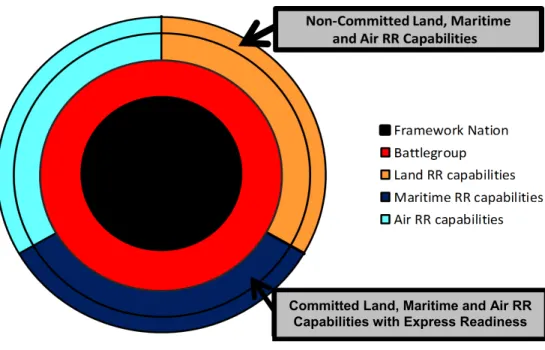
67.Unlike the EU BG roster, the Land, the Maritime and Air RR mechanisms would work by MS offering modules on a voluntary basis from a pre-agreed list. In order to enable this adding of modules to the main building block (namely the EU BG), the modules have to be timely committed18 and be at the same Express readiness as the EU BG forces. The donor MS would be warned by EUMS of this possibility in order to allow them to increase their preparedness, which could include making contact with the EU BG FN. Integration would be aided if such modules had joined an EU BG preparatory exercise(s) - on arrangement between the respective MS. An example of a modular EU RR force composition, based on EU BG operation, is shown in Figure 5.
Figure 5 – Example of modular EU RR force composition based in an EU BG operation
18 See Military RR Initiation Procedures, Main Body, chapter M: commitment either specifically indicated by MS at the time of their
contribution to RR databases, or confirmed by MS after EUMC agreement of the request (RR initiation measure) to commit the indicated potentially available modules included in RR databases (standard contributions).
Committed Land, Maritime and Air RR Capabilities with Express Readiness
EEAS 02168/3/14 REV3 JD/is 27/68
EUMS
EN
MODULAR APPROACH IN RR OPERATIONS (OTHER THAN EU BG OPERATIONS) 68.The scope and scale of possible operations/missions that could be undertaken by a Single
Service RR are broad. However, the Single Service RR contributions offered by MS might not be able to tackle all the tasks requested by Council. Thus, flexibility of force design is key to providing the EU with appropriate tools that are readily available in an appropriate timescale. 69.Depending on the situation, the available required Single Service RR capabilities could be
considered as the main building blocks of such a Single Service RR to a crisis; this approach seeks to add to its (and wider EU RR) potential.
70.While the Single Service RR core elements19 and required capabilities constitute a capable and autonomous force under certain circumstances, without additional enablers and capabilities, its ability to execute the full spectrum of possible tasks could be constrained (e.g. Air RR from a Deployment Operating Base (DOB) without adequate organic Force Protection that could be provided by a Land RR module).
71.Thus Single Service RR mechanisms will include a list of Single Service RR core elements and potentially required capabilities. These required capabilities in each domain will be deduced from the assignment of tasks among the Single Service RR tools (Annex A).
72.The requirement for other complementary capabilities depends on the characteristics of the operation. These complementary capabilities could be part of the other Single Service RR mechanisms. In this case, the modular approach will allow these elements to be added to the selected or core Single Service RR.
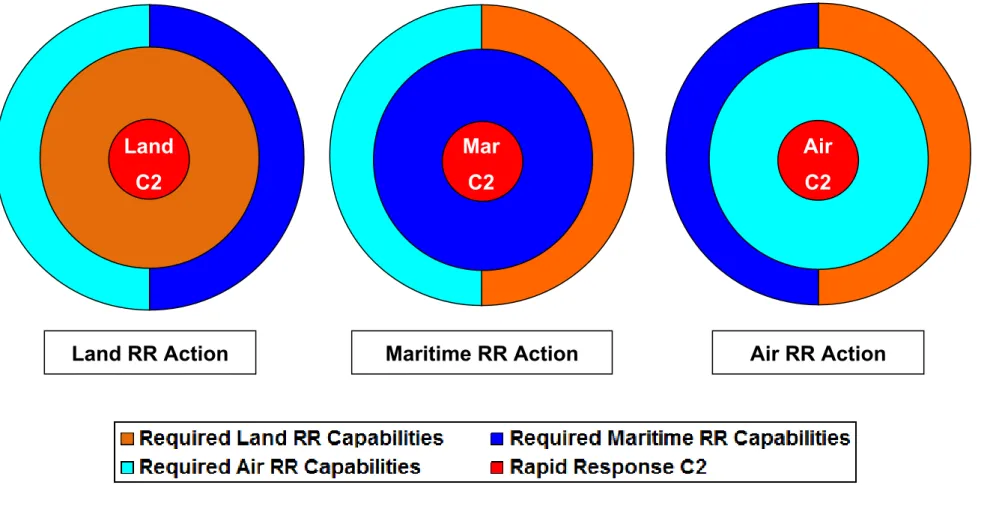
73.The Land, the Maritime and Air RR mechanisms would work with MS offering modules on a voluntary basis from a pre-agreed list. In order to enable this adding of modules to the main building block (core or selected Single Service RR), the modules have to be timely committed20 and be at the same readiness than the core or selected Single Service RR forces. Schemes of modular Single Service RR force composition, based on Single Service RR operation, are shown in Figure 6.
19 Namely: Command and Control (C2): including a Communication and Information Systems (CIS) element; Core capabilities to fulfil the possible tasks; along with Combat Service Support: including logistic (transport, supply, maintenance), medical and administrative groups.
20See Military RR Initiation Procedures, Main Body, chapter M: commitment either specifically indicated by MS at the time of their contribution to RR databases, or confirmed by MS after EUMC agreement of the request (RR initiation measure) to commit the indicated potentially available modules included in RR databases (standard contributions).
EEAS 02168/3/14 REV3 JD/is 28/68
EUMS
EN
Figure 6 – Schemes of modular force composition based in Single Service RR missions/operations
Land RR Action
Maritime RR Action
Air RR Action
Mar
C2
Land
C2
Air
C2
EEAS 02168/3/14 REV3 JD/is 29/68
M.MILITARYRAPIDRESPONSEMECHANISMS
74.The availability of forces offered by MS, at the correct readiness, will dictate whether a Military Rapid Response is possible.
75.Forces and HQs offered at high readiness are more likely to be used in Military Rapid Response operations/missions than those required for standard Military Response. For operations/missions using forces which are not pre-agreed (e.g. all Military RR except those using the EU BG) it remains a national decision which forces and at what readiness they might be offered to the EU for Military Rapid Response.
76.MS are to offer , on voluntary basis, such Military Rapid Response forces by means of a pre-agreed roster (as in the case in the EU BG), the Land, Maritime and Air RR Databases along with the related RR Force Generation Conference, if it is required (see Fig. 7). Under
determined circumstances, alternate RR recourse mechanisms could be employed (e.g. Framework Nation21 and TEU Art.44).
Figure 7: Military Rapid Response Mechanisms
77.In order to enable joint as well as one service-led RR actions, it is necessary to avoid
mismatches between EU BG roster and Land, Maritime and Air Databases (commitment and response times).
78.Changes in the readiness (to meet the timeline for an operation) of the forces provided through the RR Force Generation Conference, until their assignment to the OpCdr by a Transfer of Authority (TOA), remain a national responsibility.
21Defined in the EU Framework Nation Concept (Ref. B) as "A MS or group of MS that has volunteered to, and that the Council has agreed, should have specific responsibilities in an operation over which EU exercises political control".
EEAS 02168/3/14 REV3 JD/is 30/68
EUMS
EN
79.MS contributions to RR (Land, Maritime and Air) Databases may be completed through RR Questionnaires issued on a timely basis by the EUMS. In order to facilitate advance planning and the RR force generation process, MS contributions to the RR mechanisms will include the Capability Codes22 related to the units/elements which constitute the whole contribution and caveats, if necessary. Furthermore, committed EU BG packages are always identified (Ref. F) in detail to facilitate other MS contributions into the package or the RR databases. In addition, any double-hatting of MS contributions for the EU RR mechanisms and other international
commitment (e.g. NATO Response Force) should be indicated as a remark.
80.RR Questionnaires will allow MS to contribute with capabilities and facilities not included in the EU CCS capability code list (e.g. National and Overseas Airfields).
81.MS Express contributions to RR databases could be linked to a preferred EU BG committed in the same stand-by six month period23of the year.
82.MS Contributions to EU BG rosters and Land, Maritime and Air RR databases will be consolidated by six month periods at least 13 months in advance of the beginning of the first semester of the related year. This timeline will enable RR capabilities to train with their respective preferred EU BG, committed during the same stand-by period, if desired, with the agreement of the related EU BG Framework Nation (FN).
83.Extending the availability up to 120 days over the envisaged end of standby if activated. MS committed Contributions to EU BG roster and RR databases are in principle deployable until and thus beyond the last day of the standby period. This implies that a RR operation could be extended for a maximum of 120 days beyond the standby period24. MS will state the
non-availability of their contributions beyond the standby period in the related questionnaires, which will then be indicated on the EU BG roster and RR databases.
84.Under determined arrangements and with the EUMC/PSC agreement, non-EU MS could contribute to EU BG rosters and RR databases but cannot be the FN of the contributed capability.
22 In accordance with the EU Capability Codes and Statement (EU CCS) 2012 (Doc. EEAS 01021/1/12 dated on 11 July 2012,
agreed by EUMC on 18 July 2012).
23 From 1st January to 30th June and from 1st July to 31st December. 24 Ref. F, para 9 d.
EEAS 02168/3/14 REV3 JD/is 31/68
EUMS
EN
EU BG ROSTER25
85.MS EU BG contributions will be included in a pre-agreed roster of committed and identified capabilities. The EU BG generation process26 is defined in the EU Battlegroup Concept (Ref. F). EU BG equipment will be prepared and held at Express readiness during the whole stand-by period. Although not precluded, units that are committed to more than one roster (national or international) would not necessarily guarantee the required level of availability.
RAPID RESPONSE DATABASES
86.Land, Maritime and Air RR databases could offer an indication of the potential availability (EU affirmed27) of assets and capabilities, including the necessary C2 arrangements, in order to support a more informed decision making, as well as advance planning. Therefore, they are initially only to be considered as planning tools. MS can contribute with varying degrees of commitment (from potentially available to committed). RR databases should be designed to be interoperable with the appropriate Planning Tools used by the EU HQs, where practicable. 87.RR Questionnaires to contribute to RR databases will allow MS, on a voluntary basis, to
commit28 their contributions (EU committed). Additionally, it will be possible for MS to assign their contributions to the Express sub-category which in turn could enable a Joint Express response. MS Express committed contributions to RR databases could also be linked to a preferred EU BG committed in the same stand-by semester of the year.
88.Blank RR Questionnaire templates should be sent to MS 21 months in advance of the beginning of the first semester of the related stand-by year to facilitate the consolidation of the RR
databases 18 months in advance of the beginning of the first semester of the related stand-by year.
89. Military Rapid Response Coordination Conference (MilRRCC). This conference aim is to contribute and refine RR databases, and it may also be an opportunity to highlight, discuss and resolve any related issues. This conference will be chaired by the EUMS and linked to the EU BG Coordination Conferences (EU BGCC) in order to improve the effects of the whole RR suite. After each MilRRCC, the EUMC will report the results together with its evaluation to the
25 EU BG roster is officially called EU Battlegroup Offers and Commitments. 26 Ref. F, Annex B.
27RR contributions which nations have offered to EU RR databases, subject to case-by-case political decitions, for future EU RR operations and missions.
28Although not precluded, units that are committed to more than one roster (national or international) would not necessarily guarantee the required level of availability.
EEAS 02168/3/14 REV3 JD/is 32/68
EUMS
EN
PSC. In addition, MS shall update their contributions to the RR Databases in between conferences and on their own initiative as necessary.
RAPID RESPONSE FORCE GENERATION
90.Force Generation for CSDP military operations/missions is described in the EU Concept for Force Generation (Ref. R). EUMS planners and MS will have to strive to ensure that Force Generation for Military Rapid Response takes place quickly to achieve the required response time. The availability of forces, equipment and C2 from MS, and their readiness, together with the availability of Strategic Lift will be the dominant factors in determining the likely structure of the military force for a Military Rapid Response. In particular the early availability and suitability of a potential OHQ/FHQ and their staff and an OpCdr and FCdr will be key factors. 91.Thus, the early identification of critical assets or shortfalls in the force package is essential. RR
force generation should alleviate any weakness or gaps that would compound the risks associated with a faster deployment.
92.In the absence of further specific Force Generation mechanisms for Military Rapid Response, proactive coordination/dialogue between military planners of the EUMS and MS to identify the best suited OHQ, FHQ and forces for a potential operation is vital, in accordance with the EU Concept for Military Command and Control (Ref. Q). It is in this context, based on transparent information provided by MS and on accurate information with regard to available NATO assets and capabilities under the Berlin plus arrangements29, that valuable planning time can be lost or saved. Finally MS and other troop contributors should confirm the level and quality of their contributions at the Force Generation Conferences (Ref. O, para 61).
29 If using the Berlin Plus construct, a PSC/NAC meeting will confirm, if appropriate, the availability of pre-identified NATO common assets and capabilities, beyond those used in the planning phase, and all the practical arrangements, including hand-over and recall (Ref. O, para 62).
EEAS 02168/3/14 REV3 JD/is 33/68
EUMS
EN
ALTERNATE RAPID RESPONSE MECHANISMS
93.In most operations/missions in which the most important criterion is urgency, the recourse to a Framework Nation30 operation (Ref. B) could be envisaged, enabling the EU to mount
multinational operations/missions at relatively short notice. This alternate mechanism requires a volunteer MS or group of MS and Council agreement.
94.In addition, another alternate RR recourse mechanism could be Article 44 operations. In accordance with Article 44.1 of the TEU (Ref. E) "…the Council may entrust the
implementation of a task to a group of Member States which are willing and have the necessary capability for such a task."
95.MS that have broad capability spectrum and specific concerns over a given crisis could be the Framework Nation for a CSDP joint military operation on the basis of the Framework Nation Concept. This approach guarantees that all participating MS have the political will, the capacity and the motivation to proactively resolve the crisis. All concerned and voluntary MS would act as a coalition able to pool the necessary military capacities to address the crisis.
N. MILITARYRAPIDRESPONSEINITIATIONPROCEDURES
96.In order to enable joint as well as one service-led RR actions, it is required to establish
procedures to allow early MS commitment of their potentially available (not-committed) Land, Maritime and Air contributions to databases. In addition, these procedures should facilitate the ability to anticipate an emerging crisis and to adequately increase the readiness posture or alert status of voluntary committed RR elements. Furthermore, in order to facilitate an effective Rapid Response Force Generation Conference, RR initiation procedures should include MS force-sensing to contribute with critical assets or shortfalls in the force package to prepare the Provisional Statement of Requirement (PSOR) or the recourse to the alternate RR mechanisms. 97.In accordance with the EU Concept for Force Generation (Ref. R), force generation (FG) is
integral to the planning of the operation and it should be considered at the earliest stages of the planning process. Therefore during the Advance Planning phase, if required, the EUMS will support CMPD to tailor a PSOR (see Fig. 8). This PSOR should pre-identify:
- an OHQ and an OpCdr, and a FHQ and a FCdr; or, where applicable, a MHQ and a MCdr
30 Defined in the EU Framework Nation Concept (Ref. B) as "A MS or group of MS that has volunteered to, and that the Council has agreed, should have specific responsibilities in an operation over which EU exercises political control".
EEAS 02168/3/14 REV3 JD/is 34/68
EUMS
EN
- the necessary already committed RR elements from the EU BG roster and (Land, Maritime and Air) RR databases
- the necessary potentially available RR elements from (Land, Maritime and Air) RR databases
- other not available RR critical elements or shortfalls.
98.As a result of the initiation of an EU Military RR by PSC decision on choosing Option for Urgent Response and/or a Fast-track Process, ideally the PSC will agree subsequently31 the designation of OHQ/OpCdr and FHQ/FCdr; or, where applicable, MHQ/MCdr. Additionally the EUMC will as soon as possible agree the following RR initiation measures (see Fig. 8):
- Establish OHQ and FHQ/(F)HQ/MHQ liaison elements to EUMS. - Establish OHQ Advance Planning Teams (APT) to EEAS/EUMS.
- Recommend to move (national responsibility) to Express readiness (5 days) the personnel of committed RR elements required from the EU BG roster and (Land, Maritime and Air) RR databases.
- Request the related MS commitment of the necessary potentially available RR elements from (Land, Maritime and Air) RR databases and recheck/reaffirm MS potential caveats for those RR elements based on the concrete operation.
- Conduct an informal force-sensing32 on the other not available RR critical elements or the recourse to the alternate RR mechanisms.
99.If the initiation of an EU Military RR is made by PSC decision on choosing a Fast Track Process at the same time that the PSC agrees the CMC: it will not be possible to meet an "EU BG operation" planning time (5 days) if the OHQ and the OpCdr, and a FHQ and a FCdr (or, where applicable, a MHQ and a MCdr) were not previously identified and activated (except in the case of EU BG) and were not involved in the EUMS' military input delivery to the CMC development process (see Main Body, chapter P, para 119- 120).
100. After the approval of the CMC and in accordance with the results of RR initiation measures the OpCdr with the assistance of the EUMS will conduct the RR Force Generation Conference
31EU rapid response will require rapid access to resources, in particular an early PSC and national decision making on the selection and designation of a military OpCdr and activation of an OHQ, and/or military Mission or Force Cdr (Ref. O, page 28, para 68 and footnote 22).
32 Ref. O, page 17, para 25.
EEAS 02168/3/14 REV3 JD/is 35/68
EUMS
EN
taking into account the EUMS preparatory work33. To that effect the EUMS will have previously provided the OpCdr with a PSOR draft based on the following (see Fig. 8):
- already committed RR elements from the EU BG roster, if appropriate, and (Land, Maritime and Air) RR databases already at Express readiness (5 days) and at Rapid Response
readiness (20 days)
- MS (Land, Maritime and Air) RR database elements committed after EUMC request - MS offered contributions after conducting a force-sensing on not available RR critical
elements or shortfalls.
33 Ref. R, para 23.
EEAS 02168/3/14 REV3 JD/is 36/68
EUMS
EN
Figure 8: Military Rapid Response initiation procedures scheme
EEAS 02168/3/14 REV3 JD/is 37/68
O. FACILITATINGOFFERSANDCOMMITMENTSTOTHEEUBGCONCEPT
101. MS agreed a procedure for filling EU BG rosters and RR databases more systematically by planning contributions on the basis of regularly recurring, voluntary commitments, called
Framework Nation approach. This approach allows other MS to join them on a regional or partnership basis and it takes into account the provision of specialised capabilities in order to strengthen the procedure.
102. This approach promotes, on a voluntary basis, recurrent commitments for 6-months or, when possible, 12 months stand-by periods. Thus, this procedure will mitigate gaps, will make more effective use of resources and will improve the effectiveness of MS training efforts.
Furthermore, it encourages experienced FNs to support MS that take on the FN responsibilities for the first time.
103. Cooperation at bilateral/multilateral level on a permanent basis optimised for some regions could also help to mitigate gaps in the EU BG roster and service databases. Within this approach, the leading MS34 will be the one responsible to make the initial offer to the roster/database.
EU BG CONTEXT
104. This approach for the EU BG roster was agreed in the European Council on 19 November 201235. The European Council on 19-20 December 201336 again encouraged MS to use this approach which promotes predictability, consistency and a more fair share of the burden (Ref. L, para 8).
105. In order to fulfil the agreed level of ambition of having two EU BGs on stand-by at any one time, if applying the usual 6-months stand-by period, there is a need for a minimum of 12 MS volunteering as FN, each recurring on the roster every three years. When there are fewer than 12 MS willing to act as FN, this will result in gaps in the roster unless some FN MS offer a stand-by period of 12 months or volunteer as FN more frequently.
34 All MS operating under a multinational formation must in advance formally approve their database offer following their appropriate procedures as agreed by its framework agreement.
35 On 19 November 2012, the Council adopted the Council Conclusions on military Capability Development (Ref. JJ, para 14).
36 “taking forward the agreed Framework Nation approach to fill the EU BG Roster more systematically” (Ref. K, para 12 b, adopted on 20 December 2013 by the European Council in Ref. J).
EEAS 02168/3/14 REV3 JD/is 38/68
EUMS
EN
RR CONTEXT
106. In addition, a similar approach could also apply to the provision of specialised/niche capabilities (Ref. L, para 8) in the RR databases.
P. MILITARYRAPIDRESPONSEPLANNING
CRISIS MANAGEMENT PROCEDURES
107. The military contribution to the EU CMP (Ref. O) is described in the EU Concept for Military Planning at the Political and Strategic Level (Ref. P).
108. The EUMS is the source of integrated military expertise within the European External Action Service (EEAS). As an integral component of the EEAS, the EUMS conducts early warning, situation assessment and strategic planning, with particular focus on inter alia operations / missions (both military and those requiring military support).
EARLY WARNING AND SITUATION ASSESSMENT
109. Situation Assessment is the evaluation and interpretation of information gathered from a variety of sources. The product of this assessment is used to inform decision makers in order that they may provide particular direction in the production of plans.
110. Early Warning is the communication of prioritised risks to those with the capacity to act based on the forecasting of the probability and severity of a latent conflict escalating into violence37. Early warning contributes to the avoidance of strategic surprise.
111. Initial work can be stimulated by PSC/MS or by initiative of the HR. This initiative of the HR is the start point for the development of the PFCA.
112. In case of urgency, the PSC option to decide to move directly to development of a CMC excluding the PFCA is called Option for Urgent Response. If this is the situation, then a broad understanding of the EU's potential comprehensive and multidimensional approach would be required as soon as possible.
37Or escalating into a state with severe consequences.
EEAS 02168/3/14 REV3 JD/is 39/68
EUMS