2.
Absorptive Capacity
2.1 IntroductionIn this chapter, we present a review of the literature on absorptive capacity used in our study. First we will elaborate on the importance of absorptive capacity for firms confronted with changing knowledge environments. After that, we will discuss several definitions of absorptive capacity and the determinants of this concept as found in the literature. Finally, we will deal with absorptive capacity in the context of small- and medium-sized enterprises. Since this study is specifically focused on innovation at the firm level, the review has been restricted to this particular context.
2.2 The Need for Absorptive Capacity
Nowadays, the majority of firms are increasingly faced with globalization and a hardening of the competition. This is why organizations try to learn to develop their capabilities faster than their competitors. In order to survive, firms need to introduce new goods and services and find new ways of doing business on an ever more frequent basis. Further, they have to increase their flexibility in dealing with the changing nature and demography of their workforce. Some organizations may not be capable of pursuing such strategies for various reasons, such as a lack of capital, infrastructure/technology, and/or human resources (Freel, 2000; Rothwell, 1994). The decisions concerning the response to these external challenges by means of the innovation of products/services/organization should be regarded in the light of the specific objectives of the firm (Webster, 2004).
These processes are in line with the evolutionary theory (Nelson and Winter, 1982). The basic idea of the evolutionary model is “the idea of natural selection” … or “a view of organizational genetics – the processes by which traits of organizations, including those traits underlying the ability to produce output and make profits, are transmitted through time” (Nelson and Winter, 1982:9). In a competitive business environment firms are driven by the goal of making
profits, whereby there is a constant search for ways to increase these profits. In this context, a firm is assumed to possess certain capabilities which it can use in problem-solving situations. From an external point of view, a firms’ ability to survive and grow is dependent on the market environment, which plays a determining role in a firm’s success. The evolutionary theory of firms indicates the adaptive behavior of organizations and how they deal with turbulent external business environments that force them to provide goods/services of a better quality than those of their competitors.
In this study we will measure absorptive capacity in terms of innovation. The following section discusses the subject of innovation in more detail.
The innovativeness of firms may be affected by both internal and external factors. External factors are basically associated with a firm’s environment consisting of other firms in the form of suppliers or buyers, in which there is the urgency for renewal (Jorna and Waalkens, 2006). Other external factors are the nature of the market, the production process, and knowledge spillovers (Webster, 2004). Internal factors include, for instance, a firm’s inherited capacities, such as skills and the accumulated experience of its workforce (Webster, 2004), as well as the ability to respond appropriately to the intrinsic motivation of its employees (Jorna and Waalkens, 2006).
It has been argued that innovation plays an important role in a firm’s survival in the business environment. Innovations can in this context be viewed as a multidimensional concept (Neely et al., 2001). Schumpeter, for example, defines innovation as “1) the introduction of a new good …; 2) the introduction of a new production method …; 3) the opening of a new market … 4) the opening of a new source of supply … 5) the carrying out of the new organization of any industry …” (Schumpeter, 1934:66). Similarly, Lundvall (1992) describes innovation as an ongoing process of exclusion, search, and exploration resulting in: 1) new products, 2) new techniques, 3) new organizational forms, and 4) new markets. In short, innovation can be considered as the introduction of something new into an organization (Jorna, 2006).
In addition, business literature offers various classifications of innovations that have been developed and applied (e.g., Schumpeter, 1934; Johannessen et al., 2001; Avermaete et al., 2003). Some authors (e.g., Avermaete et al., 2003; Johannessen et al., 2001) discuss innovation from the perspective of output (e.g. product, process, organizational), while others (e.g., Damanpour, 1996; Jansen et al., 2006; Abernathy and Clark, 1985) describe the concept in terms of the degree of change (i.e., radical and incremental). Yet another perspective used in capturing the dynamic process of innovation is that of the various stages of innovation (i.e., invention initiative and realized innovation).
2.2.1 The stage of an innovation process
Before an innovation is actually implemented, a firm has to generate ideas and develop plans. Rogers (2003) refers to this process as the initiation stage, defined as all the information gathering, conceptualization, and planning activities leading up to the final decision to adopt the innovation. A furniture firm, for instance, may develop plans to start the manufacturing of a new out-door chair in the upcoming production-year, and a software firm may target a new market in a different region. In this study we refer to these activities as initiatives, defined as all new less formal ideas and plans under discussion within the firm, which are laid down in written documents. Generally, part of these initiatives are not being implemented as due to factors such as a lack of financial resources and/or skilled workers (Freel, 2000; Rothwell, 1994), a focus on short-term targets/requirements (Freel, 2000), and forcemajeures (e.g., an earthquake). Wheelwright and Clark (1992) have labeled this phenomenon as the innovation funnel. According to Leonard and Sensiper (2000:287), the process of innovation is “a rhythm of search and selection, exploration and synthesis, cycles of divergent thinking followed by convergence.” In more technical terms, they claim that the generation of ideas is followed by development, adoption or testing, and finally by implementation. As already mentioned, initiative is the result of divergent views or the generation of ideas, which ultimately yields innovation. During each subsequent step, the generation of ideas recurs on a smaller scale (Leonard and Sensiper, 2000), which means that the large input of ideas that comes into the funnel’s entrance is filtered through an evaluation process, in which the best ideas are selected for further development, so that only a limited number reaches the other end of the funnel (Wheelwright and Clark, 1992).
2.2.2 Innovation output
As discussed above, innovation is the output of initiatives within a firm. Porter (1990:36) argues that a firm is a collection of activities that are performed to design, produce, market, deliver, and support its product. Following Porter (1990) we classify innovation output into three types: product, process, and organizational innovation (e.g., Avermaete et al., 2003).
Product innovation can be considered as any good or service that is perceived by an individual or a firm as new (Kotler, 1991). Therefore, one person or organization may regard a product as an innovation while another party does not (Johannessen et al., 2001). New designs of chairs/tables or software are perceived as a product innovation. Mostly however, product innovation is associated with changes in methods of processing (Avermaete et al., 2003). For instance, when a furniture firm has formerly used mahogany wood as a raw
material, it may need to adjust its production process if it decides to start using mahogany wood or jackfruit wood, since the wood types have to be processed differently. Other process changes may include the adjustment of the existing infrastructure, technology, or equipment. These examples of adjustment are called process innovation (Avermaete et al., 2003).
Process innovation can be defined as changes in the ways of producing or developing products, including new logistics, new raw material, new production lines, new production processes/methods, and new technology. This type of innovation does not stand on its own. In many cases, process innovation may be the consequence of product innovation or/and organizational innovation. Organizational innovation is defined as changes in the ways of organizing and managing a firm, including human resource management and the improvement of the firm’s access to the market (i.e., expanding new markets) (Avermaete et al., 2003). The relations among the three types of innovation can be illustrated as follows: when a furniture firm exploits a new market as the result of an organizational innovation, it may need to develop a new table design (a product innovation) in order to operate in this new market. As a consequence, the existing production lines may have to be adjusted, which requires, for example, the introduction of different material and new technology (a process innovation).
2.2.3 Degrees of change
Innovation may be categorized into the degree of change and the level of novelty or newness involved (Damanpour, 1996). Newness or novelty very much depends on the perception of the creator (i.e., the firm) (Tidd et al., 2005). A product perceived as an innovation by one firm may be considered as a mere modification or a common item by another one. One furniture firm may perceive a new model of an outdoor table as an innovation, whereas another one may consider it as the modification of an existing product. Similarly, the use of Java as a programming language may be new to some software firms, whereas other firms, which have used it for a number of years, may consider it as old technology. Therefore, the level of firms’ experience in innovation plays an important role in this context.
Based on the degree of change, innovation can be subdivided into radical or exploratory and incremental or exploitative innovation. Radical or exploratory innovation entails fundamental changes in the activities of an organization and includes a clear deviation from existing practices. This type of innovation is aimed at meeting the needs of emerging customers or markets (Benner and Tushman, 2003). Examples of radical innovations are new designs, new markets,
and new channels of distribution (Abernathy and Clark, 1985). Radical innovation requires the generation of new knowledge out of existing knowledge (Benner and Tushman, 2003).
In the case of incremental or exploitative innovation, the focus is more on strengthening the existing capabilities of firms, which means that the existing products and/or processes are mainly subjected to minor changes (Gopalakrishnan and Damanpour, 1997). This type of innovation is meant to meet the needs of existing customers or markets (Benner and Tushman, 2003). Examples of incremental innovation are the elaboration of existing knowledge and skills, the improvement of existing designs, expansion in terms of increasing the existing products and services, and the improvement of the efficiency of the existing distribution channels (Abernathy and Clark, 1985). Incremental innovation therefore specifically builds on existing knowledge and reinforces the existing skills, processes, and structures (Abernathy and Clark, 1985).
Based on the above discussions, the main focus of innovation is to introduce something new (i.e., an entirely new product or a modification) into a firm (West and Farr, 1990).
Innovation is the application of new knowledge by which a firm is better able to meet the needs of its customers. This concept is given shape by the introduction of new (or improved) products or by providing a new (or an improved) service to customers. In this respect a better use of existing knowledge as well as a more effective acquisition and assimilation of (new) knowledge collected from external sources are very important for a business’ growth. Since knowledge is the key to innovation, it is of great importance for an organization to be able to absorb, assimilate, and utilize knowledge from all available sources (Van den Bosch et al., 1999).
Firms can be viewed as open systems (e.g., resource-dependency theory (Ulrich and Barney, 1984)1). This means that in the case of innovation, some firms are
not capable of mobilizing their existing resources (i.e., knowledge) but need to obtain (new) knowledge from other parties. These parties can be buyers, suppliers, universities, or other research institutions. The process of acquiring knowledge from others can be explained from the perspective of the resource-dependence theory.
1 This theory will be explained in detail in Section 2.4. in connection with the concept of
Examining absorptive capacity (Cohen and Levinthal, 1990) 2, i.e. the ability of
a firm to recognize and obtain external knowledge as a useful resource in the process of innovation, is a highly relevant task in gaining an insight into the dynamics of a firm’s innovativeness. Many authors argue that absorptive capacity promotes the speed, frequency, and magnitude of innovation, which in turn generates new knowledge that again becomes part of the absorptive capacity of the organization (Kim and Kogut, 1996; Helfat, 1997; Van den Bosch et al., 1999).
2.3 Absorptive Capacity
The concept of absorptive capacity has been considered as one of the most important concepts that have emerged in the field of organizational research in the past years (Lane et al., 2002). Earlier studies indicate a consensus on absorptive capacity as a set of organizational routines necessary to identify and utilize generated knowledge (e.g., Zahra and George, 2002). The concept of absorptive capacity was originally introduced in macroeconomics, where it refers to the ability of an economy to utilize and absorb external information (i.e. knowledge) and resources (Adler, 1965) in Tua et al., (2006).
Cohen and Levinthal (1989:569) have adjusted this macroeconomic concept to organizations and define it as “the ability to identify, assimilate, and exploit knowledge from the environment – what we call a firm’s ‘learning’ or ‘absorptive capacity’. Given the importance of external knowledge to industrial innovation, “absorptive capacity represents an important part of a firm’s ability to create new knowledge” (1989: p. 570).
In 1990 Cohen and Levinthal (1990:128) redefined the concept as “the ability of a firm to recognize the value of new external information, assimilate it, and apply it to commercial ends”. This definition represents a single-loop learning process (absorptive capacity learning new absorptive capacity). A single-loop learning process is initiated when a firm has detected certain errors and wants to correct these errors during the ongoing business procedures in order to continue its present policies or to achieve the planned objectives without any modifications to the organization’s underlying norms, policies, and goals (Argyris and Schön, 1978:2-3). From this perspective absorptive capacity is viewed as a firm-level construct, which expresses the cumulative effect of continuous organizational learning.
2 According to Cohen and Levinthal (1989; 1990), innovation is no longer regarded as a
calculable, purely technical process but rather as a knowledge intensive activity requiring managerial and technical capabilities as well as external linkages to information acquisition, cooperation, and networking, as cited in Koch and Strotmann (2008).
According to Cohen and Levinthal (1990:131), although “a firm3’s absorptive
capacity will depend on the absorptive capacities of its individual members. It is not, simply the sum of the absorptive capacities of its employees, and it is therefore useful to consider what aspects of absorptive capacity are distinctly organizational. […] It refers not only to the acquisition or assimilation of information by a firm but also to the firm’s ability to exploit it”. The Cohen and Levinthal’s definition, however, primarily deals with external knowledge. It implicitly suggests that firms are aware of their internal knowledge but have no access to it (Tua et al.,2006). Apart from not having access to their knowledge, there may be cases, in which organizations are not aware of their knowledge. This especially applies to tacit knowledge, which can only be communicated by direct, i.e., physical and social interaction. The internal diffusion of new knowledge and technology requires a network of both formal and informal communication linkages (Jones and Craven, 2001).
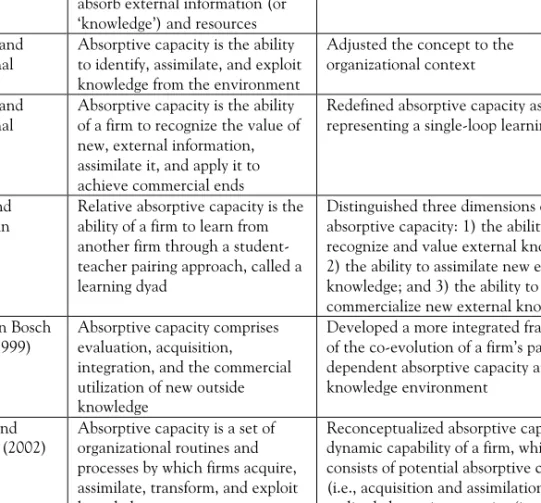
The concept of absorptive capacity has been used in many different research fields, such as strategic management (e.g., Nahapiet and Ghoshal, 1998; Van den Bosch et al., 1999), organizational learning (e.g., Barkema and Vermeulen, 1998), knowledge management (e.g., Lane and Lubatkin, 1998), external interactions (e.g., Caloghirou et al., 2004), and innovation management (e.g., Helfat, 1997; Van den Bosch et al., 1999). Only a few scholars have explicitly attempted to revise and expand Cohen and Levinthal’s original definition, as summarized in Table 2-1. Lane and Lubatkin (1998) have developed the notion of relative absorptive capacity. They have reconceptualized the firm-level concept of absorptive capacity as a learning dyad-level construct, arguing that “the ability of a firm to learn from another firm is jointly determined by the relative characteristics of the two firms” (Lane and Lubatkin, 1998). Further, they have distinguished absorptive capacity into three dimensions: 1) the ability to recognize and value new external knowledge; 2) the ability to assimilate new external knowledge; and 3) the ability to commercialize new external knowledge.
Van den Bosch et al., (1999) have developed a more integrated framework of the co-evolution of a firm’s path-dependent absorptive capacity and the knowledge environment. They argue that Cohen and Levinthal’s implicit feedback loop is dependent on the environment in which a firm competes and on its success in coping with this environment. When the business environment changes, the firm will respond to this situation, and if its response does not work as expected, the firm will try to improve it.
3 The original term used by Cohen and Levinthal (1990) is “organization”. In the context of this
More recently, Zahra and George (2002) have presented a re-conceptualization of Cohen and Levinthal’s interpretation of absorptive capacity. Zahra and George picture absorptive capacity as a set of organizational routines and processes, by which firms acquire, assimilate, transform, and exploit knowledge. They also propose that these four organizational capabilities (i.e., acquisition, assimilation, transformation, and exploitation) build on each other to yield even more absorptive capacity. A firm’s absorptive capacity is viewed as a dynamic capability4 that influences the organization’s ability to create and deploy the
knowledge necessary to build other organizational capabilities (Zahra and George, 2002). Furthermore, they suggest that absorptive capacity may be divided into ‘potential’ absorptive capacity (acquisition and assimilation) and ‘realized’ absorptive capacity (transformation and exploitation).
This notion of absorptive capacity, however, is mainly relevant in the context of large firms. In large firms, organizational functions such as planning, organization, leadership, and control are separated in various functions. The initiatives and decisions with respect to the acquisition and utilization of new external knowledge are made by various people (i.e., management and employees) in the firm. This condition is significantly different from the context of small firms, especially in a developing country. Managerially, the small firm is usually administered by one individual (i.e., the owner of a firm), also called a ‘one man show’, rather than by a formalized management structure (Stanworth and Curran, 1976). In other words, in the case of small firms all initiatives and decisions are highly dependent upon the company owner’s abilities.
Based on the aforementioned as summarized in Table 2.1, we have adopted the original definition by Cohen and Levinthal (1990) in the context of this study, while supplementing the interpretation of Zahra and George (2002). This resulted in the following definition of a firm’s absorptive capacity: the ability of a firm to absorb new external knowledge and use it to further develop new products, processes, or services. This definition implies that (new) knowledge from outside is a fundamental element of the concept of absorptive capacity. Therefore, our study has focused mainly on external knowledge (i.e., its characteristics) and its impact on a firm’s absorptive capacity. Chapter 3 discusses external knowledge and its characteristics in more detail. Zahra and George (2002) suggest that absorptive capacity may be divided into potential
4 According to Helfat et al., (2003:4), “a dynamic capability is the capacity of an organization to
purposefully create, extend, or modify its resource base”. Furthermore, the resource base of an organization includes tangible, intangible, and human assets (or resources) as well as capabilities which the organization owns, controls, or has access to on a preferential basis (ibid). The type and importance of resources for an organization will be discussed in detail in Chapter 3.
and realized absorptive capacity. Using their categorization in the setting of SMEs may broaden the understanding of the concept of absorptive capacity in its various contexts.
Table 2.1. Definitions of absorptive capacity
Author (Year) Definitions What is new?
Adler (1965)* Absorptive capacity is the ability of an economy to utilize and absorb external information (or ‘knowledge’) and resources
Macroeconomic point of view
Cohen and Levinthal (1989)
Absorptive capacity is the ability to identify, assimilate, and exploit knowledge from the environment
Adjusted the concept to the organizational context Cohen and
Levinthal (1990)
Absorptive capacity is the ability of a firm to recognize the value of new, external information, assimilate it, and apply it to achieve commercial ends
Redefined absorptive capacity as representing a single-loop learning
Lane and Lubatkin (1998)
Relative absorptive capacity is the ability of a firm to learn from another firm through a student-teacher pairing approach, called a learning dyad
Distinguished three dimensions of absorptive capacity: 1) the ability to recognize and value external knowledge; 2) the ability to assimilate new external knowledge; and 3) the ability to commercialize new external knowledge Van den Bosch
et al. (1999) Absorptive capacity comprises evaluation, acquisition, integration, and the commercial utilization of new outside knowledge
Developed a more integrated framework of the co-evolution of a firm’s path-dependent absorptive capacity and the knowledge environment
Zahra and
George (2002) Absorptive capacity is a set of organizational routines and processes by which firms acquire, assimilate, transform, and exploit knowledge
Reconceptualized absorptive capacity as a dynamic capability of a firm, which consists of potential absorptive capacity (i.e., acquisition and assimilation) and realized absorptive capacity (i.e., transformation and exploitation)
Note: *Cited in Tua et al. (2006)
2.4 Understanding the Process of Absorptive Capacity
As explained in the previous section, a firm’s absorptive capacity can be regarded as a process aimed at acquiring knowledge from other sources, absorb this external knowledge, and utilize it for realizing commercial output. The process of absorptive capacity can be analyzed by means of the knowledge transfer framework. Several authors argue that knowledge transfer is considered as a fundamental issue for organizations (Albino et al., 2004) and that it has become one of the most critical aspects in knowledge management processes (Kuhn and Abecker, 1997). Ouchi (1980) defines knowledge transfer as an interdependent process involving an exchange during which an individual or an
organization gives and receives information. This process has specific goals that can be conceptualized as a continuum, ranging from the exploration of new knowledge through a renewed combination of existing knowledge (Appleyard, 1996) to the exploitation of existing knowledge (Grant, 1996). According to March (1991), the goal of knowledge transfer is either to explore new knowledge or to exploit existing knowledge, although often the process will be aimed at both objectives.
From another perspective, Argote and Ingram (2000) define knowledge transfer as the process through which an organizational unit is affected by the experiences of other parties. Referring to the organizational dimension, most authors agree that knowledge transfer depends on the characteristics of the individuals involved, such as experience, values, motivation, and beliefs (Albino et al., 2004). Moreover, knowledge transfer is strongly affected by the relationship between source and recipient. Hansen (1999) shows how strong ties among groups positively affect the transfer of complex knowledge.
Many studies have attempted to explain why and how knowledge transfer takes place among firms. Using a framework of knowledge transfer may offer a more profound understanding of the reasons why a firm needs absorptive capacity and how it is organized.
The basic explanation for the phenomenon of knowledge transfer from one firm to another in order to absorb external knowledge is given by the resource dependency theory (i.e., Pfeffer and Salancik, 1978). The resource-dependency theory views a firm as an open system, which means that it (1) is not self-sufficient; (2) cannot generate all necessary resources internally; and (3) has to mobilize resources from other organizations in its environment in order to survive. This is why most firms are deliberately focused on adopting resources from other organizations5. Pfeffer and Salancik (1978:258) argue that “to survive, organizations require resources. Typically, acquiring resources means the organization must interact with others who control those resources. In that sense, organizations depend on their environments. Because the organization does not control the resources it needs, resources acquisition may be problematic and uncertain. Others who control resources may be undependable, particularly when resources are scarce. … Survival of the organization is partially explained by the ability to cope with environmental contingencies; …”. According to Barney (1991:101), firm resources can be defined as, “all assets, capabilities, organizational processes, firm attributes, information, knowledge, etc. controlled by a firm that enables the firm to conceive of and implement strategies that improve its efficiency and
effectiveness”. So in the current competitive environment, knowledge is a fundamental asset for organizations. It is in fact one of the most important resources (Teece, 1998).
From this perspective, organizations can be viewed as a coalition, which influences their structure and patterns of behavior to acquire and maintain external resources. According to Ulrich and Barney (1984), a firm can acquire external resources by either decreasing or increasing its dependence on other organizations, that is, its power can be modified through its interaction with other parties.
We therefore argue that due to the insufficiency of their existing resources firms need to absorb means (e.g., knowledge) from outside, especially when the market competition increases. Firms can absorb this knowledge from other parties, such as customers, competitors, universities, and business associations or through addressing other means, such as radio, television, newspapers, and the Internet.
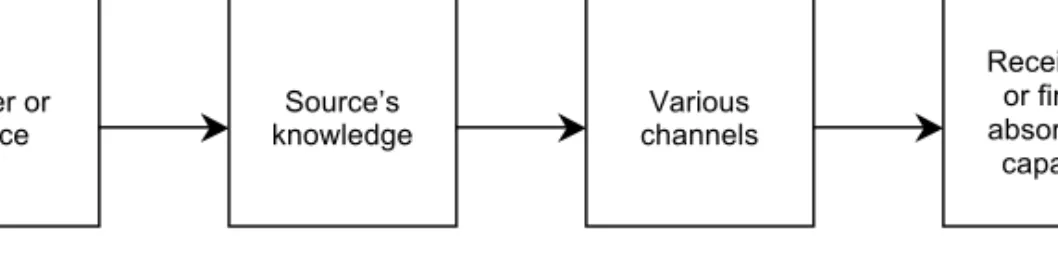
In order to acquire a better understanding of how knowledge transfer takes place, we adopted the classical communication model of Shannon and Weaver (1949) and a refined version by Berlo (1960) as our starting point. Shannon and Weaver’s model depicts communication as a linear process, its purpose being purely quantitative. It views this process as a series of steps during which a message is conveyed from a source or sender to a destination or a receiver. Instead of using a mathematical formulation as is done by Shannon and Weaver, Berlo (1960) applies verbal descriptions. Berlo’s model defines the components of the communication process as sender, message, channel, and recipient, thereby providing verbal descriptions of how each item affects the communication process. By combining Shannon and Weaver’s approach with Berlo’s refined version in defining the main components of the communication model and describing the knowledge transfer process, the following framework has resulted.
Communication theory can provide a useful underpinning for the knowledge transfer framework. As Figure 2.1 shows, the sender becomes the “source” of knowledge which transmits a message through a channel to a receiver. The recipient is the “receiver”, i.e., a firm which absorbs external knowledge. In the context of this study, the receiver’s ability to acquire, assimilate, and utilize external knowledge is labeled as the firm’s absorptive capacity (Cohen and Levinthal, 1990) as explained in the previous section. The message is the “external knowledge” which is communicated through various channels, such as face-to-face contact, telephone, fax, and email. Insight can be gained into a firm’s absorptive capacity by focusing on the structure of the communication
between the external environment and the organization, as well as that among the subunits of the organization, and on the character and distribution of the expertise within the organization (Cohen and Levinthal, 1990:132). According to the communication theory’s point of view, a communication channel can be defined as a means by which information or knowledge is being moved from one point to another within a social system (Chakrabarti et al., 1983). This is why the communication channel plays an important role in the degree of a firm’s absorptive capacity.
Figure 2.1. Understanding knowledge transfer by using the theory of communication
According to Arrow (1969), communication channels differ in terms of costs (or, equivalently, capacities). These differences may influence a receiver firm with respect to the extent to which it can absorb external knowledge. Furthermore, Arrow emphasizes that mass media play a major role in alerting individuals or organizations to the possibility of an innovation, while personal contact seems to be the most relevant instrument in leading to its adoption (Arrow, 1969). In the context of this study, we will explore various types of communication channels used by firms to obtain or absorb knowledge from other organizations. Section 3.6.2.3 of Chapter 3 discusses this issue in more detail.
We want to note that in the context of this study, absorptive capacity is conceived from the receiver’s point of view (i.e., the focal firm). So, we will focus on the characteristics of the message (i.e., knowledge) and on the characteristics of the channels. We will therefore not pay any specific attention to external firms (i.e., the senders of the knowledge).
2.5 The Determinants of Absorptive Capacity
A study carried out by Lane et al. (2002) concludes that the determinants of a firm’s absorptive capacity have only been scarcely examined. Of these few studies, Daghfous (2004) has provided an overview of the determinants of absorptive capacity which have mainly been derived from the work of Cohen
Sender Sender or source Message Source’s knowledge Channels Various channels Recipient Receiver’s or firm’s absorptive capacity
and Levinthal (1990). The determinants of absorptive capacity can be broadly categorized into two groups: internal and external factors (Daghfous, 2004). Internal factors include the prior knowledge base, the level of education, the presence of gatekeepers, and investments in R&D. External factors contain external knowledge and the interaction with other firms. Each factor will be elaborated in detail in the following section.
2.5.1 Internal factors
Prior related knowledge
Cohen and Levinthal (1989:569-570) introduce the absorptive capacity construct as follows: “the firm’s ability to identify, assimilate and exploit knowledge from the environment,” pointing out that “a stock of prior knowledge … constitutes the firm’s absorptive capacity”. In another article, they consider the level of prior related knowledge as the determinant of a firm’s absorptive capacity (Cohen and Levinthal, 1990). According to Kim (1998), a prior knowledge base is the sum of all individual units of knowledge within an organization. Prior related knowledge has a positive effect on a firm’s absorptive capacity because it determines the level of a firm’s ability to perform three principal activities: to acknowledge the value of the new knowledge, to assimilate it, and to apply it for commercial ends (Cohen and Levinthal, 1990). In addition, Cohen and Levinthal (1990) argue that prior related knowledge, also called internal knowledge, is crucial in developing and adopting new knowledge. So far, most authors, following Cohen and Levinthal (1990), have considered the level of prior related knowledge (such as learning experience and shared language) as an important determinant of absorptive capacity.
Level of education
According to Vinding (2000), the employees’ level of education is another determinant of absorptive capacity. The more education and training individuals have received, the higher their ability to assimilate and use new knowledge. As a firms’ absorptive capacity depends on that of its organizational members, the level of education and training of these individuals has a positive influence on the level of the absorptive capacity of this organization (Schmidt, 2005). In addition, Rothwell and Dodgson (1991) argue that in order for a firm to gain proper access to knowledge from outside its boundaries, a sufficient number of qualified technical specialists, scientists, and engineers is required. Moreover, prior skills stimulate creativity through the development of novel ideas by combining new and old knowledge (Daghfous, 2004).
The presence of gatekeepers
The presence of so called ‘gatekeepers’ plays an important role in determining absorptive capacity. The main role of gatekeepers is reducing the communication gaps and mismatches between the providers and the users of knowledge (Daghfous, 2004). Vinding (2000) states that the gatekeeper, whose role it is to create a language that can be understood by all different departments and parties involved, can improve a firm’s absorptive capacity through knowledge sharing.
Cohen and Levinthal (1990) introduce two types of gatekeepers, 1) the one who acts as a boundary spanner within the firm and 2) the one who serves as an interface between the firm and the environment. As a boundary spanner, the gatekeeper functions as a transducer of intra-firm knowledge (Afuah, 2003), who converts the available knowledge within a firm into a form or with additional information that is more accessible to members of the firm. As an interface, the gatekeeper links the organization with the external information sources, acting as the transducer of inter-firm information (Afuah, 2003). Gradwell (2003) argues that the role of the gatekeeper as an interface is to screen the environment for relevant knowledge and transform this information in such a way that it can be understood by the firm’s employees. In addition to detect knowledge and bring it into the firm, as an interface, the gatekeeper also may send information into the environment presenting the firm in a favorable light.
Firm’s size and age
Daghfous (2004) claims that size can affect a firm’s absorptive capacity. Larger firms with sufficient R&D resources are likely to be more innovative than smaller firms, which in most cases have only limited R&D capacities. This situation suggests that a firm’s innovativeness (the outcome of absorptive capacity) and its size are positively correlated.
In their study of high-tech firms, Lee and Sung (2005) indicate that size as measured by the number of employees, is significantly related to R&D activities, which are often used as an indicator to measure a firm’s absorptive capacity (Cohen and Levinthal, 1990). A study by Liao et al., (2003) however, suggests that compared to large organizations, smaller firms are better capable of responding to changes and introducing innovations, because these organizations have less bureaucracy and their business culture is less hierarchical.
Sørensen and Stuart (2000), who studied high-tech firms, state that a firm’s age as measured by a firm’s number of patents is positively correlated with absorptive capacity. Further, a study on innovation in Belgian small food firms by Avermaeteet al.(2003) shows that older firms are more likely to introduce
new products than younger ones. These findings support the claim that as a firm grows older, its organizational operations and competencies have gradually improved, which promotes a climate for innovation (Sørensen and Stuart, 2000). Lee and Sung (2005) however, show that age has a negative impact on a firm’s absorptive capacity.
Investments in R&D
In studying absorptive capacity Cohen and Levinthal (1989) mainly focus on the role of R&D expenditures. They also point to the dual role of R&D in the innovation process of firms: realizing absorptive capacity and generating new knowledge and innovations. Many authors use R&D to model absorptive capacity at the firm level. Daghfous (2004) argues that investments in R&D have repeatedly been found to play a critical role in the improvement of the skills of the employees. The relationship between R&D spending and absorptive capacity seems to be bi-directional (Daghfous, 2004): absorptive capacity influences the direction and intensity of R&D (Vinding, 2000), while the R&D investments in turn affect the efficiency of absorptive capacity (Daghfous, 2004). Organizational structure and human resource practices
It has also been argued that the absorptive capacity of a firm is determined by its expertise in stimulating and organizing knowledge sharing (Van den Bosch et al., 1999). Daghfous (2004) states that a firm’s organizational structure and its cross-functional communication can improve its absorptive capacity (Van den Bosch et al., 1999; Lane and Lubatkin, 1998). Furthermore, in order to improve absorptive capacity, the organizational structure should be flat, flexible, adaptable, dynamic, and participative (Daghfous, 2004). In addition, Gradwell (2003) points to the strong positive influence of close networks and relationships within firms on the transfer of tacit knowledge.
Closely related to the organizational structure are human resources. Human resource practices stimulate job rotation and encourage employees to read relevant literature and monitor developments that help process the flows of knowledge (Mahnke et al., 2003). In addition, human resource management can help in stimulating learning through reward and training systems (Daghfous, 2004). These approaches can be used to increase the absorptive capacity of the individuals, thereby improving the absorptive capacity of the organization as a whole (Schmidt, 2005). Furthermore, the structures, tools, and incentives of an organization are usually determined by the management (i.e., the owner/ manager) to stimulate the exchange of knowledge and learning (Schmidt, 2005). Lenox and King (2004) argue that in order to build absorptive capacity managers need to take part in the process of knowledge provision and sharing.
2.5.2 External factors
External knowledge
Daghfous (2004) mentions the external knowledge environment as another factor which is crucial for absorptive capacity. In fact, a firm does not exist alone in its environment. As an open system (i.e., resource dependency theory), a firm constantly interacts with its external environment, such as its suppliers and its buyers, by exchanging knowledge (Nonaka and Takeuchi, 1995). This knowledge may partly consist of new capabilities to improve the firm’s absorptive capacity (Dahgfous, 2004). In this respect, Waalkens (2006) shows in a study conducted among firms in the architectural and engineering sectors in the Netherlands, that the extent to which organizations are capable of gathering external knowledge is one of the predictors of innovation activity. Furthermore, Waalkens (2006) finds indications that knowledge from its suppliers and its competitors is particularly important for a firm’s innovation process.
After reviewing 289 absorptive capacity papers, Lane et al. (2006) have distinguished two main focuses underlying a firm’s absorptive capacity. The first focus concerns the characteristics of the external knowledge, which affect its absorption and assimilation by the organization. The second focus concerns the different characteristics of knowledge within the organization. In other words, knowledge characteristics “… have been viewed both as independent and as mediating variables that affect knowledge recognition, acquisition, and assimilation” (Lane et al., 2006:846).
Furthermore, several knowledge characteristics6 have been studied, namely 1)
knowledge content or “know what”, and 2) tacitness or “know how” (Lane et al., 2006). Lane et al. also argue that the effect of knowledge characteristics, for example content and type (i.e., sensory, coded, and theoretical) – to be explained in Chapter 3 – on a firm’s absorptive capacity has received relatively little attention. The current study intends to fill this gap.
Interaction
Scholars have identified interaction as one of the main determinants of a firm’s absorptive capacity. According to Lane and Lubatkin (1998), interaction among firms affects their ability to recognize, value, and absorb new external knowledge. Other examples of studies which share the view that interaction and relations among firms strengthen these organizations’ absorptive capacity are those of Ghoshal and Bartlett, (1988), Levinson and Asahi (1995), and Steensma (1996). Caloghirou et al., (2004) have investigated the extent to which the interaction of a firm’s internal capabilities with external sources of knowledge affects the
level of the organization’s innovativeness. Yli-Renko et al. (2001) state that repeated interaction enhances firms’ ability to acquire knowledge from other organizations and evaluate its relevance. Similarly, Dyer and Singh (1998) suggest that a firm’s ability to identify, assimilate, and apply another firm’s knowledge is based on sociological interactions and collaborative processes which are determined by both the organization’s members and the external partners.
In addition, connections with external sources of public and private nature can help a firm in building absorptive capacity (Cockburn and Henderson, 1998; Powell et al., 1996). Also Waalkens (2006) finds that in the construction sector in the Netherlands, firms which collaborate on a more frequent basis positively contribute to innovation. In this respect it has to be added that face-to-face interaction in a close physical proximity stimulates the sharing and development of knowledge in order to realize innovation.
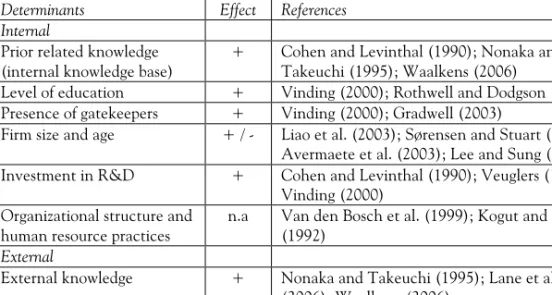
Tabel 2.2 summarizes the internal and external determinants of a firm’s absorptive capacity.
Table 2.2. Internal and external determinants of absorptive capacity
No. Determinants Effect References
Internal
1 Prior related knowledge
(internal knowledge base) + Cohen and Levinthal (1990); Nonaka and Takeuchi (1995); Waalkens (2006) 2 Level of education + Vinding (2000); Rothwell and Dodgson (1991) 3 Presence of gatekeepers + Vinding (2000); Gradwell (2003)
4 Firm size and age + / - Liao et al. (2003); Sørensen and Stuart (2000), Avermaete et al. (2003); Lee and Sung (2005) 5 Investment in R&D + Cohen and Levinthal (1990); Veuglers (1997);
Vinding (2000) 6 Organizational structure and
human resource practices n.a Van den Bosch et al. (1999); Kogut and Zander (1992) External
1 External knowledge + Nonaka and Takeuchi (1995); Lane et al. (2006); Waalkens (2006)
2 Interaction + Ghoshal and Bartlett (1988); Levinson and Asahi (1995); Steensma (1996)
Source: Adopted from Daghfous (2004)
2.6 The Absorptive Capacity of Small- and Medium-sized Enterprises As the literature indicates, the vast majority of the research on absorptive capacity has been conducted within large companies, while there are only a few studies on this topic in the context of small- and medium-sized enterprises (SMEs) (see Liao et al., 2003 and Waalkens, 2006 in the context of developing countries). This means that absorptive capacity research on the level of SMEs is
scarce (Liao et al., 2003). In addition, different ways of measuring absorptive capacity are needed on the SME-level (Jones and Craven, 2001).
Liao et al. (2003) have examined absorptive capacity and its relationship with firm responsiveness among growth-oriented SMEs in the United States. In a more recent study, Waalkens et al. (2008) has adopted an extended concept of absorptive capacity developed by Zahra and George (2002) in the context of Dutch architectural and engineering SMEs. In Waalkens’ study, R&D expenditure, the only indicator variable used in this type of study, was complemented with other alternative measures of absorptive capacity.
There are several characteristics that differentiate SMEs from large firms. Generally, in contrast to large firms, SMEs are usually characterized by relatively simple organizational structures. This is why it is easier for an SME to adapt, internalize, and crystallize new information and disseminate it more efficiently across the entire enterprise (Pelham, 2000). In addition, since SMEs have only a limited range of products and customers, they can minimize the requirements for their formal decision-making procedures (Appiah-Adu and Singh, 1998). Chen and Hambrick (1995) argue that smaller firms are also quicker and more agile than their larger counterparts because of their structural simplicity and the fact that their operation trajectories are shorter and therefore more streamlined. However, many SMEs are characterized by their lack of long-range focus, strategic orientation, systematic decision-making, and customer orientation (Sexton and Van Auken, 1982). In addition, their decision-making tactics are often described as ad-hoc and short-term, while their decision-making processes are generally centralized. Furthermore, these processes are often strongly linked to the owner of the firm or the key manager (Tidd et al., 2005). They are usually the creative minds and the central figures that make the strategic decisions and initiate the innovative activities within the firm (Johannisson, 1998).
As regards these aspects large firms are different. Mostly, large firms are better capable of achieving economies of scale in their operations (Hambrick et al., 1982) and generally they have a broader range of resources at their disposal (Singh, 1990), which can be used to strengthen their competitive position and absorb the shocks of change or drawbacks. Large firms can typically benefit from their greater size. They can more easily acquire market share on the basis of their product lines and reputation, exploit their patents, introduce economies of scale in their research and development activities, use their bargaining power over their suppliers and buyers, and dominate the market through pricing leadership (Porter, 1980; Scherer and Ross, 1990). Furthermore, large companies usually have a special business unit engaged in developing initiatives and making decisions in the field of innovation, called an R&D department.
2.7 Conclusion
A firm’s ability to absorb, assimilate, and utilize knowledge from outside, also called a firm’s absorptive capacity, is crucial for its survival. We have discussed several theories which provide a broader understanding of the concept of absorptive capacity in a business context. In our study, we used a knowledge transfer framework as our starting point. More specifically, both the evolutionary theory and the resource-dependency theory were introduced to gain an insight into the dynamics of absorptive capacity in a business context. Further, we addressed the communication theory to capture the concept’s processes and mechanisms.
Innovation as one of the main indicators of absorptive capacity has also been discussed in detail, with a particular focus on issues such as the degree of change, the different stages, and the target outputs. In order to obtain a broader understanding of absorptive capacity in the context of SMEs, we adopted Cohen and Levinthal’s original definition (1990) and added the description presented by Zahra and George (2002), suggesting that the concept may be divided into potential and realized absorptive capacity.
The determinants of the absorptive capacity of firms as identified by the previous studies can generally be grouped into two main categories: internal and external factors. Since absorptive capacity is closely related to external knowledge (Cohen and Levinthal 1990), the current study will particularly pay attention to external determinants i.e., the characteristics of external knowledge and the interaction between a firm and its environment as the source of this external knowledge. The characteristics of external knowledge that have an impact on a firm’s absorptive capacity are discussed in Chapter 3, while Chapter 4 deals with the interaction between a firm and its environment. Furthermore, several internal determinants which are considered to be relevant in the context of SMEs (i.e., a firm’s age, its size, and the level of education of its employees) will also be taken into account (see Chapter 5).