University of Vermont
ScholarWorks @ UVM
Graduate College Dissertations and Theses Dissertations and Theses
2015
Conceptualizing Contemplative Practice as
Pedagogy: Approaches to Mindful Inquiry in
Higher Education
Melissa Hammerle
University of Vermont
Follow this and additional works at:https://scholarworks.uvm.edu/graddis
Part of theEducational Methods Commons, and theHigher Education Commons
This Dissertation is brought to you for free and open access by the Dissertations and Theses at ScholarWorks @ UVM. It has been accepted for inclusion in Graduate College Dissertations and Theses by an authorized administrator of ScholarWorks @ UVM. For more information, please contact
Recommended Citation
Hammerle, Melissa, "Conceptualizing Contemplative Practice as Pedagogy: Approaches to Mindful Inquiry in Higher Education" (2015).Graduate College Dissertations and Theses. 517.
CONCEPTUALIZING CONTEMPLATIVE PRACTICE AS PEDAGOGY: APPROACHES TO MINDFUL INQUIRY IN HIGHER EDUCATION
A Dissertation Presented by
Melissa Hammerle to
The Faculty of the Graduate College of
The University of Vermont
In Partial Fulfillment of the Requirements for the Degree of Doctor of Education
Specializing in Educational Leadership and Policy Studies May, 2015
Defense Date: March 25, 2015 Dissertation Examination Committee: Jill Mattuck Tarule, Ed.D., Advisor Fiona Patterson, D.S.W., Chairperson Judith A. Aiken, Ed.D. Cynthia Gerstl-Pepin, Ph.D. Cynthia J. Forehand, Ph.D., Dean of the Graduate College
Abstract
A compelling argument has been made which claims that institutions of higher education focus disproportionately on transmitting basic skills to their students at the expense of supporting issues of central importance to the development of emerging adults, including clarifying values and identity and defining individual purpose and meaning (Palmer & Zajonc, 2010). As a result, an increasing number of postsecondary teachers are considering how they can refashion education by using contemplative inquiry to deepen student learning and personal growth. This movement to reframe the teaching-learning paradigm has led to the development of teaching methods that seek to cultivate emotional, psychological and intellectual competencies including creativity, self-understanding, awareness and mental flexibility (Lief, 2007). Contemplative pedagogy, which can include mindfulness practices and contemplative or imaginative inquiry, provides such a framework for teaching and learning. Faculties at institutions of higher education across the U.S. are increasingly adapting this educational model for use in their classrooms.
The purpose of this qualitative study was to understand ways in which faculty members in higher education are developing mindfulness-based contemplative pedagogies and to identify critical variables that have informed how they have
conceptualized and implemented this educational model. I employed a collective case study methodology to explore the experiences of faculty members who have embedded contemplative inquiry within the broader context of a traditional liberal arts curriculum. The study focused on why and how these instructors have developed contemplative teaching practices, their experiences integrating these practices into the classroom, and the potential outcomes they identified for themselves and their students. The findings suggest that, for these teachers, contemplative pedagogy provides a mechanism to deepen learning through a process of embodied inquiry in which both student and teacher are actively engaged. Through their teaching practices participants demonstrated a common goal: to foster in students qualities of mind that might help them engage more directly with learning as an experiential process of personal inquiry. This study informs the evolving landscape of contemplative education by exploring how teachers are developing and implementing contemplative models for learning in order to address issues of
personal meaning and purpose in higher education.
Keywords: higher education, contemplative pedagogy, mindful teaching, contemplative education
Dedication
Thomas, Luke, Thea Ruo Ni and
Galway Kinnell and Philip Levine, Two dear friends and mentors
who passed away while I was completing this study
Acknowledgements
My profound gratitude to all at UVM who supported me on this journey: especially Jill Mattuck Tarule, whose own work inspired me long before we met, and whose insight and guidance made my work stronger, more thoughtful and more focused. Judith Aiken, an extraordinary teacher, women’s advocate, and leader in higher education. Cynthia Gerstl-Pepin, whose important research and writing has led me to deeper insights into the complex world of social justice education. And to Fiona Patterson, for bringing to the committee important perspectives that helped to ensure this study would be rigorous and relevant.
In addition, I am grateful to Ellen Baker for welcoming me so warmly into the Teacher Education program so many years ago. To Kim Nicasio, for all that she does to support so many. To Roman Vogel, for the care and attention he brings to his work on behalf of students and faculty. And to Colby Kervick, for her deep commitment to her students and to the field of special education; she has been a valued partner and friend. Lastly, to all of the wonderful colleagues I’ve met at UVM, and all of my cohort members, thank you.
v
I have had the extraordinary good fortune to be surrounded on all sides by friends and family who are committed to lives of authenticity, integrity, and to the cultivation of compassion. Thanks to them all for their support and friendship and love.
Special thanks to Ellen Hammerle and Peggy Hammerle McGuire for their unwavering encouragement and steadfast love.
And blessings to the beautiful child who arrived during this writing: Grace Mansfield. My thanks to Patricia, for showing me the way.
And of course my deepest gratitude to Thomas, Luke, and Thea: without you, nothing would be possible.
Table of Contents
Acknowledgements ... iii
List of Figures ... vi
Chapter One: Introduction ...1
Background: Mindfulness Research ...7
Research Problem ...9
Problem Statement ...10
Research Questions ...11
Defining the Terminology ...11
Significance of the Study ...13
Chapter Two: Literature Review ...17
Higher Education: Spirituality, Wholeness and Embodied Cognition ...19
Mindfulness and Contemplation in Education ...23
Pedagogy, Learning and the Emerging Adult ...29
The Role of the Teacher in Contemplative Education ...32
Summary ...37
Chapter Three: Methodology ...39
Qualitative Research Tradition ...40
Site and Participant Selection ...42
Data Collection ...43
Data Analysis ...46
Researcher Positionality ...50
Limitations ...52
Chapter Four: Findings ...54
The Mindful Teacher: Teaching for Wholeness and Authenticity ...55
Bringing Contemplative Practices into the Classroom ...57
Contemplative pedagogy and social justice education ...64
The Mindful Learner: Contemplation and Intellectual Inquiry ...66
Developing the Whole Student ...71
Mindfulness and Self-Care ...74
Student Experiences ...76
The Mindful Classroom: Implementing Contemplative Pedagogy ...80
Contemplative Traditions ...81
Describing Contemplative Pedagogy ...83
Contemplative Practice as Embodied Learning ...87
Building Teaching-Learning Communities ...90
Observations from the Field ...91
Institutional and Peer Support: Developing Networks for Contemplative Teaching ...92
Chapter Five: Discussion ...96
Conclusion ...111
Postscript: Framing the Study ...114
References ...118
Appendix A: Consent Form ...128
List of Figures
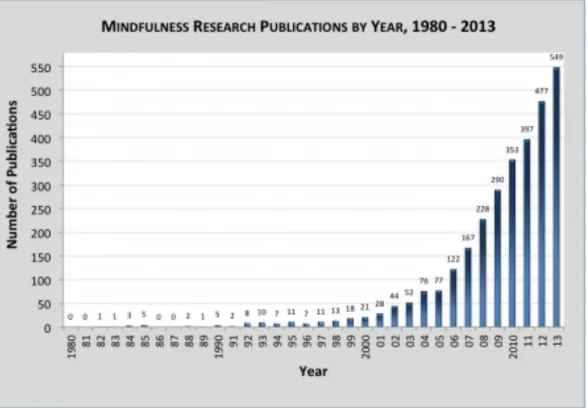
Figure 1: Mindfulness Research Publications by Year: 1980-2013 ...7
Figure 2: Concentrative vs. Mindfulness Meditation ...24
Figure 3: Faculty Positionality in Sentipensante Pedagogy ...34
Figure 4: The Seven Synergies of Mindful Teaching ...35
Figure 5: The Triple Tensions of Mindful Teaching ...37
Chapter 1: Introduction
During the last fifteen years a quiet pedagogical revolution has taken place in colleges across the United State. Often flying under the name “contemplative pedagogy,” it offers to its practitioners a wide range of educational methods that support the development of student attention, emotional balance, empathetic connection, compassion and altruistic behavior. (Zajonc, 2013, p. 83)
Due to their inward focus, contemplative pedagogical methods can enrich and complement the disciplinary modes of inquiry already used in the liberal arts by enhancing the learner’s personal connection with the subject matter. In many areas of academic inquiry, contemplative practices have been found to enhance…creativity, open-mindedness, the ability to hold paradox, and compassionate civic engagement. (Burggraf and Grossenbacher, 2007, p. 1)
The incorporation of contemplative practices in Western curricula is still a relatively marginal phenomenon [because] we have not yet developed a rigorous conceptualization of contemplative practice as pedagogy. (Ergas, 2013, p. 4) Higher education in the United States is at a crossroads. On the one hand,
academic institutions are engaged in the education of a multicultural, secular constituency through mass education in an increasingly technological world. On the other hand, the pedagogical framework for learning in higher education remains (tacitly and otherwise) rooted in traditional and historical precedent and practice. What this means, in part, is that the concurrent epistemological framework upon which teaching pedagogies have developed, namely objectivism and post-positivism (Butin, 2010; Palmer, 2004; Palmer & Zajonc, 2010; Rendón, 2009), continue to shape most of the learning modalities, pedagogical practices, and the institutional landscape of higher education today (Chickering, Dalton & Stamm, 2006). Palmer and Zajonc (2010) referred to this epistemological premise as the myth of objectivism and have argued that by giving
precedence to this epistemological framework for learning we have created divided institutions, where educators focus disproportionately on transmitting basic skills to their
students at the expense of supporting issues of central importance to the development of emerging adults, including issues of meaning, purpose and personal values. Harry Lewis (2006), the former dean of Harvard College, wrote that:
Harvard and our other great universities [have] lost sight of the essential purpose of undergraduate education…college or university is not just a place for the transmission of knowledge, but a forum for the exploration of life’s mystery and meaning. (p. xv)
Within the context of a secular, pluralistic and highly individualistic as well as highly fragmented learning environment, colleges and universities have been unsure how to educate the whole student (Chickering et al., 2006).
In this complex landscape, postsecondary teachers increasingly question how they can refashion education by focusing on teaching and learning frameworks that address the emotional and psychological as well as the intellectual life of the student and the teacher. In recent decades education theorists have proposed a range of pedagogical practices in an attempt to redress some of the problems identified with an increasingly fragmented curriculum and learning culture. Among them, Apple (1979), Freire (1970), and Giroux (1981) addressed the entrenched economic and cultural mechanisms driving this educational model and developed arguments for a critical pedagogy. Other scholars “challenged epistemological frameworks based on modernist rational knowing, linear developmental schemes, the notion of objectivity, the divide between theory and practice, and the exclusion of the contributions of women, indigenous people and people of color” (Rendón, 2009, p. 15). Further interrogations of the curriculum and teaching
including feminist teaching theories (Belenky, Clinchy, Goldberger, & Tarule, 1986; Gilligan, 1982), engaged pedagogy (hooks, 1994), holistic educational theory (Miller, 2000), transformative theory (Dirkx, J., Mezirow, J., & Cranton, P., 2006) and integral theory (Esbjörn-Hargens et al., 2010; Gunnlaugson, 2009). In the process, scholars have cautioned that we must approach this phenomenon with a sense of urgency:
Today, as our social reality has become dramatically complex, higher education [has become] a multi-institutional configuration… Within this vast dynamic complexity, the questions of the relationship between the extraordinary
knowledge development of our time and questions of purpose, meaning, faith, and ethics have become both more difficult and more urgent. (Parks, 2000, p. 11) By privileging learning as intellectual development that is rational and empirical, while viewing the social, emotional and spiritual development of young adults as
secondary to academic matters, we risk neglecting how we are preparing college students to address larger societal and social issues (Chickering et al., 2006; Rendón, 2009). As critical, feminist, and engaged theorists have argued, educational models that perpetuate bias and discrimination by maintaining hierarchies within the school and the classroom (i.e., by race, gender, social class, etc.), and that identify an emotional as well as
intellectual divide between teacher and student, student and content, and even student and classroom community, ultimately perpetuate systems that serve to isolate and silence (hooks, 2010). However, Chickering et al. (2006) argued that colleges and universities are the only social institutions in a secular democracy that can educate its citizenry to effectively respond to and address these broader problems with the level of cognitive and emotional competency they require. Hooks (1994) also argued that to educate and give
voice to the whole person within the context of a pluralistic, democratic society, it is necessary to challenge and change the way pedagogy is understood.
Within the stratified culture of higher education, professors are also recognizing their own need to incorporate personal meaning and value into their work in the
classroom while calling for a new pedagogical vision that responds to these needs. Hooks (2010) addressed this problem by envisioning engaged pedagogy as dependent upon the “mutual relationship between teacher and students that nurtures the growth of both parties…[by] expanding both heart and mind” (p. 22). To counter the paradigm that separates intellectualism from intuition, self from other, teacher from learner, scholars are beginning to explore a more holistic framework for both teaching and learning identified as contemplative pedagogy (Palmer & Zajonc, 2010), in which the instructor is both a reflective teacher (Schön, 1987) and a contemplative practitioner (Miller, 2014) who fosters qualities of mind that can potentially lead to “awareness and acceptance, compassion, integrity, tolerance, patience, focused-attention, and wisdom” (Rogers & Maytan, 2012). In this way, some postsecondary teachers are implementing
contemplative and mindfulness learning strategies in order to support the development of the whole person so that the inner life of both student and teacher can be given a central place in learning:
By encouraging contemplative ways of knowing in higher education in diverse disciplines, we can encourage a new form of inquiry and imaginative thinking to complement critical thinking, and we will educate active citizens who will support a more just and compassionate direction for society. (Bush as cited in Palmer & Zajonc, 2010, p. 165)
These teachers are employing contemplative pedagogy to explore practices that will integrate personal meaning and values into the teaching and learning experience. At its foundation, the developing field of contemplative studies represents an effort to claim a more embodied, integrative framework for learning where students approach content as they simultaneously explore “the systematic training of consciousness” (Roth, 2011, p. 29). Moving beyond “western epistemological biases,” the premise of this pedagogical approach claims that learning is both a subjective and an objective experience and that developing awareness through contemplative disciplines is necessary in order to understand the role of the learner in this intersubjective process (p. 29). In turn, this pedagogy addresses a larger question facing the world of higher education: “How can higher education become a more multidimensional enterprise, one that draws on the full range of human capacities for knowing, teaching, and learning” (Palmer & Zajonc, 2010, p. 2)?
Contemplative education attempts to foster the development of experiential, contemplative, and mindful inquiry in curriculum and pedagogy. In addition to addressing the social and emotional needs of contemporary college students as factors that inform their intellectual growth, contemplative pedagogy also addresses the needs of the teacher to be fully engaged in the process of connected knowing and teaching
(Belenky et al., 1986) that takes place in the learning exchange. Contemplative pedagogy relies, therefore, on a conception of mindful teaching as a process through which
“teachers struggle to attain congruence, integrity and efficacy in their practice”
(MacDonald & Shirley, 2009). In this evolving paradigm, contemplative pedagogy seeks to foster critical thinking, focus and attention, insight, compassion, connection, inquiry
into the mind, personal meaning-making, creativity, and an understanding of the moral and ethical dimensions of education (Barbezat & Bush, 2014). In this way, contemplative pedagogy is informed by the growing body of research on mindfulness in education and medicine (American Mindfulness Research Association, AMRA, 2014), as well as research-based studies in cognitive and social psychology that are shedding new light on how students learn (Ambrose, Bridges, DiPietro, Lovett, & Norman, 2010).
At the same time, contemplative pedagogy is seen as a framework for teaching that supports both the intellectual as well as the emotional life of the teacher as well as the student. This is important as it supports a process through which professors can question the “dominant agreements that govern pedagogical practice in higher education” in order to “assemble and validate…newly constructed agreements that speak to who we are as whole human beings—intelligent, social, emotional and spiritual” (Rendón, 2009, p 48). In other words, an intention of contemplative educators is to deepen the learning process for students and teachers while also addressing issues of fragmentation and isolation within academia. Barbezat and Bush (2014) suggested that contemplative pedagogy could be understood as a “contemplative epistemology” (p. xiii), a theoretical lens that holds the potential to fundamentally shift the way in which students and teachers engage with each other as well as the material they are studying. However, as Ergas (2013) noted, contemplative practices remain only marginal in Western curricula because “we have not yet developed a rigorous conceptualization of contemplative practice as
pedagogy” (p. 4). This study considers how current faculty are conceptualizing
contemplative practice as pedagogy in the context of Western institutions of higher learning.
Mindfulness Research
Over the past 50 years, mindfulness and contemplative practices rooted in Eastern religious and philosophical traditions have become the focus of significant study and research across the disciplines, from psychology (e.g., Arch & Craske, 2010; Goleman, 1995), to medicine (e.g., Grossman, Niemann, Schmidt, & Walach, 2004; Kabat-Zinn et al., 1998), to neuroscience (e.g., Davidson et al., 2003; Farb, Anderson, Mayberg, Bean, McKeon, & Segal, 2010), to education (e.g., Eppert & Wang, 2008; Miller, 2006; Oman, Shapiro, Thoresen, Plante, & Flinders, 2008). According to the American Mindfulness Research Association, the number of published studies on mindfulness in the sciences and humanities increased from 0 in 1980 to 549 in 2013.
This body of research reflects a growing interest in the West in mindfulness meditation and contemplative inquiry as practices that can decrease stress, reduce chronic pain, increase self-awareness, improve attention and concentration, support positive emotions, and enhance creativity (Smalley & Winston, 2010). These empirical findings have informed recent developments in educational theory including contemplative pedagogy. In this context, contemplative pedagogy provides a framework for learning and engaged teaching that has the potential to address a range of challenges facing both students and teachers in higher education today by fostering a range of competencies:
We point to ways by which meditation may complement the traditional goals of the academy by helping to develop traditionally valued academic skills as well as helping to build important affective and interpersonal capacities that foster psychological wellbeing and the development of the “whole person.”
(Shapiro et al., 2011, p. 494) This teaching and learning model seeks to support a more “balanced” education that “cultivates abilities beyond the verbal and conceptual to include matters of heart, character, creativity, self-knowledge, concentration, openness and mental flexibility” (Lief, 2007, p. 1). This new direction in teaching offers exciting opportunities for
teachers to consider how to effectively integrate contemplative and mindfulness practices into the classroom that have the potential to foster deeper personal growth within the context of intellectual engagement. The development of contemplative pedagogy as a field of practice embedded in a “relational ontology” (Palmer & Zajonc, 2010) is
supported by the newly identified academic field of contemplative studies (as developed at institutions including Brown University, Stanford, UCLA, the University of Virginia),
and the growth of such academic organizations as the Association for Contemplative Mind in Higher Education, the Mind and Life Institute, The Mindfulness in Education Network, and The Association for Mindfulness in Education. Shapiro, Brown, and Astin (2011) reported that the empirical research to date on the application of mindfulness and contemplative practice to learning has led to impressive findings specifically relevant to higher education, among them that mindfulness and/or concentration-based meditation may “improve a student’s ability to focus, process information quickly and accurately; it may decrease anxiety and depression among students; and it can support the development of creativity, skills needed for interpersonal relationships, self-compassion, and
empathetic responses” (p. 4). Gunnlaugson (2009) has provided a definition of contemplative education that identifies the theoretical lens that grounds this study:
Informed by various contemplative wisdom traditions, contemplative education involves the integration of contemplative practices into the curriculum of traditional higher education settings for the purposes of fostering intuitive, non-conceptual and experiential forms of knowing along paths of learning
characterized by wholeness, unity and integration. (p. 26)
Through this interpretive lens, reality is understood to be an intersubjective experience that is socially constructed (Butin, 2010).
Research Problem
While there has been a growing interest in bringing contemplative pedagogy and mindfulness practices into the academy, there has been little research into the experiences of faculty as they develop new curricula that integrate mindfulness and contemplative
practices into their teaching—including their purposes for creating these new teaching models, what their contemplative curricula looks like, inherent challenges they have faced or personal growth they have experienced through their work with students, discoveries they have made about the application of this form of pedagogical inquiry within the academy, and perceived benefits they have observed within the context of student learning. As academic institutions and their faculties consider emerging
approaches to pedagogical practices that address the intellectual as well as the inner life of both the student and the teacher, it will be helpful to better understand how individual instructors have constructed these frameworks for learning and how they have
experienced the integration as well as the effects of this approach to teaching and learning within their classrooms. In this qualitative study I explored the experience of several faculty members in higher education who are integrating contemplative and mindfulness practices into their teaching in the broader context of a traditional liberal arts curriculum. In particular, the study focused on why and how these instructors have created and
implemented experiential contemplative or mindfulness-based practices, their
experiences integrating these practices into their curriculum, and the potential outcomes they have identified for themselves and their students.
Purpose Statement
The purpose of this study was to understand ways in which faculty members in higher education are developing mindfulness-based contemplative pedagogies and to identify critical variables that have informed how they have conceptualized and implemented this educational model.
Research Question
What is the experience of faculty who are using contemplative pedagogy as a model for teaching in the postsecondary classroom?
Subquestions
What factors informed their decision to create contemplative or mindfulness-based curricula?
What has been the effect of these practices on their teaching and on student learning experiences?
What does their contemplative, mindful pedagogy look like in practice?
What do they hope to achieve, for themselves and for their students, by incorporating contemplative practices into their teaching?
Defining the Terminology
For the purposes of this study, contemplative pedagogy is understood as the essential feature of an integrative teaching and learning approach in higher education that can incorporate some or all of the following characteristics, including mindfulness meditation and a range of mindfulness and contemplative practices:
• Exploring multiple perspectives and including multiple ways of
knowing
• Weaving together the domains of self, culture and nature
(interconnectedness of self and other)
• Combining critical thinking with experiential feeling (reflective self
-inquiry)
• Engaging regular personal practices of transformation (i.e., meditation) and bringing those into the classroom
• Encouraging “shadow work” within learners and teachers, an
exploration of the nonrational side of the human self
• Honoring the range of conventional, alternative, holistic, critical and
transformative approaches to education
(Esbjörn-Hargens et al., 2010, pp. 5-6) Mindfulness is most commonly understood as a “practical way to be more in touch with the fullness of your being through a systematic process of self-observation, self-inquiry, and mindful action” (Kabat-Zinn, 1994, p. 6). In this way, mindfulness has been referred to as a state of awareness, a practice that develops such a state, a manner of processing information, and a trait (Brown & Ryan, 2003; Germer, Siegel, & Fulton, 2005; Kostanski & Hassed, 2008; Siegel, 2007). As a practice, it can involve any number of activities that help to foster greater insight and awareness and connection (to self and others) through embodied, intentional exercises. Mindfulness meditation is a practice that can include concentration and open awareness training, contemplative inquiry, journaling and reflective practice (Zajonc, 2013). Kabat-Zinn (1994) wrote that: “[The power of mindfulness] lies in its practice and its applications. Mindfulness means paying attention in a particular way: on purpose, in the present moment, and nonjudgmentally” (p. 4).
In addition, Langer (1997) has been instrumental in studying mindfulness strictly as a phenomenon and quality of mind, one independent of meditation or contemplative inquiry. As a social psychologist she has done extensive research studying the attributes of mindfulness and mindlessness and investigated how these mental states inform how we think and how we learn. She defined mindfulness as “openness to novelty; alertness
to distinction; sensitivity to different contexts; implicit, if not explicit, awareness of multiple perspectives; and orientation in the present” (Langer, 1997, p. 4).
More broadly, contemplative practices can be characterized this way:
Contemplative practices quiet the mind in order to cultivate a personal capacity for deep concentration and insight. Examples of contemplative practice include not only sitting in silence but also many forms of single-minded concentration, including meditation, contemplative prayer, mindful walking, focused experiences in nature, yoga, and other contemporary physical or artistic practices.
(The Center for Contemplative Mind in Society, 2007) Throughout this study I will refer to mindfulness meditation, mindfulness practices, and contemplative pedagogy as aspects of a “body-oriented pedagogy” (Ergas, 2013, p. 4). These definitions will be adaptive and fluid depending on how research participants define them within the context of their teaching. However, the definitions and concepts presented here inform the terminology used throughout this study.
Significance and Purpose of the Study
To teach in a manner that respects and cares for the souls of our students is essential if we are to provide the necessary conditions where learning can most deeply and intimately begin. (hooks, 1994, p. 13)
Transformation toward increasing wholeness is the goal for a contemplative teaching and learning environment. (Byrnes, 2012, p. 26)
In 2011, Shapiro et al. published a review of the research into contemplative pedagogy specifically related to higher education. The report, commissioned by the Association for Contemplative Mind in Higher Education, entitled Toward the
research-based evidence of the effects of meditation on cognitive and academic performance for college students as well as its relation to emotional development, including: creativity, interpersonal relationship skills, empathy and self-compassion. Based on their findings, the authors concluded that:
The applications of meditation in higher education are potentially broad, affecting cognitive, emotional, and interpersonal domains. Research addressing the effects of meditation on academic performance, psychological wellbeing, and
interpersonal experience for students in college, medical school, and other higher education settings has shown promising results. (Shapiro et al., 2011, p. 520) While the broader literature reflects significant empirical findings exploring the effects of mindfulness practices on students, there is a paucity of research into the actual experience of teachers in higher education who have incorporated contemplative and mindfulness practices into their classroom and how they are defining and developing this work:
In the late 20th century and early 21st century, contemplative education/studies
courses, concentrations and initiatives have emerged in the academy. Although there has been significant discussion of postsecondary courses and programs that have integrated contemplative views and practices in the literature, there have been few inquiries of contemplative curricula and pedagogy in higher education. (Wehlburg, 2013, Foreword)
At the same time, Sanders (2013) noted that there is growing evidence that contemplative education contributes to the positive development of students, and that meditation
specifically “correlates with several beneficial academic and psychological factors related to student learning and functioning in higher education” (p. 1). Shapiro et al. (2011)
called for further research addressing the question of how best to incorporate
contemplative practices into the unique culture of colleges and universities: “While there is a growing body of research to support these findings, there is a need for thoughtful, well-designed research to guide educators in integrating meditative and other
contemplative practices into the academy” (p. 36).
In my review of the literature and research into contemplative pedagogy in higher education, I found very few studies investigating the experience of faculty who are committed to engaging a contemplative, integrative teaching paradigm. While several scholars have argued for the need for a more contemplative turn in teaching practices across higher education, there is little research into the ways in which teachers are engaging this curricular model and their experience implementing contemplative practices in their classroom teaching. This is a significant gap in the growing literature on contemplative and mindfulness pedagogy and higher education, especially given the quickly expanding field of contemplative studies and the increasing numbers of
postsecondary teachers who are developing contemplative frameworks for their teaching. As a measure of this growing field, the Association for Contemplative Mind in Higher Education, incorporated in 2008, already has a membership of almost 800 educators from around the country.
By giving voice to the experiences of some of these teachers, and by examining how and why they have adapted their teaching to incorporate a contemplative experience or practice, this study can help us to better understand the ways in which these modalities can inform teaching and learning in higher education, and ways in which faculty are engaging the question of how to teach with integrity and wholeness themselves while
addressing the intellectual and emotional lives of their students. As institutions of higher education face significant challenges concerning how faculty can best support student learning and student development in the context of a multidimensional, technological global environment on the one hand, and on the other a growing sense of fragmentation and isolation across the academy, this will become an ever more urgent issue in the years ahead. What some have called a revolution in learning (Levy, 2013), contemplative education situates postsecondary teaching at this critical juncture. This is a field ripe for further investigations into faculty and student experiences.
Chapter 2: Literature Review
Taken as a set, [these theories and practices] foreground the importance of interlinking individual emancipation, pedagogical innovation, revolutionary vitality, evolutionary thinking, spiritual tradition, and political action. (Molz & Hampson, 2010, pp. 42-43)
The philosophical argument for an experiential American educational model has some of its earliest roots in the theoretical school of pragmatism as articulated in the work of John Dewey (1938). Not only did he elaborate a theory of education that based effective teaching and learning on the qualitative experience of the student, he questioned some of the premises that shaped western models of education. Namely, as noted above, the either-or phenomenon that led to the perception of teaching as the imposition of knowledge “from above and from outside” and as knowledge as “essentially
static…taught as a finished product, with little regard either to the ways in which it was originally built up or to changes that will surely occur in the future” (Dewey, 1938, pp. 18-19). Dewey suggested that progressive education, in order to support the development of the whole person (specifically in the context of a democratic society), should be based upon a creative, dynamic, participatory process between student and teacher that allows for the “kind of present experiences that live fruitfully and creatively in subsequent experiences” (p. 28). This pedagogical stance identified teaching and learning as an iterative process that involves the ongoing reconstruction of experience and knowledge (Dewey, 1938).
Over time, an attempt to shift the educational model upon which learning in K-12 and higher education has developed has led to several theoretical constructs that redress important assumptions embedded within the teaching-learning paradigm. Some
of these approaches include critical pedagogy (Apple, 1979; Freire, 1970; Giroux 1981), feminist theory (Belenky, Clinchy, Goldberger & Tarule, 1986; Gilligan, 1982),
transformative learning (Dirkx et al., 2006; O’Sullivan, 1999), engaged pedagogy (hooks, 1994), holistic education (Miller, 2000), and integrative learning (Esbjörn-Hargens et al., 2010). Contemplative pedagogy, which embraces “a view that values experiential and transformative learning as forms of ‘contemplative knowing’” (Palmer & Zajonc, 2010, p. 15), has drawn the attention of a wide number of academics across disciplines who recognize the need for radical shifts in teaching and learning in order to transform the pervasive biases that inform the traditional epistemology embedded in educational models (hooks, 2010).
The historical trajectories that have led to the integration of contemplative inquiry and mindfulness practice in teaching pedagogies in higher education are broad and complex. As suggested above, the academic culture both mirrors and interrogates the dominant culture within which it is embedded. In turn, this interaction between evolving epistemological and philosophical frameworks in the context of social and cultural change has resulted in contemporary models of teaching and learning that rely increasingly on a range of disciplinary perspectives and diverse inquiry methods
(Flinders & Thornton, 2009). The field of contemplative education has been informed by extensive research not only in the areas of psychology and medicine, but has been viewed as well as a process that can deepen imaginative inquiry and creativity (Brady, 2007). I will consider the relevance of this research as it relates specifically to both how learning works in the emerging adult and how these practices support the work of the teacher.
And I will identify ways in which these findings are informing pedagogy in the complex world of higher education.
Higher Education: Spirituality, Wholeness and Embodied Cognition
The work of Harry Lewis (2006), Parker Palmer (2010), Sharon Daloz Parks (2000), Laura Rendón (2009), and Arthur Zajonc (2010), as cited above, represents a growing call for a reassessment of the fundamental educational mission of higher education. Rendón’s study (2009) was the first of its kind to examine how faculties are attempting to “shatter” the current belief system that she claims works against
“wholeness, multiculturalism and social justice” (p. 1). Her intention was to arrive at a model of wholeness in teaching; this became Sentipensante Pedagogy (sensing/feeling). Her work lay the groundwork for a reframing of pedagogy in higher education with the sole purpose of repositioning faculty in territory that honors and engages their multiple identities and invites them to bring their whole selves into their teaching, writing and research while simultaneously addressing the inner life of the student.
Lewis (2006) labeled the success of higher education as the achievement of a “hollow excellence,” claiming that universities have forgotten the ideals and goals that were once fundamental to their mission: while universities succeed more than ever as repositories of knowledge, he argued, they have forgotten their essential role, which is to help students “learn who they are, to search for a larger purpose for their lives, and to leave college as better human beings” (p. xiv). In the largest study of its kind, Astin, Astin and Lindholm (2011) investigated the spiritual life of college students and faculty and they found that almost 80% of students and faculty reported that they were
committed in their teaching and learning to a personal search for purpose and meaning. When asked how frequently they experienced that kind of search in a college classroom, 60% reported never.
Consequently, in response to these issues, one area of research has focused on the role spirituality plays in the educational and developmental life of undergraduates. Chickering, Dalton and Stamm (2006), for example, examined the historical context out of which secular institutions of higher education came to repudiate the inclusion of any form of moral indoctrination in the classroom. They suggested that during this process the learning environment in institutions of higher education shifted towards rational empiricism and professional preparation, losing sight of the need to address issues of personal growth with a focus on authenticity and a connection to the inner life and that these institutional changes are the result, in part, of the ways in which universities have evolved from faith-based, Christian institutions to modern, secular institutions:
The wholesale acceptance by the 1960s of the university as the institutional center for developing the knowledge on which a modern scientific technological society depends eliminated entirely any theological basis for the engagement of churches with higher education. Today the church has become the sole guardian of faith, the college and university the prime champions of knowledge. (Sloan as cited in Chickering et al., 2006, p. 80)
Astin et al. (2011), in their longitudinal, seven-year study, asked how “students change during the college years and the role that college plays in facilitating the
development of their spiritual qualities” (p. 1). In their analysis, they cited a surge of interest among scholars and researchers in the topic of spirituality in higher education. In
their research they referenced several definitions of “spirituality” in the literature, but most relevant to this study is the definition cited by Helminiak (1987): “Within the spiritual domain, human development can be characterized both by one’s capacity to integrate the many other aspects of development—cognitive, social, emotional, moral— with one’s capacity for integrity, wholeness, openness, self-responsibility and authentic self-transcendence” (Astin et al., 2011, p. 28). The findings from this study indicate that most college students claim to have an interest in spirituality and that, in turn, most freshman expect that college will be a time for their own spiritual development. But these authors also identified the ways in which secular institutions of higher education can actually inhibit the spiritual growth of students. They claimed that those who believe that higher education should only be concerned with the cognitive or intellectual
development of students in fact encourage a “kind of fragmentation and a lack of authenticity…where academic endeavors can become separated from students’ most deeply felt values” (p. 7).
While the topic of spirituality and student development in a secular context has been of interest to many scholars, there has been as well other currents in the research exploring alternative approaches to the dominant rational-empirical approach to education. Some scholars have considered the ways in which this epistemological framework could be balanced through “soulful” learning and the creation of a spiritual curriculum (Miller, 2000), but the broader discourse investigating a shift of curricular paradigms has extended in many directions. There are strains of this line of inquiry found in theories of engaged pedagogy (hooks, 1994), connected learning (Belenky et al., 1986), integrative education (Esbjörn-Hargens et al., 2010), and transformative learning
(Brookfield, 2000; Mezirow, 1997; O’Sullivan, 1999). All of these approaches share what Habermas (as cited in Mezirow, 2003) identified as a divide between instrumental and communicative learning. Instrumental learning in this paradigm is about controlling the environment. Communicative learning relies on critical-dialectical discourse to perceive truth as that defined by and contextualized within a given reality. Goleman (1995) claimed that such dialectical discourse has the potential to develop qualities of emotional intelligence, which supports a framework for learning that addresses the social, psychological and emotional development of the student. In Mezirow’s (2003) analysis of transformative learning theory he also referenced Kegan’s (1982) work in the area of constructive-developmental identity psychology which located specific developmental stages of the individual self, noting our unique capacity for critical self-reflection, especially in early adulthood. As in all of these approaches, growth is understood to be dependent upon a process of differentiation, involving an “emergence from
embeddedness” (Schachtel as cited in Kegan, 1982, p. 31). For some, this process of a reflective, connected, constructivist learning model is informed by thinkers such as Freire (1970) and Giroux (1981), who identify the ultimate goal of education as liberation from oppression and see universities as “locations that help to create activists to bring about the democratic reconstruction of society” (Marshall & Oliva, 2006, p. 19).
Vygotsky (1978) considered the development of the whole person in the context of their potentiality as learners. His analysis involved what he called a “zone of proximal development” (p. 86), suggesting that there is a sphere within which people learn, in that space between what they understand and know and their potential for knowing. When applied to emerging adults, this frame for learning can be linked to Maslow’s (1943)
developmental stage of self-actualization in his hierarchy of needs, and Mezirow’s (1997) transformative learning theory, in which he states that: “When circumstances permit, transformative learners move toward a frame of reference that is more inclusive, discriminating, self-reflective and integrative of experience. A frame of reference encompasses cognitive, conative, and emotional components, and is composed of two dimensions: habits of mind and a point of view” (p. 5). In turn, cognitive scientists have concluded that our cognition “emerges from a background of a world that extends beyond us but that cannot be found apart from our embodiment” (Varela, Thompson, & Rosch, 1993, p. 217). This understanding of cognition as an interconnected, embodied,
relational process identifies both the intellectual and experiential (emotional, physical, spiritual) as factors that inform how we know.
Mindfulness and Contemplation in Education
The breadth of research exploring the mental, emotional, and physical effects of mindfulness meditation and mindfulness practices represents studies across the
disciplines (from medicine to law) and includes research subjects from Buddhist monks to cancer patients to elementary school students. In order to ground this current study in relevant research, I will reference studies that link mindfulness specifically to growth indicators relevant to emerging adults: including positive qualities of mind that support learning (focus and attention) and engender positive emotional and mental health, and character attributes that support acceptance, tolerance, and compassionate action.
Meditation and contemplation are two categories of practice that inform
different techniques and that can generate different qualitative experiences. In this way, studying and describing the benefits and practices of mindfulness meditation and
contemplative inquiry is challenging as each approach is derived from a complex mix of historical, cultural, spiritual practice and discourse. That being said, contemplation has been characterized as a radical openness involving attention and awareness (Miller, 2014), while mindfulness, to return to Kabat-Zinn’s (1994) definition, can mean “paying attention in a particular way…that nurtures greater awareness, clarity, and acceptance of present-moment reality” (p. 4). In turn, all meditation practices share the goal of
“training an individual’s attention and awareness so that consciousness becomes more finely attuned to events and experiences in the present” (Shapiro, Brown & Astin, 2011, p. 494). Goleman (1988) suggested that there are four kinds of mindfulness practices, focusing on the body, feelings, the mind, or on mind objects. He broadly divides meditation into two groups: concentrative meditation and mindfulness meditation, establishing the following characteristics for each:
Figure 2: Concentrative vs. Mindfulness Meditation
Concentrative Meditation Mindfulness Meditation
Disciplined, single-pointed focus of attention.
Opening and expanding to an awareness of thoughts and feelings as they pass through the mind, but not focusing on a single purpose.
Attention is focused in a non-analytical, unemotional way, with the intent to directly experience the object of meditation.
Meditator may focus attention on breath, a word (Benson & Proctor, 1984), or specific sounds (see Carrington, 1998).
Involves three core elements: intention, attention, and attitude (Shapiro,
Carlson, Astin & Freedman, 2006). *Intention involves consciously and purposefully regulating attention. *Attention is the ability to sustain attention in the present moment without interpretation,
discrimination or evaluation. *Attitude is a frame of mind brought to mindfulness
meditation; commonly described as openness, acceptance, or
nonjudgmentality.
Like the zoom lens on a camera. Like the wide angle lens on a camera.
(Shapiro, Brown & Astin, 2008, p. 7) Accordingly, meditation is a form of contemplation that involves concentrated and
focused practice (Miller, 2014).
There are now hundreds of studies confirming the positive outcomes of meditation and identify mindfulness meditation and contemplative practice as healing paradigms that can address issues related to depression, stress, chronic pain, obesity, post-traumatic stress, among many other emotional and physical challenges (The Center for Mind-Body Medicine, 2015). In addition, several studies offer evidence that
meditation can strengthen attentional capacities which can help students focus their attention in order to retrieve and hold a range of information (Jha, Krompinger, & Baime, 2007; Tang et al., 2007; Van den Hurk, Giommi, Gielen, Speckens, & Barendregt, 2010). Other studies have shown how mindfulness training decreases stress hormones to
promote relaxation while supporting the immune system (e.g., Davidson et al., 2003; Witek-Janusek et al., 2008). And still other studies demonstrate that regular, ongoing meditation practice can impact the thickness of the cerebral cortex, which plays a key role in brain functions including memory, attention, awareness, and language acquisition (e.g., Lazar et al., 2005). In addition, mindfulness and meditation practices can decrease the heart rate, allowing practitioners to breathe more deeply and slowly, decreases blood pressure, and improve digestion and vision (Rogers & Maytan, 2012). In other words,
mindfulness meditation has been shown to help practitioners relax, calm the mind, and improve mental functioning.
Jon Kabat-Zinn was one of the first researchers to investigate the impact of mindfulness practice on health, and in one early study he looked at psoriasis patients to see if their condition would be impacted by the introduction of mindfulness meditation training into their treatment protocol (Kabat-Zinn et al., 1998). The result of that study showed that mindfulness as a medical intervention has the potential to be effective in increasing the rate at which healing can occur. Kabat-Zinn went on to develop a treatment program that has had huge implications for the medical and mental health fields. Mindfulness-Based Stress Reduction (MBSR) is now a model for treatment programs internationally, and has informed such programs as: Mindfulness-Based Cognitive Therapy, Acceptance and Commitment Therapy, Dialectical Behavior
Therapy, and Mindfulness-Based Eating Awareness Training (Rogers & Maytan, 2012). Specifically looking at college students, several important studies led by Shauna Shapiro and her colleagues have shown that regular meditation over a period of time (8-10 weeks) can decrease their levels of depression and anxiety (Shapiro, Schwartz & Bonner, 1998). Additional research with college-age and adult populations has shown that meditation can also reduce internal stress and enhance wellbeing (e.g., Baer, 2003; Brown, Ryan & Creswell, 2007). Other studies have shown how meditation can improve an individual’s ability to regulate emotion and strengthen memory (Roberts-Wolfe, Sacchet, Hastings, Roth & Britton, 2012) and how specific practices can increase the feeling of connection (Hutcherson, Seppala, & Gross, 2008) and a sense of relatedness and closeness to others (Brown & Kasser, 2005). And two studies evaluating the impact
of Mindfulness Based Stress Reduction on levels of self-compassion demonstrate a link between mindfulness meditation and increases in self-compassion (Shapiro, Astin, Bishop, & Cordova, 2005; Shapiro, Brown, & Biegel, 2007).
Roberts and Danoff-Burg (2010) conducted a study with more than 500 college students in which five aspects of mindfulness were evaluated: nonreactivity,
nonjudgment, observation, awareness and describing. Their study was titled:
“Mindfulness and Health Behaviors: Is Paying Attention Good for You?” Their findings: that mindfulness (as a state) promotes mental and physical health. Two other studies focused on the effects of meditation interventions on college students’ psychological distress (Deckro et al., 2002) as well as on variables including stress, forgiveness and hope in college students (Oman, Shapiro, Thoresen, Plante, & Flinders, 2008). These studies found that meditation programs provided significant relief from stress and an increased capacity to experience forgiveness.
There is a rapidly growing body of research investigating the links between meditation, mindfulness and contemplative practices and enhanced states of mind and being. These findings shed light on how meditation and mindfulness programs and interventions can support emerging adults at a time of significant emotional and
intellectual development and growth. They also describe the broader benefits that can be shared by students and teachers alike in cultivating connected, contemplative, mindful learning communities. Indeed, one meta-analysis showed that mindfulness has the potential to specifically improve student-teacher relationships and instructional strategies in the classroom (Albrecht, Albrecht, & Cohen, 2012). Of course, one of the many
study. In order to investigate how meditation impacts the cerebral cortex over time, for example, it is necessary to work with long-time, regular meditators. These individuals clearly sustain a practice of mindfulness meditation, unlike students who are just being introduced to the concepts and practices.
Langer’s (1997) work is critically important to the field as her research investigates mindfulness as the “juxtaposition of cognition to habit” (MacDonald & Shirley, 2009, p. 24). In this paradigm, Langer (1997) views mindfulness as “the continuous creation of new categories; openness to new information; and an implicit awareness of more than one perspective” (p. 4). In contrast, mindlessness “is
characterized by an entrapment in old categories; by automatic behavior that precludes attending to new signals; and by action that operates from a single perspective” (p. 4). In her research she investigates how changes in perspective allow someone to notice
novelty, which in itself engenders creativity and supports a reconstruction of our knowing. This expansive ability to create meaning has the potential to break down categories and mindless habits of mind in order to open up avenues towards learning. Langer’s studies investigate changes in behavior based on the understanding that perception is itself an act of cognition. In this way, her work informs the field of teaching and learning and suggests that understanding mindfulness as both a trait and state is central to understanding the phenomenon, providing a cognitive framework for practice. Her findings therein connect mindfulness with embodied cognition (Varela, Thompson, & Rosch, 1993). She noted, in turn, that creativity and mindfulness could be considered two ways of looking at the same “qualities of mind” (p. 129). Eisner (2002) reaffirmed this central link between cognition and perception in learning:
To be able to create a form of experience that can be regarded as aesthetic requires a mind that animates our imaginative capacities and that promotes our ability to undergo emotionally pervaded experience. Perception is, in the end, a cognitive event. What we see is not simply a function of what we take from the world, but what we make of it. (Eisner, 2002, p. xii)
Pedagogy, Learning and the Emerging Adult
The contemplative learning paradigm is grounded in the theoretical perspective that “compassionate action is fostered in students when they learn not only with the intellect but also with the heart” (Palmer & Zajonc, 2010, p. 98). Zajonc (2010) went on to argue that “expanding our ontology and enriching our epistemologies…is a
requirement for any future philosophy of education that will give us the integrative education our students and our world sorely need” (p. 98). What is relevant for this study is how this learning paradigm specifically addresses our understanding of how emerging adults learn and how these practices can support the wellbeing of student and teacher. Ambrose et al. (2010) (like Dewey, 1938) defined learning as a process that leads to change as a result of experiences. The authors identified three critical variables in their definition: “1. Learning is a process, not a product. 2. Learning involves change in
knowledge, beliefs, behaviors and attitudes. 3. Learning is not something done to
students, but rather something students themselves do as the direct result of how they interpret and respond to their experiences” (p. 3). In addition, they defined development
for the emerging adult “as a response to intellectual, social, or emotional challenges that catalyze students’ growth” (p. 159).
Perry’s pivotal 15-year study, the findings of which were published in 1970 as
Forms of Intellectual and Ethical Development in the College Years, identified nine
“positions” of student development across the four years of college. These nine stages were broken down into three broader categories: modifying dualism, realizing relativism, and evolving commitments (Perry, 1970). One of the many illuminating findings from this study had to do with the changing developmental pressures on emerging adults across generations and the implications this has for higher education. The study showed that college students cannot be adequately supported by an educational culture that maintains an outdated epistemology. Specifically this was in reference to Perry’s findings that, compared to the level at which students in the 1950’s and 1960’s were developing within the context of his scheme (to Position 8 or 9), fifty years earlier a college senior “might achieve a world view of Position 3 or Position 4)” (p. 214). In other words, the findings identified that the worldview and the level of intellectual and ethical development for each generation is adaptive and evolving. This led Perry to argue that new educational customs (be they curricular models, residential life models, or teaching and learning models) must be responsive to the emerging levels of intellectual and ethical development of each generation.
Chickering and Reisser (1993) proposed a model that has shaped subsequent thinking in the field and upon which ongoing investigations have been based. They proposed seven areas (what he called vectors) of development that together frame the complex issues that impact student growth in emerging adults. They are: developing competence, managing emotions, moving through autonomy toward interdependence, developing mature interpersonal relationships, establishing identity, developing purpose,
developing integrity (Chickering & Reisser, 1993). This broad framework for
psychological, emotional and intellectual growth broke down the complex processes that inform this developmental period. Indeed, it also showed that this period, while
challenging in that a young adult is managing these multiple growth processes simultaneously, is also an opportunity for positive and expansive transformation. Transformation, in this context, is defined by Mezirow (2000) as “a movement through time of reformulating reified structures of meaning by reconstructing dominant
narratives” (p. 19).
Perry’s study was challenged for its reliance on a sampling that was limited to middle class white men at Harvard. However, Ambrose et al. (2010) noted that others who studied student development in a more inclusive context (i.e., Gilligan, 1977; Kohlberg, 1981) also showed that there is a generalizable trajectory in student
development and it is intrinsically linked to learning. The literature identifies a range of factors including gender, race, social identity, and sexual orientation, that impact and modify these developmental trajectories (e.g., Adams et al., 1997; Baxter-Magolda, 1999; Belenky et al., 1986). And although developmental models for learners in college are similar, the challenges at each stage are unique depending on how identity and culture inform the psychological changes inherent in growth. In this way, how students learn is impacted both by their level of development and the cultural climate established in the classroom. Optimal learning happens when we “consider students holistically as intellectual, social, and emotional beings” (Ambrose et al., 2010, p. 187).
Parks (2000) elaborated on the developmental theories of Kegan (1982) and Fowler (1981) by adding to their framework of how students learn and know by drawing
attention to the question of what students know: “careful consideration must also be
given to the formative power of the images (content) our structures of mind hold and to the role of imagination in human intelligence” (p. 13). In other words, her findings suggest that how we develop and implement curriculum in higher education is critical to how we support the intellectual and spiritual growth of emerging adults.
The Role of the Teacher in Contemplative Education
The literature that addresses the psychological, emotional, and spiritual domains of learning in higher education ultimately considers the role of the teacher as critical in fostering student growth. Pascarella and Terenzini (1991) found that the relationship between students and faculty is absolutely central to student learning and student wellbeing in the college years. And yet the literature also shows that there has been evidence of a growing distance between students and faculty as the pressures on faculty to publish more frequently and to serve on more institutional committees has left them with less time to devote to their students (O’Meara & Braskamp, 2005). So while on the one hand the teacher is instrumental in setting the context for learning (in the classroom and in the learning community broadly), faculty are increasingly feeling distanced from their students by virtue of an increasing institutional expectation for research output in addition to their ongoing teaching responsibilities. The impact of this has been to lessen the time faculties have available to mentor, to advise and to actively support their
students (Millem, Berger, & Dey, 2000). Another significant consequence of this changing work environment is that within the first years of their careers, faculty are seen
abandoning their hope for an integrated professional and personal work-life balance (Lindholm, 2003).
Rendón (2009) addressed these challenges in her Sentipensante Pedagogy, in which she identified a need to create a model for teaching and learning in the classroom that “speaks to our humanity [teachers and students], compassion, and care for our self-worth and the external world we inhabit” (p. 4). That teaching model identifies the instructor as:
A. A teacher/learner, who possesses knowledge and expertise but who
also realizes that no one human being knows everything, and that the key to learning is to remain open to the experience;
B. An artist, who fosters creativity and insightful thinking,
C. An activist/social agent, who is concerned with social justice work,
D. A healer/liberator, who can play a role in healing the wounds of
students’ past invalidation and releasing self-limiting beliefs,
Figure 3, Faculty Positionality in Sentipensante Pedagogy
(Rendón, 2009, p. 138)
Similarly, Miller (2000) suggested that only when educators engage their soul as well as their mind will their teaching and their sense of engagement change profoundly.
Palmer (1998) wrote that teaching emerges from a person’s inwardness. And yet faculty tend to feel fearful that teaching with a level of connection and openness will intrude on the private lives of both students and teachers (Astin & Astin, 1999). Freire (1970) noted that the intention of experiential practice is to explore personal meanings by holding “objectivity and subjectivity in constant dialectical relationship” (as cited in Skubikowski et al, 2009, p. 178). Holistic and mindful teaching reinforces the idea that “an intellectual and moral relation between teacher and student makes possible what is often called the social construction of meaning” (Hansen, 2001, p. 11). Indeed,
and thus intimately, in the learning process. This invites a level of renewal and engagement for the instructor, while placing the “student in the center of his or her learning so that the student can connect his or her inner world to the outer world.
Through this connection, teaching and learning is transformed into something personally meaningful yet connected to the world” (Barbezat & Bush, 2014, p. 6).
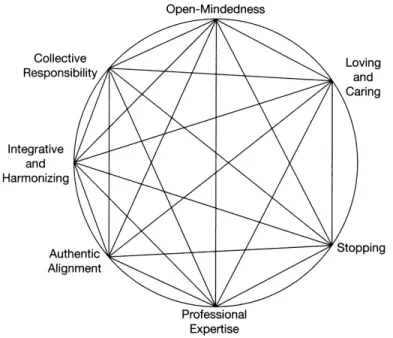
McDonald and Shirley (2009) conceptualized mindful teaching as a process “in which teachers struggle to attain congruence, integrity and efficacy in their practice” (p. 4). Their theoretical framework identified seven “synergies” as well as three “tensions” of mindful teaching. The visual representations below show the qualities and limitations McDonald and Shirley identified as being critical to the processes in which the mindful teacher engages:
Figure 4: The Seven Synergies of Mindful Teaching
According to this conceptual framework, these seven qualities and attributes, when dynamically engaged as part of the teaching process, have the potential to deepen and enrich the teaching experience. In this theory of mindful teaching, each of these competencies is meant to work in combination with all of the others—not necessarily simultaneously, but in a constant unfolding and refocusing. The state of
open-mindedness implies a state of acceptance that fosters critical self-inquiry; a loving and caring teacher is one whose primary concern is the wellbeing of his or her students and who teaches from a place of love; the ability to stop encourages the teacher to cultivate calm abiding in order to become a self-reflective practitioner; the teacher should be an expert in his/her professional field or content area; the ability to authentically align with the curriculum with the needs of the learners is vital to building an effective learning environment; expert teachers are able to integrate new practices into their teaching while maintaining proven strategies; and collective responsibility suggests that teachers, students and the larger community view education as a civic responsibility and together work to support and build a positive and effective education system.
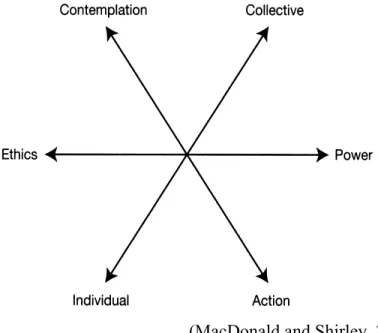
Underlying these seven synergies, complementing them while also holding them in conflict, are the triple tensions of mindful teaching:
Figure 5: The Triple Tensions of Mindful Teaching
(MacDonald and Shirley, 2009, p. 69) These tensions represent forces in opposition that challenge the equilibrium attempted through the seven synergies: the tension between contemplation (the pull within) on the one hand and action (the demands of the work) on the other; the tension between the individual teacher’s needs on the one hand and the collective’s needs on the other; and the tension between the call to take ethical stands even when they are in opposition to the status quo as defined by those in power.
Summary
Research findings suggest that mindfulness and contemplative practices can positively impact teachers and students across a number of significant measures by developing positive qualities of mind (Rogers & Maytan, 2012). Contemplative pedagogies, that can include mindfulness or contemplative inquiry and practice, can be seen to counter what many perceive as the fractured and fragmented culture of teaching
and learning in higher education. While hundreds of research studies are being conducted each year exploring how mindfulness training can inform teaching and learning, more and more teachers are experimenting with ways to bring these practices into their classrooms:
While contemplative practices have been foundational to wisdom traditions throughout recorded history, it is only recently that these practices are being examined in different contexts of learning, particularly in higher education…. These [practices] draw broadly from the perennial world wisdom traditions (i.e., Buddhist, Taoist, Quaker) and recent scientific research (i.e., neuroscience, cognitive science, clinical psychology) in the interests of investigating contemplative practices as a means for enhancing learning and development across a broad array of educational contexts and disciplinary fields.