Developments in the Australian Private
Security Industry
Tim Prenzler
†, Rick Sarre and Karen Earle
††Police necessarily retain the major role in enforcing the law after crimes have been committed and offenders have been apprehended. However, given that public sector policing draws heavily on equipment and personnel services supplied by private providers, and that public police officers have many offenders handed over to them by the private sector, private security could be considered ‘the primary protective resource’ (Pastor 2003, p. 44). Despite this, there is very little information publicly available on the range, size and scope of security industries in Australia and there is no comprehensive study of the growth of these industries, the functions of their different components, how they relate to each other and the effectiveness of different regulatory strategies. This paper reports on current aspects of the security industry in Australia as part of a wider study of these issues more generally.
Introduction
The private sector in Australia has been answering in a dramatic way a growing demand for diversified policing roles. But the regulatory structures, ‘partnership’ models, legal powers and immunities, and attention to the uniqueness of officer and public safety around the private sector are based upon ideas of policing that are rapidly becoming outdated. The current research integrates a variety of source material to explore the size, growth and various components of the industry, public/private partnerships and developments in industry regulation. The study shows that the private security industry is growing at a faster rate than both the Australian population and police, and is now larger in numbers than conventional police forces. The 1980s and 1990s saw an expansion of the industry. During that time exposés of malpractice emerged. These triggered expanded modes of regulation across Australia, which introduced a period of stability. However, in 2003 to 2005, a series of fresh scandals over security officer conduct, along with revelations of deficient security standards in key areas, precipitated major reviews and modification of regulatory systems. Moves for change came from within, as well as from outside, the industry. Before dealing with these issues, it is instructive to begin with an update on the size and growth of the industry.
† School of Criminology, Griffith University †† University of South Australia
The Size and Growth of the Australia Security Industry
Australia followed an international trend of substantial growth in security services in the last three decades of the 20th century (de Waard 1999; van Steden and Sarre 2007). Nonetheless, the precise dimensions of this change are difficult to trace. The occupational category ‘guards and security officers’ was introduced into Australian census reports only in 1986. However, the number of categories included in the census as security providers has increased significantly since 1986 and moved beyond simply classifying security providers as ‘guards and security officers’. Therefore, while we can gain a picture of the increase in security providers more broadly, the individual occupation category changes are more difficult to analyse accurately.
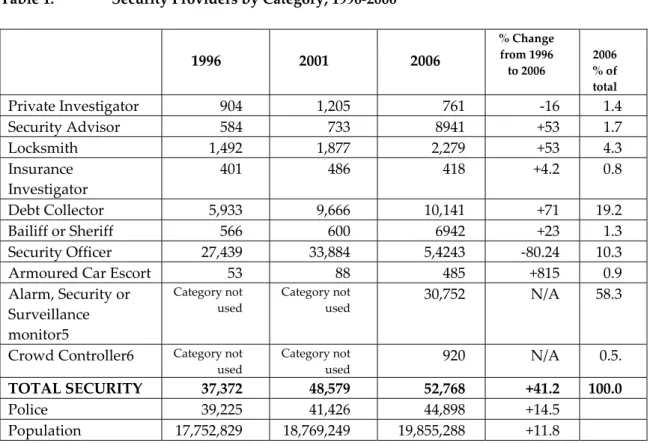
As shown in Table 1, more consistent occupational categories apply for a wider range of security occupations for the two census collection periods, 1996 and 2001. However, additional categories of ‘alarm, security or surveillance monitor’ and ‘crowd controller’ were introduced in 2006. The introduction of categories seems to have affected the number of security providers classifying their occupation as ‘security officer’.
Table 1 also shows that over the 10 year period, 1996 to 2006, the Australian population increased by 11.8%, police numbers increased by 14.5% and security providers (broadly defined) increased by 41.2%. Overall, these figures show a ratio of security providers to police of 1.2:1 in 2006. Note that the ABS category shift from ‘security officer’ to ‘alarm, security and surveillance monitoring’ as an occupation category has played havoc with the percentage change numbers. One would hope that there will be no further changes in the 2011 census to enable a stronger analysis.
Table 1: Security Providers by Category, 1996‐2006 1996 2001 2006 % Change from 1996 to 2006 2006 % of total Private Investigator 904 1,205 761 ‐16 1.4 Security Advisor 584 733 8941 +53 1.7 Locksmith 1,492 1,877 2,279 +53 4.3 Insurance Investigator 401 486 418 +4.2 0.8 Debt Collector 5,933 9,666 10,141 +71 19.2 Bailiff or Sheriff 566 600 6942 +23 1.3 Security Officer 27,439 33,884 5,4243 ‐80.24 10.3
Armoured Car Escort 53 88 485 +815 0.9
Alarm, Security or Surveillance monitor5 Category not used Category not used 30,752 N/A 58.3
Crowd Controller6 Category not
used Category not used 920 N/A 0.5. TOTAL SECURITY 37,372 48,579 52,768 +41.2 100.0 Police 39,225 41,426 44,898 +14.5 Population 17,752,829 18,769,249 19,855,288 +11.8
Source: Australian Bureau of Statistics.
Figure 1 shows the total number of police and security providers for Australia from
1991 to 2006.
1 The category ‘security advisor’ became ‘security consultant’ in 2006 census 2 The category ‘bailiff or sheriff’ became ‘court bailiff or sheriff’ in 2006 census
3 If the category ‘security guard’ included the total of the new categories for 2006 the total ‘security officer’ would be 36,661 (see footnotes 6 and 7)
4 If the category ‘security guard’ included the total of the new categories for 2006 the % change would be +34
5 New category introduced in 2006 census 6 New category introduced in 2006 census
Figure 1 : Police Officers and Security providers, 1991 – 2006*
Source: Australian Bureau of Statistics 1991‐2006.
*Combined security related functions for all census reports. Note that these have been modified and
expanded over time. In 1991 “guards and security officers” was the only category in use.
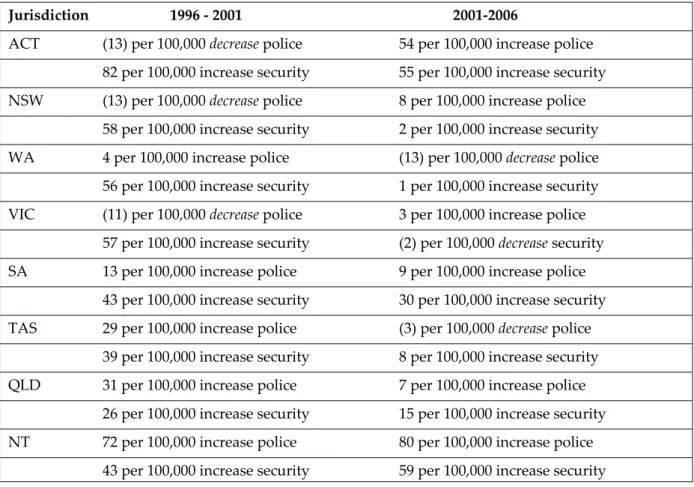
Tables 2a and 2b show the rate of security providers (broadly defined) per 100,000 population for 1996, 2001 and 2006 census data for total Australia and for each jurisdiction. The data show that, within Australia overall, from 1996 to 2006 police numbers increased by five per 100,000 and security personnel increased by 56 per 100,000 population. Indeed, the change in police per 100,000 population came as an increase between 2001 and 2006. In contrast, police did not change per 100,000 population from 1996 to 2001. Security providers increased by 49 per 100,000 from 1996 to 2001 and by seven per 100,000 from 2001 to 2006.
Table 2a: Security Providers and Police; rate per 100,000 population, 1996-2006 (Total for Australia)
______________________________________________________________
1996 221 police per 100,000 population 210 security per 100,000 population
2001 221 police per 100,000 population 259 security per 100,000 population
2006 226 police per 100,000 population 266 security per 100,000 population
______________________________________________________________
Table 2b: Security Providers and Police; increase/decrease in rate per 100,000 population, 1996‐2001 and 2001‐2006 (by jurisdiction)
Jurisdiction 1996 ‐ 2001 2001‐2006
ACT (13) per 100,000 decrease police 54 per 100,000 increase police 82 per 100,000 increase security 55 per 100,000 increase security
NSW (13) per 100,000 decrease police 8 per 100,000 increase police 58 per 100,000 increase security 2 per 100,000 increase security
WA 4 per 100,000 increase police (13) per 100,000 decrease police 56 per 100,000 increase security 1 per 100,000 increase security
VIC (11) per 100,000 decrease police 3 per 100,000 increase police 57 per 100,000 increase security (2) per 100,000 decrease security
SA 13 per 100,000 increase police 9 per 100,000 increase police 43 per 100,000 increase security 30 per 100,000 increase security
TAS 29 per 100,000 increase police (3) per 100,000 decrease police 39 per 100,000 increase security 8 per 100,000 increase security
QLD 31 per 100,000 increase police 7 per 100,000 increase police 26 per 100,000 increase security 15 per 100,000 increase security
NT 72 per 100,000 increase police 80 per 100,000 increase police 43 per 100,000 increase security 59 per 100,000 increase security
Source: Australian Bureau of Statistics
Table 3 below shows the change in the ratio of security providers to police from 1996 to 2001 and from 2001 to 2006 for each jurisdiction and total Australia. Interestingly, the ratio of security providers to police remained relatively constant in all jurisdictions from 2001 to 2006 with all changes being less than 0.1 of security to police per 100,000 population. However, from 1996 to 2001 all jurisdictions, with the exception of Queensland and the Northern Territory, increased their ratio of security to police.
However, the census data have a number of limitations. They do not differentiate between private and public security operatives, although other sources suggest that the private sector in countries like Australia makes up at least 75% of security personnel (Prenzler 2005). The census also only reports a person’s main
occupation and security work appears to be a major secondary occupation for many people. Licence figures therefore provide an alternative perspective on personnel.
The most recent national analysis of licences found that, in 2003, under core State and Territory licensing systems, there were 97,182 security licences (Prenzler
2005). Various downward adjustments for individuals holding multiple licences and upward adjustments for unlicensed operators or those operating under non-core legislation (such as process servers in some jurisdictions) suggest a very approximate figure7 of 100,000 plus persons directly involved in security work. This indicates that there are at least twice as many individuals working in security than police but with about half of the security providers part-time. The prominence of part-time and also casual work is supported by a special Australian Bureau of Statistics study of the contracting sector in 1998/9 (ABS 2000), which found that 47% of persons were employed casually, 37% permanent full-time and 14% permanent part-time.
Table 3: Ratio of Security Providers to Police (SP:P), 1996, 2001, 2006 _____________________________________________________________
State 1996 2001 CHANGE 2006 CHANG E
A.C.T. 1.20:1 1.54:1 0.34 Ç 1.45:1 0.09È NSW 1.04:1 1.40:1 0.36 Ç 1.34:1 0.06È W.A. 0.78:1 0.98:1 0.20 Ç 1.04:1 0.06È VIC 0.91:1 1.24:1 0.33 Ç 1.21:1 0.03È S.A. 0.76:1 0.90:1 0.14 Ç 0.98:1 0.08Ç TAS 0.73:1 0.81:1 0.08 Ç 0.85:1 0.04Ç QLD 1.08:1 1.04:1 0.04 È 1.08:1 0.04Ç N.T. 0.74:1 0.71:1 0.03 È 0.72:1 0.01Ç AUST 0.95:1 1.17:1 0.22 Ç 1.18:1 0.01Ç _____________________________________________________________
Source: Australian Bureau of Statistics
From the limited amount of data collected as part of the authors’ current research, it appears that Victoria hosts the most number of individual licensed security agents, South Australia has the most diverse number of licence categories, while individual security agents in the Northern Territory hold the highest number of licences each.
An additional comparative perspective on private security and public policing is provided by the recent ‘Counting the Costs of Crime’ study by the Australian Institute of Criminology (Mayhew 2003, pp. 7-8). Based on Productivity Commission
data, the cost of conventional police services focused on crime in 2001-2 was estimated at $3.2 billion. A similar analysis for the private security industry, using figures supplied by the Australian Security Industry Association (ASIAL), resulted in an amount of $3.1 billion (Mayhew 2003, p. 7). Hence, according to these sources, a roughly equal amount was spent on public and private policing.
Developments in Private Policing and Private-Public Partnerships
Despite the growth of private security, policing has been largely immune from the deliberate political privatisation policies of the 1980s and 1990s. The figures and data presented above show police numbers continuing to increase at a rate higher than that of general population growth. There has also been very little in the way of outsourcing of police work. There appear to be two main factors behind the growth in private security; first, market demand, partly in response to steep rises in crime from the 1970s to the 1980s and continuing high levels of crime; and second, the shift in consciousness away from reliance on police to a mentality of self-protection linked to what Garland (2001) refers to as a process of ‘responsibilisation’; that is, a shifting of much of the crime prevention burden away from police and back to the private individual. Garland (2001, p. 124) argues that this strategy is actively promoted by governments insofar as it reflects… a new kind of indirect action, in which state agencies activate action by non-state organisations and actors. The intended result is an enhanced network of more or less directed, more or less informal crime control, complementing and extending the formal controls of the criminal justice state. … [State agencies] seek to build broader alliances, enlisting the governmental powers of private actors, and shaping them to the ends of crime control
Other contributing factors for the growth of private security include increased security requirements in insurance policies, the growth in legal responsibilities on property owners for the safety of visitors and staff, improvements in security technology (for example, in the quality of CCTV images - see Wilson and Sutton 2003) and the spread of knowledge about successful situational and environmental design approaches to crime prevention.
The list of examples of private-public partnerships in security grows exponentially. Developments in public-private partnership possibilities were highlighted by the showcase of security at the 2000 Sydney Olympics (Sarre and
Prenzler 2005, p. 195). The close co-operation between police and private security firms was deemed an outstanding success. Over 4,000 security officers worked a combined total of 27,000 shifts over the two-week period (Dolahenty 2001, pp. 10-11).
Furthermore, with reference to a review of anti-terrorist strategies and infrastructure, NSW Police Commissioner Ken Moroney recommended closer co-operation between police and security providers, emphasising that private security is ‘an important part of providing [a] law enforcement approach, not only in the terrorism context but in the prevention of crime generally’ (Petersen 2004).
Privatisation of security has not required legislative amendments. Private providers draw substantive authority from the law enforcement and self-defence powers of citizens and in particular, from the rights of property owners to control entry to premises and protect property (Sarre and Prenzler 2005, p 120ff). Nonetheless, some special provisions aid private security (for example, elements of weapons legislation), and some recent developments in the law have enlarged the scope of private operators.
Conduct Issues and Regulatory Change
Each State and Territory in Australia has a licensing system for security providers that resulted from a major shift, mainly in the 1990s, from partial and minimalist forms of occupational registration to full licence requirements. The new systems were based upon compulsory pre-entry training and a set of disqualifying criminal offences. The main focus of the initial wave of change in the early 1990s was on private contract security companies and staff. The introduction of licensing was driven by a series of scandals (Prenzler 2004) including a long-term problem of assaults and negligence by crowd controllers, recurring allegations of incompetency and poor training, convicted criminals accessing security courses, fraud in alarm and patrol services by major firms and a trade in confidential information between private investigators and public servants.
Moreover, evidence has emerged in the last decade of corrupt preferential arrangements between police and emergency security services, the misuse of firearms in public places, insider thefts by security officers, an enormous waste of police resources responding to false intruder alarms and misleading advertising of security products.
The general direction of the new licensing systems received widespread support from industry members (Prenzler and Hayes 1999; Prenzler and Sarre 1999). Limited forms of evidence of effectiveness, regarding licence application rejections, for example, showed that potentially inappropriate persons were being excluded from working in security. Nonetheless, a number of issues remained. One was that there was no national consistency, with a patchwork of standards and terminology across the eight jurisdictions. In addition, while New South Wales, South Australia and Western Australia eventually developed comprehensive, or near comprehensive, licensing, other jurisdictions left out key areas of security work, such as in-house guarding and station monitoring. In addition, locksmiths were omitted from licensing requirements. There were also concerns about the extent to which criminal history checks could be conducted nationally. Moreover, concerns persisted about pre-entry training standards. Training is highly variable and in most jurisdictions basic licences are available after one week’s training. The research also found that there was little in the way of proactive auditing of conduct once licences were issued.
Recent Adverse Events
By the year 2000 it appeared that the regulatory regime rolled out over the 1990s had largely taken effect as intended. Despite the concerns outlined above, scandals involving security providers were much less prominent in the media. Within a few years, however, a new series of scandals forced regulators to re-think their systems (e.g. Dibben 2004; O’Rourke and Kidman 2004). For example, in January 2004, well-known cricketer David Hookes died following a physical altercation with a crowd controller undertaking order maintenance duties at a hotel in Melbourne. In September 2005 the man charged over the incident was found not guilty of manslaughter. However, the circumstances of the altercation, in which crowd controllers followed the Hookes party well beyond the hotel premises, suggested inappropriate and provocative conduct by the security providers (Daily Telegraph
2004).
In Sydney in July 2004 a cash-in-transit guard shot dead a robber. The robber had severely assaulted the guard but was fleeing the scene when he was shot. New South Wales Police charged the guard with murder (Warne-Smith 2004). More broadly across New South Wales from 2003/4 numerous firearms were stolen from security officers and from the premises of security firms (Vermeer 2004).
In Adelaide in 2003-4 disquiet followed the alleged infiltration of nightclub security by bikie gangs involved in the sale of illicit drugs, money laundering and gang fights (Merola 2004; Sproull 2003), while in Perth in 2004 nine dangerous prisoners escaped from court custody under the control of a private security contractor (Pennells 2004).
It was estimated that in early 2004 more than 50 people in Victoria were suing security providers for compensation (Butler and Kelly 2004; Eliot 2004; Gibson 2004; Owen-Brown 2004). In that same year, concerns began to be expressed that inadequate training and staffing meant that many crowd controllers were over-exposed to injury and abuse (Tickner 2004).
These issues were not confined to the smaller industry players. In October 2004, Australia’s largest security firm, Chubb, pleaded guilty in the Federal Court to 26 criminal charges brought by the Australian Competition and Consumer Commission. The Commission alleged that Chubb had misrepresented its ability to fulfil conditions in its mobile patrol contracts. Chubb was fined $1.5 million after pleading guilty (Goodsir 2004; Wallace 2004).
In June 2005 the federal government launched a major review of airport security following revelations of drug smuggling involving baggage handlers. The review was prompted, in part, by allegations of inadequate screening and lax supervision of security personnel at airports (Canberra Times 2005). The ‘Wheeler Report’ was published in September of that year (Australian Government 2005). Extra police were needed, said Sir John Wheeler, to overcome the deficiencies of policing at Australian airports which he described as ‘often inadequate and dysfunctional’ with security systems ‘typically uncoordinated’ (p. xi).
Finally, in July 2007, the Fairfax press reported that private personnel would not be engaged to assist the policing of the APEC summit in Sydney in September 2007 because of their links to organised crime. Attorney-General Philip Ruddock responded quickly by asserting that private security operators had not been ruled out (Age 2007) and, indeed, there were private providers engaged in that operation.
Thus, there has been increased pressure to meet the regulatory challenges with reviews and subsequent innovative changes.
Jurisdictional reviews
The incidents mentioned above provoked unprecedented negative media reports on the security industry. Headlines such as ‘Wild West security guard culture’ (Sunday Mail 2004, 1 August, p. 3) began to appear in the press. Victoria, South Australia, New South Wales, Queensland and Western Australia launched reviews of their regulatory systems (e.g. Office of Fair Trading 2005). There were related amendments to regulations during 2003-2004 in the Australian Capital Territory, Tasmania and the Northern Territory.
On May 23, 2005, the South Australian parliament passed amendments to the
Security and Investigation Agents Act 1995 (SA) that now allow the government
security licensing agency (the Office of Consumer and Business Affairs) to deny a security licence to an applicant without having to give reasons to that applicant, on the basis that to do so would allow confidential intelligence to become too freely available. The amendments also require compulsory fingerprinting of applicants for a licence and compulsory psychological testing and random drug tests of any applicant (Atkinson 2005). By way of comparison, the Private Security Act 2004
(Victoria) allows fingerprinting of applicants and close associates when identity is in question (sections 22, 79).
In addition, the peak industry association, the Australian Security Industry Association Limited (ASIAL), took the opportunity to renew its efforts to have governments adopt its policy of comprehensive licensing and national consistency in licensing. It continues to work closely with governments on the reviews (ASIAL 2005). Indeed, the Chubb verdict, referred to above, provided a unique opportunity for the ASIAL Board. At the end of 2004, the Board established an independent advisory panel to report back to them with a range of options concerning the issues raised by the Chubb case. Thereafter, the panel facilitated an arrangement whereby Chubb would willingly submit to a range of compliance measures, including a financial contribution to assist in setting up a Centre for Security Compliance Excellence. This Centre is now in a position to make compliance training and testing available to security firms (ASIAL 2004).
Discussion
Figures on the size and growth of the security industry show that Australians, across all jurisdictions, are becoming increasingly dependent on security services,
especially private sector services, for protection from crime and other forms of harm. People are therefore also increasingly exposed to forms of misconduct by security providers, such as assault, trespass, invasion of privacy, negligence, fraud, harassment and wrongful imprisonment (Sarre and Prenzler 2005, p. 202 ff). Consequently, the developments in industry regulation outlined above represent important advances in protecting the public from malpractice. Australian governments are recognising that the enormous potential benefits of private security and public-private partnerships need to be underwritten by basic levels of prescribed competency and integrity. The fact that the general direction of change is supported by surveys of security providers and industry associations shows that the industry itself aspires to more professional standing.
Nonetheless, a variety of challenges remain to the attainment of an ideal model of professionalism in security. For one thing, it is difficult to professionalise a workforce with such a large amount of part-time and casual employment, and with a likely high turnover rate. Questions also remain about the adequacy of training standards.
One issue that has tended to be neglected in the current enthusiasm for public-private partnerships is that the two ‘groups’ operate on fundamentally opposing principles. Public police have a duty to serve the public equally and prioritise assistance on the basis of the gravity of threat. Private providers are primarily obligated to their employer or principal. The latter can be a government agency and contractual arrangements can require police-like duties to the public, but the basis of engagement remains selective. Recent cases where this was an issue suggest that the growth of private security will mean that such conflicts of loyalty (at least in the eyes of some) will increase, with possible consequences for public safety.
Allied to the above issue is the question of whether or not licence holders should be given any powers above those of citizens or agents of property owners. At present, security licences, in most cases, do not grant additional powers. A case might be made, for example, for private investigators to access confidential information for legitimate purposes (for example, when acting in concert with police and pursuant to a warrant) and under strict conditions. However, one condition of special powers for licence holders might be that they also are given public interest responsibilities.
Another area that received no direct analysis in the current round of jurisdictional review processes was the question of regulatory style. No real data were produced, for example, on the way complaints are investigated and
adjudicated. Nor were data sought on outcomes, including complainant and subject satisfaction. Similarly, methods of auditing firms or individual licence holders also received little or no attention. Nothing was explored about the nature of the relationships, such as forms of communciation for example, between regulators and licence holders. The role of ongoing research into issues such as officer safety or the effects of shift work received no attention, which is regrettable (Sarre 2005).
Another particularly disappointing aspect of the 2005 reforms was that there was only limited progress on developing a path towards national consistency in licensing (Cowan 2005). Each of the eight systems remains at odds on almost every aspect of licensing, including length and types of disqualifying offences, licence categories, training periods and fees.
Conclusion
The private security industry in Australia and elsewhere grows apace. A series of scandals has followed in the wake of this continued growth. In response, tougher licensing requirements have been introduced, with likely positive impacts in the conduct and competency of security providers. Nonetheless, a number of issues and problems remain to be resolved, including issues of the powers of private security providers, more proactive forms of regulation and a case for a national licensing system. Police and private security operatives alike need to be constantly engaged in forward thinking regarding preferred accountability structures, regulatory regimes and models of public/private partnerships. Legal powers and immunities may need to be clarified. Strategies that may enhance the safety of officers and the public generally should be employed. In this way, policy makers, industry personnel and academics together will be in the best position to control the future of policing rather than leave it simply to happenstance.
References
ABS (2000) Security Services cat. 8557.0, Canberra: Australian Bureau of Statistics.
ABS (2001-2006) Census of Population and Housing, data available on request, Canberra: Australian Bureau of Statistics.
Age (2007) ‘“Lone Wolf” Worry for APEC Security’, Age on line, 11 July 2007.
ASIAL (2004) Raising Compliance Standards. http://www.asial.com.au (media releases). Accessed 15 July 2005.
ASIAL (2005) Security Industry Position on Security Industry Amendment Bill 2005.
http://www.asial.com.au. Latest News. Accessed 15 July 2005.
Atkinson, M. (2005) Tougher Crowd Controller Conditions Pass Parliament, Media release, South Australian Attorney General, May 23.
Australian Government (2005) An Independent Review of Airport Security and Policing for the Government of Australia, (The ‘Wheeler Report’) Canberra: Commonwealth of Australia.
Butler, M. and Kelly, J. (2004) ‘Victims Suing Bouncers’. Herald Sun, January 22, p. 4.
Canberra Times (2005) ‘Airport security reform essential’, June 9, p. 16.
Cowan, R. (2005) ‘Licensing review results are yet to come’, Security Insider, Vol. 10, No. 1.
Daily Telegraph (2004) 28 January, p. 5.
De Waard, J. (1999) ‘The Private Security Industry in International Perspective’, European Journal on Criminal Policy and Research, Vol. 7, No. 2, pp. 143-174.
Dibben, K. (2004) ‘Friend Tells Court of Offer to Join Brinks Van Robbery Gang’, Sunday Mail (Qld), September 12, p. 22.
Dolahenty, A. (2001) ‘Securing the “best ever” games’, Security Australia, April, pp. 10-11.
Eliot, L. (2004) ‘Hotel bouncers accused of retribution attack on patron’, West Australian. 31 January, Garland, D. (2001) The Culture of Control: Crime and Social Order in Contemporary Society, Oxford: Oxford University Press.
Gibson, R. (2004) ‘Lies bounce boss to jail’, West Australian, August 5, p. 34.
Goodsir, D. (2004) ‘Chubb to face loss of licence over rorts’, Sydney Morning Herald, November 1, p. 3. Mayhew, P. (2003) ‘Counting the Costs of Crime in Australia’, Trends and Issues in Crime and Criminal Justice. 247, Canberra: Australian Institute of Criminology.
Merola, A. (2004) ‘Bikie Warning at Nightclubs’, Sunday Mail (SA), January 11, p. 8.
Office of Fair Trading (2005) Review of the Security Providers Act 1993, Consultation Paper.,Brisbane: Queensland Government.
O’Rourke, J. and Kidman, J. (2004) ‘Missing: 163 handcuffs, 203 batons ... and staff morale’, Sun Herald, July 4, p. 9.
Owen-Brown, M. (2004) ‘Heaven Guards Accused of Assault 80 Times in a Year’, Advertiser, 17 February, p. 4.
Pastor, J.F. (2003, The Privatisation of Police in America: An analysis and case study, Jefferson NC: McFarland.
Pennells, S. (2004) ‘Sorry they got away, says AIMS’, West Australian. July 23, p. 4.
Petersen, F. (2004) ‘Enlist Private Security to Bolster Defences: Police’, Sydney Morning Herald, March 15, p. 11.
Prenzler, T. (2004) ‘The Privatisation of Policing’, in R. Sarre and J. Tomaino (eds.) Key Issues in Criminal Justice, Adelaide: Australian Humanities Press.
Prenzler, T. (2005) ‘Mapping the Australian Security Industry’, Security Journal, Vol. 18, No. 4, pp. 51-64.
Prenzler, T. and Hayes, H. (1999) ‘An Evaluation of the Queensland Security Providers Act’,
Australian and New Zealand Journal of Criminology, Vol. 32, No. 1, pp. 79-94.
Prenzler, T. and Sarre, R. (1999) ‘A Survey of Security Legislation and Regulatory Strategies in Australia’, Security Journal, Vol.11, No. 2, pp. 7-17.
Sarre, R. (2005) ‘Researching Private Policing: challenges and agendas for researchers’, Security Journal, Vol.18, No. 3, pp. 57-70.
Sarre, R. and Prenzler, T. (2005) The Law of Private Security in Australia, Pyrmont, NSW: Thomson LBC. Sproull, R. (2003) ‘Gangs take over pubs’, Australian, October 25, p. 4.
Sunday Mail (2004) ‘Wild West security guard culture’, August 1, p. 3.
Tickner, L. (2004) ‘Bouncers need to use brains, not brawn’, West Australian, April 16.
van Steden, R. and Sarre, R. (2007) ‘The growth of privatised policing: some cross-national data and comparisons’, International Journal of Comparative and Applied Criminal Justice, Vol. 31, No. 1, pp. 51-71. Vermeer, T. (2004) ‘Guards give up pistols’, Sunday Telegraph, August 15, p. 1.
Wallace, N. (2004) ‘Chubb fined $1.5m over phantom security patrols’, Sydney Morning Herald, December 31, p. 6.
Warne-Smith, D. (2004) ‘Murder Charge Ends Farce’, Australian, August 3, p. 5.
Wilson, D. and Sutton, A. (2003) ‘Open-Street CCTV in Australia’, Trends and Issues in Crime and Criminal Justice, 271, Canberra: Australian Institute of Criminology.