What effort does it take to deploy an open source ERP?
Perceived ease of use and Perceived usefulness
Master thesis, 15 credits, INFM02, in Informatics
Author: Vadim Koroliov
Supervisor: Björn Johansson
Examiners: Lars Fernebro Markus Lahtinen
3
Title What effort does it take to deploy an open source ERP? Perceived ease of use and Perceived usefulness
Author Vadim Koroliov
Publisher Department of Informatics, Lund University
Supervisor Björn Johansson
Examiners Lars Fernebro
Markus Lahtinen
Year of publication 2012
Type of thesis Masters
Language English
Keywords: Open source ERP, Open source ERP adoption, Open source ERP deployment
Abstract
ERP systems are rapidly becoming a de facto standard in business activity. While large and medium-sized companies have the luxury to afford proprietary ERP solutions, small companies are struggling with resource poverty which forces them to consider other solutions. One solution available could be open source ERP products especially since these are without a license cost. However, there is little knowledge available on open source ERP adoption in small companies. That is why the first step is to spread light on open source ERP deployment in terms of knowledge and time. The purpose is accomplished by using the research framework based on Technology Acceptance Model 2 (TAM2), usability testing and user training and education factors. The factors of Perceived Ease of Use (PEOU) and Perceived Usefulness (PU) are used to determine the ease of deployment process, and the usefulness of the open source ERP deployed in relation to the made effort. The research method implied a pre-study and an experiment. The pre-study‟s purpose was to obtain an insight on open source ERP deployment process before any experiments are made. An initial experiment was setup with three IT-related students. The empirical study was then complemented with additional three students with non-IT background in order to build evidence for stronger conclusions. The findings suggest that user with advanced computer skills perceive open source ERP deployment process as easy, and the open source ERP being useful to the business activity.
4 1. Introduction ... 7 1.1 Problem discussion ... 9 1.2 Purpose ... 10 1.3 Research Questions ... 10 1.4 Delimitation ... 11 1.5 Outline ... 11
2. Literature Review and Research Framework ... 12
2.1 Enterprise Resource Planning systems overview and definition ... 12
2.2 Open Source and Open Source ERP... 15
2.3 Knowledge and ERP adoption ... 19
2.4 Research Framework ... 19
3. Methods ... 25
3.1 Research strategy and procedure ... 25
3.2 Data Collection ... 26
3.3 Compiling and Analysis ... 28
3.4 Research credibility ... 28 4. Empirical Findings ... 30 4.1 Deployment Pre-study ... 30 4.2 Profiling ... 32 4.3 Deployment Experiment ... 33 5. Discussion ... 39
5.1 Perceived Ease of Use ... 39
5.2 Perceived Usefulness ... 41
5.3 Differences on the level of respondents’ background... 42
6. Conclusions and Further Research ... 43
Appendix 1 – Questionnaire – Profiling ... 45
Appendix 2 - Business Case and Interview ... 46
Appendix 3A – Interview Transcripts ... 47
Appendix 3B – Interview Transcripts ... 51
Appendix 3C – Interview Transcripts ... 54
Appendix 3D – Interview Transcripts ... 57
5
Appendix 3F – Interview Transcripts ... 62
Appendix 4A – Invoices from experiment ... 64
Appendix 4B – Invoices from experiment ... 65
Appendix 4C – Invoices from experiment ... 66
6
List of figures
Figure 2.1 Top 10 ERP Vendors………..………...14
Figure 2.2 Open Source ERP projects………..………….18
Figure 2.3 Technology Acceptance Model 2…………..………...21
Figure 2.4 Research Framework………..………...23
Figure 4.1 Google results on open source ERP………..………..34
List of tables
Table 2.1 ERP Tier Classification……….………..14Table 4.1 General Information on Interviewees……….………..32
7
1. Introduction
Today‟s business environment is characterized by harsh competition. Therefore, established business actors and start-ups are steadily looking for opportunities and new means to employ in profit making. In other words, companies are interested to gain and retain new customers in order to secure market position and boost profits. Usually, the price for such strategy is investment in resources, research and development projects.
One of the existing resources, information technology (IT), has been paid special attention. Academics and business experts regard IT as a strategic tool (McFarlan, 1984; Benjamin, 1983), which has historically served business interests for more than five decades. Beginning with a small and highly specialized focus, IT applications have evolved to large and extensive functional software packages able to support core and strategic business processes in a company.
A distinct role in business management, planning, administration, and operation is given to Enterprise Resource Planning (ERP) systems because of their impact on firms and business processes (Markus and Tanis, 2000). In this context, Markus and Tanis (2000) explained that ERP systems brought desired integration of business processes, systems and information. The immediate advantages of that integration are common data elements, in-depth analysis of business information, and reduction of organizational and maintenance costs.
However, there are contrary opinions. Wieder et al. (2006) rushed to contradict popular believes; in other words, the researcher suggests that there is no significant performance difference between ERP adopters and non-adopters both on process and overall firm levels. In conclusion, the views on the benefits and advantages of ERP systems adoption are split.
Nevertheless, the market tendency is that ERP adoption is growing and will grow among organizations worldwide. Jacobson et al. (2007) note, in their report on ERP market sizing, that ERP investments in large corporations, small and medium-sized enterprises (SME) are continuously increasing. The ERP systems became in practice an industry standard (Parr and Shanks, 2000) and, as Boykin (2001) argued, an entry price for doing business in the market.
And so grows the ERP products market. Up to recent years, the ERP systems offer has been primarily characterized by proprietary software products. The largest ERP vendors presently are SAP, Oracle, Infor and Microsoft. At the same time, the industry witnessed the proliferation of open source ERP packages as well. The open source ERP packages, and specifically community-based versions, provide a free alternative to commercial ERP packages. Some notable examples are OpenBravo, Compiere, TinyERP, OFBiz, Adempiere, xTuple/PostBook and others, and the majority of them target the SMEs. One would wonder why they are free. Usually, the companies who stand behind these products earn money in a different way, other than traditional. Along
8 with the community version, which is completely free, there are commercial versions with better support, updates and upgrades. The open source ERPs and open source business paradigm shall be discussed in detail in later chapters.
In brief, open source ERP vendors bring a couple of reasons of why to choose open source ERP. Firstly, there are no upfront licensing fees. Anyone can download the software from vendor‟s website and try the product for free. Thus, assess whether it suits the company‟s needs or not. Nevertheless, Johansson and Sudzina (2008) explain that ERP license fees constitute only between one-third and one-sixth of costs associated with ERP adoption. Haddara (2011) summarizes and identifies nine additional main ERP adoption costs, such as maintenance, HR costs and so on.
Secondly, open source offers free control of software customization with support of contributing communities and organizations. There is also professional-quality support available from companies working with that specific ERP. And one of the last arguments is that open source reduces the specification risk, characteristic to custom built software, and loss of vendor risk (Opentaps.org, 2011). Not less important is the promise of “be up and running with a full system in 10 minutes” (xTuple.com, 2011) – this, in particular, makes it very interesting to challenge.
Some support for open source ERP is present among academics. Raphael Valyi, as cited in Fougatsaro (2009), completes the list of reasons of why companies should choose open source ERP:
- Quality –as a result of commitment of vendors and communities to development efforts.
- No hidden costs – as opposed to proprietary ERP systems, where changes scalability issues might be imminent.
- Freedom to upgrade or not.
Despite all the benefits, open source software has its own disadvantages, which have been discussed and presented by Fougatsaro (2009) and others in their articles.
The comparison of proprietary and open-source (community/free) ERP advantages and disadvantages, as well as a total cost of ownership analysis have been rolled out to a limited or no extent in previous research. In addition, the full picture of open source ERP‟s issues and benefits still has to be covered (De Carvalho, 2006). Therefore, it might be difficult to evaluate which type of ERP brings the most value. In conclusion, in current circumstances where ERP systems are becoming a need, companies are given various options which they might find useful to take in consideration.
9
1.1 Problem discussion
In recent years, ERP systems have become attractive to SMEs also, i.e. the SMEs‟ interest towards ERP system has increased. This happened for a number of reasons. Firstly, ERP vendors have shifted their development efforts focus from mainly large customers - today a saturated market, to small and medium sized companies – a promising market both in cash and in customers. Consequently, the range of ERP packages offer has considerably increased, adjusting to the needs and pockets of various companies (Bajaj, 2008).
Secondly, it is the highly dynamic business environment which requires ERP adoption in order to gain competitive advantage over rivals (Bajaj, 2008). In the same context, Jacobson et al. (2007) mention that ERP adoption among SMEs comes as a response to new customer requirements, as well as to the wish to participate in a highly global market. Finally, ERP systems offer unprecedented advantages over other traditional functional systems of managing business (Holsapple and Sena, 2003). Despite having a growing interest for ERP, the actual rate of ERP adoption in SMEs is low if compared to larger firms (McLaren, 2006; Buonanno et al., 2005).
The reasons for low ERP adoption in SMEs are multiple. Buonanno et al. (2005) suggest that structural and organizational reasons are important factors to ERP adoption. Despite the fact that ERP package is only a software product, it also affects the organizational and structural aspects of an enterprise. The ERP software packages come bundled with predetermined business logic. In other words, an ERP package is an infrastructure itself. Consequently, adoption of ERP systems brings not only various benefits to business activity, but also structural, organizational, cultural and strategy changes (Shehab et al., 2004).
However, before any further statements are made about ERP adoption in SMEs, it is important to differentiate within the group in terms of company size. The reasons regard the constraints and objectives of ERP systems in this group of organizations (Laukannen et al., 2007). Because of the significant differences that exist among those, the study shows that small and medium-sized companies should not be considered as a homogeneous category. To exemplify, Laukannen et al. (2007) explain that in terms of general constraints, small companies in comparison to medium-sized have a lower user IT competence and insufficient information, but are less sensitive to changes enforced by ERP implementation; in terms of ERP objectives, medium-sized companies feel eager to develop new strategic ways of doing business, and are more interested in expanding its business activity. Regarding resource availability, small companies in comparison to mid-size and large enterprises have limited/scarce resources (Laukannen et al., 2007).
Speaking of small companies specifically, Laukannen et al. (2007) point out that financial factor is one of the resources that constrain ERP system adoption. In the same context, Buananno et al. (2005) mention that small companies do not consider the financial factor as the major barrier to ERP adoption. However the study results cover a larger group of SMEs, while Laukannen et al. (2007) differentiates between the two groups of companies. Somewhat apparent, the financial
10 factor can be crucial and decisive for small companies. So if small companies are financially poor, then the logical question arises: so why not chose the open source ERP, especially when it is free to acquire, and it is argued, at least by Boulanger (2005), that open source software systems are a feasible alternative to proprietary systems. However, Johansson and Sudzina (2008) state that financial cost is not the only factor affecting the intention to adopt an open source ERP.
The other factors found are knowledge and time. Laukannen et al. (2007) suggest that knowledge is another determinant barrier lying in the way of ERP adoption in small companies specifically, whether it is IT competency, enough information for decision-making in ERP selection or system usage. It is crucial to understand that knowledge requirements change along various stages of ERP life cycle and embrace a large set of skills, experiences, abilities and perspectives (Suraweera, 2007). In other words, type of knowledge required in implementation phase, for example, would be different from what knowledge is needed in the system use phase. Regarding time, d‟Amboise and Muldowney (1988) found that small companies allot more attention to adjusting to, and not to controlling and predicting their environment. Thus small companies cannot allocate more time because of the availability of resources.
Taking into consideration the fact that there is an interest and there seems to be a lack of academic support on the subject of open source ERP adoption in small companies, it would both interesting and challenging to spread light and new knowledge in this field. The first step to create new knowledge would be to find out what it takes to deploy a free open source ERP, i.e. find, install and use it, in terms of knowledge and time.
1.2 Purpose
The aim of this study is to find the perceived ease of use of open source ERP in the context of its deployment from user‟s point of view, as well as to find out the perceived usefulness of the open source ERP when deployed.
1.3 Research Questions
In order to fulfill the purpose stated above there are two questions this thesis intends to find answers to.
From user perspective in the case of an open source ERP deployment:
- What is the perceived ease of use in terms of time and knowledge? -What is the perceived usefulness of open source ERP?
11
1.4 Delimitation
As this study intends to assess perceived ease of use and perceived usefulness of an open source ERP at deployment stage, the potential structural, organizational and other ERP adoption cost issues lay outside the focus area. In addition, the study will focus on micro or single-man companies.
Focusing on single-man company and open source ERP deployment stage, permits to avoid issues of cost increase, structural and organizational changes related to company size and long term use of ERP systems. However, small companies who are interested in adopting open source ERP should be aware that possible structural and organizational changes could occur; as well as be ready to incur additional ERP adoption costs.
1.5 Outline
The following chapters will discuss the theoretical framework, methods, results, data analysis and conclusions of the study. The literature review part will describe the open source software and ERP concepts, present the existing theoretical framework on open source ERP and Technology Acceptance Model 2, usability testing methods and user training.
The method part will present the research strategy and design. The chapter will elaborate on the setup of ERP deployment-experiment and further tools used for data collection.
The last chapters will build on data presentation and analysis, followed by conclusions and further research recommendations in the area of open source ERP deployment.
12
2.
Literature Review and Research Framework
The purpose of this chapter is to provide general information on ERP and Open Source software, as well as to set up the lens for thorough issue investigation. Models and theories are used in order to better interpret the reality and support the answering of the research questions.
2.1 Enterprise Resource Planning systems overview and definition
For the sake of clarity and in order to give a clear picture to ERP-interested audience, an ERP description and explanation is given below. The reason is that ERP description will make it easier to determine if the product is what it claims to be; in other words, it will help understand what an ERP system is. A supporting argument for above is the fact that most of respondents in this research study were not acknowledged with the ERP phenomenon. For any small company or business the following description would be useful.So what is an Enterprise Resource Planning system? According to Shehab et al. (2004, p.359), ERP is merely “a business management system that comprises integrated sets of comprehensive software, which can be used, when successfully implemented, to manage and integrate all the business functions within an organization”. The same definition is supported by, and embraces the views of various researchers and scientists in the domain (Davenport, 1998; Kumar and Hillergersberg, 2000). An ordinary ERP package consists of tools and applications which execute and assist the following business functions: financial and cost accounting, sales and distribution, materials management, human resource, production planning and manufacturing, supply chain, and customer information (Boykin, 2001; Yen et al., 2002).
Moreover, ERP systems facilitate the real-time data flow or instant communication between all supply chain processes – internal and external – in an organization (Wier et al., 2007). In other words, different departments or parts and stakeholders of an organization share the information throughout their activity; and, according to Siriginidi (2000), that in turn affects an organization‟s workflow by integrating the entire enterprise with tasks, responsibilities, locations, positions and so on.
Now let us get back to its history so to understand better how ERP systems evolved. According to Markus and Tannis (2000) the ERP phenomenon arose in 1970‟s. It all started in the manufacturing industry. This industry has been using computers for better productivity, profitability and information flow across the company for more than 30 years (Shehab et al, 2004).
13 The roots of the ERP systems stem from simple inventory control packages, material requirements planning (MRP) and material resource planning (MRPII) systems. Inventory control systems were built for inventory management processes; MRPs were designed for manufacturing work and purchase orders handling. However, existing business information systems were redundant, costly and loosely coupled. McKenney and McFarlan describe the systems as “islands of automation” lacking a unifying visionary scope (as cited in Markus and Tanis, 2000).
In the beginning of the 1980s, MRPIIs were developed in an attempt to integrate primary functions, such as production, marketing and finance, and secondary functions – engineering, personnel and purchasing. MRPII‟s were capable of handling all resources in an organization. The packages brought the required integration of information and processes. Throughout the 1980s and 1990s, integrated software packages have been developed in US, Germany and Netherlands (for example SAP).
The maturity of ERPs, term coined to highlight the latest versions of MRP II, took place in the middle of 1990s; these packages included enhancements of back-office functions, i.e. order management, warehousing, distribution production, quality control, human resource management etc. In recent years, the functionality of ERP systems has broadened to encompass front-office functions – sales force, marketing, e-commerce, supply chain management system. In order to fully benefit from ERP adoption and operation, Siriginidi (2000) argues that companies are advised to recognize the information needs, as well as to provide appropriate information infrastructure for all stakeholders – employees, customers and suppliers.
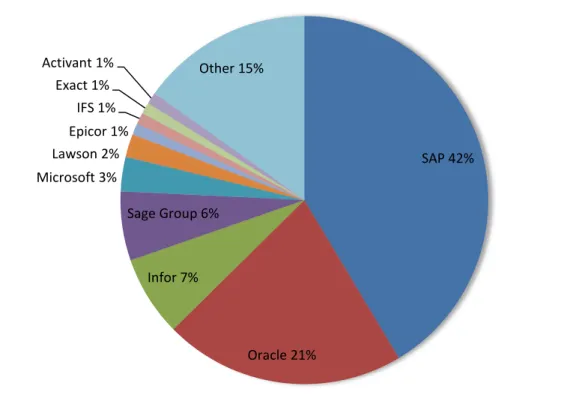
Initially, the solutions aimed small companies. Later, ERP packages were developed specifically for the needs of large companies. According to Caldwell and Steing, approximately 40% of the companies with revenues higher than 1 billion dollars implemented ERP systems (as cited in Willis and Willis-Brown, 2002). Nowadays, the ERP market is represented by multiple vendors. The biggest suppliers of ERP software packages are SAP, Oracle, Infor, Microsoft and others (for detailed list see Figure 2.1).
14
Figure 2.1. Top 10 ERP Vendors by 2006 total revenue share (AMR Research, 2007)
The versatility of ERP vendors and products has skyrocketed in recent years. The complexity of the ERP offers is also highlighted by the existence of TIER classification (see Table 2.1). At present, ERP market is aimed at companies of all sizes and for different pockets. TIER 1-2 satisfy the needs of large companies, or increasing companies. Tier 3-4 ERP packages are designed for the needs of small and medium-sized companies (SME).
Tier Software Concurrent Users Employees Cost per user (US
dollars)
1 mySAP/R3 100 - 1000+ 1,000+ 80,000
2 Baan, MAPICS 50 – 500 200 – 2000 40,000
3 EFACS, Dynamics GP 30 – 200 50 - 1000 10,000
4 Sage line 50, SAP Business One 1 – 40 20 – 200 2,000
Table 2.1. ERP Tier Classification (BPIC, 2011)
From the table above, it is clear that ERP software supply is rich and meeting different demands. A special interest in the ERP market is given to SMEs. ERP vendors are continuously providing
SAP 42% Oracle 21% Infor 7% Sage Group 6% Microsoft 3% Lawson 2% Epicor 1% IFS 1% Exact 1%
Activant 1% Other 15% SAP
Oracle Infor Sage Group Microsoft Lawson Epicor IFS Exact Activant Other
15 new solutions, such as Application Service Providing, Outsourced ERP systems, preconfigured ERP applications etc. - to fit the organizational and structural realities of SMEs (Bajaj, 2008).
Generally speaking, the advantages of ERP adoption, such as low operating cost and improved customer service, have been highly promoted by ERP vendors, though with low scientific support. And however promising they sound, there are some major drawbacks with ERP systems. Shehab et al. (2004) managed to summarize the critiques given to ERP systems adoption through literature review. The latter came up with the following major drawbacks: large data storage and networking needs; cumbersome business process re-engineering and customization tasks; high expenses on ERP implementation and associated services which account for at least triple amount of money spent on ERP license, not of least importance is the misalignment/misfit problem. In conclusion, ERP systems place high burden on company resources. Adam and O‟doherty (2000) denote that ERP projects are big, expensive, and difficult, requiring substantial investment of capital, staff and time.
The reality of many small companies, which are the focus of this research project, is different. As mentioned above, small companies postpone ERP adoption for two main reasons: lack of financial resources and lack of time and knowledge (Laukannen et al., 2007; Johansson and Sudzina, 2008). Having ERP as a becoming de facto industry standard (Parr and Shanks, 2000), the following problem and question arise: what is the solution? And one possible answer lies not far away. In the following section, the topic of Open Source and Open Source ERP will be covered.
2.2 Open Source and Open Source ERP
The Open Source phenomenon has been present since the 1960‟s, and its current growing popularity has been influenced by a series of historical events and factors: the institution of Free Software Foundation by Richard Stallman in 1985, the development of Linux operation system, the spread of Internet, and, not the least, the open source community.
So what is Open Source software? According to Open Source Initiative (2011), an organization in charge of promoting open source software, open source means access to software‟s source code along with 10 additional conditions:
1. Free redistribution 2. Source code 3. Derived works
4. Integrity of the author‟s source code
5. No discrimination against persons or groups 6. No discrimination against fields of endeavor 7. Distribution of license
16 8. License must not be specific to a product
9. License must not restrict other software 10. License must be technology-neutral
In summary, the criteria listed above guarantee free distribution of software along with the source code. Modifications to and derived works based on initial code are allowed. In other words, anyone is allowed to access the code, modify and use it for different purposes. The licenses under which the open source software is published must not be specific to a product, nor restrict other software.
This type of movement/initiative has given birth to many projects, and, with the help of Internet development, has involved millions of volunteers. So far open source software products/projects have been very successful. Some of the prominent examples are Apache web server, Mozilla Firefox web browser, database server MySQL, Linux, OpenOffice, Ubuntu and other. The same tendency is followed on the ERP market, where open source ERP software packages have gained substantial popularity.
This fact is confirmed by the large number of downloads (Sourceforge, 2011). However, Johansson and Sudzina (2008) state that the reasons for downloading these packages could be different, and not necessarily imply proper use in business activity. Yet, the number of open source ERP packages is increasing. Some of well-known names in this segment are OpenBravo, Adempiere, TinyERP, Opentaps, Postbooks/xTuple and others. For an extensive list it is enough to search Google.com for „open source ERP‟ keywords.
Open source software products are developed in various countries around the world: Spain, United Kingdom, Portugal, United States, Austria, Germany, Belgium, India and many more. This fact along proves the success of open source model and its business paradigm worldwide. A better explanation of open source paradigm has been given by Perens (2005) in his article “Open Source”. He explains that “multiple entities (individuals, companies, academic institutions, others) come together to develop a software product”. Therefore, the open source development is seen as a result of a community effort.
However, the initial effort starts with an individual or a single entity, and the source code of the product is released before it is finished. The release usually happens when the software becomes useful to others. With time, the software product gets additional features as a consequence of mass participation. In other words, open source software development and growth depends on the interest of parties involved (Perens, 2005). And as the development occurs, the costs and the risks are shared among the participants.
However, a question still remains: how to earn money with the open source model? Perens (2005) explains that open source software is not the profit-center. Companies involved in this paradigm usually earn money in a different manner, where open source software is the “enabling
17 technology”. The profit is coming through different means: professional support, customization, differentiation etc. Blankenhorn (2009) identified at least 11 distinct business models:
1. Support Ware–providing technical and customer support for a fee.
2. Product Ware–“the software is free; you just buy the box it runs in. Android phone uses this” (Blankenhorn, 2009).
3. Cloud Ware–providing the software in the cloud; paying for the service (SugarCRM). 4. Project Ware–open source-based projects; fees for work and project (IBM model). 5. SaaS Ware–renting out the software on time basis.
6. Ad Ware–same as SaaS model, except that it is free. Money comes from ads. (Google). 7. Sugar Daddy Ware–“Our software has a sugar daddy. Firefox has Google. Eclipse has
IBM. So just use it” (Blankenhorn, 2009).
8. Foundation Ware–open source project with a foundation supported by many companies and parties interested.
9. Beg Ware–projects supported through donations.
10.Tchotchke Ware – selling accessories and things not related to the use of software product (such as t-shirts, cups etc.).
11.Let‟s make a deal Ware – the initial costs are supported out of own pockets until any good business opportunity comes (Soundforge, Drupal etc.).
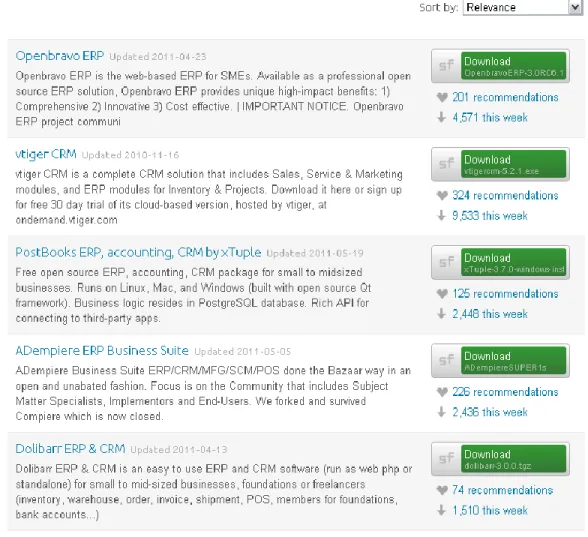
Having understood the open source business model, it would be rather interesting to follow what the most popular open source ERP vendors promise and offer besides the free version. According to Sourceforge.net, the largest open source software promoting website, there are 735 open source ERP projects. The most relevant results are presented in the Figure 2.2. In order to obtain a better view on these packages, a good idea is to visit their websites. The choice fell on the first three: OpenBravo, vtiger CRM and PostBooks by XTuple. OpenBravo ERP is offered as a community version.
OpenBravo is also available as Amazon cloud service. The company with the same name promises “superior user experience by combining web-based simplicity with powerful and practical features that drive productivity and user satisfaction” (Openbravo.com, 2011). The software is supported on multiple computer platforms and operating systems. Along with free product, the company offers OpenBravo professional version, commercial modules, consulting & training services. The quality of the product is backed up by various case study examples available on the website, in the Customer stories section. The company claims to have more than 1,000 customers and more than 12,000 community members.
The vtiger customer relationship management (CRM) system website is less impressive. However, the company offers almost the same services as OpenBravo. The free version is offered along with a professional version and featured services. There is missing information about existing customers; nevertheless, the number of registered community users is slightly over 3,800. The product is available for Linux and Windows supporting platforms.
18 And lastly, xTuple Company offers the PostBooks open source ERP. As it is mentioned on the site, PostBooks is “a full-featured, fully-integrated Accounting, ERP, and CRM system, the core of the award winning xTuple ERP Suite” (xtuple.com, 2011). xTuple offers more than 12 products and featured services. The number of customers is somewhat small, up to 10 customers. The community size number was hard to find.
In the real lives of small companies, where the resources and knowledge are limited, open source ERPs seem to be a viable solution. First of all, the product is free, so the license cost problem is solved. Secondly, the problem of knowledge still remains, because it is still not known how much knowledge is required to adopt and use an open source ERP. And generally, it would be interesting to find out how much effort is required to deploy and start using one of these products. In order to address this issue, a theoretical model built on TAM2 model was used.
19
2.3 Knowledge and ERP adoption
As pointed out in the introductory chapter, an ERP adoption process poses different needs and challenges for knowledge requirements. Pan et al. (2006) argue that knowledge needs regard organizational activities, such as planning, as well as ERP specific knowledge in order to be able to customize and configure the ERP system. However, this study will only focus on user‟s computer skills.
Kramaergaard and Rose (2002) in their paper on ERP implementation have concluded that a wide range of competences are required for complex interactions with ERP systems. This range
includes personal, business and technical skills. The same authors observed that the necessary competence mix varies during the whole time of interaction with an ERP system.
The same complexity and difficulty of interacting with ERP systems is highlighted by Boudreau (2003), who mentions that such systems require training, knowledge and time.
2.4 Research Framework
Having reviewed the literature and theoretical models available (User Experience, TAM, Contingency theory etc.) the choice fell on Technology Acceptance model 2 and Usability testing. At first sight, usability testing and user experience evaluation models seem to be more appropriate to this topic. Usability testing permits to measure such criteria as learnability, effectiveness, memorability etc. of the software. For example, the amount of knowledge and time could be measured, or the steps of deployment could be counted and measured. User experience evaluation allows investigating the experience one has when using a system over a period of time. In addition, according to Väänänen-Vainio-Mattila et al. (2008), user experience evaluation models are limited to traditional usability perspective, and there is a lack of sharing on what user experience really means.
However, the purpose of this study is to explore rather than to measure the open source ERP characteristics. Secondly, usability testing and user experience evaluation are dependent on software product‟s characteristics, such as interface, menus etc. This thesis, however, is not concerned with a specific open source ERP product, but rather with the whole process from the very moment of finding, to the very last moment of using the open source ERP installed. That is why TAM2 was used as the main theoretical model to structure the research problem according to two perspectives: Perceived Ease of Use and Perceived Usefulness.
The theoretical model will help assess the experimenters‟ intention to use open source ERP, a factor which according to previous research affects the actual usage of ERP, which answers the question whether a software product is usable or not.
20 When assessing the Perceived Ease of Use, five usability factors proposed by Nielsen (2011) were taken into consideration – learnability, efficiency, memorability, errors and satisfaction. While Perceived Ease of Use can help assess the whole experience with the software, the usability factors can help explain how easy it is to use a software product and its interface specifically (Nielsen, 2011) – more information on usability is given on p.24. Regarding Perceived Usefulness of open source ERP, the external factors developed in TAM2 were assessed.
2.4.1 Technology Acceptance Model 2
TAM2 comes as an extension to the initial Technology Acceptance Model (TAM) developed by Davis (1989). Both of the models or both versions address the subject of system usage. The model helps to understand and evaluate the reasons and factors which affect the use and adoption of new systems or existing systems. Also, the TAM model is viewed as a tool to measure users‟ willingness and intention to adopt a system. However, in this research, TAM2 will also serve as a structuring tool to assess the perceived ease and perceived usefulness of an open source ERP.
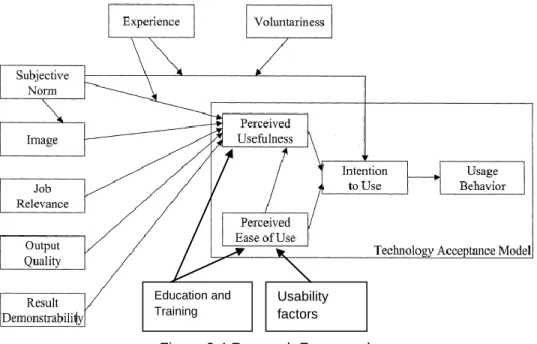
The initial model was limited to two factors, which in opinion of its author, affect the intention and use of a system: perceived ease of use (PEOU) and perceived usefulness (PU). Despite its popularity and use, Venkatesh and Davis (2000) suggested an extension of the initial model. The extended features take into consideration the external factors which affect perceived usefulness (for detailed picture see Figure 2.3). Venkatesh and Davis (2000) explain that external factors have social and cognitive character. For a better understanding these shall be explained further.
21
Figure 2.3 TAM2 model (Venkatesh and Davis, 2000)
Perceived usefulness is the extent the user thinks the systems helps her or him to perform the tasks, i.e. job activities. Perceived ease of use measures the effort required to use a system, i.e. how easy it is to perform the job tasks. PEOU affects the PU and the Intention to Use. One user‟s intention to use affects in turn the actual usage of the systems, i.e. determines the Usage Behavior.
Now there are following the external factors. Subjective norm is one‟s perception that closest people consider she should or should not perform certain type of behavior (Venkatesh and Davis, 2000). The key idea behind is that persons are susceptible to other people‟ ideas and views. That is why some persons perform actions motivated by other people.
Voluntariness is defined as the degree to which potential adopters perceive the adoption decision to be voluntary (Venkatesh and Davis, 2000). In other words, voluntariness determines if system use is perceived as obligatory and unwilling or opposite to these.
Image has a positive effect on perceived usefulness, if the use of the system is to enhance user‟s social status or image; otherwise it has a negative effect on perceived usefulness. Experience
might also have a positive or negative effect on PU. It is considered that a system is most like to be perceived useful if the user is experienced.
Job relevance, as defined by Venkatesh and Davis (2000, p.191), is “an individual‟s perception regarding the degree to which the target system is applicable to his or her job”. In other words, job relevance measures whether a system use is important to daily job tasks.
22
Output Quality measures the quality level of the tasks performed by the system. In other words, if the task performed by the system is perfect, then the perceived usefulness of the system is appreciated higher.
And ultimately, Result Demonstrability measures the tangibility of the results given by a system. Venkatesh and Davison (2000, p.192) explain that “even effective systems can fail to garner user acceptance if people have difficulty attributing gains in their job performance, specifically to their use of the system”. That is why it is important for users to see direct results of their system use, in order for the system to be perceived as useful.
This thesis‟ scope is limited to the deployment of a system, i.e. the installation and first use of an open source ERP package. That is why the use of the TAM2 model would be partial. And namely, the interest lies on perceived ease of use and perceived usefulness of the open source ERP in its installation and first use. In order to assess the usage behavior factor more time is needed, so that relevant behavior patterns have already developed. By finding out what the level of PEOU is, and later discovering the PU, we would also be able to assess the attitude of small companies towards using and adopting an open source ERP in their environment. That is we would be able to predict whether deployment of an open source ERP system would affect positively or negatively company‟s intention to use an open source ERP. To support this prediction further research is needed. The TAM2 model shall be completed with relevant theoretical support on necessary knowledge and user training for information systems. These will also help analyze and serve as reference in later discussion.
2.4.2 End-user training and education
While searching for critical success factors for ERP implementation, much of the attention stumbled upon end-user training and education. This key ingredient is also relevant to this thesis, as it determines the ease of interaction with ERPs. Bueno and Salmeron (2008) collected common believes about the role of training and education of ERP users. They emphasized the need of training before, during and after implementation. The reason is that training affects the knowledge ERP systems users have towards these tools, as well as help to fight technical and other nature complexities. Amoako-Gyampahand Salam (2004) share the belief that training and education ultimately affect the perceived ease of use and perceived usefulness – factors mentioned in the Technology Acceptance Model.
2.4.3 Usability testing
Another factor which can explain the ease of ERP implementation and use is usability. According to Nielsen (2011), usability is “a quality attribute that assesses how easy user interface are to use”. Nielsen explains that usability consists of five components:
23 1. Learnability – “how easy is it for user to accomplish basic tasks the first time they
encounter the design?”
2. Efficiency – “once users have learned the design, how quickly can they perform tasks?” 3. Memorability – “when user return to the design after a period of not using it, how easily
can the reestablish proficiency?”
4. Errors – “how many errors do users make, how severe are these errors, and how easily can they recover from the errors?”
5. Satisfaction - “how pleasant is it to use the design?” (Nielsen, 2011)
The resulting research framework includes TAM2 components with integrated usability and education and training factors (Figure 2.4).
Figure 2.4 Research Framework
TAM model and usability factors compatibility has been already tested by Calisir and Calisir (2004). However, in this thesis the framework composed provides lens to direct, structure and analyze the results.
Perceived Usefulness (PU) and Perceived Ease of Use (PEOU) are the guiding pillars of this study. PEOU will help assess the ease with which users can deploy an open source ERP.PU is result-oriented and assesses the utility of open source ERP after its deployment. Both PEOU and PU are affected by education and user training. PU is, in turn affected by external factors developed by Venkatesh and Davis (2000). PEOU is influenced by the usability factors identified by Nielsen (2011). The effect of usability factors on PEOU will be studies as a whole, rather than concentrating on each factor specifically.
Education and Training
Usability factors
24 It is worth repeating that this research framework model is built for structuring and guiding this thesis, rather than testing itself or measuring knowledge and time variables. Moreover, the research framework was successfully implemented as valid data was collected (see Chapter 4).
25
3. Methods
This chapter will present the research strategy, data collection techniques as well as compiling and analysis applied to the findings. The chapter will end with discussion on research credibility.
3.1 Research strategy and procedure
In order to build the foundation for problem investigation, a literature research has been rolled out which was used to build the theoretical framework presented in the chapter above.
The initial intention was to spread light on open source ERPs in small companies, which continues to be a topic with little discussion in the academic world. From that point, two main research questions were derived in order to explore the practical knowledge needs for an open source ERP deployment process. In order to investigate the process in depth, a deployment experiment has been set up. The experiment was led by a business case (see Appendix 2), which consisted of guiding tasks. The business case was compiled based on personal experience with open source ERP obtained in the deployment pre-study.
In other words, the first step in compiling the business case was to personally deploy an open source ERP. During deployment, various sources of documentation were used for instructions. Also, the pre-study helped to structure and organize the data collected, thus supporting clear structure and transparency through the results and analysis. The process of deploying an open source ERP is described in the chapter below.
Before the experiment, its participants were handed in a structured questionnaire with closed/restricted form. The purpose of the questionnaire was to establish an accurate profile of experiment participants, in term of computer experience and knowledge regarding computer usage. During and after the experiment, the participants were interviewed in order to get a better insight on the deployment process.
During the experiment, the participants were given questions when different milestones had been achieved. The questions usually related to the easiness of the process. The interview which followed after the experiment finished, were related directly to the theoretical reference used in the research, and assessed PEOU and PU.
The interviews resulted in data which were later analyzed through the theoretical framework lens. Not of less importance is the fact that theoretical framework has been used as foundation for the interview questions, also did it bring structure to the material analyzed later. That is why TAM2
26 model was used to base the interview upon. The findings and analysis are presented in a descriptive manner, in order to give a detailed picture of the process.
3.2 Data Collection
There were two main methods for data collection which involved six students from different universities in Sweden. The first method used in data collecting is a structured questionnaire (see Appendix 1). The questionnaire gathered data on participants‟ general information profile, as well as data on computer experience and knowledge. One of the purposes of questionnaire was to establish whether experiment participants had any previous experience which resembled the experience required in accomplishing the task, i.e. installing and using software. Key (1997) suggests that a good questionnaire should be as short as possible whilst getting essential data; also the questions should be clear and objective, i.e. non-misleading etc. These factors were considered when compiling the questionnaire.
The other data collection was interview with the participants of the experiment. According to Kvale and Brinkmann (2009) semi-structured interviews are most appropriate for face-to-face meetings. The freedom offered by semi-structured interviews was crucial to findings, as the interviewees were able to express the issues and their thoughts regarding the easiness of deploying an open source ERP. The other reason, of why semi-structured interview was preferred, is the possibility to come with follow up questions, and thus make it more as a discussion, so that a greater level of details would come up, although keeping it centered on the main topic.
Large amount of effort has been put before the interview, in order to be able to thoroughly understand the problem area and correctly grasp interviewees‟ statements. That has also affected the ability to put follow up questions in the moments where it was felt that additional explanation was needed from interviewees. The questions in the interview have been carefully structured in a guiding manner.
The interviews have been audio recorded, and after completion immediately transcribed. When choosing the recording method – video or audio – preference was given to audio, in order to set up a comfortable environment for participants. Nevertheless, audio recording was most handy for both sides.
3.2.1 Deployment Experiment
The deployment experiment partially served as a data collection method through observation. The experiment involved six bachelor and master students (see Table 4.1) who were asked to find and download only one of open source ERP packages available on the World Wide Web; and then proceed with the installing of the package on personal computer. In the next phase, the
27 participants were asked to print out an invoice. In order to simulate a real business situation, the subjects were handed a business case with enough data to print the first customer invoice (see Appendix 2). And for the case to resemble a real business situation, all data contained were enough to make a valid invoice according to Swedish regulations, i.e. VAT, Address details, Organizational number etc. During the experiment, the participants were continuously asked to assess the knowledge and time required to complete a certain task.
Printing of invoice was not set as the ultimate goal, but rather as a guiding objective which would require some effort and user interaction with the software. Of great interest was the whole process, from its start to its end – printing the invoice. It is important to mention and understand, that this experiment shares features with observational studies and usability tests.
Firstly, the intention of the experiment is to answer the research questions posed by observing its participants in the settings close to reality, i.e. in front of the computer in an office. Lastly, the experiment shares the features of a usability test, where the system is tested for ease of use. However, the focus of this study is not the interface nor the productivity, but rather the whole experience of the participants from the very moment of deciding to look for an open source system to the very last moment of printing the first invoice. Creswell (2007) admits and supports the use of mixed research tools and strategies in order to satisfy the needs and purpose of the research.
3.2.2 Sampling
The sampling technique was influenced by the organizational characteristics of small companies, and namely single-man companies. This tells that there are no strict requirements on choosing participants, and there are no strict requirements for IT skills. However, in order to avoid bias or misinterpretation accurate profiling of participants computer skills have been made. Therefore, six subjects were taken from Lund School of Economics and Management and Stockholm University.
3.2.3 Design of Interview
The questions in the interview were constructed around two important aspects: 1. Perceived Ease of Use
2. Perceived Usefulness
The profiling questions, as previously mentioned, had the purpose of establishing the background of the participant and his or her level of computer skills (see Appendix 1).
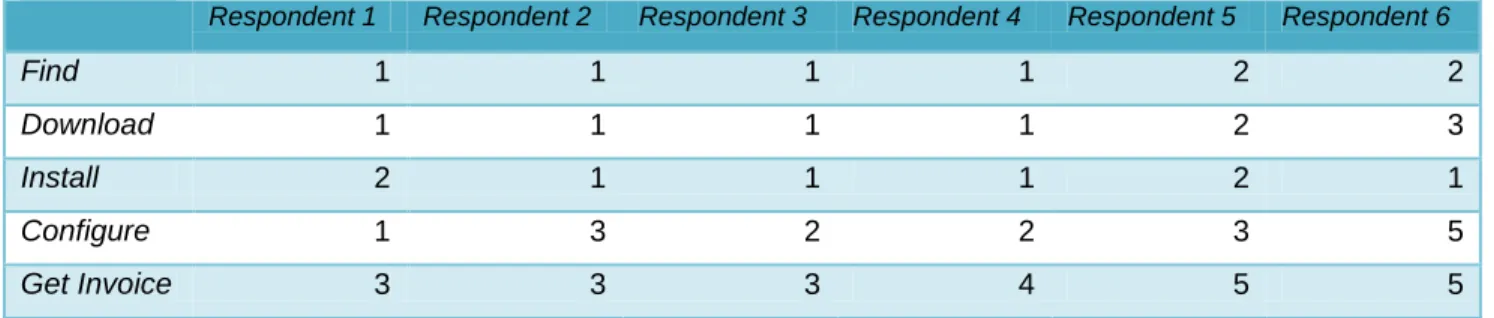
The questions related to Perceived Ease of Use had the purpose to assess the level of ease perceived by experiment participants in the open source ERP deployment process. As TAM2 is a quantifiable model, the participants were asked to answer PEOU questions on a scale from 1 to 5,
28 were 1 was ranked as very easy and 5 – very difficult. Also, clarifying questions followed in order to get better explanation of why participants gave specific grades. The questions related to Perceived Usefulness were designed to assess the positive or negative influence of TAM2 external factors on PU (see Appendix 2).
3.3 Compiling and Analysis
Having collected empirical evidence, the next step in the research process was analyzing the data. Creswell (2007) suggests that analysis should start when enough primary information is collected. However, enough is a relative measure. It was decided to stop with three participants when same behavior tendency was observed, in other words, same results were coming out. However, the empirical evidence was completed with three more experiments with the focus on participants with non-IT related educational background.
Kvale and Brinkmann (2009) suggest that coding of the data should be rolled out. Narrative structuring meaning coding has been applied; collected data was structured according to deployment process stages: choosing and downloading an open source ERP, installing and configuring, business case solution, PEOU, and PU. This was done for two reasons: the relatively short size of transcripts, and the ease to follow the statements respondents made; the other reasons is the wish to present the data in a narrative manner, where actions and events are presented in chronological order, so that to get a better grasp of the issue. The same structure is kept when data is presented and analyzed in the later chapters of the thesis.
The participant responses were coded in order to have a better traceability. Each response was given a number and the initial of the participant‟s name. The actions of experiment participants between their oral responses are presented in italics style. This was done in order to give a clear picture of what happened during the deployment experiment. An example of transcript coding follows below.
Example:1C: Reading about one of the ERP sites he found... Cloud ERP, that‟s an advantage for
future.
This example shows that before giving his first response, (C)hristopher was reading about one of the ERP sites he found.
3.4 Research credibility
29 3.4.1 Reliability and Validity
Importance of reliability has been stressed by many scientists (Creswell, 2007). In order to adhere to this criterion, the research process has followed scientific methods, when it comes to sampling or interviewing. As well, the thesis was attempted to be written in great detail in order to provide transparency and traceability from the moment of discussing the problem area to formulating the research conclusions. Thus, if same research is embarked on, the probability of getting same results if same conditions are met is very high. Thus, it is very reliable.
Validity refers to measuring correctly what was intended to be measured. Trochim (2006) suggests that in order to assure validity, one must ask himself or herself whether the measures used in the research brought to valid results. The research questions of this thesis have been formulated through the lens of theoretical framework (TAM2).
3.4.2 Bias
According to Bennett (2011), bias could particularly touch many aspects of a research paper and namely: the research design, the research measurement, and not least the research sampling. In order to address these issues, this research process has been kept objective till the last moment. However, it is very difficult for researchers to find bias in their studies. One of the solutions was peer reviewing and supervisor assistance and guidance. Another possible bias problem could be the sample used in this research. However, careful profiling has been done, and thus conclusions made in this study will be linked to the pre-existing computer knowledge and skills the interviewees had.
3.4.3 Ethics
Kvale (1996) suggests that the core issues in research ethics are beneficial consequences, consent and confidentiality. The experiment participants were informed about the purpose of the study beforehand, thus they wanted to participate in the study. Also, the interviewees were left to read the thesis and comment. However, no negative remarks have been given from their side. The experiment participants were notified about their right to be anonymous in this study, however everyone gave the permission to present their names.
30
4. Empirical Findings
In this chapter a summary of the empirical results will be presented. The structure of the presentation is arranged into the following parts: Deployment Pre-study, Profiling, Perceived Ease of Use, and Perceived Usefulness. Perceived Ease of Use will cover subtopics: Finding and choosing, Installing and Configuring, Getting the first invoice tasks. The primary data is covering the knowledge and time aspects.
4.1 Deployment Pre-study
The purpose of the deployment pre-study was to obtain an insight on open source ERP
deployment process before any experiments were made. The results of the pre-study were used for setting up the experiment and interviews.
4.1.1 Finding, choosing and downloading the open source ERP
The process started with finding information about available open source ERPs on the World Wide Web. Having taken the suggestion of Johansson and Sudzina (2008), the first source to look for open source software was www.sourceforge.org, which is the largest project promoting open source software. Using this portal‟s search function, the keywords “open source ERP” were queried. Over 13,000 hits came up, however not all of the results were relevant to the search.
According to sourceforge.org, the two most popular and downloaded open source CRM & ERP solutions were OpenBravo and PostBooks. So the next logical step was to check out the website of respective projects, and the information provided.
Both of the websites made a professional impression. OpenBravo impressed by the number of customers, and both of the open source ERPs have a large community of users. With no previous experience related to ERP and its activity, the deciding criteria for choosing one was the technical criteria and requirements. It was relatively easy to find the download page and proceed to downloading. Both software products offered solution for cloud, Linux and Windows platforms, however PostBooks/xTuple offered also for Apple/MAC OS users.
4.1.2 Installing and configuring the open source ERP
Having consulted the available documentation, first difficulties appeared. OpenBravo promised a very simple, one-click installation for Linux users, but more complicated installation paths for other platforms, i.e. advanced computer skills are needed. xTuple software promised easy installation on all platforms. Having available only Linux and Windows operating systems, it was
31 decided to try out OpenBravo on Linux and xTuple on Windows XP. Indeed, the installation process was very easy for OpenBravo, but with no transparency whatsoever. Only, advanced computer users could be able to follow the installation procedure. After installing, OpenBravo on Linux/Ubuntu the software ran in web browser successfully.
Regarding, xTuple the installation procedure was as easy, plus the level of procedure transparency and clearness was quite high. The user is guided by explanatory instruction with options of choosing elements to be installed. By default, all elements are being installed. The software also ran with no errors on Windows XP. The approximate time for both installations was ten to fifteen minutes, with high speed internet available. At this point, it is important to mention that from the technical standpoint, the requirements are not high. The computer properties available were 1GB RAM, 10GB free space on hard drive, and Windows XP. The basic needs for installation are mentioned on the vendors‟ websites.
It was decided to proceed with xTuple. The argument behind is the availability and spread of Windows operation systems, since theoretically the majority of small companies would have a computer running Windows. The next step was to get acknowledged with xTuple open source ERP.
4.1.3 Getting the first invoice with open source ERP
The logging in procedure is very easy. However, potential users have to pay attention to details while installing, because important information is given, such as credentials, which would be of use later.
After logging in, as an experienced user of computer and software products, the first thing was to get accustomed with menus available in the software. xTuple offers a very pleasant user interface, with large buttons and well organized modules, such as sales, inventory and other. For screenshots please visit www.xtuple.com.
After getting to know the software, the decision was to consult available documentation and tutorials on how to work with the ERP. There are many videos available; some of the videos are introductory, and some of them give detailed instructions on the internals and functions of the system. From the video tutorials (www.xtuple.com, 2011), it was found out that following steps were required in order to get a valid invoice:
1. Register a new user for the company a. Create separate account
b. Enter details such as address, company info, logo etc. 2. Register the new customer with according details
3. Create a new product/item 4. Configure the taxation settings
32 5. Create a new sales order containing the product created
6. Ship and print out the invoice.
These steps were enough to print an invoice valid for Swedish standards, i.e. having required information. Generally speaking, the process was quite easy if the instructions are followed, but instead it is time-consuming. In other words, for better job performance time is needed to master the ERP.
4.2 Profiling
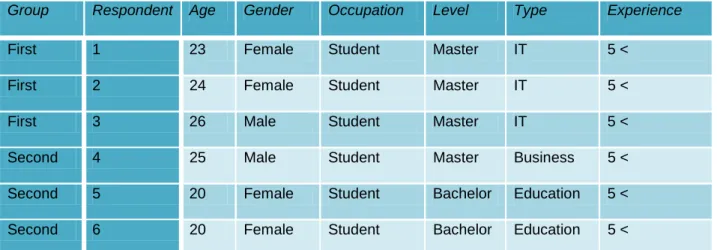
The interviewees who took part in the deployment experiment are bachelor and master students within Information Systems (3), Business (1) and Education (2) fields. The general information about the interviewees is summarized in the table below (Table 4.1).
Group Respondent Age Gender Occupation Level Type Experience
First 1 23 Female Student Master IT 5 <
First 2 24 Female Student Master IT 5 <
First 3 26 Male Student Master IT 5 <
Second 4 25 Male Student Master Business 5 <
Second 5 20 Female Student Bachelor Education 5 <
Second 6 20 Female Student Bachelor Education 5 <
Table 4.1 General information on interviewees
The interviewees‟ computer experience has been assessed as between intermediate and advanced levels, with computer experience being over five years on average. Having been asked on the purposes they use their computer, the respondents commonly replied that internet and studies are the main reasons. Only two of the respondents used computer for work and multimedia also.
All of the interviewee respondents confessed that they have tried to install software on their computer and succeeded at least once. Regarding software usage, all respondents have been using one or more software products for a long time, five years or more; and all of them have advanced skill level with the product they have been using over that period of time.
All respondents have been provided with a business case (see attached Appendix 2), used as a guide in deployment experiment. In brief, the experiment participants were asked to choose, install, configure and accomplish the task of printing the first invoice. During all stages, the respondents were continuously asked to evaluate the process from knowledge and time perspectives.
33
4.3 Deployment Experiment
In this part of the chapter the stages of the deployment experiment will be described along with the empirical findings.
4.3.1 Finding, choosing and downloading the open source ERP
Having been asked to find and choose an open source ERP, all of the respondents tried to search for one on the World Wide Web. The most common search keywords used were “open source ERP”, “free ERP” and “open source ERP download”. Asked to explain the logic behind the search actions, respondents clarified that they were willing to evaluate the search results given by Google web search engine according to their relevance. Google has been referred as the main source for new information. In other words, the respondents chose the first results on the Google‟s webpage, after having queried for open source ERP. The usual results webpage included OpenBravo, xTuple, Compiere, Opentaps and other results (for details see Figure 4.1).
34
Figure 4.1 Google results on open source ERP (Google.com, 2011)
To the question on how easy it was to find an open source ERP, four out of six respondents agreed that finding one was very easy, both in knowledge and time.
The respondents proceeded with looking at the websites available in the search results. Asked how the respondents evaluated different OS ERP choices, they gave different answers. Some took into consideration the professionalism of the website. In other words, they considered the looks and the design of the website. The rest of participants did not have any explanation for the choice. Ultimately, the users selected to proceed with xTuple/PostBooks open source ERP, as a final choice. Respondent 4 chose initially Compiere, as an option, but gave up on it as he was not able to find the download link for Windows 7 operation system. Compiere provides a solution for other than Windows platforms.
However, it is crucial to mention that none of the respondents took into consideration the technical parameters and requirements of the open source ERP.
35 The findings on this stage of the experiment were that respondents did not have difficulties with finding an open source ERP system. It is also important to mention that 4 out of 6 respondents could not motivate the reasons behind choosing that specific open source ERP.
4.3.2 Installing and configuring the open source ERP
Most of the experiment participants have shown same behavior during the installation process, meaning that the actions respondents took did not vary. None of them gave too much consideration to installation and configuring information. All of them made the choice to proceed with preconfigured elements.
The respondents explained that this behavior is due to lack of knowledge about certain parts of software, such as databases offered and other elements; one of the respondents mentioned that “sometimes this is scary just because there are things configured you don‟t know anything about it” (27C, Appendix 3A). But in order to be on the safe side, the respondents chose to install all elements suggested. Also, the rush can be explained by the wish to run and try out the software at once, skipping the configuration and installation details.
When asked to share the first impression about the installation, the respondents thought that the process was very easy and took little time and knowledge effort. However, five respondents shared the impression that it was difficult to configure the software due to no previous knowledge of the open source ERP product. Respondent 3 mentioned that there was no need to configure the software and she felt comfortable with preconfigured settings. It is also important to point out that one of the respondents had difficulties with English version of the software (Respondent 5). She did not feel comfortable with English, since she was accustomed to Spanish user interface language. The respondent tried to set up the Spanish language for the xTuple ERP system, but the setting missed both in the installation part and the settings menu of the product. This issue was the reason the respondent failed to complete the whole task.
The findings on this stage of the experiment were that installing and configuring the open source ERP was an easy task, with respondents choosing preconfigured settings due to lack of knowledge. Not of lest importance is the fact that the open source ERP product (xTuple) did not have a language setting in the software, thus making it difficult to interact with its interface.
4.3.3 Getting the first invoice with open source ERP
This part of assignment was the most challenging and most complex for all participants. Some of the issues happened right at the beginning of the task, when users could not find the credentials needed to login to the enterprise resource system. Four out of six participants found the interface of the software very “handy” and pleasant; in the same time, one respondent did not feel comfortable with interface language and another respondent mentioned that “[f]or the first time it is a bit complicated, but I guess it needs some time to get used to”.