Exploring Application and Infrastructure Adaptation on Hybrid Grid-Cloud
Infrastructure
Hyunjoo Kim
1, Yaakoub el-Khamra
3,4, Shantenu Jha
2, Manish Parashar
1 1NSF Center for Autonomic Computing, Dept. of Electrical & Computer Engr., Rutgers University, , NJ, USA
2
Center for Computation & Tech. and Dept. of Computer Science, Louisiana State University, USA
3
Texas Advanced Computing Center, The University of Texas at Austin, Austin Texas, USA
4
Craft and Hawkins Dept. of Petroleum Engineering, Louisiana State University, USA
Abstract
Clouds are emerging as an important class of distributed computational resources and are quickly becoming an inte-gral part of production computational infrastructures. An important but oft-neglected question is, what new appli-cations and application capabilities can be supported by clouds as part of a hybrid computational platform? In this paper we use the ensemble Kalman-filter based dynamic application workflow and investigate how clouds can be effectively used as an accelerator to address changing computational requirements as well as changing Quality of Service constraints (e.g., deadlines). Furthermore, we explore how application and system-level adaptivity can be used to improve application performance and achieve a more effective utilization of the hybrid platform. Specifically, we adapt the ensemble Kalman-filter based application formulation (serial versus parallel, different solvers etc.) so as to execute efficiently on a range of different infrastructure (from High Performance Computing grids to clouds that support single core and many-core virtual machines). Our results show that there are performance advantages to be had by supporting application and infrastructure level adaptivity. In general, we find that grid-cloud infrastructure can support novel usage modes, such as deadline-driven scheduling, for applications with tunable characteristics that can adapt to varying resource types.
Categories and Subject Descriptors D.1.3 [Concurrent Programming]: Distributed Programming, Parallel Program-ming General Terms Algorithms, Management,
Perfor-mance, ExperimentationKeywordsCloud Computing,
Hy-brid Computing
I. Introduction and Motivation
Clouds are emerging as an important class of distributed computational resources – both, for data-intensive and compute-intensive applications. In fact, they are rapidly joining high-performance grids as viable computational platforms for scientific exploration and discovery, and it is clear that future production computational infrastructures will integrate both paradigms. It is thus critical to under-stand what role clouds will play in the formulation and ex-ecution of computational applications and what abstractions and tools are necessary to support their usage.
Clouds support a different although complementary us-age model to more traditional High Performance Computing (HPC) grids. Cloud usage models are based upon on-demand access to computing utilities, an abstraction of un-limited computing resources, and a usage-based “payment model” whereby users essentially “rent” virtual resources
and “pay” for what they use. Several recent efforts [?],
[?], [?] have clearly demonstrated that clouds can be
ef-fectively used as alternate platforms for certain classes of applications. These include applications with very modest communication and synchronization requirements such as parameter sweeps and data analytics. Many applications that currently use clouds are legacy or cross-over applica-tions from the cluster/HPC world. For example, there are many traditional HPC applications that use clouds such as
Cyclone [?] – SGI’s latest cloud offering. Furthermore, it
has also been established that there are application profiles that are better suited to HPC grids (e.g., large scale DNS and Quadratic Mean calculations), and others that are more appropriate for clouds.
Whereas it is important to explore and support the migration of traditional applications to cloud computational platforms, it is also imperative to ask: What new appli-cations and application capabilities can be supported by clouds – either as stand-alone infrastructure, or as part of a hybrid grid-cloud computational platform? Can the addition of clouds enable scientific applications and usage
modes, that are not possible otherwise? What abstractions and systems are essential to support these advanced appli-cations on different hybrid grid-cloud platforms (e.g., High-Performance Computing (HPC) and/or High Throughput Computing (HTC) grid-clouds). These questions and related issues frame the scope of this paper.
We address these issues in the context of dynamic appli-cations, defined as applications whose execution trajectory or resource requirements cannot be completely determined a priori. This can be due to a change in computational re-quirement or a change in execution trajectory. Furthermore, an application is referred to as dynamic only if it is able to respond to changes. Ideally, dynamic applications are able to adapt at the application level, as well as at the infrastructure utilization level. Thanks to the ability to provide an illusion
of unlimited and/or immediately available resources, as
currently provisioned, clouds have the interesting and useful ability to support applications with changing requirements. Furthermore, dynamic applications due to their ability to adapt to changes in infrastructure can effectively utilize clouds resources when necessary.
We established in Ref. [?] that clouds in conjunction
with traditional HPC and HTC grids provide a balanced infrastructure supporting scale-out and scale-up/down for a range of application (model) sizes and requirements. We also demonstrated that such hybrid infrastructure support a range of objectives, for example, reduced times-to-solutions, reduced costs (in terms of currency or resource usage), or resilience against unexpected outages (e.g., unexpected delays in scheduling queues or unexpected failures). In this paper, we investigate how clouds can be effectively used as accelerators to address changing computational requirements as well as changing Quality of Service (QoS) constraints (e.g., deadline) for a dynamic application work-flow. Furthermore, we explore how application and system-level adaptivity can be used to achieve improved overall application performance and more effective utilization of the hybrid platform.
Two high-level goals guide the design of the experiments presented in this paper. One goal of this paper is to estab-lish the benefits from a hybrid HPC grid-cloud execution environment for a sophisticated scientific application. This
extends the work in Ref. [?], where we now have a much
richer space of infrastructure and application variability – including more virtual machine types, sequential and parallel implementations of the scientific applications. We investigate how acceleration – defined as a reduced TTC, can be achieved by exploring & exploiting a richer set of infrastructure, but we also investigate these objectives in the context of a richer application space, i.e., different solvers, pre-conditioners etc., predict and model parallel tasks and their usage of hybrid HPC grids and cloud infrastructure.
In the second goal, we want to investigate application-infrastructure adaptivity, how it can be supported on
hybrid-infrastructure, and the subsequent performance advantages. Specifically, we want to validate the conceptual architec-ture and framework for supporting adaptivity as defined
in Ref [?]. To this end, three approaches to supporting
adaptivity in computational science applications are
inves-tigated: (i) Track 1 – referred to as infrastructure-level
adaptivity is characterized by the selection of
infrastruc-ture as a degree-of-freedom; (ii) Track 2 – referred to
as application-level adaptivity, and which is characterized by the tuning of applications in various ways, and (iii)
Track 3– adaptivity of both infrastructure and application. For example, track 1 involves provisioning of immediately available resources; technically, track 2 is about changing the numerical solvers & preconditioners, and the number of ensemble members, size of ensembles and possibly also the frequency of assimilation. A necessary condition is that the application formulation should be amenable to and support runtime adaptivity. Track 3 considers both infrastructure adaptivity and application tuning at the same time. We aim to understand the relative merits and performance trade-offs of the three tracks.
Our adaptive workflow is an ensemble Kalman-filter
(EnKF) that uses a reservoir simulator [?] to forecast
an ensemble of models and a repeating analysis step to match model production with historical production (his-tory matching). We investigate the application along the three tracks described above. Experimental results show that adaptivity can reduce total time-to-completion (TTC)
with a reasonable cost. Experiments also establish that
application-level adaptivity can affect TTC.
The rest of this paper is organized as follows. Section??
discusses related works and provides some background
information. Section??describes reservoir characterization
and the EnKF applications workflow, introduces Comet-Cloud, and then describes dynamic execution and adaptivity
of EnKF using CometCloud. In Section ?? we describe
the experimental environments and present our results.
Section??concludes this paper.
II. Related and Prior Work
A. Related Work
In Ref. [?], Buyya et.al. describe an approach of
ex-tending a local cluster to cloud resources using schedulers applying different strategies. Their approach was simulated-based, and not executed on production runs on cloud resources. References [?] and [?], investigate the elastic
growth of grids to clouds. Vazquez et.al. [?] use the
Grid-Way metascheduler to elastically grow the grid
infrastruc-ture to Nimbus [?] based cloud. Their experimented used the
NAS Grid Benchmark suite. Ostermann et.al. [?] extended a
envi-ronment to include cloud resources; they used the Austrian Grid and an Eucalyptus-based academic cloud installation. Our previous work considered a hybrid computing
en-vironment which integrated clusters with clouds [?], grids
with clouds [?] and enabled autonomic cloudbursts on
demand. CometCloud is very flexible and able to integrate multiple resource types, while other approaches are closely based on one resource class, for example, they use some specific grid based job scheduler, resource management, etc. CometCloud uses an overlay mechanism, therefore any kind of node can join CometCloud and provide computing or/and storage capability.
Several economic models for resource scheduling on grids have been proposed, however, there exist limited effort on resource scheduling on hybrid computing environments.
Recently a combinatorial auction model [?] was proposed
for both grids and clouds and a cost model based on
economic scheduling heuristics [?] was investigated for
cloud-based streams. An adaptive scheduling mechanism [?]
used economic tools such as market, bidding, pricing, etc. on an elastic grid utilizing virtual nodes from clouds. Other tools and resource management systems used include
GridARM [?] and GLARE [?].
In Ref. [?], on-demand resource provisioning
mecha-nism based upon load was presented. In contrast, resource provisioning in this paper is based on user objective and metrics. The autonomic scheduler decides on the mix of resource classes and the number of nodes depending on user-defined objectives, the estimated runtime of tasks and the cost calculated from the time-to-completion.
B. Objective Driven Hybrid Usage of HPC
Grids and Clouds
Developing and deploying applications on a hybrid and dynamic computational infrastructure presents new and in-teresting challenges. There is the need for programming systems that can express the hybrid usage modes and associated runtime trade-offs and adaptations, as well as coordination and management infrastructures that can im-plement them in an efficient and scalable manner. Key issues include decomposing applications, components and workflows, determining and provisioning the appropriate mix of grids/clouds resources, and dynamically scheduling them across the hybrid execution environment while satis-fying/balancing multiple, possibly changing objectives for performance, resilience, budgets and so on [?].
In Ref. [?], we investigated the integration of HPC grids and clouds and how an autonomic framework was used to support the following autonomic objectives:
• Acceleration: This use case explores how clouds can be used as accelerators to improve the application time-to-completion by, for example, using cloud resources to alleviate the impact of queue wait times or exploit
an additionally level of parallelism by offloading ap-propriate tasks to cloud resources, given apap-propriate budget constraints.
• Conservation: This use case investigates how clouds can be used to conserve HPC grid allocations, given appropriate runtime and budget constraints.
• Resilience:This use case will investigate how clouds can be used to handle unexpected situations such as an unanticipated HPC grid downtime, inadequate allocations or unanticipated queue delays.
C. Conceptual Architectures for Adaptivity
in Computational Science
Looking at existing practices in computational science, two corresponding conceptual architectures can be ob-served. As discussed in Ref. [?], both of these architectures are composed of the application, a resource manager that allocates, configures and tunes resources for the application, and an autonomic manager that performs the tuning of application and/or system parameters.
In the first conceptual architecture, the application and
resources are characterized using a number ofdynamically
modifiable parameters/variables that have an impact on
the overall observed behavior of the application. Each of
these parameters has an associated range over which it
can be modified, and these constraints are known a priori.
The intention of the autonomic tuning manager is to alter
these parameters based on some overall required behavior
(referred to as the application objective) that has been defined by the user. Tuning in this case is achieved by taking into account, for example, (i) historical data about previous runs of the application on known resources, obtained using monitoring probes on resources; (ii) historical data about previous selected values of the tunable parameters; (iii) empirically derived models of application behavior; (iv) the specified tuning mechanism and strategy; etc. For example, an autonomic tuning mechanism in this architecture may
involve changing the size of the application (for instance,
the number of data partitions generated from a large data set, the number of tiles from an image, etc.), or the set of parameters over which execution is being requested. This tuning is used to make desired tradeoffs between quality of solution, resource requirements and execution time or to ensure that a particular QoS constraint, such as execution time, is satisfied.
Another conceptual architecture, where the application is responsible for driving the tuning of parameters, and choosing a tuning strategy. The autonomic tuning manager is now responsible for obtaining monitoring data from resource probes and the strategy specification (for one or more objectives to be realized) from the application. Tuning now involves choosing a resource management strategy that can satisfy the objectives identified by the application. An
example of such an architectural approach is the use of resource reservation to achieve a particular QoS
require-ment. The G-QoSM framework [?] demonstrates the use
of such an architecture, involving the use of a soft real-time scheduler (DSRT) along with a bandwidth broker to make resource reservation over local compute, disk and network capacity, in order to achieve particular application QoS constraints.
We conclude this sub-section with some observations: A key underlying concept is the separation of management and optimization policies from enabling mechanisms that allows a repertoire of a mechanisms to be automatically orchestrated at runtime to respond to the heterogeneity and dynamics, both of the applications and the infrastructure. Examples of mechanisms could be alternative numerical algorithms, domain decomposition, and communication pro-tocols. If this were an autonomics paper, we would focus on developing policies and strategies that are capable of identifying and characterizing patterns at design and at runtime and, using relevant policies, to manage and opti-mize the patterns. However, in this work we will not focus on the policies and metrics that determine adaptivity, but will focus on the capabilities and performance arising as a consequence of the adaptivity.
We reiterate that the conceptual architectures – tuning
by and of applications, are not exhaustive [?], but provide
an initial formulation with a view towards understanding adaptivity in the EnKF application that we investigate. As a final observation, we note that application and system spe-cific runtime adaptations are widely used in computational science applications as a means for managing applications and tuning performance. But supporting them on production grade infrastructure and at scale has been challenging.
III. Application
Characterization
and
Dy-namic Execution
A. Reservoir
Characterization:
EnKF-based History Matching
EnKF represent a promising approach to history match-ing [?], [?], [?], [?]. EnKF are recursive filters that can be used to handle large, noisy data; the data in this case are the results and parameters from an ensemble of reservoir models that are sent through the filter to obtain the “true state” of the data. Since the model varies from one ensemble member to another, the run-time characteristics of the ensemble simulation are irregular and hard to pre-dict. Furthermore, during simulations, when real historical data is available, all the data from the different ensemble members at that simulation time must be compared to the actual production data before the simulations are allowed to proceed. This translates into a global synchronization point for all ensemble members in any given stage.
The variation in computational requirements between individual tasks and stages can be large. As a result, efficient execution of large scale complex reservoir characterization studies requires dynamic runtime management to ensure effective resource utilization and load-balancing. Further-more, since the computational requirements are no know a priori, the application can potentially benefit from the elasticity of cloud resources. For this reason, performing large scale complex reservoir characterization studies can benefit greatly from the use of a wide range of distributed, high-performance and throughput as well as on-demand computing resources.
B. CometCloud Overview
CometCloud [?] is an autonomic computing engine for
clouds and grids environments that enables the develop-ment and execution of dynamic application workflows in heterogeneous and dynamic clouds/grids infrastructures. It supports the on-demand bridging of public/private clouds and grids as well as autonomic cloudbursts. Conceptually, CometCloud is composed of a programming layer, service layer, and infrastructure layer. The infrastructure layer uses
the Chord self-organizing overlay [?], and the Squid [?]
information discovery and content-based routing substrate build on top of Chord. The service layer provides a
Linda-like [?] tuple space. The programming layer provides the
basic framework for application development and man-agement including the master/worker/BOT, workflow and MapReduce/Hadoop [?], [?].
Key components of CometCloud include:
Workflow Manager:The workflow manager is responsi-ble for coordinating the execution of the overall application workflow, based on user-defined polices.
Estimators:Estimators provide an estimate for the com-putational cost of each task. This estimate can be obtained through a computational complexity model or through quick, representative benchmarks.
Autonomic Scheduler: The autonomic scheduler uses the estimator to compute anticipated runtimes for tasks on available resource classes, and to determine the initial hy-brid mix HPC grids/clouds resources based on user/system-defined objectives, policies and constraints.
Grids/Clouds Agents: The grid/cloud agents are re-sponsible for provisioning the resources on their specific
platforms, configuringworkersas execution agents on these
resources, and appropriately assigning tasks to these
work-ers. CometCloud primarily supports apull-basedmodel for
task allocation, where workers directly pull tasks from the Comet space. However, on typical HPC grid resources with
a batch queuing system, a combined push-pull model is
used, where we insert “pilot-jobs” [?] containing workers
into the batch queues and the workers then pull tasks from the Comet space when they are scheduled to run.
At each stage of the workflow, the workflow manager determines the number of ensemble members at the stage as well as relative computational complexity of each member and then it encapsulates each ensemble member as a task. Once the tasks to be scheduled within a stage have been identified, the autonomic scheduler analyzes the tasks and their complexities to determine the appropriate mix of Ter-aGrid (TG) and EC2 resources that should be provisioned. This is achieved by (1) clustering tasks based on their complexities to generate blocks of tasks for scheduling, (2) estimating the runtime of each block on the available re-sources using the cost estimator service and (3) determining the allocations as well as scheduling policies for the TG and EC2 based on runtime estimates as well as overall objectives and resource specific policies and constraints (e.g., budgets). More details are described in [?].
C. Dynamic Execution and Adaptivity of
EnKF using CometCloud
As stated earlier, we consider two types of adaptivity in this paper. Infrastructure adaptivity explores a richer infras-tructure space and selects appropriate numbers and types (e.g., number and type of virtual machines), of resources based on application requirements and overall constraints. The second type of adaptivity is application adaptivity which involves adapting the structure and behavior of the applications based on application/system characteristics (e.g., the size of ensemble members, problem size and application configuration) and runtime state.
Infrastructure adaptivity is achieved by estimating each ensemble member’s runtime on available resources and se-lecting the most appropriate resources for them. To estimate runtime on each different resource class, the CometCloud autonomic scheduler asks a worker per resource class to run the runtime estimation module, which is achieved by inserting a runtime estimation (benchmark) task into the Comet space. A worker running on each resource class pulls the task, executes it and returns the estimated runtime back to the scheduler.
If there is no active worker on a resource class, the scheduler launches a new worker on the resource class.
The overhead of running an estimation task itself is 5%
of that of an actual task. However, if the scheduler should start a new worker for estimation, it can cause additional time overhead, for example, the overhead of launching a new EC2 instance, or the waiting time in a queue after submitting a pilot job for TG. This runtime estimation is accomplished at the beginning of every stage because each stage is heterogeneous and the runtime of the previous stage can not be used for the next stage. Once the autonomic scheduler gathers estimated runtimes from all resource classes, it maps the ensemble members (encapsulated as asks) to the most appropriate available resource class based
EnKF application CometCloud Cloud Grid Agent Pull Tasks Pull Tasks Push Tasks HPC Grid Mgmt. Info. Mgmt. Info. HPC Grid CloudCloud
Cloud Agent Workflow manager Runtime estimator Autonomic scheduler Monitor Analysis Adaptation Adaptivity Manager Application adaptivity Infrastructure adaptivity
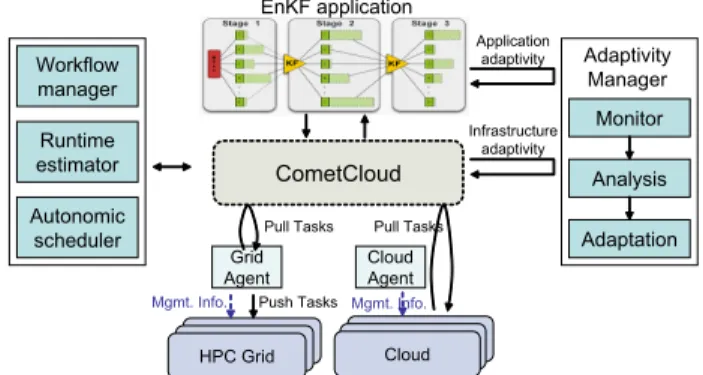
Fig. 1:Autonomic architecture for adaptivity. Workflow manager, runtime estimator, autonomic scheduler as well as adaptivity manager collaborate to reach a decision regarding the best resource provisioning and application configuration.
on the defined policy. Policies determine whether runs are made with deadline-based or cost-based (i.e. with budget limits). After then the scheduler decides the number of nodes (workers) for each resource class and the appropriate mix of resources. Naturally, workers can consume more than one task and the number of workers is typically smaller than the number of tasks.
Application adaptivity on the other hand relies heavily on the application infrastructure. Since the reservoir simulator
is based on PETSc [?], we have access to a wide variety
of direct and iterative solvers and preconditioners. The selection of optimal solver and preconditioner combination depends on the problem (stiffness, linearity, properties of the system of equations, etc.) as well as the underlying infrastructure. Since the simulator needs to perform sev-eral iterations, the first few iterations are performed with several solver/preconditioner combinations. This
“optimiza-tion” study is performed with ensemble member rank 0
only, also known as the “base–case” from which all other ensemble members are generated. The combination with the best performance (shortest wall-clock time) is then selected and passed on to the next stage to reduce simulation runtime.
The overall system architecture used in the experiments
is shown in Figure ??. Every stage of the application
workflow is heterogeneous, and as a result, the selection of infrastructure and application configurations for each stage can be different. At every stage, the autonomic manager collects information about both, the infrastructure and the application, and analyzes this information to decide on ap-propriate resources and application configuration. These de-cisions affect both current stages (infrastructure adaptivity) as well as subsequent stages (application adaptivity). After reaching a decision on the most efficient infrastructure/ap-plication configurations and mix of resources, resources are provisioned and “ensemble-member-workers” are executed. On the EC2, this translates to launching appropriate VMs running custom images. On the TG,
ensemble-member-workers are essentially “pilot jobs” [?] that are inserted into the queue. The workflow manager inserts tasks into CometCloud and ensemble-workers directly access Comet-Cloud and retrieve tasks based on the enforced scheduling policy. TG workers are allowed to pull the largest tasks first, while EC2 workers pull the smallest tasks. While this policy is not optimal, it was sufficient for our study. During the execution, the workflow manager monitors the executions of the tasks to determine progress and to orchestrate the execution of the overall workflow. The autonomic scheduler also monitors the status of the resources (using the agents), and determines progress to ensure that the scheduling ob-jectives and policies/constraints are being satisfied, and can dynamically change resources allocation if they cannot be satisfied.
It is possible that for a given user defined deadline, that the objective of finishing all tasks at or before the deadline not be met. This could be simply due to insufficient resources for the computational load as a consequence of the deadline imposed; or it could be due to autonomic schedul-ing efficiency. In this paper, we focus on the situation where the objective of accelerating the solution/TTC on the TG by using EC2 is successful. In addition to the efficiency of the autonomic scheduler (which we do not analyze here), the relative capacity of the TG & EC2 resources will determine the maximum value of acceleration possible for a given workload. In other words, with the addition of sufficiently large number of cloud resources – possibly of different types of clouds, any imposed deadline will be met for a given workload.
IV. Experiments
Our experiments are organized with the aim of un-derstanding how application and infrastructure adaptivity facilitate desired objectives to be met. Specifically, we investigate how adaptivity – application or infrastructure, or possibly both in conjunction, enable lowering of the TTC, i.e., acceleration. We explore, (1) how the autonomic scheduler reduces TTC when a deadline is specified, and (2) how adaptation helps achieve the desired objective by facilitating an optimized application and/or infrastructure configuration, or via autonomic scheduling decisions when multiple types of cloud resources are available.
We use a small number of stages of the EnKF workflow with a finite difference reservoir simulation of problem size 20x20x20 gridpoints and 128 ensemble members with het-erogeneous computational requirements. Our experiments are performed on the TG (specifically Ranger) and several
instance types of EC2. Table ?? shows the EC2 instance
types used for experiments. We assume that a task assigned to a TG node runs on all 16 cores for that node (for Ranger). TG provides better performance than EC2, but is also the relatively more restricted resource – in that there are
TABLE I:EC2 instance types used in experiments
Instance type Cores Memory(GB) Platform(bit) cost($/hour)
m1.small 1 1.7 32 0.1
m1.large 2 7.5 64 0.34
m1.xlarge 4 15 64 0.68
c1.medium 2 1.7 32 0.17
c1.xlarge 8 7 64 0.68
often queuing delays. Hence, we use EC2 which is available immediately at a reasonable cost to accelerate the solution of the problem. A task pulled by EC2 node runs sequentially (in case of m1.small which has a single core), or in parallel (other instance types with multiple cores) inside a single VM. To enable MPI runs on multi-core EC2 instance, we created a MPI-based image on EC2. This image included the latest versions of compilers, MPICH2, PETSc and HDF5 and was configured for performance above all else. Although we experimented with using MPI across multiple
VMs as described in Section ??, we exclude using data
from experiments involving running MPI across VMs in the analysis of understanding the effect of adaptivity; as is expected, due to communication overheads, it displays poor performance as compared to MPI within a single VM.
A. Baseline: Autonomic Scheduling
(Accel-eration) in Response to Deadlines
When the deadline by when all tasks must be completed has been determined/decided, the autonomic scheduler es-timates TTC, first assuming the availability of only TG resource. The scheduler then decides how much of the workload should be migrated to EC2 in order to meet the given deadline. If the deadline is sooner than the estimated TTC (assuming usage of only TG resources), the number of tasks which should be off-loaded onto EC2 is decided and the autonomic scheduler selects the appropriate EC2 instance types and number of such nodes. It then allocates the appropriate number of nodes of the selected instance types.
The autonomic scheduler has no knowledge of runtime characteristics of tasks on different resources, the sched-uler makes decisions based on estimated runtime from the runtime estimator. The runtime estimator is a simple utility that launches a full-size ensemble member simulation with a reduced number of iterations to minimize cost. The results of various ensemble members are tabulated and used to predict the full runtime cost of a complete ensemble member simulation.
In this experiment set, we limit EC2 instance types to m1.small and c1.medium, and run the EnKF with 2 stages, 128 ensemble members. For baseline experiments/perfor-mance numbers, we do not try to optimize using adaptivity (neither application-level nor infrastructure adaptivity.
Fig-ure??depicts the TTC for different values of imposed
dead-lines and thus gives quantitative information on acceleration provided by the autonomic scheduler to meet deadlines. The
TTC 0 20 40 60 80 100 120 140 120 108 96 72 24 Deadline (minute) Ti m e (m in ut e) stage1 stage2 Task consumption 0 50 100 150 200 250 300 350 400 450 120 108 96 72 24 Deadline (minute) Nu m be r o f t as ks 0 5 10 15 20 25 nu m be r o f E C2 n od es stage2-TG tasks stage2-EC2 tasks stage1-TG tasks stage1-EC2 tasks stage1-allocated EC2 nodes stage2-allocated EC2 nodes
EC2 Cost 0.0 0.5 1.0 1.5 2.0 2.5 3.0 3.5 4.0 120 108 96 72 24 Deadline (minute) C os t ( $) stage1-estimated cost stage2-estimated cost stage1-experimental cost stage2-experimental cost
(a) Time To Completion (b) Task consumption (c) EC2 cost
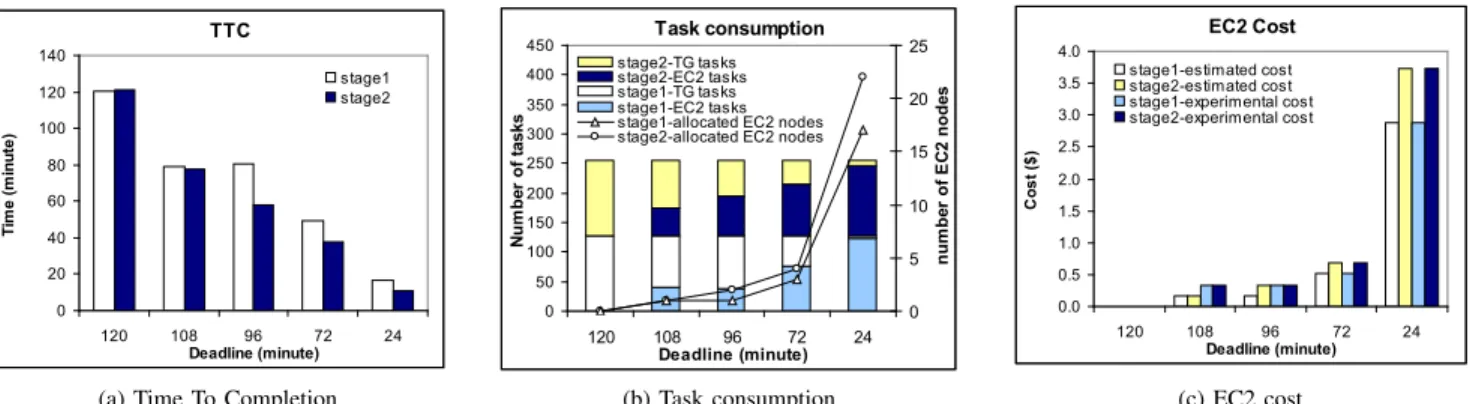
Fig. 2:Results from baseline experiments (without adaptivity) but with a specified deadline. We run the EnKF with 2 stages , 128 ensemble members and limit EC2 instance types to m1.small and c1.medium. Tasks are completed within a given deadline. The shorter the deadline, the more EC2 nodes are allocated.
imposed deadline is assumed to be 120, 108, 96, 72 and 24 minutes respectively; this corresponds to 0%, 10%, 20%, 40% and 80% acceleration, based upon the assumption that a deadline of 120 minutes (0% acceleration) corresponds
to a TTC when only TG nodes are used. Figure ?? (a)
shows TTC for stage 1 and stage 2 where each stage is heterogeneous and all tasks are completed by the deadline
(for all cases). Figure ?? (b) shows the number of tasks
completed by the TG and number off-loaded onto EC2, as well as the number of allocated EC2 nodes for each stage. As the deadline becomes shorter, more EC2 nodes are allocated, hence, the number of tasks consumed by EC2 increases. Because m1.small have relatively poorer performance compared to c1.medium, the autonomic sched-uler only allocates c1.medium instances for both stages.
Figure?? (c) shows costs incurred on EC2. As more EC2
nodes are used for shorter deadlines, the EC2 cost incurred increases. The results also show that most tasks are off-loaded onto EC2 in order to meet the “tight” deadline of finishing within 24 minutes.
B. Track 1: Infrastructure adaptations
The goal of experiment involving infrastructure-level adaptivity (track-1) is to investigate advantages – perfor-mance or otherwise, that may arise from the ability to dynamically select appropriate infrastructure, and possibly vary them between the heterogeneous stages (of the ap-plication workflow). Specifically, we see if any additional acceleration (compared to the baseline experiments) can be obtained. In order to provide greater variety in resourceselection, we include all EC2 instance types from Table??;
these can be selected in stage 2 of the EnKF workflow.
C. Track 2: Adaptations in application
exe-cution
In this experiment we run ensemble member rank0with
variations in solvers/preconditioners and infrastructure. In
each case, ensemble rank 0 was run with a solver
(gen-eralized minimal residual method GMRES, conjugate gra-dient CG or biconjugate gragra-dient BiCG), a preconditioner (block Jacobi or no preconditioner) for a given problem size with a varying number of cores (1 through 8). Two infrastructure solutions were available: a single c1.xlarge or four c1.medium instances.
D. Track 3: Adaptations at the application
and infrastructure levels
In this experiment set, we explore both infrastructure as well as application-level adaptivity. We try infrastructure-level adaptivity in the first stage, followed by application-level adaptivity in the second stage and hybrid adaptiv-ity in the third stage. In principle the final performance should not be sensitive to the ordering. We will com-pare hybrid-adaptivity to application-adaptivity, as well as infrastructure-adaptivity.
V. Analysis
A. Track 1: Infrastructure adaptations
Figure ?? (a) shows TTC and EC2 cost, with and
without infrastructure adaptivity. Overall, TTC decreases when more resource types are available and infrastructure adaptivity is applied; this can be understood by the fact that the autonomic scheduler can now select more appropriate resource types to utilize. There is no decrease in the TTC when using infrastructure adaptivity for a deadline of 120 because all tasks are still completed by TG node (since it represent 0% acceleration). The difference between the TTC with and without infrastructure-level adaptivity, decrease as the deadline becomes tighter; results show almost no savings with the 24 minutes deadline. This is mostly due to the fact that with a 24 minute deadline, a large number of nodes are allocated thus no further gain can be obtained through infrastructure adaptivity.
Infrastructure Adaptivity (stage2) 0 20 40 60 80 100 120 140 120 108 96 72 24 Deadline (minute) Ti m e (m in ut e) non-adaptive runtime infrastructure-adaptive runtime
Application Adaptivity (stage2)
0 20 40 60 80 100 120 140 120 108 96 72 24 Deadline (minute) Ti m e (m in ut e) non-adaptive runtime application-adaptive runtime
Hybrid Adaptivity (stage3)
0 5 10 15 20 25 30 35 120 108 96 72 24 Deadline (minute) Ti m e (m in ut e) infrastructure-adaptive runtime application-adaptive runtime hybrid-adaptive runtime
EC2 Cost (stage2)
0.0 2.0 4.0 6.0 8.0 10.0 12.0 14.0 120 108 96 72 24 Deadline (minute) C os t ( $) 0 5 10 15 20 25 30 35 nu m be r o f n od es non-adaptive cost infrastructure-adaptive cost non-adaptive number of c1.medium infra-adaptive number of c1.xlarge
EC2 Cost (stage2)
0.0 0.5 1.0 1.5 2.0 2.5 3.0 3.5 4.0 120 108 96 72 24 Deadline (minute) C os t ( $) 0 5 10 15 20 25 nu m be r o f n od es non-adaptive cost application-adaptive cost number of c1.medium
EC2 Cost (stage3)
0.0 1.0 2.0 3.0 4.0 5.0 6.0 7.0 8.0 9.0 10.0 120 108 96 72 24 Deadline (minute) C os t ( $) 0 5 10 15 20 25 nu m be r o f n od es application-adaptive cost infrastructure-adaptive cost hybrid-adaptive cost number of c1.medium number of m1.xlarge number of c1.xlarge
(a) Infrastructure adaptivity (b) Application adaptivity (c) Infrastructure/Application adaptivity
Fig. 3:Experiments with adaptivity. (a) Track 1-Infrastructure adaptivity: we limit EC2 instance types to m1.small and c1.medium for non-adaptive run and use all types described in Table??for infrastructure-adaptive run. The TTC is reduced with infrastructure adaptivity at additional cost. (b) Track 2-Application adaptivity: the optimized application option is used for application-adaptive run. The TTC is reduced with application adaptivity for equivalent or slightly less cost. (c) Track 3- Infrastructure/Application adaptivity: the TTC is reduced further than with application or infrastructure adaptivity on its own. The cost is similar to that in infrastructure adaptivity for durations less than one hour since EC2 usage is billed hourly with a one hour minimum.
Figure??(a) also shows the number of nodes allocated
for each run and the cost of their usage. The autonomic scheduler selects only c1.xlarge to use for infrastructure-adaptive runs because the runtime estimator predicts that all tasks will run fastest on c1.xlarge. On the other hand the scheduler selects only c1.medium for non-adaptive runs. Infrastructure-adaptive runs cost more than non-adaptive runs, roughly 2.5 times more at the 24 minute deadline even though the number of nodes for non-adaptive runs is larger than the number of nodes for infrastructure-adaptive runs. This is because the hourly cost of c1.xlarge is much higher
than c1.medium (see Table ??) and both TTCs are rather
short (less than half hour). Since we used deadline-based policy, the autonomic scheduler selects the best performing resource regardless of cost; however, when we switch poli-cies to include economic factors in the autonomic scheduler decision making (i.e., considering TTC as well as cost for 24 minutes deadline), the scheduler selects c1.medium instead of c1.xlarge.
B. Track 2: Adaptations in application
exe-cution
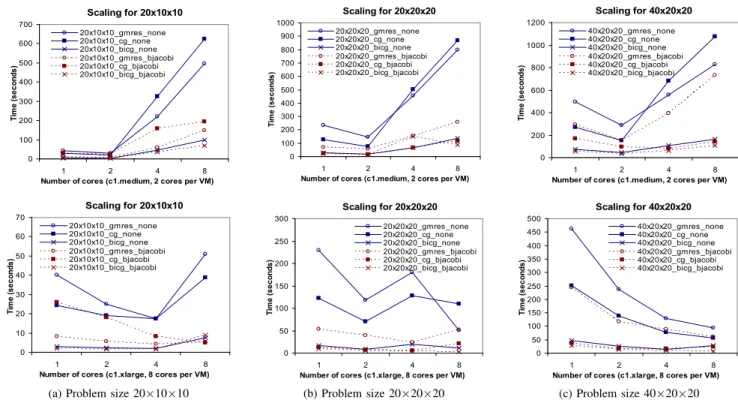
Figure??shows the time to completion of an individual
ensemble member, in this case ensemble rank0 with
vari-ous solver/preconditioner combinations. For experiments in track-2, we varied over two different types of
infrastruc-ture, each with 4 different core counts (1,2,4 and 8) and
three problem sizes. We investigated six combinations of solvers and preconditioners over the range of infrastructure. Naturally, there is no one, single, solver/preconditioner combination that works for all problem sizes, infrastructures and core counts. Note the experiments were carried out on different infrastructure, but the infrastructure was not
adaptivelyvaried. For example, a problem of size 40x20x20 is best solved on 4 cores in a c1.xlarge instance with a BiCG solver and a block Jacobi preconditioner. This is different from the 2 core, BiCG solver and no preconditioner combination for a 20×10×10 problem on a c1.medium VM. Basic profiling of the application suggests that most of the time is spent in the solver routines, which are communication intensive. As there is no dedicated, high bandwidth, low latency interconnect across instances, MPI performance will suffer, and subsequently MPI intensive
Scaling for 20x10x10 0 100 200 300 400 500 600 700 1 2 4 8
Number of cores (c1.medium, 2 cores per VM)
Ti m e (s ec on ds ) .. 20x10x10_gmres_none 20x10x10_cg_none 20x10x10_bicg_none 20x10x10_gmres_bjacobi 20x10x10_cg_bjacobi 20x10x10_bicg_bjacobi Scaling for 20x20x20 0 100 200 300 400 500 600 700 800 900 1000 1 2 4 8
Number of cores (c1.medium, 2 cores per VM)
Ti m e (s ec on ds ) .. 20x20x20_gmres_none20x20x20_cg_none 20x20x20_bicg_none 20x20x20_gmres_bjacobi 20x20x20_cg_bjacobi 20x20x20_bicg_bjacobi Scaling for 40x20x20 0 200 400 600 800 1000 1200 1 2 4 8
Number of cores (c1.medium, 2 cores per VM)
Ti m e (s ec on ds ) .. 40x20x20_gmres_none 40x20x20_cg_none 40x20x20_bicg_none 40x20x20_gmres_bjacobi 40x20x20_cg_bjacobi 40x20x20_bicg_bjacobi Scaling for 20x10x10 0 10 20 30 40 50 60 70 1 2 4 8
Number of cores (c1.xlarge, 8 cores per VM)
Ti m e (s ec on ds ) .. 20x10x10_gmres_none 20x10x10_cg_none 20x10x10_bicg_none 20x10x10_gmres_bjacobi 20x10x10_cg_bjacobi 20x10x10_bicg_bjacobi Scaling for 20x20x20 0 50 100 150 200 250 300 1 2 4 8
Number of cores (c1.xlarge, 8 cores per VM)
Ti m e (s ec on ds ) .. 20x20x20_gmres_none 20x20x20_cg_none 20x20x20_bicg_none 20x20x20_gmres_bjacobi 20x20x20_cg_bjacobi 20x20x20_bicg_bjacobi Scaling for 40x20x20 0 50 100 150 200 250 300 350 400 450 500 1 2 4 8
Number of cores (c1.xlarge, 8 cores per VM)
Ti m e (s ec on ds ) .. 40x20x20_gmres_none 40x20x20_cg_none 40x20x20_bicg_none 40x20x20_gmres_bjacobi 40x20x20_cg_bjacobi 40x20x20_bicg_bjacobi
(a) Problem size 20×10×10 (b) Problem size 20×20×20 (c) Problem size 40×20×20
Fig. 4:Time to completion for simulations of various sizes with different solvers (GMRES, CG, BiCG) and block-Jacobi preconditioner. Benchmarks ran on EC2 nodes with MPI. Problem size increases going from left to right. The top row is for a 2 core VM and the bottom row is for an 8 core VM.
solvers. The collective operations in MPI are hit hardest, af-fecting Gram-Schmidt orthogonalization routines adversely. Conjugate gradient solvers on the other hand are optimal for banded diagonally dominant systems (as is the case in this particular problem) and require less internal iterations
to reach convergence tolerance. Figure ?? shows that the
performance profile changes as the problem size increases (moving from left to right). Comparison of the profiling data suggests that a smaller percentage of simulation time is spent in communication as the problem size increases. This is obviously due to the fact that there are larger domain partitions for each instance to work on. Detailed profiling of inter–instance MPI bandwidth and latency is still underway however early results suggest that this trend continues.
Figure ?? (b) shows TTC (upper figure) and EC2 cost
(lower figure) using application adaptivity. Applying an op-timized application configuration reduces TTC considerably. Application configuration does not affect the selection of infrastructure and the number of nodes, hence, the cost depends on TTC. However, since EC2 costs are billed on an hourly basis (with a minimum of one hour), the decrease in cost does not match the decrease in TTC. For example, at 108 minute deadline, the time difference between non-adaptive mode and application-non-adaptive mode is more than one hour, hence, the cost of application-adaptive mode reduces half. However, because TTCs are all within one hour for other deadlines, EC2 costs are the same for them.
C. Track 3: Adaptations at the application
and infrastructure levels
Figure ?? (c) shows TTCs and EC2 costs when both
application and infrastructure adaptivities are applied; the white columns correspond to infrastructure adaptivity TTC, the light blue columns correspond to application adaptiv-ity TTC and the dark blue columns correspond to hy-brid adaptivity TTC. As mentioned earlier, the application spends most of its time in the iterative solver routine. The application also runs twenty time-steps for each of the 128 simulations. Therefore, the potential for improvement in TTC from solver/preconditioner selection is substantial. As we expect, the TTC of infrastructure-adaptive runs are larger than those of application-adaptive runs, especially since infrastructure adaptivity occurs once per every stage and application adaptivity influences every solver iteration. Both infrastructure and application adaptivity result in TTC reduction, and even more so when used simultaneously. The cost for using infrastructure adaptivity is higher than that of using application adaptivity. This is due to the simple fact that application adaptivity improves the efficiency of the application without the need for an increase in resources. It is worth mentioning that ours is a special case as the application depends heavily on a sparse matrix solve with an iterative solver. Other applications that use explicit methods cannot make use of application adaptivity (no solvers).
VI. Conclusion and Future Work
In summary, by developing and analyzing a dynamic workflow application to by explore a rich set of infrastruc-ture as well as application configurations, we established the benefits of hybrid HPC grids-clouds execution modes. We also investigated application or/and infrastructure adaptivity and determined how the adaptations affect performance as measured by time-to-completion, as well as cost. To achieve these objectives, we built an autonomic adaptation engine inside of CometCloud, consisting of an autonomic adap-tivity manager along with the workflow manager, runtime estimator, autonomic scheduler, and grids/clouds agent.
Experimental results show that time-to-completion de-creases with both system or application-level adaptivity. We also observe that the time-to-complete decreases further when applying both the system and application-level adap-tivity. Furthermore, while EC2 cost decreases when appli-cation adaptively is applied, it increases when infrastructure adaptivity is applied. This is despite a reduced time-to-completion, and is because adaptation causes the application to use more expensive instance types.
The new autonomic capabilities added to the Comet-Cloud engine enable it to schedule complex workflows with varying costs, objective functions and satisfy goals such as reduced time-to-completion or reduced total-cost etc. in a hybrid HPC Grid-Cloud environment. While our work so far has been focused on EnKF inverse problem workflow (a fairly straightforward, linear workflow), workflows such as parameter or model surveys can similarly be scheduled. Investigation of more complex workflows and their schedul-ing is still in the plannschedul-ing phase. Some challenges that we anticipate include scheduling nonlinear and conditional tasks as well as “while–loop” workflows. These types of complex workflows cannot be easily analyzed for cost, and are unpredictable a priori. However, the autonomic and adaptive capabilities we developed will play a major part in resolving these issues.
In the near future we will be working on expanding our cloud infrastructure integration to include Eucalyptus and Nimbus clouds. Proper performance investigation of the reservoir simulator (including MPI message frequency, size, latency, bandwidth and so on) is also being studied. In terms of optimization, work will begin on investigating the effects of network performance for file transfer as well as VM optimization. Finally, we intend to revisit other autonomic objectives (conservation and resilience) with the newly developed autonomic layer.
Acknowledgements
The research presented in this paper is supported in part by National Science Foundation via grants numbers IIP 0758566, CCF-0833039, DMS-0835436, CNS 0426354, IIS 0430826, and CNS 0723594, by Department
of Energy via grant numbers DE-FG02-06ER54857 DE-FG02- 04ER46136 (UCoMS), by a grant from UT Battelle, and by an IBM Faculty Award, and was conducted as part of the NSF Center for Autonomic Computing at Rutgers University. Experiments on the Amazon Elastic Compute Cloud (EC2) were supported by a grant from Amazon Web Services and CCT CyberInfrastructure Group grants. SJ and MP would like to acknowledge the e-Science Institute, Edinburgh for supporting the Research theme on Distributed Programming Abstractions. YE would like to acknowledge Dr. Christopher White, Dr. Kent Milfeld and Mr Bob Garza.
References
[1] C. Vecchiola, S. Pandey, and R. Buyya, “High-performance cloud computing: A view of scientific applications,” inPervasive Systems, Algorithms, and Networks (ISPAN), 2009 10th International Sympo-sium on, dec. 2009, pp. 4 –16.
[2] S. Ostermann, R. Prodan, and T. Fahringer, “Extending grids with cloud resource management for scientific computing,” inGrid Com-puting, 2009 10th IEEE/ACM International Conference on, oct. 2009, pp. 42 –49.
[3] K. Chine, “Scientific computing environments in the age of vir-tualization toward a universal platform for the cloud,” in Open-source Software for Scientific Computation (OSSC), 2009 IEEE International Workshop on, sept. 2009, pp. 44 –48.
[4] Cyclone. http://www.sgi.com/products/hpc cloud/cyclone/. [5] H. Kim, Y. el Khamra, S. Jha, and M. Parashar, “An autonomic
approach to integrated hpc grid and cloud usage,” ine-Science, 2009. e-Science ’09. Fifth IEEE International Conference on, Dec. 2009, pp. 366–373.
[6] Y. E. Khamra and S. Jha, “Title: Developing Autonomic Distributed Scientific Applications: A Case Study From History Matching Using Ensemble Kalman-Filters,” in Sixth International Conference on Autonomic Computing, 2009. ICAC ’09 (Barcelona). IEEE, 2009. [7] Y. Y. El-Khamra, “Real-time reservoir characterization and
be-yond: Cyberinfrastructure tools and technologies,” Master’s thesis, Louisiana State University, Baton Rouge, Louisiana, 2009. [8] M. D. de Assuncao, A. di Costanzo, and R. Buyya, “Evaluating
the cost-benefit of using cloud computing to extend the capacity of clusters,” inHPDC ’09: Proceedings of the 18th ACM international symposium on High performance distributed computing. New York, NY, USA: ACM, 2009, pp. 141–150.
[9] C. Vazquez, E. Huedo, R. Montero, and I. Llorente, “Dynamic provision of computing resources from grid infrastructures and cloud providers,” inGrid and Pervasive Computing Conference, 2009. GPC ’09. Workshops at the, may 2009, pp. 113 –120.
[10] T. Freeman and K. Keahey, “Flying low: Simple leases with workspace pilot,” inEuro-Par, 2008, pp. 499–509.
[11] H. Kim, S. Chaudhari, M. Parashar, and C. Marty, “Online risk analytics on the cloud,” inCluster Computing and the Grid, 2009. CCGRID ’09. 9th IEEE/ACM International Symposium on, May 2009, pp. 484–489.
[12] A. Ozer and C. Ozturan, “An auction based mathematical model and heuristics for resource co-allocation problem in grids and clouds,” in Soft Computing, Computing with Words and Perceptions in System Analysis, Decision and Control, 2009. ICSCCW 2009. Fifth Interna-tional Conference on, sept. 2009, pp. 1 –4.
[13] P. Martinaitis, C. Patten, and A. Wendelborn, “Remote interaction and scheduling aspects of cloud based streams,” inE-Science Workshops, 2009 5th IEEE International Conference on, dec. 2009, pp. 39 –47. [14] L. Nie and Z. Xu, “An adaptive scheduling mechanism for elastic grid computing,” Semantics, Knowledge and Grid, International Conference on, vol. 0, pp. 184–191, 2009.
[15] K. Czajkowski, S. Fitzgerald, I. Foster, and C. Kesselman, “Grid information services for distributed resource sharing,” inHigh Per-formance Distributed Computing, 2001. Proceedings. 10th IEEE International Symposium on, 2001, pp. 181 –194.
[16] M. Siddiqui, A. Villazon, J. Hofer, and T. Fahringer, “Glare: A grid activity registration, deployment and provisioning framework,” SC Conference, vol. 0, p. 52, 2005.
[17] T. Dornemann, E. Juhnke, and B. Freisleben, “On-demand resource provisioning for bpel workflows using amazon’s elastic compute cloud,” in CCGRID ’09: Proceedings of the 2009 9th IEEE/ACM International Symposium on Cluster Computing and the Grid. Wash-ington, DC, USA: IEEE Computer Society, 2009, pp. 140–147. [18] S Jha, D S Katz, A Luckow, A Merzky and K Stamou, Understanding
Scientific Applications for Cloud Environments, submitted to book on Cloud Computing, Edited by Raj Kumar Buyya, to be published by Wiley
draft available at: http://cct.lsu.edu/∼sjha/select\ publications/cloud
book chapter.pdf.
[19] R. J. Al-Ali, K. Amin, G. von Laszewski, O. F. Rana, D. W. Walker, M. Hategan, and N. J. Zaluzec, “Analysis and Provision of QoS for Distributed Grid Applications,”Journal of Grid Computing (Springer), vol. 2, no. 2, pp. 163–182, 2004.
[20] S. Jha, M. Parashar, and O. Rana, “Investigating autonomic be-haviours in grid-basedcomputational science applications,” inGMAC ’09: Proceedings of the 6th international conference industry session on Grids meets autonomic computing. New York, NY, USA: ACM, 2009, pp. 29–38.
[21] R. E. Kalman, “A new approach to linear filtering and
prediction problems.” [Online]. Available: http://www.cs.unc.edu/
∼welch/kalman/media/pdf/Kalman1960.pdf
[22] Y. Gu and D. S. Oliver, “An iterative ensemble kalman filter for multiphase fluid flow data assimilation,”SPE Journal, vol. 12, no. 4, pp. 438–446, 2007.
[23] X. Li, C. White, Z. Lei, and G. Allen, “Reservoir model updating by ensemble kalman filter-practical approaches using grid comput-ing technology,” inPetroleum Geostatistics 2007, Cascais,Portugal, August 2007.
[24] Y. Gu and D. S. Oliver, “The ensemble kalman filter for continuous updating of reservoir simulation models,” Journal of Engineering Resources Technology, vol. 128, no. 1, pp. 79–87, 2006.
[25] H. Kim, M. Parashar, L. Yang, and D. Foran, “Investigating the use of cloudbursts for high throughput medical image registration,” in Proceedings of the 10th IEEE/ACM International Conference on Grid Computing (Grid 2009), 2009.
[26] I. Stoica, R. Morris, D. Liben-Nowell, D. R. Karger, M. F. Kaashoek, F. Dabek, and H. Balakrishnan, “Chord: A scalable peer-to-peer lookup protocol for internet applications,” inACM SIGCOMM, 2001, pp. 149–160.
[27] C. Schmidt and M. Parashar, “Squid: Enabling search in dht-based systems,”J. Parallel Distrib. Comput., vol. 68, no. 7, pp. 962–975, 2008.
[28] N. Carriero and D. Gelernter, “Linda in context,”Commun. ACM, vol. 32, no. 4, pp. 444–458, 1989.
[29] J. Dean and S. Ghemawat, “Mapreduce: simplified data processing on large clusters,”Commun. ACM, vol. 51, no. 1, pp. 107–113, 2008. [30] Hadoop. http://hadoop.apache.org/core/.
[31] Thain D, Tannenbaum T and Livny M 2005 Distributed Computing in Practice: The Condor Experience Concurrency - Practice and Experience 17 2-4 323-56.
[32] S. Balay, K. Buschelman, W. D. Gropp, D. Kaushik, M. G. Knepley, L. C. McInnes, B. F. Smith, and H. Zhang, “PETSc Web page,” 2001, http://www.mcs.anl.gov/petsc.