Securely Replicated Web Documents
Bogdan C. Popescu, Maarten van Steen, Bruno Crispo, Andrew S. Tanenbaum
Division of Mathematics and Computer Science
Faculty of Sciences Vrije Universiteit, Amsterdam, The Netherlands
{
bpopescu, steen, crispo, ast
}
@cs.vu.nl
Jan Sacha
Computer Science Department, Trinity College Dublin, Ireland
[email protected]
Ihor Kuz
National Information and Communications Technology, Sydney, Australia
[email protected]
Abstract
In order to achieve better scalability and reduce latency in handling user requests, many Web applications make ex-tensive use of data replication through caches and Content Delivery Networks. However, in such scenarios data is often placed on untrusted hosts. As a result, existing replication mechanisms open a wide class vulnerabilities, ranging from denial of service to content masquerading. In this paper we present an architecture that combines data content, replica-tion strategies and security in one unified object model and offers integrity guarantees for Web documents replicated on non secure servers.
1 Introduction
Starting with the late 90’s, the World Wide Web has been experiencing scalability problems due to irregular data access patterns. When a Web document suddenly becomes very popular (a phenomenon known as a flash crowd), clients experience long delays in retrieving it. The single hosting server simply cannot cope (CPU-wise or bandwidth-wise) with the sudden high demands. A possible solution to this problem is data replication.
A common way of replicating Web documents is through content delivery networks (CDNs). These are normally run by companies that set up a large number of servers around the world, each server dedicated to hosting Web document replicas. The owners of these documents usually have no control over the replicating servers. Thus, in the CDN sce-nario, clients are retrieving data from hosts that are
con-trolled neither by them, nor by the content providers. This situation is by no means specific only to CDNs; caching presents the same problem.
Retrieving data from untrusted hosts introduces a series of security issues, which can be grouped in two categories -document integrityandsecure naming. Document in-tegrity deals with ensuring that a document retrieved by a client from an untrusted host has not been tampered with by that host. Secure naming deals with establishing secure as-sociations between Web documents and the real-world en-tities in charge of them.
This paper introduces a security architecture that guaran-tees data integrity and secure naming for Web content even when this content is replicated on untrusted hosts. While read-only secure storage systems have already been pro-posed [6], the main contribution of this paper is to describe a design where data content, replication strategies and se-curity are all integrated in one unified object model. Our design has been validated through a number of performance tests we have carried on a prototype implementation, results which are also presented in this paper.
The rest of the paper is organized as follows: in Section 2 we introduce a new Web document model with a quick dis-cussion on how such a model can be implemented in order to use most of the current Web infrastructure. Section 3 de-scribes our security architecture, and how this architecture tackles secure naming and document integrity issues. Sec-tion 4 describes our prototype implementaSec-tion, and a num-ber of performance tests we have performed, Section 5 dis-cusses related work, while Section 6 points to directions for future work and concludes.
2 Globe Web Documents
For the work described in this paper we rely on the ser-vices offered by Globe [17] - a middleware architecture that allows the development of distributed applications based on replicated shared objects. One such distributed application is GlobeDoc [18]. GlobeDoc objects are the building blocks for our new Web document model.
In the GlobeDoc model of the Web, a Web site is com-posed of related Web documents. A Web document itself is a collection of logically related Web resources. These Web resources are referred to as a document’s page elements and can be anything that is accessible over the Web (e.g., HTML files, text files, images, audio files, video files, ap-plets, etc.). The relation between the resources contained in a Web document is generally stronger than that between the documents contained in a Web site. For example, an orga-nization’s Web site contains a collection of Web documents that are somehow related to that organization, while a Web document representing a news story would contain only the elements directly relating to that story (e.g., the HTML page plus any icons and images relating to the story or the page layout).
In GlobeDoc, a Web document is encapsulated in a Globe distributed shared object which contains that docu-ment’s elements in its state. Such a GlobeDoc object offers methods that allow clients to access and modify its state on a per-element basis. The hyper-linked structure that is nor-mally provided by Web pages is maintained in GlobeDoc. A relative hyper-link contained in some GlobeDoc object’s element refers to another element in that same object. Like-wise, an absolute hyper-link may refer to an element con-tained in another GlobeDoc object.
Every GlobeDoc object is identified by a unique object ID (OID). This is a 160-bit number which does not con-tain any location information and is not human readable. The GlobeDoc architecture, therefore, contains two services that facilitate locating objects. The Naming Service [3] maps human readable object names onto OIDs. The Globe Location Service [16] maps OIDs onto contact addresses, which contain information about where and how to contact a GlobeDoc object.
By virtue of it being a Globe distributed shared object, a GlobeDoc can distribute (replicate) its state over multiple physically separated address spaces (or machines). As such, requests for an object’s state will be distributed over these various machines, thereby spreading the total load gener-ated by the requests and preventing any single machine hosting the GlobeDoc from becoming overloaded. Simi-larly, by strategically replicating a GlobeDoc object’s state so that it is close to large concentrations of clients, the traf-fic at each replica will have a local character, increasing responsiveness for clients and decreasing overall network
traffic and saturation. This architecture is ideally suited to the creation of (peer-to-peer) content delivery networks.
Also, because Globe makes the state distribution trans-parent to clients and because the distribution policies can be determined independently per Globe object, GlobeDoc makes it possible to apply distribution strategies on a per-document basis. In this way GlobeDoc allows replication of Web documents without imposing any single global replica-tion policy on all documents. [13] has shown that applying per-document distribution strategies can lead to better effi-ciency than the application of one-size-fits-all strategies.
2.1 GlobeDoc Services
A client accesses a GlobeDoc object using a standard Web browser. However, standard Web browsers cannot di-rectly connect to GlobeDoc objects and invoke its methods to retrieve the page elements. For this task, browsers rely on a GlobeDoc proxy server to intercept requests to GlobeDoc objects and manage the interaction with the object (i.e., connect to the object and retrieve its elements). Because standard Web browsers do not understand GlobeDoc object names,hybrid URLsare used. These are just regular URLs that start with a distinguishing prefix (which in our case is
http://enter.globeworld.org). GlobeDoc and page element names are then embedded in these hybrid URLs.
GlobeDoc proxies connect to GlobeDoc objects by bind-ing to them. The result of bindbind-ing to a GlobeDoc object is that a local representative of that object is placed in the ad-dress space of the binding process. A local representative is a local part of the GlobeDoc object. It can be a simple object proxy, forwarding method invocations to other repli-cas, or it can be a full replica containing a local copy of the GlobeDoc object’s state. The client, however, is unaware of this and simply invokes methods from the local representa-tive as though the object was local.
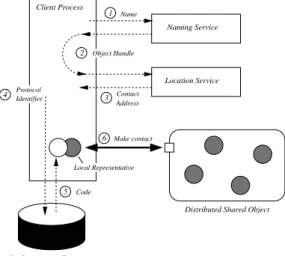
Binding itself consists of two distinct phases: (1) finding the object, and (2) installing the local representative. This is illustrated in Figure 1. Finding an object is separated into a name-lookup and a location-lookup step; installing the local representative requires that a suitable contact address and implementation be selected.
2.1.1 Naming Service
To find an object, a process must resolve the object’s name to an OID. This is done by passing the object name to a naming service. The naming service returns the object’s OID. Whereas an OID uniquely identifies an object (i.e., an object always has exactly one OID), an object may have multiple names that resolve to its OID. An object name is simply a human-readable string that represents an object. It is up to the naming service to interpret this name and resolve it to an OID.
4 3
5 2
6
Object Handle
Distributed Shared Object 1 Contact Address Naming Service Location Service Client Process Name Local Representative Make contact Implementation Repository Protocol Identifier Code
Figure 1. Binding to a GlobeDoc object
2.1.2 Globe Location Service
Resolving an object’s name leads to an OID. An OID, how-ever, does not identify the location of an object and its repli-cas. To find the actual object, the OID must first be passed to a location service, which returns one or several contact addresses which represent GlobeDoc object contact points. The location service is responsible for storing contact ad-dresses and resolving OIDs to these contact adad-dresses. Be-sides looking up contact addresses for objects, the location service also allows addition, deletion and modification of contact-address mappings.
The Globe Location Service is implemented as a dis-tributed search tree. In this tree, the world is divided into a hierarchical set of domains. At the lowest level there is one domain per site; a collection of sites form a region, etc. An object is recorded at each site where it has a contact address, and recursively in each enclosing region up to the root of the tree. Initially, a record at the site level contains the actual contact addresses while records at higher levels contain pointers to the next lower level. Recording an ob-ject at multiple levels allows searches with expanding rings: a search starts at the local site, followed by the local region, then the next higher level region, etc., and eventually fol-lowed by the root.
2.1.3 Object Server
A GlobeDoc object’s replicas are implemented as stateful local representatives hosted on object servers. An object server is a process that provides an address space, con-tact points andruntime services to the local representa-tives that it hosts. The object server also manages a local representative’s access to local resources such as local disks and networking resources. Besides simply hosting LRs, a
Globe object server also has a remotely accessible interface that allows other local representatives, other Globe object servers, or administrators to request services from it. These services include the creation and destruction of GlobeDoc objects and their replicas.
3 The GlobeDoc Security Architecture
In this section we will describe the mechanisms used to make GlobeDoc objects secure. We have been using well-known security and cryptographic techniques as building blocks, and combine them in an architecture that can offer secure naming and data integrity guarantees.
Following the model of the Web master for regular Web documents, we require that behind each GlobeDoc object there is a person or organization - theobject owner- that is in charge of it. The owner is the one who creates the object and is responsible for providing permanent storage for it, updating it, and setting up the replication and security poli-cies for the object. Furthermore, we require each GlobeDoc to have a unique public/private key pair associated with it, which is generated by the owner when the object is created. As we will describe next, the object owner uses the object’s private key to sign the object’s state (files) before it repli-cates it, while clients use the public key to perform integrity checks when retrieving parts of the object’s state from un-trusted hosts.
3.1 Secure Naming
3.1.1 The ProblemSecure naming deals with creating secure and trustworthy associations between Web resources and qualified names, which in turn convey information about the real world en-tities that are behind these resources. In the current Web, name binding is accomplished through the Domain Name System (DNS) [11], a hierarchical distributed database that translates between human-readable resource names and their IP addresses. Data integrity requirements were left out from the original DNS design, which made it vulnerable to various types of masquerading attacks. To prevent these, a secure DNS (DNSsec) framework has been proposed [5] and is currently being deployed.
All DNSsec does is establish secure associations be-tween resource names and sets of IP addresses. However, clients cannot authenticate IP addresses, so their attempts to retrieve data from servers at these addresses are vulner-able to man-in-the-middle attacks. To prevent this, secure Web servers have public/private key pairs which they use to authenticate to clients. The server’s public key needs to be certified by some Certificate Authority (a trusted third party) through a digital certificate that binds the public key
to the server’s name (which presumably can be traced to the qualified path name solved through DNSsec). Having this public key, securely associated to the server’s name (by the CA), and to the server’s IP address (by DNSsec), the client can then authenticate the server. In this way, the man-in-the-middle attack becomes impossible, and the name binding and secure channel establishment can be safely combined.
The problem with this approach is that it does not work well with dynamically replicated Web documents. Al-though DNS supports mirroring Web sites by allowing mul-tiple addresses associated with the same name, the basic assumption is that mirroring is more or less static. Dy-namic active replication of Web documents would put se-rious strain on the resource-record caching that makes DNS so efficient.
In conclusion, the approach as followed in DNSsec for secure naming of Web documents will not work well for the GlobeDoc model we are proposing. For GlobeDoc objects we need a naming mechanism that both:
• Securely associates objects with the real-world entities behind these objects.
• Supports efficient lookup operations even when ob-jects are massively replicated and replicas’ network addresses change frequently.
3.1.2 Our Solution
As described in Section 2, each GlobeDoc is identified through a unique 160-bit object ID (OID). Secure name binding requires creating a secure association between an OID, the object’s public key, and the real-world entity (in-dividual, company, organization) that is in charge of the ob-ject.
First, we will examine how to securely link the object’s public key to the OID. This can be accomplished by having the OID be the 160-bit secure hashSHA-1[1] of the object’s public key, in fact creating aself-certifying OIDfor the ob-ject. TheSHA-1secure hash function has the property that it is computationally intractable to find two different inputs with the same hash. Therefore an OID obtained in this man-ner is securely linked with the public key of the object. This approach of using self-certifying OIDs is similar to the one taken by the designers of the SFS system [10], who have pioneered the concept of self-certifying resource names [9]. Now, the only thing left is to securely associate self-certifying OIDs with the real-world entities in charge with their corresponding objects. As stressed in the SDSI doc-ument [15], we believe that establishing trust in a remote entity (trusting that entity to be who it claims to be) is such a security-sensitive task that it is better to give most control over it to the users themselves. To facilitate this, GlobeDoc objects have a special security interface that can be used
by clients (in fact by their proxies) to retrieve any certifi-cates the objects can provide to prove their identity. The users themselves can specify a number of CAs they trust, and store their public keys with their user proxy. When the user requests an element part of a GlobeDoc, its proxy re-quests identity certificates that match the user’s list. For the first match found, the proxy displays the naming informa-tion in the certificate. The user examines this informainforma-tion and can then make a decision how much trust to put in that object.
The CA-mediated secure name-binding mechanism we just described is appropriate when Web objects are used for highly sensitive applications such as commerce or e-banking. For less sensitive applications, users may find the name-binding information provided by a DNSsec-like name service sufficient. The good news is that DNSsec can be extended to support self-certifying OIDs by storing them in the resource records instead of IP-addresses [3]. The great advantage of this would be that DNS would store onlylocation-independentdata. The location-dependent information associated with each object (the addresses of its replicas) is retrieved in an additional step from the Globe Location Service. This two step secure name resolution al-lows us to overcome the problems DNS has when tracking dynamically replicated documents.
One point we want to stress here is that users do not have to trust the information stored in the Location Service. In fact, using the Location Service is not even mandatory for GlobeDoc objects; a per-object dedicated directory replica keeping track of all the other replicas’ contact points would accomplish the same task. A malicious Location Service server can return false contact points to its clients, making these clients bind to replicas which are not part of the ob-jects they want to contact. However, as we will see in the next section, clients can easily detect when the data they are retrieving is not part of the GlobeDoc object they want to browse, so the most harm a malicious Location Service server can do is a temporary denial of service.
As a conclusion, secure naming for GlobeDoc objects is achieved through self-certifying OIDs, which can be stored in DNSsec resource records. When additional security guar-antees are necessary, object-provided certificates, signed by trusted CAs can also be employed. Because only location-independent information is stored, this mechanism has the two properties we required in Section 3.1.1: it securely as-sociates Web objects to the real-world entities in charge of them, and can efficiently support massively replicated objects even when replicas network addresses change fre-quently.
3.2 Document Integrity
3.2.1 The ProblemMost of the data transfer in the current WWW is inse-cure. Clients simply connect to Web servers and request the documents stored there. This approach is clearly vulnera-ble to man-in-the-middle attacks, not to mention malicious caches. In such an attack scenario, an active attacker inter-cepts the client’s request, and answers with his own docu-ment. Although such attacks are infrequent, that is prob-ably as much due to the lack of determination on the part of the attackers as to the inherent security of the underlying network architecture. Furthermore, due to the possibility of such attacks, the security of an HTTP request is down-graded to the security of the weakest network link/router on the request path.
In the current WWW, the most common protection against such attacks is through TLS (Transport Layer Secu-rity) [4]. TLS uses public-key cryptography to authenticate servers and establish secure channels between servers and clients.
The main problem with TLS is that it requires servers to be trusted. The secure channel between the client and server does not help at all if a malicious server sends bogus data over it. For this reason, TLS allows documents to be replicated only on trusted servers, which greatly restricts the set of acceptable hosts.
Turning back to our GlobeDoc objects, we can see that a mechanism like TLS is clearly not suited for ensuring data integrity. As mentioned in Section 2, GlobeDoc objects dy-namically place their replicas on (possibly) untrusted ob-ject servers close to where their client requests are com-ing from. Our assumption is that most of these servers are honest, but we need to consider the possibility that some of them may try to replace the documents they host with fake data. Therefore, we need a security mechanism that en-forces the following three properties on the replicated state of a GlobeDoc:
• Authenticity- the document the client receives from a server has indeed been created by the object’s owner. No attacker or malicious server should be able to pass off one of their own documents as being part of the object.
• Freshness- the client is guaranteed to receive the most recent version of a document part of a object. No at-tacker or malicious server should be able to pass off genuine but old versions of a document and convince the client they are fresh.
• Consistency- the client is guaranteed to receive a doc-ument, part of the object, that is consistent to what she has requested. No attacker or malicious server should
be able to replace the requested document with another fresh document part of the same object.
Our aim is to come up with a security design that en-forces these three properties, and at the same time is effi-cient and lightweight (especially on server load), so that it can be employed with every type of Web application. 3.2.2 Our Solution
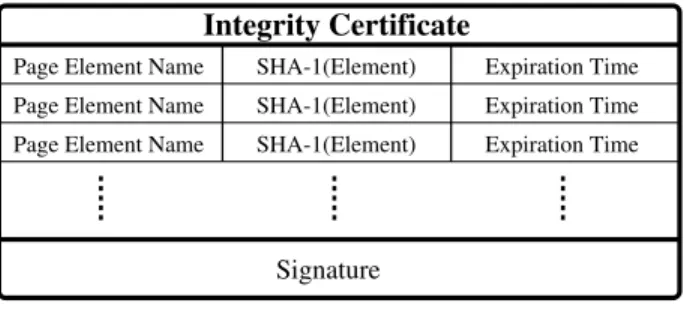
As we mentioned in Section 2, a GlobeDoc consists of a number of page elements. These can be HTML source files, images, Java applets and so on. We preserve the integrity of the object’s state by having anintegrity certificate associ-ated with the object. As shown in Figure 2, this is a digital certificate signed with the object’s private key that contains a table with entries for each page element for the object. Each page element entry contains the element’s name, its secureSHA-1hash, and a validity interval.
Signature
Expiration Time Expiration Time SHA-1(Element)
SHA-1(Element) Page Element Name
Page Element Name
SHA-1(Element) Expiration Time
Page Element Name
Integrity Certificate
Figure 2. Integrity certificate for a GlobeDoc object
Every server that hosts GlobeDoc replicas is required to store all of the object’s page elementsandthe object’s in-tegrity certificate. As we mentioned in Section 3.2.1, page elements retrieved from untrusted servers should be authen-tic, fresh, and consistent with the user request. The integrity certificate allows the user to check for these properties in the following steps.
• Using the object’s public key, the client verifies that the signature on the integrity certificate has been generated using the object’s private key (authenticity).
• The client checks the “element name” field in the cer-tificate to ensure it is the same as the element name she has requested (consistency).
• The client computes theSHA-1hash of the page ele-ment and makes sure it is the same as the one in the certificate (authenticity).
• The client checks the time of retrieval to ensure it falls in the validity interval specified in the certificate (freshness).
3.3 Putting the Pieces Together
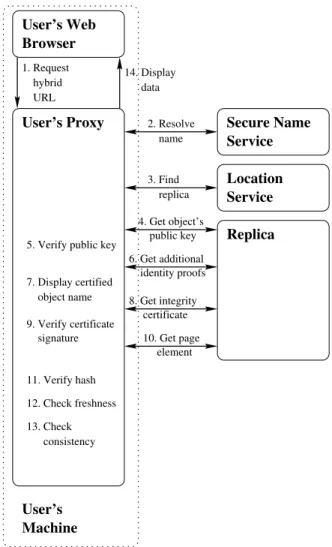
The security architecture for GlobeDoc objects results from combining the various security mechanisms described so far. The key advantage of this architecture is provid-ing integrity guarantees for end-users, even when the Web content they are browsing is replicated on untrusted servers. Figure 3 shows how secure browsing through GlobeDoc ob-jects works.
replica 4. Get object’s public key 5. Verify public key
7. Display certified object name consistency data hybrid 1. Request 14. Display User’s Machine User’s Proxy certificate 8. Get integrity signature 9. Verify certificate 11. Verify hash 12. Check freshness 13. Check 10. Get page element identity proofs 6. Get additional 3. Find Secure Name Service User’s Web Browser Service Location Replica URL 2. Resolve name
Figure 3. Secure Web browsing through GlobeDoc objects
The user starts with a hybrid URL (as described in Sec-tion 2), with an embedded object and page element name. The user can either directly type the hybrid URL in the Web browser, or get to it through an external link in some other GlobeDoc object. When the user’s proxy receives this URL, it will resolve the object name by contacting the se-cure naming service, thus obtaining a self-certifying OID. The proxy then queries the Location Service for that OID
and finds the closest object replica. The Location Service is not trusted, so there is a chance that the address it re-turns may point to a replica which is not part of the object. However, this can cause at most denial of service for the user, since she can always check the authenticity of the data retrieved from the replica. Our assumption is that the Loca-tion Service provides accurate informaLoca-tion most of the time; if attackers are able to corrupt some of the LS’s servers, this can be easily detected, and appropriate measures (rebooting servers, restoring the original data content from backups, etc.) can be taken.
Once the user is connected to a GlobeDoc object replica, the proxy first retrieves the object’s public key, takes its
SHA-1hash and makes sure it matches the self-certifying OID. As an extra security check, the proxy can request some additional identity proof from the object, in the form of a name certificate signed by one of the CAs trusted by the user. If such a certificate is found, the naming information in the certificate is displayed to the user in a“Certified as:”
window. Next, the proxy requests the object’s integrity cer-tificate, and verifies its signature using the object’s public key. At this point, the secure binding between the proxy and the object is complete; the proxy now requests the page element specified in the URL; once it has received it, it per-forms the authenticity, consistency and freshness tests dis-cussed in the previous section. If all these tests are success-ful, the page element is sent to be displayed in the user’s browser, otherwise a “Security Check Failed” HTML doc-ument is generated.
4 Performance Evaluation
Our implementation consists of two components: the ob-ject server and the client proxy, which are both implemented in Java, using JDK 1.3 with the standard crypto libraries.
The object server provides all the runtime services needed for creating and running GlobeDoc object replicas. These services are offered through a command interface which can be remotely accessed through a secure TLS con-nection, in which case TLS also takes care of the remote en-tity authentication. We support a simple but effective access control model: the server administrator sets up a Java key-store listing the public keys for all entities allowed to create GlobeDoc replicas on the server; such entities can be either GlobeDoc owners (individuals) or other GlobeDoc object servers (in this way we can support dynamic replication al-gorithms). Each entity is then allowed to manage only the replicas it creates (this includes replica destruction). We are currently working on integrating more complex poli-cies - allowing dynamic resource negotiation, and delega-tion mechanisms - but this is outside the scope of this paper. The client proxy needs to be installed by every client that wants to access secure GlobeDoc objects; the proxy
identi-Host Architecture RAM OS Java
ginger.cs.vu.nl, Dual 2 GB Linux Sun JDK
VU, Amsterdam Pentium III, 2.4.9 1.4 “primary” 2×1 GHz
sporty.cs.vu.nl, Dual 2 GB Linux Sun JDK
VU, Amsterdam Pentium III, 2.4.9 1.4 “secondary” 2×1 GHz
canardo.inria.fr, Pentium III 256 MB Linux Sun JDK
Inria, Paris 1 GHz 2.4.7 1.4.2
ensamble02. Ultra 256 MB SunOS Sun JDK
cornell.edu, SPARC-IIi 5.8 1.3
Cornell, 450 MHz Ithaca, NY
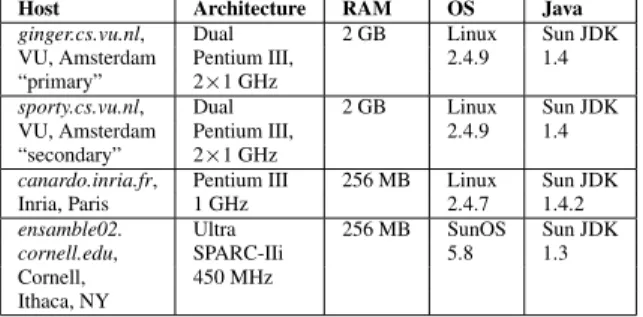
Table 1. Experimental setting
fies GlobeDoc names from the hybrid URLs passed by the client browser, does name resolution and replica location, retrieves the desired page elements and performs the au-thenticity, freshness and consistency tests discussed earlier. The proxy also transparently handles any regular HTTP re-quests it receives from the browser.
For our experiments we have used four hosts: two in Amsterdam (“primary” and “secondary”), one in Paris, and one in Ithaca, NY. Table 4 summarizes the system configu-ration for each of these hosts.
In the first experiment we used four GlobeDoc objects, each consisting of one page element (image), of sizes 1KB, 10KB, 100KB, 300KB, 600KB, and 1MB respectively. For each of these objects, we placed one replica on an object server running on the Amsterdam “primary” host. Each of the objects was then accessed from the Amsterdam “sec-ondary”, Paris and Ithaca hosts, using thewgetHTTP client. On each of these hosts,wgetwas configured to use the lo-cally installed secure GlobeDoc proxy. The aim of the ex-periment was to measure the security overhead; in order to do this, we placed timers in various parts of the proxy and server code, and measured, for each object access, the amount of time dedicated to security-specific operations (these are: retrieving the object’s public key, verifying its
SHA-1hash matches the object Id, retrieving the object cer-tificate and verifying it, computing the hash of the page el-ement and verifying it against the hash in the certificate). Figure 4 shows the results of this experiment (these are av-erage values computed after running the experiment for 24 consecutive hours at 6 minutes intervals).
As we can see, the overhead for transferring small page elements is significant (around 25%), and this is due to the fact that our proxy first needs to retrieve the GlobeDoc ob-ject public key and the obob-ject certificate (about 2KB of ex-tra information). However, for larger data ex-transfers, this initial security exchange becomes less significant, and the overhead is mainly dictated by the time needed to compute the hash over the actual data (which is proportional to the data size, but independent of the network placement of the replica). It is also worth noticing that for large data trans-fers, the security overhead is worse when the proxy and the
500 600 700 800 900 ’Ithaca’
1000
Security Overhead (percentage)
Data Size (KB) ’Amsterdam’ ’Paris’ 5 400 300 200 100 0 30 25 20 15 10 0
Figure 4. Security overhead
object replica are on the same LAN (the Amsterdam pri-mary - Amsterdam secondary case), because in this case the network transfer time is so small that the time to com-pute the hash dominates. For the actual deployment of the GlobeDoc architecture, we expect the most common case to be the one in the Paris-Amsterdam setting (client and replica in relatively close network proximity, although not on the same LAN). In this case, we can see that the security overhead drops quite rapidly for larger data transfers. We achieve even lower overhead when replicas and clients are placed on different continents (the Amsterdam-NY setting), in which case the transfer time is so large that adding a bit of computation hardly matters. However, this latter setting is less realistic for the architecture we advocate - the whole point with GlobeDoc objects is to place replicas in close proximity of the clients.
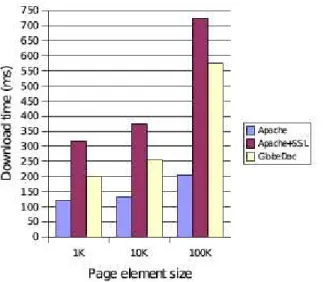
In the second experiment we used three GlobeDoc ob-jects, each consisting of 11 page elements. One of the page elements was always a 5KB text file. The other 10 elements are images, and are of size 1KB each for the first object, 10KB each for the second, and 100KB each for the third object. Thus, the total size for the first object is 15KB, for the second 105KB, and for the third 1005KB. For each of these objects, we place one replica on an object server run-ning on the Amsterdam “primary” host. We also place the same page elements (as text and image files) in a directory accessible by an Apache web server, also running on the Amsterdam primary host.
The aim of the experiment was to compare the perfor-mance of the GlobeDoc server/proxy combination to the Apache server. For this, we compared the time needed to access the four GlobeDoc objects using wget and the GlobeDoc secure proxy with the time needed to download (again using wget) the same files from the Apache server through standard HTTP and secure (SSL) HTTP connec-tions. Figures 5, 6, and 7 show the average timing computed
after running this experiment for 24 consecutive hours at 15 minutes intervals.
Figure 5. Performance comparison - Amster-dam client
Figure 6. Performance comparison - Paris client
We can see that although running as interpreted Java code, our proxy/object server combination performs quite similar to the compiled C Apache code. On the disap-pointing side, it should be noticed that our implementation does not always outperform the Apache/SSL combination,
Figure 7. Performance comparison - Ithaca client
which we would have expected considering that GlobeDoc requires only public key signature verification operations which are much faster than the public key encrypt/decrypt operations required by SSL. The reason for this is the Java memory management mechanism combined with the rather limited memory resources on the Paris and Ithaca hosts; the result is extensive memory swapping which greatly reduces performance. In the case of the Amsterdam client, the large amount of physical memory reduces the need for memory swapping.
Despite these shortcoming, we believe that our proof-of-concept prototype has served its purpose, and has demon-strated that our design is viable. Furthermore, in the worst-case performance scenarios, the determining factors are the specifics of the Java environment - particularly its memory allocation mechanism - as opposed to performance limita-tions introduced by our design. For this work, we have used Java because it is ideal for quick prototyping, but we be-lieve that implementing the same functionality as compiled C code as a “GlobeDoc” Apache module for example -would greatly improve performance.
It is also important to stress that the biggest advantage of the GlobeDoc architecture is the ability to place object replicas in close proximity to clients, which greatly reduces the client-perceived latency. However, the aim of the exper-imental work in this paper is to prove that the security mech-anisms we have devised for GlobeDoc do not introduce ex-cessive overhead, which we believe we have demonstrated. By no means are we trying to quantify the performance im-provement introduced by actually replicating Web content
by means of the GlobeDoc architecture; this is work has already been done, and the results were presented in [13].
5 Related Work
The WWW has experienced explosive growth, with an increasing number of security-sensitive applications mak-ing now use of it. Not surprismak-ingly, the issue of “makmak-ing the Web more secure” has attracted considerable attention, with multiple solutions proposed for a number of specific application scenarios. What makes the GlobeDoc approach distinctive is the fact that it considers not only security but other aspects, such as data content aggregation and replica-tion, creating a unified Web document object model.
The current “state of the art” for secure Web browsing is the combination of DNSsec [5], certified Web servers’ public keys and TLS [4]. In Section 3 we have described how these mechanisms can be combined in order to achieve secure naming, server authentication and integrity guaran-tees for the data received by the clients. However, this approach does not support document replication on un-trusted hosts. Furthermore, since DNSsec records are used to store location-dependent information (IP addresses), this approach does not scale well for dynamically-replicated documents.
Along the same lines is the SHTTP proposal [14], which extends the HTTP protocol with a number of security ex-tensions. The aim is to allow end-to-end integrity checks, as well as data confidentiality and traceability for HTTP trans-actions. This proposal explicitly mentions secure data repli-cation on untrusted hosts as a potential benefit, which is also one of the motivations for GlobeDoc. However, SHTTP comes as an Internet RFC, which means it is only a set of guidelines for system developers. GlobeDoc is an actual system architecture with a running prototype implementa-tion. Furthermore, GlobeDoc is broader in its scope, also dealing with data replication aspects (replica hosting, repli-cation algorithms, consistency models), which are not cov-ered by SHTTP.
Like GlobeDoc, the read-only Secure File System (r-oSFS) [6] focuses on securely replicating data on untrusted servers. The basic architectural element for r-oSFS is the file system; because of this it is possible to use r-oSFS as a middleware and implement various distributed applications on top of it, a secure Web infrastructure being one such pos-sible application [7]. In order to guarantee the integrity of data replicated on untrusted hosts, r-oSFS constructs a hash tree by applying a secure hash function (SHA-1) on the data blocks and i-nodes of the file system. This approach is very efficient, since only the root of the tree needs to be signed by the owner, but has the drawback that only one global (per-file system) consistency interval can be supported, instead of allowing per-file freshness constraints.
Although r-oSFS file systems can be replicated on un-trusted hosts, there is little support for the actual replication. In contrast, each GlobeDoc comes with its own replication policy which ispart ofthe object itself; this allows for very fine-grained (per page-element) replication policies to be defined, which has been proven [13] to greatly improve per-formance. Following the same logic, the GlobeDoc security architecture uses per page-element expiration dates, which allow owners to set per page-element freshness constraints (which is not possible with r-oSFS).
The Gemini project [12] at Carnegie Mellon University aims at creating a publisher-centric replication infrastruc-ture for information dissemination. Gemini is built as an extension to the Squid [2] WWW cache, and - like secure GlobeDoc - aims at providing integrity guarantees for Web documents replicated on untrusted hosts. However, Gem-ini focuses more on dynamic Web data, and their secu-rity solution is different from the one we advocate in this paper - they require the untrusted caches to sign the data they return to clients, which ensures that malicious caches serving bogus content are eventually caught “red-handed”. On the other hand, GlobeDoc makes impossible for mali-cious servers to pass bogus data undetected. Furthermore, GlobeDoc provides a unified Web document object model, with explicit support for replication, features which are not present in Gemini.
Finally, OceanStore [8] is a project that aims at using untrusted hosts to provide a “utility infrastructure designed to span the globe and provide continuous access to per-sistent information.” To accomplish this ambitious goal, the designers of the system make use of peer-to-peer tech-nologies, such as associative storage, distributed routing, and probabilistic query algorithms. Although both make use of untrusted storage, OceanStore and GlobeDoc have slightly different goals: OceanStore assumes that all the storage is untrusted, and focuses on high data redundancy to prevent loss due to malicious hosts or catastrophic events. GlobeDoc on the other hand assumes that each document has access to some secure storage provided by its owner (the traditional Web document model), and relies on un-trusted hosts for replication in order to improve perfor-mance. Although we recognize the many revolutionary ideas OceanStore introduces, we believe that the GlobeDoc Web document model is more appropriate for the next gen-eration of secure WWW services.
6 Conclusion
In this paper we have presented a security architecture that integrates data content, replication mechanisms and se-curity policies in one unified object model, and guarantees data integrity and secure naming even when object replicas are placed on untrusted servers. Our experimental results
show that this new object model can be efficiently integrated into the current Web infrastructure, and the security mecha-nisms do not incur excessive performance penalty.
One direction for future work is support for more com-plex data hosting negotiation mechanisms. We are working on the design of a policy language that would allow ob-ject owners to express quality of service requirements be-fore instantiating new object replicas. At the same time server administrators will be able to specify resource lim-itations (in terms of disk space, memory, network band-width among other things) for the replicas they are willing to host, with the object server being responsible with en-forcing these limitations.
Another direction for future work is GlobeDoc support for dynamic Web content. We believe this will be particu-larly challenging because the technique we currently apply to secure static documents - signing them with the object key - does not work in the case of dynamic data - it would require the object owner to sign the results for every pos-sible client query, which is clearly not feapos-sible. In such a setting, a solution based on auditing the untrusted servers where the data is replicated, as suggested in [12], combined with a probabilistic double-checking of the dynamic Web content these untrusted servers generate is likely to be more effective.
References
[1] Secure Hash Standard. FIPS 180-1, Secure Hash Stan-dard, NIST, US Dept. of Commerce, Washington D. C. April 1995.
[2] Squid web proxy cache. http://www.squid-cache.org. [3] G. Ballintijn, M. van Steen, and A. Tanenbaum. Scalable
User-Friendly Resource Names. IEEE Internet Computing, 5(5):20–27, 2001.
[4] T. Dierks and C. Allen. The TLS Protocol Version 1.0,. IETF RFC 2246, January 1999.
[5] D. Eastlake. Domain name system security extensions. RFC 2535, March 1999.
[6] K. Fu, M. Kaashoek, and D. Mazieres. Fast and Secure Dis-tributed Read-only File System. InProc. 4th USENIX Symp. on Operating Systems Design and Implementation, pages 181–196, San Diego, CA., Oct. 2000.
[7] M. Kaminsky and E. Banks. SFS-HTTP: Securing the web with self-certifying URLs. citeseer.nj.nec.com/470041.html. [8] J. Kubiatowicz, D. Bindel, Y. Chen, P. Eaton, D. Geels, R. Gummadi, S. Rhea, H. Weatherspoon, W. Weimer, C. Wells, and B. Zhao. OceanStore: An Architecture for Global-scale Persistent Storage. InProc. 9th ACM ASPLOS, pages 190–201, Cambridge, MA, November 2000. ACM. [9] D. Mazieres and M. F. Kaashoek. Escaping the Evils of
Cen-tralized Control with Self-Certifying Pathnames. InProc. 8th ACM SIGOPS European Workshop, Sintra, Portugal, Sept. 1998.
[10] D. Mazieres, M. Kaminsky, M. F. Kaashoek, and E. Witchel. Separating Key Management from File System Security. In
Proc. 17th Symp. on Operating Systems Principles, pages 124–139, Kiawah Island, SC, 1999.
[11] P. V. Mockapetris and K. J. Dunlap. Development of the domain name system. InSIGCOMM, pages 123–133, 1988. [12] A. Myers, J. Chuang, U. Hengartner, Y. Xie, W. Zhuang, and H. Zhang. A Secure, Publisher-Centric Web Caching In-frastructure. InProc. 20th IEEE Infocom, Anchorage, AK., April 2001.
[13] G. Pierre, M. van Steen, and A. Tanenbaum. Dynamically Selecting Optimal Distribution Strategies for Web Docu-ments.IEEE Transactions on Computers, 51(6), 2002. [14] E. Rescorla and A. Schiffman. The Secure HyperText
Trans-fer Protocol. IETF RFC 2260, August 1999.
[15] R. L. Rivest and B. Lampson. SDSI – A Simple Distributed Security Infrastructure. Presented at CRYPTO’96 Rumpses-sion, 1996.
[16] M. van Steen, F. Hauck, P. Homburg, and A. Tanenbaum. Locating Objects in Wide-Area Systems. IEEE Commun. Mag., pages 104–109, January 1998.
[17] M. van Steen, P. Homburg, and A. Tanenbaum. Globe: A Wide-Area Distributed System. IEEE Concurrency, pages 70–78, January-March 1999.
[18] M. van Steen, A. Tanenbaum, I. Kuz, and H. Sips. A Scal-able Middleware Solution for Advanced Wide-Area Web Services. Distributed Systems Engineering, 6(1):34–42, March 1999.