Low-Cost IttyBitty™ Thermal Sensor
General Description
The MIC281 is a digital thermal sensor capable of measuring the temperature of a remote PN junction. It is optimized for applications favoring low cost and small size. The remote junction may be an inexpensive commodity transistor, e.g., 2N3906, or an embedded thermal diode such as found in Intel Pentium® II/III/IV CPUs, AMD Athlon® CPUs, and Xilinx Virtex® FPGAs.
The MIC281 is 100% software and hardware backward compatible with the MIC280 and features the same industry-leading noise performance and small size. The advanced integrating A/D converter and analog front-end reduce errors due to noise for maximum accuracy and minimum guardbanding.
A 2-wire SMBus 2.0-compatible serial interface is provided for host communication. The clock and data pins are 5V-tolerant regardless of the value of VDD. They will not clamp the bus lines low even if the device is powered down. Superior performance, low power, and small size make the MIC281 an excellent choice for cost-sensitive thermal management applications.
Datasheets and support documentation are available on Micrel’s website at: www.micrel.com.
Features
Remote temperature measurement using embedded thermal diodes or commodity transistors
Accurate remote sensing: ±3°C max., 0°C to 100°C Excellent noise rejection
I2C and SMBus 2.0-compatible serial interface SMBus timeout to prevent bus lockup
Voltage tolerant I/Os Low power shutdown mode Failsafe response to diode faults 3.0V to 3.6V power supply range Available in IttyBitty SOT23-6 package
Applications
Desktop, server, and notebook computers Set-top boxes
Game consoles Appliances
Ordering Information
Part Number Marking(1) Slave Address Ambient Temp. Range Package
MIC281-0YM6 TB00 1001 000xb –55° to +125°C SOT23-6 MIC281-1YM6 TB01 1001 001xb –55° to +125°C SOT23-6 MIC281-2YM6 TB02 1001 010xb –55° to +125°C SOT23-6 MIC281-3YM6 TB03 1001 011xb –55° to +125°C SOT23-6 MIC281-4YM6 TB04 1001 100xb –55° to +125°C SOT23-6 MIC281-5YM6 TB05 1001 101xb –55° to +125°C SOT23-6 MIC281-6YM6 TB06 1001 110xb –55° to +125°C SOT23-6 MIC281-7YM6 TB07 1001 111xb –55° to +125°C SOT23-6 Note:
1. Underbar (_) may not be to scale.
Pin Configuration
SOT23-6 (M6) Top View
Pin Description
Pin Number Pin Name Pin Function
1 VDD Analog input: Power supply input to the IC. 2 GND Ground return for all IC functions.
3 T1 Analog input: Connection to remote diode junction. 4 CLK Digital input: Serial bit clock input.
5 DATA Digital input/output: Open-drain. Serial data input/output. 6 NC No connection: Must be left unconnected.
Absolute Maximum Ratings
(2)Power Supply Voltage (VDD) ... +3.8V Voltage on T1 ... –0.3V to VDD + 0.3V Voltage on CLK, DATA ... –0.3V to 6V Current into Any Pin ... ±10mA Power Dissipation, TA = +125°C ... 109mW Storage Temperature (Ts) ... –65°C to +150°C ESD Ratings(4)
Human Body Model ... 1.5kV Machine Model ... 200V Soldering (SOT23-6 package)
Vapor Phase (60s) ... 220°C+5/-0°C Infrared (15s) ... 235°C+5/-0°C
Operating Ratings
(3)Power Supply Voltage (VDD) ... +3.0V to +3.6V Ambient Temperature Range (TA) ... –55°C to +125°C Package Thermal Resistance
SOT23-6 (JA) ... 230°C/W
Electrical Characteristics
(5)VDD = 3.3V; TA = 25°C, unless noted. Bold values indicate TMIN ≤ TA ≤ TMAX, unless noted(3) .
Symbol Parameter Condition Min. Typ. Max. Units
Power Supply
IDD Supply Current
T1 open; CLK = DATA = High;
Normal mode 0.23 0.4 mA
Shutdown mode; T1 open; Note 7
CLK = 100kHz 9 µA
Shutdown mode; T1 open;
CLK = DATA = High 6 µA
tPOR Power-on Reset Time, Note 7 VDD > VPOR 200 µs
VPOR Power-on Reset Voltage All registers reset to default values;
A/D conversions initiated 2.65 2.95 V
VHYST Power-on Reset Hysteresis
Voltage, Note 7 300 mV
Temperature-to-Digital Converter Characteristics
Accuracy, Notes 7, 8, 9
0°C ≤ TD ≤ 100°C, 0°C < TA < 85°C;
3.15V < VDD < 3.45V ±1 ±3 °C
–40°C ≤ TD ≤ 125°C, 0°C < TA < 85°C;
3.15V < VDD < 3.45V ±2 ±5 °C
tCONV Conversion Time
Note 7 200 240 ms
Remote Temperature Input, T1
IF Current into External Diode,
Note 7
T1 forced to 1.0V, high level 192 400 µA
Electrical Characteristics
(5)(Continued)
VDD = 3.3V; TA = 25°C, unless noted. Bold values indicate TMIN ≤ TA ≤ TMAX, unless noted(3).
Symbol Parameter Condition Min. Typ. Max. Units
Serial Data I/O Pin, DATA
VOL Low Output Voltage, Note 6 IOL = 3mA 0.3 V
IOL = 6mA 0.5 V
VIL Low Input Voltage 3V ≤ VDD ≤ 3.6V 0.8 V
VIH High Input Voltage 3V ≤ VDD ≤ 3.6V 2.1 5.5 V
CIN Input Capacitance Note 7 10 pF
ILEAK Input Current ±1 µA
Serial Clock Input, CLK
VIL Low Input Voltage 3V ≤ VDD ≤ 3.6V 0.8 V
VIH High Input Voltage 3V ≤ VDD ≤ 3.6V 2.1 5.5 V
CIN Input Capacitance Note 7 10 pF
ILEAK Input Current ±1 µA
Serial Interface Timing
t1 CLK (clock) Period 2.5 µs
t2 Data In Setup Time to CLK High 100 ns
t3 Data Out Stable after CLK Low 300 ns
t4 Data Low Setup Time to CLK
Low Start Condition 100 ns
t5 Data High Hold Time after CLK
High Stop Condition 100 ns
tTO Bus Timeout 25 30 35 ms
Notes:
2. Exceeding the absolute maximum ratings may damage the device.
3. The device is not guaranteed to function outside its operating ratings. Final test on outgoing product is performed at TA = 25°C.
4. Devices are ESD sensitive. Handling precautions are recommended. Human body model, 1.5kΩ in series with 100pF. 5. Specification for packaged product only.
6. Current into the DATA pin will result in self-heating of the device. Sink current should be minimized for best accuracy. 7. Guaranteed by design over the operating temperature range. Not 100% production tested.
8. Accuracy specification does not include quantization noise, which may be up to ±1/2 LSB.
Timing Diagram
Typical Characteristics
Functional Description
Serial Port OperationThe MIC281 uses standard SMBus Write_Byte and Read_Byte operations for communication with its host. The SMBus Write_Byte operation involves sending the device’s slave address (with the R/W bit low to signal a write operation), followed by a command byte and the data byte. The SMBus Read_Byte operation is a composite write and read operation: the host first sends the device’s slave address followed by the command byte, as in a write operation. A new start bit must then be sent to the MIC281, followed by a repeat of the slave address with the R/W bit (LSB) set to the high (read) state. The data to be read from the part may then be clocked out. These protocols are shown in Figures 1 and 2. The Command byte is eight bits (one byte) wide. This byte carries the address of the MIC281 register to be operated upon. The command byte values corresponding to the various MIC281 registers are shown in Table 1. Other command byte values are reserved, and should not be used.
Figure 1. Write_Byte Protocol
Figure 2. Read_Byte Protocol
Table 1. MIC281 Register Addresses
Target Register Command Byte Value Power-on Default
Label Description Read Write
TEMP Remote temperature result 01h N/A 00h (0°C)
CONFIG Configuration 03h 03h 80h
MFG_ID Manufacturer identification FEh N/A 2Ah
DEV_ID Device and revision identification FFh N/A 0xh(10)
Note:
Slave Address
The MIC281 will only respond to its own unique slave address. A match between the MIC281’s address and the address specified in the serial bit stream must be made to initiate communication. The MIC281’s slave address is fixed at the time of manufacture. Eight different slave addresses are available as determined by the part number. See Table 2 and the Ordering Information table.
Table 2. MIC281 Slave Addresses
Part Number Slave Address
MIC281-0YM6 1001 000b = 90h MIC281-1YM6 1001 001b = 92h MIC281-2YM6 1001 010b = 94h MIC281-3YM6 1001 011b = 96h MIC281-4YM6 1001 100b = 98h MIC281-5YM6 1001 101b = 9Ah MIC281-6YM6 1001 110b = 9Ch MIC281-7YM6 1001 111b = 9Eh
Temperature Data Format
The least-significant bit of the temperature register represents one degree Centigrade. The values are in a two’s complement format, wherein the most significant bit (D7) represents the sign: zero for positive temperatures and one for negative temperatures. Table 3 shows examples of the data format used by the MIC281 for temperatures.
Table 3. Digital Temperature Format
Temperature Binary Hex
+127°C 0111 1111 7F +125°C 0111 1101 7D +25°C 0001 1001 19 +1°C 0000 0001 01 0°C 0000 0000 00 –1°C 1111 1111 FF –25°C 1110 0111 E7 –125°C 1000 0011 83 –128°C 1000 0000 80 Diode Faults
The MIC281 is designed to respond in a failsafe manner to diode faults. If an internal or external fault occurs in the temperature sensing circuitry, such as T1 being open or shorted to VDD or GND, the temperature result will be reported as the maximum full-scale value of +127°C. Note that diode faults will not be detected until the first A/D conversion cycle is completed following power-up or exiting shutdown mode.
Shutdown Mode
Setting the shutdown bit in the configuration register will cause the MIC281 to cease operation. The A/D converter will stop and power consumption will drop to the ISHDN level. No registers will be affected by entering shutdown mode. The last temperature reading will persist in the TEMP register.
Detailed Register Descriptions
Remote Temperature Result (TEMP) 8-bits, Read Only
Local Temperature Result Register D[7] read-only D[6] read-only D[5] read-only D[4] read-only D[3] read-only D[2] read-only D[1] read-only D[0] read-only Temperature data from ADC.
Bit Function Operation
D[7:0] Measured temperature data for the remote zone. Read only
Power-up default value: 0000 0000b = 00h = (0°C) (11) Read command byte: 0000 0001b = 01h
Each LSB represents one degree centigrade. The values are in a twos complement binary format such that 0°C is reported as 0000 0000b. See the Temperature Data Format section for more details.
Note:
11. TEMP will contain measured temperature data after the completion of one conversion.
Configuration Register (CONFIG) 8-bits, Read/Write
Configuration Register D[7] reserved D[6] reserved D[5] reserved D[4] reserved D[3] reserved D[2] reserved D[1] reserved D[0] write-only Reserved Shutdown (SHDN) Reserved
Bit Function Operation(12)
D7 Reserved Always writes as zero; reads undefined
D6 Shutdown bit 0 = normal operation; 1 = shutdown
D[5:0] Reserved Always writes as zero; reads undefined
Note:
12. Any write to CONFIG will result in any A/D conversion in progress being aborted and the result discarded. The A/D will begin a new conversion sequence once the write operation is complete.
Power-up default value: x0xx xxxxb (not in shutdown mode) Command byte: 0000 0011b = 03h
Manufacturer ID Register (MFG_ID) 8-bits, Read only Manufacturer ID Register D[7] read-only D[6] read-only D[5] read-only D[4] read-only D[3] read-only D[2] read-only D[1] read-only D[0] read-only 0 0 1 0 1 0 1 0
Bit Function Operation
D[7:0] Identifies Micrel, Inc. as the manufacturer of the device Read only. Always returns 2Ah
Power-up default value: 0010 1010b = 2Ah Read command byte: 1111 1110b = FEh
Die Revision Register (DIE_REV) 8-bits, Read only
Die Revision Register D[7] read-only D[6] read-only D[5] read-only D[4] read-only D[3] read-only D[2] read-only D[1] read-only D[0] read-only MIC281 die revision number
Bit Function Operation
D[7:0] Identifies the device revision number. Read only
Power-up default value: [device revision number]h Read command byte: 1111 1111b = FFh
Application Information
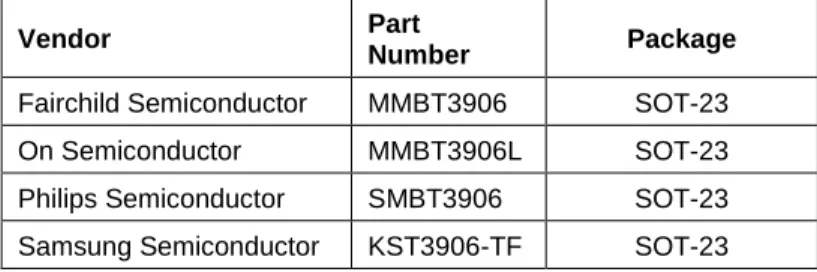
Remote Diode SectionMost small-signal PNP transistors with characteristics similar to the JEDEC 2N3906 will perform well as remote temperature sensors. Table 4 lists several examples of such parts that Micrel has tested for use with the MIC281. Other transistors equivalent to these should also work well. Table 4. Transistors suitable for use as remote diodes
Vendor Part
Number Package
Fairchild Semiconductor MMBT3906 SOT-23
On Semiconductor MMBT3906L SOT-23
Philips Semiconductor SMBT3906 SOT-23 Samsung Semiconductor KST3906-TF SOT-23
Minimizing Errors
Self-Heating
One concern when using a part with the temperature accuracy and resolution of the MIC281 is to avoid errors induced by self-heating (VDD × IDD) + (VOL × IOL). In order to understand what level of error this might represent, and how to reduce that error, the dissipation in the MIC281 must be calculated and its effects reduced to a temperature offset. The worst-case operating condition for the MIC281 is when VDD = 3.6V.The maximum power dissipated in the part is given in the following equation: PD = [(IDD × VDD)+(IOL(DATA) × VOL(DATA))]
PD = [(0.4mA× 3.6V)+(6mA× 0.5V)] PD = 4.44mW
Rθ(J-A) of SOT23-6 package is 230°C/W, therefore the theoretical maximum self-heating is:
4.44mW × 230°C/W = 1.02°C
In most applications, the DATA pin will have a duty cycle of substantially below 25% in the low state. These considerations, combined with more typical device and application parameters, give a better system-level view of device self-heating. This is illustrated by the next equation. In any application, the best approach is to verify performance against calculation in the final application environment. This is especially true when dealing with systems for which some temperature data may be poorly defined or unobtainable except by empirical means. PD = [(IDD × VDD)+(IOL(DATA) × VOL(DATA))]
PD = [(0.23mA× 3.3V)+(25% × 1.5mA× 0.15V)] PD = 0.815mW
Rθ(J-A) of SOT23-6 package is 230°C/W, therefore the typical self-heating is:
0.815mW × 230°C/W = 0.188°C
Series Resistance
The operation of the MIC281 depends upon sensing the VCB-E of a diode-connected PNP transistor (diode) at two different current levels. For remote temperature measurements, this is done using an external diode connected between T1 and ground. Because this technique relies upon measuring the relatively small voltage difference resulting from two levels of current through the external diode, any resistance in series with the external diode will cause an error in the temperature reading from the MIC281. A good rule of thumb is that for each ohm in series with the external transistor, there will be a 0.9°C error in the MIC281’s temperature measurement. It is not difficult to keep the series resistance well below an ohm (typically <0.1Ω), so this will rarely be an issue.
Filter Capacitor Selection
It is usually desirable to employ a filter capacitor between the T1 and GND pins of the MIC281. The use of this capacitor is recommended in environments with a lot of high frequency noise (such as digital switching noise), or if long traces or wires are used to connect to the remote diode. The recommended total capacitance from the T1 pin to GND is 2200pF. If the remote diode is to be at a distance of more than six-to-twelve inches from the MIC281, using twisted pair wiring or shielded microphone cable for the connections to the diode can significantly reduce noise pickup. If using a long run of shielded cable, remember to subtract the cable’s conductor-to-shield capacitance from the 2200pF total capacitance.
Layout Considerations
The following guidelines should be kept in mind when designing and laying out circuits using the MIC281.
1. Place the MIC281 as close to the remote diode as possible, while taking care to avoid severe noise sources such as high frequency power transformers, CRTs, memory and data busses, and the like.
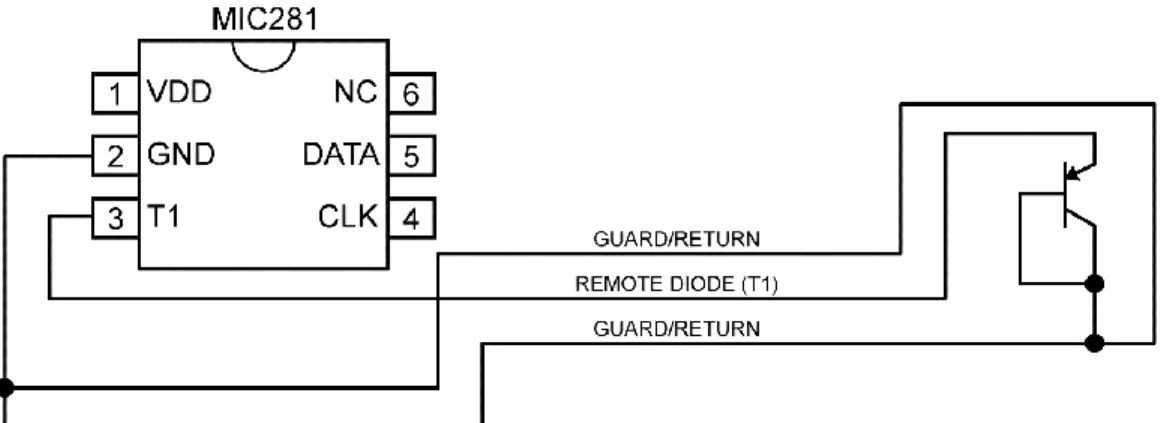
2. Because any conductance from the various voltages on the PC board and the T1 line can induce serious errors, it is good practice to guard the remote diode's emitter trace with a pair of ground traces. These ground traces should be returned to the MIC281's own ground pin. They should not be grounded at any other part of their run. However, it is highly desirable to use these guard traces to carry the diode's own ground return back to the ground pin of the MIC281, thereby providing a Kelvin connection for the base of the diode. See Figure 3.
3. When using the MIC281 to sense the temperature of a processor or other device which has an integral thermal diode, e.g., Intel's Pentium III, connect the emitter and base of the remote sensor to the MIC281 using the guard traces and Kelvin return shown in Figure 3. The collector of the remote diode is typically inaccessible to the user on these devices.
4. Due to the small currents involved in the measurement of the remote diode’s ∆VBE, it is important to adequately clean the PC board after soldering to prevent current leakage. This is most likely to show up as an issue in situations where water-soluble soldering fluxes are used.
5. In general, wider traces for the ground and T1 lines will help reduce susceptibility to radiated noise (wider traces are less inductive). Use trace widths and spacing of 10mm wherever possible and provide a ground plane under the MIC281 and under the connections from the MIC281 to the remote diode. This will help guard against stray noise pickup.
6. Always place a good quality power supply bypass capacitor directly adjacent to, or underneath, the MIC281. This should be a 0.1µF ceramic capacitor. Surface-mount parts provide the best bypassing because of their low inductance.
Package Information
(13)6-Pin SOT23 (M6)
Note:
MICREL, INC. 2180 FORTUNE DRIVE SAN JOSE, CA 95131 USA TEL +1 (408) 944-0800 FAX +1 (408) 474-1000 WEB http://www.micrel.com
Micrel makes no representations or warranties with respect to the accuracy or completeness of the information furnished in this data sheet. This information is not intended as a warranty and Micrel does not assume responsibility for its use. Micrel reserves the right to change circuitry, specifications and descriptions at any time without notice. No license, whether express, implied, arising by estoppel or otherwise, to any intellectual property rights is granted by this document. Except as provided in Micrel’s terms and conditions of sale for such products, Micrel assumes no liability
whatsoever, and Micrel disclaims any express or implied warranty relating to the sale and/or use of Micrel products including liability or warranties relating to fitness for a particular purpose, merchantability, or infringement of any patent, copyright or other intellectual property right.
Micrel Products are not designed or authorized for use as components in life support appliances, devices or systems where malfunction of a product can reasonably be expected to result in personal injury. Life support devices or systems are devices or systems that (a) are intended for surgical implant
into the body or (b) support or sustain life, and whose failure to perform can be reasonably expected to result in a significant injury to the user. A Purchaser’s use or sale of Micrel Products for use in life support appliances, devices or systems is a Purchaser’s own risk and Purchaser agrees to fully