1.1
Version:
Released
Status:
2013-01-18
Last Update:
Public
Classification:
Trademarks
The following terms are trademarks or registered trademarks of International Business Machines Corporation in the United States, other countries, or both:
● Enterprise Systems Architecture/390
● ESA/390
● IBM
● IBM logo
● HiperSockets
● PR/SM
● Processor Resource/Systems Manager
● RACF ● S/390 ● System z ● VM/ESA ● z/Architecture ● z/VM
Other company, product, and service names may be trademarks or service marks of others.
Legal Notice
This document contains information of a public nature.
Review and Approval Process
Refer to the inspection process in the System z Software Programming Process.
Required Reviewers
● Alan Altmark (z/VM Security Architect)
● Brian Hugenbruch
Document Distribution and Change Notification
The document is distributed to the reviewers of this line item. When reissued with changes, the document owner sends a note to the reviewers notifying them of the availability of a new document version.
Archival Requirements
Archival requirement according to the German evaluation and certification scheme is 5 years.
Revision History
Changes to Previous Revision Author(s)
Date Revision
Initial Draft, being a significant rewrite of the version used for z/VM V5.3. Alan Altmark
2010-08-26 0.1
Changes to Previous Revision Author(s)
Date Revision
change to ALC_FLR.2, addition of ID Stephan Mueller 2011-02-21 0.4 Addition of PTFs Stephan Mueller 2011-06-07 0.5
Clarification of FTA_SSL.1/2 and FIA_UAU.5 Stephan Mueller
2011-06-07 0.6
Editorial fixes requested by evaluator Stephan Mueller 2011-09-16 0.7 Update of FCS_RNG.1 discussion Stephan Mueller 2011-10-06 0.8 Addition of PTF Stephan Mueller 2012-02-29 0.9 Addition of PTF Stephan Mueller 2012-03-19 0.10
Fix specification of ASE_CCL.1 Stephan Mueller 2012-03-27 0.11 Editorial updates Stephan Mueller 2012-11-26 1.0
Clarify the abstract machines allowed in this evaluation, Update FCS_RNG.1 based on BSI comments
Stephan Mueller 2013-01-18
Table of Contents
1 Introduction ... 11
1.1 Security Target Identification ... 11
1.2 TOE Identification ... 11
1.3 TOE Type ... 11
1.4 TOE Overview ... 11
1.5 TOE Description ... 12
1.5.1 Structure and concept of z/VM ... 13
1.5.1.1 Differences from other operating systems ... 13
1.5.1.2 z/VM’s Kernel and non-kernel software ... 14
1.5.1.3 User’s management of virtual machines using the Control Program ... 15
1.5.1.4 Communication between virtual machines and with the Control Program ... 15
1.5.2 Intended Method of Use ... 16
1.5.2.1 Conversational Monitor System (CMS) ... 17
1.5.3 Summary of Security Features ... 18
1.5.3.1 Identification and Authentication ... 18
1.5.3.2 Discretionary Access Control ... 18
1.5.3.3 Mandatory Access Control and Support for Security Labels ... 19
1.5.3.4 Separation of virtual machines ... 19
1.5.3.5 Audit ... 19
1.5.3.6 Object reuse functionality ... 19
1.5.3.7 Security Management ... 20 1.5.3.8 TSF Protection ... 20 1.5.4 Configurations ... 20 1.5.4.1 Software Components ... 20 1.5.4.2 Software Privileges ... 20 1.5.4.3 Software Configuration ... 21 1.5.4.4 Hardware configurations ... 21 2 CC Conformance Claim ... 23
3 Security Problem Definition ... 24
3.1 Threat Environment ... 24
3.1.1 Assets ... 24
3.1.2 Threat agents ... 24
3.1.3 Threats countered by the TOE ... 25
3.2 Assumptions ... 26
3.2.1 Environment of use of the TOE ... 26
3.2.1.1 Physical ... 26
3.2.1.2 Personnel ... 26
3.2.1.3 Procedural ... 26
4.1 Objectives for the TOE ... 28
4.2 Objectives for the Operational Environment ... 30
4.3 Security Objectives Rationale ... 31
4.3.1 Security Objectives Coverage ... 31
4.3.2 Security Objectives Sufficiency ... 32
5 Extended Components Definition ... 38
5.1 Class FCS: Cryptographic support ... 38
5.1.1 Random number generator (RNG) ... 38
5.1.1.1 FCS_RNG.1 - Random number generation ... 38
6 Security Requirements ... 40
6.1 TOE Security Functional Requirements ... 40
6.1.1 Security audit (FAU) ... 44
6.1.1.1 Audit data generation (FAU_GEN.1) ... 44
6.1.1.2 User identity association (FAU_GEN.2) ... 45
6.1.1.3 Audit review (FAU_SAR.1) ... 45
6.1.1.4 Restricted audit review (FAU_SAR.2) ... 45
6.1.1.5 Selectable audit review (FAU_SAR.3) ... 45
6.1.1.6 Selective audit (FAU_SEL.1) ... 45
6.1.1.7 Protected audit trail storage (FAU_STG.1) ... 46
6.1.1.8 Action in case of possible audit data loss (FAU_STG.3) ... 46
6.1.1.9 Prevention of audit data loss (FAU_STG.4) ... 46
6.1.2 Cryptographic support (FCS) ... 46
6.1.2.1 Cryptographic key generation (FCS_CKM.1(SYM)) ... 46
6.1.2.2 Cryptographic key generation (FCS_CKM.1(RSA)) ... 46
6.1.2.3 Cryptographic key generation (FCS_CKM.1(DSA)) ... 47
6.1.2.4 Cryptographic key distribution (FCS_CKM.2(NET)) ... 47
6.1.2.5 Cryptographic key destruction (FCS_CKM.4) ... 47
6.1.2.6 Cryptographic operation (FCS_COP.1(NET)) ... 47
6.1.2.7 Random number generator (Class DRG.2) (FCS_RNG.1) ... 47
6.1.3 User data protection (FDP) ... 48
6.1.3.1 RACF Persistent Storage Object Access Control Policy (FDP_ACC.2(RACF-PSO)) ... 48
6.1.3.2 RACF Transient Storage Object Access Control Policy (FDP_ACC.2(RACF-TSO)) ... 49
6.1.3.3 RACF System Object Access Control Policy (FDP_ACC.2(RACF-SYSTEM)) ... 50
6.1.3.4 Discretionary Access Control Policy by CP (FDP_ACC.2(CP)) ... 50
6.1.3.5 Access Control Functions by RACF (FDP_ACF.1(RACF)) ... 51
6.1.3.6 Discretionary Access Control Functions by CP (FDP_ACF.1(CP)) ... 52
6.1.3.7 Export of user data with security attributes (FDP_ETC.2(LS) (Labeled Security Mode only)) ... 52
6.1.3.8 Export of user data with security attributes (FDP_ETC.2(VIRT)) ... 53
6.1.3.9 Complete information flow control (FDP_IFC.2(NI)) ... 53
6.1.3.10 Complete information flow control (FDP_IFC.2(LS) (Labeled Security Mode only)) ... 54
6.1.3.11 Complete information flow control (FDP_IFC.2(VIRT)) ... 55
6.1.3.12 Simple security attributes (FDP_IFF.1(NI)) ... 55
6.1.3.13 Simple security attributes (FDP_IFF.1(VIRT)) ... 56
6.1.3.14 Hierarchical security attributes (FDP_IFF.2(LS) (Labeled Security Mode only)) ... 56
6.1.3.15 Import of user data without security attributes (FDP_ITC.1(LS) (Labeled Security Mode only)) ... 58
6.1.3.16 Import of user data with security attributes (FDP_ITC.2(BA)) ... 58
6.1.3.17 Import of user data with security attributes: labeled security (FDP_ITC.2(LS) (Labeled Security Mode only)) ... 58
6.1.3.18 Import of user data with security attributes (FDP_ITC.2(VIRT)) ... 59
6.1.3.19 Full residual information protection (FDP_RIP.2) ... 59
6.1.3.20 Full residual information protection of resources (FDP_RIP.3) ... 59
6.1.4 Identification and authentication (FIA) ... 59
6.1.4.1 Authentication failure handling (FIA_AFL.1) ... 59
6.1.4.2 User attribute definition (FIA_ATD.1(HU)) ... 60
6.1.4.3 User attribute definition (FIA_ATD.1(TU)) ... 60
6.1.4.4 User attribute definition: labeled security (FIA_ATD.1(LS)) ... 60
6.1.4.5 Verification of secrets (FIA_SOS.1) ... 60
6.1.4.6 Timing of authentication (FIA_UAU.1) ... 61
6.1.4.7 Multiple authentication mechanisms (FIA_UAU.5) ... 61
6.1.4.8 Protected authentication feedback (FIA_UAU.7) ... 61
6.1.4.9 Timing of identification (FIA_UID.1) ... 61
6.1.4.10 User identification before any action (FIA_UID.2(VIRT)) ... 62
6.1.4.11 User-subject binding (FIA_USB.1(LS) (Labeled Security Mode only)) ... 62
6.1.4.12 Enhanced user-subject binding (FIA_USB.2) ... 62
6.1.5 Security management (FMT) ... 63
6.1.5.1 Management of object security attributes (FMT_MSA.1(DAC)) ... 63
6.1.5.2 Management of object security attributes: labeled security (FMT_MSA.1(LS) (Labeled Security Mode only)) ... 63
6.1.5.3 Management of security attributes (FMT_MSA.1(VIRT-CIFCP)) ... 63
6.1.5.4 Static attribute initialisation (FMT_MSA.3(DAC)) ... 63
6.1.5.5 Static attribute initialisation (FMT_MSA.3(NI)) ... 64
6.1.5.6 Static attribute initialization: labeled security (FMT_MSA.3(LS) (Labeled Security Mode only)) ... 64
6.1.5.7 Static attribute initialisation (FMT_MSA.3(VIRT-CIFCP)) ... 64
6.1.5.8 Security attribute value inheritance (FMT_MSA.4(DAC)) ... 64
6.1.5.9 Management of TSF data (FMT_MTD.1(AE)) ... 65
6.1.5.10 Management of TSF data (FMT_MTD.1(AS)) ... 65
6.1.5.11 Management of TSF data (FMT_MTD.1(AT)) ... 65
6.1.5.12 Management of TSF data (FMT_MTD.1(AF)) ... 65
6.1.5.13 Management of TSF data (FMT_MTD.1(NI)) ... 65
6.1.5.17 Management of TSF data (FMT_MTD.1(VIRT-COMP)) ... 66
6.1.5.18 Revocation of Object Attributes (FMT_REV.1(OBJ)) ... 66
6.1.5.19 Revocation of User Attributes (FMT_REV.1(USR)) ... 66
6.1.5.20 Specification of management functions (FMT_SMF.1) ... 67
6.1.5.21 Security roles (FMT_SMR.1) ... 67
6.1.6 Protection of the TSF (FPT) ... 68
6.1.6.1 Reliable time stamps (FPT_STM.1) ... 68
6.1.6.2 Inter-TSF basic TSF data consistency (FPT_TDC.1(BA)) ... 68
6.1.6.3 Inter-TSF basic TSF data consistency: labeled security (FPT_TDC.1(LS) (Labeled Security Mode only)) ... 68
6.1.6.4 Inter-TSF basic TSF data consistency: virtualization (FPT_TDC.1(VIRT)) ... 68
6.1.7 TOE access (FTA) ... 68
6.1.7.1 TSF-initiated session locking (FTA_SSL.1) ... 68
6.1.7.2 User-initiated locking (FTA_SSL.2) ... 69
6.1.8 Trusted path/channels (FTP) ... 69
6.1.8.1 Inter-TSF trusted channel (FTP_ITC.1) ... 69
6.2 Security Functional Requirements Rationale ... 70
6.2.1 Security Requirements Coverage ... 70
6.2.2 Security Requirements Sufficiency ... 73
6.2.3 Security Requirements Dependency Analysis ... 76
6.2.4 Mutual support of the security functions ... 81
6.3 Security Assurance Requirements ... 82
6.3.1 Security Target evaluation (ASE) ... 83
6.3.1.1 Conformance claims (ASE_CCL.1(CCL)) ... 83
6.4 Security Assurance Requirements Rationale ... 84
7 TOE Summary Specification ... 85
7.1 TOE Security Functionality ... 85
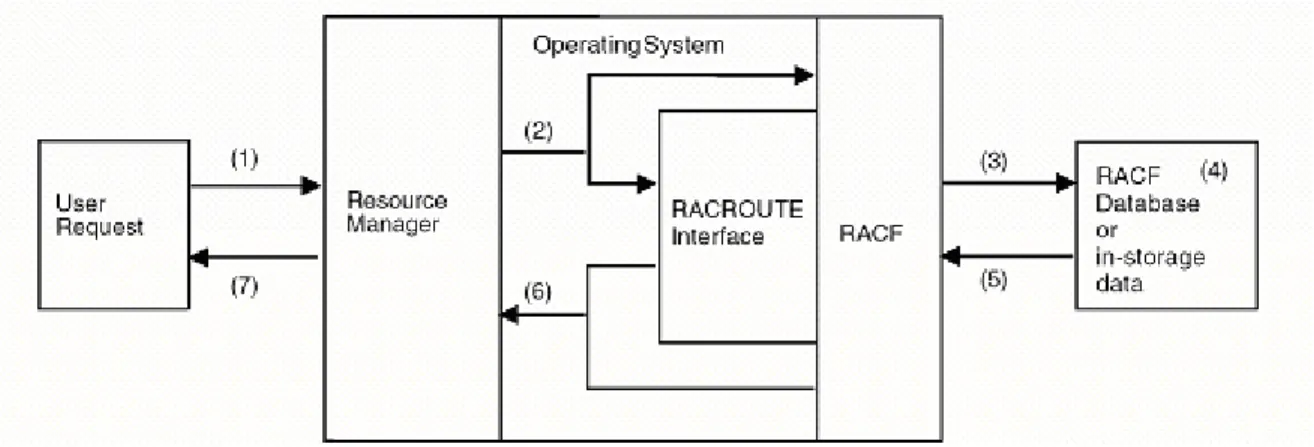
7.1.1 Overview of the TOE architecture ... 85
7.1.2 F.AU: Auditing ... 86
7.1.2.1 F.AU.1 - Generation of Audit Records ... 86
7.1.2.2 F.AU.2 – Protection of the Audit Trail ... 87
7.1.2.3 F.AU.3 - Audit Configuration and Management ... 87
7.1.3 F.AC: Access Control ... 88
7.1.3.1 F.AC.1 - General Operation ... 88
7.1.3.2 F.AC.2 – Profiles ... 89
7.1.3.3 F.AC.3 – Access control enforcement ... 92
7.1.3.4 F.AC.4 - Access Control Configuration and Management ... 97
7.1.3.5 F.AC.5 – Protected Resources ... 97
7.1.3.6 F.AC.6 – Access control enforcement by CP ... 98
7.1.4 F.I&A: Identification and Authentication ... 98
7.1.4.1 F.I&A.1 – Identification and authentication mechanism ... 98
7.1.4.2 F.I&A.2 – Passwords ... 100
7.1.4.3 F.I&A.3 – Identity Change ... 101
7.1.5.1 Access to virtual machines ... 104
7.1.5.2 Virtual machine networking ... 104
7.1.6 F.OR: Object re-use ... 105
7.1.7 F.SM: Security Management ... 105
7.1.7.1 F.SM.1 – Management of user security attributes ... 106
7.1.7.2 F.SM.2 – Management of object security attributes ... 107
7.1.7.3 F.SM.3 – Management of audit ... 107
7.1.7.4 F.SM.4 – Management of system assurance testing ... 108
7.1.8 F.TP: TOE Self Protection ... 108
7.1.8.1 F.TP.1 – Supporting Mechanisms of the Abstract Machine ... 108
7.1.8.2 F.TP.2 – Structure of the TOE ... 109
8 Abbreviations, Terminology and References ... 111
8.1 Abbreviations ... 111
8.2 Terminology ... 111
List of Tables
Table 1: Mapping of security objectives to threats and policies ... 31
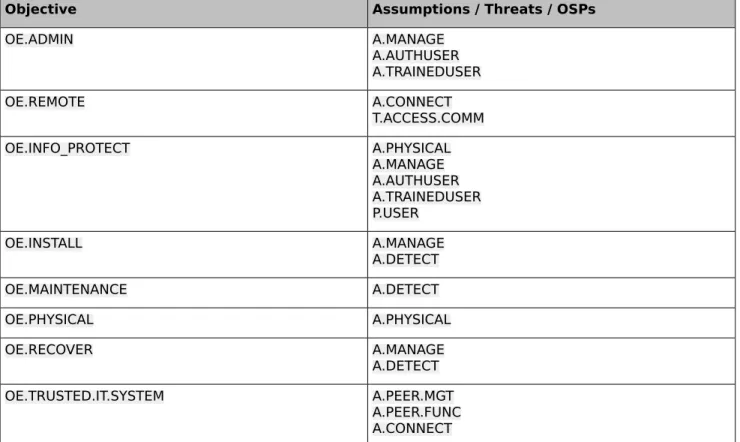
Table 2: Mapping of security objectives for the Operational Environment to assumptions, threats and policies ... 32
Table 3: Sufficiency of objectives countering threats ... 33
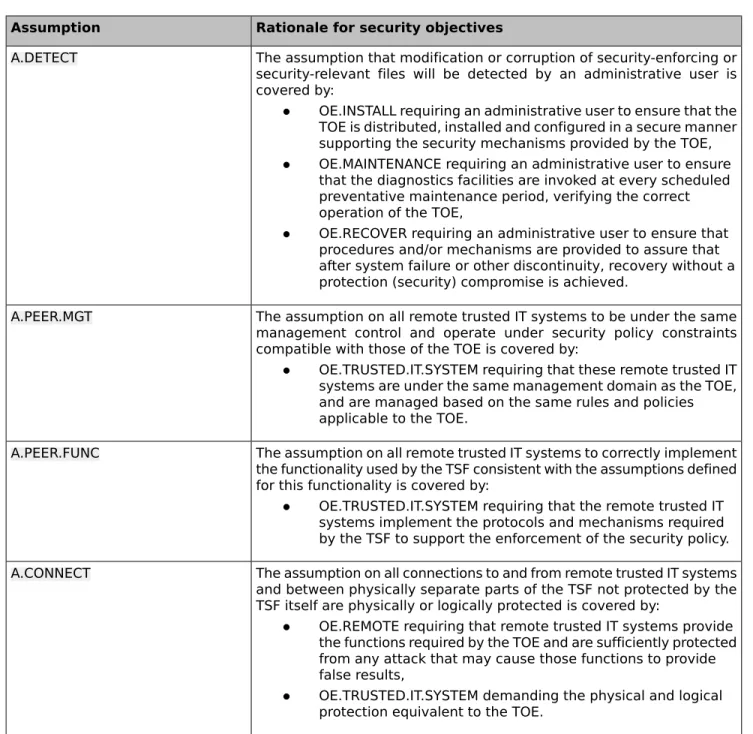
Table 4: Sufficiency of objectives holding assumptions ... 35
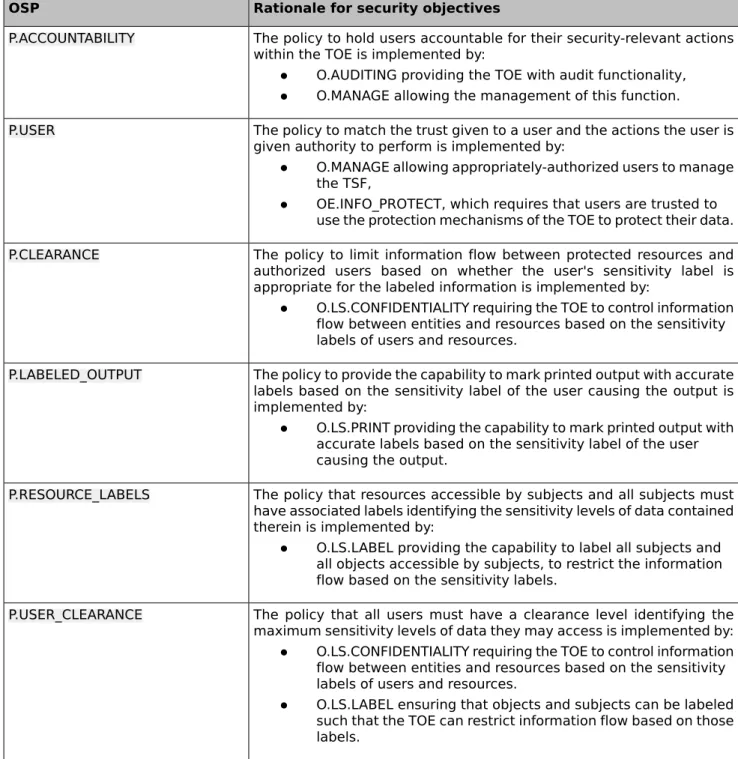
Table 5: Sufficiency of objectives enforcing Organizational Security Policies ... 37
Table 6: Security functional requirements for the TOE ... 40
Table 7: Mapping of security functional requirements to security objectives ... 70
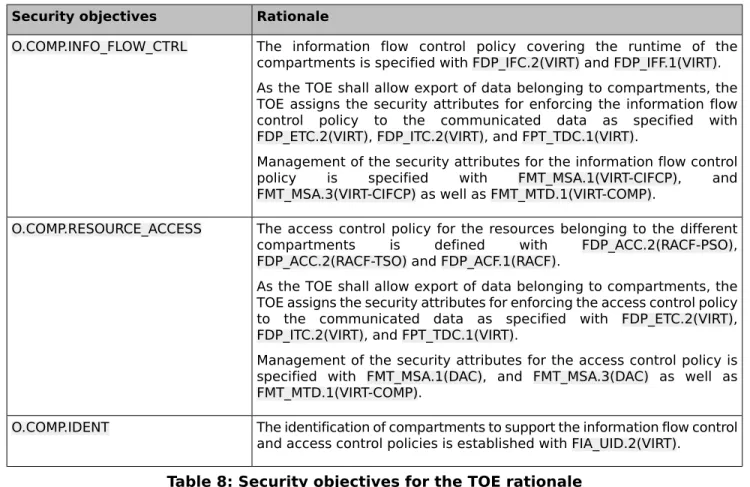
Table 8: Security objectives for the TOE rationale ... 73
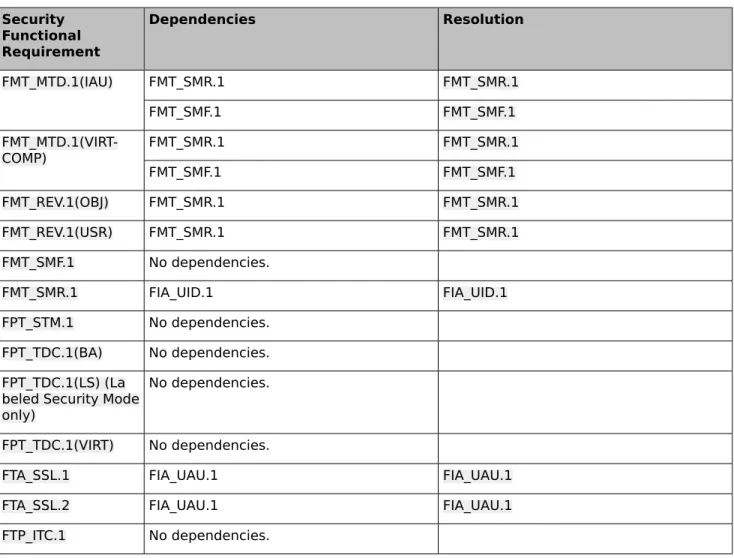
Table 9: TOE SFR dependency analysis ... 76
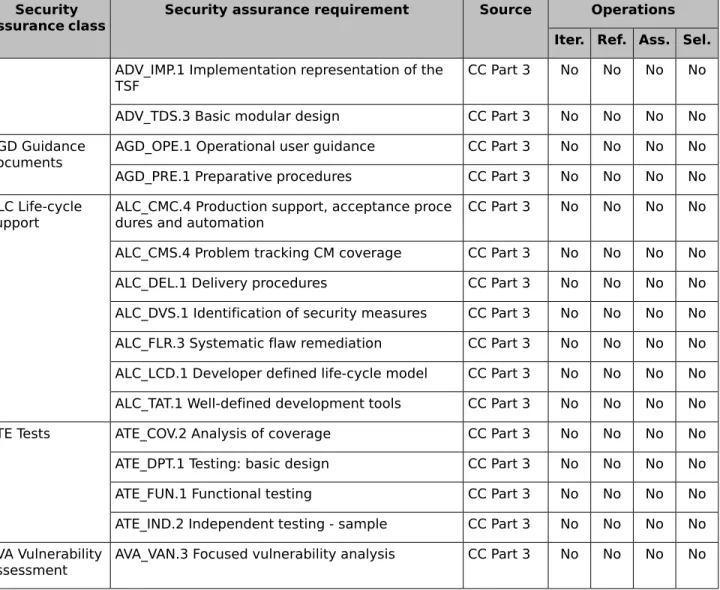
Table 10: Security assurance requirements ... 82
Table 11: RACF user profile ... 90
Table 12: RACF group profile ... 91
Table 13: RACF resource profile ... 91
List of Figures
1 Introduction
1.1 Security Target Identification
IBM z/VM Version 6 Release 1 Security Target Title: 1.1 Version: Released Status: 2013-01-18 Date: IBM Corporation Sponsor: IBM z/VM Development Developer: BSI-DSZ-CC-0752 Certification ID:
access control, discretionary access control, general-purpose operating system, information protection, security labels, mandatory access control, security, virtual machine
Keywords:
1.2 TOE Identification
The TOE is z/VM Version 6 Release 1.1.3 TOE Type
The TOE type is virtual machine operating system implementing a hypervisor.
1.4 TOE Overview
This security target (ST) documents the security characteristics of the IBM z/VM Version 6 Release 1 hypervisor product when configured in a secure manner according to the supplied security guide. z/VM is a highly secure, flexible, robust, scalable virtual machine hypervisor for IBM System z® mainframe servers onto which to deploy mission-critical virtual servers. A single System z server can host up to 60 instances of z/VM, one per logical partition (LPAR), and each instance of z/VM can host tens to hundreds of virtual servers. Multiple instances of z/VM can be connected to form a networked system called a "collection". The communication aspects within z/VM used for these connections are also part of the evaluation. External communication links can be protected against loss of confidentiality and integrity by cryptographic protection mechanisms not part of the TOE. Due to the functionality of performing identification and authentication of users, implementation of DAC and MAC, providing management facilities for all security-related functions and the fact that support functionality is hosted in different virtual machines, z/VM also resembles an operating system. Therefore, the Operating System Protection Profile ([OSPP]) is used as a basis for this ST. z/VM meets all of the requirements of the Operating System Protection Profile base [OSPP], as well as its extended packages for labeled security [OSPP-LS] and virtualization [OSPP-VIRT].
z/VM provides identification and authentication of users using different authentication mechanisms, both discretionary and mandatory access control to a large number of different objects, separation of virtual machines, a configurable audit functionality, sophisticated security management functions, preparation of objects for reuse and functionality used internally to protect z/VM from interference and tampering by untrusted users or subjects.
1.5 TOE Description
The Target of Evaluation (TOE) is the z/VM virtual machine operating system with the software components as described in section 1.5.4. z/VM is an operating system designed to host other operating systems, each in its own virtual machine. Multiple virtual machine can run concurrently to perform a variety of functions requiring controlled, separated access to the information stored on the system. The TOE provides a virtual machine for each logged in user, separating the execution domain of each user from other users as defined in the virtual machine definitions stored in the system directory. In addition, the system directory contains access control information for privileged functions, such as use of certain options of the processor’s DIAGNOSE instruction. In addition to the system directory, the RACF security server is employed to mediate access to resources and privileged functions.
For the purpose of this ST, the TOE is one instance of z/VM running on an abstract machine as the sole operating system on the level of the abstract machine and exercising full control over this abstract machine regardless which software runs inside of virtual machines. This abstract machine is provided by a logical partition (LPAR) of an IBM System z server.
The LPAR itself is not part of the TOE, but belongs to the TOE environment. It is to be noted that although a z/VM instance can be run within a z/VM instance, the evaluated configuration is restricted to one z/VM instance running directly within an LPAR. A z/VM instance running within a virtual machine is allowed, but this “second level” z/VM instance is not in an evaluated configuration, as some security functionality is implemented differently, in particular with respect to the usage of the processor’s Start Interpretive Execution (SIE) instruction.
Multiple instances of the TOE may share the RACF database. This is done by sharing the DASD (direct access storage device) volume keeping the RACF database between the different z/VM instances. Although sharing of the RACF database between z/VM and z/OS is technically feasible, it is explicitly excluded from this evaluation.
The platforms selected for the evaluation consist of IBM products, which are available when the evaluation has been completed and will remain available for some period of time afterwards. Even if withdrawn from general marketing, the product may be obtained by special request to IBM. The TOE security functions (TSF) are provided by the z/VM operating system kernel (called the Control Program – CP) and by an application called RACF that runs within a specially-privileged virtual machine. In addition to providing user authentication, access control, and audit services to CP, RACF can provide the same services to other authorized virtual machines. z/VM provides management functions that allow configuring the TSF and tailor them to the customer’s needs. Some elements have been included in the TOE which do not provide security functions, but run in authorized mode and could therefore, if misbehaved, compromise the TOE. Since these elements are substantial for the operation of many customer environments, they are included as trusted applications within the TOE.
In its evaluated configuration, the TOE allows two modes of operation: a standard mode meeting all requirements of the Operating System Protection Profile base [OSPP] and its extended package for Virtualization [OSPP-VIRT], and a more restrictive mode called Labeled Security Mode, which additionally meets all requirements of the OSPP extended package for Labeled Security [OSPP-LS]. In both modes, the same software elements are used. The two modes have different RACF settings with respect to the use of security labels. All other configuration parameters are identical in the two modes.
1.5.1 Structure and concept of z/VM
z/VM provides a mechanism to run a heterogeneous mix of z/Architecture® or Enterprise System Architecture/390 (ESA/390) operating systems with overcommitment of processor and memory resources. It provides each end user with an individual working environment known as a virtual machine. The virtual machine simulates the existence of a dedicated real machine, including CPU, memory, operator controls, and input/output (I/O) resources.
Because each virtual machine provides an environment that conforms to the machine architecture, the virtual machine can host a conformant operating system (called a guest). Multiple instances of Linux, z/OS, z/VSE, z/TPF, and even z/VM itself, can run concurrently on the same z/VM system that is supporting z/VM CMS applications and end users. As a result, application development, testing, and production environments can share a single physical computer.
1.5.1.1 Differences from other operating systems
z/VM is similar to any other operating system in that it implements the concepts of:
● Users logging into the system and controlling software acting on behalf of the user ● Access control to memory objects or devices based on rules enforced on users and their
associated group or (in Labeled Security Mode) security label assignment
● Nucleus or kernel software running in a privileged and protected environment, controlling
and enforcing rules upon subjects and objects
● Management of real and virtual memory and separation of address spaces between different
virtual machines
● Scheduling of user software to run multiple software concurrently on one or more processors
in a serialized manner
The major difference from a general-purpose operating system is the concept of virtual machines implemented by z/VM. Upon login, each user is provided with a virtual machine that is capable of running arbitrary software. That software must be an operating system, whether it supports a single user or multiple users. Applications run within the operating system. A virtual machine differs from application environment of general-purpose operating systems in the following ways:
● Predefined limits of processors (i.e. definition of logical processors whose number may
differ from the number of real processors), processing time (i.e. processing power of logical processors), memory ranges accessible from inside the virtual machine and access to devices are enforced on every virtual machine.
● Virtual machines allow software to run in problem and supervisor state provided by the
underlying processors restricted by the limits of the virtual machine z/VM defined by the administrator.
● Hardware can be virtualized. Access to hardware not dedicated for one virtual machine
only is virtualized by the TOE (such access to the timer of the abstract machine is mediated by the TOE). Virtualized devices can be accessed the same way, as they would be accessed natively by software inside virtual machines.
● Hardware can be simulated. In some case there is no hardware, but the TOE simulates a
hardware device (such as a virtual LAN adapter for providing virtual machines access to the virtual LAN maintained by the TOE). This device can be accessed like any other real hardware from inside the virtual machine using a device driver.
● Pre-defined processor instructions are simulated by the Control Program (CP) to ensure
strict separation of virtual machines. z/VM defines the limits of each virtual machine. A set of parameters for the virtual machine environment is loaded into a table within the processor
when z/VM passes control to a virtual machine. Whenever the processor detects that an instruction cannot be handled within this "interpreted environment", it generates an interrupt to CP which then handles the instruction by simulating the processor instruction, in addition to well-defined sanity checks. To activate the interpreted environment, the processor provides the Start Interpretive Execution (SIE) instruction.
By using the processor’s SIE instruction, the Control Program is capable of maintaining a m:n association between the number of logical processors available in the logical partition z/VM is running in, and the number of virtual processors defined for a virtual machine. Given that an arbitrary number of virtual machines may be active at any one time, it is possible to have more virtual processors demanding access to the CPU than are available in the partition. This time-sharing of the available CPU capacity is implemented in CP by having a pre-emptive scheduler for virtual processors. Pre-emption is implemented by utilizing the SIE instruction’s timing mechanism, which allows CP to specify how long the SIE environment is executed by one processor. After the expiry of the timer, the SIE instruction ends, the virtual processor stops, and control is returned to CP.
1.5.1.2 z/VM’s Kernel and non-kernel software
The z/VM Control Program (CP) is primarily a real-machine resource manager. CP provides each user with an individual working environment known as a virtual machine. Each virtual machine is a functional equivalent of a real system, sharing the real processor instructions and its functionality, storage, console, and input/output (I/O) device resources.
CP provides connectivity support that allows application programs running within virtual machines to exchange information with each other and to access resources residing on the same z/VM system or on different z/VM systems.
In order to create and maintain these rules (virtual machine definitions), additional management software is employed, that runs outside the CP, but is part of the TOE. Hence, each component of the management software runs within a virtual machine. The following list illustrates, which functionality runs within virtual machines:
● CMS: a single-user general-purpose operating system that is employed to run the RACF
and TCP/IP applications. See section 1.5.2.1 for details on the intended usage of CMS in the evaluated configuration
● RACF server: provides authentication, authorization, and audit services to CP and other
authorized virtual machines that run applications on CMS. It communicates with CP through a tightly-controlled well-defined interface.
● TCP/IP server: provides traditional IP-based communications services. It is not part of CP,
but runs within a virtual machine.
Imbedded within the TCP/IP stack is the Telnet service that enables users to access their virtual machine consoles (“log on”) from the IP network. In particular, this Telnet service receives console traffic from the network, removes the telnet or TN3270 protocol wrappers, and then forwards it to CP using a special form of the DIAGNOSE processor instruction. CP generates a virtual console session as a memory object. All outgoing information is sent from the CP back to the Telnet service, which encapsulates the information in the Telnet or TN3270E protocol and sends it back to the client. The TCP/IP server also provides SSL/TLS allowing the establishment of a cryptographically secured channel.
1.5.1.3 User’s management of virtual machines using the Control Program
The login facility is provided by the Control Program (CP). When a user connects to the z/VM system, they are presented with a welcome message or logo screen. At that point they are prompted to provide their credentials, which consist of a user ID (the name of the virtual machine) and a password. CP hands the credentials to RACF for validation and, if successful, creates the virtual machine environment and connects the user’s terminal to the virtual machine. This connection is referred to as the virtual machine operator’s console, or simply the virtual console.
CP provides an interactive shell on the virtual console with which the user can enter CP commands to manipulate the virtual machine. After an operating system is IPLed, the console is treated as an I/O device visible to the guest operating system. If desired, the user may explicitly direct the console to communicate with CP. Thus the console serves two purposes after IPL. There may be multiple terminal devices (e.g. 3270s) available to the virtual machine, but only the virtual machine operator’s console be used to communicate with CP. Any other terminal devices can communicate only with the guest operating system.
The virtual machine definition typically contains a directive to cause the guest operating system to start automatically at logon. If not, the user can manually IPL the guest.
The virtual machine is initialized with an administrator-predefined virtual machine definition. While the virtual machine is running, the user of the virtual machine may be allowed to alter the virtual machine definition by using the console interface to the CP. These changes are not stored; hence they are in effect until the user logs off from his virtual machine.
If the virtual machine definition contains a CONSOLE statement, the virtual console will be visible to the software running in the virtual machine and can be used to communicate with the guest operating system or applications.
Interfaces to CP for software running in virtual machines are provided using processor instructions (DIAGNOSE, IUCV).
1.5.1.4 Communication between virtual machines and with the Control
Program
z/VM offers the following communication facilities:
● A virtual LAN segment or switch that simulates an ethernet or System z HiperSockets
network. They can be used to communicate between virtual machines or, in the case of the virtual switch, with external (physical) LAN segments. This is provided as part of the virtual I/O subsystem for the virtual machine.
● VMCF (Virtual Machine Communication Facility) provides bidirectional communication
channels between virtual machines. This is provided by the DIAGNOSE 0x68 instruction.
● IUCV (Inter-User Communication Vehicle) offers bidirectional communication channels
between virtual machines or between a virtual machine and CP. This is provided by the IUCV (0xB2F0) instruction.
● CP commands MESSAGE (MSG), SMSG, and WARNING (WNG) provide unidirectional
communication channels between virtual machines. Users can send messages to each other, but there is no "reply" mechanism. This is available to the guest by command at the virtual console or by the use of DIAGNOSE 0x08 by the guest operating system.
● Virtual Channel-To-Channel simulates the functions of a point-to-point channel connection,
providing a bidirectional communication channel between virtual machines. This is provided as part of the virtual I/O subsystem for the virtual machine.
All listed communication channels are established and maintained by CP. CP protects them against spoofing or eavesdropping ("sniffing").
In addition to the explicitly-defined communication channels above, CP allows the configuration of:
● Shared disk space between virtual machines. CP does not control the access to data stored
in these shared devices but performs access control when initially linking to the disk; hence, the software inside the accessing virtual machines must have some sort of synchronization mechanism such as Reserve/Release to avoid data inconsistencies on shared disk space.
● Shared memory between virtual machines. CP allows the following types of sharing: ❍ Private memory: this memory is not shared
❍ Shared exclusive write: shared memory is allocated once and accessible from
virtual machines. Upon first write access, the complete memory area is copied to the write-accessible virtual machine memory. The copied memory is marked as private memory and access to the shared memory area is prohibited.
❍ Shared write: a memory area is shared between virtual machines. All virtual
machines with access have read and write access to this memory area.
❍ Read only: a memory area is shared between virtual machines. However, all virtual
machines with access have read-only access to this memory area.
It is to be noted that processor signaling using the SIGP processor instruction is limited to virtual processors belonging to the signaling virtual machine. CP ensures that these signals do not traverse the virtual machine boundary.
1.5.2 Intended Method of Use
z/VM provides a general computing environment that allows users (virtual machines) to gain controlled access to Control Program (CP)-managed resources in different ways:
● Using CP commands from the virtual machine console accessible locally or remotely by
Telnet connections via the Telnet service provided by the TCP/IP stack application running in a dedicated virtual machine.
● Access of resources assigned to this virtual machine in the virtual machine definition. The
operating system just “sees” those resources assigned to the virtual machine.
● Access to additional authorized resources by use of CP commands issued from the virtual
console or via the DIAGNOSE 0x08 instruction. The virtual console may be accessed from
❍ A local terminal physically attached to the system,
❍ A remote terminal accessing the system using the telnet service provided by the
TCP/IP stack application running in a dedicated virtual machine,
❍ Another virtual machine that has been authorized to take control of the user’s
virtual console.
● Execution of a processor instruction by software running inside a virtual machine causing
the SIE instruction to terminate and to return the processor control to the CP for simulating the instruction.
● Communication with CP or other virtual machines from inside the virtual machine using
the processor’s DIAGNOSE instruction, which is defined by the architecture to be intercepted in all cases and simulated by CP.
to perform any further actions. After successful authentication, the user’s associated virtual machine is created based on the virtual machine definition. The virtual machine identifier is identical with the user ID. Hence, the virtual machine ID is used as a synonym to the user ID and managed identically by the TOE.
All TOE resources are under control of the TOE. The TOE mediates access of subjects to TOE-protected objects based on discretionary and/or mandatory access rights. Subjects in the TOE are called virtual machines. They are the active entities that may act on behalf of users. Data is stored in named objects. The TOE can associate a set of security attributes with each named resource, which includes the description of the access rights to that object and (in Labeled Security Mode) a security label.
Objects are owned by users, who are assumed to be capable of assigning discretionary access rights to their objects in accordance with the organizational security policies. Ownership of named objects can be transferred under the control of the access control policy. In Labeled Security Mode, security labels are assigned by the TOE, either automatically upon creation of the object or by the trusted system administrator. The security attributes of users, data objects, and objects through which the information is passed are used to determine if information may flow through the system as requested by a user.
Apart from normal users, z/VM recognizes administrative users with special authorizations. They are trusted to perform system administration and maintenance tasks, which includes configuration of the security policy enforced by the z/VM system and attributes related to it. Authorizations can be delegated to other administrative users by updating their security attributes. The TOE also recognizes the role of an auditor, who uses the audit system provided by z/VM to monitor the system usage according to the organizational security policies.
The TOE is intended to operate in a networked environment with other instantiations of the TOE as well as other well-behaved systems operating within the same management domain. All those systems need to be configured in accordance with a defined common security policy.
1.5.2.1 Conversational Monitor System (CMS)
CMS is used as operating systems for TOE applications (such as TCP/IP). The following information concludes that no functionality of CMS is security relevant as it can be considered as a form of library to mediate operations from the TOE applications to the CP.
CMS is a single-user general-purpose operating system delivered with z/VM. It is to be used to run the TCP/IP application in a virtual machine and the RACF security server. Customers can write their own applications to be run on CMS either its native or POSIX-conformant application programming interfaces (APIs).
Although being a general-purpose operating system, CMS offers no security functionality claimed in this document. Security functions are implemented by servers that run as applications on top of CMS. CMS uses CP communication channels (such as IUCV) for ensuring the confidentiality and integrity of the communication with the servers. In addition, these communication channels ensure that the communication partner is really the expected partner (i.e. the communication channels ensure that when CMS assumes to communicate with the Shared File System server, it really speaks with it). Security functions such as listed the following are provided by the filesystem servers:
● Access control and audit for the Shared File System (SFS) ● Access control and auditing for the Byte File System (BFS)
However, when using CMS to run TOE components, the following restrictions apply:
● Each CMS instance running a TOE component must only be used to run this component.
No other service must be provided by this CMS instance.
● Each CMS instance running a TOE component must be restricted to be manageable by
authorized users only.
● Each CMS instance running a TOE component must not use SFS (i.e. the virtual machine
definition assigns only exclusive minidisks to the virtual machine).
● The virtual machine definition only assigns private memory for the virtual machines running
CMS with a TOE component. However, it is permitted to boot CMS from the commonly shared read only code segment (Named Saved System, NSS) containing the CMS binary object code.
These restrictions allow CMS to be treated as a supporting library for this evaluation, since no security functionality required for the operation of the TOE is provided by CMS. CMS is only required to provide a runtime environment for TOE applications.
1.5.3 Summary of Security Features
The primary security features of the product are:
● Identification and authentication ● Discretionary access control
● Mandatory access control and support for security labels in Labeled Security Mode ● Separation of virtual machines
● Audit
● Object reuse functionality
● Security management
● TSF protection
These primary security features are supported by domain separation and reference mediation, which ensure that the features are always invoked and cannot be bypassed.
1.5.3.1 Identification and Authentication
z/VM provides identification and authentication of users by the means of an alphanumeric user ID and a system-encrypted password. The following parts of the TOE perform identification and authentication independently:
● Control Program
● RACF
For performing identification and authentication, z/VM employs RACF managing resource profiles and user profiles.
1.5.3.2 Discretionary Access Control
For implementation of extended DAC rules, RACF provides the capability and flexibility as required by the evaluation compared to the usage of the system. Hence, the evaluated configuration of z/VM includes RACF. Basically, a user's authority to access a resource while operating in a RACF-protected system at any time is determined by a combination of these factors:
● Security classification of the user and the resource profile (this specified in section 1.5.3.3) ● Access authority specified in the resource profile
1.5.3.3 Mandatory Access Control and Support for Security Labels
In addition to DAC, z/VM provides Mandatory Access Control (MAC), which imposes access restrictions to information based on security classification. Each user and each RACF controlled object can have a security classification specified in its profile. The security classification can be a security level and zero or more security categories. Security labels are maintained separately from privilege classes in RACF.
The access control enforced by the TOE ensures that users may only read labeled information if their security label dominates the information’s label, and that they may only write to labeled information containers if the container’s label dominates the subject’s.
1.5.3.4 Separation of virtual machines
Operating system failures that occur in virtual machines do not normally affect the z/VM operating system running on the real processor. If the error is isolated to a virtual machine, only that virtual machine fails, and the user can re-IPL without affecting the testing and production work running in other virtual machines.
Supported by the underlying processor, the TOE restricts results of software failures (such as program checks) occurring in a virtual machine to this machine, thus not affecting other virtual machines or the CP.
Failures of CP that cannot be isolated to a particular virtual machine result in the abnormal termination (“abend”) of the Control Program. In the event of such an abend, the system will re-initialize itself, if possible. Special abend code numbers are used to identify the specific reason for the abend.
1.5.3.5 Audit
The TOE provides an audit capability that allows generating audit records for security critical events. RACF provides a number of logging and reporting functions that allow resource owners and auditors to identify users who attempt to access the resource. The audit records generated by RACF are collected into files residing on disks that are protected from unauthorized modification or deletion by the DAC and (in Labeled Security Mode) MAC mechanism.
1.5.3.6 Object reuse functionality
The TOE provides a facility clearing protected objects and storage previously used by virtual machines or the TOE itself prior to reassignment to other virtual machines or the TOE. This ensures confidentiality of data maintained either by the TOE or by virtual machines.
DASD devices and their derivatives (such as minidisks or temporary disks) are to be cleared manually by the administrator in accordance with the organizational policies. There is additional software support by the IBM Directory Maintenance Facility (DirMaint), which however is not part of this evaluation
1.5.3.7 Security Management
z/VM provides a set of commands and options to adequately manage the TOE’s security functions. The TOE recognizes several roles that are able to perform the different management tasks related to the TOE’s security:
● General security options are managed by security administrators.
● Management of MAC attributes is performed by security administrators in Labeled Security
Mode.
● Management of users and their security attributes is performed by security administrators.
Management of groups can be delegated to group security administrators.
● Management of virtual machine definitions is performed by security administrators. ● Users are allowed to change their own password, their default group, and their user name. ● Users may choose their security label from the range defined in their profile at login time
in LSPP mode.
● Auditors manage the parameters of the audit system (e.g. list of audited events) and can
analyse the audit trail.
1.5.3.8 TSF Protection
The z/VM control program enforces integrity of its own domain. No virtual machine can access TOE resources without appropriate authorization. This prevents tampering with TOE resources by untrusted subjects.
Supportive to this functionality are hardware implemented facilities, namely the
Interpretive-Execution Facility (SIE instruction). Therefore the hardware and firmware components providing the abstract machine for the TOE are required to be physically protected from unauthorized access.
1.5.4 Configurations
1.5.4.1 Software Components
The Target of Evaluation, IBM z/VM Version 6 Release 1, requires the following software components to be installed, enabled, and configured:
● CMS for operating RACF and TCP/IP
● Control Program (CP)
● RACF Security Server feature
● TCP/IP for z/VM
● PTF UM90240 (RSU4)
● PTF UM33246 (Super Cor PTF for 0910)
● PTF UK76856 (SSL APARs PM52716 and PM43382)
Apart from these required elements, the following elements may be used in the system:
● SSL support for the network communication
1.5.4.2 Software Privileges
An unprivileged user is defined as a virtual machine which (these options are documented in the guidance):
● Has AT MOST the CP commands available in IBM-defined privilege class G (it may have
fewer)
● Does not have SPECIAL, group-SPECIAL, CLAUTH, AUDITOR or group-AUDITOR, OPERATIONS
or group-OPERATIONS authority to RACF
● Does not have COMSRV, DIAG88, DIAG98, DEVMAINT, MAINTCCW, or SETORIG options in
its CP directory entry.
● Does not have access to the VM directory (source or object forms)
● Does not have read-write access to the PARM disk(s), or other system areas of CP-owned
volumes
● Does not have read-write access to the source or object code of CP, CMS, RACF, or VM
TCP/IP.
● Does not have read-write access to the RACF database. ● Does not have read-write access to the RACF audit trail.
● Does not have OBEY authority for VM TCP/IP or other form of administrative authority over
a virtual machine that has any of the special privileges described above.
All other virtual machines are considered to be Trusted Users or Administrators. A Trusted User has access to additional sensitive resources, system services or commands, but cannot alter it's own configuration or bypass DAC controls of resources it does not own, change ownership of system resource, and cannot disable system MAC controls which is possible to an administrator.
1.5.4.3 Software Configuration
The TOE software components allow a broad range of configuration possibilities. However, to implement all security requirements, restrictions on the configuration must be made.
The Secure Configuration Guide provides instructions and constraints for the evaluated configuration.
1.5.4.4 Hardware configurations
The following assumptions about the technical environment of the TOE are made.
In this ST, the TOE is seen as one instance of z/VM running on an abstract machine as the sole operating system and exercising full control over this abstract machine. This abstract machine can be provided by one of the following: a logical partition provided by a certified version of PR/SM on an IBM System z processor:
● IBM System z10 Business Class
● IBM System z10 Enterprise Class
● zEnterprise 114
● zEnterprise 196
The abstract machine itself is not part of the TOE, rather, it belongs to the TOE environment. Nevertheless the correctness of separation and memory protection mechanisms implemented in the abstract machine is analyzed as part of the evaluation since those functions are crucial for the security of the TOE.
The following peripherals can be used with the TOE preserving the security functionality:
● all storage devices supported by the TOE ● all network adapters supported by the TOE
2 CC Conformance Claim
This ST is CC Part 2 extended and CC Part 3 conformant, with a claimed Evaluation Assurance Level of EAL4, augmented by ALC_FLR.3.
This ST claims conformance to the following Protection Profiles:
● [OSPP]: Operating System Protection Profile (with exception of SFR FCS_RNG.1, which is
superseded by FCS_RNG.1 in section 5.1). Version 2.0 as of 2010-06-01; strict conformance.
● [OSPP-LS]: OSPP Extended Package - Labeled Security. Version 2.0 as of 2010-05-28; strict
conformance.
● [OSPP-VIRT]: OSPP Extended Package - Virtualization. Version 2.0 as of 2010-05-28; strict
conformance.
3 Security Problem Definition
3.1 Threat Environment
Threats to be countered by the TOE are characterized by the combination of an asset being subject to a threat, a threat agent and an adverse action.
3.1.1 Assets
Assets to be protected are:
● Persistent storage objects used to store user data and/or TSF data, where this data needs
to be protected from any of the following operations:
❍ Unauthorized read access
❍ Unauthorized modification
❍ Unauthorized deletion of the object ❍ Unauthorized creation of new objects
❍ Unauthorized management of object attributes ● Transient storage objects, including network data ● TSF functions and associated TSF data
● The resources managed by the TSF that are used to store the above-mentioned objects,
including the metadata needed to manage these objects
3.1.2 Threat agents
Threat agents are external entities that potentially may attack the TOE. They satisfy one or more of the following criteria:
● External entities not authorized to access assets may attempt to access them either by
masquerading as an authorized entity or by attempting to use TSF services without proper authorization.
● External entities authorized to access certain assets may attempt to access other assets
they are not authorized to either by misusing services they are allowed to use or by masquerading as a different external entity.
● Untrusted subjects (i.e. compartments) may attempt to access assets they are not
authorized to either by misusing services they are allowed to use or by masquerading as a different subject.
Threat agents are typically characterized by a number of factors, such as expertise, available resources, and motivation, with motivation being linked directly to the value of the assets at stake. The TOE protects against intentional and unintentional breach of TOE security by attackers possessing an enhanced-basic attack potential.
The following threats are addressed by the TOE. All threats have been copied from the [OSPP] and extended packages. As in the [OSPP], there are no threats and policies to justify the assurance
3.1.3 Threats countered by the TOE
T.ACCESS.TSFDATAA threat agent might read or modify TSF data without the necessary authorization when the data is stored or transmitted.
T.ACCESS.USERDATA
A threat agent might gain access to user data stored, processed or transmitted by the TOE without being appropriately authorized according to the TOE security policy.
T.ACCESS.TSFFUNC
A threat agent might use or modify functionality of the TSF without the necessary privilege to grant itself or others unauthorized access to TSF data or user data.
T.ACCESS.COMM
A threat agent might access a communication channel that establishes a trust relationship between the TOE and another remote trusted IT system or masquerade as another remote trusted IT system.
T.RESTRICT.NETTRAFFIC
A threat agent might get access to information or transmit information to other recipients via network communication channels without authorization for this communication attempt by the information flow control policy.
T.IA.MASQUERADE
A threat agent might masquerade as an authorized entity including the TOE itself or a part of the TOE in order to gain unauthorized access to user data, TSF data, or TOE resources.
T.IA.USER
A threat agent might gain access to user data, TSF data or TOE resources with the exception of public objects without being identified and authenticated.
T.DATA_NOT_SEPARATED
The TOE might not adequately separate data on the basis of its sensitivity label, thereby allowing information to flow illicitly from or to users.
T.ACCESS.COMPENV
A threat agent might utilize or modify the runtime environment of other compartments in an unauthorized manner.
T.INFOFLOW.COMP
A threat agent might get access to information without authorization by the information flow control policy.
T.COMM.COMP
A threat agent might access the data communicated between compartments or between a compartment and an external entity to read or modify the transferred data.
3.2 Assumptions
This section describes the security aspects of the environment in which the TOE is intended to be used. It includes information about the physical, personnel, procedural, and connectivity aspects of the environment.
The TOE is assured to provide effective security measures in a cooperative non-hostile environment only if it is installed, managed, and used correctly. The operational environment must be managed in accordance with user/administrator guidance documentation. The following specific conditions are assumed to exist in an environment where the TOE is employed.
3.2.1 Environment of use of the TOE
3.2.1.1 Physical
A.PHYSICAL
It is assumed that the IT environment provides the TOE with appropriate physical security, commensurate with the value of the IT assets protected by the TOE.
3.2.1.2 Personnel
A.MANAGE
The TOE security functionality is managed by one or more competent individuals. The system administrative personnel are not careless, willfully negligent, or hostile, and will follow and abide by the instructions provided by the guidance documentation.
A.AUTHUSER
Authorized users possess the necessary authorization to access at least some of the information managed by the TOE and are expected to act in a cooperating manner in a benign environment.
A.TRAINEDUSER
Users are sufficiently trained and trusted to accomplish some task or group of tasks within a secure IT environment by exercising complete control over their user data.
3.2.1.3 Procedural
A.DETECT
Any modification or corruption of security-enforcing or security-relevant files of the TOE, user or the underlying platform caused either intentionally or accidentally will be detected by an administrative user.
A.PEER.MGT
All remote trusted IT systems trusted by the TSF to provide TSF data or services to the TOE, or to support the TSF in the enforcement of security policy decisions are assumed to be under the same management control and operate under security policy constraints compatible with those of the TOE.
A.PEER.FUNC
All remote trusted IT systems trusted by the TSF to provide TSF data or services to the TOE, or to support the TSF in the enforcement of security policy decisions are assumed to correctly implement the functionality used by the TSF consistent with the assumptions defined for this functionality.
3.2.1.4 Connectivity
A.CONNECT
All connections to and from remote trusted IT systems and between physically-separate parts of the TSF not protected by the TSF itself are physically or logically protected within the TOE environment to ensure the integrity and confidentiality of the data transmitted and to ensure the authenticity of the communication end points.
3.3 Organizational Security Policies
P.ACCOUNTABILITY
The users of the TOE shall be held accountable for their security-relevant actions within the TOE.
P.USER
Authority shall only be given to users who are trusted to perform the actions correctly.
P.CLEARANCE
The system must limit information flow between protected resources and authorized users based on whether the user's sensitivity label is appropriate for the labeled information.
P.LABELED_OUTPUT
The beginning and end of all paged, hardcopy output must be marked with sensitivity labels that properly represent the sensitivity label of the output.
P.RESOURCE_LABELS
All resources accessible by subjects and all subjects must have associated labels identifying the sensitivity levels of data contained therein.
P.USER_CLEARANCE
All users must have a clearance level identifying the maximum sensitivity levels of data they may access.
4 Security Objectives
This section defines the security objectives of the TSF and its supporting environment. Security objectives, categorized as either IT security objectives or non-IT security objectives, reflect the stated intent to counter identified threats, comply with any organizational security policies identified, or both. All of the identified threats and organizational policies are addressed under one of the following categories.
4.1 Objectives for the TOE
O.AUDITING
The TSF must be able to record defined security-relevant events (which usually include security-critical actions of users of the TOE). The TSF must protect this information and present it to authorized users if the audit trail is stored on the local system. The information recorded for security-relevant events must contain the time and date the event happened and, if possible, the identification of the user that caused the event, and must be in sufficient detail to help the authorized user detect attempted security violations or potential
misconfiguration of the TOE security features that would leave the IT assets open to compromise.
O.CRYPTO.NET
The TSF must allow authorized users to remotely access the TOE using a
cryptographically-protected network protocol that ensures integrity and confidentiality of the transported data and is able to authenticate the end points of the communication. Note that the same protocols may also be used in the case where the TSF is physically separated into multiple parts that must communicate securely with each other over untrusted network connections.
O.DISCRETIONARY.ACCESS
The TSF must control access of subjects and/or users to named resources based on identity of the object. The TSF must allow authorized users to specify for each access mode which users/subjects are allowed to access a specific named object in that access mode.
O.NETWORK.FLOW
The TOE shall mediate communication between sets of TOE network interfaces, between a network interface and the TOE itself, and between subjects in the TOE and the TOE itself in accordance with its security policy.
O.SUBJECT.COM
The TOE shall mediate communication between subjects acting with different subject security attributes in accordance with its security policy.
O.I&A
The TOE must ensure that users have been successfully authenticated before allowing any action the TOE has defined to provide to authenticated users only.
O.MANAGE
The TSF must provide all the functions and facilities necessary to support the authorized users that are responsible for the management of TOE security mechanisms and must ensure that only authorized users are able to access such functionality.
O.TRUSTED_CHANNEL
The TSF must be designed and implemented in a manner that allows for establishing a trusted channel between the TOE and a remote trusted IT system that protects the user data and TSF data transferred over this channel from disclosure and undetected modification and prevents masquerading of the remote trusted IT system.
O.LS.CONFIDENTIALITY
The TOE will control information flow between entities and resources based on the sensitivity labels of users and resources.
O.LS.PRINT
The TOE will provide the capability to mark printed output with accurate labels based on the sensitivity label of the subject requesting the output.
O.LS.LABEL
The TOE will provide the capability to label all subjects, and all objects accessible by subjects, to restrict information flow based on the sensitivity labels.
O.COMP.INFO_FLOW_CTRL
The TOE will control information flow between compartments under the control of the TOE, based on security attributes of these compartments and potentially other TSF data (e.g., security attributes of objects). This information flow control policy must be able to allow the isolation of individual compartments from other compartments controlled by the TOE.
O.COMP.RESOURCE_ACCESS
The TOE will control access of compartments to objects and resources under its control based on:
● security attributes of the objects,
● security attributes of the compartment that attempts to access the object, and ● the type of access attempted.
The rules that determine access may be based on the value of other TSF data. Access must be controlled down to individual compartments and objects.
O.COMP.IDENT
For each access request, the TOE is able to identify the compartment requesting to access resources, objects or information.
4.2 Objectives for the Operational Environment
OE.ADMIN
Those responsible for the TOE are competent and trustworthy individuals, capable of managing the TOE and the security of the information it contains.
OE.REMOTE
If the TOE relies on remote trusted IT systems to support the enforcement of its policy, those systems provide the functions required by the TOE and are sufficiently protected from any attack that may cause those functions to provide false results.
OE.INFO_PROTECT
Those responsible for the TOE must establish and implement procedures to ensure that information is protected in an appropriate manner. In particular:
● All network and peripheral cabling must be approved for the transmittal of the most
sensitive data held by the system. Such physical links are assumed to be adequately protected against threats to the confidentiality and integrity of the data transmitted.
● DAC protections on security-relevant files (such as audit trails and authentication
databases) shall always be set up correctly.
● Users are authorized to access parts of the data managed by the TOE and are trained
to exercise control over their own data.
OE.INSTALL
Those responsible for the TOE must establish and implement procedures to ensure that the hardware, software and firmware components that comprise the system are distributed, installed and configured in a secure manner supporting the security mechanisms provided by the TOE.
OE.MAINTENANCE
Authorized users of the TOE must ensure that the comprehensive diagnostics facilities provided by the product are invoked at every scheduled preventative maintenance period.
OE.PHYSICAL
Those responsible for the TOE must ensure that those parts of the TOE critical to enforcement of the security policy are protected from physical attack that might compromise IT security objectives. The protection must be commensurate with the value of the IT assets protected by the TOE.
OE.RECOVER
Those responsible for the TOE must ensure that procedures and/or mechanisms are provided to assure that after system failure or other discontinuity, recovery without a protection (security) compromise is achieved.
OE.TRUSTED.IT.SYSTEM
The remote trusted IT systems implement the protocols and mechanisms required by the TSF to support the enforcement of the security policy.
These remote trusted IT systems are under the same management domain as the TOE, are managed based on the same rules and policies applicable to the TOE, and are physically and logically protected equivalent to the TOE.
4.3 Security Objectives Rationale
4.3.1 Security Objectives Coverage
The following table provides a mapping of TOE objectives to threats and policies, showing that each objective counters or enforces at least one threat or policy, respectively.
Threats / OSPs Objective P.ACCOUNTABILITY O.AUDITING T.ACCESS.TSFDATA T.ACCESS.USERDATA T.ACCESS.TSFFUNC O.CRYPTO.NET T.ACCESS.TSFDATA T.ACCESS.USERDATA O.DISCRETIONARY.ACCESS T.RESTRICT.NETTRAFFIC O.NETWORK.FLOW T.ACCESS.TSFDATA T.ACCESS.USERDATA O.SUBJECT.COM T.IA.MASQUERADE T.IA.USER O.I&A T.ACCESS.TSFFUNC P.ACCOUNTABILITY P.USER O.MANAGE T.ACCESS.COMM O.TRUSTED_CHANNEL T.DATA_NOT_SEPARATED P.CLEARANCE P.USER_CLEARANCE O.LS.CONFIDENTIALITY P.LABELED_OUTPUT O.LS.PRINT P.RESOURCE_LABELS P.USER_CLEARANCE O.LS.LABEL T.INFOFLOW.COMP O.COMP.INFO_FLOW_CTRL T.ACCESS.COMPENV T.COMM.COMP O.COMP.RESOURCE_ACCESS
Threats / OSPs Objective T.ACCESS.COMPENV T.INFOFLOW.COMP T.COMM.COMP O.COMP.IDENT
Table 1: Mapping of security objectives to threats and policies
The following table provides a mapping of the objectives for the Operational Environment to assumptions, threats and policies, showing that each objective holds, counters or enforces at least one assumption, threat or policy, respectively.
Assumptions / Threats / OSPs Objective A.MANAGE A.AUTHUSER A.TRAINEDUSER OE.ADMIN A.CONNECT T.ACCESS.COMM OE.REMOTE A.PHYSICAL A.MANAGE A.AUTHUSER A.TRAINEDUSER P.USER OE.INFO_PROTECT A.MANAGE A.DETECT OE.INSTALL A.DETECT OE.MAINTENANCE A.PHYSICAL OE.PHYSICAL A.MANAGE A.DETECT OE.RECOVER A.PEER.MGT A.PEER.FUNC A.CONNECT OE.TRUSTED.IT.SYSTEM
Table 2: Mapping of security objectives for the Operational Environment to assumptions, threats and policies
4.3.2 Security Objectives Sufficiency
The following rationale provides justification that the security objectives are suitable to counter each individual threat and that each security objective tracing back to a threat, when achieved, actually contributes to the removal, diminishing or mitigation of that threat:
Rationale for security objectives Threat
The threat of accessing TSF data without proper authorization is removed by:
T.ACCESS.TSFDATA
● O.CRYPTO.NET requiring cryptographically-protected
communication channels for data including TSF data controlled by the TOE in transit between trusted IT systems,
● O.DISCRETIONARY.ACCESS requiring that data, including TSF
data stored with the TOE, have discretionary access control protection,
● O.SUBJECT.COM requiring the TSF to mediate communication
between subjects.
The threat of accessing user data without proper authorization is removed by:
T.ACCESS.USERDATA
● O.CRYPTO.NET requiring cryptographically-protected
communication channels for data including user data controlled by the TOE in transit between trusted IT systems,
● O.DISCRETIONARY.ACCESS requiring that data including user
data stored with the TOE, have discretionary access control protection,
● O.SUBJECT.COM requiring the TSF to mediate communication
between subjects.
The threat of accessing TSF functions without proper authorization is removed by:
T.ACCESS.TSFFUNC
● O.CRYPTO.NET requiring cryptographically-protected
communication channels to limit which TSF functions are accessible to external entities,
● O.MANAGE requiring that only authorized users utilize
management TSF functions.
The threat of accessing a communication channel that establishes a trust relationship between the TOE and another remote trusted IT system is removed by:
T.ACCESS.COMM
● O.TRUSTED_CHANNEL requiring that the TOE implements a
trusted channel between itself and a remote trusted IT system protecting the user data and TSF data transferred over this channel from disclosure and undetected modification and prevents masquerading of the remote trusted IT system,
● OE.REMOTE requiring that those systems providing the
functions required by the TOE are sufficiently protected from any attack that may cause those functions to provide false results.
The threat of accessing information or transmitting information to other recipients via network communication channels without authorization for this communication attempt is removed by:
T.RESTRICT.NETTRAFFIC
● O.NETWORK.FLOW requiring the TOE to mediate the
communication between itself and remote entities in accordance with its security policy.
Rationale for security objectives Threat
The threat of masquerading as an authorized entity in order to gain unauthorized access to user data, TSF data or TOE resources is removed by:
T.IA.MASQUERADE
● O.I&A requiring that each entity interacting with the TOE is
properly identified and authenticated before allowing any action the TOE is defined to provide to authenticated users only. The threat of accessing user data, TSF data or TOE resources without being identified and authenticated is removed by:
T.IA.USER
● O.I&A requiring that each entity interacting with the TOE is
properly identified and authenticated before allowing any action the TOE has defined to provide to authenticated users only. The threat of not adequately separating data on the basis of its sensitivity label, thereby allowing information to flow illicitly from or to users, is removed by:
T.DATA_NOT_SEPARATED
● O.LS.CONFIDENTIALITY requiring the TOE to control information
flow between entities and resources, based on the sensitivity labels of users and resources.
The threat of utilizing or modifying the runtime environment of compartments executing on behalf of other users is removed by: T.ACCESS.COMPENV
● O.COMP.RESOURCE_ACCESS requiring the TOE to control access
of compartments to objects and resources under its control.
● O.COMP.IDENT requiring the TOE to identify the compartment
requesting to access resources, objects or information for each access request.
The threat of accessing information without authorization by the information flow control policy is removed by:
T.INFOFLOW.COMP
● O.COMP.INFO_FLOW_CTRL requiring the TOE to control
information flow between compartments under the control of the TOE based on security attributes of these compartments and potentially other TSF data.
● O.COMP.IDENT requiring the TOE to identify the compartment
requesting to access resources, objects or information for each access request.
The threat of accessing the data communicated between compartments or between a compartment and an external entity is removed by: T.COMM.COMP
● O.COMP.RESOURCE_ACCESS requiring the TOE to control access
of compartments to objects and resources under its control,
● O.COMP.IDENT requiring the TOE to identify the compartment
requesting to access resources, objects or information for each access request.