Bio-SNG from Thermal Gasification -
Process Synthesis, Integration and
Performance
STEFAN HEYNE
Heat and Power Technology Department of Energy and Environment CHALMERS UNIVERSITY OF TECHNOLOGY
Bio-SNG from Thermal Gasification - Process Synthesis, Integration and Performance
STEFAN HEYNE
ISBN978-91-7385-838-0 © STEFAN HEYNE, 2013
Doktorsavhandlingar vid Chalmers tekniska högskola Ny serie nr 3519
ISSN 0346-718X Publication 2013:2
Heat and Power Technology
Department of Energy and Environment
CHALMERS UNIVERSITY OF TECHNOLOGY,GÖTEBORG
ISSN 1404-7098
CHALMERS UNIVERSITY OF TECHNOLOGY
SE-412 96 Göteborg Sweden
Phone: +46 (0)31-772 10 00
Printed by Chalmers Reproservice
CHALMERS UNIVERSITY OF TECHNOLOGY
Heat and Power Technology
Department of Energy and Environment Chalmers University of Technology
A
BSTRACTBiomethane or synthetic natural gas (Bio-SNG) produced from gasified renewable woody biomass is a promising option for replacing fossil natural gas. The complete interchangeability with natural gas in all its conventional applications such as in the power generation, transportation and chemical industry sector is of particular interest.
This work presents results from a comprehensive process integration study of different process alternatives for Bio-SNG production from gasified biomass. The influence of the main conversion steps in the process chain – drying, gasification, gas cleaning, methanation, and gas upgrade – on the overall process performance is investigated. Process bottlenecks and both heat and material integration opportunities are highlighted. Using future energy market scenarios the energetic, economic, and carbon footprint performance of the investigated processes are evaluated from a system perspective clearly showing the sensitivity of the obtained results to underlying assumptions.
It is shown that drying of the biomass feedstock prior to gasification using excess process heat – using steam drying or low-temperature air drying technology – is an important aspect for improving the process energy efficiency. The results also indicate that indirect and direct gasification technologies perform equally well within the overall Bio-SNG production process. Existing infrastructure in the form of biomass-fired combined heat and power plants based on fluidised bed combustion technology presents interesting opportunities for integrating indirect gasification for Bio-SNG production, with beneficial effects on the cogeneration of electricity from the Bio-SNG process excess heat. The choice of methanation technology between fixed and fluidised bed is not a critical one with respect to process integration, since both technologies allow for efficient heat recovery and consequent cogeneration. For gas upgrade, in particular removal of CO2 from the
product gas, amine based separation is shown to achieve better energy efficiency and economic performance than membrane based or pressure swing adsorption processes. Preliminary estimations of Bio-SNG costs are significantly higher than current natural gas prices, thus dedicated and long term policy measures are necessary in order to stimulate Bio-SNG production. The process integration aspects presented in this thesis can contribute to reducing production costs by increasing energy efficiency and in consequence increasing economic robustness of Bio-SNG process concepts.
KEYWORDS: process integration, synthetic natural gas, biomass, gasification,
I. Heyne, S., Harvey S. (2009). Methane from biomass: process-integration aspects. Proceedings of the Institution of Civil Engineers – Energy, 162 (EN1), pp. 13-22. DOI: 10.1680/ener.2009.162.1.13.
II. Heyne, S., Harvey S. (2009). Production of Synthetic Natural Gas from biomass – process integrated drying. Proceedings of the 22nd International Conference on Efficiency, Cost, Optimization, Simulation and
Environmental Impact of Energy Systems (ECOS), Foz do Iguaçu/Brazil,pp. 1877-1886.
III. Heyne, S., Thunman, H., Harvey, S. (2012). Extending existing combined heat and power plants for synthetic natural gas production. International Journal of Energy Research, 36 (5), pp. 670-681. DOI: doi:10.1002/er.1828. IV. Heyne, S., Seemann, M., Harvey, S. (2010). Integration study for alternative
methanation technologies for the production of synthetic natural gas from gasified biomass. Chemical Engineering Transactions, 21, pp. 409-414. DOI: 10.3303/CET1021069.
V. Heyne, S., Harvey, S. (2013). Assessment of the energy and economic performance of second generation biofuel production processes using energy market scenarios. Applied Energy, 101, pp. 203-212. DOI: 10.1016/j.apenergy.2012.03.034.
VI. Heyne S., Harvey, S. (2013). Impact of choice of CO2 separation technology
on thermo-economic performance of Bio-SNG production processes.
Accepted for publication in International Journal of Energy Research. DOI: 10.1002/er.3038.
VII. Heyne S., Thunman, H., Harvey, S. (2013). Exergy-based comparison of indirect and direct gasification in the framework of Bio-SNG production. Submitted for publication in Biomass Conversion and Biorefinery.
Co-authorship statement
Stefan Heyne is the main author of all appended papers. Professor Simon Harvey supervised the work with contribution to all papers. Professor Henrik Thunman co-supervised the work and contributed substantially to Papers III and VII with conceptual input and modelling guidance. Assistant Professor Martin Seemann assisted with input about the methanation technologies investigated in Paper IV.
of conversion steps within the Bio-SNG process and the associated process integration aspects within this thesis.
A substantial part of the material presented in this thesis is based on the author’s Licentiate thesis:
Heyne, S. (2010). Process Integration Opportunities for Synthetic Natural Gas (SNG) Production by Thermal Gasification of Biomass. Licentiate thesis. Department of Energy and Environment, Chalmers University of Technology. Gothenburg, Sweden.
Related work not included in this thesis
• Pihl, E., Heyne, S., Thunman, H., Johnsson, F. (2010). Highly efficient electricity generation from biomass by integration and hybridization with combined cycle gas turbine (CCGT) plants for natural gas. Energy, 35 (10), pp. 4042-4052. DOI: 10.1016/j.energy.2010.06.008.
• Heyne, S.; Thunman, H., Harvey, S. (2008). Integration aspects for synthetic natural gas production from biomass based on a novel indirect gasification concept. 11th Conference on Process Integration, Modelling and Optimisation for Energy Saving and Pollution Reduction (PRES), 24 - 28 August 2008,
Prague, Czech Republic.
• Arvidsson, M.; Heyne, S.; Morandin, M.; Harvey, D. (2012). Integration opportunities for substitute natural gas (SNG) production in an industrial process plant. Chemical Engineering Transactions, 29, pp. 331-336. DOI: 10.3303/cet1229056.
The article by Erik Pihl et al. focuses on biomass gasification for integration in natural gas power plants and is not dedicated to Bio-SNG production. It was therefore decided to not include it in this thesis. The second article is a conference paper that presents an early version of the base case SNG process used in Paper III. It also is the basis for the integration considerations presented in Paper II. Including it was not considered instrumental to improving the quality of the thesis and it therefore was discarded. The last article is mainly the work of Maria Arvidsson and is rather considered a continuation of the current work investigating further possibilities for integration of Bio-SNG production.
In: System perspectives on biorefineries. Sandén, BA (ed.). Chalmers University of Technology, Göteborg.
• Heyne, S, Liliedahl, T, Marklund, M (2013) Biomass Gasification – A Synthesis of Technical Barriers and Current Research Issues for Deployment at Large Scale. f3 – The Swedish Knowledge Centre for Renewable Transportation Fuels. Report 2013:5, Gothenburg, Sweden.
1.1 Background ... 1
1.2 Thesis Outline ... 7
2 Technology Background and Literature Review 9 2.1 Conversion Steps for Bio-SNG Production ... 10
2.1.1 Drying ... 10
2.1.2 Gasification and Gas Cleaning ... 12
2.1.3 Methanation ... 16
2.1.4 Gas upgrade ... 18
2.2 Industrial Scale Production of SNG ... 20
2.3 Process Synthesis and Integration Studies on Bio-SNG Production ... 23
3 Objectives and Scope 27 3.1 Objectives ... 27 3.2 Scope ... 28 4 Methodology 31 4.1 Process Modelling ... 32 4.2 Process Integration ... 39 4.2.1 Pinch Technology ... 39
4.2.2 Integration with Existing Infrastructure ... 42
4.3 Process Evaluation ... 43
4.3.1 Performance Indicators ... 43
4.3.2 Energy Market Scenarios and Estimation of CO2 Emission Balances ... 49
5 Results & Discussion 53 5.1 Influence of Different Process Steps on Process Performance ... 53
5.1.4 Gas upgrade ... 61
5.2 Integrated process concepts for Bio-SNG production ... 63
5.2.1 Rankine steam cycle integration ... 63
5.2.2 Integration with existing infrastructure ... 63
5.3 Evaluation of integrated Bio-SNG process configurations ... 70
5.3.1 Energy efficiency ... 71 5.3.2 Carbon footprint ... 74 5.3.3 Process economics ... 76 6 Conclusions 79 6.1 Process synthesis ... 79 6.2 Process integration ... 80 6.3 Process Performance ... 81 7 Future research 83 7.1 Technical aspects ... 83
7.2 Process integration aspects ... 84
7.3 Economic aspects ... 85
Nomenclature and Abbreviations 87
References 89 Acknowledgements 99
1
Introduction
1.1 Background
Natural gas is the world’s third most important energy source accounting for about 21% of primary energy supply1. In the European Union natural gas is the second
most important source of primary energy, with a share of about 25% of total supply (Eurostat, 2012). The future demand for natural gas use is estimated to increase further on a global level with a moderate increase for Europe. Figure 1 illustrates the historic development of natural gas use on a global and European level as well as projections according to the International Energy Agency (IEA)‘s World Energy Outlook 2011 (IEA, 2011a).
FIGURE 1. Natural gas use for the European Union and on a global level (historical
data from BP World Energy Statistics 2012 (2012), projections from IEA World Energy Outlook 2011 (IEA, 2011a)).
1 29529 TWh (2539 Mtoe) natural gas, corresponding to 20.9% of the total primary energy demand of 141095 TWh (12132 Mtoe) in 2009 (IEA, 2011a)
0 10000 20000 30000 40000 50000 60000 1960 1980 2000 2020 Na tu ra l g a s u se [T W h ] Year Historical data
New policies scenario
Current policies scenario
450 ppm scenario
World
The New Policies scenario represents the core scenario of the IEA World Energy Outlook assuming implementation of new policy measures according to recent government commitments, while the Current Policies scenario assumes no additional policy measures besides those in place as of mid-2011. Finally, the 450 ppm scenario is based on the goal of limiting the increase in global mean temperature to 2°C above pre-industrial levels, illustrating a possible pathway of policy measure implementation in order to reach that goal (IEA, 2011a). Except for IEAs 450 ppm scenario (implying the largest efforts for CO2 reduction) all
scenarios imply an increased use of natural gas over the coming 20 years. A recent development that may change the predictions considerably is the increasing exploitation of non-conventional gas resources, mainly by hydraulic fracturing (or fracking). In a dedicated scenario accounting for these gas resources IEA forecasts a substantially larger gas supply on a global level with gas overtaking coal in global primary energy supply by 2030 and reaching a level of 25% of world energy supply by 2035 (IEA, 2011b). However, environmental concerns related to the extraction of these non-conventional gas resources (e.g. ground water contamination by leakage of fracking chemicals) may well lead to more stringent regulations which could hinder the growth rate of non-conventional natural gas market share. A general consensus from all scenarios is that natural gas will play an important role in the future energy supply mix.
Natural gas in Europe is mainly used in heat and power generation plants, for heating and cooking in the residential and service sector, as well as in industry. As illustrated in Figure 2, the distribution of industrial sectors using natural gas in Europe is widespread with the chemical, mineral, and food industries having the largest share. In addition to the energy use of natural gas in industry (980 TWh/yr), an additional 153 TWh/yr (i.e. about 13.5% of the total natural gas use in industry) are used for non-energy purposes (mainly as process feedstock in the chemical industry), according to statistical data for 2010 (Eurostat, 2013).
FIGURE 2. Natural gas use in Europe 2010 (Eurostat, 2013).
37.7 %
Residential & Service
37.0 %
Heat & Power
22.0 % Industry 0.6 % Transport 2.7 % Other & Losses 5139 TWh in Total 13.5 % Non-energy use
Chemical and Petrochemical Food & Tobacco
Non-Metallic Minerals Iron & Steel Paper, Pulp & Print Machinery Other 19.4 % 13.4 % 13.3 % 8.7 % 8.4 % 7.5 % 15.8 % 1132 TWh in Industry 980 TWh for energy use 153 TWh
In Sweden, the share of natural gas in primary energy supply is considerably lower compared to the European average, corresponding to only about 3% of the total primary energy supply of 618/yr TWh in 2010 (Energimyndigheten, 2012). Natural gas is mainly used in the heat and power sector and in industry. Of the 5 TWh/yr of natural gas used in industry, about 25% are used for non-energy purposes serving as process feedstock, mainly in the chemical and petrochemical industry. The distribution of natural gas use in Sweden is illustrated in Figure 3.
FIGURE 3. Natural gas use in Sweden 2010 (Eurostat, 2013).
Europe in general and Sweden in particular are net importers of natural gas with an energy dependency for natural gas of about 62.4% (Europe) and 100% (Sweden) in 20102. Europe, including Sweden, has therefore a lot to benefit from replacing fossil natural gas with domestic and renewable alternatives. Both reduced fossil CO2 emissions and energy dependency are major incentives for substitution
of fossil natural gas with renewable alternatives. Natural gas is mainly composed of methane (mole-% above 90%, with a strong variation depending on the origin of the gas), therefore a renewable alternative for replacing natural gas is biomethane, namely methane (CH4) originating from biomass. A number of different terms are
used in connection to biomethane and for the sake of clarity the common terminology – that also will be used within this thesis – is summarized below:
• Biomethane
General term for high purity methane produced from biomass feedstock.
• Biogas
Gas mixture containing methane originating from anaerobic digestion of biomass feedstock, primarily waste streams such as manure, sewage sludge,
2 Energy dependency is defined as the ratio between net import and gross inland consumption of natural gas (Eurostat, 2012)
12.8 %
Residential & Service
52.4 %
Heat & Power
30.8 % Industry 2.3 % Transport 1.7 % Other & Losses 17 TWh in Total Non-energy use 25.0 %
Chemical and Petrochemical
Food & Tobacco Non-Metallic Minerals Iron & Steel Other 21.4 % 20.1 % 12.9 % 6.5 % 14.2 % 5 TWh in Industry 3.8 TWh for energy use 1.25 TWh
or organic waste. Raw biogas is often of low purity and consists of a mixture of mainly methane and carbon dioxide.
• (Bio-)SNG
synthetic (or substitute) natural gas at high purity, produced by a catalytic synthesis process from syngas, i.e. a mix of hydrogen, carbon monoxide (and/or carbon dioxide). Syngas is obtained by thermal gasification of e.g. coal or biomass.
Biomethane can basically replace fossil natural gas in any of its applications. Biomethane can be distributed via the natural gas grid or by road transport in compressed or liquefied form (CNG/LNG). The natural gas grid infrastructure in Europe is well developed, as illustrated by Figure 4. Sweden’s natural gas infrastructure is restricted to the southwest of the country, but liquefied natural gas is considered a promising option for overcoming limitations for natural gas distribution. A recent study investigating options for increasing natural gas use for heavy duty road transport concluded that full coverage of Sweden could be accomplished by installing only 18 additional LNG refilling stations in addition to existing and planned ones (Stenkvist et al., 2011), basically uncoupling the dependence of natural gas usage on existing gas grid infrastructure. In addition, a proposal for a directive on the deployment of alternative fuels infrastructure recommends an improvement in natural gas refilling stations ensuring a maximum distance of 150 km between CNG stations and 400 km between LNG stations for all EU member countries by 2020 (European Commission, 2013). If this proposal is accepted, future distribution of biomethane can be assumed to be essentially unrestricted.
FIGURE 4. Natural gas grid infrastructure in Europe (left – modified from
The transport sector is of particular interest for biomethane as well as for other biofuels. IEA estimates that by 2050 about 27% of the transport fuel needs – corresponding to nearly 8900 TWh/yr3 – could be covered by biofuels on a global
level, resulting in avoided emissions of about 2.1 Gt of fossil CO2 per year. The
amount of biomass necessary for biofuel production can be produced without land use competition and competition for food and fibre given a sound policy framework and technological improvements in biomass conversion processes (Eisentraut et al., 2011). In Sweden, a recent governmental directive proposes a change in transport sector energy supply aiming at being independent from fossil fuels by 2030 (Regeringen, 2012). The major pathways for achieving this ambitious goal are electrification and biofuels, as well as increased efficiency in the transport system.
Estimations on the future development of the transport energy demand based on a EU study (European Commission, 2010) illustrated in Figure 5 indicate a slight increase in the total value with decreasing demand in the private and public road transport sector as well as an increase in the heavy duty transport and aviation in Europe. For Sweden the total transport energy demand is estimated to continue to grow within the near future and thereafter contract back to the 2010 year level by 2030. Trends within specific transportation sectors are expected to be similar to those of the rest of Europe.
FIGURE 5. Transport sector energy demand predictions for Europe and Sweden
based on the EU reference scenario (European Commission, 2010)
The total Swedish transport energy demand in 2010 (including international transport, not included in Fig 5) amounted to 122.1 TWh. As illustrated in Figure6, production of upgraded biogas from fermentation provided 0.6 TWh in 2010
3 Estimated total transport fuel demand in 2050: 116 EJ (32222.2 TWh) with a contribution of 32 EJ (8888.9 TWh) from biofuels (Eisentraut et al., 2011)
Sweden 0% 10% 20% 30% 40% 50% 60% 0 1000 2000 3000 4000 5000 2010 2015 2020 2025 2030
Share of total demand for different
se ct or s To ta l t ra n sp o rt se ct o r e n e rgy d e m an d [T W h ] Europe Total
Public road transport Private cars and motorcycles Heavy duty transport Rail Aviation Inland navigation 0% 10% 20% 30% 40% 50% 60% 0 20 40 60 80 100 120 2010 2015 2020 2025 2030 To ta l t ra n sp or t s e ct or e n e rg y de m and [T W h ]
Share of total demand for different
se
ct
or
corresponding to about 12% of the renewable transportation fuel use (Energimyndigheten, 2012), the remainder being covered by ethanol and biodiesel.
FIGURE 6. Current production and production potential of methane from
fermentation and gasification in relation to the transport sector’s final energy consumption in Sweden (based on (Energimyndigheten, 2012; Lineé et al., 2008)). These numbers could be substantially increased by further increasing biogas production from fermentation as well as by introducing Bio-SNG production via gasification. 57% of the Swedish transport fuel demand could theoretically be covered by renewable methane. However, there will be competition from other biofuel market segments (e.g. ethanol, biodiesel, DME) for both the feedstock (forest residues) and market share, thus such a large share of natural gas driven vehicles is unlikely to occur. According to estimates from 2008, there are currently biogenic feedstock resources for production of 10.6 TWh/yr of biomethane from fermentation as well as forest residues for producing 59 TWh/yr of Bio-SNG from gasification available in Sweden at present. In the future, using new technologies, the biomethane production potential from biomass fermentation could possibly increase to about 15 TWh/yr. Improved forest management is estimated to increase the availability of biomass lignocellulosic feedstock. If this increased feedstock is used to produce Bio-SNG, the potential from forest residues could increase to 89 TWh/yr by 2025 (Lineé et al., 2008). In such a scenario, biomethane supply would be dominated clearly by Bio-SNG from thermal gasification which would account for more than 85% of the supply. Bio-SNG production by gasification in conclusion has a considerably larger potential to replace fossil natural gas compared to biogas from fermentation.
When considering alternative processes for generation of biomass-based fuels or products a crucial aspect is the choice of performance indicators to rank the different alternatives. It is a challenging task to define indicators that are capable of covering all the dimensions implicated with biofuel production and varying
0.6 TWh2) 1.4 TWh
69.6 TWh 122.1 TWh
2) Amount upgraded to transportation fuel
biogas from fermentation Bio-SNG from gasification fossil fuels - 114.7 TWh
electricity - 2.4 TWh
biofuels (ethanol, biogas & biodiesel) - 5 TWh Final energy consumption
in the transport sector in 20103)
Biogas production in 2010
Estimate for readily available biomethane production potential (2008)
3) Including international transport 1) Scaled up by a factor of 10 for better visibility
57 %
10.6 TWh
59 TWh
0.5 %
performance indicator definition or underlying assumptions may change results considerably (Lind et al., 2012). The different dimensions investigated may vary from energy performance aspects, to environmental aspects such as for example greenhouse gas emissions, land use change effects or water use, as well as to economic and social aspects. It is hardly possible to define a universal indicator suitable for comparison of a large variety of processes but certain assumptions have to be made and most importantly clearly presented when analysing different processes.
This thesis presents a thorough investigation of a number of key Bio-SNG production processes. The work focuses on process synthesis and includes process models for the different conversion steps in the production chain, an in-depth analysis of process integration options in order to maximize conversion efficiency, as well as an evaluation of the performance of the process configurations investigated.
1.2 Thesis Outline
Starting from the historical development of SNG production processes as well as the current status of industrial scale production plants, the details on the conversion steps and technologies within SNG production followed by a review of research activities focusing on integration methodologies and studies of Bio-SNG production processes are presented in Chapter 2. Thereafter, the objectives and scope of the current work are defined based on the identified research needs in Chapter 3. Chapter 4 includes an overview of the methodology adopted in this thesis. Important results from the appended papers are presented and discussed in Chapter 5. The order of presentation of the results is structured according to the process steps within the Bio-SNG production process. The influence of the different conversion steps on process performance is illustrated, and finally the integration of the overall process to existing infrastructure as well as system level performance indicators are presented. Chapter 6 summarizes the conclusions that can be drawn from the obtained results and finally, Chapter 7 outlines future areas of research efforts identified based on the current work.
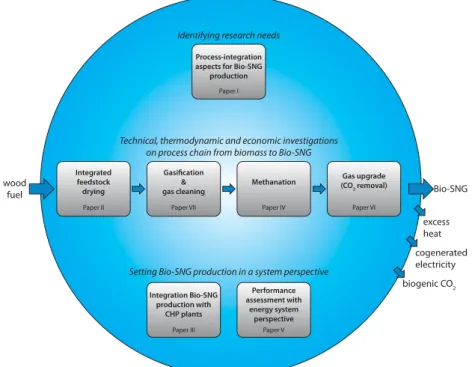
Figure 7 illustrates the focus areas of the appended papers as well as their interrelations in the context of the Bio-SNG production process.
FIGURE 7. Content of and links between papers included in this thesis.
In Paper I research needs in relation to process integration aspects for Bio-SNG production are identified. Papers II, IV, VI and VII investigate different conversion steps within the Bio-SNG process and their importance for overall process performance. Paper III evaluates the consequences of integrating Bio-SNG production into existing infrastructure and Paper V assesses the energy and economic performance as well as the carbon footprint for Bio-SNG production in particular and biofuels in general, also accounting for the background energy system the process is to be implemented into.
Paper I Process-integration aspects for Bio-SNG
production Paper II Integrated feedstock drying Paper VII Gasification & gas cleaning Paper IV Methanation Paper VI Gas upgrade (CO2 removal) Paper III Integration Bio-SNG production with CHP plants Paper V Performance assessment with energy system perspective Identifying research needs
Technical, thermodynamic and economic investigations on process chain from biomass to Bio-SNG
Setting Bio-SNG production in a system perspective wood fuel Bio-SNG excess heat cogenerated electricity biogenic CO2
2
Technology Background and
Literature Review
The general process setup for Bio-SNG production by thermo-chemical gasification is illustrated in Figure 8. Overall, the process releases substantial amounts of excess heat. This excess heat can be partly used to satisfy heat demands in nearby processes or district heating networks. It can also be partly converted to electric power. The cogenerated heat and power constitute value-added products and services which can be sold, thus generating additional revenue.
FIGURE 8. Bio-SNG production process with illustration of additional export (as
well as possible import) of by-products and services.
With Bio-SNG, electricity, heat, and possibly carbon dioxide and sulphur as product spectrum, the process represents a biorefinery concept according to IEA’s definition, namely “the sustainable processing of biomass into a spectrum of marketable products and energy” (IEA, 2009). Carbon dioxide could be considered as a product if biomass based processes are included in a future carbon capture and storage (CCS) framework (i.e. if the capture and storage of biogenic dioxide generates a revenue). Sulphur can be recovered by the well-known Claus
Dryingg Gasification Gas cleaningg Methanation Gas upgrade
woody
biomass
SNG
Bio-SNG production process
excess heat
heat
electricity
electricity
heat
recoverable
by-products
heat demand
power demand
sulphurpCO
2process but the amount of sulphur needs to be considerable to make the process economically viable. Woody biomass has a very low sulphur content so sulphur recovery is not an option for that feedstock, but might become when considering herbaceous crops or waste biomass where sulphur contents can be up to 1% approaching sulphur content levels of bitumous coal (Klass, 1998). One of the key issues for biorefineries is the efficient conversion of biomass material to products and services, demanding a sound heat and material integration of the different sub-processes to form a viable process in terms of energetic, economic and environmental performance (Demirbas, 2009). As the overall process is exothermal, heat import should be avoided. Inappropriate process design may however lead to import of external heat in order to satisfy the heat demand of sub-processes such as e.g. CO2 separation during gas upgrade. In a similar manner,
electricity is needed within the process but if process excess heat is used efficiently for cogeneration of electricity, import of electricity can be avoided. The integration of the different process steps is not a trivial task due to the large number of process alternatives and – in consequence – the large number as well as the varying nature of the process parameters to be handled. Process modelling and optimization studies in combination with process integration methods are needed to systematically analyse and improve the performance of biorefinery processes (Damartzis & Zabaniotou, 2011). In this chapter, an overview of the technology alternatives and modelling approaches for the different conversion steps is presented, followed by a review of industrial scale activities for SNG production. Finally a review of literature focusing on process integration aspects within Bio-SNG production is presented.
2.1 Conversion Steps for Bio-SNG Production
2.1.1 DryingThe natural moisture content of woody biomass is usually around 50 wt-%. Natural drying at the place of harvest or dedicated storage of biomass can reduce the moisture content considerably. Prior to gasification or combustion, a drying process is generally used to reduce the feedstock moisture content using low quality heat, thereby avoiding providing drying heat at the elevated temperature level of the thermal conversion process. Increases in energy efficiency of e.g. combustion boilers of about 5-15% can be achieved when drying the fuel prior to combustion (Amos, 1998). The optimal feed moisture content for biomass gasification depends on the gasification technology and the subsequent product gas usage, but is between 10-20 wt-% for most gasifiers (Cummer & Brown, 2002).
The energy demand for moisture evaporation alone is around 2650 kJ/kg H2O
(assuming the moisture enters the drying process at 0ºC and leaves as saturated vapour at 80ºC, imaginable representative temperature level for the exhaust of an air dyer). Additional energy input is needed in the drying equipment for heating up the biomass, compensating for losses, and material/gas transport.
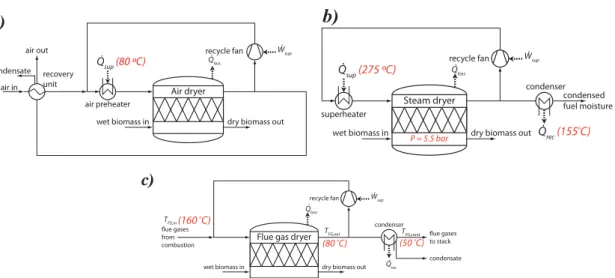
Basically, three different drying techniques are applied within the bioenergy sector: • Low-temperature air drying
• Steam drying • Flue gas drying
A rough estimation of the energy demand for flue gas dryers amounts to 3200kJ/kg H2O (Wimmerstedt & Linde, 1998). In contrast, for a steam dryer, the
net heat demand is considerably lower (theoretically as low as 600 kJ/kg H2O),
since it is possible to recover a large amount of the input heat by condensation of the evaporated biomass moisture. A steam dryer is, therefore, of particular interest for heat integration opportunities. This advantage is counteracted by the higher investment costs. A fluidised bed type steam dryer compared to a stand-alone flue gas dryer capable of removing 25 ton/h of H2O is estimated to result in about 40%
higher investment costs (Wimmerstedt & Linde, 1998). Such a dryer could for example supply a biomass boiler with a thermal load of about 175 MWLHV(20
wt-%moisture) when assuming drying from 50 to 20 % moisture content prior to
combustion.
A common problem associated with biomass drying is the emission of volatile organic compounds (VOC) emitted from the wet material in addition to the water vapour. Higher temperatures lead to higher emissions, and depending on the dryer type and the nature of the organic material, flue gases and water condensate flows contain a certain amount of impurities requiring treatment (Svoboda et al., 2009). The condensate mainly contains organic acids, terpenes and alcohols, whereas the flue gases are contaminated with non-condensable terpenes and aromatic compounds (Ek et al., 2000).
Given that a lower drying temperature leads to lower emissions and given the attractiveness of using low quality heat for the drying process, there is currently significant interest in the development of low-temperature air drying systems. Two different concepts for air drying – single-stage drying with recycle and multi-stage drying – have been estimated to result in energy demands just above 2700kJ/kgH2O with heat sources at temperatures as low as 80ºC (Holmberg &
system with inlet air temperatures at 70ºC (Opcon, 2013). Using low grade heat – that is usually discarded into the environment – for drying purposes instead of high temperature flue gases often generated by combustion of additional biomass represents a large potential for energy savings. It is estimated to increase the biomass potential within the Swedish forest industry by up to 25% without any additional wood cuttings (Johansson et al., 2004). This optimistic scenario is based on assumptions for the pulp and paper industry where the heating value is increased with excess heat from kraft boilers that else would be lost to the environment and also accounts for the fact that the loss of solid combustible mass by biological degradation is substantially decreased by the fuel drying process. More moderate estimates of the energy saving potential of drying are about 10% (Spets, 2001).
2.1.2 Gasification and Gas Cleaning
After drying, biomass is fed into a gasification unit for the major conversion step within the Bio-SNG process converting solid biomass into product gas. For conventional thermal gasification three technology alternatives exist, that are depicted in Figure 9.
FIGURE 9. Different types of thermal gasification technology.
There also exist gasification technologies adapted to wet biomass feed – namely hydrothermal gasification at conditions close to the critical point for water (374 °C, 221 bar) – that have been proven on a laboratory scale (Waldner & Vogel, 2005). Luterbacher et al. (2009) investigated this technology for production of Bio-SNG and identified it as a promising future technology. However, due to its early stage of development and limited amount of published data, the hydrothermal gasification technology is not considered in this work.
Biomass Product gas Oxidant Ash/Slag Fixed bed of biomass Biomass Oxidant Ash/Slag Product gas Ash/Slag Cyclone Gas, ash &
bed material bed material Fluidised bed biomass & bed mateial Fixed bed gasifier
(Updraft - countercurrent configuration)
Biomass Oxidant Ash/Slag Product gas Entrained flow of biomass Fluidised bed gasifier
Thermal gasification of biomass basically proceeds in three major steps. First the remaining fuel moisture is evaporated, followed by pyrolysis converting the biomass into a char as well as permanent and condensable (water and tars) gases. The major chemical reactions occurring in gasification are listed here (adopted from Heyne et al. (2013)):
Biomass feedstock →
→ char + tars + CO2 + H2O + CH4 + CO + H2 + (C2 – C5) + impurities (R1) C + ½ O2→ CO ∆Hr298K = -109 kJ/mol (partial oxidation) (R2)
C + CO2↔ 2 CO ∆Hr298K = +172 kJ/mol (reverse Boudouard) (R3)
C + H2O ↔ CO + H2 ∆Hr298K = +131 kJ/mol (steam gasification) (R4)
CH4 + H2O ↔ CO + 3 H2 ∆Hr298K = +159 kJ/mol (steam reforming) (R5)
CO + H2O ↔ CO2 + H2 ∆Hr298K = -42 kJ/mol (water gas shift) (R6)
The first reaction (R1) represents the pyrolysis step while the remaining reactions (R2-R6) are heterogeneous and homogeneous gasification reactions.
The various gasification technologies considered for realizing these conversion reactions require specific feed qualities, have different ranges of operation, and – most importantly – have a certain range of capacity. Indicative values for these different parameters are given in Table 1. Fixed bed gasification is mainly suited for small scale applications, whereas fluidised bed and entrained flow gasification are more suitable for medium to large scale applications.
TABLE 1: Gasification technology characteristics.
Fixed Bed Fluidised Bed Entrained Flow
Input Particle Size [mm] 10 – 300 < 50 < 0.1 Outlet Gas Temperature
[ºC] 400 – 1000 700-1200 1200-1500 Operating Pressure from atmospheric pressure (1 bar) to ~25 bar Gasification Medium air, steam, oxygen, flue gas, product gas Plant Size [MWth input] < 10 10 – 100 100 – 1000 The different operational ranges and setups also result in differing qualities of the product gas with respect to gas composition, heating value and level of purity (e.g. tar content). Besides the gasification technology, the gasification medium influences these properties to a major extent. Fixed bed and entrained flow gasification are direct gasification technologies with an oxidising medium (e.g. air or oxygen) partly combusting the biomass in order to provide the necessary heat
for gasification. Fluidised bed gasification can be operated in the same way using oxygen for direct gasification, but even allows for indirect gasification, with the heat for gasification being transferred to the biomass by means of the circulating bed material. A separated combustion chamber then heats up the circulating bed particles. The non-gasified char from the gasification reactor provides additional fuel supply to the combustion chamber. A simplified flow diagram involving indirect gasification is illustrated in Figure 10. Indirect gasification produces a gas with very low nitrogen content, making it suitable for synthesis of biofuels or chemicals. In the case of direct gasification, oxygen-production is necessary in order to obtain a nitrogen-free gas.
FIGURE 10. Simplified flow diagram of indirect gasification.
In the framework of Bio-SNG by thermal gasification, the two concepts considered for large-scale production are indirect and direct gasification in fluidised beds, both technologies available in the 100 MW range, with direct gasification being considered more suitable for the largest scales as the technology is less complex to operate under pressurised conditions. There also exist a number of small-scale concepts (e.g. heat-pipe reformer for SNG production (Tremel et al., 2012)) that have not been considered in this work. For indirect gasification pressurising the gasification process implies pressurising two vessels (see Figure 10) and, in addition, managing the pressure differential between these two vessels. No commercial pressurised indirect gasification units exist, and it is unlikely that this will be the case in the medium term (Heyne et al., 2013). Fluidised bed gasification has the advantage of being available at larger scale in relation to fixed bed gasification, and gives considerably higher methane content in the product gas – leading to higher conversion efficiency – compared to entrained flow gasification. Pressurisation is sometimes considered necessary to keep the increase in vessel volume moderate when scaling-up in thermal size, thereby gaining in economy of scale.
Gasification
fluidised
bed
combustion
hot bed material bed material, ash & charfuel gasification medium product gas fuel flue gas air heat fuel
A general goal for biomass gasification for SNG production is a high methane content out from the gasifier, leading to better performance as losses in the methanation section can be avoided. However, the aim of high methane yields conflicts with associated high tar yields that are undesired. Considering modelling aspects of biomass gasification in fluidised beds, the range of models proposed in the literature varies from black-box to computational fluid-dynamic models. Gómez-Barea and Leckner (2010) present a comprehensive review of available models and conclude that most models are well capable of representing the specific reactor types they have been developed for. However, little data is available for validation of detailed models and in addition, validation at large scale is a major issue that is yet unresolved. Models used for gasification are therefore often specific to a reactor type of experimental equipment used and comparison between model results may in consequence be biased. Too many parameters such as feedstock composition, size, and shape, reactor geometry and operation concept, bed material choice and others make it difficult to apply general approaches that are at an acceptable level of detail for tackling the above mentioned task within a process integration study such as conducted within this thesis.
The product gas resulting from the gasification process mainly consists of carbon monoxide, hydrogen, carbon dioxide, methane and water vapour. However, the presence of trace components makes several gas cleaning steps necessary prior to synthesizing methane. The constituents present in the product gas and needing treatment are particulate matter (ash, bed particles), higher hydrocarbons and tars, sulphur and nitrogen compounds, as well as alkali metals. Gas cleaning – and in particular tar cleaning – is still considered by many as the Achilles heel of biomass gasification for downstream synthesis applications (Heyne et al., 2013).
Particulates may be removed from the product gas by cyclones, hot gas or fabric filters, as well as by scrubbing separators. Particle separation also reduces the tar content of the product gas and the extent of such removal is dependent on the separation technology applied (Han & Kim, 2008).
Tar removal is necessary in order to avoid excessive fouling of the heat exchanger equipment. It is possible to reduce tar formation during the gasification process by using catalytic bed material (Pfeifer et al., 2004), but several post-gasification product gas cleaning technologies are available as well. Scrubbing has been demonstrated as feasible to remove product gas tar both below and above the water dew point (Rauch & Hofbauer, 2003; Zwart et al., 2009). Water condensation in the scrubbing unit makes a phase separation of the condensate necessary and yields waste-water contaminated with organic compounds, thereby favouring scrubbing technology that operates above the dew point. However, scrubbing generally implies thermal losses during the process as part of the sensible heat of
the product gas is lost. Catalytic reforming of tars at higher temperatures might overcome this problem but has not yet been proven on an industrial scale. Chemical looping reforming (CLR) has been proven at a laboratory scale to produce clean synthesis gas (Ryden et al., 2006) and could potentially be applied for tar reforming within biomass gasification for biofuel production processes (Dutta et al., 2011; Lind et al., 2010).
Sulphur compounds – mainly hydrogen sulphide – present in the product gas are highly poisonous to catalysts and need to be reduced to very low concentrations prior to the synthesis step. Regenerative sulphur guards may be used to reduce sulphur concentrations to well below 1 ppm (Forzatti & Lietti, 1999). Washing techniques are also available to remove sulphur, even making recovery via the Claus process possible. However, the recovery of sulphur is only economically feasible for large scale units since sulphur compounds are only present in minor concentrations in product gas resulting from wood biomass (Vogel et al., 2006). For removing alkali traces in the product gas, both washing techniques and techniques based on solid sorbents – “alkali getters” – are available. The latter operate at high temperatures and are either based on chemisorption or physical adsorption (Turn et al., 1998). The influence of this removal process on the overall energy balance of the SNG process can be considered negligible due to the small amount of alkali present in the product gas based on wood biomass with low ash content. This can, however, change if wood waste material, sludge or other contaminated feedstock are used for gasification. Leaching of the feedstock prior to gasification is an alternative technology used to remove alkali (Cummer & Brown, 2002)
2.1.3 Methanation
Clean product gas is catalytically converted to methane in the following step. The main reaction occurring during methanation is the conversion of carbon monoxide and hydrogen to methane and water. As documented in the literature (Hayes et al., 1985) and as is obvious from reaction (R7), the optimal ratio of hydrogen to carbon monoxide prior to methanation is 3:1.
CO 3 H2 CH4 H2O ∆H K = - 206 kJ/mol (R7)
For product gas from biomass gasification, however, this ratio is often less than 2:1, making a water-gas shift (reaction (R8), already mentioned in gasification reactions as reaction (R6)) necessary.
Carbon dioxide is another possible source of methane from the product gas and can be converted according to reaction (R9). This is, however, a linear combination of reactions (R7) and (R8). The reaction illustrates that complete conversion of the carbon stock in the product gas (represented by CO and CO2) can be converted in
case enough hydrogen can be supplied.
CO2 4 H2 CH4 2 H2O ∆H K = -164 kJ/mol (R9)
The highly exothermic character of the methanation reaction (R7) makes it an interesting source of recoverable process heat within the Bio-SNG process. Two different reactor concepts have been developed for methanation with most of the development having occurred in connection with coal-to-SNG projects undertaken during the 1970s and 1980s (Kopyscinski et al., 2010). Methanation is either carried out in a series of adiabatic fixed bed reactors with inter-cooling and optional product recycle (Harms et al., 1980; Moeller et al., 1974), or in a single fluidised bed reactor at isothermal conditions (Friedrichs et al., 1982). Commonly used catalysts are Ni-based. Experimental results for catalytic conversion of methane indicate that the theoretical chemical equilibrium is approached very closely (Seemann, 2006). The two alternative technologies are illustrated in Figures 11 and 12.
The Paul-Scherrer-Institute (PSI) has adopted the isothermal fluidised bed methanation technology for biomass-based product gas in a once-through reactor and has successfully operated the pilot-scale in the Güssing biomass gasification plant (Bio-SNG, 2009; Seemann, 2006).
FIGURE 11. Adiabatic fixed bed methanation with inter-cooling and recycle
(TREMP technology). H1 & H2: heater, C1-C4: cooler, R1-R3: adiabatic methanation reactor (flowsheet adapted from Harms et al. (1980)).
R1 R2 R3 compressor H1 H2 C1 C4 C3 C2 split flash tank syngas steam condensate CH4-rich gas recycle compressor Ni-based fixed bed catalyst
FIGURE 12. Isothermal fluidised bed methanation (COMFLUX technology). H1 &
H2: heater, C1: cooler, R1: isothermal methanation reactor (flowsheet adapted from Friedrichs et al. (1982)).
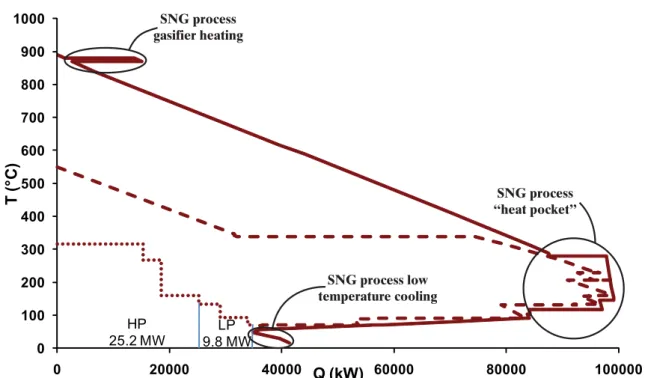
From a process integration perspective the main differences between the two technologies are the temperature levels where excess heat is released and the operating pressure. For the adiabatic process, temperatures up to 650ºC are reached, limited by catalyst sintering problems at higher temperatures (Rostrup-Nielsen et al., 2007). Fluidised bed methanation is operated at temperatures around 300ºC. Lower temperatures would be even more favourable from a thermodynamic viewpoint, but are, however, limited by catalyst activation and carbon deposition problems (Seemann, 2006). A higher pressure is favourable for methane yield as the number of moles is reduced from four to two according to reaction (R7). Pressure effects are considerably more marked at higher temperatures (Deurwaarder et al., 2005). Consequently, adiabatic fixed bed methanation needs to be operated at elevated pressure in contrast to isothermal methanation, which achieves high conversion efficiencies even at atmospheric pressures. A careful integration of the methanation process into the overall Bio-SNG process is crucial to obtain an optimal overall process performance.
2.1.4 Gas upgrade
The gas produced by methanation is a mixture of methane, carbon dioxide and water, with remaining traces of nitrogen, hydrogen and carbon monoxide. In order to feed Bio-SNG into the natural gas grid, certain quality requirements need to be fulfilled. Quality requirements differ between countries, but a harmonisation of gas quality within the European Union is in progress (EASEE-gas, 2005). Table 2 presents the recommended quality requirements. A number of trace components present in gas originating from biomass (e.g. CO, H2 and NH3) are, however, not
mentioned. R1 compressor C1 syngas steam flash tank condensate CH4-rich gas H1 H2 Ni-based catalyst material fludized by syngas/steam mixture
TABLE 2. Natural gas quality requirements according to a recommendation of the
European Association for the Streamlining of Energy Exchange – gas (EASEE-gas, 2005)
Parameter Unit Min Max
Wobbe Index (WI) a kWh/m3 13.60 15.81 Relative Density RD b m3/m3 0.555 0.700
Total Sulphur S mg/m3 - 30
H2S + COS (as S) mg/m3 - 5
Mercaptans mg/m3 - 6
Oxygen O2 mol-% - 0.001
Carbon Dioxide CO2 mol-% - 2.5
Water Dewpoint ºC at 70 bar - -8 Hydrocarbon Dewpoint ºC at 70 bar - -2
a The Wobbe index WI is defined as the higher heating value divided by the square root
of the relative density RD √
b The relative density RD is defined as the gas density in relation to the density of air at
standard conditions (0ºC, 1.01325 bar)
The most important gas upgrade step is the separation of CO2. This is an energy
intensive process with several technical solutions available that differ considerably in heat and power demand. Table 3 gives an overview of the most common technologies and a qualitative indication of their energy demand, methane recovery and investment costs.
TABLE 3. Qualitative characterisation of CO2 separation processes (ISET, 2008; Johansson, 2008; Reppich et al., 2009).
Technique Heat Demand Power Demand Methane Recovery Investment Costs Pressurised Water
Scrubbing (PWS) none moderate high low Physical Absorption
(Selexol) moderate moderate high moderate Pressure Swing
Adsorption (PSA) none moderate high moderate Amine Based
Absorption (MEA) very high low very high high
Membrane Separation none high moderate very high Cryogenic Separation none high very high very high
When integrating the CO2 separation within the Bio-SNG process, the energy
heat and pressure levels of the other process steps. This is, in particular, applicable to the heat demand; as an example, one could imagine covering the large heat demand of an amine-based absorption (MEA) by means of using the reaction heat released during methanation.
Finally, the gas needs to be dried of any remaining moisture and then compressed. Drying is usually achieved by a glycol wash unit using triethylene glycol (TEG) as a solvent, alternatively it may be done by means of a temperature swing adsorption (TSA) process using silica gel or aluminium oxide (GPSA, 2004). The compression level is dependent on the location of the production site and the grid into which the Bio-SNG is to be fed. Local distribution networks in Sweden have a pressure of up to 10 bar, whereas large transmission pipelines are pressurised up to 80 bar.
2.2 Industrial Scale Production of SNG
Production of SNG from solid fuels (primarily coal) was initially driven by the oil crisis in the 1970s leading to a number of pilot and demonstration plants (Kopyscinski et al., 2010). The Great Plains Gasification Plant (Panek & Grasser, 2006) is the only plant that was built on commercial scale and that is still in operation today. The plant was started up in 1984 with a gas production capacity of about 1.5 GWSNG. The plant has operated continuously since start-up and its
capacity was gradually increased by process changes to reach 2 GWSNG by 20044.
During normal operation the plant is supplied with 18000 t/d of lignite coal, corresponding to about 3.4 GW. In addition to SNG the plant produces a number of by-products such as naphtha, phenol, krypton, xenon, liquid nitrogen, and carbon dioxide. The latter is transported by pipeline and used for enhanced oil recovery (Panek & Grasser, 2006).
Investigations of Bio-SNG production processes based on thermo-chemical gasification of woody biomass started around the millennium shift when interest in large-scale production of renewable electricity, transportation fuels and materials increased. However, no industrial scale plant for Bio-SNG production is in operation to date. A number of biomass gasification concepts exist which have been demonstrated at varying scale and level of development and which are also considered for Bio-SNG production. One prominent example of biomass gasification technology is the fast internally circulating fluidised bed (FICFB) gasifier developed at TU Vienna with its demonstration plant in Güssing, Austria that was started up in 2001 (Hofbauer et al., 2002). It is an indirect gasification
4 170 million standard cubic feet of SNG per day (4.62 million Nm3/day) with an average heating value of 972 BTU/scf (37.8 MJ/Nm3) (Panek & Grasser, 2006)
technology operating similarly to the general concept illustrated in Figure 10. The Güssing gasifier has a 8 MWth fuel feed thermal capacity. The product gas is used
for co-generation of heat and power in internal combustion engines. A number of CHP plants based on the FICFB technology are in operation in Austria (Oberwart, Villach) and Germany (Senden) (Rauch, 2012). In the plant in Güssing, methanation tests were performed using a slip-stream of the product gas (Seemann, 2006; Seemann et al., 2004) and a demonstration Bio-SNG plant with a 1MWSNG production capacity was installed and has been operated successfully
since 2009 (Bio-SNG, 2009).
A number of industrial scale projects for Bio-SNG production are planned based on the indirect gasification concept developed and demonstrated in Güssing. The Gothenburg Biomass Gasification (GoBiGas) project (GoBiGas, 2012; Gunnarsson, 2011) is currently under construction with a 20 MWLHV,SNG plant
based on the FICFB gasification technology that is to start full scale operation in November 2013. The methanation and gas upgrade section in the GoBiGas plant is provided by Haldor Topsøe using a fix bed adiabatic methanation technology. This is different from the Güssing plant, where isothermal methanation in fluidised bed has been applied. The feedstock for gaining first operational experience will be wood pellets with the goal of changing to wood chip forest residues once the main process has been demonstrated. After evaluation of the operational experiences an extension of the plant to a total production capacity of 100 MWLHV,SNG is
envisaged.
In France, the Gaya Bio-SNG production project based on the FICFB gasification technology is under development (Mambré, 2010; Perrin, 2012) with a thermal feedstock input of 0.6 MWth. The project is designed as a development and testing
platform that is planned to be run during a 5-year testing period with the aim of identifying favourable process options and conditions for scale-up to industrial size. Another gasification technology based on the FICFB concept is the Adsorption Enhanced Reforming (AER) gasification technology that was successfully tested at the Güssing plant in 2007/2008 (Koppatz et al., 2009). The concept uses a CaO-containing bed material and operates in the lower temperature range for fluidised bed gasification (600-700 ºC). This allows situ carbonation of the bed material forming CaCO3, and CO2 is thus removed from the product gas in the gasification
reactor. On the combustion side, the carbonation reaction is reversed forming CaO and the CO2 is released with the flue gases. The resulting product gas from the
gasifier has a considerably higher H2 content and in particular a H2/CO ratio in the
range of 3:1 making it particularly suitable for methanation. Based on the successful tests in Güssing a 10 MWth plant was planned to be built in Germany
(Marquard-Möllenstedt et al., 2009) but due to drastic increases in wood fuel prices the project was abandoned for economic reasons (Bomm, 2011).
The Energy Research Centre of the Netherlands (ECN) has demonstrated Bio-SNG production based on its MILENA indirect gasification technology at pilot scale (0.8 MWth input). The major difference compared to the Güssing gasifier is
the fact that both combustion and gasification are integrated in a single vessel. Biomass is gasified with steam in an inner annular space in a fluidised bed. The unconverted char is burnt with air in the lower part of the vessel surrounding the gasification reactor for supplying the necessary heat (van der Meijden et al., 2009). ECN in collaboration with the HCV group is going to build a plant in Alkmaar for gasification of 11.6 MWth of waste wood for production of Bio-SNG based on the
MILENA technology. The plant will use the major part of the cleaned product gas for production of green electricity using a boiler connected to a steam power cycle, and about 10% of the gas will be upgraded to Bio-SNG. The plant is scheduled for start-up in 2014 (van der Meijden et al., 2011, van der Drift, 2013).
In Finland, a consortium between Gasum, Helsingin Energia and Metsä Fibre is studying possibilities to build a 200 MWSNG Bio-SNG plant adjacent to a pulp mill.
No choice of technology is done so far and an investment decision is planned to be taken in 2014 (Siitonen et al., 2012).
Direct oxygen-blown gasification technology is the core of the Bio2G project being considered by E.ON with the purpose of building a large scale Bio-SNG production plant with capacity of 200 MWSNG in Sweden (Fredriksson Möller,
2011). Due to uncertainties regarding support policies and in consequence a high economic risk the project was put on hold at the end of 2012 (Hennius, 2012). Several obstacles to industrial activities still need to be resolved in order to incite large scale production of second generation biofuels in general:
• there are no suppliers that provide turnkey-ready plants
• considerable biomass fuel market price variations and rather high price levels in relation to fossil alternatives make it difficult to ensure the profitability of biofuel processes
• policy instruments promoting biofuels need to be clearly defined to allow for long term planning
All these aspects imply high financial risks for companies engaged in biofuel production activities. One pathway for reducing the financial risks is through technical process improvements in the process chain. Process integration may
contribute to reducing these risks by guiding the technology development by pinpointing crucial aspects for specific sub-processes for the overall process energy performance .
2.3 Process Synthesis and Integration Studies on
Bio-SNG Production
A number of published studies have investigated the Bio-SNG process covering a varying spectrum of aspects from energy conversion efficiency and economic performance to process synthesis and integration with varying levels of detail.
Mozaffarian and Zwart (2003) compared different process configurations for production of Bio-SNG with pressurised oxygen-blown CFB gasification and atmospheric indirect steam gasification as key conversion technologies. Excess process heat was assumed to be used for cogeneration of electricity but no detailed process integration approach was applied. The study concluded that indirect gasification is the technology of choice leading to cold gas conversion efficiencies of up to 70% on a lower heating value (LHV) basis. Cost estimations for this technology determined in the study of Mozaffarian and Zwart (2003) are in the range of 16-40 €/MWhSNG. Another study pointing out indirect gasification as
superior to other gasification technologies for Bio-SNG production was published by van der Meijden et al. (2010). This study focuses on the energetic performance of different process configurations. Indirect gasification is stated to result in considerably higher net biomass to SNG conversion efficiency (67 % on a LHV basis, including the electricity balance and assuming biomass feedstock with a 15 wt-% moisture content), compared to 58% and 54 % for direct oxygen-blown and entrained flow gasification, respectively.
Exergetic analyses of Bio-SNG production based on indirect gasification technology point out the gasifier, methanation step and CO2 separation unit as the
largest sources of exergy losses (Jurascik et al., 2010; Vitasari et al., 2011). The overall exergetic efficiency of the process on a dry fuel basis (13.8 wt-%) is shown to vary from 69.5-71.8% for the investigated range of gasification temperatures and pressure, i.e. 650-800ºC and 1-15 bar (Jurascik et al., 2010).
Gassner proposed a methodology for synthesis of thermo-chemical processes for production of biofuels (Gassner, 2010) that is illustrated in detail for Bio-SNG production (Gassner & Maréchal, 2009, 2012). Starting from a superstructure with different technology options for the main process steps in Bio-SNG production, a genetic optimisation algorithm is used to identify optimal process solutions with respect to specified performance indicators, such as specific investment cost,
exergy efficiency, or chemical efficiency. The latter efficiency is defined by Gassner & Maréchal as being a weighted fuel-equivalent efficiency where cogenerated or consumed services such as heat or electricity are replace by the equivalent amount of natural gas using reference conversion efficiencies. Each set of technology and operating parameters generated by the algorithm is analyzed using an energy-integration model maximising combined fuel, heat and power production of the process using a mixed integer linear programming approach. The nature of the genetic algorithm allows multi-objective optimisation resulting in pareto curves indicating the trade-off between competing objective functions, for example specific investment cost and energy efficiency. Applying this methodology to Bio-SNG production results in overall energy efficiencies – accounting for the energy content of all streams leaving and entering the system – in the range of 69-76% and production costs in the range of 76 - 107 and 59 - 97 €/MWhSNG based on a thermal
input of 20 and 150MWLHV into the process, respectively (Gassner & Maréchal,
2009). Contrary to the above-mentioned studies, Gassner & Maréchal identify direct oxygen-blown gasification to be the most promising technology for Bio-SNG production (Gassner & Maréchal, 2012). A selection of other findings from the studies from Gassner and Maréchal are that air and steam drying are advantageous technologies for pretreatment prior to gasification, hot gas cleaning in particular is beneficial for pressurised gasification in connection to methanation with CO2
removal downstream of the methanation unit. For large scale pressurised gasification they conclude that physical absorption is the most suitable CO2
separation technology for achieving high overall process energy efficiency. In addition Gassner and Maréchal stress that energy recovery and cogeneration contribute significantly to energy and cost-efficient process design and that integration with existing facilities might be an option since small scale steam cycles are usually inefficient and expensive.
Rönsch (Rönsch, 2011; Rönsch & Kaltschmitt, 2012) compares indirect and direct gasification for SNG production with different options for converting the process excess heat to electrical power and identifies O2-blown gasification as being slightly
more advantageous with respect to exergetic efficiency and economic performance. However, the environmental performance evaluation measured as emission of CO2-equivalents per MJSNG produced is in favour of indirect gasification for SNG
production.
Nyström et al. (2007) investigated Bio-SNG production and a number of other biomass gasification concepts in connection to co-location or integration with a natural gas turbine combined cycle (NGCC) plant and an existing district heating network. Bio-SNG production for transportation fuel purposes was identified as the economically most robust solution among the transportation fuel processes investigated (DME, Bio-SNG and hydrogen), given the assumption that policy
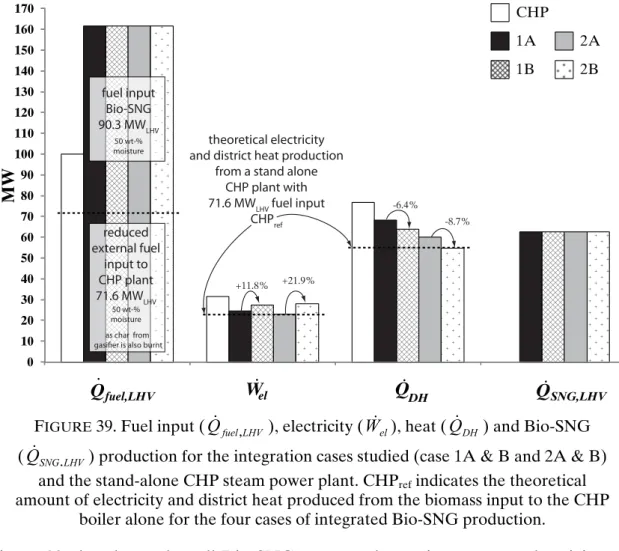
support for transportation biofuels is in place. No heat or material integration with the combined cycle plant was assumed for SNG production and using Bio-SNG as fuel for the NGCC plant was stated to result in low overall energy efficiency from biomass to electricity and heat. Using the biomass gasification product gas directly in the gas turbine was identified as a preferable alternative. The latter concept also was illustrated economically viable by Pihl et al. (2010). Integration of Bio-SNG process with petrochemical processes has been investigated by Arvidsson et al. (2012) for replacing fossil natural gas feedstock. The case study investigating the replacement of the site’s total demand in natural gas of 162 MWth,LHV shows that the process excess heat from Bio-SNG production
can be effectively used to cover the industrial site’s steam demand (19 MW) or alternatively cogenerate electricity to cover the Bio-SNG process’ electricity demand (21 MW). By maximally utilizing the thermal integration possibilities it was shown that it is possible to cover the site’s net steam demand and produce additional 30 MW of electricity, but at the cost of an additional import of 36 MWLHV of biomass fuel.
3
Objectives and Scope
3.1 Objectives
This work focuses on using process integration methods and tools to identify efficient and cost-effective pathways for the production of Bio-SNG by thermal gasification of biomass. The approach adopted accounts for the energy and monetary flows associated with all process product and energy service streams delivered by the Bio-SNG production process.
A variety of applicable technologies exist to achieve conversion within the Bio-SNG production process. The combination of these different technologies results in a number of possible process configurations with varying product spectra. So far, no plant has been built on an industrial scale and there is a lack of knowledge about how to combine the different sub-processes into an optimized and well-integrated process. Using process integration tools – in particular pinch methodology – this study investigates thermal integration opportunities between the different sub-processes and the resulting consequences for overall process efficiency.
The focus of the evaluation of different process pathways is on: • the conversion efficiency of biomass to SNG
• the use of recoverable process heat for the cogeneration of power and useful heat
• the economic performance as well as the carbon footprint
In order to facilitate this evaluation, it is necessary to carefully define appropriate performance indicators. These performance indicators should be of a general character, allowing for a fair comparison of Bio-SNG with other biofuel production process options.
Models for obtaining the mass and energy balances for the different process steps within the SNG production process are developed and used as a basis for process synthesis. The modelling of the different sub-processes is based on extensive literature data studies as well as published experimental data, when available. Wherever possible, a model capable of reflecting the influence of changes in operating parameters on the energy and material balance performance was developed. When this was not possible due to limited information on the processes, or the complexity of the modelling effort was judged beyond the scope of this work, standard performance as published in the literature was implemented in the models. A base case Bio-SNG production process flowsheet is proposed, and by varying or replacing different sub-processes in the base case, bottlenecks with respect to energy efficiency are identified. Based on this investigation critical process steps for process heat integration and Bio-SNG yield are identified. Process integration tools are used to identify opportunities for overall process performance improvements by changes involving these critical process steps.
As the introduction of second generation biofuels may be facilitated by making use of existing infrastructure, possible integration of the Bio-SNG production process with existing biomass-based combined heat and power plants is investigated in detail.
In order to be able to evaluate the performance of a Bio-SNG process implemented within an existing background energy system, it is important to clearly define the system boundaries and the underlying assumptions for the evaluation. Using energy market scenario tools, a consistent definition of possible future background energy systems can be achieved. Using the energy, economic, and carbon footprint performance data of the available energy conversion technologies within these energy market scenarios, a consistent assessment of the Bio-SNG process alternatives investigated is presented including indirect effects related to the changed consumption and production of fuels and energy services within the energy system. This will be illustrated by the use of different appropriate performance indicators.
3.2 Scope
The scope of this thesis has been limited to currently available technologies for large-scale Bio-SNG production. Technologies considered for small-scale application or being at early development state as mentioned in Section 2 were therefore excluded. Due to these imposed restraints, the major subject of investigation of this work was focused on direct and indirect fluidised bed
gasification technologies as central conversion step within the Bio-SNG process as well as all associated process steps.
The focus has been on evaluation of process concepts based on indirect gasification as a number of studies identify this technology as superior with respect to energy conversion performance compared to alternative gasification technologies in the framework of Bio-SNG production (Mozaffarian & Zwart, 2003; van der Meijden
et al., 2010). In addition, indirect gasification as a potential retrofit technology for
existing combustion units (Thunman & Seemann, 2009) has been investigated within this work. With ready access to indirect gasification experimental research at Chalmers University of Technology, allowing immediate access to key information about important trends for this technology (Thunman & Seemann, 2009), adopting this technology pathway as the main focus of this work was a natural choice. A comparative analysis based on exergy effi