This version was downloaded from Northumbria Research Link: http://nrl.northumbria.ac.uk/38078/
Northumbria University has developed Northumbria Research Link (NRL) to enable users to access the University’s research output. Copyright © and moral rights for items on NRL are
retained by the individual author(s) and/or other copyright owners. Single copies of full items can be reproduced, displayed or performed, and given to third parties in any format or medium for personal research or study, educational, or not-for-profit purposes without prior permission or charge, provided the authors, title and full bibliographic details are given, as well as a hyperlink and/or URL to the original metadata page. The content must not be changed in any way. Full items must not be sold commercially in any format or medium without formal permission of the copyright holder. The full policy is available online: http://nrl.northumbria.ac.uk/policies.html
Deep Learning-based Regional Image Caption
Generation with Refined Descriptions
P Kinghorn
PhD
2017
Deep Learning-based Regional Image
Caption Generation with Refined
Descriptions
Philip Kinghorn
A thesis submitted to the
University of Northumbria at Newcastle For the degree of
Doctor of Philosophy
Department of Computer Science and Digital Technologies, Faculty of Engineering and Environment,
Date: 06/10/17
Acknowledgements
There have been many people who have helped and supported me throughout my PhD studies. I would especially like to thank Molly Elliot for her unending support and encouragement, helping me maintain my focus and always being there when I’ve needed her most over the past many years. I would like to thank my principal supervisor Dr Li Zhang, for her guidance, help and proof reading throughout my research, my papers and this thesis. I would also like to thank Prof. Ling Shao, for his helpful directions and advice during his time at Northumbria University. I must also thank my family, again for all their help and support not just throughout my studies but the past 25 years.
I would like to thank my fellow researchers within the lab at Northumbria University. Especially, Ben Fielding, Kamlesh Mistry and Diptangshu Pandit for all their help over the past three years of study. Finally, I would also like to thank John Graham and Kerry Veitch for all their time spent proof reading and their support and kindness.
I declare that the work contained in this thesis has not been submitted for any other award and that it is all my own work. I also confirm that this work fully
acknowledges opinions, ideas and contributions from the work of others.
Any ethical clearance for the research presented in this thesis has been approved. Approval has been sought and granted by the Faculty Ethics Committee on 12/2015.
I declare that the Word Count of this thesis is 39,327 words.
Name: Philip Kinghorn
Image captioning in recent research generally focuses upon small, relatively high-level captions. These captions are generally without detail, or insight. Missing out information which we as humans could easily, and would generally, report. This restricts the usefulness of existing systems within real-world applications. Within this thesis, we propose the following solutions to address these problems.
The first stage proposes a region-based approach, focusing upon regions within images and describing them with attributes. These attributes add more meaning to standard classification labels. Improving the classification label, ‘dog’, produced by existing systems, to the more detailed label ‘white spotted dog’. This adds a large degree of detail when used within template-based description generation. The area of healthcare is also explored in which the system is paired with a visual agent. The agent can describe the environment and report potential hazards, as well as socialising through conversation.
The second stage improves upon the previous architecture, by proposing another region-based architecture which removes the rigidity of templates. Instead sentences are generated through a Recurrent Neural Network. Training this architecture on multiple smaller datasets allows for a quicker training stage, with less computing power required during both training and testing. An encoder-decoder structure is proposed to translate the detailed region labels into full image descriptions. This produces natural sounding descriptive phrases that accurately depict the contents of an image.
The third stage proposes a hierarchically trained, end-to-end style system to generate an image description with the same required functionality to describe detections in detail but without the need for multiple models. This system can utilise the humanoid robot’s vision and voice synthesis capabilities. Overall, the above proposed systems within this research outperform many state-of-the-art methods for the refined image description generation task, especially with complex and out-of-domain images, such as images of paintings.
1. Kinghorn, P., Zhang, L. & Shao, L. A Hierarchical and Regional Deep Learning Architecture for Image Description Generation. Pattern Recognition Letters (2017).
2. Kinghorn, P., Zhang, L. & Shao, L. A region-based image caption generator with refined descriptions. Neurocomputing (2017).
3. Kinghorn, P., Zhang, L. & Shao, L. Deep learning based image description generation. in 2017 International Joint Conference on Neural Networks (IJCNN) 919–926 (IEEE, 2017).
4. Zhang, L., Fielding, B., Kinghorn, P. & Mistry, K. A vision enriched intelligent agent with image description generation. in Proceedings of the 2016
International Conference on Autonomous Agents & Multiagent Systems 1488– 1490 (2016).
5. Fielding, B., Kinghorn, P., Mistry, K. & Zhang, L. An Enhanced Intelligent Agent with Image Description Generation. in International Conference on Intelligent Virtual Agents 110–119 (2016).
6. Neoh, S. C., Zhang, L., Mistry, K., Hossain, M. A., Lim, C. P., Aslam, N., &
Kinghorn, P. Intelligent facial emotion recognition using a layered encoding cascade optimization model. Applied Soft Computing, 34, 72-93. (2015)
1.1 Aims and Objectives ... 1
1.1.1 Descriptive Captions ... 2
1.1.2 Cross Dataset Functionality ... 3
1.1.3 Intelligent Agent and Robotics ... 3
1.2 Motivation ... 4
1.2.1 Natural or Human Like Descriptions ... 5
1.2.2 Social Media and Public Images ... 5
1.2.3 Healthcare ... 6
1.2.4 Automated Human Description – CCTV ... 7
1.3 Contributions ... 7
1.4 Thesis Outline ... 12
Chapter 2 Background... 15
2.1 Composite methodology ... 16
2.1.1 Pre-Processing ... 16
2.1.2 Region of Interest Extraction ... 16
2.1.3 Feature Extraction ... 16
2.1.4 Classification ... 17
2.1.5 Support Vector Machines/Regressor... 19
2.1.6 Sentence Generation... 20
2.2 End-to-End ... 20
2.2.1 Pre-Processing ... 21
2.2.2 CNN Feature Extraction and Image representation ... 21
2.2.3 Sentence Generation... 22
2.3 Transfer Learning ... 25
2.5.1 Bleu ... 27
2.5.2 CIDEr ... 28
2.5.3 Meteor ... 28
2.5.4 Rouge ... 28
2.5.5 SPICE ... 28
2.6 Deep Learning Frameworks ... 29
2.7 Summary ... 30
Chapter 3 Related Work... 33
3.1.1 Localisation ... 33
3.1.2 Feature Extraction ... 35
3.2 Attribute Prediction ... 36
3.3 Description Generation ... 38
3.3.1 Composite Image Caption... 38
3.3.2 Video Caption ... 42
3.3.3 End-to-End Image Caption ... 43
3.4 Image Synthesis from Descriptions ... 50
3.5 Robot Image Understanding and Integration ... 50
3.6 Caption/Description Dataset ... 51
3.6.1 Image... 51
3.6.2 Video ... 53
3.7 Summary ... 53
Chapter 4 Composite Deep Learning Image Description Generator ... 57
4.1 Introduction ... 57
4.2 The Proposed Image Description Generation Framework ... 60
4.2.1 Object Detection and Classification... 60
4.2.4 Fall Detection ... 63
4.2.5 Attribute Learning ... 64
4.2.6 Attribute Datasets ... 65
4.2.7 Prepositions ... 66
4.2.8 Sentence Generation and Construction ... 66
4.3 Results and Evaluation ... 68
4.4 Experiment with an Intelligent Visual Agent... 71
4.5 Summary ... 72
Chapter 5 Region-based Image Caption Generator with Refined Descriptions ... 75
5.1 The Proposed Image Description Generation System ... 77
5.1.1 Object Detection and Recognition ... 77
5.1.2 Scene Classification ... 78
5.1.3 Attribute Prediction Using RNNs ... 78
5.1.4 Sentence Generation... 81
5.2 Evaluation ... 83
5.2.1 Evaluation Metrics ... 83
5.2.2 Evaluation Results ... 84
5.3 Summary ... 96
Chapter 6 A Hierarchical and Regional Deep Learning Architecture for Image Description Generation ... 99
6.1 Introduction ... 99
6.2 The Proposed Deep Network for Image Description Generation ... 102
6.2.1 Model Training... 102
6.2.2 Model Datasets ... 104
6.2.3 Architecture ... 104
6.3.1 Experimental Results ... 113
6.4 Summary ... 114
Chapter 7 Conclusion and Future work ... 117
7.1 Summary of Contributions ... 117 7.1.1 Composite methodology ... 118 7.1.2 Refined Descriptions ... 118 7.1.3 Hierarchical Architecture ... 119 7.1.4 Potential Limitations ... 120 7.2 Future Work ... 121 References ... 125
API – Application Programming Interface RNN – Recurrent Neural Network
LSTM – Long Short Term Memory GRU – Gated Recurrent Unit CRF – Conditional Random Field CNN – Convolutional Neural Network DNN – Deep Neural Network
RPN – Region Proposal Network SVO – Subject – Verb - Object MLP – Multi-Layer Perceptron SVM – Support Vector Machine SVR – Support Vector Regressor NLP – Natural Language Processing ROI – Region of Interest
LAN – Local Area Network CPU – Central Processing Unit GPU – Graphics Processing Unit
HOG – Histogram of Oriented Gradients SIFT – Scale Invariant Feature Transform HCI – Human Computer Interaction
1
Describing the contents of images is a relatively easy task for humans, and can be achieved with reasonable accuracy from a very young age. Humans can recognize, distinguish and describe many objects, scene or image categories with many external factors, such as occlusions, changes in illumination and pose that make this task incredibly difficult for machine learning algorithms to succeed (Oliva and Torralba, 2007). Computer vision algorithms have struggled to match this capability.
Although recent research indicates that these algorithms have become incredibly powerful in certain vision domains such as image classification and segmentation, producing detailed descriptive sentences based on the contents of an image is still a challenging task. Applying such a task to robotic vision research may also enable humanoid robots to conduct personalized interaction with humans and understand their surroundings, potentially automating care environments.
Each of these areas has recently been an active research area, and has seen a large increase in performance and results due to the resurgence of powerful deep learning algorithms, in particular Convolutional Neural Networks (CNN) (LeCun et al., 1999). In the domain directly linked to this research, image captions have been widely produced, with systems that can generate paragraphs based on sentences and topics. However, giving a system or model the ability to accurately portray and describe the contents of an image is lacking and is a very active research domain and a difficult challenge for computer vision.
When we, as humans look at an image, we can look at objects, people, scenes and their relationships and describe them in fluid detail. For a machine to achieve similar results, they too should be able to detect objects and people and then describe them to a similar degree.
1.1
Aims and Objectives
The main objective of the research conducted is to propose and improve upon existing image description frameworks, with the ability to automatically classify and describe an image and all of its contents, and improve upon the short captions that are commonplace within this domain.
2 To work towards this overarching aim the following objectives must be explored.
1. Image feature extraction – Experimenting and exploring techniques ranging from low level features, such as edges and colours, to deep learned features from CNN sliding windows.
2. Multiple asset model training – Train respective models and techniques on the relevant datasets for:
a. Object detection and classification b. Person detection
c. Object and Person attribute prediction
3. Caption/Description training – Train sentence, word or character level RNN predictors for whole system pipeline.
4. Model Construction – Merge, build and manage full system pipeline in order for detailed caption generation to take place on a wide variety of image scenarios and styles.
The secondary objective is to allow such a system to be utilised on any image, creating a system to perform cross dataset improves upon its real world usability, thus allowing the system to be extended to run with devices and applications utilising intelligent agents and robotics.
Existing research has focussed on generating high-level, short captions, with minimal added detail. In order to meet the objective, we propose multiple novel frameworks and methods which explore both composite and end to end style architectures within multiple areas of computer vision and Machine Learning research. The proposed architectures and their internal structures require multiple domains, such as object detection and classification, attribute and scene prediction among others. This allows details and objects that may previously be overlooked to be reported and described. This research, without crossing into these multiple domains, severely limits the overall capability and usability, which could effectively pigeon-hole the proposed frameworks into a specific domain, which is against the aims of this thesis and the research within. 1.1.1 Descriptive Captions
When humans describe an object or a person, they would very rarely simply state one label. E.g. ‘Cup’ ‘Man’ or ‘Car’, instead they can add their attributes almost without thought. This diversifies these labels and creates a very descriptive and vivid piece of
3 information. E.g. ‘Shiny red car, with silver wheels’, manufacturer information and its environment can also be very easily added.
One of the preliminary stages within the methodology is to accurately locate, classify and describe objects and people. Typical systems within this area simply look at the overall image or focus on one Region of Interest (ROI), through the use of an attention mechanism and collected features. Through in-depth detection of multiple regions, we can provide a more complex description of a whole image, rather than one specific section or region, which removes bias from the frameworks and models and produces a more general image description.
1.1.2 Cross Dataset Functionality
There are several disadvantages with typical machine learning systems that are trained upon one dataset. Upon testing the system, the images and/or data tested is generally from the same domain. This could effectively force a system to only function well within that domain. Proposing architectures and models that are hierarchically trained and tested upon different datasets allows the system to describe any image passed through it, with a higher degree of accuracy. Such a system could find applications in more varied areas in the wild or within active research. Similar in effect to transfer learning, in that its domain or dataset is not fixed, however not yet to the degree in which for example, training a system on real world images and testing it on oil paintings.
1.1.3 Intelligent Agent and Robotics
Adding the ability for image description to robots and intelligent agents allows for a fluid and free moving camera that can capture its scenes regularly, analyse them quickly, and interpret and understand the scene and then act or converse appropriately. Humanoid robots may not yet be commonplace in homes, however exploring and proposing frameworks that can run on smaller readily available counterparts, such as the NAO and Pepper from Aldebaran Robotics (Aldebaran, 2017), show their incredible potential use within the home in the near future.
Intelligent agents such as Siri and Google Now offer conversation and helpful tools with the use of collected data direct from a mobile phone, such as location or device information (Gyroscope, compass etc.) as well as user entered data, such as personal information. Images have been explored in the context as an aid to product searching
4 on the web, e.g. providing or capturing an image of an item, and using the system to search until it locates a website that sells that product. Adding real world images or analysis could allow this to be used on the fly in videos or from microphones that can record natural descriptions.
1.2
Motivation
In recent years, many methods have been proposed for image description generation. However, the majority of the related research relies upon holistic approaches for image understanding and entity recognition, which may lose details relating to important aspects or regions of an image.
Automatic description of images can enable smoother internet navigation for those with visual impairments. As computing hardware becomes more powerful, this technology can become more mainstream allowing the systems, software and models to become much more accessible and dramatically more portable. Systems such as this allow an increased degree of freedom for visually impaired users as well as potentially reducing work load within healthcare and industry.
This ability could allow for the expansion of applications within robotics, as well as healthcare. These domains are explained in further detail in the following sections. Most of the existing research within the image captioning domain utilise a Convolutional Neural Network (CNN) – Recurrent Neural Network (RNN) style architecture. This works well in most circumstances, especially with the aim of producing short and high-level captions. In this methodology CNNs extract image features from across the entirety of the image, as explained in Chapter 2. These form a very large feature vector, which consists of anywhere between 128 and 4096 dimensions, meaning typical Machine Learned methods cannot cope with the scale or would simply be too slow to be effective, especially in real time or real world scenarios. This paired with the RNN which learns the sequences and patterns within image captions, generates these sentence captions by utilising the large feature vector and the individual generation of each word, this leads to short, relatively nondescript captions.
5 To this end we propose models in which feature vectors are collected for many individual regions within an image. This forms the core of the region-based approach that gives the flexibility for many aspects such as the cross domain, as well as the increased descriptive capability.
1.2.1 Natural or Human Like Descriptions
Image descriptions have generally been referred to and act as image captioning, commonly producing captions of ~10 words in length (Vinyals et al., 2014). This does not provide sufficient word count for much, if any detailing information to be present, unless the tested image is incredibly simple, unlike real world images. This provides the motivation to increase upon the existing research without the wait or need for a complex dataset, which could drain existing resources. Existing research will simply acknowledge the presence of objects and/or people with minimal added detail, providing the motivation in this research to increase upon this fact and describe, in as much detail as humans would within natural conversation.
Existing methods do not provide enough detail and in many cases, do not emulate human judgements. In dataset construction humans are asked to annotate images but this can be extremely short and simple in an effort to reduce the overall difficulty of the problem.
1.2.2 Social Media and Public Images
With the ever-increasing wealth of publicly available images online, due to mainstream and social media, images can be paired with irrelevant or unnecessary user data. User-entered captions on social media could be entirely unrelated to the image content, referring to friends or family that are not present, therefore reducing the effectiveness of those users who rely on screen reading technologies. Recently datasets have been proposed utilising these paired image data (Xiao et al., 2010; Chen et al., 2015; Torabi et al., 2015; Elliott et al., 2016). However, they require an initial cleaning process (Verma and Jawahar, 2011) in order to maintain the desired standard of paired images and captions. This process can be time and resource consuming and difficult, as human annotators can make mistakes over the large number of images, which could sacrifice data validity in the long run.
Automating this process by utilising techniques outlined within this thesis could speed up development and dataset production, while ideally reducing the amount of errors
6 to ensure data precision and integrity. Such a system could accurately annotate, classify and describe these images automatically, allowing screen readers etc. to provide a better experience for those with visual impairments.
Companies that collect or utilise large numbers of images could have their images automatically annotated and described making it easier for natural search queries to locate them or even to describe people (S. Li et al., 2017). Rather than a basic and vague label, users could enter a search query in their natural description. This could return images more accurately based on their request and narrow down the search quickly, yet very effectively, dramatically increasing productivity for the end user. 1.2.3 Healthcare
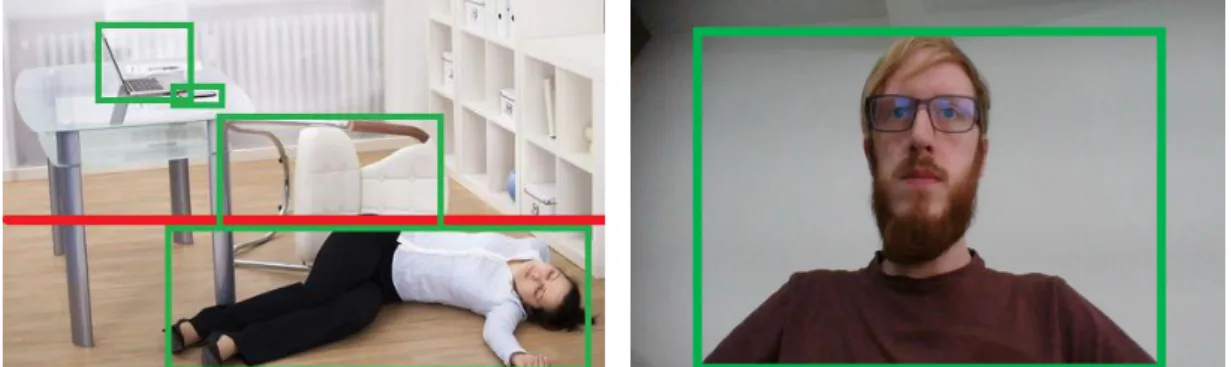
Adding image description and object attribute prediction functionality within a care providing environment would allow for detailed information regarding changes to living or communal spaces to be automatically collected and verified, especially when paired with aspects from robotics such as automated or remote cameras as well as humanoid robots such as Pepper (Aldebaran, 2017). This could detect and alert users to hazards and potentially even falls depending upon the training and implementation of the system framework.
This, paired with some of the robotics previously mentioned, allows for a free moving camera that can allow an implemented system to understand its environment, by detecting and describing objects within the camera’s vision to those within the vicinity of the robot and care providers who can monitor, oversee and ideally prevent any issues.
There is also the opportunity to pair such a system with visual agents, this could allow for a conversation and socialising aspect to be integrated as well as all of the previously discussed benefits. This has the added benefit of being accessible from readily available hardware, such as laptops or tablets, without the need for a care provider or consumer to invest in automation and robotics, such as the previously mentioned Pepper from Aldebaran Robotics.
The previous motivation regarding the widespread use of holistic features can limit these systems within the healthcare domain. If the training data and training process allowed, these systems could in theory be used to describe images such as X-rays and
7 MRIs. Extracted regional information could pinpoint fractures and or breaks better than typical holistic collected features.
1.2.4 Automated Human Description – CCTV
Person description is another avenue of research explored during this thesis. One of the benefits of the proposed frameworks allows such an image captioning and descriptive system to be easily adapted to the description and annotation of a person. A system that could accurately and automatically describe a person in an image, could eventually reduce personnel work load in the relevant domains.
This thesis provides an initial exploration into this ability. Within the Chapter 6 a multistage end-to-end style system is trained in which only one branch of the system describes people, however the attribute prediction covers a wide range of user attributes, and if needed could be retrained or fine-tuned on a specific set, for a specific purpose. Tailoring this aspect of the system for this application could be beneficial for person re-identification tasks such as identifying people on no-fly lists or wanted for convictions so that human resources could be spent on more pressing or urgent matters. This combined with other aspects such as social media could allow for automated posting to alert the general public if required.
1.3
Contributions
Multiple algorithms, structures and architectures have been proposed with the main intention to improve upon the descriptive nature of existing image caption systems. The research conducted has generally focused upon adding regional information and a large vocabulary of attributes, increasing the descriptiveness and accuracy of the automatically generated captions to be more human like. Multiple standard large-scale image datasets such as ImageNet (Russakovsky et al., 2015) for the required subdomains have been used, in tandem with large scale image-description paired databases, such as Microsoft MSCOCO (T.-Y. Lin et al., 2015).
To address these issues, in this research we propose multiple methods and approaches that have been combined to achieve the aim. This has also lead to the exploration of multiple active research areas to increase the descriptive nature of image captioning frameworks.
8 1. The first contribution presented within this thesis is a composite based image captioning framework utilising individual image regions and additional attribute information.
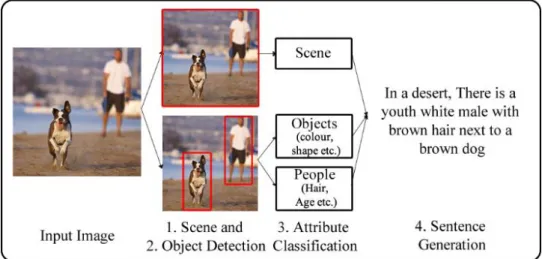
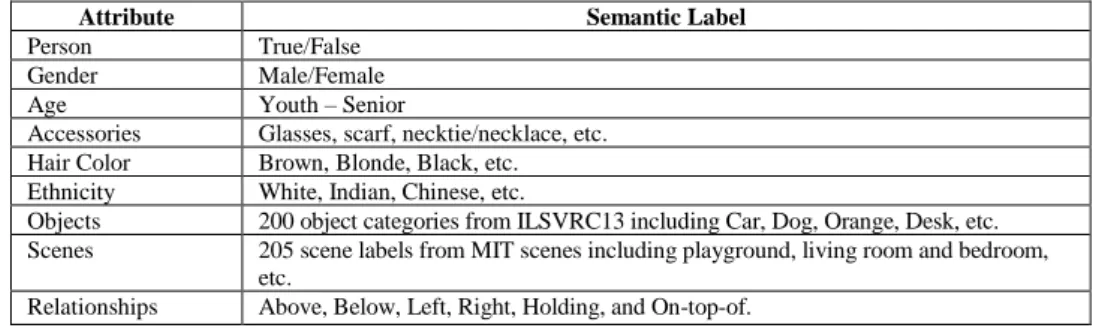
This research utilizes local image regions to initialize image descriptions rather than focus on single stage holistic features of an input test image, therefore image features are extracted from each region. The system contains the core functions of scene classification, object detection and classification, attribute learning, relationship detection and sentence generation. We have also further investigated the applicability of our systems on the fall detection and hazard identification research domains. This is paired with a 3-D intelligent agent for use within care environments.
The proposed system utilises the powerful CNN feature extractors on multiple locations rather than the whole image. This has the added benefit of capturing a dramatically larger area within the image that the remainder of the system pipeline can annotate. This produces many more features which in turn allows for more detail. For example, if the feature extractor collects 4096 features per image, we collect 4096 features for every viable image region. The methodology for determining region viability changes throughout this research however ranges from a Selective Search (Sande, 2011) algorithm to a dedicated Region Proposal Network (Ren et al., 2015). This possesses a trade-off in which the caption detail, i.e. the aim of this research, is achieved with the sacrifice of execution speed in comparison to some other models and frameworks.
The work also adds attributes to increase the descriptive nature of captions. Our initial work explored the combination of the required research areas and proposed an architecture that is based around local regions, extracting regional features rather than holistic features typically used in existing research. This allowed classified labels and their associated attributes to be placed into a sentence generation methodology which can cover a diverse range of sentence or descriptive outputs.
We propose multiple system frameworks that explore sentence generation from these newly created descriptive labels. The initial research stage involves templates, substituting temporary values for the generated content. The follow up method removes the need for fixed templates, and instead incorporates Recurrent Neural
9 Networks to generate the improved and refined attributes leading to the improved final descriptions.
This system has been reported in Chapter 4 and presented in Kinghorn, Zhang and Shao, (2017c)
2. The second major contribution presented within this research is a fully supervised deep learning framework which combines the regional and attribute aspects of the previous system but improves upon the sentence construction by proposing the use of RNNs to the generated regional information into more refined and useful descriptions.
This proposes a method to translate regional information to Image descriptions. Our proposed architectures can describe image regions in detail, by describing people, their clothes, gender and hair styles, as well as the objects, size colour and shape etc. This research utilises RNNs for attribute prediction rather than the SVMs, due to some limitations within the SVM implementations that are explored later in this thesis, and other methods commonly found within those research domains. RNNs are incredibly useful at generating sequential text data, which inspired their use for attribute prediction. Due to the nature in which they generate based on features and previous generated words, RNNs in theory should stop generating when no other attributes describe the region. The same principle ensures that the generated attributes should not contradict. For example, for a given region both attributes ‘Male’ and ‘Female’ should not be present, therefore it should technically be impossible for these two to be generated for the same region, there is no safeguard against this process with SVMs other than post-processing.
When SVMs are used in this domain, one SVM is required per attribute. When systems require many attributes, this SVM methodology quickly scales, resulting in many SVMs all processing the same feature vector. At run time, all SVMs are tested utilising the same feature vector, consuming resources and, in many cases not being entirely accurate. RNNs allow for one test scenario with one set of CNN extracted features and allow for a multi-word label or caption of a region to be generated. This can be treated as a descriptive region label in our overall system framework.
10 The combination of attributes and generated object labels, that have been classified with the use of trained fully connected layers (fc) of a CNN, produces a multi-word descriptive label, which is useful in many areas that have previously been mentioned. This stage enables us to treat the image captioning problem as a machine translation problem, effectively translating an image into a descriptive caption through the detailed region. We propose the utilisation of an encoder-decoder description generator embedded with two RNNs to produce refined and detailed descriptions of a given image. This combines the multi label captions, and concatenates them to form a source sentence, consisting of nouns and adjectives. The encoder network then encodes the entire sentence based on the vocabulary into a fixed feature vector of a given length. This feature vector is immediately decoded into a fully descriptive sentence, inferring any detail or words that are missing from the initial label. This can also be viewed as the combined region labels being a source language, and the description being the target, allowing the system to infer the sentence structure and missing words based on those already generated by the system, as well as those present within the encoder-decoder training procedure.
This system is explained in further detail in Chapter 5 and presented in Kinghorn, Zhang and Shao, (2017b).
3. The third and final major contribution of this research proposes a deep neural network architecture utilising a hierarchical training process in order to streamline the overall system pipeline. It has also been deployed and integrated with the vision API of a humanoid robot to indicate its effectiveness in real-life settings.
A novel deep architecture for image region annotation is proposed as the third research contribution. It generates not only regional annotations but also integrates the regional captioning into full image descriptions. The proposed deep networks within this thesis have a more efficient training process and show great robustness and efficiency in dealing with out-of-domain images.
A unique model architecture is proposed to contribute to the solving of this description problem. With the aim of producing a model that can test an image in one pass, while contributing detailed regional information and the previously mentioned machine translation, we propose a hierarchically trained deep neural network. The initial stage
11 utilises the RPN (Ren et al., 2015) to deliver accurate and near cost-free ROIs that the designed model can then use for the relevant labelling and description. The second stage uses a Recurrent Neural Network (RNN)-based encoder-decoder structure to translate these regional descriptions into a full image description. Especially, the proposed deep network model can label scenes, objects, human and object attributes, simultaneously, which is achieved through multiple individually trained RNNs. The model consists of multiple branches trained on individual datasets. This allows individual branches that specialise on a specific intended output. For example, training certain sections on a scene dataset produces scene labels simultaneously, while another section that is trained on objects produces the corresponding object labels. This process freezes and restricts parts of the network to prevent undesired training. As previously mentioned, this also is more efficient, as it could require much less training data per branch than if the whole network had to be trained in the typical end-to-end fashion. This would require many more samples, each having every single required piece of information annotated in the correct format and accurately.
Image captioning is treated as a machine translation problem rather than a captioning problem as previously described, with the aim of more natural and human sounding outputs. This is achieved with the use of an encoding and decoding RNN.
Many of the above proposed models and systems have been deployed where possible to a robotic platform, utilising photo and voice functionality. A humanoid robot and its application in this domain are proposed. The robot in question is the NAO H25 humanoid robot, equipped with stereo vision, speech synthesis and speech recognition allowing the robot to audibly describe and react to its surroundings. The robot utilisation is based upon LAN connectivity with a powerful GPU workstation. Multiple experiments were conducted on the deployed system and the robot application. The first experiment is conducted on a large image description dataset, the IAPR-TC 12.
This system is reported in Chapter 6 and is presented in Kinghorn, Zhang and Shao, (2017a)
12 The final contribution of this research is the ability for these systems to be able to handle and describe a wide range of images, not just those present in the test sets of the datasets within the given training domain, but images collected from other datasets and images collected from in the wild. This is most notable in Chapter 5, when the proposed system is tested on oil paintings of dramatically different styles, still producing accurate descriptions with none to very minor alterations within the training process.
1.4
Thesis Outline
Chapter 1 focuses on the introduction and origins of image captioning and description and the composite areas explored in the proposed methods order to achieve the main objective. For example, object detection, localisation and classification, scene classification as well as person attribute labelling.
A brief overview and background to the research covered and the multiple research areas are covered in Chapter 2.
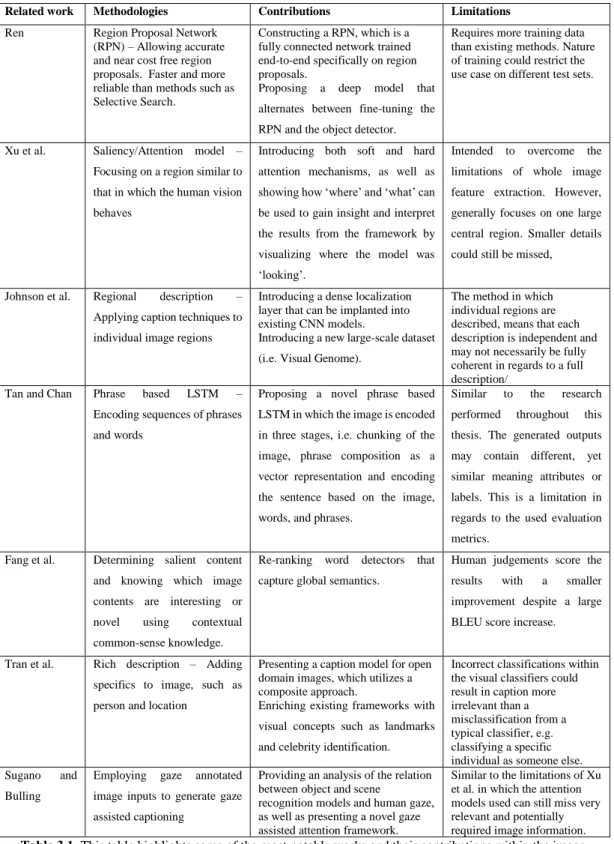
Chapter 3 discusses and outlines current research within the prominent areas of the research explored, as well as reviewing the state-of-the-art methodology and existing architectures. As the methodology explored covers a diverse range of techniques, this chapter is separated into multiple sections.
In Chapter 4, the initial stage of the proposed research utilising a region-based system with template-based sentence generation description is presented. A composite method is proposed to accommodate all of the required and generated/predicted information and create a system that can be utilised for benefits within a healthcare application. Aspects of Human Computer Interaction (HCI) are also explored.
Chapter 5 consists of the next stage in the research in which machine translation aspects are explored to generate the required descriptions with the intended level of detail, as well as more efficient and accurate attribute prediction models. Aspects of transfer learning are also explored. This chapter directly extends the research conducted in the previous chapter.
End-to-end style model architectures are explored in Chapter 6, presenting a unique model structure requiring less computation resources and training time. This model involved multiple training stages and processes which are further discussed, as well as
13 a thorough evaluation utilising the commonly used metrics available from the MSCOCO (T.-Y. Lin et al., 2015) evaluation scripts.
Finally, chapter 7 summarizes and concludes the thesis with the contributions and methodologies explored. This chapter also expresses some possible paths for future research within the image captioning/description research domain.
15
Image captioning/description has been an active research area for some time, recently gaining traction from the deep learning community. Image captioning is the direct result of a computer system that can receive an input image, then correctly and automatically annotate and describe its contents. Image captioning can therefore cover many existing computer vision domains in order to fulfil this criterion. For example, for these systems to recognize and locate objects, object classification must be explored, and for natural sounding output descriptions, utilising techniques and methods within the field of Natural Language Processing (NLP) becomes necessary.
16 The main concepts used throughout the research are CNN (Convolutional Neural Network) and RNN (Recurrent Neural Network). General research background on these methodologies are presented throughout this chapter.
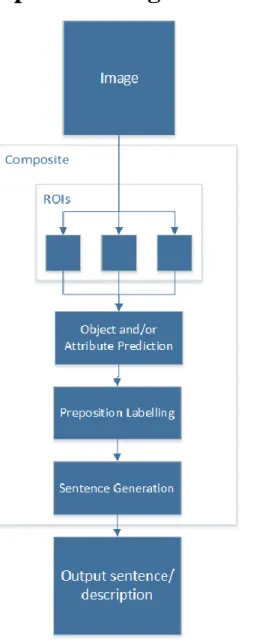
There are two commonly implemented architectures used within the field of image captioning/description, composite and end-to-end. High level examples of these architectures are shown in Figure 2.1. The initial sections of this chapter explore the features and stages of each of these architectures and their position within the active research environment.
2.1
Composite methodology
The composite framework for image captioning generally produces longer descriptions. This framework generally consists of multiple separate stages that are run procedurally, one stage after the other.
2.1.1 Pre-Processing
As previously stated, a composite framework consists of multiple separate stages. These stages can differ dramatically depending upon the final aim of the system. In this background section, we outline some of the initial and pre-processing stages that the image undergoes in order to deliver the desired output sentence or description. 2.1.2 Region of Interest Extraction
Methods such as object localisation and recognition, as well as many composite image caption frameworks depend upon ROI extraction. This process involves searching over an image, and producing bounding boxes or regions that have the possibility to contain something interesting. These are boxes where the features or pixel values are generally more varied and/or different enough from the rest of the image. The most common methods of generating these regions for further processing in the pipeline are the Selective Search (Sande, 2011) algorithm, Edge-Boxes, and the newest methods, the RPN (Ren et al., 2015). These are further discussed in detail in the following chapter.
2.1.3 Feature Extraction
In early computer vision research, a number of existing techniques allow for feature extraction, these generally differ from the CNN extraction commonly implemented in
17 recent works. Some of the most commonly used low level features that have been utilised in this and related work are briefly discussed.
Variations of the HOG descriptor are used for textual descriptors, and canny edge detectors are used for edge detection. SIFT features are extracted to allow for scale invariant feature use. Each of these techniques has strengths and weaknesses for certain types of classification. For example, texture descriptors can be used exclusively or in tandem with other features for attributes that relate specifically to texture, such as metallic or spotted. CNN feature extraction could/can also be used, this technique is explained further in section 2.2.2
2.1.4 Classification
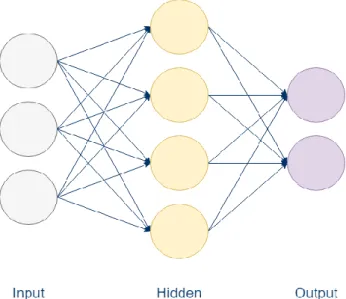
A Multilayer Perceptron or more traditionally named Artificial Neural Networks (ANN) have been widely used for classification problems (Chaudhuri and Bhattacharya, 2000; Orhan, Hekim and Ozer, 2011; Talukdar and Mehta, 2018) Multilayer perceptrons were created in an attempt to overcome the limitations of earlier perceptrons in which the classes were not linearly separable meaning the models were unable to classify correctly or accurately (Kotsiantis, 2007). Neural networks generally consist of a number of nodes or neurons connected to each other. The layers of these neurons are typically separated into three categories forming the structure, typically these neural networks consist of one input layer of multiple neurons, one or more hidden layers of multiple neurons and an output layer consisting of a number of neurons equal to the number of classes (High level representation shown in Figure 2.2).
To train these neural networks these neurons will be equipped with initially random values or multipliers that the input values will pass over before an output is given (Hemmat Esfe et al., 2015), this is the feedforward part of the neural network model. To adjust the weights and the values within the network the error is calculated based on the target output and the actual output, and during backpropogation updates them based on the comparison of target to actual outputs. How these values are updated based on these values is dependant upon the activation function set before training begins, typically these are tangent sigmoid for hidden layers, and linear for the output layers. Training is ceased either upon an exeptable error rate upon evaluation. I.e.
18 Mean squared error (MSE) or upon reaching a set number of iterations over the training set (epochs).
2.1.4.1 Objects
Composite methods for object classification are typically different to conventional and recent object classification techniques such as fully connected convolutional networks. One of the early, successful object detectors trained 200 SVMs, one for each possible object label (Girshick et al., 2016).
2.1.4.2 Attributes
Where attributes are present in composite methods they have generally utilised SVM classifiers trained on low level extracted features as previously discussed. One of the earliest works into object attribute prediction explored selecting features that were discriminable for a specific attribute (Farhadi et al., 2009). For example, to train a specific detector, the features which distinguish between those with and without that attribute are used, not all of the available/collected features.
Attributes add a substantial amount of information to an otherwise basic label. For example, tying a colour, texture, or style as a pre-requisite much more information about that object has been given. When attempting to deliver upon the research aim of increasing the descriptive nature of these captions, this is of high priority to ensure that these labels are paired with the correct and detailed label attributes.
19 2.1.5 Support Vector Machines/Regressor
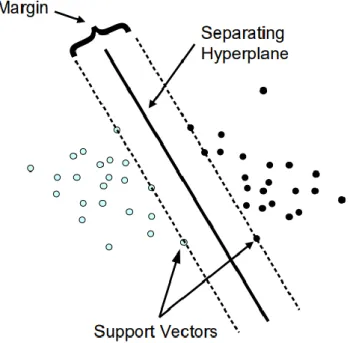
There have also been some more traditional tools used in image captioning in order to increase the accuracy of these deep learned methodologies. In addition to SVMs having their use within attribute prediction, as described in the previous section, they have been utilised by (S. Liang et al., 2017) to determine which differently trained model is used to infer for a given test case image. Combining a relatively cheap machine learning model to enhance the capability of deep models allows for added confidence measures from the deep model and produces a more relevant caption. SVMs (Cortes and Vapnik, 1995) are based on the concept of mapping multiple input vectors to a very high dimensional feature space, and in terms of classification the aim is to identify the plane between multiple classes (Meyer and Technikum Wein, 2001). For linearly separable SVMs this process can be seen within figure 2.3.
Support Vector Machines produce their classification result as either a 0 or a 1. Which can translate to a query being part of the tested class or not, it is entirely binary with no immediately available confidence measure. This limitation had been addressed by (Drucker et al., 1997) in which a regression technique based on “Vapniks concept of support vectors” outlined in the original paper is implemented. These machines produce a range of outputs between 0-1 providing a confidence score and a more usable output depending upon the scenario. SVRs have been implemented for a
Figure 2.3. Linear separable data and the separating hyperplane produced based on the supporting edge of class vectors (Meyer, 2007).
20 number of active domains such as sales forecasting (Yu, Qi and Zhao, 2013), user gaze tracking (Lu et al., 2010a) and stock market prediction (Yang, Chan and King, 2002).
2.1.6 Sentence Generation
One of the earliest examples of sentence construction within image description frameworks is that of Li et al., (2011) among other methods, templates are stated to be a popular and effective method when adjectives, nouns and prepositions are present. For example, two objects each with an adjective, and a preposition can construct a sentence such as “There is a [adjective] [object] [preposition] [adjective] [object]” producing something like “There is a green apple on top of the wooden table” (Xu et al., 2015).
Templates provide a fast prototyping option when other aspects of the system are already in use, the system can be set up with very little compute cost and time. However, the sentences can all sound very similar, they would all be structured identically which could lead to grammatical errors, and over a large number of images potentially miss a large amount of detail. There have been numerous efforts in recent research to overcome some of these limitations of templates by combining them with other approaches, these are discussed in more detail in the following chapter.
Another approach to sentence generation has been sentence/caption retrieval. This as the name suggests retrieves a sentence from a large corpus that the system believes is the closest matching sentence to the image, rather than generating or constructing a sentence from previous or existing detections. This has the benefit of producing a grammatically correct sentence every time, however this method could lead to the possibility of producing two identical descriptions of images whose content differ substantially.
2.2
End-to-End
The simplified high-level architecture of this style of image caption system consists of a very deep convolutional neural network (LeCun et al., 1999) that acts as the feature extractor paired with a sentence/description generation algorithm such as a Recurrent Neural Network (Lipton, Berkowitz and Elkan, 2015). These models are trained in an end-to-end fashion on paired image-caption datasets such as Flickr8k/30k and MSCOCO, further details on these systems are presented in Chapter 3.
21 2.2.1 Pre-Processing
Within these models, data-loaders and image pre-processing, where images are resized and scaled, is required in order for the initial CNN to accept and run the selected image. In general, many of the existing pre-trained nets require this, unless the dataset images are small such as the MNIST or CIFAR dataset, any user captured or standard size image must be scaled to around 224 x 224 pixels, in a 3-dimensional format.
2.2.2 CNN Feature Extraction and Image representation
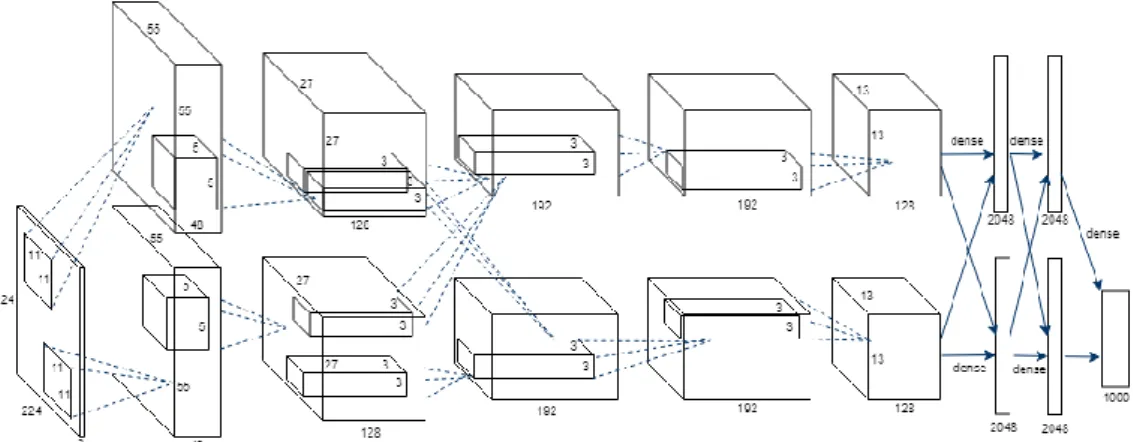
In this style of system, to represent the image for the subsequent stages, a form of feature extraction takes place with the use of a very deep CNN, sometimes referred to as a DNN (Deep Neural Network). These large models are generally pre-trained to a high degree of accuracy in their desired field, such as scene or object recognition. To utilise a CNN as a feature extractor it must first be trained. The process to train these models is conceptually similar to the methodology for typical Artificial Neural Networks. However, with a lot more data. Typical architectures for CNNs consist of Convolutional layers, Pooling layers and Fully Connected layers (Krizhevsky, Sulskever and Hinton, 2012).
Convolutional layers apply a mathematical convolution to the layers input and pass the result to the following layer. The next layer is typically a pooling layer. These layers take clusters of nodes from the previous network layer and output them as a single node. This style typically repeats until the fully connected layers are added where the final classification takes place. CNNs share the same architecture traits as ANNs in which the layers are connected via weights that are updated through the forward and backward passes of the model, as well as utilising the fully connected architecture for the models last layers.
As a CNN is generally applied for the classification application, it must be used as a feature extractor, by removing the output layers, this would therefore mean that the network would produce a high dimensional vector rather than label confidence scores. For example, the AlexNet CNN with the output (or fully connected) layers of the network removed, can produce a 4096-dimensional feature vector. It has been commonplace for CNNs pre-trained on the extremely large ImageNet dataset to be used as a generic feature extractor in many other areas, such as scene and object recognition.
22 Features of images can be collected from something as simple as pixel values, collecting each value in an image would lead to the feature vectors being incredibly large due to the increase in mainstream camera quality etc. CNNs can be used as a feature extractor, by learning the features from a small grid and using this trained detector at different locations across the whole of the image, dramatically scaling down the size of the collected features making them much more manageable, combining this with pooling layers, and then alternating, creates a very discriminative feature extractor that can be utilised on high resolution images. This can be shown briefly in Figure. 2.4, for a trained 3x3 feature extractor over a 5x5 image. The yellow 3x3 grid shows the trained feature extractor during its first two steps over the blue 5x5 grid image. The feature extractor has stored methods to execute over those pixel values (the small red multipliers). The sum of the calculations returns the results in a new reduced dimensional vector, as shown in the green box on the newly created 3x3 vector to the right of the original blue image. The extractor is moved one step and the process continues.
Pooling would be done in a very similar fashion however simply collecting the highest value within its sliding window or adding them all together or averaging among others. This style of feature extraction technique is used throughout the conducted research, starting in chapter 4.
Figure 2.4. (Orange) Trained feature extractor on each 3x3 patch collecting smaller feature vector as it passes over each pixel of the image. (Stanford CNN tutorial, available at: http://cs231n.stanford.edu/)
2.2.3 Sentence Generation
As mentioned in the previous sections, sentences and descriptions have been constructed with methods such as templates, substituting entities into the variables within a fixed sentence and Conditional Random Fields (CRFs) which can produce longer sentences but can sound robotic and rigid. There have also been works in which the closest relating sentence/description has been retrieved from the corpus based on
23 the image features. In a bid to overcome this issue in recent research the use of recurrent neural networks has been the main methodology for generating sentences from images.
2.2.3.1 Recurrent Neural Networks
Recurrent Neural Networks are based on the use of time steps, as most neural networks accept the current input example, RNNs take the current example and the input at the previous time step. This can be simply defined as the decision a RNN makes. The timestep, t-1 affects the decision of the network at timestep t. This is the RNNs two inputs, the present moment (t), and the immediate past (t-1). This can act as a form of context and allow the correct reactions to new data, much in the same way humans also respond to similar circumstances.
This is different from typical neural networks due to this feedback loop, revising their own outputs as inputs immediately after producing them. This adds memory to neural networks, collecting and storing the hidden information and patterns within sequences of data.
This can be described mathematically as:
ℎ𝑡 = 𝜙(𝑊X𝑡+ 𝑈h𝑡−1) (1)
This defines the hidden state at timestep t (ht). This is a function of the input at the given timestep, modified by the matrix containing the weights in addition to the hidden state of the timestep on previous multiplied by its own hidden state matrix. The generated error will be calculated within the back-propagation algorithm to adjust the weights to minimise this loss. 𝜙 is generally either a logistic sigmoid or tanh function depending upon the task, and this is utilised with the sum of the weight input and the hidden state.
RNNs can suffer from a number of issues which can dramatically affect the training and in the end how successful the model is at its given task. The largest issue is the vanishing and exploding gradients problem. These mathematical problems are on the basis that the matrices within these networks go through the multiplication process with a multiplier larger than 1, the values can quickly become immense. The reverse in the case of vanishing gradients is when the multiplier is less than 1. This makes the weights either immeasurably large, which can be truncated or squashed. However
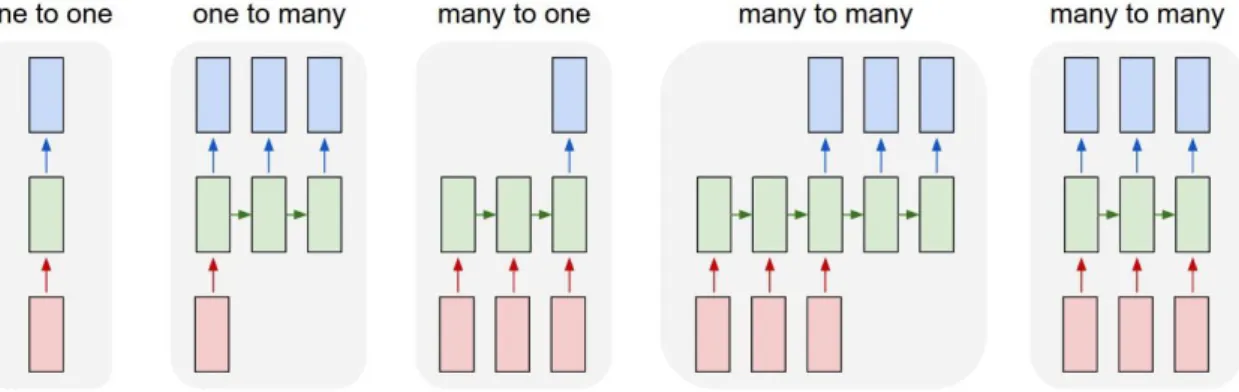
24 incredibly small (vanishing) gradients propose a much larger challenge (Karpathy, 2015). These RNNs can generate sentences and descriptions word by word, or on an individual character based level, and are used to overcome the limitation of the fixed input and output vector length of neural networks, examples shown in Figure 2.5.
Figure 1.5 With each box a sequence, this above displays some of the versatility of RNNs (Karpathy, 2015)
2.2.3.2 Long Short-Term Memory Units (LSTM) and Gated Recurrent Units (GRU)
LSTMs were proposed after RNNs as a potential and usable solution to the problems of vanishing gradients as previously discussed. This is achieved by their memory that can help to store and maintain a more constant error. This allows the RNN it is linked with to iterate and learn over many more time steps. LSTMs differ slightly to those nodes typically found within an RNN, as the gated cells within LSTMs allow data to be stored, written and read from, the decision to perform each action is performed from within the cell. The gates within the LSTM are activated or blocked based on the input and its confidence which is determined and if necessary filtered based on its own set of internal weights, these weights are also adjusted during the RNN training procedure (Mikolov et al., 2010; Mao et al., 2014; Karpathy, 2015; Lipton, Berkowitz and Elkan, 2015).
The other unit in this section is the GRU, this cell is essentially identical to the LSTM as previously described however lacks an output gate. Instead, the GRU writes its contents to the overall neural network rather than the cell at each timestep.
2.2.3.3 Character Based RNN
Recurrent Neural Networks that follow the character level modality (Hwang and Sung, 2017) have a number of benefits over the word-based equivalents. For example, modelling out of vocabulary words is a large benefit. However, in recent research their
25 overall performance does not compare to the word based methods. This could be down to their need to consider many more previously generated tokens in order to predict the next one, compared to relatively few words that need to be taken into account. There are a number of available character models both in research and in public repositories, such as the popular Char-RNN (Karpathy, 2016) package, which can generate anything from Baby names to Linux source code.
2.2.3.4 Word Based RNN
The word based RNNs are typically the modality used within the image caption domain, a high level example is shown in Figure 2.6. Pairing these with a CNN feature extractor as presented earlier provides a solid baseline for improving and innovating within this domain. The word based RNNs, are based on the principle that given a sequence of words, i.e. a sentence or caption, the probability of each word should be predicted, given the previous words. This allows the next word to be accurately predicted, when given the features and starting words, this combination allows for words to be continuously generated at each time step until the caption and the stop word has finished being generated.
Figure. 2.6. A high level representation of the word based RNNs producing words that would eventually form a full sentence.
2.3
Transfer Learning
Where possible, aspects of transfer learning have been explored. Transfer learning is utilised when there is not sufficient data in an intended domain, that when the typical training procedure is adhered to over fitting can occur and the model performs
26 unsatisfactorily. To this end, related data can be utilised from either the target or another related domain to include information learned from both domains. This is similar to the belief in which children learn, for example a child can only store and recognise a certain number of objects within a day, anything new they see or learn is heavily weighted on knowledge and understanding from those existing learned classes.
Transfer learning can take many forms and has many different approaches in order to execute the knowledge transfer. For example, Cross-domain knowledge transfer and Cross-view knowledge transfer. Cross domain identifies the gap between source and target data that can be entirely different to another, for example cars. This domain could utilise data from wheels or car radiators to the unrelated such as laptops. Whereas cross-view aims to account for the near infinite available viewpoints of any one object (Shao, Zhu and Li, 2015).
2.4
Attention Based Methodology with a Multi-Layer Perceptron
Attention over the wording of an image, is considered a form of textual context between generated words and/or characters. Within the literature, this is can be accomplished with the use of a more traditional MLP (Multilayer Perceptron) (Shen and Huang, 2016; Yang et al., 2016). In which the weight of each word within the overall sentence is calculated, this is achieved by passing each word and each extracted entity into the MLP. These MLPs are generally used in combination with CNNs for the feature extraction and provide the information required for an RNN to generate the correct words in the correct order.2.5
Evaluation
There has been active research into automatically determining the similarity between generated and reference annotation descriptions. A number of methods have been utilised throughout this research, some of which were originally intended for other domains. Possibly the most accurate method for determining the quality of the generated captions is for a human to evaluate and score based on a number of criteria. However, this can be expensive and require additional clearing stages to ensure good
27 data. Throughout research some of the common/popular criteria are as follows (Bernardi et al., 2017):
• Does the description accurately describe the image?
• Is the caption/description grammatically correct?
• Whether the caption/description contains no incorrect information
• Is the caption/description relevant for the given image?
• Is the caption diversely constructed (creative, no rigidity in templates for example)
• Does the caption/description sound human like?
In recent research, most if not all methods refer to the MSCOCO evaluation script when comparing between relating or competing works. This standard script contains 4 evaluation metrics, these are Bleu (Papineni et al., 2002), CIDEr (Vedantam, Lawrence Zitnick and Parikh, 2015), Meteor (Denkowski and Lavie, 2014) and Rouge (Lin, 2004). A modified script with a relatively newer metric, SPICE (Anderson et al., 2016), is also available. These metrics are discussed in more detail later in the chapter. 2.5.1 Bleu
The Bleu score is possibly the earliest evaluation metric that has become ‘standard’ in the image captioning domain. The Bleu score was originally utilised for evaluating machine translation systems, between source and target languages. The score presents multiple methods outlining the number of matching n-grams (1-4). The basic measure of BLEU has been shown to favour smaller captions, as even if a caption is for example two words long, as long as those two words are in the reference, the score will be unreasonably high.
BLEU-1 works on an individual word basis. For each individual word within the reference caption, Bleu takes its frequency. The frequency of the word becomes Wmax.
Within the generated captions, the frequency of each word is capped at Wmax, meaning
that any frequency below Wmax would be treat as its own value, whereas any frequency
above Wmax will remain equal to Wmax. To calculate the unigram precision score for
BLEU, Wmax is divided by the length of the generated caption. This is applied to each
word within the generated caption and produces an overall score between 0-1, where 1 represents a 100% relation between reference and generated caption.
28 A similar method is applied over more than one word, i.e. bigram or n-grams in order to generate the score for the different BLEU scores.
2.5.2 CIDEr
The CIDEr metric works at its best when used with many reference sentences, the dataset the authors provide contains 50 reference sentences for 1000 pascal VOC images (Everingham et al., 2010). Their evaluation metric is based on determining the human consensus within a large amount of data. This is achieved by a triplet based method in which human annotated descriptions are collected, and an automated metric in which the consensus is captured.
2.5.3 Meteor
Meteor is a thorough search method that claims to align with human rankings stronger than other metrics. This metric evaluates generated and reference sentences by exhaustively identifying matches in a number of areas. These areas are as follows:
• Scoring words which match identically in their current ‘in-sentence’ form. This is achieved with the use of a word stemmer, such as the Stanford parser (Schuster and Manning, 2016).
• This is extended to determine if any of the matching words share a synonym within the WordNet (Miller, 1995) dataset.
• Finally recognising matching phrases to a pre-processed internal language paraphrasing table.
2.5.4 Rouge
The rouge metrics contains many individual metrics within the package, including multiple n-gram based methods, very similar to the Bleu score.
In recent research, the most commonly reported Rouge metric is Rouge-L This metric is a measure of the longest common subsequence, in which the score would increase depending upon the longer the length in which the two sentences are similar. Slightly differing LCS evaluation methods have been used to compare large text summarization applications.
2.5.5 SPICE
SPICE, or Semantic Propositional Image Caption Evaluation is a metric specifically designed to evaluate the similarity of automatically generated image descriptions more
29 closely to human judgements. Their work states that the metric scores 0.88 in correlation with human judgements on MSCOCO as opposed to 0.43 for CIDEr and 0.53 for Meteor. This is achieved by initially converting both the reference and candidate captions into an intermediate representation, in this case a scene graph, this is achieved by semantically parsing the generated captions.
There has been recent research into the viability and meaning of these metrics (van Miltenburg and Elliott, 2016). As simply comparing text outputs to text outputs does not directly relate to where a given improvement within a system has occurred. They provide a very good benchmark for simple comparison, but contain little to no information regarding the strengths and weaknesses of the given model. They state within their research that when checking a system’s outputs, they check for accuracy and then categorize the errors. They state that many systems do improve upon other frameworks, however only 20% of the generated outputs are free from errors while 26% are irrelevant or just wrong in comparison to the source image.
2.6
Deep Learning Frameworks
There are also a number of frameworks commonly used within machine and deep learning research. These frameworks are typically used to develop and implement these deep and powerful models. The frameworks range in functionality, complexity and ease of use, however all have very similar end goals to be powerful, reliable and efficient and creating and running these very complex models. Some of the more popular frameworks are briefly described below:
Caffe (Jia et al., 2014) was widely used among Deep Learning research and has gained popularity among senior researchers, before being replaced with newer more efficient alternatives. It was initially produced with the aim to enable the production of state-of-the-art deep learning algorithms with a growing collection of existing pre-trained models. The framework is equipped with bindings that allows communication with C++, python and MATLAB allowing for both training and distribution of the generated models. At the time of the research Caffe was stated to be able to process > 40 million images in a single day on a Nvidia TITAN GPU.
Caffe 2 (Facebook Research, 2017) is the direct successor and intended replacement to Caffe. This framework aims to provide an easy way to experiment and utilise the same created models within the cloud and mobile platforms with minimal effort.
30 Google has released a proprietary framework named TensorFlow (Abadi et al., 2016). This framework is based on the utilisation and manipulation of mathematical Tensors and data flow graphs. This system allows for deployment and utilisation again on both CPU and GPU, however it holds a major advantage in its ability to be ported to mobile devices within the same API.
Theano (Theano Development Team, 2016) is a similar framework to TensorFlow, however integrally relies upon the python Numpy framework for most of its matrix manipulations.
Keras (Chollet, 2015) is a relatively new framework, and aims to be a high level neural network API. This particular framework runs on top of either TensorFlow, Theano or CNTK. The high level nature again, allows for rapid prototyping due to the ability to build and remove layers quickly and easily within code. Allowing the created models to be run on both CPU and GPU seamlessly adds to its functionality.
Torch (Collobert, Farabet and Kavukcuoğlu, 2008) is a machine learning framework designed specifically for use on GPUs and is designed for speed due to the nature of the LUA scripting language. When used in tandem with the CUDA implementation required for GPU processing and optimization it is an incredibly fast and efficient tool. Torch has heavily influenced a python framework producing a Python Torch
framework - PyTorch. This has much of the same functio