FOR A REAL
-
TIME
S
TRATEGY
G
AME
Research-in-Progress
Xharmagne Carandang
Object Consulting
Australia
xharmagne.carandang@
objectconsulting.com.au
John Campbell
Faculty of Business,
Government and Law
University of Canberra
Australia
[email protected]
Abstract
Tangible User Interfaces (TUIs) allow interaction with computer applications using physical objects called tangibles. TUIs have a number of latent advantages over traditional user interfaces including spatial naturalness and immediate haptic feedback where users receive both tactile and digital responses from computer systems. This paper presents the preliminary design and test results of a tabletop Tangible User Interface for a real-time strategy game. A preliminary assessment of the TUI prototype was conducted by comparison with a Graphical User Interface (GUI) version of the same real-time strategy game. The results showed that users performed better with the GUI and found it easier to use, but reported more interest and greater enjoyment when using the TUI. However, preferences were split evenly between the two interface types. Based on this initial evaluation, suggestions are made for improving the TUI design and potential future research is identified.
Introduction
A Tangible User Interface (TUI) allows users to interact with computer applications using physical objects called “tangibles” (Hornecker and Buur 2006; Ullmer and Ishii 2000), and is an approach that builds upon concepts developed from earlier research into “Graspable User Interfaces” (Fitzmaurice et al. 1995). According to Ullmer and Ishii (2000), TUIs have three key properties where physical representations:
• Are computationally coupled to digital information and models;
• Embody mechanisms for interactive control; and
• Perceptually coupled to actively mediated digital representations.
This research-in-progress examines the design of a TUI within the context of a gaming application. In so doing, a comparison is made between distinct artifact instantiations of a Tangible User Interface and a Graphical User Interface (GUI) for the same single-player tower defense game: a type of spatial real-time strategy game. Typically tower defense games cannot easily use a purely physical interface such as in the case of traditional board games because many aspects of game play require real-time computation for resource movement and game response. This computational requirement and the tangible and spatial element associated with these kinds of strategy games provide an appropriate context for the development and testing of a TUI.
TUIs have a number of latent advantages over traditional user interfaces including spatial naturalness in how humans interact with physical objects (Sharlin et al. 2004; Xie et al. 2008), and immediate haptic feedback where users receive both tactile and digital responses from computer systems (Ishii 2008). However, TUIs also have limitations concerning efficiency (expert GUI users can make use of hot keys to speed up the completion of a task), versatility (a TUI based system is typically task specific whereas a GUI system can be used for a wide variety of tasks), and accessibility (TUI systems may not be suitable for some including the disabled).
Design principles for TUIs are scarce. It has been argued that the fundamental quality of a TUI is determined by the strength of coupling between the TUI and the task it is designed to support, rather than the coupling between its physical and digital representations (Sharlin et al. 2004). Fishkin (2004) reported a trend of increasing levels of embodiment (coupling between input and output) and metaphor (analogy between physical and virtual objects and actions) in TUIs over time. However, no conclusion can be drawn as to whether this trend implies that high levels of embodiment and metaphor mean better TUI design.
Given the special-purpose nature of TUIs, further research is required of contextualized principles for TUI design in different application domains (Jacob et al. 2007). Also, very few direct comparisons have been made to traditional interfaces in specific application domains. Consequently there remains some uncertainty about which contexts TUIs are best suited.
Methodology
The study is being undertaken following principles of design science research and using established guidelines to guide artifact design and creation (Hevner et al. 2004). The design science research approach has been used in prior HCI studies (Haynes et al. 2009; Zimmerman et al. 2007). According to HCI researchers Carroll and Kellogg (1989), HCI artifacts are an effective medium for theory development in the HCI field. Regular build and evaluation loops were embedded within the development of the TUI system prototype. In this way the TUI design involved a contextual search for utility initially invoked through seminal TUI literature sources (e.g., Hornecker and Buur 2006; Shaer and Hornecker 2010; Shaer and Jacob 2009; Ullmer and Ishii 2000) which led to particular design choices that were refined through iterative development and feedback about the system in use from academic colleagues and volunteer gamers.
In our case, a GUI tower defense game called Immune Defense had been previously developed by the first author. The existing game was subsequently modified to support tangible user interaction on a tabletop
players to prevent computer-controlled “pathogens” from reaching a specific destination point (see Figure 1). Players can place objects called “towers” on the play area to destroy or block the path of these advancing pathogens. There are different kinds of towers and these can work against pathogens in various ways. The game has multiple game levels with each level running for a fixed time period and with a fixed number of pathogen waves that the player must survive. If a certain number of pathogen opponents reach their destination, the player runs out of health and the game is concluded.
Figure 1. Screenshot of Immune Defense Figure 2. Tabletop TUI construction
Interaction Techniques
The initial design for the TUI required a combination of tangible and touch screen interactivity. Initially, the User Interface Description Language (UIDL) developed by Shaer and Jacob (2009) called Tangible User Interface Modeling Language (TUIML) was used for specifying the structure and behavior of the TUI using both sketching and diagrammatic modeling. However, this proved to be insufficient as the modeling tool did not fully support the documentation of an interface that had both tangible and touch interactions. The GUI version of the Immune Defense game was modified to support tangible user interaction on a tabletop interface by taking the existing game and plugging in components from an open-source computer-vision framework designed specifically for TUIs called reacTIVision (Kaltenbrunner and Bencini 2007). This framework was chosen as reacTIVision was originally designed to support real-time musical interaction and thus has an emphasis on speed, robustness and compact symbol sizes - attributes that were also highly relevant to the gaming application.
However, the original GUI version of the Immune Defense game was implemented using XNA: Microsoft’s framework for building games. Subsequently when converting to a TUI design, there was a mismatch in the frameworks used as the XNA framework (and most games in general) makes use of a polling technique to detect input, whereas the reacTIVision framework raises events whenever input is detected. Because of this, a software module was developed to wrap reacTIVision components in a facade that XNA could easily poll against.
Hardware Components
The hardware component of the TUI system was developed following guidelines set by Fitzmaurice et al. (1995) and Kaltenbrunner et al (2007). A table was custom built to support a 100 cm x 80 cm sanded glass surface, enclosed to allow for diffusion of infrared light (See Figure 2). Because the distance short-throw projectors must be from a surface to project an image of about 100 cm x 80 cm, the table is 90 cm high. Grooves were inserted inside the table cabinet to allow adjustment of the inner shelf position so that the distance between the playing surface and the camera, lights and projector could be varied based on the size of the projected image.
Tangibles that are placed on the glass tabletop by users are tagged with ‘fiducials’. These are symbols that can be identified and tracked by reacTIVision through a camera. Information about the tracked tangibles is sent from reacTIVision to the TUI Defense Tower Application and this information is used as input to control the game, and the game is projected back onto the glass surface.
To prevent the projected image from interfering with the camera’s tracking of tangibles, the camera and projector must work on different wavelengths. This is achieved by using infrared for illumination, and then applying a filter to the camera to block out the visible light from the projector. The technology used is Rear Diffused Illumination (Rear DI) where infrared light is shone from below the touch surface and a diffuser is placed on top of the surface. An object that touches the surface reflects more light than the diffuser and this extra light is then detectable by the camera. Transparent glass pucks were used as tangibles (see Figure 3). The fiducials were made of paper, cut to the shape of the tangibles, and attached by glue. The tangibles allowed sufficient light through to display the color of the object they represented in the game (see Figure 4).
As the project progressed, iterative build and evaluation cycles were embedded within the ongoing development of the TUI system prototype. These iterative design and build cycles were necessary to improve performance and address unforeseen implementation difficulties. For example, the TUI interface relied upon four 850 mm infrared 48-LED lights for illumination. These lamps were first positioned such that they pointed towards the top corners of the table based on the initial design principle that such placement would help diffuse the light. However, as the table was constructed in such a way that the glass surface was positioned more to the left-hand side (see Figure 2), the projected light was so bright on the left side of the table that fiducials placed there could not be seen by the camera. To work around this, the lamps on the left side were adjusted to point slightly downwards, and a matte black material was placed underneath them to allow for better diffusion.
Figure 3. TUI Tangible specifications Figure 4. Tangibles with fiducials attached
Design refinement was also required for image capture. Initially a single 800x600 pixel camera was incorporated into the TUI design. However the images that were captured lacked the focal detail necessary for reacTIVision to reliably detect the fiducials. An Imaging Source DMK 31BU03 USB CCD Monochrome Camera was chosen as it could detect infrared light and capture 1024x768 pixel images, at up to 30 frames per second. This resolution was found to be better suited to the surface size when combined with a wide angle 1.67mm 113˚ FOV CS lens with internal optics that prevented distortion of the images captured.
Initial Prototype Evaluation
A convenience sample of sixteen participants was enlisted to evaluate the TUI prototype and compare its performance and operation with the GUI version of the same tower defense game. The participants chosen had extensive experience using computers, an interest in tower defense games, and a medium to high level of skill in playing tower defense games. Participants were aged between 17 and 23 years old and included five girls and eleven boys. The general characteristics of this sample were relevant to the aims of this project particularly as a user-centered design process was used during artifact construction, and thus it was deemed important for the evaluation to be performed by potential users of this type of system. Recruitment of participants was done using the snowball sampling technique (Rauterberg 1999) where subjects were asked to identify similarly qualified acquaintances. Inexperienced users were excluded from the research design to avoid the results being confounded by user experience factors.
During the prototype evaluation participants were instructed to play both versions of the tower defense game: GUI and TUI. One half of participants used the TUI first, while the other half used the GUI first. This design was chosen to control for learning effects between trials because of the subjective nature of interface style comparison. According to Birnbaum (1999), context is needed for subjective judgment to be made. A within-subjects design gives participants that context and allowed the different interface styles to be compared. This also helped to reduce the possibility of individual differences biasing the results (shuttleworth 2009).
During the evaluation, participants were permitted to play each interface for one level of game play. Participants were also allowed to continue playing for as long as they could survive. The data collected at this stage was both quantitative and qualitative. This data included total play time, final game score, and observational notes of general behavior and strategy (see Appendix for data and survey items).
A Post-Game Questionnaire was administered at the conclusion of each play to evaluate participants’ enjoyment and other subjective elements of user experience with each interface. The questionnaire included modified items from the Intrinsic Motivation Inventory (IMI), a multidimensional Likert scale questionnaire based on Self-Determination Theory that is used to “assess participants’ subjective experience related to a target activity in laboratory experiments” (University of Rochester 2008) as well as scale items to measure perceived ease-of-use (Davis 1989). Finally, participants were asked to fill out an interface preference survey asking them to identify which interface they preferred, and containing open-ended questions regarding the basis of their choice and overall experience with each interface.
Summary of Quantitative Data Analysis
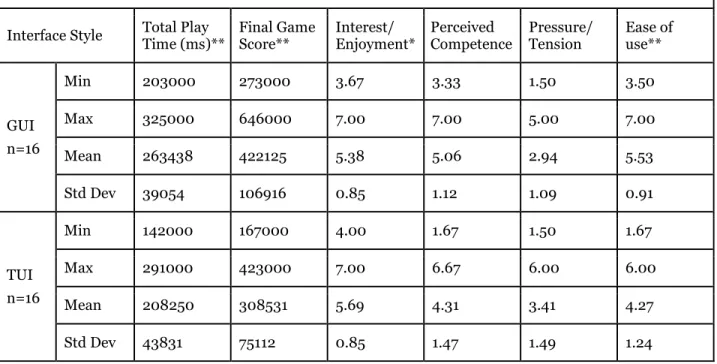
Descriptive statistics for all variables by interface style are shown in Table 1. Total Play Time was measured in milliseconds. Since the goal of the trial was to survive for as long as possible, the greater the Total Play Time the better the outcome. The results from MANOVA indicated that there were significant differences for both Total Play Time (GUI 263438ms vs. TUI 208250ms, p<0.001) with players typically surviving much longer in the GUI environment. There was also a significant difference for Final Game Score (GUI 422125 points vs. TUI 308531, p<0.002). Survival and points scored were both higher the GUI condition than for the TUI condition suggesting that the TUI had in some way hindered user performance and may require further design work and reengineering.
For the IMI subscales and Ease of Use measures, MANCOVA was conducted to test Interest/Enjoyment, Pressure/Tension and Ease of Use. Perceived Competence was treated as a covariate because of its likely influence on other variables. The MANCOVA was significant at p< 0.001. After adjustment for Perceived Competence (which was itself non significant), the scores for Interest/Enjoyment were significantly higher for the TUI condition than the GUI condition (p<0.05), while scores for Ease of Use were significantly higher for the GUI condition than for the TUI condition (p<0.003). No significant difference was found between the scores for Pressure/Tension.
Table 1. Descriptive statistics for game performance, IMI subscales and ease of use
Interface Style Total Play Time (ms)** Final Game Score** Interest/ Enjoyment* Perceived Competence Pressure/ Tension Ease of use** GUI n=16 Min 203000 273000 3.67 3.33 1.50 3.50 Max 325000 646000 7.00 7.00 5.00 7.00 Mean 263438 422125 5.38 5.06 2.94 5.53 Std Dev 39054 106916 0.85 1.12 1.09 0.91 TUI n=16 Min 142000 167000 4.00 1.67 1.50 1.67 Max 291000 423000 7.00 6.67 6.00 6.00 Mean 208250 308531 5.69 4.31 3.41 4.27 Std Dev 43831 75112 0.85 1.47 1.49 1.24 ** p<0.01; * p<0.05
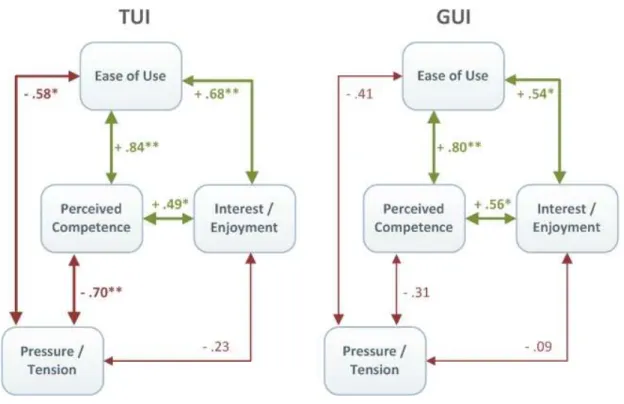
An analysis of Pearson’s Correlation Coefficients indicated statistically significant positive relationships between Interest/Enjoyment, Perceived Competence and Ease of Use for both of the interface styles; and statistically significant negative relationships between Perceived Competence and Pressure/Tension, and between Ease of Use and Pressure/Tension for the TUI application. These relationships and their corresponding correlation coefficients for each interface are shown in Figure 5. While there is a negative correlation between Interest/ Enjoyment and Pressure/Tension for both interface types, the relationships are not statistically significant.
Follow up regression analyses were performed to examine the effects of interface style and perceived characteristics on game performance as measured by Total Play Time (F=4.32, p<.006, Adjusted R Squared = .36) and Final Score (F=3.87, p<.01, Adjusted R Squared = .32). None of the perceived interface characteristics were significant in either model. However the regression coefficient for interface style was significant in both models showing that Total Play Time and Final Score were significantly lower for the TUI interface (t=-2.76, P<.01 and t=-2.24, P<.03 respectively).
Summary of Qualitative Data Analysis
Participants were also asked to indicate their preferred interface and share any views regarding the overall experience. Qualitative data was processed using thematic analysis and used to contextualize the quantitative findings. The themes identified were:
• Responsiveness - many participants commented that the TUI was not as responsive as expected. These views appeared to relate to the general expectation of users that the TUI would respond as an extension of human movement and action.
• Enjoyment - Despite the issues with responsiveness, many participants said that they enjoyed the game on both interfaces but especially the TUI because it was more natural and had an element of novelty.
• Naturalness - Some participants said they found the TUI fun because it had more physical interaction, and one participant remarked that they liked how the TUI had a good combination of physical and intellectual aspects. Some participants felt that strategizing was easier on the TUI
because the physicality enabled them to feel “part of the game” and more “in control” of what was happening.
• Novelty - Most participants mentioned novelty as a reason why they considered the TUI more entertaining. The TUI was associated with terms such as “futuristic” and “unusual experience”.
Figure 5. Correlations for IMI Subscales and Ease of Use (*p<0.05; ** p< 0.01)
As shown below in Figure 6, a small proportion of participants had no preference for either interface style while the remaining participants’ preferences were split evenly between TUI and GUI. Despite the evidence that participants found the GUI more usable and that they did better and felt more competent playing the GUI version of the game, preference between the GUI and the TUI remained evenly split. Perhaps this is because participants found the TUI more enjoyable – it is suggested by Hassenzahl et al. (2000) that both hedonic and ergonomic quality contribute to the appeal of a software type, and that both quality aspects can compensate one another.
Discussion
The initial evaluation trial raised several questions that may be explored in further research and design. First, users identified novelty as an important factor in their preference for the TUI. But what happens when this novelty is lost? To deal with this, a future study is planned that includes strategies to familiarize users prior to experimentation through, for example, pre-exposure to in-depth familiarization sessions for both TUI and GUI versions. Also, there appears to be some merit in adopting a longitudinal approach to the research and thus formally including an expert review group in the design, build and evaluate activities.
Second, users appeared to expect a very high level of responsiveness for the TUI. Thus better responsiveness from the TUI may increase perceptions of performance, ease of use and preferences for this interface style. Future work is required to investigate ways to improve responsiveness for a tabletop TUI of this size. For example, the use of multiple cameras to create a stitched higher quality image could improve detection performance of tangibles. Another option might include the use a mix of technologies alongside computer vision to implement the TUI. Further, the combination of different interface technologies may not only improve responsiveness but also allow for the integration of alternative interaction techniques to further mould the TUI to the specific game context, and to take greater advantage of the strengths of this new wave of natural user interfaces.
Third, in the pilot study evaluation, the TUI did not have a counterpart for GUIs’ keyboard shortcuts. Shortcuts are commonly used by expert users to improve their efficiency (Jacob et al. 2007). For the initial evaluation study, this consideration has been scoped out and put aside as a possible extension for future research. Further evaluation trials should examine the possibility of incorporating shortcut functionality.
Fourth, some of the feedback from participants included suggestions for the TUI interface. One participant commented that the use of magnetic tangibles for towers might be useful so they “wouldn’t worry about accidentally moving another tower and selling it”. Some users also suggested altering the tabletop surface to include a grid (using, for example, grooves or slightly raised lines), to provide a more physical way of knowing possible places to build a tower. This is similar to Shaer and Jacob’s (2009) idea of having a physical constraint – a tangible that limits the behavior of another associated tangible. They argued that the physical properties of a constraint guide the user in understanding how to manipulate a tangible. Interestingly, these suggestions are, in general, to tailor the tabletop TUI to not just the specific application type, but the specific game context itself. This supports earlier research that the strength of a TUI lies in its coupling with the task it is designed to support (Shaer and Hornecker 2010; sharlin et al. 2004).
Concluding Remarks
This paper examined a tabletop TUI in the context of a real-time strategy game - specifically a tower defense game - utilizing a hybrid of touch and tangible interaction techniques. Design of a rear diffuse illumination 100cm x 80cm tabletop TUI was detailed and a comparison was made between the tabletop TUI game and its GUI counterpart using an experimental approach based on design science research principles. Whilst an entirely appropriate method for designing innovative interfaces, the greatest weakness and strength of using this method was that its “artifact in use” approach was subject to potential confounding due to the large number attributes and affordances involved, and their complex interactions with one another.
Users performed better with the GUI and found it easier to use, but reported more interest and enjoyment with the TUI. Overall, however, preference was split evenly between the two interface types. Analysis of qualitative findings provided further insight into these results, and the implications for the next stage in the research project.
There is much potential for the use of a tabletop TUI for tower defense games. The designed tabletop TUI game leverages upon TUIs' fundamental characteristic and advantages noted in the literature - coupling of the physical and the digital worlds; and naturalness - creating an enjoyable experience for the users.
better in terms of ease of use and performance outcomes. Feedback received indicated that, in line with existing theory, the TUI can be further enhanced by tailoring it to the specific game context.
Appendix
Interface Performance Metrics:
Total Play Time (TPT) Final Game Score (FGS)
Survey Construct Items:
Interest/Enjoyment: IE (University of Rochester 2008) • I would describe the game as very interesting
• The game did not hold my attention at all (reverse score)
• I thought the game was quite enjoyable and I would play it again
Perceived Competence: PC (University of Rochester 2008) • After playing for a short while, I felt fairly competent
• I think I did pretty well at the game
• I am satisfied with my performance at the game
Pressure/Tension: PT PC (University of Rochester 2008) • I felt very tense while playing
• I was very relaxed while playing the game (reverse score)
Ease of Use: EOU (Davis 1989)
• I found the game interface easy to use
• Learning to operate the game interface was easy for me
• I found it easy to get the game interface to do what I wanted it to do
• My interaction with the game interface was clear and understandable • I found the game interface to be flexible to interact with
• It was easy for me to become skillful at using the game interface
Interface Preference Questions
• Which interface did you prefer? Please tick one of the following boxes:
GUI (Graphical User Interface)
TUI (Tangible User Interface)
No Preference
• Please give a brief explanation for your selection:
References
Birnbaum, M. H. 1999. “How to Show That 9 > 221: Collect Judgments in a Between-Subjects Design,”
Psychological Methods (4), pp. 243-249
Carroll, J. M. and Kellogg, W. A. 1989. “Artifact as Theory-Nexus: Hermeneutics Meets Theory-Based Design,” In CHI '89: Proceedings of the SIGCHI conference on Human factors in computing systems: Wings for the mind, ACM Press, pp. 7-14.
Davis, F. D. 1989. “Perceived Usefulness, Perceived Ease of Use, and User Acceptance of Information Technology,” MIS Quarterly (13: 3), pp. 319-340.
Fishkin, K. P. 2004. “A Taxonomy For and Analysis of Tangible Interfaces,” Personal Ubiquitous Computing (8:5), pp. 347-358.
Fitzmaurice, G. W., Ishii, H., and Buxton, W. A. S. 1995. “Bricks: Laying the Foundations for Graspable User Interfaces,” In CHI '95: Proceedings of the SIGCHI conference on Human factors in computing systems, ACM Press/Addison-Wesley Publishing Co., pp. 442-449.
Haynes, S. R., Carroll, J. M., Kannampallil, T. G., Xiao, L. and Bach, P. M. 2009. “Design Research as Explanation: Perceptions in the Field,” In CHI ’09: Proceedings of ACM CHI 2009 Conference on Human Factors in Computing Systems, ACM Press, pp. 1121-1130.
Hassenzahl, M., Platz, A., Burmester, M., Lehner K. 2000. “Hedonic and Ergonomic Quality Aspects Determine a Software's Appeal,” In CHI ‘00: Proceedings of the SIGCHI conference on Human factors in computing systems, ACM Press/Addison-Wesley Publishing Co., pp. 201-208.
Hevner, A. R., March, S. T., Park, J., and Ram, S. 2004. “Design Science in Information Systems Research,” MIS Quarterly (28:1), pp. 75-105.
Hornecker, E. and Buur, J. 2006. “Getting a Grip on Tangible Interaction: A Framework on Physical Space and Social Interaction,” In CHI '06: Proceedings of the SIGCHI conference on Human Factors in computing systems, ACM Press, pp. 437-446.
Ishii, H. 2008. “Tangible Bits: Beyond Pixels,” In TEI '08: Proceedings of the 2nd international conference on Tangible and embedded interaction, ACM Press, pp. xv-xxv.
Jacob, R. J. K., Girouard, A., Hirshfield, L. M., Horn, M. S., Shaer, O., Solovey, E. T., and Zigelbaum, J. 2007. “Reality-Based Interaction: Unifying the New Generation of Interaction Styles,” In CHI '07:
CHI '07 extended abstracts on Human factors in computing systems, ACM Press, pp. 2465-2470. Kaltenbrunner, M. and Bencina, R. 2007. “Reactivision: A Computer-Vision Framework for Table-Based
Tangible Interaction,” In TEI '07: Proceedings of the 1st international conference on Tangible and embedded interaction, ACM Press, pp. 69-74.
Rauterberg, M. 1999. “New Directions in User-System Interaction: Augmented Reality, Ubiquitous and Mobile Computing,” In Proceedings of IEEE Symposium on Human Interfacing, Man & Machine: The Cooperation of the Future, IEEE Press, pp. 105-113.
Shaer, O., and Hornecker, E. 2010. “Tangible User Interfaces: Past, Present, and Future Directions,”
Foundations and Trends in Human-Computer Interaction (3:1&2), pp. 1-137.
Shaer, O., and Jacob, R. 2009. “A Specification Paradigm for the Design and Implementation of Tangible User Interfaces,” ACM Transactions on Computer-Human Interaction (TOCHI) (16:4), pp. 1-39. Sharlin, E., Watson, B., Kitamura, Y., Kishino, F., and Itoh, Y. 2004. “On Tangible User Interfaces,
Humans and Spatiality,” Personal Ubiquitous Computing (8:5), pp. 338-346.
Shuttleworth, M. 2009. “Within Subject Design,” in Experiment Resources. Retrieved from
http://www.experiment-resources.com/within-subject-design.html.
Ullmer, B. and Ishii, H. 2000. “Emerging Frameworks for Tangible User Interfaces,” IBM Systems Journal (39:3-4), pp. 915-931.
University of Rochester. 2008. Intrinsic Motivation Inventory (IMI), Retrieved from
http://www.selfdeterminationtheory.org/questionnaires/10-questionnaires/50.
Xie, L., Antle, A. N., and Motamedi, N. 2008. “Are Tangibles More Fun?: Comparing Children's Enjoyment and Engagement Using Physical, Graphical and Tangible User Interfaces,” In TEI '08:
Proceedings of the 2nd international conference on Tangible and embedded interaction, ACM Press, pp. 191-198.
Zimmerman, J., Forlizzi, J., and Evenson, S. 2007. “Research through Design as a Method for Interaction Design Research in HCI,” In Proceedings of the SIGCHI conference on Human factors in computing systems, ACM Press, pp. 493-502.