MULTIOBJECTIVE OPTIMIZATION FOR SPACE
SYSTEMS ARCHITECTURE: APPLYING AND
EXTRACTING KNOWLEDGE
A Dissertation
Presented to the Faculty of the Graduate School of Cornell University
in Partial Fulfillment of the Requirements for the Degree of Doctor of Philosophy
by Nozomi Hitomi
c
2018 Nozomi Hitomi
MULTIOBJECTIVE OPTIMIZATION FOR SPACE SYSTEMS ARCHITECTURE: APPLYING AND EXTRACTING KNOWLEDGE
Nozomi Hitomi, Ph.D. Cornell University 2018
Distributed spacecraft missions (DSM) are gaining traction in the space com-munity for the potential to deploy multiple simple and low-cost spacecraft to pro-vide high temporal resolution of observations over regions of interest. Designing a DSM, however, remains challenging due to the many architectural decisions in-volved at both the spacecraft-level and system-level and due to the presence of mul-tiple conflicting objectives of maximizing performance while minimizing cost and risk. One proven approach to architecting DSMs is to gather a team of design ex-perts from multiple disciplines and leverage their combined experiences to quickly identify a few feasible mission architectures. The rapid design process allows the team to refine the design problem several times to better capture the stakeholders’ needs. A typical design team, however, only explores a handful of alternative mis-sions, which limits their understanding of the key design decisions that determine a DSM’s metrics. Another popular approach is to convert the design problem into an optimization problem and rely on search algorithms to explore more of the tradespace. In particular, multiobjective evolutionary algorithms (MOEA) have shown promise on DSM design problems, but they are considered compu-tationally inefficient because they generally don’t leverage the available domain-or problem-specific knowledge. To identify promising missions, MOEAs require evaluating hundreds or thousands of candidate solutions using computationally expensive simulations to compute their metrics. These computational burdens
hinder designers from iterating through multiple problem formulations.
This thesis proposes a new tradespace exploration tool that combines the ef-ficiency of expert design heuristics with the explorative power of an MOEA. The tool exploits the available expert knowledge to push the exploration to the most promising regions of the tradespace while searching other regions of the tradespace for novel solutions not captured by the knowledge. First, expert design knowledge is encoded as knowledge-dependent operators so that they can easily be incor-porated into MOEAs. Next, an MOEA is augmented with an adaptive operator selection strategy (AOS) that allows an MOEA to efficiently utilize multiple evolu-tionary operators by constantly monitoring each operator’s ability to create high-quality solutions and adapting the search strategy to apply the most effective ones. Given several dependent operators along with conventional, knowledge-independent operators, the AOS can explore the tradespace by leveraging both the expert design heuristics and the explorative power of an MOEA.
This thesis also develops an MOEA that can extract new knowledge by applying a data mining algorithm to candidate solutions generated during an optimization run. This tool is useful when there are few or no design heuristics available for a given problem. The proposed tool encodes the extracted knowledge as evolutionary operators and uses them with an AOS to guide the remainder of the optimization
process. The extracted knowledge is also provided to the user in an
easy-to-understand form, with the hope that the information can help decipher the results and elucidate the key design decisions.
The efficacy of the proposed tradespace exploration tools are demonstrated on a DSM design problem for climate monitoring. The results shows that combining an MOEA with knowledge from experts or data mining algorithms leads to significant improvements in computational efficiency over a conventional MOEA.
BIOGRAPHICAL SKETCH
The beginnings of Nozomi Hitomi’s path toward engineering can be traced back to when he was 4 years old in Cleveland, Ohio. One day at daycare, the class went to “Safety Town” and learned from the local police officers that you should always wear your helmet when riding a bicycle because it can protect your head against hard impacts. When Nozomi got home later that day, he found his helmet that his parents made him wear when riding. As if he was challenging the foundations of the advise given earlier that day, Nozomi strapped on his helmet, ran from one end of the hallway with his head down, and slammed his head into the drywall at the other end. Although there was a 8 inch hole in the wall that Nozomi would be scolded for, he learned that helmets indeed protect your head.
In successive years, Nozomi grew to enjoy making things. He loved playing and building with Legos and K’NEX, and a electric train set, where the tracks could be laid in any which way. Sometimes, designs were a bit unconventional like taping tracks for Hot Wheels cars together to create vertical loops or carving a semi-truck for the Pine Wood Derby event in Cub Scouts when everyone else carved a sleek-looking car. For his science fair project in 7th grade, he tested the effects of centrifugal forces on plant growth using styrofoam soup bowls spun by a magnetic stir plate. Quirky ideas followed him to Dartmouth College, where his freshman design team worked on a recycling bin that could sort materials based on the sound of an object thrown into the chute of the bin.
Upon graduating Dartmouth with a B.A. and B.E. in mechanical engineering in 2011, Nozomi worked as a design engineer at Honda R&D Americas in Colum-bus, OH. At Honda, he was responsible for designing the roof structure of several models taking into account new safety standards from NHSTA and manufacturing processes being installed at the factory. The major projects that he was involved
in were the 2014 Acura TLX, 2016 Acura NSX, and 2016 Honda Civic. These models required designing from the ground up or major re-designs, and although Nozomi was able to use his creativity to contribute innovate solutions, he did not always have an easy time implementing certain designs. The Civic posed the greatest challenges, where Nozomi involved in the early design stages. He was responsible for guaranteeing that the stylists reserved enough packaging space in the areas critical for safety. It was a constant battle with the stylist who wanted to protect their aesthetic visions. Other challenges on the job included significant design changes due to decisions made late in the design process to change available features. Such incidences typically resulted in headaches for many, but inspired Nozomi to explore other design methodologies.
In the Fall of 2013, Nozomi moved to Ithaca, NY to begin his Ph.D. degree in mechanical engineering at the Sibley School of Mechanical and Aerospace En-gineering at Cornell University. Coincidentally, Daniel Selva was looking for his very first Ph.D. student to research tools to support the design process, especially in the early phases of design for space missions. Seizing this perfect opportunity to address his frustrations from the design process at Honda and to get closer to fulfilling a childhood dream to work in the space sector, Nozomi began work in the Systems Engineering Architecture and Knowledge (SEAK) lab under Dani Selva. Outside of his design career and research, Nozomi enjoys being outside. He likes to go on short day hikes, cycle, and most of all, go fishing. He took a fly fishing course through Cornell’s physical education program, and although he only caught a few bluegill during the course, Nozomi eventually learned when and where to fish during his time in Ithaca. He has caught many of the game species in the area, the largest being a 33 inch lake trout weighing 8 pounds. In addition to outdoor hobbies, he likes to cook, brew, and eat with friends.
ACKNOWLEDGEMENTS
I am grateful to the many who have journeyed with me during my time in Ithaca and supported me in my Ph.D. endeavors. None of the work in this thesis would have been possible without the guidance of Dani Selva. I feel very lucky to have started at Cornell just as Dani was looking for his first batch of Ph.D. students and that our research interests and personalities were compatible. Through many one-on-one sessions, he taught me everything I now know about systems architecture and helped troubleshoot (even debug) my algorithms and methodologies. I am thankful for the many hours that Dani put into revising and critiquing my lengthy conference and journal papers, and I am a better writer and researcher because of it. I also cherished the lab Dani put together and its culture that made the Selva lab feel like a family. I need to thank his wife Ana Diaz and his daughter Emma for sharing Dani and his time.
My other thesis committee members also played a great role in shaping me and my research. My first ever aerospace engineering course was Mason Peck’s spacecraft dynamics class, and learning about attitude determination and con-trols furthered my understanding and appreciation of spacecraft design. Pat Reed taught me much of what I know about multiobjective optimization and evolu-tionary algorithms, and he really helped me refine my ideas on adaptive operator selection.
I am also thankful for my committee members connecting me to practitioners and researchers outside of Cornell. My work on the TROPICS mission with Bill Blackwell at Lincoln Laboratory provided me with an exciting opportunity to apply tradespace exploration for a real-problem. Working on TROPICS led to further opportunities with Jacqueline Le Moigne and her TAT-C team who took interest in my research and awarded me with a NASA Science and Technology Research
Fellowship (NSTRF) that funded my research for the last two years. Through this fellowship and work on TAT-C, I was encouraged that my research could contribute to NASA’s design tools. I also was able to learn about and talk to people working at the Goddard Mission Design Lab and gain a better understanding for the breadth of users and use cases for a mission design-support tool. My internship at the Aerospace Corporation was also very enlightening and reassured me that interest in tradespace exploration tools was not isolated to just NASA. I want to thank Matt Ferringer, Lake Singh, Ron Clifton and Anne Gick for providing me with the opportunity to combine the methods and tools developed at Aerospace with parts of my research.
I need to thank all of the friends I made in Ithaca that made it possible to get through the Ph.D. program. Bryan Peele and Christoforos Mavrogiannis got me through the torrents of dynamics and controls homework that often required late nights and Friday beers. The others who kept me sane and smiling through the years are Ravi Patel, Ilse Van Meerbeek, Jon Jalving, Yolanda Lin, Robert Carson, Jack Hartman, Emily Powell, Bo Yang, Jordan Chipka, Zimu Zhu, Suwon Bae, Joyce Fang, George Valogiannis, and Matt Kasemer. Some of my best times at Cornell were sharing food and drink and laughing with all of you.
Thank you to my lab mates who made time in lab infinitely better than just working at my desk Nathan Knerr, Harris Bang, Clara Abello, Pau Buzzi, Ximo Gallud, Samalis Santini, Antoni Viros, Prachi Dutta, and Filipe Pereira. I partic-ularly enjoyed my cultural and religious education I received from you.
I couldn’t have completed my thesis work without the support and love from my family. I never really appreciated my parents’ research when I was young, so I am extra grateful for my father’s interest in my research and my mother’s encouragement to pursue my dreams. My favorite new family tradition that started
in first full year in Ithaca is our family video-chats for birthdays. All of us would sing ”Happy Birthday”, but due to lags in our connections, it always turns out as a hysterical, off-key and offbeat song. Even though we’re spread out across America now, silly moments like these warm me up and make you feel closer. Thank you Yutaka, Emi, and Kei for being my goofy and loving siblings.
Lastly, I am immensely grateful for the love and support from Jen Fownes over the last 10 years. From our time together at Dartmouth, she has been a source of much of my happiness and encouragement. She put up with my hectic work schedule during my first year at Cornell, when I would come home to a warm dinner before heading back to campus to finish work. She introduced me to salsa, which is now in my repertoire of other ballroom dances that she has exposed me to. I’m not a great dancer, but it is a fun way to show off a little at weddings and other formal events. I am lucky to have found some one who laughs at my bad jokes, enjoys eating as much as I do, and dreams of new adventures together.
TABLE OF CONTENTS
Biographical Sketch . . . iii
Acknowledgements . . . v
Table of Contents . . . viii
List of Tables . . . x
List of Figures . . . xii
1 Introduction 1 1.1 Motivation . . . 1
1.2 Background . . . 7
1.2.1 Tradespace Exploration . . . 7
1.2.2 Multiobjective Optimization Problems . . . 9
1.2.3 Multiobjective Evolutionary Algorithms . . . 10
1.2.4 Knowledge-intensive EAs . . . 12
1.2.5 Knowledge Driven Optimization . . . 20
1.3 General Problem Statement . . . 23
1.4 Approach . . . 24
1.5 Research questions . . . 26
1.6 Structure . . . 28
2 A Classification and Comparison of Credit Assignment Strategies for Multiobjective Adaptive Operator Selection 30 2.1 Introduction . . . 30
2.2 Background . . . 33
2.2.1 Multiobjective Evolutionary Algorithms . . . 33
2.2.2 Adaptive Operator Selection (AOS) . . . 35
2.3 Multiobjective Credit Assignment . . . 40
2.3.1 Inputs to Credit Assignment Functionh(φ, ψ, oi) . . . 41
2.3.2 MOEA Fitness Function in h(φ, ψ, oi) . . . 43
2.4 Experimental Setup . . . 51 2.4.1 AOS Algorithms . . . 52 2.4.2 Operators . . . 56 2.4.3 Comparative Study . . . 58 2.5 Results . . . 62 2.5.1 Experiment A . . . 62 2.5.2 Experiment B . . . 66 2.6 Discussion . . . 80 2.7 Conclusion . . . 83
3 Incorporating Expert Knowledge Into Evolutionary Algorithms with Operators and Constraints to Design Satellite Systems 85 3.1 Introduction . . . 85
3.2.1 Knowledge-intensive EA: Operators . . . 90
3.2.2 Knowledge-intensive EAs: Constraints . . . 93
3.3 Design Problem . . . 96
3.4 Available Knowledge . . . 99
3.4.1 Spacecraft Mass . . . 100
3.4.2 Instrument Duty Cycle . . . 100
3.4.3 Launch Vehicle Packing Efficiency . . . 101
3.4.4 Instrument-Orbit Relationships . . . 102
3.4.5 Synergistic Instrument Pairs . . . 103
3.4.6 Interfering Instrument Pairs . . . 104
3.5 Experiment . . . 105
3.6 Results . . . 107
3.6.1 Search performance . . . 107
3.6.2 Application of knowledge . . . 113
3.7 Conclusion . . . 122
4 Extracting and Applying Knowledge with Adaptive Knowledge-Driven Optimization to Architect an Earth Observing Satellite System 127 4.1 Introduction . . . 127
4.2 KDO\AOS Framework . . . 130
4.2.1 Data mining method . . . 134
4.2.2 Adaptive Operator Selection . . . 137
4.3 Case Study Problem . . . 139
4.4 Experimental setup . . . 145 4.5 Results . . . 148 4.5.1 Search performance . . . 148 4.5.2 Data Mining . . . 152 4.5.3 AOS . . . 156 4.6 Conclusion . . . 159 5 Conclusion 162 5.1 Summary . . . 162 5.2 Main Contributions . . . 165 5.3 Discussion . . . 168 5.4 Future work . . . 171 A Appendix A 174 Bibliography 181
LIST OF TABLES
1.1 Advantages and disadvantages of expert- and MOEA-based
tradespace exploration . . . 6
2.1 A classification of multi-objective credit assignments . . . 41
2.2 Summary of multiobjective credit assignments . . . 44
2.3 Test problem properties . . . 59
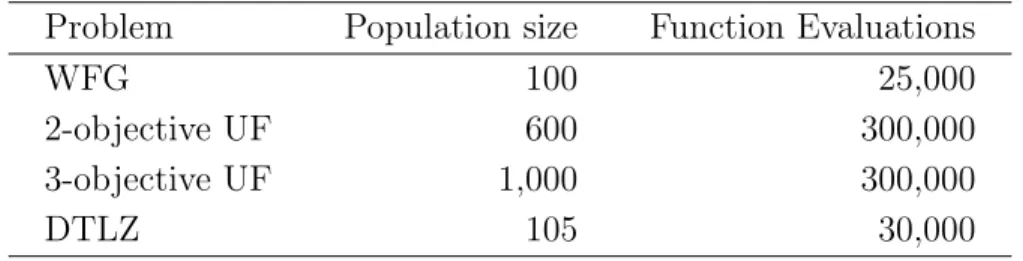
2.4 Parameters for the MOEAs and operator selectors . . . 60
2.5 Population size and number of function evaluations for each problem 62 2.6 Experiment A: Best Operator and mean IGD . . . 64
2.7 Experiment A: Best Operator and mean HV . . . 65
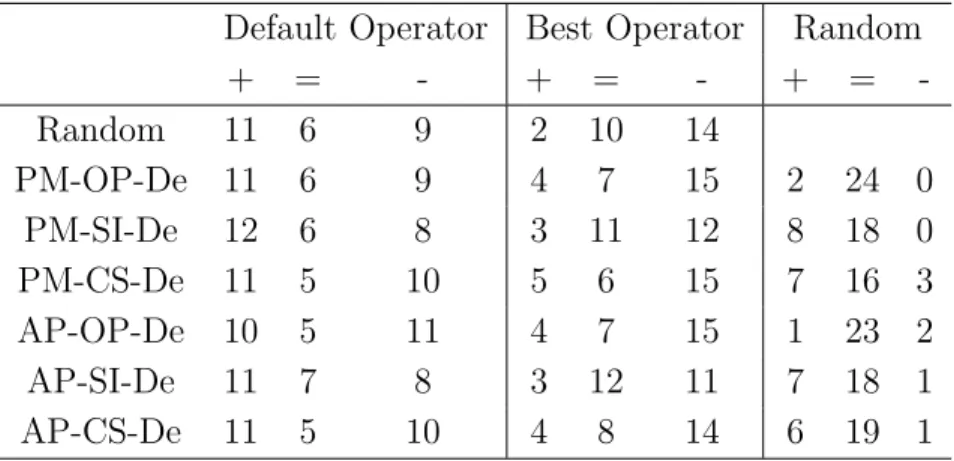
2.8 Statistical comparison of the final IGD achieved by decomposition-based AOS and the control strategies . . . 67
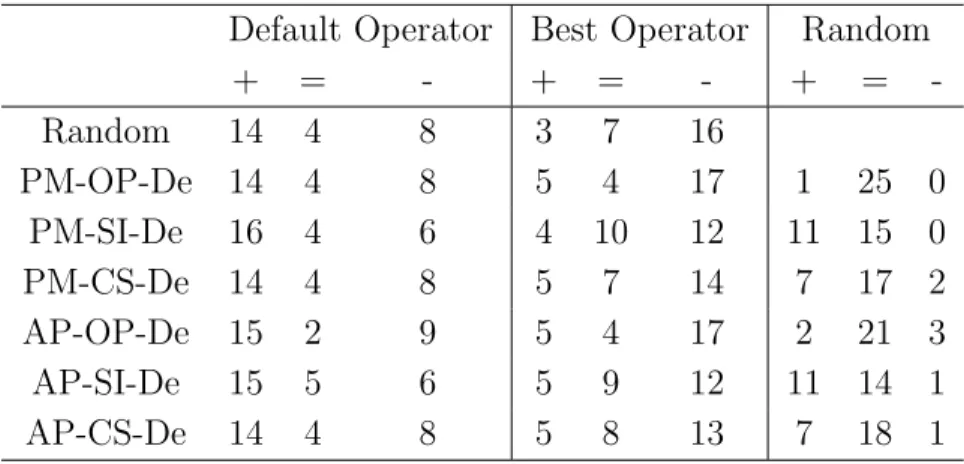
2.9 Statistical comparison of the final HV achieved by decomposition-based AOS and the control strategies . . . 68
2.10 Statistical comparison of the final IGD achieved by dominance-based AOS and the control strategies . . . 73
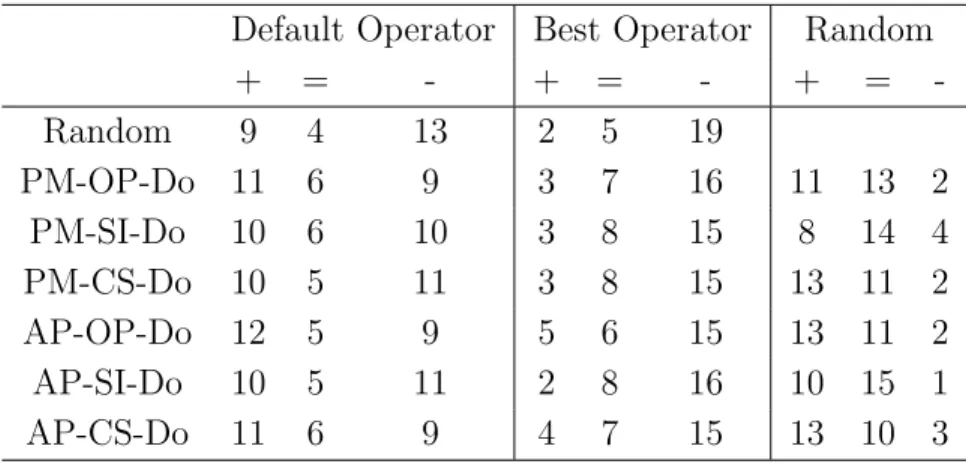
2.11 Statistical comparison of the final HV achieved by dominance-based AOS and the control strategies . . . 73
2.12 Statistical comparison of the final IGD achieved by indicator-based AOS and the control strategies . . . 77
2.13 Statistical comparison of the final HV achieved by indicator-based AOS and the control strategies . . . 77
3.1 Candidate Instruments . . . 97
3.2 Candidate Orbits . . . 97
3.3 Median (Standard Deviation) HV values achieved by each method. 109 3.4 Median (Standard Deviation) IGD values achieved by each method. 109 4.1 Example Requirements for Surface Measurements . . . 140
4.2 Candidate instruments . . . 141
4.3 Candidate orbits . . . 141
4.4 Design features . . . 144
4.5 Average number of function evaluations saved . . . 151
4.6 The relative frequency of occurrence of the extracted features . . . 153
A.1 Experiment B: mean (standard deviation) IGD values achieved by decomposition-based AOS . . . 175
A.2 Experiment B: mean (standard deviation) HV values achieved by decomposition-based AOS . . . 176
A.3 Experiment B: mean (standard deviation) IGD achieved by dominance-based AOS . . . 177
A.4 Experiment B: mean (standard deviation) HV achieved by dominance-based AOS . . . 178
A.5 Experiment B: mean (standard deviation) IGD achieved by indicator-based AOS . . . 179
A.6 Experiment B: mean (standard deviation) HV achieved by
LIST OF FIGURES
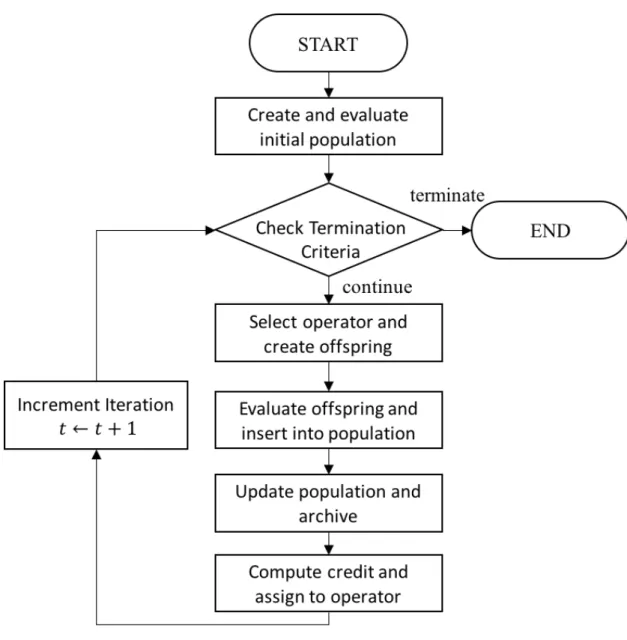
2.1 The general flow of an AOS strategy for MOEAs . . . 37
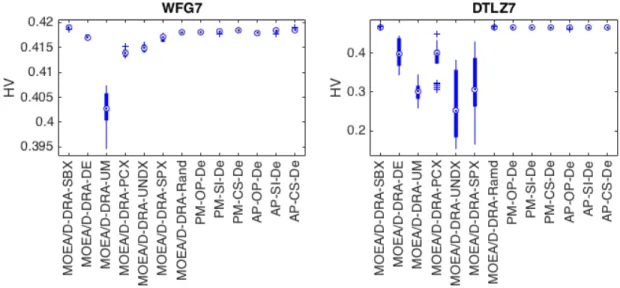
2.2 Boxplot of HV achieved by single operator MOEAs on the WFG7
and DTLZ7 problems. . . 66
2.3 Boxplot of HV achieved on the WFG7 and DTLZ7 problems
by single-operator MOEA/D-DRA, random operator selector with MOEA/D-DRA (MOEA/D-DRA-Rand), and decomposition-based
AOS. . . 69
2.4 The average credits received per epoch by each operator during the
search on the WFG7 problem using dominance-based credits and PM. An epoch is equivalent to 250 evaluations. Note the difference
in scale for each AOS. . . 69
2.5 Boxplot of HV achieved on the WFG7 and DTLZ7 problems by
the single-operator NSGA-II, the random operator selector with
NSGA-II (NSGA-II-Rand), and the dominance-based AOS. . . 75
2.6 The average credits received per epoch by each operator during the
search on the DTLZ7 problem using dominance-based credits and PM. An epoch is equivalent to 300 evaluations. Note the difference
in scale for each AOS. . . 75
2.7 Boxplot of HV achieved on the WFG7 and DTLZ7 problems by
single-operator IBEA, random operator selector with IBEA
(IBEA-Rand), and indicator-based AOS. . . 78
2.8 The average credits received per epoch by each operator during the
search on the DTLZ7 problem using indicator-based credits and PM. An epoch is equivalent to 300 evaluations. Note the difference
in scale for each AOS. . . 79
3.1 The history of the hypervolume (HV) over the number of function
evaluations (NFE). . . 108
3.2 The history of the inverted generational distance (IGD) over the
number of function evaluations (NFE). . . 108
3.3 The set of non-dominated solutions found in a representative trial
by each method at 500 NFE, 1,000 NFE, 2,000 NFE, and 5,000 NFE. The dashed black line shows the approximated Pareto front
P F∗ . . . 111
3.4 The fraction of trials by an algorithm attaining more than 75% of
the range of the attained HV values as a function of NFE. . . 111
3.5 The fraction of trials by an algorithm attaining less than 25% of
the range of the attained IGD values as a function of NFE. . . 112
3.6 The knowledge violations corresponding to the provided knowledge
for all solutions that entered the population during the optimization
across all 30 trials of-MOEA. The color indicates the level of each
3.7 The credits earned by each operator over 5,000 NFE, averaged over the 30 trials by O-AOS. . . 117
3.8 The selection frequency of each operator over 5,000 NFE, averaged
over the 30 trials by O-AOS. The dashed line shows the minimum selection probability of 0.03. . . 117
3.9 The solutions that entered the population during the 30 trials by
-MOEA (left) and C-DNF (right). Solutions highlighted in red are
inconsistent with all KD constraints. Solutions highlighted in blue are consistent with at least one KD constraint. . . 120 3.10 The fraction of the solutions in the archive that are consistent with
each KD constraint, averaged over the 30 trials by C-ACH. . . 121
3.11 The sum of knowledge violations of solutions that entered the EA’s population across all 120 trials. The color indicates the level of the overall knowledge violation. . . 122
4.1 A flowchart of KDO\AOS. . . 133
4.2 The history of the hypervolume for each algorithm . . . 149
4.3 A qualitative comparison of solution quality obtained by -MOEA
and KDO\AOS . . . 150
4.4 Solutions with f eature1000 from a) the first 1,000 function
evalua-tions of one trial run and from b) every solution discovered across all 120 trials. . . 154
4.5 Solutions with f eature1000 from a) the first 4,000 function
evalua-tions of one trial run and from b) every solution discovered across all 120 trials. . . 155
4.6 History of the credits earned by the operators used by KDO\AOS . 157
4.7 History of how KDO\AOS adapts its operator selection during the
CHAPTER 1
INTRODUCTION
1.1
Motivation
In recent years, interest in distributed spacecraft missions (DSM) have been gain-ing traction [2, 159] because of their advantages over a monolithic missions and the recent advances in space technology that are making DSMs more economi-cally feasible. Compared to a monolithic mission, a DSM can fly multiple simpler and inexpensive spacecraft [47, 143] and provide increased capabilities such as im-proved temporal, spatial, and angular sampling [29, 135, 136]. Funding a DSM has historically been cost-prohibitive, but the recent popularization of standards such as CubeSat specifications [149], development of smaller and cheaper instruments and bus components [166], and availability of more economical launch opportuni-ties [159] are creating new possibiliopportuni-ties for DSMs.
As a result government agencies and the private sector are now seriously ex-ploring and investing in DSM missions. One example is NASA’s CYclone Global Navigation Satellite System (CYGNSS) mission, which launched in 2017 and is tasked with monitoring wind speeds of tropical cyclones with 8 spacecraft [154]. Previous monolithic missions, such as ASCAT and QuikSCAT, measuring ocean-surface wind speeds have a mean revisit time of over 24 hours in the tropical regions [160]. In comparison, CYGNSS can sample a tropical cyclone with a mean revisit time of 4 hours [156], drastically increasing the ability to not only predict a storm’s evolution, but also to accurately model storm genesis and intensifica-tion. In 2016, NASA funded another DSM called Time-Resolved Observations of Precipitation structure and storm Intensity with a Constellation of Smallsats
(TROPICS) to provide all-weather observations of 3D temperature and humidity profiles of tropical storms with 12 CubeSats [12]. TROPICS is expected to achieve median revisit times of 60 minutes or less in the tropics, which will advance our understanding of tropical storms and develop more accurate numerical weather prediction models. In the private sector, Planet Labs has been on the forefront of investing in DSMs having launched 149 satellites as of 2017 [1]. Their goal is to provide medium-to-high resolution imaging of the entire planet on a daily basis and deliver Earth imagery and imagery-derived data products to customers involved in agriculture, defense, emergency response, and insurance among other markets [1, 14].
DSMs have a lot of potential in many domains, but due to their complexities in design and operation, any DSM’s success will depend on its system architecture. The architecture of a system is “an abstract description of the entities of a system and the relationship between those entities” [31], and it represents the high-level decisions made by system engineers and architects. All complex systems involve many stakeholders and different interacting components, and it is important to establish an appropriate architecture in the early phases of the design process because architectural decisions have large impacts on downstream decisions and on the system’s performance, cost, risk, flexibility, and other metrics [31, 42, 155, 161]. Examples of architectural decision for a DSM include the number of spacecraft to utilize for the mission, their individual instrument payloads, and their assigned orbits.
A key step in selecting an appropriate system architecture is tradespace explo-ration, where many candidate concepts are generated and evaluated to understand the key tradeoffs and drivers of the metrics. Tradespace exploration for DSMs,
however, is challenging due to: 1) the large number of design variables includ-ing each satellite’s orbital parameters, payload, bus, and launch vehicle and their complex, nonlinear interactions; 2) many nonlinear constraints involving packag-ing space, power requirements, link budgets, thermal control, and on-board data handling capabilities; 3) multiple conflicting objectives of maximizing performance while minimizing cost and risk; 4) and the computationally expensive models used to simulate and evaluate a given mission.
Currently, there are two main approaches for handling the complexity tradespace exploration for DSMs. The first approach, adopted by concurrent de-sign teams such as Team X at NASA JPL, is to rely heavily on a team of dede-sign experts to quickly generate and evaluate candidate missions and to rapidly iterate through multiple design formulations [42, 87, 142, 198]. Leveraging their combined expertise, design heuristics, model-based simulation tools, and effective communi-cation within the team, a concurrent design team can rapidly identify a few of the most promising missions within a vast tradespace. The quick turn-around allows the team to iterate and explore new design formulations that take into consider-ation new informconsider-ation gained from previous formulconsider-ations. By iterating through multiple formulations, the team is not only more knowledgeable about the par-ticular mission at hand, but also more confident that the mission selected at the end of the process will meet the stakeholder needs [87, 119]. This human-centric approach, however, requires a lot of human resources, years of design experience in multiple disciplines, and often a dedicated facility or center to promote an in-teractive and collaborative design process [87, 142]. Moreover, the experts’ design heuristics that quickly reveal promising mission architectures can limit and bias the concept generation to only the seemingly promising regions of the tradespace and ignore any novel solutions that may exist in other regions [155]. Finally, with
limited time and effort, these concurrent design teams can analyze only a dozen or so concepts in-depth before selecting a final mission architecture to develop in detail [29, 90].
The other approach is to formulate the design problem as an optimization problem [31, 90] and use a computer algorithm to explore the vast tradespace of possible DSMs and discover promising missions. In particular, multiobjective optimization algorithms such as multiobjective evolutionary algorithms (MOEA) are playing a critical role as a decision support tool in architecting and designing DSMs [24, 50–53, 75, 79, 127, 163, 165, 177, 177, 184]. Unlike single-objective opti-mization methods, multiobjective optiopti-mization approaches explicitly allow trade-off analysis because they keep each objective separate and present the architect with promising solutions that optimally trade the multiple system metrics such as performance, cost, and risk. Moreover, MOEAs can evaluate thousands or mil-lions of alternative missions and provide insights of the key trades and drivers through multiobjective visual analytics [25, 26, 100, 104, 189, 191, 192] and data mining algorithms [7, 37, 40, 141]. Compared to a human-centric tradespace ex-ploration, conventional MOEAs utilize a stochastic sampling process that is not guided by expert knowledge, resulting in exploration of seemingly unpromising ar-eas of the tradespace and an opportunity to discover novel solutions. The disregard for problem- or domain-specific knowledge, however, results in an computationally inefficient search that relies on evaluating many solutions before discovering a set high-quality solutions. Evaluating many thousands or millions of alternative mis-sions is impractical when architecting a DSM because evaluating even a single mission requires computationally expensive model-based simulations that can take minutes, hours, or days to complete. Consequently, tradespace exploration with MOEAs on one problem formulation is time intensive, and iterating through
mul-tiple formulations becomes challenging. The inability to iterate through mulmul-tiple problem formulations greatly inhibits the problem discovery process [188,190] that helps to refine model assumptions and arrive at an appropriate problem formula-tion.
Table 1.1 summarizes the advantages and disadvantages of these two paradigms for architecting DSMs. Note that the table is not comprehensive, and thus, the number of advantages versus the number of disadvantages for a particular method does not imply that a certain method is better or worse. Instead, Table 1.1 is meant to show that the two methods have many complimentary features. On the one hand, expert-based tradespace exploration is able to quickly identify promising missions and iterate through multiple problem formulations, but it is resource and knowledge intensive and can only explore a small number of alternative mission concepts. On the other hand, an MOEA can explore a vast area of the tradespace using little design expertise, but its computational inefficiency makes it difficult for mission architects to iterate through multiple problem formulations.
This thesis aims to develop a tradespace exploration tool for architecting DSMs that can explore a vast region of the tradespace and identify promising mission
concepts quickly. To achieve this goal, the tool brings together the reasoning
capabilities of humans with computationally powerful algorithms. Specifically, the efficient and powerful design heuristics used in expert-based tradespace exploration are combined with the explorative capabilities of MOEAs to help system architects design DSMs. This thesis demonstrates the decision-support tool’s capability to not only efficiently explore the tradespace and identify high-quality solutions, but also to reveal new insights into the design problem that can inform decision making and future tradespace exploration.
Table 1.1: Advantages and disadvantages of expert- and MOEA-based tradespace exploration
Advantages Disadvantages
Exp
ert-based
• Quickly identifies promising missions
• Enables multiple problem formulations
• Requires years of experience
• Limited tradespace exploration
• Neglects seemingly unpromising solutions
MOEA
• Requires little design expertise
• Able to explore millions of missions
• Explores seemingly unpromising solutions
• Computationally inefficient
• Does not leverage expert knowledge
• Hinders problem discovery
The remainder of this Introduction chapter is organized as follows. Section 1.2 presents the necessary background on tradespace exploration, multiobjective opti-mization problems, MOEAs, prior work on incorporating knowledge into MOEAs, limitations of existing approaches, and the research gaps. A general problem state-ment is given in Section 1.3, and Section 1.4 presents the approach for developing an efficient and effective decision-support tool. Section 1.5 poses the research ques-tions that are addressed in this thesis. Lastly, Section 1.6 lays out the structure of the rest of the thesis.
1.2
Background
1.2.1
Tradespace Exploration
The set of possible architectures in a space defined by two or more metrics is called the tradespace [31, 155]. For real-world design problems, it is often challenging to identify an architecture that appropriately balances multiple conflicting metrics, and designers strive to find a good tradeoff in all metrics. A common trade seen in many systems including DSMs is between some performance metric (e.g., revisit time) and cost, where an increase in performance will generally increase the cost of a system. The relationship in this trade is typically not uniform throughout the tradespace; it might be possible for architectures in one region of the tradespace to significantly improve their performance with little additional cost while archi-tectures in another region of the tradespace require substantial cost increases for a modest or no improvement in performance.
An architect is responsible for understanding the characteristics and causes of such trends within a tradespace in order to move forward with a final archi-tecture or set of archiarchi-tectures for further analysis. An effective approach to un-derstanding the tradespace is through the Design by Shopping approach [6]. In Design by Shopping, designers or architects are presented with several to many candidate architectures to build a better intuition of the tradespace, and based on the presented architectures the architect can “shop” for or choose an architec-tures to analyze further. An architect can make an informed decision by relying on visualization tools [25, 26, 100, 104, 115, 141, 180, 188, 192] or data mining algo-rithms [45, 75, 88, 95, 164] to analyze the candidate architectures and gain valuable information about the attainable limits of each metric, the tradeoffs between
met-rics, the key design decisions that impact the tradeoffs, and how one architecture compares with others. In the early phases of the design process, Design by Shop-ping is preferred over point solution comparisons, which compares two or three specific design solutions in detail [31]. Point solution comparisons provides an architect with incomplete knowledge about the tradespace and can prematurely focus the design process on a specific solution without considering other, poten-tially better, alternatives [155].
In order to conduct Design by Shopping, a set of candidate architectures must be generated and evaluated to compute their metrics. A sufficient number of can-didate architectures needs to be generated in different regions of the tradespace such that the architect can draw accurate and meaningful conclusions about which architectures are preferable. This solution generation process for DSMs is challeng-ing because 1) the size of the tradespace is large [90, 158, 163] and 2) evaluatchalleng-ing a single architecture can be time and computationally expensive [51, 53]. The size of the tradespace and expensive evaluations preclude solution generation methods such as full or fractional factorial enumeration that sample the entire tradespace and generate too many solutions [167]. Instead, tradespace exploration methods are used to generate and evaluate solutions in the most promising regions of the tradespace and avoid generating low-quality solutions that have poor tradeoffs in the metrics. To achieve this, recent tradespace exploration tools focus on convert-ing the design problem into a multiobjective optimization problem [31] and utilizconvert-ing a multiobjective optimization algorithm [51, 53, 54, 75, 79, 90, 118, 153, 165, 183, 191].
1.2.2
Multiobjective Optimization Problems
Multiobjective optimization problems (MOP) can capture many real-world design problems that involve optimizing multiple conflicting and incommensurable objec-tives [28]. Formulating a problem with multiple objecobjec-tives is particularly useful when the decision makers’ preferences in the objectives are difficult to define with a utility function (e.g., a weighted sum of multiple objectives) that collapses the mul-tiple objectives into a single objective. Under the Design by Shopping paradigm, the goal of multiobjective optimization is to simultaneously optimize in all objec-tives, present the decision makers with a diverse set of solutions that optimally trade the objectives, and allow the decision makers to develop their preferences based on the presented solutions and their tradeoffs.
Without loss of generality, it is assumed that all objectives are to be minimized and describe a continuous or discrete multiobjective problem as:
min
x∈X f(x) subject to
gi(x)≤0, i= 1,2, ..., p
hj(x) = 0, j = 1,2, ..., q
where x is a design vector containing L real- or discrete-valued design variables,
X ⊆ RL is the decision space that can include continuous or discrete design
vari-ables,f(x) :X →Rm is the objective function mapping xinto them-dimensional
objective space,gi(x) is theith inequality constraint,pis the number of inequality
constraints, hj(x) is the jth equality constraint, and q is the number of equality
constraints.
For an MOP, two solutions can be objectively compared using Pareto
if and only if∀i∈ {1,2, ..., m} ui ≤vi and ∃j ∈ {1,2, ..., m} such that uj < vj. “u
dominatesv” is expressed asu≺v, where≺is an extension of<inR[200]. Given
a set of solutionsS, the subsets⊆S that are not dominated by any other solution
inSare called the non-dominated solutions, also referred to as the Pareto frontP F
ofS. The truly optimal set of solutions is called the true Pareto FrontP F∗, which
consists of feasible solutions that are not dominated by any other solution
belong-ing to the set of all possible solutionsX. In practice, however, exactly determining
P F∗ is difficult or impossible, so the ultimate goal when solving a multiobjective
problem is to obtain a set of solutions whose Pareto frontP F approximatesP F∗.
Since P F∗ typically has a diverse set of solutions, a multiobjective optimization
algorithm not only has to push convergence of P F toward P F∗, but also must
obtain diverse solutions in P F that spread across P F∗.
1.2.3
Multiobjective Evolutionary Algorithms
Real-world problems often have multiple incommensurable objectives and have
unfavorable mathematical properties (e.g. linear, discontinuous,
non-differentiable, non-convex) in the objective and constraint functions f, g,and h.
These properties make it difficult or impossible to apply efficient optimization algorithms, such as gradient descent algorithms, without making strong simplify-ing assumptions about the problem. Instead, many practitioners tackle real-world problems with heuristic and meta-heuristic optimization algorithms including mul-tiobjective evolutionary algorithms (MOEA) [22, 24,50–53,75,79, 106,116,118,127, 153, 163, 165, 177, 177, 184].
MOEAs are a popular choice to solve real-world problems because they can not only handle objective functions that are multimodal, nonlinear, and nonconvex, but
also optimize all objectives simultaneously. MOEAs are inspired by natural evolu-tion, where “fit” individuals are able to pass on their genetic information to their offspring. In an MOEA, a solution to the problem is represented by an individual, and a set of individuals create a population. The individuals undergo asexual and sexual reproduction via one or more mutation and crossover operators to create new offspring that enter the population. To maintain a specified population size and improve the overall quality of the population, a selection operator tends to se-lect the fittest individuals to remain in the population. Occasionally, the sese-lection operator will allow less fit individuals to remain in the population to help maintain diversity within the population and avoid excessive selection pressure, which can cause the search to prematurely converge on local optima. Over time, an effec-tive MOEA will evolve a population of solutions toward more fit individuals that contain good trades in the objectives.
MOEAs are versatile and can be applied to problems across many domains, and they have shown much promise on space-related problems including optimizing satellite constellation configurations [50–53,177,184] and the architecture for Earth observing satellite systems [163, 165]. Conventional MOEAs such as NSGA-II [39] or MOEA/D [193], however, are considered computationally inefficient because they stochastically sample the search space and require many function evaluations
to identify a high-quality solution set [22, 118]. If each function evaluation is
computationally expensive and takes hours or days, then evaluating thousands of solutions becomes intractable.
An MOEA’s inefficiency can in part be explained by their failure to leverage any available knowledge about the problem structure or the domain [13,22,118] or take advantage of good design features that can be explicitly extracted by data
min-ing the solutions discovered durmin-ing the optimization. It is well known from the No Free Lunch Theorem (NFLT) for optimization that general purpose algorithms like MOEAs cannot perform well across all possible problems [186,187]. The NFLT for optimization, in short, says that if no prior assumptions are made about the prob-lem at hand, no optimizer can be expected to perform better than any other [80]. In other words, to improve an algorithm’s computational efficiency and its ability to consistently discover high-quality solutions, it must be specialized to a specific problem or class of problems by incorporating problem- or domain-specific infor-mation [13]. Note that this does not violate the NFLT for optimization because the increased efficiency and performance of the specialized algorithm is offset by its decreased performance on problems outside of its specialization. The decreased efficiency and performance on the other problems, however, is of little importance as long as the algorithm is applied to problems that are relevant to the provided information. The following subsection discuss the existing literature on knowledge-intensive EAs, which incorporate problem- or domain-specific knowledge into EAs to significantly improve their search performance and efficiency.
1.2.4
Knowledge-intensive EAs
Even prior to the formal proofs of the NFLT for optimization, the pioneers of evo-lutionary computing advocated for the incorporation of domain-specific knowledge into EAs and other “black-box” optimization algorithms [33, 66, 129, 152]. Early work focused on genetic algorithms and Schema Theory [81] and recommended using domain-specific knowledge to obtain good solution representations, where the schema or “building blocks” [66] were meaningful to the underlying problem and could be passed onto offspring solutions. Specialized solution representations
can also help by reducing the size of the search space if they can remove redun-dant representations of a given solution [49]. Furthermore, if the problem involves constraints, it is beneficial to use a representation that reduces or eliminates the generation of infeasible solutions [13, 27, 49, 128]. However, defining a specialized representation for the problem at hand can be difficult [74], so it is not always a feasible method of incorporating knowledge.
Expert knowledge can also be leveraged to create a low-fidelity evaluation model to approximate the fitness of a solution [91] and inform initialization, selection, mu-tation, or crossover [92]. For example, a 3D finite element analysis can sometimes be approximated using a less costly 2D analysis. If a good approximation model does not exist for the problem of interest, however, it may be time consuming or intractable to create a low-fidelity model from first principles or from avail-able training-data. Moreover, it is difficult to construct an approximate model that is globally correct and does not introduce false optima that can mislead the search [91, 92].
A simpler and popular alternative is to intelligently initialize the population with known high-quality solutions as opposed to random initialization or statistical methods such as Latin hypercube sampling [98]. Seeding a population with a few known good solutions can “warm start” the algorithm and significantly reduce the time required to discover high-quality solutions [63, 118, 172]. Initializing the pop-ulation with known feasible solutions can also be beneficial for solving constrained optimization problems because it reduces the time spent on finding a feasible re-gion of the design space [13, 168]. Intelligent initialization must be implemented with caution, however, so that it does not significantly reduce the diversity of the population and hinder the search [168, 172]. Moreover, intelligent population
ini-tialization only applies knowledge at the very beginning of the search, and the algorithm does not explicitly use that knowledge to conduct the rest of the search.
In contrast, KD operators or KD constraints can be used to continuously guide the search process. In addition, both approaches can accommodate multiple sources of knowledge, which is desirable when solving complex design problems that benefit from leveraging a lot of available knowledge from expert designers or multiple rules learned by a KDO algorithm. Despite their advantages, how-ever, there are three main issues that must be addressed to successfully apply KD operators and KD constraints. First, in the presence of multiple sources of knowl-edge, an EA should be able to detect and focus on applying the knowledge that is most beneficial in improving the search performance. Not all knowledge will be equally beneficial in accelerating the optimization [77], but prior to the search, it can be difficult to assess how well a KD operator or constraint will help guide the search. Moreover, there is some evidence in the literature showing that incor-porating knowledge can actually fail to improve an EA’s search performance [22]. Second, multiple sources of knowledge can introduce conflicting information, espe-cially when trying to solve multiobjective problems because many design heuristics focus on improving a single objective. For example, in a spacecraft design problem maximizing scientific benefit and minimizing cost, one heuristic suggests group-ing several instruments together on the same spacecraft to leverage data fusion opportunities and increase the scientific benefit, but another heuristic advocates for fewer onboard instruments to reduce the spacecraft weight and cost. These heuristics are in direct conflict with each other, but different solutions from sepa-rate regions of the tradespace can be improved using one or the other. Therefore, an EA should have a mechanism to balance the use of these heuristics to achieve good tradeoffs in the conflicting objectives. Finally, an EA should not over-rely on
the provided knowledge because it can introduce a strong bias that leads the EA to prematurely converge on local optima [169, 172]. Therefore, an EA should not only exploit the knowledge to guide the search toward the promising regions of the tradespace, but also explore the tradespace to potentially discover novel solutions that are not captured by the provided knowledge.
The following two subsections provide the details of related work on EA’s that utilize KD operators and KD constraints and their mechanisms to address the three issues above. It should be noted that while we use the term KD constraints in this thesis, a solution that does not satisfy a KD constraint is not necessarily an infeasible solution to the problem at hand. For example, a KD constraint may penalize a solution for a satellite if its payload contains too many instruments, which can result in low duty cycles due to limited onboard power and deliver low scientific benefit. Such a satellite is still a feasible solution, however, and may even be preferred for the data fusion opportunity on the measurements taken at the same time and from the same perspective. Such KD constraints are meant to guide the search to promising solutions but not change the underlying problem formulation. So, to remove possible confusion with regard to the feasibility of a solution, a
solution that satisfies a KD constraint will be referred to asconsistent as opposed to
feasible. Similarly, a solution that does not satisfy a KD constraint will be referred
to as inconsistent instead of infeasible. Lastly, analogous to constraint violations,
the amount by which a solution violates a KD constraint will be quantified and
Knowledge-dependent operators
Early work on KD operators focused on exploiting the problem structure to pre-serve the feasibility of solutions, specifically for combinatorial problems dealing with scheduling or permutations [49, 152]. If the problem structure cannot be fully exploited to develop operators that maintain feasibility, repair operators can be employed to remedy a solution’s infeasibility [128, 130]. These operators that preserve the feasibility of the solutions eliminate or reduce the need to search for feasible solutions and allow the algorithm to spend the entire search within the feasible region.
More commonly, knowledge-intensive EAs leverage domain-specific heuristics or knowledge of features common in high-quality solutions. For example, Bonissone et al. create specialized mutation operators to improve lamp filters. They focus on modifying the design variables known to significantly impact the efficiency and color temperature of the transmitted light and modify the design variables to create smooth transitions in transmittance over the visible spectrum [13]. Similarly, Chabuk et al. exploit a known causal relationship where an impedance mismatch between the transmission lines and radiating elements of a dipole antenna is caused by a suboptimal antenna length [22]. Solutions with this impedance mismatch are subject to larger mutations on the antenna length and are less likely to pass on the gene associated with antenna length when recombined with another solution. Mahbub et al. use knowledge of the gross effect of a design variable for a mixed-energy portfolio on the objectives (e.g. increasing the pro portion of natural gas generally increases emissions and reduces cost). The knowledge is used to bias the mutation to prefer increasing or decreasing design values to improve specific objective values [118]. Calvo et al. search for protein structures with minimal free
energy by using mutations that alter the angles formed in their secondary and tertiary structure such that they are consistent with known angle dependencies in similar proteins [18]. Finally, Hitomi and Selva utilized several KD operators on a multi-satellite design problem that, for example, added specific instruments to a satellite to leverage cross-registration of data products or removed superfluous instruments from its payload [77].
While the above have demonstrated that KD operators can help improve an algorithm’s search performance, over-utilizing them can cause a reduction in the population’s diversity and lead the search to prematurely converge on local op-tima [169]. KD operators drive the search to regions of the tradespace that are known to contain promising solutions, but this bias can be too strong and under-mine the exploration of the tradespace. One solution is to apply both knowledge-independent and KD operators together, and increase and decrease their rates, respectively, according to a predetermined schedule [18, 88, 118]. This allows the algorithm to exploit the given knowledge at the beginning to push the search to-ward promising regions of the tradespace, and then focus on exploration at the end of the search to avoid premature convergence. However, determining an appropri-ate schedule prior to the search is not straightforward because the performance of many good operators, including knowledge-independent ones, depends on both the particular instance of a problem and on the state of the search [74, 78]. Moreover, determining an appropriate schedule becomes more complicated in the presence of operators encoding conflicting knowledge because they can undo each other’s modifications.
A more adaptive procedure is used in hyperheuristics [17,30] and adaptive oper-ator selection (AOS) strategies [56, 78]. Given a set of operoper-ators, these approaches
continuously adapt their search strategy by focusing on utilizing the best subset of operators that consistently discovers improving solutions. Hyperheuristics and AOS strategies are often used to increase the robustness of the search to the given problem or algorithm parameters [17,72,78,109], but they have further advantages when incorporating domain-specific knowledge [77]. These methods allow users to incorporate multiple KD operators instead of only a few (1-3 operators) in other approaches [13,18,22,118]. Even in the presence of conflicting knowledge, the algo-rithm will focus on applying the knowledge that leads to better solutions, given the current state of the search. Furthermore, knowledge-independent operators such as crossover and mutation can be employed alongside KD operators, so if or when the KD operators are unable or no longer able to create improving solutions, the algorithm can adapt its search strategy to a more conventional evolutionary search. Thus, the adaptive selection over the given operators balances the exploitation of the provided knowledge with the exploration of other regions in the tradespace.
Knowledge-dependent constraints
Despite the plethora of literature on constraint-handling methods for EAs [27, 128, 157], the literature contains few examples of applying knowledge through constraints. The existing constraint-handling methods are purposed for solving constrained-optimization problems, where it is assumed that the constraints are part of the problem definition and must be satisfied. Therefore, existing constraint-handling methods would treat KD constraints as an absolute truth even though expert knowledge and heuristics may not actually be accurate or relevant for a given problem instance. Moreover, additional constraints effectively reduce the size of the search space and prevent the exploration of novel solutions in seemingly unpromising regions of the tradespace [155]. Finally, conflicting knowledge in the
form of constraints can create contradictions that always lead to inconsistent solu-tions, and the constraint-handling methods will guide the search to solutions with fewer knowledge violations as opposed to solutions with better objective values. For example, one KD constraint might limit the mass of a satellite to avoid using large and expensive spacecraft buses and launch vehicles, while another KD con-straint forces a satellite to carry a minimum number of instruments to facilitate data cross-registration and leverage economies of scale. If the minimum number of instruments is large enough, then it can cause the satellite to exceed the upper limit on its mass. In this case, obtaining a solution that is consistent with both KD constraints becomes impossible.
Nevertheless, constraints provide a natural and simple way of guiding the search process to known good regions of the tradespace using existing constraint-handling methods. The Learnable Evolution Models (LEM) algorithm combines evolution-ary algorithms with data mining to extract knowledge during the optimization and apply it to guide the remainder of the search. The knowledge is encoded as a logi-cal rule in disjunctive normal form (DNF), where each literal in the rule represents a feature commonly appearing in good solutions [132]. This rule is applied to cre-ate new solutions that satisfy at least one literal in the rule. Since a solution only needs to satisfy one literal, conflicting knowledge can be incorporated into the DNF rule. However, the LEM does not have an adaptive mechanism to select the most appropriate literal or set of literals that a solution should satisfy to improve upon the best solutions found so far. This is especially problematic when the search moves to a region of the tradespace where all solutions are consistent with one of the KD constraints. If the newly created offspring also lie in the same region, then they will also satisfy the DNF rule, and none of the other KD constraints will help guide the search until the search moves away from that region.
A more adaptive constraint-based approach is seen in a work by Gaur and Deb [65]. A relationship between design variables is enforced only if it is present in a user-specified fraction of the non-dominated solutions in the current population, assuming that other high-quality solutions will also contain the same relationship. Thus, a KD constraint is enforced or activated as the algorithm discovers improving solutions that are also consistent with the knowledge. However, this approach does not have a mechanism for handling conflicting knowledge. Non-dominated solutions in separate regions of the tradespace can be consistent with different conflicting KD constraints. As a result, it is possible with Gaur and Deb’s method that conflicting KD constraints are simultaneously enforced, which will produce solutions that are inconsistent with at least one of the KD constraints.
1.2.5
Knowledge Driven Optimization
Many knowledge-intensive EAs assume the knowledge is readily-available prior to the search, but often, it must be acquired by soliciting expert designers or gath-ering known, high-quality solutions, both of which can be time-consuming and complicated processes. Optimization algorithms that hybridize machine learning with evolutionary algorithms can bypass this human-centric, knowledge-acquisition process by extracting useful information from a set of known solutions or solu-tions discovered during the optimization. Bayesian optimization and Estimation of Distribution Algorithms are examples that use solutions discovered during the optimization to obtain knowledge in the form of a probabilistic model, which pre-dicts the objective values and their associated uncertainties as a function of the decision values [23,62,101,146,197]. The probabilistic models inform the algorithm on how to sample the decision space to create new solutions that are expected to
improve the current objective values and/or reduce the uncertainty in the model. Although these probabilistic models store useful knowledge, the knowledge they store is implicit in their models and is generally too complex for a human to inter-pret and understand. Therefore, the user has difficulty gaining new insights into the problem that can be easily communicated to other designers or stakeholders and documented for use on similar problems in the future [7, 89, 126].
Knowledge-driven optimization (KDO) approaches focus on extracting easy-to-understand design features from high-quality solutions or non-dominated solu-tions under the assumption that solusolu-tions near or on the Pareto front share certain properties that make them optimal [40]. By analyzing these properties, a system architect can not only have more confidence in the evaluation model but also gain valuable insights into the problem relating the decision variables and objective values. For example, on a hybrid rocket design problem, Watanabe, Chiba, and Kanazaki found that 83% of all Pareto-optimal designs had similar port radii [180], so when designing hybrid rockets in the future, it would be beneficial to explore de-signs with a similar port radius. These important design features are often revealed off-line through data visualization methods applying clustering and manifold learn-ing such as self-organizlearn-ing maps [141], iso-maps [104], heat maps with cp-lines [25], Hyper-Radial Visualization [26], analysis of non-correspondence areas [192], and Cityplot [100]. However, the knowledge, implicit in the visualizations, is subject to human interpretation, and unambiguously communicating the knowledge to other designers or translating the knowledge to future problems can be challenging [89].
To this extent, other KDO algorithms focus on extracting knowledge in a more explicit form with a formal, mathematical representation that also resembles nat-ural language (e.g. first-order logic) so that it can be clearly communicated and
understood by humans [7, 89, 126]. Moreover, these KDO algorithms do not re-quire a human in-the-loop, allowing for a more automated process, where the newly learned knowledge is codified and can be reapplied during an optimization to accelerate the convergence or stored for future use. Such KDO algorithms rely on data mining methods including classification rule mining [75], classification trees [45, 88, 95, 164], and Algorithm Quasi-optimal (AQ) learning [21, 131].
One shortcoming of current KDO algorithms is that they do not discriminate knowledge that is effective at accelerating the convergence of the search from knowl-edge that has little benefit to the optimization process. Instead, they combine the extracted knowledge into a single rule or apply the knowledge through constraints. Even among the knowledge that helps guide the search, it is likely that some lead to more improving solutions than others. In fact, the ability of the extracted knowl-edge to accelerate the search has been shown to vary during the optimization, often with diminishing efficacy as the search progresses [75]. As the knowledge is applied to solutions in the population, the entire population may begin to reflect the encoded design features, after which, the knowledge cannot contribute further modifications. Therefore, rigidly applying knowledge may waste computational resources and prevent the algorithm from sufficient tradespace exploration to dis-cover new regions with high quality solutions, which can lead to convergence on local optima [77].
EMO/I is a KDO algorithm that applies linear regression to a log-linear model during the search to obtain a rule in the form of a power-law that captures common design features in non-dominated solutions. EMO/I then uses the power-law to “repair” solutions during the remainder of the optimization process [65], but there is no mechanism that prevents applying the power-law rule if it does not lead
to improving solutions. A similar approach uses distance-based regression trees during the search to extract rules that differentiate solutions that are near and far from regions of interest, and the extracted rules are then imposed as constraints on any new solutions [140]. As constraints, each extracted rule is given equal importance in guiding the search, which prevents the algorithm from focusing on applying the rule, if any, that leads to more improving solutions. Learnable evolution models (LEM) [133] uses AQ learning to generate multiple logical rules that relate specific design features to the high-quality solutions in the population. The rules are combined into one logical sentence in a disjunctive normal form, and future solutions must satisfy the sentence by conforming to at least one of the rules. Since it does not matter which rule in the sentence is satisfied, LEM cannot differentiate the rules within the ruleset that are effective in accelerating the convergence from those that do not help guide the search. LEMMO [95] is a variation of LEM that uses C4.5, a decision tree induction algorithm, instead of AQ learning. Each positive rule produced by C4.5 is used to create a new solution, treating each rule as equally important in guiding the search.
1.3
General Problem Statement
If MOEAs are to tackle complex problems that have computationally expensive evaluation functions, it will be beneficial for them to leverage as much available knowledge. The existing knowledge-intensive EAs and KDO algorithms, however, do not fully address the three main concerns when incorporating domain- and problem-specific knowledge from multiple sources into MOEAs. These concerns are presented again below.
1. In the presence of multiple sources of knowledge, an EA should be able to detect and focus on applying the knowledge that is most beneficial in improving the search performance.
2. Using knowledge from multiple sources can introduce conflicting information since many design heuristics focus on improving only one of the multiple conflicting objectives. MOEA should have a mechanism to balance the use of these heuristics to achieve good tradeoffs in the objectives.
3. An MOEA should balance the exploitation of the provided knowledge with the exploration of regions of the tradespace that are not captured by the knowledge to push the convergence rate without sacrificing the discovery of novel solutions and converging on local optima.
Some of the existing knowledge-intensive MOEAs and KDO algorithms simply have no mechanism that allows multiple sources of knowledge to be incorporated, while others apply the provided knowledge too rigidly and generally do not monitor whether the design heuristics are helping to produce improving solutions. There is a need to develop a more flexible and adaptive algorithm that can incorporate knowledge from multiple sources, identify and apply the knowledge that leads to improving solutions even in the presence of conflicting information, and balance the exploitation of the provided knowledge with exploration of other regions of the tradespace.
1.4
Approach
This work proposes a flexible and adaptive mechanism for applying knowledge, available prior to the search or extracted during the search using data mining
methods, to guide the optimization process and improve the efficiency and efficacy of an MOEA. A major component of this work relies on using knowledge-dependent (KD) operators and an adaptive operator selection (AOS) strategy. The KD op-erators are used to encode available knowledge into design heuristics that are used during the search to try to improve a given solution. For example, in satellite design, if an active instrument and passive instrument operating near the same spectral bands are assigned to the same instrument payload, then the instruments will experience noise in their measurements from electromagnetic interferences. This knowledge can be encoded into a KD operator that removes one of the two instruments from the satellite’s payload to alleviate the situation. The AOS is
used to control the application of multiple evolutionary operators through acredit
assignment strategy, which rewards operators for creating improving solutions and anoperator selection strategy, which selects and applyies the operators with many credits. Through an AOS, multiple KD operators can be assigned to an MOEA and used alongside multiple knowledge-independent (KI) operators such as conven-tional crossover and mutation operators. The efficacy of these operators on a given problem is dependent on the state of the search [74, 78], so an adaptive selection of the given operators allows for the selection of the most effective operators at each iteration. Moreover, the AOS will help to balance the application of the provided knowledge with the exploration of other regions of the tradespace not captured by the knowledge. The performance of both KD and KI operators will be monitored, and the KD operators will be used more often only when the provided knowledge consistently leads to improving solutions. Otherwise, the AOS can adopt a more conventional evolutionary search with the KI operators that can better explore the tradespace.
KDO method can be utilized with the proposed approach using an AOS. New knowledge, extracted through data mining solutions discovered during the op-timization, is encoded as new KD operators. These KD operators are utilized alongside KI operators by an AOS, and the search strategy is adapted to utilize the extracted knowledge if it beneficial to the optimization process.
1.5
Research questions
Prior to the work conducted in this thesis, no MOEA had been augmented with an AOS with the purpose of incorporating domain- and problem-specific knowledge. The literature on knowledge-intensive EAs focus on single-objective problems [106], discuss algorithms that do not have a mechanism to adapt the use of the provided knowledge [118, 162, 163], or both [13, 18, 22, 88]. The existing literature regarding AOS strategies explores the elevated generality of an EA and increased robustness of an EA’s performance to its parameterization that result from utilizing multiple KI operators [68, 73, 82, 109, 113, 117, 125, 178]. Consequently, it is not surprising that no prior work on KDO algorithms has utilized an AOS to balance the use of KD operators created from data mining methods with the use of KI operators.
The lack of existing literature on knowledge-intensive MOEAs and KDO algo-rithms using an AOS prompts three research questions that are addressed in this thesis.
1. What are appropriate credit assignment strategies for an AOS on an multi-objective optimization problem?
MOEA’s search performance?
3. Does an AOS improve the search performance of KDO algorithms?
The first question explores a fundamental component of AOS strategies. Re-call that an AOS monitors each operator’s performance or its ability to create improving solutions through a credit assignment strategy. The AOS then uses the information about the operators’ performances to select the most appropriate op-erator at each iteration. Much work has been conducted on how an AOS selects the next operator once the operator performance metrics are given, and these op-erator selection strategies have been empirically compared in several comparative experiments [58, 68, 103, 109, 174]. In contrast, there is no existing study compar-ing the credit assignment strategies for an AOS on a multiobjective optimization problem [68,73,82,109,113,117,125,178]. The absence of such a comparative exper-iment provides little guidance for algorithm developers on which credit assignment strategy to use when implementing an AOS. Since the proposed approach for a knowledge-intensive MOEA utilizes an AOS, a better understanding of the credit assignment strategies is required.
The second question addresses the benefits of utilizing KD operators with an AOS. Given the same amount of computational resources (e.g. number of function evaluations or wall clock time), a successful knowledge-intensive MOEA should be able to discover a higher-quality set of solutions than a knowledge-independent MOEA even when provided with multiple KD operators that might contain con-flicting information. Moreover, to elucidate the advantages and disadvantages of the proposed method, the use of KD operators should be compared to the use of KD constraints, which are also used in existing algorithms. There is no prior work that examines the performance of an MOEA incorporating knowledge through
op-erators versus through constraints, so it is unclear when one approach is more appropriate than the other.
The final question examines the application of an AOS within a KDO algorithm to adaptively apply KD operators that are created during the optimization. As with a successful knowledge-intensive MOEA, a successful KDO algorithm should be able discover a higher-quality set of solutions than a conventional MOEA when given the same amount of computational resources. No prior work has attempted to extend a KDO algorithm with an AOS, and therefore, an AOS’s contribution to the KDO search strategy must be examined carefully. Specifically, the application of the knowledge-dependent operators by an AOS should be compared with existing methods that are less adaptive.
1.6
Structure
The structure of this thesis is as follows.
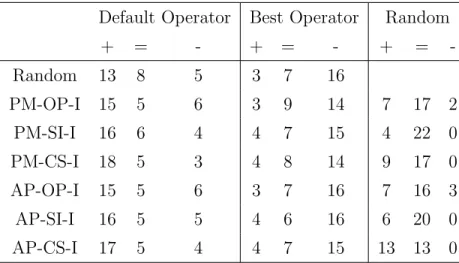
Chapter 2 provides a survey of the literature on existing credit assignment strategies for AOS on multiobjective problems. Based on the existing literature, a classification of these strategies is developed for the first time, identifying nine categories based on the type of fitness function and set of solutions used to assess an operator’s impact. This classification reveals gaps in the literature and five new credit assignment strategies are proposed to fill the gaps. This chapter also addresses the lack of any previous comparative experiment analyzing the efficacy of existing credit assignment strategies. Nine credit assignment strategies are com-pared experimentally on standard benchmarking problems to evaluate their effect in elevating the generality of an MOEA and outperforming a random operator
![Table 2.6: Experiment A: Best Operator and mean IGD Problem MOEA/D-DRA [DE] NSGA-II [SBX] IBEA [SBX]](https://thumb-us.123doks.com/thumbv2/123dok_us/814223.2602969/79.918.234.751.156.794/table-experiment-best-operator-problem-moea-nsga-ibea.webp)
![Table 2.7: Experiment A: Best Operator and mean HV Problem MOEA/D-DRA [DE] NSGA-II [SBX] IBEA [SBX]](https://thumb-us.123doks.com/thumbv2/123dok_us/814223.2602969/80.918.226.760.158.797/table-experiment-best-operator-problem-moea-nsga-ibea.webp)