A D
-nA
233 076
0 hour per respon~se. including the t~eb aiwn fStfljctions. 00rching existingdaasuc. gatherln~~~~~~~~~~~ollection
of information. Send commnt rgdin hsbre siaeo n te seto ORA$ cn Wanhngton Hleadquarters Services. Directorate for Infonnation operations and Reports. 1215=feroOavl 141.-nagemient and Budget. PaperwOrk Reduction Project (0704-011881. Washington, DC 20503. 1. Agency Use Only (Leave blank). 2. Report Date. 3. Report Type and Dales Covered.
1 1990 Journal, Article
4. Title and Subtitle. 5. Funding Numbers.
MlcrobioLogic&lly Influenced Corrosion in Copper and Nickel, Seawater Piping 062315m
Systems Progran: Eleent NO. 61153
00101
6. Author(s). icetN.010
rakNo. 10
Brands Little, Patricia Wagner, Richard Ray, and Michael. McNeil31
Accession No. DM250092
___________________________________________________________________DN094463 7. Performing Organization Name(s) and Address(es). 8. Performing Organization
Naval Oceanographic and Atmospheric Research Laboratory Report Number. ocean Science Directorate
Stemd.s Space Center, MS 39529-5004 JA 333:051:90
9. Sponsoring/Monitoring Agency Name(s) and Address(es). 10. SponsoringlMonitoring Agency
Naval, Coastal, Systelm Center, Panam City, FL 3407-5000 and Report Number.
Naval. Oceanographic and Atmospheric Research Laboratory. Basic JA 333:051:90
Research Management Office, Stenntis Space Center, MS 39529-5004
Accesion 10r
11. Supplementary Notes. NTIS CRA&l
OTIC TAB 1
Unannounced 0
MTSJ Justification_ _
____________________________________________ BY_________
12a. OistributionlAvailabiiity Statement. Distributioni
Approved for public release; distribution is wiLimited. is AaladoSpecial
Q !'lTy
13. Abstract (Maximum 200 words).
Copper and nickel, seawater piping system were severely pitted after exposure to maine and estuarine waters. Sur-faces were ilforuLy covered with thick deposits, ranging in color from blue-green to reddish-brown to black. Pits developed wnder surface deposits containing 10 4-10 5 cu 2 sulfate-reducing bacteria in association with other bacte-ria. Pita were irregular in shape, lacking a consistent morphology. The observed corrosion was attributed to the presence and activities of microorganisms that resulted in differential. aeration cells, Large cathode::anode surface ratios, concentration of chlorides, devLopmnt of acidity within pits, and reactions of the base metals with micro-biologically produced sulf Idest. Chlorine and sulfur reacted selectively with iron and nickel. In the alloys, Leaving
copper-rich
spongy pit
interiors.
D T I(
r
SELECTE
MAR 2 619911
14. Subject Terms. 15. Number of Pages.
(U) Corrosion; (U) Polymer Composites; (U) Glass Reinforced Plastic; a (U) lio0fouling; (U) Corrosion; (U) Blodterlorat ion: (U) ElectrochemIstry. 16. Price Code.
17. Security Ciassification Is. Security Ciassification 1g. Security Classification 20. Limitation of Abstract.
of Report. of This Page. of Abstract
Unclassified Unclassified Unclassified BAR
Microbiologically Influenced Corrosion in
Copper and Nickel Seawater Piping Systems
Brenda Little Naval Oceanographic and Atmospheric Research Laboratory
Patricia Wagner Stennis Space Center, Mississippi
Richard Ray
Michael McNeil Naval Coastal Systems Center
Panama City, Florida
ABSTRACT
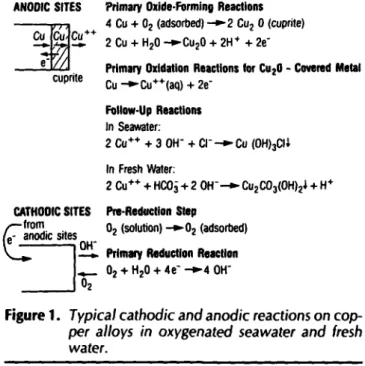
ANODIC SITES Primary Oxide.Forming ReactionsCopper and nickel seawater piping systems were severely CU--- cu++ CU 4 + 02 (adsorbed) -- 2 Cu2 0 (cuprite) pitted after exposure to marine and estuarine waters. 2 Cu + H20 --- CU20 + 2H* + 2e"
Surfaces were uniformly covered with thick deposits,e l//,Icupri Primary Oxidation Reactions for Cu20 - Covered Metal
ranging in color from blue-green to reddish-brown to cuplte Cu -Cu++(aq) + 2e" black. Pits developed under surface deposits containing FoIIOw.Up Reactions
104-105 cm-2 sulfat-reducing bacteria in association
with other bacteria. Pits were irregular in shape, lacking In Seawater
a consistent morphology. The observed corrosion was 2 Cu++ + 3 OH + C1- -Cu (0H)CI attributed to the presence and activities of microor- In Fresh Water:
ganisms that resulted in differential aeration cells, large 2 Cu+ + + HC03 + 2 OH-- Cu2CO3(OH)24 + H+ cathode::anode surface ratios, concentration of
chlo-rides, development of acidity within pits, and reactions CATHOmIC SITES PsRduction Sep
of the base metals with microbiologically produced sul- a fnodic site 0 (so u
fides. Chlorine and sulfur reacted selectively with iron ePrimay Reduction Reaction
and nickel in the alloys, leaving copper-rich spongy pit . 02 + H20 + 4e- -4 OH"
interiors. f 02
Figure 1. Typical cathodic and anodic reactions on
cop-INTRODUCTION
per alloys in oxygenated seawater and freshwater.
C
opper and nickel alloys have a long history ofsuc-cessful application in the marine environment. Predominantly copper alloys are frequently used for
sea-water piping systems and heat exchangers due to good ments, such as evaporators, heat exchanger pumps and corrosion resistance combined with mechanical work- valves, diffusers for steam nozzles in steam ejectors, and ability, excellent electrical and thermal conductivity, turbine blades (Tipton and Kain, 1980). Friend (1980) ease of soldering and brazing, and a resistance to macro- reported that a passive film similar in structure to that fouling. In oxygenated seawater a film of cuprous oxide, observed on pure nickel is formed on Ni-Cu alloys con-cuprite (Cu20), forms on the metal (North and Pryor, taining more than 30 percent Ni. A metal protected by
1970). Copper ions and electrons pass through the film. a passive film is resistant to uniform corrosion. Alloys Copper ions dissolve in the water and precipitate as containing less than this amount of Ni behave like
cop-Cu2(OH)3Cl independent of alloy chemistry (Pollard et per. The formation of the protective passive film in nickel
al., 1989). Figure I presents a set of reactions consistent is aided by the presence of iron, aluminum, and silicon
with observed corrosion behavior for copper alloys in (Shreir, 1977a). seawater and fresh water. Alloying nickel and iron into
copper alters the corrosion product and improves corro- Copper and nickel alloys are susceptible to several sion resistance. The mechanism is not fully understood types of localized corrosion. Premature corrosion failures but appears to be related to control of the cathodic rather in predominantly copper alloys have been attributed than the anodic reaction (Hack et al., 1986). An alloy to erosion corrosion caused by the removal or break-containing 88.5 percent copper, 10 percent nickel, and down of the protective film by mechanical forces, such
1.5 percent iron has been shown to be the most corrosion as local turbulence or impingement (Bates and Popple-resistant copper-based alloy for seawater service (Bates well, 1975; Shreir, 1977a; Sato and Nagata, 1978) and and Popplewell, 1975). under-deposit corrosion (LaQue, 1975). In high velocity seawater, predominantly nickel alloys are superior to Predominantly nickel alloys have been used exten- copper-rich alloys because the protective surface film sively in highly aerated fast-moving seawater environ- remains intact under highly turbulent and erosive
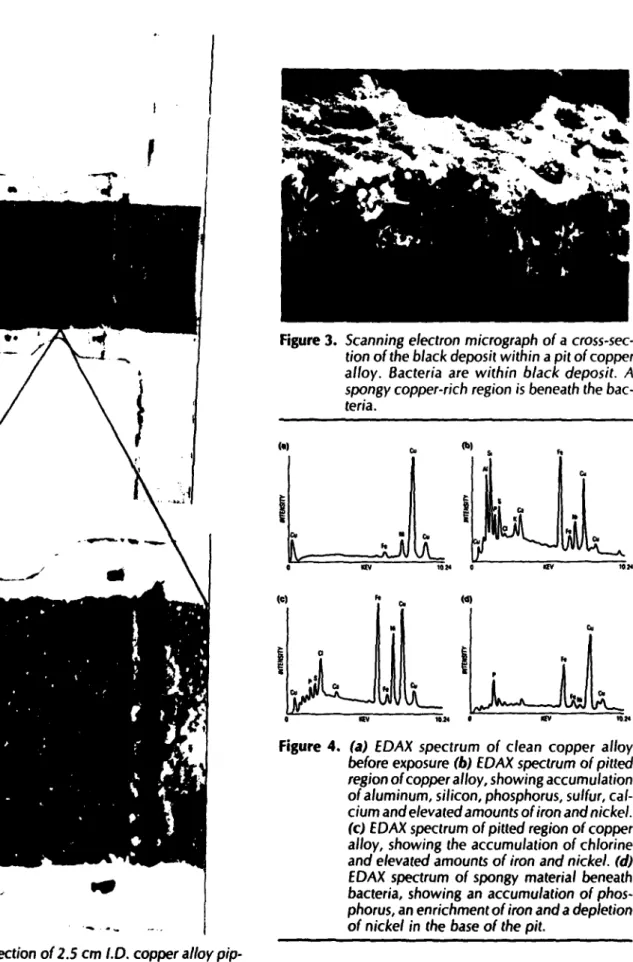
tions (Fink and Boyd, 1972). Nickel alloys are susceptible Surface deposits were thick and multilayered (Figure to pitting and crevice corrosion attack under stagnant 2), varying in color with depth. Outermost layers were conditions (Maylor, 1978; Southwell and Alexander, dark green to reddish-brown. Bright bluish-green depos-1967; Stover, 1961). its were found on the surface in unpitted areas. Pit interi-ors were black. Pit depths were typically 1.7-2.0 mm. Both copper and nickel alloys are vulnerable to micro- Surface chemical and microbiological characterizations biologically influenced corrosion. Differential aeration were performed with a KEVEX-7000 energy-dispersive (Pope, 1985), selective leaching (Alanis et al., 1986), X-ray spectrometer (EDAX) coupled to an AMRAY 1 000A
under-deposit corrosion (Pope, 1986), and cathodic scanning electron microscope. A cross-section through depolarization (Miller, 1970) have been reported as the pitted areas exposed subsurface bacteria within the mechanisms for microbiologically influenced corrosion thin black deposit (Figure 3) and a spongy subsurface. of copper and nickel alloys. Differential aeration occurs An EDAX spectrum (Figure 4a) of the base metal shows when the concentration of oxygen is higher at an area of the relative concentrations of iron, nickel and copper. the metal surface and lower at surrounding areas. In The layer containing the bacteria, examined at two loca-oxygenated electrolytes, areas that are lower in oxygen tions, showed consistent accumulations of phosphorus, concentration will be the anodes of the differential aera- sulfur, calcium and chlorine (Figure 4b, c) in addition to tion cell while surrounding areas will becathodes. Differ- elevated amounts of iron and nickel. The spongy layer ential aeration cells frequently form in association with under the bacteria included an accumulation of phos-surface deposits. As is the case with other chemical reac- phorous and a depletion of nickel (Figure 4d). Numbers tions, corrosion tends to reach an equilibrium rate lower of sulfate-reducing bacteria in the flow-through water than the initial rate as a result of the formation of anodic and in the biofilm were estimated by the Most Probable and cathodic reaction products. For example, the Number (MPN) method using a medium containing lac-cathodic reaction would slow down if the hydrogen tate as the electron donor and carbon source made to product of the cathodic reaction were not removed. The the salinity of the seawater (Pfennig et al., 1981). Scrap-decreased reaction rate is due to "cathodic polariza- ings from the area within the pits indicated the presence tion." Any reactant that can remove the cathodic reac- of 1 x 10s sulfate-reducing bacteria cm-2. Within the tion product is a cathodic depolarizer. Pope et al. (1984) surface film on the unpitted surface, 1 x 101 sulfate-have proposed that the following microbial products reducing bacteria cm-2 were detected.
accelerate localized attack: C02, H2S, NH31, organic and
inorganic acids; metabolites that act as depolarizers; and Water removed from the failed pipe section was sulfur compounds such as mercaptans, sulfides, and typical of seawater: salinity, 35 parts per thousand; dis-disulfides. Sulfide corrosion products can also act as solved oxygen, 6.4 mg I-'; pH, 8.2; total organic depolarizers (Behret et al., 1975). Geesey et al. (1986) carbon, 1.8 mg I-1; total suspended solids, 3.0 mg I-1;
have recently demonstrated that the extracellular poly- and total dissolved sulfate, 2.4 g 1-i. Dissolved sul-mers secreted by bacteria can play a role in the corrosion fides were below the detection limits. The sulfate-reduc-of copper alloys. ing bacterial population in the seawater was typically
I
1 x 101-102 cc-1.This paper will present case studies of
microbiologi-cally influenced corrosion in a copper seawater piping Nickel Alloy
system after a service life of approximately one year and
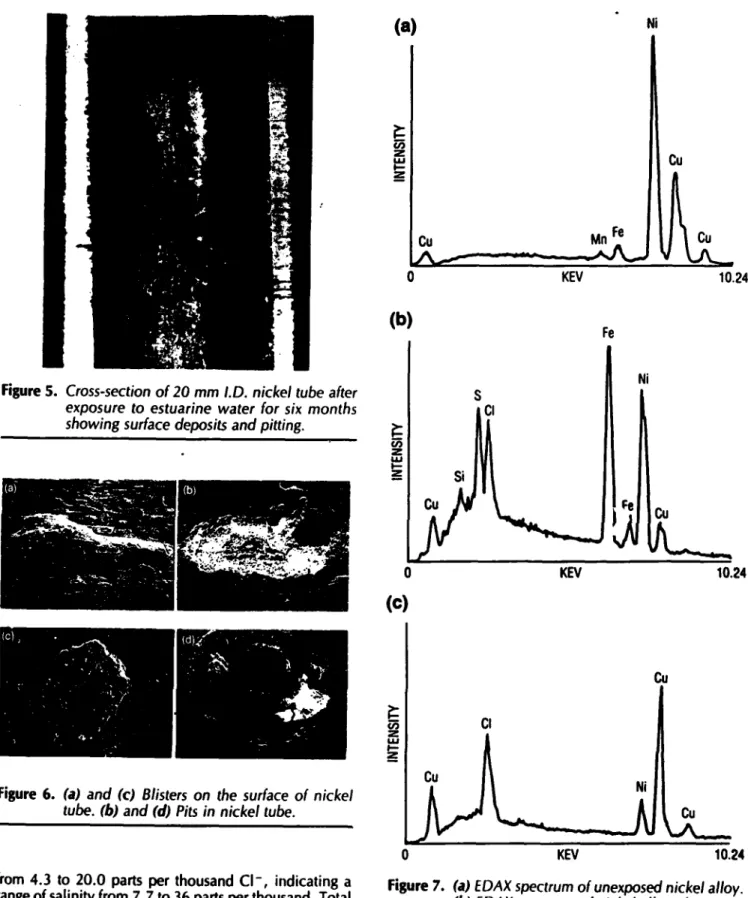
in nickel alloytubingafterexposuretoestuarine waterfor Visual examination of the nickel alloy (66.5% nickel, six months. A discussion of possible microbiologically 31.5% copper and 1.25% iron) after exposure to estua-influenced corrosion mechanisms is included. rine Gulf of Mexico water for six months indicated a
multilayered scale with localized pitting (Figure 5). The average pit depth was 1.0 mm. Surface scales were
char-CASE HISTORIES
acterized by blisters (Figure 6a, c) containing corrosion products and concentrations of bacteria. Numbers of sulfate-reducing bacteria within the surface depositsCopper Alloy were typically 1 x 104 cm- 2. Removal of the scale exposed localized, irregular-shaped pits (0.3-0.5 mm
A heavily pitted section of copper/nickel piping wide x 0.8-1.2 mm deep) (Figures 6b, d). The
unex-| (88.5% copper, 10% nickel and 1.5% iron) (15 cm I x posed nickel alloy contained copper, nickel, manga-2.5 cm I.D.,
~nese,
wall thickness 3.6 mm) was removed from nesed nd iro (Fig and iron (Figure 7a). The EDAX spectrum frome cT Dper u fomthe seawater piping system of a surface ship after approxi- the black layer within the pits showed accumulations mately one year of seawater service. During operation of sulfur and chlorine and increased amounts of iron
of the ship, the seawater piping system had been main- compared to the base alloy (Figure 7b). Physical removal
tained with continuously flowing seawater (1.6 m sec-1) of the biofilm from the pit exposed a region depleted
at a maximum temperature of 300 C. During the twelve in nickel and iron (Figure 7c) containing an increased
to eighteen months of the shipbuilding process, however, proportion of copper. the system had been operated with estuarine water from
the Gulf of Mexico with intermittent flow and long peri- Gulf of Mexico estuarine water temperature varied ods of stagnation. from 9°C to 300 C; pH varied from 7.4 to 8.2; chlorinity,
(a)
* .Figure 3. Scanning electron micrograph of a
cross-sec-tion of the black deposit within a pit of copper alloy. Bacteria are within black deposit. A spongy copper-rich region is beneath the bac-teria.
(b)
- 1024 )104 12 V
plFla
Figure 4. (a) EDAX spectrum of clean copper alloy
before exposure (b) EDAX spectrum of pitted region of copper alloy, showing accumulation of aluminum, silicon, phosphorus, sulfur, cal-cium and elevated amounts of iron and nickel.
(c) EDAX spectrum of pitted region of copper
alloy, showing the accumulation of chlorine
and elevated amounts of iron and nickel. (d)
EDAX spectrum of spongy material beneath bacteria, showing an accumulation of phos-phorus, an enrichment of iron and a depletion of nickel in the base of the pit.
Figure 2. Cross-section of 2.5 cm I.D. copper alloy pip-ing after one year in seawater service, showpip-ing thick surface deposits and pitting.
(a)
Ni
Un'1 CU 0 KEV 10.24(b)
Fe
Ni Figure 5. Cross-section of 20 mm I.D. nickel tube after Sexposure to estuarine water for six months CI
showing surface deposits and pitting.
tu Si Cu Fe Cu 0 KEV 10.24 (C) Cu C
Figure 6. (a) and (c) Blisters on the surface of nickel Ni
tube. (b) and (d) Pits in nickel tube. Cu
0 KEV 10.24
from 4.3 to 20.0 parts per thousand CI-, indicating a Figure 7. (a) EDAX spectrum of unexposed nickel alloy. range of salinity from 7.7 to 36 parts per thousand. Total (b) EDAX spectrum of nickel alloy after expo-suspended solids ranged from 10 to 65 mg I- . Dissolved sure to estuarine water for six months showing
oxygen varied from 4.3 mg I-' during the summer to accumulations of silicon, sulfur, and chlorine
10.8 mg I- I during the winter months. Dissolved sulfides with elevated concentrations of iron and were below detection limits. The mean concentration for nickel. (C) EDAX spectrum of the residual metal sulfates (S04-2) was 2.5 gram
- . The MPN for sulfate- in the base of the pit showing nickel depletion
reducing bacteria in the estuarine water was 1 x 10² to and copper enrichment.
10, cc-,.
DISCUSSION
(a)Copper alloys prevent or retard the settlement of mac-
4
A rofouling species, such as barnacles and mussels(More-ton and Glover, 1980; Fischer et al., 1981; Roberts, 1976). However, bacteria, microalgae, protozoa, and their cellular exudates form a slime layer on copper-containing surfaces (Danile and Chamberlain, 1981; (b)
Field, 1981; Purkiss, 1970). Marszalek et al. (1979) doc- ___ umented that copper fouled at a slower rate than stainless -- 14-'
steel and glass surfaces and that the microflora on copper
surfaces was less diverse than that found on the steel and '----"- -*- glass exposed under identical conditions to Gulf Stream N__ ,_,,_-8/
water in Key Biscayne, Florida. They reported that fungi 7 % %_
were conspicuously
absent
onthe
copper surfaces and !_diatoms appeared only after copper surfaces were cov-ered with a microfouling layer populated with bacteria
and copious amounts of extracellular polymer. It has 01 1 j! At"
been reported that both macrofouling and microfouling - , ,',*,*. , increase as the concentration of nickel in the alloy
increases (Uhlig and Revie, 1985).
Corrosion can range from highly uniform to highly Figure 8. (a) Differential aeration cell formed by micro-localized. In uniform corrosion the anodic and cathodic bial colonies. (b) Detailed reactions resulting
sites are difficult to discriminate experimentally, while from the formation of a differential aeration
in localized corrosion they are not. Crevice corrosion, cell.
filiform corrosion, pitting, selective leaching and ero-sion-corrosion are typical forms of localized corrosion. No general theories apply to all forms of localized
corro-sion. Nevertheless, the following factors are frequently the activity of copper ions at a low value and facilitates
important: cathode: :anode surface area ratio, differential anodic dissolution of the copper. Under these circum-aeration, and pH changes at anodic and cathodic sites. Mos cofiredcases of microbiologically influenced stances, pitting in copper alloys involves the conven-snces, ditin ot copper nde the circum-Most confirmed casescterized as local influn tional features of differential aeration, a large cathode::
corrosion are characterized as localized corrosion (Char-
aoesraeae aiadtedvlpeto
cdt
acklis et al., 1989; Videla, 1985; Tatnall, 1981; Kobrin, anode surface area ratio, and the development of acidity within the pit. Under some conditions this can lead to 1976). Discrete mounds or columns develop on metal the formation of nantokite, CuCI, and a form of corrosion surfaces as a result of microbial activities and result in a termed "bronze disease" (Scott, 1990).
localization of anodic and cathodic reactions.
Pitting in predominantly copper alloys has been attrib- Under-deposit Geesey et al. (1986) have demonstrated that the
exopolymers that anchor cells to surfaces exhibit satura-uted to under-deposit attack (Figure 8a). Udreoit ion binding of copper ions in aqueous suspensions. corrosion is extremely important for these alloys because Microcolonies within a biofilm have the capacity to form
it initiates a series of events that are individually or coconce s with ajaet arasin a o-collctielyextemey crrosve Shrir,197). ead copper concentration cells with adjacent areas in a
bio-collectively extremely corrosive (Shreir, 1977). Dead film that contain less reactive polymer, promoting deteri-barnacles, dirt, debris or microbiological colonies oraton e reacte oneratin cere
accumulating on the surface result in the formation of
ortion
of copper surfaces. The concentration cells are
differentil aeraion hells s urf resub). In t a o in e maintained by the acid-producing activities of the biofilm
differential aeration cells (Figure 8b). In an oxygenated mcrfr. environment, such as unpolluted natural seawater, the microflora.
area immediately under the deposit becomes deprived In the two case studies reported, sulfate-reducing bac-of oxygen. That area becomes a relatively small anode teria were isolated from localized deposits associated compared to the large surrounding oxygenated cathode. with the pits. Sulfate-reducing bacteria are a diverse Cathodic reduction of oxygen may result in an increase group of anaerobic bacteria that can be isolated from a in pH of the solution in the vicinity of the metal. At the variety of environments (Pfennig et al., 1981; Postgate, anodic site the metal will form metal cations. If the metal 1979), including seawater (Battersby, 1988), where the hydroxide is the thermodynamically stable phase in the concentration of sulfate is typically 2 grams per liter. solution, the metal ions will be hydrolyzed by water with Even though the oxygen content of seawater ranges from the formation of H ions. If the cathodic and anodic sites 6-10 ppm, anaerobic microorganisms can survive in are separated from one another, the pH at the anode will anaerobic microniches until conditions are suitable for decrease and that at the cathode will increase. Cl - from their growth (Costerton and Geesey, 1986; Staffeldt and the electrolyte will migrate to the anode to neutralize Kohler, 1973). Seawater piping systems have high sur-any buildup of charge (Hoar, 1947). The low solubility face areas at which nutrients can concentrate, predispos-of copper chlorides and hydroxychlorides maintains ing these systems to biofilm formation (Costerton et al.,
14 - MTS Journal - Vol. 24, No. 3
.. .
1987). If the aerobic respiration rate within the biofilm is ions. For these reasons turbulence-induced corrosion greater than the oxygen diffusion rate, the metal/biofilm and sulfide attack of copper alloys cannot be decoupled interface can become anaerobic and provide a niche for easily. In the presence of oxygen, the possible corrosion sulfide production by sulfate-reducing bacteria (Little et reactions in a copper sulfide system are extremely com-al., 1990). plex because of the large number of stable copper
The impact of sulfides on the corrosion of copper alloys sulfides (Ribbe, 1976), their differing electrical conduc-has received a considerable amount of attention. Little tivities, and catalytic effects. Transformations between hece al. consid1989haveablihed mot attenton. of ts Lsulfides, - or of sulfides to oxides, result in changes in
et ai. (1988, 1989) have published several reports docu- volume that weaken the attachment scale and oxide sub-menting localized corrosion of copper alloys by sulfate- scale leading to spalling. Bared areas repassivate, thus reducing bacteria in estuarine environments. Others forming cuprous oxide (Figure 9b).
have reported the failure of copper alloys in polluted
seawater containing waterborne sulfides that stimulate Pope (1986) has isolated sulfate-reducing bacteria pitting and stress corrosion cracking (Rowlands, 1965). from 90/10 copper/nickel surfaces under deposits of iron-Copper alloys suffer accelerated corrosion attack in sea- and manganese-oxidizing bacteria and under discrete water containing 0.01 ppm sulfide after one-day expo- deposits of slime-forming organisms where severe pitting sure (Gudas and Hack, 1979). A porous layer of cuprous was observed. The pits under the deposits contained up sulfide with the general stoichiometry Cu2 - xS, O<x< 1 to several million sulfate-reducing bacteria per pit. It was forms in the presence of sulfide ions (Syrett, 1980). Cop- proposed that the deposits were formed by the action per ions migrate through the layer, react with more sul- of slime-forming organisms and iron- and manganese-fide, and produce a thick, black scale (Figure 9a). Under depositing bacteria that precipitate metals in the hydrox-these conditions, corrosion is under cathodic control, ide forms. These surface deposits provide an anaerobic limited by the diffusion of H I ions to the cathodic sites environment that permits the growth of sulfate-reducing (Syrett, 1980; Macdonald et al., 1979). The role of bacteria and the production of corrosive metabolic cathodic depolarization is not adequately understood products.
and may be a transient phenomenon. EDAX spectra for the pitted copper alloy indicate that It has been argued that if the copper sulfide layer were nickel had been selectively removed from the alloy in djurelite (Cu,.%S) the sulfide layer would be protective the presence of sulfate-reducing bacteria. Verink and (North and MacLeod, 1986). Even if such a sulfide film Pourbaix (1971) and Efird (1970) reported denickelifica-were technically passivating (Figure 9a), the film's tion of Cu/Ni alloys associated with occluded cells in salt mechanical stability is so poor that sulfide films are use- solutions where lowering of the pH had taken place. A less for corrosion protection. In the presence of turbu- detailed discussion of the mechanisms for selective lence, the loosely adherent sulfide film is removed, attack and dealloying has been addressed by Shreir exposing a fresh copper surface to react with the sulfide (1 977b).
Nickel is generally regarded as a corrosion-resistant
(,) Thick saiiie-icWide material. In flowing seawater the reported corrosion rate is typically 0.012 mm/yr. Alloys containing more than 40 percent Ni tend to show the passivity associated with
T..Cor"s WN pure Ni. The passive layer that forms on nickel alloys
Thmn
-s Vrc is not impaired under turbulent conditions (May and
.sa.I"Welden, 1965). However, high nickel alloys do exhibit
a tendency toward pitting corrosion.
Because the pitting potential of nickel/copper alloy is typically within 20-30 mV of the open circuit potential
(b) Th ical = su*d. (Bates and Popplewell, 1975), these alloys have a
pani converted su. and oxide
marked tendency for the initiation of pitting in
chloride-...,h containing environments where the passive film can be
'"l " .disturbed. Under stagnant conditions, chlorides can pen-Cormionrrsm etrate the passive film at weak points and cause pitting
4-11- attack. Sulfides can cause either a modification of the
Mew oxide layer as described for copper or breakdown of the oxide film of nickel based alloys. Pit initiation and propagation depend on the depth of exposure,
tempera-Figure 9. (a) Schematic of thick sulfide-rich scale form- ture, and presence of surface deposits (Maylor, 1978;
ing on copper alloy (Taken from Syrett, 1980 Southwell and Alexander, 1967; Gouda et al., 1990).
with permission). (b) Schematic showing
dis-ruption of sulfide-rich film on copper alloy by Schumacher (1979) reported that predominantly
the introduction of aerated seawater (Taken nickel alloys were susceptible to under-deposit corrosion from Syrett, 1980 with permission). and oxygen concentration cells (Figure 8 a,b). Gouda et
al. (1990) demonstrated pitting of nickel/copper tubes MTS Journal * Vol. 24, No. 3 * 15
exposed in Arabian Gulf seawater. In their studies, pits Corrosion: 1988 Workshop Proceedings, ed. G. J. Licina, developed under deposits of sulfate-reducing bacteria pp. 4-1-4-33. Palo Alto: Electric Power Research Institute, and nickel had been selectively dealloyed. Inc.
The microbiologically influenced corrosion of nickel Costerton, J. W., Cheng, K.-J., Geesey, G. G., Ladd, T. I., reported in this paper was characterized by the formation Nickel, biofilms in nature and disease. Ann. Rev. Microbiol. 41:I. C., Dasgupta, M., and Marrie, T. ). 1987. Bacterial
of blisters and pits containing sulfate-reducing bacteria. 435464. Differential aeration cells appear to have been formed,
with low oxygen concentration immediately underneath Costerton, J. W. and Geesey, G. G. 1986. The microbial
ecol-the deposits. This created an environment for ecol-the growth ogy of surface colonization and of consequent corrosion. and activities of sulfate-reducing bacteria. The surface In: Biologically Induced Corrosion, ed. S. C. Dexter, pp. area under the deposit became anodic and corroded 223-232. Houston: National Association of Corrosion while the electrons that were generated reacted at the Engineers.
cathodic region of high oxygen concentration. Chlorine Danile, G. F. andChamberlain, A. H. L. 1981. Copper immobi-and sulfur accumulated within the region of the pit immobi-and lization in fouling diatoms. Botanica Marina. 24(4):
reacted with the iron and nickel in the alloy. Nickel 229-243.
had been selectively removed from the alloy, leaving a Efird, K. D. 1970. Crevice corrosion of copper-nickel alloy and spongy copper-rich material in the base of the pit. its relation to the experimental Pourbaix diagram. Masters/
Ph.D Thesis, University of Miami, Florida.
CONCLUSIONS
Field, B. 1981. Marine biofouling and its control: history and state-of-the-art review. In: Oceans '81 Conference Record, Copper and nickel alloys used in seawater environ- 1, Boston, MA.ments can suffer from microbiologically influenced cor- Fink, F. W. and Boyd, W. K. 1972. Corrosion of Metals in rosion. In the two case studies reported, pitting occurred Marine Environments. DMIC Report. Battelle Memorial under surface deposits containing 104-101 sulfate- Institute, Columbus, Ohio.
reducing bacteria cm - 2
. Possible mechanisms for the
observed pitting include the formation of differential aer- Fischer, E. C., Castelli, V. I., Rodgers, S. D., and Bleik,
ao cells that increase the cathode: :anode area ratio, H. R. 1981. Technology for control of marine
biofouling-ation th atin of a cdenirea ratin a review. In: Marine Biodeterioration: An Interdisciplinary initiating the formation of an acidic environment within Study, eds. J. D. Costlow and R. C. Tipper, pp. 261-299.
the pit. Chlorine and sulfur accumulated in the pits of Annapolis: Naval Institute Press. both alloys, and nickel was selectively removed from the
pitted regions. Friend, W. Z. 1980. Corrosion of Nickel and Nickel-Base
Alloys. 459 pp. New York: John Wiley & Sons Ltd.
Geesey, G.G., Mittleman, M.W., lwaoka, T., and Griffiths,
ACKNOWLEDGMENTS
P.R. 1986. Role of bacterial exopolymers in the deteriora-tion of metallic copper surfaces. Materials Performance This work was supported by the Office of Naval 25(2): 37-40.Research (ONR), Program Element 61153N, through the
NOARL Defense Research Sciences Program and by Dr. Gouda, V. K., Banat, M. I., Riad, T. W., and Mansour, S. I.
Michael Marron, ONR Code 1141 MB. NOARL Contri- 1990. Microbial-Induced Corrosion of Monel 400 in
Seawa-bution Number 333:051:90. ter. In: Proceedings Corrosion '90, Paper #90107, Las Vegas, NV: National Association of Corrosion Engineers. Gudas, J. P. and Hack, H. P. 1979. Sulfide induced corrosion
REFERENCES of copper nickel alloys. Corrosion 35: 67-73.
Alanis, I., Berardo, L., De Cristofaro, N., Moina, C., and Valen- Hack, H., Shih, H., and Pickering H. 1986. Role of the corro-tini, C. 1986. A case of localized corrosion in underground sion protective film in the corrosion protection of Cu-Ni
brass pipes. In: Biologically induced Corrosion, ed. S. C. alloys in seawater. In: Surfaces, Inhibition and Passivation,
Dexter, pp. 102-108. Houston: National Association of eds. E. McCafferty and R. ). Broadd, pp. 355-367,
Electro-Corrosion Engineers. chemical Society.
Bates, J. F. and Popplewell, J. M. 1975. Corrosion of condenser Hoar, T. P. 1947. Disc. Faraday Soc., No.1, 299.
tube alloys in sulfide contaminated brine. Corrosion. 31(8): Kobrin, G. 1976. Corrosion by microbiological organisms in
269-275. natural waters. Materials Performance 15(7): 38-43.
Battersby, B. L. 1988. Sulphate-reducing bacteria. In: Methodsin Aquatic Bacteriology, B. Austin (ed), pp. 269-299. New LaQue, F. L. 1975. Environmental factors in corrosion of metals
York: John Wiley & Sons Ltd. in seawater and sea air. In: Marine Corrosion, Causes and
Prevention. 332 pp. NY: John Wiley & Sons Ltd.
Behret, H., Binder, H., and Standstede, G. 1975.
Electrocata-lytic oxygen reduction with thiospinels and other sulfides of Little, B., Ray, R., Wagner, P., Lewandowski, Z., Lee, W. C., transition metals. Electrochimica Acta 20:111-1 17. Characklis, W. behavior of stainless steels in natural seawater. In: Proceed.G., and Mansfeld, F. 1990. Electrochemical Characklis, W. G., Little, B. J., and McCaughey, M. S. 1989. ings Corrosion '90, Paper No. 150, Las Vegas, NV: National
Biofilms and their effect on local chemistry. In: Microbial Association of Corrosion Engineers.
Little, B., Wagner, P., Jacobus, J., and Janus, L. 1989. Evalua- Purkiss, B. E. 1970. Corrosion in industrial situations by mixed tion of microbiologically induced corrosion in an estuary. microbial flora. In: Microbial Aspects of Metallurgy, ed. 1.
Estuaries 12(3): 138-141. D. A. Miller, pp. 107-128. NY: American Elsevier
Publish-Little, B., Wagner, P., and Jacobus, J. 1988. The impact of ing Co.
sulfate-reducing bacteria on welded copper-nickel seawater Ribbe, P. H. (ed). 1976. Sulfide mineralogy. pp. CS-58-CS-piping systems. Materials Performance 27(8): 57-61. 76, Mineralogical Society of America, Washington, DC.
Macdonald, D. D., Syrett , B. C., and Wing, S. S. 1979. Roberts, D. 1976. Mussels and pollution. In: Marine Mussels:
Corrosion of Cu-Ni alloys 706 and 715 in flowing sea Their Ecology and Physiology, ed. B. L. Bayne, pp. 67-80. water -2. effect of dissolved sulfide. Corrosion 35(8): London: Cambridge University Press.
367-378. Rowlands, J. C. 1965. Corrosion of tube and pipe alloys due
Marszalek, D. S., Gerchakov, S. M., and Udey, L. R. 1979. to polluted sea water. I. Appl. Chem. 15: 57-63.
Influence of substrate composition on marine microfouling. Sato, S. and Nagata, K. 1978. Factors affecting corrosion and Applied and Environmental Microbiology 38(5): 987-995. fouling of condenser tubes of copper alloys and titanium. May, T. P. and Welden, B. A. 1965. Copper- nickel alloys for Light Metal Technical Reports a 19(3,4): 83-94.
service in seawater. I. Tray. Cent. Rech. Etude 6:141-156. Schumacher, M. (ed.) 1979 Seawater Corrosion Handbook.Park Ridge, New
jersey. Noyes Data Corporation. 494 pp.
Maylor, J. B. 1978. Corrosion resistance of high nickel sea
water. Anti-Corrosion Methods and Materials 25(7): 3,5-9. Scott, D. A. 1990. Bronze disease: a review of some chemical factors. To appear in Iournal of the American Institute of Miller, J. D. A. 1970. Microbial corrosion of buried and Conservation, August 1990.
immersed metal. In: Microbial Aspects of Metallurgy, ed. I.
D. A. Miller, pp. 61-106. NY: American Elsevier Publishing Shreir, L. L. 1977a. Corrosion, Vol. 2, Corrosion Control, pp.
Co. 14.62-14.86. London: Newnes-Butterworths.
Moreton, B. B. and Glover, T. J. 1980. New marine industry Shreir, L. L. 1977b. Corrosion, Vol. 1, Metal/Environment Reac-applications for corrosion and biofouling resistant copper- tions, pp. 1: 166-169. London: Newnes-Butterworths. nickel alloys. Biologia Marina, Proceedings of 5th Interna- Southwell, C. R. and Alexander, A. L. 1967. Corrosion of tional Congress on Marine Corrosion and Fouling, pp. metals in tropical environments, Part 8. Nickel and
nickel-267-278, Barcelona, Spain. copper alloys: Sixteen years exposure. Naval Research Labo-North, N. A. and MacLeod, I. D. 1986. Corrosion of metals. ratory, NRL Report 6592, Washington, D.C.
In: Conservation of Archaeological Objects, ed. C. Pearson, Staffeldt, E. E. and Kohler, D. A. 1973. Assessment of corrosion
pp. 68-98. London: Butterworths. products removed from "La Fortuna," Punta Dogana del North, R. F. and Pryor, M. j. 1970. The influence of corrosion Mar., Venezia. Petrolio e Ambiente, pp. 163-170.
product structure on the corrosion rate of Cu-Ni alloys. Stover, H. E. 1961. Premature failure of copper-nickel alloys Corrosion Science. 10: 297-311. in seawater. Corrosion 17:461T-462T.
Pfennig, N., Widdel, F., and Truper, H. G. 1981. The Dissimi- Syrett, B. C. 1980. The mechanism of accelerated corrosion of latory Sulfate-Reducing Bacteria. In: The Prokaryotes: A copper-nickel alloys in sulfide polluted seawater. In: Pro-Handbook on Habitats, ed. M.P. Starr et al., p. 926-940. ceedings Corrosion '80, Paper #33, Chicago, IL: National
NY: Springer-Verlag. Association of Corrosion Engineers.
Pollard, A. M., Thomas, R. G., and Williams, P. A. 1989. Tatnall, R. E. 1981. Fundamentals of bacteria-induced corro-Synthesis and stabilities of the basic copper (11) chlorides sion. In: Proceedings of Corrosion '81, Paper #129, atacamite, paratacamite and botallackite. Mineralogical Toronto, Canada: National Association of Corrosion
Magazine 53: 557-563. Engineers.
Pope, D. H. 1986. A Study of Microbiologically Influenced Corosiope in Nuclear Power Plants atudy Mical a Gnuide Tipton, D. G. and Kain, R. M. 1980. Effect of temperature onthe resistance to pitting of Monel alloy 400 in seawater. In:
Corrosion in Nuclear Power Plants anda Practical ie fr Proceedings of Corrosion '80. Chicago, Illinois: National Countermeasures. Palo Alto, CA: Electric Power Research Association of Corrosion Engineers.
Institute.
Uhlig, H. and Revie, R. W. 1985. Corrosion and Corrosion
Pope, D. H. 1985. MIC in U.S. industries-detection and pre- Control: An Introduction to Corrosion Science and Engineer-vention. In: Argentine-USA Workshop on Biodeterioration ing. Third Edition. NY: Wiley-lnterscience Publication, John (CONICET-NSF), pp. 105-118. Sao Paulo, Brazil: Aquatec Wiley & Sons Ltd. 441 pp.
Quimica. Verink, E.D. and Pourbaix, M. 1971. Use of electrochemical Pope, D. H., Duquette, D. J., Johannes, A. H., and Wayner, hysteresis techniques in developing alloys for saline
expo-P.C. 1984. Microbiologically influenced corrosion of indus- sures. Corrosion 27: 495.
trial alloys. Materials Performance 23(4): 14-18. Videla, H. A. 1985. Mechanisms of MIC. In: Argentine-USA Postgate, J. R. 1979. The Sulfate-Reducing Bacteria. 2nd Ed. Workshop on Biodeterioration (CONICET-NSF), pp. 43-63,
144pp. London: Cambridge University Press. Sao Paulo, Brazil: Aquatec Quimica.