
Low-powered wireless solutions have the potential to
increase the M2M market by over 3 billion connections
September 2014
Tom Rebbeck, Michele Mackenzie and Nuno Afonso
Introduction
In 1952, having purchased the rights to the transistor from AT&T, Masaru Ibuka and Akio Morita of Tokyo Tsushin Kogyo challenged their engineers to build a portable radio that would fit into a pocket. Despite resistance as most people at the time believed that the challenge was impossible, the first battery-powered pocket radios were sold in 1955. The company, under its new name Sony, would go on to sell millions of radios.
Today we have an analogous situation. Telecoms engineers are being challenged to produce a low-power, wide-area (LPWA) network1 that can connect to modules that require a single AA battery for 10 years of life and that will cost under USD5 each. This paper looks at the potential market for such a solution.
Assuming this challenge can be met, we believe that LPWA services can target a market of over 3 billion machine-to-machine (M2M) connections by 2023 and generating over USD10 billion from connectivity revenues alone.
LPWA networks open new market opportunities for three main reasons:
Low cost. By selling modems for under USD5 and with annual connectivity costing less than USD1 for some applications, LPWA will be able to provide connectivity to a range of different services for which the costs of a traditional cellular solution would be prohibitive. No power source required. Many M2M applications
that could support the costs associated with a traditional
cellular solution cannot do so as they are not attached to a permanent power supply. By making a service that can operate for years on the same batteries opens many possible markets (gas and water meters being perhaps the most obvious examples).
Strong propagation. The ability to reach deep underground makes it possible for applications such as connecting meters located in basements and sensors monitoring sewer condition.
The characteristics of these LPWA networks lend themselves to new uses that cannot be addressed with traditional cellular systems; most of the opportunity for LPWA services is not at the expense of cellular M2M operations but expands the potential market.
1
We use LPWA to refer to proprietary technologies already deployed (e.g. Sigfox, Weightless, On-Ramp and Semtech) as well as technologies that are currently being developed such as LTE MTC and ‘Clean-slate’.
“Working with current M2M customers, we realised that there are more potential customers for a solution that has a low-cost module, doesn’t need a power source - it has to work with no power supply - and can be connected deep indoors”
Cédric Levasseur, Network Chief Architect (Bouygues Telecom)
Based on our research, including discussions with a number of telecoms operators and other industry players, this paper provides:
A sizing of the market opportunity for LPWA connectivity. This section contains a forecast of the number of connections and connectivity revenue enabled by LPWA
Details of a number of applications for LPWA technology. This section describes some examples of applications, and provides our assumptions behind the adoption forecasts for each
A description of the ideal characteristics of LPWA networks. This includes a more detailed description of the technical capabilities of an ideal LPWA network, and discusses the different alterative solutions.
Key messages
The total addressable market for LPWA services is extremely large, potentially of the order of 14 billion connections. We are forecasting that, of this addressable market, there will be more than 3 billion
connections in 2023, generating over USD10 billion in connectivity revenues.
The LPWA opportunity is largely incremental to the traditional cellular market. We do not see LPWA connectivity as a competing technology to traditional cellular networks. While we expect to have some overlap in certain applications (about 4% of total LPWA connections), LPWA services will mainly be used to create a new market opportunity. The characteristics of LPWA technology low cost, high propagation, and no requirement for mains power make it ideal for those markets that traditional cellular technology struggles to address. As such, we expect operators with strong M2M ambitions to offer multiple network solutions to meet the needs of clients.
The characteristics of LPWA technology will make it suitable for many vertical markets. We believe that no single vertical market will dominate the opportunity for LPWA services; realistic short-term uses exist in smart cities, agriculture, utilities and so on. This is different from the traditional cellular M2M market which we believe will be dominated by a small number of vertical markets (e.g. automotive, smart metering).
The low cost of modules and service will make new business models possible. Most M2M services are sold in the form of a device and with a monthly service fee. With low and predictable lifetime costs, developers using LPWA for connectivity will be able to sell devices for a fixed fee including all device and service fees. For example, a bicycle tracker could be sold for USD40 for a device and five years of service included. We believe these new business models will reduce the barriers to adoption and help drive the market.
Overall LPWA opportunity
The potential market opportunity for LPWA services is extremely large. As can be seen in Figure 1, we believe that the total addressable market2 for LPWA services may be close to 14 billion devices by 2023.
2
The addressable market represents the total potential number of connections that we believe could use LPWA. For example, for smart street lighting, the addressable market is the total number of street lights. As a result, while the addressable market will grow over time this growth will be gradual.
Figure 1: Total addressable market and forecast of LPWA opportunity and connections, worldwide, 2013–2023 [Source: Analysys Mason, 2014]
In the coming decade we expect that the LPWA market assuming it can meet the target of a long life on battery power and low-cost modules and service will exceed 3 billion connections by 2023 (see Figure 2).
LPWA connectivity can address needs across multiple vertical markets. We have categorised the potential opportunity into seven broad categories, each of which combines multiple uses. We believe that no single application will dominate this market. The market for LPWA services will look very different
from the traditional cellular market, which according to our forecasts is dominated by the automotive and utilities sectors. The characteristics of LPWA connectivity, crucially the low cost, make it a flexible solution that can be applied to a vast range of businesses many of which could not support the cost of traditional cellular solutions. 0 2 4 6 8 10 12 14 2 0 1 3 2 0 1 4 2 0 1 5 2 0 1 6 2 0 1 7 2 0 1 8 2 0 1 9 2 0 2 0 2 0 2 1 2 0 2 2 2 0 2 3 Con n e c ti o n s (b ill io n s )
Total addressable market Forecast of LPWA connections
“The most massive uses of M2M are still to be unlocked. The existing network technology is not adequate for them. For example, personal asset tracking is still too cumbersome due to battery consumption.”
Juan Campillo, Investment Manager, Chief Commercial Digital Office (Telefónica)
Figure 2: Forecast for LPWA connections [Source: Analysys Mason, 2014]
While the revenue generated by each LPWA connection will be much lower than a cellular equivalent, the overall size of the market means that, by 2023 we expect it to generate more than USD10 billion globally in connectivity revenues alone. Additional revenues, not forecast here, will be earned from device and application sales. We would expect that, for a typical LPWA service, connectivity would typically account for less than 50% of lifetime revenues3.
Figure 3: Forecast of connectivity revenues from LPWA services [Source: Analysys Mason, 2014]
3
For example, for a bicycle tracking application sold for USD40 including five years of service, the connectivity’s share of the total revenue would be around a third, assuming that connectivity costs around USD3 per annum per device.
0.0 0.5 1.0 1.5 2.0 2.5 3.0 3.5 2 0 1 3 2 0 1 4 2 0 1 5 20 16 2 0 1 7 2 0 1 8 2 0 1 9 2 0 2 0 2 0 2 1 2 0 2 2 2 0 2 3 Con n e c ti o n s (b ill io n s ) Industrial Consumer Utilities Smart buildings Smart cities
Agriculture and environment Logistics 0 2 4 6 8 10 2013 2014 2015 2016 2017 2018 2019 2020 2021 2022 2023 USD b ill io n s USD34 billion accumulated connectivity revenue by 2023
As with any forecast for a new technology and service, predictions need to be treated with some caution. It is impossible to specify with a high degree of accuracy the level of interest in a new service. To balance this uncertainty, in developing our forecasts, we have underpinned our numbers on what we see as real uses. From the interviews that we performed in researching this paper, we were provided with multiple examples of customers that already have a need for a low-cost connectivity solution. Some of these examples such as monitoring refillable tanks and bottles demonstrate a requirement for an improved solution in vertical markets that may not be immediately apparent. More applications may well be possible.
On top of the forecasts presented above, significant upside may exist. In developing these forecasts, we have not included the more extreme scenarios or uses. One interviewee suggested that LPWA connectivity could be built into every window latch as part of a building management system potentially reaching dozens of connections per premise. As the demand for such an application appears to us to be uncertain at present, even for a USD1 module, we have not included these estimates in our forecast4.
Compared to the overall IoT market, LPWA will represent over 10% of all connected devices
Figure 4: Number of connected devices, 2023 [Source: Analysys Mason, 2014]
We are forecasting that LPWA equipment will be used to connect a low proportion but significant number of all connected devices (see Figure 4). Estimates of the size of the broader IoT and M2M markets vary considerably, in part due to definitional differences; Ericsson, Huawei, Cisco and others have forecast the market to exceed 20 billion by 20205. These figures include all connectivity types (e.g. short range radio such as ZigBee and Bluetooth, as well as traditional cellular, fixed and LPWA connections). If we accept a figure of around 25 billion connected devices in 2023 to be reasonable, then we expect LPWA to connect over 10% of the market.
LPWA will represent a greater number of connections than traditional cellular though total connectivity revenues will be significantly lower
At around 3.1 billion connections in 2023, we expect LPWA-connected devices to outnumber those connected via traditional cellular networks. As we expect connectivity revenues per connection to be lower (typically USD1–7 per device per annum), the size of the connectivity market is correspondingly far smaller, though still
4
If LPWA can realise 40 connections per house in a developed market, then the USA alone would have over 4 billion connections.
5
See http://www.ericsson.com/res/docs/whitepapers/wp-50-billions.pdf, http://www.huawei.com/en/about-huawei/publications/winwin-magazine/hw-079060.htm, http://share.cisco.com/internet-of-things.html
Total IoT/M2M market
Connected devices 20 billion+ LPWA market Connected devices: 3.1 billion Connectivity revenue: USD10.7 billion Traditional cellular M2M market Connected devices: 1.4 billion Connectivity revenue: USD44.8 billion
large enough we believe to be of considerable interest to operators trying to increase their M2M revenues. Additionally, we would expect LPWA services to be an important part of a portfolio of solutions offered by network operators; an operator may risk
losing the larger cellular opportunity if it cannot also provide a client with an LPWA solution.
Traditional cellular connectivity is ideal for devices that require bandwidth for more than just simple messages or certain quality of
service levels. For many ‘smart grid’ applications, security, connected cars and so on, LPWA is unlikely to be suitable. However, for many other applications that cannot support the price of cellular modems or connectivity, and only need limited bandwidth, LPWA is well suited.
Figure 5: Comparison of market for LPWA and traditional cellular, 2023 [Source: Analysys Mason, 2014]
LPWA potential by vertical market
In this section, we take each of the vertical markets in turn, discuss the potential uses and provide some details supporting our forecasts.
Utilities: LPWA technology allows more connected gas and water utility meters
The key application of LPWA technology in the utilities market will be gas and water smart meters, though other applications such as pipeline monitoring are
also possible. The focus of most smart metering rollouts to date has been on electricity meters, rather than for gas and water meters, partly as the total benefits are believed to be higher6, but also, and more importantly, for practical reasons:
6
The European Union estimates that smart electricity meters generate benefits of EUR309 per meter compared to EUR160 per gas smart meter. See http://ec.europa.eu/energy/gas_electricity/smartgrids/smartgrids_en.htm
0.0 0.5 1.0 1.5 2.0 2.5 3.0 3.5 4.0 4.5 LPWA Cellular Con n e c ti o n s (b ill io n s )
Unique LPWA connections Overlap Unique cellular connections
“Gas and water meters are perfect for LPWA because there is no electricity around to power the M2M module.”
David Lister, Research Manager for M2M (Vodafone)
“[Cellular] is far from reaching many of the use cases that could be in the market”
Cédric Levasseur, Network Chief Architect (Bouygues Telecom)
Gas and water meters are not connected to mains electricity. It would be particularly challenging to connect water meters to electricity as they are often located in inaccessible places (e.g. in the street in front of the house).
Gas and water meters are often found underground where there may be no traditional cellular connectivity.
LPWA solves both of these problems. Battery power means no need for mains electricity and strong propagation means that, even underground, the meters should have connectivity.
Our forecasts are driven by the upgrade of gas and water to smart metering and we have not included electricity meters as a potential market for LPWA services. While LPWA technology could be applied to electricity metering, we understand that it is
not well suited to smart grid applications. Also, most developed markets are well advanced with deployments or plans for electricity metering
using existing technology and we believe it extremely unlikely that they would change direction. Finally, one of the key benefits of LPWA (solving the lack of a mains power supply) obviously does not apply to electricity meters.
In Figure 6, we summarise the utilities market for LPWA and cellular services, and indicate the level of overlap between the two solutions (i.e. the number of connections that could be targeted by both solutions).
Total connections Total connectivity revenues Figure 6: Summary of forecast of utilities connections and connectivity revenue, 2023 [Source: Analysys Mason, 2014]
LPWA 553 million USD1 350 million
Traditional cellular 300 million USD3 400 million
Overlap ~60 million
Smart cities: Street light, parking and waste management all lend themselves to LPWA connections
The broader smart cities category contains a large range of different potential services, including traffic management, public display boards, public transport applications and so on. Our forecast for LPWA is underpinned by three main applications to which we believe the technology will be well suited street lighting, parking and waste bins though we also expect it to be applied to other services. We provide more details of these three key segments below.
Street lighting. LPWA
technology is well matched to the requirements of remote
management of street lighting, for example remotely turning lights on or off or adjusting the strength of the light depending on
conditions as well as providing alerts for lighting failures and for preventative maintenance. We estimate that of the more than 300 million street lights in the world in 2023, around a quarter will be connected by LPWA technology.
“Currently, 3G is not cost efficient enough for most water and gas meters. Also the battery life is too short.”
Chief Technology Office (Asian operator)
“In Smart Cities, we see LPWA as a great alternative to mesh and cellular for solutions like street lighting, parking, water distribution, bins and street assets.”
Juan Campillo, Investment Manager, Chief Commercial Digital Office (Telefónica)
Parking. By connecting car parking spaces to a network, the municipality can more closely manage and regulate the slots and reduce costs. Equally, by having an accurate up-to-the-minute view of the location of available spaces, drivers can be routed directly to the nearest free space, reducing congestion. We forecast there to be over 100 million regulated, monetised parking spaces and by 2023 over 30 million of these spaces will be connected. We believe that LPWA technology is well equipped to meet this need. Waste management. By connecting waste bins to an M2M network, the waste management company is
provided with an accurate view of which need emptying and which do not. Based on this information, collection can be optimised, reducing costs. While some initial deployments of waste management solutions use traditional cellular technology, from our interviews, we believe that LPWA services could be well placed to offer a lower-cost alternative. Accurate global data on the number of waste bins globally is difficult to obtain, but we estimate that there are approaching 300 million and that by 2023 around 20% could be connected using LPWA.
In Figure 7, we summarise the smart cities market for LPWA and cellular M2M connectivity, and indicate the level of overlap between the two solutions
Total connections Total connectivity revenues
Figure 7: Summary of forecast of smart cities connections and connectivity revenue, 2023 [Source: Analysys Mason, 2014]
LPWA 270 million USD740 million
Traditional cellular <10 million <USD730 million
Overlap ~3 million
Smart buildings: The smart building potentially represents an extremely large market, but prospects are uncertain
From the interviews that we performed, the smart building7 was identified as potentially one of the largest markets, but also one of the most uncertain. At one extreme, it was suggested that any device with a
microcontroller could be connected as could all windows and doors. While not impossible, we have not included these more extreme scenarios, which could result in
a potential market for the smart building alone at over 10 billion connections, as we are unclear about the demand for connecting every device or window, even if the module unit price is extremely low. Also we believe that smart building controls (e.g. for alarms) are more likely to use short-range radio connected to a traditional cellular (rather than LPWA) gateway. Finally, LPWA connectivity may
not be suited to providing the level of assurance required by services like security alarms.
Even excluding these uses, the potential market for LPWA services in the building is still exceptionally large, for example:
7
By smart buildings we are referring to both residential and commercial properties, and so including smart homes and building management in this category.
“Home automation is a hard market; the device would need to be extremely cheap [for LPWA to be viable].”
Cédric Levasseur, Network Chief Architect (Bouygues Telecom)
Smoke alarms. In many countries there is already legislation requiring the installation of smoke alarms and the link between working alarms and lives saved is clear. LPWA can serve a role here by ensuring that the alarm is functioning correctly and alerting the home owner if not. LPWA technology would not though be used as the actual alarm, or to connect to a fire service (as the service level assurances may not be sufficient to do this, and also because the primary aim of the alarm is to alert people in the building, not people a network connection away). We
estimate that the number of LPWA-connected smoke alarms globally could exceed 200 million by 2023. White goods. We see the
application of LPWA to white goods being based largely on the requirements of manufacturers rather than for consumers. For
manufacturers, it is extremely difficult to know the location of devices, and this can be extremely
problematic when there are product recalls (e.g. when a dangerous fault is diagnosed). Also, by monitoring devices the manufacturer can offer preventive maintenance and to diagnose problems when they do occur. If software upgrades are required, it may be possible that LPWA could be used. In addition, LPWA does not require the consumer to have a broadband connection and to connect the white good to the local Wi-Fi network. The barriers to adoption would be cost, with even an additional USD7 of cost representing a large portion of a USD250 refrigerator’s price, and long replacement cycles, with most white goods having a life of at least five years. Despite these barriers by 2023, we believe that white goods alone could represent a market of over 200 million LPWA connections.
In Figure 8, we summarise the smart building market for LPWA and cellular services, and indicate the level of overlap between the two solutions.
Total connections Total connectivity revenues
Figure 8: Summary of forecast of smart building connections and
connectivity revenue, 2023 [Source: Analysys Mason, 2014]
LPWA 780 million USD1 350 million
Traditional cellular <250 million <USD5 700 million
Overlap ~39 million
Consumer market: Using LPWA, consumers will be able to track all high-value goods
LPWA connectivity means that consumers can track any item with high emotional or financial value that may be vulnerable to loss or theft. The most obvious examples are high-value bicycles and pets but plenty of others are possible, such as expensive photographic equipment, expensive audio or video equipment and so on. For most of these devices, the cost of a GSM module and service is likely to be too high for most consumers; with LPWA a lifetime cost of a USD40-70 covering the device, ten years of connectivity and service will be palatable to a far larger market.
If we explore the bicycles and pets markets in more detail:
Bicycles. We estimate that there are around a billion bicycles in the world, around a third of which could be classed as higher-value bicycles. We do not believe the consumers would invest in tracking lower-value bicycles. Assuming by 2023, around half of these high-value bicycles have an LPWA connection, the potential market is over 100 million.
“If information is required on the health-status of the alarm such as battery status and activation history then a delay-tolerant LPWA is sufficient. This capability may be required for household insurance purposes.
Pets. Globally around 750 million cats and dogs are kept as pets. Taking a global average connection rate of around 15%, we have a forecast of over 100
million. While alternative GSM-based pet-tracker devices are already available, we believe the market for these to be currently extremely small, with price as the main barrier. LPWA may be able to offer a more affordable pet tracking solution and contribute to reduce the number of lost pets. This concern is shared by governments. In England
the government will make it compulsory for all dogs to have a microchip by April 20168 to help trace back each dog to its owner.
In Figure 9, we summarise the consumer uses market for LPWA and cellular services, and indicate the level of overlap between the two solutions.
Total connections Total connectivity revenues Figure 9: Summary of forecast of consumer connections and connectivity revenue, 2023 [Source: Analysys Mason, 2014]
LPWA 390 million USD1 360 million
Traditional cellular <10 million <USD320 million
Overlap ~2 million
Logistics: LPWA can help track and trace hundreds of types of objects
Many logistics applications only require relatively simple information, such as location and a status update. The data is often not required in real time once an hour or even once a day is often sufficient and the status update can contain relatively limited information, such as whether the container is full, whether the temperature has exceeded a certain point and so on. For these applications, LPWA is ideally suited and we believe this is a market that will have at least 200 million connections by 2023. As with the other services discussed, we believe that ‘cannibalisation’ of traditional services is limited there will remain a distinct market for more sophisticated track-and-trace services, where data is required in real time or with the connected car, where large software updates may be required. These services will continue to require more powerful cellular networks.
There are two examples which illustrate the potential market for LPWA services in the broader logistics market. Container tracking. We estimate there to be around 30 million shipping containers. Excluding the small
proportion that are refrigerated and so may require more capable cellular connections, the remaining containers would be ideal candidates for a very low-cost, track-and-trace LPWA-based solution. Refillable tanks and bottles. Globally there are hundreds of millions refillable tanks and bottles. For
vendors it is currently impossible to track their location or to know their status (e.g. to see whether they need refilling). By connecting these tanks and bottles to simple modules, suppliers of industrial liquids and gases could significantly improve their efficiency. By 2023 for this market alone we are forecasting almost 200 million connections globally. From our interviews, we know that industrial gas companies are already talking to operators about this opportunity.
Many other logistics applications are possible, such as for railway companies to track the location of all wagons, for suppliers of domestic gas tanks and so on. Each of these applications may only have a few million potential
8
See https://www.gov.uk/government/news/all-dogs-in-england-to-get-free-microchips
“The adoption of pet tracking applications would benefit from a longer battery life. People wouldn’t mind replacing batteries every month, but every three days it is too much.”
connections in each country, but combine to form a large market and one that more expensive cellular solutions cannot easily address.
In Figure 10, we summarise the logistics uses market for LPWA and cellular services, and indicate the level of overlap between the two solutions.
Total connections Total connectivity revenues Figure 10: Summary of forecast of logistic connections and connectivity revenue forecast, 2023 [Source: Analysys Mason, 2014]
LPWA 300 million USD780 million
Traditional cellular 160 million USD6 000 million
Overlap ~30 million
Agriculture and environment: Agriculture is potentially large market with many uncertainties Of all the vertical markets explored in this paper, agriculture is perhaps the most uncertain, though potentially the market is vast. Unlike many of the other services discussed, where we have existing uses and customers, agriculture, while often mentioned as a candidate for M2M, has relatively few solid proof points. That said, the potential is significant, possibly representing hundreds of millions of connections.
In exploring this market we have considered three applications:
Land monitoring. LPWA services could form part of efforts to monitor and optimise irrigation and water levels, by measuring tank and flow levels, water pump status (e.g. pressure) and power. While some farmers in the developed world may be able to cover the costs of traditional cellular systems, often the lack of power sources and coverage can make this unfeasible. For farmers in less developed countries, the cost of traditional cellular systems may well be prohibitive, as well as the additional problems associated with a less robust power supply. LPWA may be able to solve these issues. The size of the potential connection for land monitoring is difficult to establish but we expect almost 100 million connections by 2023.
Livestock monitoring. The second area to which LPWA connectivity can be applied is to monitor the location and well-being of livestock. With the average cost of a dairy cow at over USD20009, there are strong incentives for farmers to monitor their livestock closely. In addition, most countries already have rules in place to control livestock population and movement, these regulations can for example assist to trace and control the spread of disease. For example, in the Netherlands the government has rules to frequently monitor animal health, to be able to quickly respond to disease outbreaks. Cellular solutions are ill-suited to this task, due to the lack of power and often coverage. For LPWA globally, we believe that this could constitute over 200 million connections globally by 2023.
Forest monitoring. LPWA can make it feasible (technologically and economically) to deploy sensors across vast areas of forest land. These sensors can provide valuable information (e.g. location, temperature, smoke, wind direction) to act on illegal logging, fire prevention and fighting. In Brazil, the Institute for the environment and renewable resources (IBAMA) partnered with a local M2M provider to fight illegal logging in the Amazon forest10. This solution in Brazil uses traditional cellular technology, so is limited by existing coverage and by batteries that need replacing after around a year. An LPWA solution would provide greater coverage and a longer battery life. We estimate that by 2023, there could be more than 100 million LPWA connections for forest monitoring.
9
See http://www.dairyco.org.uk/market-information/farm-expenses/cow-heifer-prices/gb-cow-heifer-prices/#.U8Zz3fldVV8 10
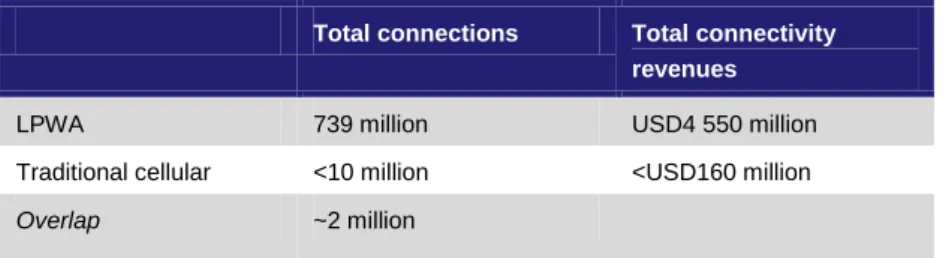
In Figure 11, we summarise the size of the agriculture market for LPWA and cellular services, and indicate the level of overlap between the two solutions.
Total connections Total connectivity revenues
Figure 11: Summary of forecast of agriculture and environment connections and connectivity revenue forecast, 2023 [Source: Analysys Mason, 2014]
LPWA 739 million USD4 550 million
Traditional cellular <10 million <USD160 million
Overlap ~2 million
Industrial: the strong QoS requirements of industrial applications and their typically short-range connectivity requirements restrict the size of the addressable market for LPWA services The industrial vertical sector is a market expected to have some potential for LPWA applications, though the limits on the capabilities of LPWA may restrict the opportunity. Reliability is paramount in industrial processes to satisfy mission-critical requirements (e.g. air quality, machine diagnostics) that require real-time information. Both requirements are difficult to address with LPWA technologies. However LPWA can play a number of roles in improving operational efficiency for industrial companies. For example, some applications that require short-range coverage may not be economically feasible to deploy using short-range technologies such as Wi-Fi or ZigBee that require the installation of multiple access points and backhaul links. LPWA services could offer an alternative for such cases. Our forecast considers three main applications that are discussed below:
Indoor asset tracking: LPWA technology is well suited to help track inventory in warehouses. By attaching a LPWA module to a pallet, the company can have visibility on its location and be more efficient managing warehouse space. We believe that by 2023, there will be over 60 million LPWA connections.
Pipeline monitoring: LPWA is particularly appropriate for oil and gas pipeline monitoring. These pipelines often find themselves in remote locations, which make it very important to have a connectivity solution that can use stand-alone batteries with long battery life and strong coverage. The sensors deployed along the pipeline length transmit information such as leakages and flow pressure.
In Figure 12, we summarise the size of the industrial market for LPWA and cellular services, and indicate the level of overlap between the two solutions.
Total connections Total connectivity revenues Figure 12: Summary of forecast of industrial connections and connectivity revenue forecast, 2023 [Source: Analysys Mason, 2014]
LPWA 95 million USD630 million
Traditional cellular <10 million USD300 million
Overlap ~1 million
Ideal characteristics of a LPWA network
LPWA technology addresses applications that require strong propagation, low cost of modules and can operate well with low bandwidth. The ideal LPWA
network considers those criteria but also the ability to provide robust service provision and ease of integration with existing communications’ infrastructure, as shown in Figure 13.
“For LPWA to succeed the modules have to be substantially cheaper than GSM. There also needs to exist a strong ecosystem supported by multiple vendors”
David Lister, Research Manager for M2M (Vodafone)
The industry is involved in an ongoing debate over which technology should be used for LPWA connectivity. As part of this debate, a group of industry participants have published a paper to discuss the future options for mobile network operators11. Added to this many operators are currently trialling alternative technology solutions.
A detailed assessment of the technical benefits of each alternative solution is beyond the scope of this paper. In this section we discuss some of the key characteristics of a LPWA network and explore some of the
compromises involved in selecting a technology.
None of technologies currently available and being developed is perfect. All have advantages and disadvantages but industry will need to achieve a degree of consensus in order to reach scalability. The alternative with its associated technology fragmentation brings a high risk that no technology will build an ecosystem that has wide acceptance and low costs.
Figure 13: Characteristics of an ideal LPWA network [Source: Analysys Mason, 2014]
Elements Description
Spectrum Low frequency (<1GHz), to support strong propagation
Licensed, to support some degree of service level assurance
Transmission Can be low bandwidth and high latency. High coverage and low power are more important
Propagation Very strong. Able to reach terminals underground
Module battery life Long. Modules are expected to last 10 years on one AA battery Module power consumption Low
Module cost Low. Below USD5
Scalability Able to support billions of devices on the network
Wireless technology Compatible with existing cellular network infrastructure to reduce roll-out costs and complexity
Standardised to enable economies of scale
Spectrum: license-exempt spectrum has faster time to market but it may struggle to protect from interference
Many of the LPWA technologies (e.g. Sigfox) operate in license-exempt spectrum. While license-exempt spectrum has some benefits (such as rapid time to
market and no spectrum fees) clear disadvantages are also present. The most obvious disadvantage is the lack of control and the likelihood of
interference. Even if a device is designed so as to operate in a (currently) relatively uncongested frequency band, during the lifetime of the LPWA module, which could be ten years, new mass-market devices may be introduced that compete and cause interference.
Furthermore, LPWA technologies using licenced spectrum are being developed in a way to have a minimal impact on an operator’s existing spectrum holdings. Three alternatives are being explored:
11
A Choice of Future m2m Access Technologies for Mobile Network Operators, 2014. See http://www.cambridgewireless.co.uk/docs/Cellular%20IoT%20White%20Paper.pdf
“The use of licensed spectrum is ideal as it would protect transmissions from
interferences that cause loss of
propagation, affecting bandwidth and QoS”
Cédric Levasseur, Network Chief Architect (Bouygues Telecom)
The use of LTE guard-band spectrum between adjacent channels for LPWA services12. With this solution, spectrum that is currently not in use would be used.
The use of a 200kHz channel of spectrum previously allocated to GSM, with no guard band13 The use of a 200kHz channel of spectrum previously allocated to GSM, with a 100kHz guard band13
Transmission and propagation: devices can be reached underground and over long distances All LPWA technologies aim to go beyond the propagation levels of traditional cellular technologies, which have a link budget of about 140dB. Figure 14 shows how the different technologies compare on link budget. On-Ramp has the highest value and claims to reach devices over 65km away with a clear line of sight. To be able to achieve long-range coverage, LPWA networks typically need to operate on low frequencies (below 1GHz).
Technology Development status Link budget (dB) Figure 14:
Comparison of link budgets by technology [Source: Analysys Mason, 2014]14 Sigfox Existing 156 On-Ramp Existing 172 Semtech Existing 156
Clean-slate Being developed 161
LTE MTC Being developed 161
GSM Existing 139
LTE Existing 141
Reducing the transmission power will decrease the signal coverage but it will increase the battery life of the device due to the lower power consumption. For some applications, operators may be able to preserve battery life by opting for lower propagation power.
Module battery life: the activity of modules is restricted to help limit their power consumption Modules need to have a very low power consumption to be capable of operating for 10 years on a single AA battery. This battery life will depend on the application’s requirements. For example, the higher the number and size of the messages sent and received, the lower the battery life will be. Figure 15 shows how the frequency of reports and the coverage selected can affect the battery life of the module for Clean-Slate15.
Coverage enhancement
4 reports per hour 1 report per hour 1 report per 6 hours Figure 15: Battery life by coverage for Clean-Slate [Source: Neul and Huawei16, 2014]
GSM + 0dB > 10 years > 10 years > 10 years
GSM + 10dB 4 years > 10 years > 10 years
GSM + 20dB 0.5 years 2 years 9 years
12
See page 7 of http://cwbackoffice.co.uk/Presentation/Wirelessly_Connecting_IoT_19.06.14_RobertYoung.pdf 13
See page 13 of
http://cwbackoffice.co.uk/Presentation/Wirelessly_Connecting_IoT_19.06.14_JohanBergman_AmitavaGhosh.pdf 14
The link budget data is based on publicly available data from the vendors and may not be on a like for like basis. 15
Clean-slate is a LPWA technology being developed and designed to operate in ‘refarmed’ GSM spectrum or LTE guard bands.
16
Module cost: a strong ecosystem is key to support the low costs per module
To meet the module cost target of less than USD5, the existence of an ecosystem that can provide the economies of scale to make business models feasible is critical. Without the support of vendors and developers, it may be difficult to achieve low prices of hardware and widespread availability of application support.
The expected cost per module for Clean-slate is to be lower than USD4 as illustrated in Figure 16.
Cost category Expected value in 2016 (USD) Figure 16: Module cost estimate for Clean-Slate [Source: Neul and Huawei16, 2014] Bill of materials 2.17
Mechanical, assembly and test 1.06
OEM value added 0.64
Total 3.87
Scalability: to support a high number of devices can come at a cost of bandwidth per connection
The number of devices supported per base station or access point varies by technology. The ability for the network to cope with an increasing number of devices can help ‘future-proof’ the investment of the operator. The capacity to support multiple devices is affected by parameters such as the size and frequency of the messages per device. For example, On-Ramp claims to be able to support 550 000 devices per access point but for a maximum throughput of 168 bytes per day per device17.
Wireless technology: the ability to re-use existing network infrastructure is very attractive for operators
From an operator perspective, integrating LPWA services with the existing network infrastructure will reduce roll-out time and cost, and minimise ongoing support and maintenance costs. The alternative is for operators to build and maintain a second network, potentially requiring a dedicated network team.
Technology Development status Re-uses traditional cellular network? Figure 17: Reuse of existing network by technology [Source: Analysys Mason, 2014] Sigfox Existing No18 On-Ramp Existing No18 Semtech Existing No18
Clean-slate Being developed Yes
LTE MTC Being developed Yes
The technologies Clean-Slate and LTE MTC are being developed to be integrated with existing 2G, 3G and LTE networks. For these
technologies, the exact details of network upgrade are being clarified it may be as simple as a remote software upgrade but more likely a site visit will be required, though with no
17
See http://www.onrampwireless.com/wp-content/uploads/2013/01/008-0012-00_H_ORW_Technology_White_Paper.pdf 18
As currently specified, the technology does not re-use traditional cellular infrastructure though this may be possible in future
“LPWA needs to be easy to integrate with the existing cellular deployments and allow us to manage a single multipurpose network. If devices are to last for years, we need LPWA to be a future-proof service (technical and regulatory wise).”
Juan Campillo, Investment Manager, Chief Commercial Digital Office (Telefónica)
modifications to the antenna needed. The upgrade should be relatively straightforward and low cost. This approach also allows the operator to reuse other services such as power and backhaul.
Sigfox, On-Ramp and Semtech on the other hand, require a purpose-built network to deploy their services. For operators, this could mean still using existing sites though additional integration and infrastructure, including antenna, would be required. Also a dedicated team to maintain this second network may be required, increasing operational complexity for the operator.
Conclusions
In the mid-1950s, Sony’s engineers successfully developed an affordable, portable radio and in doing so created a new market worth millions of dollars. If the telecoms
industry can meet its target and produce USD5 modules that can last years on each battery, we believe that the potential market for LPWA is also significant. We are forecasting over 3 billion connections based on an assessment of short-term applications. Applying LPWA technologies to new problems not considered here, and there may be additional potential. While there is some overlap with cellular solutions, most of this opportunity
we believe is incremental as LPWA services can open new markets across a range of vertical sectors, supported by new business models. A number of alternative technology solutions are possible for LPWA, all of which promise high propagation, low module price and long battery life. We believe that the ideal technology will use licenced spectrum, to support some degree of service level assurance, and will reuse existing cellular
infrastructure to speed national network rollout and reduce costs.
“[For LPWA to be a success] we have to be able to show that it is better than today in terms of cost, coverage and power”
David Lister, Research Manager for M2M (Vodafone)
About Analysys Mason
Analysys Mason is a trusted adviser on telecoms, technology and media. We work with our clients, including operators, regulators and end users, to:
design winning strategies that deliver measurable results
make informed decisions based on market intelligence and analytical rigour develop innovative propositions to gain competitive advantage.
With around 250 staff in 13 offices, we are respected worldwide for our exceptional quality of work,
independence and flexibility in responding to client needs. For 25 years we have been helping clients in more than 100 countries to maximise their opportunities.
Consulting
Our focus is exclusively on TMT.
We support multi-billion dollar
investments, advise clients on
regulatory matters, provide
spectrum valuation and auction
support, and advise on operational
performance, business planning and
strategy.
We have developed rigorous
methodologies that deliver tangible
results for clients around the world.
For more information, please visit
www.analysysmason.com/consulting
.
Research
We analyse, track and forecast the different services accessed by consumers and enterprises, as
well as the software, infrastructure and technology delivering those services.
Research clients benefit from regular and timely intelligence in addition to direct access to our
team of expert analysts.
Our dedicated Custom Research team undertakes specialised and bespoke projects for clients.
For more information, please visit
www.analysysmason.com/research
.
19
19
Published by Analysys Mason Limited • Bush House • North West Wing • Aldwych • London • WC2B 4PJ • UK
Tel: +44 (0)845 600 5244 • Fax: +44 (0)845 528 0760 • Email: [email protected] • www.analysysmason.com/research Registered in England No. 5177472
© Analysys Mason Limited 2014
All rights reserved. No part of this publication may be reproduced, stored in a retrieval system or transmitted in any form or by any means electronic, mechanical, photocopying, recording or otherwise without the prior written permission of the publisher.
The opinions expressed are those of the stated authors only. Analysys Mason Limited recognises that many terms appearing in this report are proprietary; all such trademarks are acknowledged and every effort has been made to indicate them by the normal UK publishing practice of capitalisation. However, the presence of a term, in whatever form, does not affect its legal status as a trademark.
Analysys Mason Limited maintains that all reasonable care and skill have been used in the compilation of this publication. However, Analysys Mason Limited shall not be under any liability for loss or damage (including consequential loss) whatsoever or howsoever arising as a result of the use of this publication by the customer, his servants, agents or any third party.
![Figure 1: Total addressable market and forecast of LPWA opportunity and connections, worldwide, 2013–2023 [Source: Analysys Mason, 2014]](https://thumb-us.123doks.com/thumbv2/123dok_us/773349.2597801/3.892.193.747.181.459/figure-addressable-forecast-opportunity-connections-worldwide-source-analysys.webp)
![Figure 2: Forecast for LPWA connections [Source: Analysys Mason, 2014]](https://thumb-us.123doks.com/thumbv2/123dok_us/773349.2597801/4.892.196.577.157.463/figure-forecast-lpwa-connections-source-analysys-mason.webp)
![Figure 4: Number of connected devices, 2023 [Source: Analysys Mason, 2014]](https://thumb-us.123doks.com/thumbv2/123dok_us/773349.2597801/5.892.133.604.462.717/figure-number-connected-devices-source-analysys-mason.webp)
![Figure 5: Comparison of market for LPWA and traditional cellular, 2023 [Source: Analysys Mason, 2014]](https://thumb-us.123doks.com/thumbv2/123dok_us/773349.2597801/6.892.176.798.102.1147/figure-comparison-market-traditional-cellular-source-analysys-mason.webp)
![Figure 7: Summary of forecast of smart cities connections and connectivity revenue, 2023 [Source: Analysys Mason, 2014]](https://thumb-us.123doks.com/thumbv2/123dok_us/773349.2597801/8.892.106.579.454.582/figure-summary-forecast-connections-connectivity-revenue-source-analysys.webp)
![Figure 13: Characteristics of an ideal LPWA network [Source: Analysys Mason, 2014]](https://thumb-us.123doks.com/thumbv2/123dok_us/773349.2597801/13.892.104.767.435.762/figure-characteristics-ideal-lpwa-network-source-analysys-mason.webp)