Headquarters, U.S. MCO 5530.14A Marine Corps PCN 10208597900
________________________________
MARINE CORPS
PHYSICAL SECURITY
PROGRAM
MANUAL
DISTRIBUTION STATEMENT A: Approved for public release; distribution is unlimited
MCO 5530.14A PS
JUN 05 2009 MARINE CORPS ORDER 5530.14A
From: Commandant of the Marine Corps To: Distribution List
Subj: MARINE CORPS PHYSICAL SECURITY PROGRAM MANUAL
Ref: (a) DODI 5200.08, “Security of DOD Installations and Resources,” December 10, 2005
(b) DOD 5100.76-M, “Physical Security of Sensitive
Conventional Arms, Ammunition and Explosives,” August 12, 2000
(c) DOD 4160.21-M, “Defense Materiel Disposition Manual,” August 18, 1997
(d) SECNAVINST 5510.36A (e) SECNAVINST 5510.30B (f) SECNAVINST 5239.3A
(g) DODD O-5210.41, “Security Policy for Protecting Nuclear Weapons,” November 1, 2004
(h) DODI 2000.16, “DOD Antiterrorism (AT) Standards,” October 2, 2006
(i) UFC 4-010-01, “DOD Minimum Antiterrorism Standards for Buildings,” January 22, 2007
(j) UFC 4-021-01, “Design and O&M: Mass Notification Systems,” April 9, 2008
(k) MCO P11000.5G
(l) MCO P11000.12C (m) MCO 3302.1D
(n) DOD O-2000.12-H, “DOD Antiterrorism Handbook,” February 2004
(o) EKMS 1A (NOTAL) (p) MCO 5110.1D
(q) MIL-HDBK-1013/1A, “Military Handbook Design
Guidelines for Physical Security of Facilities,” October 9, 1987
(r) MCO 5090.4A
(s) CJCSI 3121.01A, “Standing Rules of
Engagement/Standing Rules for the Use of Force for US Forces (U),” January 15, 2000
(t) DODD 5210.56, “Use of Deadly Force and the Carrying of Firearms by DOD Personnel Engaged in Law
Enforcement and Security Duties,” November 1, 2001 DISTRIBUTION STATEMENT A: Approved for public release;
(u) MCO 5500.6G (v) MCO 3574.2K (w) MCO 5580.2B
(x) UFC 4-022-01, “Security Engineering: Entry Control Facilities/Access Control Points,” May 25, 2005
(y) DODD 8190.3, “Smart Card Technology,” August 31, 2002 (z) DODD 1000.25, “DOD Personnel Identity Protection (PIP) Program,” April 23, 2007
(aa) DOD 5200.08-R, “Physical Security Program,” April 9, 2007
(ab) NAVMED P-117
(ac) DOD 6055.9-STD, “DOD Ammunition and Explosives Safety Standards,” July 1999
(ad) NAVSEA OP 5 Volume 1 (ae) MCO P8020.10B
(af) OPNAVINST 5530.13C (ag) NAVSUP P-724
(ah) DOD 4500.9-R, “Defense Transportation Regulation (DTR),” August 2008
(ai) DOD 5200.2-R, “Personnel Security Program,” January 1987
(aj) MCO 8023.3A
(ak) DOD 5220.22-M, “National Industrial Security Program Operating Manual (NISPOM),” February 28, 2006
(al) MCO P4400.150E (am) MCO P4400.151B
(an) DOD 4140.1-R, “DOD Supply Chain Materiel Management Regulation,” May 23, 2003
(ao) OPNAVINST 8015.2B (ap) MCO 8300.1C
(aq) MCO P8020.11
(ar) DOD 4160.21-M-1, “Defense Demilitarization Manual,” August 18, 1997
(as) MCO 8373.2E
(at) NAVSEA OP 3565 Vol II
(au) MCO P5750.1G (av) NAVSEA SW020-AG-SAF-010
(aw) NAVSEA SWO23-AG-WHM-010 (ax) MCO 1620.2D
(ay) MCO P4066.17
(az) DOD 7000.14-R, “DOD Financial Management Regulations (FMRs),” September 17, 2008
(ba) SECNAV M-5214.1 (bb) SECNAV M 5210.1
Reports Required: I. Physical Security Survey Form (NAVMC
11121) (Report Control Symbol EXEMPT). Encl (1) Chap.3, par 3001.4 and App E
II. Missing, Lost, Stolen and Recovered (MLSR) Reporting (Report Control Symbol DD-5530- 01). Encl (1), Chap 10, par. 10001.5 and App M
III. Law Enforcement and Physical Security Activity Report (LEPSAR) (Report Control Symbol (EXEMPT). Encl(1), Chap 10, par. 10004.1 and App N
1. Situation. Physical security is a primary command
responsibility. Reference (a) requires commanders to establish and issue regulations for the security of property and places under their command. This Order constitutes the Marine Corps Physical Security Program and prescribes policy, assigns
responsibilities, and presents requirements. The Order also provides uniform procedures, standards, supporting details, and outlines requirements to support commander’s efforts. To be effective, a physical security program must receive attention from all echelons within the chain of command.
2. Cancellation. MCO P5530.14, MCO 5510.15A, MCO 5500.18, MCO 1630.4A, MCO 5500.14A, MARADMIN 601-02, MARADMIN 360-01, and participation with OPNAVINST 5530.13.
3. Mission. Establish the Marine Corps Physical Security Program and provide policy to support commander’s efforts to maintain a robust physical security program. Ensure all
personnel are aware of and involved in protecting United States Government and Marine Corps personnel and property, per
references (a) through (bb).
4. Execution. The Marine Corps Physical Security Program must receive attention from all echelons within the chain of command. Emphasis is placed on the commander/commanding Officer’s (CO)
responsibility to ensure that the command security posture is accurately and consistently addressed and resources are afforded to execute and support these programs. Marines, Sailors, and civilian employees will be actively involved and vigilant in the security of United States (U.S.) Government and Marine Corps personnel and property. Commanders will develop and maintain an operational capability to present and preserve a sound, secure physical security posture throughout their areas of
a. Commander’s Intent and Concept of Operations (1) Commander’s Intent
(a) Enhance unit, base, and installation physical security by maintaining an effective physical security program.
(b) Integrate physical security planning,
requirements, procedures, and equipment in all force protection (FP) and antiterrorism (AT) efforts.
(c) Provide physical security guidance and requirements.
(d) Control access to Marine Corps installations to prevent injury to personnel and/or damage to assets in
accordance with reference (a).
(2) Concept of Operations. This Order establishes a formal physical security program within the Marine Corps and applies to all Marine Corps commands. This Order further: (a) Identifies that the Commandant of the Marine Corps (CMC) is responsible for establishing and maintaining the Marine Corps Physical Security Program, to include the
promulgation of appropriate and applicable directives, in accordance with reference (a).
(b) Directs commanders to support the provost marshal to ensure the physical security program is provided adequate command attention and assistance through proper staffing, retention of experienced personnel, and training. (c) Directs and assists those responsible for physical security in their efforts to carry out the mission. (d) Provides requirements for physical security for Marine Corps installations and organizations, as well as:
1. Provides commanders the authority and
responsibility to protect personnel, facilities, property, and material under their command.
2. Identifies measures to safeguard personnel, facilities, property and material at all Marine Corps
3. Provides guidance for evaluating, planning and implementing Marine Corps command physical security
programs.
4. Assists those responsible for physical security in their efforts to carry out the assigned mission. (e) Emphasis is placed on the commanding officer's responsibility to ensure that the command security posture is accurately assessed and security resources are appropriate to execute these programs.
(f) Installation commanders/commanding officers are responsible for physical security within their commands.
(g) The provost marshal is the installation
commander’s designated representative responsible for planning, implementing, enforcing and supervising the installation
physical security program.
(h) The security officer at each Marine Corps
organization (battalion/squadron size and larger) is responsible for security matters within the organization. The security
officer plans, implements, manages and directs the organization physical security program in accordance with the commanding
officer’s guidance and in coordination with the provost marshal. b. Subordinate Element Missions
(1) Deputy Commandant, Plans, Policies, and Operations (PP&O) (DC PP&O). The DC PP&O is responsible for the Marine Corps Physical Security Program. The DC PP&O serves as the Service level point of contact for coordination, development, and execution of Marine Corps Physical Security policies.
Director, Security Division. The Director, Security Division (PS) is responsible to the DC PP&O for providing
direction, supervising development, articulating emerging concepts and advocating Marine Corps capabilities for issues pertaining to Marine Corps physical security efforts. In this capacity, the Director, Security Division (PS) will:
(a) Exercise overall staff cognizance for matters relating to physical security.
(b) Develop Marine Corps physical security policy and oversee its execution.
(c) Coordinate with the Deputy Commandant
Installations and Logistics (DC I&L) and Commander, Marine Corps Systems Command (COMMARCORSYSCOM) for physical security of Arms, Ammunition, and Explosives (AA&E) in accordance with reference (b).
(d) Provide policy, guidance, and assistance to commanders to enable them to develop and maintain effective physical security programs.
(e) Manage a program to assess the level of security afforded installations and assets, and develop plans for
security upgrades.
(f) Coordinate with the Deputy Commandant Programs and Resources (DC P&R) for all funding in support of physical security programs and initiatives.
(g) Ensure a review of all Military Construction (MILCON) projects is coordinated with the DC I&L and DC P&R. This review serves to ensure that physical security, AT, and FP measures and costs are identified at the installation and
incorporated in MILCON cost estimates.
(h) Direct the Marine Corps Physical Security Program.
(i) Plan, program, and budget requisite resources in support of the Marine Corps Physical Security initiatives to include:
1. Marine Corps Electronic Security Systems (MCESS) for Marine Corps critical assets.
2. Installation Physical Security Site Assistance Visits.
3. Physical Security Upgrade Projects. (j) Provide applicable updates to the Inspector General of the Marine Corps (IGMC) Automated Inspection Reporting System (AIRS) checklist, pertaining to physical security, in support of the Command Inspection Program.
(k) Represent Marine Corps interests in physical security related working groups.
(l) Serve as the exception and waiver authority for AA&E physical security deficiencies
(2) Deputy Commandant, Installations and Logistics (DC I&L)
(a) Develop policy for installation master planning that factor in and documents physical security requirements. (b) Provide programmed MILCON project documentation to DC PP&O (PS) for review.
(c) Coordinate review of all Physical Security Upgrade Project (PSUP) funding requests with DC PP&O (PS).
(d) Coordinate with Naval Facilities Engineering Command (NAVFACENGCOM) to ensure that all physical security, AT, and FP measures are included in the design and construction of Marine Corps facilities, as applicable.
(e) Provide requirements to support physical security of ordnance material.
(3) Commander, Marine Forces (COMMARFOR). The Commander of U.S. Marine Corps Forces Africa, Command, Central, Europe, Korea, North, Pacific, Reserves, and South, (COMMARFORAF, COMMARFORCOM, COMMARFORCENT, COMMARFOREUR, COMMARFORKOR, COMMARFORNORTH, COMMARFORPAC, COMMARFORRES, and COMARFORSOUTH respectively) will ensure that all requirements of this Order are executed within their headquarters, subordinate commands, and area of responsibility (AOR). COMMARFORs will serve as the exception and waiver authority for crime prevention and physical security deficiencies not relating to AA&E.
(4) Inspector General of the Marine Corps (IGMC)
(a) Coordinate with the Director, Security Division (PS) regarding the integration of the provisions of this Order in the AIRS checklist.
(b) Coordinate Command Inspection Program support with the Director, Security Division (PS).
(5) Installation Commander. The installation commander is inherently responsible for the overall command security
posture to include perimeter and area security, and protection of personnel and property aboard the installation. Installation commanders will implement, execute, and administer requirements of this Order. In this effort, the installation commander will: (a) Establish and maintain an installation physical security program that encompasses requirements outlined in this Order.
(b) Draft and maintain an installation physical security plan as part of the installation AT Plan.
(c) Appoint the provost marshal, in writing, as the staff officer responsible for security and law enforcement matters in accordance with this Order.
(d) Publish an annual consolidated list of all restricted areas aboard the installation, including all tenant command restricted areas. Figures 7-1 and 7-2 are available to assist commanders in prioritizing asset protection efforts. (e) Integrate security efforts to ensure continuity in providing an effective installation physical security program and posture.
(f) Establish and maintain an installation Physical Security Council (PSC).
(g) Review, endorse, and forward, via the chain of command, to higher headquarters, all requests for exceptions and waivers. Ensure that the provost marshal provides comments to all exception/waiver requests concerning the impact to the overall installation security posture.
(h) Report Missing, Lost, Stolen, and Recovered (MLSR) reportable items, via the chain of command, to CMC (PS/LPC).
(i) Review, endorse, and forward, via the chain of command, to higher headquarters, all request for physical
(j) Incorporate subordinate and tenant organization physical security plans in the installation physical security plan.
(k) Coordinate Flight Line Security (FLS) measures and procedures with Marine Corps Air Station, Marine Corps Air Facility, and Marine Air Wing (MAW) commanders, as applicable. (l) Ensure that substantial command-wide emphasis is placed on the security of AA&E.
(m) Establish and maintain an installation-wide crime prevention program.
(n) Provide policy and guidance to installation and tenant commands, including commercial carriers and contractors regarding the control, storage, and transportation of personal weapons and ammunition aboard the installation in accordance with reference (b).
(o) Maintain an installation-wide barrier plan in support of the physical security program. Ensure all command and tenant activity plans are included.
(p) Assign the provost marshal as the primary coordinator for all flight line security matters.
(q) Develop installation master plans that incorporate appropriate AT, FP, and physical security requirements.
(r) Ensure all installation MILCON projects address, incorporate, and integrate AT, FP, and physical security
requirements. MILCON project must include infrastructure requirements.
(s) Budget for base security and identify funding shortfalls to the comptroller for appropriate action.
(t) Notify Security Division (PS), via chain of command, when planned construction or upgrades require
modification to existing MCESS.
(6) Marine Corps Air Facility (MCAF) and Marine Corps Air Station (MCAS) Commanders. MCAS commanders, designated as an installation commander, are required to carry out those
function listed in paragraph (6). However, there are air stations and air facilities located within the confines of a Marine Corps Base that must address additional security
requirements. MCAS and MCAF commanders will:
(a) Coordinate aircraft and FLS measures with MAW headquarters components, installation commanders and provost marshals/security officers.
(b) Approve all plans for restricted areas within or adjacent to flight lines. This information will be forwarded to the installation commander (where applicable) for inclusion in the installation restricted area list.
(c) Notify the provost marshal of planned aircraft parking areas, to include transient aircraft, and any changes to the parking areas, in order for physical security requirements to be coordinated.
(d) Provide equipment and facilities to support FLS operations.
(e) Coordinate and approve plans for flight line Entry Control Facilities (ECF) and Access Control Points (ACP). Include policy concerning runway use by security and safety
personnel.
(f) Procure, install, and maintain physical barriers (automated, portable, fences, etc.) to deter, delay, and deny entry to unauthorized persons to flight line restricted areas. (g) Incorporate FLS issues in the facility or
station physical security plan and ensure the plan is included in the installation physical security plan (where applicable). (h) Address FLS issues at MCAF/MCAS or installation Physical Security Council meetings.
(i) Notify Security Division (PS), via chain of command, when planned construction or upgrades require
modification to existing MCESS.
(j) Coordinate off installation, downed aircraft security requirements and support procedures with the MAW
component commander, provost marshal and installation commander (where applicable).
(k) Coordinate and provide security, as required, when and where Marine Corps assets are staged and/or stored in an off-installation location.
(l) Review, endorse, and forward, via the chain of command, all requests for physical security exceptions and
waivers. All requests will contain an endorsement, or comments from the provost marshal, concerning the impact to the
installation/facility security posture. Where applicable, forward to the installation commander for review/comment.
(m) Review, endorse, and forward, via the chain of command, all requests for physical security related funding.
(n) Draft and maintain a physical security plan and ensure it is included in the installation AT plan.
(o) Assign a command security officer as the primary coordinator for flight line security matters.
(p) Budget for adequate base security and identify funding shortfalls to the comptroller for appropriate action. (7) Commanding Officer (CO)(Battalion/Squadron and higher). Commanding officers are responsible for physical
security within his/her organization. Commanding officers will: (a) Establish and maintain a command physical
security program that encompasses requirements of this Order. (b) Appoint a command security officer in writing. Provide sufficient resources, staff assistance, and authority to implement, manage, and execute an effective physical security program.
(c) Identify, in writing, all designated restricted areas within the command and provide the information, in
writing, to the provost marshal annually. Commanding officers of MARFORRES sites will identify, in writing, and maintain a copy of all restricted areas under their cognizance.
(d) Report Missing, Lost, Stolen, and Recovered reportable items, via the chain of command, to CMC(PS/LPC) and ensure that a copy of the MLSR report is provided to the
(e) Ensure that there is a strong, viable and
visible command emphasis with regard to the security of AA&E. (f) Ensure that all personnel who account for,
maintain, dispose of, distribute, and provide security for AA&E, are screened in accordance with this order and reference (b). (g) Designate, in writing, an AA&E officer who will be responsible for all AA&E accountability and security matters. (h) Develop and maintain an organization barrier plan in support of the installation barrier plan.
(i) Ensure that all AA&E is accounted for,
inventoried, maintained, and reported in accordance with this Order.
(8) Provost Marshal (PM). The provost marshal serves as the staff officer responsible for coordinating physical security and law enforcement programs. The provost marshal is
responsible for ensuring that these programs complement the overall installation security effort. In this capacity, the provost marshal will:
(a) Conduct law enforcement operations and crime prevention efforts in support of the physical security program, including measures to enhance security during periods of
increased threat and crisis situations.
(b) Determine the adequacy of the installation physical security posture with a physical security survey program.
(c) Maintain liaison with installation and/or
regional Naval Criminal Investigative Service (NCIS) personnel in support of criminal investigations.
(d) Maintain liaison with federal, state, local, other military activities, and host nation officials regarding law enforcement/physical security concerns.
(e) Provide commanders with technical assistance and recommend equipment, procedures, and methods to enhance physical security.
(f) Support the installation commander in developing and maintaining a comprehensive Physical Security Plan.
(g) Coordinate and support the PSC.
(h) Review, comment, and ensure the implementation of compensatory measures, and endorse all requests for physical security waivers and exceptions from command and tenant
organizations.
(i) Ensure physical security programs complement FP, AT, Critical Infrastructure Protection (CIP), Chemical
Biological, Radiological, Nuclear, and high-yield explosives (CBRNE), Safety, Fire, and Crime Prevention programs.
(j) Supervise the operation of, and coordinate all efforts regarding, the Security Division (PS) centrally managed MCESS aboard the installation.
(k) Assist command/organization security officers in physical security, FP, CIP, AT, and crime prevention efforts. (l) Supervise the FLS program.
(m) Maintain the FLS access database and issue badges.
(n) Publish an FLS order.
(o) Assign patrol zones in and around flight lines. (p) Screen and train non-military police personnel assigned to augment the FLS program prior to assignment.
(q) Coordinate off installation, downed aircraft security requirements and support procedures with the MAW commander and installation commander.
(r) Investigate MLSR incidents when appropriate and refer to NCIS for investigation, as required.
(s) Publish and staff a recommended installation restricted areas list to the installation commander, no later than 31 February, annually.
Marshal’s Office who account for, maintain, dispose of, distribute, and provide security for AA&E, are screened in accordance with this Order and reference (b).
(u) Publish and maintain security force orders, to include post specific orders. Update and review the orders on an annual basis.
(v) Coordinate and maintain a robust crime prevention program that includes:
1. Supervision for the conduct of crime prevention surveys for installation organization.
2. Liaison with local civilian police agencies to foster and maintain a working relationship in support of a coordinated security and crime prevention effort.
3. Reporting annual crime statistics to the installation commander and Security Division (PS).
4. Supporting the Commander’s Welcome Aboard Brief.
5. Provide unit crime prevention briefs as requested.
6. Establishment and maintenance of a Lost and Found Property Program in accordance with reference (c).
(w) Review all plans for facility construction or modification and provide comments as required.
(x) Support commands in establishing and updating barrier plans.
(9) Physical Security Chief. The physical security chief serves as the provost marshal’s resident protection professional. The physical security chief is responsible for establishing, implementing, and managing the installation physical security and loss prevention programs. In this capacity, the physical security chief will:
(a) Supervise the Provost Marshal’s Physical Security Section.
(b) Support the provost marshal by establishing, implementing, and maintaining:
1. Physical security programs that utilize active and passive security measures and management protocol designed to prevent unauthorized access to personnel, equipment, material and documents, and safeguard against acts of terrorism, espionage, sabotage, damage, and theft.
2. Crime and loss prevention programs that increase personal safety, protect government and personal
property from theft, misuse and unlawful destruction. In this effort, focus on reduction of manpower, time, and cost expended by the government in the investigation, pursuit, and prosecution of criminal activities.
3. Procedures for timely submission of required reports.
(c) Act as the manager and systems administrator for the Security Division (PS) centrally managed MCESS aboard the installation.
1. Provide testing, preventive maintenance, and troubleshooting to the installation’s MCESS in protection of AA&E, flight lines, and other critical assets.
2. Coordinate, assist, and ensure that all required MCESS training is conducted.
(d) Assist tenant commands in physical security related training.
(e) Ensure physical security programs encompass the security efforts of tenant activities.
(f) Ensure tenant activities have security programs that complement the overall installation security effort.
(g) Track all MLSR reports submitted by commands located aboard the installation, and determine if the loss was due to a physical security deficiency.
(h) Ensure that the installation Public Affairs Office (PAO) is provided crime prevention media on a monthly
basis for release in the installation paper or other media sources.
(i) Ensure that installation crime statistics are maintained in order to identify trends and areas of increased criminal activity.
(j) Conduct unit level crime prevention briefs as directed.
(k) Conduct crime prevention and community relation programs as directed by the provost marshal.
(l) Review all plans for facility construction or
modification and provide physical security, AT, and crime prevention comments as required.
(m) Assist commands in planning and carrying out barrier plans.
(10) Command/Organization Security Officer. The
command/organization security officer serves as the focal point for command physical security matters and will report directly to the commanding officer in matters pertaining to physical
security. Security officers will be appointed in writing by the commanding officer. In the performance of their duties,
security officers will:
(a) Plan, manage, implement, and direct the organization’s physical security program.
(b) Establish physical security requirements for the command with assistance from the installation provost marshal, public works officer, and facilities engineer as appropriate.
(c) Develop, implement, and maintain an organization physical security plan to support the host installation AT plan.
(d) Develop and maintain a security education program.
(e) Identify assets (property and structures) requiring protection by priority and location. Particular
attention will be paid to those areas housing personnel and storing government property.
(f) Identify in writing, all designated restricted areas within his/her command and provide this information to the host commander.
(g) Determine and identify resources or resource shortfalls (e.g., personnel, materials, funds, etc.) required to implement physical security measures.
(h) Assist the commanding officer in specifying facility, training, construction, and equipment requirements necessary to comply with this Order.
(i) Program and budget fiscal resources necessary to support physical security requirements and correct deficiencies.
(j) Serve as the organization point of contact for all command physical security and loss prevention matters.
(k) Coordinate all physical security matters with the installation provost marshal.
(1) Attend quarterly PSC meetings.
(m) Ensure physical security programs support the installation security effort.
(n) Support the installation crime prevention effort as directed.
(0) Ensure that unit crime prevention briefs are scheduled and conducted.
(p) Ensure that crime prevention material is conspicuously posted on unit bulletin boards.
(q) Maintain and implement the organizational barrier plan.
(r) Coordinate all physical security initiatives with the provost marshal.
(11) In addition to the requirements identified above, commanding officers of Marine Corps organizations not located aboard Marine Corps installations will ensure that all
requirements of this Order are established and maintained, as applicable and appropriate. Commanding officers will coordinate physical security requirements and support with the host and
higher headquarters.
5. Administration and Logistics. Recommendations for changes to this Order are encouraged. All recommendations will be forwarded via the chain of command to the Commandant of the Marine Corps, Security Division (PS).
6. Command and Signal
a. Command. This Order is applicable to the Marine Corps Total Force.
b. Signal. This Order is effective the date signed.
J. F. DUNFORD, JR.
Deputy Commandant for Plans, Policies and Operations
DISTRIBUTION: PCN 10208597900
COPY TO: 7000260 (1) 8145004 (2)
LOCATOR SHEET
Subj: MARINE CORPS PHYSICAL SECURITY PROGRAM MANUAL Location: ______________________________________
(Indicate Location(s) of copy(ies) of this Order.)
RECORD OF CHANGES Log completed change action as indicated. Change
TABLE OF CONTENTS CHAPTER 1 INTRODUCTION 2 SECURITY PLANNING 3 SECURITY MEASURES 4 SECURITY FORCES
5 BARRIERS AND OPENINGS
6 ELECTRONIC SECURITY SYSTEMS
7 CRITICAL ASSET PROTECTION
8 SECURITY OF ARMS, AMMUNITION, AND EXPLOSIVES (AA&E)
9 CRIME PREVENTION
10 REPORTING REQUIRMENTS
11 EXPEDITIONARY PHYSICAL SECURITY
APPENDIX
A DEFINITIONS
B ACRONYMS
C WAIVER AND EXCEPTION REQUEST FORMAT
D PHYSICAL SECURITY PLAN (FORMAT)
E PHYSICAL SECURITY SURVEY FORM (NAVMC 11121)
(EXAMPLE)
F INSTRUCTIONS FOR PREPARATION, COMPLETION,
AND DISTRIBUTION OF A PHYSICAL SECURITY SURVEY
H SECURITY RISK CATEGORIES
I AA&E SCREENING PACKAGE
J AA&E FACILITY MINIMUM CONSTRUCTION
REQUIREMENTS
K AA&E SURVEILLANCE REQUIREMENTS
L MLSR AA&E REPORTABLE QUANTITIES
M MISSING, LOST, STOLEN AND RECOVERED (MLSR) PREPARATION GUIDE
N INSTRUCTIONS FOR COMPLETING THE LAW
ENFORCEMENT AND PHYSICAL SECURITY ACTIVITY
REPORT (LEPSAR)
FIGURES
2-1 MARINE CORPS PHYSICAL SECURITY CREDENTIAL
2-2 EXAPMPLE REQUEST FOR ISSUANCE OF PHYSICAL
SECURITY CREDENTIALS
2-3 EXAMPLE ACKNOWLEDGEMENT OF RECEIPT OF
PHYSICAL SECURITY CREDENTIALS
2-4 RISK MANAGEMENT PROCESS
3-1 LIGHTING SPECIFICATIONS
3-2 ILLUMINATED AREA SPECIFICATIONS 5-1 SECURITY BARRIERS AND FUNCTIONALITY
5-2 EXAMPLE AUTHORIZED PERSONNEL/VISITORS ECF
5-3 EXAMPLE COMMERCIAL TRAFFIC ECF 5-4 ECF ZONES
5-5 EXAMPLE HINGE PROTECTION
7-2 PHYSICAL SECURITY THREAT MATRIX 7-3 LIMITED WATERWAY AREAS
7-4 WATERSIDE SECURITY ZONES
7-5 COMBINATION LOCK REPLACEMENT PRIORITY 8-1 ARMORY DAY GATE
8-2 TUFLOC DOOR LOCK
CHAPTER 1 INTRODUCTION
PARAGRAPH PAGE
GENERAL . . . 1000 1-3
THE SECURITY CHALLENGE . . . 1001 1-4
MARINE CORPS PHYSICAL SECURITY PROGRAM . 1002 1-5 SECURITY OF MARINE CORPS
INSTALLATIONS AND RESOURCES . . . 1003 1-6
SECURITY RESPONSIBILITIES . . . 1004 1-6
PHYSICAL SECURITY OF ORGANIZATIONS NOT LOCATED ABOARD MARINE CORPS
INSTALLATIONS . . . 1005 1-6
PHYSICAL SECURITY OF TENANT AND CIVILIAN AGENCIES/ORGANIZATIONS
ABOARD MARINE CORPS INSTALLATIONS . . . . 1006 1-7
PHYSICAL SECURITY COUNCIL . . . 1007 1-7
EXCEPTIONS AND WAIVERS . . . 1008 1-8
HOST NATION CONFLICT . . . 1009 1-10
PROJECT PLANNING . . . 1010 1-10
PHYSICAL SECURITY UPGRADE
CHAPTER 1 INTRODUCTION
1000. GENERAL. Physical security is the utilization of active and passive security measures and management protocol that are designed to prevent unauthorized access to personnel, equipment, material, documents, and safeguards against espionage, sabotage, acts of terrorism, damage, and theft. Physical security is an integral part of all Force Protection (FP), Antiterrorism (AT), Critical Infrastructure Protection (CIP), Safety, Fire,
Chemical, Biological, Radiological, Nuclear, (high yield) Explosives (CBRNE)), and crime prevention programs.
1. This Order provides guidelines for the application of physical security programs for Marine Corps commands and
installations. Physical security guidelines are applicable to Marine Corps organizations not located aboard a Marine Corps installation, and tenant and civilian agencies/organizations aboard Marine Corps installations. Applicable definitions and acronyms are contained in Appendix A and B, respectively. This Order further:
a. Expands on responsibilities and discusses various security vulnerabilities, details protective measures, and identifies management actions that must be employed to provide and sustain an acceptable physical security posture.
b. Establishes uniform physical security requirements. The language separates recommended physical security measures from required measures and eliminates conflicting guidance.
c. Identifies physical security requirements not covered by other specialized security programs, or issues more stringent guidelines. Protection of classified material, information assurance security, and nuclear weapons security are
specifically addressed in references (d) through (g),
respectively. Those requirements augment the basic guidance contained in this Order.
d. Establishes procedures for Marine Corps commanders authorized to issue regulations for the protection or security of property or places under their command as specifically
1001. THE SECURITY CHALLENGE
1. Protection of personnel and property is accomplished by: a. Identifying the personnel or property requiring
protection.
b. Determining jurisdiction and boundaries. c. Assessing the threat.
d. Committing resources.
e. Establishing perimeters, barriers, and access control. f. Providing the means to detect efforts to wrongfully remove, damage, or destroy property.
g. Employing a security force sufficient to protect, react to, and control situations and circumstances that threaten
personnel and property. 2. There are a number of factors involved in the security
challenge. The geographic location, size, type, jurisdiction, and mission of an identified property form a basis for security requirements. Procedures, plans, policies, and agreements
directly impact security. Physical security systems, resources and measures assist in safeguarding personnel, protection of property, and preventing loss. All of these factors must be addressed in forming a physical security program. The physical security program is concerned with means and measures designed to achieve a sound physical security posture; thereby, allowing installation AT and FP goals to be achieved more easily. The program goal is to safeguard personnel and protect property by preventing, detecting, and confronting unauthorized acts. These unauthorized acts include but are not limited to terrorism,
espionage, sabotage, wrongful destruction, malicious damage, theft, and pilferage.
3. Terrorist and criminal activity worldwide against U.S. military and business concerns poses a clear and persistent danger to Marine Corps interests. While such activity is principally targeted against commands overseas, prudence dictates recognition of the potential threat to activities within the continental United States. It is imperative that commands assign security officers to address physical security
issues. Security officers will use the guidance and policies contained in this Order and reference (a), in determining
security and/or protective measures deemed essential for their particular spaces, areas and/or buildings.
4. Military activities located within leased space facilities have unique challenges in addressing physical security issues (commercial firms/contractors located in same building(s),
public facilities, shared entranceways and common spaces, etc.). Liaison with appropriate authorities (General Services
Administration (GSA), building administrators, lessors, etc.) is essential to outline security measures necessary for protection of lives and property, tailored to the individual
characteristics of the leased space. Commands located within leased facilities will ensure that security is properly
addressed in all lease agreements. Requirements outlined in this Order, references (a) and (h) through (j), will be
thoroughly addressed and annotated in all lease agreements. 1002. MARINE CORPS PHYSICAL SECURITY PROGRAM. Physical
Security is the foundation of, and an integral part of all force protection (AT, CIP, Fire, Safety, CBRNE) and crime prevention programs. While the other security programs rely heavily on physical security for success, the success of the physical
security program does not depend on any other security program. Physical security specialists are requisite experts in the area of AT, CIP, FP, and crime prevention.
1. Commanders must place emphasis on ensuring that the Provost Marshal provides adequate support to the physical security
program through proper staffing, retention of personnel, training, and continued education.
2. Marine Corps physical security specialists serve as the combatant commander’s and installation commander’s resident subject matter expert in the ambit of physical security and crime/loss prevention. The physical security chief serves as the resident protection professional responsible for
establishing, implementing, and managing the physical security and crime/loss prevention programs. Physical security personnel provide commanders:
a. Risk management and mitigation skills necessary to
conduct a risk analysis of an asset, facility, area, and provide the commander with a defense in depth approach against all
b. A working knowledge of physical security equipment, to include functionality, application, sustainability, in both expeditionary and garrison environments.
c. Best practice principles and equipment that focus on Reducing manpower, time, and cost expended by the government. d. Expertise in integrating physical security planning, requirements, procedures, and equipment in all FP and AT efforts.
1003. SECURITY OF MARINE CORPS INSTALLATIONS AND RESOURCES. Installation commanders are authorized to issue regulations for the protection and security of property and places under their command pursuant to the provisions of reference (a), and to provide guidance relative to the enforcement of the laws that prohibit unlawful entry.
1. Security regulations or orders must be conspicuously and appropriately posted. Reference (a) provides penalties for violations of such regulations or orders as have been
promulgated or approved by the installation commander for the protection and security of DOD property or places.
2. Installation commander’s authority, per reference (a), is limited to property and places “under their command” and
requires installation commanders to comply with the implementing policies and procedures established by the DOD.
3. Particular attention and effort will be afforded to those areas/assets involving national security and assets not
involving national security but inherently dangerous to others. 4. Penalties for persons who unlawfully enter or reenter a military installation are addressed in reference (a).
1004. SECURITY RESPONSIBILITIES. Security is the direct
responsibility of all Marines, Sailors, and civilian employees. 1005. PHYSICAL SECURITY OF ORGANIZATIONS NOT LOCATED ABOARD MARINE CORPS INSTALLATIONS. Commanders of Marine Corps
organizations not located aboard a Marine Corps installation are required to establish and maintain a physical security program. Organizations located aboard other DOD service/agency sites will coordinate physical security requirements with the host. Host service/agency requirements will impact security requirements,
however all Marine Corps organizations must ensure that the following is accomplished in accordance with this Order: a. Establish a command physical security program.
b. Appoint a command security officer in writing.
c. Establish a command physical security survey program per
paragraph 3001.
d. Marine Corps organizations will establish an Inter-Service Support Agreement (ISSA), Memorandum of Understanding (MOU) or Memorandum of Agreement (MOA) with the host service that address physical security issues, as directed by higher headquarters. Organizations located in foreign countries must ensure that physical security issues are addressed in Status of Forces Agreements (SOFA) or Host Nation (HN) agreements. Topics to be addressed include property boundaries, Intrusion Detection System (IDS) monitoring, available response forces, deadly force training and issues, physical security support, etc. The
Commanding officer is required to coordinate all such agreements through higher headquarters, to include Staff Judge Advocate (SJA) and/or legal offices.
1006. PHYSICAL SECURITY OF TENANT AND CIVILIAN AGENCIES/ ORGANIZATIONS ABOARD MARINE CORPS INSTALLATIONS. Tenant and civilian organizations aboard Marine Corps installations will maintain an active physical security program that complements the installation’s program. Host installations will establish a MOU/MOA/ISSA, where applicable and as directed, with tenant and civilian agencies that incorporate or recognize a physical
security survey program. Commanders of installations located in foreign countries must ensure that physical security issues are addressed in SOFA or HN agreements, as applicable, with foreign tenant and civilian agencies. All agreements will be
coordinated with all special staff offices, particularly the SJA and/or Legal Office. Tenant organizations will be made aware of all installation physical security initiatives to include the Physical Security Council (PSC), AT contingency drills, and other initiatives that affect the installation or organization. 1007. PHYSICAL SECURITY COUNCIL. Installation commanders will establish, in writing, a physical security council that will meet on a quarterly basis. The PSC may be combined with the AT Working Group (ATWG) to alleviate any duplication of effort. The PSC assist commanders in coordinating and implementing
initiatives that support the installation’s physical security, FP, CIP, and AT programs. The PSC provides a means for the commander to gain maximum participation from organizations throughout the installation in support of physical security interests. The installation commander or a designated
representative will chair the PSC.
1. The PSC will consist of those personnel who are most suited to materially assist the installation commander in the physical security effort. Examples of personnel who must attend are the provost marshal, operations officer, facilities officer,
comptroller, SJA representative, and others as designated by the commander.
2. PSC subject matter is focused on, but not limited to, the installation’s physical security, FP, CIP, and AT posture. The council will conduct a review of physical security, FP, CIP, and AT deficiencies and recommend corrective action, that may
include fiscal and/or logistical solutions. Physical security challenges, especially those emanating from DOD minimum
standards for AT, requiring facility/infrastructure projects will be documented (for the short, intermediate, and/or long term) and incorporated into installation master planning updates.
3. When agenda items directly impact their command, tenant or unit commanders/command security officers will attend PSC
meetings.
4. Council minutes will be recorded for accuracy and
distributed to attendees for review. Minutes will be maintained on file for a period of three years.
5. Physical Security Working Group (PSWG). The PSWG will
include a representative from the installation Physical Security section, facilities, comptroller, and the ATO. The PSWG is
responsible for research and action on those issues requiring action as designated by the physical security council. The PSWG should meet as often as necessary to address project matters, but will meet at least twice a year. The PSWG will report all findings to the PSC.
1008. EXCEPTIONS AND WAIVERS. Exceptions and waivers serve to permit deviations from requirements of this Order. Security Division (PS) serves as the sole authority for exceptions and waivers to physical security requirements of Arms, Ammunition,
and Explosives (AA&E) of reference (b) and this Order.
COMMARFORS serve as the exception/waiver authority for all other physical security and crime prevention requirements, unless
otherwise identified herein. Exceptions, waivers, or extension requests will be assigned an exception or waiver number, and completed in the Naval Letter format outlined in Appendix C. 1. All requests for waivers or exceptions will contain an organization plan of action and milestones (POA&M).
2. Non-applicable elements shall be noted as N/A.
3. Requests will contain an analysis of the problem and a
detailed description of compensatory security measures that the commanding officer has implemented.
4. All requests will be staffed through the installation provost marshal. The provost marshal is responsible for endorsing all requests and ensuring the most recent physical security survey for that facility is attached. Additionally, the provost marshal will identify if and/or how the exception or waiver impacts or may impact the overall installation security posture.
5. Exception or waiver requests will be forwarded via the chain of command, including the installation commander, for comment, to the appropriate COMMARFOR for approval/disapproval.
6. Requests for an exception or waiver to an AA&E deficiency will be forward via the chain of command, including the
installation Commander and cognizant COMMARFOR, to Security Division (PS) for approval/disapproval.
7. Exceptions are granted for three years when corrective
action of a security deficiency is beyond the capability of the organization, or the condition necessitating the request cannot be corrected in the near-term. Waivers are granted for a one-year period when corrective action of a security deficiency may be accomplished by the organization in the near-term.
8. Permanent (long term/greater than 3 years) exceptions will not be granted.
9. Blanket (listing several different facilities which have the same deficiencies) exceptions or waivers will not be granted.
10. Approval of exceptions and waivers does not relieve
commanding officers of their security responsibility, ensuring the implementation of compensatory security measures, and the development of a POA&M to correct the identified deficiency. 11. Exceptions and waivers are self-canceling at the end of the allocated time. Requests for an extension will be submitted prior to the date of expiration, and will be staffed in the same manner as the original request.
12. Commands are directed to notify the approving authority once the exception/waiver deficiency(ies) has been corrected and the requirement no longer exists.
13. Waivers or Exceptions will not be granted for new
construction, MILCON, or renovations exceeding the fifty percent threshold with the exception of facilities listed on the
Historical Registry.
1009. HOST NATION CONFLICT. Organizations located outside of the United States may not be able to implement certain
requirements of this Order. In those instances, commanders must address physical security requirements and compensatory measures in a SOFA or HN Agreement.
1010. PROJECT PLANNING. All plans for construction, MILCON, and facility sustainment, repair, and modernization (FSRM) must incorporate physical security, AT, and FP features, in
accordance with references (a), (h) through (j), and (k) and (l).
1. All plans for MILCON and FSRM construction must be reviewed by the Provost Marshal or designated representative, and the installation Security Officer during the design process, all
subsequent design review phases, and the final (100%) drawings. 2. All construction projects, to include MILCON and FSRM
projects will be reviewed by the installation physical security chief and Antiterrorism Officer (ATO) and verified by Security Division (PS) and CMC(I&L) during validation, to ensure physical security and force protection requirements have been addressed. 3. Contract for bid will not be processed without documentation of design review by security and AT representatives.
Electronic Security Systems (ESS), (including Intrusion Detection, Mass Notification Systems (MNS), Closed Circuit Television (CCTV), etc.) commands must ensure that the
installation physical security chief forwards a request for support and/or cost estimates to Security Division (PS). This will provide notification of a requirement and allow sufficient time for planning and funding. Security Division (PS) manages a centrally funded program that provides security services and equipment to the installations. These systems and equipment are considered collateral equipment and cannot be funded with MILCON funds but can be included in the MILCON project contract for contracting efficiency provided the funding is separate and distinct from MILCON funds.
5. Commands must ensure that infrastructure requirements are coordinated with and reviewed by installation communications and information management and public works offices.
1011. PHYSICAL SECURITY UPGRADE PROJECTS (PSUP) PROGRAM 1. Upgrades or modifications to existing facilities must conform to standards contained in this Order.
2. Physical Security Upgrade Project (R-2) Funding. This
funding is awarded annually in support of installation physical security upgrade projects. Consideration for funding requires the installation to initiate correspondence to CMC(LFF-2), via the chain of command, in accordance with the procedures outlined in reference (k). Once received at CMC(LFF-2), the project will be reviewed and validated by Security Division (PS) and CMC(LFF-2) and will compete for funding against security projects
initiated throughout the Marine Corps. Approved projects will be awarded design funds and installations will be notified via Naval Message traffic. Construction projects are evaluated and approved based on initial correspondence; therefore
installations are not required to submit an additional request. Request for authority to advertise the project for execution will be submitted on the installation’s contract advertisement forecast in accordance with references (k) and (l).
3. The status of PSUP projects can be reviewed on line via the Facilities Integration Website at
https://www.hqmc-facilities.org/. Any questions or concerns must be properly routed through the appropriate chain of command, to include the MARFOR, Marine Corps Installation (MCI), and HQMC (I&L and PS).
CHAPTER 2 SECURITY PLANNING
PARAGRAPH PAGE
GENERAL . . . 2000 2-3
PHYSICAL SECURITY CREDENTIALS . . . 2001 2-3
PHYSICAL SECURITY PLAN . . . 2002 2-6
RISK MANAGEMENT . . . 2003 2-7
COST OF SECURITY . . . 2004 2-12
COORDINATION . . . 2005 2-13
SECURITY CONSIDERATIONS . . . 2006 2-13
CHAPTER 2 SECURITY PLANNING
2000. GENERAL. Security planning is a continuous process carried out in advance of, and concurrent with, security operations. Normally, planning for security operations will fall within the patterns used by military planners, i.e., the estimate, the plan, and implementation in the administrative plan or annexes. The security estimate with its analysis of the mission and situation (courses of action and decision) provide the basis for the security plan. Each installation and
organization (battalion/squadron and above) will develop and publish a Physical Security Plan as part of its AT Plan. Tenant activity physical security plans will be submitted to the
installation Provost Marshal to be integrated into the installation plan. Classification of the plan will be
established per reference (d). Further guidance on physical security plans is available in paragraph 2002.
2001. PHYSICAL SECURITY CREDENTIALS. In the performance of their assigned duties, physical security specialists, both military and civilian, must be permitted access to all
designated restricted areas and other facilities containing critical assets. Physical security specialists will possess an official means to identify themselves to unit commanders with facilities/areas requiring physical security support as
prescribed herein. Security Division (PS) will issue physical security credentials to school-trained military police and civilians assigned to the provost marshal’s physical security
Section performing the duties of a physical security specialist. An example of the official credentials is provided in figure 2-1.
1. Security Division (PS) will maintain strict accountability of Marine Corps physical security inspector credentials by central issuance.
2. Prior to requesting credentials, installation provost marshals must certify that the individual meets each of the following criteria:
a. Successful completion of the U.S. Army Conventional
Physical Security Course, the Federal Law Enforcement Training Center (FLETC) Physical Security Course, or a Physical Security Professional (PSP) Certificate from ASIS International.
b. Entry of a course completion certificate into the Service Record Book (SRB), and assignment of the additional Military Occupational Specialty (MOS) 5814 (military personnel only).
c. Assignment to the physical security unit, and performing the duties of a physical security specialist.
Figure 2-1.--Marine Corps Physical Security Credential
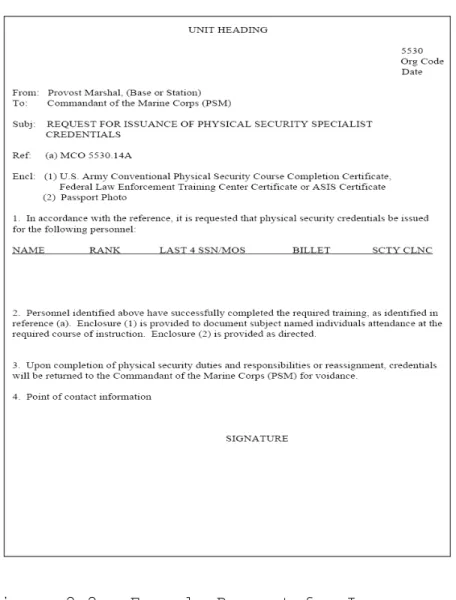
2. Installation provost marshals will request physical security credential issuance in the format prescribed in figure 2-2. Each individual requiring credentials will enclose a passport identification photograph, approximately 1-1/4 inches square, and a copy of the following certificates with each request. a. U.S. Army Conventional Physical Security Course
b. FLETC Physical Security Course Completion Certificate. c. ASIS International Physical Security Professional
Certificate.
Figure 2-2.—-Example Request for Issuance of Physical Security Credentials
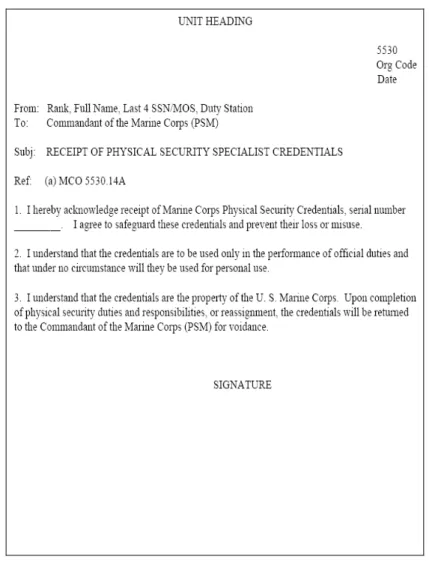
3. Upon receipt of credentials, an acknowledgement of
responsibilities, figure 2-3, will be completed. This document will be promptly returned to Security Division (PS).
4. It is the responsibility of the provost marshal and physical security chief to ensure that credentials are returned to
Security Division (PS) for voidance when individuals are no longer assigned to the physical security unit or performing the duties of a physical security specialist.
Figure 2-3.—Example Acknowledgement of Receipt of Physical Security Credentials
2002. PHYSICAL SECURITY PLAN. A model physical security plan format is provided in Appendix D. The intent of the plan is to clearly identify how the installation/activity conducts day-to-day security as well as how it responds to security incidents. The plan will reflect the detailed implementation of Marine Corps policy at the installation/activity and should not be philosophical or a verbatim reiteration of this Order. The physical security plan will be included as an annex or appendix in the installation AT Plan which is detailed in reference (m). The physical security plan is not intended to replace the AT
plan; it will complement the plan with detailed information concerning daily application of access control, material
control, barriers, etc., aboard the installation. The physical security plan will be reviewed annually in conjunction with the AT plan.
2003. RISK MANAGEMENT. Risk analysis is a process used by commanders to identify, assess, and mitigate risks from
operational factors, and assists in the decision making process that balances risk costs with mission accomplishment.
Commanders can use the information derived from the risk analysis process to determine which assets require increased protection and where future expenditures are required to
minimize risk of attack, or lessen the severity of the outcome of such an attack.
1. The fundamental goal of risk management is to enhance operational capabilities and mission accomplishment, with minimal acceptable loss.
2. Risk management assists commanders by:
a. Enhancing operational mission accomplishment;
b. Supporting a well-informed decision-making process; c. Providing assessment tools to support operations; d. Preserving and protecting personnel, combat weapon systems, and related support equipment, while avoiding unnecessary risk;
e. Identifying where feasible and effective control
measures need to be implemented because specific standards do not exist.
3. Risk management does not replace sound decision making, remove risk altogether, support a zero defect mindset, justify violating the law, nor should it inhibit the commander’s
flexibility, initiative, or accountability.
4. Commanders should conduct an installation level risk analysis on an annual basis.
5. Principles of Risk Management. There are basic principles that must be applied when implementing the risk management process. They include:
a. Accept No Unnecessary Risk. The most logical choices
for accomplishing a mission are those that meet all mission requirements while exposing personnel and resources to the
might otherwise go unidentified and provides tools to reduce or offset risk. The corollary to this axiom is “accept necessary risk” required to successfully complete the mission or task. b. Make Risk Decisions at the Appropriate Level. The appropriate level for risk decisions is the one that can make decisions to eliminate or minimize the vulnerability to a threat, implement controls to reduce the risk, or accept the risk. Commanders at all levels must ensure that subordinates know how much risk they can accept and when to elevate the decision to a higher level. The risk management process must identify clear accountability, and ensure that risk decisions are made at the appropriate level. If during execution of the mission or task, it’s determined that the controls available will not reduce risk to an acceptable level, the decision to accept risk must be elevated to the next level in the chain of command.
c. Accept Risk When Costs Outweigh the Benefits. The
process of weighing risks against opportunities and benefits helps to maximize mission success. Balancing costs and benefits is a subjective process and must remain the commander’s
decision.
d. Anticipate and Manage Risk by Planning. Integrate risk
management into planning at all levels. Commanders must
dedicate time and resources to apply risk management effectively in the planning process, where risks can be more readily
assessed and managed. Integrating risk management into planning as early as possible provides the greatest opportunity for
making well-informed decisions and implementing effective risk control measures. During execution phases of operations, the risk management process must be applied to address previously unidentified risks while continuing to evaluate the
effectiveness of existing risk control measures and modify them as required.
6. Types of Risk Analysis. There are two types of risk
analysis: crisis and deliberate. Time is the basic factor that contributes to the selection of the type used.
a. Crisis. Crisis risk analysis is an “on-the-run” mental
or verbal review of the situation using the basic risk analysis process. The crisis process of risk management is employed to consider risk while making decisions in a time-compressed
execution phase of training or operations as well as in planning and execution during crisis responses. This type of analysis is particularly helpful for choosing the appropriate course of
action when an unplanned event occurs.
b. Deliberate. Deliberate risk analysis is the application of the complete process when time is not critical. It uses
experience and brainstorming to identify threats and develop controls and is most effective when done in a group.
7. Risk Analysis Elements. The risk analysis contains key elements that, when performed in sequence, systematically
identify and evaluate resources, facilities, and activities in terms of various factors. The following elements must be
present to determine risk. The key elements of the risk analysis are:
a. Threat Assessment. The threat assessment is used to identify threats (including, but not limited to, acts of
terrorism, espionage, sabotage, wrongful destruction, malicious damage, and theft and the direct impact of each threat on
resources, facilities, and activities. Threat information gathering is diverse and includes foreign intelligence, open source materials, domestic criminal information, and information from federal, state, and local authorities.
b. Criticality Assessment. This is done to determine which assets need to be protected. The criticality assessment
determines the importance of each asset and its necessity to complete the mission, the effect of the threat on the asset, and the recoverability of the asset from the attack. Consideration should therefore be given to the resources that must be expended to recover an asset, repair it for return to service, or
implementing contingency plans and acceptable alternatives. c. Vulnerability Assessment. The vulnerability assessment is the process the Commander uses to determine the
susceptibility of assets to attack from threats identified by the threat assessment. Vulnerabilities are always there, no matter the policies, procedures, and protective measures in place; however, the key is to mitigate asset vulnerabilities based on threat. Identifying and understanding vulnerabilities is important in determining how well an asset must be protected from loss. Vulnerabilities are the one component, in the risk assessment process, over which the commander has the most
d. Risk Assessment. Risk assessment combines the threat, criticality, and vulnerability ratings given to each asset. The risk assessment methodology is further discussed in reference (n). In order for there to be risk, each one of the elements must be present; therefore, Risk = Threat x Criticality x Vulnerability. Risk is based on the value of the asset in
relation to the threat and vulnerabilities associated with it. Risk is derived by combining the relative impact of any loss or damage to an asset (Criticality) with the relative probability of an unwanted event (Threat x Vulnerability).
e. Cost Benefit Analysis. In order to complete the risk analysis, mitigation options must be identified. Appropriate controls must be determined, decisions must be made, controls must be implemented, and after implementation, controls must be supervised and reviewed. Because risk should be mitigated only to the point where it becomes cost-prohibitive, a cost benefit analysis needs to be used to determine appropriate controls. Cost Benefit Analysis = Risk/Cost Benefit (mitigation options x risk reduction x cost). The cost and effectiveness of each mitigation option should be identified so decision-makers can see the cost and benefit of each option. The success of risk analysis in the risk management process is contingent on:
(1) Commanders weighing risk versus benefits, and making and/or implementing decisions to accept risk or reduce
unacceptable risk.
(2) Acceptable risks being communicated to subordinates. (3) Continuous evaluation of effectiveness of applied controls and capture of lessons learned.
8. Risk Management Process Overview
a. The risk management process requires the following: (1) Identify threats.
(2) Prioritize criticality of assets to be protected. (3) Evaluate asset vulnerabilities based on currently existing protection and identified threats.
(5) Develop controls and make risk decisions. (6) Implement controls.
(7) Supervise and reevaluate controls.
b. Risk Management Process Application Guidelines. To get maximum benefit from the risk management process the following guidelines should be applied. Figure 2-4 provides a graphic depiction of the entire risk management process.
(1) Apply the Process in Sequence. Each element of the risk analysis process is a building block for the next element. For example, if the threat assessment is interrupted to focus control on a particular threat, other more important threats may be overlooked and the risk analysis process may be distorted. Until each element is complete, it is not possible to
successfully move to the next.
(2) Maintain Balance in the Process. All parts of the process are important. Time must be allocated to ensure the total process can be completed. The objective is to assess the time and resources available for risk management activities and allocate them to the actions in a manner most likely to produce the best overall result.
(3) Apply the Process as a Cycle. Notice that
“supervise and review” feeds back into the beginning of the process. When “supervise and review” identifies additional threats or determines that controls are ineffective, the entire risk management process should be repeated.
Figure 2-4.--Risk Management Process
2004. COST OF SECURITY. When determining physical security expenditures, planners must include all costs associated with protecting each item identified in the risk management process. Additional points to consider when identifying critical items are the costs of the item to be protected, ramifications upon the civilian population in the event of damage/loss of the item, and the importance to national security and the command’s
readiness posture. The cost of security is often greater than the dollar value of the property protected. Items that are
vital to national security or may pose a threat to the civilian population must be provided additional security commensurate with their sensitivity and the threat.