U.S. Department of the Interior
U.S. Geological Survey
MINERAL COMMODITY
SUMMARIES 2013
Abrasives
Fluorspar
Mercury
Silver
Aluminum
Gallium
Mica
Soda Ash
Antimony
Garnet
Molybdenum
Sodium Sulfate
Arsenic
Gemstones
Nickel
Stone
Asbestos
Germanium
Niobium
Strontium
Barite
Gold
Nitrogen
Sulfur
Bauxite
Graphite
Peat
Talc
Beryllium
Gypsum
Perlite
Tantalum
Bismuth
Hafnium
Phosphate Rock
Tellurium
Boron
Helium
Platinum
Thallium
Bromine
Indium
Potash
Thorium
Cadmium
Iodine
Pumice
Tin
Cement
Iron and Steel
Quartz Crystal
Titanium
Cesium
Iron Ore
Rare Earths
Tungsten
Chromium
Iron Oxide Pigments
Rhenium
Vanadium
Clays
Kyanite
Rubidium
Vermiculite
Cobalt
Lead
Salt
Wollastonite
Copper
Lime
Sand and Gravel
Yttrium
Diamond
Lithium
Scandium
Zeolites
Diatomite
Magnesium
Selenium
Zinc
U.S. Department of the Interior
KEN SALAZAR, Secretary
U.S. Geological Survey
Marcia K. McNutt, Director
U.S. Geological Survey, Reston, Virginia: 2013
Manuscript approved for publication January 24, 2013.
For more information on the USGS—the Federal source for science about the Earth, its natural and living resources, natural hazards, and the environment—
visit http://www.usgs.gov or call 1–888–ASK–USGS.
For an overview of USGS information products, including maps, imagery, and publications, visit http://www.usgs.gov/pubprod
For sale by the Superintendent of Documents, U.S. Government Printing Office Mail: Stop IDCC; Washington, DC 20402–0001
Phone: (866) 512–1800 (toll-free); (202) 512–1800 (DC area) Fax: (202) 512–2104
Internet: bookstore.gpo.gov
Any use of trade, product, or firm names is for descriptive purposes only and does not imply endorsement by the U.S. Government.
Although this report is in the public domain, permission must be secured from the individual copyright owners to reproduce any copyrighted material contained within this report.
Suggested citation:
U.S. Geological Survey, 2013, Mineral commodity summaries 2013: U.S. Geological Survey, 198 p. ISBN 978–1–4113–3548–6
CONTENTS
Page
General: Page
Introduction ... 3
Growth Rates of Leading and Coincident Indexes for Mineral Products ... 4
The Role of Nonfuel Minerals in the U.S. Economy ... 5
2012 U.S. Net Import Reliance for Selected Nonfuel Mineral Materials ... 6
Significant Events, Trends, and Issues ... 7
Appendix A—Abbreviations and Units of Measure .... 192
Appendix B—Definitions of Selected Terms Used in This Report ... 192
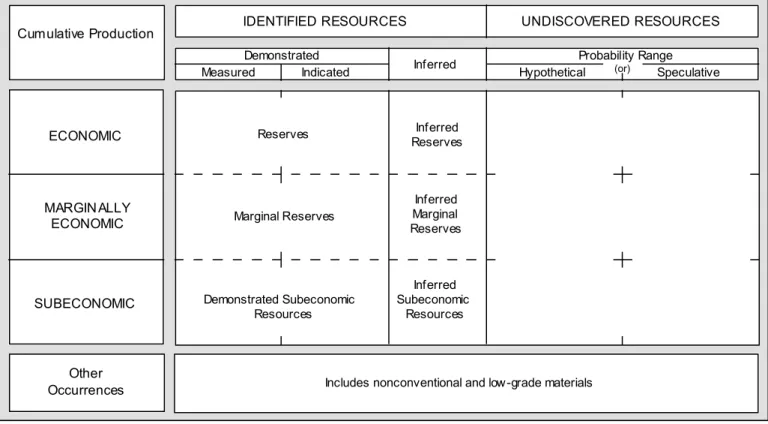
Appendix C—Reserves and Resources ... 193
Appendix D—Country Specialists Directory ... 198
Mineral Commodities: Abrasives (Manufactured) ... 14 Aluminum ... 16 Antimony ... 18 Arsenic ... 20 Asbestos ... 22 Barite ... 24
Bauxite and Alumina ... 26
Beryllium ... 28 Bismuth ... 30 Boron ... 32 Bromine ... 34 Cadmium ... 36 Cement... 38 Cesium ... 40 Chromium... 42 Clays ... 44 Cobalt ... 46 Copper ... 48 Diamond (Industrial) ... 50 Diatomite ... 52 Feldspar ... 54 Fluorspar ... 56 Gallium ... 58 Garnet (Industrial) ... 60 Gemstones ... 62 Germanium ... 64 Gold ... 66 Graphite (Natural) ... 68 Gypsum ... 70 Helium ... 72 Indium ... 74 Iodine ... 76
Iron and Steel ... 78
Iron and Steel Scrap ... 80
Iron and Steel Slag ... 82
Iron Ore ... 84
Iron Oxide Pigments ... 86
Kyanite and Related Materials ... 88
Lead ... 90 Lime ... 92 Lithium... 94 Magnesium Compounds ... 96 Magnesium Metal ... 98 Manganese ... 100 Mercury ... 102 Mica (Natural) ... 104 Molybdenum ... 106 Nickel ... 108 Niobium (Columbium) ... 110
Nitrogen (Fixed)—Ammonia ... 112
Peat ... 114
Perlite ... 116
Phosphate Rock ... 118
Platinum-Group Metals ... 120
Potash ... 122
Pumice and Pumicite ... 124
Quartz Crystal (Industrial) ... 126
Rare Earths ... 128
Rhenium ... 130
Rubidium ... 132
Salt ... 134
Sand and Gravel (Construction) ... 136
Sand and Gravel (Industrial) ... 138
Scandium ... 140 Selenium ... 142 Silicon ... 144 Silver ... 146 Soda Ash ... 148 Sodium Sulfate ... 150 Stone (Crushed) ... 152 Stone (Dimension) ... 154 Strontium ... 156 Sulfur ... 158
Talc and Pyrophyllite ... 160
Tantalum ... 162
Tellurium ... 164
Thallium ... 166
Thorium ... 168
Tin ... 170
Titanium and Titanium Dioxide ... 172
Titanium Mineral Concentrates ... 174
Tungsten ... 176 Vanadium ... 178 Vermiculite ... 180 Wollastonite ... 182 Yttrium ... 184 Zeolites (Natural) ... 186 Zinc ... 188
INSTANT INFORMATION
Information about the U.S. Geological Survey, its programs, staff, and products is available from the Internet at <http://www.usgs.gov> or by calling (888) ASK–USGS [(888) 275–8747].
This publication has been prepared by the National Minerals Information Center. Information about the Center and its products is available from the Internet at <http://minerals.usgs.gov/minerals> or by writing to Director, National Minerals Information Center, 988 National Center, Reston, VA 20192.
KEY PUBLICATIONS
Minerals Yearbook—These annual publications review the mineral industries of the United States and of more than
180 other countries. They contain statistical data on minerals and materials and include information on economic and technical trends and developments. The three volumes that make up the Minerals Yearbook are Volume I, Metals and Minerals; Volume II, Area Reports, Domestic; and Volume III, Area Reports, International.
Mineral Commodity Summaries—Published on an annual basis, this report is the earliest Government publication to
furnish estimates covering nonfuel mineral industry data. Data sheets contain information on the domestic industry structure, Government programs, tariffs, and 5-year salient statistics for more than 90 individual minerals and materials.
Mineral Industry Surveys—These periodic statistical and economic reports are designed to provide timely statistical
data on production, distribution, stocks, and consumption of significant mineral commodities. The surveys are issued monthly, quarterly, or at other regular intervals.
Metal Industry Indicators—This monthly publication analyzes and forecasts the economic health of three metal
industries (primary metals, steel, and copper) using leading and coincident indexes.
Nonmetallic Mineral Products Industry Indexes—This monthly publication analyzes the leading and coincident
indexes for the nonmetallic mineral products industry (NAICS 327).
Materials Flow Studies—These publications describe the flow of materials from source to ultimate disposition to help
better understand the economy, manage the use of natural resources, and protect the environment.
Recycling Reports—These materials flow studies illustrate the recycling of metal commodities and identify recycling
trends.
Historical Statistics for Mineral and Material Commodities in the United States (Data Series 140)—This report
provides a compilation of statistics on production, trade, and use of approximately 90 mineral commodities since as far back as 1900.
WHERE TO OBTAIN PUBLICATIONS
• Mineral Commodity Summaries and the Minerals Yearbook are sold by the U.S. Government Printing Office.
Orders are accepted over the Internet at <http://bookstore.gpo.gov>, by telephone toll free (866) 512–1800; Washington, DC area (202) 512–1800, by fax (202) 512–2104, or through the mail (P.O. Box 979050, St. Louis, MO 63197–9000).
• All current and many past publications are available in PDF format (and some are available in XLS format) through <http://minerals.usgs.gov/minerals>.
INTRODUCTION
Each chapter of the 2013 edition of the U.S. Geological Survey (USGS) Mineral Commodity Summaries (MCS) includes information on events, trends, and issues for each mineral commodity as well as discussions and tabular presentations on domestic industry structure, Government programs, tariffs, 5-year salient statistics, and world production and resources. The MCS is the earliest comprehensive source of 2012 mineral production data for the world. More than 90 individual minerals and materials are covered by two-page synopses.
For mineral commodities for which there is a Government stockpile, detailed information concerning the stockpile status is included in the two-page synopsis.
Abbreviations and units of measure, and definitions of selected terms used in the report, are in Appendix A and Appendix B, respectively. “Appendix C—Reserves and Resources” includes “Part A—Resource/Reserve Classification for Minerals” and “Part B—Sources of Reserves Data.” A directory of USGS minerals information country specialists and their responsibilities is Appendix D.
The USGS continually strives to improve the value of its publications to users. Constructive comments and suggestions by readers of the MCS 2013 are welcomed.
Sources: U.S. Geological Survey, Metal Industry Indicators and Nonmetallic Mineral Products Industry Indexes.
LEADING
COINCIDENT
The leading indexes historically give signals several months in advance of major changes in the corresponding coincident index, which measures current industry activity. The growth rates, which can be viewed as trends, are expressed as compound annual rates based on the ratio of the current month's index to its average level during the preceding 12 months.
90 91 92 93 94 95 96 97 98 99 30 20 10 0 -10 -20 -30 30 20 10 0 -10 -20 -30
NONMETALLIC MINERAL PRODUCTS:
Percent
Percent November
November
LEADING AND COINCIDENT GROWTH RATES, 1990–2012
Percent Percent 90 91 92 93 94 95 96 97 98 99 30 20 10 0 -10 -20 -30 30 20 10 0 -10 -20 -30 LEADING COINCIDENT November October
PRIMARY METALS: LEADING AND COINCIDENT GROWTH RATES, 1990–2012
GROWTH RATES OF LEADING
AND COINCIDENT INDEXES
FOR MINERAL PRODUCTS
09 08 10 11 12 08 09 10 11 12 07 07 06 06 05 05 04 04 03 03 02 02 01 01 00 00
NET EXPORTS OF MINERAL RAW MATERIALS
GOLD, SODA ASH, ZINC CONCENTRATES, ETC. Imports: $8.1 billion Exports: $9.1 billion Net exports: $1.0 billion
DOMESTIC MINERAL RAW MATERIALS FROM MINING
COPPER ORE, IRON ORE, SAND AND GRAVEL, STONE, ETC.
Value: $76.5 billion
THE ROLE OF NONFUEL MINERALS
IN THE U.S. ECONOMY
(ESTIMATED VALUES IN 201
2
)
1Major consuming industries of processed mineral materials are construction, durable goods manufacturers, and some
nondurable goods manufacturers. The value of shipments for processed mineral materials cannot be directly related to gross domestic product.
METALS AND MINERAL PRODUCTS RECYCLED DOMESTICALLY
ALUMINUM, GLASS, STEEL, ETC.
Value of old scrap: $30.4 billion
NET EXPORTS OF OLD SCRAP
GOLD, STEEL, ETC. Imports: $6.8 billion Exports: $26.4 billion Net exports: $19.6 billion
Sources: U.S. Geological Survey and U.S. Department of Commerce.
MINERAL MATERIALS PROCESSED
DOMESTICALLY
ALUMINUM, BRICK, CEMENT, COPPER, FERTILIZERS, STEEL, ETC. Value of shipments: $704 billion NET IMPORTS OF PROCESSED MINERAL MATERIALS METALS, CHEMICALS, ETC. Imports: $147 billion Exports: $120 billion Net imports: $27 billion
VALUE ADDED TO GROSS DOMESTIC PRODUCT BY MAJOR INDUSTRIES THAT CONSUME PROCESSED MINERAL MATERIALS1 Value: $2,390 billion U.S. ECONOMY Gross Domestic Product: $15,700 billion 5
2012 U.S. NET IMPORT RELIANCE
1Commodity Percent
ARSENIC (trioxide) 100
ASBESTOS 100
BAUXITE and ALUMINA 100
CESIUM 100
FLUORSPAR 100
GRAPHITE (natural) 100
INDIUM 100
MANGANESE 100
MICA, sheet (natural) 100 NIOBIUM (columbium) 100 QUARTZ CRYSTAL (industrial) 100
RUBIDIUM 100 SCANDIUM 100 STRONTIUM 100 TANTALUM 100 THALLIUM 100 THORIUM 100 GALLIUM 99 GEMSTONES 99 VANADIUM 96 BISMUTH 92 PLATINUM 91 GERMANIUM 90 IODINE 88 ANTIMONY 87
DIAMOND (dust, grit, and powder) 85
STONE (dimension) 85
POTASH 81
BARITE 80
COBALT 78
RHENIUM 78
TITANIUM MINERAL CONCENTRATES 77
TIN 75
SILICON CARBIDE (crude) 73
ZINC 72 CHROMIUM 70 GARNET (industrial) 65 TITANIUM (sponge) 64 PEAT 62 SILVER 57 PALLADIUM 54 NICKEL 49 MAGNESIUM COMPOUNDS 46 TUNGSTEN 42 SILICON 36 COPPER 35
NITROGEN (fixed), AMMONIA 35
MAGNESIUM METAL 31
MICA, scrap and flake (natural) 31
VERMICULITE 30 PERLITE 24 ALUMINUM 20 SALT 19 SULFUR 19 PUMICE 15 GYPSUM 12
IRON and STEEL 11
BERYLLIUM 10
IRON and STEEL SLAG 9
CEMENT 7
PHOSPHATE ROCK 5
Major Import Sources (2008–11)2 Morocco, China, Belgium
Canada, Zimbabwe
Jamaica, Brazil, Guinea, Australia Canada
Mexico, China, South Africa China, Mexico, Canada, Brazil China, Canada, Japan, Belgium South Africa, Gabon, Australia, China China, Brazil, Belgium, India Brazil, Canada, Germany China, Japan, Russia Canada
China
Mexico, Germany, China
China, Estonia, Germany, Kazakhstan Germany, Russia
India, France
Germany, United Kingdom, China, Canada Israel, India, Belgium, South Africa
Rep. of Korea, Canada, Austria, Czech Republic China, Belgium, United Kingdom
Germany, South Africa, United Kingdom, Canada China, Belgium, Russia, Germany
Chile, Japan
China, Mexico, Belgium, Bolivia
China, Ireland, Republic of Korea, Russia China, Brazil, Italy, Turkey
Canada, Russia China, India, Morocco
China, Norway, Russia, Finland Chile, Netherlands, Germany
South Africa, Australia, Canada, Mozambique Peru, Bolivia, Indonesia, China
China, South Africa, Romania, Netherlands Canada, Mexico, Peru, Spain
South Africa, Kazakhstan, Russia, Mexico India, Australia, China, Canada
Japan, Kazakhstan, China, Ukraine, Canada
Mexico, Canada, Peru, Poland
Russia, South Africa, United Kingdom, Norway Canada, Russia, Australia, Norway
China, Canada, Brazil, Australia China, Bolivia, Canada, Germany Brazil, Russia, China, Canada Chile, Canada, Peru, Mexico
Trinidad and Tobago, Russia, Canada, Ukraine Israel, Canada, China
Canada, China, India, Finland South Africa, China, Brazil, Australia Greece
Canada, Russia, China, Mexico Canada, Chile, Mexico, The Bahamas Canada, Mexico, Venezuela
Greece, Iceland, Mexico, Montserrat Canada, Mexico, Spain
Canada, European Union, Mexico, Rep. of Korea Russia, Kazakhstan, Japan, Kenya,
Japan, Canada, Italy, South Africa Canada, Republic of Korea, China, Mexico Morocco, Peru
1Not all mineral commodities covered in this publication are listed here. Those not shown include mineral commodities for which the United
States is a net exporter (for example, molybdenum) or less than 5% import reliant (for example, talc). For some mineral commodities (for example, rare earths), not enough information is available to calculate the exact percentage of import reliance; for others (for example, lithium), exact percentages may have been rounded to avoid disclosing company proprietary data.
SIGNIFICANT EVENTS, TRENDS, AND ISSUES
In 2012, the estimated value of mineral production increased in the United States for the third consecutive year. Production and prices increased for most industrial mineral commodities mined in the United States, but production and prices for nearly all metals declined. Minerals remained fundamental to the U.S. economy, contributing to the real gross domestic product (GDP) at several levels, including mining, processing, and manufacturing finished products. Minerals’ contribution to the GDP increased for the second consecutive year. After continued decline following the 2008–09
recession, the construction industry began to show signs of improvement during 2012, with increased production and consumption of cement, construction sand and gravel, and gypsum, mineral commodities that are used almost exclusively in construction. Crushed stone production, however, continued to decline. The figure on page 4 shows that the primary metals industry and the nonmetallic minerals products industry are intrinsically cyclical. Growth rates are directly affected by the U.S. business cycle as well as by global economic conditions. The U.S. Geological Survey (USGS) generates composite indexes to measure economic activity in these industries. The coincident composite indexes describe the current situation using production, employment, and shipments data. The leading composite indexes forecast major changes in the industry’s direction by such variables as stock prices, commodity prices, new product orders, and other indicators, which are combined into one gauge. For each of the indexes, a growth rate is calculated to measure its change relative to the previous 12 months. Following a steep decline to -20% in early 2009, the leading index shows the growth of primary metals increased to almost 20% in late 2009. Since then, the index has steadily decreased. At the end of 2012, the growth rate was -2%. The primary metals industry was supported by modest metals demand generated from the manufacturing and construction sectors. This is likely to continue into 2013. The nonmetallic mineral products industry was boosted by the rebound in construction activity in 2012, with more than half of its output going to the construction sector. The recovery in the U.S. housing industry is fueling demand for
industrial minerals and products. The nonmetallic mineral products leading index growth rate ended 2012 indicating that the nonmetallic mineral products industry is poised for a recovery in 2013.
As shown in the figure on page 5, the estimated value of mineral raw materials produced at mines in the United States in 2012 was $76.5 billion, a slight increase from $74.8 billion in 2011. Net exports of mineral raw materials and old scrap contributed an additional $21 billion to the U.S. economy. Domestic raw materials and domestically recycled materials were used to process mineral materials worth $704 billion. These mineral materials, including aluminum, brick, copper, fertilizers, and steel, and net imports of processed materials (worth about $27 billion) were, in turn, consumed by
downstream industries with a value added of an estimated $2.4 trillion in 2012.
The estimated value of U.S. metal mine production in 2012 was $34.9 billion, about 3% less than that of 2011. Principal contributors to the total value of metal mine production in 2012 were gold (36%), copper (27%), iron ore (15%), molybdenum (10%), and zinc (4%). Average prices for most domestically mined metals decreased in 2012. The yearly average price of gold continued to climb, but no new alltime high was reached during the year. The estimated value of U.S. industrial minerals mine production in 2012 was $41.6 billion, more than 7% more than that of 2011. The value of industrial minerals mine production in 2012 was dominated by crushed stone (29%), cement (16%), and construction sand and gravel (16%). In general, industrial minerals prices were relatively stable, with modest price variations.
Mine production of 15 mineral commodities was worth more than $1 billion each in the United States in 2012. These were, in decreasing order of value, gold, crushed stone, copper, cement, construction sand and gravel, iron ore (shipped), molybdenum concentrates,
phosphate rock, lime, industrial sand and gravel, soda ash, clays (all types), salt, zinc, and silver.
The figure on page 6 illustrates the reliance of the United States on foreign sources for raw and processed mineral materials. In 2012, the supply for more than one-half of U.S. apparent consumption of the 41 mineral commodities shown in the figure came from imports, and the United States was 100% import reliant for 18 of those. For the first time since 2002, the United States was not 100% import reliant for rare earths. Although not enough information was available to calculate the exact percentage of import reliance, rare earths mining resumed in Mountain Pass, CA. U.S. import reliance has increased significantly since 1978, the year that this information was first reported. At that time, the United States was 100% import reliant for 7 mineral
commodities, and more than 50% import reliant for 25 mineral commodities. In 2012, the United States was a net exporter of 15 mineral commodities, meaning more of those domestically produced mineral commodities were exported than imported. That figure has remained relatively stable, with net exports of 18 mineral
commodities in 1978.
In 2012, 11 States each produced more than $2 billion worth of nonfuel mineral commodities. These States were, in descending order of value—Nevada, Arizona, Minnesota, Florida, California, Alaska, Utah, Texas, Missouri, Michigan, and Wyoming. The mineral production of these States accounted for 64% of the U.S. total output value (table 3).
The Defense Logistics Agency (DLA) Strategic Materials is responsible for providing safe, secure and
TABLE 1.—U.S. MINERAL INDUSTRY TRENDS
2008 2009 2010 2011
Total mine production (million dollars): 2012
e
Metals 27,300 22,000 30,300 36,000 34,900 Industrial minerals 43,900 37,000 36,100 38,800 41,600 Coal 36,600 35,700 38,600 44,900 41,100 Employment (thousands of production workers):
Coal mining 71 71 70 77 73
Metal mining 32 28 29 198 1102
Industrial minerals, except fuels 79 73 71 2NA 2NA
Chemicals and allied products 513 479 474 483 499 Stone, clay, and glass products 363 303 283 278 273 Primary metal industries 348 273 275 302 320 Average weekly earnings of production workers (dollars):
Coal mining 1,138 1,250 1,365 1,404 1,352 Metal mining 1,195 1,096 2NA 2NA 2NA
Industrial minerals, except fuels 838 807 2NA 2NA 2NA
Chemicals and allied products 809 841 888 911 919 Stone, clay, and glass products 711 706 726 767 765 Primary metal industries 851 819 880 890 911
eEstimated. NA Not available.
1Metal mining and industrial minerals (except fuel), combined.
2Because of changes to U.S. Department of Labor reports, these data are no longer available.
Sources: U.S. Geological Survey, U.S. Department of Energy, U.S. Department of Labor.
TABLE 2.—U.S. MINERAL-RELATED ECONOMIC TRENDS
2008 2009 2010 2011
Gross domestic product (billion dollars) 2012
e 14,292 13,974 14,499 15,076 15,700 Industrial production (2007=100): Total index 96 85 90 94 97 Manufacturing: 95 82 87 90 94
Nonmetallic mineral products 88 67 69 71 71 Primary metals: 100 74 91 97 99 Iron and steel 106 68 89 97 101
Aluminum 93 76 90 96 100
Nonferrous metals (except aluminum) 103 94 112 110 108
Chemicals 92 83 86 87 87
Mining: 101 96 101 107 113
Coal 102 93 94 94 88
Oil and gas extraction 101 107 110 116 126
Metals 103 90 96 99 97
Nonmetallic minerals 90 72 72 71 73 Capacity utilization (percent):
Total industry: 77 69 74 77 79
Mining: 90 80 84 87 90
Metals 79 70 75 76 74
Nonmetallic minerals 77 65 70 72 76
Housing starts (thousands) 900 554 586 612 772
Light vehicle sales (thousands)1 9,720 7,550 8,620 9,760 11,200
Highway construction, value, put in place (billion dollars) 81 82 82 79 79
eEstimated. 1Excludes imports.
environmentally sound stewardship for strategic and critical materials in the U.S. National Defense Stockpile (NDS). DLA Strategic Materials stores 28 commodities at 15 locations in the United States. In fiscal year 2012, DLA Strategic Materials sold $1.5 million of excess mineral materials from the NDS. At the end of the fiscal year, mineral materials valued at $1.4 billion remained in the NDS. Of the remaining material, some was being
held in reserve, some was offered for sale, and sales of some of the materials were suspended. Additional detailed information can be found in the “Government Stockpile” sections in the mineral commodity reports that follow. Under the authority of the Defense Production Act of 1950, the U.S. Geological Survey advises the DLA on acquisition and disposals of NDS mineral materials.
TABLE 3.
—
VALUE OF NONFUEL MINERAL PRODUCTION IN THE UNITED STATES AND
PRINCIPAL NONFUEL MINERALS PRODUCED IN 2012
p, 1Percent
Value of U.S.
State (thousands) Rank total Principal minerals, in order of value
Alabama $1,010,000 23 1.32 Cement (portland), stone (crushed), lime, sand and gravel (construction), cement (masonry).
Alaska 3,500,000 6 4.58 Gold, zinc, silver, lead, sand and gravel (construction). Arizona 8,050,000 2 10.52 Copper, molybdenum concentrates, sand and gravel
(construction), cement (portland), silver.
Arkansas 800,000 26 1.05 Bromine, stone (crushed), sand and gravel (industrial), cement (portland), sand and gravel (construction). California 3,580,000 5 4.68 Sand and gravel (construction), boron minerals, cement
(portland), gold, stone (crushed).
Colorado 1,930,000 12 2.52 Molybdenum concentrates, gold, cement (portland), sand and gravel (construction), stone (crushed).
Connecticut2 173,000 43 0.23 Stone (crushed), sand and gravel (construction), clays
(common), stone (dimension), gemstones (natural). Delaware2 13,400 50 0.02 Magnesium compounds, sand and gravel (construction),
stone (crushed), gemstones (natural).
Florida 3,640,000 4 4.76 Phosphate rock, stone (crushed), cement (portland), sand and gravel (construction), zirconium concentrates. Georgia 1,440,000 15 1.89 Clays (kaolin), stone (crushed), clays (fuller's earth),
cement (portland), sand and gravel (construction). Hawaii 107,000 47 0.14 Stone (crushed), sand and gravel (construction),
gemstones (natural).
Idaho 728,000 29 0.95 Molybdenum concentrates, phosphate rock, sand and gravel (construction), silver, stone (crushed). Illinois 1,170,000 21 1.53 Stone (crushed), sand and gravel (industrial), cement
(portland), sand and gravel (construction), tripoli. Indiana 838,000 25 1.10 Stone (crushed), cement (portland), lime, sand and gravel
(construction), cement (masonry).
Iowa 731,000 28 0.96 Stone (crushed), cement (portland), sand and gravel (construction), sand and gravel (industrial), lime. Kansas 1,220,000 20 1.60 Helium (Grade–A), stone (crushed), salt, cement
(portland), helium (crude).
Kentucky 786,000 27 1.03 Stone (crushed), lime, cement (portland), sand and gravel (construction), clays (common).
Louisiana 492,000 34 0.64 Salt, sand and gravel (construction), stone (crushed), sand and gravel (industrial), lime.
Maine 133,000 45 0.17 Sand and gravel (construction), cement (portland), stone (crushed), stone (dimension), cement (masonry). Maryland2 289,000 40 0.38 Cement (portland), stone (crushed), sand and gravel
(construction), cement (masonry), stone (dimension). Massachusetts2 209,000 41 0.27 Stone (crushed), sand and gravel (construction), stone
(dimension), lime, clays (common).
Michigan 2,240,000 10 2.93 Iron ore (usable shipped), cement (portland), sand and gravel (construction), salt, stone (crushed).
Minnesota2 4,500,000 3 5.88 Iron ore (usable shipped), sand and gravel (industrial),
sand and gravel (construction), stone (crushed), stone (dimension).
Mississippi 196,000 42 0.26 Sand and gravel (construction), stone (crushed), clays (fuller's earth), clays (ball), clays (bentonite).
TABLE 3.
—
VALUE OF NONFUEL MINERAL PRODUCTION IN THE UNITED STATES AND
PRINCIPAL NONFUEL MINERALS PRODUCED IN 2012
p, 1Percent
Value of U.S.
State (thousands) Rank total Principal minerals, in order of value
Missouri 2,640,000 9 3.45 Stone (crushed), cement (portland), lead, lime, sand and gravel (industrial).
Montana 1,420,000 16 1.86 Copper, palladium metal, molybdenum concentrates, platinum metal, gold.
Nebraska 335,000 37 0.44 Sand and gravel (construction), cement (portland), stone (crushed), sand and gravel (industrial), lime.
Nevada 11,200,000 1 14.58 Gold, copper, silver, lime, sand and gravel (construction). New Hampshire2 157,000 44 0.21 Sand and gravel (construction), stone (crushed), stone
(dimension), gemstones (natural).
New Jersey2 292,000 39 0.38 Stone (crushed), sand and gravel (construction), sand and
gravel (industrial), greensand marl, peat.
New Mexico 1,490,000 14 1.95 Copper, potash, sand and gravel (construction), stone (crushed), molybdenum concentrates.
New York 1,270,000 17 1.66 Stone (crushed), salt, sand and gravel (construction), cement (portland), wollastonite.
North Carolina 911,000 24 1.19 Stone (crushed), phosphate rock, sand and gravel (construction), sand and gravel (industrial), feldspar. North Dakota2 97,000 48 0.13 Sand and gravel (construction), lime, stone (crushed),
clays (common), sand and gravel (industrial).
Ohio2 1,220,000 19 1.60 Stone (crushed), sand and gravel (construction), salt, lime,
cement (portland).
Oklahoma 651,000 32 0.85 Stone (crushed), cement (portland), sand and gravel (industrial), sand and gravel (construction), iodine. Oregon 316,000 38 0.41 Stone (crushed), sand and gravel (construction), cement
(portland), diatomite, perlite (crude).
Pennsylvania2 1,790,000 13 2.35 Stone (crushed), cement (portland), lime, sand and gravel
(construction), sand and gravel (industrial).
Rhode Island2 40,900 49 0.05 Stone (crushed), sand and gravel (construction), sand and
gravel (industrial), gemstones (natural).
South Carolina2 498,000 33 0.65 Cement (portland), stone (crushed), sand and gravel
(construction), clays (kaolin), cement (masonry).
South Dakota 364,000 35 0.48 Gold, stone (crushed), cement (portland), sand and gravel (construction), lime.
Tennessee 1,030,000 22 1.34 Stone (crushed), zinc, cement (portland), sand and gravel (industrial), sand and gravel (construction).
Texas 3,390,000 8 4.43 Cement (portland), stone (crushed), sand and gravel (construction), sand and gravel (industrial), salt. Utah 3,490,000 7 4.56 Copper, molybdenum concentrates, gold, potash,
magnesium metal.
Vermont2 117,000 46 0.15 Stone (crushed), sand and gravel (construction), stone
(dimension), talc (crude), gemstones (natural).
Virginia 1,250,000 18 1.64 Zirconium concentrates, sand and gravel (construction), cement (portland), lime, titanium concentrates.
Washington 689,000 30 0.90 Gold, sand and gravel (construction), stone (crushed), cement (portland), diatomite.
West Virginia 341,000 36 0.45 Stone (crushed), cement (portland), lime, sand and gravel (industrial), cement (masonry).
Wisconsin2 660,000 31 0.86 Sand and gravel (industrial), stone (crushed), sand and
gravel (construction), lime, stone (dimension).
Wyoming 2,220,000 11 2.90 Soda ash, clays (bentonite), helium (Grade–A), sand and gravel (construction), cement (portland).
Undistributed 880,000 XX 1.15 Total 76,500,000 XX 100.00
pPreliminary. XX Not applicable.
1Data are rounded to no more than three significant digits; may not add to total shown.
B1 Copper and molybdenum +/- gold, silver
B2 Copper +/- gold, silver B3 Lead, zinc +/- copper +/- gold +/- silver
B4 Zinc and silver + lead and gold Be Beryllium Fe Iron Mg Magnesium Mo Molybdenum Zn Zinc Au Gold
P1 Silver +/- base metals P2 Gold and silver P3 Gold and silver base metals
P4 Platinum and palladium
SYMBOLS
MAJOR METAL-PRODUCING AREAS
RE Rare earths B1 P1 P1 B1 B2 B1 B1 B1 B1 B1 Be Zn P4 Mo Mo Mo Mg B3 Fe Fe Fe P2 P2 P2 P2 P2 Au Au P3 AuAuAu Au B2 B2 B2 P2 Au P1 P2 Au B4 B3 B1 Au P2 Zn Au Mo P3 P2 RE Au 0 250 500 Kilometers 0 250 500Kilometers 0 500 1,000Kilometers 11
MAJOR INDUSTRIAL MINERAL-PRODUCING AREAS—PART I
SYMBOLS
Ba B Br Dia Gar Gyp He Irz I Ky MgCp Barite Borates Bromine Diatomite Garnet Gypsum Helium Ilmenite, rutile, and zircon Iodine Kyanite Magnesium compounds Mica O Peat P K Salt NaC NaS S Talc Vm Wol Zeo Mica Olivine Peat Phosphate Potash Salt Soda ash Sodium sulfate Sulfur Talc Vermiculite Wollastonite Zeolites Pyrp Pyrophyllite Gar Wol S S Gar Vm Irz Ky Salt Salt Mica P S Vm Mica P Irz Peat P Salt S S S K Gyp Salt Peat MgCp Gyp S S Salt S Salt Br Gyp Gyp S Gyp Salt Salt S Salt S Peat S Gyp He Gyp Salt I Gyp I Salt Gyp S Salt Zeo Gyp Gyp S S Mica He He He Salt NaSK S Zeo Zeo Gyp P He Mica K P Talc Gyp He S NaC Zeo Salt K Salt MgCp Gyp Gyp Salt S Dia O Gar B Gyp Zeo B Dia Ba MgCp Gyp Ba Salt Gyp Salt S Dia Zeo Dia Gyp NaC NaS Dia S Salt Gyp S Pyrp K Zeo He S S S S S S S Talc Talc Talc Talc He He Wol Peat Gar Salt Peat S Ba Mica Salt Peat Peat I S S S Gyp Gyp MgCp Peat Peat S S S S Salt Salt Peat Salt Salt 0 250 500Kilometers 0 500 1,000Kilometers 0 250 500KilometersIS
IS
IS
MAJOR INDUSTRIAL MINERAL-PRODUCING AREAS—PART II
BC Bent Clay DS FC Fel Ful IS Ka Li Per Pum Ball clay Bentonite Common clay Dimension stone Fire clay Feldspar Fuller's earth Industrial sand Kaolin Lithium carbonate Perlite
Pumice and pumicite
SYMBOLS
IOP Iron oxide pigments Pum Per Ful Clay Clay Clay Clay Clay Fel IS IS IS Clay Clay IS IS Ka Ful Bent FC Clay Clay Clay Pum DS DS DS DS IS IS IS IS DS IS IS IS Ful Ful DS DS DS DS Clay DS IS IS DS Fel Clay Ful DS Clay DS IS Clay IS Ka DS Ka IS Fel Ful Ka Ful IS Bent DS Fel DS Clay IS Clay FC IS IS Clay DS IS Clay IS Clay Ka Clay BC IS Clay DS IS Ful BC Bent Clay Clay DS Ful Clay IS IS BC Clay Ful IS DS IS DS IS IS FC Fel BC IS DS IS DS Clay Clay Clay Clay Pum DS Clay IS DS Clay Clay IS Clay Bent Bent Bent Bent DS Per DS Per Pum Pum Per DS DS Fel Bent Per DS DS Clay Pum Ka Per IS DS Fel IS IS Pum Li IS Pum Pum Per IS Fel IS Pum IOP IS IS DS DS DS DS DS DS FC Clay 0 250 500Kilometers 0 250 500Kilometers 0 500 1,000Kilometers 13
ABRASIVES (MANUFACTURED)
(Fused aluminum oxide and silicon carbide) (Data in metric tons unless otherwise noted)
Domestic Production and Use: Fused aluminum oxide was produced by two companies at three plants in the
United States and Canada. Production of regular-grade fused aluminum oxide had an estimated value of $1.7 million. Silicon carbide was produced by two companies at two plants in the United States. Domestic production of crude silicon carbide had an estimated value of about $26 million. Bonded and coated abrasive products accounted for most abrasive uses of fused aluminum oxide and silicon carbide.
Salient Statistics—United States: 2008 2009 2010 2011
Production,1 United States and Canada (crude): 2012
e
Fused aluminum oxide, regular 10,000 10,000 10,000 10,000 10,000 Silicon carbide 35,000 35,000 35,000 35,000 35,000 Imports for consumption (U.S.):
Fused aluminum oxide 285,000 64,200 185,000 223,000 193,000 Silicon carbide 127,000 78,000 143,000 129,000 113,000 Exports (U.S.):
Fused aluminum oxide 21,900 12,300 20,000 19,900 19,500 Silicon carbide 17,000 20,700 23,100 27,800 19,000 Consumption, apparent (U.S.):
Fused aluminum oxide NA NA NA NA NA Silicon carbide 145,000 92,300 155,000 136,000 130,000 Price, value of imports, dollars per ton (U.S.):
Fused aluminum oxide, regular 512 608 555 627 555 Fused aluminum oxide, high-purity 1,230 1,170 1,300 1,360 1,180 Silicon carbide 835 557 793 1,260 1,280 Net import reliance2 as a percentage
of apparent consumption (U.S.):
Fused aluminum oxide NA NA NA NA NA
Silicon carbide 76 62 77 74 73
Recycling: Up to 30% of fused aluminum oxide may be recycled, and about 5% of silicon carbide is recycled.
Import Sources (2008–11): Fused aluminum oxide, crude: China, 81%; Venezuela, 8%; Canada, 8%; and other, 3%.
Fused aluminum oxide, grain: Brazil, 28%; Germany, 22%; Austria, 19%; Italy, 7%; and other, 24%. Silicon carbide, crude: China, 68%; South Africa, 11%; Romania, 6%; Netherlands, 6%; and other, 9%. Silicon carbide, grain: China, 44%; Brazil, 23%; Norway, 7%; Russia, 6%; and other, 20%.
Tariff
: Item Number Normal Trade Relations
Fused aluminum oxide, crude 2818.10.1000 12–31–12Free. White, pink, ruby artificial
corundum, greater than 97.5%
fused aluminum oxide, grain 2818.10.2010 1.3% ad val. Artificial corundum, not elsewhere
specified or included, fused
aluminum oxide, grain 2818.10.2090 1.3% ad val. Silicon carbide, crude 2849.20.1000 Free. Silicon carbide, grain 2849.20.2000 0.5% ad val.
Depletion Allowance: None. Government Stockpile: None.
ABRASIVES (MANUFACTURED)
Events, Trends, and Issues: In 2012, China was the world’s leading producer of abrasive fused aluminum oxide and
abrasive silicon carbide, with production of nearly 695,000 tons and 450,000 tons, respectively, nearly at capacity. Imports and higher operating costs continued to challenge abrasives producers in the United States and Canada. Foreign competition, particularly from China, is expected to persist and further curtail production in North America. Abrasives markets are greatly influenced by activity in the manufacturing sector in the United States. During 2012, these manufacturing sectors included the aerospace, automotive, furniture, housing, and steel industries. The U.S. abrasive markets also are influenced by economic and technological trends.
World Production Capacity
Fused aluminum oxide Silicon carbide
:
2011 2012 2011
United States and Canada 60,400 60,400 42,600 42,600 2012
Argentina — — 5,000 5,000 Australia 50,000 50,000 — — Austria 60,000 60,000 — — Brazil 50,000 50,000 43,000 43,000 China 700,000 700,000 455,000 455,000 France 40,000 40,000 16,000 16,000 Germany 80,000 80,000 36,000 36,000 India 40,000 40,000 5,000 5,000 Japan 25,000 25,000 60,000 60,000 Mexico — — 45,000 45,000 Norway — — 80,000 80,000 Venezuela — — 30,000 30,000 Other countries 80,000 80,000 190,000
World total (rounded) 1,190,000 1,190,000 1,010,000 1,010,000 190,000
World Resources: Although domestic resources of raw materials for the production of fused aluminum oxide are
rather limited, adequate resources are available in the Western Hemisphere. Domestic resources are more than adequate for the production of silicon carbide.
Substitutes: Natural and manufactured abrasives, such as garnet, emery, or metallic abrasives, can be substituted
for fused aluminum oxide and silicon carbide in various applications.
eEstimated. NA Not available. — Zero.
1Rounded to the nearest 5,000 tons to protect proprietary data. 2Defined as imports – exports.
ALUMINUM
1(Data in thousand metric tons of metal unless otherwise noted)
Domestic Production and Use: In 2012, 5 companies operated 10 primary aluminum smelters; 4 smelters were
closed temporarily for the entire year. Based on published market prices, the value of primary metal production was $4.32 billion. Aluminum consumption was centered in the East Central United States. Transportation accounted for an estimated 34% of domestic consumption; the remainder was used in packaging, 26%; building, 12%; electrical, 9%; machinery, 8%; consumer durables, 7%; and other, 4%.
Salient Statistics—United States: 2008 2009 2010 2011
Production: 2012
e
Primary 2,658 1,727 1,726 1,986 2,000 Secondary (from old scrap) 1,500 1,260 1,250 1,450 1,600 Imports for consumption 3,710 3,680 3,610 3,710 4,500
Exports 3,280 2,710 3,040 3,420 3,600
Consumption, apparent2 3,940 3,320 3,460 3,550 4,520
Price, ingot, average U.S. market (spot),
cents per pound 120.5 79.4 104.4 116.1 98.0 Stocks:
Aluminum industry, yearend 1,220 937 1,010 1,060 1,100 LME, U.S. warehouses, yearend3 1,290 2,200 2,230 2,360 2,300 Employment, number4 38,000 33,800 29,200 30,300 35,000
Net import reliance5 as a percentage of
apparent consumption E 10 14 3 20
Recycling: In 2012, aluminum recovered from purchased scrap in the United States was about 3.4 million tons, of
which about 53% came from new (manufacturing) scrap and 47% from old scrap (discarded aluminum products). Aluminum recovered from old scrap was equivalent to about 35% of apparent consumption.
Import Sources (2008–11): Canada, 62%; Russia, 7%; China, 5%; Mexico, 4%; and other, 22%. Tariff
: Item Number Normal Trade Relations
Unwrought (in coils) 7601.10.3000 2.6% ad val. 12–31–12 Unwrought (other than aluminum alloys) 7601.10.6000 Free. Unwrought (billet) 7601.20.9045 Free. Waste and scrap 7602.00.0000 Free.
Depletion Allowance: Not applicable.1 Government Stockpile: None.
Events, Trends, and Issues: During the first quarter of 2012, the leading U.S. aluminum producer announced that its
smelter in Alcoa, TN, which had been closed temporarily in 2009, would be closed permanently. The same company also announced that two potlines at its Rockdale, TX, smelter also would be permanently closed. Failure to obtain favorable power supply contracts was cited as the reason for the permanent closures. Throughout the year, the owners of smelters in Hannibal, OH, Hawesville, KY, and Mt. Holly, SC, were negotiating power supply contracts to reduce costs. If power costs were not reduced, closures of these smelters would likely take place. During the third quarter of 2012, two potlines were closed temporarily at the Hannibal, OH, smelter. The owners of smelters in
Columbia Falls, MT, and Ravenswood, WV, were negotiating power supply contracts to reopen those smelters, which had been temporarily shut down in 2009. Work on an expansion project continued at a smelter in New Madrid, MO, that would increase primary aluminum capacity to 279,000 tons per year from 263,000 tons per year by yearend 2012. An expansion of the smelter in Sebree, KY, also was expected to be completed by yearend 2012, increasing the aluminum smelting capacity to 210,000 tons per year from 196,000 tons per year. By the beginning of the fourth quarter of 2012, domestic smelters operated at about 70% of rated or engineered capacity.
Reliance upon imports of aluminum increased in 2012 as primary production remained near the level in 2011, and net imports increased to supply domestic manufacturers. Canada, Russia, and the United Arab Emirates accounted for about 72% of total U.S. imports. Total aluminum exports from the United States increased by 5% in 2012 compared
ALUMINUM
with the amount exported in 2011, and imports of crude and semifabricated aluminum in 2012 were 21% higher than the amount imported in 2011. China, Canada, Mexico, and the Republic of Korea, in descending order, received approximately 85% of total United States exports. Scrap to China accounted for 40% of total aluminum exports. The monthly average U.S. market price for primary ingot quoted by Platts Metals Week started the year at $1.034 per pound and reached a peak of $1.079 per pound in March. The monthly average price began a downward trend, reaching $0.939 per pound in August. The monthly average price increased to $1.033 per pound in September. Prices on the London Metal Exchange (LME) followed the trend of U.S. market prices.
World primary aluminum production increased slightly in 2012 compared with production in 2011. New capacity in China, India, and Qatar, and restarting smelters that had been shut down in 2008 and early in 2009, accounted for most of the increased production. The increased production from these smelters was partially offset by shutdowns primarily in the second half of the year as aluminum prices declined. Other factors cited for the shutdowns included currency valuations, labor disputes, power price increases, and power shortages, in Australia, Canada, the
Netherlands, South Africa, the United Kingdom, the United States, and Venezuela. World inventories of metal held by producers, as reported by the International Aluminium Institute, remained in a narrow range through August at about 2.4 million tons since yearend 2011. Inventories of primary aluminum metal held by the LME worldwide increased slightly during the year to 5.1 million tons in mid-October from 5.0 million tons at yearend 2011.
World Smelter Production and Capacity
Production Yearend capacity
: 2011 2012e 2011 United States 1,986 2,000 3,160 20122,900 e Argentina 440 455 455 455 Australia 1,950 1,900 1,980 1,980 Bahrain 881 900 900 970 Brazil 1,440 1,450 1,700 1,700 Canada 2,980 2,700 3,020 3,020 China 18,100 19,000 25,000 25,000 Germany 433 405 620 620 Iceland 800 800 800 800 India 1,670 1,700 2,310 3,150 Mozambique 562 550 570 570 Norway 1,070 1,000 1,230 1,230 Qatar 390 585 585 585 Russia 3,990 4,200 4,450 4,450 South Africa 809 600 900 900
United Arab Emirates 1,800 1,850 1,800 1,850 Other countries 5,100 4,760 6,540
World total (rounded) 44,400 44,900 56,000 56,400 6,250
World Resources: Domestic aluminum requirements cannot be met by domestic bauxite resources. Domestic
nonbauxitic aluminum resources are abundant and could meet domestic aluminum demand. A process for recovering alumina from clay was being tested in Canada to prove if it would be economically competitive with the processes now used for recovering alumina from bauxite. Processes for using other aluminum-bearing resources have not been proven to be economically competitive with those now used for bauxite. The world reserves for bauxite are sufficient to meet world demand for metal well into the future.
Substitutes: Composites can substitute for aluminum in aircraft fuselages and wings. Glass, paper, plastics, and
steel can substitute for aluminum in packaging. Magnesium, steel, and titanium can substitute for aluminum in ground transportation and structural uses. Composites, steel, vinyl, and wood can substitute for aluminum in construction. Copper can replace aluminum in electrical applications.
eEstimated. E Net exporter. 1See also Bauxite and Alumina.
2Domestic primary metal production + recovery from old aluminum scrap + net import reliance; excludes imported scrap. 3Includes aluminum alloy.
4Alumina and aluminum production workers (North American Industry Classification System—3313). Source: U.S. Department of Labor, Bureau of Labor Statistics.
5Defined as imports – exports + adjustments for Government and industry stock changes.
ANTIMONY
(Data in metric tons of antimony content unless otherwise noted)
Domestic Production and Use: There was no antimony mine production in the United States in 2012. Primary
antimony metal and oxide was produced by one company in Montana, using foreign feedstock. The estimated distribution of antimony uses was as follows: flame retardants, 35%; transportation, including batteries, 29%; chemicals, 16%; ceramics and glass, 12%; and other, 8%.
Salient Statistics—United States: 2008 2009 2010 2011
Production: 2012
e
Mine (recoverable antimony) — — — — — Smelter:
Primary W W W W W
Secondary 3,180 3,020 3,520 3,230 3,100 Imports for consumption 29,000 20,200 26,200 23,500 24,000 Exports of metal, alloys, oxide,
and waste and scrap1 2,200 2,100 2,550 4,170 3,900 Consumption, apparent2 30,400 21,200 27,000 22,700 23,100
Price, metal, average, cents per pound3 280 236 401 650 602 Stocks, yearend 1,490 1,420 1,560 1,430 1,520 Employment, plant, numbere 10 15 15 20 20 Net import reliance4 as a percentage of
apparent consumption 90 86 87 86 87
Recycling: Traditionally, the bulk of secondary antimony has been recovered as antimonial lead, most of which was
generated by and then consumed by the battery industry. Changing trends in that industry in recent years, however, have generally reduced the amount of secondary antimony produced; the trend to low-maintenance batteries has tilted the balance of consumption away from antimony and toward calcium as an additive.
Import Sources (2008–11): Metal: China, 74%; Mexico, 12%; Peru, 3%; and other, 11%. Ore and concentrate: Italy,
45%; Bolivia, 26%; China, 23%; and other, 6%. Oxide: China, 63%; Mexico, 15%; Belgium, 9%; Bolivia, 9%; and other, 4%. Total: China, 67%; Mexico, 15%; Belgium, 7%; Bolivia, 4%; and other, 7%.
Tariff
: Item Number Normal Trade Relations
Ore and concentrates 2617.10.0000 12–31–12Free. Antimony oxide 2825.80.0000 Free. Antimony and articles thereof,
Unwrought antimony; powder 8110.10.0000 Free. Waste and scrap 8110.20.0000 Free.
Other 8110.90.0000 Free.
Depletion Allowance: 22% (Domestic), 14% (Foreign). Government Stockpile: None.
ANTIMONY
Events, Trends, and Issues: In 2012, antimony production from domestic source materials was derived mostly from
recycling lead-acid batteries. Recycling supplied only a minor portion of estimated domestic consumption, and the remainder came from imports. Only one domestic smelter in Montana continued to make antimony products. The company that operated the domestic smelter progressed further with the development of its Mexican operations. Its 150-ton Puerto Blanca mill and Madero smelter were being supplied by more than seven Mexican antimony mines. Four furnaces were operating at the Mexican smelter, and three of them were being retrofitted for increased production. They were designed to handle low-grade antimony oxide ore, which predominates in Mexico. The Mexican combination flotation and gravity mill was delivering concentrates to the smelter. The mill recovered the sulfides and some of the oxides not recoverable by flotation methods. A large precrusher was being installed to handle oversize rock from the Los Juarez property.
In China, the world’s leading antimony producer, the Government continued to shut down antimony mines and smelters in an effort to control environmental issues and resolve safety problems. The price of antimony remained in a fairly narrow band during 2012. The price started the year at about $5.70 per pound, rose to $6.30 per pound by early July, and finished September at about $5.80 per pound. Prices continued to be influenced by production constrictions in China, combined with moderate world consumption increases.
Several new antimony mine projects were being evaluated and developed in Armenia, Australia, Canada, China, Georgia, Italy, Laos, Russia, and Turkey.
World Mine Production and Reserves: The reserves figure for South Africa was changed based on new information
from official Government sources in that country.
Mine production Reserves5
2011 United States — 2012— — e Bolivia 3,900 4,000 310,000 China 150,000 150,000 950,000 Russia (recoverable) 3,300 3,300 350,000 South Africa 4,700 5,000 27,000 Tajikistan 2,000 2,000 50,000 Other countries 14,100 13,100
World total (rounded) 178,000 180,000 1,800,000 150,000
World Resources: U.S. resources of antimony are mainly in Alaska, Idaho, Montana, and Nevada. Principal
identified world resources are in Bolivia, China, Russia, and South Africa. Additional antimony resources may occur in Mississippi Valley-type lead deposits in the Eastern United States.
Substitutes: Compounds of chromium, tin, titanium, zinc, and zirconium substitute for antimony chemicals in paint,
pigments, and enamels. Combinations of cadmium, calcium, copper, selenium, strontium, sulfur, and tin can be used as substitutes for hardening lead. Selected organic compounds and hydrated aluminum oxide are widely accepted substitutes as flame retardants.
eEstimated. W Withheld to avoid disclosing company proprietary data. — Zero. 1Gross weight, for metal, alloys, waste, and scrap.
2Domestic mine production + secondary production from old scrap + net import reliance. 3New York dealer price for 99.5% to 99.6% metal, c.i.f. U.S. ports.
4Defined as imports - exports + adjustments for Government and industry stock changes. 5See Appendix C for resource/reserve definitions and information concerning data sources.
ARSENIC
(Data in metric tons of arsenic unless otherwise noted)
Domestic Production and Use: Arsenic trioxide and primary arsenic metal have not been produced in the United
States since 1985. However, limited quantities of arsenic metal have been recovered from gallium-arsenide (GaAs) semiconductor scrap. The principal use for arsenic trioxide was for the production of arsenic acid used in the formulation of chromated copper arsenide (CCA) preservatives for the pressure treating of lumber used primarily in nonresidential applications. Three companies produced CCA preservatives in the United States. Ammunition used by the United States military was hardened by the addition of less than 1% arsenic metal, and the grids in lead-acid storage batteries were strengthened by the addition of arsenic metal. Arsenic metal was also used as an antifriction additive for bearings, to harden lead shot, and in clip-on wheel weights. Arsenic compounds were used in fertilizers, fireworks, herbicides, and insecticides. High-purity arsenic (99.9999%) was used by the electronics industry for GaAs semiconductors that are used for solar cells, space research, and telecommunication. Arsenic was also used for germanium-arsenide-selenide specialty optical materials. Indium-gallium-arsenide was used for short-wave infrared technology. The value of arsenic compounds and metal consumed domestically in 2012 was estimated to be about $6 million.
Salient Statistics—United States: 2008 2009 2010 2011
Imports for consumption: 2012
e
Metal 376 438 769 628 950
Trioxide 4,810 4,660 4,530 4,990 5,950
Exports, metal 1,050 354 481 705 220
Estimated consumption1 4,130 4,740 4,820 4,910 6,680 Value, cents per pound, average:2
Metal (China) 125 121 72 74 77
Trioxide (Morocco) 19 20 20 22 22
Net import reliance3 as a percentage of
estimated consumption 100 100 100 100 100
Recycling: Arsenic metal was recycled from GaAs semiconductor manufacturing, and arsenic contained in the
process water at wood treatment plants where CCA was used was also recycled. Electronic circuit boards, relays, and switches may contain arsenic, though no arsenic was recovered from them during recycling to recover other contained metals. There was no domestic recovery of arsenic from arsenic-containing residues and dusts generated at nonferrous smelters in the United States.
Import Sources (2008–11): Metal: China, 86%; Japan, 13%; and other, 1%. Arsenic trioxide: Morocco, 70%; China,
18%; and Belgium, 12%.
Tariff
: Item Number Normal Trade Relations
Metal 2804.80.0000 12–31–12Free. Acid 2811.19.1000 2.3% ad val. Trioxide 2811.29.1000 Free. Sulfide 2813.90.1000 Free.
Depletion Allowance: 14% (Domestic and foreign). Government Stockpile: None.
ARSENIC
Events, Trends, and Issues: Human health and environmental concerns led to a voluntary ban on the use of CCA
wood preservatives in most residential applications at yearend 2003. However, because of known performance and lower cost, CCA was still allowed in treated wood for use in nonresidential applications. Owing to the residential ban, however, imports of arsenic trioxide declined to an average of 6,800 tons per year gross weight during 2007 to 2011, from an average of almost 28,000 tons per year during 1999 to 2003.
Arsenic metal exports from 2005 to 2008 were at extraordinary high levels. It is likely that much of the material reported as arsenic was arsenic compounds, including arsenic acid and CCA that became available for export following the phase-out of the residential use of CCA preserved wood. Other materials that were reported under this category included arsenical lead and residues containing arsenic, which continue to be reported under this category. As the United States does not produce arsenic metal, it is likely that only a small portion of material exported under this category was pure arsenic metal.
In 2008, the U.S. Environmental Protection Agency (EPA) issued a reregistration eligibility decision (RED) in which it determined that CCA wood preservatives were eligible for reregistration as a pesticide for use in treating lumber for certain outdoor applications, exclusive of those for use in most residential settings. The RED included labeling guidelines and detailed worker and environmental protection guidelines for wood-preserving plants using CCA. By December 31, 2013, all wood-preserving plants using CCA were to be upgraded to fully meet RED requirements. In 2012, market conditions continued to improve for GaAs-based products. GaAs demand, while still driven mainly by cellular handsets and other high-speed wireless applications, increased owing to rapid growth of feature-rich,
application-intensive, third- and fourth-generation “smartphones.” See the section on gallium for details.
World Production and Reserves
Production Reserves4 : (arsenic trioxide) 2011 United States — 2012— e Belgium 1,000 1,000
Chile 10,000 10,000 World reserves are thought to be China 25,000 25,000 about 20 times annual world
Morocco 8,000 6,000 production.
Russia 1,500 1,500
Other countries5 300
World total (rounded) 45,800 44,000 300
World Resources: Arsenic may be obtained from copper, gold, and lead smelter flue dust as well as from roasting
arsenopyrite, the most abundant ore mineral of arsenic. Arsenic has been recovered from realgar and orpiment in China, Peru, and the Philippines; from copper-gold ores in Chile; and was associated with gold occurrences in Canada. Orpiment and realgar from gold mines in Sichuan Province, China, were stockpiled for later recovery of arsenic. Arsenic also may be recovered from enargite, a copper mineral. Global resources of copper and lead contain approximately 11 million tons of arsenic.
Substitutes: Substitutes for CCA in wood treatment include alkaline copper quaternary, ammoniacal copper
quaternary, ammoniacal copper zinc arsenate, copper azole, and copper citrate. Treated wood substitutes include concrete, steel, plasticized wood scrap, or plastic composite material.
eEstimated. — Zero.
1Estimated to be the same as net imports. 2Calculated from U.S. Census Bureau import data.
3Defined as imports – exports + adjustments for Government and industry stock changes. 4See Appendix C for resource/reserve definitions and information concerning data sources.
5In addition to Bolivia, Iran, Japan, and Portugal, which are included in “other countries,” Mexico and Peru have reported arsenic trioxide production in recent years, but information is inadequate to make estimates for production in current years, if any.
ASBESTOS
(Data in metric tons unless otherwise noted)
Domestic Production and Use: Asbestos has not been mined in the United States since 2002. The United States is
dependent on imports to meet manufacturing needs. Asbestos consumption in the United States was estimated to be 1,060 tons, based on asbestos imports through July 2012. The chloralkali industry accounted for an estimated 57% of U.S. consumption; roofing products, about 41%; and unknown applications, 2%.
Salient Statistics—United States: 2008 2009 2010 2011
Production (sales), mine — — — — 2012—
e
Imports for consumption 1,460 869 1,040 1,180 1,060
Exports1 368 59 171 169 55
Consumption, estimated 1,460 869 1,040 1,180 1,060 Price, average value, dollars per ton2 746 787 786 931 1,790
Net import reliance3 as a percentage of
estimated consumption 100 100 100 100 100
Recycling: None.
Import Sources (2008–11): Canada, 87%; Zimbabwe, 5%; and other, 8%.
Tariff: Item Number Normal Trade Relations
Crocidolite 2524.10.0000 12–31–12Free.
Amosite 2524.90.0010 Free.
Chrysotile:
Crudes 2524.90.0030 Free.
Milled fibers, group 3 grades 2524.90.0040 Free. Milled fibers, group 4 and 5 grades 2524.90.0045 Free. Other, chrysotile 2524.90.0055 Free.
Other 2524.90.0060 Free.
Depletion Allowance: 22% (Domestic), 10% (Foreign). Government Stockpile: None.
ASBESTOS
Events, Trends, and Issues: U.S. imports and consumption of asbestos declined 10% in 2012. All asbestos
imported and used in the United States was chrysotile, solely sourced from Brazil. This is the first year in more than 100 years that chrysotile was not imported from Canada. There was no chrysotile produced in Canada in 2012 so domestic consumers sought other sources for their supply. The increase in the average value of all imported chrysotile was because only high-valued chrysotile was imported from Brazil; there were no imports of lower valued chrysotile from other countries in 2012. Based on current trends, U.S. asbestos consumption is likely to remain near the 1,000-ton level, as it has in the past 4 years.
World Mine Production and Reserves
Mine production Reserves4
:
2011
United States — 2012— Small
e Brazil 302,000 300,000 Moderate Canada 50,000 — Large China 440,000 440,000 Large Kazakhstan 223,000 240,000 Large Russia 1,000,000 1,000,000 Large Other countries 19,000 20,000
World total (rounded) 2,030,000 2,000,000 Moderate Large
World Resources: The world has 200 million tons of identified resources of asbestos. U.S. resources are large but
are composed mostly of short-fiber asbestos, for which use is more limited than long-fiber asbestos in asbestos-based products.
Substitutes: Numerous materials substitute for asbestos in products. Substitutes include calcium silicate, carbon
fiber, cellulose fiber, ceramic fiber, glass fiber, steel fiber, wollastonite, and several organic fibers, such as aramid, polyethylene, polypropylene, and polytetrafluoroethylene. Several nonfibrous minerals or rocks, such as perlite, serpentine, silica, and talc, are considered to be possible asbestos substitutes for products in which the reinforcement properties of fibers were not required.
eEstimated. — Zero.
1Probably includes nonasbestos materials and reexports.
2Average Customs value for U.S. chrysotile imports, all grades combined. Prices for individual commercial products are no longer published. 3Defined as imports – exports.
4See Appendix C for resource/reserve definitions and information concerning data sources.
BARITE
(Data in thousand metric tons unless otherwise noted)
Domestic Production and Use: Domestic producers of crude barite sold or used for grinding an estimated 654,000
tons in 2012 valued at about $58 million, a decrease in production of about 8% compared with that of 2011. Most of the production came from four major mines in Nevada followed by a significantly smaller sales volume from a single mine in Georgia. In 2012, an estimated 3.5 million tons of barite (from domestic production and imports) was sold by crushers and grinders operating in nine States. Nearly 95% of the barite sold in the United States was used as a weighting agent in gas- and oil-well drilling fluids. The majority of Nevada crude barite was ground in Nevada and Wyoming and then sold primarily to gas-drilling customers in Colorado, New Mexico, North Dakota, Utah, and Wyoming. Crude barite was shipped to a Canadian grinding mill in Lethbridge, Alberta, which supplies the western Canada drilling mud market. The barite imports to Louisiana and Texas ports mostly went to offshore drilling operations in the Gulf of Mexico and to onshore operations in Louisiana, Oklahoma, and Texas.
Barite is also used as a filler, extender, or weighting agent in products such as paints, plastics, and rubber. Some specific applications include its use in automobile brake and clutch pads and automobile paint primer for metal protection and gloss, and to add weight to rubber mudflaps on trucks and to the cement jacket around underwater petroleum pipelines. In the metal-casting industry, barite is part of the mold-release compounds. Because barite significantly blocks x-ray and gamma-ray emissions, it is used as aggregate in high-density concrete for radiation shielding around x-ray units in hospitals, nuclear powerplants, and university nuclear research facilities. Ultrapure barite consumed as liquid is used as a contrast medium in medical x-ray examinations.
Salient Statistics—United States: 2008 2009 2010 2011
Sold or used, mine 648 396 662 710 2012654
e
Imports for consumption 2,620 1,430 2,110 2,320 2,810
Exports 62 49 109 98 150
Consumption, apparent1 (crude and ground) 3,210 1,780 2,660 2,930 3,310 Consumption2 (ground and crushed) 2,840 2,410 2,570 2,910 3,470
Estimated price, average value,
dollars per ton, f.o.b. mine 73 80 77 86 89 Employment, mine and mill, numbere 350 330 350 350 350 Net import reliance3 as a percentage of
apparent consumption 80 78 75 76 80
Recycling: None.
Import Sources (2008–11): China, 92%; India, 4%; Morocco, 2%; and other, 2%.
Tariff: Item Number Normal Trade Relations
Crude barite 2511.10.5000 $1.25 per metric ton. 12–31–12 Ground barite 2511.10.1000 Free.
Oxide, hydroxide, and peroxide 2816.40.2000 2% ad val. Other chlorides 2827.39.4500 4.2% ad val. Other sulfates of barium 2833.27.0000 0.6% ad val. Carbonate 2836.60.0000 2.3% ad val.
Depletion Allowance: 14% (Domestic and foreign). Government Stockpile: None.
BARITE
Events, Trends, and Issues: During 2012, the number of drill rigs operating in the United States decreased, mainly
as a result of low natural gas prices. At the beginning of 2012, there were 2,007 rigs operating offshore and onshore in the United States, but by early November, the number had decreased to 1,800. Because oil and gas drilling is the dominant use of barite in the United States, the count of operating drill rigs is a good barometer of barite consumption or if the industry is stockpiling. Based on the decreased rig count and the estimated increase in barite imports, it is likely that the barite industry is stockpiling in order to provide adequate supplies when demand increases and as a hedge against rising barite prices.
With the worldwide oil and gas drilling boom, the demand for barite is strong. China and India hold a controlling position in barite supply and have increased prices substantially in recent years. As a result, there is an increased effort to discover and develop new barite resources. While China and India will continue to be the dominant barite producers and exporters, mine projects in various stages of development are ongoing in Kazakhstan, Liberia, Mexico, and Zimbabwe.
Barite prices increased in 2012 compared with those at yearend 2011. The October published price range for Chinese unground barite, free on board (f.o.b.) China, was in the range of $146 to $158 per ton, an increase of about $22 per ton. The price range for Indian unground barite, f.o.b. Chennai, was in the range of $160 to $170 per ton, an increase of about $21 per ton. The price range for Moroccan unground barite, f.o.b. Morocco, was in the range of $140 to $152 per ton, an increase of about $35 per ton.
World Mine Production and Reserves
Mine production Reserves4
: 2011 United States 710 2012654 15,000 e Algeria 40 60 29,000 China 4,100 4,000 100,000 Germany 70 70 1,000 India 1,350 1,400 32,000 Iran 350 350 NA Kazakhstan 5200 200 NA Mexico 157 160 7,000 Morocco 600 650 10,000 Pakistan 58 60 1,000 Peru 87 90 NA Russia 62 60 12,000 Turkey 230 250 4,000 United Kingdom 50 50 100 Vietnam 85 85 NA Other countries 220 220
World total (rounded) 8,370 8,400 240,000 24,000
World Resources: In the United States, identified resources of barite are estimated to be 150 million tons, and
undiscovered resources include an additional 150 million tons. The world’s barite resources in all categories are about 2 billion tons, but only about 740 million tons is identified resources.
Substitutes: In the drilling mud market, alternatives to barite include celestite, ilmenite, iron o