The generation of electricity from fossil fuels, notably natural gas and coal, is a major and growing contributor to the emission of carbon dioxide – a green-house gas that contributes significantly to global warming. We share the sci-entific consensus that these emissions must be reduced and believe that the U.S. will eventually join with other nations in the effort to do so.
At least for the next few decades, there are only a few realistic options for reducing carbon dioxide emissions from electricity generation:
increase efficiency in electricity generation and use;
expand use of renewable energy sources such as wind, solar, biomass, and geothermal;
capture carbon dioxide emissions at fossil-fueled (especially coal) electric generating plants and permanently sequester the carbon; and
increase use of nuclear power.
The goal of this interdisciplinary MIT study is not to predict which of these options will prevail or to argue for their comparative advantages. In our view, it is likely that we shall need all of these options and accordingly it would be a mistake at this time to exclude any of these four options from an overall carbon emissions management strategy. Rather we seek to explore and evaluate actions that could be taken to maintain nuclear power as one of the significant
options for meeting future world energy needs at low cost and in an environ-mentally acceptable manner.
In 2002, nuclear power supplied 20% of United States and 17% of world electricity consump-tion. Experts project worldwide electricity con-sumption will increase substantially in the com-ing decades, especially in the developcom-ing world, accompanying economic growth and social progress. However, official forecasts call for a mere 5% increase in nuclear electricity generating capacity worldwide by
CHAPTER 1 — THE FUTURE OF NUCLEAR POWER —
OVERVIEW AND CONCLUSIONS
In our view, it would be a mistake
at this time to exclude any of these
four options from an overall carbon
emissions management strategy.
much as 75%. These projections entail little new nuclear plant construction and reflect both economic considerations and growing anti-nuclear sentiment in key countries. The limited prospects for nuclear power today are attributa-ble, ultimately, to four unresolved problems:
Costs: nuclear power has higher overall lifetime costscompared to natural gas with combined cycle turbine technology (CCGT) and coal, at least in the absence of a carbon tax or an equivalent “cap and trade” mechanism for reducing carbon emissions;
Safety: nuclear power has perceived adverse safety, environmental, and health effects, heightened by the 1979 Three Mile Island and 1986 Chernobyl reac-tor accidents, but also by accidents at fuel cycle facilities in the United States, Russia, and Japan. There is also growing concern about the safe and secure transportation of nuclear materials and the security of nuclear facil-ities from terrorist attack;
Proliferation: nuclear power entails potential security risks, notably the possi-ble misuse of commercial or associated nuclear facilities and operations to acquire technology or materials as a precursor to the acquisition of a nuclear weapons capability. Fuel cycles that involve the chemical reprocess-ing of spent fuel to separate weapons-usable plutonium and uranium enrichment technologies are of special concern, especially as nuclear power spreads around the world;
Waste: nuclear power has unresolved challenges in long-term management of radioactive wastes.The United States and other countries have yet to imple-ment final disposition of spent fuel or high level radioactive waste streams created at various stages of the nuclear fuel cycle. Since these radioactive wastes present some danger to present and future generations, the public and its elected representatives, as well as prospective investors in nuclear power plants, properly expect continuing and substantial progress towards solution to the waste disposal problem. Successful operation of the planned disposal facility at Yucca Mountain would ease, but not solve, the waste issue for the U.S. and other countries if nuclear power expands substantially.
We believe the nuclear option should be
retained, precisely because it is an
important carbon-free source of power.
Today, nuclear power is not an economically competitive choice. Moreover, unlike other energy technologies, nuclear power requires significant govern-ment involvegovern-ment because of safety, proliferation, and waste concerns. If in the future carbon dioxide emissions carry a significant “price,” however, nuclear energy could be an important — indeed vital — option for generat-ing electricity. We do not know whether this will occur. But we believe the nuclear option should be retained, precisely because it is an important carbon-free source of power that can potentially make a significant contribution to future electricity supply.
To preserve the nuclear option for the future requires overcoming the four challenges described above—costs, safety, proliferation, and wastes. These challenges will escalate if a significant number of new nuclear generating plants are built in a growing number of countries. The effort to overcome these challenges, however, is justified only if nuclear power can potentially contribute significantly to reducing global warming, which entails major expansion of nuclear power. In effect, preserving the nuclear option for the future means planning for growth, as well as for a future in which nuclear energy is a competitive, safer, and more secure source of power.
To explore these issues, our study postulates a global growth scenariothat by mid-century would see 1000 to 1500 reactors of 1000 megawatt-electric (MWe) capacity each deployed worldwide, compared to a capacity equivalent to 366 such reactors now in service. Nuclear power expansion on this scale requires U.S. leadership, continued commitment by Japan,
Korea, and Taiwan, a renewal of European activity, and wider deployment of nuclear power around the world. An illustrative deployment of 1000 reactors, each 1000 MWe in size, under this scenario is given in following table.
This scenario would displace a significant amount of car-bon-emitting fossil fuel generation. In 2002, carbon equiva-lent emission from human activity was about 6,500 million tonnes per year; these emissions will probably more than double by 2050. The 1000 GWe of nuclear power postulated here would avoid annually about 800 million tonnes of car-bon equivalent if the electricity generation displaced was gas-fired and 1,800 million tonnes if the generation was coal-fired, assuming no capture and sequestration of carbon dioxide from combustion sources.
2000 PROJECTED 2050 GWe CAPACITY 2050 Total World Developed world U.S.
Europe & Canada Developed East Asia
FSU
Developing world China, India, Pakistan Indonesia, Brazil, Mexico Other developing countries
1,000 625 300 210 115 50 325 200 75 50 17% 23% 16% 2% 19% 29% 23% 11% NUCLEAR ELECTRICITY MARKET SHARE REGION
Projected capacity comes from the global electricity demand scenario in Appendix 2, which entails growth in global electricity consumption from 13.6 to 38.7 trillion kWhrs from 2000 to 2050 (2.1% annual growth). The market share in 2050 is predicated on 85% capacity factor for nuclear power reactors. Note that China, India, and Pakistan are nuclear weapons capable states. Other developing countries includes as leading contributors Iran, South Africa, Egypt, Thailand, Philippines, and Vietnam.
FUEL CYCLE CHOICES
A critical factor for the future of an expanded nuclear power industry is the choice of the fuel cycle — what type of fuel is used, what types of reactors “burn” the fuel, and the method of disposal of the spent fuel. This choice affects all four key problems that confront nuclear power — costs, safety, pro-liferation risk, and waste disposal. For this study, we examined three represen-tative nuclear fuel cycle deployments:
conventional thermal reactors operating in a “once-through” mode, in which discharged spent fuel is sent direct-ly to disposal;
thermal reactors with reprocessing in a “closed” fuel cycle, which means that waste products are separated from unused fissionable material that is re-cycled as fuel into reactors. This includes the fuel cycle currently used in some countries in which plutonium is separated from spent fuel, fabricated into a mixed plutonium and uranium oxide fuel, and recycled to reactors for one pass1;
fast reactors2with reprocessing in a balanced “closed” fuel cycle, which means thermal reactors operated world-wide in “once-through” mode and a bal-anced number of fast reactors that destroy the actinides separated from ther-mal reactor spent fuel. The fast reactors, reprocessing, and fuel fabrication facilities would be co-located in secure nuclear energy “parks” in industrial countries.
Closed fuel cycles extend fuel supplies. The viability of the once-through alternative in a global growth scenario depends upon the amount of uranium resource that is available at economically attractive prices.We believe that the world-wide supply of uranium ore is sufficient to fuel the deployment of 1000 reactors over the next half centuryand to maintain this level of deployment over a 40 year lifetime of this fleet. This is an important foundation of our study, based upon currently available information and the history of natural resource supply.
The result of our detailed analysis of the relative merits of these representative fuel cycles with respect to key evaluation criteria can be summarized as fol-lows:The once through cycle has advantages in cost, proliferation, and fuel cycle safety, and is disadvantageous only in respect to long-term waste disposal; the
We believe that the world-wide supply
of uranium ore is sufficient to fuel the
deployment of 1,000 reactors over the
next half century.
1. This fuel cycle is known as Plutonium Recycle Mixed Oxide, or PUREX/MOX. 2. A fast reactor more readily
breeds fissionable isotopes-potential fuel-because it utilizes higher energy neu-trons that in turn create more neutrons when absorbed by fertile ele-ments, e.g. fissile Pu239is bred from neutron absorp-tion of U238followed by beta (electron) emission from the nucleus.
two closed cycles have clear advan-tages only in long-term aspects of waste disposal, and disadvantages in cost, short-term waste issues, prolifer-ation risk, and fuel cycle safety. (See Table.) Cost and waste criteria are likely to be the most crucial for deter-mining nuclear power’s future.
We have not found, and based on current knowledge do not believe it is realistic to expect, that there are new reactor and fuel cycle technologies that simultaneously overcome the problems of cost, safety, waste, and proliferation.
Our analysis leads to a significant conclusion:The once-through fuel cycle best meets the criteria of low costs and proliferation resistance. Closed fuel cycles may have an advantage from the point of view of long-term waste disposal and, if it ever becomes relevant, resource extension. But closed fuel cycles will be more expensive than once-through cycles, until ore resources become very scarce. This is unlikely to happen, even with significant growth in nuclear power, until at least the second half of this century, and probably considerably later still. Thus our most important recommendation is:
For the next decades, government and industry in the U.S. and elsewhere should give priority to the deployment of the once-through fuel cycle, rather than the development of more expensive closed fuel cycle technology involving reprocessing and new advanced thermal or fast reactor technologies.
This recommendation implies a major re-ordering of priorities of the U.S. Department of Energy nuclear R&D programs.
Fuel Cycle Types and Ratings
Reactor
ECONOMICS Fuel Cycle
Once through Closed thermal Closed fast × short term – long term – short term + long term – short term + long term SAFETY
+means relatively advantageous; ×means relatively neutral; –means relatively disadvantageous
This table indicates broadly the relative advantage and disadvantage among the different type of nuclear fuel cycles. It does not indicate relative standing with respect to other electricity-generating technologies, where the criteria might be quite different (for example, the nonproliferation criterion applies only to nuclear).
WASTE PROLIFERATION + – – + – – × × + to – + – –
PUBLIC ATTITUDES TOWARD NUCLEAR POWER
Expanded deployment of nuclear power requires public acceptance of this energy source. Our review of survey results shows that a majority of
Americans and Europeans oppose building new nuclear power plants to meet future energy needs. To understand why, we surveyed 1350 adults in the US about their attitudes toward energy in general and nuclear power in particu-lar. Three important and unexpected results emerged from that survey: The U.S. public’s attitudes are informed almost entirely by their perceptions
of the technology, rather than by politics or by demographics such as income, education, and gender.
The U.S. public’s views on nuclear waste, safety, and costs are critical to their judgments about the future deployment of this technology. Technological improvements that lower costs and improve safety and waste problems can increase public support substantially.
In the United States, people do not connect concern about global warming with carbon-free nuclear power. There is no difference in support for build-ing more nuclear power plants between those who are very concerned about global warming and those who are not. Public education may help improve understanding about the link between global warming, fossil fuel usage, and the need for low-carbon energy sources.
There are two implications of these findings for our study: first, the U.S. pub-lic is unlikely to support nuclear power expansion without substantial
improvements in costs and technology. Second, the carbon-free character of nuclear power, the major motivation for our study, does not appear to moti-vate the U.S. general public to prefer expansion of the nuclear option.
The U.S. public is unlikely to support
nuclear power expansion without
substantial improvements in costs and
technology.
ECONOMICS
Nuclear power will succeed in the long run only if it has a lower cost than competing technologies. This is especially true as electricity markets become progressively less subject to economic regulation in many parts of the world. We constructed a model to evaluate the real cost of electricity from nuclear power versus pulverized coal plants and natural gas combined cycle plants (at various projected levels of real lifetime prices for natural gas), over their eco-nomic lives. These technologies are most widely used today and, absent a car-bon tax or its equivalent, are less expensive than many
renewable technologies. Our “merchant” cost model uses assumptions that commercial investors would be expected to use today, with parameters based on actual experience rather than engineering estimates of what might be achieved under ideal conditions; it compares the constant or “lev-elized” price of electricity over the life of a power plant that would be necessary to cover all operating expenses and taxes and provide an acceptable return to investors. The compara-tive figures given below assume 85% capacity factor and a 40-year economic life for the nuclear plant, reflect economic conditions in the U.S, and consider a range of projected improvements in nuclear cost factors. (See Table.)
We judge the indicated cost improvements for nuclear power to be plausible, but not proven. The model results make clear why electricity produced from new nuclear power plants today is not competitive with electricity produced from coal or natural gas-fueled CCGT plants with low or moderate gas prices, unless allcost improvements for nuclear power are realized. The cost compar-ison becomes worse for nuclear if the capacity factor falls. It is also important to emphasize that the nuclear cost structure is driven by high up-front capital costs, while the natural gas cost driver is the fuel cost; coal lies in between nuclear and natural gas with respect to both fuel and capital costs.
Nuclear does become more competitive by comparison if the social cost of carbon emissions is internalized, for exam-ple through a carbon tax or an equivalent “cap and trade” system. Under the assumption that the costs of carbon emissions are imposed, the accompanying table illustrates the impact on the competitive costs for different power sources, for emission costs in the range of $50 to $200/tonne carbon. (See Table.) The ultimate cost will depend on both societal choices (such as how much carbon dioxide emission
REAL LEVELIZED COST Cents/kWe-hr
Nuclear (LWR)
+ Reduce construction cost 25% + Reduce construction time 5 to 4 years + Further reduce O&M to 13 mills/kWe-hr + Reduce cost of capital to gas/coal Pulverized Coal
CCGTa (low gas prices, $3.77/MCF) CCGT (moderate gas prices, $4.42/MCF) CCGT (high gas prices, $6.72/MCF)
6.7 5.5 5.3 5.1 4.2 4.2 3.8 4.1 5.6 CASE (Year 2002 $)
a. Gas costs reflect real, levelized acquisition cost per thousand cubic feet (MCF) over the economic life of the project.
Comparative Power Costs
$50/tonne C Coal Gas (low) Gas (moderate) Gas (high) 5.4 4.3 4.7 6.1
CARBON TAX CASES LEVELIZED ELECTRICITY COST cents/kWe-hr $100/tonne C 6.6 4.8 5.2 6.7 $200/tonne C 9.0 5.9 6.2 7.7 Power Costs with Carbon Taxes
to permit) and technology developments, such as the cost and feasibility of large-scale carbon capture and long-term sequestration. Clearly, costs in the range of $100 to $200/tonne C would significantly affect the relative cost competitiveness of coal, natural gas, and nuclear electricity generation. The carbon-free nature of nuclear power argues for government action to encourage maintenance of the nuclear option, particularly in light of the reg-ulatory uncertainties facing the use of nuclear power and the unwillingness of investors to bear the risk of introducing a new generation of nuclear facilities with their high capital costs.
We recommend three actions to improve the economic viability of nuclear power:
The government should cost share for site banking for a number of plants, certification of new plant designs by the Nuclear Regulatory Commission, and combined construction and operating licenses for plants built immedi-ately or in the future; we support U.S. Department of Energy initiatives on these subjects.
The government should recognize nuclear as carbon-free and include new nuclear plants as an eligible option in any federal or state mandatory renewable energy portfolio (i.e., a “carbon-free” portfolio) standard.
The government should provide a modest subsidy for a small set of “first mover” commercial nuclear plants to demonstrate cost and regulatory fea-sibility in the form of a production tax credit.
We propose a production tax credit of up to $200 per kWe of the construc-tion cost of up to 10 “first mover” plants. This benefit might be paid out at about 1.7 cents per kWe-hr, over a year and a half of full-power plant opera-tion. We prefer the production tax credit mechanism because it offers the greatest incentive for projects to be completed and because it can be extended to other carbon free electricity technologies, for example renewables, (wind currently enjoys a 1.7 cents per kWe-hr tax credit for ten years) and coal with carbon capture and sequestration. The credit of 1.7 cents per kWe- hr is equivalent to a credit of $70 per avoided metric ton of carbon if the electrici-ty were to have come from coal plants (or $160 from natural gas plants). Of course, the carbon emission reduction would then continue without public assistance for the plant life (perhaps 60 years for nuclear). If no new nuclear plant is built, the government will not pay a subsidy.
These actions will be effective in stimulating additional investment in nuclear generating capacity if, and only if, the industry can live up to its own expectations of being able to reduce considerably capital costs for new plants.
Advanced fuel cycles add considerably to the cost of nuclear electricity. We considered reprocessing and one-pass fuel recycle with current technology, and found the fuel cost, including waste storage and disposal charges, to be about 4.5 times the fuel cost of the once-through cycle. Thus use of advanced fuel cycles imposes a significant economic penalty on nuclear power.
SAFETY
We believe the safety standard for the global growth scenario should maintain today’s standard of less than one serious release of radioactivity accident for 50 years from all fuel cycle activity. This standard implies a ten-fold reduction in the expected frequency of serious reactor core accidents, from 10-4/reactor year to 10-5/reactor year. This reactor
safety standard should be possible to achieve in new light water reactor plants that make use of advanced safety designs. International adherence to such a standard is important, because an accident in any country will influence public attitudes everywhere. The extent to which nuclear facilities should be hardened to possible terrorist attack has yet to be resolved.
We do not believe there is a nuclear plant design that is totally risk free. In part, this is due to technical possibilities; in part due to workforce issues. Safe operation requires effective regulation, a management committed to safety, and a skilled work force. The high temperature gas-cooled reactor is an interesting candidate for reactor research and development because there is already some experience with this system, although not all of it is favorable. This reactor design offers safety advantages because the high heat capacity of the core and fuel offers longer response times and precludes excessive temperatures that might lead to release of fission products; it also has an advantage com-pared to light water reactors in terms of proliferation resistance.
These actions will be effective in
stimulating additional investment in
nuclear generating capacity if, and only
if, the industry can live up to its own
expectations of being able to reduce
considerably overnight capital costs
for new plants.
Because of the accidents at Three Mile Island in 1979 and Chernobyl in 1986, a great deal of attention has focused on reactor safety. However, the safety record of reprocessing plants is not good, and there has been little safety analysis of fuel cycle facilities using, for example, the probabilistic risk assess-ment method. More work is needed here.
Our principal recommendation on safety is:
The government should, as part of its near-term R&D program, develop more fully the capabilities to analyze life-cycle health and safety impacts of fuel cycle facilities and focus reactor development on options that can achieve enhanced safety standards and are deployable within a couple of decades.
WASTE MANAGEMENT
The management and disposal of high-level radioactive spent fuel from the nuclear fuel cycle is one of the most intractable problems facing the nuclear power industry throughout the world. No country has yet successfully imple-mented a system for disposing of this waste. We concur with the many inde-pendent expert reviews that have concluded that geologic repositories will be capable of safely isolating the waste from the biosphere. However, implemen-tation of this method is a highly demanding task that will place great stress on operating, regulatory, and political institutions.
For fifteen years the U.S. high-level waste management program has focused almost exclusively on the proposed repository site at Yucca Mountain in Nevada. Although the successful commissioning of the Yucca Mountain repository would be a significant step towards the secure disposal of nuclear waste, we believe that a broader, strategically balanced nuclear waste program is needed to prepare the way for a possible major expansion of the nuclear power sector in the U.S. and overseas.
The global growth scenario, based on the once-through fuel cycle, would require multiple disposal facilities by the year 2050. To dispose of the spent fuel from a steady state deployment of one thousand 1 GWe reactors of the light water type, new repository capacity equal to the nominal storage capaci-ty of Yucca Mountain would have to be created somewhere in the world every three to four years. This requirement, along with the desire to reduce long-term risks from the waste, prompts interest in advanced, closed fuel cycles.
We do not believe a convincing case can
be made, on the basis of waste
manage-ment considerations alone, that the
benefits of advanced, closed fuel cycles
will outweigh the attendant safety,
environmental, and security risks and
economic costs.
These schemes would separate or partition plutonium and other actinides — and possibly certain fission products — from the spent fuel and transmute them into shorter-lived and more benign species. The goals would be to reduce the thermal load from radioactive decay of the waste on the reposito-ry, thereby increasing its storage capacity, and to shorten the time for which the waste must be isolated from the biosphere.
We have analyzed the waste management implications of both once-through and closed fuel cycles, taking into account each stage of the fuel cycle and the risks of radiation exposure in both the short and long-term.We do not believe that a convincing case can be made on the basis of waste management considera-tions alone that the benefits of partitioning and transmutation will outweigh the attendant safety, environmental, and security risks and economic costs.Future technology developments could change the balance of expected costs, risks, and benefits. For our fundamental conclusion to change, however, not only would the expected long term risks from geologic repositories have to be sig-nificantly higher than those indicated in current assessments, but the incre-mental costs and short-term safety and environincre-mental risks would have to be greatly reduced relative to current expectations and experience.
We further conclude that waste management strategies in the once-through fuel cycle are potentially available that could yield long-term risk reductions at least as great as those claimed for waste partitioning and transmutation, with fewer short-term risks and lower development and deployment costs. These include both incremental improvements to the current mainstream mined repositories approach and more far-reaching innovations such as deep borehole disposal. Finally, replacing the current ad hoc approach to spent fuel storage at reactor sites with an explicit strategy to store spent fuel for a period of several decades will create additional flexibility in the waste management system.
Our principal recommendations on waste management are:
The DOE should augment its current focus on Yucca Mountain with a balanced long-term waste management R&D program.
A research program should be launched to determine the viability of geologic disposal in deep boreholes within a decade.
A network of centralized facilities for storing spent fuel for several decades should be established in the U.S. and internationally.
NONPROLIFERATION
Nuclear power should not expand unless the risk of proliferation from opera-tion of the commercial nuclear fuel cycle is made acceptably small. We believe that nuclear power can expand as envisioned in our global growth scenario with acceptable incremental proliferation risk, provided that reasonable safe-guards are adopted and that deployment of reprocessing and enrichment are restricted. The international community must prevent the acquisition of weapons-usable material, either by diversion (in the case of plutonium) or by misuse of fuel cycle facilities (including related facilities, such as research reactors or hot cells). Responsible governments must control, to the extent possible, the know-how relevant to produce and process either highly enriched uranium (enrichment technology) or plutonium.
Three issues are of particular concern: existing stocks ofseparatedplutonium around the world that are directly usable for weapons; nuclear facilities, for
example in Russia, with inadequate controls; and transfer of technology, especially enrichment and reprocessing technology, that brings nations closer to a nuclear weapons capability. The proliferation risk of the global growth scenario is underlined by the likelihood that use of nuclear power would be introduced and expanded in many countries in different security circumstances. An international response is required to reduce the proliferation risk. The response should:
re-appraise and strengthen the institutional underpinnings of the IAEA safe-guards regime in the near term, including sanctions;
guide nuclear fuel cycle development in ways that reinforce shared nonpro-liferation objectives.
Nuclear power should not expand unless
the risk of proliferation from operation of
the commercial nuclear fuel cycle is made
acceptably small.
Accordingly, we recommend:
The International Atomic Energy Agency (IAEA) should focus overwhelmingly on its safeguards function and should be given the authority to carry out inspections beyond declared facilities to suspected illicit facilities;
Greater attention must be given to the proliferation risks at the front end of the fuel cycle from enrichment technologies;
IAEA safeguards should move to an approach based on continuous materi-als protection, control and accounting using surveillance and containment systems, both in facilities and during transportation, and should implement safeguards in a risk-based framework keyed to fuel cycle activity;
Fuel cycle analysis, research, development, and demonstration efforts must include explicit analysis of proliferation risks and measures defined to minimize proliferation risks;
International spent fuel storage has significant nonproliferation benefits for the growth scenario and should be negotiated promptly and implemented over the next decade.
ANALYSIS, RESEARCH, DEVELOPMENT, AND DEMONSTRATION PROGRAM
The U.S. Department of Energy (DOE) analysis, research, development, and demonstration (ARD&D) program should support the technology path lead-ing to the global growth scenario and include diverse activities that balance risk and time scales, in pursuit of the strategic objective of preserving the nuclear option.For technical, economic, safety, and public acceptance reasons, the highest priority in fuel cycle ARD&D, deserving first call on available funds, lies with efforts that enable robust deployment of the once-through fuel cycle. The current DOE program does not have this focus.
Every industry in the United States develops basic analytical models and tools such as spreadsheets that allow firms, investors, policy makers, and regulators to understand how changes in the parameters of a process will affect the per-formance and cost of that process. But we have been struck throughout our study by the absence of such models and simulation tools that permit in-depth, quantitative analysis of trade-offs between different reactor and fuel
cycle choices, with respect to all key criteria. The analysis we have seen is based on point designs and does not incorporate information about the cost and performance of operating commercial nuclear facilities. Such modeling and analysis under a wide variety of scenarios, for both open and closed fuel cycles, will be useful to the industry and investors, as well as to international discussions about the desirability about different fuel cycle paths.
We call on the Department of Energy, perhaps in collaboration with other coun-tries, to establish a major project for the modeling, analysis, and simulation of commercial nuclear power systems — The Nuclear System Modeling Project.
This project should provide a foundation for the accu-mulation of information about how variations in the operation of plants and other parts of the fuel cycle affect costs, safety, waste, and proliferation resistance characteristics. The models and analysis should be based on real engineering data and, wherever possible, practical experience. This project is technically demanding and will require many years and considerable resources to be carried out successfully.
We believe that development of advanced nuclear technologies — either fast reactors or advanced fuel cycles employing reprocessing – should await the results of the Nuclear System Modeling Projectwe have proposed above. Our analysis makes clear that there is ample time for the project to compile the necessary engineering and economic analyses and data before undertaking expensive development programs, even if the project should take a decade to complete. Expensive programs that plan for the development or deployment of commercial reprocessing based on any existing advanced fuel cycle tech-nologies are simply not justified on the basis of cost, or the unproven safety, proliferation risk, and waste properties of a closed cycle compared to the once-through cycle. Reactor concept evaluation should be part of the Nuclear System Modeling Project.
On the other hand, we support a modest laboratory scale research and analy-sis program on newseparation methods and associated fuel forms, with the objective of learning about approaches that emphasize lower cost and more proliferation resistance. These data can be important inputs to advanced fuel cycle analysis and simulation and thus help prioritize future development programs.
The modeling project’s research and analysis effort should only encompass technology pathways that do not produce weapons-usable material during normal operation (for example, by leaving some uranium, fission products,
For technical, economic, safety, and
public acceptance reasons, the highest
priority in fuel cycle R&D, deserving
first call on available funds, lies with
efforts that enable robust deployment
of the once-through fuel cycle.
and/or minor actinides with the recycled plutonium).The closed fuel cycle cur-rently practiced in Western Europe and Japan, known as PUREX/MOX, does not meet this criterion. There are advanced closed fuel cycle concepts involving combinations of reactor, fuel form, and separations technology that satisfy these conditions and, with appropriate institutional arrangements, can have significantly better proliferation resistance than the PUREX/MOX fuel cycle, and perhaps approach that of the open fuel cycle. Accordingly, the govern-ments of nuclear supplier countries should discourage other nations from developing and deploying the PUREX/MOX fuel cycle.
Government R&D support for advanced design LWRs and for the High
Temperature Gas Reactor (HTGR) is justified because these are the two reactor types that are most likely to play a role in any nuclear expansion. R&D support for advanced design LWRs should focus on measures that reduce construction and operating cost. Because the High Temperature Gas Reactor (HTGR) has potential advantages with respect to safety, proliferation resistance, modularity and efficiency, government research and limited development support to resolve key uncertainties, for example, the performance of HTGR fuel forms in reactors and gas power conversion cycle components, is warranted.
Waste management also calls for a significant, and redirected, ARD&D pro-gram. The DOE waste program, understandably, has been singularly focused for the past several years on the Yucca Mountain project. We believe DOE must broaden its waste R&D effort or run the risk of being unable to rigor-ously defend its choices for waste disposal sites. More attention needs to be given to the characterization of waste forms and
engi-neered barriers, followed by development and testing of engineered barrier systems. We believe deep boreholes, as an alternative to mined repositories, should be aggres-sively pursued. These issues are inherently of interna-tional interest in the growth scenario and should be pur-sued in such a context.
There is opportunity for international cooperation in this ARD&D program on safety, waste, and the Nuclear System Modeling Project. A particularly per-tinent effort is the development, deployment, and operation of a word wide materials protection, control, and accounting tracking system. There is no currently suitable international organization for this development task. A pos-sible approach lies with the G-8 as a guiding body.
Our global growth scenario envisions an open fuel cycle architecture at least until mid-century or so, with the advanced closed fuel cycles possibly deployed later, but only if significant improvements are realized through
The closed fuel cycle currently practiced
in Western Europe and Japan, known
as
PUREX/MOX, does not meet this
nonproliferation criterion.
research. The principal driver of this conclusion is our judgment that natural uranium ore is available at reasonable prices to support the open cycle at least to late in the centu-ry in a scenario of substantial expansion. This gives the open cycle clear economic
advantage with proliferation resistance an important additional feature. The DOE should undertake a global uranium resource evaluation program to determine with greater con-fidence the uranium resource base around the world.
Accordingly, we recommend:
The U.S. Department of Energy should focus its R&D program on the once-through fuel cycle;
The U.S. Department of Energy should establish a Nuclear System Modeling project to carryout the analysis, research, simulation, and collection of engineering data needed to evaluate all fuel cycles from the viewpoint of cost, safety, waste management, and proliferation resistance;
The U.S. Department of Energy should undertake an international uranium resource evaluation program;
The U.S. Department of Energy should broaden its waste management R&D program;
The U.S. Department of Energy should support R&D that reduces Light Water Reactor (LWR) costs and for development of the HTGR for electricity application.
We believe that the ARD&D program proposed here is aligned with the strategic objec-tive of enabling a credible growth scenario over the next several decades. Such a ARD&D program requires incremental budgets of almost $400 million per year over the next 5 years, and at least $460 million per year for the 5-10 year period.
In 2000 nuclear power produced about 17% of the world’s electricity from 442 commercial reactors in 31 countries. The United States has the largest deployment, with 104 operating reactors producing 20% of the country’s elec-tricity, followed by France, Japan, Germany, Russia, and South Korea. The reliability of these plants has improved considerably in recent years (for example, capacity factors of U.S. nuclear reactors have achieved 90%), and many will have their originally expected operating lives extended significantly. Nuclear power is clearly an important source of electricity in the United States and the world.
If current policies continue, however, nuclear power is likely to decline gradually and conceiv-ably disappear in this century from the world’s electricity supply portfolio. We believe remov-ing nuclear power as a supply option would be a mistake at this time. The primary reason is that nuclear power is an important source of electricity that does not rely on fossil fuel and hence does not produce greenhouse gas emis-sions. This is the primary motivation for our examination for an inter-connected set of issues that will challenge nations individually and col-lectively over the next century. The issues are:
reducing atmospheric pollution and
emis-sions of greenhouse gases;
meeting dramatically increased energy, and
especially electricity, demand throughout the industrialized and developing world; and
assuring security and minimizing conflict
associated with energy supply. Our study undertakes to:
describe the characteristics of a nuclear
nificant contribution to reducing CO2
emis-sions;
identify the issues that must be addressed if
nuclear power is to make a contribution on this scale; and
outline the needed program of analysis,
research, development, and demonstration.
GLOBAL WARMING
Most developed countries are in the early stages of implementing policies to stabilize and ulti-mately reduce greenhouse gas emissions and the attendant global warming. The scientific consensus about the risks of further significant increases in atmospheric greenhouse gas con-centrations grows steadily stronger and more widely endorsed. This consensus underlies a strong impetus for governmental actions that prepare the ground for meeting possibly
strin-gent CO2 emission constraints in the decades
ahead, specifically global emission levels com-parable to or below those of today, despite a considerable increase in energy production and use. Developing countries will need to limit the growth of greenhouse gas emissions while their energy consumption increases dramatically. For
example, if atmospheric concentration of CO2
is not allowed to exceed twice its pre-industrial
value, then CO2 emissions in the 21st century
will need to be held to half the cumulative total
expected under a “business as usual” trajectory,1
and the annual emission rate would eventually need to fall well below the 2000 value. While our focus is on global warming because of its overwhelming international implications, we recognize that reduction in other emissions from fossil fuel combustion would have
strategy. Each of the options presents technical, economic, environmental, political, and human behavioral issues that make their ultimate mar-ket penetration uncertain.
Nuclear power is a special case, however. If cur-rent trends continue, nuclear power will gradu-ally decrease and perhaps even disappear as part of the global energy portfolio, thus failing to make any long-term contribution to reduc-ing greenhouse gas emissions. Few nuclear power plants are under construction world-wide, and of those, most are being built in a small number of developing countries or
devel-oped countries in East Asia.2In most developed
countries, the use of nuclear power is not expected to expand and, in many of these coun-tries, including the United States, nuclear power has been explicitly excluded from policies to stabilize and reduce carbon emissions (e.g., direct and tax subsidies for renewable energy and energy conservation, high mandated pur-chase prices for renewable energy, renewable energy portfolio standards). In Britain, nuclear power plants pay a “carbon tax,” even though
they have essentially no CO2 emissions. We
believe that a more objective approach will have a better chance at meeting the global warming challenge. Indeed, it is likely that our energy
future will exploit allof the four options to one
degree or another. This study addresses the issues associated with maintaining the nuclear power option.
ELECTRICITY DEMAND
The U.S. National Academy of Engineering named electrification as the premier
engineer-ing achievement of the twentieth century3. This
is a remarkable statement for the century of lasers, computers, airplanes, and other ubiqui-tous and important technologies and is indica-tive of the extraordinary impact of electricity in improving the quality of people’s lives. Accordingly, it should not be surprising that global electricity use is expected to increase dramatically in the years ahead, even taking into account improvements in end use efficien-cy. Growth in electricity use is expected espe-cially in developing countries, as they strive to meet basic needs and to modernize and indus-trialize their economies.
We believe that the United States will eventual-ly join with other developed countries in the effort to reduce greenhouse gas emissions, even if the mechanisms for doing so are uncertain for the moment. Developing countries – cer-tainly the large ones, such as China, India, Pakistan, Brazil, and Indonesia – must ulti-mately be party to this effort if it is to succeed. Achieving the reductions in greenhouse gas emissions likely to be required will be a major technical and economic challenge to both developed and developing countries that will persist for many decades into the future. The power sector contributes about a third of greenhouse gas emissions worldwide. The Energy Information Administration (EIA) of the U.S. Department of Energy projects that, in
the absence of CO2-control policies and
tech-nologies, electricity’s share of global emissions
of greenhouse gases (CO2 and others) will
climb to over 40% by 2020. In the United States, almost 90% of the carbon emissions from elec-tricity generation come from coal-fired genera-tion, even though this accounts for only 52% of the electricity. (About 29% of United States electricity comes from carbon-free nuclear and renewables-based generation; about 19% comes from natural-gas-fired and oil-fired gen-eration, but both of these fuels release less car-bon per kilowatt-hour than coal-fired genera-tion does.)
There are few realistic options to reduce signif-icantly carbon emissions from electricity gener-ation (besides lowering standards of living):
increased efficiency in electricity end-use
and generation;
increased use of renewable energy
technolo-gies (e.g., wind, solar, biomass, and geother-mal);
introduction of carbon capture and
seques-tration at fossil-fueled (especially coal) power plants on a massive scale; and
increased use of nuclear fission power
reac-tors (and possibly fusion at a later date).
As we have argued in Chapter 1,our view is that
it would be a mistake to exclude at this time any of these four basic options as a possibly important part of an overall carbon emissions management
The U.S. Department of Energy’s EIA projects a 75% increase in global electricity use in two decades, from 2000 to 2020. By mid-century, a threefold increase or more is credible and, indeed, expected. Table 2.1 gives the growth rate for electricity use in different regions of the world as anticipated in the EIA
“business-as-usual” projections to the year 2020.4
There is a strong correlation between electricity consumption per capita and the United Nations “human development index” (HDI), which combines indicators of health, education, and
economic prosperity.5 Industrialized countries
have an HDI above 0.9 (on a scale of 0 to 1) and per capita energy consumption above 4000 kWe-hrs.
Large developing countries, such as China, India, Pakistan, and Indonesia, are well below the industrialized country HDI and aspire to advance by rapid economic growth. Overall, energy consumption per capita in the develop-ing world is currently less than a fifth of that in the developed world. Unless provided with assistance or incentives, these developing nations are likely to seek the lowest cost supply alternatives that can meet their growing indus-trial and consumer demand for electricity. This prospect clearly raises the specter of substantial-ly increased greenhouse gas emissions, since coal is likely to be an economic choice for many
developing countries, e.g. China and India.How
these developing countries meet their electricity demand is of central interest to the discussion of global warming, since over time their choices will influence global emissions levels more than meas-ures taken by the developed world. Greater elec-tricity consumption is desirable because it accompanies social and economic advance, but we want the electricity production to take place in an economic and environmentally acceptable manner.
The attractiveness of nuclear power as an option will be determined by many country-specific factors. To understand how much nuclear power would be needed to make a
sig-nificant contribution to reducing CO2
emis-sions by 2050, and where it might be deployed, we present, in Appendix 2, a simple scenario for electricity growth over the next fifty years. The
but on a model of what electricity growth could be as countries attempt to raise individual living standards to acceptable levels within credible growth constraints. The model assumes a mod-est 1%/year annual growth in per capita elec-tricity consumption for developed countries and a growth rate for developing countries that takes them to 4000 kWe-hrs/person/year in 2050 (i.e., we determine the growth rate as an outcome). Population projections are those currently provided by the United Nations. The one additional constraint in the scenario is that the annual growth rate in total electricity pro-duction for any country is capped at 4.7%; this is one half percent above EIA’s projected elec-tricity growth rate for the developing world overall up to 2020. Sustaining a 4.7%/year growth rate for fifty years yields a factor of ten increase; although within the realm of possibil-ity with appropriate policies and sufficient resource investment, this cap on total growth represents a very ambitious target for any indi-vidual developing country. Within this scenario, global electricity production is slightly below the EIA reference in 2020 and about a factor of three greater in 2050 than it is today. The impli-cations of this scenario for four categories of nations are described below.
Developed countries. Among the major devel-oped countries, the United States is unique in having a projected large increase in population and a concomitant large increase in total elec-tricity demand. If the global deployment of nuclear power is to grow substantially by mid-century, the United States almost certainly must be a major participant. Nuclear power growth is unlikely to be very large in other key developed countries, such as Japan (with an anticipated population decline) or France (with a stable population and a power sector already
domi-Table 2.1 Anticipated Growth of Electricity (billion kWe-h)4 1999 2020 GROWTH RATE % Industrialized (US) FSU Developing 7,500 3,200 1,500 3,900 10,900 4,800 2,100 9,200 1.8 1.9 1.8 4.2 Total World 12,800 22,200 2.7 REGION (billion kWe-h)
More advanced developing countries. Countries such as China, Brazil, Mexico, and Iran can reach the 4000 kWe-hrs/person/year benchmark with annual growth rates of elec-tricity consumption in the 2%-3% range. Although improved business, regulatory, finan-cial, political, and other conditions may be needed, these countries would likely be very important for an expanded nuclear power sce-nario. By 2050, they will have large urban pop-ulations (above 85%), an important factor favoring the introduction of large base load plants. This model is, of course, subject to coun-try-specific caveats; for example, Iran has abun-dant natural gas supplies, so its pursuit of nuclear power logically raises proliferation con-cerns. Collectively, countries in this group have relatively little nuclear power today but could turn to nuclear power to meet a fraction of their future electricity supply needs, as South Korea has done.
Less advanced developing countries.Countries such as India, Pakistan, Indonesia, Philippines, and Vietnam (with a combined projected pop-ulation of 2.5 billion in 2050) may, with consid-erable progress in their political, legal, financial, and regulatory regimes and an associated increase in domestic and foreign investment in their energy sectors, reach 2000-3000 kWe-hrs/person/year by mid-century. This will be a tall order. Nuclear power may account for part of the dramatic increase in electricity supply called for in these countries (India is an excep-tion in that it already has fourteen units), but pursuing such a capital- and management-intensive technology will prove challenging. In many cases, proliferation concern – the concern that the commercial nuclear fuel cycle will be used as a source of materials and/or technology that will lead to proliferation of nuclear weapons – will accompany development of sub-stantial nuclear technology infrastructures. Least advanced developing countries. Many large developing countries, with a particular concentration in Africa, cannot come close to the per capita benchmark within economically credible scenarios. These countries are not good candidates for nuclear power, barring an unforeseen breakthrough in technology and capital requirements.
In sum, electricity utilization is likely to increase significantly worldwide over the next
half-centu-ry, requiring a major investment in both
replacement and expansion of generating capacity. Much of the expansion will take place in the developing world. Selected developed countries will be central to a major increase in nuclear power, but large parts of the developing world are unlikely participants. If developing nations do adopt nuclear power, all nations of the world will have an interest in how these countries regulate their nuclear enterprise with respect to reactor and fuel cycle safety, trans-portation of nuclear materials, waste disposal, and especially proliferation safeguards.
SECURITY
Yet another reason for thinking about the nuclear option — national security — is not new. The dependence of the developed world on oil from the Middle East, an unstable region of the world, has long presented a risk to the economies of the United States and other coun-tries that depend on imported oil, such as Japan, Germany, and France. The United States’ dependence is linked principally to fuel for the transportation sector, but many other countries rely on oil for significant power generation. Nuclear power offers one option for reducing this dependence.
Within the time horizon addressed in this study, however, the national security implications of expanded nuclear power may be even more sig-nificant with respect to natural gas, which dis-plays the same lack of geographic correlation between supply and demand that has defined the geopolitical landscape for oil. It is likely that many nations, including the United States, may import large quantities of LNG or liquids from gas, produced from stranded gas in diverse regions of the world.
There is another national security dimension to nuclear power. Combating nuclear proliferation is one of our most important foreign policy objectives. There is no doubt about the great risk to the security of the United States and the rest of the world that the spread of nuclear weapons to other states and perhaps non-state actors would bring. So there is a major security
interest in how all aspects of nuclear commerce develop around the world. For example, the extensive U.S. “Cooperative Threat Reduction
program,”6provides assistance to Russia for the
purpose of improving their efforts to protect their nuclear weapons and nuclear explosive
materials against theft.7 On the other hand,
there is considerable tension between the United States and Russia created by Russian assistance to Iran on commercial nuclear power, especially since Iran is awash in natural gas. Indeed, it is worth recalling that the unresolved nuclear fuel cycle “schism” of the 1970s between the United States and its European and Japanese allies stemmed from nonproliferation concerns. In the Ford and Carter administrations, the United States stopped the recycling of plutoni-um in commercial reactors because of prolifer-ation risks associated with a “plutonium econo-my.” The hope that others would emulate this policy was not realized, as energy resource-poor countries, such as France and Japan, evaluated the balance of risks differently. As countries look to shape today’s nuclear fuel cycle policy and R&D decisions in the context of the world environmental, economic development, and security needs of the next fifty years, finding a common path among the G-8 and others can itself contribute significantly to managing pro-liferation concerns. The expansion of nuclear power, should it occur, will raise proliferation concerns that call for ongoing American engagement in nuclear fuel cycle issues inde-pendent of nuclear power’s level of contribu-tion to domestic electricity generacontribu-tion.
THE CHALLENGES OF NUCLEAR POWER EXPANSION
Despite the strong rationale for reducing green-house gas emissions that contribute to global warming, for meeting increasing demand for electricity, and for improving the national secu-rity aspects of energy supply, the EIA’s “busi-ness-as-usual” projection for nuclear power indicates a mere 5% increase in 2020, even as world electricity use increases by 75%. After 2020, if significant investments are not made, nuclear power supply would decline as existing reactors are retired. EIA projects significant
China, Japan, and South Korea, largely offset-ting decreases in the United States and Western Europe. In the United States, the last nuclear plant order was in 1979. There is considerable anti-nuclear sentiment in Europe: Belgium, Germany, the Netherlands, and Sweden are offi-cially committed to phasing out nuclear power gradually; and there is public opposition to nuclear power in Japan and Taiwan. To be sure, several countries are still on a path to construct new operating units — South Korea, Finland, India, and Russia are examples — and China may yet commit to substantial new nuclear plant construction.
There are several reasons why nuclear power has not met the expectations for capacity growth projected several decades ago. One fac-tor is that the public perception of nuclear ener-gy is unfavorable, in part due to concern about effects of radiation that the public associates with nuclear energy. More importantly, the adverse impression derives from real and unique problems presented by this technology. These problems are:
Unfavorable economics. Most operating nuclear plants are economical to operate when costs going forward are considered, i.e. when sunk capital and construction costs are ignored. However, new plants appear to be more expen-sive than alternate sources of base load genera-tion, notably coal and natural gas fired electric-ity generation, when both capital and operating costs are taken into account.
Coal plants have capital costs intermediate
between those of gas and nuclear. Even with SO2
and NOx controls that meet U.S. new source
performance standards, new coal plants are widely perceived to be less costly than nuclear
plants. However, if CO2emissions were in the
future to become subject to control and a signif-icant “price” placed on emissions, the relative economics could become much more favorable to nuclear power.
Perceived adverse safety, environmental, and health effects.After the 1979 accident at Three Mile Island in Harrisburg, Pennsylvania and the 1986 accident at Chernobyl in the Soviet Union, public concern about reactor safety increased
Mura plant underscored safety concerns about the nuclear fuel cycle outside of the reactor. There is also concern about transportation of nuclear materials, and waste management. The September 11, 2001 terrorist attack on the World Trade Center and the Pentagon have heightened concerns about the vulnerability of nuclear power stations and other facilities, espe-cially spent fuel storage pools, to terrorist attack. There is concern about radiation expo-sure of citizens and workers from activities of the industry despite good regulation and health records. There are significant environmental impacts, ranging from long-term waste dispos-al to the handling and disposdispos-al of toxic chemi-cal wastes associated with the nuclear fuel cycle. Proliferation.The possibility exists that nations wishing to acquire or enhance a nuclear weapons capability will use commercial nuclear power as a source of technological know-how or nuclear weapons usable material, notably plutonium. Although this has not proved to be the preferred pathway to nuclear weapons capa-bility, the possession of a complete nuclear fuel cycle, including enrichment, fuel fabrication, reactor operation, and reprocessing, certainly moves any nation closer to obtaining such a capability. The key step for achieving nuclear weapons capability is acquisition of sufficient weapons-usable fissionable material, either high-enriched uranium or plutonium. Unfortunately, reprocessing of spent fuel for the fuel cycle operation in Europe, Russia, and Japan has led to the accumulation of about 200 tonnes of separated plutonium. The associated risks have been viewed with increased alarm since the 9/11 events that demonstrated the reach of international terrorism. Radiation exposure from spent fuel that is not reprocessed is a strong, but not certain, barrier to theft and misuse.
Difficulty of waste management. There are many radioactive waste streams created in vari-ous parts of the nuclear fuel cycle. What deservedly receives the most attention is the high level waste containing the fission products and/or transuranic (TRU) elements created during energy generation. The spent fuel from nuclear reactors contains radioactive material that presents health and environmental risks that persist for tens of thousands of years. At
present, no nation has successfully demonstrat-ed a disposal system for these nuclear wastes. On the other hand, Finland has decided on a path to manage spent fuel, and the United States has decided to proceed with licensing of Yucca Mountain as a geological repository. At the same time, many of the discussions surround-ing alternative reactors and fuel cycles are moti-vated by a desire to reduce high-level waste management challenges.
The potential impact on the public from safety or waste management failure and the link to nuclear explosives technology are unique to nuclear energy among energy supply options. These characteristics and the fact that nuclear is more costly, make it impossible today to make a credible case for the immediate expanded use of nuclear power.
Inevitably, there will be a high degree of govern-ment involvegovern-ment in nuclear power, even in market economies, to regulate safety, waste, and proliferation risk. This is, in itself, another chal-lenge for nuclear power. There is considerable variation in how different countries approach the issues of safety, proliferation, and waste management. This often complicates the role of governments in setting international rules – especially for preventing proliferation, but also for safety and waste management – that serve common interests. Poor safeguarding of nuclear materials or facilities in any nation could result in acquisition of nuclear explosives by a rogue state or terrorist group for use in another nation. The Chernobyl accident demonstrated the potential for radioactivity to spread across borders and thus the importance of uniformly high safety standards and advanced safety tech-nologies (such as western reactor containment designs).
Nuclear power’s value as a carbon-free electric-ity supply technology has also generally not been recognized in government policies. Government policies have focused on targeting renewable energy resources and end-use effi-ciency improvements through a combination of direct subsidies, tax subsidies, renewable energy portfolio standards, appliance efficiency stan-dards, and other “second best” mechanisms to promote carbon-free supply technologies and to reduce electricity demand. Nuclear power
has generally been excluded from these pro-grams. While the European Union will intro-duce a carbon dioxide emissions trading system in a few years, countries have not yet turned to broad policies to internalize the social costs of carbon emissions that would provide incentives for investment in all carbon free electricity sup-ply or energy efficiency technologies, including nuclear power. Thus nuclear power does not compete on a level playing field and, from this perspective, is presently being discriminated against in policies designed to respond to the challenge of reducing carbon dioxide emissions. Given these difficulties, it is fair to ask whether nuclear energy can ever recapture its attractive-ness as a major energy supply option. However, this is not the question we seek to address. The answer to such a question necessarily depends on how societies and technology evolve (eco-nomic growth, electricity demand, fuel prices, environmental constraints, premium attached to energy security, the cost of alternatives such as renewables, new technologies such as fusion). The difficulties facing nuclear power should not, at this time, rule it out as one of a small number of options that may be attractive to exercise in the future, as countries develop responses to the energy and environmental
challenges of this century.We believe that it is
important for governments to adopt policies that enable the full range of significant options avail-able. Nuclear is one of those options.Whether it is an option that will eventually be exercised will depend on many unknown contingencies.
Given the difficulties that confront nuclear power, the effort required to overcome them is justified only if nuclear power potentially can make a significant impact on the major chal-lenges of global warming, electric supply, and security. That is, for nuclear power to merit strategic focus and sustaining actions on the part of government , there must also be a com-mitment to significant expansion of nuclear power that will sustain and perhaps modestly increase its share of global electricity genera-tion, even as use of electricity multiplies.
NOTES
1. T.M.L. Wigley,“Stabilization of greenhouse gas concentra-tions,” in U.S. policy on climate change: What next,? Aspen Institute, Washington D.C., 2002.
2. In 2003, five new units are expected to come into opera-tion: one in the Czech Republic, two in China, and two in South Korea. An additional 18 plants are under con-struction worldwide, primarily in China, Taiwan, India, Japan, and South Korea.
3. National Academy of Engineering website http://www.greatachievments.org/
4. U.S. Department of Energy, Energy Information Administration (EIS) International Energy Outlook 2002. 5. S. G. Benka,“The Energy Challenges,” Physics Today (April
2002) p. 38.
6. This is the Nunn-Lugar-Domenici program. See “ DOE’s non-proliferation programs with Russia,” Co- chairs Howard Baker and Lloyd Cutler, January 10, 2001, The Secretary of Energy Advisory Board, U.S. DOE. 7. For a recent report card, see M. Bunn, A. Wier, and J.P.
Holdren,“Controlling nuclear warheads and materials,” Nuclear Threat Initiative, Washington, D.C., March 2003.
Our study makes two assumptions: First, as dis-cussed in Chapter 1, that nuclear energy is an important energy supply option for the future, but that exercising the option for significant deployment requires that the four significant challenges — cost, safety, waste, and prolifera-tion — must be addressed and overcome. Second, as discussed in Chapter 2,that the public and private sectors can justify devoting the resources necessary to overcome these four challenges only if there is some reasonable possibility for major ben-efit to societyfrom having this option available in the future.
Therefore, we must consider large-scale deploy-ment of nuclear power as a possible outcome and understand fully the ramifications of turn-ing to nuclear power to provide a significant source of non-carbon electricity supply. From a public policy perspective, the scenarios that merit analysis are either a large-scale deploy-ment or a phase-out of nuclear power over the next half-century. We stress that our approach is to evaluate expansion of nuclear energy as an optionpossibly needed in the future to meet a significant fraction of world electricity demand while addressing global environmental chal-lenges. We are notdeclaring a specific goal for a particular time. Our evaluation criteria are:
favorable economics;
effective waste disposal;
high proliferation resistance; and
safe operation of all aspects of the fuel cycle. To undertake this evaluation we need to estab-lish a point of reference for nuclear deployment
this point of reference, we stipulate as the basis of a scenario that nuclear energy will retain or increase its current share of electricity generation at mid-century.1 The projected growth rate of
electricity over a half century period is uncer-tain. The average rate of growth will depend importantly on several variables, notably the rate of economic growth and the price of elec-tricity. A range of possibilities2 is presented in
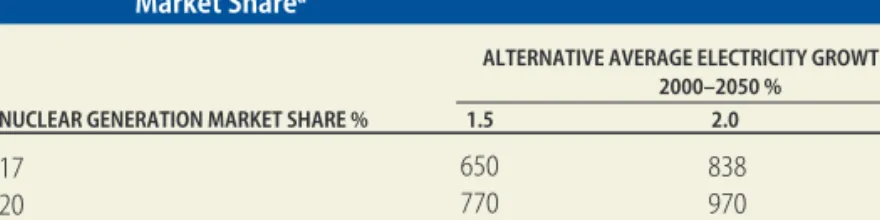
Table 3.1.
We adopt 1000 to 1500 GWe as the mid-centu-ry reference point range for our study. This is large enough to reveal the challenges that need to be faced to enable the large-scale deployment of nuclear energy. Our analysis and conclusions concerning what we refer to as the global growth scenario, as described in Chapter 1, would not change significantly if this number of deployed reactors were somewhat higher, nor if the time period to reach full operational deployment were extended. We have examined the rate of deployment that would need to occur for a deployment in the range of 1000 to 1500 GWe and note that it is unlikely to proceed in a linear manner; for the next ten to fifteen years, deployment is likely to be slow, and
there-Chapter 3 — Outline of the Study
Table 3.1 Alternative Reference Points for Nuclear Deployment in 2050 in GWe for Different Assumptions about Electricity Growth Rates and Nuclear Market Sharea
ALTERNATIVE AVERAGE ELECTRICITY GROWTH RATES 2000–2050 % 2.0 2.5 17 20 25 838 970 1,235 1,060 1,235 1,545 NUCLEAR GENERATION MARKET SHARE % 1.5
650 770 880