Evaluation of the
Conflict Prevention Pools
The Security Sector
Reform Strategy
Principal author,
Nicole Ball
EVALUATION REPORT EV 647
December 2003 CABINETEvaluation of the Conflict Prevention Pools
Bradford University, Channel Research Ltd, PARC
& Associated Consultants
Thematic Case Study 1
The Security Sector Reform Strategy
Principal Author: Nicole Ball
March 2004
DISCLAIMER
The opinions expressed in this report are those of the author/s and do not necessarily represent the views of the Department for International Development nor of the other government departments who have assisted in managing this evaluation (Cabinet Office, Foreign and Commonwealth Office, Ministry of Defence, HM Treasury).
Contents
TABLE OF CONTENTS
PREFACE iii
EVALUATION TEAM ACKNOWLEDGEMENTS vii
LIST OF ACRONYMS ix
EXECUTIVE SUMMARY 1
1. BACKGROUND 6
2. SSR AND CONFLICT PREVENTION: WHAT BENCHMARK
FOR BEST PRACTICE? 8
3. RELATION OF SSR STRATEGY TO THE BENCHMARK 13
4. EFFECT ON PREVENTING NEW CONFLICTS AND CONTAINING
EXISTING ONES 21
5. EFFECT ON INTERNATIONAL ARRANGEMENTS 25
6. EFFECT ON INTER-DEPARTMENTAL PROCESSES 27
7. IMPLICATIONS FOR FINANCIAL MANAGEMENT 31
8. RECOMMENDATIONS I: SHOULD THE STRATEGY BE CONTINUED
AND HOW CAN IT BE IMPROVED? 33
9. RECOMMENDATIONS II: BASELINES, TARGETS AND INDICATORS 35
ANNEX 1: SSR BASELINE: PROMOTING SECURITY FOR PEOPLE
AND STATES 37
ANNEX 2: TAILORING SUPPORT TO COUNTRY CONTEXT 38
ANNEX 3: DELIVERY ON THREE MAIN OUTPUTS FY 2002/3 43
ANNEX 4: SSR STRATEGY ALLOCATION 2003/4 46
ANNEX 5: EMERGING UK CONSENSUS ON SSR 48
ANNEX 6: LIST OF KEY DOCUMENTS AND OTHER WRITTEN
MATERIALS CONSULTED 50
Preface
PREFACE
P1. The Conflict Prevention Pools (CPPs) are a joint Foreign and Commonwealth Office (FCO), Ministry of Defence (MOD) and Department for International Development (DFID) mechanism for funding and managing the UK’s contribution towards violent conflict prevention and reduction. The Africa Conflict Prevention Pool (ACPP) covers sub-Saharan Africa while the Global Conflict Prevention Pool (GCPP) covers the rest of the world. The CPPs were established by Her Majesty’s Government (HMG) in April 2001, following a government-wide review of UK conflict prevention work in 2000. The rationale behind the CPPs is that by bringing together the interests, resources and expertise of FCO, MOD and DFID, greater effectiveness can be achieved. To this end, the CPPs share a joint Public Service Agreement (PSA) target, expressed as follows:
Improved effectiveness of the UK contribution to conflict prevention and management as demonstrated by a reduction in the number of people whose lives are affected by violent conflict and a reduction in potential sources of future conflict, where the UK can make a significant contribution.
P2. HMG commissioned the first evaluation of the Conflict Prevention Pools to inform the Spending Review 2004 (SR04). DFID has managed this evaluation through Evaluation Department in collaboration with an Evaluation Management Committee (EMC) that also included the Cabinet Office Defence and Overseas Secretariat (Chair), the FCO’s United Nations Department, MOD’s Directorate of Policy and Planning, DFID’s Conflict and Humanitarian Assistance Department (CHAD) and DFID’s Africa Conflict Team (now the Africa Conflict and Humanitarian Unit), situated in the Africa and Greater Horn Department (AGHD).
P3. The establishment of a cross-Whitehall Evaluation Management Committee was an innovative approach to managing an evaluation in DFID, and followed the ethos of the joint working of the CPPs. It allowed for extensive consultation between the various departments and conflict prevention teams. Many thanks are due to the various EMC members who contributed to the management of this evaluation. These include: Chris Chalmers, Benjamin Saoul and Anthea Dolman (Cabinet Office), Clare Barras and Stephen Evans (HMT), Joan Link, Euan Wallace and Karen Wolstenholme (FCO), Bernard Harborne and Malcolm Hood (AGHD), Tom Owen-Edmunds, Catherine Masterman and Ben le Roith (CHAD), Alicia Forsyth, Charlotte Brown, Campbell McCafferty (MOD).
P4. The study was managed by Mary Thompson, Iain Murray and Dale Poad (DFID Evaluation Department) in collaboration with the EMC. It was edited by Caryn Maclean P5. The evaluation was undertaken by Bradford University, Channel Research Ltd, the PARC & Associated Consultants. The GCPP Security Sector Reform (SSR) case study was carried out by Ms Nicole Ball who has conducted extensive fieldwork on SSR in a number of countries. This study was carried out through review of relevant documents, including the reports of geographic case studies undertaken for the evaluation, and interview of UK-based officials involved in SSR work. The UK-based interviews focused on several categories of stakeholders: members of the SSR Strategy Steering Group; members of
Preface
the SSR Policy Committee; representatives of three main SSR Strategy instruments (DAT, GFN, Defence Diplomacy); representatives of the GCPP and ACPP; and officials currently working on or recently working on key geographic desks (Balkans, Indonesia, Uganda). P6. The aim of the evaluation of the CPPs is to assess current government approaches to Conflict Prevention through the GCPP and the ACPP, and to provide an overview of lessons learned and recommendations for the way forward. The purpose of evaluation generally is to examine the design, implementation and impact of selected programmes in order to learn lessons from them so that these can be applied to current and future work, and also to help strengthen HMG’s accountability. It should be borne in mind that any programmes or projects examined are the product of their time, and that the policies they reflected and the procedures they followed have often changed in the light of HMG’s developing knowledge.
P7. The GCPP SSR Case Study is one of six studies undertaken within the framework of the evaluation of the Conflict Prevention Pools. In accordance with the Terms of Reference (ToRs) and the Inception Report, the Evaluation placed maximum emphasis on the macro level: the policy processes in Whitehall by which decisions on allocations are made and implemented by the CPPs. Considerable attention has also been placed on the meso level: the degree to which CPP policies and activities in a given conflict, or given sector of conflict prevention policy such as SSR, form part of a coherent package of direct interventions by the international community and local actors to the problems of preventing large scale deadly conflicts. The micro-level of analysis (review of specific projects) confines itself largely to the way in which projects impact on the meso and macro levels. The Evaluation has not analysed systematically whether specific projects funded by the CPPs have been well managed and whether they have achieved their specific project goals. Single projects have been analysed to the extent that they reflect on the macro and meso levels.
P8. The main findings of the evaluation, reflected in this Synthesis Report, are that the CPPs are doing significant work funding worthwhile activities that make positive contributions to effective conflict prevention, although it is far too early in the day to assess impact. The progress achieved through the CPP mechanisms is significant enough to justify their continuation. Overall, the consultants believe that worthwhile improvements could be achieved through:
a. more consistent approaches to joint assessment and priority setting; b. more determined pursuit of coordinated international responses;
c. and by allocation of more administrative resources and staff trained appropriately in the associated processes.
P9. This case study notes that the SSR Strategy is relatively new and has set itself the goal of enhancing the capacities of local actors. The SSR Strategy is well-positioned to achieve significant gains in this area, and all of its funded activities are relevant to SSR. In Uganda and Sierra Leone, the SSR Strategy was clearly making an important contribution
Preface
to conflict prevention. In Afghanistan, the portfolio of SSR projects, and the support offered by the SSR Strategy, have the potential to meet a range of short to medium term needs within the security sector that can support the process of peace consolidation.
P10. Overall the consultant’s main findings are as follows:
a. Potential synergies between various individual projects were not explored as often as they might be. Similarly, more clarity is required on how funding decisions taken at the political level conform to SSR Strategy requirements.
b. There has been a significant inter-play between the UK and the international community concerning the development of the SSR concept, the principles underpinning that concept, and the practices flowing from it. As a result, UK thinking and practice on SSR has helped to shape the emerging international consensus on SSR, and consequently reflects that consensus to a large degree. c. As a result of the SSR Strategy, there is now a better idea of what a joined-up approach to SSR might be and a growing recognition that a joined up approach can add value to UK SSR work. Progress is reflected in the development of an SSR Policy Brief (MOD, FCO and DFID) which sets out the Government’s policy on SSR.
d. A major challenge facing the SSR Strategy is to clarify SSR principles and good practice for HMG personnel developing and implementing policy for conflict-affected countries and regions.
e. In common with other strategies, the SSR Strategy has experienced considerable pressure to ensure that spend is on target and has, thus far, performed very well in this regard.
P11. The evaluation of the Conflict Prevention Pools is comprised of the following reports which can be found on the corresponding web-site links:
Synthesis Report www2.dfid.gov.uk/aboutdfid/performance/files/ev647synthesis.pdf Security Sector Reform, Nicole Ball www2.dfid.gov.uk/aboutdfid/performance/files/ev647ssr.pdf United Nations, Pierre Robert & Andrew Mack www2.dfid.gov.uk/aboutdfid/performance/files/ev647un.pdf Sudan, Emery Brusset www2.dfid.gov.uk/aboutdfid/performance/files/ev647sudan.pdf Sierra Leone, Jeremy Ginifer & Kaye Oliver www2.dfid.gov.uk/aboutdfid/performance/files/ev647sleone.pdf Afghanistan, Jonathan Goodhand & Paul Bergne www2.dfid.gov.uk/aboutdfid/performance/files/ev647afghanistan.pdf Russia and the FSU, Greg Austin & Paul Bergne www2.dfid.gov.uk/aboutdfid/performance/files/ev647russia.pdf Portfolio Review, Greg Austin & Malcolm Chalmers www2.dfid.gov.uk/aboutdfid/performance/files/ev647portfolio.pdf
Evaluation reports can be found at the DFID website: http://www2.dfid.gov.uk/aboutdfid/performance/ Michael Hammond
Head of Evaluation Department 2 April 2004
Evaluation Team Acknowledgements
EVALUATION TEAM ACKNOWLEDGEMENTS
The members of the Evaluation Team would like to acknowledge the support of the Evaluation Management Committee (EMC) and those who gave their time in support of this study.
The Evaluation Team has been supported effectively by Ms Janet Wilson, the Programme Officer at Bradford University’s Centre for International Cooperation and Security. Research assistance has been provided by Mr Todd Krannock, Mr David Newton, Mr Rob Lawton, Mr Nick Robson and Mr Thom Oommen. Mr Ken Berry has provided review assistance for the synthesis report and some case study reports, as well as having drafted some background material.
Bradford University Channel Research Ltd
List of Acronyms
LIST OF ACRONYMS
ACPP Africa Conflict Prevention Pool
ACSC Advanced Command and Staff Course AGHD Africa and Greater Horn Department ASEAN Association of South East Asian Nations CHAD Conflict and Humanitarian Affairs Department CPP Conflict Prevention Pool
DAC Development Assistance Committee DAT Defence Advisory Team
DCAF Democratic Control of the Military
DFID Department for International Development DDR Disarmament, Demobilization and Reintegration EC European Commission
EMC Evaluation Management Committee
EU European Union
FCO Foreign and Commonwealth Office FRY Former Republic of Yugoslavia GFN Global Facilitation Network GCPP Global Conflict Prevention Pool HMG Her Majesty’s Government HMT Her Majesty’s Treasury IOT Initial Officer Training MOD Ministry of Defence
NATO North Atlantic Treaty Organisation NGO Non-Governmental Organisation NSC National Security Council
OECD Organisation for Economic Cooperation and Development OGDs Other Government Departments
OSCE Organisations for Security and Cooperation in Europe PSA Public Service Agreement
PSOs Peace Support Operations
RCDS Royal College of Defence Studies SALW Small Arms/Light Weapons
SDA Service Delivery Agreement SSR Security Sector Reform ToRs Terms of Reference
UN United Nations
UNDP United Nations Development Programme
UK United Kingdom
Executive Summary
EXECUTIVE SUMMARY Background
S1. In June 2002, Ministers approved a security sector reform (SSR) Strategy,1 and it
became operational at that time based on development work undertaken in the previous year (the Strategy was therefore launched just 13 months before the start of this evaluation). The objective of the SSR Strategy is ‘to help governments of developing and transition countries fulfil their legitimate security functions through reforms that will make the delivery of security more democratically accountable, as well as more effective and efficient, thereby reducing the potential for both internal and external conflict’. This objective promotes conflict prevention because security bodies that adhere to professional standards and the norms of democratic accountability and are effective in fulfilling their security roles will:
• help provide adequate protection to people and states; • contribute effectively to regional peace support operations;
• ensure that the security bodies do not themselves become a source of insecurity. S2. The SSR Strategy relies on three outputs to achieve its objective: policy development and analysis, technical assistance, and capacity building. As a thematic strategy within the Global Conflict Prevention Pool (GCPP), the SSR Strategy is designed to support regional or country specific conflict prevention programmes under either the GCPP or Africa CPP (ACPP). It does so by providing coherent guidance on SSR policy and by acting as a central base for resources that would otherwise be duplicated between strategies.
S3. The main instruments of the SSR Strategy are: • courses funded under defence diplomacy; • military education courses;
• the Defence Advisory Team (DAT), established to provide defence management assistance in partner countries for defence policy reviews, financial management support and advice on civil-military relations;
• the Global Facilitation Network (GFN), a research, advisory and mobilisation tool for the UK Government and international partners facilitating policy development and capacity building for SSR.
Together these accounted for 84.5 per cent of the £5,050,000 allocated to the SSR Strategy in fiscal year 2003/4. The lion’s share of resources in the SSR Strategy (some 58 per cent) go to military diplomacy education courses or other military courses.
S4. Security sector reform is a relatively new and evolving concept. Donor support to SSR in partner countries can be highly political and may involve altering power balances among local stakeholders, significant institutional restructuring and cultural change in those institutions. The path followed must be developed locally and be contextually appropriate.
Executive Summary
Therefore, the benchmark for SSR good practice should describe general principles for donor engagement, rather than provide a template for SSR in support of conflict prevention. Eight internationally recognised principles for effective donor support to security-sector reform are:
• adopt a broad definition of the security sector;
• situate SSR in the context of providing a secure environment for people; • recognise that all countries can benefit to varying degrees from SSR; • foster local ownership of reform processes;
• develop comprehensive frameworks for promoting SSR and assist reforming countries to develop their own frameworks;
• build capacity to undertake SSR in reforming countries; • adopt a long-term approach;
• adopt a regional/sub-regional perspective. 2
Effect on Preventing New Conflicts and Containing Existing Ones
S5. The SSR Strategy is relatively new and has set itself the goal of enhancing the capacities of local actors. The SSR Strategy is well-positioned to achieve significant gains in this area, and all of its funded activities are relevant to SSR. In Uganda and Sierra Leone, the SSR Strategy was clearly making an important contribution to conflict prevention. In Afghanistan, the portfolio of SSR projects, and the support offered by the SSR Strategy, have the potential to meet a range of short to medium term needs within the security sector that can support the process of peace consolidation. As noted in respect of Afghanistan, the gigantic size of the conflict problems which the SSR work is supposed to alleviate is a challenge that is not matched by the combined resources of the Afghanistan Strategy and the SSR Strategy.
2 These principles have been culled from a variety of sources, including: Dylan Hendrickson, A Review of
Security-Sector Reform, CSDG Working Paper No 1, 1999; Bonn International Center for Conversion, Security Sector Reform, Brief 15, June 2000; Clingendael Institute, International Alert and Saferworld, Towards a Better Practice Framework for Security Sector Reform: Broadening the Debate (London/The Hague, 2001);
Tim Edmunds, ‘Defining Security Sector Reform,’ Civil-Military Relations in Central and Eastern Europe
Network Newsletter, No 3 (October 2001), pp 3–6, http://civil-military.dsd.kcl.ac.uk/CMR%20Network/
cmrn3.htm#New_Agenda; OECD, The DAC Guidelines: Helping Prevent Violent Conflict, Paris, 2001;
‘Security Issues and Development Co-operation: A Conceptual Framework for Policy Coherence’, The DAC
Journal, Volume 2, No 3, 2001; UNDP, ‘Democratizing security to prevent conflict and build peace,’ Human Development Report, 2002 (New York, 2002) Chapter 4, pp 85–100; UNDP, Bureau for Conflict Prevention
and Recovery, Justice and Security Sector Reform: BCPR’s Programmatic Approach (New York, November
2002) www.undp.org/erd/jssr/docs/jssrprogramaticapproach.pdf; Hans Born, P. Fluri and A. B. Johnsson,
Parliamentary Oversight of the Security Sector: Principles, Mechanisms and Practices, Handbook for Parliamentarians No 5 (Geneva/Belgrade: DCAF/Inter-Parliamentary Union, 2003); and Clingendael Institute,
Enhancing Democratic Governance of the Security Sector: An Institutional Assessment Framework, prepared for the Netherlands Ministry of Foreign Affairs (The Hague, 2003).
Executive Summary
S6. Through the country/region case studies, the Evaluation found that the potential synergies between various individual projects were not explored as often as they might be. The Evaluation did not find a consistent set of ideas on the ways in which the SSR Strategy can be used to have the maximum effects for the lowest cost on preventing particular types of conflicts. More than a few officials believed the approach to what measures work best in certain circumstances was either lacking transparency, inadequately articulated or simply ad hoc. In some cases, according to certain officials, the decision to fund certain measures was often made at a high political level with only minimal articulation of how they conformed to an agreed SSR Strategy.
S7. The SSR Strategy has as yet not penetrated the work of the country/regional strategies on the sort of sustained and wide-ranging basis that would be necessary for all of its activities to pass the test of highest relevance to priority conflict prevention needs (in 2002/3, the DAT undertook policy advice activities in some seventeen countries while the GCPP and ACPP are active in SSR to some degree in a much bigger number of countries). The linkage between the highest priority conflict prevention needs within these countries and the specific type of support has not always been articulated or obvious. The SSR Strategy is beginning to address the question of prioritisation, but the Steering Group and Policy Committee can go only so far on their own. Determining and communicating overall priorities is the responsibility of the GCPP and the ACPP. At the time interviews for this Evaluation were conducted, the ACPP was undergoing a process of reviewing its priorities and anticipated being able to identify SSR-related priorities in early 2004. Within the GCPP as a whole, the lack of clear procedures for identifying in-country priorities and mechanisms to implement priorities has created problems for many GCPP strategies, the SSR Strategy included.
S8. Many officials interviewed for this Evaluation identified mainstreaming SSR within the departments as a high priority. Buy-in at senior levels and a deeper understanding of the benefits of a holistic approach to SSR among officials in London and overseas posts is a clear necessity. Achieving this should be a high priority for the SSR Strategy Steering Group. While the SSR Strategy has already set in motion several activities that will help with mainstreaming, a clear description of the baseline principles and associated practice would complement these activities, as would clarification of what the three departments agree is, and is not, SSR for those UK officials not working on SSR on a daily basis.
Effect on International Arrangements
S9. There has been a significant inter-play between the UK and the international community concerning the development of the SSR concept, the principles underpinning that concept, and the practices flowing from it. In consequence, UK thinking and practice on SSR both strongly reflect the emerging international consensus on security-sector reform and are in many respects shaping that consensus. The UK is seen to be a leader in the international community on SSR issues. Without the support of the UK Government, SSR would have a much lower profile internationally than it currently does. The SSR Strategy, through the GFN, is taking a leading role in promoting capacity building through networking in Africa, Asia and Latin America. Defence Diplomacy and military education courses also contribute to building capacity, as does much of the DAT’s work. In addition to developing capacity to address SSR in these regions, the regional networks supported by the UK
Executive Summary
could provide a mechanism for identifying and disseminating lessons learned in the conduct of SSR as well as articulating SSR requirements and concerns from the regional perspective.
Effect on Inter-Departmental Processes
S10. During the first 18 months of its existence, the SSR Strategy has sought to promote a joined-up approach to SSR within Whitehall. In consequence, there is now a better idea of what a joined-up approach to SSR might be and a growing recognition that a joined-up approach can add value to UK SSR work. There also seems to be a growing recognition that there is considerable overlap between democratic civil-military relations (Ministry of Defence’s (MOD’s) Defence Diplomacy work) and SSR (Department for International Development (DFID)), as well as DFID’s work on safety, security and access to justice. S11. A concrete indication of the progress made by the three departments to date is the development of an SSR Policy Brief, signed by three Ministers, which sets out the Government’s policy on SSR and describes some of the work undertaken thus far. All of the officials on the SSR Strategy’s Steering Group and the Whitehall SSR Policy Committee interviewed for this Evaluation agreed that the Policy Brief constitutes an important step forward. It is the product of lengthy consultations among the three departments, and as such provides a useful platform for carrying forward SSR work. Additionally, the work of the Strategy’s main instruments is increasingly incorporating the international benchmarks. A major challenge facing the SSR Strategy is to clarify SSR principles and good practice for Her Majesty’s Government (HMG) personnel developing and implementing policy for conflict-affected countries and regions.
S12. At the same time, not-inconsiderable impediments to joined-up work remain. While the three departments will always address SSR from somewhat different perspectives, there is a view among some officials that the way in which the SSR Strategy has been managed to date has not maximised opportunities to bridge the gulf between the three departments. There is room to consider whether the growing demands on the SSR Strategy can be satisfied by current bureaucratic arrangements.
S13. Although some of these factors are beyond the control of the strategy management team, interviews conducted for this evaluation reported a culture of inadequate consultation and transparency within the SSR Strategy. Transforming this culture would go a long way toward resolving the concerns raised by many of those interviewed about the management of the SSR Strategy and would promote a stronger shared vision of the objectives of SSR throughout HMG.
Implications for Financial Management
S14. The impact of any strategy on financial management should be to increase the effectiveness and efficiency with which resources are employed in support of an agreed objective. In common with other strategies, the SSR Strategy has felt considerable pressure to ensure that spend is on target. The SSR Strategy has thus far performed very well in this regard.
Executive Summary
has resided primarily with the departments in charge of implementing those activities, there now appears to be a trend toward somewhat greater transparency and participation within the SSR Strategy on such decisions. This opens up opportunities for engaging in joint discussion of the priority that any particular activity should have within the strategy as well as how a particular activity fits in with the priorities of the country/region in which the activity is to be implemented. There already is some good practice within the SSR Strategy on these points and they should be extended to all Strategy activities.
Recommendations
S16. The SSR Strategy should be continued (this and other recommendations are elaborated at length in the body of the report). Demand for SSR will continue to exist for the foreseeable future. It is likely that there will be a growing market for SSR assistance. The UK has already invested a fair amount of resources in developing SSR-related expertise, and is looked to by many abroad as a source of innovation and good practice. SSR is an area where joint action by relevant ministries will definitely add value. SSR is also an area where joint action by groups of external actors will add value. It would be helpful if the SSR Strategy indentified explicitly how its work can contribute to coordination among other donors.
S17. Timely attention to prioritisation, mainstreaming, and mechanisms to promote a joined up approach will greatly enhance the capacity of the SSR Strategy to deliver on its main objective in a manner supportive of the joint Public Service Agreement (PSA). It is recommended that the SSR Strategy Steering Group consider how best to generate a more detailed framework for promoting the SSR priorities of the GCPP and ACPP for specific conflicts. In particular, the SSR Strategy should consider how best to communicate to both UK-based and in-country staff the mechanisms they can use:
• to develop a joint analysis of the SSR needs in a country or region that is consistent with HMG conflict prevention priorities and the stated needs of local governments; • to prioritise these needs; and
• to translate priorities into coherent programmes of support.
The review should also clarify the principles on which SSR work should be based and how these relate to the variety of activities funded by the CPPs in the area of SSR. A high priority should be attached to developing mechanisms for incorporating lessons learned into ongoing SSR work.
S18. While it is not the remit of the SSR Strategy to determine how the geographic strategies apply SSR principles and good practice, we believe that it is very much the remit of the SSR Strategy to clarify for the geographic strategies what SSR principles and good practice are. In order to achieve this objective, the SSR Strategy and all of its instruments need to serve the joined-up conflict prevention requirements of the geographic departments. This was explicitly recognised by the SSR Strategy Steering Group in September 2003. The SSR Strategy Steering Group needs to monitor and evaluate the intensity and quality of service to (and sustained dialogue) with the country desks or country/conflict steering groups.
Background
1. BACKGROUND
1. In March 2001, Ministers agreed to establish the Security Sector Reform (SSR) Strategy within the Global Conflict Prevention Pool (GCPP). A Whitehall Security Sector Reform Policy Committee was established, chaired by a member of the Conflict and Humanitarian Affairs Department (CHAD) of the Department for International Development (DFID), and with representation from the Foreign and Commonwealth Office (FCO) and Ministry of Defence (MOD). In June 2002, Ministers approved an SSR Strategy,3 and the
Strategy became operational (this was just 13 months before the start of this evaluation). The objective of the SSR Strategy is to ‘help governments of developing and transition countries fulfil their legitimate security functions through reforms that will make the delivery of security more democratically accountable, as well as more effective and efficient, thereby reducing the potential for both internal and external conflict’.
2. The decision to establish the SSR Strategy reflected the belief of the UK Government that appropriate, accountable, and affordable security bodies in countries at risk of violent conflict are a potentially important adjunct to prevention or management of such conflicts and that the UK Government can more effectively deliver on its conflict prevention objectives by working in a joined up manner to promote those outcomes. According to the SSR Strategy: ‘The responsible and legal conduct of security is a prerequisite for building a secure environment in which a country can develop without violent conflict and in which people can go about their business without fear or threat’.4 In order to achieve such
‘responsible and legal conduct’, it is often necessary for a country to make significant changes in the governance and management of its security sector. This process, known as SSR, is defined by the SSR Strategy as encompassing ‘the behaviour, conduct and performance of security sector actors, relationships between the security sector and civil society, and the processes of managing security within democratic societies. SSR is an essential part of the wider governance reform that will contribute to an indigenous capacity to build sustainable security and peace’.5
3. Security-sector reform is one component of creating a safe and secure environment, and preventing conflict is one of the potential benefits of security-sector reform. SSR intersects with two other critical components of creating security: enhancing the operational effectiveness of security bodies (domestically and regionally) and overcoming the legacies of violent conflict. The precise nature and scope of these intersections, which are shown graphically in Annex 1, will vary according to the environment in which SSR is undertaken. 4. Democratic control of responsible security bodies, acting only in the most professional manner according to international law, and with high levels of effectiveness and efficiency, is the desired end-state of SSR (both in donor and recipient countries). 6 As those we
interviewed generally recognised, the transition to this end-state is a long, difficult and unpredictable path that may often only be subject to external influences at the margins. In a paper prepared for the United Nations Development Programme (UNDP), the principal
3 Joint FCO, DFID, MOD Paper, ‘Strategy for Security Sector Reform’, 12 June 2002.
4 Ibid.
5 Ibid.
Background
author of this report noted that ‘External actors must accept that every country has a unique history and mode of operations. They must also accept that there are different ways to achieve the end states of transparency, accountability and civil management and oversight of the security bodies’.7 What is more, the defence forces, public security and
intelligence services and judicial processes of a state can be the most difficult to reform, even for a democratic government in the developed world. The agencies possess the coercive powers of the state. They are the most powerful institutions in any country, and when a government seeks ‘root and branch’ changes, such reform can take many years. 5. As noted in the report for UNDP, the ‘principles of good governance in the security sector describe an ideal-type and do not provide a roadmap for change’. It is therefore likely that there will need to be an iterative process of policy development and implementation which will progressively bring principles, policies and practice closer together. Where targeted short-term activities are used in SSR, the objective should be to identify a series of practical steps that are achievable and contribute to long-term progress. 6. The challenge for a country like the UK of adapting the new agenda linking SSR in other countries to conflict prevention was complicated by decades of a different sort of involvement in the security sector during the Cold War. In those years, security assistance from the major providers in both East and West almost always took the form of training and equipment designed to enhance operational capacity, with the primary aims either of buying influence or of opposing each others’ client states, with little or no concern for democratic governance or rule of law considerations. The development assistance agencies of major donors avoided interaction with the security sector, and democratic governance and rule of law considerations were also largely absent from their support which tended to concentrate on economic and social development. The result was tolerance of politicised security bodies, their frequent disregard for the rule of law, all too regular abuse of human rights, and unnecessarily high (or inappropriately allocated) security sector budgets to the neglect of social and economic development. 8
7. The growing interest of external actors in SSR through the 1990s was some indication that the old ideas had lost their appeal. The UK adoption in 2002 of the SSR Strategy to support the Conflict Prevention Pools (CPPs) is certainly confirmation that UK assistance to security sectors abroad is now set on a very different path from that of several decades ago.
7 Nicole Ball, ‘Enhancing Security Sector Governance: A Conceptual Framework for UNDP’, 9 October
2002, http://www.undp.org/erd/jssr/docs/nicoleballpaper.htm. This work was done under DFID funding— part of a broader effort by it to get SSR, SALW and conflict prevention issues into what was then the emergency response division of UNDP.
8 See Nicole Ball, Security and Economy in the Third World (Princeton, NJ: Princeton University Press,
1988), especially chapter 7 ‘Capital, Growth and Security Assistance,’ pp 237–94 and Nicole Ball, ‘Pressing for Peace: Can Aid Induce Reform?’, Policy Essay no. 6 (Washington DC: Overseas Development Council, 1992).
SSR and Conflict Prevention: What Benchmark for Best Practice?
2. SSR AND CONFLICT PREVENTION: WHAT BENCHMARK FOR BEST
PRACTICE?
8. In the Inception Report, it was proposed and agreed by the Evaluation Management Committee, that each case study would contrast the CPP strategy it was reviewing with a set of policy proposals for conflict prevention goals in the named country/region or thematic activity that had been devised outside Her Majesty’s Government (HMG). This independently-derived set of policy proposals would be used as a benchmark for consideration of whether HMG had selected an optimum portfolio of activities and whether the components selected were making (or were likely to make) a significant impact on the conflict prevention goals of HMG. Each case study would then compare the CPP-funded portfolio of activities and associated strategy documents against this external or independently derived benchmark.
9. In the case of the SSR Strategy, it has not proven so simple to identify a set of benchmarks for best practice in SSR that are instantly distinguishable from the work of HMG. The UK was the first government of an Organisation for Economic Cooperation and Development (OECD) member country to have established a discrete sub-programme on SSR within an overarching programme of conflict prevention linking the three main departments involved. It is pioneering an holistic approach to SSR that is based on an awareness of the highly political nature of the processes necessary to achieve democratic security-sector governance. The components of this approach have been evolving since the early 1990s within the governments and multilateral organisations that provide both development and security assistance.9 European Union (EU) governments and the United
States have, for example, supported the development of democratic civil-military relations in the context of North Atlantic Treaty Organisation (NATO) and EU accession of countries in East and Central Europe and the Baltic countries.10 Similarly, OECD countries, the EU
and the United Nations Development Programme (UNDP) have supported police and justice reform programmes in many parts of the world. Virtually all donors have supported efforts to reduce the proliferation of small arms and light weapons (SALW) and to disarm, demobilise and reintegrate (DDR) ex-combatants.11
10. There have historically tended to be quite different perspectives on SSR and its relationship to conflict prevention according to the different primary missions of a foreign ministry, a defence ministry and a development ministry. Foreign and defence ministries have been particularly interested in promoting the capacity of a country’s security bodies to provide security, both domestically and regionally/internationally to peace support operations, thus contributing to conflict prevention in-country or in other countries. The development community has focused
9 It is important to recognise that non-OECD countries have also chosen to undertake SSR-related activities
without external support. For example, the ASEAN Regional Forum has decided to promote publication of defence white papers and associated reform of military doctrine as a means of establishing more transparency in national security policy. The post-1994 government of South Africa has undertaken a major, indigenously developed and implemented, security-sector transformation, affecting defence, safety and security, justice and intelligence.
10 See, for example, publications of the Geneva Centre for the Democratic Control of the Armed Forces,
www.dcaf.ch and information on the Stability Pact created by the EU, http://www.stabilitypact.org/.
11 While many SALW and DDR programmes are intended first and foremost to build trust among excombatants
SSR and Conflict Prevention: What Benchmark for Best Practice?
on creating a secure environment for maximising human development of the poor. Development actors are only slowly coming to terms with the need to incorporate into their SSR concept a number of broader, and sometimes morally troubling, political objectives, including the need to improve the operational capacity of security bodies in order to contribute to conflict prevention, even if those bodies are not yet fully democratically accountable.12 They need to make this
adjustment in order to increase buy-in from the defence and foreign policy communities, just as the defence and foreign policy actors need to accept that not all security-related assistance can be classified as SSR.
11. The challenge is not only to develop a comprehensive approach to SSR, but importantly to specify and strengthen the linkages between that SSR approach and conflict prevention. In an international environment in which the conflict prevention agenda and the SSR agenda are both new and rapidly developing, it is difficult to find highly developed views in general about best practice in SSR as it relates to conflict prevention. In general terms, there are three basic reasons why SSR along the lines described above can promote conflict prevention. Security bodies that adhere to professional standards and the norms of democratic accountability and are effective and efficient in fulfilling their security roles will help to:
• provide adequate protection to people and states;
• contribute effectively to regional peace support operations;
• ensure that the security bodies do not themselves become a source of insecurity. 12. Lack of democratic accountability can lead to corrupt behaviour on the part of security force personnel, government officials, politicians, and other key actors that prevents security bodies from being professionally trained, adequately equipped and appropriately financed. Inadequate adherence to professional standards can mean that security bodies do not have the capacity to plan, manage their resources effectively and efficiently, ensure clear lines of responsibility, or develop sound human resource management and procurement systems. Lack of operationally effective security forces (often a result, inter alia, of a lack of professionalism and democratic accountability) allows criminality and armed opposition to flourish, undermining the conditions for development and making large-scale armed conflict more likely. All of this will affect their ability to protect people and states and to contribute effectively to regional peace support operations.13
12 Dylan Hendrickson and Andrzej Karkoszka, ‘The Challenges of Security Sector Reform’, pp 175–202, in
SIPRI Yearbook 2002: Armaments, Disarmament and International Security (London: Oxford University Press for Stockholm International Peace Research Institute, 2002). This chapter examines a range of issues affecting the viability of SSR efforts in Africa, Asia, Eastern Europe, and Latin America. Some of the implications of SSR for transition countries are discussed in Timothy Edmunds, ‘Security Sector Reform: Concepts and Implementation’, Report for Geneva Centre for Democratic Control of Armed Forces, Security Sector Reform: Conceptual Framework and Practical Implications (Workshop 20-22 November 2001), http://www.dcaf.ch/ publications/E-Packages/ws_criteria%20221101/DCAF%20SSR%20Report1. pdf, and Timothy Edmunds, ‘Security Sector Reform in Central and Eastern Europe: Criteria for Success and Failure’ (Workshop 22-23 November 2001), http://www.dcaf.ch/publications/E-Packages/ ws_criteria%20221101/ DCAF%20SSR%20Report1.pdf.
13 While democratic accountability and adherence to professional standards will not automatically produce
more effective and efficient security bodies, there is a strong correlation between the absence of these factors and ineffective and inefficient security bodies. For example, see Günther Bächler, ‘Security Sector
Reform’, pp. 20-21 in Conflict Transformation through State Reform (Berlin: Berghof Research Center for
SSR and Conflict Prevention: What Benchmark for Best Practice?
13. By the same token, a poorly-managed, unprofessional and unaccountable security sector can be a major source of insecurity, both domestically and regionally. Countries where the security sector does not operate within the framework of democratic accountability are more likely to experience internal and external violent conflict. This arises from: • a disregard for the rule of law, including the ability of the security bodies to act with
impunity and engage in serious human-rights violations;
• the tendency to settle disputes with neighbours through the use of force, rather than develop mechanisms to mediate conflict;
• support for highly centralised political systems that exclude the majority of the population and undermine the ability of poor people to improve their lives and livelihoods.14
14. Annex 2 demonstrates that activities undertaken to promote SSR can be short-, medium- and long-term in nature. They can occur at all stages of the conflict cycle. In post-conflict environments, it is likely that most short-term security-related activities will be focused more on creating security than on SSR per se, but the linkages to SSR should not be ignored, nor should activities such as taking steps to create a reform friendly environment be neglected.
15. It is within this extremely complex context that any consideration of benchmarks for good practice in SSR as a thematic ‘Strategy’ in support of conflict prevention should be situated. There can probably be no concrete international benchmark at a thematic level for this rather specialised form of bureaucratic organisation. The test of effectiveness must be its contribution to reducing the risk of, or mitigating the effects of, large scale conflict in specific cases. There is, however, growing agreement that donors need to follow a number of basic principles (as guidelines for engagement, rather than a template for policy or programme development):
• adopt a broad definition of the security sector;
• situate SSR in the context of providing a secure environment for people; • recognise that all countries can benefit to varying degrees from SSR; • foster local ownership of reform processes;
• develop comprehensive frameworks for promoting SSR and assist reforming countries to develop their own frameworks;
• build capacity to undertake SSR in reforming countries; • adopt a long-term approach;
SSR and Conflict Prevention: What Benchmark for Best Practice?
• adopt a regional/sub-regional perspective.15
16. In applying these principles, it is important to keep the following points in mind: • SSR is highly political and involves altering power balances: between civilians and
security body personnel, between the executive and legislative branches of government, within the executive branch, and between government and civil society. Altering these power balances involves significant institutional restructuring and cultural change. Thus, the motivations of key actors have to be understood to the extent possible.16
• The dilemmas and policy tensions implicit in this area of activity must be specified, and practical advice offered for addressing both generic problems and country specific problems in ways that are finely tuned to the political, social, economic and security circumstances of countries concerned.
• These problems and practical solutions must be discussed widely, especially in ways that are likely to influence and shape the views, behaviours and approaches of key local actors.
• The practical ideas and possible solutions should be delivered not just for long-term impact but also in support of short-term preventive actions to the extent feasible. • In cases where partner governments are not receptive to external influence on the
most important issues, efforts need to be made to develop a constituency for reform, for example by cultivating reform-minded officials and helping to mobilize local civil society.17
15 These principles have been culled from a variety of sources, including: Dylan Hendrickson, A Review of
Security-Sector Reform, CSDG Working Paper No 1, 1999; Bonn International Center for Conversion, Security Sector Reform, Brief 15, June 2000; Clingendael Institute, International Alert and Saferworld, Towards a Better Practice Framework for Security Sector Reform: Broadening the Debate (London/The Hague, 2001);
Tim Edmunds, ‘Defining Security Sector Reform,’ Civil-Military Relations in Central and Eastern Europe
Network Newsletter, No 3 (October 2001), pp 3–6, http://civil-military.dsd.kcl.ac.uk/CMR%20Network/
cmrn3.htm#New_Agenda; OECD, The DAC Guidelines: Helping Prevent Violent Conflict (Paris, 2001);
‘Security Issues and Development Co-operation: A Conceptual Framework for Policy Coherence’, The DAC
Journal, Volume 2, No 3, 2001; UNDP, ‘Democratizing security to prevent conflict and build peace,’ Human Development Report, 2002 (New York, 2002), Chapter 4, pp 85–100; UNDP, Bureau for Conflict Prevention
and Recovery, Justice and Security Sector Reform: BCPR’s Programmatic Approach (New York, November
2002), www.undp.org/erd/jssr/docs/jssrprogramaticapproach.pdf; Hans Born, P. Fluri and A.B. Johnsson,
Parliamentary Oversight of the Security Sector: Principles, Mechanisms and Practices, Handbook for Parliamentarians No 5, (Geneva/Belgrade: DCAF/Inter-Parliamentary Union, 2003); and Clingendael Institute,
Enhancing Democratic Governance of the Security Sector: An Institutional Assessment Framework, prepared for the Netherlands Ministry of Foreign Affairs (The Hague, 2003)
16 External actors need to realistic about the difficulties they face in understanding the motivations of key
players or institutional dynamics, in part because motivations often shift during a conflict.
17 These modes of operation are relevant for both local stakeholders and external actors such as the UK. For
a methodology that incorporates them that is intended for use by developing and transitional countries, see
Clingendael Institute, Enhancing Democratic Governance of the Security Sector: An Institutional Assessment
Framework, prepared for the Netherlands Ministry of Foreign Affairs (The Hague, 2003), http:// www.clingendael.nl/cru/pdf/2003_occasional_papers/SSGAF_publicatie.pdf.. The objective of this framework is to help partner countries to prioritise their SSR needs by analysing a series of entry points. Although aimed in the first instance at partner countries, this framework could also assist external actors to understand the political context in which they are operating.
SSR and Conflict Prevention: What Benchmark for Best Practice?
17. Thus, the SSR Strategy within the GCPP should be evaluated both against the positive aspirations and characteristics of international SSR work at the thematic level and, at the country level, against the consideration that donors may have few entry points for supporting SSR because it is such a highly contested and politically complex field. The work of the CPPs in SSR will always be sharply limited by the openness of the partner government to the specific programmes. The external actor can only offer inspiration, support and ideas for other people’s SSR.
18. The above discussion of politics and priorities exposes the need to be able to identify with some degree of reliability the most appropriate entry point for using SSR support as a conflict prevention tool. Analysis of the potential of SSR to support conflict prevention should therefore, at least in the first instance, situate narrowly technical descriptions of evolving institutional capacities within a much broader analysis of the entry points for changing the calculation of key players about resort to violence and about appropriate norms for governance of the armed forces, security services or judicial institutions.
Relation of SSR Strategy to the Benchmark
3. RELATION OF SSR STRATEGY TO THE BENCHMARK
19. As noted above, there has been a significant inter-play between the UK and the international community concerning the development of the SSR concept, the principles underpinning that concept, and the practices flowing from it. In consequence, UK thinking and practice within the SSR thematic strategy of the GCPP strongly reflect the emerging international consensus on security-sector reform benchmarks or ‘guiding principles’ (as they also continue to shape that consensus). Each of the Strategy’s main instruments, discussed below, is increasingly reflecting the international benchmarks for the SSR principles. The additional major challenge facing the SSR Strategy is to translate SSR principles into feasible solutions for HMG personnel required to prevent or mitigate conflict in specific countries and regions.18 The following discussion addresses both the thematic
level and the conflict-specific or country-specific work of the SSR Strategy. The discussion is intended to highlight the areas of commonality between the international benchmarks, as un-formed as they may be, and UK concepts and practices and to identify how relevant the work of the SSR Strategy has been to the purposes of conflict prevention, both at a thematic level and for specific conflicts.
20. The objective of the SSR Strategy is ‘to help governments of developing and transition countries fulfil their legitimate security functions through reforms that will make the delivery of security more democratically accountable, as well as more effective and efficient, thereby reducing the potential for both internal and external conflict’.19 Although the SSR Strategy
is established within the GCPP, it also supports the work of the Africa Conflict Prevention Pool (ACPP). Moreover, a significant amount of resources the allocated to the geographic strategies in both the GCPP and the ACPP have been used for SSR-related activities. 21. The SSR Strategy proposes to assist these governments to:
• improve their policy making—including through engagement with wider civil society; • establish mechanisms which will strengthen security sector accountability and
transparency;
• enhance efficiency and effectiveness in the development and employment of security sector capacity.20
22. The SSR Strategy identifies three main outputs to achieve these purposes:
• Policy development and analysis: ‘The development of generic and region-specific Whitehall policy and strategy papers on request from FCO/MOD/DFID,’ aimed at creating a ‘better understanding of security problems,’ thereby helping to develop ‘more appropriate policy responses’.
18 Some tools already exist, for example, Department for International Development, Understanding and
Supporting Security Sector Reform, February 28, 2002, www.dfid.gov.uk. As discussed below, others are in development. What does not seem to exist as yet is an articulated strategy for mainstreaming. See also section 4.
19 ‘Strategy for Security Sector Reform: Joint Conflict Prevention Pools’, para 8.
Relation of SSR Strategy to the Benchmark
• Technical assistance: ‘Providing effective SSR assistance is a priority theme for conflict reduction.’ Technical assistance can ‘involve government-to-government work É support for non-state actors and provision of education and training opportunities for military and other security sector personnel’.
• Capacity building: ‘Work with bilateral donors, multilateral organisations, NGOs and academic institutions to create a global climate conducive to SSR by influencing agendas and developing local capacity for reform’.21
23. The Strategy is designed to ‘support regional or country specific conflict prevention programmes that include SSR activities, whether developed under the GCPP or ACPP, by providing coherent guidance on SSR policy and a central base for resources which would otherwise be duplicated between strategies (e.g. non-country specific Defence Diplomacy capacity). The SSR Strategy is not intended to ‘duplicate, replace, or fund specific security sector reform activities that have been developed under existing regional strategies’. 24. Thus at a general level of mission statement and objectives, the SSR Strategy can be judged to be operating close to the international benchmarks in terms of relevance. The same pattern can be seen in closer examination of the specific instruments funded by the SSR Strategy, as they operate at country-level. Though, at that level, it may be impossible to judge the degree to which alternative priorities or choices are shaped by the likes and dislikes of the partner governments, rather than by the preferred positions of HMG.
25. The SSR Strategy funds four main instruments through which SSR in support of conflict prevention can be provided:
• Defence Advisory Team.
• Global Facilitation Network (GFN) for SSR. • Defence Diplomacy courses.
• Military education courses.
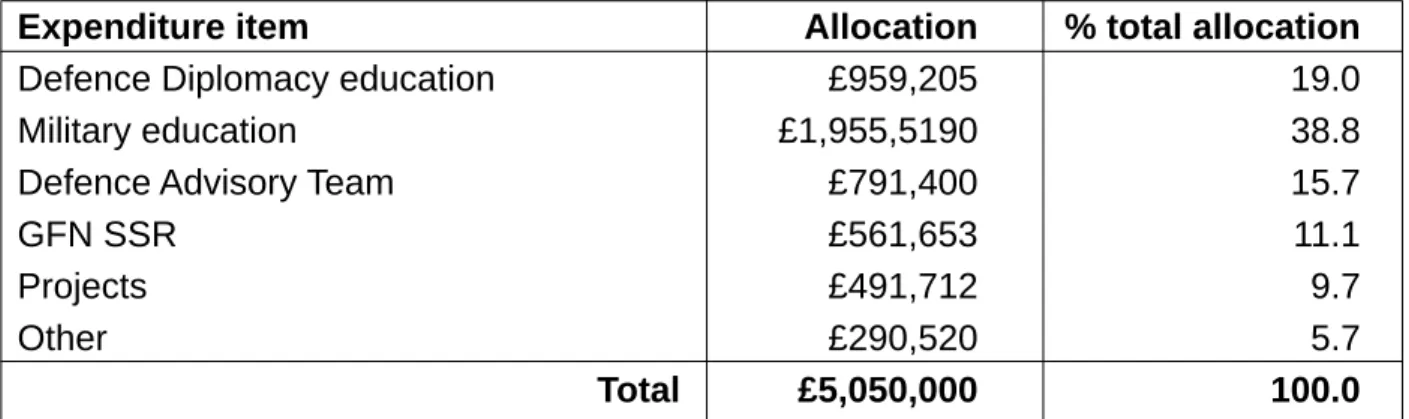
The Strategy also funds a number of stand-alone projects. Together these programmes accounted for 84.5 per cent of the £5,050,000 allocated to the SSR Strategy in fiscal year 2003/4. Additional detail on expenditure is found in Table 1 and Annex 4.
21 ‘Strategy for Security Sector Reform’, para 19. Additional detail on the types of activities that fall under
Relation of SSR Strategy to the Benchmark
Table 1: SSR Strategy Allocation 2003/4
Expenditure item Allocation % total allocation
Defence Diplomacy education £959,205 19.0
Military education £1,955,5190 38.8
Defence Advisory Team £791,400 15.7
GFN SSR £561,653 11.1
Projects £491,712 9.7
Other £290,520 5.7
Total £5,050,000 100.0
26. Annex 3 provides descriptions of delivery on three main outputs of the SSR Strategy in 2002/3. It is extracted from the SSR Bid to the GCPP, FY 2003/4 and 2004/5. As such it does not fully reflect the activities actually undertaken during 2003 or the evolution of SSR Strategy instruments such as the GFN and Defence Advisory Team (DAT). It does, however, reflect the range of activities that the SSR Strategy has been involved in and the general orientation of key instruments. The material in Annex 3 demonstrates a strong overlap between the work of the SSR Strategy and the international benchmarks at both thematic and country level. Some examples of this are highlighted below.
27. Defence Advisory Team: the DAT was established to provide defence management assistance in partner countries in three core areas: defence policy reviews, financial management and civil-military relations. It was set up by the Secretary of State for Defence in February 2001, two months in advance of the formal creation of the GCPP, though after the completion of the cross-cutting review that recommended the establishment of the GCPP. The cross-cutting review had identified SSR as one of 22 tools of conflict prevention. The review also identified links with the armed forces of partner countries as a useful entry point for conflict prevention in general.
28. In 2002/3, the DAT had a staff of ten, including both civilian and military personnel, among them a member of DFID. The operating costs (£500,000 in 2002/3) are provided by the SSR Strategy, and programme/project costs for significant DAT work-streams are met from individual country or thematic strategies in the GCPP or ACPP. The GCPP SSR Strategy funds the attachment to DAT of advisers in various fields (governance, police/ justice, and intelligence/security reform).22 In 2002/03, the DAT undertook policy advice
activities in 17 countries:
• Ethiopia, Ghana, Rwanda, Sierra Leone, Uganda
• Afghanistan, Bulgaria, Guyana, Indonesia, Iraq, Latvia, Macedonia, Romania, Serbia and Montenegro, Sri Lanka, Ukraine, Uzbekistan.
22 See http://www.mod.uk/issues/cooperation/dat/index.htm, and N.A. Fuller, ‘Defence Advisory Team. Annual
Report, 2002/03’, April 2003. The police/justice and intelligence/security reform advisers will joint the Team in 2004.
Relation of SSR Strategy to the Benchmark
29. Global Facilitation Network: created with core funding from the SSR Strategy in November 2002, and fully operational in May 2003, the GFN is centred around an independent team of specialists (academics and practitioners) located at Cranfield University. The team is a resource and mobilisation tool for the UK Government and international partners facilitating policy development and capacity building for SSR. The aim of the GFN is to support SSR in societies in transition. The GFN has three core objectives:
• supporting policy development by providing assessments, scoping studies, country analyses, concept and briefing papers, and presentations for a range of stakeholders; • assisting capacity-building through support to new academic institutions, designing accredited flexible learning and educational materials, and participating SSR management training programmes;
• developing an information repository containing SSR events, news, contacts, documents and information, accessible via the GFN website.
The work of the GFN is supported by an international advisory group.23
30. The GFN is currently engaged in or developing a range of capacity building activities such as supporting regional networks, developing distance learning and other training/ educational materials for both SSR practitioners and civil society, and disseminating information through their website. It is precisely in these areas that the vast majority of those interviewed for this Evaluation indicated that the GFN’s capacity to contribute to the work of the SSR Strategy and conflict prevention lies.
31. The GFN’s recent experiences in developing regional networks and building capacity illustrate the importance of a number of the baseline principles discussed above: building local capacity, fostering local ownership, and adopting a long-term approach. The Africa SSR Network is currently being formed under the guidance of African members of the GFN Advisory Group, and has considerable potential to build capacity in a sustained and context-appropriate manner. Work is also underway on preparing the ground for a future Asia network, and GFN are exploring opportunities for a similar venture in Latin America. In each of these cases it is clear that network development is a long-term process that proceeds most effectively when locally owned. In principle, attention to capacity building will also provide opportunities to inject a regional or sub-regional perspective into work undertaken through the SSR Strategy, although since no regional network was in operation at the time of this Evaluation, it was impossible to assess the extent to which this will occur.
32. Two GFN activities that will get off the ground in 2004 with the collaboration of DAT are of particular interest in terms of supporting a conflict prevention approach to SSR within HMG: a short-course on SSR and a repository of good practice in SSR. Again, as these are not yet operational, it was impossible to determine how well they will fulfil this objective, although the outline of the short-course available to us suggests that it has the potential to provide a solid introduction to the subject for UK officials.
Relation of SSR Strategy to the Benchmark
33. Defence Diplomacy Educational Activities: these activities comprise educational courses and a fellowship programme. Since 2000, Cranfield University has offered seven-week courses in the UK and two-seven-week courses abroad on the subject of ‘Managing Defence in a Democratic, Market-based Society’. The objective is to promote democratic accountability and effectiveness and efficiency in the conduct of defence. A fellowship of up to three years, managed by MOD and the host institution, helps develop capacity outside the defence sector in priority countries to engage in and inform the national debate about the conduct of defence. Cranfield University also runs a Global Security MSc course, which aims to generate in-depth knowledge and understanding of what constitutes security in the twentyfirst century and the place, relevance and limitations of military forces in helping to solve multi-dimensional security problems. 24
34. While the Defence Diplomacy activities were in existence prior to the creation of the SSR Strategy, the three departments assessed and prioritised these activities for inclusion in the Strategy. The curriculum of the MOD courses has been progressively modified to enhance their ability to contribute to the change in attitudes or capacities identified as the benchmark for SSR in section 2. Until recently there was no mechanism for ensuring either that the export courses are the highest priority tasks for SSR in the target countries or that they are targeted on the highest priority countries. In October 2003, agreement was reached that decisions on where export courses will take place in the future will be broadened to include representatives of DAT, DFID and FCO, along with MOD. Course participants are both military and civilian and are selected from priority countries and regions that are agreed by the Steering Committees of both Pools (based on UK Foreign, Security and Defence Policy Objectives) but are not covered by separate Pools strategies.25 At the
same time, since the UK-based courses can only accommodate a small number of participants from each country per year, the resulting gains for conflict prevention may be fairly small and gradual.
35. Military education: the objective of military education funded under the SSR Strategy is to influence military behaviour in ways consistent with democratic accountability and the promotion of military effectiveness and efficiency. It consists of three programmes which, in common with the Defence Diplomacy education activities, were created prior to the establishment of the SSR Strategy budget line:
• Royal College of Defence Studies (RCDS) course for senior officers and non-military officials from the UK and abroad aimed at developing their analytical powers, understanding of defence in a democracy, and international security and strategic vision;
• Advanced Command and Staff Course (ACSC) course for military officers and civilians ranked lieutenant colonel or equivalent from abroad to international relations, law, ethics, human security and defence management;
24 MOD, ‘Security Sector Reform Strategy—Activities undertaken by the MOD,’ undated, pp 4–6, MOD,
‘Security Sector Reform—A MOD Position Paper,’ Director Approved Draft 17 July 2003, para 19), Dr Laura Cleary, ‘Managing Defence in a Democratic, Market-based Society’, description of 7-week certificate course. Cranfield University, Global Security MSc, http://www.cranfield.ac.uk/prospectus/shrivenham/gs.cfm.
25 Course participants from countries that are not GCPP and ACPP priorities are funded through the Defence
Relation of SSR Strategy to the Benchmark
• Initial Officer Training (IOT) to develop basic professional military skills and the qualities of leadership, intellect and ethical behaviour demanded of a junior leader working in a democratic context.26
36. As with the Defence Diplomacy courses, many of these activities may contribute to the change in attitudes or capacities identified as the benchmark for SSR in section 2. They seek to influence the behaviour of attendees in a manner that is consistent with democratic accountability, as well as to promote military effectiveness and efficiency, and are targeted on countries and regions that are agreed by HMG to be conflict-prevention priorities.27 However, as with the UK-based Defence Diplomacy courses, the military
education courses are not in a position to educate large numbers of officers from any individual country, nor necessarily the most influential officers, and thus resulting gains will only accrue rather slowly.
37. Questions were raised by a number of officials interviewed for this Evaluation about the relevance to SSR and conflict-prevention of the three military education courses and the various Defence Diplomacy activities funded under the SSR Strategy. Many of these activities may contribute to the change in attitudes or capacities identified as the benchmark for SSR in section 2, but are a long way from being the highest priority tasks for SSR in some of the target countries. The SSR Strategy funds activities in some countries that are not even the subject of country conflict strategies under the GCPP or ACPP. The selection of target countries for SSR Strategy activities shows a mix between high priority countries from the point of view of conflict prevention or reduction (Iraq and Afghanistan) and those that seem to be of quite low priority (Ukraine and Bulgaria). Important countries like Russia have not been included, even though there is no SSR program within the country strategy under GCPP.
38. In defence of the activities, it was asserted that they have the potential to support both SSR and conflict prevention, albeit at a relatively slow pace. There can be no doubt that the ability to offer a place in one of the UK-based courses or holding an export course in a particular country or region can be a crucial component of an SSR programme. Additionally, an effort is made to include the most significant politico-military policy makers and decision takers in the senior-level courses. What is more, building democratically accountable controlled and effective armed forces increases the pool of potential donors for regional and international peace support tasks. Senior officials made plain to the Evaluation that HMG placed high priority on a number of these military education courses for their contribution to UK positioning in international affairs and security policy in general. This view held that the UK needed a wide-ranging set of defence relationships in countries that may not now be high priority for conflict prevention so that the UK was positioned strategically in the event that circumstances changed.
39. The counter-argument was made more in terms of process. Some officials questioned how decisions had been made within the SSR Strategy to allocate funds to these courses in the context of maximising the benefits of the limited resources at the disposal of the Strategy.
26 MOD, ‘Security Sector Reform Strategy—Activities undertaken by the MOD,’ undated, pp 4–6, MOD,
‘Security Sector Reform—A MOD Position Paper,’ Director Approved Draft 17 July 2003, para 19.
27 Here, too, course participants from countries that are not GCPP and ACPP priorities are funded through