De
fi
ning the New Behavioral
Science(s)
Carter E. Timon,University of Pennsylvania, USA
A B S T R A C T
Behavioral science, once a hypernym for a collection offields, is becoming a hyponym of itself. Nonacademic and academic practitioners alike increasingly discuss a“behavioral science,”a discipline that consolidates research from the other behavioral sciences to improve humans’(and organizations’) predictive and manipulative powers. Despite the use-fulness of a shared understanding ofbehavioral science, few can agree on a definition. After a brief overview of what behavioral scientists do and produce, I provide an inexhaustive list of the predicates behavioral scientists use to interpret the objects, people, and signs of theirfield and explore the grounding phase parts of objects’or signs’existence that behav-ioral scientists read to categorize objects or signs. I propose that behavbehav-ioral scientists have begun to define behavioral science work by classifying objects or signs (which make up their work) using a partonomy in which a behavioral science-ness of a sign is directly positively correlated with the strength of its relation to the signspsychologyandeconomics. Finally, I discuss what this definitional practice suggests for the behavioral sciencefield now and in the future.
I
had the luxury of completing a rigorous master’s program at a rigorous school. It was (and is) called the master of behavioral and decision sciences. This article comes from a lengthy attempt to systematically explain what that title—master of behavioral and decision sciences—really means. For example, why is the pro-gram title pluralized? What, precisely, are the“sciences”to which we are refer-ring? Is it a separate behavioral science and a separate decision science or a co-hesive pair of sciences that are behavioral-and-decision? Perhaps, we refer to an incohesive group of three or more sciences, which, more or less, deal withContact Carter E. Timon at 3508 Market St., Suite 202, Philadelphia, PA 19104, USA (carter.timon@ gmail.com).
I would like to thank Justin T. Clapp for his unmatched help on this article, from meeting to review and comments, and to general reading. I would also like to thank Asif Agha for taking the time to meet with me and help me develop this article and my ideas and for all his wonderful input. Finally, I would like to thank members of the University of Pennsylvania Semiotic Anthropology Conference for their helpful comments.
Signs and Society, vol. 8, no. 3 (Fall 2020). © 2020 by Semiosis Research Center at Hankuk University of Foreign Studies. All rights reserved. 2326-4489/2020/0803-0005$10.00
decisions and behaviors. This sort of referential confusion seemed to be a con-cern for not only myself but other students in my cohort too and, intriguingly, for some of the program’s professors and administrators.
For example, in one of ourfirst professional development meetings (manda-tory meetings to help us succeed in the workforce) our advisor said that a crucial task for us will be to design, memorize, and deploy a quick, one-to-two-sentence description (thinkelevator pitch) of what behavioral science is. This, he told us, will be a vital tool for our survival. After all, most“industry people”(e.g., CEOs, vice presidents, and hiring officers) do not know what behavioral science is and will need to be educated about why they need it.1
Unfortunately, however, he could not give us a pitch right there. He had been grappling with this question for a little over a year (the lifespan of the program at the time), and, despite refining, his answer was still unsettled.“It’s a very dif-ficult task,”he said.2
To begin our analysis, we mustfirst acknowledge thatbehavioral scienceis not a new term. The lexeme was once a hypernym in most places. It was used mostly as a catchall term for those research projects (and disciplines) not in the camp ofnatural sciences. As such, it was a hypernym for many disciplines we now have (such as anthropology, psychology, economics, and sociology) and often appeared as (the plural form)behavioral sciences. The pragmatic em-phasis in the lexeme’s sense was onbehavioral, in contrast tonatural, and thus helped do the work of separating out one group of researchers from naturalists. At some point, however, thebehavioralbegan to be taken more literally, refer-ring to any discipline that studied the behavior of people.3
Now,behavioral science(depluralized) is becoming a hyponym of itself (and the plural form). The lexeme is still being used to parse out practices within academia, but the pragmatic emphasis in use is now onscience: it is positioned as a unique discipline, which is more (practical and) scientific than other re-search into humanity and human behavior. Furthermore, although young and poorly defined,behavioral sciencecertainly possesses a set of goals and practi-tioners and the ability to systematically produce results. Chiefly, it seems to be a project of collecting products (e.g., results and theories) and practices (methods)
1. In fact, he assured us that they will want it once they understand it; he has received, he tells us, amazing feedback and interest from such CEOs, vice presidents, and other industry people when they begin to consider the potential of this behavioral science. I can confirm that“industry people”do seem excited by thefield.
2. Perhaps this was a bit of strategic pedagogy, which one might say has been successful if one considers the existence of this article.
3. Research on the behavior of nonhuman species may have been considered“behavioral,”but this was likely a fringe interpretation, since any study of nonhuman species was“natural science.”
from any of the old behavioral sciences (mostly psychology and economics) in such a manner as to consolidate or better organize them, so that we may produce new and refine current methods (formulas) for behavior manipulation and change (control).
As such, the rest of this article will serve to analyzeBehavioral Science the hyponym, notbehavioral sciencesthe hypernym. Henceforth, I use the proper-noun formBehavioral Scienceto refer to the hyponym and my topic, in order to differentiate it from the older use of behavioral science(s) (i.e., the hypernym).4
What Do They Do and What Do They Make?
Another anecdote: I was sitting at a happy hour, having drinks with some fel-low Behavioral Science students and our advisor.5Somehow, the what-I-study
elevator-pitch dilemma came up again. My advisor said his current top answer, and perhaps the one he will settle on forever, is something like:“[Behavioral Sci-ence is] the study of what people usually do and how they make decisions in various [common] situations.”
That is a great starting point and perhaps perfectly balanced to be edible to academics, laypeople, and business bigwigs. But it does not tell us (1) who does the studying, (2) what activities the studying consists of, and (3) what such a sci-ence produces (besides the ever-popular and amorphous“knowledge and un-derstanding”). If Behavioral Science is to be a science, a discipline, we have to know how to do it and who can do it. We need to be able to tell apart a Behav-ioral Scientist from a non-BehavBehav-ioral Scientist, and we need to be able to tell when the scientist is doing Behavioral Science versus, say, grooming himself. In short, we need to be able to recognize it.
I do not pretend to be able to answer all these questions in this article nor to provide a singular and exhaustive rubric for checking Behavioral Science-ness in people, their activities, their tools, and their creations. However, I do attempt to glimpse some of the activities and products of Behavioral Science (both canon-ical and noncanoncanon-ical ones), describe some aspects of the partonomy through which Behavioral Science may be defined, and discuss the implications of such
4. Among practitioners, many use the term“B-Sci”to refer to this new market-ready discipline. I ultimately decided to use the termBehavioral Scienceinstead ofB-Sciin order to avoid sounding too informal toward the discipline.
5. This was our reward for assisting with the program-sponsored conference some months prior. The conference was the second annual Norms and Behavior Change conference with keynote speaker Simon Gächter, a behavioral economist.
a partonomy and its relation to canonical activities and products within Behav-ioral Science.
Method and Data
I carry out much of my analysis through a semiotic lens of the kind developed by Charles Sanders Peirce (PWP) and as continued today by various authors (e.g., Parmentier 1994; Kockelman 2005; Agha 2007). Thus I use such terms as sign (a thing that in some way stands for another thing) and object (the thing for which a sign stands) throughout the article.
The data for this article come from three sources: First, from research articles and other objects created or talked about among Behavioral Science students and faculty at a university Behavioral Science program. Many of the articles (and other publications, such as project reports) are found within the syllabi for courses sponsored by the same Behavioral Science program. Second, I ob-tained data from a survey, administered anonymously online and distributed solely to students and faculty within the aforementioned Behavioral Science program. The survey, created using Qualtrics, consisted of eight questions, in-cluding three demographic questions (questions 2–4) and one attention-check question (question 5). The demographic questions were randomized in order to nullify any order effects they may have had on participants. Thefirst question in the survey was always“Define‘Behavioral Science’in one to two sentences,”in order to achieve primary definitions that could not be affected by later questions in the survey. A second definition question—“Describe what behavioral science is to a layman. . .”(see appendix, question 7)—always appeared between the questions about products and activities (questions 6 and 8).6This allowed the
participants a break from the rather tedious format of the products and activities questions and was intended to encourage completion. The activities and prod-ucts questions could not be randomly ordered because of limitations with the survey software. Finally, only seven (n57) full responses were recorded, from a population of about ninety faculty and students. As such, these data are not intended to represent a population, only provide glimpses into the possible ways of glossing Behavioral Science, its activities, and people. Finally, I use data from
6. The Behavioral Science (hyponym)/behavioral science (hypernym) distinction is not made in these sur-vey questions because it was discovered in part through use of these sursur-vey responses. Thus, behavioral sci-ence (ambiguous) is used here and in the other survey questions in order to refrain from biasing participant answers. Only once, in thefirst“Define‘Behavioral Science’ ”question, is the Behavioral Science (ambiguous, capitalized) pattern used in the survey (see appendix). It became apparent later that all participants were dis-cussing Behavioral Science (hyponym). The survey questions are represented throughout as they appeared to participants for the benefit of the reader.
informalfield notes I took during my various activities within the program to inform my analysis and discussion.
Activities and Products
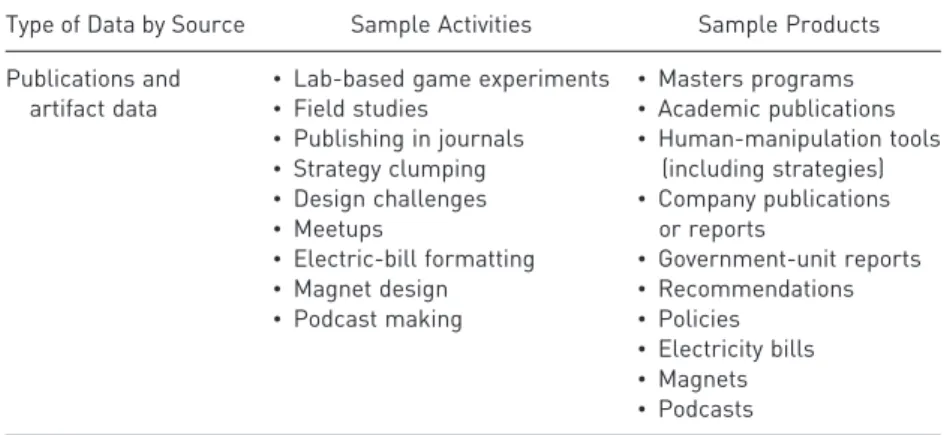
Behavioral Science includes a variety of activities and products, the range of which is extensive enough that I do not wish to, nor could I, present an exhaus-tive list here. Instead, I will merely give theflavor of the referent(s) of“doing Behavioral Science”(table 1).
Behavioral Scientists often perform lab experiments in attempts to explain and predict human behavior. Some of these experiments do not involve the use of economic games, but many do (e.g., Fehr and Rockenbach 2003). Other exper-iments are not lab based but take place“in thefield”(e.g., Stutzer et al. 2011) and may be done in cooperation with a government or other policy-making organi-zation (e.g., United Kingdom Office of Fair Trading 2010). Often, the results of such lab andfield experiments end up being published in academic or peer-reviewed journals. Behavioral Science writing also appears in less traditionally scholarly places, such as personal blogs (e.g., Collins 2016), company websites (e.g., Ross et al. 2013), and company blogs (such as the blogPeople Science, run by Maritz, a sales and marketing company).7
Behavioral Scientists also engage in something I call strategy clumping. Strat-egy clumping includes the creation of taxonomies of behavior-change tech-niques and theories (e.g., Munscher et al. 2016) but also includes the creation Table 1. Some Activities and Products That Are Considered “Behavioral Science” in Particular Contexts
Type of Data by Source Sample Activities Sample Products
Publications and artifact data
• Lab-based game experiments
• Field studies • Publishing in journals • Strategy clumping • Design challenges • Meetups • Electric-bill formatting • Magnet design • Podcast making • Masters programs • Academic publications • Human-manipulation tools (including strategies) • Company publications or reports • Government-unit reports • Recommendations • Policies • Electricity bills • Magnets • Podcasts
7. As of this writing, the blog can be found at https://peoplescience.maritz.com.
of other structures which organize behavior-change techniques and so-called behavioral insights into practical manipulation tools.8For example, the
Behav-ioral Insights Team (BIT) has completed such a task and published afi fty-three-page description of their behavior-change tool,“The EAST Framework.”9EAST
(Easy, Attractive, Social, and Timely) is not a result of usual taxonomy-creation methods (e.g., a scoping review of the literature, such as Szaszi et al. [2018], fol-lowed by a systematic organization offindings), nor is it a result of attempting to sum up the current behavior literature (as was its predecessor, MINDSPACE [Messenger, Incentives, Norms, Defaults, Salience, Priming, Affect, Commit-ments, and Ego], which can be found in Dolan et al. [2012]). Rather, it is a result of a wider array of activities within BIT. David Halpern, chief executive of BIT, explains in the preface:“Alongside the policy work and trials conducted by the Team over the last three years, we have conducted many seminars, workshops and talks with policy makers, academics and practitioners. From these many sessions, together with our trials and policy work, has emerged a simple, pragmatic frame-work to help think about behaviour change”(Behavioral Insights Team 2014, 3).10
The array of activities used to organize manipulation data and tools reflects another common theme in current Behavioral Science—the use of nonstandard interactional spaces, such as seminars, workshops, and talks with policy makers, to perform the science. We will discuss this more below. For now, let us be sat-isfied by noting that what we are observing is that valid Behavioral Science can be done through activities in less traditionally“scientific”interactions (semi-nars, workshops, and talking with policy makers). These less traditional inter-actions also include“design challenges”(e.g., Rare 2019) or case competitions (in which Behavioral Science practitioners, usually students of thefield, compete individually or on teams to design a behavioral solution to an issue posed by a company or other organization) and practitioner“meetups.”11
Let me now turn to some sample products of Behavioral Science activities. A few of the products we have already discussed: a graduate program in Behavioral
8. This is a term that I hear often and suspect to mean something like“results of behavioral research and any useful-in-application ideas that one gets from learning about such research and results.”
9. The Behavioral Insights Team is a for-profit company that was originally a policy-advisory unit within the UK government but that later broke off and became a separate organization.
10. Interestingly, EAST is thus presented as something that naturally arose, with little to no human manipulation or interference. Rather, it was unavoidable from conducting these activities, and any other rational person who engaged in these activities with BIT would create EAST too, if only they were attentive. This is interesting because the presentation of these activities is a form of evidentiality, used to obscure the unscientific nature of (at least part of) EAST’s birth.
11. Action Design Network is an organization that, at the time of this writing, sets up contacts in particular cities through which it organizes such meetups. These meetings are monthly events“bringing together researchers, designers, product managers, and entrepreneurs to learn about cutting edge behavioral research, and how to practically apply it to public policy and consumer products”(Action Design Network 2019).
and decision sciences, academic publications, and for-profit organization publica-tions (e.g., the BIT publication). For-profit organizations are not the only ones who can produce nonacademic journal publications: nonprofits (e.g., Ross et al. 2013) and governments (e.g., United Kingdom Office of Fair Trading 2010) do it too, of-ten in the form of activity reports that are in turn ofof-ten writof-ten by the Behavioral Scientists working in these organizations. As such, some of the products of Behav-ioral Science also include targeted recommendations and organizational policies in-tended to change behavior (which are included in these reports). Finally, these products—recommendations and policies—and products of strategy clumping of-ten overlap and fall within the category of manipulation tools.
The research and manipulation focus of both Behavioral Science activities and products is reflected in the answers given by students in a Behavioral Sci-ence graduate program when I surveyed them (table 2). There is a strong em-phasis in these lists on evidence collection and practical testing of Behavioral Science objects. In fact, respondents only listed objects used for research or human behavior change. Thus, it seems we can update our definition from the top of the article:“Behavioral Science is the study of what people usually do and how they make decisions in various common situations in order to change human(s’) behavior.”
Phase-Based Definitions
However, some activities, such as electricity-bill formatting, magnet design, and podcast making (table 1), and products (electricity bills, magnets, and podcasts) do not seem typical of most social scientists. For example, the electricity bill I refer to is one you may have received if you live in the United States: it contains not only one’s electricity usage but also some data on one’s neighbors’usage (Laskey and Kavazovic 2010). The magnet is one given to me during my partic-ipation in Rare’s design challenge (one of the activities mentioned above). It consists of a pathway with various activities along it (“Frame, Empathize, Map, Ideate. . .”etc.) and the title“The Behavior-Centered Design Journey” (fig. 1). Finally, the“podcasts”product refers to a podcast calledChoiceology, which is hosted by University of Pennsylvania professor Katie Milkman and covers all topics in Behavioral Science.
These objects—magnets, electricity bills, podcasts—rarely come under such formulations asBehavioral Science products. Rather, they are often at least called consumer products. That is, these three examples are less canonical samples of Behavioral Science products.
One might argue that these objects are noncanonical (and perhaps not even Behavioral Science products) from a physical standpoint: Behavioral Science 478 • Signs and Society
Table 2. Activities and Products of Behavioral Science as Listed by Behavioral Science Graduate Students
Activities Products
Question: Think of“doing behavioral science.” What are thefirst seven activities that come to mind? Please list them here.
Question: Think of“the products of behavioral science.”What are thefirst seven products that come to mind? Please list them here.
OPTIONAL: If you believe an activity on this list is typical of most behavioral scientists, please write“Typical”in parenthesis at the end of the activity name. If you believe an activity has only made the list because it is your unique or uncommon way of doing behavioral science, please mark it by writing“Mine”in parenthesis at the end of the activity name. For example:“Activity 1 (Typical)”;“Activity 2 (Mine).”
OPTIONAL: If you believe a product on this list is typical of most behavioral scientists, please write“Typical”in parenthesis at the end of the activity name. If you believe a product has only made the list because it is a result of your unique or uncommon way of doing behavioral science, please mark it by writing“Mine”in parenthesis at the end of the product name. For example:“Product 1 (Typical)”; “Product 2 (Mine).”
Cumulative answers: Cumulative answers:
- Marketing - Default settings - Choice architecture - UX design/testing - Surveys/AB testing
- Editing the language/content of letters - Observation (typical)
- Finding a problem to solve (typical) - Collecting data (using offline surveys
and online methods of data collection) to get a data-driven understanding of the situation (typical)
- Designing an experiment tofind a potential solution to that problem (typical)
- Applying the proposed solution to a small sample audience (typical)
- Making statistical inferences on the experimental results (typical) - Conducting variations of the above
experiment on different samples to identify the best solution (mine) - Deploying the selected solution to the
population (mine) - Research - Field experiments - Laboratory experiments - Focus groups - Data analysis
- Nudges [behavior change technique] (typical)
- Default options
- UX design for web interfaces - Marketing
- Apps (especially those that have VERY[sic] user-friendly design, Uber, Amazon, etc.)
- Uber (typical) - IKEA stores (typical)
- Packaging of consumer goods like Coca-Cola, Pepsi, Lays (chips), Doritos, etc. (typical)
- Online and offline advertisements (typical)
- Enterprise software products (mine) - Other consumer software products
(typical) - Websites (typical) - Paper/presentation (typical) - A program such as SaveMoreTomorrow (typical) - Coaching (typical)
- Slide deck (typical) - Slide deck (mine)
- Save More Tomorrow savings plan (typical)
Table 2. (Continued)
Activities Products
- Research tofind, replicate or identify BSci [sic] principles in the lab, real world, or online (typical)
- Identifying and classifying behaviors outside of the lab (typical)
- Applied research to change behavior (typical) - Changing behavior without any research
component (typical)
- Designing, carrying out, and interpreting the results of studies (typical)
- Advising organizations/individuals how to use BSci [sic] effectively (typical) - Using BSci [sic] principles in designing
products, websites, programs, etc. (typical) - Learning about how people make decisions
(typical)
- Learning about how people react differently to how choices are presented (typical) - Learning about choice architecture (typical) - Using persuasive techniques to encourage
certain behavior (typical)
- Applying concepts in thefield to improve people’s lives and create better decision making (typical)
- Learning how most people share certain preferences (typical)
- Understanding statistics and how to perform RCTs [random control trials] (typical) - Read books from popular press (Nudge,
Thinking Fast and Slow, etc.) - Consider a graduate program - Explore statistics
- Explore data science - Review literature (typical)
- Find a possible logical explanation to the behavior (mine)
- Think on ways that such behavior can be modified (typical) and whether those solutions align with behavioral theory (typical) - Draft several possible solutions [to a
behavioral problem?] - Pilot solutions (typical)
- Implement solutions and evaluate (typical)
- Get Out the Vote techniques (mine) - Energy efficiency techniques, like
O-power [electric bill] (typical) - Noom app (social diet app) (typical) - Tax compliance policy (typical) - Uber apology design (typical) - Behavior change interventions - Scientific research
- Shoves [behavior change technique] (typical)
- Budges [behavior change technique] (typical)
Note.—Respondents put“(typical)”next to an item if they considered it to be something other Behavioral Scientists do. They put“(mine)”next to an item if they considered it less common and perhaps particular to them.
products are not typically made of metal or printed ink on paper or MP4files distributed over free podcasting software. But, perhaps more convincingly, one might argue that the human activity involved in these objects’production is (or is not) that of Behavioral Scientists: many of the activity routines required in these productions—mining metals for magnets, formatting and printing ink to paper, and electronic sound editing—are never (or rarely) considered Behav-ioral Science techniques. Yet, as Howard Becker noticed, to create art takes many nonartists working together (more or less) over potentially vast time and space in so-called art worlds (Becker 2008). Behavioral Science, like an art world, requires many non-Behavioral Scientists to work together or in succession to add to a work before it can be presented as Behavioral Science.12
12. This does not mean Behavioral Scientists are not involved as well.
Figure 1.The Behavior-Centered Design Journey, reproduced with permission from the Center for Behavior and the Environment at Rare (https://behavior.rare.org).
But perhaps one may argue that not during but after their production, ob-jects become Behavioral Science obob-jects. Such a state would occur when these objects are used to perform activities of Behavioral Science. Would this satisfy the (amorphous) criteria forBehavioral Science product? Objects that are used to conduct Behavioral Science after their creation can be labeledtools, certainly, but can they be labeledproductstoo?
Ignoring the circumstances of a tool’s initial creation (as these circumstances may be seminars, workshops, talks with policy makers, etc.), the subsequent use of such tools is both reflexive and recursive (often with an eye toward improve-ment), thus making themproductsof Behavioral Science as well. The magnet (fig. 1) is expressly used after its initial forging to create“behavioral solutions,” and should the magnet be found lacking in any way, we can expect that it may be remade (once the resources to do so are available). Similarly, the podcast is used by Behavioral Scientists (students among them) to learn Behavioral Science. Choiceology, like other podcasts, receives feedback and ratings for its shows, which it in turn uses to improve the show.
But the electricity bill, for example, only lends itself to Behavioral Science in the future (and thus becomes a tool-product) when Behavioral Scientists pick it up and begin exploring the behavior of a population that encounters this object (which has been done). That is, through“uptake”(Agha 2007, 171) by Behav-ioral Scientists, an object can become“of Behavioral Science”for further Behav-ioral Scientists. More precisely, the object can now be reanalyzed and revalorized to receive a Behavioral Science formulation. If such population explorations (or other research projects) are not done with the electricity bill, the bill does not become a tool for Behavioral Science and cannot become“of Behavioral Sci-ence”in that manner. If this is the case, then the bill has merely used a piece of Behavioral Science in its creation.13The bill, however, may still receive a
Behav-ioral Science formulation, if not for the tool-product quality then for the fact that at least some activity or activity routine performed during the bill’s production was considered Behavioral Science.14
Thus, we have isolated at least two ways in which a sign (or sign-configuration) or an object (e.g., activities, products, or other objects represented in the world) can be put under a Behavioral Science object formulation. First, a sign or object can be put under a Behavioral Science object formulation if it is at least partially
13. It may however receive a Behavioral Science formulation for this quality, rather than for the tool-product quality.
14. In this case, the research activities that suggested including neighbor-comparison data to the bill may suffice to warrant a Behavioral Science object formulation.
produced using another sign or sign-configuration that is validly considered Be-havioral Science. Second, a sign or object can be put under a BeBe-havioral Science object formulation if Behavioral Scientists take it up in order to conduct further Behavioral Science. This latter manner of formulation simultaneously affords use of a tool-product formulation for the sign or object that has been taken up by Be-havioral Scientists.
Both of these methods of classifying signs and objects as Behavioral Science require isolating a phase of the sign’s or object’s existence (whether a phase of its creation or a phase of its use postcreation) and linking that phase to the be-havior of Bebe-havioral Scientists. That is, a phase of the sign’s (or object’s) exis-tence is isolable, which itself can become a sign referring to Behavioral Science (the object). These two methods, therefore, are merely a potentialfirst step in a partonomy—a hierarchy of classification based on whole-part relationships— that serves as a rubric for defining Behavioral Science. So, while a definition of a given phase of a sign’s or object’s existence is necessary to define the whole sign or object as Behavioral Science, another definition of a subphase offirst phase is necessary to verify if the definition of the phase ofXsign’s orXobject’s existence is of Behavioral Science. Specifically, the behavior of Behavioral Scien-tists (in the target phases of object or sign creation or of postcreation usage) must be analyzed by semiotic readers in order to afford the“doing Behavioral Science”formulation to the given object or sign phase and thus to the object or sign as a whole. Thus, the next step for our study is tofind out which pieces of a sign, which phases of a sign’s existence, are treated by Behavioral Scientists as the crucial ground that links the larger sign to the object Behavioral Science.
Survey-Based Definitions
When surveyed about how to define Behavioral Science both in general and specifically to a layperson, respondents marked very specific forms of research, application, and personhood as belonging to Behavioral Scientists (table 3). Spe-cifically, they mark Behavioral Scientist personhood by marking Behavioral Sci-entists as largely psychologists and economists, especially those that do not adhere to traditional formulations of the economically rationalhomo economicus.15
More-over, other pieces of the definitions mark Behavioral Scientists as“glorified mar-keters,”manipulators, and people“who care about employee engagement/hap-piness/teamwork”and who can use their knowledge to be useful“across many different industries”(table 3).
15. One respondent placed all of Behavioral Science within psychology as a subfield, while another referred to it solely as studying deviations from rational economic theory, which suggests it could be a subfield of economics.
Table 3. Definitions of Behavioral Science as Provided by Graduate Students
Plain Definitions Definitions to a Layperson
Question: Define“Behavioral Science” in one to two sentences
Question: Describe what behavioral sci-ence is to a layman. (Assume this lay-person is educated but without exper-tise in thisfield. Your description, whatever length, should allow him/her/ them to accurately define behavioral science. This is the only question in which you should specifically be responding to a layperson audience.)
Cumulative answers: Cumulative answers:
The study of human behavior and decision making in various environments and social contexts
Someone who manipulates people into doing things,a psychologist, or someone who cares about employee engagement/happiness/teamwork Behavioral Science is the study of how
differentinternal and external factors affect human and animal behavior. Furthermore, it tries to understand how these factors can be modified to encourage thetarget audience to adopt the desired behaviors
Behavioral Science studies what factors make me behave the way I do and how I can modify my thinking and surround-ings to behave in a more desired man-ner. It’sdifferent from psychology in the sense that psychology studies how we think internally and is not visible to the naked eye, behavioral science is more external and is visible to the naked eye
The study of how human behavior differences[sic]from what is predicted by traditional economic theory (rational econs)
Studying human behavior
A sexier way to say“psychology”without freaking people out. Also, a subfield of psychology focusing on drivers of behavior
Using thetools of science and psychol-ogyto understand and influence be-havior.A sort of glorified marketer with a tendency to[ward] more prosocial goals
Behavioral science is the study of human behavior,using scientific methods and without making assumptions that people will always act rationally or in their bestfinancial interest
Behavioral science is the study of human behavior. A behavioral scientist using scientific methods to learn about why people do the things they do andhow they react to different treatments The research & enactment of
behavior change
Using psychology & economicsto influence behavioracross many different industries
Is the science that studies the patterns present in human’s behavior and how they can influenceindividual and group decisions
Behavioral sciencestudies how we react to diverse incentives and how we can use identified patterns to modify people’s behavior to achieve better outcomes
Note.—Sections of responses that denote or connote aspects of Behavioral Science but that have not been thoroughly discussed above or are relevant to this discussion are highlighted in bold.
Hypostatic Abstraction: A Brief Aside
In Peircean semiotics, a quality of an object can be noticed by observers as a qualisign (a type of sign that represents a quality of a thing, such as light waves bouncing off a blue marker, which is interpreted as a blue marker). Qualisigns are often created through a process of hypostatic abstraction. Hypostatic ab-straction in semiotics is a process in which a predicate (e.g., blue) is treated as an abstraction (e.g., blueness) that is assigned to an object (Parmentier 1994). When we read an object, we select certain predicates (e.g., blue), match them to an object or sign (e.g., a marker), assign them truth values based on the matching relation (e.g., yes, there is blue ink in that object marker, or no, it is red ink), and hypostatically abstract to label the object (e.g., a blue marker). The object thenceforth has vital qualia that are inseparable from it.
Furthermore, we exclude certain predicates early in the process. For example, with a blue marker, we exclude such things as its length, its ability to be used as a pointer, and the funny way one can wear the marker cap as a little hat on one’sfingertip. If I said to you that that is a blue marker because I canfit the cap over the tip of myfinger, you would immediately argue with me.16This
is another important point: the hypostatically abstracted qualisigns (e.g., blue-ness) that in turn permit a particular object formulation (e.g., blue marker) have a sociological determination. Norms—for a particular reference group—guide which predicates are initially applied to an object (to be later abstracted) and, at times, which predicates receive which truth formulation.
Abstracted Survey-Based Definitions
We have already seen which predicates are normatively abstracted among Be-havioral Scientists to create valid qualisigns that mark an object (or sign) or a part of an object (or sign) as“of Behavioral Science”(table 3). Any object (ac-tivity, activity routine, product, or other thing) can be tested for Behavioral Science-ness using the predicates listed in table 3. For clarity, I have restated the predicates in the definitions above as solely predicates with excess defi nitional-structure objects removed (table 4).
The data in table 4 are a start to understanding how people in Behavioral Science define appropriate behavior among Behavioral Scientists and thus how they decide when a part of an object (or sign) is sufficiently“of Behavioral Sci-ence.”(Notice the prevalence of references to psychology and economics.) When a semiotic reader analyzes in this way, she can then turn to the whole object
16. Most likely, of course.
(or sign) to assess whether a Behavioral Science object formulation is appropri-ate for the object (or sign).
At this point, we should have the mechanics of the Behavioral Science par-tonomy mostly sorted out, albeit without an explicit attempt to produce an ex-haustive list of (1) the predicates Behavioral Scientists use to interpret the objects, people, and signs in theirfield and (2) the grounding parts of objects’or signs’ existence that may be read by Behavioral Scientists (we have discussed a phase in the creation process and a phase in the postcreation usage processes). Now, we will shift to my brief explanation as to why psychology and economics (and their part components, such as economic laboratory experiments) have come Table 4. Predicates Listed in Survey Responses from Table 3
Behavioral Science Is a. . .
- A study of human behavior and/or decision making in various environments and/or social contexts
- Someone who manipulates people into doing things - A psychologist
- Someone who cares about employee engagement/happiness/teamwork
- A study of how different internal and/or external factors affect human and/or animal behavior
- A study of how to modify internal and external factors to encourage a target audience to adopt desired behaviors
- A study of what factors make me behave the way I do and how I can modify my thinking and surroundings to behave in a more desired manner. Not a study of how we think internally, which is not visible to the naked eye
- Something that is more external and is visible to the naked eye
- A study of how human behavior differs from what is predicted by traditional economic theory (rational econs)
- [The act of] studying human behavior - A rebranded psychology
- A subfield of psychology focusing on drivers of behavior
- Using the tools of science and psychology to understand and influence behavior - A sort of glorified marketer with a tendency to more prosocial goals
- A study of human behavior, using scientific methods, without making assumptions that people will always act rationally or in their bestfinancial interest
- A study of human behavior
- A behavioral scientist using scientific methods to learn about why people do the things they do and how they react to different treatments
- A research and/or enactment of behavior change
- Using psychology and economics to influence behavior across many different industries - A science that studies the patterns present in human’s behavior and how they can
influence individual and group decisions - A study of how we react to diverse incentives
- A study of how we can use identified patterns to modify people’s behavior to achieve better outcomes
Note.—These predicates are used by various people at various times to decide if a sign or object holds the quality of Behavioral Science-ness.
up so frequently in the data. Then, andfinally, we will discuss what this prevalence of psychology and economics, in tandem with the partonomy mechanics, means for the Behavioral Sciencefield.
The Centralization of Behavioral Economics
Psychology and economics have become centralized in the new Behavioral Sci-ence. Specifically, behavioral economics, the union between the psychology and economics disciplines, is centralized. Behavioral economics, having come about in the latter half of the twentieth century, is currently a hub of reform for thefield of economics. Its history has been documented more fully in other places (Sent 2004; Heukelom 2012; Nagatsu 2015), but it is important to note that it has had a history of defiance and marginality that, after a series of successes,flipped the discipline into centrality among many groups, including governments, acade-mies, and various other organizations, such as for-profit companies.
I say that behavioral economics has a defiant tinge to it because it started as an alternative to traditional neoclassical economics and has fought mainstream economics ever since. Nagatsu (2015) observes that what Camerer and Loewen-stein (2004, 7) summarized as the process of doing behavioral economics is in fact also a neat road map of its history:
First, identify normative assumptions or models that are ubiquitously used by economists, such as Bayesian updating, expected utility, and dis-counted utility. Second, identify anomalies—i.e., demonstrate clear viola-tions of the assumption or model, and painstakingly rule out alternative explanations (such as subjects’ confusion or transactions costs). Third, use the anomalies as inspiration to create alternative theories that gener-alize existing models. A fourth step is to construct economic models of behavior using the behavioral assumptions from the third step, derive fresh implications, and test them.
Behavioral economics seems to have rejection of the status quo woven into its history and practice. Indeed, its creation was an explicit project of the Alfred P. Sloan and Russel Sage Foundations from 1984–92, which sought to inspire Dan-iel Kahneman, Amos Tversky, and Richard Thaler and their associates with the drive for scientific success in creating an alternative to mainstream economics (Heukelom 2012).17 Part of this required the consideration of psychological
17. Both Thaler and Kahneman have been awarded the Nobel Prize in Economics since then. Thaler won his in 2017 and Kahneman his in 2002. Kahneman’s was given for his work with Tversky, but Tversky died in 1996, and the prize is not given posthumously.
research results typically absent from economic theory (Sent 2004). The result was a wildly successful discipline, one that, marginalized and slow growing for a while, is now center stage in many discussions of human behavior.
One reason for the success of the discipline is likely its adoption of standard economic modeling techniques (Nagatsu 2015). Angner (2014) points out that for this same reason, when examining the epistemology of behavioral economics, we are faced with an apparent paradox: behavioral economics simultaneously re-jects and relies on basic assumptions of neoclassical economic theory.18
What-ever the theoretical issues, howWhat-ever, the simultaneous adoption and rejection of problematic elements of neoclassical economics while providing alternative so-lutions and practical advice may lie at the heart of behavioral economics’current popularity. That is, while behavioral economics was originally concerned with pointing out anomalies, “second wave” behavioral economics systematically explores and proposes solutions to these issues (Rabin 2002, 658; Nagatsu 2015, 446). Behavioral economists, having made everyone aware of problems, now hold (an implied set of the“only”) solutions. For example, when the housing bubble burst in 2008, policy makers, stockbrokers, and economists themselves were faced with a terrible problem: If traditional economics could not prevent a housing-bubble recession, what was it good for?
Luckily, Thaler (one of the leaders of the behavioral economic charge) was publishing a book with Harvard legal scholar Cass Sunstein. This book outlined a new method of organizational control, a nudge, that could preserve liberty while ensuring people choose more properly. A nudge, as they describe it, is a behavioral intervention that encourages certain behaviors by changing the“choice architecture,”(the decision-making environment) not the amount of choices available (Thaler and Sunstein 2008). For example, moving a certain product to eye level in a grocery store is a nudge because you can still pick something on a harder-to-reach shelf but are more likely to pick what is easiest tofind and grab.
I do not know if Barack Obama readNudge, but we do know that he was faced with a recession and he created a specific advising unit, the Social and Behavioral Science Team (SBST), intended to use research on human behavior to help him govern. He appointed Cass Sunstein as head of this team. And, on September 15, 2015, after a year of SBST’s work,“President Obama issued an executive order directing Federal Government agencies to apply Behavioral
18. Angner (2014) goes on to argue that this paradox can be resolved if we interpret behavioral economists as treating neoclassical economic theory assumptions as Weberian ideal types—analytical constructs that are not intended to reflect any true reality but that are nonetheless useful in research.
Science insights to their programs to better serve the American people”(Social and Behavioral Science Team 2017).
Thus, with 2008, SBST, and numerous Nobel prizes given out to behavioral economists, the once sideline subfield leapt into the foreground of all things people science. The literature on“nudging”has exploded. Behavioral Science is now the most popular girl in school and is done through such activities as de-scribed above.“Behavioral insights”areflooding the market and are apparent in many technologies (such as personalized advertising). Behavioral economics, already having created one brilliant Behavioral Science product-tool—the nudge—is ripe to present others.
Partonomy and a Centralized Behavioral Economics
To summarize: particular behaviors of Behavioral Scientists, through hypostatic abstraction, can become qualisigns, marking particular phases of an object’s or sign’s existence. These qualisigns can in turn be used as qualifying criteria for the whole object or sign to be put under a Behavioral Science object formula-tion. That said, the ability for an object or sign to be successfully formulated asBehavioral Scienceis not the same as being (in vivo) successfully formulated asBehavioral Science.
To be“successfully formulated,”the categorizing proposition (“Xis Behav-ioral Science”) must be accepted as true by target interlocutors, specifically whatever reference group the formulator wishes to represent an object (or sign) to as Behavioral Science. Those who can successfully read the speaker’s sign (in-cluding its relation to the object it refers to) are considered the social domain of recognition for the Behavioral Science (semiotic) register.19However, much
of the semiosis that I discuss is based in social norm dynamics, and, as Bicchieri (2016) suggests, any norm must always be discussed in terms of its relation to a specific reference group.20Therefore, I will use the term“reference group”
for any group toward which a semiotic producer performs, intending to turn that group into a social domain of recognition for the signs it, the producer, is creating.
At times, semiotic formulations are not successful because the intended ref-erence group holds different beliefs from the sign producer. For example, when I produced the sign products of behavioral sciencein my survey, respondents seemed confused. In response to the question that asks respondents to list their
19. See Agha (2007) for more discussion on social domains (169) and the semiotics of registers (145–89). 20. Wherein a reference group is the group of people who hold the beliefs that define a particular norm.
first seven top-of-mind behavioral science products (see appendix and table 2), one respondent said:“Not entirely sure how you are defining product—if it has to be a physical thing or not. Non-‘things’(typical):21nudges, default options,
UX design for web interfaces, marketing.22‘Things’(typical): Apps (especially
those that haveVERY[sic] user-friendly design, Uber, Amazon, etc.).”23
It is important to note here that respondents are likely not confused about how to categorize objects because they are confused about categorization in gen-eral or what“product”means in most contexts. Rather they are confused be-cause they do not know which parts of an object or sign I, the survey adminis-trator, use as the ground in the partonomy. They are confused because, beyond a certain inner circle set of common predicates, they do not know what others would consider valid markers of Behavioral Science product-ness. They do not know the full range of inclusion and exclusion criteria to which their refer-ence group (of readers and me) adheres.24
However, if we take the prevalence of psychology and economics (both in the field in general and in the data within this article) in tandem with the partonomy mechanics I discuss above, we can begin to sketch a norm-based in-terpretive framework for the currentfield of Behavioral Science. First, we have seen that the behavior of Behavioral Scientists is at the foundation of the Behav-ioral Science partonomy. As such, certain behaviors will be normatively accepted as Behavioral Science and nonnormative behaviors will be rejected or debated. Second, we have also seen that psychology and economics, chiefly embodied in the activities, tools, and products of behavioral economics, are central in the performance of Behavioral Science. Any qualisign that references psychology or economics stands a good chance of being hypostatically abstracted to mark a sign or object as of Behavioral Science. Therefore, Behavioral Scientist behavior that is not canonically formulated as the behavior of psychologists, economists,
21. I asked respondents to mark, in this manner, whether the object they listed was something they considered typical of most behavioral science (scientists), or, rather, if they thought their example was singular to them or less common—denoted with a“(mine)”sign.
22. Wherein UX is“user experience”or“user interface”or the side of a website or software object with which the consumer typically interacts.
23. I must note that of course much of this confusion may have resulted from my own poor question design. But, by that token, why then were there no such comments marking confusion on an identical question wherein only“activities”was swapped in for“products”and“doing behavioral science”for“the products of behavioral science”? One reason is that an ontology to which the respondents adhere makes the activities question and its answers more obviously related than the products question and its answers. It seems that the discursive artifacts that behavioral scientists produce (e.g., techniques and ideas) lend themselves to more categorization difficulty than do the durable physical artifacts (e.g., things made of metal or plastic) that count as typical“products”in the economy.
24. Perhaps this is why many of them have expressed interest in reading this article.
or behavioral economists is dramatically less likely to survive the partonomy. That is, such practices are less likely to produce objects or signs that Behavioral Scientists will formulate as Behavioral Science.
And this seems to be apparent in the data: otherfields that study human behavior (e.g., anthropology and sociology) are not mentioned at all or men-tioned only in passing. Thus begins debate about who is involved in Behavioral Science. Behavioral economists and psychologists, wishing not to seem exclu-sionary, often assert that Behavioral Science is interdisciplinary and welcoming of allfields and methodologies. But in the same breath, such people turn to me and ask,“But what could anthropology contribute to Behavioral Science?”25
Indeed, a desire for the tools to explore (replicable) manipulation of popula-tion behavior is a key goal of Behavioral Science. Academies, governments, and other organizations create spaces for Behavioral Science to be performed as a transaction: the organizations expect a product from the activities of those in-cluded. Often, these organizations know there is a risk of failure but so too do the individuals doing Behavioral Science. As such, failure is rare, and some product, if only a report, comes out of the interaction. One must not ignore that such structuring strongly incentivizes organizations to keep paying for Behav-ioral Science activities and for BehavBehav-ioral Scientists to continue to produce (nearly) surefire manipulation tools. Such a situation would minimize the per-formance of exploratory and intermediary studies.
Moreover, the relatively central positioning of behavioral economics within the interactional contexts that define Behavioral Science today, and the goals of Behavioral Science—chiefly, to develop formulas of human behavior and behav-ior change and other tools of behavbehav-ior change—result in a chain-link hierarchy of methodologies. By definition, such a behavioral-economics-centered frame-work marginalizes other disciplines to varying degrees.
Furthermore, conventional (psychological and economic) methodologies that can accomplish the production goals of modern Behavioral Science, includ-ing statistical reasoninclud-ing, deductive logic, and other quantitative methods of ex-ploration and explanation (such as lab experiments,field experiments, and ran-dom controlled trials), are prioritized and treated with positive affect.26There is
nothing wrong with using these, and I agree with Becker (2017) that a turf war
25. This really did happen. I did not have a prepackaged answer for my friend, so he left, behavioral economics in hand. I am still working out an answer for him.
26. Many researchers in less central disciplines of Behavioral Science may in fact reject the use of behavioral formulas—namely, statements of deductive logic intended to predict (and be generalizable to) what“most people”do (e.g., statements to describe tendencies)—but such notions are often rejected by central and powerful Behavioral Scientists.
between quantitative and qualitative scientists is largely a waste of time, a regret-table and unnecessary rejection of useful evidence-generating techniques.
However, I point out the distinctive quantitative centralization in Behavioral Science because it acts to further marginalize certain disciplines (e.g., anthropol-ogy and sociolanthropol-ogy) and their results through a marginalization of their method-ologies (which are in turn inextricably linked to their theories and empirics). While economics and psychology enjoy relative centrality, other disciplines that study human behavior, like anthropology and sociology, are rarely discussed among Behavioral Scientists.27The contributions such other disciplines may
af-ford are left wholly or mostly unexplored. Unfortunately, this article, too, can-not explore the offerings of noncentral disciplines to Behavioral Science, but this article is intended at least to call attention to this issue.
Object Formulations, Affect, and Disciplinary Boundaries
We have seen that the partonomy that helps to define ambiguous objects and signs as part of Behavioral Science is itself organized by the use of techniques used within behavioral economics (and to a lesser extent, within psychology and economics in general) and by appeals to the behaviors of Behavioral Scien-tists. Although techniques used in nonbehavioral economics are not necessarily excluded from classification as parts of Behavioral Science activities, they are lower on the partonomy and less likely to successfully receive the Behavioral Science moniker.
The partonomy of Behavioral Science identifies and reinforces the use of a specific class of techniques (activities, products, tools, etc.), adherence to which is emblematic of membership in thefield, and departures from which are likely to yield affective reactions. For example, the use of nonnormative styles and
27. Although certain works of quantitative sociology are sometimes praised and utilized. For example, some professors and students in my program lament the lack of a sufficient theory for Behavioral Science or human behavior. But one review of the behavior literature reveals that there are over eighty different theories of behavior and behavior change (Davis et al. 2015). The same review notes that only a handful of these theories—three or four—are used with any regularity (Davis et al. 2015). Furthermore, this review explicitly did not include many anthropologic or sociologic theories (as they were frequently trapped within book-length accounts, thus not logistically easy to include) nor discussed theories of group behavior (as opposed to solely individual behavior) (Davis et al. 2015). What we are observing is that much research that could be relevant to Behavioral Science is simply not being read, let alone talked about, in part due to logistics but also in part due to perceived usefulness or relevance: having a methodology that does not produce an equation or statistically replicable result for individuals’behavior by the end of the article does not produce something directly actionable (and is thus harder to sell). It is difficult to replicate (and therefore to refine in order to create a recommendation) and to generalize (into a recommendation for behavior change). As such, many Behavioral Scientists may encounter a theory not (primarily) crafted with these traits and complain of its insufficiency.
techniques (such as anthropological writing styles) in doing Behavioral Science would necessarily trigger an affective response. Whether such a response is pos-itive or negative would vary depending on the interpreter but may likely be more positive if one frames the use of these nonnormative techniques as an example of the interdisciplinarity of Behavioral Science. However, for some reference groups of Behavioral Scientists, such nonnormative behavior may be interpreted as an affront to the standards of Behavioral Science and thus to the selfhood of the Behavioral Scientist doing the interpreting. In such a case, negative affect is to be expected.
Furthermore, the partonomy of Behavioral Science formulations and the centralization of behavioral economics enable the discipline-internal prolifera-tion of specific techniques that are felt to be canonical and essential to the pursuit of disciplinary goals. As such, someone who does not stray from these canonical forms can emblematically display a self that has aptitude and competence in Behavioral Science. Anyone striving to perform a Behavioral Scientist identity, therefore, would have strong incentive to utilize such canonical forms, ones that are held at present to be prototypical samples of the categories that form its partonomy,fidelity to which indexes authentic membership in thefield.28
In sum, the current methods of defining objects and signs as samples of Be-havioral Science in its new sense (the partonomy discussed above, with its be-havioral economics core) act as a gaze-narrowing device that delimits objects of disciplinary concern and affectively regulates membership in the discipline’s ranks, even though its membersfind the boundaries of the discipline difficult to define. The new Behavioral Science claims interdisciplinarity and wide ap-plicability but utilizes a strictly limited set of tools. Moreover, alternative tools (e.g., theories and methods of qualitative research) have received sufficiently little attention by practitioners that their usefulness to the new Behavioral Sci-ence is as yet unknown to them.
My Behavioral Science advisor (and, indeed, all who advised on this article) was not wrong to struggle with the definition of Behavioral Science, nor to re-sist putting down an unchanging, nomic, all-encompassing answer, nor to in-sist on interdisciplinarity. Behavioral Science is a young and amorphousfield and there is still room and time to shape it. It can now quickly produce appli-cable results. But in its current state, it is also dominated by the tools, theories, and practices of only a few of the disciplines that study human behavior.
28. Consider Agha’s (2007, 185) comment on semiotic performance (in registers particularly, but the comment applies):“For when differences in semiotic behavior are reanalyzed as more or less authentic or more or less correct forms of expression, asymmetries of competence are endogenized into register models as indices of speaker difference, social distinction, or rank.”
Appendix
Survey Questions
1. Define“Behavioral Science”in one to two sentences. 2. What kind of researcher are you? (Select one)
a. Behavioral Scientist b. Implementation Scientist c. Other ______
3. What is your experience with behavioral science? a. Little (between 2 and 6 months)
b. Some (between 6 months and 1 year) c. Moderate (more than 1 year)
d. Extensive (more than 1 yearAND, for example, it is your career focus)
e. None
4. Are you currently a student or do you already have your terminal degree (as far as your current planning goes)?
a. Student
b. Non-Student/Terminal Degree
5. Are you receiving this e-mail through a Penn Lab’s listserv or from a Penn Master’s program listserv?
a. I was e-mailed by a Lab
b. I was e-mailed by a Master’s Program
6. Think of“doing behavioral science.”What are thefirst seven activities that come to mind? Please list them here.
OPTIONAL: If you believe an activity on this list is typical of most behavioral
scientists, please write“Typical” in parenthesis at the end of the activity name. If you believe an activity has only made the list because it is your unique or uncommon way of doing behavioral science, please mark it by writing “Mine”in parenthesis at the end of the activity name.
For example: “Activity 1 (Typical).” “Activity 2 (Mine).”
7. Describe what behavioral science is to a layman. Assume this layperson is educated but without expertise in thisfield. Your description should allow him/her to define behavioral science. This is the only question in which you should specifically be responding to a layperson audience.
8. Think of“the products of behavioral science.”What are thefirst seven prod-ucts that come to mind? Please list them here.
OPTIONAL: If you believe a product on this list is typical of most behavioral
scientists, please write“Typical”in parenthesis at the end of the activity name. If you believe a product has only made the list because it is a result of your 494 • Signs and Society
unique or uncommon way of doing behavioral science, please mark it by writing“Mine”in parenthesis at the end of the product name.
For example: “Product 1 (Typical).” “Product 2 (Mine).”
References
Action Design Network. 2019. “Action Design Cities.” Action Design Network. Accessed April 2019. http://www.action-design.org.
Agha, Asif. 2007.Language and Social Relations. New York: Cambridge University Press. Angner, Erik. 2014.“To Navigate Safely in the Vast Sea of Empirical Facts: Ontology and
Meth-odology in Behavioral Economics.”Synthese192:3557–75.
Becker, Howard S. 2008.Art Worlds: Updated and Expanded. Berkeley: University of Cali-fornia Press.
———. 2017.Evidence. Chicago: University of Chicago Press.
Behavioral Insights Team. 2014.EAST: Four Simple Ways to Apply Behavioural Insights. London. Bicchieri, Cristina. 2016.Norms in the Wild: How to Diagnose, Measure, and Change Social Norms.
New York: Oxford University Press.
Camerer, C. F., and G. Loewenstein. 2004.“Behavioral Economics: Past, Present, Future.”In
Advances in Behavioral Economics, edited by C. F. Camerer, G. Loewenstein, and M. Rabin, 3–51. Princeton, NJ: Princeton University Press.
Collins, Jason. 2016.“Failure to Replicate: Ego Depletion Edition.”Jason Collins Blog, April 15, 2016. https://jasoncollins.blog/2016/04/15/failure-to-replicate-ego-depletion-edition. Davis, Rachel, Rona Campbell, Zoe Hildon, Loma Hobbs, and Susan Michie. 2015.“Theories
of Behaviour and Behaviour Change across the Social and Behavioural Sciences: A Scop-ing Review.”Health Psychology Review9 (3): 323–44.
Dolan, P., M. Hallsworth, D. Halpern, D. King, R. Metcalfe, and I. Vlaev. 2012.“Influencing Behaviour: The Mindspace Way.”Journal of Economic Psychology33:264–77. https://doi .org/10.1016/j.joep.2011.10.009.
Fehr, Ernst, and Bettina Rockenbach. 2003. “Detrimental Effects of Sanctions on Human Altruism.”Nature422:137–40.
Heukelom, Floris. 2012.“A Sense of Mission: The Alfred P. Sloan and Russell Sage Founda-tions’Behavioral Economics Program, 1984–1992.”Science in Context25 (2): 263–86. Kockelman, Paul. 2005.“The Semiotic Stance.”Semiotica157 (1/4): 233–304.
Laskey, Alex, and Ogi Kavazovic. 2010.“Opower: Energy Efficiency through Behavioral Sci-ence and Technology.”XRDS: Crossroads, the ACM Magazine for Students17 (4): 47–51. Munscher, Robert, Max Vetter, and Thomas Scheuerle. 2016.“A Review and Taxonomy of
Choice Architecture Techniques.”Journal of Behavioral Decision Making29:511–24. Nagatsu, Michiru. 2015.“Behavioral Economics, History of.”InInternational Encyclopedia
of the Social and Behavioral Sciences, 2nd ed., 2:443–49. https://doi.org/10.1016/B978-0 -08-097086-8.03053-1.
Parmentier, Richard J. 1994.Signs in Society: Studies in Semiotic Anthropology. Bloomington: Indiana University Press.
Peirce, Charles S. 1955.Philosophical Writings of Peirce, edited by Justus Buchler. New York: Dover Publications [cited asPWP].
Rabin, Matthew. 2002.“A Perspective on Psychology and Economics.”European Economic Review46 (4–5): 657–85.
Rare. 2019.“Behavior-Centered Design Challenge.”Rare: Center for Behavior and the Environ-ment. Accessed April 2019. https://give.rare.org/event/behavior-centered-design-challenge /e220155.
Ross, Rebecca, Shannon White, Josh Wright, and Lori Knapp. 2013.“Using Behavioral Eco-nomics for Postsecondary Success.”Ideas42:1–45.
Sent, Esther-Mirjam. 2004. “Behavioral Economics: How Psychology Made Its (Limited) Way Back into Economics.”History of Political Economy36 (4): 735–60.
Social and Behavioral Science Team. 2017.“About SBST.”Social and Behavioral Science Team, January 20, 2017. Accessed April 2019. https://sbst.gov.
Stutzer, Alois, Lorenz Goette, and Michael Zehnder. 2011.“Active Decisions and Prosocial Behavior: A Field Experiment on Blood Donation.”Economic Journal121: F476–F493. Szasazi, Barnabas, Anna Palinkas, Bence Palfi, Aba Szollosi, and Balazs Aczel. 2018.“A
Sys-tematic Scoping Review of the Choice Architecture Movement: Toward Understanding When and Why Nudges Work.”Journal of Behavioral Decision Making31:355–66. Thaler, Richard H., and Cass R. Sunstein. 2008.Nudge: Improving Decisions about Health,
Wealth, and Happiness. New Haven, CT: Yale University Press.
United Kingdom Office of Fair Trading. 2010.The Impact of Price Frames on Consumer Decision Making. Discussion paper (OFT1226, May 2010). London: Office of Fair Trading.