A New Program Model for Supporting Applied
Research and Program Evaluation, Education and
Professional Development, and Knowledge Exchange
in Public Health
Recognition and Thanks
We would like to thank the many individuals, health units, and associations who have contributed to the development of the new program model and who continue to support public health research, education and development across the system. We particularly would like to recognize the directors and medical officers of health from the five Public Health Research Education and Development (PHRED) program sites as well as members of the Ontario Public Health Association (OPHA) and its board of directors, the Association of Local Public Health Agencies (alPHa), the Council of Medical Officers of Health (COMOH), and health unit participants in the many consultative activities held throughout 2010. Supporting evidence-informed practice will depend on the continued engagement of the field and OAHPP working in partnership.
We also recognize the support of the Public Health Division in the Ministry of Health and Long-Term Care and the Ministry of Health Promotion and Sport as the PHRED program has been reimagined to meet the needs of the field and support the achievement of the Ontario Public Health Standards. Please contact Shawna Gutfreund [email protected] if you have any questions or would like to comment on the paper.
Visit our website at http://www.oahpp.ca/resources/projects/srke for additional information on this initiative and to access any of the OAHPP documents described in this paper.
Executive Summary
Applied research and program evaluation, education and professional development, and knowledge exchange are critical functions to support public health practice. In January 2011, the Ontario Agency for Health Protection and Promotion (OAHPP) started to play a greater role in supporting public health units address these functions. This arose from the transfer of the provincial share of funding for the Public Health Research, Education and Development (PHRED) program. In preparation for this transfer, OAHPP held consultations with the field to identify their needs and priorities in order to help shape the design of the new program model.
Through extensive consultation with the field, a new program model to support applied research and program evaluation, education and professional development, and knowledge exchange has been developed. The program elements and services that comprise the new model were identified by the field as priority areas that can help meet local needs and build local capacity, while strengthening the system as a whole. The goals of the new program are to strengthen the public health system by
enabling evidence-informed practice that is responsive to the needs and emerging issues of health units. Further program services are designed to support health units in generating and accessing public health knowledge, and to facilitate collaboration and provide system-level supports while building on and aligning with local, regional, and provincial capacity.
The new program model is structured around the three program functions: Applied research and program evaluation
Education and professional development Knowledge exchange.
From the program functions, five program elements emerged: Library services
Knowledge exchange support Locally driven collaborative projects Ethics support
Student education and preceptor support.
Each of the program elements includes a number of program services. To implement the new program model, OAHPP has been and will continue to work with health units, public health associations,
ministries and others to ensure the transition to the new program meets the local needs and achieves its goals. It is anticipated that some of the program services will be in place by April 2011 with all program services operational by the end of 2011.
Table of Contents
Introduction ……… 6
Planning for the New Program Model Strategy ……… 7
Initial Discussions ……….. 9
Discussion Paper ……… 9
Survey ……… 10
Focus Group ……….. 15
The New Program Model ……… 17
Library Services Overview ……… 19
Planning for the Library Services ………. 20
Description of Services Offered through Library Services ………. 20
Three-Year Plan ……… 22
Summary ……… 22
Knowledge Exchange Support Overview ……… 22
Planning for Knowledge Exchange Support ………. 23
Description of Services Offered through Knowledge Exchange Support ……….. 23
Three-Year Plan ……… 25
Summary ……… 25
Locally Driven Collaborative Projects Overview ……… 25
Description of Services Offered through Locally Driven Collaborative Projects…………. 26
Three-Year Plan ………..………. 28
Summary ……… 28
Ethics Support Overview ……… 29
Planning for Ethics Support ………. 29
Description of Services Offered through Ethics Support ………. 30
Three-Year Plan ………..………. 31
Summary ……… 32
Student and Preceptor Coordination Support Overview ……… 32
Description of Services Offered through Student and Preceptor Coordination Support 33 Three-Year Plan ……… 34
Summary ……… 34
Program Management Overview ……… 34
Description of Program Management ………. 35
Three-Year Plan ...………. 36
List of Tables
Table 1: Total Ranking and Weighted Rank Score of the Program Functions ………. 11 Table 2: Qualitative Feedback on the Top 5 Program Elements ……….. 13 Table 3: Feedback on the Priority Elements from the October 5, 2010, Focus Group ………. 16
List of Diagrams
Diagram 1: Consultation Timeline ………. 8 Diagram 2: Potential Program Elements Presented in the Discussion Paper ……… 10 Diagram 3: Overview of the New Program Model ………. 18
List of Charts
Introduction
Applied research and program evaluation, education and professional development, and knowledge exchange are critical functions to support public health practice. Since the 1990s, the Public Health Research, Education and Development program (PHRED) has played an important role in advancing these functions for the Ontario public health sector. Prior to the PHRED program, the Teaching Health Unit program (THU) enhanced knowledge and its application.
The vision of the PHRED program was to provide provincial and regional supports. However, changes in the funding model from 100% provincial to a 50/50 cost-shared model with municipalities did not fully enable this vision. Originally, six, then five PHRED sites, housed in the public health units of Hamilton, Kingston, Ottawa, Sudbury, and Middlesex-London, worked towards meeting the applied research and education needs of the Ontario public health system, while other health units also pursued research, education and development activities.
With the creation of the Ontario Agency for Health Protection and Promotion (OAHPP),
recommendations from the Capacity Review Committee (CRC)1, the Agency Implementation Task Force (AITF) 2 and a tri-partite working group with representatives from the PHRED program, Ministry of Health and Long-Term Care (MOHTLC) and OAHPP3, suggested that the PHRED program functions be transferred to OAHPP. The rationale was that a central agency playing a provincial coordination role could better ensure that all health units would have more equitable access to required supports, coordination and leadership. Further, it was expected that placing the provincial share of PHRED program funding within OAHPP would maximize the program’s impact through alignment with other similar program streams and expertise at OAHPP, reduce costly duplication of effort, and help ensure that scarce public health resources were used more effectively.
In December 2009, the Government of Ontario approved the transfer of the provincial funding of the PHRED program functions to OAHPP. The provincial share of funding transitioned to OAHPP on January 1, 2011. In preparation, OAHPP carried out extensive research and consultation with health units, directors and medical officers of health from the five PHRED program sites, public health associations, relevant ministries, and internal staff to help guide the development of the new program model. This paper recounts the program development and consultation phase as well as its outcomes. It is intended to capture the evolution of the program considerations throughout 2010 for interested parties as well as describe the structure and services of the applied research and program evaluation, education and professional development, and knowledge exchange services available to health units starting in a phased approach in April 2011.
1
“Revitalizing Ontario’s Public Health Capacity: The Final Report of the Capacity Review Committee,” May 2006.
2 “From Vision to Action: A Plan for the Ontario Agency for Health Protection and Promotion”. Final Report of
the Agency Implementation Task Force, March 2006.
3
“Description of Post-PHRED Knowledge to Action (K2A) Model: Conceptual Description of Model Attributes”. Tri-Partite Working Group: Ontario Agency for Health Protection and Promotion; Public Health Division, Ministry of Health and Long-Term Care; Public Health Research, Education and Development Program. July 2009.
Planning for the New Program Model
Strategic Considerations and Guiding Principles
With the transfer of the PHRED functions, OAHPP would assume the provincial leadership and
coordination of public health applied research and evaluation, education and professional development, and knowledge exchange functions. OAHPP wanted to build on the successes of the existing PHRED program, the recommendations of the Tri-Partite report, and other related activities in the field while aligning with the overall OAHPP vision and services. Given that only the provincial share (or 50% of the PHRED funding envelope) would be transferred, there were limitations on the potential design of the model and services that could be offered.
To inform the planning of the new program model, OAHPP developed the following strategic considerations:4
The new model will provide support to all local public health units through a combination of local, regional and provincial services.
The new model will strive to balance central support to the functions with building local/regional capacity for research, program evaluation, education, professional development and knowledge exchange.
The new model will be funded within the provincial allocation while leveraging existing resources at OAHPP. There is an expectation that the model will develop over time to obtain external funding and enlarge its scope of activities.
The lessons and experience of five PHRED sites and previous models for education, research and knowledge exchange in public health are valued points of reference from both the perspectives of those who ran the programs and their many clients across the public health system. Similarly, the lessons and experiences of the many other health units that have engaged in applied public health research and knowledge exchange activities contributed to the understanding of the potential for a provincial model.
Consultation and communication with the field as the model is developed and refined is essential, including PHRED program staff and steering committee, the 36 health units and their leadership, the Ontario Public Health Association (OPHA) and the Association of Local Public Health Agencies (alPHa) affiliates and constituent societies representatives/executives, Public Health Division within the MOHLTC, the Ministry of Health Promotion and Sport (MHPS), and academic partners. This consultation should inform both the model development as well as the means by which the priorities of the field will be provided to set a provincial agenda for the model. The new model has the potential to strengthen and align research and program evaluation, education and professional development, and knowledge exchange as part of a provincial strategy. The implementation of the new model should be aligned with OAHPP’s broader strategic activities.
The new model should link researchers, public health practitioners, and front-line health workers to the best evidence and knowledge.
4 “Discussion Paper: Supporting Applied Research and Program Evaluation, Education and Professional
Development, and Knowledge Exchange Functions in Public Health”. Ontario Agency for Health Protection and Promotion. July 2010.
The design and structure of the new model should be informed with an understanding of the current environment of other public health networks and educational/research partners (e.g., Population Health Improvement Research Network).
In addition to the strategic considerations, four values were proposed to guide the planning of the new program model:5
Value-Added: Designed to complement existing programs and to provide additional resources to support health units in meeting the Foundational Standard of the Ontario Public Health Standards (OPHS) and to build capacity. The services will be visible and tangible to the health units and the public health system.
Relevant: Driven by the priorities of the health units and developed to address their needs.
Equitable: Designed to provide support to all health units, to reduce barriers to accessing such supports, and to build bridges across the sector.
Collaborative: Developed through consultation with public health units and key partners. The model should seek to promote collaboration across the sector, whether between/among health units and OAHPP as well as with academic and professional association partners.
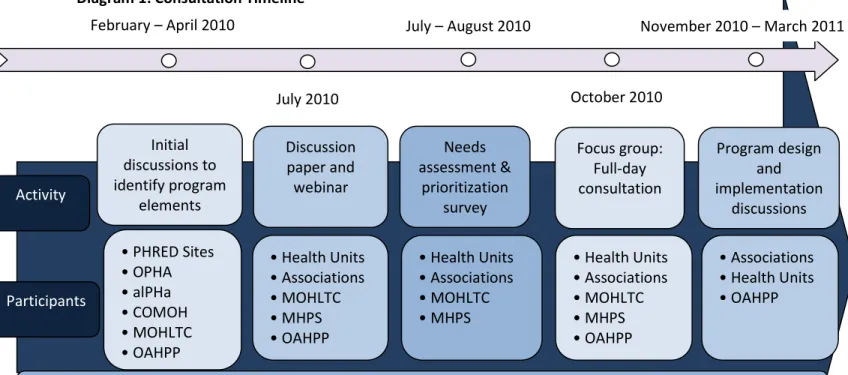
It was clear that in order to develop a new program model that builds on the strengths of the PHRED program, complements local structures, and supports and meets the needs and priorities of the field, consultation and communication with public health professionals and organizations would be essential. Over the course of 12 months, OAHPP had (and will continue to have) numerous consultations (see Diagram 1).
Diagram 1: Consultation Timeline
5 Ibid Activity Participants Initial discussions to identify program elements Discussion paper and webinar Needs assessment & prioritization survey Focus group: Full-day consultation Program design and implementation discussions • PHRED Sites • OPHA • alPHa • COMOH • MOHLTC • OAHPP
OAHPP & PHRED Program sites worked together to support the transition, including archiving and ensuring continued access toPHRED products and resources
• Health Units • Associations • MOHLTC • MHPS • OAHPP • Health Units • Associations • MOHLTC • MHPS • Health Units • Associations • MOHLTC • MHPS • OAHPP • Associations • Health Units • OAHPP February – April 2010 July 2010 July – August 2010 October 2010 November 2010 – March 2011
Initial Discussions to Identify Program Elements
To begin developing the framework for the model, OAHPP had discussions with the five PHRED directors and their medical officers of health, the board of directors of OPHA, and members of COMOH. At the same time, an internal working group at OAHPP was created. It brought together staff from relevant portfolios (research operations, knowledge exchange, library services, ethics, and education and professional development), to provide expertise and advice to help with developing the new model. The internal working group sought to ensure that the program would be built on and aligned with existing activities while also retaining its unique features.
Through the initial consultations with the field, ideas for program elements emerged. OAHPP researched the various program elements, scanned the environment for other service models, and closely reviewed and considered the Knowledge to Action (K2A) model6 to develop a discussion paper entitled, “Supporting Applied Research and Program Evaluation, Education and Professional
Development, and Knowledge Exchange Function in Public Health.”
Discussion Paper and Webinar
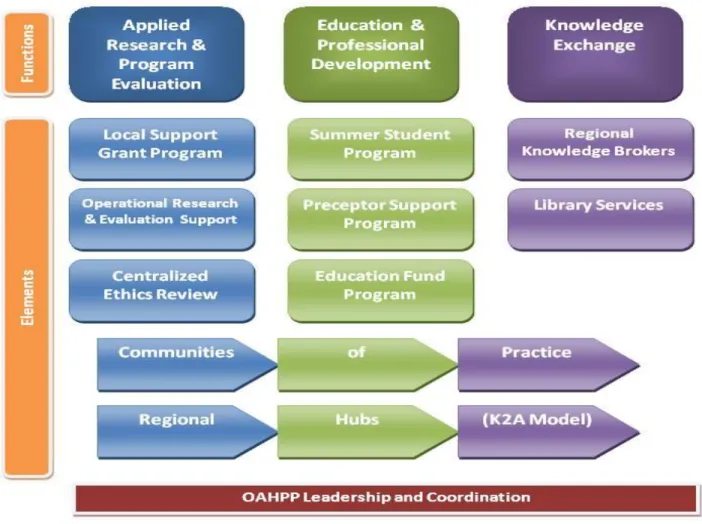
The discussion paper was produced and broadly disseminated in July 2010. It presented a menu of potential program elements that could support applied research and program evaluation, education and professional development, and knowledge exchange in light of the strategic considerations and guiding principles. Ten potential program elements were presented that aligned with the three program functions.
The three program functions are:
Applied Research & Program Evaluation: Applied public health research and program evaluation;
Education & Professional Development: Continuing education for health professionals and leadership in undergraduate, graduate and continuing professional education of future public health professionals;
Knowledge Exchange: Public health knowledge synthesis, dissemination and diffusion. Diagram 2 summarizes the potential program elements that were presented in the discussion paper, each aligned under the relevant functions. Two potential elements — communities of practice and regional hubs — were presented as cross-functional elements as they spanned all three functions.
6
Tri-Partite Working Group: Ontario Agency for Health Protection and Promotion; Public Health Division, Ministry of Health and Long-Term Care; Public Health Research, Education and Development Program. Description of Post-PHRED Knowledge to Action (K2A) Model: Conceptual Description of Model Attributes. July 2009.
Diagram 2: Diagram of Potential Program Elements Presented in the Discussion Paper7
Acknowledging that the available resources (i.e., provincial share of PHRED program funding) would be insufficient to provide all of the potential elements described in the discussion paper, the paper was used, in conjunction with a survey, to solicit feedback from health units, alPHa, OPHA and their
affiliates/constituent societies, and relevant ministries regarding the transfer of the program functions. An introductory webinar, on July 15, 2010, launched the process and provided an introductory
description of the potential elements. After the webinar, the discussion paper was posted online and circulated via email along with an online survey in July 2010. The survey results were then used to inform a focus group and the program design.
Survey
The survey sought feedback from health units, public health associations, and relevant ministries on the potential program elements described in the OAHPP discussion paper, “Supporting Applied Research
7 “Discussion Paper: Supporting Applied Research and Program Evaluation, Education and Professional
Development, and Knowledge Exchange Functions in Public Health”. Ontario Agency for Health Protection and Promotion. July 2010.
and Program Evaluation, Education and Professional Development, and Knowledge Exchange Functions in Public Health.” Respondents were asked to provide input on both the description of the potential program elements as well as how the elements could be prioritized. To rank the program elements, organizations were asked to identify those that would best meet their local needs and priorities and strengthen the system as a whole.
Surveys were sent to all 36 health units, 14 public health and professional associations, and relevant branches in two ministries (See Appendix A for a list of organizations that received the survey).
Organizations were asked to submit only one survey response on behalf of their organization and to try to capture as complete a portrait of their needs and priorities as possible by consulting with their staff/members.
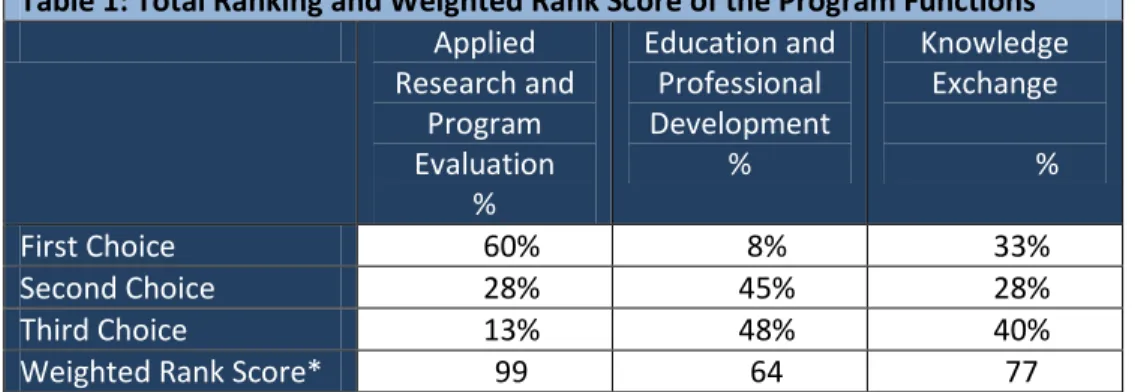
The responses from the survey were analyzed and presented in the October 2010 consultation report, “Consultation Results: Supporting Applied Research and Program Evaluation, Education and Professional Development, and Knowledge Exchange Functions in Public Health: Possible Program Elements Survey”. Overall, there was strong agreement that the menu of potential program elements addressed the goals of the transfer and the program functions. Within the three program functions, applied research and program evaluation and knowledge exchange functions were ranked the highest (see table 1). Among the individual program elements, the local support grant, operational research and evaluation support, library services, and regional knowledge brokers were ranked the highest (see chart 1).
Table 1: Total Ranking and Weighted Rank Score of the Program Functions8
Applied Research and Program Evaluation % Education and Professional Development % Knowledge Exchange % First Choice 60% 8% 33% Second Choice 28% 45% 28% Third Choice 13% 48% 40%
Weighted Rank Score* 99 64 77
*The weighted rank score was calculated with arbitrary numbers of 3 for first choice, 2 for second choice and 1 for third choice
8 “Consultation Results: Supporting Applied Research and Program Evaluation, Education and Professional
Development, and Knowledge Exchange Functions in Public Health: Possible Program Elements Survey”. Ontario Agency for Health Protection and Promotion. October 2010.
** Respondents were asked to rank all the elements. They were only able to use each rank once, and all elements needed to be ranked to proceed to the next question. As such, there were 100 cells for this question. The largest cell count was 10, which indicates that the responses were varied. Therefore, the responses were aggregated into to the top 3 choices, middle 3 choices and the lowest four choices.
This chart presents the results of the aggregated top 3 choices.
In addition to ranking the program functions and elements, respondents provided very thoughtful comments on the program elements described. A number of overarching themes emerged from the survey comments9:
Ensuring that the model enhances and encourages collaboration and partnership;
Recognizing the importance of knowledge exchange and transferability of tools and outcomes; Ensuring that existing services and resources are not duplicated;
Balancing local supports with central infrastructure;
Questioning how everything will fit together and recognizing links between elements; Needing to understand local needs and structures;
Designing the program so that it allows central coordination to provide local capacity while not putting the resources to OAHPP’s sole “use”;
A tension between ensuring the program element is equitable verse equal;
Differing opinions on whether certain program elements or functions are best done centrally or locally/regionally;
Ensuring that the program element has a positive cost–benefit ratio and that it fills a gap and addresses a need;
Clarifying that the new model will not replace existing services; and Recognizing the importance of building capacity.
9 “Consultation Results: Supporting Applied Research and Program Evaluation, Education and Professional
Development, and Knowledge Exchange Functions in Public Health: Possible Program Elements Survey”. Ontario Agency for Health Protection and Promotion. October 2010.
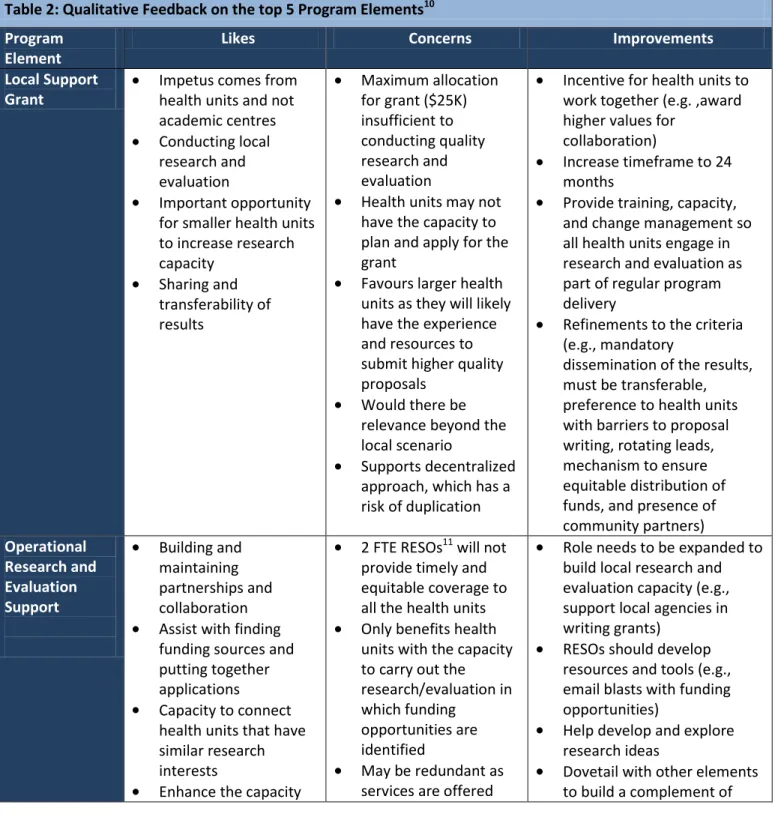
Feedback was provided on each of the program elements. Respondents generally commented on the strengths and weakness of each element and how they could be improved. Qualitative comments on the top five program elements are presented in table 2.
Table 2: Qualitative Feedback on the top 5 Program Elements10 Program
Element
Likes Concerns Improvements Local Support
Grant
Impetus comes from health units and not academic centres Conducting local research and evaluation
Important opportunity for smaller health units to increase research capacity Sharing and transferability of results Maximum allocation for grant ($25K) insufficient to conducting quality research and evaluation
Health units may not have the capacity to plan and apply for the grant
Favours larger health units as they will likely have the experience and resources to submit higher quality proposals
Would there be relevance beyond the local scenario
Supports decentralized approach, which has a risk of duplication
Incentive for health units to work together (e.g. ,award higher values for
collaboration)
Increase timeframe to 24 months
Provide training, capacity, and change management so all health units engage in research and evaluation as part of regular program delivery
Refinements to the criteria (e.g., mandatory
dissemination of the results, must be transferable, preference to health units with barriers to proposal writing, rotating leads, mechanism to ensure equitable distribution of funds, and presence of community partners) Operational Research and Evaluation Support Building and maintaining partnerships and collaboration Assist with finding funding sources and putting together applications
Capacity to connect health units that have similar research interests
Enhance the capacity
2 FTE RESOs11 will not provide timely and equitable coverage to all the health units Only benefits health units with the capacity to carry out the research/evaluation in which funding
opportunities are identified
May be redundant as services are offered
Role needs to be expanded to build local research and evaluation capacity (e.g., support local agencies in writing grants)
RESOs should develop resources and tools (e.g., email blasts with funding opportunities)
Help develop and explore research ideas
Dovetail with other elements to build a complement of
10
Ibid
11
of health units to apply for grants and conduct research
Assist health units in fostering linkages to academic institutions and promoting collaboration with researchers in OAHPP and academia
through other agencies or at the health unit (or could be built into other program elements)
needed supports (especially grants and ethics review)
Centralized Ethics Review
Establishing a
consistent process and reviews
Having a review committee with the appropriate expertise and breadth of experience
Having clear guidelines for identifying when ethics review is required
Address an identified need
Opportunity for training and tools
Turn-around time and bureaucracy
Local accountability needs to remain Enhance (not replace) Research Ethics Boards in existence at the local level and wishing to continue Will it be mandatory for projects to be reviewed centrally even if there is an established local process (i.e., duplicative/ competitive)? One coordinator will not be able to address the demand
Need to conform to Tri-Council Policy
statement
Centralize the creation of policies, procedures,
guidelines, and tools that can be used centrally and locally Provide training on ethics review at the local level to build capacity
Be a consultative body rather than overseeing submissions Ensure local involvement to present and understand the local needs
Library Services Supports evidence- informed decision- making and practices Having access to up-to-date and relevant information
Essential requirement for evidence-informed practice, opportunity for single point of access
Fills a significant gap/need for health units Notional funding suggested is insufficient Timeliness and prioritization of requests
May not be value- added to health units that already have library services Should not replace existing library capacity in the system
Offer training and support for conducting literature reviews Build on existing resources Electronically supported system for knowledge management issues that face all health units (e.g.,
Regional Knowledge Brokers Generates quality research Supports practice-based research Builds communities of expertise Establishes partnerships with academic organizations Enhances capacity Has the potential to assist with meeting the Foundational Standard of the Ontario Public Health Standards
Ensuring equitable access to all health units
Has greatest benefit for the host health unit Ensuring the
information generated from the hub is shared Requires a costly infrastructure
Needs to remain local Duplication of efforts, both content and infrastructure
Duplication of existing structures, such as the National Collaborating Centres
Concern that is a regionalization of OAHPP itself
Multiple year funding Needs to be practice-based Focus on the Ontario Public Health Standards
Combine with knowledge brokers and communities of practice
Content or functional, not regional, hubs
Through the survey, respondents were able to identify priority elements and indicate how they could be refined and enhanced to recognize existing capacity, best meet their needs, and strengthen the system. To continue to develop the new program model, the results of the survey were used to inform a focus group.
Focus Group
Representatives from each of the health units, public health associations, and relevant ministries came together for a one-day focus group on October 5, 2010. The goals of the focus group were fourfold: to share feedback from the survey; to foster the development of a shared understanding of health unit perspectives across the province; to consider, reflect on and confirm the priority elements; and to refine the priority elements to inform the final program development and implementation.
Focus group participants confirmed, and strongly endorsed, the priority elements that were identified through the survey: local support grants, centralized ethics, operational research and evaluation
support, library services, and regional knowledge brokers. In addition to these elements, there was also strong consensus to support future public health professionals. There was concern that without
supporting students, there may be a gap left behind by the PHRED program transfer. It was
recommended to look for opportunities to build on the strengths of the PHRED Connection, a network that supports student placements by providing an opportunity for coordinators to share ideas and develop resources.
Throughout the day, focus group participants worked through activities to help facilitate discussions on how the elements could be enhanced to better meet their needs and priorities. Although there was confirmation on the priority elements, many refinements were proposed. Table 3 provides a summary of the feedback.
Table 3: Feedback on the Priority Elements from the October 5, 2010, Focus Group Program
Element
Feedback Local Support
Grant
Larger collaborative grants are preferred to smaller individual health unit grants Consider collaborative grants offered on a sliding scale depending on the number of health units and complexity
Topics for the grants should be decided from the bottom-up (i.e., at the local level) Mechanisms need to be provided to allow for collaboration and the identification and shaping of topics (e.g., holding a forum for health units to come together to identify topics for grants and collaboration)
Recognizing that there is a certain grant application fatigue, the grant stream should be designed in a way to reduce competition and increase success rate
Operational Research and Evaluation Support
Having a research facilitator who can identify funding opportunities, help prepare and submit funding applications, help manage the funds, and assist with
collaboration is a good idea in theory; however there are huge capacity challenges as many health units are not ready or interested in this type of research facilitation The role of a research facilitator could be linked to the local support grant to support the projects funded through this stream by facilitating collaboration, assisting with the proposals, and helping ensure that the findings of the projects are transferable to other health units and shared
This program element needs a re-think in light of the needs expressed and the various research and program evaluation capacity of health units
Centralized Ethics
There was strong endorsement for ethics support as it fills an identified gap It is important to ensure that in designing this program element it complements and works with existing ethics structures in, or used by, health units
A process should be established for health units that do not have ethics support Ethics tools, forms, and training should be created and offered for use or adaption by health units
An ethics community of practice should be developed Accessing the ethics services should be voluntary
Library Services
There was recognition that library services are critical and essential for evidence-informed practice and that there is a division between health units with and without library services
Considerations for pooling and building on existing library resources to develop a shared service model should be explored
how practitioners access evidence should be conducted
Regional Knowledge Brokers
The concept of knowledge brokers and the types of services they could provide was identified as being unclear
It is important for there to be opportunities and resources for linking and brokering access to evidence and information and providing advice on its application to practice
Knowledge brokering needs to support a network (not necessarily defined geographically), be linked vertically (OAHPP, ministries) and horizontally (health units), and needs to be bidirectional
Having individuals or resources able to help identify activities occurring in other health units and linking health units with similar interests
This program element needs to be approached in a systematic and change management way to facilitate success as it is a new concept in the field of public health
The New Program Model
A new program model to address applied research and evaluation, education and professional development, and knowledge exchange in public health has been designed based on the needs, priorities, and feedback from the field.
The program recognizes that there are differing capacities and needs across public health units. Services offered through this program aim to ensure a baseline of access to information, evidence, and support for all health units. Those with more capacity may not need as much support from some of the services. At the same time, certain services may be more appealing to those with greater capacity (e.g. funding for collaborative projects). Meeting the diversity of needs will continue to be a priority as the program evolves and is evaluated.
Goals for the New Program Model
The goals for the new model are to:
1. Strengthen the public health system by enabling evidence-informed practice that is responsive to the needs and emerging issues of health units and uses the best available evidence to address them;
2. Support health units in generating, accessing and using public health knowledge; and
3. Facilitate collaboration and provide system-level supports while building on and aligning with local, regional, and provincial capacity.
Structure of the New Program Model
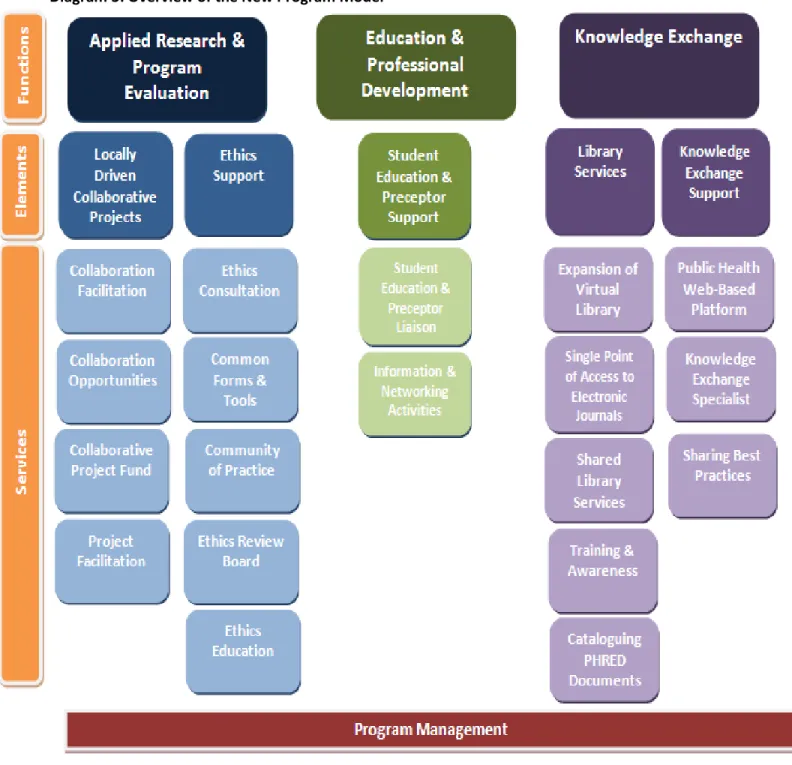
The new program model is structured around the three program functions: applied research and program evaluation, education and professional development, and knowledge exchange. To support these functions, five program elements and their accompanying services will be developed:
1. Library services;
2. Knowledge exchange support; 3. Locally driven collaborative projects; 4. Ethics support; and
5. Student education and preceptor support.
Diagram 3 presents an overview of the new program model. It shows the various program services and their alignment to the program elements and functions.
The vision of the new program model is for the elements and services to be complementary, aligned, and comprehensive. The intention is for the program elements to integrate so that they support and strengthen each other, and thus can achieve the goals of the program. For example, the locally driven collaborative projects will rely on library services, ethics support, knowledge exchange support, and student education and preceptor support. Consequently, in order to conduct a locally driven
collaborative project, access to library services and resources will be needed. The project will need to go through an ethics review to ensure that the project participants are respected and that regulatory requirements are fulfilled. Locally driven collaborative projects will support students and therefore may rely on the student education and preceptor support. Additionally, the knowledge exchange support will be utilized to share and make accessible the findings of the project.
Program Elements and Services
In the sections that follow the program elements and services are described. It is important to note that the program elements and services are presented as distinct only for the purposes of identifying the services offered and how they align and meet the program functions. As noted above, it is intended that the program elements and services are integrated and aligned to support and strengthen each other to meet the goals of the overall program. Over time, services will be evaluated and adjustments made to continually meet the needs of the field.
Library Services
Overview
Access to scientific resources and the best available evidence is essential for health units to guide evidence-based decision-making and interventions and to fulfill the requirements of the Foundational Standard. Library services play a key role in advancing knowledge transfer. Health information professionals are the bridge among people, information, and technology. Access to tools such as bibliographic databases and academic journals is equally important in advancing knowledge transfer. In building on and complementing the existing public health library infrastructure present across the system, a library services partnership will be developed to provide all health units with access to both skilled library professionals and supplemented resources. A single point of access to full-text journals will be available for all health units as well as access to additional electronic journals through the expansion of the Virtual Library contents. Awareness building and training will be offered to health unit staff to learn more about the resources available and how to access them. PHRED documents will be catalogued for easy access and to preserve the legacy of the program.
Planning for Library Services
To identify the library services needs and gaps in health units, an environmental scan will be conducted in consultation with the Ontario Public Health Libraries Association (OPHLA) and representatives from health units without libraries. The results of the environmental scan will detail existing infrastructure and utilization, help inform potential new acquisitions for the Virtual Library, identify training needs for public health professionals working in health units, and help shape the shared library services model. The planning process will be launched in January 2011 with the expectation that all services will be available by fall 2011.
Description of Services Offered through Library Services
Expansion of the Virtual Library
The Virtual Library is a suite of bibliographic databases that indexes thousands of peer-reviewed scientific journals. In addition to bibliographic records, the Virtual Library links to full-text public health journals which are considered core resources in public health. Currently, the Virtual Library is accessible to public health staff working in health units.
Although the Virtual Library provides access to a number of databases, not all public health disciplines or subjects are equally represented. Additionally, there may be other databases relevant to public health outside the Virtual Library. The Virtual Library will be reviewed through an environmental scan to identify how it can be strengthened in order to better serve the needs of health units. The results of the environmental scan will help to identify new and additional databases that should be acquired. Funds will be provided to purchase annual subscriptions to the identified databases. Potentially, health units could also add custom subscriptions on topics of interest and, through the partnership team up with other units to leverage better rates.
Library
Services
Expansion of Virtual Library Single Point of Access to Electronic Journals Shared Library Services Partnership Training & Awareness Cateloguing PHRED DocumentsSingle Point of Access to Electronic Journals
A subscription for a web-based tool that organizes and provides links to all the public health library’s e-resources will be purchased annually for all health units. This tool offers users a “one-stop” search of all the public health units’ e-collection with easy navigation to full-text content. It will maximize the access and exposure of e-resources by integrating the e-journals subscribed to by individual health units, titles in the full-text database in the Virtual Library and e-journal package, as well as e-books.
Shared Library Services Partnership
Access to skilled library professionals and resources will be enhanced through a shared library services partnership. Through engaging in partnerships with interested health units with an existing library, staffing capacity will be supplemented to allow them to provide services to a group of health units without a library. Libraries that participate in this partnership will have an opportunity to hire additional skilled library professionals and purchase additional items for their collection. As such, health units without a library will be able to request literature searches, article delivery, and other supports to a library within this partnership.
Through the shared library services partnership, all 36 health units will have access to skilled library professionals and resources. Health units without a library will be able to access library services through this partnership, and health units with a library will have the opportunity to expand. Moreover, this partnership will be linked to maximize information-sharing, pooling of work, and supporting knowledge exchange.
Training and Awareness
The acquisition of relevant information is dependent on individuals knowing where and how to retrieve the information. Information literacy is therefore an essential skill for the public health workforce. Library awareness and training will be offered to public health professionals working in health units. Training sessions will be offered to provide public health professionals with information on what resources are available to them and how best to use these resources (e.g., using the Virtual Library to conduct literature searches). Other training tools may include a newsletter and a distribution list for emailing practice tips.
Cataloguing PHRED Documents
Over the last few decades, a number of documents have been created through the PHRED program. To preserve and maintain the rich information contained within these documents, they will be digitized, catalogued, and stored in an easily searchable and accessible electronic warehouse that is available publicly.
Three-Year Plan — Library Services
Summary — Library Services
Library Services
Services Offered Opportunities for the Field to Participate in the Program Design and Implementation Awareness building and training to learn more
about the library resources available and how to access them
A single point of access to full-text journals Access to more electronic journals through the expansion of the Virtual Library
Access to additional journals and books through the expansion of public health library collections
Access to skilled library professionals
Contributing to the design and completion of an environmental scan
Participating in a working group that helps shape the shared library services partnership model
Joining the shared library services partnership as a service provider
Knowledge Exchange Support
Overview
Knowledge exchange support will be provided to help health units and public health associations make available, access, understand, and use the best available evidence on current and emerging public health issues and priorities. This will assist health units in making evidence-informed decisions at the policy, program, and practice levels and meet the OPHS. It will also allow health units and associations to collaborate and stay abreast and informed of various past and present public health activities and projects. The knowledge exchange support element, in collaboration with other OAHPP programs, will plan, develop, implement, and maintain a web-based public health platform that includes, at minimum, a searchable electronic warehouse, an inventory of activities, and an interactive online collaborative space. Further, this element will also include a knowledge exchange specialist and supports for sharing best practices.
Jan – March 2011
- Conduct an environmental scan
- Subscribe to a single point of access library toolfor all health units
- Provide library training and awareness until the shared library service model is implemented
- Catalogue PHRED documents
Year 1 April 2011 – March 2012
- Purchase additional resources for the Virtual Library - Develop, prepare, and implement the shared library service partnership
Year 2 April 2012 – March 2013
- Maintain subscription to additional resources for the Virtual Library
- Maintain subscription to access tool
- Maintain the shared library service partnership
- Upload PHRED documents into a searchable electronic warehouse
Year 3 April 2013 – March 2014
- Maintain subscription to additional resources for the Virtual Library
- Maintain subscription to access tool
- Maintain the shared library service partnership
Planning for Knowledge Exchange Support
Knowing where to find information and evidence, who to contact for advice, and what others are working on will assist public health professionals to make evidence-informed decisions and align efforts while minimizing or eliminating duplication. To develop the public health web-based platform, both a needs assessment and environmental scan will be conducted. The needs assessment will help identify the type of information that should be included, the features that should be made available, and the practices that should be encouraged to maximize the use of the public health web-based platform in the field. The environmental scan will identify opportunities for the platform to align or integrate with existing structures/systems and to gather the information and resources required. OPHA, alpha, and their members will coordinate and play a leading role in the planning of the platform.
Description of Services Offered through Knowledge Exchange Support
Public Health Web-Based Platform
The features of the public health web-based platform will be confirmed after the needs assessment is completed. At a minimum, however, the platform will include a searchable electronic warehouse, an inventory of activities, and an interactive online collaborative space.
Searchable Electronic Warehouse
Final reports, white papers, tools, forms, and other knowledge products created through this program, and the PHRED program (which are owned by PHRED), will be stored in the public health web-based platform, which will be publicly available and easily searchable. This will allow public health
professionals to easily search for and access important and relevant knowledge products. Grey literature from other OAHPP programs (e.g. the Regional Infection Control Network (RICNs), Core Competencies, and the Provincial Infectious Diseases Advisory Committee (PIDAC)) will also be accessible through this warehouse.
Knowledge
Exchange
Support
Public Health Web-Based Platform Knowledge Exchange Specialist Sharing Best PracticesOpportunities to collaborate and integrate with other organizations will be explored to expand the warehouse beyond the grey literature produced through this and other OAHPP programs.
Inventory of Activities
An inventory of activities will be established and maintained to enable knowledge of activities occurring in the public health system. The inventory will include current information on existing resources, experts, activities, programs, and networks across the province in public health. This will provide a one-stop shop for public health professionals and others to gain a provincial perspective of the current public health landscape. Through using the inventory, individuals will be able to identify possibilities for collaboration and partnerships, avoid duplication of efforts, build on existing resources, and identify gaps.
Each year, a status update will be developed, circulated, and stored in the searchable electronic warehouse. The maintenance and annual report of the inventory will be the responsibility of the Knowledge Exchange Specialist.
Interactive Online Collaborative Space
An interactive online collaborative space will be developed and maintained. This space will support public health professionals in collaborating through various tools such as sharing documents, e-learning resources and tools, a calendar of events, blogs, wikis, and more. The interactive online collaborative space will also support listserv/communities of practice, and other social media.
The purpose of the online collaborative space is to allow public health professionals across the province to share ideas, knowledge and experience to support the transfer of research into programs, policy and practice, and to support the development of ongoing work by providing effective, accessible, and easy to use tools.
Sharing Best Practices
Opportunities to share best practices will be explored and supported by the Knowledge Exchange Specialist. The mechanisms to share best practices will be identified through the needs assessments. Potential mechanisms may include newsletters, email blasts, case studies, workshops and/or
communities of practice. Funding will be provided to support the sharing of best practices.
Knowledge Exchange Specialist
A Knowledge Exchange Specialist will be hired to support the knowledge exchange activities of this program. The Knowledge Exchange Specialist will be responsible for maintaining the inventory of activities through preserving relationships with health units, public health associations, and relevant professional associations. He/she will develop, disseminate, and post an annual status report on its content. The Knowledge Exchange Specialist will also support activities to share best practices by facilitating the identification of a topic, collaboration, content development, and assisting with the knowledge exchange strategy. Further, the Knowledge Exchange Specialist will also support the use of the interactive online collaborative space.
The Knowledge Exchange Specialist, in partnership with other program staff, will be responsible for promoting the use of these online resources by the public health field.
As the Knowledge Exchange Specialist is immersed in the activities and expertise of the health units through supporting the inventory, online collaborative space and sharing best practices, he/she will also be responsible for identifying and fostering opportunities for collaboration and exchange across public health units and professionals associations, and with researchers and other actors in the public health field who share similar interests.
Three-Year Plan — Knowledge Exchange Support
Summary — Knowledge Exchange Support
Knowledge Exchange Support
Services Offered Opportunities for the Field to Participate in the Program Design and Implementation Access to and use of the public health
web-based platform which includes a(n): o Searchable electronic warehouse o Inventory of activities
o Interactive online collaborative space Knowledge exchange specialist support Sharing best practices
Providing OPHA and alPHa with needs, priorities, and resources for the public health web-based platform
Identifying mechanisms for sharing best practices
Locally Driven Collaborative Projects
Overview
A locally driven collaborative projects stream will be established. This stream will help health units meet the Ontario Public Health Standards (OPHS) by facilitating participation, engagement, and uptake of research and program evaluation activities. The designated funding for this stream will allow
collaboration among health units, public health associations, community partners, and researchers so that they can work together to explore a topic, intervention, or program related to an identified critical
Jan – March 2011
- Conduct a needs assessment and environmental scan for the public health web-based platform
- Explore mechanisms for sharing best practices
Year 1 April 2011 – March 2012
- Develop and implement the public health web-based platform - Disseminate a status report on the inventory
- Share best practices
Year 2 April 2012 – March 2013
- Continue to upload grey literature into the platform - Update the inventory and disseminate a yearly status report - Continue to use and access the collaborative space
- Share best practices
Year 3 April 2013 – March 2014
- Continue to upload grey literature into the platform - Update the inventory and disseminate a yearly status report - Continue to use and access the collaborative space
public health issue. Support for this stream will include collaboration opportunities and facilitation, project funding, and project facilitation.
The structure of this program element will focus on collaboration, rather than competition. A facilitated process will occur on a yearly cycle to determine public health areas of research/evaluation interest, with a focus on the OPHS and meeting the needs of the system.
Description of Services Offered through Locally Driven Collaborative Projects
Collaboration Facilitation
A Knowledge Exchange Specialist will be hired to assist in the development, implementation, and dissemination of the locally driven collaborative projects.12 The Knowledge Exchange Specialist will establish ongoing relationships with the field to help identify needs and priorities and to transform practice, clinical, or management questions into research questions. The Knowledge Exchange Specialist will coordinate activities to support the identification of themes and topics for the projects. This may include speaking to health units, professional associations, and various workgroups, conducting a survey, and organizing web-conferencing and face-to-face consultations.
A role of the Knowledge Exchange Specialist will be to foster collaboration and partnerships by connecting health units, researchers, and OAHPP with similar interests. The Knowledge Exchange Specialist will be able to help build partnerships and collaboration through the analysis of input from
12
This Knowledge Exchange Specialist is in addition to the Knowledge Exchange Specialist hired for the knowledge exchange support element.
Locally
Driven
Collaborative
Projects
Collaboration Facilitation Collaboration Opportunities Collaborative Project Fund Project Facilitationconsultations, other communications, networking with external stakeholders, and from continual scanning of the environment. The Knowledge Exchange Specialist will support the collaboration by assisting project applicants formulate the research question, methodological approach, and the knowledge transfer strategy. Further, the Knowledge Exchange Specialist will help promote the progress of the findings/outcomes of the various projects through supporting the development and implementation of the various projects’ knowledge transfer strategies.
The Knowledge Exchange Specialist will also be responsible for developing and implementing an overall knowledge exchange strategy for the locally driven collaborative projects and to regularly communicate the status (and results) of the proposed, ongoing, and completed projects.
Collaboration Opportunities
Health units and associations will be provided with an opportunity to come together to brainstorm, prioritize, and align their research and program evaluation efforts. The intent is to generate a prioritized set of critical public health issues, potential/preferred topics, and develop the locally driven
collaborative projects. Such opportunities may occur through surveys, participating in blogs and web-conferencing, and face-to-face meetings. The collaboration opportunities will be supported by the Knowledge Exchange Specialist and Project Facilitator.
Collaborative Projects Fund
Further to the collaboration opportunities and the synthesis/analysis assistance provided by a
Knowledge Exchange Specialist, prioritized topics for projects will be defined. Health units, public health associations, community partners, and researchers with similar interests, experience, and knowledge in the topic will be brought together to put forth an application.
Projects will be awarded up to $100,000 per project and the funding can flow over one or two years. A maximum of $400,000 will be available each year. It is expected that projects will cover a range of topics/priorities and may be of differing size/value.
Funding criteria will focus on the opportunity for capacity building, generation of new knowledge, and transferability/applicability across the public health system. Applications will be reviewed for relevance of project objectives, potential impact, feasibility, appropriate methods and analytical framework. Applications must be submitted on a topic identified by the field, bring together health units from different regions and of various sizes, and include funding such that students are implicated in the project.
All projects funded through this program will be required to develop and implement a knowledge transfer strategy.
Project Facilitation
A Project Facilitator will be hired to support and coordinate the locally driven collaborative projects. The Project Facilitator will manage the application process: supporting health units complete the application form, organizing the peer review, acting as a liaison between the peer review committee and the applicants, and sending out communications regarding the application. Additionally, the Project Facilitator will work with OAHPP and health units’ legal, finance, privacy, and ethics teams to ensure agreements and processes are created and followed.
In addition to managing the locally driven collaborative projects application process, the Project Facilitator will assist health units in identifying and applying for external funding opportunities (e.g., providing advice and training on how to put together a funding application through one-on-one
consultation and working with OAHPP research operations team to offer workshops/webinars). Further, the Project Facilitator will identify funding opportunities and circulate them to all health units through a monthly e-blast.
Three-Year Plan — Locally Driven Collaborative Projects
Summary — Locally Driven Collaborative Projects
Locally Driven Collaborative Projects
Services Offered Opportunities for the Field to Participate in the Program Design and Implementation Project facilitation
Knowledge exchange specialist support Research facilitation support
Project funding
Opportunities for students
Participating in a working group that will help develop a framework for identifying themes, and the tools and criteria for the submission, review, and approval process
Attending a session at the Ontario Public Health Convention to begin brainstorming ideas for locally driven collaborative projects and to identify opportunities for collaboration Participate in follow-up collaborative sessions after the Convention to continue working on ideas for locally driven collaborative projects Submit an application with a team of
colleagues from different organizations for a locally driven collaborative project
Year 1 April 2011 – March 2012
- Confirm the topics for locally driven collaborative projects - Establish collaboration and develop collaborative projects - Training and awareness on external grants
- Monthly e-blasts of funding opportunities
Year 2 April 2012 – March 2013
- Continue working and wrapping up collaborative projects (Year 1)
- Implement the knowledge exchange strategies for the collaborative projects - Training and awareness on external grants
- Monthly e-blasts of funding opportunities
Year 3 April 2013 – March 2014
- Confirm the topics for locally driven collaborative projects - Establish collaboration and begin working on the collaborative projects - Training and awareness on external grants
- Monthly e-blasts of funding opportunities
Jan – March 2011
- Develop a framework for identifying topics
- Set up processes and criteria for the submission, review, approval, and monitoring of projects
- Begin identifying topics for locally driven collaborative projects
- Monthly e-blasts of funding opportunities
Ethics Support
Overview
Public health activities are vast. They include surveillance, research, program evaluation and quality improvement initiatives. The appropriate level of ethical oversight for these activities can often be unclear and the necessary resources are often considered burdensome for health units. Leveraging off the work and resources from OAHPP, ethics support will be available. This will include ethics
consultation services and education, common forms and tools for the ethics oversight process, the establishment and maintenance of a public health ethics community of practice, and access to an ethics review board.
The opportunities to use any of the ethics support services will be available to all health units on a voluntary basis.
Planning for Ethics Support
OAHPP is currently developing a framework for ethics review appropriate to population and public health. Initially, the focus will be on research, program evaluation, quality improvement, and
surveillance activities. All these activities have the potential to raise similar ethical concerns. Therefore, a common process is being developed for all these activities where the level of ethical scrutiny is
proportionate to the risk to individuals, communities, the evaluators themselves, and to potential damage to trust in the institutions conducting the evaluations.
Building on the current work within OAHPP, a suite of ethics supports will be offered to all health units. This will be separate from the internal services and ethics review processes for OAHPP.
Ethics
Support
Ethics Consultation Common Forms and Tools Community of Practice Ethics Review Board Ethics EducationDescription of Services Offered through Ethics Support
Consultation Services
An informal consultation service will be available for those planning or reviewing a project at a local health unit should ethical issues be identified. Those planning a project may seek consultation simply to determine the need for formal ethics review or to discuss how best to address a particular ethical issue associated with a planned project, or for guidance regarding use of ethics forms or tools. Those reviewing projects may seek consultation to discuss a challenging issue they have identified when reviewing a particular project or for input regarding development or modification of a review process.
Ethics Education
A range of ethics education services will be offered including webinars, online modules, a collection of case studies, and other written materials. Topics will include issues specific to public health, general principles to guide the ethical conduct of research and other evaluative activities, and how to use the new ethics services. In addition, training will be provided for those who participate in the review of protocols through the ethics review board.
Ethics Board of Record
An ethics review board will be established. The board will be made up of staff from OAHPP, public health units, and community members with knowledge, expertise, and interest in public health and ethics. For protocols that require full board reviews, the ethics review board would conduct both the initial ethics review and the continuing reviews (e.g., amendments, adverse events, and annual renewals). Options will be explored for the ethics board to conduct delegated/expedited reviews. Additionally, a provision will be established to ensure that during public health emergencies all health units could access the ethics review board with an accelerated process to review protocols. The ethics review board will offer two forms of ethical oversight services for health units conducting research or other evaluative activities; use of these oversight services by health units will be voluntary.
1. For projects involving a single site, the ethics review board can serve as the Board of Record, assuming responsibility for ethical review and oversight of individual projects on behalf of a health unit.
2. For projects involving multiple sites, the ethics review board can serve as a single point of protocol submission and review with open input into the review process by all sites involved. For these multi-site studies, the ethics board could serve as the Board of Record or, for those health units with their own ethics board, it could serve as a coordinating centre for the
submission of protocols and a discussion forum, with ultimate decision-making remaining in the hands of the local ethics board.
Common Forms and Tools
Working with the health units, common forms and tools will be developed to assist with the ethics review oversight of research, surveillance, program evaluation, and quality improvement activities. These forms and tools will be used by the ethics review board of record and can be used and/or adapted by individual health units carrying out their own ethics review and to assist them with thinking through potential ethical issues.
Common forms and tools may include:
Risk assessment tools (e.g., checklists) for various activities to determine the level of ethics review (if any) that is required
Guidelines for ethical review of various public health activities
Worksheets that raise common ethical questions to consider when developing protocols for public health research or other evaluative activities. These will be tailored to quality
improvement, program evaluation, and surveillance studies Consent form templates
Application forms for ethics review
Documents related to continuing ethics review, e.g., renewal forms, amendment forms, and forms for notification of unanticipated adverse events
Templates for progress reports and final reports
Community of Practice
To build on existing competencies and to facilitate exchange of knowledge, ideas, and experience regarding ethics review of research and other evaluative activities in public health, a public health ethics community of practice will be formed. To begin, the community of practice will develop one or more electronic mailing lists to serve as discussion forums. Later efforts may include a virtual journal club, hosting of workshops or conferences, and creating an inventory of ethical issues that arise in the planning or implementation of a project (with recognition of the need to respect the confidentiality of those involved), as well as the responses to these issues. This inventory would promote knowledge sharing within the community of practice.
Ethics Coordinator
An Ethics Coordinator will be seconded from a health unit to support all ethics support activities.
Three-Year Plan — Ethics Support
Year 1 April 2011 – March 2012
- Establish a public health ethics community of practice - Develop common forms and tools
- Provide ethics training - Plan for the ethics review Board of Record
- Second Ethics Coordinator from a health unit
Year 2 April 2012 – March 2013
- Maintain the public health ethics community of practice - Update, maintain, and further develop common forms and tools
- Continue providing ethics training
- Offer ethics consultations - Implement the ethics review Board of Record
Year 3 April 2013 – March 2014
- Maintain the public health ethics community of practice - Update, maintain, and further develop common forms and tools
- Continue providing ethics training
- Continue offering ethics consultations
- Continue providing reviews though the ethics review Board of Record
Jan – March 2011
- OAHPP develops framework for public health ethics review
Summary — Ethics Support
Ethics Support
Services Offered Opportunities for the Field to Participate in the Program Design and Implementation Ethics consultation services
Ethics education
Common forms and tools
Public health ethics community of practice Ethics review board
Participating in a focus group to identify education and other ethics support needs Participating in a working group to help guide the development of the common forms and tools and the public health ethics community of practice
One-year secondment of an individual from a health unit to assist in implementation of the ethics services
Student Education and Preceptor Support
Overview
Supporting students and preceptors is an important component of nurturing the next generation of public health professionals. Student placement coordinators and preceptors play a large role in ensuring that students have a productive and rewarding experience during their student placements and are exposed to public health practice. They support two-way learning: student to professionals, and professionals to student. PHRED Connection, a long-standing group of public health professionals in the role of student placement coordinators, allows for the sharing of ideas and develops resources to enhance the student placement process and preceptor development across health units in Ontario. The work of PHRED Connection will be supported by hiring a Student Education and Preceptor Liaison and continuing to facilitate information-sharing, tool development, and networking among health units that welcome student placements (e.g., regular teleconferences, listserv, face-to-face meetings).
The opportunity to participate in the student education and preceptor support activities wi