A
University
of
Sussex
PhD
thesis
Available
online
via
Sussex
Research
Online:
http://sro.sussex.ac.uk/
This
thesis
is
protected
by
copyright
which
belongs
to
the
author.
This
thesis
cannot
be
reproduced
or
quoted
extensively
from
without
first
obtaining
permission
in
writing
from
the
Author
The
content
must
not
be
changed
in
any
way
or
sold
commercially
in
any
format
or
medium
without
the
formal
permission
of
the
Author
When
referring
to
this
work,
full
bibliographic
details
including
the
author,
title,
awarding
institution
and
date
of
the
thesis
must
be
given
Paraphrase Identification Using
Knowledge-Lean Techniques
Asli Eyecioglu Ozmutlu
Submitted in partial fulfilment of
the requirements for the degree of
Doctor of Philosophy
In the Department of Informatics and Engineering,
University of Sussex
Abstract
This research addresses the problem of identification of sentential paraphrases; that is, the ability of an estimator to predict well whether two sentential text fragments are paraphrases. The paraphrase identification task has practical importance in the Natural Language Processing (NLP) community because of the need to deal with the pervasive problem of linguistic variation.
Accurate methods for identifying paraphrases should help to improve the performance of NLP systems that require language understanding. This includes key applications such as machine translation, information retrieval and question answering amongst others. Over the course of the last decade, a growing body of research has been conducted on paraphrase identification and it has become an individual working area of NLP.
Our objective is to investigate whether techniques concentrating on automated understanding of text requiring less resource may achieve results comparable to methods employing more sophisticated NLP processing tools and other resources. These techniques, which we call “knowledge-lean”, range from simple, shallow overlap methods based on lexical items or n-grams through to more sophisticated methods that employ automatically generated distributional thesauri.
The work begins by focusing on techniques that exploit lexical overlap and text-based statistical techniques that are much less in need of NLP tools. We investigate the question “To what extent can these methods be used for the purpose of a paraphrase identification task?” For the two gold standard data, we obtained competitive results on the Microsoft Research Paraphrase Corpus (MSRPC) and reached the state-of-the-art results on the Twitter Paraphrase Corpus, using only n-gram overlap features in conjunction with support vector machines (SVMs).
These techniques do not require any language specific tools or external resources and appear to perform well without the need to normalise colloquial language such as that found on Twitter. It was natural to extend the scope of the research and to consider experimenting on another language, which is poor in resources. The scarcity of available paraphrase data led us to construct our own corpus; we have constructed a paraphrase
including a variety of texts. While there is still debate as to whether a binary or fine-grained judgement satisfies a paraphrase corpus, we chose to provide data for a sentential textual similarity task by agreeing on fine-grained scoring, knowing that this could be converted to binary scoring, but not the other way around. The correlation between the results from different corpora is promising. Therefore, it can be surmised that languages poor in resources can benefit from knowledge-lean techniques.
Discovering the strengths of knowledge-lean techniques extended with a new perspective to techniques that use distributional statistical features of text by representing each word as a vector (word2vec). While recent research focuses on larger fragments of text with word2vec, such as phrases, sentences and even paragraphs, a new approach is presented by introducing vectors of character n-grams that carry the same attributes as word vectors. The proposed method has the ability to capture syntactic relations as well as semantic relations without semantic knowledge. This is proven to be competitive on Twitter compared to more sophisticated methods.
Keywords: Paraphrasing, Knowledge-Lean, Twitter, Turkish, MSRPC, SVMs, N-grams, Overlap methods. Word2Vec
Declaration
I declare that this thesis was composed by myself, that the work contained herein is my own except where explicitly stated otherwise in the text, and that this work has not been submitted for any other degree or professional qualification except as specified.
Contents
Abstract ... II Contents ... V List of Tables ... IX List of Figures ... XI Abbreviations ... XII Acknowledgments ... XIII 1 Introduction ... 1 1.1 Motivation ... 11.2 Outline of the Thesis ... 6
2 Paraphrase Identification and Related Research ... 9
2.1 Introduction ... 9
2.2 Definition of paraphrasing ... 10
2.3 Corpus Data for Paraphrasing Tasks ... 12
2.3.1 Single Monolingual Corpora ... 12
2.3.2 Monolingual Comparable Corpora ... 13
2.3.3 Monolingual Parallel Corpora ... 13
2.3.4 Bitexts (Bilingual Parallel Corpora) ... 14
2.3.5 Web as a Corpus ... 14
2.4 Paraphrase Identification (PI) ... 16
2.4.1 Corpora for Paraphrase Identification ... 16
2.4.2 Methods for Paraphrase Identification ... 18
2.5 Other Paraphrasing Tasks ... 23
2.5.1 Paraphrase Generation (PG) ... 23
2.5.2 Paraphrase Extraction (PE) ... 26
2.6 Summary ... 31
3 Exploiting Overlap Similarity Measures for Paraphrase Identification ... 32
3.1 Introduction ... 32
3.2 Data Pre-processing Techniques ... 33
3.3 Lexical and character bigram features ... 37
3.3.1 Similarity measures ... 38
3.4.1 Byblo Thesaurus ... 42
3.4.2 Distributional Word Similarity for Paraphrase Identification ... 43
3.5 Classification Methods and Evaluation Measures ... 47
3.5.1 Classification ... 47
3.5.2 Evaluation Measures ... 47
3.5.3 Baselines ... 48
3.6 Results and Analysis ... 49
3.6.1 Overlap Measures Results ... 49
3.6.2 Distributional word similarity results on MSRPC ... 54
3.7 Discussion and Overall Summary ... 56
4 Paraphrase Identification using Simple Overlap Features and SVMs ... 58
4.1 Introduction ... 58
4.2 Twitter Paraphrase Corpus and SemEval-2015 Task 1 ... 59
4.3 Knowledge-Lean Approaches for Twitter ... 59
4.3.1 Pre-Processing ... 60
4.3.2 Baselines ... 61
4.3.3 Preliminary Experiments ... 61
4.3.4 SVM Classifiers ... 62
4.3.5 Vector Operations and Boolean algebra ... 64
4.3.6 Deviating from Set Theory: Four Features and Instances ... 66
4.4 SVM Classification and Results ... 69
4.5 Test Set Results ... 71
4.6 Comparison to MSRPC and PAN ... 73
4.6.1 Pre-processing ... 73
4.6.2 SVM with 10-fold Cross-Validation on the MSRPC and PAN ... 74
4.6.3 Results ... 74
4.7 Analysis and Discussion ... 76
4.8 Overall Summary ... 78
5 Constructing a Turkish Paraphrase Corpus and Applying Knowledge-Lean Techniques for Paraphrase Identification ... 79
5.1 Introduction ... 79
5.2 Paraphrase Corpora in Other Languages ... 80
5.4.1 Source Data ... 82
5.5 Filtering the Data and Aligning Sentences for Monolingual Parallel Corpora ... 85
5.5.1 Extracting Sentences for Ideal Candidate Pairs ... 86
5.5.2 Drawing Inferences from the Process of Corpus Construction ... 89
5.6 Annotation and Human Agreement ... 90
5.6.1 Preparation for Annotation ... 90
5.6.2 Annotation Guidelines ... 91
5.6.3 Inter-Annotator Agreement ... 92
5.6.4 Annotator Bias ... 94
5.7 Turkish Paraphrase Corpus (TuPC) ... 95
5.7.1 Train and Test Set ... 95
5.7.2 Baseline ... 96
5.8 Paraphrase Identification on Turkish Paraphrase Corpus ... 96
5.8.1 Pre-processing and Simple Similarity Measures ... 96
5.8.2 Extracting Character and Word N-gram Features ... 97
5.8.3 Results ... 97
5.9 Discussion ... 99
5.10 Overall Summary ... 100
6 Distributed Sentence Representation with Vectors of Words and Characters . 102 6.1 Introduction ... 102
6.2 Neural Network Architectures: CBOW and SG ... 104
6.2.1 Word and Character Embeddings ... 105
6.3 Constructing Statistical Models from unlabelled datasets ... 107
6.3.1 Datasets used for training ... 108
6.3.2 Training Sets of TPC and MSRPC ... 108
6.3.3 Wikipedia Dataset ... 109
6.3.4 Statistical Models ... 109
6.3.5 From Words to Vectors ... 111
6.3.6 Smaller Fragments of Text: From Characters to Vectors (ng2v) ... 112
6.4 Sentence Representation with Compositions of Vectors ... 113
6.4.1 Vector Operations ... 114
6.4.2 Sentence Similarity Using Word Order ... 114
6.5.1 w2v and ng2v features ... 117
6.6 Results ... 118
6.6.1 TPC Training Set Model Results ... 118
6.6.2 TPC Wikipedia Model Results ... 120
6.6.3 Comparison of Overall Results ... 123
6.7 Discussion ... 125
6.8 Overall Summary ... 126
7 Conclusions and Future Directions ... 128
7.1 Summary ... 128
7.2 Answering the Questions ... 129
7.3 Contributions of the Thesis ... 131
7.4 Future directions ... 132
Bibliography ... 135
Appendix A ... 148
Appendix B ... 150
Appendix C ... 151
I. Türkçe Anlamsal Benzerlik Derlemi için Açıklama Rehberi ... 151
II. Turkish Paraphrase Corpus Annotation Guidelines ... 156
List of Tables
Table 1-1: The differences among textual entailment, paraphrase identification and semantic textual
similarity tasks ... 3
Table 2-1: Paraphrases of Definition of Paraphrasing ... 10
Table 2-2: State-of-the-art paraphrase identification results on MSRPC ... 23
Table 3-1: A sample sentence pair from MSRPC and its representations with each data smoothing techniques applied ... 35
Table 3-2: Representations of a PoS-tagged sentence from MSRPC ... 36
Table 3-3:Notations for applied data pre-processing techniques on MSRPC ... 37
Table 3-4: Experimented similarity measures, their formulas and brief explanations ... 40
Table 3-5: The number of major category words and total words in Byblo Thesaurus ... 43
Table 3-6:Number of unique tokens in MSRPC; found in WordNet and in Byblo ... 44
Table 3-7: Baseline results for MSRPC and PAN ... 49
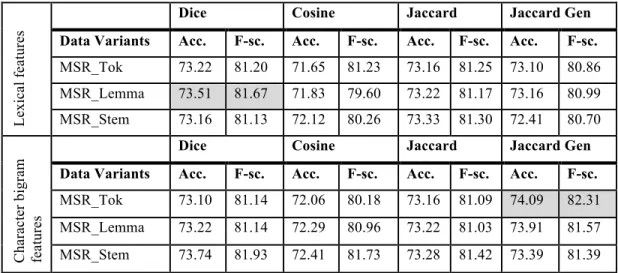
Table 3-8: The results from overlap measures that use lexical and character bigrams features on different data variants of MSRPC ... 50
Table 3-9: The results from overlap measures using lexical features on part-of-speech tagged MSRPC ... 50
Table 3-10: State-of-the-art results from the MSRPC ... 51
Table 3-11: Results from overlap measures that use lexical and character bigram features on different data variants of the PAN Corpus ... 52
Table 3-12: The result from overlap measures on part-of-speech tagged PAN Corpus ... 53
Table 3-13: Madnani et al. (2012) state-of-the-art results from PAN Corpus ... 53
Table 3-14: Distributional word similarity results on MSRPC ... 54
Table 3-15:Comparison with the corpus-based results of Mihalcea et al. (2006) and Islam and Inkpen (2007) ... 55
Table 3-16: Pearson Correlation and two-tailed t-test results ... 56
Table 4-1: Total sentence pairs in each set of TPC after removing debatable and discarded pairs ... 60
Table 4-2: Baseline results from the development and the test set of TPC ... 61
Table 4-3: Development set results of similarity measures using lexical and character bigram features on the TPC ... 62
Table 4-4: Results from character bigrams using SVM (Linear and RBF kernels) with/without scaling ... 64
Table 4-5: Truth tables of Logical Operations: AND, OR and XOR ... 65
Table 4-6: Results from logical operations AND, OR and XOR ... 66
Table 4-7: U, N, L1 and L2 features operating on individual and combined character and word units; Results obtained using SVM (Linear and RBF kernels) on the development set of TPC ... 68
Table 4-8: U, N, L1 and L2 features operating on individual and combined character bigrams, trigrams and four-grams; Results obtained using SVM (Linear and RBF kernels) on the development set of TPC ... 68
Table 4-10: The official results of SemEval-2015-Task1 (the highest 3 results) on PI task ... 72
Table 4-11: U, N, L1 and L2 features operating on individual and combined character and word units; Results obtained using SVM (Linear and RBF kernels) on the test set of TPC ... 73
Table 4-12: U, N, L1 and L2 features operating on individual and combined character n-grams (up to 4); Results obtained using SVM (Linear and RBF kernels) on the test set of TPC ... 73
Table 4-13: U, N, L1 and L2 features operating on individual and combined character and word units; Results obtained using 10-fold cross validation with SVM (Linear and RBF kernels) on MSRPC ... 75
Table 4-14: U, N, L1 and L2 features operating on individual and combined character and word units; Results obtained using 10-fold cross validation with SVM (Linear and RBF kernels) on PAN ... 75
Table 5-1: An example that shows relations between titles along with its headline in both Turkish and translation to English ... 89
Table 5-2: Sentential Semantic Similarity scores for candidate paraphrase pairs ... 91
Table 5-3: The criteria of binary judgement based on the number of annotators’ answers ... 92
Table 5-4: Cohen’s Kappa results obtained on individual parts of data for inter-agreement of annotators .. 93
Table 5-5: Fleiss Kappa score is computed based on the two different judgment criteria ... 94
Table 5-6: TuPC data statistics: positive, negative and debatable sentence pairs ... 95
Table 5-7: Baseline of TuPC computed for paraphrase identification task ... 96
Table 5-8: Similarity measures results of TuPC on character and word level ... 97
Table 5-9: TuPC results obtained from character and word n-gram features of SVM (Linear and RBF kernels) ... 98
Table 5-10: The best results on the TuPC ... 99
Table 6-1: An actual sentence representation of CBOW and SG models ... 105
Table 6-2: Sentence representation; sentence is split into adjacent trigrams ... 106
Table 6-3: Statistical properties of statistical models of words and character trigrams built from Wikipedia dataset ... 109
Table 6-4: Constructed models for word and character vectors and their attributes ... 111
Table 6-5: Word similarity examples from w2v Wikipedia trained models ... 112
Table 6-6: Examples from ng2v Wikipedia trained models ... 112
Table 6-7: TPC training set model results ... 119
Table 6-8: TPC Wikipedia models results ... 121
Table 6-9: WikiModel 2 and WikiModel 3 results of TPC after feature ablation ... 122
Table 6-10: Performance RBF and Linear classifiers using individual cosine features on the test set ... 123
Table 6-11: Our highest results on TPC ... 123
Table 6-12: State-of-the-art results on TPC ... 123
Table 6-13: WikiM2 and WikiM3 results from MSRPC ... 124
Table 6-14: State-of-the-art results from Neural Network Models on MSRPC ... 125
Table 0-2: Character n-grams (up to fourgrams) results of dice coefficient measure ... 149
List of Figures
Figure 2-1: Examples of large and small scale paraphrasing (Hirst, 2003) ... 11Figure 2-2 (Brockett & Kok, 2010): Graph created from English-French (E-F), English-German (E-G), and French-German (F-G) bilingual parallel corpora. Bold edges have large positive weights. ... 25
Figure 2-3 (Barzilay & McKeown, 2001): Aligned sentences ... 26
Figure 2-4 (Lin & Pantel, 2001): Inference rules ... 27
Figure 2-5 (Barzilay & Lee, 2003): Lattice and slotted lattice, derived from five sentences. ... 28
Figure 2-6 (Pasca & Dienes, 2005): Acquisition of paraphrases from the web ... 29
Figure 2-7 (Bannard & Callison-Burch, 2005): Paraphrase Extraction via pivoting techniques ... 30
Figure 3-1: (Fernando & Stevenson, 2008) The word-to-word similarities between two sentences ... 45
Figure 4-1: Character bigrams of union and intersection features of Linear and RBF classifiers on the test set of TPC ... 71
Figure 4-2: Inseparable character bigrams of length features (L1 and L2) with Linear and RBF classifiers on the test set of TPC ... 71
Figure 5-1: Data collection ... 83
Figure 5-2: A screenshot of one of the news agency’s links ... 84
Figure 5-3: Representation of candidate sentence pair ... 86
Figure 5-4: Source and target sentences for choosing a candidate sentence pair ... 88
Figure 5-5: Landis and Koch (1977) interpretation of inter-reliability scores ... 93
Figure 6-1: Representation of CBOW and SG models (Mikolov, Corrado, et al., 2013) ... 105
Figure 6-2: The stages of our development process ... 107
Figure 6-3: Notation for sentence representation with word and trigram vectors ... 114
Figure 6-4: Obtained vectors of individual sentences ... 116
Figure 6-5: Cosine measures with sentence vectors ... 116
Figure 6-6: Features obtained from cosine similarity measure of vectors, derived from w2v and ng2v models ... 117
Abbreviations
A-O
DSMs: Distributional Similarity Models FAQs: Frequently Asked Questions IE: Information Extraction
ML: Machine Learning
MSRPC: Microsoft Research Paraphrase Corpus NLP: Natural Language Processing
NNM: Neural Network Models OOV: Out-of-vocabulary P-R
PAN: Plagiarism Detection Corpus PE: Paraphrase Extraction
PG: Paraphrase Generation PI: Paraphrase Identification PoS: Part-of-Speech
QA: Question Answering RBF: Radial Basis Function
RNNM: Recurrent Neural Network Models S_Z
STS: Semantic Textual Similarity SVC: Support Vector Classifier SVM: Support Vector Machine TE: Textual Entailment
TPC: Twitter Paraphrase Corpus TuPC: Turkish Paraphrase Corpus VSM: Vector Space Model
Acknowledgments
I acknowledge the contributions of the following beloved people.
“I would like to express my sincere and deep gratitude to my supervisor, Dr. Bill Keller.” And I would like to paraphrase the previous sentence in so many ways, to show how grateful I am to have had such a pillar of strength during my project. Your knowledge and guidance form an endless corpus of wisdom that I will keep for my whole life! I also sincerely thank my MSc supervisor, Dr. Johann Briffa, whose guidance helped me to start my PhD, and my thesis committee members Prof. John Carroll and Dr. Paul Newbury for their guidance and enlightenment each year at my annual review.
I am fortunate to have the following people as my friends and to work with them in the same lab: Grecia, Ronald, Eltayyib and Rosanno. The advice and help they gave whenever I needed it gave me strength through the more difficult times.
I am thankful to my other half, Bekir, who has filled my life with love and support. Your patience and support towards me is incredible.
My beloved parents, Celal and Leyla, have enhanced my world with their endless love. To my sisters, Dilek and Hilal, my cousin Bengisu, and my niece Asya: your presence in my life has been irreplaceable; life could never be joyful without you.
I am fortunate that my world is surrounded with people who helped me stay sane through difficult times: Arzu, Fahad, Shuna, Mevra, Rabia, Leyla, Tugba, Ozden, Yasemin. I greatly value the existence in my life of so many more people, too numerous to be able to name here.
Chapter 1
1
Introduction
1.1
Motivation
This thesis is concerned with natural language processing (NLP) techniques for paraphrase identification. According to Lintean and Rus (2011), paraphrase identification may be defined as “the task of deciding whether two given text fragments have the same meaning”. It is also known as paraphrase detection (Socher, Huang, Pennington, Ng, & Manning, 2011; Zhang & Patrick, 2005) or paraphrase recognition (Androutsopoulos & Malakasiotis, 2010). Paraphrase identification methods simply take a pair of language expressions and make a judgement as to whether they are paraphrases.
Although the Paraphrase Identification (PI) task aims to identify sentences that are semantically equivalent, a number of researchers have shown that classifiers trained on lexical overlap features may achieve relatively high accuracy. Good performance is achieved without the use of knowledge-based semantic features or other external knowledge sources such as parallel corpora (Blacoe & Lapata, 2012; Lintean & Rus, 2011). This thesis is concerned with methods for paraphrase identification that can be considered
knowledge-poor aka knowledge-lean. The term “knowledge-poor” is first introduced (as far as we are aware) by Hearst and Grefenstette (1992). Their motivation is the usage of knowledge-poor corpus-based approaches for the automatic discovery of lexical relations. They believe that knowledge-poor corpus-based approaches result in stronger results without the need of complex knowledge-based approaches. The term “knowledge-lean” is used in the same way by Pedersen and Bruce (1998) in order to draw attention to the significance of corpus-based measures compared to knowledge-based measures for word sense disambiguation task.
experimental data, less usage of time-consuming resources, and less complex methods: briefly, it aims to reduce transformation of data considerably. This prevents losing useful information, which is usually thrown out or lost during transformation process. Despite the fact that these methods are considered shallow, their performance can surpass that of more elaborate approaches.
Knowledge-lean approaches have better potential applicability to less resourced languages, reduction in manual annotation effort, and potential to learn from current samples of the actual data to be processed rather that a possibly unrepresentative approximation.Methods are considered knowledge-leanif they make use only of the text at hand, and avoid the use of external processing tools and other resources. This approach has led the NLP community to the usage of techniques that require less knowledge, in order to avoid the costly and time-consuming construction of knowledge-rich resources. Knowledge-lean PI methods may thus employ shallow overlap measures based on lexical items or n-grams, but they might also make use of distributional techniques based on simple text statistics.
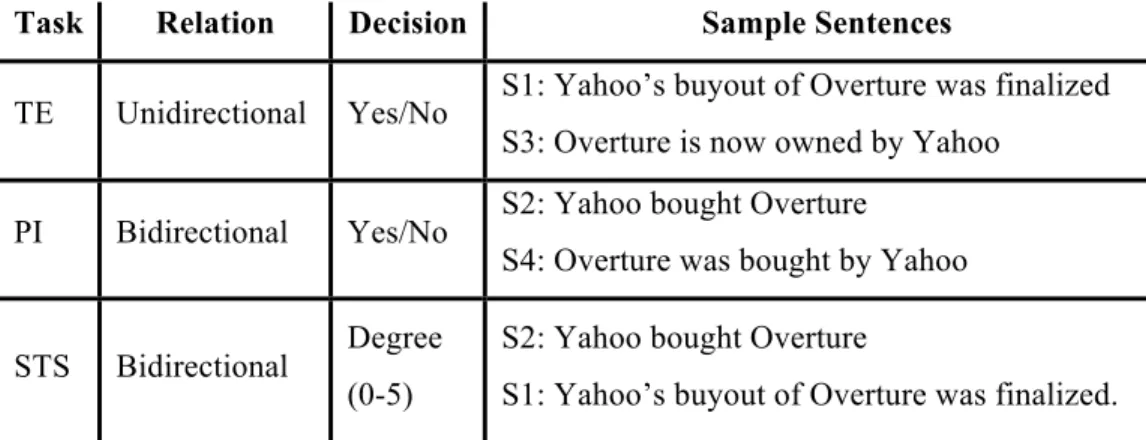
During the last two decades, paraphrase identification task has gained significant importance in applied Natural Language Processing and Computational Linguistics. The paraphrase identification task has practical importance in the NLP community because of the need to deal with the pervasive problem of linguistic variation. In particular, two NLP tasks, Textual Entailment (TE) and Semantic Textual Similarity (STS), are associated with the Paraphrase identification task. Madnani and Dorr (2010) show the difference between PI and TE with the sample sentences S1, S2 and S3 (Table 1-1). S1 entails S2 and S3, but these two entailment sentences S2 and S3 are not paraphrases of the text S1. We also added another sentence, S4, in addition to this example. The sentences S4 and S2 have a bidirectional relation so that they are paraphrases. Among these four sentences, they certainly have similarity that can be graded for the STS task, whereas PI and TE use the binary criteria (1 if there is a relation between the two text fragment; 0 otherwise).
Task Relation Decision Sample Sentences
TE Unidirectional Yes/No S1: Yahoo’s buyout of Overture was finalized S3: Overture is now owned by Yahoo
PI Bidirectional Yes/No S2: Yahoo bought Overture S4: Overture was bought by Yahoo
STS Bidirectional Degree (0-5)
S2: Yahoo bought Overture
S1: Yahoo’s buyout of Overture was finalized.
Table 1-1: The differences among textual entailment, paraphrase identification and semantic textual similarity tasks
Sentence pairs are considered to have a bidirectional entailment relation, which increases the coverage of Textual Entailment systems. Dagan (2008) proposes a concrete semantic engine for textual entailment tasks; proposing that this semantic engine also searches for possible paraphrase relations, if the two entailed sentences have semantic equivalence. Lately, Semantic Textual Similarity tasks have been integrated with paraphrase identification. Sentence pairs are assigned a degree of semantic equivalence instead of having a binary score. Recent STS shared tasks on sentence similarity (Agirre, Cer, Diab, & Gonzalez-Agirre, 2012; Agirre, Cer, Diab, Gonzalez-Agirre, & Guo, 2013) and also on multilingual sentence similarity (Agirre et al., 2014, 2015) present a great quantity of research.
Development of various other NLP applications might benefit from paraphrase identification methods. Question Answering (QA) systems deal with cases where the answer to a question might not always be in the same form as the question. The alternative answer can be retrieved from a text by rephrasing the sentence. Producing several variants of a question also increases the possibility of finding the right answer to the question. Mckeown (1983) addresses solutions to the problems in natural language systems by using a paraphraser mechanism. Ravichandran and Hovy (2002) explore paraphrased patterns in order to improve QA systems. Barzilay, Mckeown, and Elhadad (1999) show that paraphrases increase the chance of finding the right brief statement of a text for a summarization task of multiple sources such as news articles. Different phrases explaining the same event create alternatives for generating a summarized sentence from a text.
few rules to a translation algorithm can increase its performance (Madnani, Ayan, Resnik, Dorr, & Park, 2007; Owczarzak, Gorves, Genabith, & Way, 2006). Finding paraphrase pairs supplies more words, phrases and sentences to be translated. Therefore, the redundant data from the translation process can be utilized using paraphrasing tasks (See Section 3). SMT systems are trained on ‘bitexts’, bilingual parallel corpora (Bannard & Callison-Burch, 2005); augmenting such data with paraphrases can significantly improve translation quality and coverage (Callison-Burch, Koehn, & Osborne, 2006; He, Zhao, Wang, & Liu, 2011).
Several recent attempts to the use of paraphrases to augment the coverage of SMT include filtering out the out-of-vocabulary (OOV) words (Marton, Callison-Burch, & Resnik, 2009) and identifying particular words such as negators and antonyms (Marton, Kholy, & Habash, 2011) when evaluating SMT applications. On the other hand, SMT metrics, alone and in combination, can be used to identify sentence-level paraphrases (Finch, Hwang, & Sumita, 2005; Madnani, Tetreault, & Chodorow, 2012; Owczarzak et al., 2006).
Information Retrieval (IR) and Information Extraction (IE) methods are mostly used in combination with to other NLP methods and may benefit from paraphrase patterns. An early paper on IR argued for the utility of paraphrase (Culicover, 1968) and paraphrases of words in IE patterns can be identified so as to extract the required information from stored text (Shinyama & Sekine, 2003).
Barron-Cedeno et al. (2013) address the difficulty of detecting paraphrases for an automatic plagiarism detection system. They analyse the relationship with paraphrases and plagiarised texts and suggest that identifying paraphrases improves the performance of plagiarism detection systems. Ganitkevitch et al. (2011) present state-of-the-art results for compression systems, and benefit from the extraction of sentential paraphrases. Also, Natural Language Generation (NLG) Systems may benefit from paraphrasing for sentence re-writing task (Power & Scott, 2005).
Paraphrase Identification task has attracted interest in the NLP community and recently it has become an individual working area of NLP. A growing body of research has been conducted and various semantic and syntactic tools and resources have been proposed for the problem of identifying paraphrases (Chapter 2). However, the knowledge-rich approaches may be inadequate for capturing language variation, because they are limited by manually constructed resources. A knowledge-lean approach, on the other hand, has no limits or binds to tools or time-costly resources, which makes it more suitable for a wide range of applications. There is still a debate as to whether the machine can learn without deeper processing and semantics, and moreover, whether similar results can be obtained without using knowledge-rich techniques and resources.
This thesis investigates whether techniques concentrating on automated understanding of text, requiring less resource may achieve results comparable to methods employing more sophisticated NLP processing tools and other resources. Discovering the strengths of knowledge-lean techniques by comparing the features of identified paraphrase pairs is the main objective. Therefore, knowledge-lean methods will be examined to see to what extent these techniques can be used for the purpose of paraphrase identification tasks. The research reported in this thesis aims to examine knowledge-lean approaches due to their applicability to various types of texts. Even widely used, knowledge-rich, sources, such as WordNet (Fellbaum, 1998), are not complete. In WordNet, each lexical item is grouped into major category tags (Verb-Noun-Adjective-Adverb) and there is a conceptual similarity defined based on synonymous relations such as hyperonymy, hyponymy and etc. The relation between each two items defined with a similarity score. These similarities (Pedersen, Patwardhan, & Michelizzi, 2004) are computed by measuring the distance between two words. However, it is difficult to define word similarities in terms of WordNet distances.
In essence, knowledge representation is a strategic problem. Therefore, Halevy, Norvig, and Pereira (2009) claim that the data no longer require processing primarily. They propose that a large amount of data can be gathered from the web using machine learning techniques. This obtained data might overcome more limitations where there is not enough annotated data.
identification task can be obtained from lexical overlap measures, optimized with the combinations of several pre-processing steps. We start by exploring the question “How effective is it to use pre-processing with knowledge-lean techniques that are based on simple overlap measures, in order to identify paraphrase pairs?” We show that by investigating the overlapping features with the various representations of experimental data in Chapter 3, then, we query the usage of pre-processing techniques and explore the combinations of overlap features on raw data in Chapter 4.
Since knowledge-lean techniques do not require any semantic or syntactic tools, the question becomes “Can knowledge-lean techniques be adapted to another language for paraphrase identification?” The limitation of paraphrase corpora becomes another issue in answering this question, which leads us to construct a paraphrase corpus in another language. Chapter 5 reports the detail of a newly constructed Turkish Paraphrase Corpus, and we examine previously used techniques for identifying Turkish paraphrase pairs.
We expect to find the extent of the usage of knowledge-lean techniques for paraphrase identification beyond relying on overlapping features. We ask: Can continuous word representations help to identify semantic relations between a pair of sentences without usage of semantic tools? In addition: Will this help us to identify paraphrase pairs?
The first experiment to explore this uses distributional similarities of words using simple overlap features, in Chapter 3. In Chapter 6, one recent Neural Network approach – word2vec– (Mikolov, Corrado, Chen, & Dean, 2013) that underlies the distributional hypothesis is used for sentence representation, by capturing the semantic relations between word pairs from a very large unlabelled data. Next, we extend the word2vec approach by capturing the relations of character n-grams.
1.2
Outline of the Thesis
In the next chapter, we provide a rich literature review of paraphrase identification methods and focus on the research conducted on paraphrase identification in relation to the applied knowledge-lean techniques. A substantial background of paraphrasing applications will be provided, taking into account the considerable research related to this area.
Chapter 3 sets up the basis for the exploration of knowledge-lean approaches by exploiting simple overlap measures with reference to data representation techniques, which are then computed for two different paraphrase corpora. These shallow overlap methods exploit character and word n-gram features, which then computed with a few widely accepted similarity measures. These features will be elaborated also in Chapter 4. Later in Chapter 3, distributional lexical similarities from a small distributional thesaurus are used for sentence representation of paraphrase pairs. The findings from this experiment provide an insight into the usage of distributed sentence representation with vectors, given in Chapter 6.
In Chapter 4, a colloquial paraphrase corpus, Twitter Paraphrase Corpus (TPC), is used to experiment with various shallow methods for identifying paraphrases that are based on lexical and character n-grams. A SVM classifier using linear and radial basis function kernels is used for classification. Finally, we discover a set of stable features used in our system, the results of which out-performed many sophisticated methods without use of any external tools or resources. These features are extracted for the previous paraphrase dataset, Microsoft Research Paraphrase Corpus (MSRPC), and show competitive results. We conclude with a comparison of the overall results.
Chapter 5 is motivated by the competitive results obtained in Chapter 4. The MSRPC is a collection of news articles, whereas TPC is constructed from a collection of non-literarily written text. This raises the query of whether knowledge-lean techniques are applicable to other languages. We take this research one step further by exploring the applicability of knowledge-lean methods in another language. While paraphrase identification task is newly gaining importance in NLP, there are a few paraphrase datasets in other languages such as Dutch, French etc., but they were not specifically built for paraphrase identification purpose. In consideration of the lack of paraphrase corpora, we contribute by building a paraphrase corpus in Turkish. The resulting Turkish Paraphrase Corpus (TuPC) is used to experiment with our best performing methods from Chapter 4. The results are evaluated in comparison to the TPC and MSRPC results.
In Chapter 6, a recent popular approach of Neural Network Models that are built based on continuous representation of words as vectors –w2v– is used to experiment with
very large unstructured and unlabelled data enriches the knowledge-lean methods that are previously used to experiment with overlap measures. Moreover, a new approach, vector of n-grams –ng2v– motivated by the w2v models is presented. Additionally, we explore whether w2v and ng2v statistical models trained on a small dataset perform well in cases where data sparseness is the problem.
Chapter 7 includes a summary of our findings throughout this thesis. It reviews the objectives that motivate the research questions, specifying the contribution of this thesis to the area of paraphrase identification. We will draw attention to future directions in considering effective usage of knowledge-lean methods for the paraphrase identification task.
A table of system names used throughout the thesis is also provided in Appendix A (Table 0-1). The table shows data requirements, features and measures used in each individual chapter.
Chapter 2
2
Paraphrase Identification and
Related Research
2.1
Introduction
This chapter will present an overview of work on paraphrase identification and related tasks.
We begin first by considering the definition of the notion of a ‘paraphrase’ and then explain the previously used corpora in paraphrasing applications.
The following part of the chapter sets a line of demarcation among paraphrase tasks in terms of the way paraphrasing methods are performed; paraphrase identification, paraphrase generation and paraphrase extraction. The survey of Androutsopoulos and Malakasiotis (2010) proposes a clear distinction between each paraphrasing tasks without ignoring their intersecting relationships. Indeed, the boundaries between paraphrasing tasks are not strictly indicated by the most published research. One reason is that different paraphrasing tasks may be combined in ways that make it hard to distinguish between them. For instance, a system can extract new paraphrases from those generated, exploiting both paraphrase extraction and generation techniques (Bannard & Callison-Burch, 2005; Barzilay & McKeown, 2001; Callison-Burch, Cohn, & Lapata, 2008; Madnani et al., 2007). Another reason is that the problems are often illustrated with NLP tasks that induce paraphrases eventually, so that specifying the paraphrasing tasks becomes secondary issue. It is hard to draw a line while paraphrasing tasks has been explored as part of the other NLP applications. In particular, the paraphrase identification (PI) task has become central to many NLP problems, such as sentential semantic similarity, textual entailment, summarization, sentence compression etc. We then examine the research conducted on
paraphrase generation and paraphrase extraction is provided.
2.2
Definition of paraphrasing
Table 2-1 shows a variety of paraphrasing definitions suggested by different authors. This table gives the best understanding by showing that paraphrasing is more complex than simply replacing words with their synonyms. The nature of a paraphrase is also clarified in Hirst (2003) by indicating that synonymous relations are not enough to describe paraphrasing. Definition Author Pa rap hr as in g
is generally considered to be a meaning-preserving relation (Culicover, 1968)
alternative way to convey the same information (Barzilay & McKeown, 2001) represents (possibly partial) equivalencies between different expressions
that correspond to the same meaning (Glickman & Dagan, 2003) is talking about same situation in different words and different syntax (Hirst, 2003)
is the restatement (or reuse) of text giving the meaning in another form (Fernando & Stevenson, 2008) is a text-to-text relation between two non-identical text fragments that
express the same idea in different ways (Lintean & Rus, 2010) is semantic equivalence (Madnani & Dorr, 2010) is the act of replacing linguistic utterances (typically text) with other
linguistic utterances, bearing similar meaning but different form. (Marton, 2010) Table 2-1:Paraphrases of Definition of Paraphrasing
Culicover (1968) appears to have been the first to provide a definition of, and computational approach to, paraphrasing problems. Many of the types of paraphrases stem from his proposals. He states that the definition of paraphrasing, ‘same in meaning’, is not illuminating in the absence of human intuition. Hence, he proposes several paraphrase types, considering their grammatical, transformational and lexical relations.
The process of paraphrasing could be understood as first taking words individually, and then using phrases to combine them as sentential paraphrases in terms of the applied methods. This process is likely inductive. The inductive process has mainly three aspects for the purpose of analysing the paraphrase approaches. The first two are the syntactic and lexical variations of the language. The third is just a synthesis of the first two approaches.
In previous research, syntactic and lexical relations were examined separately depending on application type: whether it requires lexical or syntactic benefits for a specific application. To increase the efficiency of a system, recent research has been led to take advantage of both the syntactic and the lexical variability of language. Moreover, paraphrasing can also involve real-world knowledge, e.g. President of France ↔ Charles de Gaulle (Culicover,
1968).
Paraphrase pairs are often categorized as lexical, phrasal or sentential paraphrases (Madnani & Dorr, 2010). Linguistically, lexical paraphrases are considered according to their relationships such as synonymy, hyponymy, and hyperonymy. However, Hirst (2003) claims that paraphrases mostly correspond to the pragmatic differences in meaning, such as near-synonyms, connotations, and implications rather than absolute synonymous relations. Moreover, he characterises paraphrases as large-scale paraphrasing or small-scale paraphrasing (Figure 2-1). Large-scale paraphrasing addresses the different emphasis in sentences by using syntactic variations. This type of paraphrase is evaluated according to the stance, attitude, and opinion of a speaker. Small-scale paraphrasing is defined as lexical nuances.
Large Scale Paraphrasing
At least 13 people were killed by a suicide bomber on a bus in downtown Jerusalem this morning.
Primary emphasis in main subject and verb
A suicide bomber blew himself up on a bus in downtown
Jerusalem this morning, killing at least 13 people.
Secondary emphasis in appositive clause
Small Scale Paraphrasing
The President addressedthe nation. More formal
The President spoke to the nation. Less formal
Figure 2-1: Examples of large and small scale paraphrasing (Hirst, 2003)
Phrasal paraphrases concern paraphrase relations between sub-sentential constituents, that is constituent parts of a sentence such as noun-phrases, verb-phrases and clauses. Pattern variants are also accepted as phrasal paraphrases. In the example below, S¹, S² and S³ are paraphrases of one another. X and Y slots can be replaced with different words (Androutsopoulos & Malakasiotis, 2010):
S³: X is the writer of Y.
Sentential paraphrases require a whole sentence to be replaced with another one with a different form, both sentences preserving the same meaning. Most of the recent paraphrase identification research considers sentential paraphrases. Sentential paraphrase identification is regarded as a challenging task because of the semantic equivalency requirement, which is conditioned by the context between the two sentences.
2.3
Corpus Data for Paraphrasing Tasks
To date, several types of corpora have been used for different paraphrasing problems: Single Monolingual Corpora, Monolingual Comparable Corpora, Monolingual Parallel Corpora, and Bilingual Comparable Corpora (Madnani & Dorr, 2010). Corpus types play a significant role in the development of paraphrasing methods, which will be explained respectively according to their improvement.
2.3.1 Single Monolingual Corpora
Early paraphrasing methods generally utilised single monolingual annotated corpus by employing distributional similarity methods in order to extract paraphrases. Although this type of corpus is helpful on finding paraphrasing patterns on lexical and phrasal level, the limited quantity of data can cause coverage problems. Besides, it is unlikely to generate sentence level paraphrases. For instance, Lin and Pantel (2001) use a single corpus collected from newspaper texts. However, the size of the corpus they used was limited and became a bottleneck for acquisition of paraphrasing as well as NLP methods. The popularization of SMT-based methods in the NLP community has led to the use of larger corpora. Pasca and Dienes (2005) shows that the limitations of a single corpus might be overcome by creating a corpus by crawling the web. However, structuring the unannotated large amount of data collected from web became another issue on usage of single monolingual corpus.
2.3.2 Monolingual Comparable Corpora
Comparable corpora consist of two different raw corpora such that there is no applied parallelism in sentence level; they rather have phrasal overlaps that are similar in terms of text type, topic and length. From comparable data, it is possible to obtain information using phrasal overlaps and/or distributional similarity measures. For example, Shinyama et al. (2002) used named entity tags, while Barzilay and Lee (2003) considered word lattices (See Section 2.5.1). However, they used a domain-dependent set of news articles, which was insufficient in terms of the amount of data required. With some preparation, comparable corpora can be used to build parallel corpora in order to increase their functionality. A sample is the Microsoft Research Paraphrase Corpus (MSPRC) which follows the same method as Barzilay and Lee (2003) and Shinyama et al. (2002) to gather data. In contrast to these, however, the MSRPC targets multiple domains to be able to create a large corpus. This is then converted to parallel corpora by applying alignment techniques.
2.3.3 Monolingual Parallel Corpora
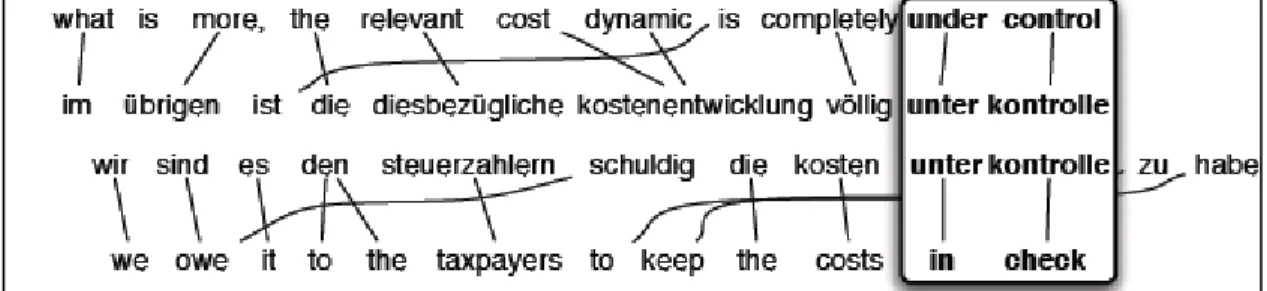
Since the use of parallel corpora has become more common, ‘text alignment’ appears to be a problem in many applications. Any parallel data have to be aligned to be employed for any further process. Because alignment techniques are varied and this might significantly affect the results, the alignment techniques should be explored before using parallel texts. A few examples are noted where alignment techniques are applied to the monolingual parallel corpora. Barzilay and McKeown (2001) employ an algorithm created by Gale and Church (1991). Another alignment method is the Multiple Sequence Alignment (MSA), proposed by Barzilay and Lee (2003). MSA is a word-to-word similarity measurement that assigns a similarity score between sentence pairs. Giza++1 (Och & Ney, 2000) is the most-widely applied alignment technique, which is used to generate SMT models from bilingual corpora. Due to the reason that it is constructed for SMT methods, it might require additional work for the paraphrasing tasks.
Barzilay and McKeown (2001) extracted paraphrases from a collection of multiple translations of classic novels written by different authors. Quirk, Brockett and Dolan (2004)
will be explained later.
2.3.4 Bitexts (Bilingual Parallel Corpora)
Bitexts are parallel corpora obtained by aligning sentences in documents in one language and their translations in a second language. In the context of paraphrasing, bitexts are first used by Bannard and Callison-Burch (2005). Their method takes the phrases in one language (source language), and matches them with their translation in other language (pivot language). The process is then repeated for the translated phrases in the pivot language. The translated phrases from pivot to source language and the original phrases from source language are accepted to have a paraphrase relation. In simple words, if the phrases in the pivot language correspond to two different phrases in the source language, these phrases are assumed to be paraphrases.
Even though bitexts rely on parallel texts or translation tables, they have gained favour in paraphrasing tasks via SMT applications. Using automatically generated paraphrases increase the performance of SMT systems (Bannard & Callison-Burch, 2005; Ganitkevitch et al., 2011; Madnani et al., 2007). Although there are attempts that directly target the paraphrase quality (Brockett & Kok, 2010; Callison-Burch, 2008), this remains secondary to the issue of acquisition problems.
A database of paraphrases is constructed by Ganitkevitch, Van Durme, and Callison-Burch (2013), which is one of the largest multilingual resources of paraphrases. This rich dataset is collected using Bannard and Callison-Burch’s (2005) method and it is available in more than 20 languages. The dataset consists of lexical and phrasal paraphrase packages, where the smallest package represents the highest similarities, whereas the larger package includes lexical and phrasal paraphrases in a wide window of decreasing similarity scores.
2.3.5 Web as a Corpus
Most of the research on paraphrasing concludes by mentioning the problem of the lack of data sources. NLP experiments have shown that the more data is available, the more reliable the results are. Despite the vast amount of unannotated data that can be found on
the web, in practice construction of such corpora is a time consuming and costly process. Moreover, the process of corpora construction might differ for every particular NLP application.
Linguistically, a corpus is described as a ‘language sample’ that represents the language via a collection of data constructed considering the explicit linguistic criteria (Sinclair, J. cited from Duclaye et al. (2002)). Following this idea, Duclaye et al. (2002) use linguistic paraphrases and semantic derivations in order to improve question answering systems. They suggest that the web is the best ‘language sample’ to be used as a linguistic resource for their task.
This trend towards web-based corpora has emphasised the limitations of annotated corpora in the field of NLP and has led to a new interest in the use of the web as a corpus. Halevy et al. (2009) draw attention to the importance of ‘the web as a corpus’ with regard to the recent success of NLP applications that use unannotated data, since they overcome the data limitation.
STRAND is a web mining method used by Resnik and Smith (2003) to explore and extract parallel texts from the web. Their aim was to find web pages with multiple translations. The translated pages were then paired up for generating candidate pairs. Due to the lack of other language sources and the legal issues on accessing data on the Internet Archive, they extracted parallel texts only in four different languages (Arabic-English, Chinese-English, Basque-English and French-English).
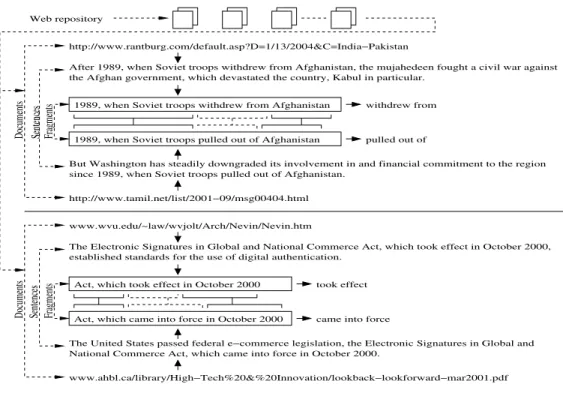
Pasca and Dienes (2005) obtained paraphrases from a large monolingual corpus, extracting over a billion pages. The web was crawled using automated methods which looked for phrase-level paraphrases by checking any overlapping text fragments occurring between aligned pairs of sentences.
Large quantities of data on the web supply more informative results, but this comes with trade-offs. It is a challenging task to deal with the information on the web and considerable amount of effort is required. Also, copyright laws reduce the legal access to large amounts of data, which might be an obstacle in obtaining information from the web.
Paraphrase Identification is defined by Lintean and Rus (2011) as “the task of deciding whether two given text fragments have the same meaning”.
In this section, we will give an overview about the type of paraphrase corpora used for paraphrase identification in the literature. A detailed description of paraphrase corpora we experimented with throughout this thesis will be provided. Section 2.4.2 will explain the methods previously used for identifying paraphrases. Then, the recent approaches for paraphrase identification will be addressed in relation to the methods based on the distributional hypothesis.
2.4.1 Corpora for Paraphrase Identification
The construction of paraphrase corpora has been an important development in research into the task of paraphrase identification. Because of the need to compare experimental results with a benchmark, there have been various attempts at constructing paraphrase identification corpora.
We experimented on three different paraphrase corpora. These are: the Microsoft Research Paraphrase Corpus (MSRPC), the Plagiarism Detection Corpus (PAN) and Twitter Paraphrase Corpus (TPC). In addition, we constructed and experimented with a new paraphrase corpus for the Turkish language. This will be discussed later, in Chapter 5. 2.4.1.1 The Microsoft Research Paraphrase Corpus
The Microsoft Research Paraphrase Corpus2 (MSRPC) (Dolan, Quirk, & Brockett, 2004) has been used for a decade as the standard for comparison of results. As it is mentioned in Section 2.3.2, the initial dataset was comparable corpora constructed by collecting comparable newswire articles, similarly to previous approaches (Barzilay & Lee, 2003; Shinyama et al., 2002). Unlike these approaches, however, Dolan et al. (2004) use broad-domain news agencies, clustering them for a reasonable amount of time to align the pairs of sentences referring to the same event. A simple string distance supported with a heuristic observation is used to extract sentential paraphrases. The second attempt by Dolan and Brockett (2005) is continued in the development of this initial dataset, training the data
with Support Vector Machine classifier. Dolan and Brockett (2005) accomplished the construction of a monolingual parallel corpora: MSRPC. There are 5,802 sentence pairs in the MSRPC. Paraphrase pairs (3,900) are scored as 1 and non-paraphrase pairs (1,901) are scored as 0. The MSRPC is split into two chunks; train sets and test sets, containing 1,725 and 4,076 sentence pairs respectively. Both sets consist of randomly chosen paraphrase and non-paraphrase pairs. So far, the MSRPC has been used merely for the comparison of paraphrase identification methods. Nevertheless, the experimental data has some drawbacks, which will be revealed throughout the experiments.
2.4.1.2 Plagiarism Detection Corpus
The Plagiarism Detection Corpus (PAN) 3 is constructed by deriving aligned corresponding sentences from 41,233 plagiarised documents. It is made available by Madnani, Tetreault, and Chodorow (2012) for the use of paraphrase identification tasks, publishing the initial results of their experiment. PAN consists of 13,000 sentence pairs in total; 10,000 for the train set and 3,000 for the test set. The data contains equal numbers of paraphrase and non-paraphrase pairs in both test and train sets. It is labelled in the same way as the MSRPC: paraphrase pairs scored 1, non-paraphrase pairs 0.
2.4.1.3 Twitter Paraphrase Corpus
The Semeval-2015 Task1, “Paraphrase and Semantic Similarity in Twitter” involves predicting whether two tweets have the same meaning. Training and test data are provided in the form of a Twitter Paraphrase Corpus (TPC) (Xu, 2014). The TPC is constructed semi-randomly and annotated via Amazon Mechanical Turk by 5 annotators. It consists of around 35% paraphrases and 65% non- paraphrases. Training and development data consists of 18K tweet pairs and 1K test data. Test data is drawn from a different time period and annotated by an expert. A novel aspect of the TPC compared to other paraphrase corpora is the inclusion of topic information, which is also used during the construction process.
3
Further to the previously described paraphrase corpora, a study (Rus et al., 2014) describes the basic characteristics of other paraphrase corpora constructed for paraphrase identification methods. However, one of the drawbacks of the paraphrase identification task is the lack of a fixed set of rules regarding the judgement criteria. Therefore, other corpora mostly do not fit the previously used judgement criteria for paraphrase identification task. Rus et al. (2014) discuss this issue with regard to the provided loose guidelines for the annotation of the MSRPC. They believe that a fine-grained judgement criterion should be provided for a paraphrase corpus to be used for paraphrase identification tasks.
2.4.2 Methods for Paraphrase Identification
The state-of the-art PI methods and their results can be found on Wikipedia4. These results are frequently updated with a short description of the applied methods and divided into two categories based on the classification technique: supervised and unsupervised. These division shows that the recent PI methods tend to use supervised approaches because they perform well as compared unsupervised approaches. This section gives an overview of the PI methods based on the applied methods rather than the classification approaches.
Previous identification methods have focused on pattern-based phrases, according to the required data. For instance, user questions and their matched answers derived from a Frequently Asked Questions (FAQs) list to obtain paraphrase questions (Tomuro & Lytinen, 2001). Another case focused on lexical ‘verb ’ paraphrases (Glickman & Dagan, 2003), firstly identifying the verb pairs and then extracting the pairs from a single corpus.
Inversion Transduction Grammar (ITG) works without requiring any thesaurus (Wu, 2005), and results higher than the baseline are obtained on both paraphrasing and textual entailment tasks.
Zhang and Patrick (2005) apply a small set of transformation rules on both lexical and syntactic levels using a decision tree learning method, which simplifies the text (also called ‘text canonicalization’). After the transformation process, the sentence pairs that
share commonality on surface strings are detected as candidate paraphrases. The given example follows canonicalization rules:
“Remaining shares will be held by QVC’s management.” “QVC’s management will hold Remaining shares.” (Canonical)
Despite the fact that it has very limited features, the results are better than the baseline. One significant reason is that the paraphrase pairs in the MSRPC include high number of lexical overlaps.
Recently, a number of studies have examined machine learning methods in order to identify paraphrases. Kozarova and Montoyo (2006) measure the lexical and semantic similarity with a combination of different classifiers: k-Nearest Neighbours, Support Vector Machines, and Maximum Entropy.
WordNet is one of the resources widely used for knowledge-based paraphrase identification methods. In WordNet, lexical items are organised as sets of synonyms or “synsets”. They synsets are then organised hierarchically according to lexical relations such as hyponymy and hypernymy. Similarity and relatedness of a pair of lexical items may be measured according to the hyponym/hypernym hierarchy in WordNet. The WordNet provides a gloss (conceptual related items) for each item, although only the items that belong to same word categories can be measured (Pedersen et al., 2004). For instance, car
is a hypernym of vehicle.
A study was performed comparing corpus-based and knowledge-based measures for a semantic textual similarity task (Mihalcea, Corley, & Strapparava, 2006). A variety of WordNet5 similarity metrics in addition to two corpus-based measures (pointwise mutual information and latent semantic analysis metrics derived from a large corpus) are experimented with on the MSRPC. Another work on semantic textual similarity focuses on only corpus-based measures utilizing semantic and string similarities (Islam & Inkpen, 2007). Their proposed method first uses three different longest common subsequence (LCS) methods for the similarities between words. Semantic similarity of a pair of
(Second Order Co-occurrence PMI). Sentence similarity is computed from the joint matrix of a string similarity matrix and a semantic similarity matrix. They claim that the computational complexity is lower as compared to Mihalcea et al. (2006)’s corpus-based and knowledge-based measures, because they use only one corpus-based measure.
Fernando and Stevenson (2008) review the semantic maximal similarities between all word-to-word relations, in addition to the lexical similarities, because near-synonymy cannot be detected on a purely lexical level. Six different WordNetsimilarity metrics are computed. It is shown that taking into account all similarities increases the performance of the system. Malakasiotis (2009) exploits one basic method (INIT) and extends this method using WordNet (INIT-WN) and then a dependency parser (INIT-WN-DEP). First, nine different string similarity measures are applied in order to detect all possible shallow features of a pair of sentences (INIT). Searching the WordNet for synonymy relations between two sentences extend the INIT method by combining all features (INIT-WN). The third method uses a dependency parser in order to detect grammatical relations of a sentence pair (DEP) and it is combined with the previous two methods (INIT-WN-DEP).
Das and Smith (2009) use a more sophisticated approach on the syntactic and lexical levels conducted with Quasi-synchronous Grammar (QG) Formalism. This model produces a syntactic structure for two given sentences in the form of their dependency trees. The sentences are to be assumed as paraphrases when the dependency trees align closely.
Sentential paraphrases are likely to have a high degree of lexical overlap. Because of this, the dissimilarity feature has been pointed out in recent research. Qiu, Kan, and Chua (2006) realized the importance of lexical dissimilarities, as well as similarities. Wan, Dras, and Dale (2006) also consider both similarity and dissimilarity of sentence pairs from their dependency trees structure. One recent paraphrase identification method (Lintean & Rus, 2010) automatically identifies paraphrases by looking at their lexico-semantic relations for either their similarity or dissimilarity scores. Weighting the dependency score of unpaired paraphrases extends the system.
Paraphrase identification methods use similarity scores on different levels, such as word-to-word similarity, synonyms, or word matching based on a thesaurus. Lintean and Rus (2011) apply a word-to-word similarity metric on syntactic and lexico-semantic levels in order to detect the similarity between two sentences. Unlike other approaches, the similarity metric and takes account of the dissimilarity scores. These scores are obtained by computing the dependencies to decide whether the two sentences have paraphrase relation. This is based on the work of Lintean, Rus, and Graesser (2008), which examines the dependencies on MSRPC to detect paraphrase relations. However, Lintean and Rus (2011) evaluated the method of weighting the dependencies, adding a few features.
Rus, Mccarthy, Lintean, Mcnamara, and Graesser (2008) suggested a lexico-syntactic approach related to textual entailment. The method, named ‘graph-subsumption’, maps each input text of two corpora into a graph and performs a subsumption rule.Let’s say t and h are the texts, t entails h, if, and only if, t subsumes h. A paraphrase relation is then detected by observing the t subsumes h and h subsumes t.
A number of researchers have investigated whether near state-of-the-art PI results can be obtained without use of external sources. Blacoe and Lapata (2012) use distributional methods to find the compositional meaning of phrases and sentences. They find that the performance of shallow approaches is comparable to methods that are computationally intensive or that use very large corpora. Lintean and Rus (2011) apply word unigrams and bigrams. Bigrams capture word order information, which can in turn capture syntactic similarities between two text fragments. Finch, Hwang and Sumita (2005) combines several MT metrics and uses them as features. Madnani et al. (2012) also shows that good results are obtained by combining different MT metrics. Ji and Eisenstein (2013) attain state-of-the-art results based on latent semantic analysis and a new term-weighting metric, TF-KLD.
The Twitter Paraphrase Corpus (TPC) has been released for the SemEval-2015 Task 1: Paraphrase Identification and Semantic Similarity (Xu, Callison-Burch, & Dolan, 2015). There were 18 teams participating in the main task, PI, and 13 teams participating in the semantic similarity task. The applied methods for PI range from simple similarity metrics, machine translation to a variety of neural network methods. Xu, Ritter, Callison-burch,
(MULTIP) and utilizes both word and sentence pair relations from the TPC.
Socher et al. (2011) obtained higher results than previous approaches. The Recursive Autoencoder (RAE), based on the recursive neural network model, is an unsupervised feature-learning algorithm that detects the semantic and syntactic similarities between patterns. A variable-sized similarity matrix is computed measuring the distance between pattern-based phrases. A dynamic pooling layer is then used to compute a fixed-sized similarity matrix of a sentence pair. This representation is used as an input to a classifier in order to detect a paraphrase relation between sentence pairs.
Hu, Lu, Li, and Chen (2014) propose two models of convolutional neural networks for matching sentences, and apply them to three sentence level tasks including paraphrase identification.
Another convolutional neural network approach optimized for the task of paraphrase identification is by Yin and Schütze (2015). Their approaches are based on representing sentences on multiple levels of granularity. They obtained three different results by improving their proposal with a pre-training technique and adding MT features (Madnani et al., 2012) to improve their base method.
He, Gimpel, and Lin’s (2015) method first utilises another convolutional neural network approach for sentence modelling; the similarity of these obtained representations of sentences are then measured with similarity metrics without the use of any external resources. Their method outperforms the previously used methods on MSRPC as well as on Sematic Textual Similarity datasets.
A variety of classifiers has been employed for the purpose of identifying paraphrases. Kozarova and Montoyo (2006) measure lexical and semantic similarity with a combination of different classifiers: k-Nearest Neighbours, Support Vector Machines, and Maximum Entropy. SVM Classifiers remain the most applicable in recent research, whether applied on their own (Finch et al., 2005; Wan et al., 2006) or as part of combined classifiers (Kozareva & Montoyo, 2006; Lintean & Rus, 2011; Madnani et al., 2012).
Table 2-2 shows state-of-the-art results for PI methods. A distinction between the previous approaches and neural network approaches is first highlighted by He et al. (2015). The grey rows indicate the results that are obtained from neural network methods. The table is updated by adding the most recently published results.
Reference Accuracy F-score
Zhang and Patrick (2005) 71.9 80.7 Lintean and Rus (2010)(Opt Minipar) 72.0 80.9 Corley and Mihalcea (2005) 71.5 81.2 Yin and Schütze (2015) (without pretraining) 72.5 81.4 Qiu et al. (2006) 72.0 81.6 Blacoe and Lapata (2012) 73.0 82.3 Fernando and Stevenson (2008) 74.1 82.4 Finch et al. (2005) 75.0 82.7 Das and Smith (2009) 76.1 82.9 Malakasiotis (2009) 76.2 82.9 Wan et al. (2006) 75.6 83.0 Socher et al. (2011) 76.8 83.6 Madnani et al. (2012) 77.4 84.1 Yin and Schütze (2015) (with pretraining) 78.1 84.4 Yin and Schütze (2015) (pretraining+MT features) 78.4 84.6 He et al.(2015) 78.6 84.7 Ji and Eisenstein (2013) 80.4 85.9
BASELINE 66.5 79.9
Table 2-2: State-of-the-art paraphrase identification results on MSRPC
2.5
Other Paraphrasing Tasks
The problem of distinguishing the paraphrasing tasks is already mentioned in the Introduction. In this section, we will briefly explain the methods of paraphrase generation and extraction.