The magazine dedicated exclusively to the technology of evidence collection, processing, and preservation
Volume 10, Number 3 • May-June 2012
TOPICS IN THIS ISSUE
!
Synthetic Cannabinoid Drugs
!
DNA Evidence Interpretation
Computer DNA Evidence Interpretation
in the Real IRA Massereene Terrorist Attack
Written by Dr. Mark W Perlin & Justyn Galloway
N
ORTHERN IRELANDis a country with ties to the Republic of Ireland in the south and the United Kingdom to the east, having a population of 1.8 million. The recent “troubles” started 50 years ago, as the terror tactics of the Irish Republican Army (IRA) and other paramilitary groups killed over 3,500 citizens. In the 1998 Good Friday agreement, the people of Northern Ireland rejected the use of violence and entered into a power-sharing government, with a mutual disarmament that ushered in a new era of peace.But this calm was shattered on the night of March 7, 2009, when two hooded gunmen emerged from a car outside the Massereene Barracks in Antrim, Northern Ireland. In less than 60 seconds, they unleashed more than 60 rounds at four unarmed soldiers and two pizza delivery men outside the
neering corpsmen who were to leave for Afghanistan the next day—Mark Quinsey (age 23) and Patrick
Azimkar (age 21)—were murdered in the attack. The Real IRA splinter group claimed responsibility, but their violence was universally condemned by all parties, as Quinsey and Azimkar’s deaths strengthened the Northern Ireland peace process.
The Police Service of Northern Ireland (PSNI) assigned 60 investiga-tors to the case, under the direction of Detective Chief Inspector Justyn Galloway. The getaway car had been abandoned in the countryside, and partially burned to destroy identifying evidence (Figure 1). However, the PSNI forensic investigation team did find items that contained trace amounts of DNA. Because witnesses do not come forward in these crimes for fear of reprisal, the DNA evidence was
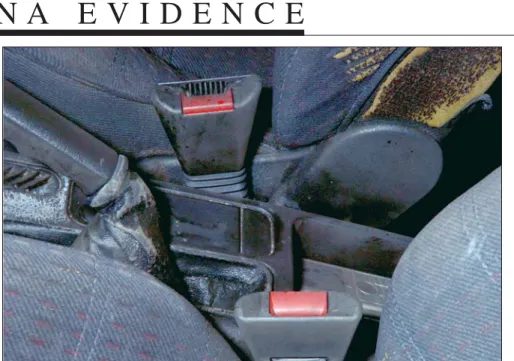
Swabs were taken from the passen-ger-side seatbelt buckle (Figure 2a). This evidence suggested a connection to one of the gunmen who had stepped out of the car. The police clearly did not plant this evidence (a standard defense suggestion) because the belt buckle was part of the car. There were also swabs from the interior of a mobile phone (Figure 2b) that had recorded the gunmen discussing the crime shortly after the shooting. A matchstick was found on the road (Figure 2c) near the car, presumably used in torching the vehicle. All of this DNA evidence was sent to the Cellmark Forensics laboratory in Abingdon, England for processing.
Cellmark's reporting scientist Dr. Emma Watson led the DNA laboratory investigation. All three evidence items were mixtures containing very little DNA. To help overcome the uncer-Figure 1—The gunmen in the terrorist attack abandoned their getaway car in the countryside—and set fire to it in an effort to destroy any evidence that might help law enforcement. But the effort did not work as well as they had hoped.
D N A E V I D E N C E
dence, each item was PCR amplified in triplicate. The mobile phone DNA underwent two rounds of enhancement to further concentrate and purify the trace biological material.
The SGMplus DNA data signals had low peak heights (most under 100 relative fluorescent units, many under 50 rfu). Some genetic loci were mix-tures containing at least two individu-als, while other loci showed small DNA quantities, allele dropout, or no visible DNA (Figure 3).
Human visual examination of the triplicate experiments for each item implicated two suspects. The DNA recovered from the seatbelt buckle was associated with Real IRA dissident Colin Duffy, who had been previously cleared of homicide charges in other cases. The DNA recovered from the mobile phone and the roadside match-stick identified suspect Brian Shivers. However, evidence interpretation by human analysts could not put a num-ber to these DNA matches. Just how specific was the match of suspect to evidence, relative to coincidence? Without a match statistic, this key DNA could be ruled inadmissible and not allowed as evidence at trial.
Cybergenetics TrueAllele Casework technology uses computers to preserve all the identification information pre-sent in DNA evidence. The technology determines match statistics that are (on average) a million times greater than human review. The method can help prosecutors put a match number to DNA evidence that analysts cannot, and can help defenders show when a suspect is actually not in the DNA.
The TrueAllele calculations are extremely thorough. The computer uses all the DNA peak height data, whereas people simplify these data to all-or-none events. It can consider a hundred thousand possible genotype scenarios, while people focus on just a few. Moreover, the computer is completely objective, never seeing a suspect’s genotype when it solves a problem, thus avoiding examination bias. The system assigns more proba-bility to those genotypes that better explain the data, producing accurate DNA match statistics.
In November 2010, Cellmark sent
Figure 2a—The passenger-side seatbelt buckle was swabbed to recover DNA evidence. This suggested a connection with one of the gunmen.
Figure 2b—A mobile phone in the console was also swabbed for DNA traces.
files to Cybergenetics. On the compa-ny’s supercomputer in Pittsburgh, Pennsylvania, TrueAllele answered 185 separate forensic questions about the three evidence items, with com-puter run times ranging from seven hours to seven days. After a week of processing, the computer put a statistic to each proposed DNA match.
Dr. Mark Perlin, Cybergenetics chief scientist and executive officer, reported that:
!A match between the seat buck-le and Duffy was 6 trillion times more probable than coincidence; !a match between the mobile phone and Shivers was 6 billion times more probable than coincidence;
!and a match between the match-stick and Shivers was 1 million times more probable than coincidence.
Preparation for the Queen v. Duffy & Shiverstrial began in the summer of 2011. Solicitor Michael Agnew was directing officer for the prosecution, working with Senior Barrister Terence Mooney. The lawyers met by phone with Perlin, planning to introduce the TrueAllele results in early December. The defense challenged the admissi-bility of the computer DNA evidence, and retained California scientific expert Professor Lawrence Mueller.
The trial began in the Antrim courthouse on November 7. It would last seven weeks, involve 1,858 wit-ness statements, produce 8,910
docu-into evidence. Justice Anthony Hart presided over the Diplock court—a trial held without a jury and with a single judge in order to avoid influ-ence through intimidation.
On Monday morning, November 14, Perlin received an unexpected call from Solicitor Agnew, asking the DNA expert to leave Pittsburgh immediately for Belfast to give evidence in court on the following day. The defense had prematurely flown in its own expert, Mueller, three weeks ahead of sched-ule, and the DNA prosecution now had to proceed without delay.
On Wednesday morning, Perlin was sworn in as an expert witness at Antrim court. Mooney began his examination-in-chief, a combined direct examination and voir dire
admissibility hearing. That day, they introduced TrueAllele match statistics for the DNA evidence, explained how the computer arrived at its conclu-sions, and established the system's reliability.
As Perlin testified, TrueAllele is based on generally accepted scientific methods, with validation studies pub-lished in peer-reviewed journals. Many studies have been conducted collabo-ratively with other groups. Scientists rely on the system to determine the composition of DNA mixtures, and measure DNA identification informa-tion. Indeed, standards organizations use Cybergenetics technology in the development of their own standard
community.
Perlin also explained that the New York State (NYS) Commission on Forensic Science has approved TrueAllele for use in DNA casework by the NYS Police. In 2011, more than 75 match reports were filed in criminal cases, and Perlin testified in state, federal, military, and foreign courts about the results. The Pennsyl-vania Superior Court affirmed the 2009 Commonwealth v. Foley homi-cide conviction, establishing a state-wide TrueAllele precedent in their published 2012 opinion. The comput-er methods have been described and published in scientific papers written by Perlin, and by independent inter-national scientists. The system is readily available to all (prosecutor and defense, police and crime labora-tory), and was used to help identify victim remains after the 2001 World Trade Center terrorist attack.
The next day of the trial, Perlin was cross-examined by Barry MacDonald, who represented Duffy. The science was on trial, as the prosecution expert carefully explained the system’s workings to the court. MacDonald cited an admissibility decision where a judge had noted that the laws of physics change at the atomic level, and he asked the prosecution expert whether the same was true of DNA. Perlin replied that moving to the quantum level in physics introduces
D N A E V I D E N C E
D N A E V I D E N C E
with forensic DNA evidence—moving to low molecular levels requires probability, which is precisely what TrueAllele provides.
On the third court day, Patrick O’Connor, defense barrister for Shivers, relentlessly attacked Perlin’s reputation and credibility. Unable to undermine the TrueAllele science, O’Connor instead strenuously argued that Perlin lacked candor, misled the court, and lacked impartiality.
Justice Hart did not agree. On December 1, the judge's 18-page rul-ing concluded, “I am satisfied that the stage has now been reached in the case of this system where it can be regarded as being reliable and accepted, and I am satisfied that Dr. Perlin has given his evidence in a credible and reliable fashion. In the light of these conclusions I can see no basis on which I could properly exercise my discretion…to exclude this evidence, and I therefore admit it in evidence.”
On January 20, 2012, Shivers was convicted of the murders of Mark Quinsey and Patrick Azimkar, found guilty of all charges, and sentenced to life in prison. Although the DNA identification was not in question, Duffy was acquitted since his role in the murders was not proven.
The Massereene TrueAllele prece-dent paves the way for future DNA investigations and trials in the United Kingdom. Police and prosecutors have acquired a powerful new tool that can take a more informative look at existing DNA evidence, helping to better identify suspects, convict crim-inals, and exonerate the innocent.
In future terrorism and murder tri-als, where intimidated witnesses may not come forward and when the case depends heavily on forensic science, this system can now be relied on to provide match statistics for trace DNA evidence.
Searching beyond an individual case, a TrueAllele investigative data-base improves on older, less informa-tive national DNA databases. The computer interpretation preserves identification information, whereas
DNA case evidence items can be compared with thousands of criminal or terrorist suspects, with the system providing the strength of match that connects them (Figure 4). Whether asking who committed a crime, or what crimes a person of interest may have committed, the probabilistic genotype database can find the match information that helps law enforce-ment proceed directly from DNA investigation to DNA evidence. !!!
About the Authors
Justyn Galloway is Detective Chief Inspector with the Police Service of Northern Ireland. Dr. Mark W. Perlin is Chief Scientific and Executive Officer at Cybergenetics, a company that provides TrueAllele products and services to the criminal justice community. He has 20 years experience developing informa-tion-preserving computer methods for interpreting DNA evidence. He can be reached at: