Drivers of Petty Corruption and Anti-Corruption Interventions in
Developing Countries – a Semi-Systematic Review
This document is an output from a project funded by the UK Department for International Development (DFID) through the Research for Evidence Division (RED) for the benefit of developing countries. However, the views expressed and information contained in it are not necessarily those of or endorsed by DFID, which can accept no responsibility for such views or information or for any reliance placed on them.
Mr Cosimo Stahl, Basel Institute on Governance, Steinenring 60, 4051 Basel, Switzerland, [email protected]
Dr Saba Kassa, Basel Institute on Governance, Steinenring 60, 4051 Basel, Switzerland, [email protected]
Dr Claudia Baez-Camargo, University of Basel, Basel Institute on Governance, Steinenring 60, 4051 Basel, Switzerland, [email protected]
Table of Contents
Table of Contents 2
Acronyms 4
1 Introduction 5
2 Definitions and conceptual challenges 7
2.1 The 2015 WDR framework 7
2.2 Defining petty corruption 7
2.3 Defining behavioural and social accountability interventions 9
3 Behavioural drivers of petty corruption 11
3.1 Automatic thinking 12
3.1.1 ‘Everybody is doing it’: the power of frames 12
3.1.2 The relevance of information 13
3.1.3 Environmental cues and automatic responses 13
3.2 Sociality: social norms and community preferences 14
3.2.1 Social values and associated practices: Reciprocity and the ambivalence of gift-giving 15
3.2.2 Informal social networks and the obligation to the group 15
3.2.3 The contradictions of social capital and the social accountability approach 16
3.3 Culture and Mental models 17
3.3.1 Evidence of the impact of cultural traits on corrupt behaviours 17
3.3.2 Culture – an appropriate explanatory variable? Critical views 18
3.3.3 Mental models and collective imagination 19
4 Assessment of the relative effectiveness of interventions against petty corruption 21 4.1 Group 1: Social-accountability anti-corruption interventions in the health and education
sectors (India) 22
4.1.1 Description of the studies and results 22
4.1.2 Discussion 24
4.2 Group 2: Social-accountability anti-corruption interventions in the health and education
sectors (Africa) 25
4.2.1 Description of the studies and results 25
4.2.2 Discussion 27
4.3 Group 3: Educational campaigns in health and education (Africa) 27
4.3.1 Description of the studies and results 27
4.3.2 Discussion 29
4.4 Educational campaigns against political corruption (Africa and India) 30
4.4.1 Description of the studies 30
4.4.2 Discussion 31
4.5 Right to information interventions (India) 32
4.5.1 Description of the studies and results 32
4.5.2 Discussion 34
4.6.1 Description of the study and results 34
4.6.2 Discussion 35
5 Synthesis analysis and policy considerations 36
5.1 Harnessing the power of information 36
5.1.1 Citizens and service users 36
5.1.2 Public officials and service providers 38
5.2 Accounting for social context and the prevalence of social bias 40
5.3 Anti-corruption interventions’ focus and implications for programme design 41
Acronyms
CSC Community ScorecardCSO Civil Society Organisation
DFID Department for International Development EARF East Africa Research Fund
ETP Extra Teacher Programme (Kenya) FOIA Freedom of Information Act GTR Grounded Theory Driven Review
ICT Information and Communications Technology NGO Non-Governmental Organisation
PTA Parent Teacher Association (Kenya) RED Research for Evidence Division (DFID) RTIA Right to Information Act (India) TNS Textual Narrative Synthesis
VEC Village Education Committee (India)
1
Introduction
Combatting corruption in the developing world has been a formidable challenge and taken a prominent place in the agenda of the international development community for the last two decades. Nonetheless, the results and outcomes of conventional anti-corruption interventions continue to be modest at best (Marquette and Pfeiffer, 2015; Mungiu-Pippidi, 2011). This is often reflected in the so-called implementation gap, whereby countries adopting sound legal and organisational anti-corruption frameworks continue to experience very high levels of corruption.
A growing critique has centred on the perception that many anti-corruption reforms and interventions fail to take into account and understand the local contexts in which they operate (Haruna, 2003; Mette Kjaer, 2004; Rugumyamheto, 2004). Also, several authors have argued that in developing countries corruption is fuelled by a large scale collective action problem where behaving corruptly represents a sensible choice for most individuals, whether because they expect everyone else to behave corruptly or because corruption is functional – as means to an end (Marquette and Pfeiffer, 2015; Mungiu-Pippidi, 2013; Persson et al., 2013). When this is the case, it is therefore unsurprising that conventional anti-corruption instruments yield limited results.
Thus, there is a need to re-think the practice of anti-corruption on the basis of evidence about the factors that drive corruption in different contexts, including the incentives, expectations and agendas across all groups in society (Baez-Camargo and Passas, 2017). In particular, it is necessary to understand the motivations shaping the behaviours of ordinary citizens who, although most sharply suffering the costs from the misuse of public funds, may nonetheless tolerate or even participate in corruption (Wrong, 2014). Thus, while much has been written in the literature about the potential of bottom-up collective action to stand up against corrupt government and state officials (Johnston, 2014; Landell-Mills, 2013; Mcneil and Malena, 2010), this potential may only be unleashed if the factors shaping attitudes towards corruption among citizens are properly addressed.
As the World Bank’s 2015 World Development Report (WDR) on human decision-making compellingly argued, behavioural studies present a promising - but the most part unexplored - approach to improve development policies by incorporating a better understanding of how individuals make choices in their everyday lives. In fact, by suggesting that “fostering collective action is not purely a matter of incentivising self-interested individuals” (World Bank, 2015, p. 61), the 2015 WDR has invited scholars and practitioners to consider not only how quasi-rational and socio-cultural factors may play a role in perpetuating vicious cycles of poverty and weak governance, but also how those same factors may be creatively harnessed towards achieving better development outcomes. This stance was echoed in the UK Institute for Government’s 2010 Mindspace Report on ‘Influencing Behaviour through Public Policy’, which stated that "shaping policy more closely around our inbuilt responses to the world offers a potentially powerful way to improve individual wellbeing and social welfare" (Dolan et al., 2010 p.8). This literature review is part of a pioneering research effort commissioned by the UK Department for International Development (DFID) through its East Africa Research Fund (EARF) that explores the utility of behavioural economics for the study of petty corruption.1 The review has been conducted following a
1
For more information about the EARF and the research project “Corruption, Social Norms and Behaviours in East Africa” please visit http://www.earesearchfund.org/ and http://www.earesearchfund.org/research-corruption-social-norms-and-behaviors-east-africa.
rigorous methodological approach and it aims to contribute evidence conducive to the feasibility of developing of anti-corruption interventions based on behavioural principles. 2
The review addresses two main review questions:
1. What behavioural factors having an impact on individual attitudes towards petty corruption have been identified in the literature?
2. What does the evidence suggest about the relative effectiveness of different types of interventions to address petty corruption?
The report is organised as follows:
Section 2 provides a brief overview of the WDR framework of human decision-making and lays out working definitions for key concepts utilised throughout the review. Section 3 is devoted to the review of the literature shedding light into behavioural factors that have a bearing on how individuals make decisions associated with practices of petty corruption. Section 4 presents the evidence from the comparative assessment of selected anti-corruption interventions. Section 5 provides a synthesis analysis integrating all reviewed studies, outlining the main messages learned and discussing the policy implications of the systematic review for the development of interventions to tackle petty corruption.
2
The present semi-systematic review is an abridged version intended for use by policy practitioners - concisely summarising and discussing all policy-relevant findings and insights yielded by a much longer and more detailed review semi-systematic review of Drivers of Petty Corruption and Behavioural Anti-Corruption Interventions in Developing Countries (Stahl et al., forthcoming), commissioned by DFID’s East Africa Research Fund commissioned and conducted by the Basel Institute on Governance in the course of 2016. The long version provides more detail and depth about research-relevant insights and crucial aspects of the research designs, including study characteristics, methodological choices and research methods. This review is not a fully systematic but adheres to systematic principles of rigour, transparency and replicability (Hagen-Zanker and Mallett, 2013) – having followed a systematic search strategy, having compiled a search log and having made use of two established review methods:
• A grounded-theory driven approach (GTR) to summarising behavioural drivers of petty corruption following a behavioural-economic conceptual framework of human decision-making (Wolfswinkel et al., 2013, World Bank, 2015).
• A textual narrative synthesis (TNS) of effective behavioural and non-behavioural (social accountability) interventions targeting petty corruption in developing countries (Popay et al., 2006).
2
Definitions and conceptual
challenges
2.1The 2015 WDR framework
The 2015 WDR “Mind, Society and Behaviour” emphasised that common approaches to development policy making can be improved by considering cognitive psychological models of decision-making and human behaviour. In addition to dominant approaches of classic rational choice and economic theory, the WDR authors call for supplementary strategies based on behavioural-economic insights that take into account evidence on the determinants of human choice and action paying attention both to mind processes and to the impact of historical experience and social influences.
This review follows the conceptual framework laid out by the 2015 WDR that identifies three broad principles of human decision making:
1. “Thinking automatically” refers to the propensity of people to make most judgments and choices automatically, rather than deliberatively. Thus, decisions may respond to the presence of frames, which refer to the way choices are presented (e.g. as a loss or a gain). Automatic thinking can also be associated to anchors, which are contextual aspects that have no direct relevance to a decision but that nonetheless affect judgement, leading individuals to jump to conclusions on very partial views of the problem. Choices may also be made on the basis of default options, which might be based on the modal patterns of behaviour prevailing in any given social context.
2. “Thinking socially” recognises that the way in which people act and think often depends on what others around them do and think. Thus, social preferences, social norms, social identities and social networks can exert a decisive influence on decision making because people care about their surroundings and strive to align with the patterns adhered to by the groups they identify with. Thus, engaging with the social determinants of individual choice involves taking into account intangible dimensions such as status, respect, shaming, and guilt, which may exert inordinate impact on patterns of decision making compared to other, perhaps more visible, factors.
3. “Thinking with mental models” means that individuals in any given society share common perspectives and ideas through which they make sense of the world around them. In other words, decision-making relies on concepts, categories, identities, prototypes, stereotypes causal narratives and worldviews drawn from one’s environment. Mental models can refer to the macro level, where individuals share a collective vision of how things work around them, which might be shaped by factors such as history, ideology, religion and exposure to different types of institutions. Mental models can also apply to the micro level, where an individual’s self-concept may consist of multiple identities, each associated with different norms that dictate adequate behaviours for different situations.
2.2Defining petty corruption
Corruption is generally defined in terms similar to those of Transparency International, which understands corruption as “the abuse of entrusted power for private gain” (see also Tanzi, 1998; Kaufmann, 1997; Rose-Ackerman, 1999; Klitgaard et al., 2000). This general definition can be further refined according to different types of corruption such as grand corruption, petty corruption or political
corruption – which depend on the scale and magnitude the corrupt transaction, the actors involved as well as the sector where such corrupt transaction occurs (Transparency International, n.d.).
A review of the literature reveals that petty corruption - also often labelled administrative or bureaucratic corruption - has been defined in many different ways, ranging from definitions that are broad and general to those that focus on particular phenomena. For instance, Transparency International defines petty corruption as the ‘everyday abuse of entrusted power by low- and mid-level public officials in their interaction with ordinary citizens, who often are trying to access basic goods or services in places like hospitals, schools, police departments and other agencies’ (Transparency International n.d.). According to the U4 Anti-Corruption Resource Centre (U4 Anti Corruption Resource Centre, n.d.), administrative or petty corruption takes place at the “implementation end of politics [policies], where public officials meet the public” most commonly in the form of acts of bribery or abuse of power in day-to-day situations. A recent systematic review on corruption identified petty corruption primarily on the basis that it involves small amounts of money and as such it may manifest in different forms and have different aims such as to “demand extra payment for the provision of government services; make speed money payments to expedite bureaucratic procedures; pay bribes to allow actions that violate rules and regulations […] obtain posts or secure promotion, or the mutual exchange of favours” (DFID, 2015, p. 13).
Although it is clear that petty corruption can manifest in many different manners, much attention has been given to bribery as a most conspicuous form of petty corruption.3 Thus, in the literature one encounters definitions that seek to differentiate among different types of bribes. Basu (quoted in Abbink et al. 2014) suggests that bribes are not limited to situations where a citizen pays to receive contracts or services from public officials in an expedited manner. Often, officials demand bribes even for delivering citizens their entitled services such as an admission to the hospital or approval of a passport. This latter situation involves what may be termed “harassment bribes”. In turn, collusive bribery happens when citizens and officials exchange favours at the cost of the public and whereby bribes are paid to obtain a favourable service that the briber is not entitled to (Abbink et al. 2014). Speed or grease money is another term that refers to the bribes given and taken in order to ensure that services are provided satisfactorily (Kaufmann and Wei, 1999).
There are significant conceptual challenges in defining and operationalizing a phenomenon as complex and multidimensional as petty corruption. In fact, as one seeks to move away from generic definitions to develop more precise and nuanced conceptualisations of petty corruption, the endeavour of arriving at universally applicable criteria becomes increasingly problematic. As Torsello (2011, p. 3) argues, at the root of the problem may be the fact that “the dichotomy private-public, informed by the Weberian rationality of the western bureaucratic machinery, is context-specific." This is so, because practices that fall within the scope of what may be “normally” understood as petty corruption may be illegal or not depending on the context but also, and perhaps more significantly, because most conventional definitions of petty corruption fail to capture the extent to which such practices may have or not social acceptability. For instance, it is significant that several of the reviewed sources focusing on regions as diverse as Sub Saharan Africa, Asia, and Central and Eastern Europe, point out that practices of gift giving are extremely difficult to neatly separate into categories of corrupt or non-corrupt because they are associated to socially valued expressions of gratitude, congratulations or sympathy and tend to be
3For instance Jain (2001, p. 75) defines petty corruption as a circumstance where “the public may be required to bribe bureaucrats to receive a service to which they are entitled or to speed up the bureaucratic process” whereas Djawadi and Fahr (2013) identify petty corruption as the “bribes that are offered by private citizens to lower level public officials for receiving special treatment, to which they are otherwise not legally entitled to."
widespread (Ruud 2000; Blundo and Olivier de Sardan, 2006; Chang et al. 2001; Moldovan et al., 2013; Stepurko et al., 2015; Miller et al., 2000).
For the aforementioned reasons, and because this review seeks to shed light into behavioural factors impacting attitudes towards petty corruption, a broad approach to defining petty corruption has been deemed most appropriate in order to capture the various manners in which individuals understand petty corruption and the practices associated with it in their local contexts. Therefore, this review focuses on informal transactions (i.e. those that do not adhere to formal processes and rules) involving low to mid-level officials on one side and ordinary citizens on the other. In this regard, the terms citizen and user are used interchangeably and the same applies to the terms public official and service provider.
2.3Defining behavioural and social accountability interventions
One of the main goals of the present study is to review the evidence on the relative effectiveness of different types of interventions addressing petty corruption. Therefore, it is important to provide clarity on what are the defining elements that constitute alternative anti-corruption approaches. In particular, this review discusses top-down, social accountability and behavioural interventions addressing petty corruption.
Top-down interventions refer to those that aim to reduce the opportunity space for engaging in corrupt actions by addressing the incentives of public officers via changes to their contractual stipulations and promoting better controls at the workplace. The term top-down refers to the fact that this type of intervention aims to support the ability of management (and ultimately political leaders) to hold public sector workers accountable.
Social accountability interventions are those involving direct citizen engagement. The World Bank defines social accountability as “the broad range of actions and mechanisms beyond voting that citizens can use to hold the state to account, as well as actions on the part of government, civil society, media and other societal actors that promote or facilitate these efforts’ (World Bank 2006, p.5). This type of intervention typically seeks to strengthen formal accountability channels by means of mobilising citizens and civil society organisations (CSOs).
In most cases, social accountability programmes involve some type of awareness raising and/or capacity building activities aimed at disseminating information about citizens’ rights and entitlements. The assumption is that access to the right information will enable citizens to better identify, resist and denounce instances of abuse of power. Sometimes capacity building activities take the form of specialised trainings to empower citizens to exercise their voice and engage proactively in specific activities. Thus, the spectrum of activities considered under the broad term social accountability goes from those emphasising education and awareness raising to those involving participatory actions whereby citizens provide inputs conducive to demand accountability and denounce corruption. There are many different modalities of citizen participation but the majority involve some form of performance monitoring of public service delivery (Molina et al., 2013; Baez-Camargo, 2015).
It follows that social accountability interventions may be classified as a) information campaigns, b) community monitoring interventions or c) a combination of the former two. It is also useful to make a distinction between direct control interventions, where ownership is promoted by empowering participants to make decisions about programme content and/or implementation, and indirect control interventions, where citizens participate in programs that have been designed and managed by other (external) actors and therefore have no direct decision making powers (Banerjee et al., 2008).
Both the top-down and the social accountability interventions are modelled after a principal-agent model of accountability relations. This implies an underlying assumption on the causes of corruption, namely that it stems from a classical principal-agent problem arising when the two parties have different interests and asymmetric information. Social accountability interventions are therefore non-behavioural because they are based on assumptions of rational decision-making by individuals who consistently aim at maximising their own interest and therefore respond rationally to changes in their incentive structures.
In contrast, behavioural interventions are grounded in the acknowledgement that behaviour is often shaped by non-rational and quasi-rational factors such as in-built mental shortcuts, default solutions to problems and social and cultural expectations of acceptability. Individuals may be enculturated as a direct result of past experiences and the long-term exposure to a given and context-specific social environment and culture. Therefore, behavioural interventions, rather than directly targeting the incentives of individuals, aim at making changes in the wider environment in which people make decisions and respond to cues. Examples of behavioural interventions include approaches such as media and education campaigns aimed at changing mental models, social norms and changing the channels or the format in which information is communicated.
3
Behavioural drivers of petty
corruption
This section summarises the findings aimed addressing review question 1:
What behavioural factors having an impact on individual attitudes towards petty corruption have been identified in the literature?
Certainly numerous factors have been identified as being associated to prevalence of corrupt behaviours in general and petty corruption in particular. Because the literature on the topic is abundant and because the focus of this review is on the behavioural underpinnings of corrupt practices, the main explanatory factors that have been conventionally associated with the prevalence of corruption are here only very briefly summarised in the manner of background to the review exploring the behavioural determinants of attitudes towards petty corruption.
Mainstream theories of corruption point to the importance of economic and political factors such as the level of economic development, the type of political system, the quality of institutions, the size of government and degree of its decentralisation, the relative level of salaries in the public sector, and the country’s openness to trade. (see literature surveys by (Treisman, 2007; Lambsdorff, 2007; Pellegrini and Gerlagh, 2008). Indeed, a significant body of empirical evidence, stemming mostly from quantitative analyses, consistently finds a strong association between corruption and low economic performance (Mauro, 1995; Gatti, Paternostro, and Rigolini 2003). Thus, in developing countries, corruption has often been explained as a market clearing mechanism responding to an insufficient supply of retail public services such as education and health care (Peiffer and Rose 2014). In particular, among explanations based on economic factors, low salaries have been identified as critically important to explain high levels of petty corruption. In fact, although the majority of the sources included in this review focus on factors other than conventional economic incentives, due recognition of the importance of low salaries is given in several of the appraised studies covering very diverse geographical regions including Africa (de Sardan, 1999; Agbiboa, 2015; Heilman and Ndumbaro, 2002), Asia (Meagher, Upadhyaya, and Wilkinson, 1999;Quah, 2006) and the post-Soviet states (Grodeland et al. 1998).
In terms of the political-institutional factors, big bureaucracies have been often associated with high corruption levels (Mauro 2004) as are weak or inadequate legal frameworks and institutions (Brogden and Nijhar, 1998; Johnston, 2005) and weak monitoring (Olken, 2007). Corruption has also been associated with regime type whereby democracies consistently perform significantly better in control of corruption measures as compared to authoritarian regimes (Acemoglu and Robinson, 2012). Some authors link this finding to particular features of democratic regimes such as freedom of the press, which has also been found to strongly correlate with indices of corruption (Rose-Ackerman and Soreide, 2011). Macro-level structural factors such as abundance of natural resources have also been associated with high levels of corruption (Leite and Weidmann, 1999).
What is perhaps more relevant to underscore in taking stock of the findings contributed by this body of literature is that a significant part rests on assumptions of rational decision making, most conspicuously on the basis of the principal agent model of accountability relations. Indicative of this is one of the most prominent formulations contributed by Robert Klitgaard, (1988), which conceptualises corruption as
equalling monopoly, plus discretion minus accountability. Because this understanding of corruption has strongly influenced the development of the mainstream anti-corruption paradigm, it is therefore no surprise that most conventional anticorruption prescriptions have also often been formulated on the basis of such assumptions. However, as mentioned earlier, conventional anti-corruption interventions have not as yet delivered the results expected in many countries (Mungiu-Pippidi, 2011; Marquette and Peiffer, 2015).
With this situation as the backdrop, the following review of the literature on behavioural determinants of corrupt behaviours and associated attitudes is intended to contribute to lay the groundwork to the development of a new generation of anti-corruption strategies that, by building on empirically derived and well contextualised insights, will be an effective complement to current approaches. The review followed a Grounded Theory-based Review (GTR) methodology in order to facilitate concept and theory building, which is especially important given the scarcity of studies explicitly exploring the links between behavioural factors of human decision making and anti-corruption outcomes. In what follows, the most salient points coming out of the literature review are organised along the three behavioural dimensions proposed by the 2015 WDR.
3.1Automatic thinking
The first of the three principles emphasised by the 2015 WDR postulates that people make most judgments and most choices automatically. This so-called automatic thinking has been found to have a significant impact on attitudes towards petty corruption. As Blundo and de Sardan (2006: 5) noted “(e)veryday corruption is a social activity, which is regulated de facto by a series of tacit codes and practical norms [...which] are never explicit and are often even unconscious and automatic.”
3.1.1 ‘Everybody is doing it’: the power of frames
One of the modalities in which automatic thinking takes over the rational mind is through the power of frames, whereby our choices and behaviours are affected by the perceptions of the generalised patterns of action adopted by others around us. A frequent scenario discussed in the literature is that, when people assume that everyone else around them is paying bribes and accepting that as a normal state of affairs, then corruption will indeed become normalised. Generalised corruption then becomes the narrow frame4 shaping the reactions of individuals who, when faced with a public official, will immediately assume the person in front of them is expecting a bribe. Similar considerations also apply to providers of public services with the result that such a shared expectation overrides any ethical objections that individuals may have about engaging in corrupt practices, thus providing an explanation to instances of intention/action divide where people may emphatically condemn corrupt acts while still engaging in them.5
This type of scenario has been empirically validated by a wealth of studies across several disciplines and utilising different methodological approaches (Kahan, 2003; Mauro, 2004; Dong et al., 2009; Barr and Serra, 2009; Kotzian, 2011; Carson, 2013; Peiffer and Rose, 2014; Zaloznaya, 2014; Lindner, 2014). Overall, this literature supports the importance of automatic thinking in settings where individual behaviours are guided, not by rational decision-making, but by emotionally nuanced perceptions of reciprocity stemming from what are perceived to be the modal patterns of behaviour.
4
Narrow frames refer to the reference to which the automatic system of the mind refers to evaluate a situation or that which “automatically comes to mind” WDR (2015, p. 6).
5
For instance, (Peiffer and Rose, 2014) reported that among Afrobarometer respondents who think bribery is wrong, 25% say they have paid a bribe in the past year. Since those thinking bribery is wrong and should be punished are a big majority of respondents, the upshot is that more than three-quarters of those who report the payment of a bribe are people who think bribery is wrong and should be punished.
An example of how narrow frames can override learned concepts comes from the study from Barr and Serra (2009) who tested the impact of education on values of integrity and professionalism among Ethiopian nursing students and found that increased exposure to the actual experience of prevailing high levels of corruption in the Ethiopian health sector led to the erosion of said norms among the students. Along similar lines, testing for the importance of reciprocity, Kahan (2003) found that the perception of others’ corrupt behaviour induced individuals to be corrupt themselves out of pride, resentment and even revenge, whereas perceived integrity of others induced individuals to behave in a similar fashion out of feelings of honour and altruism.
3.1.2 The relevance of information
Another line of inquiry, which is also consistent with the notion of automatic thinking, explores how corrupt behaviours are affected by the type of information available to individuals and the manner in which it is interpreted, with problems of incomplete information and biases in assessing the information playing a significant role.
Findings about failures to correctly account for the risks of engaging in corruption lend support to the behavioural thesis that very often individuals do not process the information available to them according to a rational actor paradigm. In an experimental setting, Djawadi and Fahr (2013) showed that individuals that engage in corrupt actions tend to systematically underestimate the probability of being caught. A plausible policy implication from such findings is that the type of information relative to the prosecution of corruption crimes that is communicated as well as the channels through which it is conveyed might have a strong impact on how it is processed by individuals. According to one study (Carson, 2013, p. 23) legal commands stated as clear rules that specify duties and responsibilities are best suited to deter corruption. Others argue that greater availability of information concerning the incidence of corrupt transactions can act as a deterrent because it increases the perception about the likelihood that corrupt officials are exposed and punished (Peisakhin and Pinto, 2010; Peisakhin, 2012). Also, information about the method and frequency of sanction enforcement may increase the perceived costs of engaging in corrupt behaviours by raising the visibility and profile of enforcing institutions, such as the police, legal authorities, watchdogs and other potential law enforcers (Carson, 2014). Finally, information about salaries of public officials may increase the willingness of citizens to denounce corruption (Barr and Serra, 2009) and motivate monitors to put more effort into exposing underperformance by public servants receiving higher wages (Abbink, 2004).6
Also important is by whom information is disseminated and the perceived authority, trustworthiness and legitimacy of the messenger (Dolan et al., 2010). For instance, Baez-Camargo and Sambaiga (2016) found that a high level of trust in civil society organisations in Tanzania was an important factor in determining the effectiveness of a community training intervention carried out by a local CSO, which provided health service users with the information required to identify and resist petty corruption in the health sector.
3.1.3 Environmental cues and automatic responses
Environmental cues, understood as unspoken signals that trigger certain behaviours, may be important in eliciting corrupt behaviours, such as a corrupt official subtly hinting at a claimant to pay a bribe (Pfeiffer and Rose, 2014). These cues evoke different beliefs about corruption and may include
6
This points to the importance of the concept of distributive fairness the perception of which significantly affects behavioural responses to petty corruption (Abbink, 2004; Abbink et al., 2014).
observed behaviours of others, gossipand hearsay, traditional and religious principles(Zaloznaya, 2014) but also particular features of the material environment.
One manifestation of the impact of environmental cues on behaviour was demonstrated in an experiment that revealed that compliance with an honour payment system for coffee in a university common room increased when images of watching eyes were hung on the nearby walls – plausibly eliciting among coffee drinking students the unconscious feeling of being watched (Bateson et al., 2006). Along similar lines, and pointing to the potentially relevant policy implications of the impact of environmental cues, van Veldhuizen (2013) explored the relationship between salary increases and the prevalence of petty corruption based on evidence from experimental research. This author argues that increasing public officials’ wages may decrease petty corruption but only if monitoring is also improved, if only just slightly. This is an interesting finding because it points to a behavioural effect where tendencies to extract corrupt rents went down disproportionately compared with the actual improvements in monitoring suggesting that the mere perception about monitoring may have served as a deterrent to public officials.
Summary points: Automatic thinking
The studies considered in this section shed light on some of the impacts that automatic systems of decision making impinge on behaviours associated with petty corruption. Three areas stand out in this respect:
• First, the prevalence of narrow frames that inform a perception that corruption is the normal state of affairs suggests that interventions aimed at emphasising examples of good behaviours could be effective at deterring petty corruption, even relative to alternative (and often costly) incentive schemes.
• Second, the role of information is key. This includes biases in assessing available information, which can possibly account for the lack of effectiveness of formal systems of monitoring and sanctioning. Also relevant is the suggestion that careful consideration of the type of information that is made available to citizens, including the manner in which it is articulated and the channels through which it is communicated, can be key to decreasing the prevalence of petty corruption practices.
• Third, environmental cues present in the physical settings where public services are provided may trigger automatic reactions affecting the willingness of users and service providers to engage in corrupt transactions. Although studies on this latter topic are scarcer, there are some notable examples of success from incorporating environmental cues to support anti-corruption reforms such as the installation of prominently displayed monitoring cameras in Georgian public offices in the aftermath of the Rose Revolution (World Bank, 2012).
3.2Sociality: social norms and community preferences
Sociality and social norms constitute the second behavioural principle of human decision making, which states that the actions of individuals are significantly influenced by their social environment. Consistent with this general notion, a significant body of literature confirms the expectation that corrupt behaviours and practices are often influenced by social preferences, social networks, social identities, and prevailing social norms.7 Furthermore, several of the works reviewed articulate the complex challenges to anti-corruption in contexts where corrupt behaviours are rarely condemned (if not outright praised)
7
Social norms - defined as ‘informal rules, driven by values and beliefs that govern interaction and are both shared and sustained by group members’ (Banuri and Eckel, 2012) - represent an embodiment of social values and principles that are held dear by communities and therefore upheld by precepts of morality.
because they are understood as being pursued in the fulfilment of values held dear in the communities (Jackall, 1988; Anders, 2002 and 2005).
3.2.1 Social values and associated practices: Reciprocity and the ambivalence of gift-giving Reciprocity is one of the social values that appears to be strongly associated with practices of petty corruption. As such, it is often inherent in the language used to implicitly refer to bribery in the public service. In their study on the effect of cultural traits on practices of petty corruption in Ukraine, Bulgaria, Slovakia and the Czech Republic, Grodeland et.al (1998) describe the language used by their respondents to describe bribing in public services, such as: "'A favour for a favour”, “If you do not ‘thank’ you should not expect further assistance”, “A service in return for a service'" (Grodeland et al. 1998: 668). Interestingly, these formulations are strikingly similar to the definitions of petty corruption given by Tanzanians in the ethnographic study of Baez-Camargo and Sambaiga (2016) where corruption was articulated as "something for something" based on a notion of justice being founded on reciprocity. One associated practice is gift-giving which tends to be widespread in contexts where reciprocity is highly valued. In West Africa, it is practiced conspicuously and occurs equally in the direction of ‘superiors’, ‘equals’ or ‘ inferiors ’ (De Sardan, 1999). The same is true for South Korea where a gift is fundamental to social practices to express congratulation, gratitude, condolence and attention (Chang et al., 2001).
The idea of defining clear-cut criteria to draw the line between a gift and a bribe is controversial. On one extreme, based on their study of South Korea, Chang et al., (2001) have attempted to develop precise measures of monetary value and gift size as indicators of whether there is an ulterior intention to a gift. Along similar lines, Grodeland et al. (1998) outlined possible additional criteria to differentiate a gift from a bribe based on aspects such as the timing of the gift, the type of service-seeking interaction in which the gift is exchanged and whether money is involved or not.
At the other end of the spectrum, Blundo and Olivier de Sardan (2006) strongly warn against conflating social norms with corrupt practices. Rather, the ethnographic literature suggests that coming up with clear dividing line between a gift and a bribe is virtually impossible in contexts where social interactions are characterised by multiple variations of actions that are similar in nature but carry ambivalent meanings (Ruud, 2000).
3.2.2 Informal social networks and the obligation to the group
Social links and informal social networks are prominent in the literature, especially that specialised on Africa. Seminal works include Ekeh’s exploration of the primordial public (Ekeh, 1975) and Hyden’s investigation on the Tanzanian economy of affectionreferring to informal economic transactions which cannot be understood outside the social relationships in which they are embedded (Hyden, 2005 [1980]).
Social networks include primary organisations like family, clan, village, tribe or race – which are bound together by affectionate ties (Anders, 2002) but may also be open and fluid to include acquaintances of varied nature and degree of proximity. Thus, any given individual may belong to a plethora of parallel and overlapping networks grounded in varying attributes of group affiliation, including neighbourliness, work relationships, church membership, etc. Besides their relevance in African contexts, the literature review reveals that such social networks are also conspicuous in other regions. Examples include the importance of extended family in India (Jauregui, 2014; Ruud, 2000), of the so-called ‘FAR’ networks (family, alumni, region) in South Korea (Chang et.al 2001), and the importance of networks of family
and close friends in most of Eastern Europe and Asia (Grodeland et al., 1998; Ledeneva, 1997 [for Russia and China]; Sneath, 2002 [for Mongolia]).
What matters most in the definition of those social networks that are relevant to this review is that, regardless of the criteria for belonging, the relationships among group members are cemented by a strong sense of moral imperatives, including a sense of obligation towards the group in the form of a general duty of mutual assistance and reciprocity for favours given (Blundo and Olivier de Sardan, 2006; de Sardan, 1999). The practices of reciprocity among members of informal networks become entrenched in good measure because of their functionality – as coping mechanisms necessary to secure basic services and meet urgent needs in contexts where state performance and quality of public services is often precarious. For instance, in urban Tanzania, voluntary associations operate on the basis of strict rules and are extremely effective in pooling resources to help members during times of need. As a consequence, such network-based associations enjoy much more trust than any other social or state institution (Baez-Camargo and Sambaiga, 2016) – pointing to the problem of lacking legitimacy and trustworthiness of public institutions.
Informal social networks are strongly associated with corrupt practices to the extent that their reliance on reciprocity and sense of obligation seamlessly extends to those members employed in the public sector. Such individuals are often subject to strong pressures to respond to the demands and expectations of their social networks, which often include making use of their position to extract rents for the benefit of the group. The moral weight ascribed to these group obligations is often so strong that it tends to outweigh any sense of responsibility to protect public resources. This is to a large extent due to the fact that missing an opportunity to avail resources for the benefit of the group may have heavy social costs, including social shame, mockery and even dishonour.
Therefore, the role of these network dynamics in fuelling corrupt practices is closely associated to locally recognised norms of sociality involving very delicate questions of status, respect, shame, guilt, peer pressure, reputation and other socially reinforced normative constraints (Baez-Camargo and Sambaiga, 2016; Dong et al., 2009; Fjeldstad et al., 2003; Fjeldstad, 2005; Gatti et al., 2003; Heilman and Ndumbaro, 2002; Kindra and Stapenhurst, 1998). Furthermore, in contexts where unwritten social norms are strictly enforced and constitute a more binding normative framework than the formal legal framework, tackling corruption becomes highly probelmatic given that the distinction between public and private becomes not only blurred but unsuitable (Anders, 2002, 2005; Blundo and Olivier de Sardan, 2006; de Sardan, 1999; Heilman and Ndumbaro, 2002; Osei-Hwedie and Osei-Hwedie, 2000). 3.2.3 The contradictions of social capital and the social accountability approach
The literature on informal social networks mentioned above stands in tension to another important body of literature on the presumed impact of sociality on development outcomes, namely the literature on social capital. As Rotondi and Stanca (2015) noted, this body of literature has generated contradictory predictions particularly with regard to the manner in which social capital relates to corruption.
On the one hand, higher levels of social capital are said to lead to a reduced opportunity space for corruption (Helliwell and Putnam, 1995) with high levels of interpersonal trust reducing corruption (Bjørnskov, 2010; Uslaner, 2008). On the other hand, social capital can be associated with high levels of corruption because social network affiliation reduces informational asymmetries, favouring collusive behaviour while conveying a sense of impunity (Putnam, 2000). Similarly, strong ties, family orientations and particularised trust have all been associated with high levels of corruption (Harris, 2007). Against this backdrop the literature on informal networks in Africa stands out insofar as it shows that higher
levels of social capital can actually exacerbate corrupt behaviour: social network affiliates are more likely to pay a bribe (Pfeiffer and Rose, 2014).
Summary Points: Sociality and Social Norms
The literature reviewed with regards to the second category of behavioural factors confirms that social norms and pressures are indeed highly relevant in the discussion about attitudes towards corrupt behaviours. In particular three topics stand out:
• Social norms enforced by a sense of moral obligation are highly context-dependent and reflect the values that are dear to communities. As such, social norms will translate into a plethora of behaviours sharing a similar, although not explicitly articulated, rationale. In non-Western contexts, where the social norms may not align well with the Weberian paradigm of the state, the resulting ambivalence of meanings and intentions make it practically impossible to discern clear-cut criteria to categorise actions and decisions as either corrupt or non-corrupt.
• Informal social networks that operate on the basis of solidarity and reciprocity are valued for pooling resources and solving problems. In Africa, as well as in other regions, the obligations towards the informal networks are closely associated with social status and reputation. Such group obligations tend to prevail when pitted against the formal rules of the state. As a consequence, the expectations from the informal groups - whereby a member holding a position of public office should do everything within his or her means to cater to the needs of the group - can fuel the incidence of corrupt actions.
• The literature on social capital demonstrates that tight communities where high levels of trust and interpersonal linkages abound are associated with both positive and negative anti-corruption outcomes. This suggests the potential of harnessing locally-esteemed values and norms to pursue improved governance and development goals.
3.3Culture and Mental models
The third behavioural principle discussed in the 2015 WDR postulates that individuals act and think influenced by the mental models prevailing in their culture. Mental models refer to categories and stereotypes that people use to make sense of the world and to shape their views. The concept of mental model may be useful for understanding precisely what corruption means in a given context. Mental models are also relevant to the extent that they shape the roles of different societal actors on the basis of what those actors believe is expected of them (World Bank, 2015). As such, mental models are often associated to culture but more broadly understood refer to predefined concepts, categories, identities, prototypes, stereotypes, causal narratives and worldviews that are shared among communities. The literature suggests several ways in which enculturation and mental models play role in shaping corrupt behaviour.
3.3.1 Evidence of the impact of cultural traits on corrupt behaviours
At a general level, a significant number of studies suggest that here is a link between culture and the predispositions towards acts of corruption of individuals (Husted, 1999; Osei-Hwedie and Osei-Hwedie, 2000; Hauk and Saez-Marti, 2002; Fisman and Miguel, 2006; Licht et al., 2006; Andaya, 2009; Jung et al., 2014; Agbiboa, 2015; Gächter and Schulz, 2016).
Repeatedly quoted in the literature is the work by Husted (1999), who tested the effect of four cultural variables on corruption outcomes. The cultural variables included in this quantitative study were: a) power distance, referring to a culture of unequal power distribution and paternalism, b) individualism vs. collectivism, which refers to the extent to which decisions about a person’s life are determined by the
individual or the in-group (circle of family, friends or peers) c) masculinity vs. femininity, measuring the extent to which competitiveness and material success are valued over quality of life, and d) uncertainty avoidance, or the extent to which a society feels threatened by uncertainty. The author found that more unequal societies favouring a competitive pursuit for materialistic rewards and a preference for risk aversion are more likely to be corrupt. Several studies have followed up on this line of research, many investigating the role of corruption in cultures that increasingly value money, materialism and economic success (Agbiboa, 2015 [for Nigeria]; Andaya, 2009 [for Cuba], Osei-Hwedie and Osei-Hwedie, 2000 [for Africa]).
Another frequently cited study was conducted by Fisman and Miguel (2006) in which they investigated the influence of culture on corrupt behaviours among UN diplomats by looking at the number of traffic violations they committed in New York City. The authors found that diplomats from low corruption countries (e.g., Norway) behaved remarkably well even in situations where they could get away with violations, while those from high corruption countries (e.g., Nigeria) committed many violations, suggesting a cultural predisposition to engage in acts of corruption. Similarly, using an experimental approach across 23 countries, Gächter and Schulz (2016) found that individual predispositions to engage in rule breaking – what they refer to as intrinsic honesty- strongly correlate to the baseline level of such behaviours prevailing in the country of origin.
3.3.2 Culture – an appropriate explanatory variable? Critical views
Several other authors regard the use of culture as an explanatory variable as problematic, since culture may be used as a residual explanation for differences that are not explained by other factors or is simply regarded as an inadequate concept to be utilised in such a manner (de Sardan, 1999; Chang et. al, 2001; Gephart, 2009; Kapoor and Ravi, 2009; S. Banuri and Eckel, 2012; Yap 2013).
Some studies suggest that culture is not a strong explanatory variable once other factors have been taken into account. For instance, Kapoor and Ravi (2009) revisited the study on parking behaviours of UN diplomats and found that the effect of culture on corruption became insignificant after controlling for quality of civil services and quality and quantity of public infrastructure in a country. Barr and Serra (2010) also tested the robustness of the findings of Fisman and Miguel (2006) and, although their findings partially support the hypothesis that individuals carry corruption norms across borders, they also found that the effect wanes with time, suggesting that people update their values when confronted with changed environments, increasingly conforming to the new norms.
In their review of the literature on the relationship between culture and corruption, Banuri and Eckel (2012) concluded that, although experimental work has revealed certain patterns that support the association between corruption and certain cultures, more research is still needed. These authors suggest that corruption norms may not be intrinsic in a culture but rather incentive-driven and that one important area that needs to be further explored is the effect of short-term punishment. This latter approach is consistent with the study by Yap (2013), who found that punishment (or lack thereof) is a much better predictor of corrupt behaviour than any cultural difference.
Several other positions critical of culture as an explanatory variable for corrupt behaviours come from the authors of qualitative studies on non-Western contexts. Focusing on the case of South Korea, Chang et.al (2001) criticised the very premise of researching culture and corruption saying that there seem to be two equally unsatisfactory perspectives on the criteria that are applied to judge whether or not behaviour is ethical for people of different cultures: On the one hand, there is the assumption that a universally applicable code of ethics is valid for all people. If this were true, then the ensuing conclusion would be simple: any behaviour complying with this universal code of ethics is ethical; otherwise, it is
not ethical. On the other hand, one can also adopt the position that any code of ethics is culture-bound, according to which, there is no universal or superior code of ethics.
Jean Pierre Olivier De Sardan, who is arguably one of the most experienced ethnographers who has studied the roots of corrupt practices in Africa, has pointed out to factors associated to local cultures (such as a pre-colonial culture of ostentation), which in contemporary settings could appear to be associated to high levels of corruption. Nonetheless he has argued: "Should one therefore impute corruption in Africa to some kind of ‘African culture’? Nothing would be more absurd. The notion of culture is extremely polysemic," and argues in favour of the avoidance of “both of these opposed and symmetrical stumbling blocks: an explanation by ‘culture’, or the denial of any ‘cultural factor’ whatsoever" (de Sardan, 1999: 44).
Adopting a different line of argument on the same topic, Gephart 2009 considers the importance of relative meanings and normative frameworks to question the very the concept of corruption on the ground that it is in and of itself exceedingly specific both socially and culturally. Therefore, this author finds the existing anti-corruption consensus to be problematic because it fails to grasp the nuances about which types of corruption emerge in different contexts and, even more basically, what corruption actually means to different social groups.
3.3.3 Mental models and collective imagination
Moving away from arguments centred on culture, the power of mental models has been further studied in other works included in this review. One compelling example is the ethnographic work of (Foerster, 2012) who analysed collective imaginations of statehood and social relations in West Africa. According to this research, which was conducted in post-conflict contexts where a functional state is absent, social actors repeat what they have lived and experienced before– using their mental models of what a ‘state looks like’ and how state actors are supposed to behave - when enacting governance practices. In turn, the lack of mental models of the state and its bureaucracy can be problematic as argued by Widmalm (2005) who described an almost complete collapse of the distinction between the public and the private spheres in India because the state is in practice so intertwined in social relations that it is hard (or even impossible) to separate the two. This, the author claims, is much more relevant than arguments about cultural acceptability of corruption since people disapprove of corruption regardless of the context but may be helpless to stand up against it if they do not understand how the state is supposed to function in the first place.
Shared images and ideas about social roles –including what constitutes being a ‘good’ politician, service provider and public official- determine how people come to expect themselves and others to behave in different situations (Kotzian, 2011). Thus, De Sardan (1999) has argued that in the African context it is common to believe that acceding to a state position confers a prebendal prerogative, whereby it makes absolute sense to expect that "a policeman has the right to deduct his dues from transporters, in the same way that a directeur de cabinet has the right to dip into special funds, or the customary judge the right to exact fees from offenders" (De Sardan 1999: 42). Similarly, Peisakhin and Pinto (2010) argued that, given that graft is so deeply embedded in India, service providers do not regard bribery as wrong or even risky but rather as standard bureaucratic practice. Evidence of precisely this type of shared beliefs of certain corrupt practices as something normal has been also discussed by Gephart (2009) for the case of Bolivia and Meagher et al. (1999) for the case of Nepal. Other research shows mental models at play in shaping behaviours vis-à-vis petty corruption but in different ways. For instance, Miller et.al (2000) studied corruption in the health sector in four
post-communist countries and found that doctors consistently justified taking informal payments and gifts from their patients on the basis of a perception that doctors work very hard and payment of extra work is fair, a position reinforced by a culture that justifies gift-taking to an unusual degree.
Sometimes the origins of mental models can be traced back a long time and therefore play a strong role in perpetuating collective patterns of social behaviour. For instance, Agbiboa (2015) studied the determinants of corrupt behaviours in the Nigerian police sector and found certain corrupt practices to be to a large degree the product of police officers’ behaviours mimicking the police culture under colonial rule. This is in line with the arguments made by Ashforth and Anand (2003) (quoted in Zaloznaya 2014: 10), who analyse corruption as a property of a collective that exists outside any one individual actor. They argue that acts of corruption become embedded and routinized in the structures and cultures of specific organizations. These organisationally rooted assumptions, values, and beliefs may then override ethical convictions that new members bring in from the outside, whereby it is plausible that an otherwise ethically-minded individual may forsake universalistic or dominant norms of ethical behaviour in favour of particularistic behaviours.
Finally, mental models can also explain why some groups may be more vulnerable to fall prey to corrupt officials than others. An experiment conducted by Hall et al. (2014) among low-income individuals found that participants who were exposed to a self-affirmation exercise, where they recalled and described an event or situation that made them feel successful or proud about themselves, thereafter displayed greater willingness to avail themselves of benefits programs than their counterparts who were not exposed to the self-affirmation exercise.
Summary points: Culture and Mental Models
As the reviewed literature considered here suggests, the evidence on the association of corrupt behaviours with certain cultures is hotly contested and inconclusive. Perhaps part of the problem is that associating undesirable behaviours with certain cultures is considered by many to be profoundly problematic and even potentially dangerous. Moving away from discussions centring on culture, mental models have been associated with behaviours of petty corruption in several manners. The following points summarise the discussion:
• There is evidence produced by several experimental and quantitative studies that suggests that there is a link between the culture individuals are enculturated into and their subsequent predispositions towards corruption. While this evidence should be taken seriously, it also seems clear that this is an area where further research is needed to better understand the conditions under which cultural background may override other variables in explaining individual choice and how changes in context and time impact the influence of cultural background in shaping attitudes towards corruption.
• The literature that is critical to cultural explanations of corrupt behaviours raises some fundamental questions about the suitability of adopting an admittedly Western influenced analytical lens –that of the good governance paradigm – to contexts that have evolved from substantially different circumstances.
• Widely held mental models can have a powerful influence over what individuals expect from the state but also can create strong preconceptions about social roles, defining identities and what are expected and acceptable behaviours associated with such identities. These collective images work to legitimise behaviours that may have no correlate to formal roles and legal mandates, thus opening the way for illicit actions to be tacitly tolerated and even accepted.
4
Assessment of the relative
effectiveness of interventions against
petty corruption
The second review question addressed in this study asks what the literature has to say about the relative effectiveness of different types of interventions to address petty corruption. In order to ensure the necessary rigour to extract meaningful insights to respond to the review question, the analysis has followed the Textual Narrative Synthesis (TNS) methodology, which has been already successfully applied to assess the effectiveness of anti-corruption policies (Hanna et al., 2011). The TNS methodology consists of a series of sequential steps through which intervention studies are clustered into comparable groups in order to allow for the identification of cross cutting themes, recurring patterns and relationships as well as moderating factors and characteristics that may account for variation in outcomes within groups. In a final step a meta-analysis investigates possible common causal relationships across groups (Barnett-Page and Thomas, 2009).
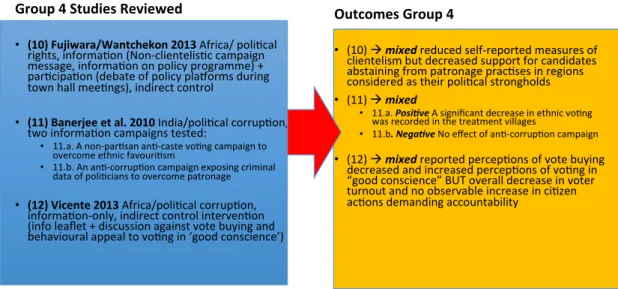
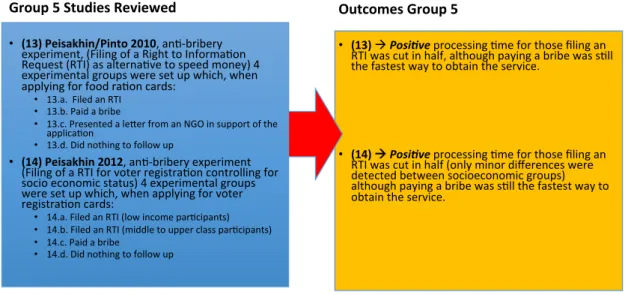
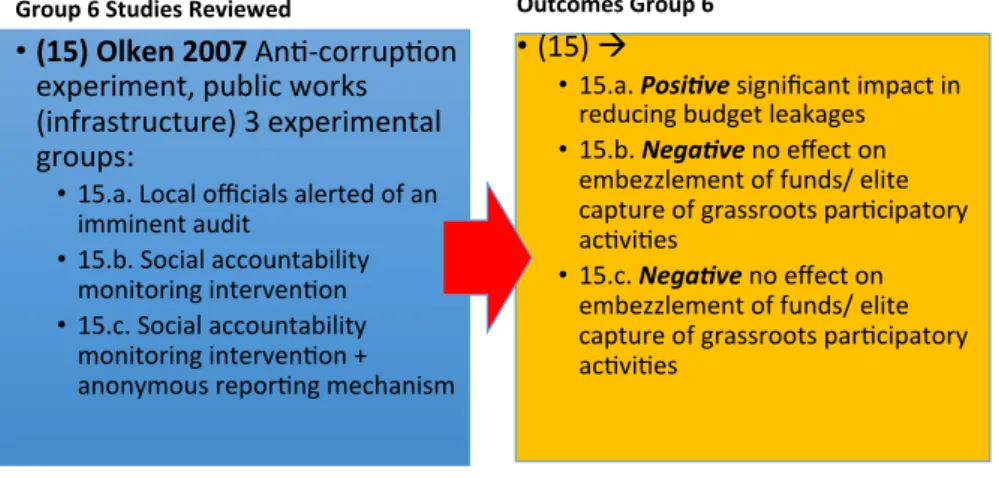
After conducting a preliminary review of a vast number of studies and subjecting them to rigorous inclusion/exclusion criteria, the main part of this assessment draws from the review of 15 experimental studies of anti-corruption interventions.8 These studies have been categorised into six groups according to type of intervention, sector, type of corrupt practices that are targeted, and geographic region. All studies discuss interventions conducted in either Africa or India with the exception of one that describes an intervention that took place in Indonesia.9 The latter study has been included because it involves an original intervention design that directly tests the relative effectiveness of top-down versus bottom up anti-corruption interventions, making it a suitable complement to the discussion.
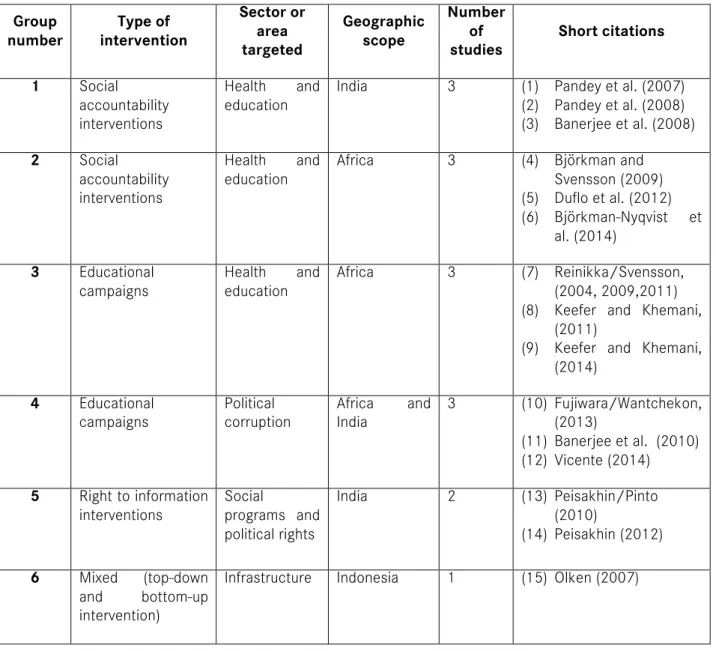
In addition to the experimental studies discussed here, a review was also conducted of several observational studies of anti-corruption interventions. By virtue of their heterogeneity, these observational studies are less suitable for comparison. Nonetheless insights from the observational studies are discussed in the synthesis analysis (section 5) in light of the findings of the TNS review. The intervention groups that have been considered for the TNS review of interventions addressing petty corruption are described in Table 1:
8Experimental studies are highlighted because they provide a high degree of internal validity as compared to observational studies and are therefore more suited to produce clear and reliable findings (Hanna et al. 2011, p. 22).
9
Drawing upon (Pandey et al., 2007) and (Chen and Ravallion, 2004) the assumption is made that the most important socio-demographic conditions prevailing in rural India and Sub-Saharan Africa are sufficiently similar to allow valid comparison.
Table 1: Summary of intervention groups reviewed Group number Type of intervention Sector or area targeted Geographic scope Number of studies Short citations 1 Social accountability interventions Health and education
India 3 (1) Pandey et al. (2007)
(2) Pandey et al. (2008) (3) Banerjee et al. (2008) 2 Social accountability interventions Health and education
Africa 3 (4) Björkman and
Svensson (2009) (5) Duflo et al. (2012) (6) Björkman-Nyqvist et al. (2014) 3 Educational campaigns Health and education Africa 3 (7) Reinikka/Svensson, (2004, 2009,2011) (8) Keefer and Khemani,
(2011)
(9) Keefer and Khemani, (2014) 4 Educational campaigns Political corruption Africa and India 3 (10) Fujiwara/Wantchekon, (2013) (11) Banerjee et al. (2010) (12) Vicente (2014) 5 Right to information interventions Social programs and political rights India 2 (13) Peisakhin/Pinto (2010) (14) Peisakhin (2012) 6 Mixed (top-down and bottom-up intervention)
Infrastructure Indonesia 1 (15) Olken (2007)
4.1Group 1: Social-accountability anti-corruption interventions in the health and education sectors (India)
4.1.1 Description of the studies and results
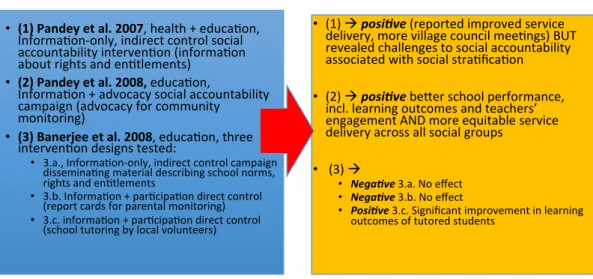
Starting with the Indian studies, Pandey et al (2007, 2008a) studied the effects of social accountability initiatives aimed at informing rural populations about their rights and entitlements regarding health and education in several Indian states (Karnataka, Madhya Pradesh and Uttar Pradesh), where public service delivery is inadequate and high levels of absenteeism and other malpractices of petty corruption prevail. The studies tested the impact of one social accountability campaign based solely on information against the impact of a similar campaign that additionally included an advocacy component motivating people to take concrete actions. The hypothesis tested was that informed and empowered citizens are less likely to tolerate petty corruption.