FACTORS AFFECTING IMPLEMENTATION OF PROCUREMENT PROCEDURES IN PUBLIC HOSPITALS:
(A Case Study of the Rift Valley General Hospital)
SAMSON SAMBA
A RESEARCH PROJECT SUBMITTED TO THE SCHOOL OF MANAGEMENT AND LEADERSHIP IN PARTIAL FULFILLMENT OF THE REQUIREMENT FOR THE AWARD OF THE BARCHELOR DEGREE OF THE MANAGEMENT AND LEADERSHIP PURCHASE AND SUPPLIES
OPTION OF THE MANAGEMENT UNIVERSITY OF AFRICA
ii
DECLARATION
This research study is my original work and has not been presented to any other Institution. No part of this research should be reproduced without the author‟s consent or that of The Management University of Africa School of Management.
Sign: ……….. Date: ………..
SAMSON SAMBA
ODL/BML/8/00338/1/2016
DECLARATION BY THE SUPERVISOR
This research has been submitted with my approval as TheManagement University of Africa project Supervisor.
Dr. Paul Machoka.
iii
DEDICATION
I dedicate this research project to the Almighty God and my beloved Wife Louisa Kahiu as well as the entire family members who offered me morale and full material support throughout my course to ensure the success of this project.
iv
ACKNOWLEDGEMENT
I wish to express my sincere gratitude to the Almighty God for the strength He gave me as well as guidance throughout my Degree Program. I extend my sincere thanks to my father and the entire family for the support they offered me both morally and financially throughout my study.
v
ABSTRACT
The general objective of this study was to examine the factors affecting implementation of procurement procedures in public hospitals, specifically the study sought to determine the effect of legal and regulatory framework, technology, procurement staff skills and organization structure on the implementation of procurement procedures in Nakuru County Teaching and Referral Hospital. The findings of this study is important to the policy makers in the public health sector as it will guide them in formulation of policies that advocate for effective procurement procedures. The study will also be of help to officers in procurement department to know the right methods of rating and choosing suppliers in order to avoid delayed service delivery. a case study research design was employed. The target population for this study comprised of 40 employees from the administration, procurement and stores department. The study targeted employee in the administration, procurement and store department since they are collectively involved in the procurement procedures. Since the population was of manageable size, the researcher used census technique to get a sample size of 40 respondents. Closed-ended questionnaires were used as the primary data colleting instruments. Testing of the reliability was done using a pilot study at Kenya Medical Training College in Eldoret where four (4) questionnaires were randomly distributed to the employee in store and procurement department. Data analysis was done using descriptive statistical techniques which includes percentage and frequencies so as to give meaningful results of data collected. From the findings the researcher concluded that the hospitals involve various stakeholders in the procurement process. Some of the actively involved stakeholder includes member of public, the county government, supplier and employees from the user department, but the county government is the most actively engaged stakeholder in the procurement process. The researcher further concluded that the level of use of technology in procurement operations is low. In addition, the researcher concluded that the organization doesn‟t conduct training programmes on application and adoption of technology in procurement. The researcher recommended that there should be adequate ICT infrastructure to facilitate implementation of procurement practices. Strong and effective pool of skills and human capital are extremely important resources for the implementation of procurement procedures. The researcher suggested that further study should be conducted on challenges facing public institution in the implementation of E-Procurement.
vi
TABLE OF CONTENTS
DECLARATION ... ii DEDICATION ... iii ACKNOWLEDGEMENT ... iv ABSTRACT ... v TABLE OF CONTENTS ... vi LIST OF TABLES ... x LIST OF FIGURES ... xiLIST OF ABBREVIATIONS AND ACRONYMS ... xii
OPERATIONAL DEFINITION OF TERMS ... xiii
CHAPTER ONE ... 1
INTRODUCTION ... 1
1.1 Background of the study ... 1
1.2 Statement of the problem ... 5
1.3Specific objectives ... 6
1.4 Research questions ... 6
1.5 Significance of the study ... 6
1.6 Limitations of the Study... 7
1.7 Scope of the study ... 7
CHAPTER TWO ... 7 LITERATURE REVIEW ... 8 2.1 Introduction ... 8 2.2 Theoretical Review ... 8 2.2.1 Efficiency theory ... 8 2.2.2 Agency theory ... 9 2.3 Empirical Review... 10
vii
2.3.2 Technology ... 13
2.3.3 Procurement staff skills... 14
2.3.4 Organization Structure ... 16
2.4Summary of the Literature ... 18
2.5 Research Gaps ... 18
2.6Conceptual Framework ... 19
Legal and regulatory framework ... 19
Procurement staff skills... 19
2.7 Operationalization of variables ... 20
CHAPTER THREE ... 22
RESEARCH DESIGN AND METHODOLOGY ... 22
3.1 Introduction ... 22
3.2 Research design ... 22
3.3 Target population ... 22
3.4 Sample Size and Sampling Technique ... 23
3.4.1 Sample Size Determination ... 23
3.4. 2 Sample techniques ... 23
3.5 Data Collection Instrument and Procedure ... 23
3.6Data Analysis and Presentation ... 24
CHAPTER FOUR ... 25
DATA ANALYSIS, PRESENTATION AND INTERPRETATION ... 25
4.0 Introduction ... 25
4.1.1 Response Rate ... 25
4.2 Presentation of Findings ... 26
4.2.1 Distribution of Respondents by Gender ... 26
4.2.2 Distribution of Respondents by Age ... 26
viii
4.2.4 Length of Service ... 27
4.2.5 Stakeholders actively engaged in the procurement process ... 28
4.2.6Procurement audit in the organization ... 29
4.2.7 Extent to whichstakeholders are engaged in the procurement process ... 30
4.2.8Effect of legal and regulatory framework on the implementation of procurement procedures ... 31
4.2.9 Extent to which legal and regulatory framework on the implementation of procurement procedures ... 32
4.2.10Adoption level of technology in its operation... 33
4.2.11 Training on application and adoption of technology in procurement ... 34
4.2.12 Adequate ICT infrastructure for the adoption of technology... 35
4.2.13Level of involvement of IT in the various procurement processes ... 36
4.2.14Effect of technology on the implementation of procurement procedures ... 37
4.2.15 Extentto which technology affect the implementation of procurement procedures ... 38
4.2.16 Procurement skills among officer involved in procurement process ... 39
4.2.17Sensitization programmes on latest procurement Act (PPDA 2015 Act) ... 40
4.2.18 Effect of procurement staff skills on the implementation of procurement procedures ... 41
4.2.19 Extent to which procurement staff skills affect the implementation of procurement procedures ... 42
4.2.20 Independence of procurement department ... 43
4.2.21 Effectiveness of user department ... 44
4.2.22Clearly defined procurement role ... 45
4.2.23 Effects of organization structure on the implementation of procurement procedures ... 46
4.2.24Extent to which organization structure affect the implementation of procurement procedure ... 47
ix
CHAPTER FIVE ... 48
5.0 SUMMARY OF FINDINGS, CONCLUSIONS AND RECOMMENDATIONS 48 5.1 Introduction ... 48
5.2 Summary of Major Findings ... 48
5.4 Conclusions ... 50
5.5 Recommendation the findings the researcher ... 51
5.6 Suggestion for further study... 51
x
LIST OF TABLES
Table 2: Response Rate. ... 25
Table 3: Distribution of Respondents by Age ... 26
Table 4: Level of Education of Respondents ... 27
xi
LIST OF FIGURES
Figure 1: Distribution of Respondents by Gender ... 26
Figure 2: Stakeholders actively engaged in the procurement process ...Error! Bookmark not defined. Figure 3: Organization conduct procurement audit .... Error! Bookmark not defined. Figure 4: Extent to which stakeholders are engaged in the procurement process ... 30
Figure 5: Effect of legal and regulatory framework on the implementation of procurement procedures ... Error! Bookmark not defined. Figure 6: Extent to which legal and regulatory framework affects the implementation of procurement procedures ... 32
Figure 7: Adoption level of technology in its operation ... 33
Figure 8: Training on application and adoption of technology in procurement ... 34
Figure 9: Adequate ICT infrastructure for the adoption of technology ... 35
Figure 10: Level of involvement of IT in the various procurement processes ... 36
Figure 11: Effect of technology on the implementation of procurement procedures . 37 Figure 12: Extent to which technology affect the implementation of procurement procedures ... Error! Bookmark not defined. Figure 13: Procurement skills among officer involved in procurement process ... 39
Figure 14: Sensitization programmes on latest procurement Act (PPDA 2015 Act) . 40 Figure 15: Effect of procurement staff skills affect the implementation of procurement procedures ... 41
Figure 16: Extent to which procurement staff skills affect the implementation of procurement procedures ... 42
Figure 17: Independence of procurement department ... 43
Figure 18: Effectiveness of user department... 44
Figure 19: Clearly defined procurement role ... 45
Figure 20: Effects of organization structure on the implementation of procurement procedures ... 46
Figure 21: Extent to which organization structure affect the implementation of procurement procedure ... 47
xii
LIST OF ABBREVIATIONS AND ACRONYMS
PPOA Public Procurement Oversight Authority.TVLB Tender Vetting and Licensing Board GDP Gross Domestic Products
ERP Enterprise Resources Planning MRO Maintenance Repair and Operations ICT Information Communication Technology
xiii
OPERATIONAL DEFINITION OF TERMS
Accountability The obligation of an individual or organization toaccount for its activities and accept responsibility for them and disclose the results in a transparent manner Procurement The act of obtaining or buying goods and services Policy A course or principle adopted or proposed by an
organization Procurement
procedures
This are rules and regulations that are adopted in buying goods and services in an organizations
Technology Technology is the change or integration of means of processing a product or service from what is perceived not be a good version to a better one. It can also be said to be a change of system or way of operation from inefficient or manual to automatic operations (Campbell, 2005).
Organization Structure
Organizational structure refers to how job and task are formally divided, grouped and coordinated. Organization structure provides a foundation within which organizations function. Dalton (2004)
1
CHAPTER ONE
INTRODUCTION
The chapter presents an introduction to the study. The main areas covered include background of the study, problem statement, research objectives, research questions, and significance of the study.
1.1 Background of the study
Procurement is generally defined as the process of obtaining goods or services in any way including borrowing, leasing or even force or pillage (Lysons& Farrington, 2016). Procurement is a core activity that has implications on the operations of an organization together with being an activity which cuts across all the departments in the organization. It is an activity that forms part of the key operations within the organization since it is through procurement that the organization acquires the various resources that ensure its continued existence.
Procurement is a vital function of any organization, public or private and in an era of globalization with the advent of entrepreneurial organizations, management of purchasing and supply in private as well as in public sectors has gained more prominence. All procurements regardless of their value or complexity follow a standard sequence of actions, which need to be effectively managed to realize the objectives of the procurement function. Effective management of the function prevents the possibility of poor performance and when attributed to non-adherence to proper procurement processes and procedures; is an indicator of poor management of the procurement function (Knight et, al, 2007).
According to Kiragu (2012), procurements should be based on value for money (defined as the optimum combination of whole life costs and fulfillment of customer‟s requirements) rather than initial purchase price. Effective and efficient procurement systems and collaborative relationships are essential to the achievement of organizational goals, cost reduction and supply chain performance. This is achieved by identifying key saving potential areas and driving innovative sourcing models which can enable operators to reinvent their cost structures.
Implementation of procurement procedures are is essentially regulated by statute or constitutional provisions, and the prescribed methods or due processes must be
2
followed. For significant expenditures of public funds, government bodies usually must use a bidding process. In the awarding or letting of public contracts, the public body invites bids or makes "requests for proposals" so that it can award the contract to the bidder who qualifies under the terms of the governing statute. The submission of a bid in response to an invitation is considered an offer, and although it may not be freely withdrawn prior to acceptance, it does not become a contract unless and until such time as it is accepted by the proper public authority under the prescribed implementation of procurement procedures. A bidder that does not respond to the terms contained in the invitation to bid is not within statutory requirements; considered to be a new proposition or a counterproposal, (Saleemi, 2009).
In China, the procurement procedure have evolved from a single-price criterion to multi-criteria that include price (cost), time, quality, etc. All tenders are assessed by a tender evaluation committee and the detailed tender evaluation criteria are prepared by this committee one day before the opening of the tenders, to avoid any unfairness in the tendering process. The selection of a best suitable company for the construction work is not based on the rule of “lowest price wins” but multi-criteria, including price, time, quality and construction plan and company‟s reputation as well as proposed project team. (Jiangsu Provincial Construction Commission, 2013).
According to Zou (2014) the contractual arrangements in China fall into three broad categories depending upon the means of arriving at the contract sum, which are lump sum contract, measurement contract and cost reimbursement contract. Despite the major progress made to date, the Chinese project contracting still has a long way to go to match up with international best practice (Lee, 2014).There are a number of issues requiring Chinese Government departments‟ urgent attention. The first issue is the contracting evaluation criteria. Research found that the current method is insensitive to an important criterion “bid price” and different cities were using different criteria with different components (Lai, 2014).
To ensure sanity and value for money in the public procurement landscape, the government of Ghana launched the Public Financial Management Reform Programme (PUFMARP). The purpose of the programme was to improve financial management in Ghana. PUFMARP identified weaknesses in the procurement system. Some of these weaknesses included: lack of comprehensive public procurement policy, lack of central body with technical expertise, absence of clearly defined roles and responsibilities for procurement entities.(Ameyaw, Mensah&Osei-Tutu 2012).
3
The Country Procurement Assessment Report of Ghana produced in 2013, revealed that most staff members of Ministries, Departments and Agencies (MDAs) and District Assemblies (DAs) responsible for procurement were not procurement-proficient, even though they have been trained. The report contended that application of the PPA and the Standard Tender and Contract Documents will not be successful without broad training and „refresher‟ programmes for officials in charge of procurement. Similarly Forgor (2007) agrees that lack of proper training of managers on the procurement process is a challenge that confronts procurement reforms. This supports the assertion that poor dissemination of procurement law is one of the challenges facing the smooth implementation of public procurement laws (Azeem, 2007). Ntayi (2009) observes that millions of dollars get wasted in Uganda due to inefficient and ineffective obstacles and challenges in the procurement process of which contract management is a part.
In Kenya, Procurement methods are open tendering, restricted tendering, direct procurement, request for proposal, request for quotations, specially permitted procurement and practices for low value procurements (Procurement Act, 2015). The most preferred method is the open tendering as it allows for fairness and transparency. The rest are usually referred to as alternative procurement methods and should only be used where expressly allowed by the law (Procurement Act, 2015). For each method, there exists a threshold of expenditure beyond which an entity cannot exceed, but the minimum level of expenditure usually depends on the procurement entity‟s budgetary allocation. There is need for strict adherence to these thresholds in order to remain compliant with the law, (Public Procurement and Regulations, 2006). The bodies which regulate public procurement in Kenya are National Treasury on public procurement and assets disposal, Public Procurement Regulatory Authority (PPRA), and Public Procurement Regulatory Board (PPRB) regulate procurement practice in Kenya. These four can be termed as the pillars of the procurement (Public Procurement and Disposal Act, 2015).
1.1.1 Health Facilities in Kenya
The health system in Kenya is organized and implemented through a network of facilities organized in a pyramidal pattern. The network starts from dispensaries and health clinics/ posts at the bottom, up to the health centers, sub-district hospitals, district hospitals level 4, provincial general hospitals level 5 and at the apex there is the Kenyatta National Hospital. The Ministry of Health (MoH) is the major financier
4
and provider of health care services in Kenya. Out of all the health facilities in the country, the MoH controls and runs about 52% while the private sector, the mission organizations and the Ministry of Local government runs the remaining 48%. The public sector controls about 79% of the health centers, 92% of the sub-health centers. Country Procurement Assessment Report (CPAR), prepared by a team of Government officials, World Bank and donor staff, and national consultants, reveals substantial inefficiency in public procurement and concludes that the principle of “value for money” is not achieved.
This is true for both governments financed and donor financed procurement. The main findings of the 2002 Country Portfolio Performance Review of World Bank projects also reviewed slow project implementation and disbursement among other factors due to, a large extent of inadequate procurement planning, non-transparent procurement procedures and poor contract management in 60% of the dispensaries. The NGO sector is dominant in health clinics, maternity and nursing homes controlling 94% of the total while also controlling 86% of the medical centers in the country (CBS, 2004).
Kenya through the Ministry of Health has not been able to adequately ensure quality health service provision to the citizens over the years. Most public hospitals are under bad conditions (Kenya Health Policy, 2014); characterized by dilapidated facilities, obsolete medical equipment, inadequate drugs and low bed capacity in the wards. Patients suffer in grief, due to inadequate care from medical personnel who complain about insufficient medical equipment and low pay among other poor working conditions. These factors can be linked to the procurement practices employed in the respective public health facilities in question (MOH Survey, 2015).
Health facilities inNakuru County are classified in tiers. Nakuru Teaching and Referral Hospital is the biggest health facility It is estimated that the hospital receive approximately 2000 patients in the Out Patient Department, 40 in the Antenatal Clinic, 100 in the Family Planning Department and 80 HIV positive babies. Poor quality of service delivery at the health facilities lead to the formation of the Quality Assurance Steering Committee in the year 2010 whose main objective was to ensure continuous delivery of quality service to the patients. In a survey carried out by the Kenya Anti-Corruption Commission of Kenya in 2010, it was revealed that even though the government agency for the supply of drugs(Kenya Anti-Corruption Commission, 2010).
5
Kenya Medical Supplies Agency (KEMSA), was availing drugs to the public hospitals, most patients were buying their own drugs and other items. Top among the items being bought included drugs at 52%, food and equipment at 16% each. This indicates that the quality of healthcare in these public institutions has greatly declined. The management of these institutions should seek for better ways of enhancing quality in service delivery (Kenya Anti-Corruption Commission, 2010).
1.2 Statement of the problem
According to health sector performance report 2013 and 2014 health institutions are ailing from shortage of drugs or holding on expired drugs. Health Centre and dispensaries are hardly stocked with the recommended medicines. It indicates that high rate of expired drugs in dispensaries and other public hospitals indicates poor planning and high wastage of public resources in the counties, thus affects efficient delivery of quality services. Procurement is an important part of efficient management and supply. An effective procurement procedure ensures the availability of the right Medicines in the right quantities, at right time for the right patient and at the right prices and at recognizable standards of quality (WHO, 2007). Like in the other parts of the country the health sector in Nakuru County has been facing numerous challenges under the devolved systems. With the introduction of county government the procurement procedures in hospitals has greatly changed. Unlike the previous system whereby KEMSA supplied drugs under the current system, health facilities are free to source for medical facilities from any other source. This has sometimes contributed to delay in delivery of drugs or in worst scenario compromise on the quality of drugs supplied. The procedure is quite tedious since the county government has to be involved in the whole procedure since it‟s the one which gives the authority to incur expenditure. Various studies have been conducted on procurement procedure. Chesang (2013) did a study on public procurement contracting procedure and its effect on procurement performance in selected ministries headquarters in Nairobi County. Mwangi (2014) conducted a study on the impact of public procurement policy on teaching and learning in public secondary schools in Kahuro district. However, none of this study focused on the health sector therefore the study seek to establish factors affecting implementation of procurement procedures in public hospitals in Nakuru County Teaching and Referral Hospital
6 1.3Specific objectives
The general objective of this study was to examine the factors affecting implementation of procurement procedures in public hospitals.
i. To determine the effect of legal and regulatory framework on the implementation of procurement procedures in Nakuru County Teaching and Referral Hospital.
ii. To establish the effect of technology on the implementation of procurement procedures in Nakuru County Teaching and Referral Hospital.
iii. To assess the effect of procurement staff skills on the implementation of procurement procedures in Nakuru County Teaching and Referral Hospital. iv. To find the effect of organization structure on the implementation of
procurement procedures in Nakuru County Teaching and Referral Hospital.
1.4 Research questions
The research questions of the study were:
i. What is the effect of legal and regulatory framework on the implementation of procurement procedures in Nakuru County Teaching and Referral Hospital? ii. What is the effect of technology on the implementation of procurement
procedures in Nakuru County Teaching and Referral Hospital?
iii. What is the effect of procurement staff skills and capacity on the implementation of procurement procedures in Nakuru County Teaching and Referral Hospital?
iv. What is the effect of organization structure on the implementation of procurement procedures in Nakuru County Teaching and Referral Hospital?
1.5 Significance of the study
The findings of this study is important to the policy makers in the public health sector as it will guide them in formulation of policies that advocate for effective procurement procedures. This will enhance service delivery in Public Hospitals in Kenya. The study will also be of help to officers in procurement department to know the right methods of rating and choosing suppliers in order to avoid delayed service delivery. The findings of this study will increase the understanding and improve existing academic knowledge regarding factors affecting procurement procedures in
7
the public health sector. Policymakers and health practitioners will also find the information useful in developing policies and procedures that guide this health process. The findings will provide proper guiding framework for the development of infrastructures that ensures quality service delivery to patients and clients in Public Hospitals.
1.6Limitations of the Study
The study faced diverse limitations such as the apathy of Hospital management in authorizing data collection in their institutions, the reluctance of the employees to fill in the questionnaires. The hospital manager‟swere reluctance to authorize data collection which i deal with through assuring the management of minimal interference with the organization operational aspects. In the context of the potential respondents‟ apathy to filling the questionnaires, the researcher addressed this apathy in different ways including obtaining of an official letter from the university detailing the collection purposes of the data as that of academic in nature. The respondentswerealsoissued with a consent statement that detailed their voluntary participation in the study.
1.7 Scope of the study
The study focused in establishing factors affecting implementation of procurement procedures in public hospitals in Nakuru County Teaching and Referral Hospital. The target population for this study comprise of 32 employees from the administration, procurement and stores department. The study was conducted in the period between January and August 2018.
8
CHAPTER TWO
LITERATURE REVIEW
2.1 Introduction
According to Bailey (2011), literature review is a summary of previous research on a topic. Literature review reviews scholarly courses, books, and some foundations pertinent to certain sections of research or interest. Within the review the author provides an explanation, critical evaluation and also a summary of every source, i.e. the assets as well as weaknesses. Literature review might recognize controversies or even gaps within topics and literature that requires further research. It focused on theoretical literature which is the diverse theories which reinforce the foundation of this research. The chapter further aims on empirical literature which discusses the diverse concepts connected to variables under study. It as well discusses conceptual framework which demonstrates the interrelationship between the variables and the indicators of each variable.
2.2 Theoretical Review
The theoretical framework introduces and describes the theory which explains why the research problem under study exists. Consists of concepts, together with their definitions, and existing theory/theories that are used for the particular study (Torraco, 2011).
2.2.1 Efficiency theory
Richard Posner first laid the groundwork for efficiency theory in the 1970s. He argued for the “allocation of resources in which value is maximized." Efficiency theory assumes that parties value assets more or less correctly and that their transacting choices are motivated solely by wealth maximization goals (Harry; Entwistle, & Martin. 2006). The other related assumption of efficiency theory is the absence of negative externalities. An externality is an effect that a transaction between one set of parties puts on other parties who were not a part of the deal (and presumably had no say in the matter). Externalities may be negative or positive (Ware
9
&Kynoch, 2013). A positive externality is a benefit to non-parties, whereas a negative externality imposes costs on non-parties. If a transaction has a negative externality, then the true cost of the transaction is higher than that paid by the parties.
The classic example of a negative externality is pollution generated by a productive enterprise that negatively affects the public, but the cost of which was not internalized by the transaction. Efficiency theory is typically applied “to contracts between firms that do not create negative externalities.” In the absence of externalities, and where there is a competitive market, theory states that efficient transacting occurs (Bower, 2012).
2.2.2 Agency theory
Agency theory was developed by Stephen Ross and Barry Mitnick in 1973. Agency theory states that agency costs arise from the conflict of interest between a principal and an agent. This conflict results, for example, when managers, who are responsible for important decisions of the firm, are not the primary claimants of the firm‟s net assets, and thus do not bear a major share of the wealth effects of their decisions.
Agency theory divides the costs of such arrangements into structuring costs, monitoring costs, and costs of bonding a set of contracts. Costly control procedures, such as the use of contracts, are necessary to align the actions of the managers (the agent) with those of the residual claimants, the shareholders (the principals). Agency theory stresses that such means of contracting reduce agency costs by coordinating the goals of the principal and the agent (Kumarappan& Joshi, 2014).
Agency theory predicts that in a well-functioning market, where there is perfect information and the ability to monitor, there should be little difficulty aligning incentives between principals and agents. If the principal is able to sufficiently monitor the agent‟s performance, it can design sanctions and incentives to encourage optimal behavior. Further, if the agent knows that the principal will become aware of poor performance, and there are switching options in the marketplace, the agent will be dissuaded from performing poorly. The agent will also be concerned about reputational effects of poor quality service provision. Agency problems are often said to arise between the shareholders of a firm (the principals) and its managers (the agents) (Ware &Kynoch, 2013).
10
In relation to public procurement contracting, agencies refer to the various suppliers and contractors that provide products and services on behalf of the government. The use of contractors and suppliers helps to improve service delivery in the public sector. It helps the government to closely monitor service delivery and provide efficient, affordable and consistent services to the public (Khayota, 2014).
2.3 Empirical Review
The procurement procedure are concerned with acquisition of goods and services from reliable sources to ensure the organization meets their strategic goals in an efficient, effective and economic way. Chartered Institute of Procurement and Supply together with the Institute for Public Procurement, on procurement practice, hold that, firms have to devise comprehensive policy procedures and directions that highly defines the authority, responsibility and lay down the guidelines for the procurement professionals and associated parties to follow in executing their roles. According to Monczka, (2014) good procurement procedure result to; effect on quality, savings on cost and contribution in the technology advancement. Singhal (2011) notes that, disruptions in the procurement procedure within the global scope ravage the organizational performance. In this case, poor procurement procedure have implicit effect on company share prices and profitability hence the need to curb any loophole that can affect business continuity (Christopher, 2008). These practices can be applied interchangeably based on the firm‟s size and given that all the practices are linked. Therefore, the practices adopted must be a projection of the long term state of the company. In light of these, the study focuses on supplier partnerships, use of information technology, lean procurement and contract monitoring and control. Salim (2013) on his study on “the role of procurement contract management practices on the effectiveness of project management at MIC-Tanzania. He concentrated on the need of contractors‟ compliance to contract terms and conditions, technical capability and contract monitoring towards project management as the objectives. The study methodology was descriptive design, purposive non-probabilistic sampling technique was used, data was collected using interview and questionnaire. From the findings the author‟s concluded that staff inadequacy, disputes caused by late delivery by suppliers, poor quality of works/services, vague specifications and supplier‟s technical incapability affect effectiveness of project management. He recommended that company should implement automated contract management system.
11
According to Agere, (2001) an ideal procurement system should also focus on effectiveness, where procuring entities should meet the commercial, regulatory and socio-economic goals of government in a manner that is appropriate to the procurement requirement. Furthermore, a good procurement practice should embrace: efficiency, which requires that procurement processes be carried out as cost effectively as possible; fair-dealing, where suppliers should be treated fairly, without discrimination or prejudice including protection of commercial confidentiality where necessary.
Sanghera (2008) says that an organization can determine if it is engaging in effective contract management if it makes appropriate strategic decisions and drafts right contracts. A contract is the pillar in the exercise of its proper and effective management. Every contract should establish its basic principles, have clear scope, define execution terms and define procedures essential for successful communication between the contractor and contracting authority. It should also implement changes, evaluate contractor performance, accept or reject the contractor‟s deliverables, identify and manage risks, handle problems, resolve disputes, approve payments, and finally close the contract process (Trent, 2007).
2.3.1 Legal and regulatory framework
In Kenya, National Treasury in public procurement and assets disposal and Public Procurement Regulatory Authoritymonitor, assess and review the public procurement and asset disposal system to ensure that they respect the national values and other provisions of the Constitution, including Article227 and make recommendations for improvements; monitor the public procurement system and report on the overall functioning of it and present to the Cabinet Secretary and the county executive member for finance in each county, such other reports and recommendations for improvements; enforce any standards developed under PPDA 2015, ensure the procurement entities implement the preference and reservations and provide data to the Authority disaggregated to indicate the number of disadvantaged groups that have benefitted. A public entity shall provide the National Treasury or the Authority with such information relating to procurement and asset disposal as may be required in writing. (PPDA 2015)
12
Enforcement is viewed as any actions taken by regulators to ensure compliance (Zubcic& Sims, 2011). Effective policy making requires information whether public entities are doing things right and whether they achieve the results intended (Acevedo, Rivera, Lima &Hawng, 2010). Strong monitoring and evaluation systems provide the means to compile and integrate this valuable information into policy cycle, thus providing the basis for sound governance and accountable public policies. Inadequate monitoring and evaluation is linked to the absence or poor presence of a control environment, and government entities are placed in a difficult position to give effect to or implement procurement as required by policy (Ambe&Badenhorst-Weiss, 2012). There is lack of proper monitoring and evaluation as required (Stemele, 2009). Hence, deviation or non- compliance goes undetected or is identified after the fact.
There are mixed opinions regarding the effect of enforcement on compliance. Sparrow (2000), argues that enforcement may make violators more sophisticated in how to prevent, and conceal detection by the authorities. However, Imperato (2005) agrees that enforcement improves compliance. According to Zubcic and Sims (2011), enforcement action and increased penalties lead to greater levels of compliance with laws. Corruption among government procurement officials in developing countries has been linked to a weak enforcement of the rule of law (Raymond, 2008). In countries with complaint and review mechanisms, bidders are allowed to verify whether the procurement processes conform to the prescribed procedures.
The possibility of review is also a strong incentive for procurement officials to abide by the rules (Huiet al., 2011). According to Collier (2002), enforcement has a greater regulatory impact beyond the violators and reminds directors and others involved in corporate management of their responsibilities and the risks attached to a failure to fulfill those responsibilities. Imperato (2005) also observes that enforcement action aiming at ensuring compliance plays an important role in corporate governance. Implementation of organizational activities depends on the organizational structure. One way to explain the effect on implementation of organizational activities is the principal-agency theory. Government delegate authority to the state corporation managers who are the agents, the managers in turn delegate the authority to the procurement staff who executes procurement functions (Eyaa&Oluka, 2011)
13 2.3.2 Technology
Technology is the change or integration of means of processing a product or service from what is perceived not be a good version to a better one. It can also be said to be a change of system or way of operation from inefficient or manual to automatic operations (Campbell, 2005). Public sector procurement activities have evolved from orders, systems to nowadays E-procurement. The study notes that unless one remembers that technology is a tool and that one needs to know how to use it, for it to be productive, the money that spend on technology will never appear to be wasted. According to the study, the emergence of internet technologies has changed the way that governments and organizations operate (Lalive, &Schmutzler, 2007). The majority of organizational spending consists of purchasing and thus in order to decrease the total costs spent on purchasing process, internet technologies have been used by both governments and enterprises.
Several studies have noted that E-Procurement is a “Revolution” due to its potential to reduce the total costs of acquisitions. These studies point out that the one thing to always remember about technology is that it is a tool to assist in getting sourcing and procurement related activities done in the organization. According to Monrove (2002), in the last decade, the development of information technology has proved decisive for the network society that has evolved in recent years. The study note that today, information technology is relatively cheap and flexible technology which not only has held significant importance for communication in society, but also for the development of the interplay between one procurement units of an organization to another. Another study by Rusek (2006), noted that the digitalization of information and data, as well as the opportunities offered by the internet, provides the basis for rationalization and improved efficiency in administrative processes for private sector procurement companies. In public sector companies digitalization provides a number of advantages, for example, the opportunity to establish new and more efficient work processes and to communicate and cooperate in new ways.
Traditional paper-based work processes in procurement can be made more efficient, changed or rendered superfluous when data and data-communication become electronic. Via this path, resources can be transferred from administration to service (Dai, 2005). Digitalization does not only bring advantages with it. The risk element in procurement changes radically along with technical development, for example,
14
when traditional paper documents disappear and are replaced by digital information that easily can be stolen (copied), changed, deleted, etc., without trace. In future, security surrounding digital systems will be allocated important priority in all fields of society (Arora, 2007)
Development also requires an important technical redirection and comprehensive further training for users. For procurement officers, development will mean the need for further training, amended procurement methods and new IT-based in procurement tools. In the latest era, the significant usage of E-Procurement systems by governments and enterprises led to significant savings in government procurement costs. It has been shown theoretically and empirically that these savings are mostly caused by increased competitive environment, thus by increased number of bidders in government procurement auctions (Elmaghraby, 2007).
The success of E-Procurement systems mostly depends on the increases in number of bidders (suppliers) that participate to procurement auctions. So, the implementation of Procurement has some restrictions namely technology adoption and usage of E-Procurement systems by suppliers. Some public institutions have not embraced e-procurement. Again, E-procurement has high maintenance costs and required level of professionalism that needs to be investigated in terms of sustainability (Cramton&Ausubel, 2006).
Berger and Humphrey (2007) noted that the use of technology has not been fully embraced in the practice of undertaking procurement activities in Kenya. Berger and Humphrey observe while there are up to date systems such as reverse auction for undertaking bidding process in procurement, in most private and public sector the process is still being undertaken manually giving room for manipulation and corruption. Manual process also takes longer thus thereby affecting procurement activities. Dale (2010) also noted that the manufacturing industry performance in Kenya is hampered by lack of investment in technology that helps to reduce lead time, improve efficiency and efficacy, and eliminate quality default and corruption in the processes.
2.3.3 Procurement staff skills
Banda (2009) stated that many procuring organizations do not have staff with the right competence critical to good procurement process management and therefore there is need for authorities to give much greater emphasis to developing such
15
competence and to adopt best practice more widely. According to a study by Banda (2009) monitoring and enforcement of quality standards is sometimes weak and failure can be traced back to problems in human resources capacity to monitor procurement process, poor determination of specifications, weak definition of requirements and/or inadequate budgets, and failure to enforce the conditions of the contract which arises due to inadequate supervision. He further notes that regulatory agencies rarely manage to enforce standards that hinder procurement fraud due to lack of capacity.
Another study by Berger & Humphrey (2007), indicated that a procurement process that is carried out professionally is key to delivery of any service on value for money principle. In that study, it was noted that most of personnel carrying out procurement functions in public institutions in Kenya have not been sensitized on procurement regulations. For example, the law requires that each procuring entity establishes a procurement unit manned by professionals in procurement. According to Sultana (2012), technological developments and organizational change have gradually led some employers to the realization that success relies on the skills and abilities of their employees, and this means considerable and continuous investment in training and development.
According to a study by Appiah (2010), current educational systems do not impart specific knowledge for specific job positions in organizations. This result to a labour force with few people with the right skills, knowledge and competencies, hence there is a need for extensive external training for human resources to be able to improve and also contribute to the productivity of organizations. Another study by Seleim (2007), explain that employee training is an important component for improved organizational performance through the increasing level of individual abilities.
According to Banda (2009), many procuring organizations do not have staff with the right competence critical to good procurement process management. There is need for authorities to give much greater emphasis to developing such competence and to adopt best practice more widely. For big projects the cost of employing advisers is very high and in many cases exceeded budgets by a substantial margin.
Overall, and as Huson, Malatesta&Parino (2004) posits, training on procurement related skills within public institutions leads to easier staff movement, reduced new staff training costs and greater access to skilled procurement professionals. In their advisory article on how public institutions in Kenya can improve their procurement
16
unit performance through training and development. Awiti (2008); Bohnstedt (2008) and Romero (2009) agree that organizations should provide guidance on the range of procurement competencies required by those engaged in significant procurement activities. This is crucial since it enables them to achieve satisfactory standards. Specifically, Woolcock (2008) argues that senior procurement managers should map out routes available to academic and professional procurement qualifications for procurement staff and most importantly, they should, introduce a procurement exchange programme as a development tool to improve the acquisition and application of procurement knowledge and skills across the public sector. Musanzikwa (2013) conducted a study to review the challenges on public procurement in Zim
babwe. In his study it was found that, majority of the procurement practitioners are incompetent. The study suggested that the professional procurement practitioners must be employed in the public procurement.
Kiage (2013) conducted a study on factors affecting public procurement in Kenya basing on procurement department in education sector, it was noted from the study that the shortage of skills has been a re-concurrent theme in public discussion. Skills and capacity shortages have been identified as the single greatest impediment to the success of public procurement in South Africa. Onyinkwa (2013) contends that there is a lack of capacity and knowledge to handle procurement processes that have led to bad governance. The South African government embarks on programmes that educate practitioners, but implementation of its programmes always falls short.
2.3.4 Organization Structure
According to Sablynski (2003) organizational structure refers to how job and task are formally divided, grouped and coordinated. Organization structure provides a foundation within which organizations function. Dalton (2004) categorized organizational structure into traditional hierarchical organization and high performance organization. Traditional hierarchical organization is any long, complex administrative structure with job specialization and complex rules based on the principle of hierarchical authority, job specialization and formal rules (Machinsky, 1990).
According to Armstrong and Stephens (2013), organizational structures provide the framework for the activities required to achieve organizational goals and objectives.
17
Basically, organizational structures can be categorized as unitary, divisionalized or centralized and matrix (Armstrong and Stephens (2008). Unitary structure, which is the most common structure, is a single and separate unit without any divisions in which the heads of each major department directly reports to the top.
In unitary structure, the relationships are not complex and are clearly defined. However, lack of cooperation between departments is common and this can be avoided if the chief executive coordinates and directs the activities. Centralized structure places authority at the centre which completely take controls of the activities and decisions of other units. Such control is exercised by authority from the headquarters who dictates policies, procedures, targets, and budgets to be followed and achieved (Armstrong and Stephens, 2008).
In a centralized structure, close control can be maintained over divisional activities, standardized procedures and systems can be used, and guidance is provided by functional specialists at the headquarters. However, a drawback of this structure is that it restricts the scope of divisional management to handle their own affairs in the light of local knowledge and lack of autonomy in divisions can constrain initiative and entrepreneurship. Decentralized structure is the direct opposite of centralized structure. In the decentralized structure gives operational autonomy to divisions, subsidiaries, or strategic business units under the overall direction of the centre in order to achieve desired results (Rabie, 2004)
By definition bureaucracy is the collective organizational structure and policies, and set of regulations in place to manage operations usually in large organizations and government bureaucracy can also be regarded as the standardized procedure that guides the execution of most or all activities within the an organization. According to Rabie (2004) bureaucracy is a management system designed to handle organization affairs and relationships with its employees and all the stakeholders. It help different types of organizations in managing their internal and external affairs. An organization structure that is appropriate to the task of an organization encourages creativity and enhances quick decision making and other operations such as procurement this enable the organization to survive and compete in dynamic and competitive situations (De Anis&Haggins 2001)
18 2.4Summary of the Literature
Although a lot of research in the area of purchasing and supplies in general and even on public policies, no study has been conducted in the Rift Valley General Hospital in Nakuru. This will be the first documented study to be done in the referral hospital of Nakuru in Kenya on the effects of supply policies on procurement in the public healthcare facility. It is also important to recognize the limitations of the existing research base on supply policies. This is a field in which research has been significantly constrained by literature review considerations. There is also a great deal of sensitivity around the confidentiality of the implementation of procurement procedures of public institutions. The fear that the top management may learn that a person has given out sensitive information on private procurement has made many customers and business managers reluctant to complete research questionnaires in the past. High drop-out rates are found in such research samples. Since it is clear that proper implementation of implementation of procurement procedures have a positive impact on the effectiveness, transparency and efficiency of public procurement; hence the need for this timely study.
2.5 Research Gaps
Various studies have been conducted Parkera and Hartley (2003) indicate that one of the main challenges facing procurement contracting practices in public institutions is increase in corruption and collusion due to the use of noncompetitive procedures. The study did not address challenges facing procurement contracting practices in private institution. Studies by Patrick (2008) and Edward (2009) sought to explain the status of effective procurement procedurein Kenya but do not offer practical solution on how government training institutions should embrace effective procurement practices. A study by Talluri (2008) found that many government organizations in India and Malaysia lack effective procurement policies for supporting effective implementation of procurement practices. A study by Moses (2009) found that application of poor sourcing strategies is a key impediment to implementation of effective procurement procedurein many government institutions in Kenya. A study by Simpson and Power (2007) found that in many African government institutions, many procurement managers are not trained on implementation of effective procurement proceduresince most African training institutions have not embraced effective procurement
19
procedurein public procurement training institutions. These studies were not specific on the type of procurement procedurehence developing a major knowledge gap on competitive procurement practices. This study aims to fill the missing gaps by determining the influence of competitive procurement procedureon service delivery.
2.6Conceptual Framework
Serakan (2003) defines a conceptual framework as a logically developed network of interrelationships among variables deemed to be the integral part of the dynamics of the situation being investigated
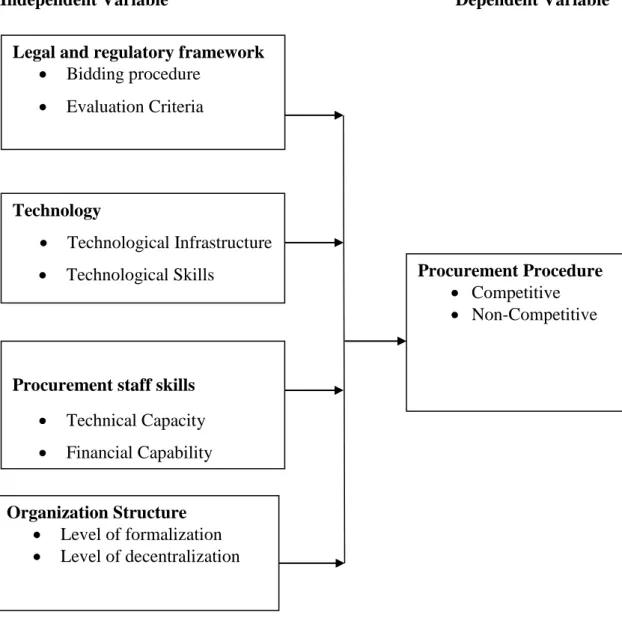
Figure 2.1: Conceptual Framework (2018)
Independent Variable Dependent Variable Legal and regulatory framework
Bidding procedure Evaluation Criteria
Technology
Technological Infrastructure
Technological Skills Procurement Procedure
Competitive Non-Competitive
Procurement staff skills Technical Capacity Financial Capability Organization Structure
Level of formalization Level of decentralization
20 2.7 Operationalization of variables
2.7.1Legal and regulatory framework
Legal and regulatory framework entail a set of rules and regulations put in place to govern the process of acquiring goods and services needed by an organization to function efficiently (Wisegeek, 2013). The exact process seeks to minimize expenses associated with the purchase of those goods and services by using strategies such as volume purchasing; the establishment of a set roster of vendors, and establishing reorder protocols that help to keep inventories low without jeopardizing the function of the operation (Muge, 2009). Both small and large companies as well as non-profit organizations regularly design and apply procurement policies to guide on procurement matters. Procurement policies are thus a set of rules and regulations that are designed by organizations to govern on application of various procurement procedures (Bartik,2009).
2.7.2 Technology
The adoption of technology in procurement lead to significant savings in government procurement costs. These savings are mostly caused by increased competitive environment, thus by increased number of bidders in government procurement auctions. information technology is relatively cheap and flexible. Technology has not only held significant importance for communication in society, but also for the development of the interplay between one procurement units of an organization to another.
2.7.3 Procurement Staff Skills
Majority of government institutions do not have staff with the right competence in procurement department. Skilled employees are critical to good procurement process management. There is need for authorities to give much greater emphasis to developing such competence and to adopt best practice more widely a procurement function that is carried out professionally is the heart of delivery of any service on value for money principle
2.7.4 Organization Structure
Organization structure is a grouping of people and tasks into different units to boost coordination of communication, decisions, and actions in an organization. Realizing the close connection between the processes taking place inside an organization makes it easier to understand the intricate task of directing an efficient organization. Some organization structure result to a bureaucratic process which enhance efficiency, logic,
21
and rationality in large organizations. However, it tends to lead to inflexibility and rigidity, which hamper decision making and create a general inability to respond to rapid changes or crises. An organization structured that is appropriate to the task of an organization encourages creativity and enhances quick decision making concerning new business opportunities, products, customers suppliers, market and technical development enabling the organization to survive and compete in dynamic and competitive situations.
22
CHAPTER THREE
RESEARCH DESIGN AND METHODOLOGY
3.1 Introduction
This chapter presents research methodology that was used in this study. This chapter contains the research design, methods of data collection, and methods of data analysis.
3.2 Research design
A research design is a plan or a framework for guiding a study. The design connects the questions or objectives of the study to the data gathered. For the purposes of this study, a case study research design was employed. The method was preferred as it permits gathering of data from the respondents in natural settings. The design was used to describe the what, who, when, how and whereof the phenomenon. The design was used previously by a number of researchers (Ngari, Kilika&Muathe, 2018).
3.3 Target population
According to Mugenda and Mugenda (2003) target Population is an entire group of individual events, objects or an item having common observable characteristics with information that the researcher is interested. The target population for this study comprised of 40 employees from the administration, procurement and stores department. The study targeted employee in the administration, procurement and store department since they are collectively involved in the procurement procedures. Table 3.1 shows the distribution of employees from the three targeted groups.
Table 3.1: Target population
Staffs by department Number
Procurement 8
Administration 12
Stores 20
Total 40
23 3.4 Sample Size and Sampling Technique
According to Mugenda and Mugenda (2010), sampling is the act, process or technique of selecting a suitable sample or a representative part of a population for the determining parameters or characteristics of the whole population. Sampling may also be defined as the selection of some part of an aggregate or totality on the basis of which a judgment or inference about aggregate or totality is made.
3.4.1 Sample Size Determination
A sample is the segment of the population that is selected for investigation. It is also small group taken from a larger population composed of members being studied. Since the population was of manageable size, the researcher used census technique to get a sample size of 40 respondents.
3.4. 2 Sample techniques
Sampling may be defined as the selection of some part of an aggregate or totality on the basis of which a judgment or inference is made (Kothari, 2006). The tabulated sample was allocated proportionately as shown in Table 3.1 through the stratified sampling technique. Further, simple random technique was used in collecting data from the respondents. Simple random sampling is most suitable because there would be equal chance/probability of selecting each unit from the population being studied when creating the sample. This technique ensured that the sample was representative, reliable, flexible and efficient.
3.5 Data Collection Instrument and Procedure
Closed-ended questionnaires were used as the primary data colleting instruments. Questionnaires was guided by research objectives and research questions of the study. The use of questionnaires as data collection instruments was appropriate as it is easier for the researcher to collect data from the respondents. Validity is the degree to which results obtained from the analysis of the data actually represent a phenomenon under study. The validity of the research was achieved through expert judgment of the research supervisor who ensured that the questionnaires was accurate and analysis of data actually represents the phenomenon under study.
Reliability on the other hand is the measure of the degree to which the research instruments yields consistent results or data after repeated trials. Testing of the
24
reliability was done using a pilot study at Kenya Medical Training College in Eldoretwhere four (4) questionnaires were randomly distributed to the employee in store and procurement department.
3.6Data Analysis and Presentation
After collection of data, they were carefully edited to detect errors and omission before being corrected for consistency and completeness. Data analysis was done using descriptive statistical techniques which includes percentage and frequencies so as to give meaningful results of data collected. The purpose of descriptive statistics is to enable the researcher to successfully describe the distributions of the items in the study. The findings was then presented using charts, graphs, and tables so as to facilitate clear interpretation of results and assisted in drawing of conclusions.
25
CHAPTER FOUR
DATA ANALYSIS, PRESENTATION AND INTERPRETATION 4.0 Introduction
This chapter presents analysis and findings of the study as set out in the research methodology. The study findings were presented onfactors affecting implementation of procurement procedures in public hospitals. The data was gathered exclusively from the questionnaire as the research instruments. The questionnaires were designed in line with the objectives of the study.
4.1.1 Response Rate
Of all the 40 questionnaire distributed out 33 were filled and returned. Giving the study 83% response rate. According to Mugenda and Mugenda (1999) a response rate of 50% is adequate for analysis and reporting; a rate of 60% is good and a response rate of 70% and over is excellent; therefore, this response rate is adequate for analysis and reporting.
Table 1: Response Rate.
Response Number of respondents Percentage (%)
Expected response 40 100
Received response 33 83
Un-received response
26 4.2 Presentation of Findings
4.2.1 Distribution of Respondents by Gender
The researcher sought to determine the distribution of the respondents on the basis of gender.
Figure 1: Distribution of Respondents by Gender
Source: Research Data (2018)
From the findings 46% of the respondents were females and 54% male. This implies that majority of respondents were male.
4.2.2 Distribution of Respondents by Age
The respondents were interviewed on the bases of distribution of age. Table 3 shows the distribution as per age.
Table 2: Distribution of Respondents by Age
Age Brackets Frequency Percentage
20-25 Years 7 21
26 – 35 years 18 55
46-55 years 4 12
Above 55 years 4 12
Total 33 100
Source: Research Data (2018)
According to the findings, 21% of the respondents were aged 20-25 years , 55% of the respondents were aged 26-35 years, 12% of the respondents were aged 46-55
40% 45% 50% 55% Male Female 54% 46%
27
while 12% of the respondents were aged 55 years and above. This implies that majority of the respondents were aged 30-39 years
4.2.3 Education level of the respondents
The respondents were interviewed on their level of education the findings were shown in table 4
Table 3: Level of Education of Respondents
Level Frequency Percentage
secondary 0 0
Undergraduate degree 10 30
Diploma 16 49
Post graduate 7 21
Total 33 100
Source: Research data (2018)
From the findings, none of the respondents stated they had attained secondary education, 30% stated they had undergraduate education, 49% stated they had attained diploma education while 21% stated they had attained postgraduate education. This implies that majority of the respondent had attained diploma education.
4.2.4 Length of Service
The researcher sought to find out the duration the respondents had been working in the organization this was shown by data in table in table 5
Table 4: Length of Service
Years of service Frequency Percentage%
Less than 2 Year 7 21
2-5 years 11 33
6-10 years 8 25
10 years and above 7 21
Total 33 100%
Source: Research Data (2018)
From the analysis 21% of the respondents indicated they have been working for less than 2 years, 33% of the respondents indicated they have been working for 2-5 years while 25% of the respondents stated they have been working for 6-10 while 21% of the respondent stated that they have been working for 10 years and above. This implies that majority of the respondents had been working for a period of 2-5 years.