http://crossmark.crossref.org/dialog/?doi=10.1016/j.ajsl.2014.04.004&domain=pdf
http://crossmark.crossref.org/dialog/?doi=10.1016/j.ajsl.2014.04.004&domain=pdf
A Hybrid Decision-Making Model for
Selecting Container Seaport in the Persian Gulf
GG
G
Jafar SAYAREH*· Hamed REZAEE ALIZMINI**
I. Introduction IV. Survey Results
II. Seaport Selection Factors V. Conclusion
III. Research Methodology
Abstract
Ports have always played a vital role in international transportation. Port selection decision is a process that requires consideration of many important and relevant criteria. The selection of the influential decision-making criteria is also a significant and vital issue which demands cautious thoughts. The main objective of this paper is to weigh the most dominant decision-making criteria by Technique for Order Preference to Similarity by Ideal Solution (TOPSIS) and select an optimised container seaport in the Persian Gulf by Analytical Hierarchy Process (AHP) according to decisive port selection factors. This paper presents an extensive review of port selection decision-making attributes in different past studies. Finally, by using TOPSIS and AHP, the findings of this research suggest that the working time, stevedoring rate, safety, port entrance, sufficient draft, capacity of port facilities, operating cost, number of berths, ship chandelling, and international policies are critical factors for selecting container seaport in the Persian Gulf.
Key Words : Port Selection Factors, Containerisation, Container Seaport Competition, AHP, TOPSIS, Carrier
GGGGGGGGGGGGGGGGGGGGGGGGGGGGGGGGGGGGGGGGGGGG
Copyright གྷ 2014, The Korean Association of Shipping and Logistics, Inc. Production and hosting by Elsevier B.V. Peer review under responsibility of the Korean Association of Shipping and Logistics, Inc. G
*GAssistant Professor, Chabahar Maritime University, Iran, Email : [email protected] **GMSc. Graduate, Chabahar Maritime University, Iran, Email : [email protected]
Contents
I. Introduction
Today is the era of container seaports, the middle-east and the Persian Gulf coastal countries are no exception. More than 60 per cent of the world general cargo trade moved by sea is carried in containers. On trades between highly industrialised countries the percentage exceeds 80 precent.1)
Container seaports are considered as gateways to international trade by all maritime nations. The modern and equipped ports in this era are craving to attract more container vessels and benefit from greater throughput. Even in developing maritime countries, to maximise the seaport˅ s revenue and at the same time making the port more appealing to both ship owners and shippers, these countries are obliged to develop their seaports and improve the quality of their services. The creation of competitive environment among seaports (particularly, among homogenous port providing similar services) has made the phenomenon of port selection a complicated decision-making task.
This paper presents a hybrid decision-making model for port managers, agents, and shipping lines to select the most appropriate container port in the Persian Gulf region for the first time. In achieving this purpose, TOPSIS is used to rank the most influential criteria affecting shipping companies in choosing a container seaport. Then, by utilizing AHP method, the ranked attributes will be employed to select the most appropriate container seaport among Jebel Ali (UAE), Shahid Rajaee, BIK, and Bushehr (Iran), and Dammam and King Fahd Port in Jubal (KSA).
The section is followed by a discussion on seaport competition and related topics. Section 3 explains the research methodology, including AHP and TOPSIS techniques. The survey results are presented in section 4. Finally, section 5 addresses the conclusion.
II. Seaport Selection Factors
Nowadays, the container port industry is very competitive and users such as shipping lines and agents select a port based on the criteria offered such as low tariffs, safety, ease of access, minimum turn around, waiting,
GGGGGGGGGGGGGGGGGGGGGGGGGGGGGGGGGGGGGGGGGGGG 1)GWorld Bank(2001)G
dwell and administration times to deal with the processing of their container ships and cargoes.2) There are quite considerable number of
studies on port selection criteria by shippers and carriers. In the past studies, factors influencing the selection of ports from perspectives of both, the shippers and shipping lines have been analyzed. These studies have produced a vast number of criteria, which are claimed to be important and decisive in port selection.
Malchow and Kanafani (2001) have identified the factors affecting port selection for US export cargo liners and found that oceanic and inland distances affect port selection negatively. Murphy et al. (1992) also investigated a series of port selection criteria from the perspectives of different market players such as ports, carrier, freight forwarder, larger and smaller shippers in US.
Lirn et al. (2004) have selected 47 criteria from a literature review and conducted two rounds of Delphi surveys involving experts in industry and academia. Using AHP analysis, the results revealed that attributes such as handling cost, proximity to main navigation routes, proximity to import/export areas, infrastructure condition, and feeder network are the most important service attributes of transshipment ports.
Ng (2006) has explored the importance of different factors in affecting port attractiveness and found monetary cost, time efficiency, geographical location and service quality as port selection criteria.
Ha (2003), in his extensive comparative evaluation of service quality factors, categorized 7 factors to port selection; namely ready information, availability of port-related activities, port location, port turnaround time, facilities available, port management, port costs, and customer convenience.
Chou (2007) has proposed a fuzzy Multiple Criteria Decision Making (MCDM) method for solving marine transshipment container port selection problem. The result showed that this fuzzy MCDM method seems to be promising. By using fuzzy MCDM method, port managers can realize what shipping companies are concerned about in selecting transshipment ports. While selecting one transshipment container port, this research found that the top decision-maker was extremely concerned about
GGGGGGGGGGGGGGGGGGGGGGGGGGGGGGGGGGGGGGGGGGGG 2)GNooramin and Kiani(2009)G
the volume of import/export/transshipment containers and cost, followed by port efficiency, port physical and port location.
Yeo et al. (2008) identified the competitiveness of major ports in North-East Asia. They analyzed the problem by Factor Analysis and found that port service, hinterland condition, availability, convenience, logistics cost, regional center and connectivity were the determining factors in these regions.
Tongzon (2009) has implied the existing literature on port choice and found factors that play significant role in the choice of ports from the freight forwarders’ perspective. His findings suggested that the factors such as high port efficiency, good geographical location, low port charges, adequate infrastructure, wide range of port services, connectivity to other ports, adequate infrastructure were important in the port selection process.
Saeed (2009) presented the results of an empirical study conducted through shipping agents working for foreign principals in Karachi, Pakistan. The Shipping Agents’ responses indicated that service quality, loading/discharging rate and handling charges were the most important selection factors.
Chou (2010) proposed the application of fuzzy MCDM model to selecting the hub location. The results showed that the model proposed in his research could be used to explain the evaluation and decision-making procedures of hub location selection well.
A review of literature reveals that there has been extensive research on the topic. An elaboration in the past studies (from 1979 to 2012) has given a list of 61 decisive factors on port selection. Table 1 provides a literature updates on port selection factors.
<Table 1> Literature updates on port selection factors
Attributes Authors (year) 1 24 h a day, seven days a week
service Yeo (2008); Grosso (2008); Rijsenbrij (1998) 2
Cargo handling facilities and ability to handle large volume
of cargo
Saeed (2009); Yeo (2008); Soong Yoon Lee (2007); Chang (2002); Murphy, Daley, Dalenburg (1992) 3 Accessibility to port Yeo (2008); Soong Yoon Lee (2007); Slack (1985);
Willingale (1981); Pearson (1980) 4 Availability and Capacity of
port facilities
Tongzon (2009); Saeed (2009); Grosso (2008); Soong Yoon Lee (2007); Myung (2003); Shin Ha
(2002); Tongzon (2002); Chang (2002); McCalla (1994); Starr (1994); Murphy,Daley,Dalenburg (1992); Peters (1990); Willingale (1981); Foster
(1979) 5 Availability empty container
port Saeed (2009); Grosso (2008)
6 Berth occupancy Authors (2012)
7 Competition Branch (2008); Grosso (2008); Soong Yoon Lee (2007); Chang (2002); Slack (1985) 8 Compliance with MARPOL-IMO-ISPS codes and EU legislation Branch (2008)
9 Computerized port operation (radar network)
Branch (2008); Rijsenbrij (1998); Peters (1990); Collison (1984)
10 Confidence in port schedules Yeo (2008); Rijsenbrij (1998); Tengku (1995); Collison (1984); Pearson (1980) 11 Cost of Vessel’s waiting time Authors (2012) 12 Cranes efficiency and number
of them Saeed (2009); Tongzon (1995) 13
Customs handling and Electronic customs
procedures
Grosso (2008); Chang (2002); Chiu (1996); Foster (1979)
14 Disruption of port operation Saeed (2009); Branch (2008)
15 E-commerce Grosso (2008)
16
Efficient Intermodal links to the port (road, rail, air, feeder,
…)
Juang(2010); Chaowarat (2009); Tongzon (2009); Branch (2008); Grosso (2008); Yeo (2008); Soong Yoon Lee (2007); Malchow & Kanafani (2004); Tiwari (2003); Tongzon (2002); Chang (2002); McCalla (1994); Starr (1994); Peters (1990); Slack
(1985); Willingale (1981)
17 Frequency of ship calls
Saeed (2009); Chaowarat (2009); Tongzon (2009); Yeo (2008); Soong Yoon Lee (2007); Malchow (2004); Tiwari (2003); Tongzon (2002); Tongzon (1995); Slack (1985); Brooks (1984); Pearson (1980) 18 Hinterland connection
condition
Chaowarat (2009); Grosso (2008); Soong Yoon Lee (2007); Willingale (1981)
19 Information on sailing options Tongzon (2009) 20
Information technology and availability of port-related
activities
Manzano (2009); Yeo (2008); Grosso (2008); Soong Yoon Lee (2007); Myung-Shin Ha (2003); Chang
(2002);
21 Innovation Branch (2008)
22 Intermodal transportation cost Grosso (2008); Yeo (2008); Soong Yoon Lee (2007); Blonigen (2006); Malchow (2004); Slack (1985) 23 International politics Peters (1990)
24 Land distance and
25 Liners’ schedule reliability
and service frequency Soong Yoon Lee (2007); Chang (2002) 26 Stevedoring rate per hour Saeed (2009); Yeo (2008); Grosso (2008); Malchow
(2004); Foster (1979) 27 Location of the port
Chaowarat (2009); Branch (2008); Myung-Shin Ha (2003); Tongzon (2002); Chang (2002); Starr (1994);
Macneil (1978); Powell (1990)
28 Maneuvering Area Author (2011)
29 Night navigation Saeed (2009)
30 Number of berths availability Saeed (2009); Tongzon (2009); Soong Yoon Lee (2007); chang (2002)
31 Numerous Port efficiency factors
Tongzon (2009); Chaowarat (2009);Branch (2008); Blonigen (2006); Tongzon (2002) 32 Ocean transport costs Blonigen (2006) 33 Peripheral resources within
the port (Ship Chandelling)
Branch (2008); Chang (2008); Yeo (2002); Rijsenbrij (1998)
34 Physical condition of
Container (20 or 40 foot) Grosso (2008); Tongzon (1995)
35 Port entrance Authors (2012)
36 Port marketing Soong Yoon Lee (2007); Chang (2002); Peters (1990)
37 Port productivity Tongzon (2009); Grosso (2008); Soong Yoon Lee (2007); Tongzon (1995)
38 Port reputation and promotion
Tongzon (2009); Yeo (2008); Soong Yoon Lee (2007); Peters (1990); Bird (1988); Brooks (1984);
Foster (1979) 39 Port disbursement account
tariff
Tongzon (2009); Yeo (2008); Soong Yoon Lee (2007); Chang (2002); Tongzon (1995); Tengku
(1995); Slack (1985); Willingale (1981) 40 Port’s reputation for cargo
loss and damage
Tongzon (2009); Saeed (2009); Yeo (2008); Tongzon (2002); Chiu (1996); Murphy,Daley (1994);
Murphy,Daley,Dalenburg (1992); Brooks (1984) 41 Port’s safety Yeo (2008); Soong Yoon Lee (2007); Chang (2002);
Rijsenbrij (1998); Tengku (1995) 42 Professional and skilled
labors in port operation
Manzano (2009); Chaowarat (2009); Yeo (2008); Soong Yoon Lee (2007); Chang (2002); Tongzon
(1995); Starr (1994) 43 Promptness of issue
document handling Yeo (2008); Grosso (2008); Chiu (1996) 44 Quality of port management
Branch (2008); Yeo (2008); Myung-Shin Ha (2003); Chang (2002); Murphy,Daley,Dalenburg (1992);
Macneil (1978); Powell (1990) 45 Risk of cancellation/delay Tongzon (2009); Slack (1985) 46 Seaport service level
Chaowarat (2009); Tongzon (2009); Grosso (2008); Yeo (2008); Soong Yoon Lee (2007); Myung-Shin Ha (2003); chang (2002); Rijsenbrij (1998); Peters (1990)
47 Shipment information Murphy,Daley (1994); Murphy,Daley,Dalenburg (1992)
48 Size and activity of FTZ in port hinterland
Chaowarat (2009); Manzano (2009); Yeo (2008); Soong Yoon Lee (2007); Tongzon (2007) 49 Storage yard and facilities Saeed (2009); Grosso (2008); Chang (2002)
50 Strike Grosso (2008)
51
The degree of technology employed in the port
operations
Branch (2008); Yeo (2008); Rijsenbrij (1998); Tongzon (1995)
52 The distance from the origin
to the port Tongzon (2009); Malchow (2004)
53 The level of traffic available from the port
Saeed (2009); Tongzon (2009); Yeo (2008); Branch (2008); – Myung-Shin Ha (2003); Tongzon (1995);
Slack (1985); Collison (1984); Foster (1979) 54 The number of routes offered
at the port
Tongzon (2009); Tiwari (2003); Pearson (1980); Foster (1979)
55
The oceanic distance from the port to the shipment’s
destination
Chaowarat (2009); Tongzon (2009); Yeo (2008); Soong Yoon Lee (2007); Malchow (2004); Tiwari
(2003); McCalla (1994); Willingale (1981)
56
The operating cost (port and cargo/passenger dues, berth charges, victualling, hire of handling equipment, pilotage,
towage and passenger and cargo handling costs)
Tongzon (2009); Saeed (2009); Manzano (2009); Branch (2008); Grosso (2008); Yeo (2008); Soong Yoon Lee (2007); Malchow (2004); Myung-Shin Ha
(2003);Tongzon (2002); chang (2002); Murphy,Daley,Dalenburg (1992); Brooks (1984);
Peters (1990)
57
The profitability of the ship owner will generate from the
port
Branch (2008)
58 Value added benefit offered Branch (2008); Grosso (2008); chang (2002)
59
Vessel size and cargo exchange (Economies of
Scale)
Saeed (2009); Manzano (2009); Branch (2008); Yeo (2008); Malchow (2004); chang (2002); Tongzon
(1995) 60 Sufficient draft in approach
channel and at berths
Yeo (2008); Soong Yoon Lee (2007); Chang (2002); Rijsenbrij (1998)
III. Research Methodology
Based on the findings of literature review (listed in table 1), a questionnaire was designed. In order to have a wider array of opinions and to satisfy the greater number of stakeholders, this questionnaire was distributed to 25 experts (e.g. senior and middle managers of shipping companies, experts of port operations, maritime university lecturers,...) to collect data using Delphi Technique3). Out of 61 factors, only 30 factors
that were judged to be important have passed the technique. Then based on the findings of the first round of Delphi technique, a second questionnaire was designed and distributed to the same mix of experts. As a result of the second round of Delphi technique, out of 30, only 16 factors were found to be very important and decisive in port selection. These are namely; Working time, Stevedoring rate, Port’s safety, Port entrance, Operating cost, International policies, Night navigation, Port management, Port labour, Custom formalities, Sufficient draft, No. of berths, Capacity of port facilities, Ship chandelling, Port location, and Port technology.
Next step was to adopt an appropriate decision-making tool to refine these criteria and find the best practical factors in port selection through Multiple Attribute Decision-Making MADM models.
The aim of MADM is to obtain the optimum alternative with the highest degree of satisfaction for all the relevant attributes.4)
The goal of this study is to select the most suitable container seaport in the Persian Gulf, as a MADM problem. As far as decision-making tools are concerned, AHP and TOPSIS techniques are used in this research.
1. Decision-Making with TOPSIS
The main concept behind TOPSIS, as a technique for solving the MADM problems, is that the chosen alternative should have the shortest distance from the Positive Ideal Solution (PIS), and also have the farthest distance from the Negative Ideal Solution (NIS).
GGGGGGGGGGGGGGGGGGGGGGGGGGGGGGGGGGGGGGGGGGGG
3)GA method of group decision-making and forecasting that involves successively collating the judgments of expe rts(Linstone and Turoff, 2002)
PIS is the solution that maximises the benefit criteria and minimises the cost criteria, while NIS is the solution, which maximises the cost criteria and minimises the benefit criteria.
Furthermore, TOPSIS alleviates the requirement of paired comparisons, and the capacity limitation may not significantly dominate the process. Hence, it is suitable for cases with a large number of attributes and alternatives, and especially handy for objectives with quantitative data. The TOPSIS solution technique comprises a series of stages as follows:5) Step 1: Construct normalised decision matrix.
This step transforms various dimensional attributes into non-dimensional attributes, which allows comparisons among criteria.
TOPSIS views a MADM problem with m alternatives as a geometric system with m points in the n- dimensional space of criteria.6) Thus, the
normalised scores or data are obtained as follows:
2 1 ij ij m ij i x r x
¦
For i = 1, …, m ; j = 1, …, n (1)Whereinxij is the score of the ith option, with respect to the jth criterion.
Step 2: Construct the normalised weighted decision matrix.
Assume that there is a set of weights for each wj criteria. Each column of the normalised decision matrix should be multiplied by its associated weight. The new matrix is constructed by:
vij = wjÝ rij (2)
Step 3: Determine the positive ideal and negative ideal solutions. Positive ideal solution:
A* = {v1*,ˎ, vn*}, Where:
v* = { max (vij) if j ȿ J ; min (vij) if j ȿ J' }
GGGGGGGGGGGGGGGGGGGGGGGGGGGGGGGGGGGGGGGGGGGG
5)GHwang and Yoon(1981); Shih, et al.(2007); Mahdavi, et al.(2008); Asgharpour(2009)G
Negative ideal solution:
A' = {v1',ˎ, vn' }, Where:
v' = { min (vij) if j ȿ J ; max (vij) if j ȿ J' }
In both solutions explained above, J and J' represent the set of positive and negative attributes, respectively.
Step 4: Calculate the separation measures (distance from PIS and NIS) for each alternative.
The separation from the positive ideal alternative is:
* * 2 1 ( ) n i j ij j S
¦
v v i = 1, …, m (3)Similarly, the separation from the negative ideal alternative is:
' ' 2 1 ( ) n i j ij j S
¦
v v i = 1, …, m (4)Step 5: Calculate the relative closeness to ideal solution Ci*.
* * * ' i i i i S C S S 0 < Ci* < 1, i= 1, …, m (5)
In this step, the option with Ci* closer to 1 is chosen.
Step 6: Rank the preference order.
In this step, the decision-maker selects the high ranked alternative.
2. Decision-Making with AHP
Perhaps the most creative task in making a decision is to decide on factors that are important for decision-making. In AHP, these factors are
arranged in a hierarchic structure descending from an overall goal through criteria to sub-criteria in their appropriate successive levels.7)
The AHP method proposed in this study involves the principal eigenvector weighting technique that utilises the experts’ opinions for both of the qualitative and quantitative attributes. The basic logic for the additive weighting methods, and hence the AHP is distinguished by the following 7 steps:
Step 1: Identify and select attributes of the decision tree in a hierarchical structure;
The first logic of every AHP analysis is to define the structure of hierarchy of the study, which may be defined as a division of series of levels of attributes in which each attribute represents a number of small sets of inter-related sub-attributes.
Step 2: Set-up the matrix of pair-wise comparisons;
The professionals’ and experts’ judgements are normally tabulated in a matrix often called the Matrix of Pair-wise Comparison (MPC). To simplify the analysis of a MADM problem through an AHP, the experts’ judgements are reflected in a MPC, wherein a decision-maker specifies a judgement by inserting the entry aij (aij> 0) stating how much more important attribute iis than attribute j.
A MPC is defined as: » » » » ¼ º « « « « ¬ ª nn n n n n ij a a a a a a a a a a A ... ... ... ... ... ... ... ) ( 2 1 2 22 21 1 12 11 (6)
Wherein; aij is the relative importance of attributes ai and aj.
In this respect, the MPC would be a square matrix, A, embracing n
number of attributes whose relative weights are w1,ˎ, wn, respectively. In this matrix the weights of all attributes are measured with respect to each other in terms of multiples of that unit. The comparison of the values is expressed in equation 7.
GGGGGGGGGGGGGGGGGGGGGGGGGGGGGGGGGGGGGGGGGGGG 7)GSaaty(1990)G
j i ij w w a (7) Where: w = [w1, w2,ˎ, wn]T, i, j = 1,2, ˎ, n, and T = Transpose matrix
Step 3: Calculate the weighting vectors of attributes;
Additive weighting methods consider cardinal numerical values that characterise the overall preference of each defined alternative. As shown in Table 2, Saaty (1990) has recommended equivalent scores from 1 to 9 that will be used as a basis to translate linguistics judgments into cardinal numbers.
<Table 2 > Comparison scale for the MPC in the AHP method Relative Importance of Attribute (Scale ) Definition 1 3 5 7 9 2,4,6,8 Reciprocals Equal importance
Moderate importance of one over another Essential or strong importance
Very strong importance Extreme importance
Intermediate values between the two adjacent judgments When activity `i` compared with `j` is assigned one of the above numbers, then activity `j` compared with `i` is assigned its reciprocal
Step 4: Principal Eigenvector approach for calculating the relative weights;
The weights of attributes are calculated in the process of averaging over the normalised columns. The priority matrix representing the estimation of the eigenvalues of the matrix is required to provide the best fit for attributes in order to make the sum of weights equal to 1. This can be achieved by dividing the relative weights of each individual attribute by the column-sum of the obtained weights.
Step 5: Check the consistency of attributes;
The decision-maker may require to make trade-offs within the attribute values in a compensatory way if the inconsistencies calculated exceed 10%.8)
The calculated priorities are plausible only if the comparison matrices are consistent or near consistent. The approximate ratio of consistency can be obtained using equation (8).
RI CI
CR (8)
Where:
CR = Consistency ratio,
CI = Consistency index, and
RI = Random index for the matrix size, n.
The value of RI depends on the number of attributes under comparison. This can be taken from Table 3 given by Saaty (1990).
<Table 3> Average random index values
N 1 2 3 4 5 6 7 8 9 10
RI 0 0 0.58 0.90 1.12 1.24 1.32 1.41 1.45 1.49
The consistency index, CI, is calculated from the following equation:
1 max n n CI
O
(9) Where Ʌ max is the principal eigenvalue of a nun comparison matrix A.Step 6: Calculation of performance scores;
In order to obtain the final priority scores, first it is necessary to calculate the performance values for each attribute. The conversion of the parameter values is accomplished using the equality function 10 proposed by Spasovic (2004). w i w b i x x x x y y y y 0 0 max (10) GGGGGGGGGGGGGGGGGGGGGGGGGGGGGGGGGGGGGGGGGGGG 8)GSaaty(1990)G
Where:
xw = Least value of a parameter,
xb = Highest value of a parameter,
y0 = Lowest score on the scale for an attribute,
ymax = Highest score on the scale for an attribute,
xi = Calculated value of parameter i, and
yi = Value of performance measure for parameter i.
Step 7: Set-up the decision matrix;
In this step, the decision-maker selects the high ranked alternative.
IV. Survey Results
The port operators, regional shipping lines managers, agent, regional forwarders, and academics were asked to rank the most important attributes identified for the purpose of this research on a preference basis. In some cases, the conception has been taken by authors from the explanation, information and instructions given by both of the respondents and self data collection.
1. Ranking Port Selection Attributes with TOPSIS
After searching all the related criteria on port selection factors, the main criteria are categorised into two categories of physical and servicing criteria, as followings:
x Physical criteria: sufficient draft, number of berths, capacity of port facilities, ship chandelling, port location, and the degree of technology employed in port operation.
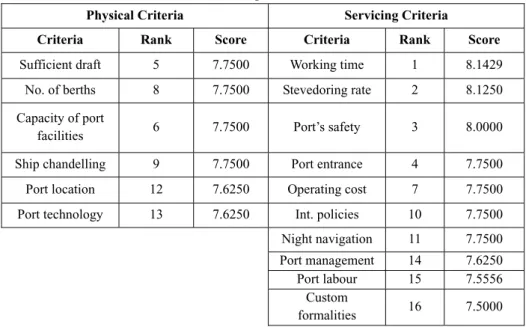
x Servicing attributes: working time, stevedoring rate, port’s safety, port entrance, operating cost, international policies, night navigation, quality of port management, port labours, and custom formalities. Respondents were asked to rank the above-mentioned criteria, as decision-making attributes for port selection. After that, their cardinal values are converted to nominal values by the use of TOPSIS, as shown in Table 4.
<Table 4> Ranked port selection attributes
Physical Criteria Servicing Criteria
Criteria Rank Score Criteria Rank Score
Sufficient draft 5 7.7500 Working time 1 8.1429 No. of berths 8 7.7500 Stevedoring rate 2 8.1250 Capacity of port
facilities 6 7.7500 Port’s safety 3 8.0000
Ship chandelling 9 7.7500 Port entrance 4 7.7500 Port location 12 7.6250 Operating cost 7 7.7500 Port technology 13 7.6250 Int. policies 10 7.7500 Night navigation 11 7.7500 Port management 14 7.6250 Port labour 15 7.5556
Custom
formalities 16 7.5000
Generally speaking, most shipping lines select ports based on the time, efficiency, and cost attributes. The TOPSIS analysis has shown that working time, stevedoring rate, safety, port entrance, sufficient draft, capacity of port facilities, operating cost, number of berths, ship chandelling, and international policies (such as embargoes) are the top ten port selection attributes in the Persian Gulf.
2. Selecting Container Seaport in Persian Gulf by AHP
As mentioned earlier, the decision-making on the most appropriate container seaport in Persian Gulf will be carried out based on the ranked attributes of section 4.1. The decision-making process in this research is a combination of AHP and TOPSIS techniques; and the results obtained by TOPSIS will be used to solve the MADM problem, by the aid of AHP.
Figure 1 illustrates the decision tree for this study which is defined in four levels. It shows six alternatives and two main attributes and their corresponding sub-attributes. The study will analyse and measure the weights of each attribute and their corresponding sub-attributes with respect to each alternative to obtain the final rankings.
<Figure 1> Container seaport selection decision tree
Solving the MADM problem, AHP Web (2012) is used, wherein the attributes’ scores are converted to AHP scale, i.e. 1 to 9 ranking. Figure 2 represents the final ranking and selection of the six alternatives.
<Figure 2> Final ranking of alternatives
43.6 19.16 13.88 9.6 7.775.9 Jebel Ali Shahid Rejaee Dammam BIK Bushehr Jubal
The AHP analysis has shown that Jebel Ali has obtained the highest priority with a ratio of 43.60%. The second priority belongs to Shahid Rajaee which has gained a priority ratio of 19.16%. Dammam is the third priority by a ratio of 13.88%. The three other ports are in a competition by priority ratios of less than 10%.
V. Conclusion
After a literature review on port selection factors, this paper provides a decision-making model for selecting the most appropriate container port in Persian Gulf, case studied among six ports as alternatives. The decision process is done in two steps, including ranking the port selection factors and selecting container seaports. The first step is solved by the use of TOPSIS technique, while the second step is modeled and analysed by the AHP.
The TOPSIS analysis has shown that working time, stevedoring rate, safety, port entrance, sufficient draft, capacity of port facilities, operating cost, number of berths, ship chandelling, and international policies are the top ten port selection attributes in the ports of Persian Gulf, respectively. The AHP analysis has shown that shipping lines prefer to berth their container vessels on Jebel Ali, Shahid Rajaee, Dammam, Bushehr, BIK, and Jubal, respectively.
It is worth noting that the performance scores from the data retrieved from questionnaires through experts and decision-makers have been analyzed by the proposed MADM method.
Variations in the values of the performance scores obtained and the fluctuations of the weights of attributes associated with different shipping lines may have resulted different ranking orders, which in turn, may lead to a different port selection approach.
As further study, it may be a good idea to add a cost-benefit trade-off analysis to the results of this research.*
Acknowledgement
The authors would like to thank the anonymous reviewers for their helpful and constructive comments that greatly contributed to improving the final version of the paper.
GGGGGGGGGGGGGGGGGGGGGGGGGGGGGGGGGGGGGGGGGGGG *GDate of Contribution ; July 19, 2013
References
AHP Web. (2012) Accessed: [December 2012],
Available at: http://www.aeaweb.org/annual_mtg_papers/2007/0105_1430_2103.pdf.
ASGHARPOUR, M. J. (2009), Multi Attribute Decision Making systems, Tehran university press.
BLONIGEN, B.A. and WILSON, W.W. (2006), International Trade, Transportation Networks and Port Choice Manuscript.
BRANCH, A.E. (2008), Elements of Shipping, London and New York, Rutledge Taylor and Francis Group.
BROOKS, M. (1984), “An alternative theoretical approach to the evaluation of liner shipping: Part 1, situation factors,” Maritime Policy and Management, Vol.11, No.1, pp.35-43.
CASTILLO-MANZANO, J.I., MERCEDES, C.N., GONZALEZ LAXE, F., LOPEZ-VALPUESTA, L. and AREVALO-QUIJADA, M.T. (2009), “Low-cost port competitiveness index: Implementation in the Spanish port system,” Marine Policy, Vol.33, pp.591-598.
CHANG, Y., LEE, S., and TONGZON, J. (2008), “Port selection factors by shipping lines: Different perspectives between trunk liners and feeder service providers,”Marine Policy, Vol.32, pp.877-885.
CHOU, C.C. (2010), “Application of FMCDM model to selecting the hub location in the marine transportation: A case study in Southeastern Asia,” Mathematical and Computer Modeling, Vol.51, pp.791-801.
CHOU, C.C. (2007), “A fuzzy MCDM method for solving marine transshipment container port selection problems,” Applied Mathematics and Computation, Vol.186, pp.435-444.
CHOU, C.C., CHU, C.W. and LIANG, G.S. (2003), “Comparison of two models for port choice,” Journal of Maritime Quarterly, Vol.12, No.3, pp.45-61.
COLLISON, F. (1984), “North to Alaska: Marketing in the Pacific Northwest-Central Alaska liner trade,” Maritime Policy and Management, Vol.11, No.2, pp.99–112.
Vol.78, No.1, pp.33-36.
GROSSO, M. and MONTEIRO, F. (2008), “Relevant strategic criteria when choosing a container port: The case of the Port of Genoa,” Association for European Transport and Contributors, pp.1-21 .
HA, M.S. (2003), “A comparison of service quality at major container ports: Implications for Korean ports,” Journal of Transport Geography, Vol.11, pp.131-137. http://www.isc.senshu-u.ac.jp/~thc0456/EAHP/AHPweb.html.
HWANG, C. and YOON, K. (1981), Multiple Attribute Decision Making Methods and Application, Berlin Heidelberg, Springer.
KAHRAMAN, C. and CEBI, S. (2009), “A new multi-attribute decision making method: Hierarchical fuzzy axiomatic design,” Expert Systems with Applications, Vol.36, pp.4848-4861 .
LINSTONE, H.A., TUROFF, M. (2002), The Delphi Method Techniques and Applications, New York, Portland State University.
LIRN, T.C., THANOPOULOU, H.A., BEYNON, M.J. and BERESFORD, A.K.C. (2004), “An application of AHP on transshipment port selection: A global perspective,” Maritime Economics & Logistics, Vol.6, pp.70-91.
LU, J., ZHANG, G., RUAN, D. and WU, F. (2007), Multi-Objective Group Decision Making Methods, Software and Application with Fuzzy Set Techniques, London, Imprical College Press.
MACNEIL, I.R. (1978), “Contracts: Adjustments of long-term economic relations under classical, neo-classical and relational contract law,” Northwestern University Law Review, Vol.72, No.6, pp.854–902.
MAHDAVI, I., MAHDAVI-AMIRI, N., HEIDARZADE, A. and NOURIFAR, R. (2008), “Designing a model of fuzzy TOPSIS in multiple criteria decision making,”
Applied Mathematics and Computation, Vol.206, pp. 607-617.
MALCHOW, M. and KANAFANI, A. (2001), “A disaggregate analysis of factors influencing port selection,” Maritime Policy and Management, Vol.28, No.3, pp.265-277.
MALCHOW, M.B. and KANAFANI, A. (2004), “A disaggregate analysis of port selection,”Transportation Research Part E, Vol.40, pp.317-337.
do?,” Maritime Policy and Management, Vol.21, No.3, pp.207–217.
MURPHY, P., DALEY, J. and DALENBERG, D. (1992), “Port selection criteria: An application of a transportation research framework,” Logistics and Transportation Review, Vol.28, No.3, pp.237-255.
MURPHY, P.R. and DALEY, J.M. (1994), “A comparative analysis of port selection factors,” Transportation Journal, Vol.34, No.1, pp.15–21.
NG, K.Y. (2006), “Assessing the attractiveness of ports in the north European container transshipment market: An agenda for future research in port competition,”
Maritime Economics and Logistics, Vol.8, No.3, pp.234-241.
NOORAMIN, A.S. and KIANI, M. (2009), “An energy – cost approach for evaluation of operating systems in container terminals,” WMU Journal of Maritime Affairs, Vol.8, No.2. pp.203-213.
NOORAMIN, A.S., SAYAREH, J., KIANI, M. and REZAEE, H. (2012), “TOPSIS and AHP techniques for selecting the most efficient marine container yard gantry crane,” OPSEARCH, Article online.
PEARSON, R. (1980), Container line Performance and Service Quality, University of Liverpool.
PETERS, H. (1990), “Structural changes in international trade and transport markets: the importance of markets,” 2nd KMI International Symposium, Seoul, pp.58–75.
POWELL, W.W. (1990), “Neither market nor hierarchy: network forms of organization,” Research in Organizational Behavior, Vol.12, pp.295–336.
SAATY T (1990), “How to make decisions: The analytical hierarchy process,”
European Journal of Operational Research, Vol.48, pp.9-26.
SAEED, N. (2009), “An analysis of carriers' selection criteria when choosing container terminals in Pakistan,” Maritime Economic and Logistics, Vol.11, No.3. pp.270-288.
SHIH, H.S., SHYUR, H.J. and LEE, E.S. (2007), “An extension of TOPSIS for group decision making,” Mathematical and Computer Modelling, Vol.45, pp.801-813.
SLACK, B. (1985), “Containerization, inter-port competition and port selection,”
SPASOVIC, L. (2004), Study to Determine the Need for Innovative Technologies for Container Transportation System, Publication of the National Centre for Transportation and Industrial Productivity, New Jersey, USA.
STARR, J. (1994), “The mid-Atlantic load centre: Baltimore or Hampton road?,”
Maritime Policy and Management, Vol.21, No.3, pp.219–227.
SUN C.C. (2010), “A performance evaluation model by integrating fuzzy AHP and fuzzy TOPSIS methods,” Expert Systems with Applications, Vol.37, pp.7745-7754.
TIWARI, P., ITOH, H. and DOI, M. (2003), “Containerized cargo shipper’s behavior in China: A discrete choice analysis,” Journal of Transportation and Statistics, Vol.6, No.1, pp.71–86.
TONGZON, J. (2002), “Port choice determinants in a competitive environment,”
Proceedings of Annual Conference and Meeting of the International Association of Maritime Economists – IAME, Panama.
TONGZON, J. (1995), “Determinants of port performance and efficiency,”
Transportation Research Part A, Vol.29, No.3, pp.245-252.
TONGZON, J. (2009), “Port choice and freight forwarders,” Transportation Research Part E, Vol.45, pp.186-195.
UNCTAD (2009), Review of Maritime Transport, United Nation, Geneva.
WILLINGALE, M. C. (1981), “The port routing behavior of short-sea operators; Theory and practice,” Maritime Policy and Management, Vol.8, No.2, pp.109-120.
World Shipping Council (2004), The World’s Largest Containership, viewed 19 April 2013, http://www.worldshipping.org/ind_6.html.
YEO, G.T., ROE, M. and DINWOODIE, J. (2008), “Evaluating the competitiveness of container ports in Korea and China,” Transportation Research Part A, Vol.42, pp.910-921.
YEO. K., LEE. H. and OH, S. (2004), “Extraction of port selection factors for increasing shippers’ attraction of small and medium ports (Written in Korean)”, The Journal of Shipping and Logistics, Vol.43, No.4, pp.33-53.