DigitalCommons@USU
DigitalCommons@USU
All Graduate Theses and Dissertations Graduate Studies
12-2013
Effective Graph-Based Content--Based Image Retrieval Systems
Effective Graph-Based Content--Based Image Retrieval Systems
for Large-Scale and Small-Scale Image Databases
for Large-Scale and Small-Scale Image Databases
Ran ChangFollow this and additional works at: https://digitalcommons.usu.edu/etd
Part of the Computer Sciences Commons
Recommended Citation Recommended Citation
Chang, Ran, "Effective Graph-Based Content--Based Image Retrieval Systems for Large-Scale and Small-Scale Image Databases" (2013). All Graduate Theses and Dissertations. 2123.
https://digitalcommons.usu.edu/etd/2123 This Dissertation is brought to you for free and open access by the Graduate Studies at
DigitalCommons@USU. It has been accepted for inclusion in All Graduate Theses and Dissertations by an authorized administrator of DigitalCommons@USU. For more information, please contact
EFFECTIVE GRAPH-BASED CONTENT-BASED IMAGE RETRIEVAL SYSTEMS FOR LARGE-SCALE AND SMALL-SCALE IMAGE DATABASES
by
Ran Chang
A dissertation submitted in partial fulfillment of the requirements for the degree
of DOCTOR OF PHILOSOPHY in Computer Science Approved: _______________________ _______________________
Dr. Xiaojun Qi Dr. Stephen Clyde
Major Professor Committee Member
_______________________ _______________________
Dr. Kyumin Lee Dr. Vicki Allan
Committee Member Committee Member
_______________________ _______________________
Dr. Yangquan Chen Dr. Mark R. McLellan
Committee Member Vice President for Research and
Dean of the School of Graduate Studies UTAH STATE UNVIVERSITY
Logan, Utah 2014
Copyright © Ran Chang 2014 All Rights Reserved
ABSTRACT
Effective Graph-based Content-Based Image Retrieval Systems for Large-Scale And Small-Scale Image Databases
by
Ran Chang, Doctor of Philosophy Utah State University, 2014
Major Professor: Dr. Xiaojun Qi Department: Computer Science
This dissertation proposes two novel manifold graph-based ranking systems for Content-Based Image Retrieval (CBIR). The two proposed systems exploit the synergism between relevance feedback-based transductive short-term learning and semantic feature-based long-term learning to improve retrieval performance. Proposed systems first apply the active learning mechanism to construct users’ relevance feedback log and extract high-level semantic features for each image. These systems then create manifold graphs by incorporating both the low-level visual similarity and the high-level semantic similarity to achieve more meaningful structures for the image space. Finally, asymmetric relevance vectors are created to propagate relevance scores of labeled images to unlabeled images via manifold graphs. The extensive experimental results demonstrate two proposed systems outperform the other state-of-the-art CBIR systems in the context of both correct and erroneous users’ feedback.
PUBLIC ABSTRACT
Effective Graph-based Content-Based Image Retrieval Systems for Large-Scale And Small-Scale Image Databases
Digital imaging was a great invention in the last century. Since digital cameras became popular in the public, a large amount of digital images emerged in the late of the twentieth century. How to manage the huge amount of images and find desired images among them became an urgent issue during the same period.
Techniques of retrieving a desired image are generally categorized into two basic classes. One relies on text-based key words to retrieve desired images in the image database. The other one relies on image-based queries to retrieve desired images in the image database. The second technique is usually named the content-based image retrieval technique. Major techniques involved in the content-based image retrieval technique include the image feature extraction, the feature matching algorithm, and the similarity calculation. Each technique plays an important role in the content-based image retrieval, and they have their own challenge issues as well. For instance, how to find an efficient and accurate feature matching algorithm is still a hot topic in the content-based image retrieval.
This dissertation addresses certain challenge issues that exist in the content-based image retrieval technique and proposes two different retrieval systems that can be applied in the small-scale and the large-scale image databases.
This work is dedicated to
my families, Qiao Xu,
Lingmin Chang and Shaohua Lu,
ACKNOWLEDGMENTS
I appreciate Dr. Xiaojun Qi for her detailed direction and encouragements for the research in this dissertation. I would like to thank my committee members, Dr. Vicki Allan, Dr. Stephen Clyde, Dr. Kyumin Lee, Dr. Yanquan Chen and previous committee members, Dr. Dan Watson and Dr. Changhui Yan.
I cordially express my appreciation to my family, friends, and colleagues for their encouragements, moral support, and patience as I worked my way from writing the initial proposal to this final document. I could not have done it without all of you.
CONTENTS Page ABSTRACT………..…….iii PUBLIC ABSTRACT………..……..iv ACKNOWLEDGMENTS………....vi LIST OF TABLES………...x LIST OF FIGURES………xi CHAPTER 1 INTRODUCTION………..1
1.1 New Era of Images and the Need for Digital Image Retrieval………1
1.2 Background of the Content-Based Image Retrieval………4
1.3 Basic Content-Based Image Retrieval Systems………...7
2 RELATED WORK………..9
2.1 Short-term Learning Techniques………...13
2.1.1 Query Updating Techniques………..13
2.1.2 Statistical Learning Techniques……….14
2.2 Long-term Learning Techniques………18
2.2.1 Latent Semantic Indexing-based Long-Term Learning………….19
2.2.2 Correlation-based Long-Term Learning………20
2.2.3 Clustering-based Long-Term Learning………..23
2.2.4 Feature Representation-based Long-Term Learning……….24
2.2.5 Similarity Measure Modification-Based Long-Term Learning…24 2.2.6 Manifold-based Long-Term Learning………...25
2.3 Evaluation Measures………..26
2.4 Outline of the Proposed Method………27
3.1 Low-Level Feature Extraction………..30
3.1.1 HSV Color Space and Color Histogram………31
3.1.2 Color Moments………..35
3.1.3 Edge Direction Histogram……….36
3.1.4 Discrete Wavelet Transform based Texture Features………37
3.2 Kernel-based Soft Margin SVM Learning………...39
3.3 CBIR Systems Based on Conventional Manifold Techniques…………..42
3.3.1 The Conventional Manifold Ranking Technique………..43
3.3.2 Variation 1: Propagating with Only Positive Feedback…………46
3.3.3 Variation 2: Propagating with Positive and Negative Feedback...46
3.3.4 Variation 3: Propagating with Weighted Positive and Negative Feedback……….………..…47
4 A SCALABLE MANIFOLD GRAPH-BASED CONTENT-BASED IMAGE RETRIEVAL APPROACH………...49
4.1 The Proposed Scalable Graph-Based CBIR Approach………..51
4.1.1 Offline Training Phase………..53
4.1.2 Online Retrieval Phase………..69
4.2 Experiments and Results………73
4.2.1 Five Image Databases………73
4.2.2 Effectiveness Evaluation………75
4.2.3 Performance Evaluation……….82
4.2.4 Comparative Complexity and Storage Evaluation……….92
4.3 Conclusions and Future Work………...93
5 A SINGLE WEIGHTED MANIFOLD GRAPH-BASED CONTENT-BASED IMAGE RETRIEVAL APPROACH …...……….………95
5.1 The Framework of the Single Weighted Manifold Graph Approach……97
5.1.1 Offline Training Phase………...98
5.1.2 Online Retrieval Phase………103
5.2 Experiments and Results………..104
5.2.1 Effectiveness Evaluation………..104
5.3 Conclusions and Future Work……….115
6 CONCLUSIONS…….….……..……….117
REFERENCES………120
LIST OF TABLES
Table Page
4.1 Comparison of retrieval performance using different wh’s ……….78
LIST OF FIGURES
Figure Page
1.1 The first digital image in the world………..4
1.2 A basic CBIR system………...8
2.1 An example of dividing an image into five regions………...10
2.2 The illustration of a RF-based CBIR system……….13
2.3 An example of the correlation matrix………21
3.1 RGB color cube………..31
3.2 HSV color cylinder………32
3.3 Example of a horse and its normalized HSV color histogram………..34
3.4 The count of pixels in each bin for the example color image………35
3.5 An example of 2-level DWT on an image……….38
3.6 An example of 2-D hyper-plane for a binary classification………...40
3.7 Mapping data points from the low-dimensional feature space to the high- dimensional feature space………..41
3.8 A toy example to illustrate the advantage of the manifold technique………43
3.9 The algorithmic view of the conventional manifold ranking technique…………45
4.1 Block diagram of the proposed system………..52
4.2 The algorithm view of the offline training phase………...54
4.3 The algorithm view of the iterative merging strategy………58
4.4 An example of R for an eight-image database after three distinct query sessions………..59
4.5 An example of merging a new column with an existing column………..61
4.7 The algorithmic view of constructing the first layer manifold graph………64
4.8 Strategy of assigning unlabeled images……….67
4.9 The structure of the proposed scalable graph-based ranking system and illustration of the layered design of the relevance vectors together with their initialization...68
4.10 Example of automatic RF scheme……….76
4.11 Comparison of the proposed system and its seven variant systems, which are built from the compact feedback log………..80 4.12 Comparison of the proposed system and its seven variant systems, which are built
from the full feedback log………..81 4.13 Comparison of ten state-of-the-art long-term-based CBIR systems on 2000-image
database………..84 4.14 Comparison of ten state-of-the-art long-term-based CBIR systems on 6000-image
database………..85 4.15 Comparison of ten state-of-the-art long-term-based CBIR systems on 8000-image
database………..87 4.16 Comparison of state-of-the-art long-term-based CBIR systems on 12000-image
database………..88 4.17 Comparison of state-of-the-art long-term-based CBIR systems on 22000-image
database………..89 4.18 Precision and recall curve of the proposed system on the 22000-image database in
the context of correct feedback………..97
5.1 Block diagram of the proposed system………..97
5.2 The algorithmic view of the offline training process………...98 5.3 The algorithm view of constructing the single weighted semantic manifold
graph.……….99
5.4 Standard Cauchy distribution function………...101
5.5 Comparison of the proposed system and its three variants, which are built from the compact feedback log……….107 5.6 Comparison of the proposed system and its three variants, which are built from
the full sized feedback log………...108 5.7 Comparison of eight state-of-the-art long-term-based CBIR systems on 2000- image database……….110 5.8 Comparison of eight state-of-the-art long-term-based CBIR systems on 6000- image database……….111 5.9 Comparison of eight state-of-the-art long-term-based CBIR systems on 8000- image database……….113 5.10 Precision and recall curve of the proposed system on 8000-imagedatabase…..115
CHAPTER 1 INTRODUCTION
With the rapidly growing number of digital images found on the Internet and housed in digital libraries, the need for effective and efficient tools to manage large image databases has grown dramatically. Specifically, the development of efficient image retrieval systems to find images of interest in this haystack of data has become an active research area in recent years [1].
1.1 New Era of Images and the Need for Digital Image Retrieval
Since the first digital image (shown in Figure 1.1) was generated in 1957 by Russell Kirsch, a scientist working in the research institute now known as the National Institute of Standards and Technology (NIST), people have entered a new era of digital imaging. Rapid development of digital imaging was stimulated by the emergence of microprocessors in the early 1970s. Millions of digital imaging devices equipped with the Charge-Coupled Device (CCDs) have launched a revolution for conventional photography and generated billions of digital images since the last decade of the twentieth century. Due to the huge amount of digital images on the Internet and in different kinds of large or small digital libraries across the world, the need for image database management and effective image retrieval tools has been growing rapidly.
Image retrieval systems meet the above need of acquiring the desired images from digital image libraries for human users. Basically, an image retrieval system is a computer system along with necessary hardware and software to search through a relatively large digital image database or library and retrieve similar images according to
the user’s query. In general, there are two kinds of image retrieval systems, namely, classical image retrieval systems and localized image retrieval systems. Specifically, classical image retrieval systems aim to find images that are similar to the query images in terms of semantic concepts. Localized image retrieval systems aim to find duplicated or near-duplicated objects in an image collection, which are the same objects contained in the query images. For example, if the query image contains a red rose with a pure background (i.e., pure black or white background), classical image retrieval systems consider any returned images containing a flower or multiple flowers with different colors and backgrounds as good retrieval results while localized image retrieval systems consider any returned images containing the rose(s) with different scales, rotation angles, and locations as good retrieval results.
In classical image retrieval systems, the query could be either text-based keywords or a certain image that the user is interested in. Most conventional techniques first require a large amount of manual labor to annotate images in the database with certain relevant keywords, descriptions, tags, or captions. They then match annotated words of the database images with the text-based query keywords submitted by the user to return similar images. Google Image (images.google.com), which is used daily by billions of people, applies this text-based conventional technique to retrieve similar images. Obviously, this kind of conventional image retrieval system requires database images to be annotated before they are added into the corresponding digital image library. Otherwise, images without any annotation will never be retrieved when a text-based query is submitted. However, manual annotation of digital images in a large digital library is an unimaginable, time-consuming task. No organizations or companies can
afford this kind of labor and expense. In addition, manual annotation has other weaknesses such as the user’s subjectiveness, erroneous image annotation, and inconsistent annotation from different users for the same images, etc. Thus, researchers start exploring techniques that perform automatic annotation for a large amount of digital images. Usually, these techniques learn a statistical model that is trained by using sufficient annotated images. With the aid of the trained model, they then perform automatic annotation for other images. The downside of automatic image annotation is that the trained model greatly relies on the quality and the number of annotated training images. If training images have inaccurate, insufficient, unevenly distributed, or low quality tags, the trained statistical model cannot provide accurate annotation for other images. Moreover, the trained statistical model cannot learn more accurate semantic concept of the images if human feedback on the automatically annotated keywords is not provided. In the 1990s, several researchers at the Massachusetts Institute of Technology (MIT), including Banireddy Prasaad, Amar Gupta, Hoo-min Toong, and Stuart Madnick, invented the first microcomputer-based digital image retrieval system for a large digital image database, wherein each image is automatically annotated [2]. This system is an initial experimental image retrieval system based on the automatic image annotation. Since the early 2000s, automatic image annotation has become a popular research topic and attracted more and more researchers to build image retrieval systems upon the automatically annotated images. These described digital image retrieval systems are also called concept-based, or “text-based” or “description-based” image retrieval systems, whose searching and retrieving process relies on automatically annotated keywords or
tags of the digital images. Later on, web-based image search engines also apply concept-based image indexing techniques to retrieve similar images from the web.
Almost at the same time of the emergence of concept-based image retrieval systems, another kind of image retrieval systems, namely, Content-Based Image Retrieval (CBIR) systems also emerged in the early 1990s. Both concept-based and CBIR systems have evolved significantly since the 1990s. In the following, I will describe the background of the CBIR system, since my proposed system belongs to this branch of the classical image retrieval systems.
Figure1.1. The first digital image in the world
1.2 Background of Content-Based Image Retrieval (CBIR)
Unlike concept-based image retrieval systems, CBIR systems perform the image retrieval task by submitting image(s) as a query and making use of low-level visual image
features (e.g., color, texture, shape, etc.) instead of keywords to represent images, where each feature can be automatically and consistently extracted without human intervention. In other words,
Typical CBIR systems perform the searching and retrieving task by analyzing colors of images, shapes of objects in images, the textures distribution of images, or any other representative information extracted from images, rather than any metadata such as keywords, tags or captions etc. Back in 1992, researcher Kato T [3] first used the term of CBIR to describe the experiment of automatic digital image retrieval by comparing image color and shape features of each database image with query’s color and shape features. Since then, this term has been wildly used to refer to all similar techniques and processes of searching and retrieving images from a digital image library using the common representative features such as colors, shapes, and textures, etc.
Early CBIR systems usually rely on image feature extraction and matching strategies to retrieve relevant images from a database. For example, Flickner et al. [4] from IBM invented the QBIC system in 1995, Gupta and Jain invented VIRAGE [5] in 1997, and Mukherjea et al. [6] invented NEC AMORE in 1999. The above three CBIR systems are the earliest systems for the commercial purpose. During the same period, some other researchers invented CBIR systems for the academic purpose, such as the MIT Photobook by Pentland et al. [7], Columbia VisualSEEK and WebSEEK by Smith and Chang [8], UCSB NeTra by Ma and Manjunath [9], and Standford WBIIS by Wang et al. [10].
Meanwhile, researchers found the advantages of employing CBIR systems in several real-world applications [11]. The following is the list of a few sample applications:
1. Architectural and engineering design: CBIR can help the designers to find similar buildings, or landscape designs by providing certain sample designs.
2. Art collections: CBIR can be applied in digital art museums and help the user to find the desired art work such as painting, drawing, photography or even sculpture by sending a sample image.
3. Criminal prevention: CBIR can help law enforcement officers to quickly find similar crime scenes, or suspects by uploading the evidence images into the system.
4. Geographical information field: CBIR can help geologic researchers to easily find desired mineral resources by grouping similar physiognomy.
5. Intellectual property: CBIR can help authors of drawing or photography to easily locate any copyright violation of their work on the Internet by submitting a digital copy of their work to the system.
6. Medical treatment: CBIR can provide the doctors great help in early diagnosis by retrieving similar pathological photos in a large medical image database.
7. Military: CBIR can help commanding officers or intelligence officers to quickly define hostile vehicles by sending the live picture of the potential enemy vehicle into the system.
8. Retail catalogs: CBIR can help customers to quickly and easily retrieve their desired merchandise by uploading the photo or picture of the merchandise to the system.
1.3 Basic Content-Based Image Retrieval Systems
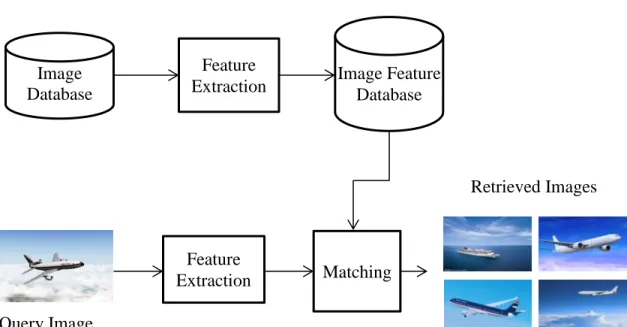
CBIR techniques are viable solutions to find desired images from digital image libraries. In a basic CBIR system, all digital images in a library are represented by their visual features (e.g., visual contents of images). Typical visual features include colors, shapes, edges, and textures to represent an image from different visual perspectives. Initially, these visual features are extracted from each image and stored in a feature database corresponding to the digital image library to facilitate the future use. When a query image is submitted to the system, visual features of the query image are first extracted. A matching method is then employed to compare the similarity between visual features of the query image and visual features of all digital images in the image database. Only those images having higher similarity scores are returned to the user as the retrieval results. Figure 1.2 shows the high-level block diagram of a basic CBIR system.
However, as the ranking of retrievals is calculated based on selected image features, the retrieval accuracy may be unsatisfactory due to the semantic gap between low-level visual features and high-level semantic concepts. This semantic gap exists because images of similar semantic content may be scattered far away from each other in the feature space, while images of dissimilar semantic content may share similar low-level features. For example, given a query image with a black horse in the front view, an image with a white horse in a side view is considered similar to the query image from the
view point of the semantic concept. However, the front view of a black horse looks very different from the side view of a white horse, so are their visual features (i.e., their visual features are different). On the other hand, the cruise in the ocean and the airplane in the blue sky, as shown in Figure 1.2, are two distinct objects with the similar low-level features. The cruise is wrongly retrieved by the CBIR system when the airplane is submitted as a query due to the high similarity of their low-level feature vectors. Humans bridge this gap without even noticing that they are doing it.However, computer vision techniques have been struggling to bridge this gap ever since the advent of the computer vision.
Figure 1.2. A basic CBIR system
Therefore, the existence of the semantic gap makes basic low-level feature-based CBIR systems have limited use. This also motivates researchers to study other techniques to bridge the semantic gap for CBIR systems.
Image Database Image Feature Database Feature Extraction Feature Extraction Matching Retrieved Images Query Image
CHAPER 2 RELATED WORK
As mentioned in the previous chapter, the semantic gap is the primary issue to be considered by researchers when they develop CBIR systems. Many novel techniques have been proposed to overcome this stubborn challenge. Representative techniques that tackle with the semantic gap problem are reviewed.
Present CBIR techniques can be generally classified into four major categories according to the survey papers by Antani et al. [12], Smeulders et al. [13], and Zhou et al. [14]. These four categories are global based [4, 7, 15, 16], region-level feature-based [1, 17 - 25], object-level feature-feature-based [19, 25 - 30], and Relevance Feedback (RF)-based [16, 27, 31 - 34], respectively.
Global feature-based techniques rely on the visual features extracted from a whole image and treat each part or object in the image without discrimination. With the aid of these global features, CBIR systems deploy variable matching strategies to find most relevant images in the database to the query image based on the similarities of global features. For example, the QBIC system [4] uses the average color and texture of an image as low-dimensional features and the 20-dimensional moment-based shape features as high-dimensional features to represent an image for the retrieval task.
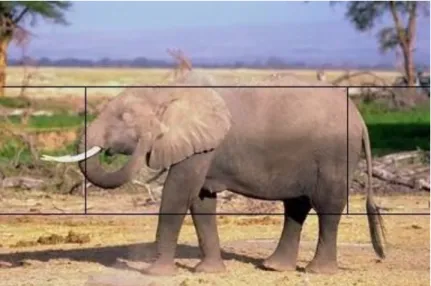
Unlike global feature-based techniques, region-level feature-based techniques usually separate an image into several regions and treat regions with different attentions according to the importance of the content in each region. The size of the regions can be either equal or different. In other words, methods of dividing the images vary depending
on real applications. Figure 2.1 shows an example of dividing an image into five different regions according to the importance of the content in each region [35]. This division scheme assumes that the central region in an image likely contains the most important visual content, the upper and lower regions normally contain the background information, and the most left and right regions possibly contain some other objects that are not the key content of an image. After extracting visual features for every region (e.g. the color, shape and texture), regional-level feature-based techniques apply various matching algorithms to calculate the similarities between the images in the digital image database and the query image at the regional level and fuse the similarities of all regions to produce a final relevance score to measure the overall similarity. For instance, Qi and Han [36] propose a CBIR system which uses a fuzzy feature representation to represent the characteristics of an image based on a set of color-clustering-based regions. The final relevance score is calculated based on a fuzzy region matching scheme.
Compared to region-level feature-based techniques, object-level feature-based techniques focus on more detailed content information. This kind of technique first applies an image segmentation method to obtain independent objects in an image. They extract visual characteristics of these objects such as color, texture, shape etc. to form a low-level visual feature vector for an image. Finally, they apply a matching algorithm on these object-level features to calculate the final relevance score for each image in the image database. Wang et al. [25] apply object-level color, texture, and shape features in their proposed SIMPLIcity CBIR system and demonstrate their effectiveness. However, image segmentation remains to be a challenging research topic in the computer vision field. There is not a universal segmentation solution for all type of images. Therefore, object-level feature-based systems suffer from the degraded quality of the segmented images.
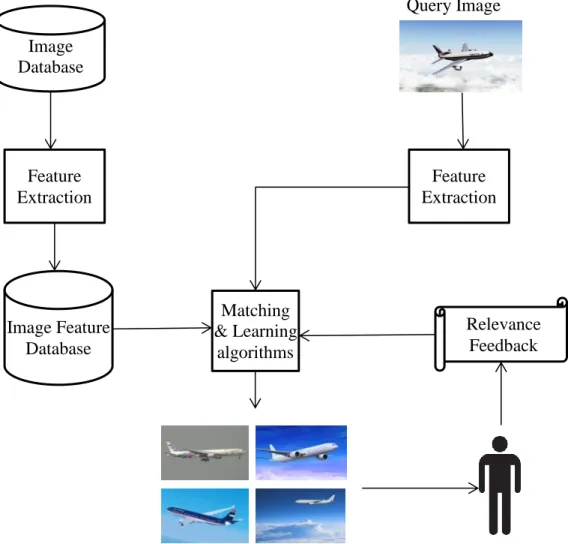
Relevance Feedback (RF)-based techniques [37] are online supervised learning techniques which have been widely adopted in CBIR systems to bridge the semantic gap. RF repeatedly modifies the query descriptive information (feature, matching models, metrics or any meta knowledge) as response to the users’ feedback on retrieved results. Therefore, it learns the query close to its optimal and returns more user-desired images (i.e., improves the retrieval precision) after each round. Figure 2.2 provides a simple flow diagram of a RF-based CBIR system. The first RF-based interactive CBIR system is proposed in [33], where the user’s provided judgment upon the retrieved images in previous retrieval iterations is used to overcome two major weaknesses in non-RF-based systems: 1) the semantic gap between high-level semantic concepts and the low-level visual features of images, and 2) the subjectivity of human perception of visual content
(i.e., inconsistent relevance judgments of the same image from different human users). Specifically, this first RF-based system dynamically updates the corresponding feature weights to capture the user’s query intention and perception subjectivity after each query iteration. As a result, this RF-based CBIR system improves the retrieval performance of other non-RF-based CBIR systems.
Figure 2.2. The illustration of a RF-based CBIR system Image Database Image Feature Database Feature Extraction Matching & Learning algorithms Feature Extraction Query Image Retrieved Images Relevance Feedback
Users play an important role in such RF-based CBIR systems. Correct feedback from users greatly boosts the performance of the CBIR system to capture the desired search intention of users. As a result, researchers have been focusing on applying learning algorithms on the user’s RF to improve the retrieval performance. These learning algorithms can be generally categorized into short-term learning techniques and long-term learning techniques. Selecting the proper learning techniques depends on the real retrieval applications. There is not a clear answer of whether short-term learning is better than term learning or vice versa. The review of short-term learning and long-term techniques is provided in the following subsections.
2.1 Short-term Learning Techniques
Short-term learning techniques aim to find out which images are relevant to the user’s query over the course of a single query session. Query updating and statistical learning techniques are two common categories of short-term learning techniques.
2.1.1 Query Updating Techniques
Query updating techniques improve the representation of the query itself by using the user’s subjectively labeled information. Examples of query updating techniques include query re-weighting [38], query shifting [39], and query expansion [40]. Specifically, Kushki et al. [38] apply the query re-weighting technique to learn an optimal mapping between low-level visual features and high-level semantic concepts of an image by adjusting the weights (or importance) of each feature component or by modifying the corresponding similarity measure. Muneesawang and Guan[39] apply the
query shifting technique to allow the user to directly modify the query image’s characteristics, which correspond to some components in the query’s feature vector, by specifying their attributes in the form of relevant or irrelevant retrieved training images marked by the user. In other words, the characteristics of the query image’s content are changed according to a more accurate semantic representation provided by the user during the retrieval process. Widyantoro et al. [40] apply the query expansion technique to include a set of relevant non-user-labeled images to compensate for the lack of the user-labeled images and help the system capture more accurate meaning of the query image.
2.1.2 Statistical Learning Techniques
Statistical learning techniques improve the classification boundary between relevant and irrelevant images or predict the relevance of unlabeled images which are attainable during the training stage. Examples of statistical learning techniques include inductive learning and transductive learning.
2.1.2.1 Inductive Learning: Inductive learning [41] is defined as a process of acquiring knowledge by drawing inductive inferences from teacher or environment-provided facts. Such a process involves operations of generalizing, transforming, correcting, and refining knowledge representations. Inductive learning techniques applied in CBIR systems create various classifiers which separate the relevant (i.e., positive) and irrelevant (i.e., negative) images and generalize well on unlabeled images. Here, relevant and irrelevant images are respectively positively and negatively retrieved images labeled by the users during the query retrieval session. Typical inductive learning
techniques include decision tree learning [42], Bayesian learning [43 - 45], support vector machine (SVM) learning [46], fuzzy SVM (FSVM) learning [47], and boosting [48].
MacArther et al. [42] apply a decision tree in the CBIR application. They use the relevant and irrelevant images marked by the user to partition the feature space until all instances in a partition are of the same class. Su et al. [44] feed the relevant and irrelevant feedback from the user into a Bayesian classifier. Relevant images are used to estimate a Gaussian distribution which represents the user desired images for a query image, while irrelevant images are used to revise the ranking of retrieved candidates. Tong and Chang [46] propose a CBIR system with the aid of the SVM which learns a proper boundary to separate images in the database into relevant and irrelevant partitions using relevant and irrelevant samples collected from previous retrieval iterations. The mechanism of the SVM will be described in Chapter 3, since it is a related technique employed in my proposed CBIR system. Wu and Yap [47] apply a FSVM to learn a decision boundary to separate positive and negative training images which are assigned corresponding fuzzy weights to determine its importance in the classification task. The learned decision boundary is then used to partition the database images into relevant and irrelevant images, where the relevant images with the largest distance to the boundary are considered to be the most similar images to the query. Tieu and Viola [48] propose a CBIR system which a “boosting” learning mechanism is used to generate a very large number (e.g., 46,875) of highly selective features to capture as many as possible aspects of an image’s visual concept. A series of weak learners based on a small number of features are trained during the query time. By combining all of these weak classifiers, the
system eventually obtains a strong classifier which is well-correlated with the ideal classification.
However, query updating methods [39] do not fully utilize the information embedded in feedback images and therefore cannot achieve satisfactory retrieval results. Inductive learning methods [46, 47] yield degraded retrieval results when the chosen classifier is trained with insufficient labeled training samples. Moreover, these two categories of techniques ignore the manifold structure of image features. Therefore, the latest trend has been moving towards RF-based transductive learning.
2.1.2.2 Transductive Learning: Transductive learning techniques explore the relationship of all database images in the feature space and propagate ranking scores of labeled images to unlabeled images via a weighted graph. In this way, the information of the entire database, instead of labels that are assigned to images by users, is efficiently utilized to facilitate the future learning. Manifold-ranking-based learning [16, 49 - 56] techniques are the representative transductive learning techniques. They use all unlabeled images as vertices in a weighted graph to propagate the ranking score of labeled images. The following paragraphs provide a brief review of representative
transductive learning techniques in CBIR systems.
He et al. [49] propose the Manifold Ranking Based Image Retrieval (MRBIR) algorithm to represent images and their relationships as a graph. This system propagates the labeled image information through the graph structure of the image database and exploits the distribution of unlabeled images to improve the retrieval accuracy. Cai et al. [50] incorporate a locality preserving regularizer into the manifold structure to learn a classification function in the image manifold. They then apply the user’s RFs to update
the manifold structure for better classification. He et al. [16] propose the generalized MRBIR (gMRBIR) algorithm to improve the MRBIR algorithm by allowing the user to submit any query image that is either inside or outside of the database. Wang et al. [51] apply the Affinity Propagation Clustering (APC) algorithm to reduce the manifold graph and preserve its manifold structure. This reduced graph damps the effect of noisy images while emphasizing the effect of reliable images. However, the retrieval performance may be degraded when clusters do not resemble the semantic concept. Lin et al. [52] propose a so-called Augmented Relation Embedding (ARE) method to transform an image space into a semantic manifold. By applying this semantic manifold structure, the system can obtain the user’s query preferences. Meanwhile, a new image representation based on the augmented feature is also deployed to adapt the ARE learning. Wan [53] proposes to divide every database image in equal-sized blocks and then apply the MRBIR algorithm on each block. The retrieval score of each image is a fusion of ranking scores of all blocks in the image. Extensive experimental results show that this block-based manifold ranking method outperforms the conventional manifold ranking method. Liu et al. [54] invent a novel manifold ranking system, named Bidirectional-Isomorphic Manifold Learning, to acquire more semantic representation from web images to overcome the imprecise semantic content representation caused by noisy and redundant information from textual and visual aspects. This method eventually optimizes the visual feature and textual spaces and unifies adjustments in both spaces to a topological structure called reversed manifold mapping. This new system also combines the image annotation and keywords correlation analysis to boost the final retrieval accuracy. Han et al. [55] come up with a novel image classification framework, which adopts Local and Global
Regressive Mapping (LGRM) in manifold learning to learn the low-dimensional embedding of the input data and the mapping function for out-of-sample data at the same time. Eventually, it predicts the class labels for a test image by applying the supervised classifier in the learned low-dimensional manifold. Xu et al. [56] propose to project the conventional manifold ranking into a Bregman divergence optimization framework by using an equivalent optimal kernel matrix. Based upon their new formulation, two effective and efficient extensions called DMRE and DMRC are created to boost the
retrieval accuracy and shorten the computational time.
All above transductive methods achieve better retrieval precision in each iterative step. However, they do not apply users’ accumulated historical RF information to improve the manifold graph. They also cannot run on a computer when the number of images in the database reaches a certain level due to the use of several large square matrices. Furthermore, all these short-term learning techniques cannot capture the semantic meaning of an image and therefore cannot achieve satisfactory retrieval results. They also cannot remember users’ historical feedback and therefore cannot utilize it in future retrievals.
2.2 Long-term Learning Techniques
Recently, long-term learning or inter-query learning extends short-term learning by utilizing the information gathered from the past retrieval sessions to improve the retrieval results in future retrieval sessions. Specifically, these long-term learning techniques first store the accumulated feedback history collected from multiple query sessions in a feedback log. They then aggregate the information in the feedback log into a
semantic matrix, relevance matrix, or affinity matrix, which can be further used to discover extra knowledge. Finally, they infer relationships between images by analyzing the transformed matrix and estimate the semantic relevance level of a database image to the current query. In general, long-term learning techniques can be categorized into six categories [57]: Latent Semantic Indexing (LSI)-based, correlation-based, clustering-based, feature representation-clustering-based, similarity measure modification-clustering-based, and manifold-based techniques. In the following subsections, a review of the representative long-term learning techniques is presented.
2.2.1 Latent Semantic Indexing-based Long-Term Learning
Latent Semantic Indexing (LSI) technique was proposed by Deerwester et al. [58] for document query in 1990. The core of LSI is to construct a term-by-document matrix and apply the Singular Value Decomposition (SVD) on this term-by-document matrix to identify patterns in the relationships between the terms and concepts contained in an unstructured collection of text. In document query, the query is a document which is represented by several known terms. Given these terms, a number of similar documents can be retrieved. When the LSI techniques are used in CBIR systems, terms refer to query images and documents refer to the retrieved relevant images in the digital image database. The term-by-document matrix in CBIR is a matrix M with the size of m× n, where m is the number of queries and n is the number of images. The SVD technique can then be applied on Mm× n to acquire an approximation term-by-document matrixMmn
~ , which is defined by the following formula:
Mmn UmrSrrVrn Mmn UmkSkkVkn ~ ~ ~ ~ (2.1)
where r is the rank of Mm× n, Mmn
~
is composed of the top k largest singular values (k < r) corresponding to the singular vectors, U contains the eigenvectors of MMT, V contains the eigenvectors of MTM (e.g., U and V are orthogonal), and S contains non-zero singular values of M at the diagonal of the matrix, which are the square roots of the non-zero eigenvalues of both MMT and MTM. This approximated decomposition greatly reduces the sizes of Umk Skk
~ , ~
andV~kn, so the storage requirement and the computational cost are reduced.
Heisterkamp [59] invent a new method to construct the term-by-document matrix M based on three assumptions: 1) images in a digital image database can be treated as the words of vocabulary of the system; 2) an image has multiple semantic concepts; and 3) many images share similar semantic concepts. SVD is then utilized on M to generate corresponding approximated Umk Skk
~ , ~
andV~kn. When an unknown query is submitted, a pseudo-documentTq is constructed for this query and projected into the latent semantic
space by Fq U~Tq. The system finds K-Nearest Neighboring documents of Fq and selects the most probable and informative terms to form the retrieval set which is returned to the user. The new retrieval iteration starts after Tq is updated based on the user’s RF.
2.2.2 Correlation-based Long-Term Learning
Correlation-based long-term learning techniques aim to explore the semantic correlation for each pair of images in an image database using accumulated historical log files obtained from query sessions. Researchers demonstrated that the efficiency of the CBIR system can be improved with the help of these log files.
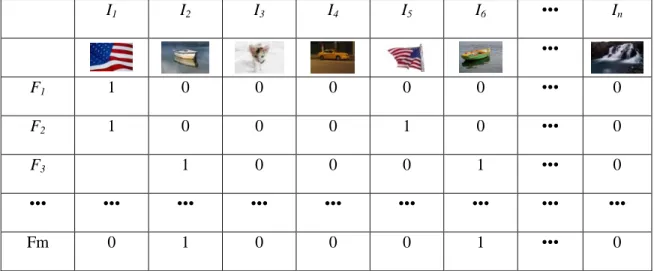
Zhou et al. [60] introduce a correlation matrix Rm×n to store the relevance
information labeled by the user, where m is the number of query sessions, and n is the number of images in the image database. Specifically, each element rij in Rm×n denotes
the relevance label of an image Ij at the ith query session Fi. Figure 2.3 shows an
example of this correlation matrix. Here, if an image is labeled as relevant by the user at a certain retrieval iteration, the corresponding element in R is set as 1’s. Suppose that image I1 is labeled as a relevant image by the user in query sessions F1, F2, and F3.
Corresponding elements in the first column are set as 1’s, respectively. For other images (e.g., images labeled as irrelevant by the user or not returned in a query session), corresponding elements are set as 0’s in the correlation matrix. Finally, the system applies the collaborative filtering method to measure the correlation between database images and the current relevant images. However, this work does not involve irrelevant images labeled by the user in the construction of the correlation matrix.
I1 I2 I3 I4 I5 I6 ••• In ••• F1 1 0 0 0 0 0 ••• 0 F2 1 0 0 0 1 0 ••• 0 F3 1 0 0 0 1 ••• 0 ••• ••• ••• ••• ••• ••• ••• ••• ••• Fm 0 1 0 0 0 1 ••• 0
Yin et al. [61] design a virtual-features-based technique to explore the long-term historical feedback information to estimate the semantic relationship between images. Specifically, their proposed system combines the short-term and long-term learning to utilize users’ historical feedback to form virtual features of images to represent the semantic meaning of images. It then adaptively calculates the similarity between each image and the query based on the semantic relevance calculated by virtual features. In addition, their proposed system is capable of handling the dynamic database by adapting the concepts according to the user’s new subjective concepts.
He et al. [62] propose a RF-based CBIR framework to combine short-term and long-term learning. Specifically, short-term learning employs the query refinement technique to update the image’s low-level visual features. Long-term learning focuses on constructing the semantic space which contains the relevant feedbacks in the previous retrieval iterations. An image in the database is then represented by a semantic vector, which can be updated according to the future accumulated users’ RF. A SVD technique is also applied on the semantic space to reduce its size. However, this system does not consider the irrelevant samples in the RF in the construction of the semantic space.
Xiao et al. [63] propose a short-term (intra-query) and long-term (inter-query) combined learning strategy by applying users’ historical RF semantic knowledge to create dynamic semantic features for database images. This system builds an adaptive semantic matrix to store the similarity of the relevant and irrelevant images in historical query sessions during the cross-session learning process. The high-level semantic similarity can benefit from the updated semantic features to boost the overall retrieval accuracy.
2.2.3 Clustering-based Long-Term Learning
Clustering-based long-term learning techniques rely on the large amount of the accumulated historical retrieval information to group database images into several clusters, where each cluster has a unique semantic concept.
Han et al. [64] propose a memory learning technique to form a knowledge memory model to store the semantic information and learn semantic relations. Specifically, the semantic correlation between a pair of images is measured as a ratio of co-positive-feedback frequency and co-feedback frequency, where co-positive-feedback frequency represents the number of times that this image pair is both labeled as positive to the same query and co-feedback frequency represents the number of times that this image pair is labeled as either both positive or one positive and one negative. With the aid of semantic correlations computed in the previous labeling, the system applies the k -means clustering method to divide database images into several semantic-correlated clusters, where images in the same cluster are regarded as sharing the same semantic concept. It then explores the semantic relations between images according to the correlation ranking learned from low-level visual feature-based short-term learning and high-level semantic-based long-term memory learning. Finally, it measures the relevance similarity between each image and query image by applying a probabilistic model.
Recently, Qi et al. [35] enhanced the retrieval performance by developing a short-term block-based FSVM and long-short-term dynamic semantic clustering (DSC) technique, which adaptively learns and updates semantic categories using users’ positively and negatively labeled RF. Specifically, in short-term learning, the system applies the nearest neighbor mechanism to choose additional similar blocks. A fuzzy metric is computed to
measure the fidelity of the actual class information of the additional blocks. The FSVM is finally applied on the enlarged training set to learn a more accurate decision boundary for classifying images. Long-term learning addresses the large storage problem by building dynamic semantic clusters to remember the semantics learned during all query sessions. In detail, it applies a cluster-image weighting algorithm to find the images most semantically related to the query. It then applies a DSC technique to adaptively learn and update the semantic categories.
2.2.4 Feature Representation-based Long-Term Learning
Feature representation-based long-term learning techniques use the user’s historical feedback to adjust the weights for the low-level visual feature vectors.
Cord and Gosselin [65] use the subset of labels which are accumulated in the historical query sessions to modify low-level visual feature vectors of images to refine images’ feature representation. A supervised optimization of a subset of feature vectors is employed to improve the representation of the image collection without any prior information.
2.2.5 Similarity Measure Modification-Based Long-Term Learning
Similarity measure modification-based long-term learning techniques aim to adaptively modify the similarity measure based on the accumulated historical user’s RF knowledge.
Hoi et al. [66] propose a CBIR system which appliesthe statistical correlation on the retrieval log to analyze the relationship among images based on the current and past query sessions. This correlation of images is stored in a retrieval log-based correlation
matrix. In details, the relevance similarity is calculated by the formula ) ( 5 . 0 ) ( 5 . 0 ) ( i LG i LL i q I f I f I
f , where q is the query image, Iiis a database image, fq(Ii)
calculates the relevance score of image Ii with regards to q, fLG(Ii) calculates the relevance
score using the correlation difference between user labeled relevant samples and irrelevant samples in the log-base correlation matrix, and fLL(Ii) calculates the relevance
score based on low-level visual feature vectors.
2.2.6 Manifold-based Long-Term Learning
Unlike the above five categories of long-term learning techniques which use the piecewise distance calculation, manifold-based long-term learning techniques explore the relationship of all database images in the feature space.
Chang and Qi [67] and Chang et al. [68] create semantic clusters based on users’ historical RF to group semantically similar images. They then construct a weighted semantic clusters-based manifold structure to represent image relationship in low-level visual feature space [67] and both low-level visual and high-level semantic feature spaces [68] for better retrieval performance. However, these two learning techniques cannot be directly applied to a large scale CBIR system due to the use of several large square matrices whose size equals to the square of the number of database images. To make the system scalable, Chang and Qi [69] propose a novel hierarchical manifold ranking system which constructs a two-layer intrinsic weighted structure using the visual space at the first layer and the visual and semantic spaces at the second layer. The relevance scores of labeled images are propagated to unlabeled images via this hierarchical manifold. However, a relatively large matrix is used to store semantic features of each database
image. The size of this matrix equals to the number of database images multiplying by the number of training queries (e.g., 10% of the number of database images). As the size of the image database grows, the size of this matrix grows too. Eventually, computer may not have enough memory space to store this matrix. So the scalability issue still presents in all existing long-term manifold-based CBIR systems.
2.3 Evaluation Measures
Two kinds of evaluation measures, Precision and Recall, are used extensively to evaluate the retrieval performance in CBIR.
Precision is the ratio of the number of retrieved relevant images and the number of all retrieved images during a single retrieval iteration. It is computed as follows:
) (Re ) (Re Pr trieved Sum levant Sum ecision (2.2)
Recall is the ratio of the number of retrieved relevant images in a query session over the number of all relevant images in the image database. It is computed by:
) _ _ (Re ) _ _ (Re Re Database in levant Sum Session in levant Sum call (2.3)
Both precision and recall are normally represented by a percentage. They also have an inversed relationship. That is, the precision decreases when the number of retrieved images increases, while the recall conversely increases.
Another often adopted measure is an evolution of the precision, which is called Average Retrieval Precision (ARP). Given multiple queries, the retrieval performance of each query is first measured by precision. The overall retrieval performance of a system is measured by averaging all of the precisions. This ARP is computed as follows:
ARPaverage(
Pi) (2.4) where Pi is the precision of each query. It is a powerful measure to represent theperformance of the CBIR system, especially when a thorough test is deployed.
Combining precision and recall generates another commonly applied measure, namely, Precision-Recall curve (PR curve), to evaluate the performance of CBIR systems. Specifically, in a PR curve, the x-axis represents recalls which are achieved by using different number of returning images in a query session, and y-axis represents the corresponding precision associated with each recall.
2.4 Outline of the Proposed Method
In this dissertation, I propose two novel manifold-based long-term learning CBIR frameworks. The first framework is named as the scalable graph-based CBIR framework, can be effectively applied to large-scale image databases. This scalable graph-based ranking system requires comparatively small memory space to construct two-layer hierarchical graphs for the image database. Therefore, this proposed system is efficient to perform retrieval tasks in large-scale image databases (i.e., image databases with more than 10,000 images). On the other hand, this proposed system has to sacrifice certain computational efficiency to build such hierarchical graphs during the offline training stage. Specifically, it takes the advantages of both RF based transductive short-term learning and semantic feature-based long-term learning techniques to improve retrieval performance. Major contributions are: 1) Quickly constructing a compact dynamic feedback log to store retrieval patterns of each past query session. 2) Efficiently merging similar semantic concepts to maintain a reasonable number of representative
semantics for all images in a database. 3) Creatively constructing two-layer hierarchical graphs to represent the inherent structure of the large-scale image database during the system offline training stage. 4) Effectively combining low-level visual and high-level semantic similarity measure to build a scalable manifold graph, which explores the intrinsic structure of images in both low-level visual and high-level semantic feature spaces. 5) Effectively designing a layered relevance vector to propagate the relevance scores from anchor images to the second layer graphs and further propagate relevance scores of labeled images to unlabeled image via the hierarchical graph-based structure.
The second framework, named as the single weighted semantic manifold graph ranking framework, can be effectively used in small databases. This proposed system requires less computation to construct the graph structure of the image database. Therefore, it’s an efficient CBIR system when users perform retrieval tasks in relatively small databases (i.e., image databases with less than 10,000 images etc.). Specifically, this framework builds a more accurate intrinsic structure for the proper image space by combining low-level and high-level relations. Major contributions are: 1) Applying the learning mechanism to explore semantic concepts of the image database. 2) Extracting high-level semantic features of each image based on users’ retrieval experiences. 3) Incorporating the importance score of each image into the affinity matrix to build the weighted semantic manifold structure. 4) Constructing the asymmetric relevance vector to propagate ranking scores of its labeled images via the manifold to images with high similarities.
The rest of this dissertation is organized as follows: Chapter 3 describes several key related techniques used in the proposed frameworks. Chapter 4 presents the
proposed scalable graph-based CBIR framework together with its corresponding extensive experiments, analysis, conclusions, and future work. Chapter 5 describes the proposed single weighted semantic manifold graph-based CBIR system together with its corresponding extensive experiments, analysis, conclusions, and future work. Chapter 6 concludes the dissertation and presents the future work to improve both frameworks.
CHAPTER 3 RELATED TECHNIQUES
In this chapter, I provide a detailed background of techniques that are employed in my proposed systems. Remaining sections in this chapter are arranged as follows: section 3.1 describes the low-level visual feature used in proposed systems; section 3.2 explains the kernel-based soft margin SVM technique that is applied in the offline training phase in proposed systems; section 3.3 describes the conventional manifold techniques.
3.1 Low-Level Feature Extraction
In computer vision, effectively representing an image is a critical issue. Powerful image features can greatly reduce the semantic gap between the human perception-based semantic concepts and the machine-based visual features. As a result, proper low-level image features should contain complementary information to represent an image or objects within an image from different perspectives. They should be of a reasonable length and easy to compute. In other words, inefficient low-level features decrease the efficiency of deploying CBIR systems in real-world applications.
Low-level features usually include color, edge, and texture features. Specifically, the color feature can be represented by the color histogram and the color moment; the edge feature can be represented by the edge histogram; and the texture feature can be represented by co-occurrence matrices and statistics of each significant subband in the wavelet transformed image.
3.1.1 HSV Color Space and Color Histogram.
In CBIR systems, color is the commonly adopted feature to represent the characteristics of an image. Researchers have explored many techniques to categorize the color into different color spaces. Red, Green, and Blue (RGB) space is a well-known common color space for the public because it works similarly as the human visual system [70]. Mixing three primary colors (e.g., red, green, and blue) can generate countless colors. Figure 3.1 shows a RGB color cube as an example. The RGB color space has many variants including ISO RGB, Extended ISO RGB, standard RGB (sRGB), Adobe RGB (1998), Apple RGB, NTSC RGB (1953), etc. [71].
Figure 3.1. RGB color cube
However, the RGB color space is not suitable for color image processing, because of the following three reasons:
(1) The colors R, G, and B have tight relationships among themselves.
(3) In computer vision, R, G, and B colors of an object in a digital image highly rely on the reflecting lights of the object, which makes the object discrimination very difficult.
As a result, Smith et al. [72] propose an HSV color space, where H, S, and V represent Hue, Saturation, and Value, respectively. Here, Hue indicates the color type, Saturation indicates the color purity, and Value indicates the color brightness. Compared to the RGB color space, the HSV color space makes the object discrimination easier because the information in three channels is relatively independent to each other. In addition, the HSV color space closely models the natural human perception and has been proven to be effective in many previous CBIR research studies. Figure 3.2 shows the HSV color cylinder as an example.
Figure 3.2. HSV color cylinder
Each point in the RGB color space can be mapped into a point in the HSV color space using the following formulas [73].
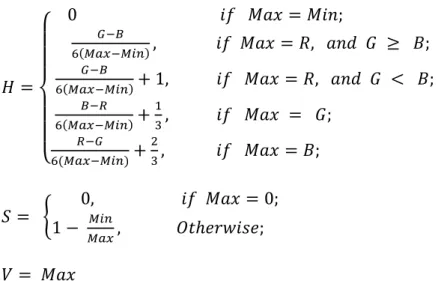
{ ( ) ( ) ( ) ( ) (3.1) { (3.2) (3.3) where Max and Min are the maximum and minimum value of the R, G, and B components at a point, respectively.
Normalized color histogram is one of the most commonly used color features. The image histogram refers to the count of different image intensities. For a color digital image, the normalized color histogram captures the joint probabilities of the intensities of the three color channels. It is defined as follows:
( ) ( ) (3.4) where X, Y, and Z respectivelyrepresent the three different color channels, such as R, G, and B in the RGB color space, and H, S, and V in the HSV color space, and N is the total number of pixels in the image. Computationally, the color histogram is generated by discretizing the color within a digital image and counting the number of the pixels of each color in each bin. Finally, this histogram is normalized in the range of [0, 1] by dividing the total number of pixels (e.g., N) in the image.
Figure 3.3 shows an example image and its 64-bin normalized HSV color histogram. Here, the image is discretized into 8 bins for H channel, 2 bins for S channel,
and 4 bins for V channel. In the following, I explain the detailed steps to obtain the 64-bin normalized HSV color histogram for the example horse image.
Figure 3.3. Example of a horse and its normalized HSV color histogram
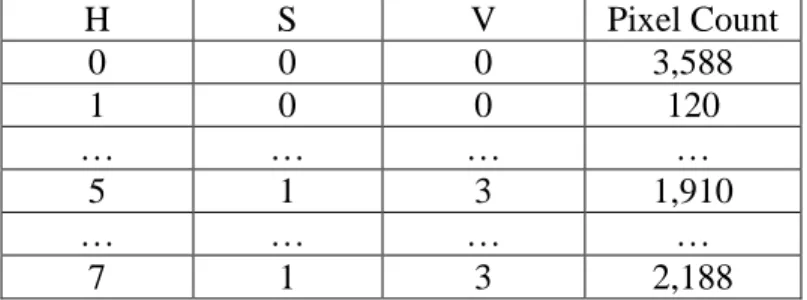
Firstly, the horse image is converted from the RGB color space to the HSV color space using Equations (3.1) through (3.3). Secondly, the values in H channel are discretely scaled into one of the eight integer values ranging from 0 to 7, the values in S channel are discretely scaled into one of the two integer values ranging from 0 to 1, and similarly the values in V channel are discretely scaled into one of the four integer values ranging from 0 to 3. Thirdly, represent each bin in a 64-bin color histogram by a 3-dimensional vector (Hvalue, Svalue, Vvalue) with Hvalue, Svalue, and Vvalue being any of the scaled integer values in the range of [0, 7], [0, 1], and [0, 3], respectively. Examples of these 3-dimensional vectors include (0, 0, 0), (1,0,0),…, (0,1,0),…(7, 1, 3). Fourthly, for each bin corresponding to its unique (Hvalue, Svalue, Vvalue) vector, record the number of pixels whose values in the three channels H, S, and V respectively are Hvalue, Svalue, and Vvalue. One sample result of this counting is shown in Figure 3.4.
Finally, the pixel count in each bin is divided by the total number of pixels in the horse image to obtain its probability. The final 64-bin normalized HSV color histogram is shown in Figure 3.3, which represents the color distribution of an image.
Figure 3.4. The count of pixels in each bin for the example color image
3.1.2 Color Moments
Color moments are another common color features. The first three order moments of an image are respectively Mean, Variance, and Skewness in each color channel. The first order moment, Mean, measures the average color in each channel. The larger mean value indicates most pixels in the image tend to have the brighter intensity. The second order moment, Variance, measures the spreadness of the color in each channel. A small variance indicates that the pixel intensities tend to be very close to the average intensity while a high variance indicates that the pixel intensities are very spread out from the average intensity. The third order moment, Skewness, measures the shape of the color distribution in each channel. They are computed as follows:
∑ (3.5) √( ∑ ( ) ) (3.6) H S V Pixel Count 0 0 0 3,588 1 0 0 120 … … … … 5 1 3 1,910 … … … … 7 1 3 2,188