Procedia - Social and Behavioral Sciences 171 ( 2015 ) 1388 – 1394
1877-0428 © 2015 Published by Elsevier Ltd. This is an open access article under the CC BY-NC-ND license (http://creativecommons.org/licenses/by-nc-nd/4.0/).
Peer-review under responsibility of the Organizing Committee of ICEEPSY 2014. doi: 10.1016/j.sbspro.2015.01.258
ScienceDirect
ICEEPSY 2014
Developing
self-efficacy and motivation to be a teacher scale,
Thai version
Natthapol Jaengaksorn
a,*, Auyporn Ruengtrakul
a, Chayut Piromsombat
a aDepartment of Educational Research and Psychology, Faculty of Education, Chulalongkorn University, Bangkok 10330, ThailandAbstract
The measurement model of self-efficacy and motivation to be a teacher were developed for student teachers as an instrument to measure such variables as appropriate to Thai context. The validation of scales of self-efficacy and motivation to be a teacher for Thai student teachers are robust and showed excellent measurement properties. The purposes of this study were to validate the developed measurement model of self-efficacy and motivation to be a teacher. The sample consisted of 78 student teachers who studying in the last academic year in university. The research instruments were questionnaire related to self- efficacy and motivation to be a teacher. Data were analyzed by using SPSS to detect reliability and other psychometric properties, as well as LISREL program version 8.72 to validate the measurement model. Major research results were as follows: 1) the developed measurement model of self-efficacy consisted of 3 indicators: efficacy in student engagement, efficacy in instructional strategies, and efficacy in classroom management according to the empirical data ( = 0.02, df = 1, p = 0.08), and 2) the developed
measurement model of motivation to be a teacher consisted of 2 indicators: intrinsic motivation, and extrinsic motivation according to the empirical data ( = 2.23, df = 1, p = 0.13)
© 2015 The Authors. Published by Elsevier Ltd.
Peer-review under responsibility of the Organizing Committee of ICEEPSY 2014.
Keywords: scale, self-efficacy, motivation to be a teacher
* Corresponding author. Tel.: +668-3473-8484.
E-mail address: [email protected]
© 2015 Published by Elsevier Ltd. This is an open access article under the CC BY-NC-ND license (http://creativecommons.org/licenses/by-nc-nd/4.0/).
1.Introduction
Self-efficacy is an important factor on achievement for individuals’ activities (Betoret, 2006; Laver, 2012; Griffioena, 2013). According to Bandura (1986), self-efficacy is a domain specific and emerging from mastery experiences in a particular domain, it could refer to individuals’ belief about their capacities to successfully carry out a particular course of action. Self-efficacy is a person’s perceived ability to carry out a desired action from four types of teacher experiences including mastery experiences about successes and failures, physiological and affective states, vicarious experiences or skill in question and verbal persuasion (Bandura, 1997; 2006; Moran, & Woolfolk, 2001). People who have high levels of self-efficacy would be more likely to succeed in their life than those who have low levels of self-efficacy.
In educational contexts, self-efficacy plays an important role for teachers to coach and guide students through well-designed learning processes. In this sense, teachers’ self-efficacy refer to teachers’ beliefs in their abilities to organize and execute courses of action necessary to bring about results described by the curriculum (Moran, Woolfolk & Hoy, 1998). The study of teacher self – efficacy began in 1970 with RAND studies of reading instruction among low-income and minority students in an urban setting (Armor, Oseguera, Cox, King, McDonnell, Pascal, Pauly & Zellmanl, 1976). Many research studies have been conducted to examine teachers’ self-efficacy (Goddard, 2001; Knobloch, 2006; Whittington & Knobloch, 2006). These studies operationally identified self-efficacy as a judgment about teachers’ capacities to bring about desired outcomes of student engagement and learning, his or her instructional strategies as well as self-efficacy for classroom management.
Teachers’ self-efficacy has been shown to be related to teachers’ motivation and teaching performance (Moran, et al, 1998). Self-efficacy and satisfaction may have implications for teachers’ job performance, academic achievement of student and motivation to be a teacher. Motivation to be a teacher is a key factor that influences student teachers in making a decision to be a teacher after their graduation. It also determines whether potential candidates would elect to teach, how long candidates remain in teacher education and the teaching profession, (Sinclair, Dowson & Mcinerney, 2006)
Many researchers have examined the motivation to be a teacher (Gao & Trent, 2009; Jarvis &Woodrow, 2005; Klassen, Al-Dhafri, Hannok, & Betts, 2011; Richardson &Watt, 2005; Roness & Smith, 2010). They suggested that student teachers may hold motivation to be a teacher when entering pre-service teacher education. The motivation includes (a) love or desire to work with children; (b) perceived worth or value of teaching; (c) desire to help others; (d) dissatisfaction with previous career; (e) benefits or convenience of teaching; (f) relative ease of entry into teacher education courses; (g) desire to impart knowledge and learning; (h) influence of others; (i) status of teaching; and (j) opportunities that teaching is provided.
Although self-efficacy and motivation to be a teacher may be identified relatively easily, there were few published measurements with established psychometric properties exist to measure these self-efficacy and motivation to be a teacher. Some well known scales for teachers’self-efficacy and motivation to be a teacher are Teacher self-efficacy scale (Moran & Woolfolk, 2001) or the Ohio State Teacher Efficacy scale, orientations for teaching survey (OTS) (Ferrell and Danial, 1993), and confirmatory factor analyses (CFA) (Dowson & McInerney, 2004; McInerney, Marsh & McInerney, 1999). However, these scales were developed in Western education contexts. Such scales might not be appropriate to be used in Thailand because the meaning of items could change across contexts. For this reason, it is important to determine whether items developed in one context are appropriate for use in other contexts. The present study therefore aims to develop measurement models of self-efficacy and motivation to be a teacher for Thai student teachers.
2. Research objectives and hypotheses
The two objectives of this study were; firstly, to develop and validate measurement model of self-efficacy and secondly, to develop and validate measurement model of motivation to be a teacher.
The first hypothesis proposed the measurement model of self-efficacy as a three-indicator construct consisted of 24 sub-indicators, and predicted that the measurement model would be significantly valid, in other words, the model would fit to the empirical data. The second hypothesis proposed the hypothetical measurement model of motivation to be a teacher as a two-indicator construct consisted of 30 sub-indicators, and predicted that the measurement model would be significantly valid, in other word, the model would fit to the empirical data
.
3. Research methods
In this exploratory research, data were used to develop and validate measurement models of self-efficacy and motivation to be a teacher. Data were collected from self-efficacy and motivation to be a teacher questionnaire and were analyzed to validate of the model. Details of the research were as follows.
3.1 Participants
The populations of this research were 364 student teachers who studying in the last academic year in Chiang Mai university. Since the acquired data were used to develop and validate of the measurement model by first-order confirmatory factor analysis, samples was calculated based on types of confirmatory factor analysis: sample size was 5 – 20 times that of parameters to be estimated in the model (Jöreskög, & Sorbom, 1996; Hair, Black, Babin, & Anderson, 2010). Because there were 7 parameters to be estimated in the model, sample sizes of 35-140 subjects were recommended. Using simple random sampling, this study finally had 78 student teachers who studying in the last academic year as participants.
3.2 Instruments
There are two types of instruments. The first one, we decided to use the Teacher self-efficacy scale (Moran & Woolfolk, 2001) or called the Ohio State Teacher Efficacy scale. This measurement consists of 24 items including 4-items in each subscale: self-efficacy for instructional strategies (SE1 8 items), self-efficacy for student engagement (SE2 8 items), and self-efficacy for classroom management (SE3 8 items). The second one, we developed motivation to be a teacher scale. This measurement consists of 30 items including 15 items in each subscale: intrinsic motivation (MT1 15 items) and extrinsic motivation (MT2 15 items). The scale uses a response scale on a 5-point (Likert-type scale) continuum with anchors at 1-not at all, 3-quite a bit, and 5-a great deal.
Sample items;
Self -efficacy
• How much can you do to craft good questions for student? • How much can you do to get through to the most difficult student? • How much can you use a variety of assessment strategies?
Motivation to be a teacher
• I chose to become a teacher because…..
I like working with children.
I want to help children and adolescents learn.
Teacher valued by society.
The examination of measurement model of self-efficacy and motivation to be a teacher including; 1) content validity by five experts to analyze indices of item objective congruence(IOC) which should be more then 0.500 2) examination of internal consistency and validity using analysis of Cronbach's α coefficients, which should be more then 0.600; and 3) content validity using confirmatory factor analysis. The measurement model was consistent with empirical data.
3.3 Data analysis
Basis data were descriptively analyzed. Content validity and reliability of the model were tested using SPSS 11.5. Structural validity was analyzed using first-order confirmatory factors analysis by the Lisrel 8.72 program.
4. Results
4.1 Self-efficacy
Descriptive content validity
There were eight items of first factor; self-efficacy for instructional strategies. Content validity was 0.600-1.000. Each question had corrected item-total correlation of 0.7200 - 0.8800 and this factor had validity of 0.9400.
There were eight items of second factor; self-efficacy for classroom management. Content validity was 0.500 – 1.000. Each question had corrected item-total correlation of 0.7100 - 0.8800 and this factor had validity of 0.9441.
There were eight items of third factor; self-efficacy for classroom management. Content validity was 0.500-1.000. Each question had corrected item-total correlation of 0.7100 - 0.8800 and this factor had validity of 0.9505.
CFA of the 1-factor/ 3-indicator model
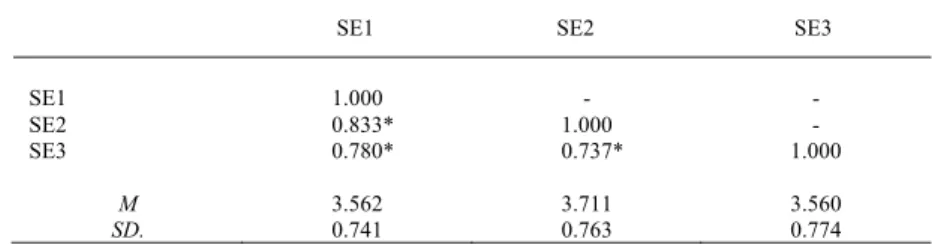
Correlation matrices with item means and standard deviations for self-efficacy were3.560 -3.720 and 0.740-0.780 respectively. Indicators in each indicator were positively related with statistical significance. The relation was at low to medium levels (r = 0.730-0.840)The pair with the highest relation was self-efficacy for instructional strategies and self-efficacy for classroom management variance could be explained together at83.30% (shown in Tables 1).
Table1 Correlations matrix, Mean, and SD for self-efficacy (N=78)
* p < .05 Note; SE1 = self-efficacy for instructional strategies; SE2 = self-efficacy for classroom management; SE3 = self-efficacy for student engagement
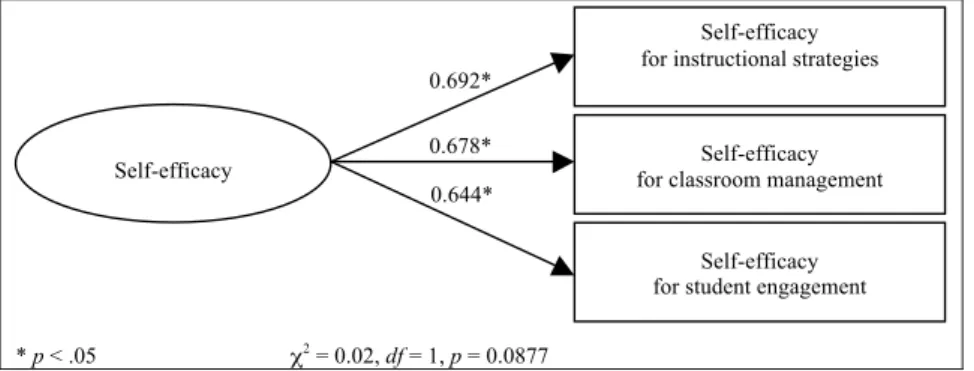
The 1-factor/3 indicator model fit the data (as well as; Chi-Square = 0.02, df = 1, P = 0.877, RMSEA = 0.00, GFI = 0.997). The threeindicator were participation in self-efficacy for instructional strategies self-efficacy for classroom management, and self-efficacy for student engagement with0.05 statistical significance. Interaction self-efficacy for instructional strategies had the most positive relation (b = 0.69). The three factors had variance together with self-efficacy determination at 87%, 79%, and 63% respectively. Details are in Table 2 and Figure 1.
Table2First – order factor analysis of measurement model of self- efficacy
Factor Factor loading R2 Coefficient of factor of Self-efficacy b(SE) B t SE SE1 0.692 (0.073) 0.692 9.493* 0.872 0.711 SE2 0.678(0.079) 0.678 8.595* 0.791 0.402 SE3 0.644(0.083) 0.644 7.716* 0.692 0.251 Chi-Square = 0.02, df = 1, P = 0.0877, GFI = 0.9978, RMSEA = 0.000
SE1 SE2 SE3
SE1 1.000 - -
SE2 0.833* 1.000 -
SE3 0.780* 0.737* 1.000
M 3.562 3.711 3.560
Figure 1.First – order factor analysis of measurement model of self- efficacy 4.2 Motivation to be a teacher
Descriptive content validity
There were fifteen items of first factor; intrinsic motivation. Content validity was 0.500-1.000. Each question had corrected item-total correlation of 0.4400 - 0.7800 and this factor had validity of 0.9362.
There were fifteen items of second factor; extrinsic motivation. Content validity was 0.500-1.000. Each question had corrected item-total correlation of 0.4400 - 0.8100 and this factor had validity of 0.9441.
CFA of the 1-factor/ 2-indicator model
Correlation matrices with item means and standard deviations for motivation to be a teacher were3.510 -3.590 and 0.860-0.910, respectively. Indicators in each indicator were positively related with statistical significance. The relation was 0.817. The pair with the highest relation was intrinsic motivation and extrinsic motivationvariance could be explained together variance could be explained together at81.70% (shown in Tables 3).
Table3 Correlations matrix, Mean, and SD for motivation to be a teacher (N=78)
* p < .05; N=78; MT1= intrinsic motivation; MT2 = extrinsic motivation
The 1-factor/2 indicator model fit the data (as well as; Chi-Square = 2.23, df = 1, P = 0.135, RMSEA = 0.146, GFI = 0.959). The twoindicator were participation in intrinsic motivation, and extrinsic with0.05 statistical significance. Interaction extrinsic motivation had the most positive relation (b = 0.99). Interaction extrinsic motivationhad the most positive relation (b = 0.992). The two factors had variance together with motivation to be a teacher determination at 97%, and 96%, respectively. Details are in Table 4 and Figure 2.
Table4First – order factor analysis of measurement model of motivation to be a teacher
Factor
Factor loading
R2 Coefficient of factor of Motivation to be a
teacher b(SE) B t
MT
• MT1 0.983 (-) 0.983 - 0.967 0.524
• MT2 0.992(0.06) 0.986 15.423* 0.972 0.535 Chi-Square = 2.23, df = 1, P = 0.135, GFI = 0.959, RMSEA = 0.146
* p < .05 χ2 = 0.02, df = 1, p = 0.0877 MT1 MT2 MT1 1.000 - MT2 0.817* 1.000 M 3.581 3.516 SD. 0.864 0.909 Self-efficacy Self-efficacy for instructional strategies
Self-efficacy for classroom management
Self-efficacy for student engagement 0.692*
0.678* 0.644*
Figure 2.First – order factor analysis of measurement model of motivation to be a teacher
5. Discussion
The validation of scales in the present study is robust and showed excellent measurement properties. Moreover, all the remaining scales met criterion levels on goodness of fit measure. That is to say, the measurements of self-efficacy and motivation to be a teacher in this study were fitted for Thai context and probably be able to measure for any context.
This study demonstrated that the measurement model can be used to measure Thai student teachers’ self-efficacy and motivation to be a teacher. The relatively small sample size of this study may limit the generalization of its findings. Thus, future research with larger sample sizes is warranted.
The key outcomes of this study are development of measurement model to measure Thai student teachers’ self-efficacy and motivation to be a teacher. A legitimate question concerns how this instrument might be used in professional settings. The measurement model will be used to assist Thai student teachers in identifying their beliefs and motivation with self-evaluate on their commitment and suitability for teaching. Moreover, they can be used to assist teacher educators to provide appropriate counseling and related support to Thai student teachers, particularly at critical phases such as entry to teacher education course, or before, during, or after practicum experiences, when self-efficacy and motivation to be a teacher of Thai student teachers are identified
.
Acknowledgements
This work was supported by “The 90th Anniversary of Chulalongkorn University Fund”
Ratchadaphiseksomphot Endowment Fund.
References
Armor, D., Conroy-Oseguera, P., Cox M., King, N., McDonnell, L., Pascal, A. Pauly, E.,& Zellman, G. (1976). Analysis of the school preferred reading programs in selected Los Angeles minority schools. (REPORT NO. R-2007-LAUSD). Santa Monica, CA: Rand Corporation. (ERIC Document Reproduction Service No. 130 243).
Bandura, A. (1997). Self-efficacy: The exercise of control. New York: Freeman.
Bandura, A. (2006). Guide for constructing self-efficacy scales. In F. Pajares& T. Urdan (Eds.), Adolescence and education. Greenwich, CT: InformationAge.
Betoret, F. D. (2006). Stressors, self-efficacy, coping resources, and burnout among secondary school teachers in Spain. Educational Psychology, 26(4), 519-539.
Dowson, M. & McInerney, D. M. (2004). The development and validation of the goal orientation and learning strategies survey (GOALS-S). Education and Psychological Measurement, 64, 290-310.
* p < .05 χ2 = 0.02, df = 1, p = 0.0877 Motivation to be a teacher Intrinsic motivation Extrinsic motivation 0.983* 0.992*
Ferrell, C. M. & Daniel, L. G. (1993). Construct validation of an instrument measuring teacher career motivations (paper presented at the annual meeting of the mid-south education research association, New Orleans, LA). East Lansing, MI: National Center for research on teacher learning. (ERIC Document reproduction service no. ED365719)
Gao, X., & Trent, J. (2009). Understanding mainland Chinese student teachers’ motivations for choosing a teacher education program in Hong Kong. Journal of Education for Teaching: International Research and Pedagogy,
35, 145–159.
Goddard, R. D., & Goddard, Y. L.,(2001).Multilevel analysis of the relationship between teacher and collective efficacy in urban schools. Teaching and Teacher Education, 17, 807-818.
Goddard, R. D., Hoy, W.K., & Woolfolk, A. (2000). Collective teacher efficacy: its meaning measure, and effect on student achievement. American Education Research Journal, 37, 479-507.
Griffioena, D, M, E., Jong, U, D., & Jak, S. (2013). Research self-efficacy of lecturers in non-university higher Education. Innovations in Education and Teaching International, 50(1), 25–37.
Hair, J. F., Black, W. C., Babin, B. J., & Anderson, R. E. (2010). Multivariate data analysis (7th ed.). Upper Saddle River, New Jersey: Pearson Education.
Heather, H., & Roy, R. (2011). Understanding the Influence of Perceived Usability and Technology Self-Efficacy on Teachers' technology acceptance. Journal of Research on Technology in Education, 43(4), 343-367.
Jarvis, J., & Woodrow, D. (2005). Reasons for choosing a teacher training course. Research in Education, 73, 29–35.
Jöreskög, K.G. & Sorbom, D. (1996). Lisrel 8: Structural Equation Modeling with theSIMPLIS Command Language. Chicago: Scientific Software International.
Knobloch, N.A. (2006). Exploring relationships of teachers’ sense of efficacy in two student teaching programs. Journal of Agricultral Education, 47(2), 36-47.
Klassen, R.M., Al-Dhafri, S., Hannok, W., & Betts, S.M. (2011). Investigating pre-service teacher motivation across cultures using the Teachers’ Ten Statements Test. Teaching and TeacherEducation, 27, 579–588.
Klassen, R, M., Bong, M., & Usher, E, L., Chong, W, H., Huan, V, S., Wong, I, Y, F., &Georgiou, T. (2009). Exploring the validity of a teachers’ self-efficacy scale in five countries.Contemporary Educational Psychology, 34, 67–76.
Larson, L, M., Wu, T, F., Bailey, D, F., Gasser, C, E., Bonitz, V, S., & Borgen, F, H. (2010). The role of personality in the selection of a major: With and without vocational self-efficacy and interests. Journal of Vocational Behavior,76, 211–222.
Laver, K., George, S., Ratcliffe, J., & Crotty, M. (2012). Measuring technology self-efficacy: reliability and construct validity of a modified computer self-efficacy scale in a clinical rehabilitation setting. Disability & Rehabilitation, 34(3), 220–227.
McInerney, V., Marsh, H. W. & McInerney, D. M. (1999). The designing of the computer anxiety and learning measure (CALM): Validation of scores on a multi-dimensional measure of anxiety and cognitions relating to adult learning of computer skill using structural equation modeling. Educational and Psychological Measurement, 59, 451-470.
Moran, T, M., Woolfolk, H, A., & Hoy, W, K. (1998). Teacher efficacy: Its meaning and measure.Review of Educational Research, 68, 202–248.
Moran, T, M., &Woolfolk, H, A. (2001). Teacher efficacy: Capturing an exclusive construct. Teaching and Teacher Education, 17, 783–805.
Richardson, P.W., & Watt, H.M.G. (2005). ‘I’ve decided to become a teacher’: Influences on career change.
Teaching and Teacher Education, 21, 475–489.
Roness, D., & Smith, K. (2010). Stability in motivation during teacher education. Journal of Education for Teaching, 36, 169–185.
Whittington, M.S.,McConnell, E., & Knobloch, N.A. (2006). Teacher efficacy of novice teachers in agricultural education in Ohio at the end of the school year. Journal of Agricultural Education. 47(4), 26-38. Doi: 10.5032/jae.2006.04027
Sinclair, C., Dowson M., and Mcinerney, D. M. (2006). Motivation to teach: Psychometric perspectives across the first semester of teacher education. Teacher College Record, 108(6), 1132-1154.