International Journal of Social Sciences and Humanities
Available online at www.sciencescholar.usVol. 3 No. 3, December 2019, pages: 188-200 e-ISSN: 2550-7001, p-ISSN: 2550-701X https://doi.org/10.29332/ijssh.v3n3.376
Work Motivation and Creativity on Teacher Ability to Develop
HOTS-based Assessments
I Wayan Widana a, I Made Suarta b, I Wayan Citrawan c
Manuscript submitted: 09 October 2019, Manuscript revised: 18 December 2019, Accepted for publication: 27 December 2019 Corresponding Authora Abstract
This research aims to determine: (1) the effect of motivation on the ability of high school/vocational high school mathematics teachers to develop HOTS-based Assessments; (2) the effect of creativity on the ability of high school/vocational mathematics teachers to develop HOTS-based Assessments; and (3) the effect of simultaneous motivation and creativity on the ability of high school/vocational high school mathematics teachers to develop HOTS-based Assessments. This research is survey research. The results of the data analysis showed that (1) motivation had a direct positive effect on the ability of high school/vocational mathematics teachers to develop HOTS-based Assessments with partial correlation coefficient values of 0.638 and sig.=0.000<0.05; (2) creativity has a direct positive effect on the ability of high school/vocational mathematics teachers to develop HOTS-based Assessments with a partial correlation coefficient value of 0.550 and sig.=0.000<0.05; (3) motivation and creativity simultaneously have a direct positive effect on the ability of high school/vocational high school mathematics teachers to develop HOTS-based Assessments with a value of F=239.474 (sig.= 0,000). The magnitude of the effect of simultaneous motivation and creativity on the ability of high school/vocational high school mathematics teachers to develop HOTS-based Assessments was 54.7%, while 45.3% was explained by other variables. Keywords assessments; creativity; HOTS; motivation; teacher ability;
International Journal of Social Sciences and Humanities © 2019.
This is an open access article under the CC BY-SA license (http://creativecommons.org/licenses/by-sa/4.0/). Contents Abstract ... 188
1 Introduction ... 189
2 Materials and Methods ... 194
3 Results and Discussions ... 195
4 Conclusion ... 197
a IKIP PGRI Bali, Denpasar, Indonesia
bIKIP PGRI Bali, Denpasar, Indonesia
Widana, I. W., Suarta, I. M., & Citrawan, I. W. (2019). Work motivation and creativity on teacher ability to develop
Acknowledgments... 197 References ... 199 Biography of Authors ... 200
1 Introduction
The phenomenon of the 21st century is characterized by 6 trends, namely (a) the ongoing digital revolution that is increasingly extraordinary so that it can change the joints of life including education, (b) the integration of parts of the world that are increasingly intensive due to internationalization, globalization, multilateral relations, communication technology, and transportation technology, (c) the ongoing leveling of the world as a result of various fundamental changes in the dimensions of human life, especially as a result of the globalization of countries, corporations, and individuals, (d) the rapid change in the world which results in the world appearing to run helter-skelter, space seems to be narrowed, time appears concise, and obsolescence of things quickly happens, (e) the growth of a knowledge-intensive society, information society, and network society that makes knowledge, information, and networks a very important capital, and (f) increasingly strict phenomena along with the creative society that puts crepe productivity and innovation as important capital for individuals, companies, and society. These six areas have given rise to new arrangements, new measures, and new needs that are different from before, which must be responded to and fulfilled by the world of national education as well as possible (Wiedarti, Laksono & Retnaningsih, 2018).
Based on the above trends, the foundations of Indonesia's national education need to be reorganized or transformed in such a way that Indonesian national education is able to make a meaningful contribution to the progress of Indonesia in the 21st century that has undergone fundamental paradigmatic changes. The rearrangement or transformation of Indonesia's national education began by placing character as the deepest dimension of national education side by side with intellect reflected incompetence. With strong character and high competence, which is produced by good education, various needs, challenges, and new demands can be met or overcome. Therefore, in addition to intellectual development, the development of student character is very important in Indonesia's national education system.
One of the national policies in education is the development of learning and assessment based on Higher Order Thinking Skills (HOTS). HOTS-based assessment is an assessment that serves to measure the ability to think at a higher level, namely the ability to think that is not merely remembering, restating, or referring without processing. HOTS-based assessment in the context of the assessment measures the ability of 1) transferring one concept to another, 2) processing and applying information, 3) looking for links from different kinds of information, 4) using the information to solve problems, and 5) analyzing ideas and information critically. However, HOTS-based assessment does not mean more difficult questions (Widana, Parwata, Parmithi, Jayantika, Sukendra & Sumandya, 2018).
The dimensions of the thought process in Bloom's Taxonomy consist of the ability to: remember (C1), understand (C2), apply (C3), analyze (C4), evaluate (C5), and create (C6). HOTS-based questions generally measure the ability in the realm of analysis (C4) with the operational verbs, namely parsing, comparing, checking, criticizing, testing, etc; evaluating (C5) with the operational verbs, namely evaluating, evaluating, refuting, deciding, choosing, supporting, guessing, predicting, etc; and creating (C6) with the operational verbs, namely constructing, designing, creating, developing, writing, combining, formulating, and others. These three areas of higher-order thinking skills are important in solving problems as well as transferring learning and creativity (Pintrich, 2002).
Viewed from the dimension of knowledge, generally, the matter of HOTS-based assessment involves the metacognitive dimension, not just measuring the factual, conceptual, or procedural dimensions. The metacognitive dimension describes the ability to connect several different concepts, interpret, solve problems, choose problem-solving strategies, find new methods, argue, and make the right decision.
The characteristics of the HOTS-based assessment can be detailed and explained as follows (Widana, 2017): (a) measuring higher-order thinking skills, including higher-level thinking skills including the ability to solve problems, critical thinking skills, creative thinking, ability to reason, and the ability to make decisions. To solve HOTS problems, high creativity and innovation are needed. Creativity to solve problems in
HOTS consists of: the ability to solve problems that are not familiar, the ability to evaluate strategies used to solve problems from a variety of different perspectives and find new models of resolution that are different from previous ways. Higher-order thinking skills can be trained in the learning process in the classroom. Therefore, the learning process should provide some space for students to explore activity-based knowledge. Activities in learning must be able to encourage students to build creativity and critical thinking; (b) Contextual and Interesting Problem-based, HOTS-based assessment is based on real situations in daily life in which students are expected to apply the concepts of learning in class to solve problems. Contextual problems faced by the world community today are related to the environment, health, earth and space, social life, cultural penetration, and the use of science and technology in various aspects of life. The contextualization of the problem in the assessment evokes a critical and caring attitude towards the environment (Sudiarta & Widana, 2019). To create a good stimulus, it is highly recommended to raise issues that are closely related to the environment where students are located or are based on emerging global issues. Problems with less attractive stimulus are not able to show the ability of students to relate the information presented in the stimulus or use information to solve problems using the logic of critical thinking; (c) is not routine and brings novelty, one of the goals of HOTS-based assessment is to build students' creativity in solving various contextual problems. Creative attitude is closely linked to innovative concepts that bring newness. based assessment cannot be tested repeatedly on the same test takers. If an item that was originally a HOTS-based assessment is tested repeatedly on the same test-taker, then the student's cognitive process becomes memorizing. Students only need to remember the ways that have been done before. No more high-level cognitive processes occur. These questions can no longer encourage test takers to be creative in finding new solutions. In fact, the question is no longer able to explore the original ideas possessed by test takers to solve the problem.
Steps for preparing HOTS-based assessment
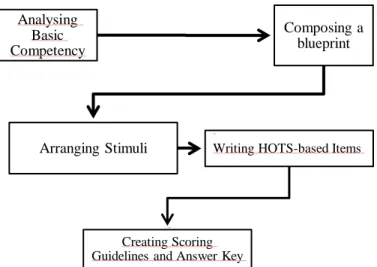
The steps for constructing the HOTS-based assessment can be described as in the following flowchart (Widana, Suarta & Citrawan, 2019).
Figure 1. HOTS-based assessment development flowchart
The preparation of HOTS-based assessment follows the flow of activities as follows: (1) activities are preceded by conducting Basic Competency Analysis that can be constructed as HOTS-based assessment. First, the teachers choose the Basic Competency that can be made as HOTS-based assessment. Not all Basic Competency can be made into HOTS-based assessment. Choose a Basic Competency that includes operational verbs in the realm of C4, C5, or C6. Teachers independently or through the Teachers Forum can analyze Basic Competency that can be made as HOTS-based assessment; (2) compiling the HOTS-based assessment grids that aim to help teachers write HOTS items. These grids are needed to guide the teachers in determining the
Analysing Basic Competency
Composing a blueprint
Arranging Stimuli Writing HOTS-based Items
Creating Scoring Guidelines and Answer Key
Widana, I. W., Suarta, I. M., & Citrawan, I. W. (2019). Work motivation and creativity on teacher ability to develop
minimum ability Basic Competency, selecting subject matter related to basic competencies to be tested, formulating question indicators, and determining cognitive levels. The format of the HOTS-based assessment preparation grids is presented in Table 1; (3) formulating interesting and contextual stimuli, the stimuli used must be interesting whereas, contextual stimulus means stimulus that is in accordance with reality in daily life. Some factors that need to be considered when compiling a stimulus containing HOTS include choosing some information which can be in the form of pictures, graphs, tables, discourse, and others that have relevance in a case; stimulus should demand the ability to interpret, search for relationships, analyze, conclude, or create; choose contextual and interesting cases/problems of current issues, and is directly related to the question (subject matter) and functions; (4) write the question items in accordance with the problem lattice, the question items are written according to the HOTS-based item writing rules. The rules for writing HOTS-based items are basically almost the same as the rules for writing items in general. The difference lies in the material aspects (must be adjusted to the characteristics of the HOTS-based assessment above), while the aspects of construction and language are relatively similar. The format of multiple-choice items cards is presented in Table 2 and description question cards are presented in Table 3.
Table 1
Blueprint of HOTS-based assessment Subjects : Mathematics
Class/Semester : ...
No. Basic
Competency Subject Matter Indicators of Items Cognitive Level Forms of Items Items No.
Table 2 Card Items (Multiple Choice) Subject : ... Class/Semester : ... Basic Competency : ... Subject Matter : ... Indicator Item : ... Cognitive level : ...
Item : ...
Key: ...
Table 3
Card Items (Essay question) Subject : ... Class/Semester : ... Basic Competency : ... Subject Matter : ... Indicator Item : ... Cognitive level : ... Item : ...
No. Description of Keywords/Keywords Score
Total Score
Motivation is one important component of increasing work productivity. Work motivation is a strength that can provide stimulation or encouragement and work enthusiasm to someone so that they can change the behavior of that person to increase productivity as desired performance. Teacher work motivation is needed to improve the quality of learning and assessment in schools (Pardee, 1990).
The factors that influence work motivation related to human needs are arranged in the form of a hierarchy of five basic human needs as follows (Snow & Narvaez, 2019): (1) physiological needs: the most basic needs for humans to live. This need motivates a person to work in order to get the minimum wage so that his needs can be met. Physiological needs include hunger, thirst, protection, sexual and other physical needs; (2) security or safety needs: the need for a sense of security, safety, the guarantee of the physical and emotional environment, and freedom from threats. Work safety and security needs include feeling protected from physical and emotional danger, as well as additional benefits and job guarantees; (3) social needs (affiliation or acceptance
Widana, I. W., Suarta, I. M., & Citrawan, I. W. (2019). Work motivation and creativity on teacher ability to develop
needs): the need for social interactions such as the need for love and satisfaction in establishing relationships with others, friendship, satisfaction and feelings of belonging and being accepted in a group with a full sense of kinship, friendship and affection ; (4) the need for appreciation (esteem needs): the competitive desire to go forward and exceed the achievements of others, the intention to have a positive impression and get attention, recognition and appreciation from others. In the context at school, these needs can also be manifested in the form of appreciation and recognition by the school principal, trust, and increased responsibility given by the school; (5) the need for self-actualization: is a person's need to realize the potential he has to achieve sustainable self-development creatively in a broader sense. In other words, self-actualization is a need to realize one's abilities and develop oneself at work as well as opportunities for better promotion.
Someone wants to work with the hope that first can meet more basic needs (physiological need) before the fulfillment of the highest needs (self-actualization). The stronger a person's needs are, the stronger the person's motivation to improve his/her behavior that leads to the satisfaction of his/her needs. The higher the motivation of someone at work, the more it will increase morale, work enthusiasm and work performance. If someone is not motivated to work, the results of his/her work will be far from expectations and conditions which are said to be low work performance. Motivation can be divided into two types, namely:
(a) Intrinsic motivation
motives that become active and functioning, do not need to be stimulated from the outside because in every individual there is already an urge to do something (Gagné, 2014). Intrinsic motivation arises as a result of encouragement from within the individual himself/herself to do the work without coercive encouragement from others but of his/her own volition. Factors that influence intrinsic motivation: (a) interest, the tendency and high enthusiasm or great desire to do certain jobs (Demos, 2019). Interest is a constant tendency to pay attention and work on activities. Work that is in demand by someone is paid attention to be continuously accompanied by a sense of pleasure (Thomas, 2009). Interest is a person's liking or interest in something that encourages that person to master knowledge and experience. This can be demonstrated through participation and activeness in seeking knowledge and experience (Mullen, 2019). Based on some of the opinions above, the characteristics of interest are one's liking and interest in what is done, the desire for someone to work, greater attention to what is done, and the participation and activeness of someone doing a job; (b) has clear goals (ideals), can encourage someone to do work with high enthusiasm; (c) commitment, is a consistent attitude in the form of a promise that comes out of a person to complete a particular job.
(b)Extrinsic Motivation
Extrinsic motivation is active motives and functions to do something because of the stimulation or encouragement from outside (Mullen, 2019). Extrinsic motivation can generate intrinsic motivation. Extrinsic and intrinsic motivation must support each other and strengthen individual performance so that they can achieve the goals set. Factors that influence extrinsic motivation include: (a) a gift, giving something to someone as an appreciation or remembrance in the form of a souvenir for work performance achieved. Gift-giving needs to be done because it is believed to be effective enough to motivate someone to achieve certain goals. Appreciation is not only in the form of goods or other materials but also in the form of verbal speech in the form of praise or showing an attitude of respect for one's achievements. Values in the form of verbal speech are very effective when delivered in front of many people, so the award can improve one's performance to achieve certain goals; (b) punishment, is an educational motivational tool not because of revenge to improve one's performance. The educational approach referred to as a punishment for educating and aiming to improve the attitudes and actions of someone deemed wrong; (c) competition, can be used as a motivational tool in the form of competition between individuals and between groups. If the competition is well managed, it can encourage someone to work harder to achieve the goals set so as to create a conducive atmosphere; (d) the recognition of the leadership and work environment of work performance that has been achieved by someone is an important part of improving one's performance. Creativity is a general ability to create something new as the ability to provide new ideas that can be applied in problem-solving or as the ability to see new relationships between elements that already existed (Beghetto, & Karwowski, 2019). Creativity as the ability to start ideas, see relationships that are new or unexpected, and formulate concepts that are not merely memorising, creating new answers to existing problems, and getting new questions that need to be answered (Goorha & Potts, 2018). Creativity is a high-level thinking ability that implies an escalation in thinking ability characterised by succession, discontinuity, differentiation, and
integration between each stage of development (Samier, 2018). Creativity is the ability to make new combinations that have social significance (Gruszka & Tang 2017). Furthermore, creativity can be seen as 4Ps (Person, Process, Press, and Product). These four Ps are interrelated implying that a creative person who involves himself/herself in the creative process with encouragement and support from the environment to produce creative products (Suryasa, Prayoga & Werdistira, 2017).
Based on the opinions above, what is meant by creativity is the ability to create something new or combine from something that has been there before into a new form that is more practical, simplified, and useful. Furthermore, the dimensions of creativity can be described as follows (Raiyn & Tilchin, 2015). (a) Person dimension, creativity is the ability or ability that exists in a person that is closely related to talent. There are 5 characteristics of personal ability to think creatively (Lebuda & Glăveanu, 2019): (1) fluency, the ability to produce many ideas; (2) originality, the ability to come up with original ideas; (3) elaboration, the ability to parse something in detail, (4) flexibility, understanding differences in the way others think about solving a problem, and (5) redefinition, the ability to review a problem based on a perspective that is different from what many people already know ; (b) Process Dimension, creativity is focused on the thought process so as to bring up unique or creative ideas. Creativity is a process or ability that reflects fluency, flexibility, and originality in thinking as well as to elaborate an idea. In this dimension, the emphasis is on aspects of the change process (innovation and variation). Creativity is defined as a process that occurs in the human brain to find and develop a new idea that is more innovative and varied, so divergent thinking skills are needed. The process of creating is the most important part in the development of creativity in which a person will feel happy to occupy himself/herself creatively with the activities he/she does; (c) Press Dimension, creativity is emphasized on press factors or encouragement, both internal self-impulses in the form of desires and desires to create things creatively, as well as external impulses from the social and psychological environment. In this case, external motivation is very important to develop one's intrinsic motivation, so they will be creative without feeling forced and there are no specific interventions; (d) Product Dimension, creativity is focused on the product or what is produced by an individual. Creative products emphasize originality, the ability to produce something new. Besides that, creativity in the product dimension is defined as the ability to make new combinations that have social significance. Thus, creativity does not only create something new but may also be a combination of something that already exists.
Creative products are classified into 3 categories (Lebuda & Glăveanu, 2019): (1) novelty, the extent to which the product is new in terms of new processes, new techniques, new concepts. Future creative products and original products are very rare among products made by people with experience of giving rise to surprises and also giving rise to ideas of other original products; (2) problem solving (solution), the extent to which the product meets the need to overcome the problem (the product must be meaningful, logical, and useful); and (3) detail (elaboration and synthesis), the extent to which the product combines elements that are not the same into a unified, sophisticated, and coherent product.
2 Materials and Methods
This research is survey research. The population was mathematics teachers in high schools/vocational schools from the provinces of Bali, NTB, and NTT. The sample of this research was 400 people determined using a multistage random sampling technique. Data were collected using a questionnaire that was completed with a free field format filled out by respondent teachers in the form of input data, suggestions, and needs of high school/vocational high school mathematics teachers related to their ability to compile HOTS-based Assessment. Research data included: (1) quantitative data on the effect of independent variables (work motivation and creativity) on dependent variables (the ability of high school/vocational high school mathematics teachers to arrange HOTS-based Assessment); and (2) qualitative data (need assessment) of high school/vocational high school mathematics teachers in developing the HOTS-based Assessment. Quantitative data were analyzed using Multiple Linear Regression Techniques, while qualitative data were analyzed qualitatively as supporting data for the quantitative data. The constellation of independent and non-independent variables can be described in Figure 1.
Widana, I. W., Suarta, I. M., & Citrawan, I. W. (2019). Work motivation and creativity on teacher ability to develop
Figure 1. The constellation of independent and non-independent variables
3 Results and Discussions
The research data were processed using SPSS 23.0 program assistance. The results of the research can be explained as follows.
Table 4 above shows the data of respondents analyzed as many as 400 people each. The mean score of the teacher's ability to compile HOTS-based Assessment was 47.58 with a standard deviation of 9.653. The mean score of the work motivation of teachers is 50.72 with a standard deviation of 11.077 and the average score of teacher creativity is 44.88 with a standard deviation of 10.132. Teacher work motivation scores have the highest standard deviation which means that variations in teacher work motivation are very diverse when compared to the variable of creativity and the teacher's ability to develop HOTS-based Assessment.
Table 5 Coefficientsa
Model
Unstandardize
d Coefficients Standardized Coefficients t Sig. Correlations Collinearity Statistics B Error Std. Beta Zero-order Partial Part Tolerance VIF
1 (Constant) 7.884 1.848 4.266 .000
Motivation_X1 .452 .031 .519 14.618 .000 .638 .592 .494 .907 1.102
Creativity_X2 .374 .034 .392 11.055 .000 .550 .485 .374 .907 1.102
a. Dependent Variable: HOTS_Y
In Table 5, the coefficient above can be explained as follows. [1] Regression equation Y = 7,884 + 0,452 + 0,374;
[2] In the t-test column, the variable motivation_X1 with a value of t = 14.618 and sig value = 0.000 <0.05 which means that the variable motivation_X1 is meaningful (cannot be ignored). Likewise, the creativity_X2 variable with a value of t = 11,055 and the value of sig. = 0,000 <0.05 which means that the creativity_X2 variable is meaningful (cannot be ignored);
Table 4 Descriptive Statistics Mean Deviation Std. N HOTS_Y 47.58 9.653 400 Motivasi_X1 50.72 11.077 400 Kreativitas_X2 44.88 10.132 400 Work Motivation (X1) Creativity (X2)
Teacher Ability Developing HOTS-based Assesments
[3] In the Collinearity Statistics column, a Tolerance value of 0.907 (greater than 0.10) and a VIF value of 1.102 (less than 10) mean that there is no multi-collinearity problem.
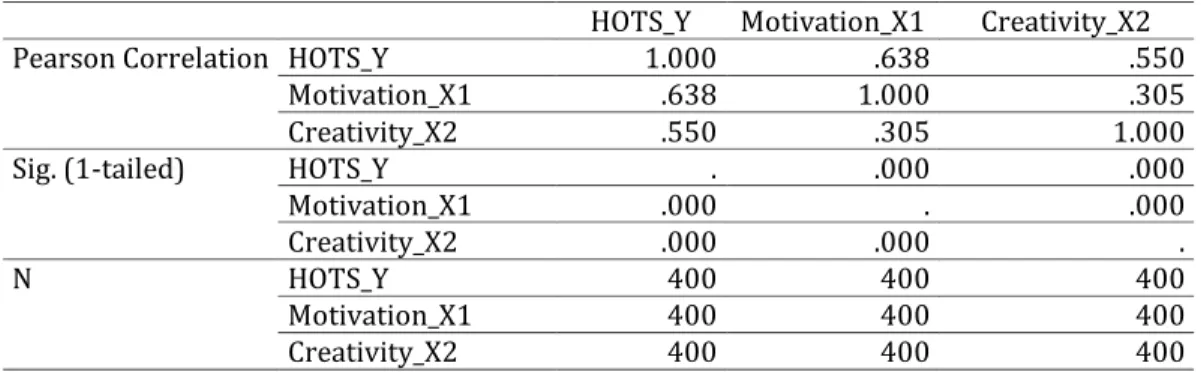
Table 6 Correlations
HOTS_Y Motivation_X1 Creativity_X2
Pearson Correlation HOTS_Y 1.000 .638 .550
Motivation_X1 .638 1.000 .305
Creativity_X2 .550 .305 1.000
Sig. (1-tailed) HOTS_Y . .000 .000
Motivation_X1 .000 . .000
Creativity_X2 .000 .000 .
N HOTS_Y 400 400 400
Motivation_X1 400 400 400
Creativity_X2 400 400 400
Table 6 shows the significance of the partial correlation coefficient to analyze the closeness of the relationship of each independent variable and the dependent variable. The correlation of coefficient value of X1 and the ability of high school/vocational mathematics teachers to the teacher's ability to compile HOTS-based Assessment questions by controlling the influence of creativity_X2 (ry1.2) is 0.638 and the value of sig.=0.000 <0.05, meaning that the correlation between the motivation of high school/vocational teachers to the teacher's ability to compile HOTS-based Assessment by controlling the effect of creativity_X2 is significant. Thus, motivation_X1 has a direct positive effect on the ability of high school/vocational high school mathematics teachers to the teacher's ability to develop HOTS-based Assessment_Y. The correlation coefficient value of creativity_X1 to the ability of high school/vocational mathematics teachers to the teacher's ability to develop HOTS-based Assessment_Y by controlling the influence of motivation_X1 (ry2.1) is 0.550 and the value of sig.=0.000<0.05, meaning that the correlation between creativity_X2 and the ability of high school/vocational mathematics teachers to the teacher's ability to develop HOTS-based Assessment_Y by controlling the effect of motivation_X1 is significant. In conclusion, creativity has a direct positive effect on the ability of high school/vocational mathematics teachers to develop HOTS-based Assessments.
Table 7 Model Summaryb
Model R Square R Adjusted R Square the Estimate Std. Error of R Square Change Statistics
Change Change df1 F df2 Change Sig. F
1 .739a .547 .544 6.515 .547 239.474 2 397 .000
a. Predictors: (Constant), Creativity_X2, Motivation_X1 b. Dependent Variable: HOTS_Y
Table 7 shows the results of the significance of the multiple correlation coefficients. F Change value of 239.474 and sig value=0.000<0.05 (significant), meaning that the multiple correlation coefficient between motivation_X1 and creativity_X2 on the ability of high school/vocational mathematics teachers to the teacher's ability to develop HOTS-based Assessment_Y is significant (meaningful). Table 7 also reveals the magnitude of the contribution of motivation_X1 and creativity_X2 to the ability of high school/vocational mathematics teachers to the teacher's ability to develop HOTS-based Assessment_Y expressed as the coefficient of determination of R Square = 0.547 meaning 54.7% of the ability of high school/vocational mathematics teachers to develop HOTS-based Assessment_Y can be explained by the variable motivation_X1 and creativity_X2. Whereas 45.3% is explained by other variables.
Widana, I. W., Suarta, I. M., & Citrawan, I. W. (2019). Work motivation and creativity on teacher ability to develop
Table 8 ANOVAa
Model Sum of Squares df Mean Square F Sig.
1 Regression 20330.100 2 10165.050 239.474 .000b
Residual 16851.650 397 42.447
Total 37181.750 399
a. Dependent Variable: HOTS_Y
b. Predictors: (Constant), Creativity_X2, Motivation_X1
Table 8 shows the test results of the significance of the Multiple Linear Regression equation. The value of F=239.447 and the value of sig.= 0.000 <0.05 (significant) mean that the equation of Multiple Linear Regression is meaningful and can be used to estimate the relationship between independent and independent variables. In conclusion, motivation and creativity simultaneously have a direct positive effect on the ability of high school/vocational mathematics teachers to develop HOTS-based Assessment_Y.
4 Conclusion
This study found that the ability of high school/vocational mathematics teachers to compile HOTS-based assessments was influenced by work motivation and teacher creativity. Teacher motivation both internally and externally can encourage teachers to start working on HOTS-based assessments. The teacher's internal motivation, among others, concerns the sense of responsibility towards the teacher's tasks in assessment, the calling of conscience to become a professional teacher, the growth of the teacher's personal awareness to carry out the task well. External motivation, among others, is related to supervision by the school principal, the existence of regulations and the teacher's obligation to compile HOTS-based questions, even the rewards or salaries provided by the school so that teachers are motivated to compile HOTS-based assessments. Likewise, the creativity variable is stated to have a direct positive effect on the ability of teachers to compile HOTS-based assessments. Creativity is related to the ability of the teacher to produce ideas or new ideas. Including new ideas to find patterns of writing questions that are not routine or that are commonly taught in class. The higher the creativity the teacher has, the greater the chance of developing HOTS-based assessments and vice versa. Teacher creativity can be developed through a series of exercises that are carried out routinely and gradually. That is, to achieve the ability to compile HOTS-based assessments teachers must diligently practice and try to compile HOTS-based assessments. In this case, the Empowerment of Subject Teachers' Consultation (MGMP) is one of the right steps taken to motivate teachers to do joint exercises, discuss, and exchange information about the preparation of HOTS-based assessments.
The ability of teachers to compile HOTS-based assessments is not solely influenced by motivation and creativity. There are still many other variables that are thought to affect the ability of teachers to prepare HOTS assessments but were not tested in this study. Other factors that are thought to influence the ability of teachers to prepare HOTS assessments include the teacher's understanding of HOTS assessment concepts, digital literacy, and thinking styles. These factors can be investigated as a research development of this research.
Acknowledgments
The highest gratitude and appreciation go to:
(1) Directorate of Research and Community Service Ministry of Research, Technology and Higher Education that has fully funded this research;
(2) The Head of the Bali Provincial Education Office, for his cooperation and positive response to the implementation of research in the form of a statement of cooperation support;
(3) The Head of the West Nusa Tenggara Province Education Office, for his cooperation and positive response to the implementation of the research in the form of a statement of cooperation support;
(4) The Head of the East Nusa Tenggara Province Education Office, for his cooperation and positive response to the implementation of the research in the form of a statement of cooperation support;
(5) Fellow high school/vocational mathematics teachers in Bali, West Nusa Tenggara and East Nusa Tenggara Provinces, who have worked hard to provide responses and input in this research.
Widana, I. W., Suarta, I. M., & Citrawan, I. W. (2019). Work motivation and creativity on teacher ability to develop
References
Beghetto, R. A., & Karwowski, M. (2019). Unfreezing creativity: A dynamic micro-longitudinal approach.
In Dynamic Perspectives on Creativity (pp. 7-25). Springer, Cham.
https://doi.org/10.1007/978-3-319-99163-4_2
Demos, E. V. (2019). The Affect Theory of Silvan Tomkins for Psychoanalysis and Psychotherapy: Recasting the
Essentials. Routledge.
Gagné, M. (Ed.). (2014). The Oxford handbook of work engagement, motivation, and self-determination theory. Oxford University Press, USA.
Goorha, P., & Potts, J. (2018). Creativity and Innovation: A New Theory of Ideas. Springer.
Gruszka, A., & Tang, M. (2017). The 4P’s creativity model and its application in different fields. In Handbook of
the management of creativity and innovation: Theory and practice (pp. 51-71).
Lebuda, I., & Glăveanu, V. P. (2019). Re/searching the Social in Creativity, Past, Present and Future: An Introduction to the Palgrave Handbook of Social Creativity Research. In The Palgrave Handbook of Social
Creativity Research (pp. 1-9). Palgrave Macmillan, Cham.https://doi.org/10.1007/978-3-319-95498-1_1
Mullen, C. A. (2019). Dynamic creativity: Influential theory, public discourse, and generative possibility.
In Dynamic Perspectives on Creativity (pp. 137-164). Springer, Cham.
https://doi.org/10.1007/978-3-319-99163-4_8
Pardee, R. L. (1990). Motivation Theories of Maslow, Herzberg, McGregor & McClelland. A Literature Review of Selected Theories Dealing with Job Satisfaction and Motivation.
Pintrich, P. R. (2002). The role of metacognitive knowledge in learning, teaching, and assessing. Theory into
practice, 41(4), 219-225.https://doi.org/10.1207/s15430421tip4104_3
Raiyn, J., & Tilchin, O. (2015). Higher-Order Thinking Development through Adaptive Problem-Based Learning. Journal of Education and Training Studies, 3(4), 93-100.
Samier, H. (2018). Intuition, creativity, innovation . ISTE Group.
Snow, N. E., & Narvaez, D. (Eds.). (2019). Self, Motivation, and Virtue: Innovative Interdisciplinary Research. Routledge.
Sudiarta, I. G. P., & Widana, I. W. (2019, October). Increasing mathematical proficiency and students character: lesson from the implementation of blended learning in junior high school in Bali. In Journal of Physics:
Conference Series (Vol. 1317, No. 1, p. 012118). IOP Publishing.
Suryasa, I. W., Prayoga, I. G. P. A., & Werdistira, I. W. A. (2017). An analysis of students motivation toward English learning as second language among students in Pritchard English academy (PEACE). International
Journal of Social Sciences and Humanities, 1(2), 43-50. https://doi.org/10.29332/ijssh.v1n2.36
Thomas, K. W. (2009). Intrinsic motivation at work: What really drives employee engagement. Berrett-Koehler Publishers.
Widana, I. W. (2017). Higher Order Thinking Skills Assessment (HOTS). JISAE: Journal of Indonesian Student
Assesment And Evaluation, 3(1), 32-44.
Widana, I. W., Parwata, I. M. Y., Parmithi, N. N., Jayantika, I. G. A. T., Sukendra, K., & Sumandya, I. W. (2018). Higher order thinking skills assessment towards critical thinking on mathematics lesson. International
Journal of Social Sciences and Humanities, 2(1), 24-32. https://doi.org/10.29332/ijssh.v2n1.74
Widana, I. W., Suarta, I., & Citrawan, I. W. (2019). Application of simpang tegar method: Using data comparison. Journal of Advanced Research in Dynamical and Control Systems-JARDCS, 11(2), 1825-1832. Wiedarti, P., Laksono, K., & Retnaningsih, P. (2018). Desain induk gerakan literasi sekolah.
Biography of Authors
Dr. I Wayan Widana, S.Pd., M.Pd. is a permanent lecturer in the Mathematics Education study program, FPMIPA, IKIP PGRI Bali. Completed his doctoral study at Jakarta State University, in the field of Educational Measurement and Evaluation expertise. Currently assigned as Chair of the IKIP PGRI Bali Academic Development Institute, which handles the field of curriculum development and improvement and other academic activities such as Field Experience Practices (PPL). Experience as an Educational Assessment Development Team in the Directorate of High School Development of the Ministry of Education and Culture since 2008 until now.
Email: [email protected]
Dr. I Made Suarta, S.H., M.Hum. completed his doctoral studies at Udayana University, with a field of linguistics. Currently as a permanent lecturer in the Indonesian Language Study Program, FPBS IKIP PGRI Bali. He has served as the rector of IKIP PGRI Bali for 3 periods, as a resource person on education issues in several well-known mass media in Bali including the Bali Post newspaper, Bali TV, TVRI Bali, and Dewata TV. Various studies have been carried out both at government agencies, the private sector, and as the winner of research grants from the Ministry of Research Technology and Higher Education.
Email: [email protected]
Dr. I Made Suarta, S.H., M.Hum. completed his doctoral studies at Udayana University, with a field of linguistics. Currently as a permanent lecturer in the Indonesian Language Study Program, FPBS IKIP PGRI Bali. He has served as the rector of IKIP PGRI Bali for 3 periods, as a resource person on education issues in several well-known mass media in Bali including the Bali Post newspaper, Bali TV, TVRI Bali, and Dewata TV. Various studies have been carried out both at government agencies, the private sector, and as the winner of research grants from the Ministry of Research Technology and Higher Education. Several ISBN books have been published as a result of thought work and academic studies relating to education, especially Indonesian.