University of Massachusetts Amherst University of Massachusetts Amherst
ScholarWorks@UMass Amherst
ScholarWorks@UMass Amherst
Doctoral Dissertations Dissertations and Theses
November 2016
Stochastic Network Design: Models and Scalable Algorithms
Stochastic Network Design: Models and Scalable Algorithms
Xiaojian WuFollow this and additional works at: https://scholarworks.umass.edu/dissertations_2
Part of the Artificial Intelligence and Robotics Commons, Natural Resources and Conservation
Commons, Natural Resources Management and Policy Commons, Operational Research Commons, Other Computer Sciences Commons, Probability Commons, Sustainability Commons, and the Theory and Algorithms Commons
Recommended Citation Recommended Citation
Wu, Xiaojian, "Stochastic Network Design: Models and Scalable Algorithms" (2016). Doctoral Dissertations. 816.
https://scholarworks.umass.edu/dissertations_2/816
This Open Access Dissertation is brought to you for free and open access by the Dissertations and Theses at ScholarWorks@UMass Amherst. It has been accepted for inclusion in Doctoral Dissertations by an authorized administrator of ScholarWorks@UMass Amherst. For more information, please contact
STOCHASTIC NETWORK DESIGN: MODELS AND SCALABLE
ALGORITHMS
A Dissertation Presented by
XIAOJIAN WU
Submitted to the Graduate School of the
University of Massachusetts Amherst in partial fulfillment of the requirements for the degree of
DOCTOR OF PHILOSOPHY September 2016
c
Copyright by Xiaojian Wu 2016
STOCHASTIC NETWORK DESIGN: MODELS AND SCALABLE
ALGORITHMS
A Dissertation Presented by
XIAOJIAN WU
Approved as to style and content by:
Daniel Sheldon, Co-chair
Shlomo Zilberstein, Co-chair
Don Towsley, Member
Scott Jackson, Member
James Allan, Chair
DEDICATION
ACKNOWLEDGMENTS
First of all, I want to thank my advisors Daniel Sheldon and Shlomo Zilberstein. In my Ph.D study, I received lots of help and great advice on research, scientific writing, academic presentation, and career planning. Their advice, deep insight into research, and encouragement are important factors to the completion of this thesis.
I also thank my two committee members. Don Towsley provided insightful comments on my thesis. Scott Jackson provided guidance on conducting multidisciplinary research.
I give my special thank to my wife, Jing Liu, who encouraged and supported me all the time during my Ph.D study.
I am very lucky to work in the RBR lab. Thanks Akshat for inspiring my initial interests in network optimization and computational sustainability, Rick for those wonderful chat during nights in the lab, Haochong for introducing the philosophy of research, Luis and Kyle for being travel companions, Yi for playing basketball together, Yoonheui for having interesting chats.
I also want to thank my friends for giving me an enjoyable life while at UMass. Thanks Bo, Kun for swimming together. Thanks Pengyu, Shaofang, Tao, Yanqin, Weixuan, Juhong, Bo, Weize, Chang, Tian, Yahan for Chinese festival celebration, parties and games during spare time. Thanks many of my friends for playing basketball. Thanks Steven for sharing research experience and helping to solve technical problems. These lists are not exhausted. At last, I want to thank all other faculty and staff members at the College of Information and Computer Sciences and, particularly, Leeanne and Micheal for their help.
ABSTRACT
STOCHASTIC NETWORK DESIGN: MODELS AND SCALABLE
ALGORITHMS
SEPTEMBER 2016
XIAOJIAN WU
B.E., WUHAN UNIVERSITY, CHINA M.S., MISSISSPPI STATE UNIVERSITY
Ph.D., UNIVERSITY OF MASSACHUSETTS AMHERST
Directed by: Professor Daniel Sheldon and Professor Shlomo Zilberstein
Many natural and social phenomena occur in networks. Examples include the spread of information, ideas, and opinions through a social network, the propagation of an infectious disease among people, and the spread of species within an interconnected habitat network. The ability to modify a phenomenon towards some desired outcomes has widely recognized benefits to our society and the economy. The outcome of a phenomenon is largely deter-mined by the topology or properties of its underlying network. A decision maker can take management actionsto modify a network and change the outcome of the phenomenon. A management action is an activity that changes the topology or other properties of a network. For example, species that live in a small area may expand their population and gradually spread into an interconnected habitat network. However, human development of various structures such as highways and factories may destroy natural habitats or block paths con-necting different habitat patches, which results in a population decline. To facilitate the
dispersal of species and help the population recover, artificial corridors (e.g., a wildlife highway crossing) can be built to restore connectivity of isolated habitats, and conservation areas can be established to restore historical habitats of species, both of which are examples of management actions. The set of management actions that can be taken is restricted by a budget, so we must find cost-effective allocations of limited funding resources.
In the thesis, the problem of finding the (nearly) optimal set of management actions is formulated as a discrete and stochastic optimization problem. Specifically, a general decision-making framework called stochastic network designis defined to model a broad range of similar real-world problems. The framework is defined upon a stochastic network, in which edges are either present or absent with certain probabilities. It defines several metrics to measure the outcome of the underlying phenomenon and a set of management actions that modify the network or its parameters in specific ways. The goal is to select a subset of management actions, subject to a budget constraint, to maximize a specified metric.
The major contribution of the thesis is to develop scalable algorithms to find high-quality solutions for different problems within the framework. In general, these problems are NP-hard, and their objective functions are neither submodular nor super-modular. Ex-isting algorithms, such as greedy algorithms and heuristic search algorithms, either lack theoretical guarantees or have limited scalability. In the thesis, fast approximate algorithms are developed under three different settings that are gradually more general. The most re-stricted setting is when a network is tree-structured. For this case, fully polynomial-time approximation schemes (FPTAS) are developed using dynamic programming algorithms and rounding techniques. A more general setting is when networks are general directed graphs. We use a sampling technique to convert the original stochastic optimization prob-lem into a deterministic optimization probprob-lem and develop a primal-dual algorithm to solve it efficiently. In the previous two problem settings, the goal is to maximize connectivity of networks. In the most general setting, the goal is to maximize the number of nodes being
connected and minimize the distance between these connected nodes. For example, we do not only want the species to reach a large number of habitat areas but also want them to be able to get there within a reasonable amount of time. The scalable algorithms for this setting combine a fast primal-dual algorithm and a sampling procedure.
Three real-world problems from the areas of computational sustainability and emer-gency response are used to evaluate these algorithms. They are the barrier removal problem aimed to determine which instream barriers to remove to help fish access their historical habitats in a river network, the spatial conservation planning problem to determine which habitat units to set as conservation areas to encourage the dispersal of endangered species in a landscape, and the pre-disaster preparation problem aimed to minimize the disruption of emergency medical services by natural disasters. In these three problems, the devel-oped algorithms are much more scalable than the existing state-of-the-arts and produce high-quality solutions.
TABLE OF CONTENTS
Page
ACKNOWLEDGMENTS . . . v
ABSTRACT . . . vi
LIST OF TABLES. . . xiv
LIST OF FIGURES . . . .xv
CHAPTER 1. INTRODUCTION . . . 1
1.1 Related Works . . . 9
1.1.1 Network Reliability . . . 9
1.1.2 Influence Maximization Problem . . . 10
1.1.3 Conservation Planning . . . 12
1.2 Organization of the Thesis . . . 13
2. STOCHASTIC NETWORK DESIGN . . . .14
2.1 Basic Setting . . . 14
2.1.1 Stochastic Network . . . 14
2.1.2 Management Actions . . . 15
2.1.3 Objective Function . . . 16
2.1.4 Decision Making Problem . . . 17
2.2 Two Examples of Stochastic Network Design Problems . . . 18
2.2.1 Influence Maximization by Source Selection . . . 18
2.2.2 Barrier Removal Problem . . . 20
2.4 Extensions . . . 24
2.4.1 Correlated Survival Probability . . . 24
2.4.2 Effect of an Action on Multiple Edges . . . 25
2.4.3 Multiple Candidate Actions . . . 25
2.5 Quota, Budget, and Prize-collecting Problems . . . 26
2.5.1 Relationship between Budget and Prize-collecting Problems . . . 27
2.6 Summary . . . 28
3. STOCHASTIC NETWORK DESIGN FOR DIRECTED ROOTED TREES . . . .29
3.1 Problem Statement . . . 29
3.2 Policy Evaluation . . . 32
3.3 Dynamic Programming Algorithm . . . 32
3.4 Rounded Dynamic Programming . . . 33
3.5 Theoretical Analysis of the Algorithm . . . 34
3.5.1 Approximation Guarantee . . . 34
3.5.2 Runtime Analysis . . . 36
3.6 Implementation . . . 38
3.6.1 Setting the Scaling Factors . . . 38
3.6.2 Detecting Infeasible Policies . . . 38
3.7 Experiments . . . 39 3.7.1 Approximation Quality . . . 40 3.7.2 Runtime . . . 40 3.7.3 Different Settings ofKu . . . 41 3.7.4 Runtime Curve . . . 42 3.7.5 Visualizing Policies . . . 42
3.8 Interactive Decision Making . . . 43
3.9 Quota and Prize-collecting Problem for Directed Rooted Tree . . . 44
3.9.1 Dynamic Programming Algorithm . . . 45
3.9.2 Improving the Dynamic Programming Algorithm . . . 46
4. STOCHASTIC NETWORK DESIGN FOR BIDIRECTED TREES. . . .49
4.1 Problem Statement . . . 50
4.1.1 Bidirected Barrier Removal Problem . . . 51
4.2 Policy Evaluation . . . 52
4.3 Dynamic Programming Algorithm . . . 54
4.4 Rounded Dynamic Programming . . . 55
4.4.1 Theoretical Analysis . . . 56
4.4.1.1 Approximation Guarantee . . . 56
4.4.1.2 Runtime Analysis . . . 59
4.5 Implementation . . . 61
4.6 Experiments . . . 62
4.6.1 Results on Small Networks . . . 62
4.6.2 Results on Large Networks . . . 63
4.6.3 Actions with Symmetric Passabilities . . . 64
4.6.4 Actions with Asymmetric Passabilities . . . 65
4.6.5 Tradeoff Between Time and Solution Quality . . . 66
4.7 Limitation . . . 66
4.8 Summary . . . 66
5. STOCHASTIC NETWORK DESIGN FOR GENERAL DIRECTED GRAPHS . . . .68
5.1 Problem Statement . . . 69
5.2 Sample Average Approximation . . . 70
5.2.1 Convergence Rates . . . 71
5.3 Sample Average Approximation for Stochastic Network Design . . . 72
5.3.1 Sampling Procedure . . . 73
5.3.2 Construction of Deterministic Optimization Problems . . . 76
5.4 Budget Set Weighted Directed Steiner Graph Problem . . . 77
5.4.1 Hardness of BSW-DSG . . . 78
5.5 Formulation of a BSW-DSG problem as a MIP . . . 80
5.6.1 Bisection Procedure . . . 82
5.6.2 Solving the Prize-Collecting Problem . . . 86
5.6.3 Complexity . . . 87
5.6.4 Improvements . . . 87
5.6.4.1 Local Search . . . 88
5.6.4.2 Greedy Padding . . . 88
5.7 Case Study: Conservation Planning Problem . . . 88
5.7.1 Problem Settings . . . 89
5.7.2 Formulated as a Stochastic Network Design Problem . . . 90
5.7.3 Sampling Procedure and the MIP Formulation . . . 91
5.7.4 Experimental Results . . . 93
5.7.4.1 Small Sample Size . . . 93
5.7.4.2 Large Sample Size . . . 94
5.7.4.3 Synthetic Data . . . 95
5.8 Summary . . . 96
6. STOCHASTIC NETWORK DESIGN FOR DISTANCE MINIMIZATION . . . .97
6.1 Stochastic Network Design with Arbitrary Edge Lengths . . . 99
6.1.1 Stochastic Network with Arbitrary Edge Lengths . . . 99
6.1.2 Management Actions . . . 99
6.1.3 Decision Making Problem . . . 99
6.1.4 Extensions . . . 100
6.1.5 Comparison with Stochastic Network Design . . . 100
6.1.6 Connection to the Continuous-Time Influence Maximization: . . . 101
6.1.7 Complexity . . . 101
6.2 Algorithm to Solve SND-AEL Problems . . . 102
6.3 Sampling Procedure . . . 102
6.4 Budget Set Weighted Shortest Path Steiner Graph (BSW-SPSG) Problem . . . 105
6.5 Solving the BSW-SPSG Problem . . . 107
6.5.0.1 Solving the Prize-Collecting Problem . . . 108
6.6 Case Study: Predisaster Preparation Problem . . . 111
6.6.1 Experimental Settings . . . 112
6.6.3 Emergency Medical Service Response Time Minimization
Problem . . . 114
6.6.3.1 Results on Sub-Networks . . . 116
6.6.3.2 Results on Complete Networks . . . 116
6.6.3.3 Experiments with More Challenging Settings . . . 117
6.7 Summary . . . 117
7. SUMMARY . . . .119
7.1 Stochastic Network Design Framework . . . 119
7.2 Fast Algorithms . . . 120
7.3 Future Directions . . . 121
7.3.1 Robust Optimization . . . 122
7.3.2 Multiple Processes . . . 123
7.3.3 Adaptive Decision Making . . . 123
LIST OF TABLES
Table Page
4.1 Comparison of SAA+MILP, RDPB and Greedy. Time is in second. Each unit of expected reward is107(square meters). “ER increase” means the increase in
expected reward after taking the computed policy. . . 63 6.1 On the complete network of Deerfield river watershed. . . 117
LIST OF FIGURES
Figure Page
1.1 Subclasses of stochastic network design problems . . . 5
2.1 The instance of the stochastic network design problem equivalent to an instance of the source selection problem. . . 19
2.2 River networks in Massachusetts . . . 21
2.3 Left: a river network with barriers A, B, C and contiguous regions u, v, w, x. Right: corresponding bidirected stochastic tree. . . 22
2.4 The instance of the stochastic network design framework representing the Knapsack problem . . . 23
3.1 A directed rooted tree . . . 30
3.2 Solution quality and runtime for different budgets . . . 40
3.3 Impact of different methods to setKu. . . 40
3.4 Visualization of several barrier removal policies . . . 41
3.5 RDP’s runtime achieving90%optimality . . . 42
3.6 A tool called river explorer built based on the RDP algorithm. The stream with darker color has higher reachability probability. The green dots represent removed/repaired barriers . . . 43
4.1 A bidirected tree . . . 50
4.2 Left: sample river network with barriers A, B, C and contiguous regions u, v, w, x. Right: corresponding bidirected tree. . . 51
4.5 Asymmetric passabilities & varying downstream passabilities. . . 64
4.6 Time/quality tradeoffs . . . 65
5.1 An example of sampling procedure. The orginal graph isGand the random graph isG0. We haveVd={u1, u2, v1, v2},Ed={(u, v)o1,(u, v)m1 ,(u, v)m2}, Euvd ={(u, v)m1 ,(u, v)m2 }. E0d={(u, v)o1}. . . 75
5.2 An example . . . 80
5.3 MIP formulation of the budget BSW-DSG problem. . . 80
5.4 Primal and dual of the PCSW-DSG problem . . . 83
5.5 An example of the input directed graph of the stochastic network design problem that models the RCW problem, in which there are three patchesu, v, w, two parcelsP1,P2 and5time steps. . . 91
5.6 Example of the layered graph of a scenario with three patchesu, v, wand two parcelsP1,P2, showing parcels (grey boxes), occupied (red) and unoccupied (blue) patches. . . 92
5.7 A compact MIP formulation for the RCW problem . . . 93
5.8 Optimality and runtime versus budget with10samples . . . 94
5.9 Optimality and runtime versus budget with300samples . . . 94
5.10 Experiments on synthetic data . . . 96
6.1 An example of creating the BSW-SPSG problem. The tuple(ei2,5)means the edgeei2has sampled length5. The graphGscontains all vertices and edges in gray. We have edge setsEe={ei1, ei2},Ef ={f2i}andE0 ={eo1, eo2} withc0= 0in the BSW-SPSG problem. If the o-d pair in the GPTNP is {u, w}, in BSW-SPSG,Θ ={(u1, w1),(u2, w2)} . . . 107
6.2 MIP formulation of the budget BSW-SPSG problem . . . 108
6.3 Primal and dual of the prize-collecting problem. . . 109
6.4 “Istanbul Prep” benchmark: Y-axis shows path lengths.. . . 114
6.5 The road network showing patient locations (blue dots), hospital (red dot), and ambulance dispatch locations (green dots).. . . 114
6.6 Performance on the sub-network of flood preparation problem. Y-axis represents
the total travel time in seconds (×104). . . 115 6.7 Training time (mins) on the sub-network. . . 115 6.8 Complete network with survival probabilities0.. . . 115
CHAPTER 1
INTRODUCTION
Many natural and social phenomena occur in networks. For example, information spreads among people [18, 42] through a social network. In a social network, people are represented by nodes, and an edge may represent the friendship between two people. If an individual receives a piece of information sent by their friends, she/he may continue to send it to her/his other friends. Over time, more and more people will receive the informa-tion, forming a so-called cascading process [42]. Another example is the spread of species within a landscape [33, 97]. Historical habitats within a landscape are divided into a finite number of habitat areas, each of which is represented by a node, and are interconnected by natural paths that species can travel along, each of which is represented by an edge. Species that live in one habitat area may expand their population and spread into a nearby habitat area along the natural paths. Over time, the population of the species increases, and a large number of habitat areas are occupied by species. This process can be modeled as a diffusion process in an interconnected habitat network.
Management actions can be taken to modify the underlying networks and reshape the phenomena toward some desired objective. For example, a company can provide rewards as one kind of management actions to inspire people to share information about a product through a social network to a large number of people—an advertising method called viral marketing [18, 57]. Ecologists want to facilitate the dispersal of endangered species of one kind by constructing corridors, as management actions, to connect fragmented habi-tats [7, 66, 67]. Habihabi-tats are fragmented by human constructed barriers, such as highways and railroads, that cut off the natural paths for species to move between habitats. Other
examples of management actions can be to improve the reliability of telecommunication networks [90], to control the spreading of epidemics [70], to minimize the disruption of emergency services by a natural disaster [60, 72].
A decision maker wants to know how to select a good set of management actions from a large number of candidate actions to steer the outcome of a phenomenon towards a certain desired objective. For example, among millions of people in a social network, a company may need to decide who to provide the rewards, or an environmental agency may need to select among hundreds or thousands of damaged habitat areas which ones should be recovered or set as conservation areas. Broadly, this question asks how to allocate resources in an efficient manner to maximally achieve certain desired objective. In most cases, the effect of one action relies on the execution of several other actions, meaning that selecting actions greedily by maximizing the marginal gain of an objective function does not provide the optimal, or even a good, strategy. The decision is often made subject to a budget limit. The purpose of this thesis is to develop tools to help a decision maker find cost-efficient management actions by solving an optimization problem.
Typical network design problems are defined to model similar network optimization problems. Example network design problems include the Steiner tree problem [37, 75] and the maximum spanning tree problem [51, 74]. These problems have been formulated and extensively studied [30, 40] and used successfully in many real-world applications, such as the design of telecommunication, traffic networks, and VLSI chips. The basic structure of a typical network design problem is that we are given a graph and a set of extra edges that can be purchased and added to the graph and are required to design an algorithm to find the least costly set of edges so that the graph augmented with the purchased edges accomplishes some desired objectives. For theSteiner tree problem, the input consists of an undirected graph, a subset of specified nodes called terminal nodes, which, for example, can represent locations that a truck needs to reach, and a set of edges that can be purchased and added to the graph. The desired output is the cheapest set of edges with which all terminal nodes are
interconnected in the augmented graph. The Steiner tree problem can model a real-world problem in which we want to build a road network to connect several important locations, represented by terminal nodes, by building roads, represented by edges, in an existing road network.
However, typical network design problems fail to capture the uncertainty or the stochas-ticity that exists in a natural or social phenomenon such as the spread of information over a social network and the dispersal of species within a landscape. Consider the same example of adding edges to a road network to connect several important terminal nodes. By solving a Steiner tree problem, we can find the least costly set of edges if all these edges or roads guarantee to work. However, in reality, some of these edges may malfunction due to var-ious reasons such as natural disasters. For example, if a flood or an earthquake happens, some roads may be destroyed, and become impossible for traffic to pass. To guarantee the connectivity of a pair of nodes, one way is to either build two parallel edges to con-nect them or build a reinforced edge that is resistant to natural disasters such as floods and earthquakes. The question asks which pairs of nodes we should invest money to connect. While making the decision, we want to take into account which edge will be under attack by a natural disaster, and how severe the damage will be. Although the perfect prediction for these events is unavailable, we could treat them as random events and build a predic-tive probabilistic model to describe them. Therefore, a better decision-making framework can be built by combining the Steiner tree problem with a probabilistic model. Another generalized version of the Steiner tree problem calledsurvivable network designdeals with uncertainty from a different perspective. In a survivable network design problem, multiple disjoint paths between two terminal nodes are required to be constructed so that the connec-tivity between them remains valid even although one path is destroyed by a natural disaster. This method doesn’t explicitly model the probabilities of edge failures, but chooses a safe way by building multiple paths beforehand with the assumption that the likelihood that all these paths fail simultaneously is very low. This method is related to an active research
area calledrobust optimization[5] where the decisions are made to optimize the worst out-comes. Robust optimization is widely used when a probabilistic model of the involved random events is not available. Otherwise, it is too pessimistic to consider the worst out-comes, and, usually, the solution produced by solving a robust optimization problem turns out to be too conservative and not cost-efficient. A better way is to take advantage of the available probabilistic model to formulate the decision-making problem. For example, if, statistically, floods are very unlikely to severely damage any roads within a certain area, the priority of building multiple roads to connect two locations to guarantee connectivity should be low. The ability to model the uncertainty of a phenomenon is the first step to produce a high-quality strategy to modify the phenomenon towards our desired direction.
The major contribution of the thesis is to provide scalable algorithms to compute high-quality solutions for a range of decision-making problems including the examples discussed earlier.
First, I propose a framework calledstochastic network designto model a range of net-work design problems by taking into account the uncertainty existing in the underlying phenomenon. The way to model the uncertainty is to use astochastic network. A stochas-tic network is a directed graph in which the presence or absence of an edge is a random event. The absence of an edge means that the edge suffers from a failure; a road, for ex-ample, is destroyed by a natural disaster. Management actions can be taken to change the probabilities of presence. An evaluation function is also defined to measure the perfor-mance a set of taken actions, and a budget constraint that limits the set of actions that can be taken. For example, in the influence maximization problem [42], the evaluation func-tion measures the expected number of people who will receive a piece of informafunc-tion if the information initially starts from a source and gradually spreads out among people over time. An evaluation function maps a subset of actions into a real value. The goal of the framework is to select a subset of actions that satisfy the budget constraint to produce the maximum (or minimum) value of the evaluation function. The framework can model a
Figure 1.1: Subclasses of stochastic network design problems
range of real-world decision-making problems if the presence probabilities, management actions, and the evaluation function are defined properly. Both the information spread-ing problem and the species spreadspread-ing problem discussed earlier can be modeled by the framework.
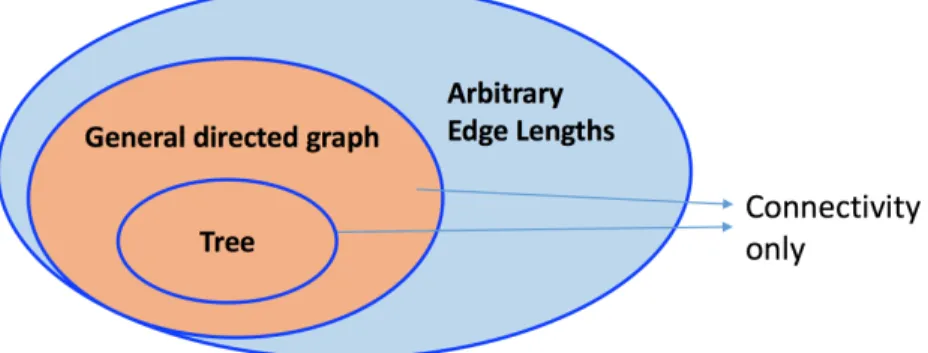
Second, I develop methodologies and scalable algorithms to solve problems within the stochastic network design framework under three different settings, as shown in Fig 1.1, that are gradually more general. In the most restricted setting, the underlying network is assumed to be tree-structured. A real-world problem that satisfies this assumption is the so-calledbarrier removal problemthat has been widely studied by researchers from envi-ronmental science and operations research [65, 63]. In a barrier removal problem, the goal is to maintain the connectivity of a river network by removing river barriers, such as dams and culverts that prevent fish from moving upstream, so that fish once enter the river from the ocean can access their historical river habitats and produce next generation. The mod-eling works well because a river network can be treated as a tree [65]. In the slightly more general setting, it is assumed that the underlying network is a general directed graph. This setting can be used to model aconservation planning problem[87], of which the goal is to conserve the population of an endangered species called red-cocked woodpecker (RCW). Human constructions and activities destroyed the natural habitats of RCWs and resulted in a decline of their population. In this problem, we want to decide which disrupted habitats,
which are either currently occupied or will potentially be occupied, to set as conservation areas to encourage the dispersal of RCWs. The influence maximization problem [42] can be modeled by this setting as well. In the first two settings, the focus is only on the con-nectivity of a network but not the distance between nodes. For the information spreading problem, under these two settings, we only maximize the number of people that the infor-mation can eventually reach but not worry how long it takes for those people to receive the information. The last setting, which is more general, is to maximize the connectivity and also minimize the distance. To adapt the stochastic network design framework to this new setting, each edge has a length that is randomly distributed in a range [0,∞]. That is, we do not only want the information to reach a large number of people in the network but also want it to reach those people within a reasonable amount of time (e.g., within a week). A decision-making problem under this last setting is related to a well-known prob-lem called continuous-time influence maximization problemin the area of computational social network [77]. In this thesis, a real-world problem called pre-disaster preparation is formulated using the stochastic network design framework under this setting. The goal of the problem is to selectively reinforce several road segments before a natural disaster, such as a flood, happens, such that when a disaster indeed happens, the response time of Emergency Medical Services (EMS), the time that an ambulance takes to travel from an ambulance center reach a patient who made the call, is minimized.
A problem,in general, for any one of these three settings is NP-hard, so the focus of the thesis is to develop approximate algorithms. When the underlying network is a tree, ap-proximation algorithms called fully polynomial-time apap-proximation schema (FPTAS) are developed to produce near optimal solutions within a reasonable amount of time. When applying to the barrier removal problem [65], the algorithm runs around 60 times faster than a state-of-the-art algorithm and produces a solution with the value within99% opti-mal value. When the underlying network is a general directed graph, an FPTAS becomes unavailable, but I develop a fast approximate algorithm by combining a sample average
ap-proximation method and a primal-dual algorithm. As demonstrated later, the algorithm is faster than a greedy baseline and produces high-quality solutions for the conservation plan-ning problem [87]. For the most general setting where the lengths of edges are considered, all previous algorithms are not applicable, but a new approximate algorithm is proposed to deal with problems of large sizes, which a greedy algorithm takes more than100hours to solve. As shown by experiments, this new algorithm can produce near optimal solutions and much faster than several existing algorithms.
Several other algorithms and optimization techniques are relevant but cannot solve stochastic network design problems with satisfiable performance and scalabilities. Approx-imation algorithm design techniques have been widely studied to solve typical network design problems such as the Steiner tree problem [37, 75], the maximum spanning tree problem [51, 74] and the facility location problem [39]. But, since these network design problems fail to model the stochasticity that exists in the problem, these algorithms can’t be applied directly. Local search algorithms can give empirically good solutions for many NP-hard problems [26, 36, 56, 61, 71]. A local search algorithm is usually fast and can stop at any time to produce a feasible solution but does not give any theoretical guarantee on the quality of the computed solution. Also, a local search algorithm is domain-dependent, that is, an algorithm that can produce a high-quality solution for one problem is hardly to be transported to solve another problem even although these two problems share several common properties, because the performance of a local search algorithm largely relies on the way that the neighborhood of a solution is defined and how a starting point of search is selected, both of which are designed based on heuristic and are hardly to generalize to a different problem. More discussion of the performance of local search algorithms is be-yond the scope of this thesis. In comparison, the algorithms provided in the thesis are very general to solve any problems within the framework, and for a tree-structured network, the theoretical result is given to bound the quality of a computed solution. Moreover, as shown in the experiments, these algorithms can be hundreds times faster than a greedy algorithm
that is one type of fast local search algorithms, that is, they are superior to local search algorithms also in terms of time efficiency. Heuristic search algorithms [48, 49, 79] are widely used to find the optimal solution or a near optimal solution [32] for a NP-hard prob-lem. With a good heuristic, a heuristic search algorithm can run very fast because a large portion of search space is pruned and is never explored by the algorithm. The problem is that it is hard to design a good heuristic function in many domains, and in some cases, computing a good heuristic value takes almost the same amount of time as solving the orig-inal optimization problem. And, a carefully designed heuristic function for one problem is hardly useful to solve a different problem. In this thesis, the interest is to develop several general algorithms that can solve a range of decision-making problems. These problems can be modeled by a unified framework, but are quite different. It is unclear how to design a general heuristic function that can work for all these problems. Also, since the number of candidate actions is usually proportional to the number of edges in a network, which can be thousands or millions, the search tree of a heuristic search algorithm can be very deep such that even with a fairly good heuristic, the algorithm may take a long time to finish. As demonstrated later, the heuristic search algorithm can find optimal solutions for a pre-disaster preparation problem [83] but can only scale up to a network with 1000 edges while my algorithms can deal with a network with50,000 edges for that problem. Other problems that are tested can be millions of candidate actions, of which a heuristic search algorithm is obviously not viable. Greedy algorithms are fast, of which the run-time are usually quadratic the number of candidate actions, but don’t have any guarantee on the solution quality for most of NP-hard problems. A constrained discrete optimization problem that a greedy algorithm has theoretical guarantee on needs to satisfy certain prop-erties [21, 24, 28, 50] such as the objective function being submodular and nondecreasing and having a knapsack constraint [91]. For problems that don’t have these properties, the greedy algorithm can perform arbitrarily bad. As shown later, a stochastic network design problem under any one of three settings doesn’t satisfy these properties. For example, the
objective function is neither submodular or supermodular. In this sense, greedy algorithms are ideal algorithm of solving stochastic network design problems. In experiments shown in other chapters, a greedy algorithm is used as a baseline algorithm to compare with other algorithms. Also, for some real-world problems such as a pre-disaster preparation prob-lem, a greedy algorithm is unable to compute a solution within 100 hours. For the same problem, my algorithm only takes 6 hours. In total, approximation algorithm design, lo-cal search, heuristic search, and greedy search are useful techniques to deal with NP-hard problems, but my fast approximate algorithms are better options in aspects of generality and scalabilities.
In summary, the thesis studies one type of decision-making problems that we want to find a good set of management actions to steer a phenomenon that occurs in network towards certain desired goal. A general framework called stochastic network design is defined to model a range of such problems, and several scalable algorithms are developed to produce high-quality solutions. These algorithms are superior to several existing techniques that are widely used to deal with NP-hard problems regarding generality and scalability. In next section, several relevant problems studied in other fields are connected to the problem studied in this thesis. The similarities and differences between them are discussed.
1.1
Related Works
Several research areas are related to our work.
1.1.1 Network Reliability
In telecommunication networks, network reliabilitydescribes the ability of a network to continue network services in the case of component failures [3]. In the basic model, each edge or node has an independent failure probability, and different metrics are used to measure the reliability, such as all-terminal reliability (the probability that the graph remains connected) and s-t reliability (the probability that there is a path from s to t).
However, most widely used metrics are intractable (#P-hard) to compute exactly [3, 11], and polynomial-time algorithms exist only for very restricted cases (e.g. series-parallel graphs) [12, 80]. The reliability network design problem is to find a network topology maximizing the reliability for a given cost constraint or minimizing the design cost for a given reliability constraint [47]. As the reliability is hard to calculate, most of the existing methods are only scalable on small networks. For example, a branch-bound algorithm, a genetic algorithm, and a neural network approach have been used but can only scale up to hundreds of edges [15, 78, 89].
The stochastic network design framework can be specialized to model several common metrics of reliability, such as s-t reliability and all-terminal reliability, so the stochastic network design algorithms can be applied to reliability network design problems. They have a better scalability, for example up to hundreds of thousands of nodes, and can produce high-quality solutions with theoretical and empirical evidence.
1.1.2 Influence Maximization Problem
Influence maximizationproblem recently becomes a hot topic in the area of computa-tional social network. The spread of information among people is modeled as a cascad-ing process through a social network, and several well-known cascade models, such as the Independent Cascade (IC) model [42], the Linear Threshold (LT) model [42], and the Continuous-Time Independent Cascade (CTIC) model [19, 77], are used to describe such a process. Each of these models defines a local rule and specifies how information spreads through a network following this local rule. For example, a set of nodes calledsourcesare infectedoractiveat the beginning of the process. Recursively, an infected node can infect its neighboring nodes, and the local rule, such as a probability distribution, describes how each neighboring node gets infected. After a certain number of such cascadingcycles, a large number of nodes become infected. For an influence maximization problem, the goal is to maximize the (expected) number of nodes that become infected eventually by taking
management actions. One type of influence maximization problems is thesource selection problem, motivated by an active research area calledviral marketing[57], where a decision maker wants to pickK nodes, also called sources, to make them infected at the beginning of the process to maximize the number of nodes infected at the end of the process [18]. This problem has a submodular objective function [42] and, a natural greedy algorithm can produce a solution with the value within63%of the optimal value. A lot of following work has been done to improve the greedy algorithm to scale up to networks of millions of nodes [8, 9, 10], but it hard to extend these algorithms to problems of other types of man-agement actions than selecting sources. Khalil et al. [44] study a problem of modifying the topology of a network, such as adding edges, deleting edges, adding nodes and deleting nodes, to maximize/minimize the influence under the LT model. The objective function has shown to be either sub-modular or super-modular, and the technique of submodular func-tion optimizafunc-tion is used to develop algorithms producing high-quality solufunc-tions. Sheldon et al. [87] study a problem of maximizing the spread of species in a habitat network by adding nodes. The optimization problem doesn’t have a sub-modular or super-modular objective function. Asample average approximation technique [45] is used to formulate the problem into a mixed integer program (MIP) and a standard solver is used to solve the MIP. As shown by experimental results, the algorithm produces high-quality solutions, but only works when the underlying network is a acyclic directed graph(DAG). In addition, the algorithm can only scale up to networks of several hundreds of nodes. Instead of maxi-mizing (minimaxi-mizing) the spread of influence directly, some other methods optimize a static property of the network, in the hope of optimizing diffusion. For instance, Schneider et al. [84] suggest betweenness centrality as a heuristic for immunizing nodes or removing edges under the SIR model, whiledegree centralityis adopted by Gaoet al.[25] to protect against virus propagation in email networks.
All these influence maximization problems with actions including selecting sources, adding (removing) nodes and edges, under the IC, LT and CTIC models are special cases of
the stochastic network design framework. Besides modifying the topology of the network, the framework also models richer management actions, such as increasing (decreasing) the probability that a node infects its neighbors, which has correspondence in reality. For ex-ample, to maximize the number of purchases by a viral marketing strategy, a company will offer a person rewards if her friends purchase the product due to her recommendation [57]. The rewards, as one type of management actions, can increase the chance that a person sends the recommendation of one product to her friends, which raises the chance that a friend will also purchase the product. To efficiently allocate rewards, we want to determine who are the good candidates to provide the rewards and who should get more rewards than others. Also, my algorithm can solve the problem introduced by Sheldon et al.[87], deal with a general directed graph, and runs much faster than their algorithm.
1.1.3 Conservation Planning
Conservation planning that has recently been taken up in the emerging field of com-putational sustainability [29]. One branch of conservation planning problems is known as reserve design or corridor design in which a decision maker selects management actions, such as purchasing or improving habitats and constructing a wildlife corridor connecting two fragmented habitats, to optimize certain metric or the connectivity of landscape to facil-itate species dispersal [7, 66, 67, 95]. A number of recent works connect the reserve design problems to typical network design [13, 14, 16, 17, 54, 55]. In most of these works, the goal is to construct, by purchasing nodes or edges, a subgraph minimizing the design cost for a given connectivity constraint, such as connecting all terminals, or maximizing certain connectivity metric for a given cost constraint, such as the total design cost less than a bud-get limit. However, as mentioned earlier, these network design problems don’t explicitly model the stochasticity of the activity of species within a landscape. A separate group of works incorporate the stochasticity into an evaluation function that measures how good a conservation strategy is [69, 81, 85]. For example, a well-known method, adopted by
ecol-ogists, to evaluate a conservation policy is calledprobability of connectivity(PC) [81], that is, the probability that one node is connected to other nodes. For a given policy, calculation of its PC score is very time-consuming, so finding the policy to maximize PC score is a complex stochastic optimization problem. Heuristic based methods and greedy algorithms are used by ecologists to solve this problem [92, 59, 62], which, as mentioned earlier, do not have any theoretical guarantee on the quality of the computed solution. The conserva-tion planning problem with the PC evaluaconserva-tion funcconserva-tion can be formulated as a stochastic network design problem, and my algorithms are capable of solving the problem.
1.2
Organization of the Thesis
The rest of this thesis is organized as follows. Chapter 2 defines the stochastic net-work design framenet-work and its extensions. Chapter 3 and 4 introduce the algorithms for tree-structured networks. Chapter 5 introduces the algorithms for general directed graphs. Chapter 6 introduces the algorithms for the setting that edges have arbitrary lengths.
CHAPTER 2
STOCHASTIC NETWORK DESIGN
This chapter introduces the stochastic network design framework. First, the basic set-ting of the stochastic network design framework is given. To help understand the motivation of the framework, two real-world problems are introduced, and the way to formulate these two problems as stochastic network design problems is explained. Then, several ways to build more complex settings by relaxing some of the assumptions of the basic setting are discussed. At last, the quota problem and the prize-collecting problem of a stochastic network design problem are briefly mentioned.
2.1
Basic Setting
This chapter introduces the mathematical formulation of the stochastic network design framework. It starts with the basic setting of the framework and discusses several ways to extend the framework. Then, several real-world problems are introduced and formulated as stochastic network design problems.
2.1.1 Stochastic Network
A stochastic network consists of a directed graph G = (V, E), where V is a set of nodes and E is a set of directed edges, and a probability mass function p : E → [0,1] that defines the probability that an edge doesn’t fail. That is, each edge is in one of two exclusive states: present (survival) or absent (failed). The state of an edge is a random event following a Bernoulli distribution. The probability of an edge (u, v) ∈ E being present is defined by p(u, v), and the probability of the edge being absent is 1−p(u, v).
The probability functionp(·)is also called thesurvival probability functionwhile p(u, v) is called the survival probability of the edge (u, v), and 1−p(u, v) is called the failure probability. To make the presentation clear, let’s for now assume that the state of each edge is independently distributed, which is a reasonable assumption for some real-world problems as shown later in section 2.2. This assumption is relaxed while discussing the ways to extend this basic setting in section 2.4. The stochastic network, in fact, defines a probability distribution over a setΦG that contains all directed graphsGs = (V, Es)with
Es ⊆ E, that is, ΦG = {Gs = (V, Es) : Es ⊆ E}. Each directed graph in ΦG is called
asample network. The probability of a sample networkGsis defined to be the probability
that all edges in Es are present and all edges not in Es are absent, which equals to the
product of the survival probabilities of all edges in Es and the failure probabilities of all
edges not inEs. That is
P r(Gs) = Y
(u,v)∈Es
p(u, v) Y
(u,v)∈E/ s
(1−p(u, v)) (2.1)
It is easy to show that probabilities of all sample networks inΦG sum to one. To sample
from the distribution defined by a stochastic network, a sample network is constructed by flipping a biased coin with probabilityp(u, v)to determine the state of each edge(u, v).
The stochastic network can model many social and natural phenomena. For the influ-ence maximization problem, the probability that a nodeu is connected to another nodev in a stochastic network represents the probability that information propagates fromutov in a social network. More details on how to formulate the influence maximization problem as a stochastic network design problem is gave later in section 2.2.
2.1.2 Management Actions
Management actions can be taken to change the survival probabilities of edges. For each edge(u, v)in a stochastic network, there is a management actionauv, with costcuv,
before and after actions are taken, two probability mass functions are defined. A probability mass functionpo :E →[0,1]defines theoriginal(by superscripto) survival probabilities
of edges, and a different probability mass functionpm : E → [0,1]defines the modified
(by superscriptm) survival probabilities after actions are taken. That is, ifauvis not taken,
p(u, v) =po(u, v)(po
uvfor short) and ifauvis taken,p(u, v) =pm(u, v)(pmuvfor short). Let
the set of all available actions denoted byA ={auv|(u, v) ∈ E}and define a policyπ to
be a subset ofA. The survival probability function is re-defined to be conditional onπas
p(u, v;π) = pouv ifauv∈/ π pmuv ifauv∈π (2.2)
The definition of management actions is very general. For an influence maximization problem, a management action models the activity that rewards are provided to a person A to increase the chance that a person A sends the information to a person B. For a con-servation planning problem, an action models the activity of building a corridor to connect two fragmented habitat areas A and B. The corridor increases the chance (modeled as the survival probability) that species can spread from A to B. Each action is associated with a cost, which is defined by a cost functionc:E →R. The cost of an edge(u, v)is written as cuvfor short. For now, it is assumed that each edge has only one candidate action, which is
reasonable from some real-world problems as shown later. This simple assumption makes the presentation clear and is relaxed later in section 2.4. If no candidate action is available, we can simply setpo
uv =pmuv andcuv= 0.
2.1.3 Objective Function
Given a stochastic networkG, we need to have an evaluation function to quantify how good a policyπis applied toG.
have the pair (s, t)connected than the pair (u, v). The function is also called the reward function, that is, r(v, u) represents the reward that we can obtain if v is connected to u. With a reward defined for each node, thereward of a sample networkis calculated as
r(Gs) = X
(s,t)∈V×V
rst·I(there is a path fromstotinGs) (2.3)
whereIis an indicator function which returns1if the specified event is true and returns0 otherwise. This is to say that for a sample network, a rewardrst is collected for each node
pair(s, t)if there is a path froms tot, and the reward of the sample network is the total rewards collected.
Then, a resilience function is defined to quantify the outcome of a policy π by the expected reward that can be obtained whenπis applied. Mathematically,
R(π;G) = X
Gs∈Φ G
P r(Gs;π)r(Gs) (2.4)
With a policy, the management action of each edge is determined. Then, the survival probability of each edge is fixed, so the probability of a sample network is calculated using the (2.1). Since the probability of a sample network also depends on the policy π taken, it is written as a function of both Gs and π as shown in (2.4). The name resilience in some way represents the robustness of the network’s connectivity to random failures, which is represented by the expected total rewards in the stochastic network design framework. Other ways to represent the resilience are discussed later. The resilience function is the objective function that we want to maximize.
2.1.4 Decision Making Problem
Now, we can define the decision-making problem, a discrete optimization problem, for the stochastic network design framework. For a given policyπ⊆A, the cost of a policy is defined to be the total cost of actions taken, that is,cost(π) =P
The inputs of the decision-making problem consist of a stochastic networkG= (V, E), an original survival probability function po (representing the probabilities before actions
are taken), a modified survival probability functionpm(representing the probabilities after
actions are taken), a reward functionrthat defines a resilience function, and a budget limit B. The goal is to find a policyπ maximizing the resilience function defined by (2.4) for a given cost constraintcost(π)≤ B. Mathematically, the decision-making problem is written as
max
π⊆AR(π) subject to cost(π)≤ B (2.5)
where the dependency of the resilience function onGis omitted without confusion.
2.2
Two Examples of Stochastic Network Design Problems
This section introduces two real-world problems and explains how they can be formu-lated as stochastic network design problems. Some of these problems have been mentioned and used as examples earlier.
2.2.1 Influence Maximization by Source Selection
The influence maximization problem is introduced in Section 1.1. Here, we formally define the source selection problem and explain how it can be formulated as a stochastic network design problem. In the source selection problem, the diffusion process is described by the Independent Cascade (IC) model [43] on a directed graph G0 = (V0, E0). Each node is either infected (also called active) or uninfected (also called inactive). Each edge (u, v)∈ E0 is associated with aninfection probabilityp0uvto represent the probability that node v will get infected if node u becomes infected. A set of nodes called sources are infected by some external sources at the beginning of the process. The process unfolds over a finite number of time steps. At each step, once a nodeu becomes infected, it will
Figure 2.1: The instance of the stochastic network design problem equivalent to an instance of the source selection problem.
a certain number of time steps, a large number of nodes become infected in the network. The process terminates or becomes stable when no nodes will get infected in the future, that is, when all nodes have made their attempts. Since the diffusion of infection starts from sources, well-selected sources can make a large number of nodes infected at the end of the process while poorly selected sources, such as sources not connecting to any other nodes, can hardly spread out the infection. To facilitate the spread of infection, a decision maker wants to find the best set of sources. Since the decision maker also has a budget constraint, (e.g., at mostK sources), in thesource selection problem, the goal is to select K sources to maximize the expected number of nodes that will be infected at the end of the cascading process. The source selection problem can be written as follows.
max
selectKsources fromV0E "
X
v∈V0
I(v will be infected) #
whereI(·)is an indicator function.
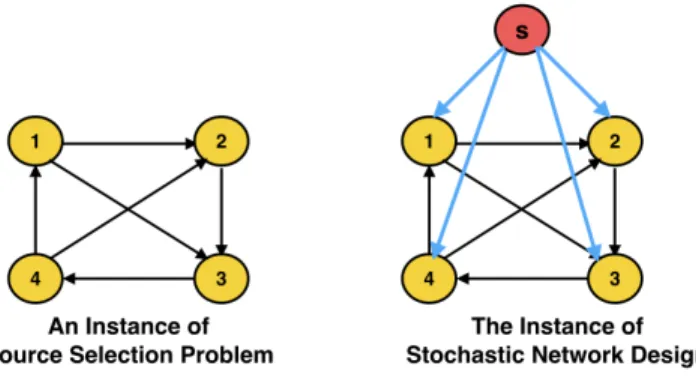
Now, I show how to formulate the source selection problem as a stochastic network design problem. First, given an instance of the source selection problem with a social network represented by a directed graphG0 and infection probabilities of all edges, a new graphG= (V, E)is created where the new node setV ={s} ∪V0 contains an extra node sand the edge setE ={(s, v)|v ∈V} ∪E0contains a directed edge fromsto eachvinV.
An example is shown in Fig. 2.1. For each edge(u, v)inE0, set the original and modified probability of the correspondent edge to bepo
uv = pmuv =p 0
uvand set the cost of the action
to becuv = 0meaning that no actions can be taken to change the infection probabilities of
edges in the social network. For each edge(s, v)withv ∈ V − {s}, setpo
uv = 0, pmuv = 1
andcuv = 1. That is, the action on(s, v)with one unit of cost can make node v infected
with probability1or equivalently makev a source. Then, we setB = K meaning that at mostK actions can be taken or equivalently at mostK sources can be selected. Therefore, a policy of the stochastic network design problem maps to a set of sources being selected. To define the resilience function, we set the value of a policy to be the expected number of nodes being infected eventually. The way is to setr(s, v) = 1for allv ∈ V − {s}and the reward for other node pairs to be 0, that is, one unit of reward is collected for a node v ∈ V − {s}if and only if the nodev is connected tos. Now, it is easy to show that the stochastic network design problem encodes the source selection problem.
It is also easy to show that the problem of maximizing the influence by modifying the topology of the network [44] can also be formulated as a stochastic network design problem.
2.2.2 Barrier Removal Problem
Fish barrier removal problem is an important ecological sustainability problem pro-posed by [65] to combat dramatic population declines of wild fish over the past two cen-turies due to the presence of river barriers. Dams and other barriers such as culverts, flood-gates, and weirs harm populations by preventing fish from accessing or moving between parts of their historical habitat. The way to address this problem is to retrofit existing bar-riers or to replace them by new instream structures that make it easier for fish to pass. The existing work formulated the optimization problem of selecting a subset of barriers to repair or remove so as to maximize the availableupstreamhabitat for anadromous fish—species such as salmon that live part of the year in oceans but travel up rivers and streams to spawn.
Figure 2.2: River networks in Massachusetts
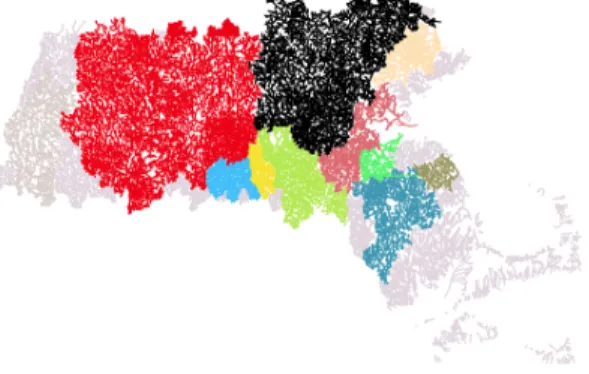
Fig. 2.2 shows river systems of Massachusetts in which different color represents different river networks. Every year, fish start from a root(e.g., the ocean or some fixed location) and swim upstream to access their historical habitats. At a barrier, a randomly selected fish can pass the barrier with a certain probability, which is called thepassage probability of the barrier. A river network is treated as a tree as justified by [65], that is, two different locations in the river is connected by a unique path. So, the probability that a fish can reach a designated location in a river from the root is the probability that the fish can pass all barriers on the unique path from the root to that location. To make the model simple, we assume that the passage of one barrier is independently distributed from the passage of any other barrier. The probability equals to the product of the passage probabilities of all barriers on the path. A barrier can be removed or repaired with a certain cost to increase its passage probability. For example, the passage probability of an old culvert is0.5, meaning that with50%chance a randomly picked fish, which, for example, is mature and has strong fins, can swim upstream to pass the culvert. If a new type of tunnel is built to replace the old culvert, some premature fish can pass the tunnel and reach upstream areas so that the passage probability may become80%. Fish, after reaching a stream segment, can consume the food and use the natural resource available in that region. One stream segment can only support a certain number of fish to live there, so we say that each stream segment has a certain amount of habitat that the fish can use. The barrier removal problem is to find the
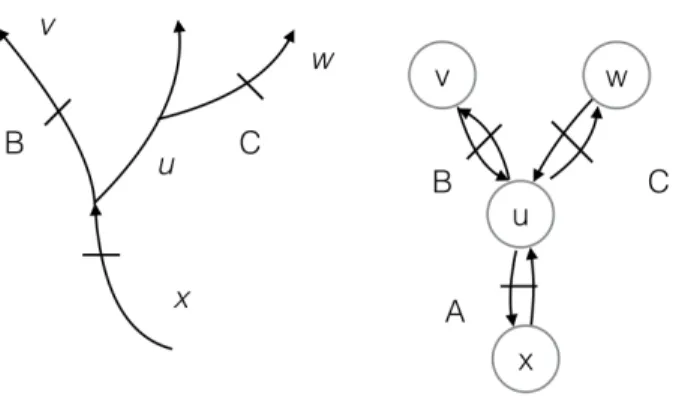
Figure 2.3: Left: a river network with barriers A, B, C and contiguous regions u, v, w, x. Right: corresponding bidirected stochastic tree.
best set of barriers to repair or remove to maximize the expected amount of habitat that fish can access.
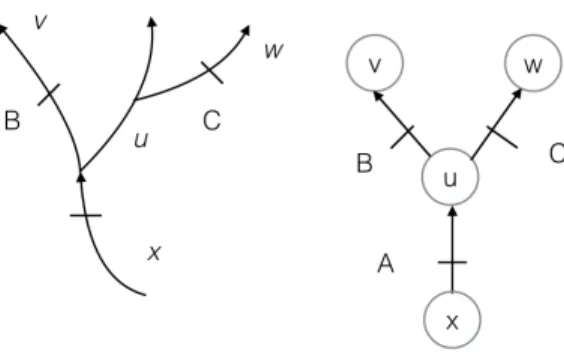
The barrier removal problem can be formulated as a stochastic network design problem. As shown in Fig. 2.3, a river network (left) can be modeled as a directed rooted tree (right) denoted by T = (V, E)with a unique root. Each nodev ∈ V represents a contiguous region of the river network—i.e., a connected set of stream segments among which fish can move freely without passing any barriers—and the rewardr(root, v)equals to the total amount of habitat in that region (e.g., the total length of all segments if the amount of habitat in a segment is proportional to its length). Thus, the total habitat that fish can use equals to the total reward collected at nodes that are connected toroot. Each barrier is represented by a directed edge that connects two regions for whichpouvis set to be the passage probability before the repair andpm
uvis set to be the passage probability after the repair. cuvis the cost
of repairing the barrier on the edge(u, v). Multiple alternative actions can be defined for each edge as discussed in section 2.4. In this way, the barrier removal problem is written as a stochastic network design problem.
Figure 2.4: The instance of the stochastic network design framework representing the Knapsack problem
2.3
The Hardness of Stochastic Network Design
In general, a stochastic network design problem is NP-hard. This can be proved by showing that an instance of the Knapsack problem, which is a well-known NP-hard prob-lem, can be written as a stochastic network design problem.
Theorem 2.3.1. The stochastic network design problem, in general, is NP-hard.
Proof. In the Knapsack problem, we are givenn items, each of which has a weight and a value. Given a bag of capacityB, the goal is to determine which items to pack to maximize the total value being packed while the total weight of packed items is no greater than the capacity of the bag. Mathematically, the Knapsack problem can be written as the following maximization problem. maxX i vi·I(iis packed) s.t. X i wi·I(iis packed)≤ B
whereviandwiare the value and the weight of theithitem andI(·)is an indicator function
that reflects how items are packed.
A Knapsack problem can be written as a stochastic network design problem shown in Fig. 2.4. In the network, V consists of n nodes {1,2, ..., n}, each of which represents an item to be packed, and an extra node s. We set po
si = 0 and pmsi = 1 for each node
i ∈ {1,2, ..., n} and set the cost of the action on (s, i) as wi. Also, we set the reward
r(s, i) to be vi for each node i ∈ {1,2, ..., n} and the reward of other node pairs to be
Therefore, a set of actions taken maps to a set of items packed. The total value of packed items equals to the expected total reward. The total weight is equivalent to the cost of the policy. Therefore, two problems are equivalent. Since we know the Knapsack problem is NP-hard, the theorem holds.
2.4
Extensions
In this section, several ways to extend the stochastic network design framework are discussed. For the ease of presentation, most of the algorithms in the thesis are presented in the basic setting of the stochastic network design framework discussed in section 2.1. These algorithms are also compatible with one or multiple these extensions. It is a future work to develop scalable algorithms to solve those stochastic network design problems with extensions of which no algorithms are given in the thesis.
2.4.1 Correlated Survival Probability
In the basic setting, the state of an edge is randomly distributed and is independent of the states of other edges, but, in a real-world problem, the states of multiple edges can be correlated. For example, in a pre-disaster preparation problem, an edge represents a road segment, and the survival probability represents the chance that the road segment will be damaged by a natural disaster such as a flood. It is very likelihood that when one road is damaged, all nearby roads are under the effect of the disaster too, implying that all these edges may fail simultaneously. To model this situation, the survival probabilities are de-fined jointly by all these edges instead of for each single edge. To draw a sample network from a correlated probability distribution, the states of multiple edges are sampled simul-taneously from a joint probability distribution instead of independently from a Bernoulli distribution. For stochastic network design problems with correlated survival probabilities, the sampling based algorithms discussed in Chapter 5 and 6 are still applicable.
2.4.2 Effect of an Action on Multiple Edges
In the basic setting, each edge is associated with a candidate action, so the total number of actions equals to the number of edges. In reality, one action may change the survival probabilities of multiple edges. For the influence maximization problem, rewards are pro-vided to a person (e.g., a node) to increase the chance that the person will share the in-formation with her/his friends. The reward can target on nodes or edges. If rewards are given to a node, the survival probabilities of all outgoing edges can increase. For exam-ple, if rewards are given to encourage a person to share the information of a product to as many friends as possible, the chance of any friend of this person to adopt the product will increase. For a variant of the barrier removal problem, introduced in section 2.2.2, called bidirected barrier removal problem[99], fish don’t start from a unique entrance, such as the ocean, but from multiple locations in the river network. These fish may pass a barrier from either upstream direction or downstream direction, each of which is modeled by a directed edge and has a different passage probabilities because of the difficulties of pass-ing a barrier from two directions are different. Since the two directions are considered, an action will modify the survival probabilities of both edges(u, v)and(v, u)simultaneously. An algorithm to solve thebidirected barrier removal problem is given in Chapter 4. The algorithms in Chapter 5 and 6 that are based sampling methods are compatible with this extension too.
2.4.3 Multiple Candidate Actions
In the basic setting, it is assumed that one edge has only one candidate action, if taken, changing the survival probability from po to pm. Sometime, it is required to have more
than one candidate actions, each of which has a different cost and a different effect. For the barrier removal problem, there may be multiple ways, or multiple actions, to repair a barrier, each of which can raise the passage probability into a different level. To repair a dam, we may have two candidate actions. One is to remove the dam completely, which
is expensive but very effective such as raising the passage probability from 0.2 to 1.0. The other is to build a small fish passage tunnel, which is less expensive but may only be helpful to mature fish such as raising the passage probability from 0.2 to 0.5. More reparing strategies can be defined and set as candidate actions. The algorithms introduced in Chapter 3 and 4 are compatible with this extensions.
2.5
Quota, Budget, and Prize-collecting Problems
The goal of the stochastic network design framework defined by (2.5) is to find the policy to maximize the resilience function and also to satisfy a budget constraint. This type of problem is thebudgetproblem. In contrast, two variant optimization problems of a budget problem are the quota problem and the prize-collecting problem, both of which have been widely studied in the community of approximation algorithm design [41]. Especially, many typical network design problems are quota problems. In a quota problem, the goal is to minimize the design cost to make a policy satisfy some constraint, which, in some sense, switches the budget constraint and the objective of a budget problem. An example problem is the Steiner tree problem [37], in which a policy needs to connect all terminal nodes and the goal is to minimize the design cost. A quota variant of a stochastic network design problem is to find a policy to minimize the cost and make the value of the policy equal or greater than a given value. Mathematically, it is written as
min
π⊂A
cost(π) s.t. R(π)≥value (2.6)
All requirements that we want the policy to satisfy is summarized by a single inequality in the constraint in the quota problem. The left side of the inequality involves an expectation that makes the optimization problem very difficulty to solve. It is an open question on how to design the scalable algorithms to solve the quota variant of a stochastic network design problem.
A prize-collecting variant of a stochastic network design problem is to find a policy to maximize the difference between the value and the cost of the policy. Mathematically, it is written as
max
π⊂A
R(π)−β·cost(π) (2.7)
The subtraction of the cost from the value is one kind of the penalty that we get while maximizing the value of the policy. In a stochastic network design problem, with more management actions, the value of the policy will increases or remain the same, but cost of the policy will also increase. The parameterβ, which is a part of the problem definition, controls our tradeoff between the value and the cost. The larger the value of β, the more penalty we will get by taking more actions. A well-defined β helps people identify a cost-efficient policy so that more actions added to the policy can only increase the value very little and not worthy investing to. The prize-collecting Steiner tree problem and the algorithms to solve it are given in the book [96].
A prize-collecting problem appears to be easier to solve than its budget variant for many network design problems [39, 96]. For example, the facility location problem is one type of prize-collecting problem [39]. Its budget variant is the so-called k-median problem that is more difficulty to solve than the facility location problem.
2.5.1 Relationship between Budget and Prize-collecting Problems
A budget problem can be rewritten as a prize-collecting problem by taking its La-grangian relaxation, that is, moving the budget constraint into the objective along with a parameterβcalled the Lagrangian multiplier. A budget problem is written as
max
π⊂A minβ R(π)−β·(cost(π)− B) (2.8)
If a policy violates the budget contraint orcost(π)− B >0, the inner minimization makes the objective negative infinity. For a policy that satisfie the contraint, the objective remain
bounded as long as value of any policy in the space is bounded. Therefore, problem (2.8) is equivalent to the stochastic network design problem defined by (2.5).
Bis irrelavant to the policy and can be removed from (2.8). If we fix the value ofβand eliminate the inner minimization problem, the problem becomes a prize-collecting prob-lem if we fixedβ. Algorithms have been developed to solve a budget problem by searching a good value of β and solving prize-collecting problems that are created by above proce-dure [39]. In Chapter 5 and 6, the same technique is used to solve stochastic network design problems in which a sequence of prize-collecting stochastic network design problems are solved.
2.6
Summary
This chapter gives the mathematical definition of the stochastic network design frame-work, which is defined under a general context and can model a range of decision-making problems. For illustrative purposes, it is explained how to formulate two real-world prob-lems using the framework. A stochastic network design problem is one type of budget problem in which the goal is to find a policy to maximize the value of the policy that sat-isfies a budget constraint. The correspondent quota problem and prize-collecting problem are briefly discussed.